The overall number of global coronavirus cases has topped 52.6 million, while the deaths have surged to 1,291,920, according to the Johns Hopkins University.As of Friday (Nov 13) morning, the total caseload and death toll stood at 52,643,939 and 1,291,921, respectively, the University’s Center for Systems Science and Engineering (CSSE) revealed in its latest update. The US is the worst-hit country with the world’s highest number of cases and deaths at 10,535,828 and 242,654, respectively, according to the CSSE.
India comes in second place in terms of cases at 8,683,916, while the country’s death toll soared to 128,121.
The other countries with more than a million confirmed cases are Brazil (5,747,660), France (1,914,918), Russia (1,822,345), Spain (1,417,709), Argentina (1,273,356), the UK (1,260,198), Colombia (1,165,326) and Italy (1,028,424), the CSSE figures showed. Brazil currently accounts for the second highest number of fatalities at 163,368. The countries with a death toll above 20,000 are Mexico (96,430), the UK (50,457), Italy (42,953), France (42,599), Spain (40,105), Iran (39,664), Peru (34,992), Argentina (34,531), Colombia (33,312) and Russia (31,326).
US reports record daily increase of
over 140,000 Covid-19 cases
The US reported 143,408 new Covid-19 cases on Wednesday, Nov 11, a record daily increase since the onset of the pandemic in the country, the US Centers for Disease Control and Prevention (CDC) said Thursday.
The new number refreshed the previous nationwide record of 134,383 cases set in previous day, pushing the seven-day average daily increase to a record high of 121,496 cases, according to latest CDC data.
Tag: Iran
-

Global Covid-19 cases top 52.6mn: Johns Hopkins
-
Iran arrests separatist leader accused of attack killing 25
Tehran (TIP): Iran’s intelligence ministry arrested a leader of a separatist group allegedly involved in the killing of dozens of people during a military parade in 2018, state-run IRNA news agency reported on Thursday. The report said the ministry announced that Farajollah Cha’ab was arrested and called him “the main person in the terrorist attack” in September 2018 in the southwestern city of Ahvaz. The report did not elaborate on when or where he was arrested. The statement said Cha’ab had been planning more attacks in Tehran and Khuzestan province. In September 2018, militants disguised as soldiers opened fire on an annual military parade in Ahvaz city, the capital of Khuzestan province. AP
-

President-elect Biden likely to provide US citizenship to over 5,00,000 Indians
WASHINGTON (TIP): US President-elect Joe Biden will work towards providing a roadmap to American citizenship for nearly 11 million undocumented immigrants, including over 5,00,000 from India, and will also establish a minimum admission number of 95,000 refugees annually.
As a largely immigrant community, but in some cases with American roots reaching back generations, Indian-Americans know firsthand the strength and resilience that immigrants bring to the United States of America, according to a policy document issued by the Biden campaign.
“He (Biden) will immediately begin working with Congress to pass legislative immigration reform that modernizes our system, with a priority on keeping families together by providing a roadmap to citizenship for nearly 11 million undocumented immigrants—including more than 500,000 from India,” it said.
The Biden Administration will support family-based immigration and preserve family unification as a core principle of the US’ immigration system, which includes reducing the family visa backlog, it said.
“And, he will increase the number of refugees we welcome into this country by setting the annual global refugee admissions target to 1,25,000 and seek to raise it over time commensurate with our responsibility, our values, and the unprecedented global need. He will also work with Congress to establish a minimum admissions number of 95,000 refugees annually,” the policy document said.Biden will remove the uncertainty for Dreamers by reinstating the DACA (Deferred Action for Childhood Arrivals) programme and explore all legal options to protect their families from inhumane separation. And, he will end workplace raids and protect other sensitive locations from immigration enforcement actions, it said.
Launched by the Obama administration, the DACA is an immigration policy that allows some individuals with unlawful presence in the US after being brought to the country as children to receive a renewable two-year period of deferred action from deportation and become eligible for a work permit in the US. DACA recipients are often referred to as Dreamers. To be eligible for the programme, recipients cannot have felonies or serious misdemeanors on their records.
The Trump Administration moved to end the DACA programme in 2017 and was ultimately blocked by the Supreme Court from doing so this year. Even so, his administration scaled back the programme and pledged to end it, leaving thousands of the program’s beneficiaries in limbo.Biden will also restore and defend the naturalization process for green card holders, the policy document said.Employment-based visas, also known as green cards, allow migrants to gain lawful permanent residence in the US in order to engage in skilled work.“He (Biden) will increase the number of visas offered for permanent, work-based immigration based on macroeconomic conditions and exempt from any cap recent graduates of PhD programs in STEM (science, technology, engineering and math) fields,” it said. “He will support first reforming the temporary visa system for high-skill, specialty jobs to protect wages and workers, then expanding the number of visas offered and eliminating the limits on employment-based green cards by country, which have kept so many Indian families in waiting for too long,” the document stated. The Biden administration, it said, will also repeal President Donald Trump’s “Muslim ban”.
President Trump had imposed a controversial travel ban, often referred to by critics as a “Muslim ban”, on several Muslim majority countries, including Iran and Syria, through a series of executive orders.
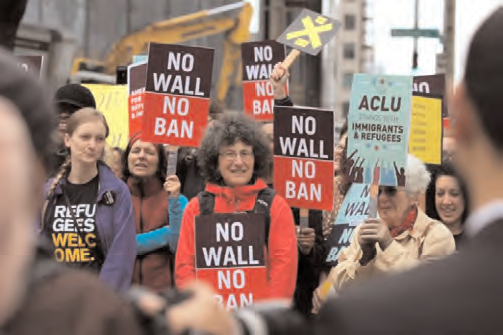
“Biden will rescind Trump’s “Muslim ban” on day one and reverse the detrimental asylum policies that are causing chaos and a humanitarian crisis at our border,” the policy document said.
(Source: PTI)
-

Biden likely to give India more strategic space
Biden has said that he would constitute a united front of the US, its allies and partners to ‘confront China’s abusive behavior and human rights violations’ and ‘place US back at the head of the table’ to mobilize collective action on global threats. Germany, France and the European Union have welcomed Biden’s election promise to work on issues like China’s unfair trade practices and other challenges.

By Yogesh Gupta Joseph Biden Jr. will soon take over as the 46th President of the United States. There is some consternation as many critics are not sure how the Joe Biden-Kamala Harris duo will react to the human rights situation, particularly in Kashmir. Also, that he will be ‘soft’ on China which may recoil on India in its current military confrontation with that country. Biden is a seasoned and skillful politician, who for decades has served on the Senate Foreign Relations Committee, including as its chair. Second, he is calm, contemplative and a team leader who will listen to and go by the professional advice of the US establishment — including the State, Defense, National and Homeland Security, CIA, Trade and other departments. His long innings as the Vice President in two terms of President Obama unambiguously authenticate this view.
In an article, Why America must lead again, in the Foreign Affairs journal in March this year, Biden wrote that President Trump had diminished the credibility and influence of the US by abdicating the American leadership, indulging in ill-advised trade wars which had hurt its own consumers and undermining and abandoning its allies which are America’s biggest strength.
The post-COVID-19 world will be very different from 2016 when the Obama-Biden duo left. China’s economy has made huge strides during this period. However, much of China’s economic growth is based on extensive use of unfair trade practices, including denial of market access, stealing of foreign technologies, subsidies to its state-owned industries and others.
China’s swift growth has been accompanied by massive modernization of its military, including manufacture of fifth generation of fighter and stealth aircraft, long- and medium-range missiles, hypersonic and artificial intelligence (AI)-based weapons, destroyers and aircraft carriers.
Similarly, China has made considerable progress in other emerging technologies like 5G, quantum computing, new materials, robotics and space weapons. The rapidly growing China is now challenging the economic and military pre-eminence of the US in Asia. It has launched aggression against a number of countries allied or getting closer to the US such as India, Taiwan, Vietnam, Australia and others and is trying to divide the transatlantic alliance.
Biden has said that he would constitute a “united front of the US, its allies and partners to confront China’s abusive behavior and human rights violations” and “place US back at the head of the table” to mobilize collective action on global threats. “When we join together with fellow democracies, our strength more than doubles. China can’t afford to ignore more than half the global economy,” he argued. Germany, France and leaders of the European Union have welcomed Biden’s election promising to work together on China and other challenges.
Though the aggressive rhetoric of Trump administration may change as Biden seeks China’s collaboration on climate change, non-proliferation and control of infectious diseases, the US and its allies will take collective action against China’s unfair trade policies, as per the Biden team. The US sanctions on export of sensitive technologies to China are likely to continue. In his earlier avatars, Biden played an important role in the passage of the Indo-US Civil Nuclear Deal in the Congress (2005) and later when the Obama administration declared India as a ‘major defense partner’ (2016). With the signing of Logistics Exchange Memorandum of Agreement (LEMOA), Communications Compatibility and Security Agreement (COMCASA) and Basic Exchange and Cooperation Agreement for Geo-spatial Cooperation (BECA) recently, India has established close linkages with the US security architecture. Its large growing economy, professional armed forces and stout determination to resist China have augmented its strategic value. In its pursuit of multipolar world, India can play a critical role in checking the growth of China’s hegemony and its domination of Asia.
Biden made it clear in his Foreign Affairs essay that he would “fortify the USA’s collective capabilities with democratic friends by reinvesting in its treaty alliances with Australia, Japan, South Korea and deepening partnerships from India to Indonesia to advance shared values in a region that will determine the USA’s future.”
Biden has promised to invest in improving America’s competitiveness, pull down trade barriers, resist the slide towards protectionism and give more emphasis to fair trade. Given the rising trade deficit and unemployment in the US, it is likely that there will be some tough negotiations with India on issues such as high tariffs, market access, levy of taxes on US technological giants like Amazon and Google, but in an amicable manner without resorting to threats and tariffs.
On issues relating to immigration, H1B visas and the studies of Indian students in US universities, Biden is likely to be more positive though keeping in view unemployment in his own country.Some Biden advisers have stated that he would raise human rights issues with India like Obama. This will be more in the nature of a dialogue among friendly states and would not be the main driver of his overall policy given New Delhi’s sensitivities and the importance attached to strategic issues confronting the two countries.
Biden has stated that his administration would stand with India against the threats it faces from its own region and along its borders. Given the above template, it is likely that India would find greater resonance on Pakistan’s support of terrorism, a continued US role in the fight against terror groups in Afghanistan and on resuming a nuclear deal with Iran.
Similarly, his stand on re-joining the Paris climate change agreement, convening a summit of democracies to discuss issues of common interest, meetings of major carbon emitters to reduce harmful emissions and control of infectious diseases would be of considerable interest to India. Summing up, India is likely to get more strategic space and a greater sympathetic understanding of its concerns from the Biden administration than that of President Trump.
(The author is a former ambassador)
-

Global Covid-19 Cases top 48.5mn: Johns Hopkins
The overall number of global coronavirus cases has topped the 48.5 million mark, while the deaths have surged to more than 1,231,610, according to the Johns Hopkins University.
As of Friday (Nov 6) morning, the total caseload and death toll stood at 48,590,825 and 1,231,616, respectively, the University’s Center for Systems Science and Engineering (CSSE) revealed in its latest update. The US is the worst-hit country with the world’s highest number of cases and deaths at 9,604,077 and 234,904, respectively, according to the CSSE. India comes in second place in terms of cases at 8,364,086, while the country’s death toll soared to 124,315.
The other top 15 countries with the maximum amount of cases are Brazil (5,590,025), Russia (1,699,695), France (1,648,989), Spain (1,306,316), Argentina (1,217,028), the UK (1,126,469), Colombia (1,117,983), Mexico (943,630), Peru (911,787), Italy (824,879), South Africa (732,414), Iran (654,936), Germany (619,186), Chile (516,582), and Iraq (489,571), the CSSE figures showed.
Brazil currently accounts for the second highest number of fatalities at 161,106.
The countries with a death toll above 10,000 are Mexico (93,228), the UK (48,210), Italy (40,192), France (39,088), Spain (38,486), Iran (36,985), Peru (34,671), Argentina (32,766), Colombia (32,209), Russia (29,285), South Africa (19,677), Chile (14,404), Indonesia (14,348), Ecuador (12,730), Belgium (12,331), Iraq (11,175), Germany (11,006), Turkey (10,639) and Canada (10,432).
-
Russia Poses Greater Election Threat Than Iran, Many U.S. Officials Say
WASHINGTON (TIP): While senior Trump administration officials said this week that Iran has been actively interfering in the presidential election, many intelligence officials said they remained far more concerned about Russia, which in recent days has hacked into state and local computer networks in breaches that could allow Moscow broader access to American voting infrastructure, a report in New York Times says. The discovery of the hacks came as American intelligence agencies, infiltrating Russian networks themselves, have pieced together details of what they believe are Russia’s plans to interfere in the presidential race in its final days or immediately after the election on Nov. 3. Officials did not make clear what Russia planned to do, but they said its operations would be intended to help President Trump, potentially by exacerbating disputes around the results, especially if the race is too close to call.
-

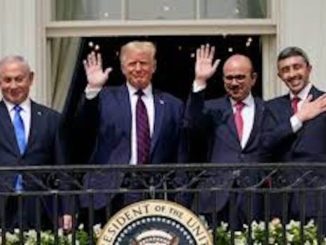
Donald Trump takes full credit for peace deals between the UAE, Bahrain and Israel
- Trump has proudly announced that five other Arab countries have also lined up to sign similar peace deals
- The White House has emphasized that the historic breakthrough was made possible by Trump’s ‘leadership and expertise as a deal-maker
- There is an old saying: ‘There are no permanent enemies, and no permanent friends, only permanent interests’. Nothing illustrates this better than the evolution of Israel’s relations with Arab countries.
No doubt, the two peace deals are a further consolidation of an America-led alliance in countering Iran’s influence in the region. In fact, one factor that has drawn both UAE and Bahrain closer to Israel is the fear of Iran’s growing role in the region. In recent years, Israel-UAE informal relations have warmed considerably and they have engaged in informal cooperation based on their joint opposition to Iran’s nuclear program and regional influence.
On 15th September 2020, a highly publicized event was held on the South Lawn of the White House in Washington DC. Donald Trump beamed proudly as the Foreign Ministers of UAE and Bahrain signed peace deals with the Prime Minister of Israel. Expectedly, Trump took full credit for these two historic peace deals which he had brokered, and which are being called the ‘Abraham Accords’.
The Abraham accords made me step back in time and see how things have changed in the Middle East. As a young Indian diplomat, I was sent to Egypt for my first overseas posting. Soon after my arrival in Cairo, Egypt and Israel had signed the historic Camp David Accords in September 1978. These had been brokered by US President Carter and paved the way for the Peace Treaty which was signed in March 1979.
The Egypt-Israel Peace Treaty ended the state of war that had existed between them since 1948. It made Egypt the first Arab country to recognize Israel, but for the same reason, it became unpopular in most of the other Arab countries. In their view, Sadat had betrayed the concept of Arab unity, and Egypt was suspended from the Arab League in 1979. Most Arab countries severed diplomatic ties with Egypt. It took several years to restore these ties, and as regards the re-admission of Egypt in the Arab League, this did not take place until 1989.
In sharp contrast with the Egypt-Israel peace treaty of 1979, no such outcry from other Arab countries has followed Israel’s peace agreements with UAE and Bahrain. Saudi Arabia is not officially a party to the agreements, but the kingdom’s close ties with the UAE and Bahrain and Saudi Crown Prince Mohammed bin Salman’s direct contacts with Trump’s son-in-law Jared Kushner do seem to indicate Saudi approval.
In fact, Trump has proudly announced that five other Arab countries have also lined up to sign similar peace deals, and though he did not name them, some are guessing that they might include Oman, Mauritania, Morocco, Tunisia and perhaps even Saudi Arabia.
Naming the accords after Abraham has more than symbolic significance, for Abraham is regarded as their patriarch both by the Israelis as well as by the Arabs; both believe that they are descended from him. Thus, the Abraham Accords are an exhortation to Arabs and Israelis–the descendants of Abraham– to live in peace with one another.
The deals are undoubtedly a diplomatic success for Trump .The White House has emphasized that the historic breakthrough was made possible by Trump’s “leadership and expertise as a deal-maker.” Soon after the UAE-Israel deal was announced, National Security Adviser Robert O’Brien told reporters that he wouldn’t be surprised if the President is nominated for the 2021 Nobel Prize. That has come true, with a right-wing Norwegian politician Tybring-Gjedde nominating Trump. Earlier, Tybring-Gjedde had nominated Trump for the 2018 Nobel Peace Prize for his efforts to bring about reconciliation between North and South Korea, but Trump did not win the Peace Prize. Whether he wins it or not this time remains to be seen.
No doubt, the two peace deals are a further consolidation of an America-led alliance in countering Iran’s influence in the region. In fact, one factor that has drawn both UAE and Bahrain closer to Israel is the fear of Iran’s growing role in the region. In recent years, Israel-UAE informal relations have warmed considerably and they have engaged in informal cooperation based on their joint opposition to Iran’s nuclear program and regional influence.
The two peace deals are also a diplomatic success for Israel, especially Prime Minister Netenyahu. For several years UAE and Israel have had many under-the-table contacts. There had been reports that Yossi Cohen, Director of the Israeli Secret Service Mossad secretly visited UAE several times for over a year to broker the accord. With the signing of the deal, all such contacts can now be conducted openly. The deal will lead to stronger economic, political and cultural ties between Israel and UAE. In a significant development, immediately after the deal was signed, the UAE Apex National Investment company signed a “strategic commercial agreement” with Israel’s Tera Group to conduct research into COVID-19 and develop a virus testing device. More such business deals would follow soon.
Bahrain’s relations with Israel have also strengthened slowly but steadily, partly due to Iran’s aggressive posturing. Although the royal family and many high-ups in the establishment in Bahrain are Sunnis, the majority of Bahraini Muslims are Shiites; it is one of three countries in the Middle East in which Shiites are the majority, the other two being Iraq and Iran. Shias have often complained of being politically repressed and economically marginalized; as a result, most of the protestors in the Bahraini uprising of 2011 were Shiites. Bahrain’s ruling family is believed to be wary of Iran’s propensity to foment sectarian trouble. Notably, Bahrain had hosted the Trump administration’s 2019 “Peace to Prosperity” economic summit to promote its Middle East peace plan. In this background, it was widely expected to follow the UAE in formalizing a peace treaty with Israel.
On its part, India has welcomed the US-brokered historic accord between Israel and the United Arab Emirates and Bahrain to normalize relations and establish full diplomatic links while also stressing on its traditional support for the Palestinian cause and an acceptable two-state solution.
The prelude to the Israel-UAE peace deal was a joint statement by these two countries and the US which referred to the suspension of the annexation of the West Bank by Israel, but this aspect was vague and lacked clarity. How long will this suspension be? Significantly, Trump administration officials have refused to clarify how long Israel will suspend annexation of Palestinian land in the West Bank as a result of this deal, and under what circumstances the U.S. would support Netanyahu returning to annexation plans. U.S.
Ambassador to Israel David Melech Friedman confirmed that the issue could be revisited, which means that the suspension could be revoked.
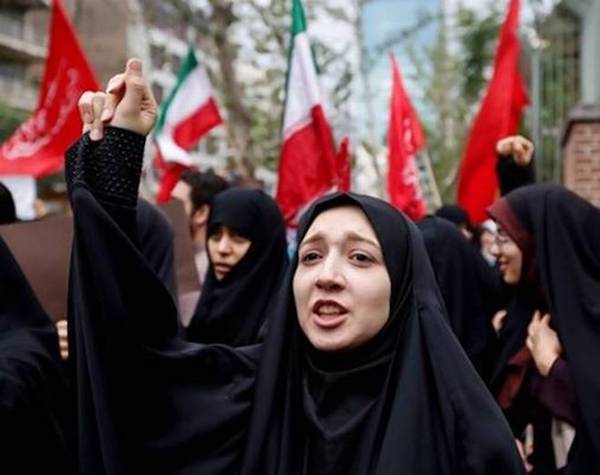
Not surprisingly, Iran has condemned these two agreements, as has Turkey. When the Israel-UAE deal was announced, Iran’s Foreign Ministry called the deal a “dagger that was unjustly struck by the UAE in the backs of the Palestinian people and all Muslims,” while Turkey said the peoples of the region “will never forget and will never forgive this hypocritical behavior” by the UAE. Iran’s President Hassan Rouhani has said that the United Arab Emirates and Bahrain will be responsible for any ‘consequences’ resulting from their normalization of relations with Israel. Iran’s relations with UAE and Bahrain had been on a down slide for the past several years. In 2016, Bahrain cut diplomatic ties with Iran and the UAE downgraded relations amid rising tensions between Saudi Arabia and Iran; predictably, these relationships have worsened even further.
The Palestinians, too have reacted with anger and have rejected the deals. When the UAE-Israel deal was announced, a spokesperson of Palestinian President Mahmoud Abbas called it “treason”. However, their options are quite limited. For example, Palestinian Prime Minister Mohammad Shtayyeh has said that Palestine would boycott the Dubai Expo scheduled for October 2020, but apart from any political points which might be scored, this boycott will not make much difference to the event.
Frankly, the Palestinian question is no longer central to the foreign policy objectives of many Arab countries, particularly those in the Gulf region. They are grappling with security issues where Iran and Turkey are perceived as playing the role of adversaries. They are also trying to keep pace with technological advances and preparing for the situation after their oil reserves run out. In this regard, they find it advantageous to deepen ties with the US and forge a relationship with Israel.
No doubt, many in the Arab world still care quite deeply about the Palestinians. However, in the policy formulations of many Arab Governments, the Palestinian issue has shrunk from representing a broader Arab cause to a tragedy that affects mainly the Palestinians.
Simply put, it may seem unbelievable how the Arab world has changed, but in the regional and global scenario, the changes were perhaps inevitable.
(The author is a retired career diplomat, now based in Gurugram, India. He can be reached at prabhu_dayal70@hotmail.com)
-

A U.S.-Iran detente could be on the cards

By Mohammed Ayoob The exit of John Bolton, and Israel’s diminished influence on Washington, signal a possible reduction in tensions.
“Israel and John Bolton have been the two major obstacles to a direct encounter between the two Presidents as a prelude to a possible rapprochement between the U.S. and Iran. Mr. Trump, despite his close relationship with Prime Minister Benjamin Netanyahu, seems to have concluded that the Israeli leader is too dependent on the U.S. and especially on Mr. Trump to attempt to block such a meeting if he decides to go ahead with it. Mr. Netanyahu seemed to confirm this understanding this week when he stated: “Obviously, I don’t tell the U.S. President when to meet or with whom.”
If it is not Afghanistan, then it must be Iran. U.S. President Donald Trump desperately needs a dramatic foreign policy breakthrough before the 2020 elections to establish his reputation as a strategist who can shape afresh the contours of American foreign policy. His lovefest with Kim Jong-un has petered out without producing any noticeable reduction in North Korea’s nuclear arsenal or any curbs on its ballistic missile program. His attempt to get the Taliban to accept a ceasefire so that he could begin withdrawing American troops from Afghanistan, and thus fulfil the promise he had made during the 2016 election campaign, has also stalled because of Kabul’s opposition and the Taliban’s unwillingness to stop military action before a settlement is announced.
This leaves Iran as the only arena where Mr. Trump can demonstrate his diplomatic dexterity even if it means returning to the status quo that had existed when President Barack Obama left office. However, Mr. Trump would like to add a dramatic flourish to turning the clock back.
Some of Mr. Trump’s closest associates, especially the recently sacked National Security Advisor John Bolton, have been promoting a policy that amounted to advocating a regime change in Iran, even if by force. However, Mr. Trump is fundamentally averse to leading the U.S. into an open-ended war with Iran. This stance is prompted largely by his attachment to his campaign promise of bringing American soldiers home that garnered a significant number of votes for him in the last election. He, therefore, abhors the idea of sending more of them to the volatile West Asia.
Zarif’s visit to Biarritz
These instincts were on display at the recently concluded G7 meeting in France following an unscheduled visit by Iranian Foreign Minister Mohammad Javad Zarif to Biarritz for talks with the French President Emmanuel Macron announced at the conclave that a Trump-Rouhani meeting was likely to take place in the “coming weeks”.
Mr. Trump said that he had no intention of imposing regime change on Iran and declared that under the right circumstances, he would certainly agree to a meeting with Mr. Rouhani.
In a speech hours earlier, Mr. Rouhani had also signaled that he was willing to talk with Trump. He has since qualified his positive response by adding that he would meet Mr. Trump only after Washington lifted the sanctions re-imposed on Tehran after Mr. Trump pulled the U.S. out of the nuclear deal in 2018. But the signal that Iranian leaders are not averse to talking with their American counterparts has been sent by Tehran and received in Washington. In turn, Mr. Trump reciprocated by stating that he has no problem meeting with President Rouhani. “It could happen. It could happen. No problem with me,” he said earlier this week.
Israel and John Bolton have been the two major obstacles to a direct encounter between the two Presidents as a prelude to a possible rapprochement between the U.S. and Iran. Mr. Trump, despite his close relationship with Prime Minister Benjamin Netanyahu, seems to have concluded that the Israeli leader is too dependent on the U.S. and especially on Mr. Trump to attempt to block such a meeting if he decides to go ahead with it. Mr. Netanyahu seemed to confirm this understanding this week when he stated: “Obviously, I don’t tell the U.S. President when to meet or with whom.”
Differences with Israel
Nonetheless, this relative softening of their respective stands by the U.S. and Iran have worried the Israeli establishment. This is why, of late, Mr. Netanyahu has once again been making shrill noises about Iran’s nuclear weapons capability. He has even gone to the extent of identifying a nuclear facility near Isfahan that, according to him, the Iranians destroyed after he had made its existence public. In response Iranian Foreign Minister Javad Zarif promptly tweeted: “The possessor of REAL nukes cries wolf — on an ALLEGED ‘demolished’ site in Iran.” It is clear that there is a fundamental disjuncture between American and Israeli objectives regarding Iran and recent events have begun to bring the fissures in American Israeli approaches to this issue into the open.
Mr. Bolton, an outspoken foreign policy hawk, has been the standard bearer of the hard line vis-à-vis Iran and is directly or indirectly responsible for many of the harshest measures adopted by the Trump administration in regard to Iran. He was also strongly opposed to the deal that Zalmay Khalilzad had worked out with the Taliban in order to begin an orderly withdrawal of American forces from Afghanistan. Mr. Bolton’s virulent opposition to any deal with Iran short of complete denuclearization and regime change, both objectives beyond the realm of possibility, had angered Mr. Trump, especially because it ran counter to his instinctive antipathy toward getting involved in overseas military conflicts.
However, the firing of John Bolton, when combined with the visible diminishing of Israeli influence on U.S. policy toward Iran, signals that Washington is interested in easing tensions with Tehran. This is confirmed by the Secretary of State Mike Pompeo’s statement on September 10 that it was possible that a meeting between Mr. Trump and Mr. Rouhani could take place this month on the sidelines of the UN General Assembly session in New York. Such a meeting, even if it does not immediately resolve all the contentious bilateral issues, could form the beginning of a de-escalatory process that is likely to benefit both Washington and Tehran in the long run.
(The author is University Distinguished Professor Emeritus of International Relations, Michigan State University, and Senior Fellow, Center for Global Policy, Washington, DC)
-

India and U.S. resolve to work through their trade differences
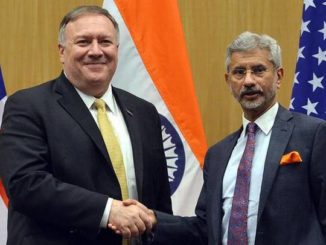
NEW DELHI (TIP): India and the U.S. resolved to “work through” their differences which have led to an impasse on trade issues as External Affairs Minister S. Jaishankar hosted U.S. Secretary of State Mike Pompeo in Delhi ahead of a meeting between Prime Minister Narendra Modi and U.S. President Donald Trump in Osaka this week.
“If you trade with somebody, and particularly if they are your biggest trading partners, it’s impossible that you don’t have trade issues. But I think the sign of a mature relationship is that ability to negotiate your way through that and find common ground,” Mr. Jaishankar said at the end of their meeting on Wednesday, although neither side announced any positive outcomes from the discussions. Mr. Pompeo and Mr. Jaishankar are understood to have thrashed out issues, including tariffs and counter-tariffs imposed by New Delhi and Washington on each other in the past year, as well as the U.S.’s specific concerns with India’s proposed laws on e-commerce and data localization, on price caps and market access.
“The U.S. is clear that it seeks greater market access and the removal of trade barriers in our economic relationship, and today I addressed these differences in the spirit of friendship and I think we will be able to resolve these issues in the interests of our two countries,” said Mr. Pompeo.
He clarified that the U.S. decision to withdraw India’s GSP preferential trade status this month had not come up for discussion.
Mr. Jaishankar said both sides had come away with a “better understanding” of each other’s concerns on a wide variety of issues besides trade, including energy, defense, investment concerns and people-to-people contacts, as well as the growing conflict in the Gulf with Iran and the peace process in Afghanistan.
Rejecting calls by the United States and the threat of sanctions under its CAATSA law, Mr. Jaishankar said that India will take its decision on the purchase of the Russian S-400 Triumf anti-missile system in its own “national interest”, and conveyed this to his American counterpart during talks here on Wednesday.
“On the CAATSA ( Countering America’s Adversaries through Sanctions Act)issue) I explained to Secretary Pompeo in some detail that we have many relationships with many countries, and many of them have some standing and they have a history,” said Mr. Jaishankar, referring to India’s traditional relationship with Russia.
Mr. Jaishankar also raised India’s concerns over growing U.S.-Iran tensions and their impact on India’s energy security.
While India has zeroed out all oil imports from Iran since the U.S. sanctions deadline ran out on May 2, it has maintained a cordial and close relationship with the Iranian government. In response, Mr. Pompeo lashed out at the Iranian government, which he called a “terrorist regime”, adding that India and the U.S. had a “shared understanding” of the terrorist threat emanating from Iran.
“We know that Iran is the world’s largest state sponsor of terror, and the Indian people have suffered from terror around the world. So I think there is a shared understanding of the threat and a common purpose to ensuring that we keep energy at the right prices and deter this threat,” Mr. Pompeo said.
The MEA declined to comment on whether it supported Mr. Pompeo’s remarks, which were made in Mr. Jaishankar’s presence. Mr. Pompeo also met with PM Modi and National Security Adviser Ajit Doval on Wednesday, June 26.
-

US to allow 8 countries to continue buying Iran oil after sanctions on Nov 5: Pompeo
India may be one of the countries to get exemption
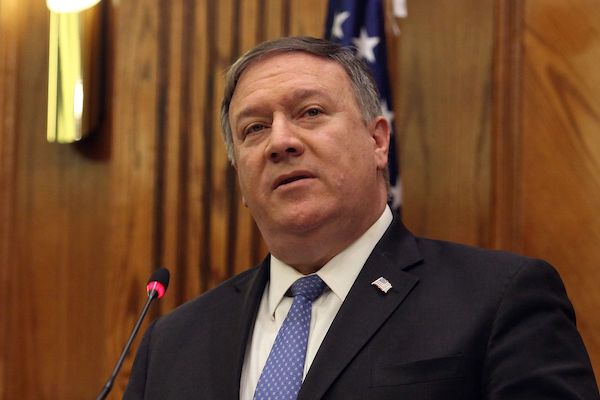
WASHINGTON(TIP): The US has agreed to temporarily allow eight countries to continue buying Iranian oil after it re-imposes crippling sanctions on Tehran on November 5, Secretary of State Mike Pompeo said on Friday, citing “significant reductions” in imports of oil from the Persian Gulf nation.
India is one of the countries expected to get the exemptions. But senior administration officials refused to spell out the names on Friday.
The list of these exemptions would be announced on Monday, November 5, Pompeo told reporters during a conference call on Iranian sanctions, with US Treasury Secretary Steven Mnuchin.
While the US had previously wanted countries including India to completely halt oil purchases from Iran by November 4 when its full sanctions against Tehran come into force, it seems to have relented considering the havoc the move to completely take out Iranian supplies from the market would have had on prices.
Pompeo said that countries like India, if it gets the exemption, would be asked to bring down their oil imports from Iran to zero in six months’ time.
Negotiations are still ongoing, he said explaining the reasons for not revealing the names of the countries that are expected to get exemptions from the US from this latest and so far the toughest American sanctions on Iran.
“We expect to issue some temporary allotments to eight jurisdictions, but only because they have demonstrated significant reductions in their crude oil and cooperation on many other fronts and have made important moves towards getting to zero crude oil importation. These negotiations are still ongoing. Two of the jurisdictions will completely end imports as part of their agreements. The other six will import at greatly reduced levels,” Pompeo said.
These economic sanctions are just a part of the US government’s total effort to change the behavior of the Iranian regime, he said.
“On November 5th, the United States will re-impose sanctions that were lifted as part of the nuclear deal on Iran’s energy, shipbuilding, shipping and banking sectors. These sanctions hit at core areas of Iran’s economy. They are necessary to spur changes we seek on the part of the regime,” he said.
“In order to maximize the effect of the president’s pressure campaign, we have worked closely with other countries to cut off Iranian oil exports as much as possible,” Pompeo said.
The expected list of exemptions to eight jurisdictions, that too temporary, is far less than the 20 countries, including India, which were exempted from Iranian sanctions during the previous Obama administration, he said.
“We will have issued, if our negotiations are completed, eight and have made it clear that they are temporary,” he said.
“Not only did we decide to grant many fewer exemptions, but we demanded much more serious concessions from these jurisdictions before agreeing to allow them to temporarily continue to import Iranian crude oil. These concessions are critical to ensure that we increase our maximum pressure campaign and accelerate towards zero,” Pompeo said.
As a result of the latest sanctions, he said the US expects to have reduced Iranian crude oil exports by more than 1 million barrels even before these sanctions go into effect. “This massive reduction since May of last year is three to five times more than what many analysts were projecting when President Trump announced our withdrawal from the deal back in May,” he said.
“Starting today, Iran will have zero oil revenue to spend on any of these things. Let me say that again: Zero. 100 percent of the revenue that Iran receives from the sale of crude oil will be held in foreign accounts and can be used by Iran only for humanitarian trade or bilateral trade in non-sanctioned goods and services,” he said.
Pompeo said the latest US sanctions are targeted at the regime, not the people of Iran who have suffered grievously under this regime.
“It’s why we have and will maintain many humanitarian exemptions to our sanctions, including food, agriculture commodities, medicine and medical devices,” he said.
India, which is the second biggest purchaser of Iranian oil after China, is willing to restrict its monthly purchase to 1.25 million tons or 15 million tons in a year (300,000 barrels per day), down from 22.6 million tons (452,000 barrels per day) bought in 2017-18 financial year, sources in New Delhi said.
The US will also demand the Society for Worldwide Interbank Financial Telecommunication (SWIFT) global financial network stop supporting Iranian banks as part of enforcing sanctions over Tehran’s nuclear program and alleged support for terrorism.
In May, President Donald Trump pulled the US out of the 2015 landmark Joint Comprehensive Plan of Action (JCPOA) terming it “disastrous”. Under the Obama-era deal, involving five permanent members of the UN Security Council and Germany, Iran agreed to stop its nuclear program in exchange for relief from economic sanctions.
After the US’ withdrawal from the deal, Trump signed fresh sanctions against Iran and warned countries against any cooperation with Tehran over its controversial nuclear weapons program.
Iran has dismissed these charges and maintains that its nuclear program is for peaceful purposes.
(Source: PTI)
-

It’s not about the nuclear deal
The U.S. won’t ease the terms of sanctions on Iran, as the goal is regime change in Tehran

By Chinmaya R. Gharekhan “The impact on India will be severe. The price of crude is already close to $80. Energy imports from Iran will become difficult and expensive. Fuel prices will go up. The Reserve Bank of India might have to increase interest rates to contain inflation and step in to check the fall in the rupee’s value. All this might have a direct bearing on politics, given the fact that the government was the beneficiary of low crude price for the first four years but may have to face consequences of inflation and attendant factors in its fifth”, says the author.
If — and that’s a big if — the leaders of the U.S., China, South Korea and North Korea succeed in concluding a deal on the denuclearization of the Korean peninsula as well as on a peace treaty formally ending the Korean War, they would be front runners for the Nobel Peace Prize. That deal could appropriately be called a Joint Comprehensive Plan of Action (JCPOA) if it lays down a detailed blueprint for denuclearization, with provisions of intrusive inspections. The only thing that could stand in their way is Iran.
There should be little doubt that U.S. President Donald Trump’s real, but of necessity undeclared, objective in withdrawing from the Iran nuclear deal is a regime change in Tehran. This goal is even more ardently desired by Israel and Saudi Arabia. Ever since Iranian President Mahmoud Ahmadinejad made particularly provocative statements about Israel, Israelis of all political persuasions have wanted to get rid of the regime in Iran. The Saudis have openly called for cutting off the head of the (Iranian) snake. Thus, three important and powerful states have a congruence of interests seldom seen in recent times.
Iranian discontent
There have been frequent and persistent reports in the Western media for several months about large-scale demonstrations and protests by Iranian people against the regime. Living conditions are difficult. Iran did not get the goodies that it expected after signing the JCPOA. Inflation is high. The Iranian rial is trading at 75,000 to the dollar. People are angry with the government. According to the well-researched work Democracy in Iran: Why It Failed and How It Might Succeed by American academic Misagh Parsa, disaffection among the people has manifested itself in several forms. Hundreds of mosques do not have imams and the attendance at Friday prayers has dwindled dramatically. Some are converting to Christianity and, according to Professor Parsa, even to the Baha’i faith, which is the largest non-Muslim community in Iran. Professor Parsa states that there is massive corruption as well as economic inequality in Iran. All in all, he suggests that it is quite likely that there might be a revolutionary upsurge, though he is careful not to indicate any timeline for it.
A different calculation
It is this discontent that Mr. Trump might be counting on tapping. His calculation seems to be that the reimposition of severe sanctions would render life very difficult, almost unbearable, for the populace who might, in the absence of other avenues, take to the streets, as they did in 1979 to overthrow the Shah’s regime which too, like the present one, had strong military and oppressive secret services such as the Savak but which could not defeat public anger, frustration and rage. For these reasons, Mr. Trump is unlikely to listen to voices of reason or to appeals from his Western allies. He is equally not likely to grant exemptions from sanctions to any country engaging in any form of trade and other transactions with Iran. His administration will follow strict interpretation of the guidelines regarding the sanctions regime.
Iranian restraint
Iran has shown restraint, forsaking knee-jerk reaction. It did not declare that the deal was dead, as it might well have done. It did not announce immediate resumption of uranium enrichment, which it emphasized will be at the industrial level. It has so far not called off International Atomic Energy Agency (IAEA) inspections. Iran will consult with the other signatories to the JCPOA for several weeks before taking any further action. This shows the maturity of Iranian diplomacy. It remains to be seen how long France and others will stick to their position of continuing to adhere to the deal; they will eventually have to fall in line in some way with the Americans, if not for political then for economic considerations. For Mr. Trump, the Republicans are fully with him and the Democrats will be too eventually.
Will Iran live up to the American calculation? For the present, Mr. Trump’s decision has strengthened the hardliners. President Hassan Rouhani, regarded as a moderate, has no option but to take a defiant stance. The Iranian people, proud as they are of their heritage, will stand behind their regime. But there may come a time when their hardships reach a stage when they might feel compelled to take to the streets.
In the meanwhile, Iran will even more vigorously support the Bashar al-Assad regime in Damascus, in which it will be joined by Russia and Hezbollah, which has done very well in the parliamentary elections in Lebanon this month. The Houthi rebels in Yemen will feel more emboldened to take on the Saudi-led coalition; of course, the Yemeni people will continue to suffer, as will the Syrian people, for years to come. Iran will more directly intervene in Iraq and render the possibility of progress in the non-existent peace effort in Afghanistan even more difficult.
If the regime in Tehran does not collapse, the Washington-Jerusalem-Riyadh axis might look for an alternative course of action, not excluding military. In that case, the Nobel Peace Prize will elude Mr. Trump.
Prime Minister Narendra Modi has established special relationship with Israel and its present Prime Minister, Benjamin Netanyahu. He has also made efforts to forge intimate relations with the U.S. With both India has the upper hand, since it is they who want to sell expensive military hardware to India. Under the circumstances, India has made a well-drafted two-sentence statement on the Trump decision. The first strikes a balance between Iran’s right to develop nuclear energy for peaceful purposes as also the international community’s concern to ensure that its nuclear program remains strictly peaceful. The second sentence contains implicit disapproval of the American decision and warns, again implicitly, against any strong military action. For India, the question will also be: can it rely on the U.S. to honor even its written word embodied in international agreements? Mr. Trump wants to annul every single achievement of his predecessor — Obamacare, the North American Free Trade Agreement, the Trans-Pacific Partnership, the Paris Agreement, and now JCPOA. India will have to remain vigilant in dealing with this administration; it would not be prudent to assume that it is a special case.
Fallout for India
The impact on India will be severe. The price of crude is already close to $80. Energy imports from Iran will become difficult and expensive. Fuel prices will go up. The Reserve Bank of India might have to increase interest rates to contain inflation and step in to check the fall in the rupee’s value. All this might have a direct bearing on politics, given the fact that the government was the beneficiary of low crude price for the first four years but may have to face consequences of inflation and attendant factors in its fifth.
(The author is a former Indian Ambassador to the United Nations, was Special Envoy for West Asia in the Manmohan Singh government)
-

Trump’s Iran walk-back: Double whammy for India after CATSA
Just when Indian diplomats were figuring out how to mitigate the impact of Countering America’s Adversaries Through Sanctions Act (CATSA) on its arms and oil trade with Russia, South Block has another reason to burn the midnight oil. US President Donald Trump’s intention to exit the Iran deal, and reimpose sanctions if Tehran declines to renegotiate, could send India’s plans for the region in smoke. The sanctions will pretty much cover all areas of interest to India vis-a-vis Iran: petroleum, ports, shipping and banking. The bright side is that except for Saudi Arabia and Israel, pretty much the rest of the world has not taken kindly to Trump’s attempt to redefine the Joint Comprehensive Plan of Action (JCPOA) to cover “responsible” behavior by Iran both externally and domestically.
The world can be grateful that Tehran doesn’t have an impetuous leader like Trump. Javed Zarif, Iran’s chief negotiator for the deal, has resolved to diplomatically lobby with the other parties to the agreement. Yet, Trump’s explanation that Iran could emulate North Korea by negotiating denuclearization will find few takers for it is widely realized that Tehran would have to be suicidal if it were to show signs of weakness. On the contrary, the US may have lost North Korea’s trust by going back on the Iran deal just as it lost Palestinian support after Trump announced the shifting of the US embassy to East Jerusalem.
India needs to work with countries with a shared interest in the JCPOA to ensure that Trump’s exit from the Iran deal does not harm its investments and plans for the region. India and other countries on the same page must also engage with Iran to discourage it from retaliatory malign behavior that may further muddy the waters. PM Modi will get the opportunity to discuss the issue with like-minded leaders when he meets them for two multilateral summits later this year. The problem for India is it has no company like the Chinese Sinopec which has no business interests with a US company and can thus escape sanctions. India will first have to make common cause with countries in the same Iranian boat.
(Tribune, India)
-

Trump scraps the Iran nuclear deal, calling it ’embarrassment’
Iran will remain in N-deal, says Rouhani
European leaders call on Washington to let them carry on with pact
WASHINGTON(TIP): US President Donald Trump on Tuesday, May 8, pulled out of the landmark nuclear deal with Iran, an Obama-era accord which he has repeatedly criticized.
“It is clear to me that we cannot prevent Iran’s nuclear bomb. The Iran deal is defective at its core. Therefore, I am announcing today that the United States would withdraw from the Iran nuclear deal,” Trump said.
Moments later he signed a fresh set of sanctions against Iran and warned countries against any cooperation with Iran on its nuclear weapons program.
Ever since his election campaign, Trump has frequently criticized the Obama-era Iran nuclear deal, also known as the Joint Comprehensive Plan of Action or JCPOA.
France, Germany, and the UK regret the U.S. decision to leave the JCPOA. The nuclear non-proliferation regime is at stake.
— Emmanuel Macron (@EmmanuelMacron) May 8, 2018
He had described the agreement, which was negotiated by then US secretary of state John Kerry, as a bad deal.
I am deeply concerned by today’s announcement that the US will be withdrawing from the JCPOA & will begin reinstating US sanctions, says @antonioguterres. Full text here: https://t.co/LqC2WFJfAC
— UN Spokesperson (@UN_Spokesperson) May 8, 2018
The Iran nuclear deal was reached in Vienna in July 2015 between Iran and the P5 (the five permanent members of the UN Security Council) plus Germany and the European Union.
Trump’s decision would have global ramifications, straining Iranian economy and heightening tensions in the Middle East.
Iran will remain in N-deal, says Rouhani
Meanwhile, Iranian President Hassan Rouhani said on Tuesday, May 8, that Iran would remain committed to a multinational nuclear deal despite US President Donald Trump’s decision to withdraw from the 2015 agreement designed to deny Tehran the ability to build nuclear weapons.
“If we achieve the deal’s goals in cooperation with other members of the deal, it will remain in place… By exiting the deal, America has officially undermined its commitment to an international treaty,” Rouhani said in a televised speech.
“I have ordered the foreign ministry to negotiate with the European countries, China and Russia in coming weeks. If at the end of this short period we conclude that we can fully benefit from the JCPOA with the cooperation of all countries, the deal would remain,” he added.
The Joint Comprehensive Plan of Action (JCPOA) is the full name for the nuclear deal, struck in 2015 between Iran, the five permanent members of the U.N. Security Council — the United States, Russia, China, Britain and France — and Germany.
Rouhani added that Iran was ready to resume its nuclear activities after consultations with the other world powers which are part of the agreement.
Trump’s announcement was hailed by Washington’s principal allies in the Middle East, Israel and Saudi Arabia, both sworn foes of Iran.
Under the deal, Iran curbed its nuclear activities in return for the lifting of most sanctions imposed on the country.
Trump said he would reimpose economic sanctions on Tehran immediately. His decision puts pressure on his European allies, who are key backers of the deal and reluctant to join the United States in reimposing sanctions on Iran.
Banking turmoil
Some Iranians had been cashing in their savings even before Trump’s announcement he would pull out from the international deal with Iran, straining a banking system weighed down by bad loans and years of isolation.
An official with Iran’s biggest state-owned Melli Bank told Reuters savings had declined by an unspecified amount, although he said this was a temporary phenomenon and that they would recover once the uncertainty over Trump’s decision passed.
“When there is political uncertainty, its psychological impact on people causes a drop in savings. But it will pass after Trump’s deadline,” the official said before the announcement, declining to be named. A senior Iranian central bank official said conditions within the banking system had deteriorated in the past year, and “we have still not passed the danger zone” but added that the central bank had “all the measures ready to prevent any crisis”.
EU will stand by Iran
Europe will stand by the international nuclear accord with Iran, EU Foreign Policy chief Federica Mogherini said in a live press statement in Rome on Tuesday. “The EU is determined to preserve it,” she said. “We expect the rest of the international community to continue to preserve it, for the sake of collective security.” “The nuclear accord belongs to the whole of the international community,” Mogherini added. “To the Iranian people I say: do not let anyone dismantle this deal, one of the greatest achievements of the international community.” “I am particularly worried about tonight’s announcement of further sanctions,” she said, adding that the deal with Iran “is the culmination of 12 years of diplomacy.”
Most Americans reject move
Less than one in three Americans agrees with President Donald Trump’s decision to pull the US out of an agreement to limit Iran’s nuclear program, according to a Reuters/Ipsos national opinion poll released on Tuesday, May 8.
The poll, conducted on May 4-8, ahead of the President’s announcement to end the deal, found that 29 per cent of adults wanted to end the deal with Iran and five other world powers to ease sanctions and limit Iran’s nuclear program. Another 42 per cent said the US should remain in the deal, and the remaining 28 per cent said they “don’t know”. Even among those who are registered as Republicans, less than half — 44 per cent — advocated ending the US involvement in the deal. Another 28 per cent wanted to remain, and the remaining 28 percent said they did not know. — Agencies
‘US undermined commitment to treaty’
If we achieve the deal’s goals in cooperation with other members of the deal, it will remain in place… By exiting the deal, America has officially undermined its commitment to an international treaty. Hassan Rouhani, Iranian President
‘Will work collectively’
We will work collectively on a broader framework, covering (Iran’s) nuclear activity, the post-2025 period, ballistic activity, and stability in the Middle-East, notably Syria, Yemen, and Iraq. Emmanuel Macron, French President
‘It’s a historic move’
Israel thinks that Trump made a historic move, and this is why Israel thanks him for his commitment to confront the terrorist regime in Tehran, and his commitment to ensure that Iran never gets nuclear weapons. Benjamin Netanyahu, Israeli Prime Minister
‘Decision misguided’
Donald Trump’s decision to withdraw from the deal is misguided. I believe that the decision to put the JCPOA at risk without any Iranian violation of the deal is a serious mistake. Barack Obama, former US President.
(Source: PTI and agencies)
-

Can the 3 Ms save Iran deal?
By Arun Kumar
The Macron-Merkel-May trio hopes to bear upon Trump to keep pact
“Besides the Europeans, the looming May 12 deadline also has India worried, as since the end of sanctions, it has greatly strengthened its bilateral relations and economic partnership with Iran. During Rouhani’s visit, the two countries signed nine agreements, including a crucial one on connectivity via the strategic Chabahar Port. India has also committed itself to completing the Chabahar- Zahedan rail link to provide an alternative route to Afghanistan, completely bypassing Pakistan”, say the author.
French President Emmanuel Macron has just ended a glitzy visit with President Donald Trump. German Chancellor Angela Merkel came calling today and British Prime Minister Theresa May has been burning the phone across the Atlantic. Their mission: to persuade the mercurial occupant of the White House not to tear up the Obama era 2015 landmark Iran nuclear deal as he threatened on the campaign trail.
The wily Donald is not telling anyone what he would do on May 12 when he must either sign a fresh waiver on Western sanctions against Iran or walk away from what Trump has decried as an “insane” and “ridiculous” deal signed by P5+1 — the US, Russia, China, UK, France and Germany — world powers with Tehran to end its nuclear weapons program.
But swept off his feet by what the American media called “Le Bromance” unleashed by Trump at the first State dinner of his presidency, Macron ended up calling for a new “big deal” with the old one limiting Iran’s uranium enrichment for 15 years serving as one of its four pillars.
Or did the suave Frenchman charm the Manhattan mogul into buying these side deals he Merkel and May have been working on to convince Trump to stay on in the Iran deal? European leaders are also said to be crafting a “Plan B” to continue without the US. But Iran is unlikely on come on board without the US.
The three new pillars that Macron suggested in Washington would rework the sunset clause in the accord to ensure there is no nuclear activity by Iran in the long run, as feared by the critics who have accused Europeans, particularly Germany, of putting business before security.
The Macron proposal would also seek to limit Tehran’s ballistic missile program and curb its “regional influence” by ceasing support for militant groups across the Middle East, particularly Yemen and Syria.
Even as he declined to show his hand, Trump suggested: “I think we will have a great shot at doing a much bigger maybe deal, maybe not deal” built on solid foundations. In an escalating war of words, he also cautioned Iran against restarting its nuclear program, warning it may “have bigger problems than they have ever had before.”
Iranian President Hassan Rouhani, who during his February visit to India — the first by an Iranian head of state in 10 years — had dismissed Trump as a “haggler”, was quick to heap fresh insults on “a tradesman” with no understanding of diplomacy. Western powers, he asserted, had no right to make changes in the deal now.
Earlier in February, Iranian deputy foreign minister Abbas Araqchi had assured that Iran’s commitment to not seek nuclear weapons is permanent and that there was no sunset clause in the deal.
Besides the Europeans, the looming May 12 deadline also has India worried, as since the end of sanctions, it has greatly strengthened its bilateral relations and economic partnership with Iran. During Rouhani’s visit, the two countries signed nine agreements, including a crucial one on connectivity via the strategic Chabahar Port. India has also committed itself to completing the Chabahar- Zahedan rail link to provide an alternative route to Afghanistan, completely bypassing Pakistan.
Chabahar Port, Rouhani declared, can serve as a bridge connecting India to Afghanistan, Central Asia and Eastern Europe.
India, which backs “full and effective implementation” of the Iran nuclear deal, could use Afghanistan as a bargaining chip at the next India-US two plus two dialogue between Trump’s incoming Secretary of State Mike Pompeo and Defense Secretary James Mattis and their Indian counterparts, Sushma Swaraj and Nirmala Sitharaman. The dialogue earlier set for April 18-19 in New Delhi was postponed with the unceremonious dismissal of Trump’s previous chief diplomat Rex Tillerson.
Pompeo, currently CIA Director, who is set to join Trump’s equally hawkish new National Security Adviser John Bolton, assured the Congress during his confirmation hearings that he would work to fix the “terrible flaws” in the Iran nuclear deal even if Trump walks away from it.
Unlike Tillerson, who favored a somewhat softer approach towards Pakistan, Pompeo, Bolton and Mattis are all for ramping up US pressure on Pakistan to roll up its terrorism infrastructure to allow India to engage in institution building in Afghanistan.
Trump’s declaration of a virtual trade war against friends and foes alike has sent diplomats across the world scrambling for new options. India and China, too, are coming closer with Chinese foreign minister Wang Yi declaring that the upcoming informal summit between Indian PM Narendra Modi and Chinese President Xi Jinping would be a “new starting point in relationship.” The two have, for long, put their vexed boundary dispute on the back burner to let their trade relations bloom. China has emerged as India’s largest trading partner with an 18 per cent growth, taking bilateral trade to $84 billion.
The fate of the Iran deal would certainly cast a shadow on the upcoming nuclear summit between Trump and North Korean leader Kim Jong-un. If Trump tears up the Iran accord, can Kim trust him to keep his word on a peace pact with Pyongyang?
Would the author of “The Art of the Deal”, who looks at every issue as a transaction, risk a legacy building landmark accord with Kim after bringing him to the negotiating table with threats of “fire and fury”?
Not likely, as after a secret preparatory visit by Pompeo, a la Henry Kissinger, the legendary architect of Richard Nixon’s opening to China, he now sees Kim whom he once dismissed as the “Little Rocket Man” as “very open and very honorable.”
At their joint presser, Macron declared that “together US and France would defeat terrorism, curtail weapons of mass destruction in North Korea and Iran and act together on behalf of the planet.” The last bit was seen as a hint that Trump may be open to revisiting the Paris Climate accord too.
Earlier in January, Trump declared that he would reconsider joining the “terrible” Trans Pacific Partnership if the US got a “substantially better deal.”
At his presser with Macron, Trump declared in a conspiratorial tone: “Nobody knows what I am going to do on the 12th (of May), although Mr President, you have a pretty good idea.” Macron responded with just a wink.
It would, indeed, be hazardous to guess what Trump would or would not do. But given that he is open to revisiting every “terrible” deal in search for a “better” one, it may be safe to presume that the Iran accord will live another day.
(The author is an expert on international affairs)
-

Qatar restores diplomatic ties to Iran amid regional crisis
DUBAI (TIP): Qatar restored full diplomatic relations with Iran early Thursday, disregarding the demands of Arab nations now locked in a regional dispute with the energy-rich country that it lessen its ties to Tehran.
In announcing its decision, Qatar did not mention the diplomatic crisis roiling Gulf Arab nations since June, when Qatar found its land, sea and air routes cut off by its neighbors over Doha’s policies across the Mideast.
“Qatar has shown it is going to go in a different direction,” said Kristian Coates Ulrichsen, a research fellow at the James A. Baker III Institute for Public Policy at Rice University who lives in Seattle. “It could very well be calculated toward reinforcing the point that Qatar will not bow to this regional pressure placed upon it.”
Qatar’s Foreign Ministry announced early Thursday that the country’s ambassador would return to Tehran. Qatar pulled its ambassador in early 2016 after Saudi Arabia’s execution of a prominent Shiite cleric sparked attacks on two Saudi diplomatic posts in Iran, a move to show solidarity with the kingdom.
“The state of Qatar expressed its aspiration to strengthen bilateral relations with the Islamic Republic of Iran in all fields,” a short Foreign Ministry statement said.
-

Myanmar insists no North Korea links as US envoy visits
YANGON (TIP): Myanmar has no military ties with North Korea, a Myanmar official said on July 17, as a US diplomat responsible for North Korea arrived for talks in which he is likely to seek assurances on efforts to isolate it.
Ambassador Joseph Yun was set to meet Myanmar’s State Counsellor Aung San Suu Kyi and the military’s commander in chief in the capital, Naypyitaw, on Monday, according to the U.S. Embassy in Yangon.
Yun attended a conference in Singapore over the weekend focusing on tension on the Korean peninsula over the North’s unrelenting nuclear and missile programmes. Ambassador Joseph Yun’s trip to Asia was announced after North Korea’s test on July 4 of on intercontinental ballistic missile that it says can carry a large nuclear warhead and some experts believe has the range to reach Alaska.
Myanmar is the only other stop on his trip, pointing to concern in Washington that Myanmar’s army, which used to have ties with North Korea, continues to give succour to Kim Jong Il’s regime.
The United States did not inform Myanmar what Yun would discuss, said Kyaw Zeya, permanent secretary at Myanmar’s Ministry of Foreign Affairs. “They are not very specific from the very beginning but we understand he is the special envoy on North Korea,” Kyaw Zeya told Reuters.
Myanmar was complying with UN resolutions on North Korea, he said. “It’s normal relations between the two countries,” said Kyaw Zeya. “As I understand, there’s no such relations between military to military. Definitely not.”
The United States in May asked Southeast Asian countries to do more to isolate North Korea, and efforts have increased after its July 4 ballistic missile test.
RESIDUAL POCKETS?: Myanmar’s former ruling junta, which, like North Korea, was also widely shunned by the outside world over its suppression of human rights, was known to have ties to North Korea, which included sending missile experts and material for arms production to Myanmar. Myanmar insists that arms deals and other military relations with North Korea stopped before its transition to a nominally civilian government in 2011.
Nobel laureate Suu Kyi took power last year amid a transition from full military rule. But the military could still have “a few residual pockets” with links to North Korea, the then top U.S. diplomat for East Asia, Daniel Russel, told a congressional hearing in September.
In March, the US Treasury levelled new sanctions against the Myanmar army’s procurement body, the Directorate of Defence Industries (DDI), under the Iran, North Korea, and Syria Nonproliferation Act Sanctions.
The DDI was previously sanctioned in 2012 and accused of materially assisting North Korea’s regime, but had fallen off the sanctions list in October after the Obama administration dropped most measures against Myanmar in recognition of a successful political transition.
But despite Suu Kyi leading the civilian administration, Myanmar’s military remains free from civilian oversight. A 2008 constitution drafted by then-ruling generals keeps the army central to politics. (Reuters)
-

Saudi Arabia chief foreign promoter of Islamist extremism in UK: Report
LONDON (TIP): Oil-rich Saudi Arabia is the chief foreign promoter of Islamist extremism in the UK, a new report has claimed, asserting that a “clear and growing link” can be drawn between overseas money and the recent wave of attacks in Britain and Europe.
The Henry Jackson Society, a foreign affairs think-tank, called for a public inquiry into the role of Saudi Arabia and other Gulf nations, BBC reported.
The think-tank said there was a “clear and growing link” between Islamist organisations in receipt of overseas funds, hate preachers and Jihadist groups promoting violence.
However, the UK’s Saudi Arabian embassy says the claims are “categorically false”. Ministers are under pressure to publish a report on UK- based Islamist groups.
The Home Office report into the existence and influence of Jihadist organisations, commissioned by former Prime Minister David Cameron in 2015, has reportedly yet to be completed amid questions as to whether it will ever be published.
Critics have suggested it could make uncomfortable reading for the government, which has close and longstanding diplomatic, security and economic links with the Gulf, particularly Saudi Arabia.
Today’s report says a number of Gulf nations, as well as Iran, are providing financial support to mosques and Islamic educational institutions which have played host to extremist preachers and been linked to the spread of extremist material.
At the top of the list, the report claims, is Saudi Arabia. It alleges individuals and foundations have been heavily involved in exporting what it calls “an illiberal, bigoted Wahhabi ideology”, quoting a number of examples.
In a minority of cases, the report alleges institutions in the UK that receive Saudi funding are run directly from Saudi Arabia, although in most instances the money appears to “simply buy foreign donors’ influence”.
In a statement, the Saudi embassy here said any accusations that the Kingdom had radicalised “a small number of individuals are baseless and lack credible evidence”.
And it pointed out that the country has itself been subject to numerous attacks by al-Qaeda and so-called Islamic State.
It added: “We do not and will not condone the actions or ideology of violent extremism and we will not rest until these deviants and their organisations are destroyed.”
The report’s release comes at a time when Saudi Arabia, the UAE, Bahrain and Egypt are all accusing Qatar of supporting extremism – a charge the report says is hypocritical. Arab foreign ministers are meeting in Cairo to discuss possible further sanctions on Qatar, while the Qatari foreign minister will be making his own country’s case at a press conference in London.
Endorsing the report, Labour MP Dan Jarvis said it shed light on “very worrying” links between Saudi Arabia and the funding of extremism and he called for the government to release its report on foreign funding. (PTI)
-

Officials say 76 police officers hurt in clashes with anti-G20 protesters
HAMBURG (TIP): At least 76 police officers were hurt on Thursday in clashes with anti-G20 protesters in Hamburg, German authorities said, as a demonstration dubbed “Welcome to Hell” erupted in violence shortly after it began.
“Police are still being attacked,” said a spokesman for Hamburg’s police force, adding that most of the officers hurt sustained light injuries.
Demonstrations turned violent late Thursday, as German police clashed with a group of masked anti-capitalist activists hurling bottles and stones.
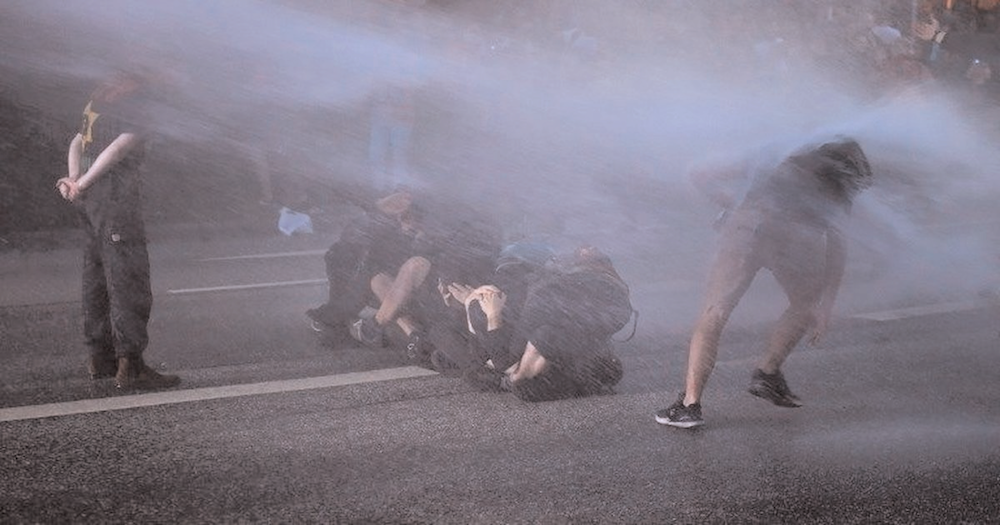
What should have been a peaceful march by around 12,000 people in Hamburg protesting against globalisation was halted as police used water cannon and tear gas to disperse around 1,000 far-left militants.
Police called with loudspeakers on protestors to remove their masks but this was ignored and after more objects were thrown, authorities decided to separate them from the other protestors, police said on Twitter.
“Unfortunately it has come to the first clashes. We are implementing corresponding measures,” read another tweet.
Protesters were seen scrambling to leave the scene, while others defiantly stood in the way of water cannon trucks as they moved in surrounded by riot police with helmets and batons.
Police tweeted a photo of a car and flames and said shop windows were smashed. The main “Welcome to Hell” march was then called off but thousands of people remained as night fell and demonstrators engaged in smaller skirmishes in the back streets of Germany’s second city, AFP correspondents said.
Up to 100,000 demonstrators are expected before and during the two-day Group of 20 meeting gathering Trump, Russia’s Vladimir Putin and Xi Jinping of China starting on Friday.
There were 20,000 police on standby together with armoured vehicles, helicopters and surveillance drones. A holding centre for detainees has been set up in a former hardware store with space for 400 people.
“War, climate change, exploitation are the result of the capitalist system that the G20 stands for and which 20,000 police are here to defend,” demonstrator Georg Ismail told AFP.
Major events like the G20 have in recent years usually been held in remote locations, but Germany was forced by its logistical demands to host it in a large city with a big venue and dozens of hotels.
Hamburg is desperate to avoid a rerun of the kind of major clashes seen at the 2001 G8 summit in Genoa or the Frankfurt opening of the new European Central Bank building in 2015.
In Hamburg, some 30 demonstrations have been announced, organised by anti-globalisation activists and environmentalists, trade unions, students and Church groups.
“Welcome to Hell” organiser Andreas Blechschmidt said the motto is “a combative message… but it’s also meant to symbolise that G20 policies worldwide are responsible for hellish conditions like hunger, war and the climate disaster”.
The main focus of attention inside the G20 venue on the first day of the summit on Friday will be Trump’s first face-to-face meeting with Putin. Speaking in the Polish capital earlier on Thursday in front of 10,000 people, Trump didn’t mince his words about Moscow.
“We urge Russia to cease its destabilising activities in Ukraine and elsewhere, and its support for hostile regimes — including Syria and Iran — and to instead join the community of responsible nations in our fight against common enemies and in defence of civilisation itself,” he said.
Arriving in Hamburg later Thursday, Trump headed to talks with German Chancellor Angela Merkel, who has vowed to defend the 2015 Paris climate accord despite the US leader’s decision to withdraw.
Merkel said before meeting the US president that Trump was facing isolation within the G20 over the issue — one of several topics where the new US leader is likely to clash with his fellow leaders. (Reuters)
-

Pakistan closely watching Modi’s trip to Israel
ISLAMABAD (TIP): Pakistan is closely watching Prime Minister Narendra Modi’s historic trip to Israel as it can have serious implications on strategic stability in the region, a media report said on July 3.
The Express Tribune reported that Pakistan officially does not comment on bilateral visits of other heads of governments and states, but it is closely following Modi’s trip since it can have serious implications on strategic stability in the region.
“Israel has long been a major supplier of arms and other defence equipment to India and those deals have deliberately been kept secret by the two sides. However, the two countries are now more open and publicly talk about their deepening defence cooperation,” the daily said.
India got access to some of the most modern defence technologies of America through Israel, defence analyst Lt-Gen (retd) Amjad Shoaib was quoted as saying by the daily. Gen Shoaib said India had greatly benefited from the defence and military ties with Israel.
Dr Zafar Nawaz Jaspal, an international affairs expert, said growing defence cooperation between India and Israel would disturb strategic balance in the South Asian region.
The Quaid-e-Azam University professor believes Israel assistance can propel India’s missile programme, something that would undermine Pakistan’s policy of maintaining credible deterrence, the daily reported.
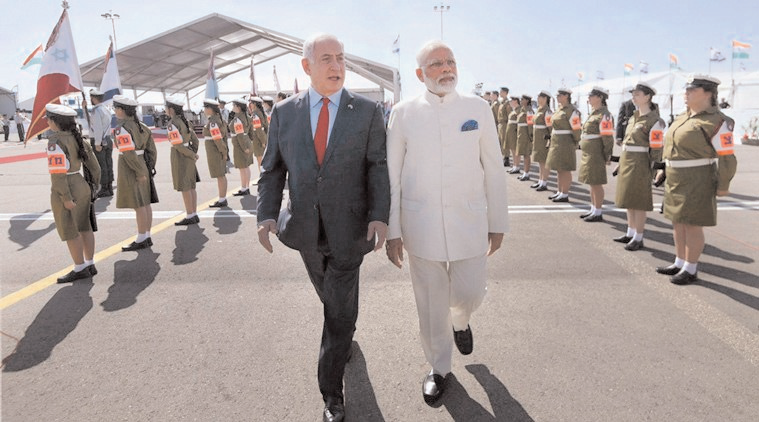
“One of the subjects on which the Indian media has created a lot of hype is the threat emanating from terrorism. It has worked hard to relate terrorism with Pakistan and blame it for virtually any terror incident occurring anywhere in India,” the daily said. PM Modi’s three-day visit to Israel is the first by an Indian Prime Minister to the Jewish nation. Israeli Prime Minister Benjamin Netanyahu along with his entire cabinet went to Tel Aviv’s Ben Gurion airport to receive Modi in a rare gesture.
Modi, before leaving for Tel Aviv, told an Israeli newspaper that terrorism was a common challenge and said New Delhi and Tel Aviv “can cooperate even more closely” in battling it.
Former ambassador Ali Sarwar Naqvi believes that the Indian media is too much obsessed with Pakistan, saying: “No matter where Modi goes, India always tries to drag Pakistan along.” However, Naqvi was sceptical if Israel would go too far to appease India.
“Pakistan is not under the immediate radar of Israel. Their (Israel) priority at the moment is Middle East.” However, Naqvi said their defence and military cooperation was something that had direct bearing on Pakistan.
For Gen Shoaib, there is a lesson for Pakistan in the ever-growing close relationship between Israel and India.
“If India can cement ties with Israel while at the same time maintaining diplomatic ties with its enemy Iran, why can’t Pakistan also show flexibility in its foreign policy,” Gen argued.
“Our foreign policy should not be merely aimed at appeasing any particular country. Rather we need to follow our own national interests,” he said.
Some analysts have advocated maintaining working relationship with Israel, if not establishing full diplomatic ties, in order to further and protect Pakistan’s interests.
In 2005, during former president Pervez Musharraf’s tenure, Pakistan and Israel established contacts and even foreign ministers of the two countries met in Turkey. However, things could not make headway further after that. (PTI)
-

Russian state has never been involved in hacking: Putin
ST PETERSBURG (TIP): President Vladimir Putin insisted June 1 that the Russian state has never engaged in hacking and scoffed at allegations that hackers could influence the outcome of elections in the United States or Europe.
But the Russian leader admitted the possibility that some individual “patriotic” hackers could have mounted some attacks amid the current cold spell in Russia’s relations with the West.
Speaking at a meeting with senior editors of leading international news agencies, Putin also alleged that some evidence pointing at Russian hackers’ participation in attacks could have been falsified in an attempt to smear Russia.
“I can imagine that some do it deliberately, staging a chain of attacks in such a way as to cast Russia as the origin of such an attack,” Putin said. “Modern technologies allow that to be done quite easily.” US intelligence agencies have accused Russia of hacking into Democratic Party emails, helping President Donald Trump’s election victory, and the Congressional and FBI investigations into the Trump campaign’s ties with Russia have shattered Moscow’s hopes for a detente with Washington. Putin said the “Russo-phobic hysteria” makes it “somewhat inconvenient to work with one another or even to talk.”
“It’s having an impact, and I’m afraid this is one of the goals of those who organize it are pursuing and they can fine-tune the public sentiments to their liking trying to establish an atmosphere that is going to prevent us from addressing common issues, say with regard to terrorism,” the Russian leader said. Putin predicted “this will end, sooner or later,” adding that “we are patient, we know how to wait and we will wait.”
Asked if Russian hackers could try to shape the outcome of German parliamentary elections later this year, Putin said: “We never engaged in that on a state level, and have no intention of doing so.”
He noted that Russia can work constructively with any German leader, adding that he had good ties with German Chancellor Angela Merkel despite some differences.
Russian meddling was also a concern in France, with Putin publicly expressing his sympathy for President Emmanuel Macron’s rivals in the campaign. Macron’s aides claimed in February that Russian groups were interfering with his campaign, and a document leak hit Macron’s campaign in the final hours of the French race.
Moscow has strongly denied all allegations of election meddling. Putin argued that hackers, wherever they come from, can’t sway election outcomes because the public mood cannot be manipulated that easily. “I’m deeply convinced that no hackers can radically influence another country’s election campaign,” he said.
“No hackers can influence election campaigns in any country of Europe, Asia or America.” Putin added that while the Russian state has never been involved in hacking, Russia-West tensions could have prompted some individuals to launch cyberattacks.
“If they have patriotic leanings, they may try to add their contribution to the fight against those who speak badly about Russia,” he said. “Theoretically it’s possible.”
Russia’s relations with the West have been at post-Cold War lows over the Ukrainian crisis. The US and the EU have slapped Moscow with sanctions over its annexation of Ukraine’s Crimean Peninsula and support for pro- Russian insurgency in eastern Ukraine.
Putin said Thursday that economic restrictions against Russia have had “zero effect.” He predicted that the current strain in relations will ease, because “it’s counterproductive and harmful.”
Touching on tensions in the Pacific, Putin said Russia’s military deployments on a group of Pacific islands also claimed by Japan have been caused by concerns about the US military buildup in the region.
The four islands, called the Northern Territories in Japan and the southern Kurils in Russia, were seized by the former Soviet Union at the end of the World War II, preventing the two countries from signing a peace treaty.
Putin said the US will likely continue to build up its missile shield in the region even if North Korea agrees to curb its nuclear and missile programs, in the same way it has continued to develop missile defenses in Europe despite a deal with Iran that curbed its nuclear program in exchange for lifting international sanctions. (AP)
-

Trump administration asks Supreme Court to revive travel ban
WASHINGTON: President Donald Trump’s administration on Thursday asked the US Supreme Court to revive his ban on travelers from six Muslim-majority nations after it was blocked by lower courts that found it was discriminatory.
The administration filed two emergency applications with the nine high court justices seeking to block two different lower court rulings that went against Trump’s March 6 order barring entry for people from Iran, Libya, Somalia, Sudan, Syria and Yemen for 90 days while the US government implements stricter visa screening.
The move comes after the Richmond, Virginia-based 4th US Circuit Court of Appeals on May 25 upheld a Maryland judge’s ruling blocking the order.
The administration also filed a separate appeal in that case. “We have asked the Supreme Court to hear this important case and are confident that President Trump’s executive order is well within his lawful authority to keep the nation safe and protect our communities from terrorism,” Justice Department spokeswoman Sarah Isgur Flores said in a statement.
At least five votes are needed on the nine-justice court in order to grant a stay. The court has a 5-4 conservative majority, with Justice Anthony Kennedy – a conservative who sometimes sides with the court’s four liberals – the frequent swing vote. Another of the court’s conservatives, Neil Gorsuch, was appointed by Trump this year.
If the government’s request is granted, the ban would go into effect. In its 10-3 ruling, the US 4th Circuit Court of Appeals said challengers of the ban, including refugee groups and others represented by the American Civil Liberties Union, were likely to succeed on their claim that the order violated the US Constitution’s bar against favoring or disfavoring a particular religion.
The March ban was Trump’s second effort to implement travel restrictions on people from several Muslim-majority countries through an executive order. The first, issued on Jan. 27, led to chaos and protests at airports and in major US cities before it was blocked by courts.
The second order was intended to overcome the legal issues posed by the original ban, but it was blocked by judges before it could go into effect on March 16. (Reuters)
-

India, Pak to become full SCO members at Astana summit: China
BEIJING (TIP): India and Pakistan’s admission to the Beijing-backed Shanghai Cooperation Organisation (SCO) will be formalised at the grouping’s summit in Kazakhstan next week, China said on June 1.
“The members states of the SCO are accelerating the MoU procedures with the two countries and everything is going very well,” foreign ministry spokesperson Hua Chunying said.
“We hope India and Pakistan as the full members at the Astana summit (on June 8-9). We also expect the Astana summit will complete the admission procedures for the two countries,” Hua told reporters.
Afghanistan, Belarus, India, Iran, Mongolia and Pakistan have observer status. (PTI)
-

Iran says it has built 3rd underground ballistic missile factory
ANKARA (TIP): Iran has built a third underground ballistic missile production factory and will keep developing its missile programme, the semi-official Fars news agency quoted a senior commander of the elite Revolutionary Guard as saying.
The development is likely to fuel tensions with the United States in a week when President Donald Trump, on his first foreign trip, has called Iran a sponsor of militant groups and a threat to countries across the Middle East. “Iran’s third underground factory has been built by the Guards in recent years … We will continue to further develop our missile capabilities forcefully,” Fars quoted Amirali Hajizadeh, head of the Guard’s airspace division, as saying. Since taking office in January, Trump has imposed new sanctions on Iran in response to its recent missile launches, putting Tehran “on notice”.
Iran has reacted defiantly. Newly re-elected pragmatist President Hassan Rouhani said on Monday: “Iran does not need the permission of the United States to conduct missile tests”. Iran’s Sunni Muslim Gulf neighbours and its archenemy Israel have expressed concerns over Tehran’s ballistic missile programme, seeing it as a threat to regional security. (PTI)
-

CPEC may ignite more India-Pakistan tensions: UN report
ISLAMABAD (TIP): The $50 billion China-Pakistan Economic Corridor (CPEC) traversing through PoK might create “geo-political tension” in the region by igniting further tensions between India and Pakistan, a UN report has warned.
The report released by the UN’s Economic and Social Commission for Asia and the Pacific (ESCAP) said that the project could also fuel separatist movement in Pakistan’s Balochistan province. “The dispute over Kashmir is also of concern, since the crossing of the CPEC in the region might create geo-political tension with India+ and ignite further political instability,” said the report on China’s ambitious Belt and Road Initiative (BRI).
The report, prepared at the request of China, also cautioned that the instability in Afghanistan could cast a shadow over viability of the CPEC over which India has already raised protests with China and boycotted the last week’s BRI summit in Beijing. “Afghanistan’s political instability could also limit the potential benefits of transit corridors to population centres near Kabul or Kandahar, as those routes traverse southern and eastern Afghanistan where the Taliban are most active,” the report said.
The report also covered other economic corridors of the BRI including the Bangladesh-China-India-Myanmar Economic Corridor (BCIM). According to the report, while the CPEC could serve as the “driver for trade and economic integration” between China, Pakistan, Iran, India, Afghanistan and the Central Asian states, it could also cause many problems within Pakistan and reignite separatist movement in the country due to opposition in Balochistan.
“However, social and environmental safeguards are a concern. The CPEC could lead to widespread displacement of local communities+ . In Balochistan, there are concerns that migrants from other regions of Pakistan will render ethnic Baloch a minority in the province,” it said.
Further, concerns exist that the CPEC will pass from the already narrow strip of cultivable land in the mountainous western Pakistan, destroying farmland and orchards. The resulting resettlements would reduce local population into an “economically subservient minority”, it said. “In addition, Hazaras are another minority of concern. If the benefits of the proposed CPEC are reaped by large conglomerates, linked to Chinese or purely Punjabi interests, the identity and culture of the local population could be further marginalised,” the report cautioned. “Marginalisation of local population groups could reignite separatist movements and toughen military response from the government,” it said.
About the BRI, it said, the scale of the BRI both in terms of geographical coverage and its cross-sectorial policy influence will shape the future of global development and governance.
“It brings wide-reaching implications for China, for the countries it links across the Asia-Pacific and for the global economy+ ,” it said. “In order for the full potential of the BRI to be realised there are several prerequisites. It should be founded on principles such as trust, confidence and sharing benefits among participating states.” It should play a positive role in the response to climate change over the coming decades, promoting low carbon development and climate resilient infrastructure, the report said.
“Lastly, to be effective and deliver results in a timely fashion, it should go beyond bilateral project transactions to promote regional and multilateral policy frameworks,” it said. “The BRI will serve the interests of China and the countries along its corridors more effectively if it is shaped as a collective endeavour and is well integrated into existing regional cooperation initiatives,” it said.
To this end, the BRI needs to co-opt and engage Asian sub regional platforms to ensure that it reinforces regional plans of connectivity and prioritises the missing transport links along corridors, particularly those in the China-Central-West Asia and the China-Indo-China-Peninsula corridors, it said.
Shamshad Akhtar, former governor of State Bank of Pakistan, who heads the ESCAP wrote the foreword for the report. In her foreword Akhtar said, “our analysis confirms the benefits the BRI could bring are significant. The BRI could help raise economic output levels by an average of 6 per cent in participating countries. If these countries lowered border transaction costs and import tariffs, the difference the BRI could make would be greater still.” (PTI)