Tag: Iran

  • Israeli minister accuses Iran of Argentina terror attacks

    Israeli minister accuses Iran of Argentina terror attacks

    BUENOS AIRES (ARGENTINA) (TIP): Israel’s agricultural minister on Thursday accused Iran of orchestrating two terrorist attacks in Argentina in the 1990s and urged the world not to negotiate with the Middle Eastern country on the future of its nuclear program.

    Agricultural Minister Yair Shamir led a delegation to Buenos Aires to commemorate the 1992 attack on the Israeli Embassy that killed 29 people and wounded hundreds.

    ”Iran continues to sow destruction and horror in all the world, but the world continues on as if nothing was happening,”Shamir said, speaking in Hebrew and accompanied by a Spanish translator.

    Shamir, the son of former Prime Minister Yitzhak Shamir, said the world takes on a “hypocritical attitude” that ignores that Iran is aiming ”at the civilized world, including Israel.” 

    Israel and Argentina have long accused Iran of both the embassy bombing and a car bomb attack on a Jewish community center in 1994 that killed 85 people.

    Speaking to the US Congress earlier this month, Israeli Prime Minister Benjamin Netanyahu mentioned the attacks in Argentina, arguing the world would be better off without a nuclear deal with Iran.

    Iran has denied involvement in both attacks. Nobody has been convicted in either attack.

    The annual commemorative event took on extra meaning this year after the mysterious death of prosecutor Alberto Nisman, who had led the investigation into the Jewish center bombing for more than a decade.

    Four days before he was found shot dead Jan. 18, Nisman had accused Argentine President Cristina Fernandez and other top government officials of orchestrating a secret deal to cover up the alleged role of several Iranians in the 1994 attack.

  • Status Quo in Israel

    The re-election of Prime Minister Benjamin “Bibi” Netanyahu after his Likud Party secured the first place with 30 out of the 120 seats in the 2015 Israeli legislative elections came as a bit of a surprise. Exit polls pointing to a better showing by the centrist-moderate coalition, the Zionist Union including the Labour Party, turned out to be wrong as the Likud emerged with far more votes than what was expected. While the Likud lacks a majority of its own, it now gets the right to form the government in coalition with other parties, and it is clear that Mr. Netanyahu will be Prime Minister for a fourth term.

    The Likud victory, belying expectations, can be attributed to the polarizing campaign led by Mr. Netanyahu who took a hyper-racist position denouncing Israeli Arabs and rejecting, in the run-up to the polls, the statehood demand by Palestinians. The triumph of the right wing also reflects the sharp change in attitudes in Israeli society that has become militantly opposed to any gesture of substantive peace with Palestinians. The silver lining in the elections was the emergence of the Joint List – a group of leftist and Arab parties – as the third largest grouping with 12 seats in the Knesset. Israeli Arabs have a larger and more inclusive voice in the Knesset than before.

    Globally, Mr. Netanyahu’s victory must frustrate even Israel’s closest ally, the United States, which was unable to dissuade the Israelis from the brutal bombardment of Gaza in 2014. A hardliner victory in Israel as the U.S. is battling the Islamic State hardly helps the larger strategic plan of easing tensions in West Asia. The U.S. has expressly supported a two-state solution and it must be worried by Mr. Netanyahu’s explicit rejection of Palestine nationhood during the election campaign. The U.S. could support a UN resolution explicitly defining a Palestinian state with pre-1967 borders as a response to Mr. Netanyahu’s change of views, but it is perhaps unlikely to happen.

    The U.S. is currently engaged in complex negotiations with Israel’s geopolitical rival Iran towards a nuclear treaty and would not want to upset its special relationship with Israel. Mr. Netanyahu’s allies go far beyond the White House and the U.S. State Department, with the powerful pro-Israel lobby spread across bipartisan lines in the U.S., especially in the resurgent Republican Party. However, Mr. Netanyahu’s uninhibited Zionist chauvinism might actually work to persuade western actors beyond the U.S. to see the Palestinian point of view on issues such as illegal Israeli settlements or the UN according statehood to the Palestinian Authority.

    (The Hindu) 

  • SPAIN FALLS FROM TOP 10 OF FIFA RANKINGS; GERMANY STILL 1ST

    ZURICH (TIP): European champion Spain have fallen out of the top 10 in FIFA’s rankings for the first time since 2007.

    World Cup winner Germany are still No. 1 ahead of Argentina, Colombia, Belgium and the Netherlands.

    The only change in the top 10 is that Italy have rose two places into 10th, while Spain drop one spot to 11th.

    None of the elite teams played in the last month, but games played earlier in the four-year cycle of results lost ranking value.

    Romania rose two places at No. 14 and could be seeded in July when European qualifying groups for the 2018 World Cup are drawn.

    Costa Rica remain No. 13 to lead CONCACAF nations. The United States fell one spot to No. 32.

    Algeria at No. 18 lead African nations. Iran are Asia’s best at No. 42.

  • Talks under way on ending UN sanctions on Iran

    Talks under way on ending UN sanctions on Iran

    UNITED NATIONS (TIP) : Major world powers have begun talks about a United Nations Security Council resolution to lift UN sanctions on Iran if a nuclear agreement is struck with Tehran, a step that could make it harder for the US Congress to undo a deal, Western officials said.

    The talks between Britain, China, France, Russia and the United States -the five permanent members of the Security Council – plus Germany and Iran, are taking place ahead of difficult negotiations that resume next week over constricting Iran’s nuclear ability.

    Some eight UN resolutions – four of them imposing sanctions – ban Iran from uranium enrichment and other sensitive atomic work and bar it from buying and selling atomic technology and anything linked to ballistic missiles. There is also a UN arms embargo.

    Iran sees their removal as crucial as UN measures are a legal basis for more stringent US and European Union measures to be enforced. The US and EU often cite violations of the UN ban on enrichment and other sensitive nuclear work as justification for imposing additional penalties on Iran.

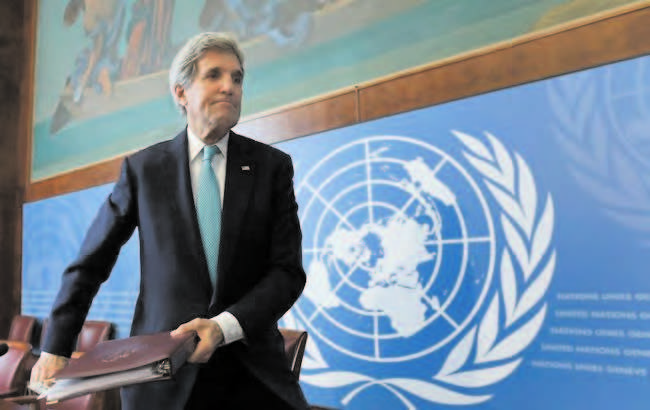
    US Secretary of State John Kerry told Congress on Wednesday that an Iran nuclear deal would not be legally binding, meaning future US presidents could decide not to implement it. That point was emphasized in an open letter by 47 Republican senators sent on Monday to Iran’s leaders asserting any deal could be discarded once President Barack Obama leaves office in January 2017.

    But a Security Council resolution on a nuclear deal with Iran could be legally binding, say Western diplomatic officials. That could complicate and possibly undercut future attempts by Republicans in Washington to unravel an agreement.

    Iran and the six powers are aiming to complete the framework of a nuclear deal by the end of March, and achieve a full agreement by June 30, to curb Iran’s most sensitive nuclear activities for at least 10 years in exchange for a gradual end to all sanctions on the Islamic Republic.

    So far, those talks have focused on separate US and European Union sanctions on Iran’s energy and financial sectors, which Tehran desperately wants removed. The sanctions question is a sticking point in the talks that resume next week in Lausanne, Switzerland, between Iran and the six powers.

    But Western officials involved in the negotiations said they are also discussing elements to include in a draft resolution for the 15-nation Security Council to begin easing UN nuclear-related sanctions that have been in place since December 2006.

  • Oil up in Asia trade despite US inventories rise

    Oil up in Asia trade despite US inventories rise

    SINGAPORE (TIP): Oil prices climbed in Asian trade as signs that a refineries strike in the United States is weakening overshadowed a rise in US crude stocks, analysts said.

    US benchmark West Texas Intermediate added 21 cents to $51.74 a barrel and Brent gained four cents to$60.59 in afternoon trade.

    Daniel Ang, an investment analyst with Phillip Futures in Singapore, said despite the rise in US inventories, traders focussed on signs that a refineries strike the the US could be settled, allowing more crude oil to be processed.

    “Although they have not come to a conclusion (on ending the strike) it seems that workers are coming back to work, which shows weakness in the strike and suggests that the strike is coming to an end soon,” he said.

    Workers and management are trying to end the strike at three major US refineries operated by Royal Dutch Shell following a stalemate on February 20.

    More than 5,000 workers spread across around a dozen installations have been on strike since February 1 demanding improved wages and safety conditions.

    The US Department of Energy (DoE) on Wednesday said commercial crude inventories jumped by 10.3 million barrels in the week February 27, higher than analyst forecasts.

    Inventories have set new records for five straight weeks, and US oil production is already high at 9.3 million barrels per day.

    Sanjeev Gupta, who heads the Asia-Pacific Oil and Gas practice at professional services firm EY, said the oil market is also closely watching developments in the talks between Iran and the US on Tehran’s nuclear ambitions.

    “Any positive news about likelihood of lifting of sanctions will lead to downward pressure on the price of Brent,” Gupta said.

    US Secretary of State John Kerry and his Iranian counterpart Mohammad Javad Zarif wrapped up three days of “intense” nuclear negotiations in the Swiss lakeside town of Montreux on Wednesday with still no deal, as a March 31 deadline for a framework agreement looms.

    Iran and the so-called P5+1 – Britain, China, France, Russia, the United States and Germany – are trying to strike a deal that would prevent Tehran from developing a nuclear bomb, a goal it denies having.

    In return, Iran is seeking an easing of punishing economic sanctions.

  • US-Israel spat intensifies over Netanyahu speech

    US-Israel spat intensifies over Netanyahu speech

    WASHINGTON: The US and Israel escalated their increasingly public spat on February 25 over Benjamin Netanyahu’s Republican-engineered congressional speech next week, with the Israeli prime minister accusing world powers of rolling over to allow Tehran to develop nuclear weapons. Secretary of State John Kerry openly questioned Netanyahu’s judgment on the issue.

    The comments injected new tension into an already strained relationship between the close allies ahead of Netanyahu’s address to Congress next Tuesday. More Democratic lawmakers announced they would boycott the speech, which was orchestrated by Republican leaders without the Obama administration’s knowledge.

    Netanyahu hopes his speech will strengthen opposition to a potential nuclear deal with Iran, President Barack Obama’s signature foreign policy objective. US and Iranian officials reported progress in negotiations this week on a deal that would clamp down on Tehran’s nuclear activities for at least 10 years but then slowly ease restrictions.

    Netanyahu lashed out at the US and other usual staunch allies of Israel.

    “It appears that they have given up on that commitment and are accepting that Iran will gradually, within a few years, will develop capabilities to produce material for many nuclear weapons,” he said in Israel.

    “They might accept this but I am not willing to accept this,” he said in remarks delivered in Hebrew and translated. “I respect the White House, I respect the president of the United States, but in such a fateful matter that can determine if we exist or not, it is my duty to do everything to prevent this great danger to the state of Israel.” 

    Kerry, testifying in Congress, dismissed Netanyahu’s worries. He argued that a 2013 interim agreement with Iran that the prime minister also opposed had in fact made Israel safer by freezing key aspects of the Islamic republic’s nuclear program.

    “He may have a judgment that just may not be correct here,” Kerry said.

    His comments, as well as statements from other top US officials, made clear the Obama administration had no plans to mask its frustrations during Netanyahu’s visit.

    In an interview Tuesday, National Security Adviser Susan Rice said plans for Netanyahu’s speech had “injected a degree of partisanship” into a US-Israel relationship that should be above politics. “It’s destructive to the fabric of the relationship,” Rice told the Charlie Rose show. “It’s always been bipartisan. We need to keep it that way.” 

    Netanyahu’s plans to speak to Congress have irritated many Democratic members, but also have put them in a difficult spot _ fearing they will look anti-Israel if they don’t attend. Still, a number of Democrats have said they plan to skip the session.

    Senate Democrats invited Netanyahu to meet with them privately while he is in Washington, but the Israeli leader refused the invitation, saying such a meeting could “compound the misperception of partisanship” surrounding his visit.

    “I regret that the invitation to address the special joint session of Congress has been perceived by some to be political or partisan,” Netanyahu wrote in a letter to Sens. Dick Durbin of Illinois and Dianne Feinstein of California. “I can assure you that my sole intention in accepting it was to voice Israel’s grave concerns” about a nuclear deal with Iran.

    Iran insists its nuclear program is for peaceful purposes.

    The White House has been weighing ways to counter Netanyahu’s address to Congress, as well as his separate speech to the annual policy conference of the American Israel Public Affairs Committee. The administration is considering whom to send to the conference, with some officials pushing for a lower-level representative than normal.


  • WHO WILL BELL THE NUCLEAR CAT? – Perspective on Nuclear India

    WHO WILL BELL THE NUCLEAR CAT? – Perspective on Nuclear India

    The world faces two existential threats: Climate change and nuclear Armageddon – and the bomb can kill us all a lot sooner and faster. The nuclear peace has held thus far as much because of good luck as sound stewardship, with an alarmingly large number of near accidents and false alarms by the nuclear rivals. Having learnt to live with nuclear weapons for 70 years, we have become desensitised to the gravity and immediacy of the threat. The tyranny of complacency could yet exact a fearful price with nuclear Armageddon. It really is long past time to lift the shroud of the mushroom cloud from the international body politic.

    Keeping nuclear nightmare at bay

    India’s propensity to let the best become the enemy of the good notwithstanding (the nuclear liability law is a good recent example), the Nuclear Nonproliferation Treaty (NPT) has kept the nuclear nightmare at bay for over four decades. The number of countries to sign it embraces virtually the entire family of nations. The number of countries with nuclear weapons is still -if only just – in single figures. Yet at the same time, the nuclear arsenals of the five NPT-defined nuclear weapons states expanded enormously under the NPT umbrella. The global total number of nuclear warheads climbed steadily after 1945, peaked in the mid-1980s at more than 70,000, and has fallen since then to a current total of almost 16,400 stockpiled by the world’s nine nuclear-armed states.

    Paradox of deterrence

    The central paradox of nuclear deterrence may be bluntly stated: Nuclear weapons are useful only if the threat to use them is credible but, if deterrence fails, they must never be used for fear of destroying the planet. Second, they are useful for some, but must be stopped from spreading to anyone else. Third, the most substantial progress so far on dismantlement and destruction of nuclear weapons has occurred as a result of bilateral US and Soviet/Russian treaties, agreements and measures, most recently a new Strategic Arms Reduction Treaty (New START). But a nuclear-weapon-free world will have to rest on a legally binding multilateral international instrument such as a nuclear weapons convention.

    Reluctant possessor

    India is the most firmly committed of the nuclear nine to such a goal that would be fully consistent with its policy as the most reluctant nuclear weapons possessor of them all. No other country paused for 24 years between the first test and eventual weaponisation. Successive governments, even since the 1998 tests, have declared with conviction that a nuclear-weapon-free world would enhance India’s national and global security, and also contribute to the attainment of India’s development goals.

    Optimism in 2009 to pessimism in 2015

    Five years ago hopes were high that the world was at last seriously headed towards nuclear disarmament. In April 2009 the (then) exciting new US President Barack Obama gave a stirring and inspiring speech in Prague outlining his dream of a world free of the existence and threat of nuclear weapons. The US and Russia negotiated New START that will cut their deployed strategic nuclear warheads by one-third to 1,550 each. The inaugural Nuclear Security Summit in Washington attracted broad international buy-in to an ambitious new agenda. In contrast to the total and scandalous failure of its 2005 predecessor, the Eighth NPT Review Conference of 2010 was a modest success.

    By the end of 2012, however, as reported in my Centre’s inaugural “Nuclear Weapons: The State of Play” report, much of this sense of optimism had evaporated. By the end of 2014, as our follow-up report “Nuclear Weapons: The State of Play 2015” documents, the fading optimism has given way to pessimism.

    A few silver linings

    To be sure, as always, there are a few silver linings. One has been the modest success of the Washington (2010), Seoul (2012) and The Hague (2014) Nuclear Security Summits in generating some consensus about the need to ensure that nuclear weapons and fissile material do not get into terrorist hands. Even here, however, much remains to be done to implement a fully effective international nuclear security system, setting global standards, including military materials within the nuclear security efforts, and with an accountability mechanism – and Russia has declined to participate further in the summit process.

    Another positive development has been the emergence of the humanitarian consequences movement. Successive conferences in Norway, Mexico and Austria have mobilised governments as well as civil society to focus on the reality that any use of nuclear weapons, the most indiscriminately inhumane ever devised, would have a catastrophic human and environmental impact, beyond the capacity of any one state’s, or all acting together through international organisations, emergency systems to address.

    Even so, levels of public engagement on nuclear weapons issues remain low and the nuclear-armed states are under little pressure to justify the claimed security benefits of nuclear deterrence, or to rigorously defend their vast expenditure on nuclear weapons and modernisation as an effective use of public money.

    The gathering nuclear storm

    Nuclear-armed states pay lip-service to the ultimate elimination of nuclear weapons, but none has committed to any “minimisation objective,” nor to any specific timetable for their major reduction – let alone abolition. On the evidence of the size of their weapons arsenals, fissile material stocks, force modernisation plans, stated doctrine and known deployment practices, all nine foresee indefinite retention of nuclear weapons and a continuing role for them in their security policies.

    North Korea conducted its third nuclear test in 2013 and the Comprehensive Nuclear-Test-Ban Treaty (CTBT) is yet to enter into force. We are no closer to resolving the challenge posed by North Korea and a comprehensive agreement on Iran eluded negotiators by the extended deadline of November 24. The push for NPT-mandated talks on a nuclear-weapon-free zone in the Middle East has stalled and the region remains highly volatile.

    New START was signed and ratified, but the treaty left stockpiles intact and disagreements about missile defence and conventional-arms imbalances unresolved. Nuclear weapons numbers have decreased overall but are increasing in Asia
    (India, Pakistan, China and North Korea); and fissile material production to make still more warheads is not yet banned. Cyber-threats to nuclear weapons systems have intensified, outer space remains at risk of nuclearisation, and the upsurge of geopolitical tensions over the crisis in Ukraine produced flawed conclusions about the folly of giving up nuclear weapons on the one hand, and open reminders about Russia’s substantial nuclear arsenal, on the other.

    The peoples of the world recognise the risks and dangers of nuclear arsenals. Curiously, however, their concerns and fears find little reflection in the media coverage or in governments’ policy priorities. In a recent survey conducted by the US Pew Research Center, nuclear weapons was chosen as the top threat in 10 of the 44 countries polled (including nuclear-armed states Russia and Pakistan), and as the second gravest threat in another 16 (including China). They were rated the top threat by 20 per cent of the people in the Middle East, 19 per cent in Europe, 21per in Asia, 26 per cent in Latin America, 22 per cent in Africa, and 23 per cent in the US.

    Latin America’s anti-nuclear commitment was reinforced by the negotiation of the regional nuclear-weapon-free zone in 1967 under the Treaty of Tlatelolco which consolidates and deepens the NPT prohibitions on getting the bomb. Since then virtually the entire southern hemisphere has embraced additional comparable zones in the South Pacific, Southeast Asia and Africa (plus Central Asia and Mongolia).

    Mitigating & eliminating nuclear risks

    Consequently, looking out at the world from our vantage point, we see no security upsides by way of benefits from nuclear weapons; only risks. Indeed it helps to conceptualise the nuclear weapons challenge in the language of risks. Originally, many countries acquired the bomb in order to help manage national security risks. As the four famous strategic heavyweights of Henry Kissinger, Sam Nunn, William Perry and George Shultz – all card-carrying realists – have argued in a series of five influential articles in The Wall Street Journal between 2007 and 2013, today the risks of nuclear proliferation and terrorism posed by nuclear weapons far outweigh their modest contributions to security.

    Viewed through this lens, the nuclear risks agenda has four components.

    First, risk management. We must ensure that existing weapons stockpiles are not used; that all nuclear weapons and materials are secured against theft and leakage to rogue actors like terrorist groups; and that all nuclear reactors and plants have fail-safe safety measures in place with respect to designs, controls, disposal and accident response systems.

    Second, risk reduction, for example by strengthening the stability-enhancing features of deterrence, such as robust command and control systems and deployment on submarines. Russia and the US could help by taking their 1,800 nuclear warheads off high-alert, ready to launch within minutes of threats being supposedly detected.

    Other countries, including Pakistan, could abandon interest in things like tactical nuclear weapons that have to be deployed on the forward edges of potential battlefields and require some pre-delegation of authority to use to battlefield commanders. Because any use of nuclear weapons could be catastrophic for planet Earth, the decision to do so must be restricted to the highest political and military authorities.

    Third, risk minimisation. There is no national security objectives that Russia and the US could not meet with a total arsenal of under 500 nuclear warheads each deployed across air, land and sea-borne platforms. If all others froze their arsenals at current levels, this would give us a global stockpile of 2,000 bombs or one-eighth the current total.

    Bringing the CTBT into force either by completing the required ratifications or changing the entry formula, concluding a new fissile material cut-off treaty, banning the nuclear weaponisation of outer space, respecting one another’s sensitivities on missile defence programs and conventional military imbalances etc. would all contribute to minimising risks of reversals and setbacks.

    None of these steps would jeopardise the national security of any nuclear-armed state; each would enhance regional and international security modestly; all in combination would greatly strengthen global security.

    Finally, risk elimination. Successive international commissions – the Canberra Commission, Tokyo Forum, Blix Commission, Evans -Kawaguchi Commission – have emphatically reaffirmed three core propositions. As long as any state has nuclear weapons, others will want them. As long as they exist, they will be used again some day, if not by design and intent, then through miscalculation, accident, rogue launch or system malfunction. Any such use anywhere could spell catastrophe for the planet.

    The only guarantee of zero nuclear weapons risk, therefore, is to move to zero nuclear weapons possession by a carefully managed process.

  • Senate confirms Ashton B. Carter as secretary of defense

    Senate confirms Ashton B. Carter as secretary of defense

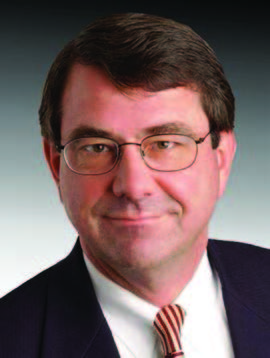
    WASHINGTON (TIP): Ashton B. Carter, a physicist with long experience in national security circles, handily won Senate confirmation Thursday, February 12, as secretary of defense, becoming President Obama’s fourth pick in six years to lead the Pentagon.

    The Senate voted 93 to 5 to approve Carter’s nomination, paving the way for him to be sworn into office sometime in the next few days.

    Voting against him were five Republicans senators: Roy Blunt (Mo.), Mike Crapo (Idaho), Mark Kirk (Ill.), James E. Risch (Idaho) and John Boozman (Ark.).

    Carter, 60, will replace Chuck Hagel, the former Republican senator from Nebraska who agreed in November to step down after Obama lost confidence in his leadership. The White House has said it wanted a new Pentagon chief to oversee the fight against the Islamic State in Syria and Iraq, as well as the continued drawdown of U.S. troops from Afghanistan.

    “With his decades of experience, Ash will help keep our military strong as we continue the fight against terrorist networks, modernize our alliances, and invest in new capabilities to keep our armed forces prepared for long-term threats,” said Obama in a statement.

    A Rhodes scholar with eclectic interests – he wrote an undergraduate thesis at Yale on the Latin writings of 12th-century Flemish monks – Carter will return to the Pentagon just 14 months after he resigned as deputy secretary of defense. He previously served as the Pentagon’s chief weapons buyer and also as a senior defense official during the Clinton administration.

    During testimony before the Senate Armed Services Committee last week, Carter pledged to keep an independent voice and demonstrated a willingness to differ with the White House. For example, he said he was “inclined” to support arms deliveries to Ukraine and that he would be open to reviewing the timetable for withdrawing troops from Afghanistan.

    Sen. Jack Reed (D-R.I.), said Carter would have to focus on existing problems such as the fighting in Ukraine, Syria, Iraq and Afghanistan but also longer-term challenges such as China’s military buildup.

    Even more daunting crises, he added, could emerge in the near future. For example, if negotiations with Iran over its nuclear program fail this year, he noted, “the consequences could alter the face of the region for generations and generations to come.”

    Sen. John McCain (R-Ariz.), the committee chairman, praised Carter on Thursday as a “committed public servant” who has drawn bipartisan support. But he questioned how much sway he would have with the White House.

    “When it comes to much of our national security policy, I must candidly express concern about the task that awaits Dr. Carter and the limited influence he may have,” McCain said. He said he had “sincere hope, but sadly little confidence, that the president who nominated Dr. Carter will empower him to lead and contribute to the fullest extent of his abilities.”

  • Reset of a policy of equidistance

    Reset of a policy of equidistance

    Soon after Prime Minister Narendra Modi took office, an Indian TV channel held a discussion on likely foreign policy reorientation. When the doyen of South Asian Studies, Stephen Cohen, was asked in which direction Mr. Modi would tilt -the U.S. or China – without hesitation he replied, “China,” adding, “because it is the Asian century.” Mr. Modi hosted Chinese President Xi Jinping last year but despite the fanfare preceding the visit, there was little to suggest any strategic overlap. Alas, Mr. Cohen was proved wrong after the Modi-Obama Joint Vision Statement reflected a sharp, strategic congruence. Mr. Modi has reset the United Progressive Alliance (UPA) government’s policy of equidistance between the U.S. and China and dropped the political refrain that India will not contain China.


    Choosing friends and allies

    In New Delhi last year, at a seminar, the former U.S. Ambassador to India, Robert D. Blackwill, posed the question: “How can New Delhi claim strategic autonomy when it has strategic partnerships with 29 countries?” After the latest Modi-Obama vision statement, even less so. Strategic autonomy and no military alliances are two tenets of India’s foreign policy. Quietly, India has converted strategic autonomy to strategic interconnectedness or multi-vectored engagement. When the Indo-Soviet Treaty of Peace, Friendship and Cooperation 1971 was signed, Mrs Indira Gandhi had requested the Soviet Union to endorse India’s Non-Aligned status, so dear was the policy at the time. That multifaceted treaty made India a virtual ally of the Soviet Union. Russia inherited that strategic trust and has leased a nuclear submarine, provided high-tech weapons to all three Services including technology for nuclear submarines and aircraft carriers. At the BRICS meeting in Brazil last year, when asked a question, Mr. Modi said as much: “If you ask anyone among the more than one billion people living in India who is our country’s greatest friend, every person, every child knows that it is Russia.” 

    On the other hand, differences over foreign policy with the U.S. are many including over Syria, Iran, Russia, BRICS and the Shanghai Cooperation Organisation (SCO). These policy irritants will not go away. The vision statement highlights (at the U.S.’s insistence) that both countries were on the same page in ensuring that Iran did not acquire nuclear weapons. The tongue-lashing by Mr. Obama to Mr. Putin over his bullying small countries has certainly embarrassed Mr. Modi who was himself disingenuous by inviting the leader of Crimea as a part of the Putin delegation in 2014, which deeply offended the Americans.

    What Mr. Obama and Mr. Modi easily agreed on was China’s “not-peaceful rise” which could undermine the rule-based foundations of the existing international order. So, Mr. Modi became a willing ally to stand up to China. The synergisation of India’s Act East Policy and U.S. rebalancing to Asia is intended to ensure that China does not cross red lines including the code of conduct at sea. The two theatres of action where freedom of navigation and overflight have to be ensured were identified as Asia-Pacific especially the South China Sea and, for the first time, the Indian Ocean Region.

    This is a veiled riposte to Chinese assertiveness in the South China Sea. Mr. Modi had earlier mooted the revival of the Quad, an enlarged format for naval exercises between India, the U.S., Japan and Australia. When it was mooted earlier in 2006, it was shot down by China. Underlying the strategic centrality of the Indian Ocean Region is the realisation that the existing India-China military imbalance across the high Himalayas can be offset only in the maritime domain where India has the initiative. Beijing realises that teaching India a lesson in 1962 was only a tactical success because territorial claims on Arunachal Pradesh got delegitimised after the unilateral withdrawal and worse, pushed India into the U.S.’s arms.


    Defence ties

    The rise of India which will punch to its weight under a new self-confident leadership pursuing a policy of multi-engagement is a manifest U.S. strategic goal. Defence has been the pivot around which India-U.S. relations were rebuilt, starting in 1991 with the Kicklighter Plan (Lt.Gen. Kicklighter of the U.S. Pacific Command) who initiated the multilayered defence relations which fructified in 1995 into the first Defence Framework Agreement. It was renewed in 2005 and now for the second time this year, the difference though is that for the first time, the vision statement has provided political and strategic underpinnings to the agreement. What had also been lacking until now was trust and the extent to which India was prepared to be seen in the American camp. Just a decade ago, while contracting for the Hawk trainer aircraft with the U.K., India inserted a clause that “there will be no US parts in it.” This followed the Navy’s sad experience of the U.S. withholding spare parts for its Westland helicopters. Such misgivings have held up for a decade the signing of the three “alphabet- surfeit” foundational defence agreements of force-multiplication. But we have moved on and purchased $10 billion of U.S. high-tech military equipment and another $10 billion worth will soon be contracted. The most elaborate defence cooperation programme after Russia is with the U.S.


    Dealing with China

    What made Mr. Modi, who visited China four times as Chief Minister, change his mind on the choice of the country for primary orientation was the jolt he received while welcoming President Xi Jinping to Gujarat last year. Mr. Xi’s delegation was mysteriously accompanied by a People’s Liberation Army (PLA) intrusion in Ladakh which did not yield ground till well after he had left. A similar affront preceded the 2013 visit of Premier Li Keqiang, making routine the PLA’s bad habits. While the UPA government had made peace and tranquillity on the Line of Actual Control (LAC) a prerequisite for consolidation of bilateral relations, border management rather than border settlement had become the norm. Seventeen rounds of Special Representative talks on the border yielded little on the agreed three-stage border settlement mechanism. It was therefore path-breaking when Mr. Modi during the Joint Statement asked Mr. Xi for a clarification on the LAC -the process of exchanging maps that had failed in the past and led to the ongoing attempt at a political solution skipping marking the LAC. Clearly, we have moved full circle in calling for a return to that process. Foreign Minister Sushma Swaraj, who was in Beijing this month, sought an out-of-the-box solution for the border, in which category LAC clarification will not figure. Mr. Modi is determined not to leave resolution of the border question to future generations as Chinese leaders have persistently counselled. 

    Mr. Modi, in Japan last year, expressed concerns over “expansionist tendencies.” 

    Chinese scholars I met in Beijing last year said that conditions for settling the territorial dispute were not favourable because the border is a very complicated issue, entailed compromise and had to take public opinion along. And most importantly, strong governments and strong leaders were needed for its resolution.

    While Mr. Xi did promise last year investments worth $20 billion, the fact is that, so far, Chinese investments in India do not exceed $1.1 billion. Mr. Xi’s dream of constructing continental and maritime Silk Roads are intended to complement the String of Pearls in the Indian Ocean Region, bypassing choke points like the Malacca Straits as well as neutralising the U.S. rebalancing to Asia.


    Risks and opportunities

    How will India walk the tightrope between the U.S. and China, given that the U.S. is about 13,000 kilometres away and Beijing exists cheek by jowl, peering over a disputed border and with a whopping $40 billion in trade surplus? China’s reaction to the vision statement has been to warn India against U.S. entrapment. Operationalising the strategic-security portions of the vision statement will not be easy, especially as India has no independent role in the South China Sea. Once the euphoria over the Obama-Modi statement dissipates, ground reality will emerge. Instigating Beijing, especially in the South China Sea will have costs like having to deal with the full frenzy of the PLA on the LAC with most likely ally, Pakistan lighting up the Line of Control (LoC) – the worst case two-front scenario.

    Given Mr. Modi’s growth and development agenda, for which he requires the U.S., China, Japan and others, he cannot afford to antagonise Beijing. The U.S. is vital for India’s rise and a hedge to China. So, New Delhi will necessarily be on a razor edge. In any realisation of the Asian century, while China and India are likely key players, Washington will be large and looming, making a geostrategic ménage à trois.

  • ISRAEL BURIES SOLDIERS, SAYS HEZBOLLAH DOESN’T WANT CONFLICT

    ISRAEL BURIES SOLDIERS, SAYS HEZBOLLAH DOESN’T WANT CONFLICT

    JERUSALEM (TIP): Israel was burying January 29 two soldiers killed in a Hezbollah missile strike that triggered Israeli fire on southern Lebanon, raising tensions between the bitter enemies to their highest in years.


    But the Israeli-Lebanese border was calm, and Israeli officials played down the threat of a new war with the powerful Iran-backed Shiite group’s militia.


    In an unusual declaration, Israeli Defence Minister Moshe Yaalon said Hezbollah had passed on a message through the UN peacekeeping mission in southern Lebanon saying it did not want a further escalation.


    “We have received a message… that, from their point of view, the incident is over,” he told public radio.


    Analysts say neither side seems keen for a repeat of the devastating Israel-Hezbollah conflict in 2006 and that any response is likely to be limited.


    The two soldiers were killed when Hezbollah fired anti-tank missiles at a convoy in an Israeli-occupied area on the border with Lebanon.

  • Charlie Hebdo sells out as 5 million print run is announced

    Charlie Hebdo sells out as 5 million print run is announced

    Charlie Hebdo is fetching $600 asking prices on eBay as millions hope to get their hands on the commemorative edition, the first to come out after eight staffers and four others were slaughtered.

    PARIS (TIP): A defiant Charlie Hebdo went on sale Wednesday, January 14, in five languages and in more than 20 countries, splashing a cartoon purporting to be Mohammed on its front cover a week after jihadist gunmen stormed the satirical weekly’s offices killing 12 people.

    The newspaper normally prints 60,000 copies a week. This week’s print run will be five million (up from three million announced on Tuesday), distributed over the next two weeks.

    It is a record for any French newspaper, with versions being printed in Spanish, Arabic, Italian, Turkish and English for the first time.

    Across Paris on Wednesday, even at 6am, many shops and kiosks had already sold out.

    At Belleville in Paris’s 19th arrondissement (district), the newspaper kiosk at the metro station had sold its 150 copies within minutes of opening at 6am.

    The paper’s front cover shows a turbaned man (not explicitly the Prophet Mohammed) shedding a tear and declaring that he too “is Charlie” – “Je suis Charlie” was the slogan of a huge outpouring of grief and solidarity in France in the days that followed the attacks. The front-page figure adds that “all is forgiven”.

    Global response

    The global attention following last week’s attacks – which saw another gunman kill four hostages in a Jewish supermarket in Paris -has seen demand for Charlie Hebdo explode as far away as India and Australia.

    While the front page had been widely shared online ahead of publication, many newspapers in both Muslim countries and in the West refrained from printing the cartoon because of blasphemy laws and also sensitivity over reproducing an image of the Prophet, which is considered offensive by Muslims.

    Charlie Hebdo’s front page was not reproduced by the mainstream media in the US, where any kind of religious satire is frowned upon, although the White House reaffirmed its “absolute support [of the] the right of Charlie Hebdo to publish things like this”.

    In Egypt, the chief imam at the al-Azhar mosque, an institution widely-seen as the centre of the Sunni Muslim faith, condemned Charlie Hebdo’s decision to lead its latest issue with a cartoon of the Prophet, calling it an “incitement to hatred”.

    The Dar al-Ifta, which represents Egyptian Muslims, called the new front page a “provocation”, while in Shiite-dominated Iran, conservative news site Tabnak accused Charlie Habdo of “once again insulting the Prophet”.

    Islamophobia and France’s far right
    Paradoxically, Charlie Hebdo is one of France’s loudest voices against racism, whose principal target of abuse has always been France’s far-right National Front (FN, whose founder Jean-Marie Le Pen has been convicted numerous times of racism and anti-Semitism). The FN is widely seen as virulently Islamophobic.

    But the newspaper’s decision in 2006 to re-print cartoons of Mohammed published in Danish daily Jyllands-Posten brought so much ire on Charlie Hebdo that its editors decided to publish regular cartoons lampooning radical Islamists as well as depictions of Mohammed himself, who, in one case, is shown lamenting the difficulty of being “followed by complete idiots”.

    Inevitably, Charlie Hebdo became the focus for widespread disapproval in France’s large Muslim community, and the two French-born gunmen who entered the newspapers offices last Wednesday, murdering 12 people, ran out shouting that they had “avenged the Prophet”.

    The survivors of the attack have defended their caricatures of Islam and Mohammed.

    “The Mohammed we have portrayed is a much nicer character than the version of Mohammed brandished by the attackers,” said one member of the weekly’s editorial staff.

    “And if we can get our ideas read across the world, it is we who are the ultimate winners,” added Charlie Hebdo’s editor-in-chief Gérard Biard.

    On Tuesday, French Prime Minister Manuel Valls set out the government’s updated response to terrorism, following last week’s murderous assault on the magazine and a Jewish supermarket.

    But he insisted that “blasphemy does not feature in the laws of France, and it never will”.

  • IMPLICATIONS OF AMERICAN WITHDRAWAL FROM AFGHANISTAN

    IMPLICATIONS OF AMERICAN WITHDRAWAL FROM AFGHANISTAN

    “The Taliban attacks within Afghanistan reached unprecedented levels in 2014. Moreover, while Washington proclaims that any process of “reconciliation” between the Taliban and the Afghan Government will be “Afghan led and Afghan driven,” the reality is that Rawalpindi will ensure that the entire “reconciliation” process will be controlled and driven by the ISI”, says the author.

    American military interventions in recent times – be these in Vietnam, Somalia, Lebanon, Libya, or Iraq -have undermined regional stability and left deep scars on the body politic of these countries. The society and the body politic of America have felt the tremors of these misadventures. The American military intervention in Afghanistan, code-named
    “Operation Enduring Freedom”, commenced in the aftermath of 9/11. Its combat role ended 13 years later on December 31, 2014. The Americans tried to win “Operation Enduring Freedom” cheaply, outsourcing many operations to the erstwhile Northern Alliance. Adversaries comprising the Mullah Omar-led Afghan Taliban, Al-Qaida, thousands of Islamic radicals from the Arab world, Chechnya, Uzbekistan, Tajikistan, China’s Xinjiang province and ISI-linked Pakistani terrorist groups escaped across the Durand Line, to safe havens under ISI protection, in Pakistan.

    The US has paid a heavy price for this folly. Some 2,200 of its soldiers were killed in combat, suffering heavy losses in the last four years after it became evident that it was pulling out. As the US was winding down its military presence and transferring combat responsibilities to the Afghan National Army (ANA), an emboldened Taliban and its Chechen, Uzbek, Uighur and Turkmen allies have emerged from their Pakistani safe havens and moved northwards. In subsequent fighting 4,600 Afghan soldiers were killed in combat in 2014 alone. The Afghan army cannot obviously afford such heavy casualties continuously, if morale is to be sustained. Its available tactical air support and air transport infrastructure are woefully inadequate. The Afghans do not have air assets which were available to the NATO forces.

    Apart from what is happening in southern Afghanistan, Taliban-affiliated groups are now increasing their activities in northern Afghanistan, along its borders with Turkmenistan, Uzbekistan, Tajikistan and China’s Xinjiang province. Afghanistan’s northern provinces like Kunduz, Faryab and Takhar have seen increased attacks by the Taliban allies, from Tajikistan, Turkmenistan and Uzbekistan. These Central Asian countries are getting increasingly concerned about the security situation along their borders. American forces are scheduled to be halved in 2015 and reduced to a token presence, just sufficient to protect American diplomatic missions by the end of 2016. Not surprisingly, President Ashraf Ghani has asked the US to review its withdrawal schedule.

    Afghanistan’s southern provinces, bordering the disputed Durand Line with Pakistan, are increasingly ungovernable. Following Gen Raheel Sharif’s assault on the Pashtuns in Pakistan’s tribal areas, over one million Pashtun tribals have fled their homes in Pakistan, with an estimated 2, 50,000 fleeing into neighboring Afghanistan. If Mullah Omar, his Taliban associates and Sirajuddin Haqqani’s terrorist outfit are finding safe havens in Pakistan, Mullah Fazlullah and his followers in the Pakistani Taliban (TTP) appear to have disappeared into the wilderness, in Afghanistan. Senator Kerry will likely secure a waiver on legislative requirements that Pakistan has stopped assistance to terrorist groups operating against Afghanistan and India, to enable the flow of American aid to Pakistan. The reality, however, is that even after the Peshawar massacre of schoolchildren, terrorist groups like the Haqqani network, Jaish e Mohammed and Lashkar e taiba receive safe haven and support in Pakistan.

    Despite professed American understanding of a “change of heart” in Islamabad and Rawalpindi, the reality remains that Mullah Omar is still leading the Afghan Taliban from a safe house in Karachi. The day-to-day conduct of operations in Afghanistan has reportedly been transferred by the ISI to one of his deputies, Mullah Akhtar Muhammad Mansour. The Taliban attacks within Afghanistan reached unprecedented levels in 2014. Moreover, while Washington proclaims that any process of
    “reconciliation” between the Taliban and the Afghan Government will be “Afghan led and Afghan driven,” the reality is that Rawalpindi will ensure that the entire
    “reconciliation” process will be controlled and driven by the ISI. China, now endorsed by the US as the new “Good Samaritan” to facilitate Afghan “reconciliation,” has maintained ISI-facilitated links with Mullah Omar’s Quetta Shura. Beijing will naturally endorse the wishes of its “all-weather friend,” Pakistan.

    Afghanistan’s Central Asian neighbors, which are members of the Shanghai Cooperation Organization (SCO), to which India was recently admitted, can expect little from this organization to deal effectively with their concerns, given the fact that China has been now joined by Pakistan as a member of the SCO. Given its growing economic woes and sanctions imposed by the US and its allies, Russia will have little choice, but to fall in line with China, though its special envoy Zamir Kabulov has expressed Moscow’s readiness to supply weapons to Kabul “when it will be necessary to supply them”. Past Russian policy has been to supply weapons to Kabul on strictly commercial terms.

    Adding to the prevailing uncertainty is the fact that Afghanistan is today ruled not by the provisions of its Constitution, but by a patchwork coalition of two formerly implacable political foes, President Ashraf Ghani and Chief Executive Abdullah Abdullah. The political gridlock in Kabul is tight. After the presidential elections, which were internationally regarded as neither free nor fair, the ruling duo, stitched together by Senator John Kerry, took months just to agree on the names of new ministers.

    India can obviously not countenance the return of an ISI-backed Taliban order in Afghanistan. The US-Afghanistan Bilateral Security Agreement envisages the possibility of a US military presence “until the end of 2024 and beyond.” Will it be realistic to expect a war-weary US and its NATO partners, now heavily focused on combating ISIL and radical groups across the Islamic world ranging from Iraq, Syria, Libya and Lebanon, to Somalia and Nigeria, to continue to bail out a politically unstable Afghanistan? Will the Americans and their allies continue providing Afghanistan adequate air support, weapons and financial assistance amounting to $5-10 billion annually?

    These are realities we cannot gloss over. A thorough review of issues like safety and security of Indian nationals and our missions in Afghanistan, access and connectivity through Iran and completion of assistance projects like Salma Dam and Afghan Parliament, has to be undertaken.

    By G Parthasarathy (The author is a career diplomat and author. He remained envoy of India to many countries, including Pakistan and was spokesperson of the Ministry of External Affairs and the Prime Minister’s Office)

  • Why this massacre of the innocents?

    Why this massacre of the innocents?

    It was a massacre of the innocents. Every report must admit this – because it’s true. But it is not the whole truth. The historical and all-too-real connections between the Pakistan army, the Inter-Services Intelligence (ISI) security police and the Taliban itself – buoyed by the corruption and self-regard of the political elite of the country – may well explain just how cruel this conflict in the corner of the old British Empire has become. And the more ferocious the battle between the military and the Islamists becomes in Waziristan, the more brutal the response of the Islamists.

    Miltary barbarity

    Thus when stories spread of Pakistani military barbarity in the campaign against the Taliban in Pakistan – reports which included the execution of Taliban prisoners in Waziristan, whose bodies were left to lie upon the roads to be eaten by animals- the more certain became the revenge of the Taliban. The children of the military officers, educated at the army school just down the road from the famous Edwardes College in Peshawar – were the softest and most obvious of targets. For many years, the ISI and the Pakistani army helped to fund and arm the mujaheedin and then the Taliban in Afghanistan.

    Saudis & weapons

    Only a few months ago, the Pakistani press was reporting that the Saudis were buying weapons from the Pakistani army to send to their rebel friends in Syria. Pakistan has been the tube through which America and its Arab allies supplied the anti-Russian fighters in Afghanistan, a transit route which continued to support the Taliban even after America decided that its erstwhile allies in that country had become super-terrorists hiding Osama bin Laden. Turkey is today playing much the same role in Syria.

    David Gosling, who was the principal of Edwardes College for four years until his return to Britain in 2010, believes that while individuals in the Pakistani army may wish for revenge after the Peshawar schoolchildren atrocity, the military may well now
    “soft-peddle their activities in Waziristan”. The Taliban, he says, “has always reacted to the army’s campaigns in Swat and Waziristan with bombs. The Pakistan army is going to be very disturbed by all this. Attacking civilian targets has a powerful effect on the population. These are soft targets. The army is going to be furious – but you have these close links between the ISI, the army and the Taliban…”

    Old loyalties

    For years, the Pakistani authorities have insisted that the old loyalties of individual military and security police officers to the Taliban have been broken – and that the Pakistani military forces are now fully dedicated to what the Americans used to call the “war on terror”. But across the Pakistan-Afghan border, huge resentment has been created by the slaughter of civilians in US drone attacks, aimed – but not necessarily successfully targeted – at the Taliban leadership. The fact that Imran Khan could be so successful politically on an anti-drone platform shows just how angry the people of the borderlands have become. Pakistani military offensives against the Taliban are now seen by the victims as part of America’s war against Muslims.

    But if the Pakistan security forces regard the Taliban as their principal enemy, they also wish to blunt any attempt by India to destroy Pakistan’s influence in Afghanistan; hence the repeated claims by the Afghan authorities – if such a term can be used about the corrupted institutions of Afghanistan – that Pakistan is assisting the Taliban in its struggle against the pro-American regime in Kabul. The army hates the Taliban – but also needs it: this is the terrifying equation which now decides the future of Pakistan.

    It may well be that the Taliban, knowing the dates of the American withdrawal in Afghanistan, now wishes to extend its power in Pakistan. More seriously, the greater the extension of Islamist rule in the Muslim Middle East – in Algeria and Libya, as well as in Syria, Iraq and Yemen, even in Lebanon – the more encouraged the Taliban becomes. As Sunni Muslims, they have often inflicted enormous carnage on their fellow Shia citizens in Pakistan -although without the headlines devoted to yesterday’s massacre.

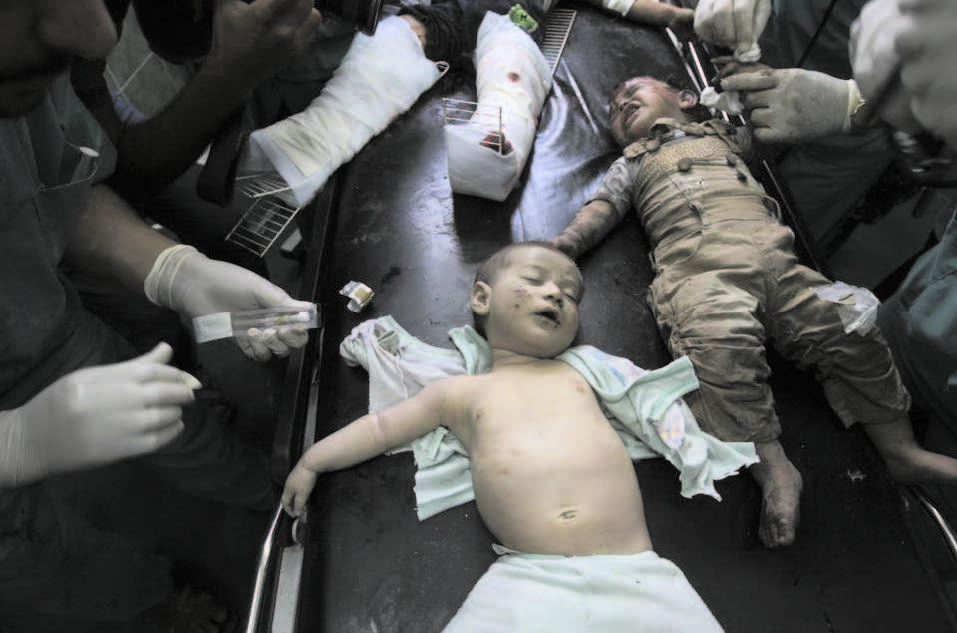
    “You must remember,” Gosling says, “how enraged people were with the Israeli attacks on Gaza this year. People in Pakistan were furious at the casualty toll – more than 2,000 people, many of them children.” Needless to say, the phrase “massacre of the innocents” was not used about those children.

    Eight deadly years

    2014

    2 NOVEMBER: Taliban suicide bomber kills 60 people in an attack on a paramilitary checkpoint close to the Wagah border crossing with India.

    8 JUNE: A suicide bomber in the country’s south-west killed at least 23 Shia pilgrims returning from Iran.

    2013

    22 SEPTEMBER: Twin suicide bomb blasts in a Peshawar church kill at least 85 people.

    3 MARCH: Explosion in Karachi kills 45 Shia outside a mosque.

    10 JANUARY: Bombing in Shia area of Quetta kills 81 people.

    2012

    22 NOVEMBER: A Taliban suicide bomber struck a Shia procession in the city of Rawalpindi, killing 23.

    5 JANUARY: Taliban fighters kill 15 Pakistani frontier police after holding them hostage for more than a year.

    2011

    20 SEPTEMBER: Militants kill at least 26 Shia on a bus near Quetta.

    13 MAY: A pair of Taliban suicide bombers attack paramilitary police recruits in Shabqadar, killing 80, in retaliation for Osama bin Laden’s killing.

    2010

    5 NOVEMBER: A suicide bomber strikes a Sunni mosque in Darra Adam Khel, killing at least 67 during Friday prayers.

    1 SEPTEMBER: A triple Taliban suicide attack on a Shia procession kills 65 in Quetta.

    9 JULY: Two suicide bombers kill 102 people in the Mohmand tribal region.

    2 JULY: Suicide bombers attack Pakistan’s most revered Sufi shrine in Lahore, killing 47 people.

    29 MAY: Two militant squads armed with hand grenades, suicide vests and assault rifles attack two mosques of the Ahmadi minority sect in Lahore, killing 97.

    1 JANUARY: A suicide bomber drives a truckload of explosives into a volleyball field in Lakki Marwat district, killing at least 97 people.

    2009

    28 DECEMBER: Bomb blast kills at least 44 at a Shia procession in Karachi.

    9 OCTOBER: A suicide car bomber hits a busy market area in Peshawar, killing 53.

    2008

    20 SEPTEMBER: A suicide bomber devastates the Marriott Hotel in Islamabad with a truck full of explosives, killing at least 54.

    2007

    27 DECEMBER: Former Prime Minister Benazir Bhutto and 20 other people are killed in a suicide bombing and shooting attack in Rawalpindi.

  • Political shadow boxing, threat & reality

    Political shadow boxing, threat & reality

    “The American invasion of Iraq cost the lives of millions of children. Whatever the changing definitions of terror, it is children that are so often the forgotten victims of conflict – regardless of the perpetrator”, says the author.

    Well, heaven preserve us: the most useless “peacemaker” on earth has just used an Arabic acronym for the greatest threat to civilisation since the last greatest threat. Yup, ol’ John Kerry called it “Daesh”, which is what the Arabs call it. It stands for the “Islamic State in Iraq and the Levant”. We prefer Isis or Isil or the Islamic State or Islamic Caliphate. Most journos prefer Isis because – I suspect – it’s easier to remember. It’s the name of an Egyptian goddess, after all.

    It’s the name of a university city’s river. Many an American scribe has questioned why Kerry should be using this goddam Arabic lingo – although we use Fatah for the PLO. It, too, is an acronym which, translated, means “the Party for Palestinian Liberation”. And in 2011, we called Tahrir Square in Cairo “Tahrir”, only occasionally reminding readers and viewers that it, too, meant “liberation”. None explained why the place was important: because this was the square mile of Cairo in which was based the largest British barracks and into which the Brits – during their much-loved occupation of Egypt – refused to allow any Egyptian to walk without permission. That’s why it was called Tahrir – liberation – when the Brits left.

    That’s why Hosni Mubarak’s attempt to prevent the protesters entering the square in 2011 placed him firmly in the shadow of Egypt’s former colonial masters. But why do we care what the great leaders of the West (or the East for that matter) actually say, when we all know it’s the kind of material that comes out of the rear end of a bull? Let me give you an example from Canada. Two years ago, the country’s Foreign Affairs Minister, John Baird, closed Canada’s embassy in Tehran because he feared his diplomats might be harmed. “Canada views the government of Iran as the most significant threat to global peace and security in the world today,” he quoth then – although CBC broadcasters have dug up a Foreign Ministry report which reported the biggest threat to the Tehran embassy was an geophysical earthquake.

    Since then, as the Toronto Star’s pesky columnist Thomas Walkom has pointed out, the Canadian Prime Minister Stephen Harper – whose pro-Israeli policies might earn him a seat in the Israeli Knesset -has discovered more threats. Russia under Vladimir Putin, Harper says, “represents a significant threat to the peace and security of the world”. The aforesaid Baird, taking his cue, no doubt from our own beloved Prince Charles, compared Putin’s Russia to Hitler’s Third Reich. More recently, Canada’s defence minister, Rob Nicholson, described the men of Isis (or Isil, or the Islamic State, or the Islamic Caliphate, or Daesh) as “a real and growing threat to civilisation itself”.

    The war against Isis/ Isil/ IS/ IC/ Daesh, he informed the people of Abu Dhabi, was “the greatest struggle of our generation”. Well, blow me down.Wasn’t Iran the greatest threat, ever since 1979? Wasn’t Abu Nidal, the Palestinian gun-for-hire? Wasn’t that British prime minister chappie, with the habit of saying “absolutely” and “completely” over and over again, convinced that Saddam was the greatest threat to our civilisation or generation, what with all his WMDs and links to Al-Qaida and tubes from Niger, and so on? For that matter, wasn’t Osama bin Laden’s Al-Qaida – the very bunch which morphed into Isis/ Isil/ IS/ IC/ Daesh in Iraq – the greatest threat to our civilisation/generation? Yet now, when the Iranian air force has joined the battle against Isis/ Isil/ IS/ IC/ Daesh alongside the US, Britain, Canada, Australia, old Uncle Tom Cobley and all, Kerry, in “Daesh” mode, tells us that the Iranian military action in Iraq (in any other circumstances, a ruthless assault on Iraq’s sovereignty) is “positive”. And Kerry, remember, was the fellow who told us last year that America was going to attack the regime of Bashar al-Assad, the greatest enemy of Isis/ Isil/ IS/ IC /Daesh – whom Obama reprieved in favour of bashing Isis/ Isil/ IS/ IC/ Daesh itself – with its ally Iran described by Canada’s Baird only two years ago as “the most significant threat to global peace and security in the world”.

    But what the hell … Don’t we live in a world where Save the Children (American branch only, you understand) gave an award to the same former British prime minister quoted above? Having given a prize to the man who encouraged George W Bush to embark on an Iraqi invasion which cost the lives of tens of thousands of children, surely this fine charity (again, the American branch only) must reinvent and re-name itself “Abandon the Children”. And by the way, one of the ex-PM’s supporters blandly told Channel 4 not long ago that our British “peace envoy” had travelled to the Middle East more than 160 times.Which means, doesn’t it, that our Middle East envoy had left his station in the Middle East more than 160 times! But again, what is a child’s life worth? In 2002, a Israeli missile attack on a Gaza apartment block killed a Palestinian militants but also 14 civilians, including several children.

    The Bush administration, draw in your breath here, folks, and grit your teeth, said that this “heavy-handed action” did not “contribute to peace”. Wow, now that was telling them. Killing kids is a bit heavy-handed, isn’t it? And I can see what the Bush lads and lassies meant when they said that eviscerating, crushing and tearing to bits a bunch of children didn’t really, well, “contribute” towards peace. It’s important, you see, to realise who our enemies are. Muslims, Iranians, Iraqis, Syrians, Russians, you name it. Not Israel, of course. Nor Americans. Think generational. Think civilisation. Think the most significant threat to global peace. Daesh. Isn’t that the name?

    (The author is an English writer and journalist from Maidstone, Kent. He has been Middle East correspondent of The Independent for more than twenty years, primarily based in Beirut) British English. (Source: The Independent)

  • 423 criminals from India living in Britain

    423 criminals from India living in Britain

    LONDON ()TIP): Around 423 criminals from India are presently living in Britain. Data revealed by Britain’s National Audit Office has shown that as of March 2014, 10,650 criminals from overseas have been living in UK. Shockingly, between January 2009 and March 2014, 151 foreign national offenders (FNOs) left prison without being considered for deportation. One in six FNOs in the community – 760 convicted criminals – had absconded with 400 of them had been missing since before 2010.

    Around 58 of them have been classed as “high harm” individuals including rapists, murderers and pedophiles. Poland dominated the list of top 10 nationalities of foreign offenders living in UK – 898 followed by Ireland 778, Jamaica 711, Romania 588, Pakistan 522, Lithuania 518 and Nigeria 468. India stands next with the number of offenders living in UK increasing from 402 to 423 between 2013 and 2014. Figures from the Home Office show that there are more than 700 murderers and 500 rapists among nearly 12,000 foreign offenders in UK. The full list, entitled the Foreign National Offender Caseload include 775 murderers, 587 rapists, 155 child rapists and 15 convicted terrorists.

    Also in the category of most serious offences are 99 other killers convicted of manslaughter and 228 paedophiles. The list also includes 88 criminals found guilty of attempted murder, 1,022 of serious violent assaults, 497 burglars, and 43 arsonists. NAO said “Removing FNOs from the UK continues to be inherently difficult and public bodies involved have been hampered in their efforts by a range of barriers, although poor administration has still played a part. The number and speed of removals can be restricted by law – typically the European Convention on Human Rights and EU law on the free movement of persons.” “Until recently, FNOs had 17 grounds for appeal that could delay removal.

    Administrative factors also form barriers with some FNOs exploiting legal and medical obstacles to removal. Many overseas countries are unwilling to receive FNOs back home. However, lack of joint working and administration errors have often led to missed opportunities for removal.” Just over half of the 2,710 persons arrested for terrorism-related offences since September 11, 2001 self-declared their nationality as British or of British dual nationality (1,420, or 52%). Of the remaining persons arrested and excluding those who declared a dual nationality, the most frequently selfdeclared nationalities were: Algeria (156 persons), Pakistan (135), Iraq (117), Afghanistan (75), Iran (63), India (59), Turkey (50) and Somalia (49). The most frequent principal offences for persons convicted since September 11, 2001 under terrorism legislation were preparation for terrorist acts (25% of persons convicted), collection of information useful for an act of terrorism (16%) and failing to comply with duty at a port or border controls (12%).

    In recent years the proportion of persons arrested who self-defined as either British or British dual nationality has been higher than the proportion since September 11, 2001. Of the 239 persons arrested for terrorismrelated offences in the year ending June 30, 2014, 181 (76%) self-defined as either British or British dual nationality.

  • INDIA LIKELY TO IMPROVE ECONOMIC GROWTH TO 6.3% IN 2016: UN

    INDIA LIKELY TO IMPROVE ECONOMIC GROWTH TO 6.3% IN 2016: UN

    UNITED NATIONS: India’s economic growth is expected to improve to 6.3 per cent in 2016 with the country leading economic recovery in South Asia, according to a United Nations report. The UN World Economic Situation and Prospects 2015 (WESP) report, launched here on Wednesday, also said India is likely to make progress in implementing economic policy reforms and help provide support to business and consumer confidence.

    It said global economic growth is forecast to continue increasing over the next two years, despite legacies from the financial crisis continuing to weigh on growth, and the emergence of new challenges, including geopolitical conflicts such as in Ukraine, and the Ebola outbreak in West Africa. The global economy is expected to grow 3.1 per cent in 2015 and 3.3 per cent in 2016, compared with an estimated growth of 2.6 per cent for 2014, when the pace of expansion has been moderate and uneven.

    It said India, which is estimated to record a 5.4 per cent economic growth in 2014, will see GDP growth improving to 5.9 per cent next year and 6.3 per cent in 2016. Economic growth in South Asia is also set to gradually pick up from an estimated 4.9 per cent in 2014 to 5.4 per cent in 2015 and 5.7 per cent in 2016. “While the recovery will be led by India, which accounts for about 70 per cent of regional output, other economies such as Bangladesh and Iran are also projected to see stronger growth in the forecast period,” the report said.

    The about six per cent growth projected for India in 2016 will be the highest since the 2008-2011 period when it had grown at about 7.3 per cent. Economic growth had slowed to 4.7 per cent in 2012, according to the UN report. During 2014, East Asia, including China, managed to register relatively robust growth, while India led South Asia to a moderate strengthening. Developing countries as a group are expected to grow at 4.8 per cent in 2015 and 5.1 per cent in 2016, up from the 4.3 per cent estimated for 2014.

    The report added that along with robust external demand, growth is expected to be underpinned by a moderate strengthening of domestic consumption and investment as countries benefit from improved macroeconomic conditions. “Several countries, notably India, are likely to make progress in implementing economic policy reforms, thus providing support to business and consumer confidence,” it said.

  • GIR: THE LAND OF THE LION

    GIR: THE LAND OF THE LION

    In Gir you touch the history of India before humanity itself. Before monuments, temples, mosques and palaces. Or rather, a history as humanity was emerging, when humans coexisted with lions, before the former had overrun the continent (and the world) and pushed the latter to the brink of extinction. Many come to Gir because, outside of Africa, it is the only place with wild lions. But to truly experience Gir and the lions, you must explore their natural habitat, with everything from tiny wild birds, not easily seen, but heard singing in the forest canopy, to crocodiles floating in the marsh waters.

    Driving around, you are uncommonly aware you are in someone else’s territory. You stay in your vehicle because you are in the home of lions, leopards, hyenas, crocodiles; you remember that humans do not rule the world, and however “advanced” we think we are, most of us would not survive very long on our own in a place like Gir. That is not to say that all humans are out of place. The local Maldhari community has lived here for generations and coexists magnifcently with the wilderness. They sustain themselves by grazing their livestock and harvesting what they need from the forest. The sizeable portion of their herds lost to lions and other predators is considered prasad, offered in exchange for living in another’s homeland.

    Flora

    Most of the area is rugged hills, with high ridges and densely forested valleys, wide grassland plateaus, and isolated hilltops. Around half of the forested area of the park is teak forest, with other trees such as khair, dhavdo, timru, amla, and many others. The other half is non-teak forest, with samai, simal, khakhro and asundro jambu, umro, amli, vad and kalam; mostly broadleaf and evergreen trees. The river Hiran is the only one to flow year-round; the rest are seasonal. There are also areas of the park with open scrub and savannah-type grassland.

    Deer and Antelope

    This variety of vegetation provides for a huge array of animals. The most-sighted animal in the park, the chital, or Indian spotted deer, inhabits the dry and mixed deciduous forest, with a population of over 32,000. The more reclusive sambar, the largest of the Indian deer species, weighing 300-500 kg, lives in the wetter western part of the park. Both the sambar and the chausingha, the world’s only 4- horned antelope (chau= four, singha= horns), are very dependent on water, and rarely found far from a water source. Another one-of-a-kind is the chinkara, the only gazelle in the world with horns in both males and females. The fastest of the Indian antelopes, the blackbuck, also lives in Gir, but has a relatively small population here compared to Velavadar National Park (near Bhavnagar), as it prefers open grasslands to forests.

    Wild Cats

    Along with the famous lions, who number around 350, the park is also home to four other wild cats. There are around 300 leopards, though they are nocturnal and thus harder to spot. Of the three smaller wildcats, the jungle cat is the most widespread, and lives in deciduous scrub and riverine areas. The mysterious desert cat is almost never seen. The rusty spotted cat, previously thought to only live in the Dangs of southeast Gujarat, has only recently been found in Gir.

    Other animals and reptiles

    The top and middle canopies of the dry, mixed and riverine decidous forests are home to troops of hanuman langur monkeys. The striped hyena is usually seen scavenging alone in the grasslands and scrub forest, far more solitary than the African hyena.Wild boars rooting into the ground for tuber provide aeration of the soil. If you look closer, you may see smaller mammals like pangolins, pale hedgehogs, Indian hares, or grey musk shrews. The ratel or honey badger is renowned for its snake-killing exploits, earning it the “most fearless animal” title in the Guinness Book of World Records. Another snake-killer in Gir is the ruddy mongoose; the snakes they contend with include the common krait, russell’s viper, and the saw-scaled viper. The Kamaleshwar reservoir now houses the largest population of marsh crocodiles in the country. Other reptiles include the soft-shelled turtle, star tortoise, Indian rock python and monitor lizard (which grows to over 1.5 m long; don’t look for the lizards that live in your yard.)

    Birds

    Gir is also home to more kinds of birds than any other park in Gujarat, yet somehow is not known for its birdlife. While it may not have the half-million flamingoes found in Kutch during breeding season, Gir is home to over 300 species of birds, many of which can be seen yearround, from the Malabar whistling thrush to the Paradise flycatcher, from the crested serpent eagle to the king vulture, from pelicans to painted storks. The noted ornithologist Dr. Salim Ali said that if there were no lions here, Gir would be well-known as one of the best bird sanctuaries in western India.

    The Asiatic Lion

    Until the early 19th century, Asiatic lions roamed an immense area of South and Southwest Asia, as far east as Greece and as far west as modern Bangladesh. As humanity has lived in this region for millennia, people coexisted with lions for thousands of years, but in the last few centuries, the growth of the human population has come at the cost of the lions’ habitat. Like the Bengal Tiger and the Asiatic Cheetah, lions saw a dramatic decline in population as their preferred habitat of grasslands and semi-forested areas became overrun with humans. Beyond just habitat reduction, though, once guns arrived and became widespread, from 1800-1860, nearly all the lions remaining outside Gujarat were hunted and killed.

    The last Asiatic lions in India outside of Gir forest were killed in 1886 at Rewah, and the last wild lion sighted the world outside Gir was in Iran in 1941. In 1901, Lord Curzon was offered to be taken lion hunting while visiting Junagadh. Noting that these were the only lions left in Asia, he declined, and reportedly suggested to the Nawab of Junagadh that it would be better to conserve the lion population than to hunt it. The Nawab began what was probably the first institutional wildlife conservation effort in India and one of the earliest in the world (though various human societies have been operating in ways that conserve wildlife throughout the ages), banning all lion hunting entirely.

    From a population reported to be as low as 20 in 1913 (considered exaggerated by some wildlife experts, noting that the first official census in the 1930s found over 200 lions), the lions have rebounded to now number 359 in the most recent census of 2005. This is due almost entirely to the Nawab’s conservation efforts, and the Indian Government’s post-independence ban on lion killing in 1955. Though the lions have maintained a small healthy population, their habitat continues to shrink, and they remain a critically endangered species.

    The Gir forest area, which covered over 3000 square km in 1880, was reduced to just over 2500 square km by the mid-20th century, and only 1400 square km today. Of that, a mere 258 square km make up the National Park itself. While the population has grown due to successful conservation programs in the park, the park is too small for the number of lions it now houses, and lions are straying outside to seek further living space, often not surviving well in the other areas. Locally called sher or sinh, the Asiatic lion is over two and a half meters long, weighs 115 to 200 kg, and can run short distances at 65 km/h to chase down the sambar, chital, nilgai, and chinkara that are its preferred prey.

    However, when not hungry, it will never attack an animal; after a lion makes a kill, it will gorge itself on up to 75 kg of meat, and then not worry about eating for a few days, so it is not unusual to see a well-fed lion lounging calmly beside a herd of grazing deer. The lions prefer open scrub and deciduous forest areas, and are very bold, not shy around humans. So even if they seem tame or timid, do not approach them, they are still very powerful wild animals.

  • A mixed Blessing for India

    A mixed Blessing for India

    Lower petroleum prices hold obvious advantages for Indian consumers, but a bearish global oil market could also hurt several segments of the country’s economy

    The Oil Ministers of 12 member states of Organization of the Petroleum Exporting Countries (OPEC) concluded their meeting in Vienna on November 27 by deciding to continue with their three-year-old production quota of 30 million barrels per day (mbpd). Thus, they calculatingly ignored nearly one mbpd oversupply in the global oil market which has pushed the crude prices down by over 30 per cent since June 2014.

    The global oil glut, in turn, has been caused by a number of factors which include OPEC’s own overproduction, rising non-OPEC production (particularly by the U.S.- based “Shale Revolutionaries”) and lower demand from China and Europe. By declining to cut their output to shore up the prices, OPEC in general, and Saudi Arabia in particular, have refused to play the role of global “swing producer.” As most factors responsible for the current global demand-supply disequilibrium are systemic in nature, the world faces prospects for relatively bearish oil prices over the foreseeable future.

    Indeed, the prices have continued to fall with the Indian basket touching $72.51/barrel on November 27 – a decline of nearly $9 from the average during the first fortnight of the month. As the world’s fourth largest importer of crude, India can afford to exult at this precipitous crude price decline. Still, given the strategic importance of this development, a more comprehensive analysis is desirable.

    A virtuous cycle in the economy From the limited perspective of India’s consumer economy, lower global oil prices undoubtedly augur well. Lower pump prices reduce pressure on the consumer who can spend the savings elsewhere, spurring the demand side of the economy. As petroleum products form a large part of the consumer price indices, lower crude prices result in reduced inflation, which in turn paves the way for lower interest rates and greater buoyancy in investments.

    Thus, lower oil prices can trigger a virtuous cycle in the Indian economy. After all, with India’s imports running at an estimated 3.7 mbpd in 2013, a $30/barrel decline in oil prices amounts to a $40 billion savings bonanza on annual imports. The impact would be best felt on the petroleum sector where marketers have been groaning under subsidy burden. The transport sector would also be a direct beneficiary. If we widen the impact analysis to consider the totality of the Indian economy, some challenges also appear.

    First, as oil producers are India’s major markets and investment destinations, their economic decline may affect the country. Recent decline in the share prices of Bharti Airtel and Bajaj Auto due to the devaluation of the Nigerian Naira illustrates this more complex trend. Second, apart from being the fourth largest oil importer, India is also the world’s sixth largest petroleum product exporter earning over $60 billion annually – nearly a fifth of global exports.

    A bearish oil market would hurt this segment with reduced demand, lower unit prices and lower margins. Third, the oil price decline coincides with resumed foreign interest in investing in India. It is difficult to assess their mutual correlation, but lower oil revenues may attenuate arrival of petrodollars into India. Fourth, whenever oil revenues decline, countries that export Gulf oil try to tighten their belts by emphasizing local production and downsizing their foreign labor force in which Indians dominate. Thanks largely to over five million Indian expatiates there, India was the world’s largest recipient of remittances which topped $70 billion in 2013. The possibility of these remittances being reduced cannot be ruled out. This would have a serious impact on remittance-dependent States such as Kerala and Goa.

    Fifth, lower crude prices may cast a shadow over the sputtering controversy over natural gas pricing norms in India as the latter generally follow the oil prices. Future investment decisions in oil-related sectors may get delayed. Sixth, lower pump prices may cause higher fuel consumption as sales of automotive products soar. This would worsen commuter woes as well as cause increased urban pollution. Finally, a decline in oil prices generally accompanies a global decline in commodity prices, particularly those of minerals and agricultural products. India remains a major exporter of these and would see lower realization, particularly of Guar Gum, a critical input for the shale industry.

    The long-term impact of lower oil prices is likely to be felt beyond the economic domain. Geopolitically, persistent lower oil revenue could propel a number of emerging exporters towards domestic political instability as the ruling elites lose their capacity to provide “stomach infrastructure” to the common man. Countries with lower per capita oil revenue such as Nigeria, Iran, Algeria and Venezuela may be more at risk. In general, however, lower oil revenues may have a dampening effect on regional or domestic disputes. Measures to leverage oil prices India can leverage the current low oil prices for long-term gains. To this end, the following measures can be considered.

    One, it can foster long-term crude supply relationships with exporters in return for stable prices, upstream engagements, inbound investments, etc.

    Two, it can enter into oil-for-infrastructure barter deals to boost project exports.

    Three, it can restructure public sector oil companies to make them more productive and globally proactive for leaner times ahead.

    Four, it can channel some of the oil bonanza to mitigate the increased cost disadvantage of renewable and alternative energy sources.

    Five, it can build its own strategic oil reserves. The current downturn in oil prices underlines the cyclic nature of commodity trade and illustrates OPEC’s reduced regulatory capacity consequent to it supplying only a third of global demand.

    While Shale Revolution may be a new and price-sensitive factor, it is unlikely to vanish with time or with lower prices. During past oil bear-hugs in 1986, 1993-99 and 2008, the lower prices invariably spurred consumption and the oil bounced back.

    There is no reason to believe that the oil prices shall not rise again. India would do well to recall an old oil adage, “The cure for high oil price is high oil price itself” – and use this rare, cyclic opportunity for long-term gains.

    (The author has served as Indian ambassador to Algeria, Norway and Nigeria – all major oil exporting countries.)

  • IRAN STILL STALLING AS NUCLEAR DEADLINE LOOMS: UN AGENCY

    IRAN STILL STALLING AS NUCLEAR DEADLINE LOOMS: UN AGENCY

    VIENNA (TIP): Tehran has yet to explain away allegations it conducted atomic bomb research, the head of the UN nuclear agency said on Thursday, four days before a deadline for Iran and six world powers to reach a deal on the Iranian nuclear programme. As US secretary of state John Kerry flies to Vienna for what are meant to be final talks to clinch a deal with Iran, International Atomic Energy Agency (IAEA) chief Yukiya Amano said he was still unable to provide “credible assurance” Iran had no undeclared nuclear material and activities.

    The talks — which have dragged on for more a year — are aimed at setting limits on Iran’s nuclear programme in return for an end to sanctions that have seriously hurt its economy. As one of the conditions, Western officials say Iran must stop stonewalling the IAEA investigation into concerns Iran may have worked on designing a nuclear-armed missile, although some experts feel this should not be a dealbreaker. “Iran has not provided any explanations that enable the agency to clarify the outstanding practical measures,” Amano told the UN agency’s 35-nation board of governors, also meeting in the Austrian capital.

    He was referring to information Iran was supposed to have given the IAEA by late August concerning allegations of explosives tests and other activity that could indicate preparations for developing nuclear bombs. Those allegations were set out in an IAEA report in 2011 based on intelligence from some 10 IAEA member states as well as the agency’s own investigation. It did not identify the countries but they are widely believed to include the United States, Israel and some of Washington’s Western allies.

    Iran denies any intention of seeking atomic weapons, saying its nuclear programme is aimed at generating electricity. “I call upon Iran to increase its cooperation with the agency and to provide timely access to all relevant information, documentation, sites, material and personnel,” Amano said. ‘Tactics of delay’ Iran’s IAEA envoy, Reza Najafi, said the allegations were based on “wrong and fabricated” information. To prove this, he told the IAEA board, Iran would be ready to give the UN agency “one managed access” to a western region, where, according to the allegations, explosives experiments took place.

    The IAEA’s priority for its inquiry has been to visit another site, the Parchin military facility, refused by Iran. While the countries in talks with Iran — the United States, France, Germany, Britain, Russia and China — want Tehran to scale back its uranium enrichment programme to lengthen the timeline for any covert bid to assemble nuclear arms, the IAEA is investigating possible research on designing an actual bomb. Even though it has long been clear that the inquiry would not be completed before the target date for a deal with the powers, Western diplomats had hoped for more progress by now.

    Israel and hawkish US lawmakers are likely to condemn any accord that they feel does not fully resolve the issue. Israel’s envoy, Merav Zafary-Odiz, said the IAEA investigation was “simply stuck because Iran has never abandoned its longstanding tactics of delay, concealment and reluctance to cooperate” with the UN agency. Iran says it is Israel’s assumed atomic arsenal that threatens peace and stability in the Middle East.

  • Why did I quit being a Republican?

    Why did I quit being a Republican?

    It is one of the most difficult decisions of my life to quit being a Republican. The more people I talk to, the more confident I feel that the GOP has completely lost its anchor values it was built upon, and the extremists have crept in and ruined it beyond repair. I have written over a hundred pieces about this, and all of them are listed in the links at www.TheGhousediary.com and http://CenterforAmericanPolitics.blogspot.com Finally, I have chosen to go independent.

    I am an American, and my loyalty is to America, and not the party. I am neither a Republican nor will be a Democrat. There are enough independents out there who choose the candidates based on the good they can do for America, all of America and not just a segment of America, I would rather be free than bounded by party politics. As an independent, I will be voting for Wendy Davis (D), Alameel (D), Marchant (R) and will be selective with local candidates.

    Why did I choose to go independent?

    I have been debating about remaining with Republican party ever since Bush and his cronies lied to the American Public about WMD, and in the process terrorized and killed nearly half a million innocent Iraqi’s and Afghans. If an individual wraps bombs to his waist and kills a bus load of people, we rightfully call him a terrorist; however, if a head of a democratic nation wraps missiles on our jets and bombs hundreds of thousands of people, we let him hide behind the word “war”, as if it makes him less of a terrorist.” It went in a different direction. The debates in mid-term 2006 elections and again in 2008 were shameful. There was no Republican in the forefront who would talk about peace – everyone was eager to bomb and terrorize others; it was sickening to hear McCain, Romney and the other insignificant men and women in the Presidential debates.

    They wanted Americans to support them based on hating and harming someone or the other, it was demoralizing to hear them all. How can we fall for such stupidity, have we lost our ability to see through the destruction they were causing to America? Millions of Americans lost their jobs causing thousands of divorces, home and business foreclosures, people lost insurance and several died for lack of it.

    Half a million innocent foreigners were massacred for no good reason, and thousands of women were put on the street to sell flesh. Thanks to the immorality caused by our president. Middle East was a pretty stable region except the Israel Palestine conflict – the Bush invasion gave birth to every damned conflict and evil we see including the ISIS. The Nation had a surplus when Clinton left, and in 8 years Bush screwed America by piling up $10 billion in budget deficit. Yuck, there was no accountability for the wrong doing.

    I shudder at the thought of Romney Presidency, he was too eager to Bomb Iran, too anxious to please his buddies Netanyahu and McCain. Of course he had nothing to lose and does not give a flip about the 47% of the Americans. He would have completed the destruction of America that Bush had left unfinished. There would have been massive unemployment, divorces, home and business foreclosures, increased crime rate and an unbearable budget deficit.

    Yet there was no significant dissent among Republicans, what do I take – that Republicans are war mongers? They are a bunch of gutless obedient conformists, and I am not and don’t belong there. I was sick of being a lone ranger in peace meetings, interfaith meetings and other community service meetings, peace talks are anathema to them and rarely do you find them in peace meetings. They don’t know nothing about biology or mathematics or polls and have made the dumbest remarks about these issues.

    They are opposed to same sex marriages – opposed to women making their own decisions about abortion. Do they know the meaning of liberty? I mean the hot heads representing the party, and not the good for nothing conformists. The turning point was when Republicans voted against equal pay for women. That is gutsy and hope the women will remember that. They claim to stick to the constitution which is the biggest joke of the century and goes to prove their hypocrisy. Facebook is loaded with their bigotry- check out the postings of Republicans undermining the president in discreet language.

    This week, they are showing their loyalty to a foreign leader over our president, that is disgustingly unpatriotic. Shame on them. This president has pulled the nation from the doldrums, despite the blatant opposition of Mitch McConnell and ugly acts of Ted Cruz and his racist father, blatantly going against him by declaring that he will oppose every bill Obama proposes and shutting down the government.

    Did any of the Republicans question that racist father Cruz who wanted to send Obama to Kenya; did anyone tell him to go to Cuba instead? Shame on us to a give a pass to these radicals. Thank God for Obama, gas prices are down and the average service person can afford to pay for a tank full of Gas. Unemployment will be low and by the time Obama is done he would have fully restored the economic prosperity that Americans enjoyed during the Clinton era, to be continued by another Clinton.

    Obama will also leave a legacy of updated roads and bridges to last for two more decades. We have to be open to immigration; this nation was built on immigrants. Sometimes the stinky Republican attitudes ( if the majority of Republicans did not approve that attitude, they did not condemn it either) and demonstrators at the border makes me wish, that the Native Americans had put an electric fence around America to prevent Columbus and his hordes from illegally entering America. Most of the mistakes made by our government are when the house, senate and the administration are all from the same party.

    If we can wise up for the sake of America, and give the Senate to Democrats and house to Republicans, but not give them big majorities, the SOB’s will become arrogant. Let them fight over the bills, debate extensively than slam dunk with a majority or go against each other. At the end, they will make good decisions for America with the checks and balances we build, it is in our hands. Finally, I have chosen to go independent. I am an American, and my loyalty is to America, and not the party.

    I am neither a Republican nor will be a Democrat. There are enough independents out there who choose the candidates based on the good they can do for America, all of America and not just a segment of America, I would rather be free than bounded by party politics. As an independent, I will be voting for Wendy Davis (D), Alameel (D), Marchant (R) and will be selective with local candidates. References, links to my articles on Obama, Romney, and some of the many stupid things Republicans have said will all be at : http://centerforamericanpolitics.blogspot.com/ and www.TheGhousediary.com

    THINGS REPUBLICANS HAVE SAID ARE HARD TO DIGEST

    ● “I think the right approach is to accept this horribly created – in the sense of rape – but nevertheless a gift in a very broken way, the gift of human life, and accept what God has given to you… rape victims should make the best of a bad situation.” Rick Santorum
    ● “Some girls rape easy.” Roge Rivard
    ● “If it’s a legitimate rape, the female body has ways of shutting that whole thing down” Todd Akin
    ● “As president, I will create 12 million new jobs.” -and within 45 minutes he said this, “Government does not create jobs. Government does not create jobs.” – Mitt Romney
    ● “White men who are in male-only clubs are going to do great in my presidency,” according to an audio recording of his comments provided to CNN. […]”Lindsey Graham,
    ● “I know the human being and fish can coexist peacefully.” ~ George W. Bush
    ● “Carbon dioxide is portrayed as harmful. But there isn’t even one study that can be produced that shows that carbon dioxide is a harmful gas.” ~ Rep. Michele Bachmann
    ● “Feminism was established so as to allow unattractive women easier access to the mainstream of society.” ~ Rush Limbaugh
    ● “I went to a number of women’s groups and said: ‘Can you help us find folks,’ and they brought us whole binders full of women.” ~ Mitt Romney
    ● “The feminist agenda is not about equal rights for women. It is about a socialist, anti-family political movement that encourages women to leave their husbands, kill their children, practice witchcraft, destroy capitalism and become lesbians.” ~ Pat Robertson ( do you remember a similar statement from a Saudi Cleric? He thought if women drive, they would become Lesbians – How stupid are these guys!
    ● “If this were a dictatorship, it’d be a heck of a lot easier, just so long as I’m the dictator.” ~ George W. Bush
    ● “Abortion Leads To Cancer, Birth Defects, And Everything Else” – Richard Burgess
    ● “Evolution Is (Still) Out To Get Jesus” – Marco Rubio
    ● “Good Christians, like slaves and soldiers, ask no questions.” ~ Jerry Falwell
    ● “How did [the Holocaust] happen? Because God allowed it to happen… because God said, ‘My top priority for the Jewish people is to get them to come back to the land of Israel.’ Hagee
    ● http://www.addictinginfo.org/ 2012/12/16/60-ridiculously-stupidrepublican- quotes/
    ● http://www.politicususa.com/ 2012/12/29/top-ten-dumbest-republicanquotes- 2012.html
    ● http://www.uselections.com/tx/tx.htm
    ● http://www.politics1.com/tx.htm –
    ● Quiz- How Republican or Democrat are you?
    ● http://www.isidewith.com/political-quiz

    Mike GhouseMike Ghouse : The author is a community consultant, social scientist, thinker, writer, news maker, and a speaker on Pluralism, Interfaith, Islam, politics, terrorism, human rights, India, Israel-Palestine and foreign policy.

  • CIA tweets ‘Argo’ errors on Iran crisis anniversary

    CIA tweets ‘Argo’ errors on Iran crisis anniversary

    LOS ANGELES (TIP): The CIA on Friday good naturedly highlighted the inaccuracies in Oscar-winning Iran hostage drama “Argo,” in a series of tweets to mark the anniversary of the 1979 crisis. The 2012 film tells the story of a bold Central Intelligence Agency (CIA) operation to rescue six US diplomats trapped in the Canadian ambassador’s residence in Tehran. It is well known that the movie takes liberties with the facts, including a white-knuckle airport runway chase at the end, and the significant underplaying of Canada’s role in resolving the crisis and rescuing the diplomats. But just in case anyone had forgotten, the CIA gave a blow-by-blow account on their Twitter feed, under the keywords “reel” (cinema) and “real” (genuine).

    Here are some excerpts: Reel #Argo: “When the US Embassy is overtaken the 6 US diplomats go right to the Canadian ambassador’s residence to live for the 3 months.” Real #Argo: “5 of them went to many different places until they ended up at the homes of the Canadian Ambassador & the Dep. Chief of Mission.” Reel #Argo: The CIA officer and the six diplomats go into town to scout locations. – Real #Argo: They never went to the marketplace to scout a location. The six hid in the Canadian’s homes for 79 days.

    Reel #Argo: Airline tickets are not waiting at the counter and have to be rechecked before the tickets are authorized and confirmed. Real #Argo: The Canadians had already purchased the tickets for the Americans. There were no issues at the counter nor the checkpoints. Reel #Argo: The Americans are detained at the airport by security guards & a call is made back to “Studio Six” to verify their identity. Real #Argo: It didn’t happen. An early flight was picked so airline officials would be sleepy & Revolutionary Guards would still be in bed. Reel #Argo: The plane clears Iranian air space and the Americans cheer and celebrate.

    Real #Argo: That happened; there was even a round of celebratory Bloody Marys. #ThankYouCanada. When “Argo” was released the Canadian ambassador, Ken Taylor — who is now 80 years old — made his views clear about regarding some aspects of the movie’s accuracy. “The movie’s fun, it’s thrilling, it’s pertinent, it’s timely,” he told the Toronto Star. “But look, Canada was not merely standing around watching events take place. The CIA was a junior partner,” he said. The US embassy was stormed on November 4, 1979, triggering a crisis which lasted 444 days and is widely credited with ending any re-election hopes president Jimmy Carter might have had.

  • Iran’s draft law moots 74 lashes, fines for dog lovers

    Iran’s draft law moots 74 lashes, fines for dog lovers

    TEHRAN (TIP): Dog lovers in Iran could face up to 74 lashes under plans by hardline lawmakers that would ban keeping the pets at home or walking them in public. A draft bill, signed by 32 members of the country’s conservative-dominated parliament, would also authorize heavy fines for offenders, the reformist Shargh newspaper reported. Dogs are regarded as unclean under Islamic custom and they are not common in Iran, although some families do keep them behind closed doors and, especially in more affluent areas, walk them outside.

    Iran’s morality police, who deploy in public places, have previously stopped dog walkers and either cautioned them or confiscated the animals. But if the new bill is passed by parliament then those guilty of dog-related offences could face lashes or fines ranging from 10 million rials to 100 million rials ($370 to $3,700 at official rates). Patting dogs or coming into contact with their saliva is seen as “najis” — direct contact and behaviour that leaves the body unclean — in the Islamic republic. “Anyone who walks or plays with animals such as dogs or monkeys in public places will damage Islamic culture, as well as the hygiene and peace of others, especially women and children,” the draft law states.

  • E-VISA SYSTEM LIKELY TO BE ROLLED OUT NEXT

    E-VISA SYSTEM LIKELY TO BE ROLLED OUT NEXT

    NEW DELHI (TIP): The Government will roll out by next week the muchawaited electronic-visa system for tourists from select countries including US and Japan. Home minister Rajnath Singh along with tourism minister Sripad Naik will unveil the first phase of e-visa system for tourists from two dozens countries including US and Japan at a function here shortly, a senior Tourism Ministry official said.

    While Australia is likely to be accorded the e-visa facility during Prime Minister Narendra Modi’s visit Down Under, some countries belonging to BRICS and African region are likely to be announced in the first phase. The e-visa is expected to give a big boost to the foreign tourist arrivals in the country. While in January about 4.95 lakh foreign tourists arrived in India, there were a total of 51.79 lakh during January-September this year. All the arrangements including the software for this system is ready now and will be operational at nine international airports including Delhi, Mumbai, Chennai, Kolkata, Hyderabad, Bengaluru, Kochi, Thiruvananthapuram, and Goa.

    The official said though there are certain issues yet to be resolved for the Goa Airport, the Government has decided in principle to extend it to Goa as well. According to the official, about 25 countries including the 13 countries which are currently having the Visaon- Arrival (VoA) facility in India to be covered under e-visa regime. US, Japan, South Korea, Thailand, Vietnam, the Philippines, Singapore are among the countries which will be given e-visa facility in the first phase. Barring a few countries like Pakistan, Sudan, Afghanistan, Iran, Iraq, Nigeria, Sri Lanka and Somalia, all 180 countries will be covered under e-visa regime in phases, the official said.

    He said China is definitely on the list of countries to be provided e-visa facility, but not in the first list. China is a big-thrust market for India and Tourism Ministry has taken various steps to woo maximum Chinese tourists. While the Incredible India website is being translated into the Chinese language and an infoline will also be established in that language. Besides guides are being trained in Chinese language to help tourists from that country. In order to get e-visa, one would need to apply in the designated website along the required fees. They would be granted an electronic version of the visa within 96 hours.

  • Pakistan’s Military Adventurism

    Pakistan’s Military Adventurism

    Right environment to turn the heat on Islamabad

    Pakistan’s military adventurism on three fronts across its borders with India, Afghanistan and Iran has created just the right environment to turn the heat on Islamabad and Rawalpindi. Apart from mounting a media offensive, it is time for India to get world attention focused on Pakistan-sponsored terrorism and the plight of Baluchis, Shias and other minorities in that country”, says the author who was a career diplomat.

    Just over a year ago Mr. Nawaz Sharif was swept back to power, prompting expectations that he would tackle the country’s security and economic crises, and improve relations with India. But one year is an eternity in the politics of Pakistan. The US is refusing to pledge additional aid beyond what was promised earlier under the Kerry-Lugar legislation. Even “allweather friend” China has expressed disappointment that Sharif’s government has not done the requisite preparatory work for utilizing aid that Beijing had promised for the development of Pakistan’s ailing power sector.

    The only silver lining is the increased remittances from Pakistan’s workers in the Gulf despite calls by Imran Khan to workers to halt such inward remittances. Instead of acting circumspectly in such a situation, Pakistan has chosen to escalate tensions on its borders with Iran, Afghanistan and India. The tensions with these three neighbors with whom Pakistan shares land boundaries have arisen because of support to cross-border terrorism. This support is rendered by state agencies to extremist Sunni groups, ranging from Lashkar e taiba to the Afghan Taliban and Jaish e Adl.

    The tensions with Iran have risen because of the support that the extremist Sunni group Jaish ul Adl receives in Pakistan’s Baluchistan Province, where the Pakistan army is simultaneously engaged in a bloody conflict against Baluchi separatists. Tensions with Iran escalated last year when Jaish e Adl mounted cross-border ground and missile attacks in Iran, resulting in Iranian casualties.

    An Iranian spokesman warned that the Iranian forces would enter Pakistani territory if Pakistan “failed to act against terrorist groups operating on its soil”. Virtually coinciding with this was an incident when Jaish e Adl kidnapped five Iranian border guards and moved them into Pakistan. Iran not only warned Pakistan of cross-border retaliation, but also brought repeated incursions from Pakistan soil to the notice of the UN Security Council in writing. Ever since the pro-Saudi Nawaz Sharif, whose links with radical Sunni extremist groups are well documented, assumed power, Pakistan has moved towards rendering unstinted support to Saudi Arabia, even in the Syrian civil war.

    It has also unilaterally annulled the Pakistan-Iran oil pipeline project, prompting action by Iran, seeking compensation. While Nawaz Sharif was commencing negotiations for a peace deal with Tehriq e Taliban in the tribal areas of North Waziristan, bordering Afghanistan, the Army Chief, Gen Raheel Sharif, disregarded the views of the Prime Minister. He launched a massive military operation, involving over 50,000 military and paramilitary personnel, backed by artillery, tanks, helicopter gunships and fighter jets. An estimated one million Pashtun tribesmen have fled their homes.

    They are now homeless and facing barriers, preventing their entry into the neighboring provinces of Punjab and Sind. Not surprisingly, ISI “assets” like the Mullah Omar-led Afghan Taliban and the Haqqani network have been quietly moved out from the battle zone, quite obviously into ISI safe houses. Unrest is brewing amidst the displaced Pashtun tribals as the army is unwilling to coordinate its operations with civilian relief agencies. The displaced and homeless Pashtun tribals, will inevitably, in due course, resort to terrorist violence across Pakistan.

    The special treatment meted out to ISI assets like Mullah Omar and the Haqqani network would have been carefully noted by the new Ashraf Ghani dispensation in Afghanistan, as a prelude to more serious attacks by the Afghan Taliban acting out of the ISI and army protected safe havens in Pakistan. Pakistan’s western borders will be neither peaceful nor stable in the coming years. The escalating tensions with Iran, the partisan stance on Saudi Arabia-Iran rivalries and the military action in North Waziristan have invited criticism within Pakistan. The escalation of tension with India across the Line of Control and the international border has to be seen in this
    context.

    What better way for the army to divert attention from its misadventures in the west than to revive the “India bogey” in Pakistan? Such an action would also test the resolve of the Narendra Modi dispensation in India to deal with crossborder terrorism. Moreover, with state assembly elections due in J&K in December, the Pakistan army would strive to ensure that the credibility of these elections is questioned by ensuring a low turnout. Hurriyat leaders like Shabir Shah and Yasin Malik have already been commissioned to stir up discontent and discredit the Indian Army during the floods.

    What Pakistan had not bargained for, as it attempted to test India’s resolve from August onwards, was the robust response that it received not only from the Indian Army, but also from the Border Security Force. This was accompanied by an ill-advised diplomatic effort to seek UN intervention in Jammu and Kashmir. Both Nawaz Sharif and his otherwise realistic NSA Sartaj Aziz seem to forget that the world changed dramatically after 9/11. The Western world led by the United States has come to realize that Pakistan-backed terrorist groups are as much a threat to their security as to that of India.

    Pakistan also seemed to ignore Mr. Modi’s unambiguous stance that dialogue and terrorism cannot go hand in hand. They also evidently misread the significance of the Obama- Modi Joint Declaration averring action for “dismantling of safe havens for terrorist and criminal networks, to disrupt all financial and tactical support for terrorist and criminal networks such as Al Qaida, Lashkar e Taiba, Jaish e Mohammed, the DCompany, and the Haqqanis.”

    Pakistan’s military adventurism on three fronts across its borders with India, Afghanistan and Iran has created just the right environment to turn the heat on Islamabad and Rawalpindi. Apart from mounting a media offensive, it is time for India to get world attention focused on Pakistan-sponsored terrorism and the plight of Baluchis, Shias and other minorities in that country. In any case, there should be no question of a sustained dialogue process till Pakistan fulfils its January 2004 assurance that territory under its control will not be used for terrorism against India.

    (The author is a former diplomat.)

  • NEED FOR A LONG-TERM PLAN NOW

    NEED FOR A LONG-TERM PLAN NOW

    It can be considered the biggest strategic failure of Indian diplomacy that even after more than six decades, India has not found a way to neutralize the malevolence of a neighbor one-eighth its size”, says the London based author.

    Pakistan has a way of making its presence felt in India’s foreign policy and national security matrix that, much to New Delhi’s chagrin tends to steal India’s diplomatic thunder. At a time when Prime Minister Modi was trying to project himself as a global statesman with a successful visit to Japan, a visit to Gujarat and then Delhi by the Chinese President, and a ‘rock-star’ reception in the US, Pakistan decided it must get some attention.

    So the Pakistani Army did what it does best. It escalated tensions along the border in an attempt to ratchet up pressure on India. It started with unprovoked mortar shelling on forward Indian positions along the Line of Control (LoC) and over the next few days, the firing spread to the international border and intensified.

    Accusing India of “deliberate and unprovoked violations of the ceasefire agreement and cross-border firing,” Pakistan promptly shot off a letter to the UN Secretary General asking for an intervention by the United Nations Military Observer Group in India and Pakistan, a body for which India sees little role after the signing of the 1972 Simla Pact.

    The UN decided to ignore Pakistani shenanigans and has merely reiterated that India and Pakistan need to resolve all differences through dialogue to find a long-term solution to the dispute. Pakistan is facing multiple crises. Its global isolation is increasing by the day. US forces are withdrawing from Afghanistan starting December 2014 and Beijing is increasingly dissatisfied with Islamabad’s attempts at controlling the flow of Islamist extremists into its restless Xinjiang province.

    Tensions are rising also on Pakistan’s borders with Iran where Pakistani Sunni extremists are targeting Iranian border posts, forcing Iranian policymakers to suggest that if Pakistani authorities “cannot control the common border, they should tell us so that we ourselves can take action.” And the new government in Afghanistan under Ashraf Ghani is likely to go even further in developing close ties with New Delhi.

    Domestically, the Kashmir issue is once again becoming a political football with Bilawal Bhutto Zardari bombastically declaring that Pakistan People’s Party (PPP) would get back entire Kashmir from India. Imran Khan is breathing down Nawaz Sharif’s neck and the Pakistan Army’s struggle against domestic Taliban seems to be going nowhere. All this is happening at a time when there is renewed confidence in India about its future as a major global player under the Modi government and when the world is ready to look at the Indian story afresh.

    No wonder, the Pakistani security establishment is nervous about its growing irrelevance – and what better way to come into global prominence once again than to try to create a crisis in Kashmir! Despite the election season in India in the last fortnight, the Modi government’s reaction has been creditable so far. Rahul Gandhi came out of hibernation to attack the Prime Minister for ceasefire violations by Pakistan. The government, however, ignored the opposition’s many taunts and confidently made clear to Pakistan that Indian forces would “make the costs of this adventurism unaffordable.”

    This gave the Indian military much-needed operational space to carve out a response which was swift, sharp and effective. Together, the Indian government and the nation’s military have underlined the costs of Pakistan’s dangerous escalatory tactics by massive targeted attacks on Pakistani Ranger posts along the border. Now the Modi government needs a long-term plan to handle Pakistan. It can be considered the biggest strategic failure of Indian diplomacy that even after more than six decades, India has not found a way to neutralize the malevolence of a neighbor one-eighth its size.

    Business-as-usual has never been an option for India, and yet India’s Pakistan policy in recent years has struggled to move beyond cultural exchanges and cross-border trade. Pakistan has continued to train its guns at India and drain India’s diplomatic capital and military strength, while India has continued to debate whether Pakistani musicians should be allowed to enter India. This disconnect between Pakistan’s clear strategic priority and India’s magnificently shortsighted approach will continue to exact its toll on India unless Delhi makes it a priority to think outside the box on Pakistan.

    Pakistan has a revisionist agenda and would like to change the status quo in Kashmir while India would like the very opposite. India hopes that the negotiations with Pakistan would ratify the existing territorial status quo in Kashmir. At its foundation, these are irreconcilable differences and no confidencebuilding measure is likely to alter this situation. India’s premise largely has been that the peace process will persuade Pakistan to cease supporting and sending extremists into India and start building good neighborly ties. Pakistan, in contrast, has viewed the process as a means to nudge India to make progress on Kashmir, a euphemism for Indian concessions. The debate in India on Pakistan has long ceased to be substantive.

    The choice that India has is not between talking and sulking. Pakistan has continued to manage the façade of talks with India even as its support for separatism and extremism in India continues unabated. India should also continue to talk (there is nothing to lose in having a low-level diplomatic engagement after all) even as it needs to unleash other arrows in its quiver to manage Pakistan. Smart policy for India means not being stuck between the talking/not talking binary.

    It’s not talking that matters but under whose terms and after years of ceding the initiative to Pakistan, it is now for India to dictate the terms for negotiations. If Pakistan manages to put its own house in order and refrain from using terrorism as a policy instrument against India, then India should certainly show some magnanimity. Indian policy makers had long forgotten poet Dinkar’s immortal lines: kshama shobhti us bhujang ko, jiske paas garal hai, uska kya jo dantheen, vishrahit vineet saral hai. (When a serpent that has venom, teeth and strength forgives, there is grace and magnanimity in its forgiveness.

    But when a serpent that has no venom and no bite claims to forgive, it sounds like hypocrisy and amounts to hiding its defeat with noble words.) Modi has done well to remind Pakistan that India can impose serious costs in response to Pakistan’s irrational behavior and he should now build on that. Pakistan’s India obsession is not about Kashmir. The very manner in which Pakistan defines its identity makes it almost impossible that India will ever be able to find a modus vivendi with Islamabad. New Delhi should be ready to face this hard reality. The Modi government has made a good start and now it should follow through with a long-term strategy vis-à-vis its immediate neighbor.

    (The author teaches at King’s College London in the Department of Defence Studies. He is also an associate with the King’s Centre for Science and Security Studies and an affiliate with the King’s India Institute. His current research is focused on Asia-Pacific security and defence issues).