Tag: Iran

  • Terrorists attack Canada

    Terrorists attack Canada

    OTTAWA (TIP): An unarmed Canadian military guard was shot in Ottawa Wednesday, October 22 morning by Michael Zehaf-Bibeau, a convert to Islam and a selfdeclared jihadist whose alleged photo was posted hours after the shooting on Islamic State social media.

    The killer then entered the Canadian Parliament presumably with the intention of massacring lawmakers inside their caucus rooms. Zehaf-Bibeau was shot by the Parliament’s sergeant of arms, who became a citizen soldier for that particular moment. Canadian authorities launched a counterterrorism operation to track other possible gunmen at the same location. Forty hours earlier, another member of the Canadian military was killed by an indoctrinated convert, identified as Martin Rouleau, in the province of Quebec.

    Weeks before, threats issued by the Islamic State included directives to their members and supporters to strike – in any way they can – against the United States and its allies, including Canada, in retaliation for Coalition airstrikes against jihadi forces in Iraq and Syria. But years before this episode, Al Qaeda and other jihadists tried to commit bloodshed in Canada, including a plot to behead the prime minister – also in Ottawa. The jihadists’ justification is that Canada is participating in the airstrikes, but this represents only a part of the greater conflict.

    For years there have been attempts to hit Canadian citizens, cities and military. Wednesday’s shooting in the country’s capital was the most shocking, but not very surprising. The question is why Canada is being attacked by jihadists (if indeed the shooters are committed to this ideology or linked to any of these movements). Canada has a strong record of promoting human rights around the world. It maintained relations with Iran when Tehran cut its ties with the United States in the 1980s. Ottawa protected the rights of Canadian Islamic militant citizens when they were about to be remitted to the Syrian regime half a decade ago. All in all, Canada has not been in the forefront of fighting the jihadi terrorists but joined the international campaigns inasmuch as Saudi Arabia, the UAE, and Egypt did.

    So why would a jihadist single out our northern neighbor? In the jihadist ideology, there are no good infidels and bad infidels; there are only infidels. Canada happens to be outside the ISIS “caliphate” and belongs to an Atlantic alliance led by the most dangerous infidel power, the United States. Like Sweden, which was hit years ago, Canada is considered a “permissible” recipient of violence. But the ideological argument is not the primary reason it is in the crosshairs of ISIS and Al Qaeda or a target for local jihadists. We know that the Islamic State and Al Qaeda have called on their members and sympathizers to strike U.S. military personnel at will and by any means necessary.

    And while we know there is a specific instruction to target military personnel, among others, Canada is targeted because the jihadists are waging a war in the Middle East to establish a caliphate with control over lives, oil and territory. The terrorists unleashed in the West, lone wolves or jihadi packs, are extensions of the Islamic State – and possibly its Al Qaeda cousins. They are enemy combatants striking in a war that the West, and Washington in particular, has refused to name. Canada is hit because it is part of the alliance, not because of an internal issue. The response should be collective, not individual. Solidarity with Canada must be the first order of the day in the United States and the rest of the free world.

  • Venezuela, New Zealand win UN security council seats but Turkey rebuffed

    Venezuela, New Zealand win UN security council seats but Turkey rebuffed

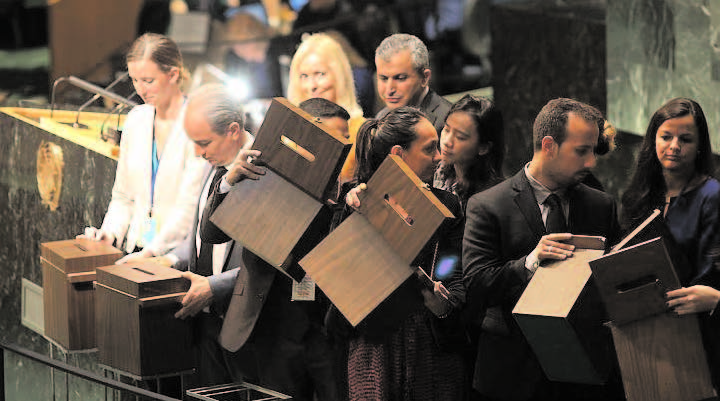
    UNITED NATIONS (TIP): Angola, Malaysia, New Zealand, Spain and Venezuela won coveted seats at the UN security council on October 16, but Turkey suffered a humbling defeat in its bid to join the world’s “top table.” The five countries garnered the required two-thirds support from the 193 countries of the UN General Assembly during three rounds of voting that ended with Turkey picking up only 60 votes.

    Turkey had been competing against New Zealand and Spain for two seats and had dispatched Foreign Minister Mevlut Cavusoglu on a high-profile mission to New York this week to lobby for votes. Angola, Malaysia and Venezuela were virtually assured to win election as their candidacies had been put forward by their region and they ran unopposed on their slates. After New Zealand’s resounding victory in the first ballot, Foreign Minister Murray McCully called the outcome a “strong vote of confidence” in his country, capping a 10-year campaign for the ultimate diplomatic prize.

    “To receive the success that we have had this morning means a lot to us and we will work very hard to make sure we give good service on the council,” McCully told reporters at UN headquarters. Venezuela won 181 votes despite criticism from rights groups and the United States over its support for Iran, Syria and other hardline regimes that are at loggerheads with the West. Venezuela’s President Nicolas Maduro called the vote “a victory, a world record of support, love and confidence. One hundred eight-one countries have said here we are, we support you.””We should feel happiness and joy in our hearts that Venezuela is beloved country in the world,” he added, speaking in Caracas. “To those birds of ill omen who say Venezuela is isolated in the world — who is isolated? The country that received 181 votes?” US Ambassador Samantha Power urged Venezuela to work cooperatively on the council.

    “Unfortunately, Venezuela’s conduct at the UN has run counter to the spirit of the UN Charter and its violations of human rights at home are at odds with the Charter’s letter,” she said. Rights groups have pointed to Venezuela’s record on the UN Human Rights Council as a cause for worry and diplomats have also expressed concern about its stance on the war in Syria. Over the three rounds of voting, Turkey saw its support dwindle from 109 votes to 73 and finally 60, surprising many who saw the regional player as a strong contender.

    Angola won 190 votes, Malaysia picked up 187, New Zealand 145 and Spain 132. The elections came at a busy time for the council, which is grappling with crises on many fronts, from the jihadist offensive in Iraq and Syria, to the Ebola outbreak in West Africa. Russia’s actions in eastern Ukraine, conflicts in Syria, South Sudan and Central African Republic and the faltering Israeli-Palestinian peace process are also at the top of the council’s agenda. A seat at the Security Council raises a country’s profile several notches, boosts influence and provides knockoff benefits in bilateral ties.

    The five elected countries to the 15- member council will join the five permanent powers — Britain, China, France, Russia and the United States — for a two-year term. Five other countries elected last year are mid-way into their term. These are Chad, Chile, Jordan, Lithuania and Nigeria. As the most powerful body of the United Nations, the security council can impose sanctions on countries and individuals, refer suspects for war crimes prosecution, endorse peace accords and authorize the use of force. It also oversees 16 peacekeeping missions in the world, with a budget of close to $8 billion. The five elected countries will replace Argentina, Australia, Luxembourg, Rwanda and South Korea, and begin their stint on January 1.

  • After-effects of the US drawdown on India

    After-effects of the US drawdown on India

    New Delhi cannot remain sanguine. A priority of the Obama Administration will be to smoothly take out its military equipment from Afghanistan, through Pakistan. The Taliban will then be viewed more benignly

    By G Parthasarathy

    Even as Prime Minister Narendra Modi was cautioning Americans in New York against any precipitate withdrawal, Afghanistan was preparing for a momentous change in Kabul. Mr Ashraf Ghani Ahmadzai was taking over as Afghanistan’s President from Mr Hamid Karzai, who had ruled Afghanistan for 12 turbulent years. Despite efforts to malign him and destabilise his Government by worthy Americans like Peter Galbraith and Richard Holbrooke and a vicious propaganda barrage from Pakistan, President Karzai succeeded in establishing a measure of effective governance in Afghanistan. He also skilfully brought together the country’s fractious ethnic groups, to deal with the challenge posed by the Pakistani-backed Afghan Taliban and the Haqqani network, together with their Islamist allies, including the Al Qaeda. The change of guard from Mr Karzai to Mr Ghani has been anything but smooth. The first round of elections in April produced no clear winner. The second round in June, which was expected to be close, produced a stunning result. It gave an unexpectedly large victory margin to Mr Ghani, over his rival, Mr Abdullah Abdullah, a former Foreign Minister and close aide of the legendary Ahmed Shah Masood. Mr Abdullah had a substantial lead in the first round of elections, securing 46 per cent of the votes, against 32 per cent for Mr Ghani. A Report by the European Union declared the second round of voting as “massively rigged”. A US report held that it was mathematically impossible for Mr Ghani to have secured the margin of victory that he did. With controversy over the electoral result spiralling out of control and assuming volatile ethnic dimensions, the Americans stepped in to broker and virtually impose an uneasy and tenuous compromise between Mr Ghani and Mr Abdullah.

    Following the agreement between the rival candidates, Mr Ashraf Ghani was sworn in as President and Mr Abdullah as ‘Chief Executive’, a post which has no constitutional sanctity. The roadmap for this transition includes the convening of a Loya Jirga to convert the post of ‘Chief Executive’ into that of an ‘Executive Prime Minister’. It remains to be seen whether the contemplated changes, with two separate centres of executive authority, can provide stable and effective governance, in a country beset with the ethnic rivalries and tensions, which have long characterised its politics. Within 24 hours of the assumption of power by President Ashraf Ghani and Chief Executive Abdullah, Afghanistan and the US inked a security agreement, which will result in the US stationing 9,800 troops in a training and counter-insurgency role in Afghanistan, beyond 2014. A ‘status of forces agreement’, giving immunity to foreign forces against prosecution in Afghan courts, was also inked. The agreements will also allow the Americans to retain air bases across Afghanistan. Pakistan has welcomed these developments. Apart from formal statements by National Security Advisor Sartaj Aziz and the Foreign Office, a meeting of the top brass of the Pakistan Army also welcomed this development as a “good move for peace in Afghanistan”. This is an astonishing turnaround for the Pakistani establishment, which has all along made its unease with the American presence in Afghanistan known. It comes at a time when an estimated 80,000 Pakistani troops and paramilitary, backed by air power, are pounding positions of the Tehreek-e-Taliban in North Waziristan – an operation resulting in an estimated one million tribal Pashtuns fleeing their homes. At the same time, the Mullah Omar-led Afghan Taliban have been on the rampage this year across Afghanistan, prompting the soft-spoken President Ghani to say, “We ask the opponents of the Government, especially the Taliban and the Hizb-e-Islami, to enter political talks”. Pakistan’s massive military offensive in the tribal areas bordering Afghanistan has been selectively undertaken. Long-term ISI assets including the Haqqani Network, the Mullah Omar-led Afghan Taliban and even the Al Zawahiri-led Al Qaeda have been spared and obviously accommodated in ISI safe houses. They will be kept in readiness to move into Afghanistan at a time of Pakistan’s choosing. Afghanistan is going to remain dependent on Nato for military and economic funding, for the foreseeable future. Nato funding of Afghanistan’s military of $5.1 billion annually till 2017 has been agreed upon. A similar amount of external funding would be required for Afghanistan’s administrative and developmental needs. The Joint Declaration issued after the Obama-Modi Summit spoke of “dismantling of safe havens for terrorist and criminal networks, to disrupt all financial and tactical support for terrorist and criminal networks such as Al Qaeda, Lashkar-e-Tayyeba, Jaish-e- Mohammed, the D-Company, and the Haqqanis”. Significantly, there is no mention in the Joint Declaration of the Mullah Omarled Taliban, which has been primarily responsible for the killing of 2,229 American soldiers in Afghanistan, the training of terrorists for jihad in Jammu & Kashmir and for colluding with the hijackers of IC 814. It has been obvious for some time that the Americans are keen to do a deal with the Taliban. They may pay lip service to statements that any internal reconciliation process has to be ‘Afghan-led’. But, the reality is different, ever since the US encouraged Qatar to host a Taliban office in Doha. An enraged Mr Karzai had torpedoed that American effort (with obvious Pakistani support), to grant international legitimacy to the Taliban. President Ghani will, however, have to reluctantly accept Pakistan-brokered American-Taliban ‘contacts’, as a prelude to giving Taliban control in parts of southern Afghanistan. India cannot be sanguine about these developments. A priority of the Obama Administration will be to smoothly take out its military equipment from Afghanistan, through Pakistan. The Taliban will be looked at rather more benignly than in the past. Militarily, the ISI/Taliban effort will be to seize control of large swathes of territory in southern Afghanistan, compelling a reduction of India’s assistance in that part of the country. Differences in the priorities and compulsions of President Ghani and ‘Chief Executive Abdullah in Kabul appear inevitable. Our membership of the Shanghai Cooperation Organisation will have to be utilised to fashion a more coordinated approach with its members – Russia, China, Iran and the Central Asian Republics. A more intensive approach on developing the port in Chah Bahar in Iran and on meeting Afghan requirements of defence equipment will be imperative. The post-9/11 ‘end game’ for the Americans in Afghanistan is just beginning. The Americans will continue to predominantly and very significantly shape the course of developments in Afghanistan.

  • Bangladesh appoints Syed Muazzem Ali as new envoy to India

    Bangladesh appoints Syed Muazzem Ali as new envoy to India

    DHAKA (TIP): Bangladesh on October 7 appointed veteran diplomat and former foreign secretary Syed Muazzem Ali as its new high commissioner to India.

    Ali served as the foreign secretary during the ruling Awami League’s previous 1996-2001 tenure.
    He will succeed Tariq A Karim who is Bangladesh’s envoy in India for the past five years, said a foreign ministry statement.

    A former member of the then Pakistani foreign service, Ali joined the service in 1968 while he severed his links with Islamabad during 1971 Liberation War expressing his allegiance to Bangladesh government in exile in India while he was posted in the United States.

    Ali earlier served as Bangladesh’s ambassador to Bhutan, Iran and France and served in other capacities in several other countries. He retired as the top bureaucrat in the foreign ministry in 2001

  • Bangladesh appoints Syed Muazzem Ali as new envoy to India

    Bangladesh appoints Syed Muazzem Ali as new envoy to India

    DHAKA (TIP): Bangladesh on Monday appointed veteran diplomat and former foreign secretary Syed Muazzem Ali as its new high commissioner to India.

    Ali served as the foreign secretary during the ruling Awami League’s previous 1996-2001 tenure.

    He will succeed Tariq A Karim who is Bangladesh’s envoy in India for the past five years, said a foreign ministry statement.

    A former member of the then Pakistani foreign service, Ali joined the service in 1968 while he severed his links with Islamabad during 1971 Liberation War expressing his allegiance to Bangladesh government in exile in India while he was posted in the United States.

    Ali earlier served as Bangladesh’s ambassador to Bhutan, Iran and France and served in other capacities in several other countries. He retired as the top bureaucrat in the foreign ministry in 2001.

  • ASIAN GAMES 2014 | A glance at winners who made India proud on Day 14 in Incheon

    ASIAN GAMES 2014 | A glance at winners who made India proud on Day 14 in Incheon

    The Day 14 of Asian Games saw India’s unhindered supremacy in the Asian Games’ kabaddi competition continued after both the men’s and women’s teams successfully defended their respective gold medals with hard-fought final triumphs over Iran here on Friday. Staging a fantastic second-half recovery, Indian men surged to their seventh straight gold by defeating Iran 27- 25 in a thrilling final at the Songdo University Gymnasium.

    India thus completed a golden double on the kabaddi mat for the second successive edition after the women defeated the same nation 31-21 in their final held earlier in the day. The country thus boosted its overall gold tally to 11 on the final day of competitions here.

    ASIAN GAMES 2014 A glance at winners who made India proud on Day 14 in Incheon1

    But it was touch and go for the Indian men, who have won the gold medal with ease on the six previous occasions since kabaddi was introduced in the 1990 Games at Beijing. They played catch-up with Iran for most part of the game before drawing level with the last seven minutes of the 40-minute match left.

    The winners were trailing by a big margin of 13-21 at half time and a huge upset was on the cards before the defending champions pulled it around in the second half with some aggressive raiding and smart catching.

    Captain Rakesh Kumar, who played with a bandaged head after getting injured by a rival defender’s knee during his raid in the second half, said after the game, “By god’s grace we won. It was tougher than we expected. Iran is a good team, but we made some mistakes initially and fell behind before recovering.”

    Rakesh also said at half time, the strategy chalked out was to pack off Iran quickly for a ‘lona’ — with only four players of the rivals left as compared to their own five — at that stage and come back into the game. “That’s what we did. Had we fallen even further behind then, it would have been curtains,” he conceded.

    India started on the wrong foot against the super-fit Iranians who looked like men possessed as they raided with gusto and defended with zeal to jump to a 17-7 lead before the Indians, who even conceded a ‘lona’ (after being all out), knew what happened.

    Experienced raider Jasvir Singh appeared to be a bit overconfident and paid the penalty for that as he was packed off when raiding thrice in the initial stages. It was left to India’s most experienced player Anup Kumar to pull in three points with a good raid and narrow the lead.

    With five minutes left for the end of the opening half, India trailed 11-18 which became 13-21 before the first half ended. The crucial turnaround happened soon after the start of the second half when India secured a ‘lona’ and then caught up with their rivals at 21-all.

    They, however, slipped down to 21-24 before staging another recovery to catch up at 24-all when seven minutes were left. Anup raided to secure a valuable point to help India lead 25-24, the first time they had done in the entire match. They added one more when Iranian’s fast raider Meraj Sheykh was caught and though Anup failed in his next raid, Meraj was again caught just as the clock ticked to full time with India ahead by two points.

    Earlier, Indian women too staged a strong second half performance to get the better of a fighting Iran 31-21 to retain the gold.

    The Indian women led 15-11 at the halfway stage of the 30-minute final but then put up a determined show in the second half to maintain their supremacy for the second edition running, having clinched gold when the event made its debut four years ago in Guangzhou.

    They, in fact, had only a two-point lead at 12-10 soon after securing the first of their two lonas (all outs) in the gold medal contest against the fitter-looking Iranian women who played with head scarves and leggings. Abhilasha Mhatre then effected a crucial raid to not only get back two points for her side but also revive two players who had been packed off by Iran’s aggressive raider Khalaj Ghazal.

  • Iranian President Rouhani terms US led anti-ISIS coalition ‘ridiculous’

    Iranian President Rouhani terms US led anti-ISIS coalition ‘ridiculous’

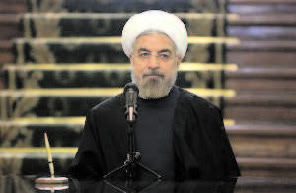
    WASHINGTON (TIP): Iranian President Hassan Rouhani has decried the US-led international coalition against Islamic State in Syria and Iraq (ISIS) describing this as “ridiculous,” move and alleged that some of the 40-member of this group had previously supplied the terror group with arms and training.

    “Are Americans afraid of giving casualties on the ground in Iraq? Are they afraid of their soldiers being killed in the fight they claim is against terrorism?” Rouhani told the NBC news in an interview which was taken in Tehran yesterday. “If they want to use planes and if they want to use unmanned planes so that nobody is injured from the Americans, is it really possible to fight terrorism without any hardship, without any sacrifice? Is it possible to reach a big goal without that? In all regional and international issues, the victorious one is the one who is ready to do sacrifice,” Rouhani said.

    It is necessary for airstrikes in some conditions and some circumstances, he said. “However, air strikes should take place with the permission of the people of that country and the government of that country,” the Iranian President said in his interview to the major American television network. Responding to questions, Rouhani said the brutal murder of two American journalist and one British national by ISIS is against the tenants of Islam. “They want to kill humanity,” he said.

    “And from the viewpoint of the Islamic tenets and culture, killing an innocent people equals the killing of the whole humanity. And therefore, the killing and beheading of innocent people in fact is a matter of shame for them and it’s the matter of concern and sorrow for all the human and all the mankind,” Rouhani told the NBC News in his interview. According to the NBC news, Rouhani alleged that many members of the US-led coalition had helped ISIS with weapons and training.

    But he declined to name the countries. Rouhani said Iran will give Iraq any support it requests for combating ISIS, but made a point of saying religious sites must be protected. “When we say the red line we mean the red line. It means we will not allow Baghdad to be occupied by the terrorists or the religious sites such as Karbala or Najaf be occupied by the terrorists,” he said. The Iranian President said he believes that the latest round of nuclear talks can still lead to a resolution. “Maybe the time could be arguable, either today or tomorrow. “However, we have no doubt that the only solution to the nuclear issue goes through negotiation,” he said. Rouhani also called for close relationship between US and Iran.

  • Top Indian challengers @ 2014 Asian Games

    Top Indian challengers @ 2014 Asian Games

    KILLER PUNCH: Mary Kom (boxing)


    12


    The Manipuri police officer is now a household name across the country. The five-time World Champion has got little left to prove, after punching her way to the bronze medal in London, but Mary Kom is still determined to add more medals to her collection. At a time when her biopic is raking in the moolah at the box office, Mary will be keen to recapture the golden moments in the ring at the Incheon Games. By topping the trials, after missing the selection for the CWG, the mother-of-three now guns for another triumph. In the 2010 edition, she won the bronze in flyweight.

    FEATHER TOUCH: PV Sindhu (badminton)


    15


    The teenager goes into the Asiad as a strong contender to end the Chinese dominance, along with her more illustrious teammate Saina Nehwal. PV Sindhu recently became the first Indian to win two medals in consecutive World Championships. Though her World Cup conqueror Carolina Marin won’t be there in Incheon, the Chinese, Chinese Taipei and Thailand shuttlers will be out in full strength to make her job tougher.

    SHARP SHOOTER: Jitu Rai (shooting)


    13


    The Nepal-born sharp shooter is literally on fire as he has shot down most of the medals that came his way this season. It began with a double at the World Cup in Maribor, Slovenia in June. The 26-year-old pistol shooter from the 11 Gorkha regiment created history when he won medals in both the 10m and 50m events. Then came the Commonwealth Games and Rai easily asserted his supremacy. The World Championships followed and the Indian was again bang on target settling for the silver and a quota place between a Korean and a Japanese who will again challenge him at the Asaid.

    BULL’S EYE: Deepika Kumari (archery)


    16


    The Tata Academy product is showing signs that she has finally got over the crushing defeat at Lord’s in the 2012 Olympics. Deepika Kumari went into the Games as one of the top medal contenders in recurve competition but went out in the preliminary round itself, crashing under the weight of expectations. The 20-year-old once again starts as a strong medal contender after showing great form in the recent World Cups. The three-time World Cup Finals silver medallist is peaking at the right time and will be keen to make amends after missing out on a bronze at Guangzhou.

    MR HERCULES: Vikas Gowda (athletics)


    17


    If there is one athlete who should get constant backing from the government then it’s this Mysore-born discus thrower, and that too just for his unwavering dedication. Vikas Gowda has trained his sights on the Rio Olympics and success at the Asian Games will only add to his confidence levels. The recent success at the Glasgow CWG shut out his critics and they are now backing him for the Asiad gold. At Incheon, Vikas, who is topping the Asian list with a throw of 65.62m, will face competition from two Iranians and one Chinese. However, exposure in the Diamond League circuit will surely help him produce the winning throw.

    MUSCLE MAN: Yogeshwar Dutt (wrestling)


    14


    In the absence of Sushil Kumar, London Olympics bronze medalist Yogeshwar Dutt will be India’s trump card in wrestling. The 31-year-old Haryana wrestler proved his form at the Glasgow CWG powering past his opponents, including in the final, with ease to bag the gold. It will be Yogeshwar’s second attempt at the Asiad after winning a bronze in the Doha Games in 2006. The Asian Championship winner in 2012 knows that Incheon will pose a much tougher competition with grapplers lining up from Iran, Japan and Korea. Yogeshwar has skipped the World Championships to focus on the Asiad gold.

  • US to hold new nuclear talks with Iran in Geneva

    US to hold new nuclear talks with Iran in Geneva

    WASHINGTON (TIP): American and Iranian officials will resume negotiations in Geneva this week as they seek to hammer out a full nuclear deal ahead of a November deadline, US officials said on September 3. The US team led by Deputy Secretary of State Bill Burns and Under Secretary Wendy Sherman will meet with Iranian officials on Thursday and Friday in the Swiss city, the State Department said in a surprise late-night statement.

  • Hamas ‘brought Israel to its knees’: Iran

    Hamas ‘brought Israel to its knees’: Iran

    TEHRAN (TIP): Iran said on August 27that Palestinian militants had emerged the victors and brought their Israeli foe “to its knees” during the bloody 50-day Gaza conflict. “The heroic Palestinian people have forged a new era with the victory of the resistance which has brought the Zionist regime to its knees,” the foreign ministry said in a statement. “This victory prepares the way for the final liberation of all the occupied lands especially Quds (Jerusalem),” it said, congratulating the Palestinian people and the militant groups in Gaza that Iran supports.

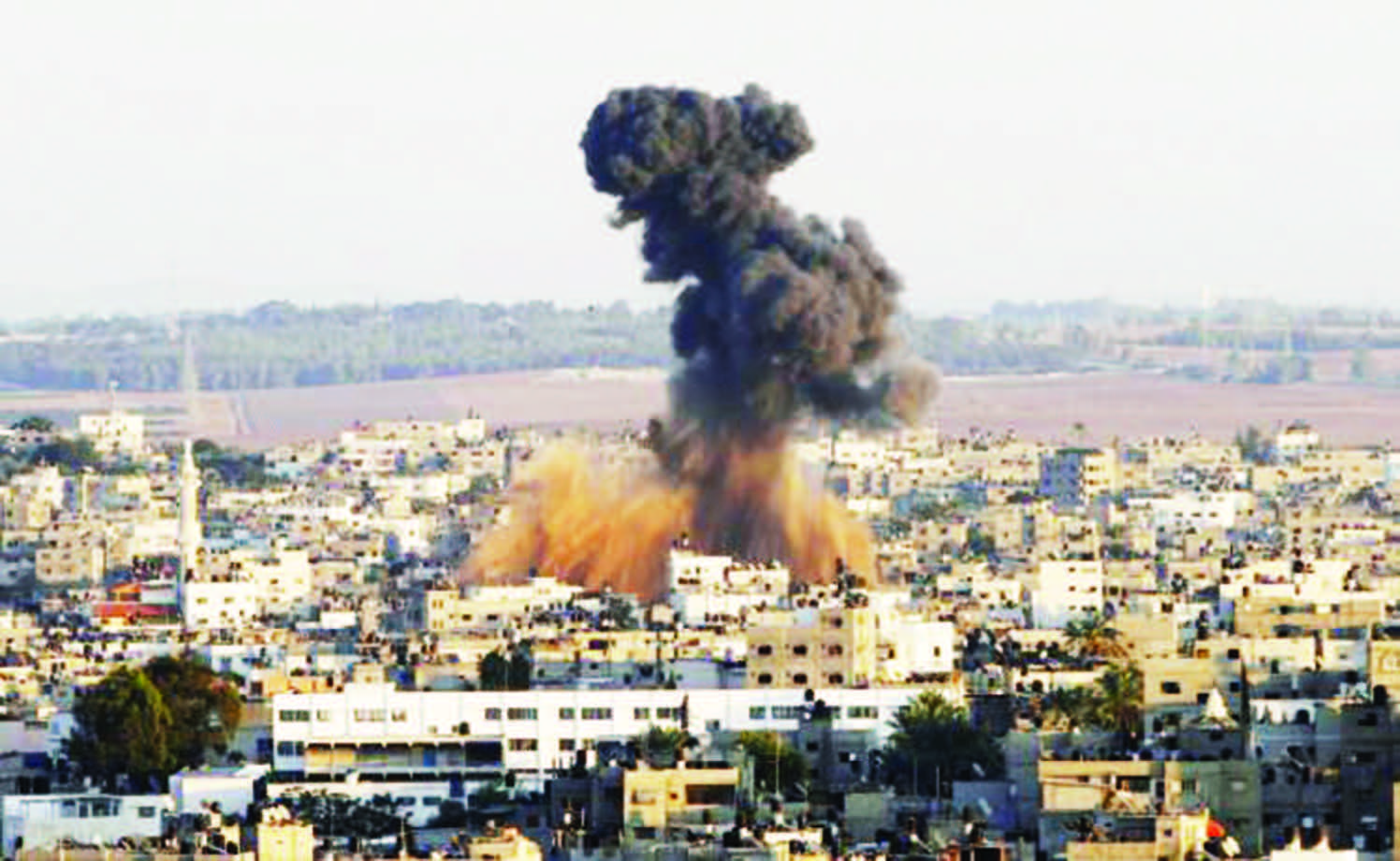
    After seven weeks of the deadliest Israeli-Palestinian violence in a decade, a long-term ceasefire took hold at 1600 GMT yesterday, sparking festivities around the Gaza Strip. The conflict, which began on July 8 when Israel began Operation Protective Edge in a bid to stamp out cross-border rocket fire, cost the lives of 2,143 Palestinians and 70 on the Israeli side. UN figures show nearly 70 per cent of the Palestinian victims were civilians, while 64 of the Israelis killed were soldiers. A Palestinian official said the Egyptian-mediated deal would involve an end to Israel’s eight-year blockade of Gaza. Ending the blockade had been a key Palestinian demand in truce talks, with the Islamist movement Hamas that rules Gaza hailing the agreement as a “victory for the resistance”.

  • Standard Chartered fined $300 million over money laundering controls

    Standard Chartered fined $300 million over money laundering controls

    NEW YORK (TIP): New York state’s banking regulator hit Standard Chartered Bank with a $300 million fine and restrictions on its dollar-clearing business on Tuesday for not detecting possible money laundering. The New York Department of Financial Services (DFS) said the British bank’s internal compliance systems had failed to detect or act on a large number of “potentially high-risk transactions” mostly originating from Hong Kong and the United Arab Emirates.

    The new punishment came two years after the bank paid US regulators $667 million to settle charges it violated US sanctions by handling thousands of money transactions involving Iran, Myanmar, Libya and Sudan. A DFS monitor appointed in 2012 to keep an eye on the bank discovered that it had not detected the allegedly high-risk transactions from Hong Kong and the UAE or reported them as it should have, the department said. “If a bank fails to live up to its commitments, there should be consequences.

    That is particularly true in an area as serious as anti-moneylaundering compliance, which is vital to helping prevent terrorism and vile human rights abuses,” said DFS head Benjamin Lawsky. The department did not give any information on the nature of the transactions, or whether they proved to involve laundering or not. In a settlement agreed with the bank, DFS ordered Standard Chartered to halt dollar-clearing operations for unnamed “high-risk retail business clients” of its Hong Kong unit.

    The bank is already cutting business with high-risk clients in UAE, but will also not be able to process dollar funds through the United States for them. Its New York branch also is forbidden to take on any clearing or deposit accounts from new customers without the approval of Lawsky’s office.

    ‘Serious blow’

    The fine would have a negative impact on the bank’s reputation and international business, independent financial analyst Francis Lun told AFP. “It’s really an oversight on the part of Standard Chartered. They’d already paid a huge penalty still they installed a system that is useless,” Lun said. “It will create tremendous problems with their international clients who cannot settle their accounts in US dollars.

    It will be a serious blow to Standard Chartered group’s international business,” Lun said. Standard Chartered is based in London but has traditionally done most of its business in Asia and the Middle East. It said it accepted responsibility and “regrets the deficiencies in the antimoney laundering transaction surveillance system at its New York branch.” It added that it would work with clients in Hong Kong and UAE affected by the DFS requirements “to minimize disruption.” “The group remains fully committed to Hong Kong and the United Arab Emirates as key markets,” the bank said.

    Hong Kong-listed shares in the bank fell 0.19 percent, to HK$157.8 ($20.36) in afternoon trade, while the Hang Seng Index remained flat. “$300 million isn’t a big number…investors will be fine with this penalty,” Tanrich Securities vice president Jackson Wong said. The action taken against Standard Chartered is part of an ongoing crackdown by New York state and federal authorities on banks, particularly foreign banks with New York branches, for handling money transfers from countries and individuals blacklisted by Washington for political reasons or for their involvement in criminal activities.

  • UN chief urges meeting on nuclear-free Mideast

    UN chief urges meeting on nuclear-free Mideast

    UNITED NATIONS (TIP):
    Secretary-General Ban Kimoon warned that the failure to hold a conference on establishing a nuclear-weapons-free-zone in the Middle East this year could jeopardize the success of next year’s review of the landmark 1970 agreement aimed at stopping the spread of nuclear arms.

    Ban urged all parties to finalize arrangements for a Mideast conference to be held as soon as possible this year, in a report to the U.N. General Assembly circulated Thursday. At the 2010 conference to review the Nuclear Nonproliferation Treaty, the 189 member nations that are party to the NPT called for convening a meeting in 2012 “on the establishment of a Middle East zone free of nuclear weapons and all other weapons of mass destruction.” It was scheduled to take place in Finland in late 2012, but the United States announced it would be delayed, apparently to save Israel, which is widely believed to possess a nuclear arsenal, though it has never confirmed having nuclear weapons.

    The final preparatory conference for the 2015 review of the NPT ended in May without agreement on final recommendations, and one of the two key issues was the failure to hold a conference on a Mideast weapons-free zone. One recommendation called for convening the conference this year. Iran, Israel and Arab states have taken part in several informal meetings, most recently in Geneva on June 24- 25, attended by veteran Finnish diplomat Jaakko Laajava, who is serving as facilitator of the proposed Mideast conference to discuss the arrangements and outcomes of a conference.

    these extended consultations, there continue to be differences among the parties on several important aspects of the conference, including on its agenda, and hence agreement on the modalities for the conference has not yet been reached,” the secretarygeneral said. Ban said he “remains concerned” that a failure to convene the Mideast weapons-free-zone conference before the 2015 NPT review conference “may frustrate the ability of states to conduct a successful review of the operation of the (NPT) treaty and could undermine the treaty process and related nonproliferation and disarmament objectives.”

  • KERRY EYES US-CHINA partnership despite tensions

    KERRY EYES US-CHINA partnership despite tensions

    HONOLULU(TIP):
    Improving US cooperation with China is critical to maintaining stability and security in the Asia-Pacific as well as combating the effects climate change, US secretary of state John Kerry said. Wrapping up an eight-day, around-theworld diplomatic trip and his sixth visit to Asia as America’s top diplomat, Kerry on Wednesday outlined renewed priorities for much of the Obama administration’s much-touted “pivot to Asia” during its final 2 years, including a focus on strengthening US-Chinese partnership in areas of agreement and bridging gaps in areas of contention.

    “One thing I know will contribute to maintaining regional peace and stability is a constructive relationship between the United States and China,” Kerry said in an address to the East-West Center think tank in Honolulu. “The United States welcomes the rise of a peaceful, prosperous and stable China: one that plays a responsible role in Asia and the world and supports rules and norms on economic and security issues.”

    “We are committed to avoiding the trap of strategic rivalry and intent on forging a relationship in which we broaden our cooperation on common interests and constructively manage our differences and disagreements,” he said. Kerry arrived in Hawaii after stops in Afghanistan, Myanmar, Australia and the Solomon Islands during which tensions between China and its smaller neighbors over competing territorial claims in the South China Sea were a major subject of discussion.

    At a Southeast Asia regional security forum in Myanmar over the weekend, Kerry formally unveiled a US proposal for a voluntary freeze on provocative actions by all claimants, including the Chinese. The US says that it has no position on the competing claims but does regard stability in the South China Sea as a national security issue, given the region’s role as one of the world’s busiest maritime shipping zones. “We do care about how those questions are resolved, we care about behavior,” Kerry said.

    “We firmly oppose the use of intimidation, coercion or force to assert a territorial or maritime claim by anyone. And we firmly oppose any suggestion that freedom of navigation and overflight and other lawful uses of the sea and airspace are privileges granted by big states to small ones. All claimants must work together to solve the claims through peaceful means. These principles bind all nations equally, and all nations have a responsibility to uphold them.” While welcomed in general by the 10 members of the Association of Southeast Asian Nations, China took a dim view of Kerry’s proposal and suggested it would not agree.

    In an apparent nod to such disagreements, Kerry said that building better ties with Beijing will not be easy or inevitable. “Make no mistake: This constructive relationship, this `new model,’ is not going to happen simply by talking about it,” he said. “It’s not going to happen by engaging in slogans or pursuing spheres of influence. It will be defined by more and better cooperation on shared challenges. It will be defined by a mutual embrace of the rules, norms and institutions that have served both our nations and the region so well.”

    Kerry said he was pleased at some areas of current US-China cooperation, including multination talks on Iran’s nuclear program, a shared interest in denuclearizing North Korea and promoting calm in South Sudan. In addition, on climate change, which he regularly describes as the biggest threat facing Earth, Kerry hailed US-Chinese initiatives to reduce greenhouse gas emissions and deforestation as well as working on sustainable, clean energy options.

    At the same time, he noted that the US and China, along with other Asian nations, routinely disagree on human rights. Kerry pointed out backsliding in rights protection and democratic principles in Myanmar and Thailand and repression in North Korea but said the United States would not relent in its drive to improve conditions. “We will continue to promote human rights and democracy in Asia, without arrogance but also without apology,” he said.

  • To each superpower, its own near-abroad

    To each superpower, its own near-abroad

    The downing of MH17 puts the spotlight back on the Ukrainian crisis. It’s a warning to the West to eschew attempts to ‘contain’ Moscow and stop the provocative expansion of NATO across Russia’s borders.

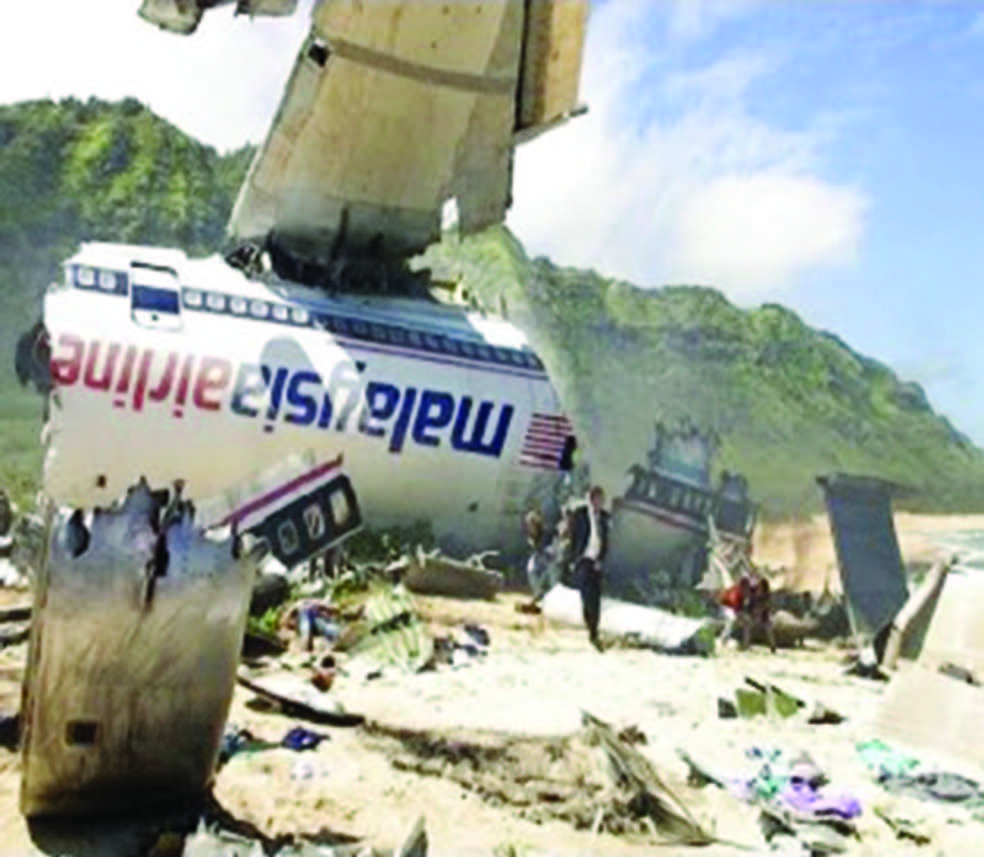
    In the early hours of the morning of July 17, Malaysian Airlines Flight MH17 with 298 people on board was shot down over eastern Ukraine, now controlled by Russian separatists, engaged in a civil war against the Kiev Government. The Russian speaking minority has evidently been reinforced and equipped by their kinsmen from across the Russia-Ukraine border. They carry heavy firepower including tanks, armoured personnel carriers and a range of surface-to-air missiles.

    The shooting down of MH17 came alongside rebel missile attacks over the past four weeks, which have downed two military transport and three state-of-the-art Sukhoi attack aircraft, of the Ukrainian Air Force. It is evident that the missile attack on MH17 was based on the mistaken assumption that it was a Ukrainian Air Force aircraft. There have been seven incidents of such inadvertent shooting down of civilian aircraft in the past. In recent times, South Korean Airlines Flight 007 with 277 passengers and crew strayed into Soviet airspace. It was shot down by a missile fired from a Soviet MiG.

    After the usual rhetoric, Presidents Ronald Reagan and Mikhail Gorbachev returned to business as usual. Thereafter, on July 3, 1988, Iran Air Flight 655, flying from Tehran to Dubai with 290 passengers, mostly pilgrims headed for Mecca, was shot down over Iranian territorial waters, by two missiles fired from the US Navy missile cruiser, USS Vincennes. The US refused to accept responsibility for the action. It paid a sum of $61.8 million as compensation to the families of the victims, following the ruling of an international tribunal.

    What the US paid was less than three per cent of what it got from Libya, for the Lockerbie bombing of Pan Am 103. The Captain of the USS Vincennes was awarded Combat Action Ribbons, shortly after shooting down a civil airliner. Washington, DC’s displeasure, about Russian supply of surface-to-air missiles to the Russian resistance in Ukraine, is surprising. It was the US that started the practice of providing lethal weaponry to non-state actors. The Central Intelligence Agency liberally provided lethal Stinger surface-to-air missiles to the anti-Soviet Mujahideen in Afghanistan, through Pakistan’s Inter-Services Intelligence.

    Three Indian Air Force aircraft – a MiG 21, MiG 27 and a helicopter gunship – were shot down and a Canberra bomber damaged, during and just prior to the Kargil conflict. The IAF aircraft were fired on by Pakistan’s Northern Light Infantry, using, what were assessed to be, Stinger surface-to-air missiles. Given the relentless US policy of strategic ‘containment’ of Russia after the disintegration of the Soviet Union, it was inevitable that, pushed to a corner by American and NATO pressures, the Russians would reach a position of saying: “Thus far and no further”.

    The erratic nature of the policies of President Boris Yeltsin and his advisers like Yegor Gaidar and Mr Andrey Kozyrev, immediately after the disintegration of the Soviet Union, evidently encouraged the US and its NATO allies to erode Russian influence in the Balkans and undermine Russian credibility in Kosovo. Simultaneously, members of armed Chechen separatist groups were openly welcomed in western Europe. Yeltsin’s incompetence in Chechnya and his inability to deal with the expansion of American-led influence just across Russia’s borders, contributed to his being eased out of office and replaced by Mr Vladimir Putin.

    Even as the Russians tried to increasingly integrate former Soviet Republics economically and strategically, the US and its NATO allies held out lucrative offers for economic integration with the European Union and membership of the NATO military alliance. Russia faced a challenge of economic isolation and military encirclement. The Russians have responded by developing economic partnerships with former Soviet Republics and the establishment of the Collective Security Treaty Organisation.

    The economic and security inroads made by the EU and NATO have, however, significantly eroded traditional Russian influence in its immediate neighbourhood. These Western moves, which the Russians naturally regard as strategic encirclement, have resulted in former Warsaw Pact members – the Czech and Slovak Republics, Hungary, Bulgaria, Romania and Poland – joining NATO In the Balkans, Croatia and Slovenia are now NATO members. Moreover, the former Soviet Baltic Republics, Estonia, Latvia and Lithuania have joined NATO.

    There are also moves to consider EU and Nato membership for Ukraine, Azerbaijan, Armenia, Kazakhstan, Moldova and Georgia. Ukraine was ruled by Russian tsars for three centuries prior to the formation of the Soviet Union. It was regarded as part of the sphere of Russian influence. Its eastern region bordering Russia was increasingly populated by Russians. Ukraine’s Crimean region was transferred by Soviet leader Nikita Khrushchev from the Russian Federation to Ukraine in 1954, as a “gesture of goodwill”, marking the 300th anniversary of Ukraine being a part of Tsarist Russia.

    Sevastopol in Crimea is vital strategically to Russia, constituting Russia’s access to the warm waters of the Black Sea. Former President Viktor Yanukovych of Ukraine and other Ukrainian leaders inevitably played off the Russians, who promised plentiful supplies of energy, against the EU, which promised prosperity. Mr Yanukovych signed an agreement in 2010 extending the lease of Sevastopol till 2042. The quite evidently American-backed movement that resulted in the ouster of Mr Yanukovych, led to the takeover of Sevastopol and the Crimean region, with a Russian majority population, by Russia.

    The US-led attempts to contain Russia have been marked by inconsistencies. The dismemberment of Yugoslavia and the independence of Kosovo were justified by Western powers on the lofty grounds of respect for “human rights”. But, today these same powers are raving and ranting against the “separatists” of the Russian minority in Ukraine, who are seeking independence, or merger with Russia.

    There is little doubt that Russia today faces serious internal problems arising out of falling birth rates, alcoholism, drug addiction, declining life expectancy and corruption. But, it will be a historical error to underestimate Russian resilience in the face of adversity. Attempts to dominate and marginalise the Russian minority in Ukraine will be fiercely resisted and reinforced by support from across the Ukrainian-Russian border.

    What is needed is a realistic political solution involving a united, but federalised Ukraine. More importantly, attempts at ‘containment’ of Russia, will have to be eschewed and the expansion of NATO across Russia’s borders ended. Given the imperatives of stability and energy security, responsible European countries like Germany and France will recognise this. Will the Americans do likewise?

  • US Vice President Joe Biden praises Japan’s new military policy

    US Vice President Joe Biden praises Japan’s new military policy

    WASHINGTON (TIP):
    US Vice President Joe Biden is welcoming Japan’s decision to loosen restrictions on its military to allow greater use of force to defend other countries. Biden spoke to Japanese Prime Minister Shinzo Abe on Thursday.

    The White House says the two agreed that Japan’s policy will strengthen US-Japanese ties and help Japan contribute more to regional peace and security. Japan’s move has drawn criticism from rival China as Beijing increases its own military posture.

    The White House says Biden also praised Japan’s sanctions on Russia. The US and Europe are sanctioning Russia over its actions in Ukraine. Japan is part of the Group of Seven nations seeking to pressure Moscow. The two leaders also discussed the nuclear threats from North Korea and Iran, plus conflicts in Iraq and Syria.

  • Devil’s Brew in Middle East

    Devil’s Brew in Middle East

    By S Nihal Singh

    America’s Receding Ability to Bring Peace

    “The major power in the region, the United States, is increasingly compromised by its total support of Israel, largely due to domestic factors, and its desire to reduce its footprint in the region. In hindsight as, many at that time suggested, the US was foolish to invade Iraq under false pretences. And on the Israel-Palestinian conflict, it is on the wrong side of history”, says the author.

    That the Middle East (West Asia of our description) is in a state of flux is crystal clear. We have a three-yearold civil war in Syria, an Iraq wracked by tribal and Shia-Sunni strife, Libya still fighting the post-Gaddafi dispensation and Israelis launching a disproportionate war on Palestinians, not for the first time. The common thread in these crises is the role of outside powers, both in creating crises in the first instance and in muddying the waters and the inability of local actors to make peace.

    In Syria, a minority Alwaite regime is seeking to retain its throne in a Sunni-majority country, with opponents of a bewildering variety of moderates and militants ranged on the other side. In Iraq, after all American troops left, Prime Minister Nouri al-Maliki, belonging to the majority Shia, has been interpreting his role primarily in terms of advancing the interests of his community.

    The Kurds are asserting their rights while the Sunni, dethroned from their ruling perch, have combined with Islamic militants to challenge the state. Both in Syria and Iraq the Islamists of the extreme variety, first under the rubric of the ISIS and later under the name of the Islamic State, have carved out an area in Syria and Iraq they rule, with President Bashar Assad’s regime in Syria and the Iraqi authorities unable to dislodge them. Superimposed on these dramatic events is the old Israel-Palestinian conflict, essentially caused by Israeli actions in occupying and colonising vast Palestinian lands and East Jerusalem on the strength of total American support extending to unprecedented military supplies and a generous annual financial subsidy.

    These actions nullify attempts at finding a twostate solution and the prospect is of one state with a growing Palestinian population living as second-class citizens. Regional powers belonging to the Sunni and Shia faiths have taken up positions determined in the first category by supporting the anti-Assad forces in Syria, more of them supporting the cause of the newly disenfranchised Sunni of Iraq. On the other side is Iran, the minority Assad regime in Syria and the Hezbollah movement of Lebanon.

    After the proclamation of the Islamic Caliphate in Syria and Iraq, the Sunni states led by Saudi Arabia have moderated their somewhat indiscriminate financial and military support for the Islamic militants fighting the Assad regime. Iran has been consistent in its support of President Assad and the Hezbollah. Turkey’s position has evolved over time, initially the leader of the regime change lobby for Syria, together with neighbours hosting large numbers of Syrian refugees.

    It is taking time to reconsider its options while deeply disappointed with US inaction in Syria while supporting the cause of the Muslim Brotherhood in Egypt and sympathetic to the plight of the Palestinians. One big change in the regional picture is the anti-Morsi coup that has eventually brought the Army under the guise of a civilian President Abdel Fatah el-Sisi to power. The Brotherhood is classed as a terrorist organisation, its leaders and hundreds of its followers are in prison. The new regime has closed the Rafah border with the Gaza Strip, a lifeline for besieged Palestinians and shut down most of their tunnels.

    Speculation is rife in this churning process, with extravagant scenarios of the break-up of Syria and Iraq and other countries essentially carved out by France and Britain out of the end of the Ottoman Empire. Two trends seem clear. The first is a sharpening Shia-Sunni conflict which is taking many forms. Second, the spreading cancer of 21st century Israeli colonization which lies at the heart of the historic Middle East conflict. There are no easy solutions to either of these problems. Any Shia-Sunni reconciliation assumes a measure of tolerance on the two sides. There are many actors inflaming passions, not least of all Iraqi Prime Minister Maliki.

    On the other side, proponents of the Islamic Caliphate are keeping the fires of intolerance burning. The major power in the region, the United States, is increasingly compromised by its total support of Israel, largely due to domestic factors, and its desire to reduce its footprint in the region. In hindsight as, many at that time suggested, the US was foolish to invade Iraq under false pretences.

    And on the Israel-Palestinian conflict, it is on the wrong side of history. What then can we expect from the devil’s brew, which is the Middle East in the coming days and months? There will no doubt be a ceasefire between Israelis and Palestinians even as Israel’s isolation in the world increases because of the scale of the carnage it has been inflicting on Palestinians, highlighted by the Human Rights Convention. But the problem will continue to fester because domestic factors compel US administrations to remain captive to the urges of Israeli colonialism.

    The other regional crises will run their course, with little prospect of millions of Syrian refugees in neighbouring countries and the internally displaced able to return home soon. In many instances, there is no home to go to. In Iraq, the virtual partition of the state into Shia, Sunni and Kurdish regions will take firmer shape. The new Egyptian regime, in terms of the Palestinian cause, is a tacit ally of Israel and will pose problems for Gazans.

    In this tangled mess, one crisis feeds on the other and the resulting picture is far from following a common pattern. The tragedy is that the sole mediator remains the United States and it is hamstrung by its own compulsions. In immediate terms, the future remains bleak. For the present, there is no countervailing force to take matters in hand.

    The East-West conflict represented by the growing antagonisms between Russia and the United States over Ukraine make a complementary Moscow initiative impossible. The only bright spot is that since things cannot get worse, they will take a turn for the better.

  • US House of Representatives backs resolution supporting Israel

    US House of Representatives backs resolution supporting Israel

    WASHINGTON (TIP): The US House of Representatives has backed a resolution expressing support for Israel and its right to self-defence. Lawmakers endorsed the non-binding measure by a voice vote on Friday. It condemns Hamas for unprovoked rocket attacks on Israel. The bipartisan resolution is sponsored by Democratic congressman Steve Israel and Republican congressman Tom Cole. Israel has intensified its broad military offensive in the Gaza Strip to stop rocket fire from Palestinian militants targeting Israel.

    The death toll from the 4-day-old conflict has exceeded 100, and President Barack Obama has told Israel the United States is willing to negotiate a cease-fire between Israel and Hamas. The measure includes a provision by Republican congressman Ed Royce highlighting Iran’s role in supporting Hamas.

  • Foreign funding and the Maharajas among NGOs

    Foreign funding and the Maharajas among NGOs

    “At the heart of the dilemmas presented by the evolving situation is the kind of Middle East major regional and world powers want to see. More importantly, where will the present series of conflicts take the region, with the escalating Shia-Sunni conflict and the dislocation of millions, either internally displaced or living as refugees in neighboring countries?” the author wonders

    Behind the frenzied diplomacy over the future of Iraq are new assumptions taking shape. First, is the division of the country among its Shia, Sunni and Kurdish areas a matter of time? Second, how far will the Islamic State of Iraq and Syria (and its variant the Levant), collectively known as the ISIS, spread from its present swathe in Syria and Iraq? What is being debated is the future shape of the Middle East some hundred years after the French-British division of the spoils of the disintegrating Ottoman Empire.

    There are no clear answers because of the variety of regional and world powers pursuing differing policies. Of the regional actors, the most important are Saudi Arabia, Iran and Turkey. Here is a conflict not only between Sunni and Shia countries but the very different inflections of the two Sunni powers and Shia Iran’s interest in seeking the destruction of the ISIS as it protects its influence in Iraq, now being governed by the majority Shias.

    The United States has an obvious interest in seeking to check the onslaught of the ISIS and to save a scrap of investment in all that it put into Iraq starting with its invasion in 2003.

    But the ISIS represents a danger also to its vital interest in Israel’s security, with the present ruling dispensation there bent on colonizing the land of Palestine in perpetuity.

    The dilemma for President Barack Obama is that having won his election and reelection on the strength of ending America’s wars in Iraq and Afghanistan, he has been forced to re-introduce American military power in the shape of 300 military advisers and the threat of air strikes. Washington cannot allow a terrorist outfit of the shape of the ISIS to hold sway over Iraq.

    Here Iranian and U.S. interests coincide, despite their backing of opposite sides in neighbouring Syria. At the heart of the dilemmas presented by the evolving situation is the kind of Middle East major regional and world powers want to see.

    More importantly, where will the present series of conflicts take the region, with the escalating Shia-Sunni conflict and the dislocation of millions, either internally displaced or living as refugees in neighbouring countries? A few pointers can be tabulated. If the present crisis in Iraq continues to take its toll, what is being described as the soft partition of its three main regions is inevitable.

    Second, the Gulf monarchies led by Saudi Arabia will draw closer even as they have been disheartened by the hesitation shown by President Obama over effectively dealing with the Syrian crisis. It remains to be seen whether the vast differences that separate Iran and the US over resolving the Iranian nuclear portfolio can be bridged in the near future.

    But Tehran has been signaling for some time under the Presidency of Mr. Hassan Rouhani that it wants to play a constructive role in the region and beyond it. Future steps taken by President Obama and Iran, among others, will decide the shape of the region. Egypt, the traditional regional heavyweight, is too involved in its domestic transition and economic woes to be of much assistance in the immediate crisis facing the region.

    Indeed, we are entering a new phase in the affairs of the region and the Arab world. The days of the Arab Spring are but a distinct memory although the hopes of a better world will not die down for ever.

    The problem for the liberals and secular reformers is that they are in a minority and religion-based politics and the destructive uses of religion in its distorted forms have taken their toll. Basically, the peoples of much of the region are conservative and God-fearing in their outlook even as the younger generation, vast sections of whom are unemployed, are looking for work and the goodies promised in a television – and internet-generated age.

    Besides, it would be imprudent to forget after the Arab romanticism introduced by Gamal Abdel Nasser in Egypt, the dream was snuffed out and disillusionment set in, accentuated by the Arabs’ humiliating defeat in the 1967 war with Israel.

    Even as the Palestinians are seeking to recover some of their land and dignity, Israel shows no sign of obliging, enjoying as it does uncritical American support, thanks to the powerful American Jewish lobby. For the most part, the Arab world has been ruled by absolute monarchies or, as in Egypt’s case, by armed forces officers donning the lounge suit, as in the case of three decades of Hosni Mubarak rule, until his overthrow.

    Tunisia, the originator of the Arab Spring, is the only country that is trying to make a success of the spirit of the original revolution. Indeed, the prospects for the Arab world look gloomy but, as the old adage has it, time does not wait for people and countries and the question before the world is where the currents of history are taking the region. In installing another armed forces man in the shape of ex-Field Marshal Abdel el-Sisi as the new President, Egypt offers no solution.

    Nor can President Bashar al-Assad of Syria fighting a vicious civil war to safeguard his office and the rule of his minority Alawite rule offer a solution. In Algeria, an incapacitated President Abdelaziz Bouteflika has won yet another show election. If the region’s leadership does not provide the answer, where will the peoples and the world look for answers?

    For one thing, the ISIS has helped concentrate minds because this is one thing neither the majority in the region nor outside powers want. The threeyear savagery of the Syrian civil war first gave rise to it even as President Assad interested outside powers to help the fight for, or against, him. In Iraq, the rapidity of the ISIS’s advance was determined in part by Prime Minister Nouri al-Maliki’s marginalization of Sunnis and the disaffection of Kurds. But the question remains: Where does the Middle East go from here? (Courtesy The Tribune)

  • MILITANTS TAKE IRAQI GASFIELD TOWN

    MILITANTS TAKE IRAQI GASFIELD TOWN

    BAGHDAD (TIP): Militants took a town an hour from Baghdad that is home to four natural gasfields on June 26, another gain by Sunni insurgents who have swiftly taken large areas to the north and west of the Iraqi capital. Iraq’s presidency said a session of parliament would be held on July 1, the first step to forming a new government that the international community hopes will be inclusive enough to undermine the insurgency. The overnight offensive included Mansouriyat al-Jabal, home to the gas fields where foreign companies operate, security forces said.

    The fighting threatens to rupture the country two and a half years after the end of US occupation. The insurgents, led by the hardline ISIS but also including other Sunni groups blame PM Nouri al-Maliki for marginalizing their sect during eight years in power and he is fighting for his job. Three months after elections, a chorus of Iraqi and international voices have called for the government formation process to be started, including Iraqi’s most influential Shia Grand Ayatollah Ali al-Sistani.

    The presidency issued a decree on Thursday for a parliament session on July 1, state television said. Parliament will then have 30 days to name a president and 15 days after that to name a prime minister although the process has been delayed in the past, taking nine months to seat the government in 2010. Maliki has dismissed the call of mainly Sunni political and religious figures, some with links to armed groups fighting Maliki, for a “national salvation government” that would choose figures to lead the country and, in effect, bypass the election. Northern Iraq’s Mosul fell to Sunni insurgents on June 10 and took Tikrit city two days later.

    Kurdish forces moved into Kirkuk on June 11 and now control the oil city. Sunni fighters want to form an Islamic Caliphate from the Mediterranean Sea to Iran. They control a border post with Syria and have stolen US-made weapons from Iraqi forces. Secretary of state John Kerry pressed Iraqi officials to form an “inclusive” government during a visit this week and urged leaders of the autonomous Kurdish region to stand with Baghdad against the onslaught.

    The United Nations has said that more than 1,000 people, mainly civilians, have been killed during the Sunni insurgents’ advance in Iraq. The figure includes unarmed government troops machine gunned in mass graves by insurgents, as well as several reported incidents of prisoners killed in their cells by retreating government forces. In addition to the bloodshed, close to a million people have been displaced in Iraq this year. Amin Awad, director of Middle East and North Africa bureau for the UN refugee agency, called Iraq on June 25 “a land of displacement”.

  • WORLD CUP FIRST ROUND LEAVES EUROPE ALL AT SEA

    WORLD CUP FIRST ROUND LEAVES EUROPE ALL AT SEA

    RIO DE JANEIRO (TIP): Cristiano Ronaldo, Wayne Rooney, Andrea Pirlo and Xavi have left Brazil with their tails between their legs highlighting the hard times for Europe at the World Cup. Having provided seven of the last eight World Cup semifinalists, Europe’s dominance appears to be on the wane after a brutal group phase for the continent’s teams.

    Where Latin American sides such as Chile and Costa Rica created sensations, Europe’s powerhouses flopped, with Italy, England, Portugal and defending champions Spain among seven teams from the UEFA zone eliminated in the first round. European superstars disappointed. In sharp contrast, World Cup crowds have thrilled to the virtuoso performances of Neymar and Lionel Messi, the swashbuckling football of Chile and Colombia, and the daring displays of giant-killing Costa Rica.

    While France, Netherlands, Germany, Belgium, Switzerland and Greece remain in contention for glory, the tournament has done little to encourage hope of a first European World Cup success in the Americas. “It cannot be a coincidence that a European team couldn’t win a World Cup held in South America,” declared Switzerland’s decorated German coach Ottmar Hitzfeld before the tournament. “Not in Uruguay, not in Mexico, not in Argentina, and for sure not in Brazil.”

    Europe’s World Cup difficulties may be part of an emerging trend. Whereas European teams filled 10 of the last-16 places in five of the first six tournaments after the round was introduced in 1986 (with nine getting there in 2002), only six made it in 2010 and this year. With tens of thousands of fans from neighbouring countries flooding into Brazil, the South American teams have clearly benefited from home advantage.

    Supporters from Argentina and Chile took over Rio de Janeiro’s Maracana when their sides played there in the group phase and France coach Didier Deschamps believes such mass support can make a difference. “We are in Brazil, so the South American teams certainly acclimatise better, and maybe the fact that they are playing so close to home and have so many supporters with them gives them added strength and energy,” he said on June 14. Developing Deschamps’s theme, Brazil striker Fred said: “I think the climate can make a bit of a difference, because we are better adapted to it.

    “The tactical aspect makes a difference, too. We see Colombia, Ecuador, Uruguay, Chile all playing technically good football. And as they are used to the very hot climate, it can end up helping a bit.” England manager Roy Hodgson feels that European sides are hindered by the strengths of their respective domestic championships. Citing the examples of Costa Rica and Iran, who almost held Argentina to a goalless draw in Group F, he said that it is easier for the tournament’s supposed weaker sides to gather together for pre-competition training camps, making them more well-drilled and tactically flexible. “Iran and Costa Rica have been together for months, so they’ve really had a chance to do the type of work that we’ve been happy to do for three or four weeks with our players,” he said after his side’s groupphase exit.

    “We’ll never get the access to our players that an Iran or a Costa Rica get.” One consolation for the Europeans is that only one of Brazil, Chile, Colombia and Uruguay can reach the semi-finals due to the configuration of the draw.

    And although only six teams from Europe reached the last 16 in 2010, three of those went on to reach the semi-finals, while the final between Spain and Holland was the second all-European affair in a row after France and Italy in 2006. France, Germany and the Dutch are again looking strong and confident. While it has been a chastening first fortnight for the old continent, the cream of European football can still rise to the top.

  • CHINA-PAK NUCLEAR PROLIFERATION

    CHINA-PAK NUCLEAR PROLIFERATION

    India should counter the challenge diplomatically

    “India has passively not taken up its concerns about the China- Pakistan missile and nuclear collaboration strongly with Beijing. This challenge surely needs to be more seriously addressed and countered, both diplomatically and strategically”, says the author.

    While explaining the rationale for Pakistan’s nuclear weapon program, its then Prime Minister Z.A. Bhutto noted that while the Christian, Jewish and Hindu civilizations had nuclear weapons capability, it was the Islamic civilization alone that did not possess nuclear weapons.

    He asserted that he would be remembered as the man who had provided the Islamic civilization with full nuclear capability. Bhutto’s views on Pakistan’s nuclear weapons contributing to the capabilities of the Islamic civilization were shared by Pakistan’s senior nuclear scientist Sultan Bashiruddin Mehmood who, along with his colleague Chaudhri Abdul Majeed, was detained shortly after the terrorist strikes of 9/11.

    They were both charged with helping Al Qaida acquire nuclear and biological weapon capabilities. Two other Pakistan scientists, Suleiman Asad and Al Mukhtar, wanted for questioning about their links with Osama bin Laden, disappeared after it was claimed that they had gone to Myanmar.

    The original sinner in nuclear proliferation, however, is not Pakistan, but China. Director of the Wisconsin Project of Arms Control Gary Milhollin has commented: “If you subtract China’s help from the Pakistani nuclear program, there is no Pakistani nuclear program”.

    There is evidence, including hints from Bhutto’s prison memoirs, that suggest that China initially agreed to help Pakistan develop nuclear weapons when Bhutto visited Beijing in 1976. It is now acknowledged that by 1983 China had supplied Pakistan with enough enriched uranium for around two weapons and the designs for a 25- Kiloton bomb. Chinese support for the Pakistan program is believed to have included a quid pro quo in the form of Pakistan providing China the designs of centrifuge enrichment plants.

    Interestingly, thanks to China, Pakistan acquired nuclear arsenal at least five years before India decided to cross the nuclear threshold. China’s assistance to Pakistan continued even after Beijing acceded to the NPT. When Pakistan’s enrichment program faced problems in 1995, China supplied Pakistan 5,000 ring magnets.

    China has subsequently supplied Pakistan with unsafeguarded plutonium processing facilities at Khushab. There is also evidence that China has supplied Pakistan with a range of nuclear weapons designs with the passage of time. While the nuclear weapons designs supplied by Dr A.Q. Khan to Libya were of a Chinese warhead tested in the 1960s, the nuclear warheads tested by Pakistan in 1998 were of a different design According to Thomas Reed, a former Secretary of the US Air Force, who was closely associated with the US nuclear weapons establishment and Dan Stillman, a US nuclear expert who had extensive interactions with his Chinese counterparts a Pakistani derivative of the Chinese CHIV-4 nuclear bomb was tested by Pakistan in China on May 26, 1990.

    This was eight years before India’s 1998 tests that validated its nuclear weapons. Reed stated that while in China, Stillman had noted that his stay at the Shanghai Institute of Nuclear Research “also produced a first insight into the extensive hospitality extended to Pakistani nuclear scientists during the late 1980s time period”.

    Reed has disclosed that “in 1982, China’s Premier Deng Xiao Ping began the transfer of nuclear technology to Pakistan”. Moreover, after warmly welcoming Prime Minister Rajiv Gandhi in Beijing in 1988, Deng commenced missile collaboration with Pakistan, with the supply of short range Hatf 2 missiles. This was followed up by assistance to manufacture Shaheen 1 (750 km range) and Shaheen 2 (range 1500-2000 km), at Fatehjang.

    China has thus not only provided Pakistan assistance for manufacturing nuclear weapons, but also for missiles which can target population centres across India. Not satisfied with providing nuclear weapons designs, knowhow and modern uranium enrichment centrifuges, China soon found that Pakistan’s arsenal would become more potent if it included lighter plutonium warheads, both for easier mating with the Chinese designed ballistic missile and for development of tactical nuclear weapons.

    Pakistan and China adopt a parallel approach on nuclear and missile proliferation in the Islamic world. Saudi Arabia’s Defence Minister, Prince Sultan, was given unprecedented access to Pakistan’s nuclear weapons facilities in Kahuta in March 1999. Shortly thereafter Dr. A.Q. Khan paid a visit to Saudi Arabia at the invitation of Prince Sultan in November 1999.

    Khan’s visit was followed by a visit to Pakistan’s nuclear facilities by Saudi scientists who had been invited by him to visit Pakistan. Given these developments and the fact that China had supplied long-range CSS 2 Saudi missiles to Saudi Arabia in the past, there is interest about the precise directions that nuclear and missile collaboration of Pakistan, China and Saudi Arabia could take. Pakistan could, for example, justify the deployment of nuclear weapons and missiles on Saudi soil.

    It is not without significance that the Chairman of Pakistan’s Joint Chiefs of Staff Committee, Gen Khalid Shamim Wynne, who handles its nuclear arsenal, was received at a high level in Saudi Arabia. Similarly, while Pakistan provided the designs of nuclear centrifuges to Iran over two decades ago, China is known to have been on the forefront of transfer of ballistic missile knowhow and technology to Tehran.

    The issue of Beijing issuing stapled visas for Indian nationals from Arunachal Pradesh visiting China was raised by External Affairs Minister Sushma Swaraj during the recent visit of Chinese Foreign Minister Wang Yi by pointedly calling on China to adopt a “One India” policy.

    While the Chinese provide stapled visas for Indian nationals from Arunachal Pradesh and oppose international funding for projects in Arunachal Pradesh and J&K, they warmly and officially welcome high functionaries from PoK, Gilgit and Baltistan. Members of China’s Peoples’ Liberation Army (PLA) have in recent years been involved in large numbers in building roads and tunnels in Gilgit/Baltistan. The construction work is said to be for a transportation corridor linking China to Arabian Sea at the Port of Gwadar.

    But tunnels across high mountains slopes are also ideal locations for nuclear weapon silos. India has passively not taken up its concerns about the China-Pakistan missile and nuclear collaboration strongly with Beijing. This challenge surely needs to be more seriously addressed and countered, both diplomatically and strategically.

  • Iraqi Army retakes Tikrit, even as militants vow to march on Baghdad

    Iraqi Army retakes Tikrit, even as militants vow to march on Baghdad

    BAGHDAD (TIP): The Iraqi army has retaken full control of the central city of Tikrit, a day after militant jihadists seized it, state-run Iraqiya TV reported. Fighters from the militant group known as the Islamic State of Iraq and the Levant took Saddam Hussein’s hometown of Tikrit on Wednesday as soldiers and security forces abandoned their posts and yielded ground once controlled by U.S. troops. That seizure followed the capture of much of Mosul, Iraq’s second-largest city, the previous day. The group and its allies among local tribesmen also hold the city of Fallujah and other pockets of the Sunni-dominate Anbar province to the west of Baghdad.

    Emergency’ decision postponed
    Meanwhile, the Iraqi Parliament’s session to consider a request to impose a state of emergency is postponed due to lack of quorum, Iraqi media reports.

    Sunni militant group vows to march on Baghdad
    The al-Qaeda-inspired group that led the charge in capturing two key Sunni-dominated cities in Iraq this week vowed on Thursday to march on to Baghdad, raising fears about the Shia-led government’s ability to slow the assault following the insurgents’ lightning gains. The Iraqi military also abandoned some posts in the ethnically mixed flashpoint city of Kirkuk that are now being held by the Kurdish security forces known as peshmerga, Brig. Halogard Hikmat, a senior peshmerga official told the Associated Press. “We decided to move on and control the air base and some positions near it because we do not want these places with the weapons inside them to fall into the hands of the insurgents,” said Hikmat.

    Iraqi government officials could not be reached to confirm the account. Also on June 12, militants attacked an Iraqi security checkpoint in the town of Tarmiyah, 50 km north of Baghdad, killing five troops and wounding nine, said officials, speaking on condition of anonymity because they were not authorised to talk to the media. A spokesman for the Islamic State said the group has old scores to settle with Prime Minister Nouri al—Maliki’s government in Baghdad.

    The Iraqi leader, a Shiite, is trying to hold onto power after indecisive elections in April. Al-Maliki has asked parliament to declare a state of emergency that would give him the “necessary powers” to run the country something legal experts said could include powers to impose curfews, restrict public movements and censor the media. Lawmakers are expected to consider that request later today. The Islamic State’s spokesman, Abu Mohammed al-Adnani, also threatened that the group’s fighters will take the southern Iraqi Shiite cities of Karbala and Najaf, which hold two of the holiest shrines for Shiite Muslims.

    “We will march toward Baghdad because there we have an account to settle,” he urged followers in an audio recording posted on militant websites commonly used by the group. The statement could not be independently verified. Al-Adnani also said that one of his group’s top military commanders, Adnan Ismail Najm, better known as Abu Abdul-Rahman al-Bilawi al- Anbari, was killed in the recent battles in Iraq. Al-Adnani said Najm worked closely with the former leader of al-Qaida in Iraq, Jordanianborn Abu Musab al-Zarqawi, who was killed by U.S. troops in 2006.

    Najm was later detained and spent years in prison before he was set free two years ago and prepared and commanded the operations that led to the latest incursions by the group in northern and central Iraq. The militants are trying to expand into other areas too. Sinjar is 400 km northwest of Baghdad in Ninevah province, outside of the semiautonomous Kurdish area, but is under Kurdish control. Iran’s foreign minister, Mohammad Javad Zarif, offered his country’s support to Iraq in its “fight against terrorism” during a phone call with his Iraqi counterpart, Iranian state TV reported. Shiite powerhouse Iran, which has built close ties with Iraq’s post-war government, a day earlier said it was halting flights to Baghdad because of security concerns and has intensified security measures along its borders.

    Iranian President Hassan Rouhani on Wednesday blasted the Islamic State as “barbaric” and said that his country’s highest security body will hold an immediate meeting to review the developments in neighbouring Iraq. The Islamic State aims to create an Islamic emirate spanning both sides of the Iraq-Syria border. It has been able to push deep into parts of the Iraqi Sunni heartland once controlled by U.S. forces because police and military forces melted away after relatively brief clashes. The White House said Wednesday that the United States was “deeply concerned” about the Islamic State’s continued aggression.

    There were no reliable estimates of casualties or the number of insurgents involved, though several hundred gunmen were involved in the Tikrit fight, said Mizhar Fleih, the deputy head of the municipal council of nearby Samarra. An even larger number of militants likely would have been needed to secure Mosul, a much bigger city. Baghdad does not appear to be in imminent danger from a similar assault, although Sunni insurgents have stepped up car bombings and suicide attacks in the capital in recent months.

    So far, Islamic State fighters have stuck to the Sunni heartland and former Sunni insurgent strongholds where people are already alienated by the Shiite—led government over allegations of discrimination and mistreatment. The militants also would likely meet far stronger resistance, not only from government forces but by Shiite militias if they tried to advance on the capital. Mosul, the capital of Ninevah province, and the neighbouring Sunni-dominated province of Anbar share a long and porous border with Syria, where the Islamic State is also active. Mosul’s fall was a heavy defeat for al-Maliki.

    His Shiite-dominated political bloc came first in April 30 parliamentary elections the first since the U.S. military withdrawal in 2011 but failed to gain a majority, forcing him to try to build a governing coalition. In addition to being Saddam’s hometown, Tikrit was a power base of his once—powerful Baath Party. The former dictator was captured by U.S. forces while hiding in a hole in the area and he is buried south of town in a tomb draped with the Saddam—era Iraqi flag.

  • Terror attacks: Inaction or capitulation?

    Terror attacks: Inaction or capitulation?

    By Zahid Hussain

    “The Karachi airport attack once again exposed the vulnerability of our security system. The sense of urgency in Islamabad was not commensurate with the scale of the crisis”, says the author.

    The ferocious terrorist attack on the Karachi international airport is a grim reminder of a state under siege with little hope of it being salvaged. The security forces cleared the airport after a fierce gun battle stretching to several hours that left over 20 people killed and some aircraft damaged. Notwithstanding the claim of success in containing the damage, the incident once again exposed the vulnerability of our security system in dealing with such organized and daring terrorist assaults.

    The most worrisome aspect was the complete lack of leadership at the national level as the country faced one of its most serious security challenges. The sense of urgency in Islamabad was not commensurate with the scale of the crisis at the country’s premier airport that was under attack with thousands of passengers caught in the crossfire.

    The federal interior minister surfaced the next morning saying that an enquiry has been ordered. He did not satisfy queries when he arrived in Karachi 22 hours later. One was also disappointed that the prime minister, apart from issuing the routine condemnation, in the manner of his predecessors, did not make a TV appearance instilling some confidence in the people during or after the crisis.

    Taking on the TTP

    This has led to observations in some circles that the prime minister’s concern for attacks outside his home province of Punjab is far less than expected. Even though all parties had agreed to give peace a chance, the present government’s inaction borders on a capitulation that has further strengthened the militants. There is still no show of any resolve to take on the TTP, which has claimed responsibility for Sunday night’s attack. There was a lot of similarity between the attack on Karachi airport and the earlier assaults on the Mehran and Kamra airbases. All were carried out by highly trained suicide squads armed with sophisticated weapons and aimed at inflicting maximum damage.

    One more objective of selecting these high-profile targets was to get maximum international publicity. The terrorists seem to have achieved both goals. The attack on the country’s biggest international airport and commercial gateway carried much greater long-term consequences for the country’s image and economy. The incident may force international airlines to review their operations in Pakistan. One should also forget about any foreign direct investment coming into the country at least for some time.

    It is shocking the way terrorists carrying huge bags of firearms and explosives breached the supposedly high-security zone and entered the runway. It was apparent that the assailants had all the relevant information about the airfield – not possible without internal help. A Taliban spokesman claimed one of their aims was to hijack a passenger aircraft.

    The attempt may have been foiled by the security forces, but the attackers could have been close to achieving their goal. The government and the security agencies are downplaying the damage as TV footage of a thick curtain of smoke covering the runway and fire engulfing areas around the aircraft shows.

    Militant nexus

    More importantly, the attack gives some insight into the militant nexus operating in Karachi. The country’s main financial centre has long been a haven for the Taliban, sectarian militants, jihad financiers and Al-Qaida sleeper cells. This lethal brew seems to have been responsible for high-profile attacks such as the one on Karachi airport and earlier, the Mehran base. Security officials suspect that most of the attackers were Uzbeks or from the tribal areas.

    It is quite plausible given that a large number of foreign fighters have taken sanctuary in North Waziristan. But these outsiders could not have carried out such coordinated and professionally planned assaults without a powerful organizational network in the city itself. Such sophisticated terrorist actions also required comprehensive planning, finances and logistical support. The presence of this kind of sophisticated terrorist network makes the city much more vulnerable, particularly with no counter-terrorism strategy in place.

    The virtual collapse of the administrative system and of lawenforcement in the city lends a favorable environment for the terrorist networks to operate with such impunity. What happened in Karachi cannot be seen in isolation. The growing stridency of the militants is a direct result of the government’s policy of appeasement in the name of peace negotiations. This approach has virtually legitimized militant violence giving the terrorist outfits even greater space.

    Fear of backlash in Punjab

    Despite the fact that hundreds of soldiers have been killed in militant attacks, the government has not given the go-ahead to the military to eliminate militant sanctuaries in North Waziristan. One major reason for avoiding an operation is seen as the fear of backlash in Punjab.

    As a result, the threat to national security from the rising militancy has become much more serious. The notion of Punjab’s safety first and foremost carries serious consequences for the country’s unity and stability. Ironically this inaction makes Punjab much more insecure in the long term. The province is the biggest incubator of sectarian extremists and jihadists. Many of the Punjabi militant groups have made North Waziristan their operational base and are working closely with the TTP and Al-Qaida. Surely, it suits these militant groups to buy time sparing Punjab for the time being. But it is not going to be very long when they will turn their attention to their home province. They have already shown their prowess by launching some spectacular attacks in Lahore and Rawalpindi not long ago.

    Also, the rise in sectarian violence has further destabilized the country. Hours before the Karachi airport attack the sectarian extremists killed over 20 Shia pilgrims in Taftan on the border with Iran. There is a clear link between the sectarian extremist group and militant outfits attacking the security forces. The latest spate of violence provides an opportunity to the government to unify the country for a decisive war against terrorism. But is anyone listening?

  • Indian Consulate in Herat, Afghanistan attacked

    Indian Consulate in Herat, Afghanistan attacked

    Two Terrorists killed: Taliban behind attack

    KABUL (TIP): The Indian consulate in the Afghan city of Herat has been attacked, and the area is surrounded by security forces. Police initially said three gunmen opened fire with machine guns and rocket-propelled grenades but one of them was killed. The other two fled into a nearby building. However, the latest report says two terrorists were killed. Afghan government sources said Taliban was behind the attack.

    The Indian foreign ministry said all of its personnel were safe.Syed Akbaruddin, a spokesman for the Indian government, confirmed the incident and praised “brave” consulate staff and Afghan security forces for repelling the attack. “All safe. Operation underway,” he tweeted. Herat lies near Afghanistan’s border with Iran and is considered one of the safer cities in the country.

    In September 2013, the Taliban launched a similar assault on the US consulate in the city, killing at least four Afghans but failing to enter the compound or hurt any Americans. Friday’s incident comes on the eve of the inauguration of new Indian Prime Minister Narendra Modi, which will be attended by Afghan President Hamid Karzai. Afghanistan has seen a surge in attacks in recent weeks as foreign troops begin to withdraw from the country.

    Millions of Afghans defied Taliban threats to take part in the first round of elections in April to replace outgoing President Karzai. The second round, due in mid-June, pits front-runner Abdullah Abdullah against Ashraf Ghani, a former World Bank economist.

  • A MODI GOVERNMENT MUST PROJECT A MORE ROBUST FOREIGN POLICY

    A MODI GOVERNMENT MUST PROJECT A MORE ROBUST FOREIGN POLICY

    “Rather than debating a new conceptual framework for our foreign policy – more “nationalistic” or resting on an “India first” foundation – we could look at how some concrete issues should be addressed by a Modi-led government”, says the author.

    Now that it appears that the next government in New Delhi could well be Modi-led, questions about the possible changes in India’s foreign policy are being raised inside and outside the country. India’s external challenges are well known and policy responses have been examined over time by governments in power. Whether or not existing policies represent the best balance in coping with our external environment with the capacities we have can always be debated.

    Some say that our foreign policy is weak and accommodating, too risk-averse and lacking in self-confidence. Others argue that we are unsure of what we want and consequently we are reactive, allowing others to define the agenda on which then we position ourselves. ‘Modi is not above the law’: NaMo insists he has nothing to hide from snoopgate probe and denies corruption slur against Vadra Hurriyat supports Army Chief’s statement that Kashmir is the ‘jugular vein’ of Pakistan Pakistan Army chief calls Kashmir the country’s ‘jugular vein’ Such a foreign policy is not seen as compatible with India’s stature and role in international affairs.

    Refashion
    Some others advocate that the Modigovernment should make a break with the Nehruvian foreign policy that India has been practicing, even under the previous NDA government. The implications of this are unclear. It could mean that we should defend our interests more vigorously, worry less about international opinion and attenuate the moral overtones of our foreign policy. Inflammatory: Pakistan’s army Chief General Raheel Sharif recently termed Kashmir Pakistan’s ‘jugular vein’ More importantly, we should develop the necessary military sinews to pursue a more robust foreign policy, including accelerating our strategic programs and climbing down from the nuclear disarmament bandwagon.

    It could mean therefore a more muscular China and Pakistan policy. It could also mean discarding our allergy to alliances, getting rid of the malady of non-alignment that still afflicts us, shedding leftist, third world rhetoric and not allowing concepts of “strategic autonomy” to constrict more decisive foreign policy choices. Rather than debating a new conceptual framework for our foreign policy – more “nationalistic” or resting on an “India first” foundation – we could look at how some concrete issues should be addressed by a Modi-led government. Pakistan is a perennial problem, embodying the worst challenges India faces, whether of terrorism, religious extremism and nuclear threats, all linked to its territorial claims on us.

    The latest statements by Pakistan’s Interior Minister and its army chief reflect Pakistan’s abiding hostility towards us. Nawaz Sharif has been harping aggressively on the Kashmir issue, calling it Pakistan’s “jugular vein”, a phrase repeated by the current army chief. By speaking highly politically about Kashmir, the army chief has drawn a red line for Pakistan, besides signaling support to the separatists in Kashmir. An unreconstructed Nawaz Sharif is lobbying with the US and UK to intervene in the Kashmir issue.

    If by “jugular vein” Pakistan means that we can inflict death on Pakistan by thirst, it is dishonestly ignoring India’s strict adherence to the 1960 Indus Waters Treaty despite the 1965, 1971, 1999 armed aggressions by Pakistan, its terrorist onslaught against India since the mid-1980s, with the 2008 Mumbai terrorist attacks capping its emergence as the epicenter of international terrorism, and its policy of derailing our power projects on the western rivers allowed by the Treaty by dragging us into international arbitration.

    Mismanagement
    Meanwhile, by acquiring contiguity with China through its illegal occupation of parts of J&K and preventing our contiguity with Afghanistan, Pakistan’s “jugular vein” receives plentiful sustenance to counter us strategically. These Pakistani statements helpfully give room and reason to a Modi-led government to reject any hurried dialogue with Pakistan and exclude Kashmir and Siachen from any future structured agenda.

    Pakistan’s intransigence also argues against any back-channel contacts, because unless Pakistan can publicly speak of its willingness to compromise over its differences with India, the back-channel is simply a means to “soften” India and exploit its attachment to a come-what-may, dialogueoriented and “readiness to walk the extramile” approach to extract concessions. China presents a more complex case as it has outshone us in its diplomatic, economic and military performance and has decisively gained ground on us regionally and internationally. By mismanaging our democratic politics internally, neglecting our defense preparedness and failing to sustain high rates of economic growth, we have gravely weakened ourselves vis a vis China.

    Diminished
    China is thus setting the agenda for our bilateral engagement, advancing its interests, keeping us on the defensive with calculated provocations and evading any serious response to our concerns. We should continue our engagement of China but make it more balanced by calibrated countervailing steps by us like winding up the Special Representatives mechanism which is no longer serving the specific purpose for which it was set up, apart from allowing the Dalai Lama to call on India’s new leader after May 16, refusing visas to Tibetans in any Chinese delegation visiting India, avoiding any official meeting between the two sides on Tibetan territory and the new prime minister visiting Tawang and Japan before the expected visit of the Chinese president to India.

    The US seems to be giving diminished political attention to India while stepping up economic pressure on us. Its threats of isolating Russia and sanctioning powerful Russian political and business personalities for actions in Crimea in disregard of Russia’s nuclear armory, its huge resource base, European energy dependence on Russia, and the risk of losing Russian logistic support for Afghanistan and for dealing with Iran and Syria, contrasts with the US reluctance to punish Pakistan for its misdemeanors in the region that has cost American lives too. US’s domination of the global financial system and its readiness to use it as an instrument of coercion stresses the need for India to assess more carefully the future of the India-US strategic partnership. Much more than this will be on the new government’s plate, of course. But if the big morsels are chewed well, the smaller ones can be swallowed with ease.