Tag: Iran

  • John Kerry warns that another budget gridlock will damage US leadership

    John Kerry warns that another budget gridlock will damage US leadership

    WASHINGTON (TIP): America’s top diplomat warned on October 23 that the United States could suffer more lasting damage to its influence abroad if the next round of budget talks in a few months lead to another breakdown. Secretary of State John Kerry said the recent 16-day shutdown had raised questions among key allies about whether Washington can be counted on to lead – whether it is in talks with Iran, Middle East peace negotiations or completing an Asia- Pacific trade deal. “What we do in Washington matters deeply to them, and that is why a selfinflicted wound like the shutdown that we just endured can never happen again,” Kerry told the Center of American Progress policy think tank. “The simple fact is that the shutdown created temporary but real consequences in our ability to work with our partners and pursue our interests abroad,” Kerry added. Kerry’s warning about future U.S. credibility was more forceful at home than abroad. In Asia recently where he stood in for President Barack Obama at summits in Indonesia, Brunei and Malaysia, Kerry dismissed the protracted budget negotiation in Washington as a “moment in politics” and assured countries it would not hurt U.S. commitments to the region.

    But back in Washington on Thursday after several weeks of non-stop travel in Asia and Europe, Kerry said the shutdown had affected confidence in the United States abroad. “This political moment was far more than just symbolism, far more than just a local fight. It matters deeply to our power and to our example,” he said. “While this chapter is temporarily over, we’ve got another date looming, and the experience has to serve as a stern warning to all.” “Make no mistake, the greatest danger to America doesn’t come from a rising rival,” Kerry said, “It comes from the damage that we’re capable of doing by our own dysfunction and the risks that will arise in a world that may see restrained or limited American leadership as a result.” U.S. lawmakers reached a last-minute deal earlier in October to break the fiscal impasse and avert a crippling debt default, but it promises another budget battle in a few months. Under the deal, a House-Senate negotiating committing will be formed to examine a broader budget agreement, with a deadline of Dec. 13. The deal funds the government until Jan. 15 and raises the debt ceiling to Feb. 7. Kerry said America’s allies were watching the budgets talks closely.

  • US-India Relations Hit a Rough Patch

    US-India Relations Hit a Rough Patch

    The author feels that there are a number of vital issues which are unlikely to be settled within the tenures of either Obama or Singh, leaving a lingering note of ambivalence in the US-India relationship even as it deepens outside of the high politics.

    When Indian Prime Minister Manmohan Singh visited Washington last month for the first time in four years, the mood was distinctly subdued. India’s once-stratospheric growth rate is stubbornly depressed. The Indian government is low on political capital and stuck in risk-averse mode until next year’s general elections, with a huge question mark over Singh’s personal future. Most Indians anyway focused on Singh’s New York meeting with his Pakistani counterpart Nawaz Sharif – underwhelming, as it turned out, and marred by a perceived slur – rather than his meetings with President Obama. More generally, the promise of USIndia relations remains far below the levels anticipated only a few years ago.

    Why the stasis?
    There are any number of reasons. Indian journalist Indrani Bagchi suggests that ‘there remains a strong lobby within this government starting with [ruling Congress Party chairwoman] Sonia Gandhi and [Defense Minister] AK Antony downwards, which retains an instinctive aversion to America’. That same government’s slow rate of economic reform irks American companies who want to invest in India. In particular, a strict nuclear liability law limits those companies’ ability to exploit a landmark civil nuclear cooperation agreement initiated by the Bush administration in 2005. Also, India’s Byzantine procurement rules madden the American defense companies eager to sell into what is one of the few growing arms markets in the world. A sense prevails that the low-hanging fruit in the bilateral relationship was picked some years ago. But one less-noticed problem is that the limited bandwidth of US foreign policy is presently occupied by issues in which India is either wary of US policy or simply apathetic.

    The Middle East
    In his speech to the United Nations General Assembly on 24 September, President Obama noted that ‘in the near term, America’s diplomatic efforts will focus on two particular issues: Iran’s pursuit of nuclear weapons and the Arab-Israeli conflict’. India has much to gain from a rapprochement between Iran and the United States, not least the ability to once again freely import Iranian oil. India was circumventing international sanctions by paying for a diminished flow of Iranian oil in rupees, but the new Iranian government is insisting that India can only pay for half this way. India is a bystander rather than active participant in the broader dispute, watching from the sidelines as the P5+1 bloc, which includes Russia and China, participates in negotiations. On Syria, India is sympathetic to the regime of President Bashar al-Assad. It views the issue through the lens of the Afghan jihad in the 1980s, which Indians see as indelibly associated with the subsequent uprising in Kashmir and the growth of anti- Indian militancy. When the Indian Government summoned the Syrian Ambassador in Delhi last month, it was not because of Syrian policies but because the ambassador had alleged that Indian jihadists were fighting with the rebels. The ambassador stated, tellingly, that ‘he was always deeply appreciative of India’s position on Syria’.

    India unsurprisingly opposes efforts to arm the Syrian rebels, tends to see the armed opposition as irredeemably compromised by jihadists and reflexively opposes US proposals for military action, particularly outside the ambit of the UN Security Council. India has already had to abandon several oil fields in Syria and, in September 2013, India’s foreign secretary even referred to an existing Indian line of credit to the Syrian government. Yet, despite these equities, India has no leverage over the parties to the conflict. In May, an Iranian suggestion of greater Indian involvement went nowhere. There is little that Singh would usefully have been able to say to Obama on the subject. At a broader level, the more the Middle East distracts from US attention to Asia- Pacific – including the so-called ‘pivot’ of American military forces eastwards – the less high-level attention India receives in Washington. India was not mentioned once in Obama’s UN address (to compare: China was mentioned once, Iran 26 times, and Syria 20).

    Afghanistan
    India’s attitude to US policy in Afghanistan is even more conflicted. India is ostensibly supportive of US policy, and has formally signed on to an Afghan-led peace process. But Indian officials and strategists scarcely disguise their discomfort towards what they see as undue American haste in withdrawing troops, an overeagerness to accommodate the Taliban as part of political reconciliation, and a continued indulgence of Pakistan despite its support for Afghan insurgents. India felt that its views were vindicated by the June debacle over the opening of a Taliban office in Doha, which deviated from the agreed protocol, handed a propaganda victory to the Taliban, and angered the Afghan government. Indian national security reporter Praveen Swami summed up many Indians’ views in complaining that the US was ‘subcontracting the task of keeping the peace in Afghanistan to the ISI’, Pakistan’s premier intelligence service.

    In recent months, Indians have taken offence at statements by James Dobbins, the US Special Representative for Afghanistan and Pakistan, echoing earlier Indian anger at the late Richard Holbrooke, and have chafed at what they see as a Western equivalence between Indian and Pakistani policy in Afghanistan. For their part, US and British officials have grown increasingly frustrated with India’s approach to the issue, arguing that India offers no plausible alternative to the policy of reconciliation given the long-term weakness of the Afghan state. Yet it is in Obama’s interests to assuage Indian concerns, emphasize that reconciliation with the Taliban will be constrained by the established ‘red lines’, that the US will not abandon counterterrorism efforts in Afghanistan after 2014, and that India’s role in Afghanistan is not only welcome, but also necessary to the strengthening of the Afghan state. India rebuffed Afghan President Hamid Karzai’s request for arms earlier this year, wary of provoking Pakistan. But one area that deserves more discussion is greater direct cooperation between India and the NATO-led coalition in Afghanistan to train and equip Afghan National Security Forces (ANSF).

    According to one report, Obama asked Singh last week for an ‘increased effort’ in Afghanistan, although it’s unclear whether this included an implied or explicit training dimension. India, entirely reasonably, sees a potential eastward flow of militants from Afghanistan and Pakistan as a major security threat, particularly with violent trends in Kashmir worsening this year. India would therefore be particularly receptive to a US commitment to monitor and disrupt militant movement in the years after 2014. In truth, it will be difficult to make progress on these issues until Washington settles its own internal debates over what its posture in Afghanistan will be after 2014 (for example, how many (if any) troops will remain in a training capacity?), which in turn will depend on the peace process itself, President Karzai’s domestic political calculations in the face of presidential elections next year, the integrity of that election, and trends in Afghanistan.

    Where next?
    The level of US-India tension should not be exaggerated. It is telling that recent revelations over US intelligence collection against Indian diplomatic targets have, unlike in the case of Brazil, had negligible impact on the relationship. Indian officials chose to brush the issue under the carpet, presumably hoping that the issue had little domestic salience and perhaps even tacitly acknowledging that the NSA’s activities against Indian internet traffic were indirectly beneficial to Indian policy objectives. Twenty years ago, the Indian response may have been very different. It is these changes in tone that convey strategic shifts as much as any large policy initiative. And although the two countries differ on the contentious big-picture issues outlined above, this has not prevented the relationship from advancing on other tracks. In September, US Deputy Secretary of Defense Ashton Carter visited India to push ahead with the bilateral Defense Trade Initiative (DTI), which Carter co-chairs with India’s National Security Advisor, Shivshankar Menon.

    Carter reiterated his suggestion, dating from last year, that US and Indian firms cooperate to produce military equipment – including helicopters, nextgeneration anti-tank missiles, mine systems, and naval guns – for both countries’ use. India has been bafflingly slow and reticent to respond to these overtures, despite the possibility of much-needed technology transfer to Indian industry (though many analysts are skeptical as to its capacity for technology absorption). The negotiations nevertheless reflect the US perception that the defense strand of its relationship with India are a priority. The road ahead is rocky. Over the next eighteen months, the US-India relationship will be severely buffeted by US policy towards Afghanistan. As the American drawdown accelerates, one possibility is that the US intensifies diplomatic efforts to peel away moderate factions within the Afghan Taliban, Whether that amounts to anything or not (and few are optimistic) the process is certain to involve at least a period of deeper USPakistan consultations, at the expense of India. Later this month, for instance, a fourth Afghanistan-Pakistan-UK trilateral summit will take place in London.

    India has quietly seethed at the previous three, viewing them as a coordinated effort to reduce Indian influence. Yet, for the United States at least, the centre of gravity of the US-India relationship is not Afghanistan, but China. The Middle East’s fast-moving and highly visible crises have briefly distracted from a slow-moving background trend: the political and economic rise of China. Yet this remains where Indian and American strategic interests are most collectively at stake, if not necessarily congruent. Following India’s most recent crisis with China, involving deep Chinese incursions into disputed territory a few months ago, New Delhi’s instinctive response was not to make a prominent feint towards Washington – something that might have been the natural response of other states eager to balance against Beijing – but to engage China more intensively, including on the border dispute itself. Indeed, Singh will make a trip to Beijing next month, with indications that he may sign an upgraded border agreement. Nothing better underscores how India’s internal debate over the desired scope of its relationship with the United States is unsettled, on-going, and erratic. More generally, much of India’s press and strategic community have accepted the popular narrative that American leadership, as well as American power, is in decline, and that US reliability is therefore in question. These issues are unlikely to be settled within the tenures of either Obama or Singh, leaving a lingering note of ambivalence in the USIndia relationship even as it deepens outside of the high politics.

  • India-US Partnership

    India-US Partnership

    Defense Trade to be the Driving Engine

    Contrary to the forecasts of doom and gloom and the skepticism surrounding his visit to Washington, the third Manmohan- Obama Summit meeting on September 27 has been quite productive. With hindsight, one can say that media reports about growing impatience of US NSA Susan Rice, impact of the comprehensive immigration law, lobbying in the Capitol Hill by Microsoft, IBM and American drug manufacturing giants against Indian IT and drug manufacturing companies and differences on Afghanistan, Iran, Syria, nuclear liability Act etc were highly exaggerated. An honest and dispassionate assessment of India-US relations in the last decade clearly shows that they have been transformed beyond recognition; India-US strategic partnership is for real and it is in for a long haul in spite of serious differences on some issues in the short run. Nothing demonstrates this better than the exponential expansion of defense trade; US exports of defense and military hardware to India in the last five years have crossed US$ 9bn; with the long shopping lists of the Indian Army, Air Force and Navy this is bound to expand further.

    If the promise of transfer of defense technology, joint research and co-production mentioned in the joint statement is taken to its logical conclusion, this collaboration could become the driving engine of closer Indo-US strategic partnership. In this regard, the US decision to supply offensive weapons to India will be the leitmotif of this burgeoning relationship. Notwithstanding these positive signals, well-known strategic analyst Brahma Chellaney feels that India-US strategic relationship is somewhat “lopsided and unbalanced” on account of structural and strategic limitations of India. A lot is made out of the flattering phrases such as the “defining relationship of the 21st century” (used by Obama and John Kerry) which might transcend into the 22nd century and India being the “lynch pin” of the US policy in Asia (used by Leon Panetta) and optimistic projections made by the heads of think tanks such as Ashley Tellis of Carnegie Endowment. Visiting American dignitaries seldom fail to stress the commonalities between India and the US: democracy, rule of law, human rights, and multi-ethnic, multireligious, multi-lingual, plural societies. These are, no doubt, important factors but must be taken with a pinch of salt.

    In the real world, so long as it serves their national interests, countries don’t mind doing business with other countries where these factors don’t hold water. The US-China relations are an obvious example of this phenomenon. While the US IT companies might continue urging the US government to apply some indirect brakes on the Indian IT companies, the fact is they have been receiving “great service, great quality at low costs” from Indian companies and it has enabled them to operate efficiently and profitably. The misperception created by media reports that the US wishes to “contain” China and hence is trying to warm up to India warrants closer scrutiny. The US-China economic, financial, trade, business and investment ties are so huge and millions of jobs in the US depend on this collaboration that the US will never risk them. As a matter of fact, the US has been quite careful not to hurt China’s sensitivities; it’s decision to call its new approach in Asia now as “Asia Rebalance” instead of “Asia Pivot” is a “course correction” keeping China in mind. On the issues of alleged incursions into Indian territories by the Chinese troops and the India-China spat regarding the ONGC-Vietnam offshore oil drilling collaboration, the US has maintained strict neutrality.

    Conversely, it is also a fact that the US won’t like to see a China-dominated Asia. This, apart from the economic considerations, explains its concerted efforts to come closer to India, ASEAN and beyond to shore up its influence in Asia-Pacific and maintain pressure on China to keep trade routes through the South China Sea open to international trade according to international laws. Some recent developments have eased the alleged “drift”, “wrinkles” and imaginary or real “plateau” in relations. The preliminary contract between the US nuclear companies, Westinghouse and NPCIL for setting up a nuclear plant in Gujarat is a welcome beginning. The establishment of “an American India- US climate change working group” and convening the “India-US Task Force on HFCs” are viewed as positive developments. And the reiteration of US support for a place for India in the reformed UNSC should be music to Indian ears. Besides, a temporary postponement by the US Federal Reserve to end the stimulus package should give countries like India some breathing time to put their finances in order. Though nothing concrete has been promised, some negotiated compromise on the new Immigration laws shouldn’t be ruled out.

    In the field of foreign affairs, the biggest relief has come from Iran. There is thaw in the air in the US-Iran relations thanks to the speech of the newly elected President Rouhani in the UN General Assembly and his wishes on the Jewish New Year on his Twitter which prompted Obama to make the historic Presidential phone call for the first time in 30 years! Unless, this process is cut short by the Iranian supreme leader, US-Iran relations should see some further easing of tension and resolution of the nuclear issue which has led to the imposition of crippling UN sanctions on Iran. This thaw has the potential of lightening India’s oil import bill if more Iranian oil comes on the market. India’s expectations from the US to put further pressure on Pakistan to bring the perpetrators of 26/11 Mumbai attack to book and rein in the terrorist groups like Al-Qaida and LeT and dismantle terror infrastructure and go slow on co-opting the Taliban in the talks on the future of Afghanistan aren’t likely to be met fully because of the US priorities to exit from Afghanistan smoothly. In the meanwhile, India should brace itself for a Taliban-dominated Afghanistan after the withdrawal of the American troops in 2014.

    What role India could play in Afghanistan after the US exit can’t be guaranteed by the US; it will have to work out a strategy with countries like China, Russia, and Iran and, of course, the US. As the economies of India and the US aren’t doing as great as they would have expected, there are domestic pressures in both countries which impact negatively on the bilateral relations. The IT and pharma MNCs in the US and the constituencies in India which didn’t favor FDI in retail and pressed for a more stringent nuclear liability Bill are manifestations of such domestic pressures. As both India and the US have strategic partnership with a number of countries, in crises situations each country will take a decision based on its strategic interests. From this perspective, KS Bajpai, a former Ambassador to the US, injects a reality check: “If ever India finds herself in an open conflict with another country, she will be just by herself; none will come to her help”. That should give us a wake-up call to mend our fences with our neighbors and create an environment of goodwill and warmth without lowering our guards and ignoring defense preparedness.

  • Britain, Iran in talks to reopen embassies

    Britain, Iran in talks to reopen embassies

    Britain has decided to revive the bridge of diplomacy with Iran. The foreign secretaries of Britain and Iran have reached a consensus to appoint their respective non-resident charge d’affaires tasked with implementing the building of relations, including interim steps on the way towards the eventual reopening of their respective embassies in Tehran and London. Diplomatic relations between London and Tehran had suffered a severe setback after the British embassy’s compounds in Tehran were overrun in 2011. The Iranian parliament later voted to downgrade relations with the UK. Foreign ministry officials from both countries will meet in Geneva next week to discuss “numbers of and conditions for locally-engaged staff in the embassy premises of each country and visits to inspect these premises”.

    According to British foreign secretary William Hague, progress would take place on a “step-by-step reciprocal basis”. “We are open to more direct contact,” he said, adding the coming months “may be unusually significant” in British-Iranian relations. “It is clear that the new president and ministers in Iran are presenting themselves and their country in a much more positive way than in the recent past,” Hague told MPs in the House of Commons. “There is no doubt that the tone of the meetings with them is different. We must test the Iranian government’s sincerity to the full, and it is important that our channels of communication are open for that.” Hague said he had had detailed discussions with Iranian foreign minister Mohammad Javad Zarif on how to improve the functioning of the UK-Iran bilateral relationship. “It is understood on both sides that given this history, progress in our bilateral relationship needs to proceed on a step-by-step and reciprocal basis,” Hague said. “The foreign minister and I agreed our officials would meet to discuss this. The first such meeting has already taken place, and will be followed by a further meeting in Geneva next week. I’ve made very clear to Mr Zarif that we are open to more direct contact and further improvements in our bilateral relationship.”

  • The Pivot under Pressure

    The Pivot under Pressure

    It’s not just the canceled trip. Other factors are limiting the ability of the U.S. to focus on the Asia-Pacific.

    Senior U.S. administration officials have been at pains in recent weeks to demonstrate how Washington’s strategic focus is shifting from the military quagmires of the greater Middle East to the dynamism of Asia. It’s a tough sell, and there is reason to doubt that America’s allies and friends in the region are buying it. Even before the cancellation of President Barack Obama’s Asia trip, which would have included the APEC and East Asia summits, doubts about U.S. focus were rising. Take Obama’s address before the UN General Assembly earlier this month. Its core takeaway is that the manifold problems of the Middle East have once more re-asserted their claim on Washington’s attention. Unveiled with much fanfare (here and here) two years ago, the so-called Asia pivot is all about shoring up the U.S. presence in a vital region that is increasingly under the sway of an ascendant China.

    Obama dubbed himself “America’s first Pacific president” and declared that Asia is where “the action’s going to be.” Vowing that the future would be “America’s Pacific Century,” his lieutenants rolled out two specific initiatives: 1.) A buildup of military forces that is plainly directed against China; and 2.) An ambitious set of trade and investment negotiations known as the “Trans-Pacific Partnership” (TPP) that would contest Beijing’s economic hegemony in East Asia. But the pivot – or the “strategic rebalance,” as administration officials now prefer to call it – was birthed with two congenital defects: It was unveiled just as the convulsions of the Arab Spring began tearing apart the decades-old political order in the Middle East, and just as an era of severe austerity in U.S. defense budgeting was taking shape. Until a few weeks ago, Obama gave every appearance of a man wishing the problems of the Middle East would just go away. But much like the Glenn Close character in Fatal Attraction, the region refuses to be ignored. For all the talk about turning the page on years of military and diplomatic activism in the region, Obama keeps having to take notice.

    Indeed, he was forcefully reminded of its combustibility when the outbreak of fighting in Gaza between Israel and Palestinian militants intruded on his last trip to Asia a year ago. And despite his stubborn determination to steer clear of it, he now finds himself sucked into Syria’s maelstrom. The president’s General Assembly address underscores the power of this gravitational pull. In it, Mr. Obama affirmed: “We will be engaged in the region for the long haul,” and outlined the security interests that he is prepared to use military action to protect. He reiterated his intention to see through the uncertain prospect of Syria’s chemical disarmament and then staked his prestige on two longshot projects: stopping Iran’s nuclear weapons program and brokering an Israeli-Palestinian peace accord. He also pledged renewed focus on sectarian conflicts and humanitarian tragedies like the Syrian civil war. This marks quite an evolution in Obama’s thinking from earlier in the year when he justified his Hamlet-like ambivalence on Syria by pondering: “And how do I weigh tens of thousands who’ve been killed in Syria versus the tens of thousands who are currently being killed in the Congo?” In all, Obama’s remarks last month mark a noticeable change in his foreign policy agenda.

    As the New York Times noted: “For a president who has sought to refocus American foreign policy on Asia, it was a significant concession that the Middle East is likely to remain a major preoccupation for the rest of his term, if not that of his successor. Mr. Obama mentioned Asia only once, as an exemplar of the kind of economic development that has eluded the Arab world.” This shift will only renew the multiplying doubts in the region about his commitment to the pivot. So too will the fiscal policy drama currently being played out in Washington, which regardless of its precise outcome, looks certain to end up codifying the sequestration’s deep budget cuts that have disproportionally affected defense spending. Already the drama in Washington has prompted him to cancel his Asia visit. Meanwhile, many in Asia are questioning whether the administration has the fiscal wherewithal to undertake its promised Asia pivot, including the military aspect. The budget squeeze is already cutting into military readiness. The U.S. Navy is slated to play a central part in the buildup, but two thirds of its non-deployed ships and aviation units reportedly don’t meet readiness goals, and the frequency of naval deployments has been noticeably pared back. The Air Force has grounded a third of its fighter squadrons and “Red Flag,” its premier combat training exercise, was canceled for the fiscal year that just ended. Deep reductions in Army and Marine Corps ground forces are in the offing, and joint exercises involving U.S. forces and their Asian counterparts have been scaled back.

    Moreover, a senior officer working on strategic planning for the Pentagon’s Joint Staff recently acknowledged the difficulty of militarily disengaging from the Middle East and re-directing forces to Asia. As Defense News reported: “‘We’ve been consumed by that arc of instability from Morocco to Pakistan for the last 10 years,’ Rear Adm. Robert Thomas said. And while the senior staffs at the Pentagon are dutifully discussing how they are rebalancing to the Pacific, ‘I suspect, though, for the next five years, just as the last 10 years, we will have this constant pull into the’ Middle East.” “Over the next several years, he continued, ‘I think that you’re going to continue to talk about a rebalance to Asia, and you’re going to do some preparatory work in the environment, but the lion’s share of the emphasis will still be in that arc of instability.’” Thomas also predicted a constant tug for resources between the U.S. military commands responsible for Asia and the Middle East. This strain may explain why the Pentagon has yet to develop a comprehensive game plan for the military buildup in Asia. Likewise in doubt is U.S. resolve on the TTP, which involves 12 Pacific Rim countries that together account for a third of the world’s trade.

    The Obama administration, having already missed the initial November 2011 deadline it set for completion, was hoping to have a basic agreement in place in time for the Asia Pacific Economic Cooperation (APEC) summit that convened in Indonesia on the weekend. But there has been slow progress in the negotiations (see here, here and here for background), and even the revised deadline looks likely to slip. Moreover, the White House has not even moved to formally request socalled “trade promotion authority,” a traditional indicator of serious intent because it puts trade deals on a quick path to Congressional approval. The administration announced more than a year ago that it would request this authority from Congress but Michael Froman, the new U.S. Trade Representative, recently stated there is “no particular deadline in mind.” Nor has the White House used its political capital to address rising domestic opposition (here and here) to the trade deal. Washington will continue to proclaim the Obama administration’s steadfastness to the Asia pivot. But U.S. allies and friends now have even more reason to think otherwise.

  • End of Euphoria

    End of Euphoria

    “What prompts Obama to bracket Manmohan Singh with Hassanal Bolkiah is not difficult to fathom – simply put, both are potential buyers of American products” says the author.
    For a prime minister who got branded – unfairly, to my mind – as the most ‘pro- American’ in independent India, Manmohan Singh’s visit to the White House on Friday has an anti-climactic touch. There is near-total absence, on either side, of the sort of rhetoric that traditionally characterized such events. Meanwhile, next Monday also happens to be an important anniversary date. Five years ago the US Congress gave final approval on October 1, 2008 to the agreement facilitating nuclear cooperation between the US and India. Ironically, neither side is eager to celebrate the 5th anniversary. The nuclear deal was expected to bring India and the US together beneath the canopy of a strategic partnership based on an unprecedented convergence of interests. The leitmotif was the containment of China. The hyperbole raised very high expectations about a brave new world in which the US and India would fasten the “global commons”, exorcise terrorists, clean up environment and propagate democracy. But the unfulfilled expectations have come to haunt the relationship.

    There has been criticism that the US-India relations are in a state of drift and New Delhi should take the blame. Indeed, the nuclear deal brought about a sea change in the mutual perceptions regarding the relationship. In tangible terms, India is able to access uranium supplies from abroad, which in turn enables it to divert the scarce domestic reserves for the nuclear weapon program. As for the US, the new climate of relationship enabled it to make an entry into the massive Indian market and arms deals so far struck by it already exceed $10 billion in value. On the other hand, the US gradually lost the enthusiasm it claimed to have possessed in 2008 for getting India inducted into the technology control regimes, especially the Nuclear Suppliers Group. Nor is Washington fulfilling its 2008 commitments on transfer of reprocessing technology. Indeed, no one talks anymore about India’s permanent membership of the UN Security Council. On the contrary, the US behaves like the aggrieved party, complaining that India got ‘more’ out of the nuclear deal, since the expected dozens of billions of dollars worth nuclear commerce that Delhi had pledged may remain a distant dream unless the Indian government ‘tweaked’ its nuclear liability legislation. The blame game has put the Indian elites under pressure to ‘perform’ – that is, to ‘compensate’ the American side by at least buying more weapons from the US so that Washington is somehow kept in good humor. It also works as pressure to open up the Indian economy to boost US exports.

    Exceptional honor
    The American side knows how to play the game, especially the present administration whose top agenda is the recovery of the US economy. Thus, President Barack Obama is hosting a lunch in honor of Manmohan Singh and the US officials claim this to be an exceptional honor being bestowed on our prime minister because he would only be the second visiting dignitary that the US president is hosting to a lunch – other than the Sultan of Brunei. What prompts Obama to bracket Manmohan Singh with Hassanal Bolkiah is not difficult to fathom – simply put, both are potential buyers of American products. However, if the fizz has disappeared from the 2008 nuclear deal, the real reasons for it are to be found somewhere else. On the one hand, the US is a diminished world power today and is rebalancing its global strategies. On the other hand, India is acutely aware of the shift in the global balance of power that is happening and is making own adjustments to meet emergent realities. Thus, even as Manmohan Singh arrives in Washington, an Indian team landed in Beijing to prepare for a historic visit by the prime minister to China in October. Again, the impending visit of Manmohan Singh to Washington did not deter Delhi from talking loudly about stepping up its oil imports from Iran.

    Similarly, at the recent G20 summit in St Petersburg, President Vladimir Putin was pleasantly surprised at the forceful opposition to foreign military intervention in Syria by Manmohan Singh. The heart of the matter is that the euphoria of the nuclear deal was simply not sustainable. The latest revelations of the US National Security Agency whistleblower Edward Snowden come as a reality check. New Delhi covered up for the US so far by bravely defending the widespread snooping by American intelligence agencies as in the interests of preventing ‘terrorist attacks.’ The argument won’t wash anymore. The disclosures on Tuesday reveal that the NSA selected India’s Permanent Mission to the UN at New York and its embassy in Washington with great deliberation as “location targets” for infiltrating the hard disks of office computers and telephones with hi-tech bugs. Are we to believe that Indian diplomats posed threat to America’s homeland security? The disclosures say the Indian missions were specifically marked for various snooping techniques including one codenamed “Lifesaver,” which “facilitates imaging of the hard drive of computers.” It is fortuitous that Snowden’s disclosures have come on the eve of the fifth anniversary of the US-India nuclear deal. They serve to bring a sense of proportions to the India-US discourse. Hopefully, this will also be the end of the blame game that the US-India ties have lost their ‘sheen’ due to the Indian inertia. There never was any real sheen in the first instance – except in the rhetoric.

  • New president Hasan Rouhani: I have power to ensure Iran will never seek nuclear bomb

    New president Hasan Rouhani: I have power to ensure Iran will never seek nuclear bomb

    TV interview comes days before first appearance at the UN General Assembly

    TEHRAN (TIP): Iran’s recently installed President has said his country won’t seek a nuclear bomb, and claimed – contrary to Western perception – he has the authority to make such decisions. Hasan Rouhani spoke to the American TV station NBC in Tehran, ahead of his first appearance on the world stage when he attends the UN General Assembly in New York. Described widely as a moderate, the Glasgow-educated former nuclear envoy was elected on a promise to ease tensions with the West and free the country from painful trade sanctions. The sanctions have slashed Iran’s vital oil exports by more than half in the past two years, sent inflation soaring and severely undercut the value of its currency. According to an NBC translation of the interview, Mr Rouhani said: “We have never pursued or sought a nuclear bomb and we are not going to do so.

    “We have time and again said that under no circumstances would we seek any weapons of mass destruction, including nuclear weapons, nor will we ever.” That denial – along with the accompanying claim that Iran’s uranium enrichment programme is for energy production – has been made before, including by Rouhani’s predecessor, Mahmoud Ahmadinejad. It hasn’t yet convinced UK or US administrations. The US and its allies suspect Iran is trying to develop a nuclear weapon, a feat some experts say the country might be able to accomplish as early as next year. During past nuclear negotiations with the West, and despite the seemingly endless discord between the two sides, Rouhani became a respected and well-liked figure. But Iran’s Supreme Leader, Ayatollah Ali Khamenei, is known to control all important matters of state, with Rouhani not thought to have the clout to make decisions about nuclear policy. Rouhani denied this in the interview, saying: “In its nuclear programme, this government enters with full power and has complete authority. We have sufficient political latitude to solve this problem.”

    He also said he received a “positive and constructive” letter from US President Barack Obama upon his election in June. He said: “From my point of view, the tone of the letter was positive and constructive. It could be subtle and tiny steps for a very important future.” White House spokesman Jay Carney said there were no plans for Mr Obama to meet Mr Rouhani at the UN General Assembly. He said: “I think it’s fair to say that the President believes there is an opportunity for diplomacy when it comes to the issues that have presented challenges to the United States and our allies with regards to Iran. “And we hope that the Iranian government takes advantage of this opportunity.”

  • Obama may meet with Iranian president

    Obama may meet with Iranian president

    WASHINGTON (TIP): The White House said on September 19it was possible that President Barack Obama would meet with Iranian President Hassan Rouhani in New York next week if Tehran signaled it was serious about giving up its nuclear programme. Obama and Rouhani will be in New York to attend the United Nations General Assembly, and speculation has grown that the two leaders might have an encounter of some type. White House spokesman Jay Carney has deflected questions all week about whether the two leaders would meet during the U.N. gathering. On Thursday, he acknowledged a change in tone between Iran and the West since Rouhani took office and said a meeting was possible, though one was not scheduled. “It’s possible, but it has always been possible,” Carney said. “The extended hand has been there from the moment the president was sworn in.”

    When Obama first ran for president in 2008, he said he would hold direct negotiations with Iran under certain conditions. Carney said Obama still holds that position. Rouhani said in a television interview broadcast on Thursday that his country did not seek war. He said Iran would never develop nuclear weapons and that he had complete authority to negotiate with Western powers. Carney told reporters that Rouhani delivered some positive-sounding rhetoric in an NBC News interview but “actions are more important than words.” The United States and its western allies believe Iran is working towards developing a nuclear weapons. Iran says its nuclear program is peaceful and aimed at power production. Carney reiterated that Obama would be willing to have bilateral negotiations provided the Iranians were serious about addressing the international community’s insistence that Tehran give up its nuclear weapons program. “That is the position we hold today,” Carney said.

  • So-Called Spring; Su-Shi Strife and The South-West Asia

    So-Called Spring; Su-Shi Strife and The South-West Asia

    “The author foresees tremendous tectonic changes in the wake of Arab Spring et al. He says, “There will be following major discernible evolutionary geo-political trends underlying the so-called Arab spring. The despotic regimes headed by dictators, monarchs, military strongmen, presidents-for-life and supreme leaders-for-life would eventually be overthrown by the popular revolt. The middle-east is surely due for a major cartographic make-over in the next few decades. The fault-lines would be sectarian, ethnic and linguistic. The glue of Political Islam supported by embedded Jihadi elements would be torn asunder while facing the sectarian, ethnic and linguistic divide.”

    Arab Spring, Arab Winter, Arab Summer, Arab Renaissance, Arab Awakening, Islamic Awakening and Islamic Rise are just few of the epithets used to describe the complex and multidimensional geopolitical changes in the middle-east region that comprises of West Asia and Northern Africa. Depending upon one’s perspective, each of these adjectives is inadequate to describe the complex geopolitical phenomena that have engulfed the region. It is important to recapitulate that barring three nations, viz. Iran, Turkey an Israel all other countries in this region are Arab. Despite Francis Fukuyama’s puerile musings about the “end of history”, we are now witnessing tectonic changes of historic proportions.

    However, it will be a very slow and bloody change that would be unstoppable despite numerous western interventions. The genie of historic change had been unleashed much earlier in 2003 when the Baathist regime was toppled in Iraq ostensibly to chase the now non-existent “weapons of mass destruction”. The ten year anniversary of the US invasion of Iraq and “the ensuing mother of all battles” does not witness peace and tranquility in that nation, divided de facto, on sectarian and ethnic fault-lines. The Iraqi Kurdistan, nominally under the central government of Iraq is on a rapid trajectory to peace, prosperity and development while Baghdad continues to witness sectarian violence and bomb attacks. The Prime Minister Nouri al- Maliki is grabbing executive powers and has inadvertently encouraged sectarian divide and Shia identity politics. Besides the Iraqi Kurds, the real beneficiary of the US invasion worth $ 870 billion has been the Islamic Republic of Iran.

    If one chooses to be historically correct, the Islamic revolution of 1979 in Iran is the real harbinger of the so-called Arab spring. A US supported dictator was overthrown by popular revolt in Iran. The popular revolution was usurped and captured by Islamist Ayatollah Khomeini leading to a lot of blood-shed and massacre of democratic and liberal sections of the Iranian society in a targeted manner. A mini-version of this so-called (“Persian”) spring was again manifest in Iran, a non-Arab Shia theocracy in 2009 under the name of “green revolution”. However, the US administration led by Barak Hussain Obama “rightly” failed to capitalize on the situation leading to brutal suppression of young Iranians by the theocratic regime and its revolutionary guards. For the first time the US and its cronies missed an opportunity for externally driven regime change in Iran. Starting with Tunisia, the Arab Spring phenomena later on engulfed Egypt and Yemen. In Yemen, an extended “managed” political change was indeed brought in grudgingly under the patronage of Western imperialistic powers. Both Tunisia and Egypt saw subsequent takeover by Islamists in democratic elections. After over-throwing of Ben-Ali, the fundamentalist An-Nahda Islamists were the victors of the Tunisian democratic elections in October 2011.

    The Jihadists and the Salafists are now working in tandem with the conservative An-Nahda Islamists to infiltrate the previously secular Tunisian state from within. The story in Egypt is not very much different where the popular revolution against Hosni Mubarak and the Armed Forces has already been annexed by the Muslim Brotherhood (MB) and Mohammad Morsey. The Egyptian judiciary, especially the Supreme Court has resisted the Muslim Brotherhood and its attempts to foist an Islamist constitution. Furthermore, the Egyptian Supreme court has postponed yet again the parliamentary elections denying the MB an opportunity to control the entire state. Parts of the civil police force have already stopped obeying orders of the Islamist government to fight against fellow citizens forcing the MB to spare its cadre for law enforcement duties. Using the fig-leaf of so-called Arab Spring, the opportunistic Western powers militarily intervened in Libya, another socialist Baathist party ruled Arab dictatorship and brought out a regime change they had craved for long.

    The subsequent Islamist take-over of Libya, the barbaric treatment (victor’s justice) given to the quixotic dictator Col Mommar Gadaffi and killings of the US ambassador and other personnel by Al Qaeda in Ben Ghazi is illustrative of the nature of the beast. Interestingly, the Shah of Iran, Saddam Hussain and Col Mommar Gadaffi, all three had indeed served with great distinction as the “useful idiots” of the Western imperialism. The ideological hollowness of the West and the cheer-leaders of the socalled Arab Spring was noted again in Bahrain where popular and public demands for political change were exterminated brutally by foreign military intervention undertaken by the Kingdom of Saudi Arabia (KSA) and Pakistan in order to prevent take-over of the Sunni ruled nation by a Shia majority population. Syrian example shows the true colors of the cheer-leaders of the so-called Arab spring.

    Another socialist and secular Arab country ruled by the Baath party is being systematically destabilized from outsideintervention for the last two years and sacrificed at the altar of Sunni-Salafi- Jihadi-Wahabi (SSJW) geopolitical interests. Foreign Sunni fighters are leading the war against the Assad regime, fully supported by the regional Sunni monarchies. What we see now is essentially a Sunni-Shia (SU-SHI) sectarian power struggle in the Islamic nations of the West Asian region with Western imperialistic intervention in a systematic manner to defeat the secular and socialist Baath party regimes and of course to safeguard the interests of the Sunni-Salafi-Jihadi-Wahabi (SSJW) alliance. This bloody sectarian conflict will not be resolved in next few months or years.

    As the geopolitical events unfold, we will witness a quasi-permanent fratricidal intra-Islamic sectarian war for decades in the west Asian region culminating in major cartographic changes. There will be multiple incarnations of Arab & Islamist “Tianamen Squares” during which the despotic rulers will brutally suppress the revolting citizens. The US strategic retreat from the middle- east and pivot to Asia will finally allow the history to emerge in the middle-east uncontaminated by the hegemonic order imposed by the US hyper-power. Right now all the Arab monarchies have tried to buy out the demands for freedom and socio-political change by bribing their respective populations with yet more goodies financed by petro-dollars. This monetary intervention would at best delay the clamor for freedom and political change only by a few years in the oil-rich nations. There will be Islamist take-over of one-kind or other in all these countries. But political Islam would not be able to provide stability and strategic security to these nations.

    Just like in the communist countries as they vied with one another for title of the adherents of the true nature of communism practiced in the former communist countries, one would witness competitive claims of “true or genuine Islamism” by various ruling dispensations in this region. Fundamentalist competitive “political Islam” in alliance with Jihadis would hijack liberal and democratic popular uprisings. Indeed, there will be immense loss of human life and Jihadi terrorism will rule the roost. Transfer of power and change of regimes will be an inherently bloody process. There will be serious human rights violations and genocide by all the sides in the name of “true Islam”. Western apologists and backers for these despotic countries under severe financial crunch would no longer be interested in maintaining the geo-political status quo ante. geopolitical tectonic changes are likely to result in emergence of new nation states. Syria might be balkanized into multiple small entities or state-lets analogous to the former Republic of Yugoslavia.

    One would not be surprised if an Independent Kurdistan finally emerges as the 4th non- Arab country in the middle-east. Iraq, Iran, Syria and Turkey may lose their respective Kurdish populations to a newly independent and democratic Kurdistan. Since the fall of the Ottoman empire, the Western imperialistic powers while arbitrarily carving out state-lets to safeguard their own economic and hydrocarbon interests, chose to sacrifice the Kurdish national interests and denied them right to a state. West Asia has app 35 million Kurdish (non-Arab) people with app half (18 million) in Turkey, 8 million in Iran, 7 million in Iraq and 2 million in Syria. Unraveling of Syria will serve as a catalyst for Turkish Kurds to revolt against the increasingly Islamist Sunni dispensation of Turkish Prime Minister Recep Tayyip Erdogan in Ankara that has systematically deviated from the secular ideology of Kemal Ata-Turk, the founding father of modern Turkey.

    Both the PKK (Kurdistan Workers Party) and its imprisoned leader Abdullah Ocalan have successfully orchestrated staggered, coordinated hunger strikes for more than two months by thousands of Kurdish prisoners in Turkish jails. Turkey is going through a schizophrenic struggle between its European aspirations and Islamic moorings. However, political Islam will not be able to hold the Turks and the Kurds together. With increasing Sunniazation of the Turkish polity, this large ethnic and linguistic Kurdish minority will eventually assert itself in this chaotic geopolitical transition. Islamic glue will not be able to hold together Turkish and Kurdish ethnic identities and a volcanic eruption of nationalist fervor will unravel Turkey as we know it. If Turkish and Syrian Kurds turn more nationalistic and declare an independent Kurdistan, Iraqi and Iranian Kurds will be forced to follow suit. As a result of this, a truncated Iraq would eventually come out as a Shia-Arab theocracy with a Sunni minority supported by the neighboring Shia-Persian theocracy, Iran. Iran would not be insulated from demands of political freedom and change if there is no external intervention.

    Young, educated and emancipated Iranians will eventually overthrow the conservative Ayatollah-cracy leading to a more democratic and liberal regime change. A non-theocratic and more democratic and liberal Iran will re-emerge as a major regional power with friendly Shia majority governments in Iraq, Azerbaijan, Bahrain and elsewhere including in Lebanon. Iran will be a longterm winner in the despite losing some territory to Kurdistan and Baluchistan. A loose federation of Shia states may become a power grouping in the region. In such a geopolitical scenario, the territorial integrity and sovereignty of the Kingdom of Saudi Arabia (KSA) would no longer be safeguarded by a strategically retreating USA. By 2017, the USA will surpass the Saudis as the largest petroleum producing nation that will become a net exporter of hydro-carbons in 2020. Future US administrations will be forced by domestic isolationists to give up the stability mantra leaving the middle-east region to its own devices.

    The ultrageriatric conservative clan of Saudi princelings with all their extremities in the grave will not be able to hold the country together especially in the face of increasingly restive and un-employed young men. Increasing modernization and “secularization” of this tribal society will be resisted violently by the ruling political establishment. There have already been small demonstrations by Sunni Muslims calling for the release of people held on security charges. Saudi women will demand equal rights and driving privileges. The Saudi women would like to emulate their more emancipated Iranian counter-parts in public discourse. If Al Qaeda or its various mutants take-over the Saudi Arabia, the House of Saud will be brutally slaughtered in the name of “liberating Islam”. The internal strife in Saudi Arabia will manifest openly in an explosive manner when the oilfields dry up in few decades. The only unrest to hit Saudi Arabia during the so-called Arab Spring wave of popular uprisings was among its Shi’ite Muslim minority. The Shia populations in the Eastern region of Saudi Arabia will eventually revolt against a Sunni-Salafi- Jihadi-Wahabi (SSJW) complex leading to emergence of another Shia state-let.

    Bahraini Shia population is likely to overthrow the ruling Sunni dynasty, leading to emergence of another Shia nation. A Palestinian state-let may eventually be established as a joint protectorate of Egypt and Jordan. Egypt and Turkey will have much diminished geo-political influence. Egypt will have to deal with the issue of human rights of an increasingly vocal Coptic Christian minority. Some countries might eventually disappear by 2030. The most putative candidates are Lebanon, Kuwait and the Palestine. The impact of these geo-political changes will without doubt creep eastwards towards the Af-Pak region of the South-Asia leading to cartographic changes in national boundaries. Pakistanoccupied Baluch principalities, exploited by the Punjabi-dominated Pakistani army will successfully revolt for an independent Baluchistan as the Chinese footprint increases in the Gwadar port. After taking over the Gwadar port, China will seriously attempt to exploit the mineral and hydrocarbon wealth of Pakistan-occupied Baluch areas, thereby, increasing the sense of alienation and marginalization amongst the Baluch tribes.

    The separatist Baluchistan Liberation Army will target Chinese companies and personnel in the ensuing war of independence. The Sistan- Baluchistan province of Iran will take its own time joining an Independent Baluchistan. The consequent undoing of the artificial geographic boundaries arbitrarily determined by the British colonialists will lead to emergence of newer states carved out of the Af-Pak region. Another fall-out of these changes would be emergence of an independent and greater Pakhtoonistan comprising of the Khyber-Pakhtoonwah province of Pakistan and the Pakhtoon areas of the Afghanistan across the now defunct Durand line. The result would a truncated but more stable Afghanistan controlled by the northern alliance comprising of the Tajeks, Hazaras and Uzbeks. A truncated Pakistan will continue to remain as a rent-seeking failed state. It may implode eventually, leading to its fragmentation followed by multi-lateral external intervention under supervision of the UN and the IAEA to secure the nuclear weapons and the fissile materials.

    Further to north-east, a restive Uighurs’ population will force the emergence of Eastern Turkistan while throwing away the 300 years’ old occupation by the Han Chinese and subsequent annexation by the Communist China led by Comrade Mao. Will this tectonic change engulf the central Asian states or the “stans” is not clear at this time as the geopolitical dynamics are entirely different in the Central Asia in comparison to the South and West Asia. There will be following major discernible evolutionary geo-political trends underlying the so-called Arab spring. The despotic regimes headed by dictators, monarchs, military strongmen, presidents-for-life and supreme leaders-for-life would eventually be overthrown by the popular revolt. The middle-east is surely due for a major cartographic make-over in the next few decades. The fault-lines would be sectarian, ethnic and linguistic. The glue of Political Islam supported by embedded Jihadi elements would be torn asunder while facing the sectarian, ethnic and linguistic divide.

    Whether some kind of democracy will eventually prevail in this region in near future is doubtful, at best. Political Islam with its Jihadi mutant will be on the ascendance temporarily as an essential bloody interim phase in the long-term development of liberal democracy in the West Asia, North Africa and Af-Pak regions of South Asia. Increasing modernization, secularization and intellectual emancipation of the common masses will eventually defeat the Islamist counterreaction in each of these countries. Iran which is way ahead in the trajectory of civilizational change and democratic evolution will emerge as the most influential regional player while Egypt, Turkey and the KSA will eclipse relatively.

  • INDIA EYES LOCAL CURRENCY SWAPS

    INDIA EYES LOCAL CURRENCY SWAPS

    NEW DELHI (TIP): The government is planning to go for local-currency-swap deals with trading partners to lower its dependence on dollars to foot the soaring import bills. It is looking at establishing multiple arrangements with some of the country’s key trading partners — China being the primary one. Commerce Secretary S R Rao said: “We are exploring the option of trading in local currencies with select partners, somewhat like we are currently doing with Iran. It’s different from central banks’ currency swap agreements that India has with Japan and Bhutan.” In other words, the government is exploring the option of using the rupee to trade with some of its partners — an arrangement similar to that with Iran for importing crude oil. Unlike in the case of dollar-swap deals, a country enters into local-currency-swap arrangements when it intends to lower its dollar dependence.

    For this, India’s focus is likely to be on BRICS countries, which have a combined forex reserve of about $4.4 trillion. The grouping had signed a swap facility last year, too. The government was now looking to have such an arrangement with China, another senior commerce department official said, asking not to be named. China has been scouting for such swap deals with some its key trade partners to promote its own currency, the yuan or renminbi, to free up its financial markets. The government is not ruling out the option of having such deals with other non-FTA countries (the countries with which India does not have a free trade agreement in place). But the real challenge would be identifying the exportable items, as India did not enjoy an edge in manufactured exports. Besides, the country had a trade deficit of around $41 billion with China, which did not gave it the comparative advantage for entering into a swap agreement, an EXIM Bank official said. At present, within BRICS, Russia and Brazil swap its currencies with China, which exports around $140 billion worth of goods and services to its trading partners. Commerce Minister Anand Sharma announced setting up an internal task force under the commerce department to “examine, study and explore” the possibility of a currency-swap arrangement with its trading partners to help stabilise the rupee. It will have representatives from the finance ministry, EXIM Bank and RBI.

  • Iran Politician ‘Too Pretty’ For City Council Seat

    Iran Politician ‘Too Pretty’ For City Council Seat

    An electoral candidate who won a place on a city council in Iran has reportedly been barred from taking up the seat because she is too attractive. During the polls in the city of Qazvin, 27-year-old Nina Siahkali Moradi received 10,000 votes, placing her 14th out of 163 candidates . She was named as an “alternate member of the Council” — in effect, the first reserve.

    But when one of those ranked above her was selected as mayor and gave up his seat, Moradi was disqualified and prevented from filling the vacancy. A senior official in Qazvin was quoted in the Times to have explained the decision by saying: “We don’t want a catwalk model on the council.” Moradi is a graduate student of architecture, and with the help of friends ran a visually impressive and high profile election campaign . The International Campaign for Human Rights in Iran said that the disqualification was apparently because of her “nonobservance of Islamic codes” , and reported suggestions that her election campaign posters were the basis for complaints from conservative rivals.

    “Almost 10,000 people voted for me and based on that I should be the first alternate member of the City Council,” Moradi told local media. The electoral review board, comprised of elder conservatives, disagreed. Seyed Reza Hossaini, Qazvin’s representative in Parliament and a review board member, told the news agency IranWire: “Her votes have been nullified due to her disqualification, as the review board didn’t approve her credentials. We have told her the reason for her disqualification .”

  • 18 Dead, 280 Hurt In Beirut Car Bomb Blast: NEWS AGENCY

    18 Dead, 280 Hurt In Beirut Car Bomb Blast: NEWS AGENCY

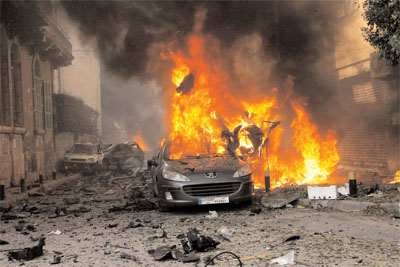
    BEIRUT: BEIRUT (TIP): A powerful car bomb tore through a bustling south Beirut neighborhood that is a stronghold of Hezbollah on August 15, killing at least 18 and trapping dozens of others in an inferno of burning cars and buildings in the bloodiest attack yet on Lebanese civilians linked to Syria’s civil war. The blast is the second in just over a month to hit one of the Shiite militant group’s bastions of support in years, and the deadliest in decades.

    It raises the specter of a sharply divided Lebanon being pulled further into the conflict next door, which is being fought on increasingly sectarian lines pitting Sunnis against Shiites. Syria-based Sunni rebels and militant Islamist groups fighting to topple Syria’s President Bashar Assad have threatened to target Hezbollah strongholds in Lebanon in retaliation for intervening on behalf of his regime in the conflict.

    August 15 explosion ripped through a crowded, overwhelmingly Shiite area tightly controlled by Hezbollah, turning streets lined with vegetable markets, bakeries and shops into scenes of destruction and burning cars. Dozens of ambulances rushed to the scene of the explosion and fire fighters used cranes and ladders in trying to evacuate dozens of residents from burning buildings. Some terrified residents fled to the rooftops of buildings and civil defense workers were still struggling to bring them down to safety several hours after the explosion.

    The blast appeared to be an attempt to sow fear among the group’s civilian supporters and did not target any known Hezbollah facility or personality. Hezbollah’s Al Manar TV and Red Cross official George Kattaneh said the death toll was at least 18 and said more than 280 were wounded. The army, in a statement, said the explosion was caused by a car bomb. It called on residents to cooperate with security forces trying to evacuated people trapped in their homes. Syria’s conflict has spilled across the border into its neighbor on multiple occasions in the past two years.

    Fire from Syria has hit border villages, while clashes between Lebanese factions backing different sides have left scores dead. But direct attacks against civilian targets were rare until Hezbollah stepped up its role in Syria. Since then, its support bases in southern Beirut have been targeted. Since May, rockets have been fired at suburbs controlled by the group on two occasions, wounding four people.

    On July 9, a car bomb exploded in the nearby Beir al- Abed district, wounding more than 50 people. However Thursday’s explosion was much deadlier than those, the bloodiest single attack in south Beirut since a 1985 truck bomb assassination attempt targeting top Shiite cleric Mohammed Hussein Fadlallah in Beir al-Abed left 80 people dead. It came despite rigorous security measure taken in the past few weeks by Hezbollah around its strongholds, setting up checkpoints, searching cars and sometimes using sniffer dogs to search for bombs.

    It also came a day before Hezbollah leader’s was scheduled to give a major speech marking the end of the month-long 2006 war with Israel. The explosion occurred on a commercial and residential main street in the Rweiss district, about 100 meters (yards) away from the Sayyed al-Shuhada complex where Hezbollah usually holds rallies. Hezbollah leader Sheikh Hassan Nasrallah, who has lived in hiding since his group’s 2006 month-long war with Israel, made a rare public appearance at the complex on Aug. 2, where he addressed hundreds of supporters.

    He was to speak again on Friday from a location in southern Lebanon, but his speeches by satellite are often transmitted to followers at the complex. Panicked Hezbollah fighters fired in the air to clear the area and roughed up photographers, smashing and confiscating some of their cameras following the explosion. Sunni-Shiite tensions have risen sharply in Lebanon, particularly since Hezbollah raised its profile by openly fighting alongside Assad’s forces. Lebanese Sunnis support the rebels fighting to topple Assad, a member of a Shiite offshoot sect.

    The group’s fighters played a key role in a recent regime victory in the town of Qusair near the Lebanese border, and Syrian activists say they are now aiding a regime offensive in the besieged city of Homs. A previously unheard-of group calling itself Aisha the Mother of Believers Brigades claimed responsibility for the attack in a video posted on YouTube, saying it is the second “message” they sent since last month’s blast in the area. The authenticity of the claim could not be independently verified.

    Our second message was strong and astounding,” said a masked man who read the statement, flanked by two other armed and masked men. He called on civilians to stay away from Hezbollah strongholds in the future, saying the militant group is “an agent for Iran and Israel.” Hezbollah lawmaker Ali Ammar called the blast a “terrorist” attack and called for restraint among the group’s supporters. He suggested the group’s political rivals in Lebanon were responsible for creating an atmosphere that encourages such attacks.

    Politicians within Lebanon’s Westernbacked coalition have slammed the group for its involvement in Syria and called for its disarmament. The U.S. Ambassador to Lebanon Maura Connelly strongly condemned the bombing. In comments posted on the embassy’s Facebook page, Connelly called for all parties to exercise calm and restraint. The British Foreign Office official in charge of Middle East policy, Alistair Burt, also condemned the attack.

    Terrorism and extremism have no place in Lebanon. I call for the Lebanese state to investigate this urgently and bring the perpetrators to justice,” he said in a statement. Outgoing Lebanese Prime Minister Najib Mikati declared Friday a day of mourning for the victims of the attack.

  • Economic Issues Likely To Dominate Kerry’s Visit To India

    Economic Issues Likely To Dominate Kerry’s Visit To India

    WASHINGTON (TIP): Economic issues like intellectual property protection, local content restrictions and a continued cap on FDI are likely to be on top of his agenda when US Secretary of State John Kerry travels to India next week for the strategic dialogue between two countries. “First and the foremost from our perspective will be economic piece of this (dialogue). There has been lot of concern on part of American business community about what they see as growing obstacles to trade and investment,” Assistant Secretary of State for South and Central Asia, Robert Blake, told an audience here.

    Both Kerry and President Barack Obama have been receiving letters from the US business community, advocacy groups, Senators and Congressmen on the trade policies of India, which they claim is harming American businesses. “Intellectual property protection, local content restrictions, continued restrictions on FDI in different sectors. This is certainly going to be our focus,” Blake said, adding that one of the goals is to reinvigorate the bilateral investment treaty talks and conclude them as soon as possible.

    Likewise, the US wants to reinvigorate the trade policy forum, and will also push for continued progress on the civil nuclear side, he added. Responding to questions, Blake said the US is not looking at any deliverables during the strategic dialogue, except to making sure that they understand each other on these issues. “India has its own concerns on comprehensive immigration reform. Obviously we need to hear from that.

    The purpose of the dialogue is to hear each other out in a very open and friendly manner and then figure out who is going to take charge of fixing these,” he said. As a result of the three rounds of strategic dialogue so far, Blake said there has been significantly quite convergence of strategic growth between the United States and India. Referring to the various bilateral and trilateral dialogues between the two countries, Blake said: “All of these collectively really enabled us to have an extremely good dialogue on issues that were previously very difficult.”

    “Things like Afghanistan, Iran, Burma and Middle East were areas of quite sharp differences. Now we have a remarkable degree of convergence, which has been a very welcome to see. Non-proliferation, food security, scientific and academic co-operation, climate change, defence trade, and regional issues like Afghanistan and Pakistan will also figure prominently during Kerry’s visit, Blake noted. Responding to questions, Blake said India is one of the highest strategic priorities for the US.

  • Waiver Augurs Well For Indo-US Ties, Say Officials

    Waiver Augurs Well For Indo-US Ties, Say Officials

    NEW DELHI (TIP): New Delhi is happy that Washington has granted another sixmonth waiver to India on Iran-related sanctions just ahead of the fourth Indo-US strategic dialogue. Along with India, China, Malaysia, South Korea, Singapore, South Africa, Sri Lanka, Turkey and Taiwan have also qualified for the exemption from sanctions. India has reduced its oil purchases from Iran considerably in the past few years, cutting imports by nearly a fifth.

    China’s reductions have, however, been more modest. An indication about India getting a fresh waiver from sanctions was recently given by US Undersecretary for Political Affairs Wendy Sherman when she visited New Delhi. “They (India) have stood side-by-side with all of us in the international community to say that Iran should not acquire a nuclear weapon.

    We greatly appreciate all of the leadership that India has provided, including their enforcement of sanctions,” she said. Officials here candidly acknowledge that the Indian economy, already going through a rough period, would have suffered greater had India attracted the Iran-related sanctions. The waiver to India is being viewed here as a move that sets a perfect stage for the fourth India-US strategic dialogue to be held here on June 24. ‘

    External Affairs Minister Salman Khurshid and US Secretary of State John Kerry will lead their respective delegations at the dialogue, which will cover the entire range of relationship between the two countries. The US has been nudging India to reduce its engagement with Iran in view of its controversial nuclear program.

    New Delhi has, however, made it clear Washington that it could not be pressed beyond a limit on the issue of Iran, keeping in view its historical ties with the Islamic country. It has also been forthright in stating that it would only abide by UN sanctions against Iran and not those slapped by individual countries, like the US.

  • Tri-service commands for space, cyber warfare

    Tri-service commands for space, cyber warfare

    NEW DELHI (TIP): The armed forces are now finalizing the plan for creation of three new tri-Service commands to handle space, cyber and special forces, which will be “critical” in deploying capabilities for conventional as well asymmetric warfare in a unified manner. Contours of the Cyber, Aerospace and Special Operations Commands (SOC), after “a lot of spadework” over the past several months, are now being fine-tuned to ensure the “formal joint plan” can be presented to the government by end-July, say sources. “The Aerospace Command, for instance, can be based at Hyderabad because of the presence of ISRO, DRDO there.

    Similarly, the SOC can come up at Delhi since the C-130J `Super Hercules’ aircraft, which are customized for special operations, are based at Hindon airbase,” said a source. The chiefs of staff committee — headed by Air Chief Marshal N A K Browne and including General Bikram Singh and Admiral D K Joshi — as well as other forums of the top military brass have been mulling over the plan since last year, as was first reported by TOI. Though the “urgent need” for Army, Navy and IAF to “synergise” their efforts in tackling challenges in the domains of space, cyber and special forces is well-acknowledged, especially with China furiously developing counter-space and cyber weapons, there has been no final decision on who will “mother” which command.

    The experience of India’s only theatre command at Andaman and Nicobar islands (ANC), with its commander-in-chief (a three-star officer like Lt-General, Vice-Admiral or Air Marshal) being rotated among the three Services, has not been successful. “Turf wars ensure the Services are not very keen to part with their assets for ANC,” said the source. At present, each Service gets to head the three unified commands — ANC, Strategic Forces Command (SFC) and Integrated Defence Staff (IDS) — by rotation.

    “But it is felt one particular service should have stake in a specific command that can draw assets and manpower from all three but is steered by that Service,” he said. So, a view that has emerged is that while SFC, IDS and Cyber Command can continue to be “rotated”, ANC should be headed by Navy, Aerospace Command by IAF, and SOC by Army. “This fits in with the domain expertise of each Service. The government will of course have to take the final call on the new commands,” he said. India has floundered for long in setting up effective and unified structures to deal with threats in space and cyberspace as well as in strengthening its clandestine and “unconventional” warfare capabilities.

    The Aerospace Command, for instance, has been demanded by the armed forces in the past also but the government has kept it in cold storage despite China having an expansive military space programme that extends to advanced ASAT (antisatellite) capabilities with “directascent” missiles, hit-to-kill “kinetic” and directed-energy laser weapons. Cyber-warfare, too, is a frontline military priority for China. Cyberweapons can cripple an adversary’s strategic networks and energy grids, banking and communication, and even sabotage a country’s nuclear programme like Iran learnt after the Stuxnet software “worm” destroyed a thousand of its centrifuges a couple of years ago.

  • Political History Of Pakistan

    Political History Of Pakistan

    Pakistan was one of the two original successor states to British India, which was partitioned along religious lines in 1947. For almost 25 years following independence, it consisted of two separate regions, East and West Pakistan, but now it is made up only of the western sector. Both India and Pakistan have laid claim to the Kashmir region; this territorial dispute led to war in 1949, 1965, 1971, 1999, and remains unresolved today. What is now Pakistan was in prehistoric times the Indus Valley civilization (c. 2500–1700 BC).

    A series of invaders—Aryans, Persians, Greeks, Arabs, Turks, and others— controlled the region for the next several thousand years. Islam, the principal religion, was introduced in 711. In 1526, the land became part of the Mogul Empire, which ruled most of the Indian subcontinent from the 16th to the mid-18th century. By 1857, the British became the dominant power in the region.With Hindus holding most of the economic, social, and political advantages, the Muslim minority’s dissatisfaction grew, leading to the formation of the nationalist Muslim League in 1906 by Mohammed Ali Jinnah (1876–1949).

    The league supported Britain in the Second World War while the Hindu nationalist leaders, Nehru and Gandhi, refused. In return for the league’s support of Britain, Jinnah expected British backing for Muslim autonomy. Britain agreed to the formation of Pakistan as a separate dominion within the Commonwealth in Aug. 1947, a bitter disappointment to India’s dream of a unified subcontinent. Jinnah became governorgeneral. The partition of Pakistan and India along religious lines resulted in the largest migration in human history, with 17 million people fleeing across the borders in both directions to escape the accompanying sectarian violence.

    The New Republic
    Pakistan became a republic on March 23, 1956, with Maj. Gen. Iskander Mirza as the first president. Military rule prevailed for the next two decades. Tensions between East and West Pakistan existed from the outset. Separated by more than a thousand miles, the two regions shared few cultural and social traditions other than religion. To the growing resentment of East Pakistan,West Pakistan monopolized the country’s political and economic power. In 1970, East Pakistan’s Awami League, led by the Bengali leader Sheik Mujibur Rahman, secured a majority of the seats in the national assembly.

    President Yahya Khan postponed the opening of the national assembly to skirt East Pakistan’s demand for greater autonomy, provoking civil war. The independent state of Bangladesh, or Bengali nation, was proclaimed on March 26, 1971. Indian troops entered the war in its last weeks, fighting on the side of the new state. Pakistan was defeated on Dec. 16, 1971, and President Yahya Khan stepped down. Zulfikar Ali Bhutto took over Pakistan and accepted Bangladesh as an independent entity.

    In 1976, formal relations between India and Pakistan resumed. Pakistan’s first elections under civilian rule took place in March 1977, and the overwhelming victory of Bhutto’s Pakistan People’s Party (PPP) was denounced as fraudulent. A rising tide of violent protest and political deadlock led to a military takeover on July 5 by Gen. Mohammed Zia ul-Haq. Bhutto was tried and convicted for the 1974 murder of a political opponent, and despite worldwide protests he was executed on April 4, 1979, touching off riots by his supporters. Zia declared himself president on Sept. 16, 1978, and ruled by martial law until Dec. 30, 1985, when a measure of representative government was restored. On Aug. 19, 1988, Zia was killed in a midair explosion of a Pakistani Air Force plane. Elections at the end of 1988 brought longtime Zia opponent Benazir Bhutto, daughter of Zulfikar Bhutto, into office as prime minister.

    A Shaky Government
    In the 1990s, Pakistan saw a shaky succession of governments—Benazir Bhutto was prime minister twice and deposed twice and Nawaz Sharif three times, until he was deposed in a coup on Oct. 12, 1999, by Gen. Pervez Musharraf. The Pakistani public, familiar with military rule for 25 of the nation’s 52-year history, generally viewed the coup as a positive step and hoped it would bring a badly needed economic upswing. To the surprise of much of the world, two new nuclear powers emerged in May 1998 when India, followed by Pakistan just weeks later, conducted nuclear tests. Fighting with India again broke out in the disputed territory of Kashmir in May 1999. Close ties with Afghanistan’s Taliban government thrust Pakistan into a difficult position following the Sept. 11 terrorist attacks. Under U.S. pressure, Pakistan broke with its neighbor to become the United States’ chief ally in the region. In return, President Bush ended sanctions (instituted after Pakistan’s testing of nuclear weapons in 1998), rescheduled its debt, and helped to bolster the legitimacy of the rule of Pervez Musharraf, who appointed himself president in 2001. On Dec. 13, 2001, suicide bombers attacked the Indian parliament, killing 14 people. Indian officials blamed the attack on Islamic militants supported by Pakistan. Both sides assembled hundreds of thousands of troops along their common border, bringing the two nuclear powers to the brink of war.

    Musharraf Extends Power
    In 2002, voters overwhelmingly approved a referendum to extend Musharraf’s presidency another five years. The vote, however, outraged opposing political parties and human rights groups who said the process was rigged. In August, Musharraf unveiled 29 constitutional amendments that strengthened his grip on the country. Pakistani officials dealt a heavy blow to al- Qaeda in March 2003, arresting Khalid Shaikh Mohammed, the top aide to Osama bin Laden, who organized the 2001 terrorist attacks against the U.S. The search for bin Laden intensified in northern Pakistan following Mohammed’s arrest.

    In Nov. 2003, Pakistan and India declared the first formal cease-fire in Kashmir in 14 years. In April 2005, a bus service began between the two capitals of Kashmir— Srinagar on the Indian side and Pakistan’s Muzaffarabad—uniting families that had been separated by the Line of Control since 1947. Abdul Qadeer Khan, the father of Pakistan’s nuclear bomb, was exposed in Feb. 2004 for having sold nuclear secrets to North Korea, Iran, and Libya. Musharraf had him apologize publicly, and then pardoned him. While much of the world reviled him for this unconscionable act of nuclear proliferation, the scientist remains a national hero in Pakistan. Khan claimed that he alone and not Pakistan’s military or government was involved in the selling of these ultraclassified secrets; few in the international community have accepted this explanation.

    Relationship with Taliban
    Pakistan has launched major efforts to combat al-Qaeda and Taliban militants, deploying 80,000 troops to its remote and mountainous border with Afghanistan, a haven for terrorist groups. More than 800 soldiers have died in these campaigns. Yet the country remains a breeding ground for Islamic militancy, with its estimated 10,000–40,000 religious schools, or madrassas. In late 2006 and into 2007, members of the Taliban crossed into eastern Afghanistan from Pakistan’s tribal areas.

    The Pakistani government denied that its intelligence agency has supported the Islamic militants, despite contradictory reports from Western diplomats and the media. In Sept. 2006, President Musharraf signed a controversial peace agreement with seven militant groups, who call themselves the “Pakistan Taliban.” Pakistan’s army agreed to withdraw from the area and allow the Taliban to govern themselves, as long as they promise no incursions into Afghanistan or against Pakistani troops.

    Critics said the deal hands terrorists a secure base of operations; supporters counter that a military solution against the Taliban is futile and will only spawn more militants, contending that containment is the only practical policy. That agreement came under fire in the U.S. in July 2007 with the release of a National Intelligence Estimate. The report concluded that al-Qaeda has gained strength in the past two years and that the United States faces “a persistent and evolving terrorist threat over the next three years.” The report also said the deal has allowed al-Qaeda to flourish. An earthquake with a magnitude of 7.6 struck Pakistani-controlled Kashmir on Oct. 8, 2005. More than 81,000 people were killed and 3 million left homeless. About half of the region’s capital city, Muzaffarabad, was destroyed. The disaster hit at the onset of the Himalayan winter. Many rural villages were too remote for aid workers to reach, leaving thousands vulnerable to the elements.

  • Sharif for warmer ties with India

    Sharif for warmer ties with India

    Says tackling terror and economic revival top priorities for the PML-N govt
    ISLAMABAD (TIP): Nawaz Sharif, poised for a record third term as Pakistan Prime Minister after his party’s emphatic victory in the landmark General Election, has sought “warmer ties” with India and said his government would devise a national policy to tackle the problem of terrorism. “We will contact every party for the purpose of forming our policy on terrorism,” Sharif said during an interaction with a group of foreign journalists at his farmhouse on the outskirts of Lahore on Monday. Referring to the attack on PML-N leader Sanaullah Zehri in Balochistan, Sharif said it would be wrong to say that terrorism had not affected PML-N. He said the PML-N government would respect the mandate given to parties by the people from the areas where they have won. Claiming that Pakistan will become the Asian tiger under his leadership, Sharif said economic revival was a top priority for the PML-N government.

    Sharif was greeted by world leaders, including the Saudi royal family and the British premier. Sharif expressed resolve to have cordial ties with all neighbors, including Iran, Afghanistan, China and India. Sharif called upon Pakistan Tehreek-e- Insaf to respect the mandate of the people and accept the results of the elections. Sharif said he would be “very happy” to invite Prime Minister Manmohan Singh to Pakistan for his oath-taking ceremony as the new Premier. “We will be very happy to invite him. I got a call from him (Singh) yesterday. We had a long chat on the phone and then he extended an invitation to me and I extended an invitation to him,” said Sharif. He said it would be an honour if Manmohan Singh was present at the swearing-in. He further said he hoped to meet the Indian Prime Minister as soon as possible as he was keen on forging good relations between the two countries.

    The PML-N chief had earlier said he is keen on resuming the India-Pakistan peace process that was interrupted in 1999 by then Army chief Pervez Musharraf, who ousted Sharif’s government in a military coup. Prime Minister Singh had yesterday lost no time in congratulating Sharif on his election victory. Responding to questions on the drone strikes, Sharif said he would discuss the issue with the US leadership. Meanwhile, President Asif Ali Zardari on Monday telephoned Pakistan Muslim League-Nawaz (PML-N) leader Nawaz Sharif and congratulated him on winning the historic polls, according to dawn.com. Zardari expressed hope that Sharif would be able to strengthen the democratic process during his political tenure.

  • Iran will ‘annihilate’ cities if Israel attacks: KHAMENEI

    Iran will ‘annihilate’ cities if Israel attacks: KHAMENEI

    TEHRAN (TIP): Iran will “annihilate” the Israeli cities of Tel Aviv and Haifa if it comes under attack by the Jewish state, supreme leader Ayatollah Ali Khamenei warned on March 21. “Every now and then the leaders of the Zionist regime threaten Iran with a military attack,” Khamenei said in a live televised speech from the northeastern holy city of Mashhad, referring to Israel. “They should know that if they commit such a blunder, the Islamic republic will annihilate Tel Aviv and Haifa,” he said. Iran is said to possess ballistic missiles capable of reaching Israel.

    It also has close relations with Israel’s foes in the region, including Lebanon’s Hezbollah and Palestinian militants in the Islamist-ruled Gaza Strip. Khamenei spoke with little sign of an easing in Tehran’s position in its confrontation with the West over its disputed nuclear programme of uranium enrichment.

    Israel, widely believed to be the Middle East’s sole but undeclared nuclear power, suspects that Tehran is seeking atomic arms, a fear shared by the United States and Western powers, and has not ruled out a military strike. Washington has also refused to rule out the military option, but insists it prefers a diplomatic solution to the nuclear stand-off. US President Barack Obama in Israel on Wednesday accepted that the Jewish state would not cede its right to confront Iran’s nuclear threat to the United States.

  • Obama To Israel  ‘You Are Not Alone’

    Obama To Israel ‘You Are Not Alone’

    JERUSALEM (TIP): President Obama’s whole visit to Israel can be summed up in one Hebrew phrase he uttered to a packed auditorium of Israeli students: You are not alone. Acknowledging the deep insecurity of a people that has experienced millenniums of persecution, not least of all Holocaust, Obama reassured them of America’s unwavering support as they grapple with a host of regional challenges, including Iranian nuclear development, civil war in Syria, the rise of Islamist powers, and ongoing tensions with their Palestinian neighbors. “Those who adhere to the ideology of rejecting Israel’s right to exist might as well reject the earth beneath them and the sky above, because Israel is not going anywhere,” he said, speaking to a select group in Jerusalem’s convention center. “Today, I want to tell you – particularly the young people – that so long as there is a United States of America, atem lo lavad.” Obama’s demeanor, words, and gestures on his first trip to Israel as president mark a decided departure from his 2009 Cairo speech to the Muslim world, in which he sought to show that the US took interest in regional affairs beyond their impact on Israel and thus rebuild credibility in a region roiled by the Iraq war and the larger war on terror.

    While not all Israelis have been impressed by the opening scene of Obama’s Act II in the Middle East, many are grateful for his unequivocal expression of support for Israel.

    Some suggest it reflects a maturing in his views, shaped in part by the turmoil of the Arab revolts of the past two years – although others see it as a preemptive charm offensive before asking the Israelis to make some tough compromises on Iran and the Palestinian issue. “In Cairo, he came to talk about peace, democracy, rights, new rules. And in a few days history changed in a scary way there. I think he understands things are different than what he thought,” says Tamar Asraf, who lives in the West Bank settlement of Eli. “And he’s coming not as the messiah, not as the sheriff; he’s coming as the president of the US, the best friend of Israel. I feel like he’s coming to support us, to help us.”

    CEMENTING THE FRIENDSHIP
    Indeed, from the moment Obama stepped off Air Force One yesterday, he exuded a spirit of friendship that carried with it both deep commitment and informal ease, shedding his suit coat barely half an hour into the visit. From an Israeli point of view, he has said all the right things and is visiting all the right places, acknowledging not only the modern state of Israel but also the Jewish people’s ancient claims to the land. But all he really had to do was land in the country for his first visit as president, a strong message of support no matter what he said or did. As Israel Hayom English editor Amir Mizroch put it, “Stop it, stop it.

    You had me at Shalom,” referring to Jerry McGuire winning his wife back with a simple “hello.” Obama, however, had much more to say than shalom. “My main goal on this trip has been to have an opportunity to speak directly to the Israeli people at a time when obviously what was already a pretty tough neighborhood has gotten tougher and let them know that they’ve got a friend in the US, that we have your back, that we consider Israel’s security of extraordinary importance to us,” he said last night at a press conference with Prime Minister Benjamin Netanyahu. “Not just because of the bonds between our peoples, but also because of our own national security interests.” Such assurances may give Obama political capital that he can cash in later, perhaps to rein in Israeli impulses to attack Iran or Syria, or to push them to make hard compromises on the Palestinian issue.

    After barely mentioning the Palestinians yesterday and spending only a few hours of his 48-hour visit in Ramallah with Palestinian Authority President Mahmoud Abbas today, Obama reaffirmed America’s commitment to a two-state solution in his Jerusalem speech.And the young Israelis in attendance were receptive, cheering loudly when he said “the Palestinian people’s right to self-determination and justice must also be recognized.” Among them was Rona Keha, an undergraduate studying political science at Ben Gurion University in Beersheva. Now, she says, “He needs to put some pressure on the Israeli government.

    He needs to start conversations and negotiate between Israel and the Palestinians. He needs to press on our government in order to start doing so,” says Ms. Keha, who spent three hours in line waiting to get into the speech. “I think this visit is one way to do it. And I hope that this visit will bring us some change.”

    BOOSTING PEACE, OR BOOTING IT DOWN THE LINE?
    Nadav Tamir, a policy advisor in Peres’s office who confessed to being emotional after Obama’s “amazing” speech, says Obama’s reassurances to the Israeli public would enable them to move forward more confidently toward peace. “I think it was the balance between showing very strong and deep care for Israel, for the history, for the future, for Zionism, but on the other hand, you know, that he told us you Israelis should feel safe enough to be proactive in terms of the peace process,” says Mr. Tamir. “When the Israeli public feel that they can trust [our] most important ally and the strongest superpower, I think it will help leaders to move the peace process forward….

    When President Obama is telling you, ‘I have your back,’ it’s very helpful.” But there is also a fair amount of skepticism that Obama will be able to follow up his eloquent words with concrete progress. “Israeli media talks about the fact that conflict in Middle East has become a kind of hobby for world leaders, and I tend to believe it is also true in the case of Obama,” says Hila Volpo, a graduate student studying political communication from Jerusalem. “I don’t think Obama believes within himself that it’s something he’s capable of doing.” Many American presidents have tried to solve the Israeli-Palestinian conflict, but even someone as engaged as former President Bill Clinton, who personally engaged in furious shuttle diplomacy, was unable to secure a deal.

    Obama, by contrast, got Israel to agree to a one-time settlement freeze but when talks stalled in September 2010, he was either unwilling or unable to pressure Israelis and Palestinians to resume talks.

    Obama also made clear in the Ramallah press conference today that he’s done an about-face on Israeli settlements, saying that a fresh freeze on Israeli settlement growth in the West Bank – a key Palestinian precondition for returning to the peace table – would just delay substantive peacemaking. That was deeply disappointing to Palestinians, but to Israelis it was a welcome change. “I heard he understood that it’s not the way [to press on settler issue], that he does not achieve anything.

    I think freezing or not freezing is not the question, the question is how does he see the future here and does he understand that he has to let Israel lead the process,” says Ms. Asraf of Eli. “I feel that he came with a lot of love, and a lot of respect, and it doesn’t seem like here is a sheriff to make everything peaceful back again … it seems like he comes as a friend

  • India Sixth Most Favourable Nation For Americans: Poll

    India Sixth Most Favourable Nation For Americans: Poll

    WASHINGTON (TIP): India is the sixth most favourable nation for Americans, while at least eight out of 10 do not like Pakistan, making it the third most unfavourable nation after Iran and Korea, according to a latest poll.

    According to the Gallup Polls, nearly seven (68 per cent) out of every 10 persons interviewed for the poll favoured India, thus ranking it sixth after Canada (91 per cent), Great Britain (88 per cent), Germany (85 per cent), Japan (81 per cent) and France (73 per cent).

    In fact Israel, the traditional American ally ranks seventh after India with 66 per cent while Mexico get only 47 per cent favourable votes. Opinion about Russia is equally divided among favourable and unfavourable rating while 52 per cent of the Americans put China in the unfavourable category. Nine out of 10 Americans have an unfavourable view of Iran, making it the worst rated country out of 22 surveyed. Seven other countries – Libya (72 per cent), Iraq (76 per cent), Afghanistan (80 per cent), the Palestinian Authority (77 per cent), Syria (75 per cent), Pakistan (81 per cent) and North Korea (84 per cent)– also receive unfavourable ratings of 70 per cent or more. “Eight countries with the most negative ratings are currently or over the past decade were involved in wars, disputes, or turmoil — in a number of instances, in ways that are hostile to the US,” Gallup said. It said the currently “hostile” category includes Iran and North Korea.

    Libya was hostile toward the US under the government of Muammar Gaddafi and more recently Ambassador Christopher Stevens and three other Americans were killed there. “The US-Pakistani relationship is beset with rockiness despite the strained cooperation between the two on military matters. Americans also strongly favour Israel’s enduring conflict with Palestinian Authority,” the survey said.

  • Ah! Chavez

    Ah! Chavez

    NAME: Hugo Rafael Chávez Frías
    OCCUPATION: World Leader
    BIRTH DATE: July 28, 1954
    DEATH DATE: March 05, 2013
    EDUCATION: Venezuelan Academy of Military Sciences

    CARACAS (TIP): Venezuela president Hugo Chavez died on 6th March, 2013. He was 58 and was suffering from cancer since a couple of months. With the death of Chavez, the future of Latin America is now uncertain.

    The news of death of Chavez was announced by Vicepresident Nicholas. He spoke to the television reporters from Caracas military hospital. Chavez was seen as a populist leader by the supporters. His critics called him neo fascist. He was an engaging speaker and charismatic personality.

    Hugo Chavez was admitted into the hospital on 18th February, 2013. It was decided to continue the chemotherapy treatment. Earlier, he was operated for cancer in Cuba. That was the fourth cancer surgery he underwent since June, 2011. Hugo Chavez was the president of Venezuela for 14 years.

    He became the symbol of Latin America. In December 2012, he went to Cuba and was out of public sight. There were many rumors about his health. A few photos were released in January which showed him on the bed in a hospital. He was looking at his two daughters who were beside him. Chavez was the favorite leader for poor. He spent the country’s revenue earned from oil on building houses for poor, health, food and education of them. Other Latin America leaders who followed Chavez have lost a good friend with the death of Chavez. Chavez’s body is kept in the military academy for people and other leaders to visit.
    Biography
    Born in Sabaneta, Venezuela, on July 28, 1954, Hugo Chávez attended the Venezuelan military academy and served as an army officer before participating in an effort to overthrow the government in 1992, for which he was sentenced to two years in prison.

    Chávez became president of Venezuela in 1999. Early into his presidency, he created a new constitution for the country, which included changing its name to the Bolivarian Republic of Venezuela. He later focused his efforts on gaining control of the state-run oil company, which stirred controversy and led to protests, strained relations with the United States and other nations, and Chávez briefly being removed from power. His actions included selling oil to Cuba and resisting efforts to stop narcotic trafficking in Columbia. In 2006, Chávez helped create the Bolivarian Alternative for the Americas, a socialist free-trade organization. He died on March 5, 2013, at age 58, following a long battle with cancer.
    Failed Coup Attempt
    Born Hugo Rafael Chávez Frías on July 28, 1954, in Sabaneta, Venezuela, Hugo Chávez was the son of schoolteachers. Before becoming known for his reform efforts and strong opinions as president of Venezuela (1999-2013), Chávez attended the Venezuelan Academy of Military Sciences, where he graduated in 1975 with a degree in military arts and science. He went on to serve as an officer in an army paratrooper unit.

    In 1992, Chávez, along with other disenchanted members of the military, attempted to overthrow the government of Carlos Andres Perez. The coup failed, and Chávez subsequently spent two years in prison before being pardoned. He then started the Movement of the Fifth Republic, a revolutionary political party. Chávez ran for president in 1998, campaigning against government corruption and promising economic reforms.
    Venezuelan President
    After taking office in 1999, Chávez set out to change the Venezuelan constitution, amending the powers of congress and the judicial system. As a part of the new constitution, the name of the country was changed to the Bolivarian Republic of Venezuela. As president, Chávez encountered challenges both at home and abroad.

    His efforts to tighten his hold on the state-run oil company in 2002 stirred up controversy and led to numerous protests, and he found himself removed from power briefly in April 2002 by military leaders. The protests continued after his return to power, leading to a referendum on whether Chávez should remain president. The referendum vote was held in August 2004, and a majority of voters decided to let Chávez complete his term in office.

    Hostility Towards the U.S.
    Chávez was known for being outspoken and dogmatic throughout his presidency, refusing to hold back any of his opinions or criticisms. He insulted oil executives, church officials and other world leaders, and was particularly hostile with the United States government, which, he believed, was responsible for the failed 2002 coup against him. Chávez also objected to the war in Iraq, stating his belief that the United States had abused its powers by initiating the military effort. He also called President George W. Bush an evil imperialist.

    Relations between the United States and Venezuela have been strained for some time. After taking office, Chávez sold oil to Cuba-a longtime adversary of the United States-and resisted U.S. plans to stop narcotics trafficking in nearby Colombia. He also helped guerrilla forces in neighboring countries. Additionally, during his presidency, Chávez threatened to stop supplying oil to the United States if there was another attempt to remove him from power. He did, however, donate heating oil to help the victims of Hurricane Katrina and Hurricane Rita, which destroyed numerous fuel-processing facilities.
    International Collaboration
    Regardless of the state of Venezuela’s relationship with the United States, while in office, Chávez leveraged his country’s oil resources to form connections with other nations, including China and Angola. In 2006, he helped create the Bolivarian Alternative for the Americas, a socialist free-trade organization joined by Fidel Castro, president of Cuba, and Evo Morales, president of Bolivia. Chávez was also an active member of the Non-Aligned Movement, a group of more than 100 countries, including Cuba, Iran and several African nations.
    Declining Health and Death
    Chávez discovered that he had cancer in June 2011, following a surgery to remove a pelvic abscess, and from 2011 to early 2012, he underwent three surgeries to remove cancerous tumors. Prior to his third surgery, in February 2012, Chávez acknowledged the severity of the operation as well as the possibility of not being able to continue his service as president, and subsequently named Venezuelan Vice President Nicolas Maduro as his successor.

    Due to his declinging health, Chávez was prevented from being inaugurated for a fourth term in January 2013. Following his years-long battle with cancer, Hugo Chávez died on March 6, 2013, at age 58, in Venezuela. He was survived by his wife, Maria Isabel Rodriguez, and five children: Rosines, María Gabriela, Rosa Virginia and Hugo Rafael.

  • Bin Laden’s son-in-law captured, charged in US with conspiring to kill Americans

    Bin Laden’s son-in-law captured, charged in US with conspiring to kill Americans

    NEW YORK (TIP): A top Al Qaeda spokesman who is the son-in-law of Osama bin Laden has been captured overseas and charged in the United States with conspiracy to kill Americans, according to an indictment unsealed Thursday, March 7. Sulaiman Abu Ghaith appeared alongside bin Laden in a 2001 video in which they took responsibility for the 9/11 attacks and warned of more, before he dropped out of sight for more than a decade before his arrest.

    According to the officials, who spoke on condition of anonymity, Turkish officials captured Abu Ghaith in the capital Ankara, where a court ruled he had entered the country illegally with a fake passport. The Turkish government then ostensibly deported Abu Ghaith to his birthplace Kuwait, but arranged for him to transit through Jordan where he was ultimately taken into custody by U.S. law enforcement, the officials said. Jordanian sources confirmed that Abu Ghaith was sent by Turkey via Jordan to Kuwait, and intercepted in Jordan and brought to the U.S. “I commend our CIA and FBI, our allies in Jordan, and President Obama for their capture of al-Qaeda spokesman Sulaiman Abu Ghaith,” said Rep. Peter King, R-N.Y., a member of the Homeland Security Committee, who first announced the news.

    “I trust he received a vigorous interrogation, and will face swift and certain justice,” added King, who is also chairman of the Sub-Committee on Counterterrorism and Intelligence. Prosecutors say from at least May 2001 to around 2002, Abu Ghaith served alongside bin Laden, appearing with him and his then-deputy Ayman al-Zawahiri, speaking on behalf of the terrorist organization and in support of its mission, and warning that attacks similar to those of September 11, 2001 would continue. The government says around May 2001, Abu Ghaith urged individuals at a guest house in Kandahar, Afghanistan, to swear allegiance to bin Laden. On the evening of Sept. 11, 2001, after the terrorist attacks on the United States, bin Laden summoned Abu Ghaith and asked for his assistance. He agreed to provide it.

    On the morning of Sept. 12, 2001, Abu Ghaith appeared with bin Laden and Zawahiri, and spoke on behalf of al-Qaeda, warning the United States and its allies that “[a] great army is gathering against you” and called upon “the nation of Islam” to do battle against “the Jews, the Christians and the Americans,” the court document says. Also, after the September 11, 2001 terrorist attacks, Abu Ghaith delivered a speech in which he addressed the then-U.S. Secretary of State and warned that “the storms shall not stop, especially the Airplanes Storm,” and advised Muslims, children, and opponents of the United States “not to board any aircraft and not to live in high rises.” Abu Ghaith arranged to be, and was, successfully smuggled from Afghanistan into Iran in 2002, where he spent most of the decade, U.S. officials said. Even as government officials applauded the arrest of Abu Ghaith, his transport to the United States stirred controversy among lawmakers who were apparently caught by surprise by the news. “We believe the administration’s decision here to bring this person to New York City, if that’s what’s happened, without letting Congress know is a very bad precedent to set,” said Sen. Lindsey Graham, R-S.C., who held a press conference with Sen. Kelly Ayotte, R-N.H. “And when we find somebody like this, this close to bin Laden and the senior al- Qaeda leadership, the last thing in the world we want to do, in my opinion, is put them in civilian court. This man should be in Guantanamo Bay,” Ayotte said. “So we’re putting the administration on notice,” said Graham. “We think that sneaking this guy into the country, clearly going around the intent of Congress when it comes to enemy combatants, will be challenged.” Earlier, House Intelligence Chair Mike Rogers, R-Mich., strongly criticized the administration for bringing Abu Ghaith to the United States. Rogers, a former FBI agent, said that Mirandizing a top al-Qaeda suspect and bringing him to the United States for trial creates a host of problems – instead of sending him to the facility at Guantanamo Bay, Cuba, which was built to handle high value prisoners. “Al-Qaeda leaders captured on the battlefield should not be brought to the United States to stand trial,” Rogers said. “We should treat enemy combatants like the enemy.

    The U.S. court system is not the appropriate venue.” The Obama administration has been trying to clear out Guantanamo and not bring any new prisoners there. Sen. Charles Schumer, D-N.Y., said it’s fine with him if Abu Ghaith is put on trial in New York because key state and city officials had been consulted in advance, unlike in the case of terror suspect Khalid Sheikh Mohammed. “Unlike with KSM, Kelly and others had been consulted ahead of time about this and they gave the green light to do it. As you know, (Police Commissioner) Ray Kelly, Mayor (Michael) Bloomberg and I opposed the trial of (Mohammed) in New York and we successfully made sure that didn’t happen,” said Schumer. “On issues like this, I defer to Commissioner Kelly, and I think the mayor does as well. And he thinks it’s OK to do it here, and I’ll go by that,” Schumer said.

  • Hagel Committed To Ties With India, Says Pentagon

    Hagel Committed To Ties With India, Says Pentagon

    WASHINGTON (TIP): As Chuck Hagel took over as Barack Obama’s new defense secretary amid a controversy over his comments on India’s role in Afghanistan, Pentagon – the US defense department headquarters – said that Hagel will work to strengthen ties to India. Hagel’s strong commitment to fostering a close defense relationship was reported Wednesday, February 27, by Washington Free Beacon, the rightwing online newspaper that had disclosed a video-recording of a speech Hagel made in 2011 about Indian aid to Afghanistan. “Secretary Hagel is strongly committed to the US strategic partnership with India and to fostering an even closer defense relationship with India that builds upon the work of Secretary (Leon) Panetta, Deputy Secretary (Ashton) Carter, and their Indian counterparts,” Free Beacon quoted Pentagon spokesperson George Little as saying. “Secretary Hagel looks forward to working closely with Indian national security and defense officials,” Little told the newspaper that had dug out the controversial comments during Hagel’s contentious confirmation hearings with his former Republicans attacking him for his positions on Israel and Iran.

    In his previously unreleased 2011speech, Hagel had said: “India for some time has always used Afghanistan as a second front, and India has over the years financed problems for Pakistan on that side of the border. “And you can carry that into many dimensions, the point being (that) the tense, fragmented relationship between Pakistan and Afghanistan has been there for many, many years.” The remarks raised a furor in New Delhi. However, in a calibrated response to the Free Beacon, the India Embassy said that Hagel’s 2011 remarks were not grounded in “reality.” “Such comments attributed to Sen.

    Hagel, who has been a long-standing friend of India and a prominent votary of close India-US relations, are contrary to the reality of India’s unbounded dedication to the welfare of the Afghan people,” the embassy spokesperson said in an email to the newspaper. “India’s commitment to a peaceful, stable, and prosperous Afghanistan is unwavering, and this is reflected in our significant assistance to Afghanistan in developing its economy, infrastructure, and institutional capacities,” the spokesperson said. “Our opposition to terrorism and its safe havens in our neighborhood is firm and unshakeable.” The existence of the video of Hagel’s speech at Cameron University in Oklahoma was disclosed by the online newspaper hours before the decorated Vietnam veteran was confirmed by the Senate after weeks of severe criticism from former Republican colleagues. The former Republican senator from Nebraska, who won two Purple Hearts for his bravery as a soldier during the Vietnam War, was accused of being critical of Israel and weak on Iran’s alleged nuclear weapon ambitions.

  • As I See It : The Origin Of Wars

    As I See It : The Origin Of Wars

    Just as Herodotus is the father ofhistory, Thucydides is the father ofrealism. To understand thegeopolitical conflict zones of the 21stcentury, you must begin with the ancientGreeks. Among the many importantlessons Thucydides teaches in his Historyof the Peloponnesian War is that whatstarts a war is different from what causesit.Thucydides chronicles how thePeloponnesian War began in the latterpart of the late fifth century B.C. withdisputes over the island of Corcyra innorthwestern Greece and Potidaea innortheastern Greece. These places werenot very strategically crucial in and ofthemselves. To think that wars must startover important places is to misreadThucydides.

    Corcyra and Potidaea, amongother locales, were only where thePeloponnesian War started; not whatcaused it. What caused it, he writes in thefirst book of his eight-book history, wasthe growth of perceived maritime powerin Athens and the alarm that it inspiredin Sparta and among Sparta’s allies.Places like Corcyra and Potidaea, and thecomplex alliance systems that theyrepresented, were in and of themselvesnot worth fighting a war over — a war thatwould last more than a quarter century,no less. That didn’t matter. They werepretexts.No one understood this distinction,which was perhaps made first inliterature by Thucydides, better thanThucydides’ most distinguishedtranslator, the 17th century Englishphilosopher Thomas Hobbes.

    Hobbeswrites that a pretext for war over someworthless place “is always an injuryreceived, or pretended to be received.”Whereas the “inward motive to hostility isbut conjectural; and not of the evidence.”In other words, the historian or journalistmight find it hard to find literaldocumentation for the real reasons statesgo to war; thus, he often must infer them.He often must tease them out of thepattern of events, and still in many casesbe forced to speculate.In applying the wisdom of Thucydidesand Hobbes to conflict zones across Asia,a number of insights may be obtained.The South China Sea conflict, forexample, becomes understandable.

    Hereare geographical features which, in theirown right, are valuable because of themeasurable energy deposits insurrounding waters. They also fall in thepath of sea lines of communications vitalfor access to the Indian Ocean in onedirection, and the East China Sea and Seaof Japan in the other, making the SouthChina Sea part of the word’s globalenergy interstate. Nevertheless, let’sassume one is somewhat dismissive ofthese facts and says such specks of dryland in the middle of a great sea are inany case not worth fighting a war over.Thucydides and Hobbes would pronouncehim wrong. They would say that it is theperceived rise of Chinese sea power — andthe alarm that it inspires amongAmerica’s formal allies and de facto allies– that, in turn, could be the real cause ofconflict sometime over the coming decade.

    Thus, the features in the South China Sea,as important as they might be, wouldmerely be the pretext.Indeed, nobody would prefer to say theyare provoking a conflict because of risingChinese sea power; rather, they would saythey are doing so because of this or thatinfringement of maritime sovereigntyover this or that islet. All the rest mighthave to be conjectured.The same is true with the conflictbetween China and Japan over theSenkaku/Diaoyu islands in the EastChina Sea. Even if one argues that theseislets are worthless, he or she would missthe point. Rather, the dispute over theseislets is a pretext for the rise of Chinesesea power and the fear that it inspires inJapan, helping to ease Japan out of itsquasi-pacifistic shell and rediscovernationalism and military power. (And bythe way, the rise of Chinese sea powerdoes not mean that China is able toengage the U.S. Navy in fleet-on-fleetbattle.

    It only means, for example, thatChina can use the placement of warshippatrols, along with economic anddiplomatic pressure and the staging ofprotests at home, all together in a seriesof “combination punches” to underminethe Japanese and other East Asian rivals.)Then there is North Korea. With a grossdomestic product of only that of Latvia orTurkmenistan, it might be assumed to beanother worthless piece of real estate.Geography tells a different story. Juttingout from Manchuria, the KoreanPeninsula commands all maritime trafficin northeastern China and traps in itsarmpit the Bohai Sea, home to China’slargest offshore oil reserve.

    China, as I’vepreviously written, favors an economictakeover of the Tumen River region –where China, North Korea and Russiaintersect, with good port facilitiesfronting Japan. The fate of the northernhalf of the Korean Peninsula will helpdetermine power relationshipsthroughout northeastern Asia, therefore.Of course, all of this, as Thucydides andHobbes would say, would have to beinferred, conjectured. North Korea’serratic behavior could start a conflict, butthe causes might also lie elsewhere.India and China have territorialtripwires in the Himalayan foothills, anarea which, again, might be judged bysome as worthless. But these tripwiresbecome more meaningful as Indiapartially shifts its defense procurementsaway from confronting Pakistan andtowards confronting China.

    It is doing sobecause the advance of technology hascreated a new and claustrophobicstrategic geography uniting India andChina, with warships, fighter jets andspace satellites allowing each country toinfringe on the other’s battle space. If aconflict ever does erupt between these twodemographic and economic behemoths, itprobably will not be because of thespecific reasons stated but because ofthese deeper geographical andtechnological causes.As for India and Pakistan, I rememberdecades ago sitting with a group ofjournalists in Peshawar, reading aboutPakistani and Indian troops confrontingeach other on the Siachen Glacier inKashmir, terrain so high the troops had towear oxygen masks.

    Could such territorybe worth fighting over? Again, theconflicting claims were merelysymptomatic of a deeper dispute over thevery legitimacy of these states arising outof the partition of the subcontinent in1947.Of course, Israel fears for its ownsurvival, were Iran to develop adeployable nuclear bomb. This is a casewhere the start of a conflict (by theUnited States, acting as Israel’s proxy)may largely overlap with its cause.Nevertheless, Israel has other fears thatare less frequently expressed.

    Forexample, a nuclear Iran would make everycrisis between Israel and Hezbollah,between Israel and Hamas, and betweenIsrael and the West Bank Palestiniansmore fraught with risk. Israel cannotaccept such augmentation of Iranianpower. That could signal the real cause ofa conflict, were Israel ever able to dragthe United States into a war with Iran.In all these cases, and others, the mostprofound lesson of Thucydides andHobbes is to concentrate on what goesunstated in crises, on what can only bededuced. For the genius of analysis lies inquiet deductions, not in the mereparroting of public statements. Whatstarts conflicts is public, and thereforemuch less interesting — and less crucial –than the causes of conflicts, which arenot often public.

    (The author is Chief GeopoliticalAnalyst for Stratfor, a private globalintelligence firm, and a non-residentsenior fellow at the Center for a NewAmerican Security in Washington. Hehas been a foreign correspondent forThe Atlantic for over a quartercentury. He is the author of 14 bookson foreign affairs and traveltranslated into many languages.)

  • Determined To Prevent Iran From Acquiring Nuclear Weapons: US

    Determined To Prevent Iran From Acquiring Nuclear Weapons: US

    WASHINGTON (TIP): In a bid to deterIran from acquiring nuclear weapons, theUS on Thursday warned Tehran of moresanctions and international isolations if itgoes ahead with the nuclear weaponspolicy.”We have been clear that the UnitedStates is determined to prevent Iran fromacquiring nuclear weapons and we havealso been clear that we believe there is stilltime to resolve this issue diplomatically,”White House Press Secretary Jay Carneytold reporters here on Thursday.

    In the statement, Carney said that if Iranfails to address the concerns of theinternational community, it will face morepressure and become increasingly isolated.”We hope that the Iranian regime willmake the strategic decision to come to theFebruary 26 talks with the P-5-plus-1 inKazakhstan prepared to discuss substanceso there can be progress in addressing theinternational community’s concerns aboutthe nature of the Iranian nuclearprogram,” he added.”The burden of sanctions could be eased,but the onus is on Iran to turn its statedreadiness to negotiate into tangible action,”Carney said in response to a question.

    Refusing to go into details of what theP5-plus-one will present to Iran in the talks,the US official said the US is ready to havea serious and substantive discussion.”Let’s allow the negotiators to do theirwork. We simply call on the Iranians toarrive at those talks with the intention ofhaving them be substantive and focused onthe issues that are of concern here to theinternational community,” Carney said.When asked about reports of Iran rollingout new atomic technologies, he said it’shardly a surprise that the actions taken byIran is a continuation of their refusal toabide by their international obligations.