
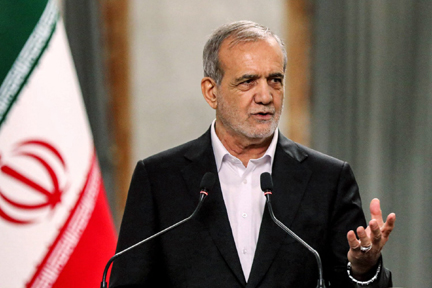

TEHRAN (TIP): Iranian President Masoud Pezeshkian has called for an end to the months-long war with the United States, saying Tehran should seek to stop the conflict while it believes it holds a “position of power and dignity”. His remarks come as Washington prepares additional economic pressure on Iran and diplomatic efforts to revive talks remain underway. “It is better that we bring the war to an end now as we are in a position of power and dignity,” Pezeshkian said during a meeting with doctors on Friday, August 21. He also claimed that Iran had gained international support during the conflict and accused the United States of attacking civilian infrastructure.
“The whole world acknowledges our victory and emphasizes that America has attacked our schools, hospitals and infrastructure in violation of all regulations and is hated around the world,” he added. Pezeshkian’s comments signal that Tehran may be seeking a diplomatic path to end the conflict while maintaining that Iran would negotiate from a position of strength. The remarks come as the war remains deadlocked and talks between Washington and Tehran are on hold.
The Iranian president also defended the June memorandum of understanding reached with Washington, despite criticism from hardliners in Iran’s parliament. Critics have accused Pezeshkian’s government of making concessions to the United States. He rejected that argument and said the agreement did not require Tehran to surrender its interests. “They cannot find even a single clause in this agreement that indicates capitulation. All the commitments concern the other side,” he said. The disagreement highlights the political debate inside Iran over whether Tehran should pursue negotiations with Washington or maintain a harder line as the conflict continues.
Pezeshkian’s call for an end to the war came as Iran and Oman discussed ways to reopen a diplomatic channel between Tehran and Washington. Oman’s state news agency reported that the two countries’ foreign ministers spoke by phone on Friday about creating conditions for the resumption of dialogue and negotiations. They also discussed developments affecting navigation through the Strait of Hormuz. Oman has previously played an important role in facilitating communication between Iran and the United States. The latest contact suggests that diplomatic channels remain active despite the military confrontation.
While Pezeshkian called for the conflict to end, Iran’s military leadership warned that the country remains prepared to respond to any fresh threat. “With preparedness across land, sea, air, air defense and cyberspace, Iran’s armed forces will respond to the enemy’s new threats with crushing, punishing and devastating responses,” Major-General Ali Abdollahi, chief of staff of Iran’s armed forces, was quoted as saying. The contrasting messages underline Tehran’s current position: Iran is signaling openness to negotiations while also warning that it remains ready for further military action if attacked.
The Strait of Hormuz remains at the center of the confrontation. Iran has kept the strategic waterway partially closed, while Washington has maintained a naval counter-blockade. The disruption has also added pressure to global energy and shipping markets. The latest diplomatic contacts between Iran and Oman also included discussions on navigation through the strait, suggesting that reopening or stabilizing the crucial shipping route could become an important part of any future negotiations.
US President Donald Trump has remained skeptical about the possibility of reaching an agreement with Tehran. Trump said Iran would like a deal but was not prepared to accept what he considers the “right deal”. He also claimed that the United States has extensive control over the region around the Strait of Hormuz.
“We have total control of that entire region having to do with the Strait of Hormuz, and that means well into it, the land areas. So, they would love to make a deal, but they’re not ready to make the right deal, in my opinion,” Trump said. Trump has separately described the Strait of Hormuz as “American territory”, further escalating the rhetoric surrounding the strategically important waterway.
The diplomatic uncertainty comes as the Trump administration prepares to intensify economic pressure on Tehran. US Treasury Secretary Scott Bessent has said Washington intends to use sanctions to pressure the Iranian government, while the administration has warned countries and companies against providing economic support to Iran.
Iran has rejected the planned measures and described Washington’s sanctions campaign as “economic terrorism”. Tehran has argued that further economic pressure will not resolve the conflict and has continued to call for negotiations based on its own conditions.
With Pezeshkian now openly calling for an end to the war while claiming Iran is in a position of strength, and Washington continuing its sanctions campaign, the conflict remains caught between diplomacy and escalation. Oman’s efforts to facilitate renewed talks could provide an avenue for dialogue, but major disagreements over sanctions, the Strait of Hormuz and the terms of any potential agreement remain unresolved.
(Source: The Sunday Guardian/ Nisha Srivastava)


Be the first to comment