Tag: Islam

  • Should Muslims sacrifice cattle on Eid-al-Adha?

    Should Muslims sacrifice cattle on Eid-al-Adha?

    By Mike Ghouse

    On Friday, July 31, 2020, over a billion and a half Muslims around the world, will be slaughtering millions of goats, camels, and cattle to carry out Abraham’s tradition of sacrificing the symbolic lamb. Is there an alternative to the ritual of slaying animals on Eid Al-Adha, the festival of sacrifice? The answer is yes!

    Rituals are the pathways to accomplish milestones of peace for oneself and with what surrounds one; life and environment. None of us can escape from the ceremonies. Each of us instinctively follows certain routines, from waking up to the time we go to sleep. Whether we shower, eat breakfast, go to the office, or gym, we follow the rituals.

    The essence of Islam is to create cohesive societies where every human feels secure about his/her faith, race, religion, region, or ethnicity. It is time for Muslims to consider the essence of sacrifice rather than the ritual itself.

    Real sacrifice requires us to give up some of what is dear to us. It is about parents going to sleep without food but feeding their kids; it is clothing their kids while waiting to get their own. In the case of extremities, we would instead get the bullet and save our loved ones, we are willing to rescue an individual from a freezing lake risking our own lives, and even strangers do that.

    A thousand years ago, a man’s assets were made up of his goats, camels, and cattle. The ultimate sacrifice one would make was to give away his precious assets in gifts. Today, the most cherished possession is money, and people must be willing to part some of it to give the ability to the receiver to spend on his/her critical needs.

    One of the examples set up for guidance was the test of Abraham’s faith, love, and devotion to God, which humans do routinely, “If you love me, you would do this for me.” A simple assurance would suffice, be it your fiancé, spouse, kids, siblings, or parents.

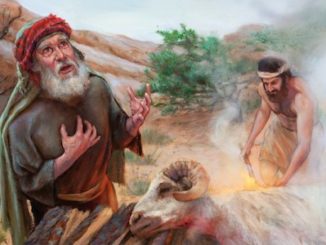
     It was Abraham’s turn to face the command of God to sacrifice his son. Upon hearing this, he prepared to submit to God’s will and places his son on the block. Right at that moment, a lamb appears as an alternative. Then God revealed to Abraham that his “sacrifice” has already been fulfilled.

    Does God want animals to be sacrificed?

    Not at all. Qur’an, Al-Hajj 22:37 (The Pilgrimage) is clear: “Never does their flesh reach God, and neither their blood. It is only your God-consciousness that reaches Him. It is to this end that we have made them subservient to your needs so that you might glorify God for all the guidance with which He has graced you. And give thou this glad tiding unto the doers of good.”

    The act symbolizes our willingness to give up a part of our bounties to strengthen and preserve the web of the universe and help those in need. We recognize that all blessings come from God, and we should open our hearts and share with others.

    What would you sacrifice instead?

    It is customary for Muslims to sacrifice an animal on the day of the Hajj, a symbolic representation of Prophet Abraham’s act. What are our alternatives?

    We can put that money to a different use that will do greater good like lending to a street hawker who can sell things from a cart and take care of his family or a single mom who can weave baskets or make sweaters to take care of her family. The beauty of this practice is you can make the same money repeatedly work for the common good. Muslims call it Sadaq-e-Jariah, which is continual giving.

    Dr. Nauman Anwar: “Sacrificing animals without making a public spectacle is still a good idea, as long as no wastage of the meat and hides occur. Many Muslim countries have a lot of poverty, and if the meat reaches the deserving population, it will help improve the nutritional status of the poor.

    Let your single sacrifice multiply rather than the one-time sacrifice of animals. Prophet Muhammad had emphasized service to fellow humans as the highest service to God. Quran (4:152) says, if you are kind to your fellow humans, which is my creation, you will earn my grace regardless of your faith.

    Honoring police, firemen, and soldiers

     Every day our police officers and firemen risk their own lives to protect ours, our freedom is protected by our men and women in the uniforms. I urge fellow Muslims to stop and salute every one of these men and women, honoring them for their love for humanity. Better yet, call the firemen, policemen, and let them know that as a Muslim you appreciate their sacrifice, and this festival is about appreciation for such sacrifice.

    I did that in Louisville; within minutes, the officer had emailed the article to his fellow officers, appreciating the Muslims.

    Prophet Muhammad (pbuh) had said the least you can do as a charity is to smile and appreciate the otherness of the others.

     You can wish your Muslim friends by saying, Eid Mubarak, Eid Saeed, Happy Eid, Happy Festivities, etc.

     ( Dr. Mike Ghouse is the founder and president of the Center for Pluralism. He is a speaker, thinker, author, community consultant, pluralist, activist, newsmaker, and an interfaith wedding officiant. More about him at www.TheGhousediary.com)


  • Should Muslims sacrifice cattle on Eid-al-Adha?

    Should Muslims sacrifice cattle on Eid-al-Adha?

    Should Muslims sacrifice cattle on Eid-al-Adha?

                                                By  Dr. Mike Ghouse


    Special article on the occasion of Eid-al-adha which falls on July 31.

    We wish our Muslim readers a Happy Eid


    Rituals are the pathways to accomplish milestones of peace for oneself and with what surrounds one; life and environment. None of us can escape from the ceremonies. Each of us instinctively follows certain routines, from waking up to the time we go to sleep. Whether we shower, eat breakfast, go to the office, or gym, we follow the rituals.

    The essence of Islam is to create cohesive societies where every human feels secure about his/her faith, race, religion, region, or ethnicity. It is time for Muslims to consider the essence of sacrifice rather than the ritual itself.

    Real sacrifice requires us to give up some of what is dear to us. It is about parents going to sleep without food but feeding their kids; it is clothing their kids while waiting to get their own. In the case of extremities, we would instead get the bullet and save our loved ones, we are willing to rescue an individual from a freezing lake risking our own lives, and even strangers do that. 

    A thousand years ago, a man’s assets were made up of his goats, camels, and cattle. The ultimate sacrifice one would make was to give away his precious assets in gifts. Today, the most cherished possession is money, and people must be willing to part some of it to give the ability to the receiver to spend on his/her critical needs.

    One of the examples set up for guidance was the test of Abraham’s faith, love, and devotion to God, which humans do routinely, “If you love me, you would do this for me.” A simple assurance would suffice, be it your fiancé, spouse, kids, siblings, or parents.

     It was Abraham’s turn to face the command of God to sacrifice his son. Upon hearing this, he prepared to submit to God’s will and places his son on the block. Right at that moment, a lamb appears as an alternative. Then God revealed to Abraham that his “sacrifice” has already been fulfilled.

    Does God want animals to be sacrificed?  

    Not at all. Qur’an, Al-Hajj 22:37 (The Pilgrimage) is clear: “Never does their flesh reach God, and neither their blood. It is only your God-consciousness that reaches Him. It is to this end that we have made them subservient to your needs so that you might glorify God for all the guidance with which He has graced you. And give thou this glad tiding unto the doers of good.”

    The act symbolizes our willingness to give up a part of our bounties to strengthen and preserve the web of the universe and help those in need. We recognize that all blessings come from God, and we should open our hearts and share with others. 

    What would you sacrifice instead?

    It is customary for Muslims to sacrifice an animal on the day of the Hajj, a symbolic representation of Prophet Abraham’s act. What are our alternatives? 

    We can put that money to a different use that will do greater good like lending to a street hawker who can sell things from a cart and take care of his family or a single mom who can weave baskets or make sweaters to take care of her family. The beauty of this practice is you can make the same money repeatedly work for the common good. Muslims call it Sadaq-e-Jariah, which is continual giving.

     Dr. Nauman Anwar: “Sacrificing animals without making a public spectacle is still a good idea, as long as no wastage of the meat and hides occur. Many Muslim countries have a lot of poverty, and if the meat reaches the deserving population, it will help improve the nutritional status of the poor.

    Let your single sacrifice multiply rather than the one-time sacrifice of animals. Prophet Muhammad had emphasized service to fellow humans as the highest service to God. Quran (4:152) says, if you are kind to your fellow humans, which is my creation, you will earn my grace regardless of your faith.

    Honoring police, firemen, and soldiers

     Every day our police officers and firemen risk their own lives to protect ours, our freedom is protected by our men and women in the uniforms. I urge fellow Muslims to stop and salute every one of these men and women, honoring them for their love for humanity. Better yet, call the firemen, policemen, and let them know that as a Muslim you appreciate their sacrifice, and this festival is about appreciation for such sacrifice.

    I did that in Louisville; within minutes, the officer had emailed the article to his fellow officers, appreciating the Muslims.

    Prophet Muhammad (pbuh) had said the least you can do as a charity is to smile and appreciate the otherness of the others.

     You can wish your Muslim friends by saying, Eid Mubarak, Eid Saeed, Happy Eid, Happy Festivities, etc.

      ( Dr. Mike Ghouse is the founder and president of the Center for Pluralism. He is a speaker, thinker, author, community consultant, pluralist, activist, newsmaker, and an interfaith wedding officiant. More about him at www.TheGhousediary.com)


  • Ramadan, everything you always wanted to know

    Ramadan, everything you always wanted to know

                 Mike Ghouse

    Ramadan is pronounced Ramzan in the Subcontinent, Iran, Turkey, and the Central Asian Republics wherever the Persian linguistic influence exists, elsewhere in the world, it is Ramadan. In the Arabic language, “Z” is “D” in most words. This article has three sections: The Spirit, Politics, and Rituals of Ramadan.


     The spirit of Ramadan

    One’s birth to the last rites of life, every moment in between, is laden with rituals, even though some of us may deny it. Indeed, whether we go to the gym, eat, sleep, wear clothes, drive, or talk on the phone, we follow  rituals. 

    Rituals signify the milestones of our daily life. Every significant moment of the day is a ritual. It is an unwritten way of measuring our progression, a memory

    pattern to bring discipline to our actions. Training is necessary to do things on time, manage personal relationships, drive to a destination, or keep within budget. The result of disciplined behavior is worthwhile for most people. When joyous, whether we are theists or not, we have to express that sentiment. Otherwise, a sense of incompleteness lingers in our hearts. 

    Every faith is composed of a set of unique rituals to bring discipline and peace to human life. Fasting is one of the five essential rituals that Muslims around the world observe.

    Ramadan is the ninth month of the Islamic lunar calendar and observing with a ritual precision; it is annual training or a refresher. It requires one to abstain from food, drink, intimacy, ill-will, ill-talk, harmful actions, and other temptations from dawn to dusk, every day for a full month. 

    One has to rise above his or her baser desires. Islam gifts this month to

    its followers to teach discipline to bring moderation to their daily lives.

    Although Ramadan is popularly known in the west for its culinary delicacies and fancy iftars (ceremonial breaking of fast at sundown), the spirit and intent of Ramadan lie in a human transformation in a month-long inner spiritual journey of finding oneself in tune with spirituality.

    God does not need the hunger or thirst of someone who hurts others, violates their dignity or usurps their rights said Prophet Muhammad (PBUH). The fasting of the stomach must be matched by the dieting of the limbs. The eyes, ears, tongue, hands, and feet all have their fasts to undergo. The tongue’s temptations, for example — lies, backbiting, slander, vulgarity and senseless argumentation — must be challenged and curbed to maintain the integrity of the fast.

    The consciousness of behavior and vigilance over action are the most profound dimensions of fasting: the fasting of the heart focuses on the attachment to the divine. That is when Ramadan becomes a source of peace and solace, just as Christmas goes beyond the rituals to bring forth kindness, charity, and caring.

    True fasting is self-purification; from this comes an abundant inner life that brings about values such as justice, generosity, patience, kindness, forgiveness, mercy and empathy — values that are indispensable for the success of the community.

    Ramadan will come and go with such stealth that we cannot but be reminded of our mortality. What is it that we value, and why? Habits, customs, even obsessive behavior like smoking can be curtailed with relative ease in the face of a higher calling.

    Politics of Ramadan

    Politics plays a crucial role in our Temples, Synagogues and Churches, Mosques are no different. For the moon sighting, a few scientifically-inclined-Muslims have adopted NASA’s calculations believed to be precise. However, four different traditions are operating concurrently; i) Strictly Calendar, ii) NASA and iii Sighting with bare eyes, and iv) sighting by others in the community.

    Muslims around the world will begin fasting from Thursday, April 23, 2020, and for a whole month after that, however, for some of them, it will start (only) if the moon is sighted.  

     The traditions of Ramadan

     It’s a celebration time when Muslims around the world anxiously wait for the first moon of the ninth Lunar month to appear in the sky. The families gather in their backyards, or get on the nearest hillock or climb on top of their homes, and wait for the pencil-thin moon to appear on the horizon, and when it does, Ramadan begins. 

    Right after the moon is sighted, the announcement goes that Ramadan has started.  

    The first evening, mosques hold “Taraweeh” prayers – in for the next 29 to 30 days, they recite a chapter each day for the full month. Due to Corona, this year, every mosque around the world has canceled the congregational prayers and asked to pray at home.  

    As the Christians do the count down from the first day of Christmas or Hindus express devotion for each one of the nine days through Navaratri or the Jews follow eight days of Chanukah, Jains observe eight days of Paryushan. Others follow a similar path, and the Muslims count the next 29 to 30 days with a sense of duty.

    Every day, with small variations in practices, families rise early around 4:00 AM and gather up in the kitchen to participate in preparing and cooking. Then the family sits around, says a short blessing, and eats the meal. Everyone has to finish off the food and water intake five minutes before sunrise or the morning call for prayers known as Azan or Adan. 

    Then everyone used to go to the mosque to pray, but this year, everyone will pray at their homes.  

     Throughout the day, a conscious effort is made to abstain from food, water, or temptations that are detrimental to self-discipline. Those who do not observe fasting, honor the ones who do, by not eating or drinking in their presence.

     One of the most appealing aspects of Ramadan is the domino effect other Muslims have on you to guard yourselves against greed, anger, ill-will, malice, hate, jealousy, and other ills of the society. One feels pious during the month. Of course, there would always a small percentage in a group who do not receive that wisdom.

      When the time to break the fast approaches towards the sundown, anxiety builds up, it is almost like the countdown of seconds when the space shuttle takes off—Muslims attempt to be in the congregation or team up with some. A prayer call (Azan) signifies the time to break the fast. 

     Prophet Muhammad had initiated a healthy way of breaking the fast; it was graduating the empty stomach with snacks like dates, fruits, and veggies to prepare the digestive system for a full meal after the prayer break. The dates are the most popular item around the world, they are chewy, meaty, and tasty after a long day of fasting, and dates are also a preferred item as it was for the Prophet. It has the right nutrients to give one a smooth transition from fasting all day to eating a full meal. 

     The breaking of fast, also known as “Iftar,” has become a community event. It is an excellent opportunity for friends of Muslims belonging to other faiths to host the Iftars. It is a way to bond, connect, and build cohesive societies. Unfortunately, this year, no one is holding the iftar parties. 

     President Clinton started the tradition of holding an Iftar party carried forward by President Bush and then-President Obama, and they invited a few Muslim leaders from around the United States. Trump held the iftars for the Muslim Ambassadors. It is a major social event for the politicians, just as it is with Christmas, Rosh Hashanah, Diwali, and other festivities.

     At the end of the 29th or 30th day, depending on the moon sighting, NASA, or other traditions, the fasting would come to an end with the celebration. It is Chandni Raat or the moonlit festivities. Usually, the evening is spent on last-minute shopping.

    The next day is Eid or festivity. It is a significant event, and Muslims gather in large spaces and perform their thanksgiving prayer. The traditional greetings are “Eid Mubarak, Ramadan Mubarak, or Happy Ramadan.”

     On this day, one formally forgives and gets forgiven and starts the year with goodwill. Every one hugs three times; I am your friend; you are my friend, and together we are friends, and together we forgive each other. It is the equivalent of Michami Dukadam in Jainism. 

     Traditionally everyone in the family wears new clothing, a symbol of starting over with a clean slate. The oldest one in the family passes on gifts and cash gifts (called Eidi) to younger members of the family to spend as they wish and to teach responsibility with freedom.

     It is also a time to share one’s wealth with the needy; it is like the tithe and is called Zakat. Every family takes out 2.5% of the value of their assets and passes on to the needy. It is an investment in human capital, to help uplift everyone on a level playing field to maintain a sustainable good in society.

     On the culinary side, it is a feast! A variety of dishes are prepared, over the years I have discovered that the most common item around the globe is a dessert made out of vermicelli’s, i.e., thin hair noodles cooked in Milk with nuts, dates, honey, and other goodies, it is both in liquid and solid formats. Of course, the Biryani is the main meal. It is a feast! 

    For fasting to be truly universal, its benefits must extend beyond the fraternal ties of Muslims and must continue to forging a common humanity with others. Fasting is meant to impart a sense of what it means to be truly human, and its universality is reflected by its observance in Bahai, Buddhist, Christian, Hindu, Jain, Jewish, Sikh, Zoroastrian and other faiths.

    (The author is the founder and president of the Center for Pluralism. He is a speaker, thinker, author, consultant, pluralist, activist, newsmaker, and an interfaith wedding officiant. He is committed to building cohesive societies and offers pluralistic solutions to the media and the policymakers. www.TheGhousediary.com )


  • IUDF opposes dividing the Indian American community by Hindutva groups

    NEW YORK (TIP): The Indo-US Democracy Foundation (IUDF), a newly formed think tank, deplores the attack on elected representatives in the U.S. by a cadre of people belonging to the Hindutva group, who support ideologies opposed by America.

     They are virtually threatening U.S. Representatives like Ro Khanna (California) and Pramila Jayapal (Washington) for not towing their line of Hindutva politics, which want to reshape India as a Theocracy or Hindu Rashtra. They even threatened Rep. Tom Suozzi of New York, a good friend of the Indian community, for demanding the restoration of democracy in Kashmir.

    The Hindutva forces in the U.S. follow the ideology of RSS, a militant organization in India, who want to make India a Hindu Rashtra and keep the Muslims, Christians, Sikhs, Dalits, and others as second class citizens, denying them equality in their ancestral land. It is not acceptable. It is un-American to profess such a fascist ideology in this land of the free.

     Rep. Khanna’s grandfather was a freedom fighter for India’s independence struggle and suffered greatly in jail for many years. Rep. Khanna rightly says that his grandfather fought for all Indians, and he cannot support divisive ideologies now. Rep.  Jayapal, too, demanded democratic rights for Kashmiris, who are citizens of India.

     The Hindutva forces in the U.S. may have money, power, and numbers; however, they forget that they have reached this level of success because of the democratic, secular, and tolerant fabric of this great country. While they enjoy the freedom and great opportunities in this nation, they are working hard on the sideline to deny these same rights and liberties to minorities and lower castes in India.

    These wolves in many garbs are busy trying to influence policies in Washington, often masquerading as champions for the Indian community in America.  Moreover, many Asian Indians in this country remained quiet for too long, under the false impression that India needed lobbying by these Hindutva groups for a better bilateral relationship. However, upon careful examination, these folks are exposed as more militant and strident in their voices than their so-called mentors in India, which is sad. It appears that they have brought their whole baggage of racism and bigotry to these shores and are working hard to convert others into the same.  In internet forums and discussion groups, they attack and denigrate anyone who is opposed to their ideology, often calling them traitors. Traitors to whom? These people seem to forget that their behavior is inconsistent with the values and traditions of this great country and is un-American.

     It is quite astonishing that some of these folks who are highly educated and better positioned in the social strata, denigrate Christianity and attack Islam in heinous terms. To intimidate others, they often use the legal system and also threaten actions from the Government of India, such as visa denial or cancellation of OCI Card.

    The Indian Diaspora is diverse and comprises many religions, regions, and languages. According to a Pew Research poll, 50% of the Indian Diaspora consists of Non-Hindus. And the majority of the Hindus in this country may also want to live in peace with one another. However, it is unfortunate that a small band of radical Hindutva supporters in this country is in the process of ruining the peace and harmony for everyone else.

    Here is a quote from the editorial of the Indian Panorama newspaper that captured the essence of the sentiment of the majority of the Indians who live here: “There is no harm in exercising one’s democratic rights in a democratic country. For long, Khalistanis have been demanding a Khalistan in India. It does not make a difference that there are people here who want a Hindu Rashtra. If the Khalistanis demanding Khalistan are anti-India and enemies of the nation, the same yardstick could be applied to those demanding a Hindu Rashtra. What is the difference? The demands of both the Khalistanis and the Hindutva supporters are divisive and against the interests of India and its 1.3 billion people.

     It is unfortunate that Indians who now are citizens of America should attempt to create hatred among people of Indian origin and divide them here in the U.S., where hundreds of ethnicities have learned to live in brotherhood and peace. Aren’t they committing a crime against America and American people? Nobody should be allowed to take advantage of the freedoms offered by the greatest nation on the earth. Nobody should be allowed to practice any form of terrorism in the greatest democracy in the world, which prides itself on the values of freedom and fraternity. President Trump, who has been bold enough to deal with the terrorism of all shades, should find a way to lock up people of foreign origin who promote hatred and create divisions and are a threat to the American National Security.

     Nobody should be allowed to take advantage of the freedoms offered by the greatest nation on the earth. Nobody should be allowed to practice any form of terrorism in the greatest democracy in the world, which prides itself on the values of freedom and fraternity. President Trump, who has been bold enough to deal with the terrorism of all shades, should find a way to lock up people of foreign origin who promote hatred and create divisions and are a threat to the American National Security.”

    Ref: https://www.theindianpanorama.news/other-stories/from-defending-a-diplomats-statement-to-advocating-hindutva-and-demanding-a-hindu-rashtra/

    https://indicanews.com/2019/09/07/ro-khannas-statement-against-hindutva-riles-bjp-supporters-but-is-hailed-by-others/
