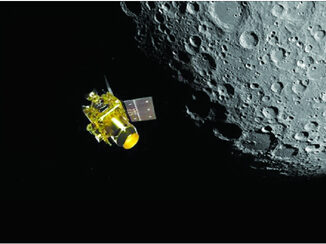
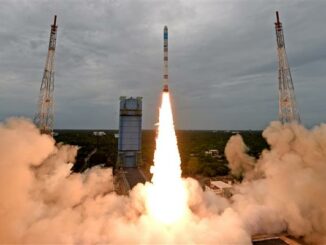
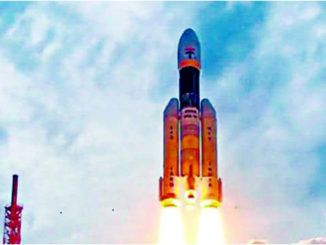
A Year of Contrasts: From space milestones and semiconductor breakthroughs to economic turbulence and climate calamities, India’s story from August 2024 to August 2025 has been one of ambition tempered by reality. The challenge now is clear: translate scientific and strategic achievements into broad-based prosperity while safeguarding people against economic and environmental shocks. If India can bridge this gap, the road to its centenary of independence in 2047 will be far more secure and sustainable.
As India marched past its 78th Independence Day on August 15, 2024, it carried the momentum of an economy on the rise, a space program gaining global attention, and a rapidly digitizing society. Yet, the following year also brought sobering reminders of deep-rooted vulnerabilities-from economic turbulence to climate shocks.
The period between August 2024 and mid-2025 was marked by scientific breakthroughs, infrastructure gains, and diplomatic assertiveness-but also by economic strains, natural disasters, and policy challenges.
The Hits: Bright Spots in India’s Progress
Space Successes and Tech Ambitions
– ISRO achieved satellite docking in December 2024, making India the fourth country after the U.S., Russia, and China to master this complex capability.
– Preparations for Gaganyaan, India’s first human spaceflight, moved into final abort-test stages, strengthening India’s credentials in crewed space exploration.
– ISRO also intensified outreach programs, inspiring millions of students and predicting a Rs 40 lakh crore space economy capable of generating 3 crore jobs in coming decades.
Digital Leap and AI Leadership
– India led the world in Generative AI training enrollments in 2024-25, reflecting its drive to upskill youth for the future economy.
– The National Academic Depository pilot advanced secure digital credentialing, reducing document fraud and boosting employability.
Semiconductor Push and
Manufacturing Growth
– The government approved four semiconductor manufacturing projects worth Rs 4,594 crore in Odisha, Andhra Pradesh, and Punjab- part of India’s ambition to become a global chip hub.
– Defense Public Sector Undertakings (DPSUs), led by HAL, continued to build indigenous aerospace capability, cutting dependence on foreign suppliers.
Climate Action and
Sustainability Recognition
– Mission LiFE (Lifestyle for Environment) gained traction, promoting eco-friendly practices nationwide and earning international support.
– A women-led self-help group in Karnataka won the UN’s Equator Initiative Award for millet-based natural farming and biodiversity conservation, highlighting India’s grassroots climate leadership.
Strategic Diplomacy and Global Standing
– India deepened engagement with G20, BRICS, and Quad partners, using forums to push for tech cooperation, clean energy investment, and balanced global governance.
– Efforts to establish a global code of conduct against pilot poaching reflected India’s growing voice in international aviation policy.
The Misses: Setbacks and Challenges
Economic Strains and Market Volatility
– GDP growth slowed to 6.5% in FY 2024-25, the lowest in four years. While agriculture and construction performed well, manufacturing and job creation lagged.
– A stock market crash in mid-2025, fueled by global uncertainty and foreign fund withdrawals, shook investor confidence and triggered government intervention.
Climate Disasters and Resource Stress
– The 2024 monsoon floods affected over 7.7 million people and caused nearly 1,900 deaths across multiple states.
– A record heatwave (April-July 2025), with temperatures soaring to 48°C, led to over 450 deaths, crop failures, and severe water stress.
Diplomatic and Trade Frictions
– India-Canada tensions deepened over allegations in the Nijjar case.
– India-U.S. trade relations soured, with Washington imposing a 25% duty on Indian imports-prompting India to lean further into partnerships with BRICS, Russia, and China.
Innovation and Skills Gaps
– Despite leading the world in AI course enrollments, India still faces a critical skill gap-too few workers are industry-ready in advanced technology fields.
– India continues to lag in creating homegrown global tech giants, with systemic hurdles in R\&D investment, venture capital access, and commercialization.
Social and Governance Concerns
– Organ donation rates remained far below potential, with institutions like KGMU performing only 29 cadaveric transplants despite capacity for 50 annually, revealing structural and cultural challenges.
– Persistent wealth inequality and youth unemployment dampened the benefits of headline economic growth.
Looking Ahead: Lessons from a Mixed Year
India’s year since Independence Day 2024 showcases a nation in rapid transition-capable of reaching the Moon and preparing for human spaceflight, yet vulnerable to economic shocks and climate extremes.
To sustain momentum and avoid future setbacks, India must:
– Close the skills gap by aligning education with industry needs in AI, robotics, and semiconductor manufacturing.
– Diversify the economy, boosting manufacturing while ensuring rural development.
– Invest in climate resilience, including heat-resistant infrastructure, urban water management, and disaster preparedness.
– Strengthen global trade diplomacy to prevent tariff disputes and maintain investor confidence.
– Build inclusive social systems, ensuring the benefits of growth reach every section of society.
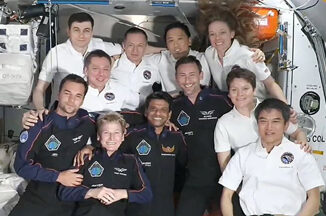
NEW DELHI / NEW YORK (TIP): A day after docking with the International Space Station (ISS), the four-member crew of the Axiom-4 (Ax-4) mission—including Indian Air Force officer Group Captain Shubhanshu Shukla—has commenced a rigorous schedule of scientific experiments as part of their two-week mission in low Earth orbit.
“On Friday, Ax-4 quickly got to work unloading sample-packed hardware and portable science freezers from inside Dragon for installation in station incubators and research refrigerators ahead of upcoming experiments,” NASA stated in an update posted on Saturday morning.
“Station safety hardware was also temporarily transferred inside Dragon as is customary for visiting spacecraft. The private astronaut quartet later joined the Expedition-73 crew for more safety reviews to learn their roles and responsibilities and communication protocols with mission controllers in the unlikely event of an emergency on the orbital outpost,” the post added. The Ax-4 crew had docked their Dragon C-213 spacecraft with the ISS at about 4.15 pm IST on June 26, and entered the space station about two hours later to meet up with the seven residents of the station who form part of Expedition-73.
“The Ax-4 and Exp 73 crews are now living and working together aboard the orbital outpost and preparing for new space research and the departure of a cargo ship,” the ISS official handle posted in the wee hours of Saturday.
The Ax-4 mission was launched on June 25 from the Kennedy Space Center in Florida by a Falcon-9 rocket, which had propelled the Dragon spacecraft into orbit for a 28-hour journey to reach the ISS. The mission is being executed jointly by the National Aeronautics and Space Administration, a US government agency, SpaceX and Axiom Space, both of which are private space technology firms. Shukla, an Indian Air Force fighter pilot and test pilot who goes by the call-sign ‘Shux”, was the pilot of the Dragon spacecraft as it orbited the Earth several times to meet up with the ISS at an altitude of about 420 kms and at a speed of over 26,000 kmph.
Other members of the crew include the mission commander, Peggy Whitson, among US’ most experienced astronauts and commander of Axiom-2, and mission specialists Sławosz Uznański-Wiśniewski, a scientist from Poland and Tibor Kapu, an engineer from Hungary.
The crew will undertake around 60 scientific studies and activities covering a wide range of topics such as medical support for diabetic astronauts, effects of microgravity on the brain and body, and the collection of vital health data.
The impact of space travel on joints, blood flow, stem cells, cancer growth, and radiation exposure are other areas of research. This is expected to enhance global knowledge in human research, Earth observation, biological and material sciences. The Indian Space Research Organisation (ISRO), which has an expansive programme on space research, including proposed manned missions and launching a space station, is focusing on advancing microgravity research aboard the ISS to enhance understanding of biological processes in microgravity and develop strategies for long-duration space missions.
Shukla’s research agenda includes investigating physical and cognitive impact of computer screens in microgravity, studying growth, metabolism and genetics of three microalgae strains in microgravity as compared to that on Earth and comparing growth, cellular responses and biochemistry of two cyano-bacteria strains in microgravity.
Also, on his schedule are identifying pathways of skeletal muscle dysfunction in microgravity and exploring therapies, examining spaceflight impacts on six crop seed varieties, investigating the impacts of spaceflight on germination and growth of crop seeds and identifying molecular mechanisms of resilience in extreme environments. His experience in manned space flight would be an important element in the research, planning and execution of the programme.
New Delhi (TIP)- Setting at rest the uncertainties resulting from multiple deferments, the Indian Space Research Organisation (ISRO) on Thursday, January 16, successfully carried out the docking of two satellites in space, making India the fourth country in the world after the US, Russia and China to accomplish the feat.
In space, docking technology is essential when multiple rocket launches are required to achieve common mission objectives. The in-space docking experiment is crucial for the smooth conduct of the country’s ambitious future missions, including Chandrayaan-4, Gaganyaan, setting up a space station and landing an astronaut on the moon.
Last October, the government had announced that India would have by 2035 its own space station, “Bharatiya Antariksh Station”.
“Spacecraft docking successfully completed! A historic moment,” ISRO said in a post on X. “Let’s walk through the SpaDeX docking process: Manoeuvre from 15 metres to 3 metres hold point completed. Docking initiated with precision, leading to successful spacecraft capture. Retraction completed smoothly, followed by rigidisation for stability. Docking successfully completed,” the post added.
After docking, the control of two satellites—Chaser and Target—as a single object was successful, ISRO said, adding that undocking and power transfer from one satellite to the other would follow in the coming days.
“India’s space programme achieves historic milestone with the successful docking of the two satellites launched under Space docking experiment, SpaDeX!” President Droupadi Murmu wrote on X, congratulating ISRO.
“Congratulations to our scientists at ISRO and the entire space fraternity for the successful demonstration of space docking of satellites. It is a significant stepping stone for India’s ambitious space missions in the years to come,” Prime Minister Narendra Modi said in a message.
Jitendra Singh, MoS, Science and Technology, said the feat was all the more memorable as the technology used was “indigenous Bharatiya Docking System”.
V Narayanan, ISRO chief, congratulated the team. The two satellites, each weighing 220 kg, were originally supposed to dock on January 7. The experiment was deferred to January 9 after scientists felt the process required further validation through ground simulations in view of an abort scenario identified by them.
A day ahead of the docking planned on January 9, the space agency initiated the drift on Spacecraft A (Chaser) to move closer to the other spacecraft (Target) from 500 metres to 225 metres. But the operation was postponed as the drift was found to be more than expected.
On January 12, the two satellites were brought as close as 3 metres from each other, but then moved away following signal issues. The two satellites were put in space in a low earth orbit by a PSLV rocket on December 30.
With the successful docking, ISRO has achieved the primary objective of the mission. Undocking and separation of the two satellites will follow. The satellites will be deployed for the operation of their respective payloads.
With the mission, ISRO aims to exhibit technologies needed for spacecraft rendezvous, docking, and undocking using two small satellites which have been mastered by only an elite group of spacefaring nations
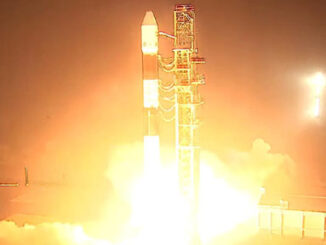
SRIHARIKOTA (TIP): The Indian Space Research Organisation (ISRO) successfully launched the Space Docking Experiment (SpaDeX) mission on Monday , December 30, 2024.
The PSLV C60 rocket carrying two small satellites, SDX01 (Chaser) and SDX02 (Target), along with 24 payloads, lifted off from the first launchpad of the Satish Dhawan Space Centre in Sriharikota at 10 p.m. About 15 minutes after liftoff, the two small spacecraft weighing about 220 kg each were launched into a 475-km circular orbit as intended.
“The rocket has placed the satellites in the right orbit which is into a 475-km circular orbit. The spacecraft’s solar panels have been deployed successfully. The two SpaDeX satellites have moved one behind another so over a period of time it will pick up travel further distance, the distance will increase by 20 km over the next few days and then the rendezvous and docking process will start. The docking process can happen in another one week; the nominal time will be approximately January 7,” said ISRO Chairman S Somanth.
With the SpaDeX mission, ISRO aims to exhibit technologies needed for spacecraft rendezvous, docking, and undocking using two small satellites which have been mastered by only an elite group of spacefaring nations.
The demonstration of this technology is essential for futuristic missions such as sending an Indian astronaut on the Moon, sample return from the Moon, the building and operation of the Indian Space Station.
ISRO said that the demonstrated precision of the PSLV vehicle will be utilized to give a small relative velocity between the Target and Chaser spacecraft at the time of separation from the launch vehicle.
GSLV mission planned in January would be 100th launch from Sriharikota: ISRO chief
“This incremental velocity will allow the Target spacecraft to build a 10-20 km inter-satellite separation with respect to the Chaser within a day. At this point, the relative velocity between the Target will be compensated using the propulsion system of the Target spacecraft,” ISRO said.
ISRO added that at the end of this drift arrest maneuver, Target and Chaser will be in the same orbit with identical velocity but separated by about 20 km, known as Far Rendezvous.
“With a similar strategy of introducing and then compensating for a small relative velocity between the two spacecraft, the Chaser will approach the Target with progressively reduced inter-satellite distances of 5 km, 1.5 km, 500 m, 225 m, 15 m, and 3 m, ultimately leading to the docking of the two spacecraft,” it added.
U R Rao Satellite Centre Director M. Sanakaran said the docking is expected between January 7 and 10.
Twenty-four PS4-Orbital Experiment Module (POEM-4) payloads will also onboard the PSLV-C60 SpaDeX mission.
The Indian Space Research Organisation (Isro) has achieved a key milestone in its space program with the successful sea-level hot test of the CE20 Cryogenic Engine on November 29, 2024. Conducted at the Isro Propulsion Complex, the test is a critical step in enhancing the engine’s performance and reliability.
The CE20 engine powers the upper stage of Isro’s LVM3 launch vehicle, which has played a pivotal role in missions like Chandrayaan-2, Chandrayaan-3, and the upcoming Gaganyaan human spaceflight project.
The engine has already proven its capability in six successful LVM3 missions and is designed to operate at thrust levels ranging from 19 tonnes to an upgraded 22 tonnes for future missions.
One of the test’s highlights was the demonstration of a multi-element igniter, essential for the engine’s restart capability in space. This innovation ensures greater flexibility for complex missions.
Additionally, Isro introduced a Nozzle Protection System to address challenges such as vibrations and thermal stress during sea-level testing. The system simplifies testing and reduces costs while maintaining safety and efficiency.
The engine and testing facility performed flawlessly, meeting all expected performance parameters. With this success, the CE20 engine is now further prepared to support India’s ambitious Gaganyaan mission, which will send three astronauts into orbit.
This achievement shows Isro’s ongoing efforts to develop advanced space technology, enhance payload capacities, and strengthen India’s position in global space exploration.
As Isro continues to refine its capabilities, the CE20 engine remains central to future missions, paving the way for greater achievements in space.
In a new study, scientists bring hope for finding more water ice in the polar craters of the Moon. Additionally, the study reveals that there’s twice as much water ice in the northern polar region compared to the southern polar region.
The study, conducted by scientists from the Space Applications Centre (SAC)/ISRO, along with researchers from IIT Kanpur, University of Southern California, Jet Propulsion Laboratory, and IIT (ISM) Dhanbad, indicates that there could be 5 to 8 times more subsurface ice in the first couple of meters compared to what’s on the surface, in both the northern and southern poles, the Indian Space Research Organisation (ISRO) said in a blogpost. This finding underscores the importance of drilling on the Moon to extract or study this ice for future missions and potential long-term human presence.
Regarding the ice’s origin, the study supports the theory that the main source of subsurface water ice in the lunar poles is the release of gases during volcanic activity in the Imbrian period.
The findings also suggest that the distribution of water ice is probably influenced by volcanic activity in the Mare regions and specific impact crater formations. The research team used seven instruments, including radar, laser, optical, neutron spectrometer, ultraviolet spectrometer, and thermal radiometer, aboard National Aeronautics and Space Administration or NASA’s Lunar Reconnaissance Orbiter to investigate the origin and distribution of water ice on the Moon.
Accurate knowledge of the distribution and depth of water ice occurrence in the lunar poles, as presented in the investigations, is crucial for constraining the uncertainties in selecting future landing and sampling sites for missions aimed at exploring and characterising lunar volatiles, ISRO said.
ISRO has accomplished a major milestone in the human rating of its CE20 cryogenic engine that powers the cryogenic stage of the human-rated LVM3 launch vehicle for Gaganyaan human spaceflight missions, with the completion of the final round of ground qualification tests. ‘ISRO’s CE20 cryogenic engine is now human-rated for Gaganyaan missions,’ the space agency said on X.
Rigorous testing demonstrates the engine’s mettle, it said, adding the CE20 engine identified for the first uncrewed flight LVM3 G1 also went through acceptance tests.
The February 13 final test was the seventh of a series of vacuum ignition tests carried out at the High Altitude Test Facility at ISRO Propulsion Complex in Mahendragiri to simulate flight conditions, it said. The ground qualification tests for the human rating of the CE20 engine involved life demonstration and endurance tests, and performance assessment under nominal operating conditions as well as off-nominal conditions with respect to thrust, mixture ratio and propellant tank pressure, it said.
ISRO’s commercial arm NewSpace India Ltd has announced plans to launch its communication satellite GSAT-20 onboard Elon Musk-owned SpaceX’s Falcon-9 rocket in the second quarter of 2024, to meet the broadband communication needs of the country. GSAT-20 (renamed as GSAT-N2) is a high throughput Ka-band satellite. Ka-band satellites deliver high-speed broadband internet connectivity and digital video and audio transmission. In a statement, the state owned NSIL said the bulk of the high throughput satellite (HTS) capacity onboard GSAT-20 satellite has already been secured by Indian service providers. GSAT-20 offers Ka-band HTS capacity with 32 beams having pan-India coverage including in Andaman and Nicobar and Lakshadweep islands, it said. “NSIL is realising GSAT-20 satellite through ISRO and will be launched onboard Falcon-9 under a launch service contract between NSIL and SpaceX, USA. GSAT-20, weighing 4,700 kg, offers HTS capacity of nearly 48Gpbs. The satellite has been specifically designed to meet the demanding service needs of remote/unconnected regions,” the statement read. According to NSIL, it is mandated to build, launch, own and operate satellites in “demand-driven mode” for meeting service needs of the user. As part of this, NSIL successfully undertook its first demand-driven satellite mission, GSAT-24 in June 2022, wherein the capacity onboard the satellite was fully secured by satellite television service Tata Play. Source: PTI
The Indian Space Research Organization (ISRO) has successfully brought the propulsion module from the Chandrayaan-3 mission back to Earth’s orbit.
While not in the original mission plan, ISRO used the logistical advantages from a near perfect Chandrayaan-3 mission to bring back the module which had been orbiting around the Moon, after travelling nearly 384,000 km. “In another unique experiment, like the hop experiment on the Vikram Lander, the Propulsion Module (PM) of Chandrayaan-3 was moved from an orbit around Moon to an orbit around Earth,” ISRO announced on Monday (December 10). The module had left Earth’s on August 1.
Unlike Chandrayaan-2, which had a full fledged orbiter with major payloads and communications systems, Chandrayaan-3 featured a lighter propulsion module. For the lander’s communications with Earth, the mission used the Chandrayaan-2 orbiter, which remains functional four years after the 2019 mission.
The only scientific instrument aboard was the Spectro Polarimetry of Habitable Planet Earth (SHAPE) — an experimental payload which studies the signatures that make Earth a habitable planet, in order to possibly identify habitable planets outside the solar system. After the propulsion module separated from the lander on August 17 — 100 km from the lunar surface, and six days before the scheduled landing — it was supposed to continue orbiting the Moon for six months or more.
“The main function of PM is to carry the LM (lander module) from launch vehicle injection till final lunar 100 km circular polar orbit and separate the LM from PM. Apart from this, the PM also has one scientific payload as a value addition which will be operated post separation of the Lander Module,” ISRO had stated ahead of the mission.
There were no plans to bring the propulsion module back to Earth, with ISRO stating that it simply wanted to operate the SHAPE payload for about three months — the mission life of the module. What helped was just how precise and efficient the Chandrayaan-3 Mission had gone thus far. “The meticulous mission planning of the earth and lunar burn maneuvers and precise injection orbit by launch vehicle resulted in propellant saving,” P Veeramuthuvel, Chandrayaan-3’s project director, told The Indian Express. To be precise, after over a month of operations, the PM continued to hold over 100 kg of fuel. “It was decided to use the available fuel in the PM to derive additional information for future lunar missions, and demonstrate the mission operation strategies for a sample return mission,” the space agency said on Tuesday.
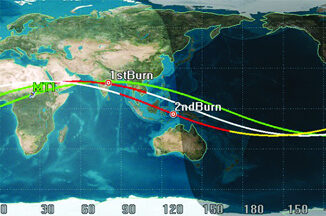
A mission plan was created to ensure the PM’s return without crashing on to the lunar surface, or entering into a low Earth orbit. “Considering the estimated fuel availability, and the safety to GEO spacecrafts, the optimal Earth return trajectory was designed for October 2023 month,” ISRO said on Tuesday. ISRO initially performed a maneuver on October 9, to raise the altitude of orbit of the PM around the moon to 5112 km from 150 km (from 2.1 hrs to 7.2 hrs). The Trans-Earth injection (TEI) maneuver was performed on October 13, following which the propulsion module made four Moon fly-bys before leaving the Moon’s sphere of influence on November 10.
ISRO chief S Somanath has confirmed that NASA is working towards sending an Indian astronaut to the International Space Station (ISS). This announcement follows the comments made by NASA chief Bill Nelson, who is in India on an official visit. The idea was first floated in high-level discussions between Prime Minister Narendra Modi and US President Joe Biden, said Somanath in Kolkata today. “We are taking it forward; that’s what the NASA chief said — that Indian astronauts will be flying to the ISS in an American vehicle,” Somanath said.
The collaboration marks a milestone in Indo-US space relations and underscores the growing partnership between the two nations in the realm of space exploration.
Somanath emphasised the importance of the programme being beneficial for India. He said astronauts would be given comprehensive training in NASA facilities.
The NASA-ISRO Synthetic Aperture Radar (NISAR) is set to be launched in the first quarter of 2024 after a few tests, particularly those related to vibration, NASA officials have said.
“ISRO is projecting the first quarter of next year. So, I mean, that’s ready,” NASA NISAR Project Manager Phil Barela said during a media interaction.
He is expecting the launch of NISAR (spelt as ‘Naisar’) “not earlier than January” from the Satish Dhawan Space Centre at Sriharikota aboard the ISRO Geosynchronous Satellite Launch Vehicle Mark-II.
The mission, which has three-year duration, aims to survey all of Earth’s land and ice-covered surfaces every 12 days. This will start after a 90-day satellite commissioning period.
Regarding the key tests that are pending to be undertaken, Barela said, “The vibration testing that’s underway, but there’s a whole slew of performance tests that we need to do.”
Battery and simulation tests have to be done to make sure that the system works fine, he said.
“We’ll be doing performance testing on the radars and various spacecraft electronics. So, a lot of testing remains but the big environments test, the only one remaining now, is vibration,” Barela said.
BENGALURU (TIP): The Indian Space Research Organisation (ISRO), which was hoping to awaken the Chandrayaan-3’s Vikram lander and Pragyan rover on September 2, says it has not received any signals from either of the two, despite continuing efforts to establish communications.
“Efforts have been made to establish communication with the Vikram lander and Pragyan rover to ascertain their wake-up condition. As of now, no signals have been received from them. Efforts to establish contact will continue,” ISRO posted on X (formerly Twitter) on Friday. On September 2, the rover was put into sleep mode; two days later, on September 4, the lander was also put to sleep, following the end of one lunar day. “Vikram will fall asleep next to Pragyan once the solar power is depleted and the battery is drained. Hoping for their awakening, around September 22, 2023,” ISRO had said on September 4.
Before putting them into sleep mode, the lander’s payloads were switched off. However, both the Vikram’s and Pragyan’s receivers were kept on by ISRO, with the hope of re-establishing communication with the two.
Nilesh M. Desai, director of the Space Applications Centre, said that efforts were on to establish contact with the lander and the rover, adding that it could happen anytime.
Once the sun sets on the moon after the completion of one lunar day, the temperature on the lunar surface could plunge below -200°C. “The temperature there goes down to minus 200 degrees. In such an environment, there is no guarantee that the battery, electronics will survive, but we did some tests and we get the feeling that they will survive even in such harsh conditions,” ISRO chairman S. Somanath had said earlier.
Since the Chandrayaan-3 mission successfully landed on the moon on August 23, the Vikram and the Pragyan have carried out many in-situ measurements, including to confirm the presence of sulphur in lunar surface in that region, and to detect the presence of minor elements.
The Vikram lander also achieved a significant milestone as it successfully undertook a hop experiment. On command, the lander fired the engines, elevated itself by about 40 cm and landed safely at a distance of 30 cm to 40 cm away. This successful hop experiment and kickstart could have significant bearing on future missions which will be launched with an objective to bring back samples from the moon, as well as future human missions to the moon. If ISRO manages to receive signals and wake the Vikram and the Pragyan, it would be a bonus for the space agency as it hopes to carry out some more experiments on the moon. The Chandrayaan-3 spacecraft was launched on July 14 and touched down on the lunar surface on August 23, making India the fourth country to successfully land on the moon and the first nation to touch down on the polar region of the moon.
(Source: The Hindu)
Another instrument onboard the Chandrayaan-3 mission’s rover ‘Pragyan’ has confirmed the presence of sulphur in the lunar region by deploying a different technique, ISRO said on Thursday, August 31.
The Alpha Particle X-ray Spectroscope (APXS) has detected sulphur, as well as other minor elements on the Moon, the Bengaluru-headquartered national space agency said in a social media post.
“This finding by Ch-3 compels scientists to develop fresh explanations for the source of Sulphur (S) in the area: intrinsic?, volcanic?, meteoritic?,……?” read the post.
ISRO also released a video of the rover rotating in search of a safe route. The rotation was captured by a lander imager camera.
“It feels as though a child is playfully frolicking in the yards of Chandamama, while the mother watches affectionately.
“Isn’t it?” ISRO quipped in the social media post.
The space agency released a video showing an automated hinge mechanism rotating the 18-cm-tall APXS, aligning the detector head to be approximately five centimetres in proximity to the lunar surface. The 26 kg, six-wheeled, solar-powered Pragyan rover is equipped to use its scientific instruments to record what the lunar soil and rocks are made of in the south polar region where Chandrayaan-3 landed and it would also show how the readings contrast with that of the highland regions.
APXS instrument is best suited for in-situ analysis of the elemental composition of soil and rocks on the surface of planetary bodies having little atmosphere, such as the Moon, an ISRO statement said. It carries radioactive sources that emit alpha particles and X-rays onto the surface sample. The atoms present in the sample in turn emit characteristic X-ray lines corresponding to the elements present. By measuring the energies and intensities of these characteristic X-rays, researchers can find the elements present and their abundances.
APXS observations have discovered the presence of interesting minor elements, including sulphur, apart from the major expected elements such as aluminum, silicon, calcium and iron. The Laser Induced Breakdown Spectroscope (LIBS) instrument onboard the rover has already confirmed the presence of sulphur. Detailed scientific analysis of these observations are in progress. APXS has been developed by the Physical Research Laboratory (PRL), Ahmedabad, with support from the Space Application Centre (SAC) Ahmedabad, whereas UR Rao Satellite Centre (URSC), Bengaluru has built the deployment mechanism, it was stated.
Source: PTI
Chandrayaan-3’s success will motivate many young boys and girls to become space scientists
“Most people I spoke to, even those belonging to what is known as the working class, seem to be aware that our space programme began soon after Independence. Homi Bhabha and Vikram Sarabhai, both pioneers in the field, had set up a rocket launching station at Thumba in Kerala in 1963. The land belonged to Latin Catholics of Kerala. Priest Fr Fernandes took the permission of his parishioners to give up the land for a national cause in a markedly patriotic gesture. As a co-religionist, I am proud of them. The Thumba station was thus born. India’s first rockets were launched from there.”
By Julio Ribeiro
The brilliant Chandrayaan-3 feat of Indian Space Research Organisation (ISRO) scientists was reflected in the joy on the faces of Indians in the country and abroad. Having served briefly as India’s Ambassador to the former Eastern Bloc country of Romania, I know that my country’s men and women were suspected of illegal migration not to Romania, but through that poor country to the UK, Germany, France or any other developed nation of Europe. The moon landing will change this perception, at least temporarily.
Many Indians would attribute the feat to PM Modi and he was certainly aware of what that would mean for a third term in office.
India and Indians will now be more respected abroad. An Indian passport used to arouse the suspicion of immigration officers who manned the desks at airports abroad. After twiddling their thumbs, consulting their seniors and generally conveying the message that you were an unwelcome guest, they finally and reluctantly let you in. That, too, I hope will change, though in view of some of our compatriots trying desperately for a better life in western Europe, North America or Australia, I have my doubts if the Indian passport will finally spell ‘welcome’.
But whatever this superb scientific feat means for Indians going abroad, its effect on fellow Indians based in their own country has been electrifying. Like most proud Indians, I watched the Chandrayaan-3 lander make a soft landing on the moon. I heard the thunderous clapping of thousands of pairs of hands at the ISRO headquarters in Bengaluru and, of course, I saw images of our omnipresent Prime Minister being relayed from Johannesburg, where he was attending the BRICS summit.
PM Modi spoke to the ISRO fraternity and to the nation on this happy occasion. The sense of achievement and triumph that coursed through every Indian’s veins at the moment of landing would have been felt by him to a much higher degree because many Indians would attribute the feat to him and he was certainly aware of what that would mean for a third term in office.
Most people I spoke to, even those belonging to what is known as the working class, seem to be aware that our space programme began soon after Independence. Homi Bhabha and Vikram Sarabhai, both pioneers in the field, had set up a rocket launching station at Thumba in Kerala in 1963. The land belonged to Latin Catholics of Kerala. Priest Fr Fernandes took the permission of his parishioners to give up the land for a national cause in a markedly patriotic gesture. As a co-religionist, I am proud of them. The Thumba station was thus born. India’s first rockets were launched from there.
Thumba was located relatively close to the line that marks the Equator. It was ideal for the experiments and research needed to be carried out by ISRO. It was only later that the launching pad in Sriharikota, which is in Andhra Pradesh, was established. Chandrayaan-3 was launched from Sriharikota, but some of ISRO’s earlier launches were from Thumba.
Narendra Modi is a natural-born leader. Blessed with good health, defined by a spartan lifestyle and the practice of yoga, he works 16 to 18 hours a day. He is accustomed to being fresh and alert with only four hours of sleep and a frugal diet. He is constantly on the move, addressing friendly gatherings which lap up every word of his. He is in the peak election mode. That mode will continue till April-May when the Lok Sabha polls are likely to be held.
Talking of next year’s General Election and the Assembly elections in Rajasthan, Madhya Pradesh, Chhattisgarh, Telangana and Mizoram later this year, let’s turn our attention to the Election Commission. That institution had been held in very high regard and esteem both in India and abroad, right from the days of the martinet TN Seshan to SY Quraishi. Alas, in the past few years, the commission has lost its foothold on that high pedestal and has been accused of favoring the party in power in a myriad of small ways.
Its aura of impartiality and its image of a neutral umpire have been battered — and this is an unmitigated disaster. The commission is a statutory body which cannot be influenced by any party, including the one in power. Even if Modi or Amit Shah cross the lines laid down by the commission itself, it is incumbent on the commission to act against the offender. Even a caution or a warning, publicly issued, would serve the purpose.
Surendra Nath, a retired IAS officer, had reminded the commission in a letter that the EVM count had to be reconciled with the VVPAT count. In case of any discrepancy, the results had to be decided as per the paper slip count. Such discrepancies were noted during the 2019 Lok Sabha vote counting. Despite undertaking to give an explanation for the discrepancies, the ECI has not replied to letters of the Law Ministry. This important matter that pertains to the people’s confidence in the commission’s neutrality and impartiality has been kept dangling midair.
Any Prime Minister on whose watch the ISRO pulled off a Herculean task would take vicarious credit for the achievement. Modi cannot be faulted for doing so. In fact, he does motivate persons who work for the government or for him in his immediate circle, the PMO, to excel. But it is also incumbent on him as a leader to ensure that the Election Commission (and also other government entities such as the Enforcement Directorate, the CBI and NIA) do their allotted tasks impartially and honestly. For, finally, the buck stops at his desk.
Coming back to the moon mission, I would have thought that ISRO’s Director and Project Director would find their pictures on the front pages of newspapers on August 25. They deserved the limelight that as scientists they had shunned or were just not bothered about. But I also got to read about Kalpana K, the Associate Project Director, and the 100-odd women who contributed to the success of the project. We are proud of our women and of our scientists.
Many young boys and girls in schools and colleges across the country will be motivated to become space scientists and join ISRO in its journey to gain international recognition and respect.
(The author is a former governor, and a highly decorated retired Indian Police Service (IPS) officer)
‘India has made tremendous strides in space exploration by landing the Chandrayaan-3 on the Moon’s south pole. It is a remarkable achievement for the scientific community in India that makes the whole nation proud of this pioneering effort. We also owe a debt of gratitude to former Prime Minister Manmohan Singh, who started the Chandrayan program, and the current government that has taken the program forward,” said George Abraham, Vice-Chairman of the Indian Overseas Congress, USA.
India’s space journey began on February 23, 1962, with the formation of INCOSPAR (Indian National Committee for Space Research), thanks to the vision of Homi Bhabha and Vikram Sarabhai with the crucial support and guidance by Jawaharlal Nehru, the first prime Minister of India. INCOSPAR was later renamed to ISRO (Indian Space Research Organization) in 1969. IOCUSA congratulates all scientists, technical staff, and others for their dedicated effort that has made history today.
India’s lunar lander touched down on the moon’s surface on August 23. (Screengrab)
I.S. Saluja
NEW YORK (TIP) How important is the landing of Chandrayan 3 on the moon on August 23, 2023 can be gauged from the news coverage of the event. All major US newspapers including The New York Times, and the TV channels including the CNN have prominently carried the news . CNN headlined “India becomes the fourth country ever to land a spacecraft on the Moon” . It said: “The mission could cement India’s status as a global superpower in space. Previously, only the United States, China and the former Soviet Union have completed soft landings on the lunar surface.
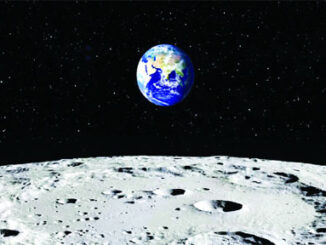
Chandrayaan-3’s landing site is also closer to the moon’s south pole than any other spacecraft in history has ventured. The south pole region is considered an area of key scientific and strategic interest for spacefaring nations, as scientists believe the region to be home to water ice deposits.
The water, frozen in shadowy craters, could be converted into rocket fuel or even drinking water for future crewed missions. Indian Prime Minister Narendra Modi watched the landing virtually and shared broadcasted remarks on the livestream.
“On this joyous occasion…I would like to address all the people of the world,” he said. “India’s successful moon mission is not just India’s alone. This is a year in which the world is witnessing India’s G20 presidency. Our approach of one Earth, one family, one future is resonating across the globe.
“This human-centric approach that we present and we represent has been welcome universally. Our moon mission is also based on the same human-centric approach,” Modi added. “Therefore, this success belongs to all of humanity, and it will help moon missions by other countries in the future.”
As Chandrayaan-3 approached the moon, its cameras captured photographs, including one taken on August 20 that India’s space agency shared Tuesday. The image offers a close-up of the moon’s dusty gray terrain.
India’s lunar lander consists of three parts: a lander, rover and propulsion module, which provided the spacecraft all the thrust required to traverse the 384,400-kilometer (238,855-mile) void between the moon and Earth.
The lander, called Vikram, completed the precision maneuvers required to make a soft touchdown on the lunar surface after it was ejected from the propulsion module. Tucked inside is Pragyan, a small, six-wheeled rover that will deploy from the lander by rolling down a ramp.
Vikram used its on board thrusters to carefully orient itself as it approached the lunar surface, and it slowly throttled down its engines for a touchdown just after 6 p.m. IST (8:30 a.m. ET) as applause erupted from the mission control room.
The Indian Space Research Organization, or ISRO, later confirmed it had established two-way communication with the spacecraft and shared the first images of the surface captured during the lander’s final descent.
The lander, which weighs about 1,700 kilograms (3,748 pounds), and 26-kilogram (57.3-pound) rover are packed with scientific instruments, prepared to capture data to help researchers analyze the lunar surface and deliver fresh insights into its composition.
Dr. Angela Marusiak, an assistant research professor at the University of Arizona’s Lunar and Planetary Laboratory, said she’s particularly excited that the lunar lander includes a seismometer that will attempt to detect quakes within the moon’s interior.
Studying how the moon’s inner layers move could be key information for future endeavors on the lunar surface, Marusiak said.
“You want to make sure that any potential seismic activity wouldn’t endanger any astronauts,” Marusiak said. “Or, if we were to build structures on the moon, that they would be safe from any seismic activity.”
The lander and rover are expected to function for about two weeks on the moon’s surface. The propulsion module will remain in orbit, serving as a relay point for beaming data back to Earth.
A global moon rush
Working alongside allies such as the United States and France, India is part of a second wave of emerging space powers. The country’s space program has become one of the world’s busiest in its development of exploratory space technology.
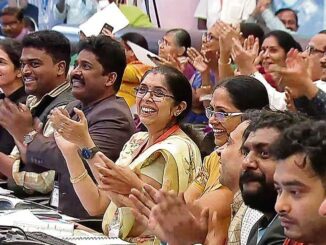
Applause erupted in the control room Wednesday, August 23 when India’s lunar lander touched down on the moon’s surface. (Image from ISRO)
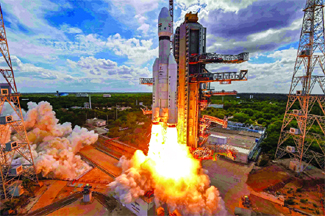
Chandrayaan-3 has been a point of national pride and widespread interest across India. Crowds gathered at the launchpad at Satish Dhawan Space Centre in Sriharikota in Andhra Pradesh state to watch the mission take flight in July. On Wednesday, August 23, more than 8 million people tuned in to view a livestream of the landing.
At least 500 people gathered at India’s Council of Scientific and Industrial Research in New Delhi Wednesday where the livestream was broadcast in an auditorium as well as outdoors at a temporary pavilion. After a successful touchdown was confirmed, Indian sweets were distributed to the audience, firecrackers were lit and spectators applauded for more than a minute.
Chants of “Bharat Mata Ki Jai” — or “victory to India” — could be heard, and children joyously waved the Indian flag.
India’s mission has taken on even greater significance since Russia’s failed Luna 25 landing attempt. With the success of Chandrayaan-3, India became the second country to land a spacecraft on the moon in the 21st century after China, which has put three landers on the lunar surface since 2013 — including the first to touch down on the moon’s far side. (The last US lunar lander, the crewed Apollo 17 mission, touched down in 1972.)
More than a dozen countries have plans for missions to the moon in the coming years, including a mission launched by Japan’s space agency — the Japan Aerospace Exploration Agency — that is expected to lift off later this month. The United States also has plans to send three commercial lunar landers to the moon starting as early as this year, while NASA continues to work toward its Artemis III mission, which could put astronauts back on the moon as soon as 2025.
Landing on the moon, however, remains a challenging endeavor. India’s last attempt to land a spacecraft on the moon, during the 2019 Chandrayaan-2 mission, failed. And two commercial spacecraft have crash-landed on the lunar surface in recent times — one from Israel in 2019 and the other from Japan in April.
“There is no doubt that landing on the Moon is a real challenge,” NASA Administrator Bill Nelson said in a statement on Sunday. “But the Moon offers great scientific reward, which is why we’ve seen so many recent attempts to visit the surface again. We’re looking forward to all that we will learn in the future, including from India’s Chandraayan-3 mission.”
On Wednesday, Nelson also shared a congratulatory note on social media, saying, “congratulations to #India on being the 4th country to successfully soft-land a spacecraft on the Moon. We’re glad to be your partner on this mission!”
India is also a signatory of the United States’ Artemis Accords, a document that outlines proposed rules of the road for future lunar exploration. Russia and China have not signed the accords.
The New York Times story emphasizes India being the first country to land a spacecraft on Moon’s Southern Polar Region. The story headlined.
India’s Chandrayaan-3 spacecraft completed a lunar landing, making the country the first to reach the moon’s southern polar region.
The New York Times report says “Two visitors from India — a lander named Vikram and a rover named Pragyan — landed in the southern polar region of the moon on Wednesday. The two robots, from a mission named Chandrayaan-3, make India the first country to ever reach this part of the lunar surface in one piece — and only the fourth country ever to land on the moon.
“We have achieved soft landing on the moon,” S. Somanath, the chairman of the Indian Space Research Organization, said after a roar ripped through the ISRO compound just past 6 p.m. local time. “India is on the moon.”
S. Somanath, the director of the Indian Space Research Organization, had fun deflecting one reporter’s question about the project’s frugal cost. Somanath laughed and said, “I won’t disclose such secrets. We don’t want everyone else to become so cost-effective!” The Chandrayaan-2 was reported to have cost about $46 million, and the Chandrayaan-3 is supposed to have been in a similar range.
Speaking to reporters gathered outside Mission Control, the chairman of ISRO, S. Somanath, told us that the lander’s rover, named Pragyaan, would be rolled out in a matter of hours or, maybe, tomorrow. Its sensors, including a laser and an alpha-particle beam, as well as instruments on the Vikram lander, will start relaying data after that.
As India looks out into the solar system, its space agency is taking a star turn from an earlier era of space exploration. While the national government looks like a hero, private companies that are increasingly important players in the country’s space program operate quietly behind the scenes.
ISRO, the Indian Space Research Organization, was born not long after NASA. In recent years, it has sent robotic orbiters to Mars and the moon and is now preparing to send the first Indian astronauts to space. Based in Bengaluru, the center of the world’s third-largest tech start-up scene, ISRO has bequeathed India a legacy of derring-do in space research.
But the accomplishments of India’s private sector may soon garner as much attention. A younger generation of space engineers, inspired by SpaceX, have started going into business on their own.
And the pace of change is quickening. Prime Minister Narendra Modi’s government wants India to harness the private sector’s entrepreneurial energy to put more satellites and investment into space, faster. That means relegating ISRO to a lower priority.
Mr. Modi hinted at this ambition in June 2020 when he launched IN-SPACe, a government agency headed by a former chairman of India’s biggest multinational automobile company, and assigned it with “space promotion and authorization.” It has become a one-stop shop for India’s private players, as they sign memorandums of understanding with the government and make plans involving ISRO’s spaceport.
This year Mr. Modi’s government published an official space policy that listed IN-SPACe’s role first and gave it more than twice as many priorities as ISRO, which is now to “focus primarily on research and development” and “expanding the human understanding of outer space.”
Outer space is of less interest to commerce, compared with satellites that exchange information with the Earth’s surface, and so the segment left to ISRO seems to be shrinking. While ISRO’s budget in the past fiscal year was less than $1.5 billion, the size of India’s private space economy is already at least $6 billion, and expected to triple as soon as 2025.
India’s main opposition party, the Indian National Congress, joins in the celebrations. “We are deeply indebted to the remarkable hard work, unparalleled ingenuity and unflinching dedication of our scientists, space engineers, researchers,” Mallikarjun Kharge, the party’s president, said.
India has a busy decade of space exploration ahead.
Chairman of ISRO S. Somanath speaking with the media after the successful landing of Chandrayan on the Moon August 23, 2023. (Photo / ISRO)
S. Somanath, the director of Indian Space Research Organization, has described the current moment as an inflection point, as the country opens its space programs to private investors after half a century of state monopoly that made advances but at “a shoestring budget mode of working.”
A large share of India’s space efforts in the coming years will focus on the moon.
In addition to the scientific results of Chandrayaan-3, India is preparing a joint lunar exploration with Japan, in which India will provide the lander and Japan the launch vehicle and the rover. The robotic mission, known as LUPEX, is also intended for exploring the South Pole of the moon.
Although an Indian astronaut flew to orbit in 1984, the country has never sent humans to space on its own. It is therefore preparing its first astronaut mission to space, called Gaganyaan. But the project, which aims to send three Indian astronauts to space on the country’s own spacecraft, has faced delays, and ISRO has not announced a date for it.
ISRO will first have to conduct a test flight of the Gaganyaan spacecraft with no astronauts aboard. Officials have said they are at the stage of perfecting the crew escape system, and they said this month that they had tested the drogue parachutes, which help stabilize the capsule that the astronauts will ride as they return to Earth.
Additionally, India is preparing for the Aditya-L1 mission, which plans to study the sun, in early September. ISRO officials have said that it will carry seven payloads to study the photosphere chromosphere and the outermost layers of the sun using electromagnetic and particle detectors.
Another mission is the collaborative NASA-ISRO Synthetic Aperture Radar, or NISAR, which will monitor changes in our planet’s land and ice surfaces from orbit. It is slated to launch from India next year.
The country will also launch a second Mars orbiter mission. The first Mars mission, Mangalyaan, successfully entered the planet’s orbit in 2014 and remained in communication with ISRO until the mission concluded in 2022 when the spacecraft lost power. It made India the first country to achieve Martian orbit on its first attempt, and demonstrated that the country could show scientific prowess even when resources are constrained: The mission’s budget of about $75 million was less than the $100 million budget of the Hollywood space film “Gravity.”
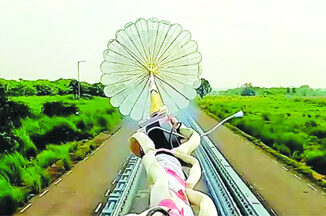
ISRO has successfully conducted a series of tests on drogue parachutes, which would play a pivotal role in stabilising the crew module and reducing its velocity to a safe level during re-entry in the planned Gaganyaan human space flight mission. The Gaganyaan mission hopes to safely transport astronauts to Space and back.
Drogue parachutes are deployed to decrease speed and stabilise rapidly moving objects. ISRO’s Thiruvananthapuram-based Vikram Sarabhai Space Centre (VSSC) successfully conducted a series of Drogue Parachute Deployment Tests at the Rail Track Rocket Sled (RTRS) facility of the Terminal Ballistics Research Laboratory in Chandigarh during August 8-10, the national space agency said in a statement here on Friday.
The tests were conducted in collaboration with Aerial Delivery Research and Development Establishment (ADRDE)/DRDO. The drogue parachutes, packed within pyro-based devices known as mortars, are cleverly designed to eject the parachutes into the air upon command. These conical ribbon-type parachutes, boasting a diameter of 5.8 metres, employ a single-stage reefing mechanism, ingeniously minimising canopy area and mitigating opening shock, ensuring a smooth and controlled descent, the ISRO (Indian Space Research Organisation) explained.
During the three comprehensive tests conducted at the RTRS facility, a range of real-world scenarios were simulated to rigorously evaluate the performance and reliability of the drogue parachutes. The first test simulated the maximum reefed load, marking a groundbreaking introduction of reefing in a mortar-deployed parachute within India. The second test emulated the maximum dis-reefed load, while the third test showcased the deployment of the drogue parachute under conditions mirroring the maximum angle of attack experienced by the crew module during its mission.
“These successful RTRS tests serve as a critical qualification milestone for the drogue parachutes, confirming their readiness for integration into the upcoming Test Vehicle-D1 mission,” the statement said.
Notably, earlier this year, the RTRS tests of Pilot and Apex cover separation parachutes were also conducted, further accentuating the progress of the Gaganyaan mission’s parachute system development. The intricate parachute sequence for the Gaganyaan crew module’s deceleration system encompasses a total of 10 parachutes.
The sequence commences with the deployment of two apex cover separation parachutes, followed by the stabilisation achieved through the deployment of two drogue parachutes. Upon release of the drogue parachutes, the mission transitions into the extraction phase, with three pilot chutes individually extracting three main parachutes, a pivotal step in reducing the Crew Module’s speed to safe levels for a secure landing, the statement said. Source: PTI
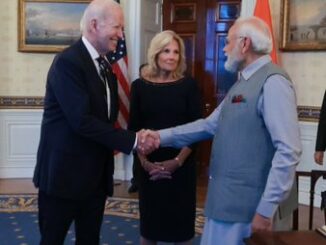
This week we are looking at Prime Minister Narendra Modi’s visit to Washington, which saw US President Joseph Biden roll out the red carpet for him. PM Modi’s visit included a private dinner at the White House, a ceremonial welcome, a state banquet, an address to the US Congress joint session and lunch at the State Department.
PM Modi is the third international leader, after French President Macron and South Korean President Yoon Suk Yeol to be invited as a State guest to the Biden White House. He is also the third Indian leader to be invited as a State visitor to Washington. In 2009, Prime Minister Manmohan Singh was invited by President Barack Obama, and in 1963, President Sarvepalli Radhakrishnan was invited by President John F Kennedy.
“Decades from now — decades from now, people will look back and say the Quad bent the arc of history toward “global good,” as the Prime Minister describes it. Together, India and the United States are working closely on everything from ending poverty and expanding access to healthcare to addressing climate change to tackling food and energy insecurity stoked by Russia’s unprovoked war on Ukraine,” U.S President Joe Biden said.
“We were strangers in defense cooperation at the turn of the century. Now, the United States has become one of our most important defense partners. Today India and the US are working together, in space and in the seas, in science and in semi-conductors, in start-ups and sustainability, in tech and in trade, in farming and finance, in art and artificial intelligence, in energy and education, in healthcare and humanitarian efforts, PM Narendra Modi said.
High-Tech partnership
The big deal announced during this visit was the MoU for a co-production deal between GE and HAL to manufacture GE-F414 jet engines in India for Tejas Light Combat Aircraft
Semiconductor supply chains: Micron Technology will invest $800 million toward a new $2.75 billion semiconductor assembly and test facility in Gujarat- the Indian Semiconductor mission will fund the rest of the project
Under the newly launched Initiative on Critical and Emerging Technology (iCET), a number of innovation partnerships, also on India and the United States have established a Joint Indo-U.S. Quantum Coordination Mechanism to facilitate joint research looking at Quantum, Advanced Computing, and Artificial Intelligence
India to join the 11-nation minerals security partnership (msp) meant to reduce dependence on China for critical minerals
Defense cooperation
India will buy 16 Drones- armed MQ-9B SeaGuardian UAVs.
The US Navy has concluded a Master Ship Repair Agreement (MSRA) with Larsen and Toubro Shipyard in Kattupalli (Chennai) and is finalizing agreements with Mazagon Dock Limited (Mumbai) and Goa Shipyard (Goa).
Placing Indian liaison officers at 3 US commands
Launch of India-U.S. Defense Acceleration Ecosystem (INDUS-X)— between private defense industries in US and India
Space cooperation:
India signed the Artemis Accords, joining 26 other countries working on exploration of the Moon, Mars, and beyond.
NASA will provide advanced training to Indian Space Research Organization (ISRO) astronauts with the goal of launching a joint effort to the International Space Station in 2024.
NASA and the ISRO are developing a strategic framework for human spaceflight cooperation by the end of 2023
Trade and Consular issues
Resolution of six of seven outstanding WTO disputes between the two countries through mutually agreed solutions, market access
India to set up consulate in Seattle, 2 other US cities. US to set up new consulates in Ahmedabad and Bengaluru
Relaxation in H1B visa norms for in country renewal and more availability of visas
The broad geopolitical takeaways of the Modi visit
Reaffirmation of India-US strategic ties, also within Quad and the Indo-Pacific, although no specific messaging on China.
High technology partnerships will drive the next phase of the relationship, just as the nuclear deal, or the defense agreements, or the search for an FTA once did. In particular, the Jet engine deal if it goes through could pave the way for more technology transfer that has thus far eluded the relationship
Leadership level summits and meetings continue to ensure India-US ties grow year on year as they have over the past two decades. Biden will visit India for the G20 summit in September, and there’s speculation PM Modi will be invited to California for the APEC summit in November, where leaders of 21 countries including US and China will meet.
Reading the fine print- the left-outs
The big-ticket item on this visit- for the GE F414 jet engines to be co-produced in India still has a long regulatory road ahead- a manufacturing license agreement has now been submitted for Congressional Notification. US Congress will need to clear the deal on two counts of Export Administration Regulations (EAR) and International Traffic in Arms Regulations (ITAR). Questions are still open on just how much technology will actually be transferred- and whether India will accept conditions attached to that….some of the reasons previous attempts on jet engine tech transfer, as the two countries attempted from 2010-2019 under DTTI, failed.
Indian regulations have similarly held up the Indo US nuclear deal between Nuclear Power Corporation of India Limited (NPCIL) and Westinghouse Electric Company (WEC) for the construction of six nuclear reactors in Kovvada, Andhra Pradesh. 8 years after Modi-Obama announced the nuclear deal is done, and worked a way around the CLNDA, there’s still no techno-commercial offer. ‘
The Biden administration has made it clear it has no interest in continuing the Trump-era FTA talks, and the Modi government has made it clear it still expects the Biden administration to restore India’s GSP status for exports. But no movement during this visit
The big ticket deal from 2019 on an Indian investment in a US LNG plant- specifically the $2.5 bn planned by Petronet in Tellurian’s Driftwood LNG project- has not been revived, nor was any announcement made on GAIL India’s plans to invest in US LNG plants.
India and US agreed to disagree, but differences over the Russian war in Ukraine remained- while Biden referred to what he called Russia’s brutal war on two occasions, PM Modi didn’t, nor did the Joint statement reflect it.
Human Rights-this remains as prickly an issue as it was in 2014, when PM Modi visited India for the first time after his visa was revoked in 2005. Ahead of this visit as many as 75 members of the US Congress wrote to President Biden demanding that he raise concerns over human rights and democracy in India publicly, which he did not.
And former President Obama said this in an interview that released the same day as the State visit:
“I think it is true that if the President meets with Prime Minister Modi, then the protection of the Muslim minority in a majority Hindu India, that’s something worth mentioning. Because, and by the way, if I had a conversation with Prime Minister Modi, who I know Well, part of my argument would be that if you do not protect the rights of ethnic minorities in India, then there is a strong possibility, and at some point, starts pulling apart. And we’ve seen what happens when you start getting those kinds of large internal conflicts”
When asked at a rare press event with – where he answered a few questions from the media, here’s what PM Modi said
“We have proven that democracy can deliver, and there is no discrimination in India on the issues of cast, creed, religion”
World View Take
Quite aside from the moment at hand, the underlying logic for India-US relations, especially between its people has always been strong- and is the reason relations remained close despite cold war tensions. PM Modi’s state visit to Washington is one more step in ties that have grown year on year over 2 decades and are poised to take the next leap on technology transfer. When it comes to questions over Indian democracy, that are internal to India, PM Modi made a rare exception in taking questions in the US, but it is the answers he gives to Indians in India on democratic freedoms that will actually count.
The satellite has re-entered the Earth’s atmosphere and would have disintegrated over the Pacific Ocean. The Indian Space Research Organisation said it successfully carried out an “extremely challenging” controlled re-entry experiment of the decommissioned orbiting Megha-Tropiques-1 (MT-1) satellite.
“The satellite re-entered the Earth’s atmosphere and would have disintegrated over the Pacific Ocean,” the Bengaluru-headquartered national space agency said on Twitter.
The low Earth satellite was launched on October 12, 2011, as a joint satellite venture of ISRO and the French space agency, CNES for tropical weather and climate studies. An uninhabited area in the Pacific Ocean between 5°S to 14°S latitude and 119°W to 100°W longitude was identified as the targeted re-entry zone for MT1, weighing about 1000 kg, ISRO said earlier this week. About 125 kg on-board fuel remained unutilised at its end-of-mission that could pose risks for accidental break-up, an ISRO statement had noted.
This left-over fuel was estimated to be sufficient to achieve a fully controlled atmospheric re-entry to impact the uninhabited location in the Pacific Ocean, ISRO had said.
Controlled re-entries involve deorbiting to very low altitudes to ensure impact occurs within a targeted safe zone.
Usually, large satellites/rocket bodies, which are likely to survive aero-thermal fragmentation upon re-entry, are made to undergo controlled re-entry to limit ground casualty risk. However, all such satellites are specifically designed to undergo controlled re-entry at end-of-life (EOL).
“MT1 was not designed for EOL operations through controlled re-entry which made the entire exercise extremely challenging”, ISRO said.
Furthermore, the on-board constraints of the aged satellite, where several systems had lost redundancy and showed degraded performance, and maintaining subsystems under harsher environmental conditions at much lower than originally designed orbital altitude added to the operational complexities. Source: PTI
As the Indian Space Research Organisation (ISRO) gears up to launch the Chandrayaan-3 mission to the Moon, the world is awaiting the discoveries that it will unravel on the lunar surface. The mission is likely to be launched this year and Isro has learned from the failure of the previous mission.
Chandrayaan-3 is a follow-up to the Chandrayan-2 mission that will demonstrate end-to-end capability in safe landing and roving on the lunar surface and consists of a lander-rover configuration. The mission will be launched aboard India’s most powerful rocket, the LVM-III, from the Satish Dhawan Space Centre in Sriharikota.
While the Indian space agency is yet to say anything about the final launch dates, it is likely to be in the second or third quarter of 2023.
The mission is aimed at better understanding the Moon’s composition. Isro has laid out three main objectives for the mission, which include demonstrating a safe and soft landing on the lunar surface, demonstrating the rover’s roving capabilities on the moon and performing in-situ scientific observations. Isro said that the mission’s Chandra Surface Thermophysical Experiment (ChaSTE) will measure the thermal conductivity and temperature, while the Instrument for Lunar Seismic Activity (ILSA) will measure the seismicity around the landing site. The Langmuir Probe (LP) will estimate the plasma density and its variations and a passive Laser Retroreflector Array from NASA is accommodated on the mission for lunar laser ranging studies.
“Chandrayaan-3 consists of an indigenous Lander module (LM), Propulsion module (PM), and a Rover with the objective of developing and demonstrating new technologies required for Interplanetary missions. The Lander will have the capability to soft land at a specified lunar site and deploy the Rover which will carry out in-situ chemical analysis of the lunar surface during the course of its mobility. The Lander and the Rover have scientific payloads to carry out experiments on the lunar surface,” Isro said in new detail.
SRIHARIKOTA (TIP): ISRO’s LV D2 carrying EOS-07 satellite and two co-passenger payloads lifted off from the spaceport here on Friday, February 10. In its second developmental flight, LV D2 carried EOS-07, an earth observation satellite as its main payload and two others — Janus-1 built by US-based Antaris and Chennai-headquartered Space Kidz India’s Azaadi SAT-2. This was ISRO’s maiden mission this year. At the end of a six-and-a-half hour countdown, the 34-metre-tall rocket lifted off from the Satish Dhawan Space Centre here, even as ISRO has pinned hopes on it to lead the space agency to success in tapping the small satellite launch vehicle market.
The maiden flight of LV on August 7, 2022 was a partial failure due to an orbit anomaly and deviation in the flight path of the rocket. LV caters to the launch of up to 500kg satellites to low earth orbits on ‘launch-on-demand’ basis. It provides low-cost access to space, offers low turn-around time and flexibility in accommodating multiple satellites, and demands minimal launch infrastructure.
EOS-07 is a 156.3kg satellite which has been designed, developed and realized by ISRO. New experiments include mm-Wave Humidity Sounder and Spectrum Monitoring Payload. While Janus-1 is a 10.2kg satellite, the 8.7kg AzaadiSAT-2 is a combined effort of about 750 girl students across India guided by Space Kidz India, Chennai.
The mission objective is to inject these satellites in a 450-km circular orbit.
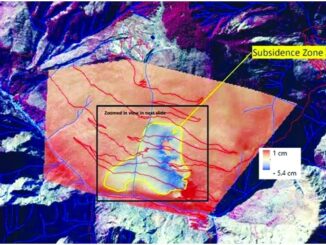
Dehradun (TIP)- The National Remote Sensing Centre (NRSC) of the Indian Space Research Organisation (ISRO) has released satellite images of Joshimath and a preliminary report on land subsidence which shows that the entire town may sink. The pictures are taken from the Cartosat-2S satellite.
Hyderabad-based NRSC has released the satellite images of areas that are sinking.
In images, the entire town, including the Army’s helipad and the Narasimha temple, has been marked as sensitive zone.
On the basis of ISRO’s preliminary report, Uttarakhand government is conducting rescue operation in danger-prone areas and the people in these areas are being shifted to safer places on priority.
According to the report, the land subsidence was slow between April and November 2022, during which Joshimath had sunk by 8.9 cm. But between December 27, 2022 and January 8, 2023, the intensity of land subsidence increased and the town sank by 5.4 cm in these 12 days.
The satellite images show that the Joshimath-Auli road is also going to collapse due to the land subsidence. Although scientists are still studying the cracks that appeared in the houses and roads after the land subsidence in the town, the findings in the primary report of ISRO are frightening.
Joshimath has been declared a land-subsidence zone by the Chamoli district administration after hundred of houses developed cracks within a few days and families had to be relocated as their residences have been identified as dangerous. While the government has announced an interim relief package of Rs 1.5 lakh and working on a rehabilitation package, the demolition of two hotels began on Thursday, January 12, but was again halted because of bad weather. The mechanical demolition was earlier stalled for a few days because of the protest of the locals and residents.
Only hotel Malari Inn and Mount View Hotel will be demolished as their existence is dangerous for the surrounding structures, the administration said assuring that no other houses will be demolished as of now. Several expert teams have been roped in to analyse the sinking of Joshimath, while tunnelling work for NTPC hydel project is being blamed by the experts. NTPC, however, issued a statement and claimed that their tunnel is not passing under Joshimath.
The Indian Space Research Organisation (ISRO) said the performance of the booster motor made by Economic Explosives Limited for its PSLV-XL rocket was satisfactory. The Indian space agency tested the booster motor called PSOM-XL at its rocket port in Sriharikota on Wednesday, December 7.
According to the ISRO, with this test, the private industry’s capability to produce the stage for PSLV has been established. This is the first step in the end-to-end production of PSLV through the industry.
The ISRO had transferred the technology to Economic Explosives Limited, Nagpur, in 2019.
The commercial arm of Department of Space NewSpace India Limited has selected the HAL-L&T-led consortium to make five PSLV-XL rockets.
Akshay Kumar is set to team up again with his Mission Mangal director Jagan Shakti for an action-drama inspired by true events.
Kumar and Shakti first worked together on the 2019 drama Mission Mangal, inspired by the story of scientists at the Indian Space Research Organisation (ISRO), who contributed to the Mars Orbiter Mission, India’s first interplanetary expedition.
The new film is also inspired by true events, a source close to the development said.
“This is an action-drama with a dash of science. It is set in current times. It is inspired by true events. He will play the role of law enforcement officer,” the source added.
The script is locked and the shoot is likely to begin next year.
“As soon as Akshay fulfils his other commitments, we will begin shooting for this film. There are so many things in the pipeline for him, so we are also waiting to go on floors. Currently due to COVID-19, the schedule of all projects is affected,” the source said.
The Indian Space Research Organisation (Isro) successfully launched the Brazil’s Amazonia-1 satellite Sunday. Polar Satellite Launch Vehicle (PSLV) C51 mission carried the earth observation satellite along with 18 co-passenger satellites, including a nanosatellite from Isro, three UnitySats by an academic consortium, and a demonstration satellite by another start-up, Pixxel (incorporated as Syzygy Space Technologies). In a first, Prime Minister Narendra Modi’s picture has been engraved on the top panel of the spacecraft Satish Dhawan Sat (SD SAT), one of the co-passenger satellites from Chennai-based Space Kidz India (SKI). “This is to show solidarity and gratitude for his (PM’s) Aatmanirbhar initiative and space privatisation”, SKI had earlier said. The satellite also carries Bhagavad Gita in SD (secured digital) card. The nanosatellite also carries three scientific payloads — one to study space radiation, one to study the magnetosphere, and another that will demonstrate a low-power wide-area communication network.
Signup to our Newsletter!
Don’t miss out on all the happenings around the world