Tag: Jallianwala Bagh

  • Jallianwala Bagh, a conspiracy or a planned massacre?

    Is it time for the British Empire to apologize for the worst massacre reported in recent times?

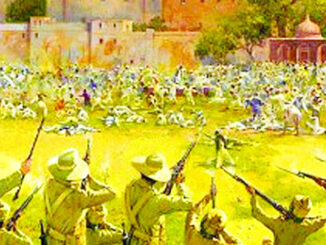
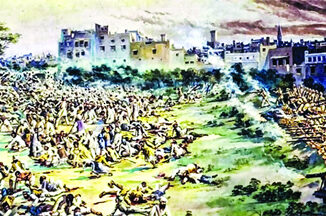
    The Jallianwala Bagh massacre, also known as the Amritsar massacre, took place on 13 April 1919. A large crowd had gathered at the Jallianwala Bagh in Amritsar, Punjab, British India, during the annual Baisakhi fair to protest against the Rowlatt Act and the arrest of pro-Indian independence activists Saifuddin Kitchlew and Satyapal. In response to the public gathering, the temporary brigadier general R. E. H. Dyer surrounded the people with his Gurkha and Sikh infantry regiments of the British Indian Army. The Jallianwala Bagh could only be exited on one side, as its other three sides were enclosed by buildings. After blocking the exit with his troops, Dyer ordered them to shoot at the crowd, continuing to fire even as the protestors tried to flee. The troops kept on firing until their ammunition was low and they were ordered to stop. Estimates of those killed vary from 379 to 1,500 or more people; over 1,200 others were injured, of whom 192 sustained serious injury. Britain has never formally apologised for the massacre but expressed “deep regret” in 2019.    (Wikipedia)

    The Massacre. The Jallianwala Bagh massacre, also known as the Amritsar massacre, took place on 13 April 1919. Estimates of those killed vary from 379 to 1,500 or more people; over 1,200 others were injured, of whom 192 sustained serious injury.
    By Prabhjot Singh

    After Parliamentarian Bob Blackman asked the British Government to formally “apologize” for the Jallianwala Bagh massacre, former MP and Chairman of the National Minorities Commission, Mr Tarlochan Singh, has urged the first turbaned Sikh British MP, Tanmanjeet Singh Dhesi, to endorse his fellow MP’s demand.

    In a letter to Mr Tanmanjeet Singh Dhesi, Mr Tarlochan Singh wants him to raise the issue in the British House of Commons to seek an “official apology” for one of the worst “massacres of innocents” in the last century.

    Demanding the apology on the lines the Canadian Prime Minister Justin Trudeau tendered in the House of Commons for the Komagata Maru episode, Mr Tarlochan Singh said that “the gravity of the Jallianwala Bagh massacre was much more serious as innocents were greeted with cannon when they assembled for a peaceful congregation to demand independence.”

    Justin Trudeau had tendered an unconditional apology for the Komagata Maru incident on May 18, 2016, in which hundreds of Sikhs, Muslim and Hindu passengers were denied entry to Canada and forced to return to an uncertain and ultimately violent fate in India.

    The Then-Opposition Leader, Rona Ambrose, NDP Leader Tom Mulcair, BQ Leader Rheal Fortin, and Green Party Leader Elizabeth May also rose to add their voices and endorse the apology.

    “Canada does not bear alone the responsibility for every tragic mistake that occurred with the Komagata Maru and its passengers, but Canada’s government was without question responsible for the laws that prevented these passengers from immigrating peacefully and securely. For that, and for every regrettable consequence that followed, we are sorry,” Trudeau said in his statement.

    Though demand for a similar apology has been raised from time to time, including during the visit of the British Monarch and Prime Ministers to India, it has not progressed beyond “regrets” expressed by the British top elite.

    As the worst massacre approaches its 106th anniversary, the demand has surfaced again, this time a British MP, Bob Blackman, raising it.

    It is time to analyze the issue in perspective. It was not only the worst massacre in recent memory of mankind, but it also infringed upon various sensitive issues, including human rights and freedom of expression.

    Let us have a look at the broader issues and sequence of events that led to this darkest phase of the Indian freedom struggle.

    Issues

    • Did it give birth to the concept of state terrorism
    • Was it the handiwork of General Dwyer alone
    • Has the country done justice to martyrs and their families
    • Is it time to look beyond rituals
    • Bagh’s epoch and media
    • Punjab’s tryst with Censorship
    • Should the British Government apologize for the Jallianwala Bagh massacre?

    In a liberal democracy, the media have a vital role to play. Though acknowledged as the fourth Estate, freedom of the Press has become a mere bogey as it was during the Jallianwala Bagh epoch.

    Not many would know that it was the Jallianwala Bagh epoch that saw the British using the draconian law to curb the freedom of the Press. They resorted to Censorship, not once, but twice, to gag the media. Still not satisfied, the then Editor of The Tribune, Mr Kalinath Ray, was taken into custody for opposing the Empire.

    A section of media, including The Tribune, served its readers as a fearless voice of the people of Punjab. When one looks back at the Jallianwala Bagh massacre, one cannot overlook the role the media played.

    Gruesome massacre

    The Jallianwala Bagh massacre was a gruesome episode that changed the narrative of the freedom struggle. It not only symbolized the brute power that the British used to contain the growing demand of the populace for freedom, liberty and equality, but also exposed the desperation of the rulers in suppressing the growing revolt. This epochal event not only gave a new direction to the war for independence but also changed the course of sub-continental history. It paved the way for Mohan Dass Karam Chand Gandhi to become Mahatma.

    Before the Vaisakhi 1919 massacre, Jallianwala Bagh was a dumping ground of no political significance. But things witnessed a massive change afterwards. It provided the much-needed launch pad that guided the destiny of the nation. Interestingly, many in the crowd had come to Amritsar to join Vaisakhi celebrations at the Golden Temple, and some others were there for the annual cattle fair. To kill time, they headed for Jallianwala Bagh without realizing what was in store for them. That day no leader in the Bagh could control or keep the gathering together.

    Historian VN Dutta believed that the alleged culprit was Hans Raj, chief organizer of the rally. It was he who prevented people from dispersing. Rather, he asked everyone to sit down as the Government would not resort to feared fire.

    “After a while, he waved his handkerchief, signaling to Dwyer and his Indian soldiers to open fire. Hans Raj had already left. He was an agent provocateur. He was later moved away to Mesopotamia, and his house in Amritsar was burnt,” V.N. Dutta had said in an interview. General Dwyer refused to believe that the crowd that had assembled at Jallianwala Bagh was innocent but hostile and had come prepared to defy authority.

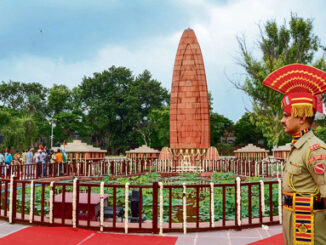
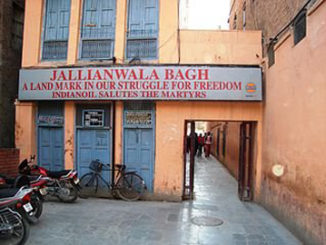
    The renovated Jallianwala Bagh , Amritsar.

    Has the nation given Jallianwala Bagh and its martyrs their due? The Bagh may have been renovated and given a facelift in recent years. But does that mitigate the anguish of the people who lost their near and dear ones or the countrymen who wanted freedom from the British empire? The British Government is still not ready to apologize for its action 106 years ago. It should have taken a lesson from the Canadian government that offered an unconditional apology for its comparatively lesser grave action in the Komagata Maru episode.

    Six years ago, rituals were gone through meticulously as the events unfolded for observing the centenary of the epochal event. The country’s Vice-President came, laid a wreath, joined a ceremonial salute to the unknown martyrs, released a coin and a set of postage stamps to mark the historic event. Unfortunately, after 106 years, no one knows how many freedom seekers laid down their lives in a most controversial, barbaric action that in the present day would have put to shame the infamous 9/11 terrorist attack on the twin towers in New York.

    At that time, there were no human rights activists, and not many would know what terrorism, including state terrorism, was all about.

    Even after more than a century,  the majority belief that the Jallianwala Bagh massacre was the result of a conspiracy that has not been satisfactorily countered. Was it a unilateral action on the part of then Lieutenant Governor Sir Michael O. Dwyer? Or was it the culmination of incidents, including the widespread violence following the arrest of some Punjab leaders, including Dr Saifuddin Kitchlew and Dr Satya Pal, besides the murder of five Europeans and the assault of missionary Miss Sherwood? Or was it because of the infamous Rowlett Bills?

    Whatever be the background or provocation, it was one of the single largest instances of brutal misuse of state power against innocent, unarmed, and peaceful protestors. Was the punishment given to the victims proportionate to the violation of law committed by them, wittingly or unwittingly? Not many references were made in those days about terrorism, what to talk of State terrorism. Now, when the world has redefined terrorism and state terrorism, social scientists in general and those studying armed conflicts will have little or no hesitation to identify the Jallianwala Bagh massacre as probably the beginning of State terrorism of suppressing or silencing the voice of dissent with brute firepower. It was the worst or blatant violation of human rights.

    While the demand for apology from the British for this unprecedented massacre has been growing louder year after year, many still see it as a major aberration or act of rashness on the part of General O’Dwyer. He believed that by killing innocent people in Jallianwala Bagh, he was sending a message to Punjab and the world that he would manage to put a finger in the dyke. Provoked by the Punjab rebellion, especially after incidents of April 10, 11 and 12, O Dwyer became furious and aggressive. With 25 Gurkhas and an equal number of Baluchis, he reached Jallianwala Bagh on the fateful day. The troops fired about 1650 bullets.

    The number of people killed in the firing and those who jumped into the well could not be authenticated even after 106 years. Even today, no one has an authentic number of those who attained martyrdom that day. Many injured died due to a lack of medical attention.

    The figures of 359 or 379 killed in firing were not working figures. Local newspapers, however, put the figure of those killed at over 1,000. Historian VN Dutta held that as many as 700 were killed in the firing. Besides, several thousand were injured who received treatment at non-official clinics or health centers. All O’Dwyer wanted was to send a strong message that Amritsar in Punjab could become a storm center of rebellion against the British Empire, and the evil had to be nipped in the bud.

    Realizing that Vaisakhi was a big event and there could be massive turnouts for protests against Rowlett Bills, the British ordered prohibitory orders on April 12 and 13 that banned public rallies, taking out of processions or gathering of groups of people at a place.  Without any warning to the crowd, he ordered fire. Havoc ensued. The gathering, terrorized by the firing, broke up. People ran for shelter, and the narrow passageways were all crammed. Some jumped into the well for safety. Those who tried to climb the walls were caught.

    Killing armless innocent people in cold blood in Jallianwala Bagh probably gave birth to ruthless State Terrorism. For Punjab, it was nothing new except that the magnitude this time was enormous.

    The Jallianwala Bagh massacre was also a litmus test for the media, which at that time was in its infancy and limited to a few newspapers. One of the newspapers that the British tried to dismiss as a small local newspaper was The Tribune.

    Media coverage of the events became a subject of considerable comment and criticism. The State used law not only to prevent publication of what was called “: objectionable material”, but the publishers of several newspapers, including those who were opposed to the British Empire, were accused of “secessionist propaganda”. But it did not deter upright media. Punjab was the center point of growing turbulence. Intriguingly, the laws the British framed to curb freedom struggle have subsequently been used by Independent India. Not many would forget the days after the then Prime Minister Indira Gandhi tried to curb freedom of the Press during the draconian emergency days. Subsequently, Punjab, too, suffered its repeated doses of censorship both during and after Operation Bluestar.

    In a liberal democracy, the media have a vital role to play. Though acknowledged as the fourth Estate, freedom of the Press has become a mere bogey as it was during the Jallianwala Bagh epoch. The concept of the notorious “Gaudi Media” has of late come to stay. The coverage of the farmers’ agitation in recent years has been an example. And the latest is the case of the stand-up comedian Kunal Kamra. Not many would know that it was the Jallianwala Bagh epoch that saw the beginning of censorship.

    The British used the draconian law to curb the freedom of the Press. They resorted to Censorship, not once, but twice, to gag the media. Still not satisfied, the then Editor of The Tribune, Mr Kalinath Ray, was taken in custody for opposing the Empire.

    In 1919, a section of media, including The Tribune, served its readers as a fearless voice of the people of Punjab. When one looks back at the Jallianwala Bagh massacre, one cannot overlook the role the media played.

    It was repeated during the 1977 emergency when again Editor of The Tribune, Madhavan Nair, and senior journalists like Shyam Khosla and Makhan Lal Kak had to face the wrath of the black laws, including detention under the draconian National Security Act and Maintenance of Internal Security Act (MISA). In 1984 again, these draconian laws were frequently used by the State to gag  Indian media in general and that of Punjab and Chandigarh in particular.

    ( Prabhjot Singh is a veteran journalist with five decades of experience covering a wide spectrum of subjects and stories. He has covered  Punjab and Sikh affairs for more than four decades, besides covering 10 Olympics and several major sporting events and hosting TV shows. For more in-depth analysis, please visit probingeye.com  or follow him on Twitter.com/probingeye)

  • Bloodbath on Vaisakhi: The Jallianwala Bagh Massacre

    Bloodbath on Vaisakhi: The Jallianwala Bagh Massacre

    April 13, 1919, marked a turning point in the Indian freedom struggle. It was Vaisakhi that day, a harvest festival popular in Punjab and parts of north India. Residents of Amritsar decided to assemble at Jallianwalla Bagh on the day to discuss the confinement of Satya Pal and Saifuddin Kitchlew, two leaders fighting for Independence and scrapping of the Rowlatt Act, which armed the British government with powers to detain any person without trial.
    The crowd had a mix of men, women and children and the protest was a peaceful one. The gathering included pilgrims visiting the Golden Temple who were merely passing through the park, and some who had not come to protest. Suddenly, as many as 90 British Indian Army soldiers, commanded by Colonel Reginald Dyer, appeared and without any warning to the people, ordered firing on the completely peaceful and defenceless crowd. The fusillade continued till Dyer’s ammunition ran out.
    This cold-blooded carnage, Dyer admitted later, was perpetrated “to strike terror not only in the city of Amritsar, but throughout the Punjab”. The official inquiry ordered by the British government said there were 379 deaths but the Congress claimed that more than 1,000 people died in the massacre.
    A well, located inside the premises of the Jallianwala Bagh, stands testimony to the brutal killings of the innocent who jumped into it in panic to save themselves from the firing. 120 dead bodies were later recovered from the well. The last known survivor of the Jallianwala Bagh Massacre, Shingara Singh, died in Amritsar on June 29, 2009, at the age of 113.
    The massacre marks one of the most heinous political crimes committed by the Britishers during the twentieth century. It became a turning point in the history of India’s struggle for freedom. The Jallianwala Bagh site in Amritsar is now a national monument. It houses a museum, a gallery, and a number of memorial structures.
    Popular resentment had been accumulating in Punjab since the beginning of the War (World War I), mainly due to the ruthless drive – by the British — for recruiting soldiers and forced contribution to the war fund. Gandhiji’s call for a country-wide hartal to protest against the Black Acts received a tremendous response from Punjab on March 30 and again on April 6.
    Gandhiji’s call for a country-wide hartal to protest against the Black Acts received a tremendous response from Punjab on March 30 and again on April 6.
    The agitated mood of the people and Hindu-Muslim solidarity demonstrated on the hartal (strike) days and on April 9 celebration of the Ramnavami festival made the Lt Governor Michael O’Dwyer’s administration panicky.
    Gandhiji’s entry into Punjab was banned: two popular leaders of Amritsar, Kitchlew and Satya Pal, were arrested. These provocations led to hartals and mass demonstrations in Lahore, Kasur, Gujranwala and Amritsar.
    In Amritsar, the police firing on demonstrators provoked some of them to commit acts of violence. The next day the city was handed over to Brigadier-General Dyer. Dyer began his regime through indiscriminate arrests and ban on meeting and gatherings.
    On April 13 – the day of Vaisakhi festival – a meeting was called in the afternoon at the Jallianwala Bagh a ground enclosed on all sides. Thousands of people, many of whom had come from surrounding villages to the fairs in Amritsar and were unaware of the ban order, gathered in the meeting.
    Suddenly Dyer appeared there with troops and without any warning to the people, ordered firing on the completely peaceful and defenceless crowd. The fusillade continued till Dyer’s ammunition ran out. Atleast about a thousand people, if not more, are estimated to have been killed. This cold-blooded carnage, Dyer admitted later, was perpetrated “to strike terror not only in the city of Amritsar, but throughout the Punjab?”
    The massacre stunned the people and became a turning point in the history of India’s struggle for freedom. Rabindranath Tagore wrote a strong letter of protest to the Viceroy, dated May 31, 1919, renouncing his Knighthood
    “….The disproportionate severity of the punishments inflicted upon the unfortunate people and the methods of carrying them out, we are convinced, are without parallel in the history of civilised governments…. The accounts of insults and sufferings undergone by our brothers in the Punjab have trickled through the gagged silence, reaching every corner of India and the universal agony of indignation roused in the hearts of our people has been ignored by our rulers,-possibly congratulating themselves for what they imagine as salutary lessons….the very least that I can do for my country is to take all consequences upon myself in giving voice to the protest of the millions of my countrymen, surprised into a dumb anguish of terror. The time has come when the badges of honour make our shame glaring in their incongruous context of humiliation, and I for my part wish to stand shorn of all special distinctions, by the side of those of my countrymen, who, for their so called insignificance, are liable to suffer a degradation not fit for human beings….”

    The Hunter Committee
    The Hunter Committee was appointed by the British government. Halfway through its proceedings, the Hunter Committee suffered the setback of being boycotted by Indian nationalists, represented by the Congress, because of the government’s refusal to release Punjab leaders on bail.
    Of the eight members in all, the Committee had three Indian members. The conduct of the Indian members is a study in principled independence and courage.
    The following erudite exchange on the pointed killings ordered by Dyer on April 13, 1919 took place during the hearings of the Hunter Committee that took place in Lahore on November 19, 1919.
    The excerpt that follows was part of a detailed and rigorous cross examination of General Dyer. Sir Chimanlal Setalvad, a lawyer from Bharuch, Gujarat, who lived in Bombay conducted this particular part of the cross-examination.
    Chimanlal Setalvad: “You took two armoured cars with you?”
    Dyer: “Yes.”
    Chimanlal Setalvad: “Those cars had machine guns?”
    Dyer: “Yes.”
    Chimanlal Setalvad: “And when you took them you meant to use the machine guns against the crowd, did you?”
    Dyer: “If necessary. If the necessity arose, and I was attacked, or anything else like that, I presume I would have used them.”
    Chimanlal Setalvad: “When you arrived there you were not able to take the armoured cars in because the passage was too narrow?”
    Dyer: “Yes.”
    Chimanlal Setalvad: “Supposing the passage was sufficient to allow the armoured cars to go in, would you have opened fire with the machine guns?”
    Dyer: “I think, probably, yes.”
    Chimanlal Setalvad: “In that case the casualties would have been very much higher?”
    Dyer: “Yes.”
    Chimanlal Setalvad: “And you did not open fire with the machine guns simply by the accident of the armoured cars not being able to get in?”
    Dyer: “I have answered you. I have said that if they had been there the probability is that I would have opened fire with them.”
    Chimanlal Setalvad: “With the machine guns straight?”
    Dyer: “With the machine guns.”
    Chimanlal Setalvad: “I take it that your idea in taking that action was to strike terror?”
    Dyer: “Call it what you like. I was going to punish them. My idea from the military point of view was to make a wide impression.”
    Chimanlal Setalvad: “To strike terror not only in the city of Amritsar, but throughout the Punjab?”
    Dyer: “Yes, throughout the Punjab. I wanted to reduce their morale; the morale of the rebels.”
    Chimanlal Setalvad: “Did it occur to you that by adopting this method of ‘frightfulness’ – excuse the term – you were really doing a great disservice to the British Raj by driving discontent deep?”
    Dyer: “I did not like the idea of doing it, but I also realised that it was the only means of saving life and that any reasonable man with justice in his mind would realise that I had done the right thing; it was a merciful though horrible act and they ought to be thankful to me for doing it. I thought I would be doing a jolly lot of good and they would realise that they were not to be wicked.”
    Setalvad’s cross examination followed Lord Hunter’s and that of one more British member. Dyer had already admitted to Lord Hunter that although “a good many” in the crowd might not have heard of his ban on the public meeting, he had ordered the firing at Jallianwala Bagh without giving any warning. He went further when he said before the Committee that, although he could have “dispersed them perhaps even without firing”. He felt it was his “duty to go on firing until (the crowd) dispersed”.
    An eight-member committee headed by Lord William Hunter, former solicitor general in Scotland constituted the Inquiry Committee. Apart from Setalvad, then Vice Chancellor, Bombay University, two other Indians were part of the Committee. Sir Chimanlal Setalvad, Pandit Jagat Narain, Member of the Legislative Council of the Lt. Governor of U.P. and Sultan Ahmed Khan, Member for Appeals, Gwalior State.
    Lord Hunter, Justice Rankin and WF Rice, Add. Secretary to the Government of India, Home Department, Major-General Sir George Barrow, Commanding the Peshawar Dn and Smith, Member of the Legislative Council of the Lt. Governor of UP were the members. The questioning was done, in turn, by eight members.
    Following up on the admissions by Dyer to the two British members before him, Setalvad probed Dyer on the two armoured cars that he had been forced to leave out. Dyer’s callousness stood exposed: even after the firing had left almost 400 dead and many more injured, when asked by Setalvad if he had taken any measures for the relief of the wounded, Dyer replied, ‘‘No, certainly not. It was not my job. But the hospitals were open and the medical officers were there. The wounded only had to apply for help.” All three Indian members of the Hunter Committee displayed a remarkable degree of independence faced with sharp differences with the British members. The differences arose over the recording of conclusions.
    The Hunter Committee ended up giving two reports – the majority report by the five British members and the minority report by three Indian members.
    Both reports indicted Dyer, in no uncertain terms. The differences were in in the degree of condemnation, in so far as Jallianwala Bagh was concerned.
    The report by the British members’ report condemned the action by Dyer on two counts: that he opened fire without warning and that he went on firing after the crowd had ‘begun to disperse’. Though his intention to create a moral effect throughout Punjab was ‘a mistaken conception of duty’, the British members thought it was “distinctly improbable that the crowd would have dispersed without being fired on”. Even the British members of the Hunter Committee, rejected the official stand that Dyer’s action had ‘saved the situation in the Punjab and averted a rebellion on a scale similar to the (1857) mutiny’.
    The minority report, drafted by Chimanlal Setalvad, on behalf of all the Indian members was not only more severe in general. It specifically condemned Dyer for “suggesting that he would have made use of machine guns if they could have been brought into action.” Members expressed strong anguish at the fact that even after the crowd had begun to disperse, Dyer had continued the firing “until his ammunition was spent.”
    Citing Dyer’s own admission in cross examination, the Indians disagreed with the opinion expressed by the British members of the Committee that the crowd was unlikely to have dispersed without the firing. In conclusion, the Indian members of the Hunter Committee described Dyer’s conduct ‘as inhuman and un-British and as having caused great disservice to British rule in India’.
    Faced with both reports, the then Viceroy of India, Chelmsford conceded that Dyer “acted beyond the necessity of the case, beyond what any reasonable man could have thought to be necessary, and that he did not act with as much humanity as the case permitted”. Dyer had no option but to resign and return to England in disgrace.
    Apologists for the Raj in Britain however, bought into Dyer’s claim that it was this bloody firing by Dyer that had saved the Raj in India. This not only reduced the punishment meted out to Dyer, he was also treated as some sort of a hero on his return. In fact, the inquiry itself could only be instituted only after an indemnity law had been passed protecting Dyer and other recalcitrant officers from criminal liability.
    Setalvad had been knighted by the British monarch, just a few months before the Jallianwala Bagh inquiry. He was then vice-chancellor of Bombay University. In his memoirs published in 1946, Recollections and Reflections, Setalvad disclosed that within the British and Indian members of the Hunter Committee had developed “a sharp cleavage of opinion”.

  • Jallianwala Bagh massacre: 104 years of tragedy

    Jallianwala Bagh massacre: 104 years of tragedy

    Very few moments in the history of our sub-continent are as repulsive to remember and yet as significant to history as the infamous Jallianwala Bagh massacre. The horrendous incident of the brutal, cold-blooded murder of 500 to 600 peaceful protestors at the hands of British imperialist rule is considered a dark chapter in the history of the Indian struggle for independence.
    The Jallianwala Bagh massacre took place on April 13, 1919, when a group of peaceful protestors was gunned down in an enclosed park with only one exit. To commemorate the spirits of all the innocent lives lost in this incident, the Government of India erected a monument in 1951. A museum was also opened in March 2019, known as Yaad-e-Jallian Museum, to put forth an authentic account of the massacre.
    A large peaceful crowd had gathered at the Jallianwala Bagh in Amritsar, Punjab, British India, to protest against the Rowlatt Act and arrest of pro-independence activists Saifuddin Kitchlew and Satyapal. In response to the public gathering, the temporary brigadier general, R. E. H. Dyer, surrounded the protesters with his Gurkha, Baloch, Rajput and Sikh troops from 2-9th Gurkhas, the 54th Sikhs and the 59th Scinde Rifles of the British Indian Army. The Jallianwala Bagh could only be exited on one side, as its other three sides were enclosed by buildings. After blocking the exit with his troops, he ordered them to shoot at the crowd, continuing to fire even as the protestors tried to flee. The troops kept on firing until their ammunition was exhausted. Estimates of those killed vary between 379 and 1,500 or more people and over 1,200 other people were injured of whom 192 were seriously injured.
    The massacre caused a re-evaluation by the British Army of its military role against civilians to “minimal force whenever possible”, although later British actions during the Mau Mau rebellion in the Kenya Colony have led historian Huw Bennett to comment that the new policy could be put aside. The army was retrained and developed less violent tactics for crowd control. The level of casual brutality, and lack of any accountability, stunned the entire nation, resulting in a wrenching loss of faith of the general Indian public in the intentions of the United Kingdom. The attack was condemned by the Secretary of State for War, Winston Churchill, as “unutterably monstrous”, and in the UK House of Commons debate on 8 July 1920 Members of Parliament voted 247 to 37 against Dyer. The ineffective inquiry, together with the initial accolades for Dyer, fuelled great widespread anger against the British among the Indian populace, leading to the non-cooperation movement of 1920-22. Some historians consider the episode a decisive step towards the end of British rule in India. Britain has never formally apologized for the massacre but expressed “deep regret” in 2019.
    Background
    During World War I, British India contributed to the British war effort by providing men and resources. Millions of Indian soldiers and laborers served in Europe, Africa, and the Middle East, while both the Indian administration and the princes sent large supplies of food, money, and ammunition. Bengal and Punjab remained sources of anti-colonial activities. Revolutionary attacks in Bengal, associated increasingly with disturbances in Punjab, were enough to nearly paralyse the regional administration. Of these, a pan-Indian mutiny in the British Indian Army planned for February 1915 was the most prominent amongst a number of plots formulated between 1914 and 1917 by Indian nationalists in India, the United States and Germany.
    The planned February mutiny was ultimately thwarted when British intelligence infiltrated the Ghadar Movement, arresting key figures. Mutinies in smaller units and garrisons within India were also crushed. In the context of the British war effort and the threat from the separatist movement in India, the Defence of India Act 1915 was passed, limiting civil and political liberties. Michael O’Dwyer, then the Lieutenant Governor of Punjab, was one of the strongest proponents of the act, in no small part due to the Ghadarite threat in the province.
    The Rowlatt Act
    The costs of the protracted war in money and manpower were great. High casualty rates in the war, increasing inflation after the end, compounded by heavy taxation, the deadly 1918 flu pandemic, and the disruption of trade during the war escalated human suffering in India. The pre-war Indian nationalist sentiment was revived as moderate and extremist groups of the Indian National Congress ended their differences to unify. In 1916, the Congress was successful in establishing the Lucknow Pact, a temporary alliance with the All-India Muslim League. British political concessions and Whitehall’s India Policy after World War I began to change, with the passage of Montagu-Chelmsford Reforms, which initiated the first round of political reform in the Indian subcontinent in 1917.
    However, this was deemed insufficient in reforms by the Indian political movement. Mahatma Gandhi, recently returned to India, began emerging as an increasingly charismatic leader under whose leadership civil disobedience movements grew rapidly as an expression of political unrest.
    The recently crushed Ghadar conspiracy, the presence of Raja Mahendra Pratap’s Kabul mission in Afghanistan (with possible links to Bolshevik Russia), and a still-active revolutionary movement especially in Punjab and Bengal (as well as worsening civil unrest throughout India) led to the appointment of a sedition committee in 1918 chaired by Sidney Rowlatt, an Anglo-Egyptian judge. It was tasked to evaluate German and Bolshevik links to the militant movement in India, especially in Punjab and Bengal. On the recommendations of the committee, the Rowlatt Act, an extension of the Defence of India Act 1915 to limit civil liberties, was enacted.
    The passage of the Rowlatt Act in 1919 precipitated large-scale political unrest throughout India. Ominously, in 1919, the Third Anglo-Afghan War began in the wake of Amir Habibullah’s assassination and institution of Amanullah in a system strongly influenced by the political figures courted by the Kabul mission during the world war. As a reaction to the Rowlatt Act, Muhammad Ali Jinnah resigned from his Bombay seat, writing in a letter to the Viceroy, “I, therefore, as a protest against the passing of the Bill and the manner in which it was passed tender my resignation … a Government that passes or sanctions such a law in times of peace forfeits its claim to be called a civilized government”. Gandhi’s call for protest against the Rowlatt Act achieved an unprecedented response of furious unrest and protests.
    The massacre
    On Sunday, 13 April 1919, Dyer, convinced a major insurrection could take place, banned all meetings. This notice was not widely disseminated, and many villagers gathered in the Bagh to celebrate the important Sikh festival of Baisakhi, and peacefully protest the arrest and deportation of two national leaders, Satyapal and Saifuddin Kitchlew.
    At 9:00 on the morning of 13 April 1919, the traditional festival of Baisakhi, Reginald Dyer, the acting military commander for Amritsar and its environs, proceeded through the city with several city officials, announcing the implementation of a pass system to enter or leave Amritsar, a curfew beginning at 20:00 that night and a ban on all processions and public meetings of four or more persons. The proclamation was read and explained in English, Urdu, Hindi, and Punjabi, but few paid it any heed or appear to have learned of it later. Meanwhile, local police had received intelligence of the planned meeting in the Jallianwala Bagh through word of mouth and plainclothes detectives in the crowds. At 12:40, Dyer was informed of the meeting and returned to his base at around 13:30 to decide how to handle it.
    By mid-afternoon, thousands of Indians had gathered in the Jallianwala Bagh (garden) near the Harmandir Sahib in Amritsar. Many who were present had earlier worshipped at the Golden Temple, and were passing through the Bagh on their way home. The Bagh was (and remains today) an open area of six to seven acres, roughly 200 yards by 200 yards in size, and surrounded on all sides by walls roughly 10 feet in height. Balconies of houses three to four stories tall overlooked the Bagh, and five narrow entrances opened onto it, several with lockable gates. During the rainy season, it was planted with crops, but served as a local meeting and recreation area for much of the year. In the centre of the Bagh was a samadhi (cremation site) and a large well partly filled with water which measured about 20 feet in diameter.
    Apart from pilgrims, Amritsar had filled up over the preceding days with farmers, traders, and merchants attending the annual Baisakhi horse and cattle fair. The city police closed the fair at 14:00 that afternoon, resulting in an even larger number of people drifting into the Jallianwala Bagh.
    Dyer arranged for an airplane to overfly the Bagh and estimate the size of the crowd, that he reported was about 6,000, while the Hunter Commission estimates a crowd of 10,000 to 20,000 had assembled by the time of Dyer’s arrival. Colonel Dyer and Deputy Commissioner Irving, the senior civil authority for Amritsar, took no actions to prevent the crowd assembling, or to peacefully disperse the crowds. This would later be a serious criticism leveled at both Dyer and Irving.
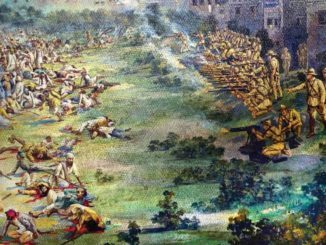
    An hour after the meeting began as scheduled at 17:30, Colonel Dyer arrived at the Bagh with a group of 50 troops, including 25 Gurkhas of 1/9 Gurkha Rifles (1st battalion, 9th Gurkha Rifles), Pathans and Baluch and 59th Sindh Rifles. All fifty were armed with .303 Lee-Enfield bolt-action rifles. Dyer may have specifically chosen troops from those ethnic groups due to their proven loyalty to the British. He had also brought two armored cars armed with machine guns; however, the vehicles could not enter the compound through the narrow entrances. The Jallianwala Bagh was surrounded on all sides by houses and buildings and had only five narrow entrances, most kept permanently locked. The main entrance was relatively wide, but was guarded heavily by the troops backed by the armored vehicles so as to prevent anyone from getting out.
    Dyer, without warning the crowd to disperse, blocked the main exits. Dyer ordered his troops to begin shooting toward the densest sections of the crowd in front of the available narrow exits, where panicked crowds were trying to leave the Bagh. Firing continued for approximately ten minutes. Unarmed civilians including men, women, elderly people and children were killed. This incident came to be known as the Amritsar massacre. Cease-fire was ordered only when ammunition supplies were almost exhausted. The troops having fired about one third of their ammunition. He stated later that this act “was not to disperse the meeting but to punish the Indians for disobedience.”
    The following day Dyer stated in a report that “I have heard that between 200 and 300 of the crowd were killed. My party fired 1,650 rounds”. Apart from the many deaths directly from the shooting, a number of people died of crushing in the stampedes at the narrow gates or by jumping into the solitary well on the compound to escape the shooting. A plaque, placed at the site after independence, states that 120 bodies were removed from the well. Dyer pushed the curfew time earlier than the usual time; therefore, the wounded could not be moved from where they had fallen and more who had been injured then died during the night.
    Casualties
    The number of total casualties is disputed. The following morning’s newspapers quoted an erroneous initial figure of 200 casualties.
    The Government of Punjab, criticized by the Hunter Commission for not gathering accurate figures, only offered the same approximate figure of 200. When interviewed by the members of the committee a senior civil servant in Punjab admitted that the actual figure could be higher. The Sewa Samiti society independently carried out an investigation and reported 379 deaths, and 192 seriously wounded. The Hunter Commission based their figures of 379 deaths, and approximately 3 times that number injured, suggesting 1500 casualties. At the meeting of the Imperial Legislative Council held on 12 September 1919, the investigation led by Pandit Madan Mohan Malviya concluded that there were 42 boys among the dead, the youngest of them only 7 months old. The Hunter commission confirmed the deaths of 337 men, 41 boys and a six-week-old baby.
    In July 1919, three months after the massacre, officials were tasked with finding who had been killed by inviting inhabitants of the city to volunteer information about those who had died. This information was incomplete due to fear that those who participated would be identified as having been present at the meeting, and some of the dead may not have had close relations in the area.
    Winston Churchill reported nearly 400 slaughtered, and 3 or 4 times the number wounded to the Westminster Parliament, on 8 July 1920.
    Since the official figures were obviously flawed regarding the size of the crowd (6,000-20,000), the number of rounds fired and the period of shooting, the Indian National Congress instituted a separate inquiry of its own, with conclusions that differed considerably from the British Government’s inquiry. The casualty number quoted by the Congress was more than 1,500, with approximately 1,000 being killed.
    Indian nationalist Swami Shraddhanand wrote to Gandhi of 1500 deaths in the incident.
    The British Government tried to suppress information of the massacre, but news spread in India and widespread outrage ensued; details of the massacre did not become known in Britain until December 1919.
    Assassination of Michael O’Dwyer
    On 13 March 1940, at Caxton Hall in London, Udham Singh, an Indian independence activist from Sunam who had witnessed the events in Amritsar and had himself been wounded, shot and killed Michael O’Dwyer, the Lieutenant-Governor of Punjab at the time of the massacre, who had approved Dyer’s action and was believed to have been the main planner.
    Some, such as the nationalist newspaper Amrita Bazar Patrika, made statements supporting the killing. The common people and revolutionaries glorified the action of Udham Singh. Much of the press worldwide recalled the story of Jallianwala Bagh, and alleged O’Dwyer to have been responsible for the massacre. Singh was termed a “fighter for freedom” and his action was referred to in The Times newspaper as “an expression of the pent-up fury of the down-trodden Indian People”.
    Singh had told the court at his trial: I did it because I had a grudge against him. He deserved it. He was the real culprit. He wanted to crush the spirit of my people, so I have crushed him. For full 21 years, I have been trying to wreak vengeance. I am happy that I have done the job. I am not scared of death. I am dying for my country. I have seen my people starving in India under the British rule. I have protested against this, it was my duty. What greater honor could be bestowed on me than death for the sake of my motherland?
    Singh was hanged on 31 July 1940. At that time, many, including Jawaharlal Nehru and Mahatma Gandhi, condemned the murder as senseless even if it was courageous. In 1952, Nehru (by then Prime Minister) honored Udham Singh with the following statement, which appeared in the daily Partap: I salute Shaheed-i-Azam Udham Singh with reverence who had kissed the noose so that we may be free.
    Soon after this recognition by the Prime Minister, Udham Singh received the title of Shaheed, a name given to someone who has attained martyrdom or done something heroic on behalf of their country or religion.


  • Many faces of Jallianwala Bagh

    Many faces of Jallianwala Bagh

    The massacre was a catalyst for fusion of multiple strands of anti-imperialist politics

    The tragic moment also became a transformative moment. The transformation manifested itself at four levels — local, regional, national and even global.

    “The April 13 massacre also contributed to a global perspective on all forms of violence and injustice. Gandhi imparted an extremely profound defining label to the massacre. He called it an act of violence not just against a community, region or even a country, but against all humanity. He termed it a ‘crime against humanity’. This was almost three decades before it became a standard catch-phrase by the human rights movements all over. The Jallianwala Bagh carnage was an act in which Punjabis or Indians were not the only victims and the British not the only perpetrators. It was an act of global shame for which all humanity ought to hang its head. Just as all injustice is global in character, so should the resistance against it be.”

    By Salil Misra

    The massacre at Jallianwala Bagh on April 13, 1919, may not have lasted more than 10 minutes. This time was enough for Brigadier General Dyer to get his troops to fire 1,650 rounds on the crowd that had gathered there on the auspicious occasion of Baisakhi. Dyer’s intention was not to disperse the crowd but to terrorize it. Close to 20,000 people had assembled there. In official records, 379 people were killed and many times more wounded. Contemporary estimates of the dead varied between 1,000 and 1,800. Some historical accounts, produced many decades after the massacre, estimated the number of the dead to be 500-700. The Jallianwala Bagh Memorial recognized close to 2,000 martyrs. It was clear that many of the wounded would not have survived. The sheer anonymity of the crowd made it difficult to get the accurate figure of the dead. The general consensus that developed subsequently was that anywhere between 500 and 1,800 people would have been killed during the shooting.

    The tragic moment also became a transformative moment. The transformation manifested itself at four levels — local, regional, national and even global.

    There is thus no clarity on the death toll. But equally, there is no clarity on why Jallianwala happened in the first place. The gathering was not entirely political. Many people had come from nearby areas and may not have known that the city of Amritsar had been placed under curfew. The city administration had been handed over to the army and thus came under the direct control of General Dyer. Amritsar had witnessed violence on April 10 when a demonstration against the Rowlatt Act had turned violent; five Englishmen had been killed by a mob. Nothing else had happened which would warrant genocidal violence on this scale. So why did it happen?

    Was it because, as some writers suggested, General Dyer was mentally sick and suffering from arteriosclerosis and experienced a sudden rush of blood? Or, more plausibly, was it because the British were haunted by the ghost of 1857? Any act of violence by Indians reminded them of 1857. They saw a great conspiracy in the events of April 10. They feared that some help would come from outside, possibly Afghanistan. They panicked. They anticipated violence from Indians and inflicted greater violence on them to prevent it.

    The story of Jallianwala Bagh, however, did not end here. It was a moment of great tragedy. Not since the days of 1857 had the country experienced such barbarity. But the tragic moment also became a transformative moment. The transformation manifested itself at four levels — local, regional, national and even global. From being a religious center, Amritsar turned into a mascot of the anti-imperialist struggle. The massacre also changed the face of Punjab. From being a colonial heartland and a garrison state at the service of British colonialism, Punjab emerged as the headquarters of the nationalist struggle. It may have been a great psychological blow to the British to discover that Punjab was no longer a part of their support system but a major actor in the struggle against them.

    Jallianwala Bagh also changed the contours of nationalist politics at the all-India level. Before the massacre, there were two shades of anti-imperialist politics. There was the mild and moderate opposition by the middle classes, which took the form of petitions and appeals to the goodwill of the rulers. Their opposition was non-violent and within the confines of the law. As against this, there were the spontaneous and often violent struggles of peasants, workers and artisans. The two forms of opposition ran parallel to each other and maintained their separate existence distant from each other. Jallianwala Bagh changed all that. Its reverberations shook the conscience of all strands of the population, cutting across class lines. Gandhi brought the two together into a composite anti-imperialist politics that was non-constitutional and non-violent at the same time and involved both the middle and the lower classes in a seamless, multi-class grid of nationalist politics. Jallianwala Bagh became the catalyst for the fusion of multiple strands of anti-imperialist politics.

    The April 13 massacre also contributed to a global perspective on all forms of violence and injustice. Gandhi imparted an extremely profound defining label to the massacre. He called it an act of violence not just against a community, region or even a country, but against all humanity. He termed it a ‘crime against humanity’. This was almost three decades before it became a standard catch-phrase by the human rights movements all over. The Jallianwala Bagh carnage was an act in which Punjabis or Indians were not the only victims and the British not the only perpetrators. It was an act of global shame for which all humanity ought to hang its head. Just as all injustice is global in character, so should the resistance against it be.

    Quite apart from the transformative character of the moment, it also created a continuous stream of literary and historical writings which shaped the ways in which Jallianwala Bagh was preserved and stored in popular memory. In historical writings, Jallianwala Bagh was projected as a trigger for subsequent anti-imperialist politics. It became a pivot for Indian nationalism, and a starting point of a process that eventually culminated in Independence in 1947. But a different dimension was imparted to it by literary writings. A large number of stories, poems and novels, written in Hindi, Punjabi, Urdu and other languages, unearthed for us the world of emotions and subjectivities around Jallianwala Bagh. They focused on the human dimension, the individual experiences, loss and sorrow, feelings and emotions, trauma and anger, often buried deep in multiple layers of the subconscious.

    Thus, it was that a brief episode became a transformative moment. Many scholarly and creative responses have illuminated for us the world of Jallianwala Bagh. We may still not know how to make sense of this world. But we know how to remember it and preserve it in our collective memory.
    (The author is Professor of History, Ambedkar University Delhi)

  • Remembering Jallianwala  Bagh Massacre

    Remembering Jallianwala  Bagh Massacre

    By Prabhjot Singh
    • Was Jallianwala Bagh, a conspiracy or planned massacre?
    • Did it give birth to the concept of state terrorism?
    • Was it handiwork of General Dwyer alone?
    • Has the country done justice to martyrs and their families?
    • Is it time to look beyond rituals?
    • Bagh’s epoch and media
    • Punjab’s tryst with Censorship

    In 1919, a section of media, including The Tribune, served its readers as a fearless voice of the people of Punjab. When one looks back at the Jallianwala Bagh massacre, one cannot overlook the role the media played.

    In a liberal democracy, the media has a vital role to play. Though acknowledged as the fourth Estate, freedom of Press has become a mere bogey as was  during the Jallianwala Bagh epoch. Not many would know that it was the Jallianwala Bagh epoch that saw the British using the draconian law to curb the freedom of the Press. They resorted to Censorship, not once, but twice to gag the media. Still not satisfied, the then Editor of The Tribune, Mr Kalinath Ray, was taken in custody for opposing the Empire.

    A section of media, including The Tribune, served its readers as a fearless voice of the people of Punjab. When one looks back at the Jallianwala Bagh massacre, one cannot overlook the role the media played. The Jallianwala Bagh massacre was a gruesome episode that changed the narrative of the freedom struggle. It not only symbolized the brute power that the British used to contain growing demand of the populace for freedom, liberty and equality but also exposed the desperation of the rulers in suppressing the growing revolt. This epochal event not only gave a new direction to the war for independence but also changed the course of the sub-continental history. It paved the way for Mohan Dass Karam Chand Gandhi to become Mahatma. Before the Vaisakhi 1919 massacre, Jallianwala Bagh was a dumping ground of no political significance. But things witnessed a massive change afterwards. It provided the much needed launch pad that guided the destiny of the nation. Interestingly, many in the crowd had come to Amritsar to join Vaisakhi celebrations at Golden Temple and some others were there for the annual cattle fair. To kill time, they headed for Jallianwala Bagh without realizing what was in store for them. That day there was no leader in the Bagh that could control or keep the gathering together.

    Historian VN Dutta believed that it was Hans Raj, chief organizer of the rally. It was he who prevented people from dispersing. Rather, he asked everyone to sit down as the Government would not resort to feared fire.

    “After a while, he waved his handkerchief signaling to Dwyer and his Indian soldiers to open fire. Hans Raj had already left. He was an agent provocateur. He was later movedaway to Mesopotamia and his house in Amritsar was burnt,” V.N. Dutta said in an interview. General Dwyer refused to believe that the crowd that had assembled at Jallianwala Bagh was innocent but hostile and had come prepared to defy authority.

    Has the nation given Jallianwala Bagh and its martyrs their due? The Bagh may have been renovated and given a facelift in recent years. But does that mitigate the anguish of the people who lost their near and dear ones or the countrymen who wanted freedom from the British empire. The British Government is still not ready to apologize for its action 103 years ago. It should have taken a lesson from the Canadian government that offered an unconditional apology for its  comparatively lesser grave action in the Komagata Maru episode.

    Three years ago, rituals were gone through meticulously as the events unfolded for observing the centenary of the epochal event. The country’s Vice-President came , laid a wreath, joined a ceremonial salute to the unknown martyrs, released a coin and a set of postage stamps to mark the historic event. Unfortunately, after 103 years, no one knows how many freedom seekers laid downtheir lives in a most controversial barbaric action that in the present day would have put to shame the infamous 9/11 terrorist attack on twin towers in New York. At that time there were no human right activists and not many would know what terrorism, including state terrorism, was all about. Even after more than a century,  the majority belief that the Jallianwala Bagh massacre was the result of a conspiracy that has not been satisfactorily counter argued. Was it a unilateral action on the part of the then Lieutenant Governor Sir Michael O. Dwyer? Or was it the culmination of incidents, including the widespread violence following the arrest of somePunjab leaders, including Dr Saifuddin Kitchlew and Dr Satya Pal, besides the murder of five Europeans and assault on missionary Miss Sherwood? Or was it because ofinfamous Rowlatt Bills?

    Whatever be the background or provocation, it was one of the single largest instances of brutal misuse of state power against innocent, armless, and peaceful protestors. Was the punishment given to the victims proportionate to the violation of law committed by them wittingly or unwittingly? Not many references were made those days about terrorism, what to talk of State terrorism. Now when the world has redefined terrorism and state terrorism, social scientists in general and those studying armed conflicts will have little or no hesitation to identify Jallianwala Bagh massacre as probably the beginning of State terrorism of suppressing or silencing the voice of dissent with brute fire power. It was the worst or blatant violation of human rights.

    While the demand for apology from the British for this unprecedented massacre has been growing louder year after year, many still see it as a major aberration or act of rashness on the part of General O Dwyer. He believed that by killing innocent people in Jallianwala Bagh, he was sending a message to Punjab and the world that he would manage to put a finger in the dyke. Provoked by the Punjab rebellion especially after incidents of April 10, 11 and 12, O Dwyer became furious and aggressive. With 25 Gurkhas and an equal number of Baluchis, he reached Jallianwala Bagh on the fateful day. The troops fired about 1650 bullets.

    Number of people actually killed in firing and those who jumped into the well could not be authenticated even after 100 years. Even today no one has authentic number ofthose who attained martyrdom that day.  Many injured died due to lack of medicalattention. The figures of 359 or 379 killed in firing were not working figures. Local newspapers, however, put the figure of those killed at over 1,000. Historian VN Dutta held that as many as 700 were killed in the firing. Besides, several thousands were injured who received treatment at nonofficial clinics or health centers. All O Dwyer wanted was to send a strong message that Amritsar in Punjab could become a storm center of rebellion against the British Empire and the evil had to be nipped in the bud.

    Realizing that Vaisakhi was a big event and there could be massive turnouts for protests against Rowlatt Bills, the British ordered prohibitory orders on April 12 and 13 that banned public rallies, taking out of processions or gathering of groups of people at a place.  Without any warning to the crowd, he ordered fire. Havoc ensued. The gathering, terrorized by the firing, broke up. People ran for shelter and the narrow passageways were all crammed. Some jumped into the well for safety. Those who tried to climb the walls were caught.

    Killing armless innocent people in cold blood in Jallianwala Bagh probably gave birth to ruthless State Terrorism. For Punjab it was nothing new except that magnitude this time was enormous. The Jallianwala Bagh massacre was also a litmus test for the media which at that time was in its infancy and limited to a few newspapers. One of the newspapers that the British tried to dismiss as a small local newspaper was The Tribune.

    Media coverage of the events became a subject of considerable comment and criticism. The State used law not only to prevent publication of what was called “:objectionable material”, the publishers of a number of newspapers, including those who were opposed to the British Empire, were accused of “secessionist propaganda”. But it did not deter upright media. Punjab was the center point of growing turbulence. Intriguingly, the laws British framed to curb freedom struggle, have subsequently been used by Independent India. Not many would forget the days after the then Prime Minister Indira Gandhi tried to curb freedom of Press during the draconian emergency days. Subsequently, Punjab, too, suffered its repeated doses of censorship both during and after Operation Bluestar. In a liberal democracy, the media has a vital role to play. Though acknowledged as the fourth Estate, freedom of Press has become a mere bogey as was during the Jallianwala Bagh epoch. The concept of the notorious “Gaudi Media” has of late  come to stay. The coverage of the farmers agitation in 2020 and 2021 has been the example. Not many would know that it was the Jallianwala Bagh epoch that saw the

    British using the draconian law to curb the freedom of the Press. They resorted to Censorship, not once, but twice to gag the media. Still not satisfied, the then Editor of The Tribune, Mr Kalinath Ray, was taken incustody for opposing the Empire.

    In 1919, a section of media, including The Tribune, served its readers as a fearless voice of the people of Punjab. When one looks back at the JallianwalaBagh massacre, one cannot overlook the role the media played.

    It was repeated during the 1977 emergency when again Editor of The Tribune, Madhavan Nair, and senior journalists like Shyam Khosla and Makhan Lal Kak had to face the wrath of the  black laws, including detention under draconian National Security Act and Maintenance of Internal Security Act (MISA). In 1984 again, these draconian laws were frequently used by the State to gag  Indian media in general and  that of Punjab and Chandigarh in particular.

    (Prabhjot Singh is a veteran journalist with over three decades of experience covering a wide spectrum of subjects and stories. He has covered  Punjab and Sikh affairs for more than three decades besides covering seven Olympics and several major sporting events and hosting TV shows. For more in-depth analysis please visit probingeye.com  or follow him on Twitter.com/probingeye. He can be reached at prabhjot416@gmail.com)

  • Farm unions say agitation to continue, announce march to Delhi on April 21

    Farm unions say agitation to continue, announce march to Delhi on April 21

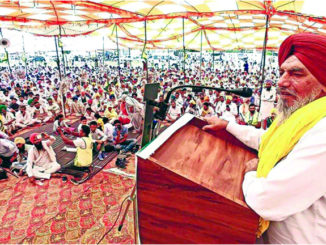
    Farmer unions in Punjab have announced a march towards Delhi on April 21, indicating that the over four-month-long protest is not going to end soon. They said that farmers, activists and women protesters will begin a massive march toward Delhi on April 21. Farmer leaders made the announcement at a Baisakhi Conference called by Bharatiya Kisan Union (Ekta Ugrahan) in Talwandi Sabo of Bathinda. The conference was organised to pay tribute to Jallianwala Bagh martyrs and to mark ‘Khalsa Sajna Diwas’. It was attended by thousands of farmers. The Baisakhi Conference was held at 38 other spots in the state as well in protest against the controversial farm laws. BKU (Ekta Ugrahan) state president Joginder Singh Ugrahan said that the April 21 Delhi march would be led by the union’s state general secretary Sukhdev Singh Kokrikalan and state treasurer Jhanda Singh Jehtuke. He said that the farmers’ protest will continue till they get their rights.

    Citing the example of India’s fight against Britishers, he said that after the Jallianwala Bagh massacre, people fought unitedly rising above caste, creed, religion and the fight against the Narendra Modi government will also be fought unitedly by the farmers, labourers, women and other countrymen.Ugrahan also said that another massive march towards Parliament will be undertaken in May.

    SKM leader Balbir Singh Rajewal said that the protest movement started by the farmers of Punjab had now turned into a nationwide mass movement and people from across the country are supporting it.

    Thousands of farmers have been camping at Delhi’s Singhu, Tikri and Ghazipur border in protest against the newly enacted three farm laws.

    There had been 11 rounds of talks between the Centre and the farmer unions but it did not yield a result. The farmers are demanding a rollback of the three laws while the government is proposing to amend the clauses with which farmers have an issue.

  • Remembering the martyrs of the Jallianwala Bagh Massacre

    Remembering the martyrs of the Jallianwala Bagh Massacre

    On Jallianwala Bagh Massacre anniversary

    • 102 years ago, on April 13, the Vaisakhi Day, General Dyer of the British Government opened fire on peaceful protestors in Jallianwala Bagh in Amritsar, India. Killing 379 Indians, according to official sources.
    • Rabindranath Tagore renounced his knighthood as “a symbolic act of protest”.
    The Jallianwala Bagh in 1919, months after the massacre.
    Jallianwala Bagh well into which people jumped to save themselves from bullets
    British Genocide and Terrorism against unarmed civilians, including women and children.
    Bullet marked wall at Jallianwala Bagh.

    The Jallianwala Bagh massacre, also known as the Amritsar massacre, was a seminal event in the British rule of India. On 13 April 1919, a crowd of non-violent protesters, along with Vaisakhi pilgrims, had gathered in the Jallianwala Bagh garden in Amritsar, P unjab to protest the arrest of two leaders despite a curfew which had been recently declared.

    An hour after the meeting began as scheduled at 16:30, Dyer arrived with a group of sixty-five Gurkha and twenty-five Baluchi soldiers into the Bagh. Fifty of them were armed with .303 Lee-Enfield bolt-action rifles. Dyer had also brought two armored cars armed with machine guns; however, the vehicles were left outside, as they were unable to enter the Bagh through the narrow entrance. The Jallianwala Bagh was surrounded on all sides by houses and buildings and had few narrow entrances. Most of them were kept permanently locked. The main entrance was relatively wide but was guarded heavily by the troops backed by the armored vehicles. The people had no-where to go and were boxed in like caged animals.

    Dyer (without warning the crowd to disperse) blocked the main exits. He explained later that this act “was not to disperse the meeting but to punish the Indians for disobedience.” Dyer ordered his troops to begin shooting toward the densest sections of the crowd to inflict maximum damage. Firing continued for approximately ten minutes. Cease-fire was ordered only when ammunition supplies were almost exhausted, after approximately 1,650 rounds were spent.

    Many people died in stampedes at the narrow gates or by jumping into the solitary well on the compound to escape the shooting. A plaque, placed at the site after independence states that 120 bodies were removed from the well. The wounded could not be moved from where they had fallen, as a curfew was declared, and many more died during the night.

    The number of deaths caused by the shooting is disputed. While the official figure given by the British inquiry into the massacre is 379 deaths, the method used by the inquiry has been subject to criticism. In July 1919, three months after the massacre, officials were tasked with finding who had been killed by inviting inhabitants of the city to volunteer information about those who had died. This information was incomplete due to fear that those who participated would be identified as having been present at the meeting, and some of the dead may not have had close relations in the area. When interviewed by the members of the committee, a senior civil servant in the Punjab admitted that the actual figure could be higher. Since the official figures were probably flawed regarding the size of the crowd (15,000–20,000), the number of rounds shot and the period of shooting, the Indian National Congress instituted a separate inquiry of its own, with conclusions that differed considerably from the Government’s inquiry. The casualty number quoted by the Congress was more than 1,500, with approximately 1,000 being killed. The Government tried to suppress information of the massacre, but news spread in India and widespread outrage ensued. Yet, the details of the massacre did not become known in Britain until December 1919.

    The day after the massacre Kitchin, the Commissioner of Lahore as well as General Dyer, both used threatening language. The following is the English translation of Dyer’s Urdu statement directed at the local residents of Amritsar on the afternoon of 14 April 1919, a day after the Amritsar massacre:

    “You people know well that I am a Sepoy and soldier. Do you want war or peace? If you wish for a war, the Government is prepared for it, and if you want peace, then obey my orders and open all your shops; else I will shoot. For me the battlefield of France or Amritsar is the same. I am a military man and I will go straight. Neither shall I move to the right nor to the left. Speak up, if you want war? In case there is to be peace, my order is to open all shops at once. You people talk against the Government and persons educated in Germany and Bengal talk sedition. I shall report all these. Obey my orders. I do not wish to have anything else.

    I have served in the military for over 30 years. I understand the Indian Sepoy and Sikh people very well. You will have to obey my orders and observe peace. Otherwise, the shops will be opened by force and Rifles. You will have to report to me of the Badmash. I will shoot them. Obey my orders and open shops. Speak up if you want war? You have committed a bad act in killing the English. The revenge will be taken upon you and upon your children.”

    Brigadier Dyer designated the spot where Marcella Sherwood was assaulted sacred and daytime pickets were placed at either end of the street. Anyone wishing to proceed in the street between 6am and 8pm was made to crawl the 200 yards (180 m) on all fours, lying flat on their bellies. The order was not required at night due to a curfew. The order effectively closed the street. The houses did not have any back doors and the inhabitants could not go out without climbing down from their roofs. This order was in effect from 19 April until 25 April 1919. No doctor or supplier was allowed in, resulting in the sick, that were shot, being unattended and left to die in Jallianwala Bagh massacre.

    After General Dyer reported to his superiors that he had been “confronted by a revolutionary army”, Lieutenant-Governor Michael O’Dwyer wrote in a telegram sent to Dyer: “Your action is correct and the Lieutenant Governor approves.” O’Dwyer requested that martial law should be imposed upon Amritsar and other areas, and this was granted by Viceroy Lord Chelmsford.

    Both Secretary of State for War Winston Churchill and former Prime Minister H. H. Asquith however, openly condemned the attack. Churchill referring to it as “monstrous”, while Asquith called it “one of the worst outrages in the whole of our history”.

    Winston Churchill, in the House of Commons debate of 8 July 1920, said, “The crowd was unarmed, except with bludgeons. It was not attacking anybody or anything… When fire had been opened upon it to disperse it, it tried to run away. Pinned up in a narrow place considerably smaller than Trafalgar Square, with hardly any exits, and packed together so that one bullet would drive through three or four bodies, the people ran madly this way and the other.

    When the fire was directed upon the center, they ran to the sides. The fire was then directed to the sides. Many threw themselves down on the ground, the fire was then directed down on the ground. This was continued to 8 to 10 minutes, and it stopped only when the ammunition had reached the point of exhaustion.” After Churchill’s speech in the House of Commons debate, MPs voted 247 to 37 against Dyer and in support of the Government.

    Rabindranath Tagore received the news of the massacre by 22 May 1919. He tried to arrange a protest meeting in Calcutta and finally decided to renounce his knighthood as “a symbolic act of protest”. In the repudiation letter, dated 30 May 1919 and addressed to the Viceroy, Lord Chelmsford, he wrote “I … wish to stand, shorn, of all special distinctions, by the side of those of my countrymen who, for their so-called insignificance, are liable to suffer degradation not fit for human beings” Gupta describes the letter written by Tagore as “historic”. He writes that Tagore “renounced his knighthood in protest against the inhuman cruelty of the British Government to the people of Punjab”, and he quotes Tagore’s letter to the Viceroy “The enormity of the measures taken by the Government in the Punjab for quelling some local disturbances has, with a rude shock, revealed to our minds the helplessness of our position as British subjects in India …

    The very least that I can do for my country is to take all consequences upon myself in giving voice to the protest of the millions of my countrymen, surprised into a dumb anguish of terror. The time has come when badges of honor make our shame glaring in the incongruous context of humiliation…”

    Dyer was met by Lieutenant-General Sir Havelock Hudson, who told him that he was relieved of his command. He was told later by the Commander-in-Chief in India, General Sir Charles Monro, to resign his post and that he would not be reemployed.

    The British Lieutenant-Governor of Punjab, Michael O’Dwyerdied the kind of death he had brought upon many on April 13, 1921.

    On 13 March 1940, at Caxton Hall in London, Udham Singh, an Indian independence activist from Sunam who had witnessed the events in Amritsar and was himself wounded, shot and killed Michael O’Dwyer, the British Lieutenant-Governor of Punjab at the time of the massacre, who had approved Dyer’s action and was believed to be the main planner. Dyer himself had died earlier in 1927. We pay our tribute to those who lost their lives in Jallianwala massacre, and salute Udham Singh who avenged their death. A nation is known by its heroes and martyrs

    (With inputs from DiscoverSikhism.com and Center For Pluralism)