Tag: Jat quota violence

  • CBI to probe three cases of Jat quota violence in Haryana

    CBI to probe three cases of Jat quota violence in Haryana

    NEW DELHI (TIP): The CBI registered three cases on Thursday to probe incidents of violence and arson during the Jat quota agitation in Rohtak in February.

    This is the first instance of the agency formally taking over the probe in a case related to the quota violence.

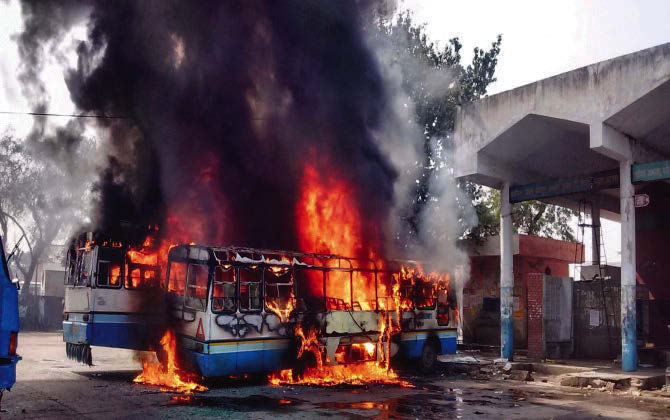
    Two of the three cases pertain to violence and arson at the residence of Haryana’s finance minister Captain Abhimanyu in Rohtak that was the hotbed of the agitation.

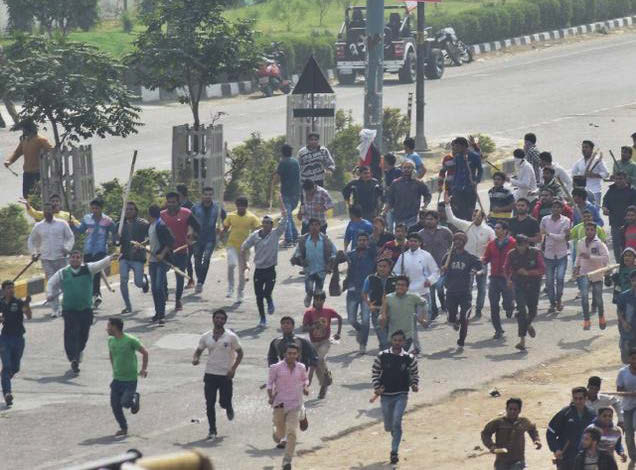
    “The third case relates to allegations of looting of weapons by thousands of armed rioters from a company of BSF and Haryana police and attempting to murder them while they were on law and order duty at the Delhi bypass in Rohtak,” said the Central Bureau of Investigation (CBI)’s spokesperson Devpreet Singh.

    The FIRs have been filed at the agency’s Chandigarh branch.

    Only one of the three FIRs, pertaining to arson at Captain Abhimanyu’s residence, has around 40 persons named as accused.

    The remaining are against unknown persons.

    The spokesperson said the CBI took over the investigation on the request of the Ha ryana government and further orders from the department of personnel and training.

    A total of 2,104 FIRs, including one for alleged gang rapes in Murthal, were registered in connection with the Jat quota violence and 701 people were arrested.

    “A large number of persons were allegedly injured and some of them grievously in these violent attacks. It was further alleged that property worth crores of rupees was burnt and weapons of police guards were looted by the agitators,” said the spokesperson.

    During a hearing on a petition with regard to violence during the agitation, the Punjab and Haryana high court had hinted last month that it may hand over all cases registered by the state police to the CBI.

  • HC stays reservation for Jats

    HC stays reservation for Jats

    CHANDIGARH (TIP): In what is seen as a setback for the Khattar government in Haryana, the Punjab and Haryana High Court here on Thursday stayed the reservation granted by the state government to Jats and five other communities.

    Reservation was granted to these communities under a new category of Backward Class (C). Under this, six communities — Jats, Jat Sikhs, Muslim Jats, Bishnois, Rors and Tyagis — are entitled to 10% quota in government jobs and admission to educational institutions.

    The government had passed a bill on providing quota in jobs and educational institutions to these categories in the state Assembly on March 29. The government succumbed to fierce agitation launched by members of the community, who paralysed rail and road network for nearly nine days over the reservation issue, leaving 31 people dead and 320 injured.

    On Thursday, the court issued a notice to the government on a petition filed by one M L Gupta of Bhiwani, who challenged the constitutionality of the newly enacted bill – The Haryana Backward Classes (reservation in services and admission in educational institutions) Act, 2016. The petitioner said that reservation for these communities was provided under the new act on the basis of the Justice K C Gupta commission report, which has already been quashed by the Supreme Court.

    The petitioner said providing reservation on the basis of the Gupta commission will amount to the revision of a judicial order, which the legislature cannot undertake. Also, only the judiciary can review the findings on an issue already decided in a judicial order. The petition also states that in 2014, the state government under Bhupinder Singh Hooda had introduced a bill to include Jats in the list of Other Backward Classes for reservation in jobs and educational institutes. But the apex court had held that Jats are not socially, educationally and politically backward, and had quashed the decision to grant reservation.

  • Jat stir: Haryana govt ‘ignored’ alerts on possible violence

    Jat stir: Haryana govt ‘ignored’ alerts on possible violence

    NEW DELHI (TIP): More than 100 intelligence alerts were allegedly ignored by the Haryana government since June last year, leading to large-scale violence in February during a fortnight-long agitation by Jats seeking reservation in government jobs, multiple sources said.

    The fresh revelations come before a one-member commission of former IPS officer Prakash Singh submits its report — likely by April-end — on alleged lapses by police and civil officials during the Jat stir. Singh had said this week that police inaction during the initial days of the agitation was “deliberate”.

    The violent quota agitation by the community that constitutes 26% of the state’s 2.64-crore population left at least 30 people dead and more than 320 injured. Besides, property worth crores of rupees was damaged in arson during the agitation that left the state paralysed for nearly two weeks.

    The state government last month approved a bill for providing reservation to Jats by including them under a newly-created backward class category.

    The government on Tuesday shunted out director general of police (DGP) Yashpal Singal for alleged failure to anticipate the violence despite intelligence inputs. Additional DGP of CID Shatrujeet Singh Kapur was transferred to crime branch. By the end of February, IGP (Rohtak range) Shrikant Jadhav, along with two DSPs posted in Rohtak, were suspended for alleged lapses.

  • HARYANA ASSEMBLY PASSES JAT QUOTA BILL

    HARYANA ASSEMBLY PASSES JAT QUOTA BILL

    CHANDIGARH (TIP): The Haryana Assembly  passed the Haryana Backward Classes (Reservation in Services and Admission in Educational Institutions) Bill, 2016 to provide reservation for Jats and four other communities in government jobs and education.

    Haryana Chief Minister Manohar Lal Khattar moved the Bill in the House to give statutory status to Backward classes Block ‘A’, Backward classes Block ‘B’ and Backward classes Block ‘C’ — by enacting the Haryana Backward Classes (Reservation in Services and Admission in Educational Institutions) Act, 2016 and requested the Central government to include this Act in 9th Schedule read with Article 31B of the Constitution of India.

    It may be recalled that the Chief Minister had promised reservation for the Jat community and others that included Jat Sikhs, Rors, Bishnois and Tyagis, by bringing a Bill during the ongoing Budget Assembly session, following a violent Jat agitation that had left the State paralysed for over ten days in February 2016.

    The press communication issued by the government said the Bill provides for increase in percentage of reservation in Schedule I, II and III for Class I and II posts for BC ‘A’, BC ‘B’ and BC ‘C’ from 10 per cent, five per cent and five per cent to 11 per cent, six per cent and six per cent respectively.

    It was also ecided to increase the existing reservation of five per cent for Economically Backward Persons in General Caste Category in Class I and II posts from five per cent to seven per cent.

    The Bill states that notwithstanding anything contained in this Act, the state government may provide horizontal reservation for such category or categories of persons within Backward Classes, as it may deem necessary from time to time.

    After analysing the Justice (Retd.) K.C. Gupta Commission report (the Commission that was set-up to entertain, examine and recommend upon requests for inclusion and exclusion of castes in the list of backward classes), the state government is satisfied that the report of the Commission is based on quantifiable data and strong evidences, which indicates that not only the five
    castes/classes — Jat, Jat Sikh, Ror, Bishnoi and Tyagi are backward classes socially and educationally, but they also comply with all legal norms suggested in Indra Sawhney’s (CWP 930 of 1990) case, which has made it imperative for the state to provide these castes/classes ten percent reservation in relaxation of general rule of 50 percent in terms of paragraph 810 of the Indra Sawhney’s case.

    Notably, reservation in Haryana has already touched the 50 per cent threshold as prescribed by the Supreme Court of India, however the case law established by Indra Sawhney’s case does not limit the powers for providing reservation to classes by the executive or legislative Branches.

    As per the judgement, reservation should not “exceed 50 per cent of the appointments in a grade, cadre or service in any particular year. It is only for extraordinary reasons that this percentage may be exceeded.” However, every excess over 50 per cent will have to be justified on valid grounds which will have to be specifically made out, said the government statement.

  • Jat quota agitation: Ex-Haryana CM Hooda’s aide arrested

    Jat quota agitation: Ex-Haryana CM Hooda’s aide arrested

    ROHTAK (TIP): Former Haryana chief minister Bhupinder Singh Hooda’s close assistant Virender Singh, who was booked for sedition and criminal conspiracy on charges of inciting violence during the Jat agitation, was arrested on March 17, police said.

    “We have arrested Virender Singh. He will be produced before court and we will be seeking his custodial interrogation,” Rohtak superintendent of police Shashank Anand said.

    Singh was political adviser to Hooda during his 10-year tenure as chief minister. He, however, claimed before reporters that he had voluntarily surrendered at the SP’s office.

    “I am a law abiding citizen. I have not done anything wrong and the truth will come out,” he said.

    The arrest came after the Rohtak district court on Tuesday denied him anticipatory bail.

    Singh along with others was booked last month under various sections of the IPC, including sedition, after an audio clip surfaced in which he was purportedly heard talking to a khap leader in order to allegedly incite violence during the Jat community’s reservation stir.

  • Jat quota stir: Tense calm as Haryana limps back to normal

    Jat quota stir: Tense calm as Haryana limps back to normal

    ROHTAK (TIP): Haryana saw a tense calm as Jats seeking job quotas withdrew from the streets or were chased away on February 24. Highway and rail traffic was restored even as security forces were on alert to foil clashes between Jats and non-Jats.

    More on “JAT QUOTA PROTESTS HARYANA – INDIA”

    Jat quota stir- Tense calmIn a sign of people’s anger over the mindless violence that rocked the state, Haryana Chief Minister Manohar Lal Khattar faced angry traders and residents in Rohtak town and was forced to retreat and leave for Delhi.

    [td_block_trending_now style=”style2″ tag_slug=”JAT QUOTA PROTESTS HARYANA – INDIA”]

    Khattar, who reached Rohtak for the first time after widespread violence during the Jat agitation devastated many parts of the town, vowed not to spare those guilty of rioting and arson that crippled Haryana.

    Charred vehicles pile up in Rohtak.
    Charred vehicles pile up in Rohtak.

    “A high-level probe will be conducted into the (violence) and strict action taken against officers and employees of police and administration involved in this,” Khattar told the media in Rohtak.

    In a fine balancing act, he said the Jat community will get job quotas under a special provision and the OBC quota of 27 percent won’t be disturbed. The OBC communities don’t want Jats to be included in the OBC bracket.

    “The government will make a separate provision for (Jats) reservation,” said a stern-looking Khattar, whose government has drawn widespread flak for failing to contain the frenzy on the streets.

    In New Delhi, Khattar attended a meeting with union Parliamentary Affairs Minister M. Venkiaih Naidu and other ministers who are part of a high-powered panel studying the issue of reservation for Jats in other states.

    Nineteen people were killed and nearly 200 injured in the nine days when Jats held Haryana to ransom, and in the process disrupted life in large parts of northern India.

    As Monday was a holiday on account of Sant Ravidas Jayanti, Tuesday was the first working day after the Jat agitation. Most schools were, however, shut.

    Traffic was restored on the busy Delhi-Ambala national highway (NH-1) after three days. Three people were killed when Jat protesters blocked the highway on Monday, forcing security forces to open fire.

    Traffic was also restored on the Delhi-Hisar NH-10, especially near Sampla town, police said.

    Curfew was relaxed in Rohtak town and some other places. Some villages and towns were tense as some members of Jat and non-Jat communities headed for a clash on Monday.

    The worst affected districts in the Jat agitation were Rohtak, Bhiwani, Hisar, Sonipat, Jhajjar, Jind, Panipat and Kaithal.

    The government has an ex-gratia of Rs.10 lakh to the next of kin of the innocents killed in the agitation and employment to a member of the family of the deceased. The PHD Chamber of Commerce and Industry has pegged the loss to Haryana and other states due to the violence at Rs.34,000 crore.

    More on “JAT QUOTA PROTESTS HARYANA – INDIA”

    The India-Pakistan train and bus services, which pass through Haryana, are expected to resume operations on Thursday. Referring to an audio clip in which a close aide of a Congress leader is heard inciting people to indulge in violence, Khattar said those who damaged property would be identified and strict action taken against them.

    The government has promised to compensate those who lost property in the agitation.

    The chief minister said ‘dharnas’ across the state had been lifted and blockades on all roads cleared.

    [td_block_trending_now style=”style2″ tag_slug=”JAT QUOTA PROTESTS HARYANA – INDIA”]

    Earlier, Khattar was shown black flags by a section of traders and residents who raised slogans against him and questioned his government’s failure to deal with the Jat agitation.

    The Punjab and Haryana High Court on Tuesday directed the Haryana government to submit a status report on the Jat agitation by next Monday.

    The Jat community wants reservation under the OBC category in government jobs and educational institutions.

    Source: IANS

  • HC seeks report on alleged Murthal rapes during Jat stir

    HC seeks report on alleged Murthal rapes during Jat stir

    CHANDIGARH (TIP): Days after allegations of women being molested during the Jat agitation, the Punjab and Haryana High Court has asked Haryana DGP and Chief Secretary to file a report in the matter. The High Court took suo motto cognizance of the issue. Reports had emerged that women passengers were raped near Murthal in Sonipat during the Jat agitation.

  • RAIL-ROAD TRAFFIC HIT AS JAT QUOTA STIR CONTINUES IN HARYANA

    RAIL-ROAD TRAFFIC HIT AS JAT QUOTA STIR CONTINUES IN HARYANA

    ROHTAK (TIP):Jat protests have disrupted road and rail traffic with the worst hit being the Rohtak-Jhajjar, the epicentre of the protests, besides Bhiwani, Sonipat and Hisar.

    Trucks have been stranded near Rohtak bypass as the agitation continues.

    Earlier, authorities blocked mobile internet services in two Haryana districts as a Jat quota agitation turned violent overnight and crippled normal life across large parts of the state which struggled to maintain supply of essential commodities for the past five days.

    Chief minister Manohar Lal Khattar called an all-party meeting on Friday to discuss the issue after Jat leaders vowed to continue the agitation till the government provided them reservation under the other backward classes (OBC) category. Khattar also convened an emergency cabinet meeting on Thursday night to review the situation in the wake of the agitation by the community which constitutes nearly 30% of the state’s population.

    INTERNET SERVICES BLOCKED IN JHAJJAR, ROHTAK

    Officials said mobile internet services have been blocked in Jhajjar and Rohtak in the Jat heartland which saw violence on Thursday when protesters clashed and pelted stones on police trying to evict them after imposition of prohibitory orders in four districts.

    They said the move was aimed at preventing spread of rumours which could add fuel to the already tense situation. The agitation also spread to northern Haryana districts of Kurukshetra and Yamunanagar.

    Two lawyers were injured and two motorcycles were set afire in a clash between members of the Punjabi community and lawyers supporting Jat protesters outside the Rohtak district court. The district administration has declared holiday in all educational institutions of Rohtak till February 21.

    The agitation by Jats has crippled life despite the state government assuring them to include them in quota for economically backward persons (EBP) of general castes and also increasing the EBP quota from 10% to 20%.Agriculture minister Om Prakash Dhankar said after the Cabinet meeting that supply of essential commodities such as cooking gas and petrol has been affected.

    “Our fuel trucks have not reached us for the past four days and soon we will be out of stock. It will add to the woes of the people,” said an employee of a fuel pump on Delhi road in Rohtak.

    90 FUEL DEPOTS DECLARED DRIED

    The All Haryana Petroleum Dealers’ Association vice-president Bhushan Goel said out of 102 fuel depots in Rohtak more than 90 have already been declared dried and remaining may go out of stock if the agitation lasts for one more day. The agitation has also affected crushing operations of the co-operative sugar mills in Jat-dominated areas of Rohtak, Meham, Gohana and Sonepat. While all state and national highways had been blocked in Rohtak, Sonepat and Jhajjar districts for the past four days, Jat protesters blocked the Bahadurgarh-Delhi road at Bahadurgarh and Najafgarh of Jhajjar district, affecting traffic movement to Delhi from Haryana on Thursday. Bus services continued to be suspended in Jind, Rohtak, Narwana, Hisar, Jhajjar, Sonepat districts.


  • QUOTA CAULDRON: ANGER IN JATLAND

    QUOTA CAULDRON: ANGER IN JATLAND

    Why Jats are protesting now?

    It’s a double whammy for them. The Punjab and Haryana high court on July 27 last year stayed the decision of the state government to grant 10 % quota to Jats and four other castes — Jat-Sikh, Bishnoi, Ror and Tyagi — under the special backward class (SBC) category. Earlier, the apex court on March 17, 2015, had quashed the decision of the Congress-led UPA government at the Centre to provide reservation to Jats under other backward classes (OBC) of the central government.

    How Jats were included in Centre’s OBC list in 2014?

    While the National Commission for Backward Classes (NCBC) had rejected the demand to include the Jats in the OBC central list, the UPA cabinet overruled its recommendation to include Jats of Haryana, Himachal Pradesh, NCT of Delhi, Uttar Pradesh, Uttarakhand Bihar, Gujarat, Madhya Pradesh and Bharatpur and Dholpur districts of Rajasthan in the OBC list.

    How Jats, 4 other castes were granted quota by Haryana?

    The previous Congress regime re-constituted the Haryana Backward Classes Commission (HBCC) to look into the quota demands of Jats, Jat Sikhs, Rors, Tyagis and Bishnois. The HBCC recommended 10% quota for five castes under the SBC category, which was implemented by the Congress regime. This took the reservation to 57% in the state.

    Whether any other castes were also given quota in 2013?

    Soon after granting SBC quota to Jats and four other castes, the previous regime also gave 10% reservation to economically backward persons (EBP) of general castes such as Brahmins, Rajput, Punjabi, Aggarwals etc. The total annual income to qualify for the EBP quota was fixed at ` 2.5 lakh. With this, the reservation reached 67% in Haryana.

    Was 10% quota under SBC and EPB categories legally tenable?

    No. The Supreme Court in its 1992 judgment in the Indra Sawhney case has held that reservation contemplated in clause 4 of Article 16 of Constitution should not exceed 50 %. Article 16 provides for equality of opportunity in matters of public employment.

    What does inclusion of Jats and 4 other castes in EBP quota entail?

    While under 10% SBC quota five castes-Jats, Jat Sikhs, Rors, Bishnois and Tyagis — competed with each other for jobs and admissions in educational institutions, the inclusion in 20% economically backward persons quota for general castes will mean more competition with other castes thus reducing their chances considerably

    What was SC/BC quota in jobs, education institutes before 2013?

    It was 47%. For SCs, the quota was 20% and for BCs it was 27%.

    Was there a bifurcation in percentage of quota for BCs?

    The reservation for BCs was bifurcated into two blocks- A & B. For block A —having 71 castes — the reservation was 16%. For block B — having five castes, Ahir, Gujjar, Lodh/Lodha, Saini and Meos — the quota was 11%.

  • Centre files review plea in SC over Jat quota verdict

    Centre files review plea in SC over Jat quota verdict

    NEW DELHI: (TIP): Compelled by electoral politics, the BJP-led NDA government has filed a review petition in the Supreme Court pleading for its nod to extend reservation to Jats in education and jobs under the Other Backward Classes (OBCs) category which enjoyed a 27% quota.

    The review petition comes in the wake of a Jat delegation’s meeting with PM Narendra Modi following the SC ruling The government’s move has come within a fortnight of the SC verdict on March 17 striking down the Centre’s March 2014 notification that had put Jats on the OBC list meant for 9 states —Haryana, HP, Uttarakhand, UP, Delhi, Bihar, Gujarat, MP and Rajasthan (Bharatpur and Dholpur districts).

    Only two days ago, the SC had reiterated its ruling by refusing to entertain a petition filed by Jat doctors pleading for exempting the admissions for the 2015-16 academic session from the purview of the judgment. The doctors, who had applied for post graduation medical courses under the OBC quota, had argued that since the admission process had begun much before the SC verdict, the quota for Jats should be retained at least for one more year. In the review petition, the government said the decision to include Jats in the OBC list was in consonance with the SC verdict in the OBC quota issue in the backdrop of the Mandal Commission report.

    All nine states had already included Jats in their OBC lists and had pleaded with the Centre to put them on the Central list as well.

    While the UPA government had extended the OBC quota to Jats on the eve of the 2014 LS elections, the Modi government supported this decision in the SC ahead of the Haryana Assembly polls last year.

  • Cabinet clears Jat reservation, drops Rahul’s anti-graft ordinances

    Cabinet clears Jat reservation, drops Rahul’s anti-graft ordinances

    NEW DELHI (TIP):
    The Union Cabinet cleared the ordinance for Jat reservation in government jobs. The anti-graft ordinances, which were pushed by Congress vice-president Rahul Gandhi, were not passed after President Pranab Mukherjee reportedly expressed reluctance to support government’s ordinance route. Ahead of Lok Sabha polls, the government decided to include the Jat community in the central list of OBCs in nine states, a move that is expected to benefit about nine crore people from the community. The decision would pave the way for the community members to avail benefits of reservation in central government jobs and central education institutions as per the existing norms.

    The Central list of OBCs for the states of Bihar, Gujarat, Haryana, Himachal Pradesh, Madhya pradesh, Rajasthan, Uttarrakhand, Uttar Pradesh and the National capital territory of Delhi will include the Jat community. On the other hand, after President Pranab Mukherjee’s reluctance over the seven anti-graft bills, the government decided not to bring ordinances. Earlier, Senior Congress leaders had met the President just before the crucial meeting. On the Telangana front, the Cabinet decided to direct Planning Commission to implement grant of special category status to Seemandhra for 5 years. The Cabinet also decided to make amendments in Andhra Pradesh Reorganisation Bill to facilitate smooth and full resettlement and rehabilitation as part of Polavaram project. Polvarum project will be executed by Central Government.

    Both the submerged area and the area where the people will be relocated, will be transferred to Seemandhra. The Union Cabinet also tried to address the concerns regarding electricity supply in the states. Congress leader Jairam Ramesh informed that the power from central generating stations will be allocated on the basis of consumption of last 5 years. He said the Telangana Bill says that only 15 per cent of unallocated power will be allocated on the basis of power consumption trends.

    The rest will be allocated on the basis of population. The Cabinet also approved transfer of 123 properties in Delhi under DDA and Land and Development Department to Wakf Board. Defending the ordinance recourse to pass the pending bills, information and broadcasting minister Manish Tiwari blamed the Opposition for disrupting Parliament. “We believe probity is public life. UPA endeavoured during various sessions bills are passed but disruptions by opposition did not allow them to be deliberated in Parliament or enacted as laws. There was a marked difference between what Opposition said and did on the issue,” he said.

  • Jats to Review Delhi March Schedule

    Jats to Review Delhi March Schedule

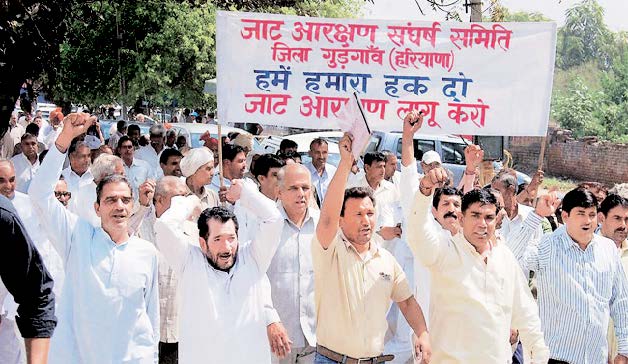
    ROHTAK (TIP): In the wake of Haryana government’s favourable disposition towards the backward classes commission recommendations, that 10% reservation be provided for Jats and four other castes ( Bishnois, Jat Sikhs, Rors and Tyagis) in the state as well as Union government jobs by including them in the OBC list, the Jat groups are having second thoughts about their scheduled march to Delhi on December 16.

    The Jat organizations, including the Sarv Khap Jat Mahapanchayat, will hold a meeting in Danoda Kalan village of Jind district to take a decision in the wake of the recent development. The khap panchayats of Rohtak region would congregate in Rohtak. It is also learnt that the state government has invited khap representatives to hold talks with the chief minister sometime in the next few days. “Efforts are underway to soothe the agitated Jat groups which are gearing up to resume the stir from December 16. While a section of Jat leaders has accepted the state government’s move, another section is eager to go ahead with the stir,” said a Jat leader.

    Hawa Singh Sangwan, president of All India Jat Arakshan Sangharsh Samiti, who has been at the forefront of agitation, said, “Now, since the commission has recommended reservation for Jats, the decision on agitation should be reviewed.” The leaders of Hooda, Gathwala, Dahiya, Dhankar, Sangwan and Kadian khaps, which are based in old Rohtak region – the stronghold of Haryana chief minister Bhupinder Singh Hooda — too have softened their stand.