NEW YORK CITY (TIP): The Consulate General of India on Thursday, December 26, paid rich tributes to the younger Sahibzadas of Guru Gobind Singh—Sahibzada Zorawar Singh and Sahibzada Fateh Singh—who were bricked alive on the orders of the Mughal governor of Sirhind for refusing to renounce their faith and convert to Islam. The solemn commemoration was held as part of Veer Bal Divas, a day declared by the Government of India to honor the extraordinary courage, sacrifice, and moral fortitude of the Sahibzadas.
Group photo of the participants with Consul General, Binaya Pradhan, at Veer Baal Diwas photo exhibit organized by the Indian Consulate in New York City. (Photo : Jay Mandal/On Assignment)
Continuing its tradition of commemorating the supreme sacrifice of the Sahibzadas through art and culture, the Consulate General of India once again organized a photo exhibition depicting the martyrdom of the Sahibzadas of Guru Gobind Singh as part of the Veer Bal Divas observances this year.
Young visitors to the Veer Bal Divas speak with Prof. Indrajit Saluja, Chief Editor of The Indian Panorama (Photo : Jay Mandal/On Assignment)
The exhibition showcased a poignant collection of paintings portraying the courage, steadfast faith, and ultimate sacrifice of the younger Sahibzadas—Sahibzada Zorawar Singh and Sahibzada Fateh Singh—who were bricked alive at Sirhind for refusing to convert to Islam. The artworks, rendered in diverse styles, vividly captured the historical tragedy as well as the timeless values of bravery, sacrifice, and resistance to oppression.
The exhibition drew a steady stream of visitors from the Indian diaspora and the wider community. Among the prominent visitors was the Gatka team led by Sardar Daler Singh, whose presence underscored the living martial and spiritual traditions inspired by Sikh history. Members of the Gatka team spent considerable time viewing the artworks and interacting with organizers, appreciating the role of visual art in educating younger generations about the legacy of the Sahibzadas.
Consulate officials noted that exhibitions such as these serve as a powerful medium to connect history with contemporary audiences, especially youth born and raised overseas. “Through paintings, history speaks directly to the heart,” an official observed, adding that the annual exhibition has become an integral part of the Consulate’s Veer Bal Divas programming.
Veer Baal Diwas photo exhibit organized at the Indian Consulate in New York City. (Photo : Jay Mandal/On Assignment)
Visitors described the exhibition as moving and educative, praising the Consulate’s effort to blend remembrance with cultural outreach. The exhibition reinforced the message that the sacrifice of the Sahibzadas remains a universal symbol of moral courage, religious freedom, and the triumph of conscience over coercion.
Speaking on the occasion, Consul General of India in New York, Ambassador Binaya Srikanta Pradhan recalled the defining moment in Sikh history when the two young sons of Guru Gobind Singh chose death over submission, standing firm in their beliefs despite severe coercion. “Their martyrdom is not merely a Sikh legacy; it is a universal testament to courage, conscience, and the inviolable right to faith,” he said, adding that Veer Bal Divas is observed to inspire younger generations to uphold ethical values and moral courage in the face of injustice.
Consul, Community Affairs, Tsewang Gyaltson welcomed the visitors to the photo exhibition and answered their questions about the photo exhibits.
Addressing the gathering, a former President of Gurdwara Baba Makhan Shah Lobana in New York, Sardar Daler Singh movingly narrated the inspiring story of the Sahibzadas, highlighting their exceptional courage, unwavering faith, and fearless defiance of oppression despite their tender age. He said the martyrdom of Sahibzada Zorawar Singh and Sahibzada Fateh Singh remains one of the most powerful examples of moral strength and spiritual resilience in world history, and continues to inspire generations of Sikhs to stand by truth and righteousness.
A particularly heartening aspect of the event was the enthusiastic participation of young boys and girls who had accompanied Sardar Daler Singh. Several of them engaged in thoughtful interaction with Prof. Indrajit Singh Saluja, Chief Editor of The Indian Panorama, sharing their understanding of the martyrdom of the Sahibzadas and reflecting on the lessons of bravery, sacrifice, and faith they had drawn from the exhibition and the narrations.
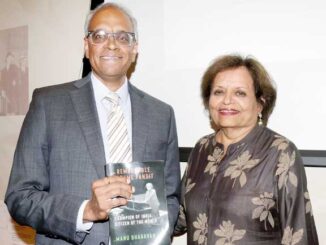
MANHATTAN, NY (TIP): Manu Bhagavan, the Hunter College professor and historian whose new biography, The Remarkable Madame Pandit: Champion of India, Citizen of the World, has drawn attention for its archival depth, appeared at Roosevelt House on the evening of September 16 for a moderated conversation with Vishakha Desai, President Emerita of the Asia Society. The program, hosted by the Roosevelt House Human Rights Program, brought together students, scholars, and New York’s South Asian community for a discussion of Pandit’s life and legacy, followed by a reception and book signing.
Manu Bhagavan (left) is seen at a book signing session. Also in the picture is Gita Sahgal (right, in a white outfit), the granddaughter of Vijaya Lakshmi Pandit.Manu Bhagavan delivers a speech at his book launch event.
Bhagavan framed Pandit’s life as a bridge between Indian nationalism and mid-20th-century internationalism, emphasizing her early role in the independence movement, her service in India’s early cabinets, and her pioneering diplomatic career that culminated in her election as President of the UN General Assembly. The event description and publisher materials highlight Bhagavan’s use of international archives to complicate familiar narratives about Pandit — portraying her not simply as a first or a symbol, but as a sophisticated practitioner of public diplomacy who engaged major institutions and leaders across the globe. Desai steered the conversation toward two recurring themes: the gendered obstacles Pandit faced while operating in predominantly male institutions, and the tension between her global commitments and domestic political currents in India. According to the event brief and the moderator’s professional interests, Desai probed how Pandit negotiated authority and visibility — how she used family connections and political networks while also crafting an independent international voice. These topics, visible in the event synopsis and promotional text, animated much of the discussion.
Manu Bhagavan and Vishakha Desai engage in a conversation.
Bhagavan illustrated his points with archival anecdotes and interpretive reframing (as summarized in promotional material): instances of Pandit’s decisive interventions at the United Nations, episodes that reveal her readiness to confront colonial and authoritarian power, and episodes of political fallout at home. While the program listing does not publish direct quotes, social posts from the day indicate a lively exchange and a full house, suggesting the material resonated strongly with the audience.
During the conversation, Bhagavan also explained how Madame Pandit spoke out against her niece, then Prime Minister Indira Gandhi, for imposing the national Emergency in 1975 and jailing opposition political leaders — a rare act of defiance within the Nehru-Gandhi family that underscored Pandit’s independence of judgment and commitment to democratic values.
The audience attentively listens to the conversation between Manu Bhagavan and Vishakha Desai at the Roosevelt House in New York City.
Audience reaction after the talk was enthusiastic. Social media posts and short video clips from the event show a standing-room crowd and a well-attended reception and signing immediately after the conversation, evidence that the book launch drew sustained interest from both academic and public audiences in New York.
The highlight of the evening was the presence of Ms Gita Sahgal, Madame Pandit’s granddaughter (her daughter’s daughter), who also spoke briefly at the event. Adding to the sense of history, the program featured a display of the original sari that Madame Pandit famously wore on significant public occasions.
One of the displayed saris that Madame Pandit famously wore on significant public occasions. (Photos: Jay Mandal/On Assignment)
Bhagavan’s biography arrives as scholars and policy practitioners revisit mid-20th-century diplomacy and the role of women in shaping international institutions. The Roosevelt House conversation positioned Pandit as relevant to contemporary debates about gender and diplomacy, postcolonial leadership, and the moral stakes of international engagement, themes that the author and moderator highlighted as central to Pandit’s continuing relevance.
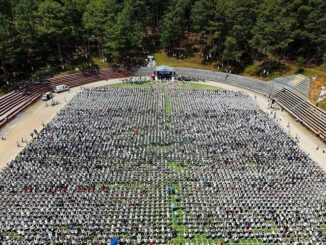
SAN PEDROCARCHA (TIP): In a landmark moment for India-Guatemala relations and the global Yoga movement, the Embassy of India in Guatemala, on behalf of the Indian Council of Cultural Relations (ICCR), in collaboration with the Municipality of San Pedro Carchá, the Association of Don Bosco Center, and with the strong support of the Governor of Alta Verapaz, Ms. Dilia Margarita Co Coy, hosted the largest International Day of Yoga celebration in the region, perhaps ever held outside India, on 13 June 2025 in San Pedro Carcha, Coban, Guatemala. This mega event drew an unprecedented gathering of over 10,000 yoga enthusiasts, making it a day of pride for Guatemala and a historic milestone in the global promotion of Yoga. To build momentum ahead of June 13, the Embassy had also organized two separate & well-received Yoga sessions in Izabal (550 participants) and the Municipality of Chalal (1,500 participants) on 11th June, 2025, demonstrating Yoga’s growing reach in Guatemala’s interior regions.
Harmony in Motion: Ms. Ruth Morales, Embassy Yoga teacher, leads a powerful Yoga session with the theme “Yoga for One Earth, One Health”, with 10,000 participants. (Photo: Courtesy Baldev Singh Grewal)
The celebration witnessed the full support and partnership of key local institutions, including the Ministry of Education, Ministry of Defense, Municipality of San Pedro Carcha, Associations of Don Bosco Center, Talita Kumu and numerous Indian companies like, HCL Tech, TCS, Grupo Uma, Caplin Point, 24X7 a.i., Lukham Pharma, Krishper Healthcare S.A., Strikar Pharma, Grupo Karims, Lakshmi Capital, Pradilsha, Khushi Enterprizes, Grupo Uma and Sierra Textiles operating in Guatemala. Their involvement was instrumental in ensuring the success of the event, from mobilization to logistics and outreach. Notably, the youth were at the heart of the celebration, with over 10,000 students from educational institutions across the region forming the core of the audience—testament to Yoga’s growing appeal among Guatemala’s next generation.
This achievement was not a one-off event but the result of sustained efforts over the past four years by the Embassy of India to promote Yoga across Guatemala. Starting with 2,500 participants in 2022 at Mariscal Zavala, the numbers steadily grew to 3,500 in 2023 and reached 5,000 in 2024. With more than 10,000 participants this year in San Pedro Carcha, Guatemala has now entered the elite global league of countries championing Yoga with unmatched enthusiasm and commitment. These celebrations have helped bring Yoga to the remotest corners of the country, particularly through youth-focused outreach programs, free workshops, and community-based events.
The grand event began with a one-minute silence in memory of the 274 lives lost in the tragic airplane crash in Ahmedabad, India on 12 June 2025. The dignitaries present, including local Guatemalan leaders, expressed their heartfelt condolences and solidarity with the people of India.
Don Bosco Center Music Band Symphony Orchestra- Music School-Art and Culture, Carcha playing the national anthem of India (Photo: Jay Mandal-on assignment)
The solemn atmosphere was followed by a moving performance of the national anthems of Guatemala, India, and the Municipality of San Pedro Carchá, performed by Don Bosco Center Music Band Symphony Orchestra- Music School-Art and Culture, Carcha.
The event was officially opened by Mr. Erwin Alfonso Catún Maquin, Mayor of San Pedro Carchá, who warmly welcomed the gathering. Remarks were delivered by Governor of Alta Verapaz, Ms. Dilia Margarita Co Coy, representatives of the Don Bosco Association and Ambassador of India to Guatemala Dr. Manoj Kumar Mohapatra, who emphasized the significance of Yoga as a universal tool for peace and wellbeing. The Ambassador also ceremoniously presented three busts of Mahatma Gandhi to Don Bosco institutions, symbolizing India’s enduring message of peace and nonviolence. In recognition of outstanding contributions, commemorative plaques were presented to key sponsors, municipal leaders, and Indian companies who helped make the event a reality.
Ambassador Dr. Manoj Kumar Mohapatra delivers his remarks, thanking all stakeholders , and highlighting Guatemala’s emergence as a global beacon of Yoga. (Photo: Courtesy Embassy of India in Guatemala)
In his heartfelt address at the International Day of Yoga (IDY2025) celebration in San Pedro Carchá on June 13, 2025, Ambassador Dr. Manoj Kumar Mohapatra expressed profound gratitude to all stakeholders, including ICCR, for their pivotal role in making the event the largest yoga gathering outside India, with more than 10,000 participants. He extended special thanks to the Municipality of San Pedro Carchá, led by Mayor Lic. Erwin Alfonso Catún Maquín, for their unwavering commitment and logistical support, which ensured the event’s monumental success. He also lauded the Association of Don Bosco for their enthusiastic partnership, noting their dedication to youth engagement, which saw a significant turnout of young participants. Ambassador Mohapatra commended the Ministry of Defense for their exceptional efforts in mobilizing such a massive crowd, ensuring safety and coordination, and acknowledged the invaluable contributions of local vendors who provided seamless transport, nutritious food, and essential logistics, including t-shirts for participants, fostering an inclusive and festive atmosphere.
On the occasion, Ambassador Dr. Manoj Kumar Mohapatra honored Governor of Alta Verapaz, Ms. Dilia Margarita Co Coy, San Pedro Carchá Mayor Lic. Erwin Alfonso Catún Maquín, and Father Antonio de Groot, General Director of the Don Bosco Center Association for their unwavering commitment and logistical support, which ensured the event’s monumental success. A few others, including sponsors received the Ambassador’s appreciation and gratitude.
The Indian Panorama Publisher and Editor presents a replica of the Golden Temple to Ambassador Manoj Kumar Mohapatra. Seen in the picture, from L to R: Ms. Carcha, Baby Carcha, Prof. Indrajit Saluja, Governor of Alta Verapaz, Ms. Dilia Margarita Co Coy, San Pedro Mayor Lic. Erwin Alfonso Catún Maquín, Ambassador Dr. Manoj Kumar Mohapatra, and Baldev Singh Grewal (Photo: Jay Mandal-on assignment)
Prof. Indrajit S Saluja, Publisher and Editor of The Indian Panorama, a premier Digital weekly newspaper published from New York who participated in the Yoga session, honored Ambassador Manoj Kumar Mohapatra for successfully organizing the historic Yoga session, with the replica of the Golden Temple, the most venerable shrine of the Sikhs who number around 30 million and are all over the world.
Mr. Erwin Alfonso Catún Maquin, Mayor of San Pedro Carchá expresses his gratitude for being made a part of the historic celebration, and pledges continued support for promoting Yoga in the community. (Photo: Courtesy Embassy of India in Guatemala)
Mayor Lic. Erwin Alfonso Catún Maquín expressed his gratitude to the Embassy and ICCR for the opportunity to be part of this historic occasion. He stated that the Municipality was honored to support such a meaningful initiative and pledged to continue promoting Yoga as a part of community life in the future. Sponsors and representatives from Indian companies expressed pride in supporting a movement that fosters wellness, inclusivity, and stronger India-Guatemala bonds. Their contributions—ranging from T-shirts, water bottles, yoga mats, and refreshments—played a key role in making the event accessible to all.
The yoga session, led by Embassy Yoga teacher Ms. Ruth Morales, followed the Common Yoga Protocol, embodying the theme “Yoga for One Earth, One Health.” Participants—from students and teachers to military personnel and civilians—enthusiastically joined in, turning the Juan Ramón Ponce Guay Stadium into a sea of synchronized movement and mindfulness. Ms. Morales guided the participants through a series of asanas, pranayama, and meditation, tailored to promote physical vitality, mental clarity, and ecological awareness, resonating with the theme’s call for holistic well-being. The stadium, bathed in the morning light, became a sea of synchronized movement, with participants from all walks of life, particularly youth, embracing yoga’s universal appeal.
Mayor Lic. Erwin Alfonso Catún Maquín invited the participants in the Yoga to a dance which he himself led. Prof. Indrajit S Saluja joined the Mayor. (Photo: Jay Mandal-on assignment)
The immense enthusiasm of the participants was visible from the way they followed the Yoga instructors’ commands. The same vigor was noticeable when Mayor Lic. Erwin Alfonso Catún Maquín invited them to a dance which he himself led. Young boys and girls were seen dancing enthusiastically in celebration of the event.
Folk dancers pictured with Ambassador Manoj Kumar Mohapatra and San Pedro Mayor Lic. Erwin Alfonso Catún Maquín (Photo: Jay Mandal-on assignment)
The folk dancers who were, earlier in the morning outside the stadium, came in and gave an electrifying dance performance, much to the joy of everyone present. All participants were given refreshment bags while they were on way back home.
Mayor Lic. Erwin Alfonso Catún Maquín hosted a lunch for the embassy staff and their guests which included me and my friends -Baldev Singh Grewal, a senior journalist and a novelist from New York, and the ace photographer from New York , Jay Mandal
The Embassy is now scheduled to host IDY 2025 events in San Salvador and Tegucigalpa on 21 June, in partnership with local governments and sponsors. These events are expected to further reinforce India’s message of global well-being through Yoga. India has undoubtedly left a remarkable impression in Guatemala, not just through diplomacy, but through the soft power of Yoga—uniting people in health, peace, and purpose.
(With inputs from a Press Release issued by Ramesh Khulbey at the Embassy of India in Guatemala)
BHUBNESWAR (TIP): The security and safety of Indian nationals anywhere in the world get top priorities of the Union Government Senior officials of the Ministry of External Affairs and the Odisha Government held that the Union Government was fully conscious of its duties and responsibilities towards Indian nationals.
“If Indian nationals face any problems anywhere, the government of India is there to protect and assist them. We have been cautioning people against falling prey to unauthorized manpower agents,’ says Arun K. Chatterjee, Secretary of the Union Ministry of External Affairs.
He said that the institution of PBD has been serving as an integral part of bonding between the Government of India and a strong overseas Indian community.
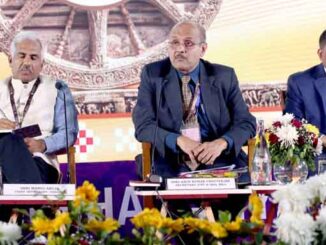
Talking to the media after the three-day Pravasi Bharati Divas 2025, Arun K. Chatterjee was joined by the Chief Secretary of Odisha, Manoj Ahuja, and other senior functionaries of both the Union Ministry of External Affairs and the Odisha government. They were unanimous in their briefing that the three-day mega event organized by the Odisha Government was a roaring success “as we have got very positive feedback from all sections, including participants.”
They were, however, confronted by some unsavory questions, especially about the denial of invitations to parents and other family members of overseas Indians belonging to Odisha.
They assailed the organizers for ignoring the claims of the local people as participants in the mega event.
Manoj Ahuja held that the Odisha Government had focused on promoting tourism as most of the delegates visited almost all 31 places of historic and religious interest. “They all were happy with the hospitality of Odisha and arrangements made for the smooth conduct of the mega event.”
Since Odisha has emerged as an ideal destination for investment in various sectors, including tourism, the State Chief Minister, Mohan Charan Majhi, has announced a Nodal Minister as a single point of contact to facilitate seamless investments in the State.
Arun Chatterjee said that Odisha has emerged as a leader of five Eastern States as it abounds in natural minerals, sports, knowledge economy and other areas. It has tremendous tourism potential as it has been successful in showcasing itself as a potential investment destination.
Besides looking east, it also emerged as a strong destination for “chalo India” initiative.
Manoj Ahuja also revealed that the Odisha government would soon conduct a census of blue-collar job seekers working in the Middle East and elsewhere. Arun Chatterjee, while responding to another question on blue-collar migrants from India, said that the Prime Minister during his recent visit to Kuwait, held a meeting with 200 blue-collar Indian workers there. “It was a lively interaction,” he said.
Responding to a question from Prof. Indrajit S Saluja, chief editor of the New York based Indian American English weekly The Indian Panorama about the participation of youth in the PBD, Arun Chatterjee revealed that the union government was conducting almost every month a group of youth of Indian origin for a three-week Know India programme. Four hundred youths benefit from this fully funded programme of the Indian government. At the end of their visit to the country of their ancestors they feel “incredibly” connected to their roots, he said.
Arun Chatterjee and Manoj Ahuja were joined by the Spokesperson of the Ministry of External Affairs, Randhir Kumar Jaiswal; and Ankan Banerjee, Joint Secretary in the Ministry of External Affairs, besides Sanjay Kumar Singh, Principal Secretary, Information and Public Relations of Odisha Government, at the media briefing.
It is time to spread a message about India’s rich and cultural heritage. As ambassadors of India, you must also look beyond some major cities and explore small towns and villages that make this country unique.
Wherever you live in any part of the world, plant a sapling in your mother’s name in the new city of your domicile. Spread a message about the philosophy, diversity and rich civilization you come from.
Institute awards to commemorate local heroes and Indian missions overseas will extend all possible support. When you come next time for the Pravasi Bharatiya Divas, bring along at least five people from your new neighborhoods.
By Prabhjot Singh
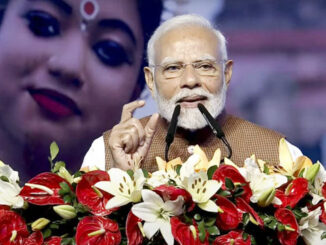
BHUBANESWAR (TIP): Prime Minister Narendra Modi, in his inaugural address to the 18th Pravasi Bharati Divas at Janata Maidan in Bhubaneshwar on Thursday, January 8 was accorded a standing ovation on his arrival at the nearly packed specially erected pandal.
Though the verve and exuberance that usually accompany his addresses at such august gatherings were missing, he made up for it with his exclamations, appealing to the participating delegates to play a proactive role in projecting India abroad.
More than 3000 delegates drawn from around the globe are participating in the biannual event held every year from January 8 to 10 to commemorate the return of the father of the nation, Mahatma Gandhi, from his stint in South Africa. The Pravasi Bharatiya Divas was started in 2003 and has served as a unique platform for overseas Indians to share their achievements and issues with people and governments of the country of their original domicile.
A view of the gathering
Prime Minister eulogized the contribution of the Indian Diaspora in making it the number one nation in the world for remittances back home. Stressing the need for connecting the new generation with its roots in India, Narendra Modi wanted the delegates to talk about India, its history, its culture, its diversity, and its progress not only with their children but also in their neighborhoods and workplaces.
He exhorted them to work as ambassadors of India as the country was making rapid strides in all areas, including technology.
Federation of Indian Associations, NY- NJ-CT-NE (FIA) Delegates at the PBD 2025 (Photo: Jay Mandal-on assignment)
Prime Minister also remotely flagged off the inaugural journey of the Pravasi Bharatiya Express, a special Tourist train for the Indian diaspora, which will depart from the Nizamuddin Railway Station in Delhi and would travel to multiple destinations of tourist and religious importance in India for three weeks. The Pravasi Bharatiya Express will be conducted under the Pravasi Teertha Darshan Yojana of the Ministry of External Affairs.
He also urged the delegates to visit all places of religious and historic significance, including Prayagraj, to avail themselves of a rare opportunity of attending the “Mahakumbh.”
After inaugurating the convention, PM Modi also went around various exhibitions and put up different departments of both the Union Government and the host Odisha government to showcase the progress the country has made since attaining Independence in 1947.
In 2047, when India completes its centenary of independence, it will be a superpower.
Prime Minister Modi inaugurated and went round the 4 exhibitions at the PBD.
Mr. Modi inaugurated four exhibitions – Vishwaroop Ram: The Universal Legacy of Ramayana – by ICCR; Diaspora’s Contribution to Technology– by MEA (curated by Dr Masooma Rizvi); “Bharat Bharatiya: Swadesh Pardes – Abhilekhiye Virasat – Launch of Oman collection”, by National Archives of India; and exhibition on Heritage and Culture of Odisha by Odisha government.
Earlier, External Affairs Minister, Dr S. Jaishankar, and Odisha Governor, Hari Babu Kambhampati, Chief Minister, Mohan Charan Majhi, talked about the importance of the PBD and the role the Indian Diaspora has played in both rebuilding India and its image overseas.
The Chief Guest, President of the Republic of Trinidad and Tobago, Christine Carla Kangaloo addressed the gathering virtually. During her address, she remembered with fondness and pride her Indian ancestry as well as the contribution of Indian diaspora in Trinidad and Tobago. (Photo: ANI)
The Chief guest, the President of Trinidad and Tobago Christine Carla Kangaloo while addressing the august gathering remotely, talked about her own journey and also those of others in her country who migrated to Trinidad and Tobago more than a hundred years ago.
An Impressive Exhibition of Pictures Narrates the Story of Valor and Martyrdom of Sahibzada Zoravar Singh & Sahibzada Fateh Singh
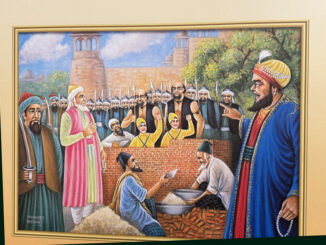
Sahibzada Zorawar Singh aged 9 and Sahibzada Fateh Singh aged 7, the two younger sons of Guru Gobind Singh, the founder of the Khalsa Panth, were bricked alive on December 28, 1704 on the orders of Wazir Khan, the Mughal faujdar of Sirhind, for refusing to renounce their faith and embrace Islam. (Photos / Jay Mandal-on assignment)
NEW YORK CITY (TIP): An exhibition highlighting the valor and sacrifices of Sahibzada Zorawar Singh aged 9 and Sahibzada Fateh Singh aged 7, the sons of Guru Gobind Singh, was organized at the Indian Consulate here on Veer Baal Diwas. The exhibition on Thursday, December 26 on Veer Bal Diwas was to “commemorate the extraordinary valor and unparalleled sacrifices” made by ‘Veer Sahibzadas’, sons of the tenth Sikh Guru, Guru Gobind Singh.
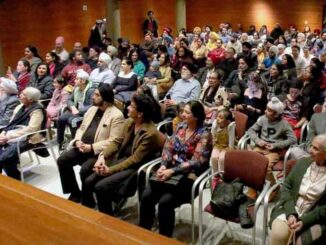
Visitors to the exhibitionGatka display by students of Akal Gatka
Around 10 Sikh young kids from the Akal Gatka Group headed by Sardar Daler Singh, a former President of Gurdwara Baba Makhan Shah Sikh Center, New York, gave a thrilling display of Gatka- the traditional Sikh martial art. Addressing the gathering on the occasion, the Deputy Consul General Varun Jeph described the valor of the Young Sahibzadas as unparalleled in the annals of human history. He had a word of appreciation for Prime Minister Narendra Modi who decided in 2022 to observe the Veer Baal Diwas to commemorate the valor and martyrdom of the Sahibzadas. “It (celebration of Veer Baal Diwas) is a befitting tribute to Guru Gobind Singh ji, a befitting tribute to all the Gurus and to the community as well”.
“May the spirit of this day guide us in our lives as we go ahead. And may the teachings of Guru Granth Sahib always show us the right path forward”, Mr Jeph added.
Speaking on the occasion, Prof. Saluja narrated the story of the valor and the martyrdom of the Sahibzadas and appealed to his community to ensure that the rich Sikh values are promoted among the Sikh youth. Prof. Saluja thanked the Consulate for organizing the historic Day.
Deputy Consul General Varun Jeph related the story of the martyrdom of the Sahibzadas and said there was no parallel to the valor of the Sahibzadas.
Sardar Daler Singh thanked the Deputy Consul General for organizing the event and said his Gatka group would soon come back to give a display of Gatka at the Consulate. He appealed to the Sikh community to promote the rich Sikh values and be prepared always to make any sacrifice for the motherland. Earlier, the Deputy Consul General gave certificates of appreciation to Gatka participants. He also presented shawls to Sardar Daler Singh and Prof. Indrajit Singh Saluja as a token of appreciation for their services. A large number of members from the Indian-American community attended the event to pay their homage and tributes to the ‘Veer Sahibzadas’.
Prof. Indrajit S Saluja pleaded with the Sikh community to promote the rich values of the Sikh religion among kids.Sardar Daler Singh, Gatka trainer and President of Akal Gatka thanked the Deputy Consul General for inviting the Gaka group and honoring them.A view of the gathering.Gatka boys with Deputy Consul General, Consulate staff and the guests (All photos by Ashish Chandratreya)
Mr. Binaya Srikanta Pradhan took over as Consul General of India at New York on January 15, 2024. He is a career diplomat of the 2002 batch of the Indian Foreign Service. He speaks English, Russian, Hindi, and Odiya languages. His diplomatic career includes senior roles in Indian Embassies in Moscow, Turkmenistan, and Pakistan from 2004 to 2012. During 2012-14, he managed India’s relations with Afghanistan and Iran at the Ministry of External Affairs, New Delhi.
From 2014 to 2019, Mr. Pradhan served as the Chief of Staff to the Minister of Petroleum & Natural Gas, Government of India. His international engagements extended to being the Deputy Chief of Mission in the Embassy of India, Moscow, from June 2019 to July 2021.
Prior to his current role as Consul General of India, New York, he held the position of High Commissioner of India to Tanzania and Permanent Representative to the East African Community (EAC) from August 2021 to January 2024. During this period India- Tanzania relationship was elevated to ‘Strategic Partnership’ and the first overseas campus of the prestigious Indian Institute of Technology (IIT) Madras in Zanzibar, Tanzania was set up.
Mr. Pradhan demonstrates a keen interest in economic and energy diplomacy. Beyond his diplomatic pursuits, he finds enjoyment in playing golf. Mr. Pradhan is married to Ms. Monalisa and they are proud parents of two daughters, Dibyanshi and Diya.
Four days after joining the present position, on the 19th January, 2024, in an interview with the Editor of The Indian Panorama Prof. Indrajit S Saluja, Consul General Pradhan spelt out in brief his priorities which included nourishing and strengthening the already strong bonds between India and the US, and exploring new areas of cooperation and relationship in diverse fields of economy, trade, technology, and culture etc. Mr. Pradhan added that serving the Indian Diaspora remained the primary focused concern of the Consulate. The strengthening of the multi-stake holders relationship will be another priority, he said.
Here is the second part of the long interview . The first one dealt with Mr. Pradhan’s views on India’s foreign policy, situations in India’s neighborhood, and India’s relations with the neighboring countries.
In the second part here , Mr. Pradhan speaks about the contribution of the Indian American Diaspora in strengthening India-US relations and in promoting business and cultural relations between the two countries, and about the consular services.
Here are the excerpts.
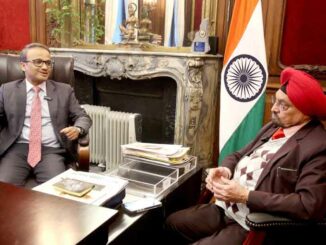
Mr. Binaya S Pradhan, Consul General of India at New York in conversation with Prof. Indrajit S Saluja, Editor of The Indian Panorama (Photo / Jay Mandal- on assignment)
TIP: What do you feel about the consulate here?
CG: I would say I’m familiar with New York, I have come to this place, I guess, eight or nine times in past, always as part of a government delegation, for three days four days. So, while the city is not new for me, working here, as a diplomat, is a new experience. I’m really happy that the team here is quite strong. The team is quite experienced, and both , the Indian colleagues and the local colleagues form a robust team. I’m really happy that they’re all committed. I found that each one of them is committed. They have understood the larger objective that we are here to serve. We are here to further the agenda of the government, which is to bring friendship between the two people and the two countries. Good thing is that in this team, everybody has understood that well,
I’m so happy to see that the number of complaints about our consular services has gone down drastically. I saw two people giving very positive comments about consular services on social media.
TIP : You have a lot of experience about business development, trade and commerce. Because in Tanzania, as you just now said, that it is the Indians, particularly the Gujaratis, and they in fact control the economy of that country if I’m not mistaken. They play a very important role. And it’s the same thing here. We have the Indian diaspora here, controlling levers of local economy in quite a few areas. And then there is a wider interest of promotion of trade and commerce between India and the US. It has been happening here, and it has accelerated over the years. And I’m sure you are the one who is going to probably look into how to further accelerate it. Do you have any roadmap for that?
CG: It would be not correct for me to say that I have a roadmap at this stage. Like I said, you know, it’s very early, but I understand the task. If we have a target of $500 billion of trade between India and United States, we need to do better. We need to bring the Indian business communities closer to the American business communities. We have to find the complementarities. We have to find the gaps where we can export more. We have to find gaps where we can connect the American business with Indian business in a win win situation. We have to get the developments reviewed at very high level. But having said that, I think, in order to make it a truly 21st century relationship we have to have stronger economic enhancement, stronger technology engagement between India and the United States. I understand the 10 states that I deal with in this region, are very prominent players in this respect. I look forward to working with the business communities here very closely. I want to work with the Indian business communities very closely who are stakeholders here. As you know, we have prominent Indian companies more than 150 who are present here. So, I want to identify areas where our intervention is required which can actually lead to some kind of enhancement of trade and investment engagement. But it’s not one sided. When I talk about economic engagement I don’t mean to indicate about Americans investing in India or I don’t mean to Indians exporting to United States. I actually look for a Win -Win partnership, because if it is to sustain, if it is to be a long-term sustainable process, it has to be both ways.
TIP: Your “One District One Product” is also working very well. I’m told that probably in the coming month or so, you’re going to focus on jute products from India.
CG: Yes. When we bring a product, we have to sustain the focus on that. If we do it for a year and forget the next year it won’t work. So, I feel that the focus that we put on coffee, we will continue that this year as well. We found there is good demand for those products which are ODOP products and we plan to continue the focus for five six years on each product so that people develop familiarity, and the market is created here. We will not be shifting every year or jumping from one to another. We will keep adding new products, though.
TIP: Wonderful strategy! I don’t mean to tire you so much. But there are a couple of questions that I would be bothering you with. One is about our young people, particularly the students. Luckily, this jurisdiction of yours has probably the best universities known in the US. And there is a diverse kind of education available here. Some specialize in technology, some specialize in medicine and some specialize in finance, some in law, and obviously, because of so many good universities here, we have a number of students preferring to come to this area, and we have a large population of Indian students here. Do you have any plans of providing them better facilities or integrating them in such a way that they become a powerful instrument of change here, and if they go back to India, in India.
CG: I’m happy that you asked me this question. In fact, today morning, we were discussing this issue. We were dealing with two Indian students who passed away in Connecticut. I was basically part of the kind of process to send their mortal remains back to India. But that was a kind of occasion when we were discussing about the student community from India. As you rightly said, we have very well-known universities and the number of students in each of the 10 states would be quite high. It’s more than 100,000 students. And they remain a very powerful constituency for us. I feel they have to be better connected with us. We have good association with different student bodies in different universities. But these days, thanks to social media, thanks to other innovative means, thanks to the possibility of using friendly associations to connect with them, the scope of connecting with Indian students is much better. We plan to work on that, in order to support the newcomers, at least. When somebody comes to United States, he’s coming to a different culture, he’s coming to a different place. After a year, he doesn’t require anybody’s support; he will be able to navigate his way through. But I think in the initial months one requires a certain amount of handholding. I was so happy to see that many students, former students, many young people, many associations are working in districts and many people are creating videos, which are very popular on social media about how a newcomer should navigate his way through in a university campus or how you adjust to the climate here, how you adapt to the lifestyle here. But we also want to be part of this fraternity to work with Indian students. We want to be connected with them , the student bodies. They come with a lot of new ideas. We want to make them a part of the team in a way that they feel a part of the team India here. In a sense, they also, at the end of the day, knowingly, or unknowingly, they are doing the same job that we are doing. If we are here with the larger objective of bringing the two countries together, deepening the relationship, they are doing on the ground in a different way. They are connected to us in a more impactful manner. So, I plan to visit different universities here. I plan to meet the student bodies. I have asked my team that we should be connected to them through social media, the student leaders, the student influencers, people who are doing good work in the youth space, we should be connected to them. I know that there are many Indian organizations who are working in that area. We will also try to take them along with us. This will remain a priority for me to remain connected to the youth, with the youth, the students.
TIP: I think GOPIO is one such organization. They have always been facilitating a reception for newcomers among the students. I have a suggestion here which you could give a thought to. Like we have Pravasi Bhartiya Divas in India, you may think of a kind of Indian students youth festival or something like that, once a year or if you want to have it at two or three different locations, then maybe you can increase the frequency. This is one way to integrate them as Indians. Number two, it will promote Indian cultural values. And they can, of course, be inviting mainstream Americans that will provide greater understanding among the American youth about Indian culture.
CG: That’s a good suggestion. And when I said that, you just came to my mind. This could work. It’s a good idea. And when I say engagement with youth, I mean, engagement with youth, not only of Indian youth, but also you know, the American heroes. And what you said makes sense, you know At the end of the day, if you are thinking of forging a partnership which would be a defining partnership of 21st century, you cannot do that without the youth, absolutely. They’re an important part.
TIP: I’m glad you understand that importance. And coming to our women here. They have a lot many problems, like domestic violence, and there are women who are battered; they are subjected to all kinds of blackmail, etc. And over the years, of course, consulate has done a lot to take care of them. But still a lot needs to be done. And maybe you could think of ways and means to further help them. Many do not know that Consulate can help them. I don’t know how you would like to let everybody know that the consulate is there to help them out. That is one area where probably much more needs to be done than has hitherto been done.
CG: When it comes to consular services, we are a service providing organization, you know. I would say that we also have gone through different processes. But I would say the issue of Indian nationals having difficulties here, whether it is women or whether it is asylum seekers, whether it is any kind of person, end of the day, we are here as an extension of government of India. Our primary job is to serve our own people. That remains our priority. What I have understood from my colleagues is that we are now having consular camps in different parts of the states. We are reaching out to different communities, doing our consular camps in gurdwaras doing our consular camps in other places. I think we can think of also reaching out to those places where we are yet to reach so that people don’t have to come to Manhattan. Rather we go there , attend to them in their own places. If we still come across complaints, our objective would be to still work towards reaching that zero-complaint stage.
TIP: What would you like to say to the readers of The Indian Panorama?
The Indian Consulate in New York – India away from India; home away from home.
CG: It is wonderful to be in New York. I have come here with a lot of excitement, enthusiasm and a commitment that I’ll be part of the team, working with you very closely to bring our two countries together to bring the two people together, bringing the Indian consulate closer to the Indian community. Be always there with you and also working very closely with you.
TIP: Thank you so much, sir, for having spoken with the Indian panorama. Thank you for your time.
NEW YORK CITY (TIP): Ambassador Binaya S Pradhan, who took over as the Consul General of India at New York on January 15, 2024 gave an interview to The Indian Panorama on the 4th day at work, on January 19.
In the 45-minute interview, Ambassador Pradhan shared his thoughts on diverse issue, from consular services to strengthening bonds within the Indian Diaspora, to promoting ties between India and the US at different levels which included trade and commerce, culture, co-operation in various other fields. Ambassador Pradhan showed a keen interest in paying special attention to the Indian youth and the Indian women here.
The Indian Panorama will carry the interview in the Republic Day special edition on January 26. The video of the interview will also be made available on The Indian Panorama website www.theindianpanorama.news
Q&A with the team of Baywatana. (Photo : Jay Mandal- on assignment)
NEW YORK, NY (TIP): In the bustling heart of the city that never sleeps, the Sikh International Film Festival 2023 unfurled a spellbinding tale of Sikh heritage and cultural diversity at the prestigious Rubin Museum on December 16th. This year’s festival treated the audience to an enchanting journey through impactful stories, with standout films like “Baywatana: Without a Country’, directed by high school students from Boston”, explored the plight of Sikhs and Hindus in Taliban-era Afghanistan.
“American Sikh”, is a true story of an Indian American Sikh who was trying to assimilate with the Americans. The Oscar qualified animated short film is a story of American Sikh Hero Vishvajit Singh and Produced by Guneet Monga Kapoor – Oscar-winning producer (The Elephant Whisperers) and Michelin-starred chef-filmmaker Vikas Khanna and directed and illustrated by American Sikh Hero Vishavjit Singh and Ryan Westra. Vikas Khanna said, “One of the highlights of screening ‘American Sikh’ at Sikh International Film Festival was engaging the little ones and the youth who could see themselves reflected in our film. Their dreams and hopes keep me inspired.”
“Colonel Kalsi: Beyond the Call”: is another true story of a Sikh Youngman Kamal Kalsi who fought to serve in the US Army with his turban and beard. The film explores themes of diversity, sacrifice, faith, identity and resilience. Colonel Kalsi expressed, “Serving in the Army with my unique camo turban and beard was a profound experience of celebrating my Sikh identity while embodying the spirit of American patriotism…”
As the curtains closed on these impactful narratives, the festival featured over 10 films, covering a diverse range of topics from current affairs to historical perspectives. Teji Bindra (Founder and President of Sikh Art & Film Foundation), Mandeep Sobti (Senior VP and Chair of Finance), Dr Paul Johar (Chair SAFF – Film Festival), Harmeet Bharara ( Former Chair FF and Gala), Hansdip Bindra ( Head of PR and Marketing), expressed their satisfaction with the films that captivated a packed auditorium at the Rubin Museum in Manhattan.
Teji Bindra emphasized, “Sikh Art & Film Foundation has been at the forefront in bringing better awareness of Sikhs through films and arts for the past 17 years. We are pleased with the fantastic movies showcased this year.” Dr. Paul Johar added, “This year’s Sikh International Film Festival showcased a powerful lineup addressing contemporary Sikh Diaspora issues, delved into the challenges faced by the community. “Amardeep Singh’s documentary, “Oneness in Diversity: Elixir of Guru Nanak and the Indic Saints,” intertwined memories of Saints and Sufi mystics, emphasizing the essential theme of oneness and diversity. The festival, with its captivating stories and impactful quotes from filmmakers, not only celebrated Sikh culture but also provided a dynamic platform for filmmakers to showcase their artistry.
The Sikh International Film Festival, originating in 2004, has been a cultural beacon, fostering awareness of Sikh culture through films and arts. As the curtains closed on this year’s festival, the organizers expressed gratitude to viewers for their unwavering support, marking a significant chapter in the festival’s journey. The success of SIFF 2023 promises an even brighter future, continuing to celebrate Sikh heritage and diversity through the captivating lens of cinema.
Website: http://sikharts.com/film-festival.html
Col Kamaljeet Singh Kalsi at SIFF in New York, December 16. (Photo : Jay Mandal- on assignment)SIFF organizers with team of American Sikh -Vishvajit Singh, Director Ryan Westra and Vikas Khanna. (Photo : Jay Mandal- on assignment)
Visitors to the exhibition ( Photos : Jay Mandal- on assignment)
NEW YORK CITY (TIP): An exhibition highlighting the valor and sacrifices of Sahibzada Zorawar Singh aged 9 and Sahibzada Fateh Singh aged 7, the sons of Guru Gobind Singh, was organized at the Indian Consulate here on Veer Bal Diwas. The exhibition on Tuesday, December 26 on Veer Bal Diwas was to “commemorate the extraordinary valor and unparalleled sacrifices” made by ‘Veer Sahibzadas’, sons of the tenth Sikh Guru, Guru Gobind Singh, a press release from the mission said.
“Honoring the exemplary courage and immortal sacrifice of Veer Sahibzaade, proud sons of Guru Gobind Singh ji,” the Consulate said in a post on X, adding that it hosted an “exhibition on the occasion of #VeerBaalDiwas, paying our tributes to the Bravehearts with unparalleled courage”. A large number of members from the Indian-American community attended the event to pay their homage and tributes to the ‘Veer Sahibzade’. The Consulate said that on the request of a local gurdwara priest and as a mark of respect, the exhibition would be displayed at the Consulate premises through December 28.
Acting Consul General of India in New York Dr. Varun Jeph partakes of langar with others at Gurdwara Baba Makhan Shah Lobana in Queens, New York where he had gone to pay obeisance to the Veer Sahibzadas on ‘Veer Bal Diwas’. Seen in the picture, from L to R: Consul, Community Affairs Vijaykrishnan, a former President of Gurdwara Baba Makhan Shah Lobana Himat Singh Sarpanch, Acting Consul General Dr. Varun Jeph, The Indian Panorama editor Prof. Indrajit S Saluja, a former president of the Gurdwara Gurmej Singh. Sukhjinder Singh, General Secretary of the Gurdwara is seen serving langar. (Photo : PTI)
The exhibition will also be showcased at gurdwaras in New York, New Jersey and Connecticut.
Earlier in the day, Acting Consul General of India in New York Varun Jeph visited the Gurdwara Baba Makhan Shah Lobana in Queens and paid obeisance to the Veer Sahibzade.
He was joined by members of the gurdwara’s executive committee and local sangat in performing ardas and kirtan. He also joined the community members for langar at the gurdwara.
Special videos on Veer Bal Diwas are also being showcased at the gurdwara for young students attending winter camps there. The Consulate General of India in Houston also observed Veer Bal Diwas, “a day commemorating the valor and martyrdom of young heroes, Guru Gobind Singh Ji’s Sahibzade. A photo exhibition showcased their courage and resilience”.
The Indian Embassy in the US said in a post on X, “Shaheedi Samagam was held at Brookfield Gurdwara, Wisconsin. Leading Sikh and Indian American leaders along with senior Embassy officials participated.”
The Indian Embassy added, “A fitting tribute was given to the exemplary courage and sacrifice of ‘sahibzadas’ of Guru Gobind Singh marking #VeerBaalDiwas.”
(With inputs from PTI)
The Consulate staff with visitors to the Exhibition (Photo/ Jay Mandal- on assignment)
Federation of Indian Associations (FIA) came into being in 1977 after changing the name of umbrella organization “Joint Committee of Indian Organizations” founded in 1975, under the leadership of Rajan Ghosh. The main goal of this organization was to celebrate India’s Independence and Republic days in Tristate area by bringing under one roof Indian students organizations: India Club of New York University, India Club of Columbia University and Association of Indians in America, The Bharathi Society of America and the Tagore Society of America.
The Global Organization of People of Indian Origin (GOPIO) Founder, Thomas Abraham, a Christian from Kerala, was elected First President of FIA in 1977. The India Day Parade has since been an annual feature.
A notable addition to the annual parade was made in 1983 to have a film star as Parade’s Grand Marshal. Bollywood actor- Sunil Dutt- was the first to be invited as the Grand Marshal of the Parade, and from then on it became a tradition to have a Bollywood actor as Parade’s Grand Marshal. Ace photographer Jay Mandal presents here selected photographs of India Day Parade organized by the FIA from 2004 to 2019
Also included here are some photographs from Independence Day celebration at the Indian Consulate in New York in 2016. It was the 1st time that in 2016 the Independence Day of India was celebrated in the street outside the Indian Consulate in New York. Then Deputy Consul General and presently India’s Ambassador to Guatemala, Manoj Mahapatra was instrumental to get the city’s permission, and the Indian Tricolor was hoisted by then MOS MJ Akbar on 64th Street, between 5th Ave and Madison Ave.
Included here are also a few pictures of Independence Day celebration at the Permanent Mission of India in 2018.
Spring arrives officially on March 20. However, New York this year may have to wait for the lovely Spring leaves, buds and blossoms. A celebrated photojournalist Jay Mandal sent The Indian Panorama a few photographs of the beginning of the Spring season at various locations in the US from yesteryears. We are glad to share the lovely pictures with the readers of The Indian Panorama.
Please do not despair if Spring season is slightly delayed. Have faith in what a British poet Percy Bysshe Shelley wrote: “If Winter comes, can Spring be far behind?”
India’s External Affairs Minister Dr. S. Jaishankar arrived in New York on September 18, 2022 to attend the United Nations General Assembly session. During his stay in the City, he met with United Nations officials, world leaders, diplomats, and the community.
Jay Mandal, a well-known photographer, took hundreds of photographs of the visit of the External Affairs Minister. Here are a few selected photographs.
All Photos: Jay Mandal/On Assignment
Ambassador Ruchira Kamboj greets External Affairs Minister, Dr. S Jaishankar with a bouquet of flowers at JFK Airport in New York City. (September 18, 2022)Dr. S. Jaishankar (Right), Union Minister for External Affairs during a bilateral meeting with his counterpart Sheikh Abdullah bin Zayed Al Nahyan of UAE on the sideline of 77th UNGA in NY City. Also in the Picture, Ambassador Ruchira Kamboj (Left), India’s Permanent Representative to the UN. (September 19, 2022)Dr. S. Jaishankar (Center), Union Minister for External Affairs before a trilateral meeting with his counterparts Sheikh Abdullah bin Zayed Al Nahyan (Left) of UAE and Catherine Colonna of France on the sideline of 77th UNGA in NY City. (September 19, 2022)French President Emmanuel Macron (Left) welcomes India’s External Affairs Minister, Dr. S Jaishankar As he arrives to attend a dinner hosted by the French President, on the theme of the North-South Divide at the French Consulate in New York. (September 20, 2022)Dr. S. Jaishankar, Union Minister for External Affairs (Right) at a bilateral meeting with James Cleverly, Secretary of State for Foreign, Commonwealth and Development Affairs of the United Kingdom, on the sideline of the 77th UN General Assembly in New York. (September 22, 2022)QUAD Meeting in NYC. From left, The Secretary of State of the United States, Antony Blinken, the Foreign Minister of Australia, Penny Wong, Indian External Affairs Minister Dr S Jaishankar and Japanese Foreign Minister Yoshimasa Hayashi at a multilateral meeting on the sidelines of the 77th United Nations General Assembly in New York City. (September 23, 2022)
Dr. S. Jaishankar, Union Minister for External Affairs delivers his statement at the 77th United Nations General Assembly in New York City. (September 24, 2022)India’s External Affairs Minister, Dr. S. Jaishankar (left) calls on CSABA KŐRÖSI, President of the 77th UN General Assembly, at the UN Secretariat in New York. (September 19, 2022)India’s External Affairs Minister, Dr. S. Jaishankar (left) and Egyptian Foreign Minister Sameh Shoukry at the bilateral meeting in New York City. (September 19, 2022)Dr. S. Jaishankar (Center), Union Minister for External Affairs before a bilateral meeting with his counterpart Sergey Viktorovich Lavrov of Russia on the sideline of 77th UNGA in NY City. (September 19, 2022)