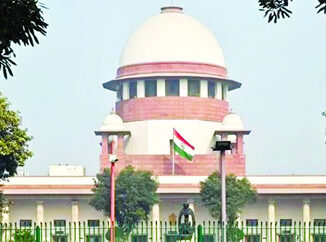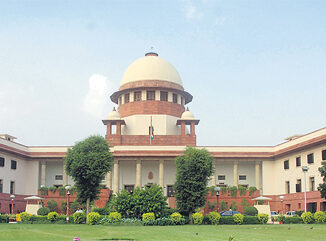
NEW DELHI (TIP): The Supreme Court on Thursday, March 2, set up a six-member expert committee headed by former SC judge Justice AM Sapre to investigate if there had been a regulatory failure in dealing with the alleged contravention of laws pertaining to the securities market in relation to the Adani Group or other companies in the wake of the Hindenburg Research report. A three-judge Bench led by Chief Justice of India DY Chandrachud asked the committee to suggest measures to strengthen the regulatory framework and secure compliance with the existing framework for the protection of investors.
“To protect Indian investors against volatility (in the securities market) of the kind that has been witnessed in the recent past, we are of the view that it is appropriate to constitute an expert committee for the assessment of the regulatory framework and for making recommendations to strengthen it,” said the Bench, which had earlier refused to accept the names suggested by the Centre for the expert committee. Other members of the committee are former SBI chairman OP Bhatt, former Bombay High Court judge JP Devadhar, Infosys co-founder Nandan Nilekani, former chief of New Development Bank of BRICS KV Kamath and advocate Somasekhar Sundaresan, who was recently recommended for appointment as a judge of the Bombay High Court. The Bench, which included Justice PS Narasimha and Justice JB Pardiwala, asked the expert committee to submit its report in a sealed cover to it in two months. The top court also directed market regulator SEBI to investigate if there was any manipulation of stock prices in contravention of existing laws. It took note of the fact that SEBI was already investigating the allegations made in the January 24 Hindenburg Research report. On February 20, it had said it couldn’t start with the presumption of a regulatory failure.
“The above directions shall not be construed to limit the contours of the ongoing investigation. SEBI shall expeditiously conclude the investigation within two months and file a status report,” the Bench clarified.
“Further, SEBI shall apprise the expert committee of the action taken in furtherance of the directions of this court as well as steps taken in furtherance of its ongoing investigation. The constitution of the expert committee does not divest SEBI of its powers or responsibilities in continuing with its investigation into the recent volatility in the securities market,” it further clarified.
Tag: JB Pardiwala
-

Hindenburg: SC sets up six-member probe panel, wants report in 2 months
-

SC junks plea to stop candidates from contesting from two seats
New Delhi (TIP)- The Supreme Court on Thursday, February 2, rejected a petition to bar candidates from contesting from more than one constituency in the general or assembly elections, calling it a matter of “parliamentary sovereignty” and “political democracy”.
A bench, headed by Chief Justice of India Dhananjaya Y Chandrachud, held that there is no manifest arbitrariness in the relevant provision in the Representation of People Act (RPA) that may warrant an intervention by the court in this matter, which, it said, falls “squarely within the legislative domain” and “realm of policy”.
“It is a matter pertaining to legislative policy since it is ultimately it is parliament’s will that determines whether the political democracy is furthered by granting such a choice,” said the bench, also comprising justices PS Narasimha and JB Pardiwala.
Candidates may contest from different seats due to a variety of reasons, noted the bench, adding: “Whether this would further the course of democracy is up to the parliament…absent any manifest arbitrariness in the said provision, we cannot strike it down.”
Dismissing a public interest litigation filed by advocate Ashwini Upadhyay, the bench also put on record in its order that a candidate may decide to contest from two seats for a variety of reasons apart from uncertainty surrounding the outcome of the political process.
“Contesting from multiple seats can be due to multiple reasons and there would be reason which weigh in the balance and whether it furthers parliamentary democracy is something which is in legislative domain. Absent any manifest arbitrariness for violation of Articles 14 and 21, it is not for this Court to strike down the provision as unconstitutional. This issue lies in the domain of parliamentary sovereignty,” stated the order.
It highlighted that parliament did amend the law in 1996 to restrict the number of constituencies to two whereas earlier, a candidate could contest from any number of seats.
“The parliament has already intervened in the past. The parliament can certainly step in again. At the relevant time when the parliament deems it appropriate to do it, they will do it. There is no question of inaction on anybody’s part,” the bench observed.
Earlier, senior counsel Gopal Sankaranarayanan, representing Upadhyay, had urged the bench to consider testing the validity of Section 33(7) of the RPA which permits a candidate to contest any election (parliamentary, state assembly, biennial council, or by-elections) from up to two constituencies. The provision was introduced in 1996 prior to which there was no bar on the number of constituencies from which a candidate could contest.
The lawyer argued that the provision has an adverse impact on the voters as well as public exchequer since the candidate must leave one constituency if he emerges victorious from both. He added that an unnecessary burden on the exchequer is imposed due to an imperative by-election and is also an injustice to the voters of the winning candidate. Source: HT