SAN FRANCISCO (TIP): Shailesh Prakash, an Indian American Google News executive picked to super charge the search giant’s news efforts, has reportedly resigned amid rising tensions with publishers accusing it of siphoning critical advertising revenue.
Prakash had served as a vice president and general manager for Google News. New York Post cited an unnamed source as confirming that he is no longer with the company.
It was first reported on his resignation, citing people familiar with the matter. The circumstances behind Prakash’s resignation were not immediately clear. Google declined to comment on the Post.
Prakash’s job experience gave him unique insight into the news industry’s gripes with Google. He joined Google in Nov. 2022 after an 11-year stint at the Washington Post, where he served as chief product and technology officer, according to his LinkedIn profile.
He was credited with guiding the newspaper’s shift toward digital content during that period, including its creation of an in-house advertising technology business, the Journal said.
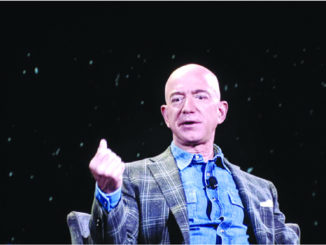
Prakash reportedly worked closely with billionaire Jeff Bezos after the Amazon founder bought the Washington Post for $500 million in 2013. The outgoing Google executive previously held roles at Sun Microsystems, Motorola, Netscape, Microsoft, and Sears Holdings, showcasing a wealth of experience in both technology and corporate strategy.
Google has faced intense scrutiny in recent months over its business practices and the alleged harm they have caused to news publishers, which rely on the search giant for the site traffic that underpins ad sales, the Post noted.
The tech giant rankled online publishers last May after it introduced a feature called “AI Overviews” – which places an auto-generated summary at the top of its search results while burying links to other sites, according to the post.
News Media Alliance, a nonprofit that represents more than 2,200 publishers, said the feature would be “catastrophic to our traffic” and has called on the feds to intervene.
Critics allege that Google used publishers’ copyrighted content to “train” its artificial intelligence tools without proper credit or attribution. Google is also accused of dodging legislative efforts aimed at making tech firms pay their fair share.
The stakes are particularly high in India, where publishers have voiced strong objections to Google’s practices, Campaign India reported. Represented by bodies like the Digital News Publishers Association (DNPA) and the News Broadcasters & Digital Association (NBDA), they assert that the tech giant’s control over ad revenue distribution marginalizes their share, affecting the sustainability of news operations.
This is especially significant in India, where an estimated 55% of news website traffic comes through Google, according to data presented to the Competition Commission of India (CCI).
Central to the publishers’ grievances is the rise in ‘zero-click searches’, a phenomenon where Google’s snippets or summaries satisfy users’ queries on the search result page itself, meaning users do not click through to publishers’ websites.
Consequently, it benefits by retaining traffic and displaying its own ads, while publishers miss out on potential revenue. Adding to their concerns, publishers also lack access to Google’s data on the revenue generated through these searches, making it harder to advocate for a fairer distribution model.
In January 2022, after receiving multiple complaints from publishing associations, the CCI launched an investigation into Google’s dominance over digital advertising and its alleged revenue practices.
The case has since been a closely watched development, expected to define whether Google has abused its market position and, more significantly, whether it should pay publishers for using snippets from their content in search results.
Tag: Jeff Bezos
-

Indian American executive Shailesh Prakash quits google news amid tensions with publishers
-

Indian-origin Aravind Srinivas’s cofounded AI startup Perplexity nears $9 billion valuation amid copyright lawsuits from publishers
NEW YORK (TIP) : AI-powered search engine Perplexity is due to raise $500 million in its fourth funding round this year, The Wall Street Journal reported on Tuesday, November 5, which would value the startup at almost $9 billion.
The latest valuation is triple the amount from a few months ago. The AI startup, which helps people search the web using a ChatGPT-style interface, is reported to receive 100 million queries every week and brings in around $50 million in annual revenue.
Perplexity’s rapid growth highlights strong investor interest in its offerings, WSJ said, and marks it as one of the most valuable AI startups amid a new wave of generative AI technology.
Notable investors backing Perplexity include Nvidia, Databricks, Amazon’s Jeff Bezos, Y Combinator’s former Head of AI Daniel Gross and present Chief Garry Tan, Figma’s Dylan Field, among others.
Perplexity joins other generative AI contenders, such as OpenAI’s ChatGPT, Microsoft’s Bing, and Google’s Gemini AI in the search space but claims to set itself apart by using multiple large language models to deliver more accurate and richer responses.
Launched in 2022, Perplexity was founded by Indian American Aravind Srinivas who previously held research-oriented roles at OpenAI, Google, and DeepMind. An IIT Madras alum with a PhD in computer science from the University of California, Berkeley, Srinivas aims “to build the world’s most knowledge centric company.”
Recently, Srinivas faced backlash from two News Corp-owned publications – The New York Post and WSJ’s parent company Dow Jones – regarding Perplexity’s ability to provide answers to user queries based on web-scraped data which includes original reporting from the publications.
Both news publications filed a copyright infringement lawsuit against the AI startup in October. In the same month, Perplexity has also been sent a cease and desist letter from The New York Times demanding to stop using its content in the AI platform’s output. This is not NYT’s first feud with an AI company – last year, it sued Microsoft and OpenAI for unethical web scraping to train ChatGPT and other AI products.
The publishers allege that using their content, the AI platforms have siphoned traffic that would have otherwise directed visitors to their own websites.
Reportedly, Srinivas was “surprised by the lawsuit” by the News Corp-owned publications and that he was interested in a “proper commercial discussion,” according to PYMNTS.
In a WSJ Tech Live held two days after the lawsuit was filed, Srinivas proposed to form revenue-sharing partnerships with the news publishers and revealed that Perplexity will be launching an advertising program in November.
“I don’t think just licensing content is the only solution,” Srinivas said. “Neither am I saying our publisher program is already there. I hope that more conversations will get us there.” -

Jeff Bezos’ girlfriend prepares for all-female flight on Blue Origin mission
Lauren Sanchez, girlfriend of Amazon founder Jeff Bezos, can soon be known as the first person to lead an all-woman space mission on Blue Origin. In an interview with The Wall Street Journal, she revealed that Bezos is encouraging her to put together a five-member female crew to fly on a Blue Origin rocket to space.
The Emmy-winning TV host-turned-helicopter pilot became a well known name when her relationship with the Amazon founder was made public in January 2019.
“It’s going to be women who are making a difference in the world and who are impactful and have a message to send,” Sanchez was quoted as saying.
“I’m going to have to hold him (Bezos) back. He’ll be cheering us all on from the sidelines,” she added.
Apart from recreational flights, the Bezos-founded private space company has performed missions for NASA that include taking up scientific equipment.
Blue Origin last year successfully launched its fifth tourist flight to space.
Six people were carried to space above the Karman line—an internationally recognised boundary of space that lies 62 miles (100 km) above the Earth’s surface—in a typical 11-minute flight.
The flight was the 21st overall for Blue Origin and New Shepard. It was the second crewed flight for the company this year, following NS-20, which launched and landed on March 31, 2022.
-
UK’s Prince William says great minds should focus on saving Earth not space travel
London (TIP): Britain’s Prince William has taken a thinly veiled swipe at the billionaires embroiled in a space tourism race, saying the world’s greatest brains should instead be focused on solving the environmental problems facing the Earth.
During a BBC interview aired on Thursday, William appeared to criticise Jeff Bezos, the world’s richest person, Elon Musk and Briton Richard Branson, whose rival ventures are all vying to usher in a new era of private commercial space travel. “We need some of the world’s greatest brains and minds fixed on trying to repair this planet, not trying to find the next place to go and live,” William said of the space race.
His comments come after Musk has spoken about missions to Mars, and Bezos described his inaugural space flight in July as part of building a road to space “so that our kids and their kids can build a future”.
“We need to do that to solve the problems here on Earth,” said Bezos, who on Wednesday celebrated sending Star Trek actor William Shatner into space in his New Shepard spacecraft.
Speaking out on green issues has become a major feature of the British royal family, and William, 39, is following in the footsteps of his late grandfather Prince Philip, Queen Elizabeth’s husband, and his father, Prince Charles.
Charles, the 72-year-old heir to the throne, has for decades called for action to stop climate change and environmental damage, long before the issue became mainstream, often facing ridicule along the way.
“It’s been a hard road for him. He’s had a really rough ride on that, and I think he’s been proven to being well ahead of the curve,” William said.
“But it shouldn’t be that there’s a third generation now coming along having to ramp it up even more. For me, it would be an absolute disaster if George (his eldest child) is sat here … in like 30 years’ time whatever, still saying the same thing, because by then we will be too late.” In an echo of his father’s message earlier this week, William also said the upcoming U.N. Climate Change Conference COP26 summit in Scotland had to deliver.
“We can’t have more clever speak, clever words but not enough action,” William said.
The prince’s personal response to the issue has been to create the Earthshot Prize, which aims to find solutions through new technologies or policies to the planet’s biggest environmental problems.
The first five winners, who will each collect 1 million pounds ($1.4 million), will be announced at a ceremony on Sunday. Reuters
-

Billionaire Jeff Bezos blasts into space on own rocket
Van Horn (TIP): Jeff Bezos blasted into space on Tuesday, July 20, on his rocket company’s first flight with people on board, becoming the second billionaire in just over a week to ride his own spacecraft.
The Amazon founder was accompanied by a hand-picked group: his brother, an 18-year-old from the Netherlands and an 82-year-old aviation pioneer from Texas — the youngest and oldest to ever fly in space.
“Best day ever!” Bezos said when the capsule touched down on the desert floor at the end of the 10-minute flight.
Named after America’s first astronaut, Blue Origin’s New Shepard rocket soared from remote West Texas on the 52nd anniversary of the Apollo 11 moon landing, a date chosen by Bezos for its historical significance. He held fast to it, even as Virgin Galactic’s Richard Branson pushed up his own flight from New Mexico in the race for space tourist dollars and beat him to space by nine days. Unlike Branson’s piloted rocket plane, Bezos’ capsule was completely automated and required no official staff on board for the up-and-down flight.
Blue Origin reached an altitude of about 66 miles (106 kilometers), more than 10 miles (16 kilometers) higher than Branson’s July 11 ride. The 60-foot (18-meter) booster accelerated to Mach 3 or three times the speed of sound to get the capsule high enough, before separating and landing upright. Source: AP
-

“Best day ever as Jeff Bezos endshis ride into space on own rocket
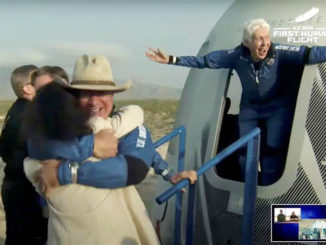
DALLAS (TIP): Jeff Bezos, the world’s richest man, went to space and back Tuesday, July 20 morning on an 11-minute, supersonic joy ride aboard the rocket and capsule system developed by his space company, Blue Origin. Riding alongside the multibillionaire were Bezos’ brother, Mark Bezos; Wally Funk, an 82-year-old pilot and one of the “Mercury 13” women who trained to go to space in the 20th century but never got to fly; and an 18-year old recent high school graduate named Oliver Daemen who was Blue Origin’s first paying customer and whose father, an investor, purchased his ticket. Funk and Daemen became the oldest and youngest people, respectively, ever to travel to space. And this flight marked the first-ever crewed mission for Blue Origin’s New Shepard suborbital space tourism rocket, which the company plans to use to take wealthy thrill seekers on high-flying joy rides in the months and years to come.
“Best day ever!” Bezos said when the capsule touched down on the desert floor at the end of the 10-minute flight. Named after America’s first astronaut, Blue Origin’s New Shepard rocket soared from remote West Texas on the 52nd anniversary of the Apollo 11 moon landing, a date chosen by Bezos for its historical significance. He held fast to it, even as Virgin Galactic’s Richard Branson pushed up his own flight from New Mexico in the race for space tourist dollars and beat him to space by nine days.
Unlike Branson’s piloted rocket plane, Bezos’ capsule was completely automated and required no official staff on board for the up-and-down flight. Blue Origin reached an altitude of about 66 miles (106 kilometers), more than 10 miles (16 kilometers) higher than Branson’s July 11 ride. The 60-foot (18-meter) booster accelerated to Mach 3 or three times the speed of sound to get the capsule high enough, before separating and landing upright.
The passengers had several minutes of weightlessness to float around the spacious white capsule. The window-filled capsule landed under parachutes, with Bezos and his guests briefly experiencing nearly six times the force of gravity, or 6 G’s, on the way back.
Led by Bezos, they climbed out of the capsule after touchdown with wide grins, embracing parents, partners and children, then popped open bottles of sparkling wine, spraying one another.
haring Bezos’ dream-come-true adventure was Wally Funk, from the Dallas area, one of 13 female pilots who went through the same tests as NASA’s all-male astronaut corps in the early 1960s but never made it into space.
“I got goose bumps,” said Angel Herrera after the capsule landed. “The hair on the back of my neck stood up, just witnessing history.” Herrera, who lives in El Paso, was one of a few dozen people who watched the launch from inside Van Horn High School, about 25 miles (40 kilometers) away.
Blue Origin — founded by Bezos in 2000 in Kent, Washington, near Amazon’s Seattle headquarters — hasn’t revealed its price for a ride to space. Two more passenger flights are planned by year’s end, said Blue Origin CEO Bob Smith.
The recycled rocket and capsule that carried up Tuesday’s passengers were used on the last two space demos, according to company officials.
Blue Origin is working on a massive rocket, New Glenn, to put payloads and people into orbit from Cape Canaveral, Florida. The company also wants to put astronauts back on the moon with its proposed lunar lander Blue Moon; it’s challenging NASA’s sole contract award to SpaceX. (AP)
(Agencies)
-
Jeff Bezos to step down as Amazon CEO on July 5
Amazon founder Jeff Bezos has picked a date to step down as CEO. Bezos, who grew Amazon from an internet bookstore to an online shopping behemoth, said Wednesday that Amazon executive Andy Jassy will take over the CEO role on July 5.
We chose that date because its sentimental for me,” Bezos said during an Amazon shareholder meeting Wednesday. He explained that it was exactly 27 years ago on that date in 1994 that Amazon was incorporated.
Seattle-based Amazon.com Inc. announced that Bezos was stepping down as CEO in February, but didn’t provide a specific date. Jassy, his replacement, currently runs the company’s cloud-computing business.
Bezos, 57 and with a personal fortune of $167 billion, won’t be going far. He will become executive chair at Amazon and focus on new products and initiatives.
-

Jeff Bezos, Amazon’s founder, will step down as CEO this year
Jeff Bezos, who founded Amazon as an online bookstore and built it into a shopping and entertainment behemoth, will step down later this year as CEO, a role he’s had for nearly 30 years, to become executive chairman, the company announced on Tuesday, Feb 2. Bezos, 57, will be replaced in the summer by Andy Jassy, who runs Amazon’s cloud-computing business. In a blog post to employees, Bezos said he planned to focus on new products and early initiatives being developed at Amazon. He said he would have more time for side projects, including his space exploration company Blue Origin, his philanthropic initiatives and overseeing The Washington Post, which he owns.
Bezos, who is the company’s biggest shareholder, will still have broad influence over Amazon.
“Jeff is really not going anywhere,“ Amazon’s Chief Financial Officer Brian Olsavsky said in a call with reporters. “It’s more of a restructuring of who’s doing what.“
Launched in 1995, Amazon was a pioneer of fast, free shipping that won over millions of shoppers who used the site to buy diapers, TVs and just about anything else. Under Bezos, Amazon also launched the first e-reader that gained mass acceptance, and its Echo listening device made voice assistants a common sight in living rooms.
As a child, Bezos was intrigued by computers and interested in building things, such as alarms he rigged in his parents’ home. He got a degree in electrical engineering and computer science at Princeton University, and then worked at several Wall Street companies.
He quit his job at D.E. Shaw to start an online retail business _ though at first he wasn’t sure what to sell. Bezos quickly determined that an online bookstore would resonate with consumers. He and his now ex-wife, MacKenzie Scott, whom he met at D.E. Shaw and married in 1993, set out on a road trip to Seattle _ a city chosen for its abundance of tech talent and proximity to a large book distributor in Roseburg, Oregon.
While Scott drove, Bezos wrote up the business plan for what would become Amazon.com. Bezos convinced his parents and some friends to invest in the idea, and Amazon began operating out of the Bezos’ Seattle garage on July 16, 1995. Amazon has gone far beyond selling paperbacks. It now produces movies, makes sofas, owns a grocery chain and even has plans to send satellites into space to beam internet service to earth. The company is one of the most valuable in the world, worth nearly $1.7 trillion.
During the pandemic, Amazon was one of the few retailers to benefit as shoppers stayed clear of malls and shopped from their phones. On the same day Amazon announced Bezos would step down, the company reported making a record profit in the last three months of 2020, and its quarterly revenue shot past $100 billion for the first time.
Bezos’ riches have also swelled: His stake in Amazon is currently worth about $180 billion. For years he stayed behind the scenes, running the company. More recently, he sometimes stepped into the spotlight, showing up at movie premieres and Hollywood parties.
In 2019, he announced he was divorcing Scott in a tweet, just before the National Enquirer published a cover story saying Bezos had an affair with a former TV host. Scott received a stake in Amazon after the divorce worth nearly $40 billion at the time. She has pledged to give away half her fortune to charities.
As Amazon has grown, so has scrutiny. Amazon and other tech giants have enjoyed light-touch regulation and star status in Washington for decades, but calls for greater regulation are growing. A report by the House Judiciary Committee in October called for possibly breaking up Amazon and others, making it harder for them to acquire companies and imposing new rules to safeguard competition. Source: AP