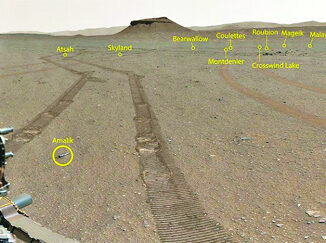
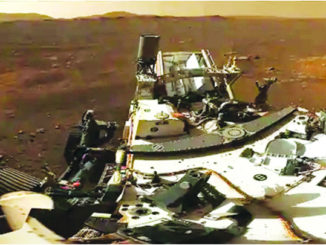
Perseverance has drilled a sample from a rock that could go on to provide answers to questions the rover came in search of on Mars.
The 24th rock core taken by the rover is believed to have been awash in water for an extended period in the distant past, and could have been part of an ancient beach that once adorned the Red Planet.
“To put it simply, this is the kind of rock we had hoped to find when we decided to investigate Jezero Crater. Nearly all the minerals in the rock we just sampled were made in water; on Earth, water-deposited minerals are often good at trapping and preserving ancient organic material and biosignatures,” Ken Farley, project scientist for Perseverance said.
Named after Yellowstone National Park’s iconic landmark, “Bunsen Peak,” the rock of approximately 5.6 feet wide and 3.3 feet high intrigued scientists as they observed it with the rover.
Its prominent stature amidst the terrain and unique texture piqued their curiosity, especially its vertical face, providing a clear cross-section for analysis and less dust accumulation for instruments. “The rock can even tell us about Mars climate conditions that were present when it was formed,” says Farley.
Before extracting a sample, Perseverance used its SuperCam spectrometers and the X-ray spectrometer PIXL to scan the rock’s composition.
Tag: Jezero Crater
-
Perseverance finds rock that could answer why the rover came to Mars
-

Perseverance rover boasts its first construction on Mars
Nearly two years after it was launched to the Red Planet, the Perseverance rover has done more than just science. It has now constructed a sample depot on the planet that will be used by future missions to return samples to Earth. The rover has beamed back a portrait of the 10 backup sample tubes. The rover has sent a panoramic view of the recently completed sample depot, which is a big milestone for the mission and humanity’s first collection of samples on another planet. The image has been made from 368 images that were sent to Earth.
Nasa said that eight of those tubes are filled with rock and regolith from Mars, while one is an atmospheric sample and one is a “witness” tube. The rover used its Mastcam-Z camera on the top of its head to capture the images that were then stitched together to form the panoramic view.
Nasa said that the depot represents a backup collection of samples that could be recovered in the future by the Mars Sample Return campaign, a joint effort between Nasa and ESA (European Space Agency) that aims to bring Mars samples to Earth for closer study.
Perseverance built the depot at “Three Forks,” a location within Jezero Crater. Billions of years ago, a river flowed into the crater, carrying sediment that formed a steep, fan-shaped delta that the rover will drive up in the months ahead. Astrobiologists suspect that while the Martian surface is now cold, dry, and generally inhospitable to life, ancient Mars was likely similar to Earth – and could have supported microbial life if any ever formed on the Red Planet. The work to build a depot on another world was not easy and the first critical requirement was finding a level, rock-free stretch of terrain which has room for each tube to be deposited. The next target was to figure out exactly where and how to deploy the tubes within that location.
While Perseverance has dropped these sample tubes, work is underway on Earth to ready for the retrieving mission that will launch to Mars, pick up these samples and return home.Source: India Today
-

NASA releases panorama taken by mars rover
The US space agency NASA released a spectacular panoramic view on Wednesday, February 23, of the landing site of the Perseverance rover on Mars.
The panorama shows the rim of the Jezero Crater where the rover touched down last week and the cliff face of an ancient river delta in the distance.
It was taken by rotating the rover’s mast 360 degrees. The mast is equipped with dual, zoomable cameras which can take high-definition video and images.
The panorama is composed of 142 individual images stitched together on Earth, NASA said.
“We’re nestled right in a sweet spot, where you can see different features similar in many ways to features found by Spirit, Opportunity, and Curiosity at their landing sites,” said Jim Bell of Arizona State University’s School of Earth and Space Exploration. Spirit, Opportunity and Curiosity were previous missions to Mars. NASA said the rover’s cameras will help scientists assess the geologic history and atmospheric conditions of Jezero Crater and identify rocks and sediment worthy of a closer examination and collection for eventual return to Earth. On Monday, the US space agency released the first audio from Mars, a faint crackling recording of a gust of wind captured by the rover’s microphone. NASA also released video of the landing of the rover, which is on a mission to search for signs of past life on the Red Planet.
Mars rover’s giant parachute carried secret message
The huge parachute used by NASA’s Perseverance rover to land on Mars contained a secret message, thanks to a puzzle lover on the spacecraft team. Systems engineer Ian Clark used a binary code to spell out “Dare Mighty Things” in the orange and white strips of the 70-foot (21-metre) parachute. He also included the GPS coordinates for the mission’s headquarters at the Jet Propulsion Laboratory in Pasadena, California. Clark, a crossword hobbyist, came up with the idea two years ago. Engineers wanted an unusual pattern in the nylon fabric to know how the parachute was oriented during descent. Turning it into a secret message was “super fun”, he said Tuesday. Only about six people knew about the encoded message before Thursday’s landing, according to Clark. They waited until the parachute images came back before putting out a teaser during a televised news conference on Monday.
It took just a few hours for space fans to figure it out, Clark said. Next time, he noted, “I’ll have to be a little bit more creative.” “Dare Mighty Things” — a line from President Theodore Roosevelt — is a mantra at JPL and adorns many of the centre’s walls. The trick was “trying to come up with a way of encoding it but not making it too obvious,” Clark said.
As for the GPS coordinates, the spot is 10 feet (3 metres) from the entrance to JPL’s visitor centre.
Another added touch not widely known until touchdown: Perseverance bears a plaque depicting all five of NASA’s Mars rovers in increasing size over the years — similar to the family car decals seen on Earth.