TRENTON, NJ (TIP): The Port Authority of New York and New Jersey Police Department has arrested one Mohamed Hassanain in the hate crime case where he had assaulted an Indian-origin Sikh taxi driver at John F. Kennedy International Airport on January 3. According to Sikh Coalition, the accused is also a taxi driver, media reports said.
A video of the incident had gone viral where accused Hassanain is seen shouting at the victim “go back to your country,” and “turbaned people” in a derogatory manner. Hassanain had further punched and shoved the Sikh driver and ripped off his turban. Hassanain has been charged with assault in the third degree as a hate crime, assault in the third degree, and aggravated harassment in the second degree. Accused Hassanain is set to be arraigned on January 15 by the competent court. Sikh Coalition, a community-based civil and human rights organization thanked police for the quick action. “We are grateful to the Port Authority Police Department and Queens District Attorney’s Office for their prompt action on this case, and for recognizing that the attack on Mr. Singh included clear anti-Sikh bias,” said Amrit Kaur Aakre, the Legal Director of the Sikh Coalition.
“This case underscores the importance of sharing all of the details of these kinds of attacks with law enforcement. Holding perpetrators accountable for both their actions and their hateful motivations is the clearest way to show that bigotry, and the violence that it fuels, have no place in our communities,” she said further.
She said that taxi and rideshare drivers from the Sikh community are at a heightened risk of hateful assault. In recent years, the Sikh Coalition has provided free legal aid to many Sikh drivers who were attacked in various places across the USA. The incident left people shocked and angered as the Sikh driver was assaulted and abused without any provocation.The victim had parked his taxi at the Terminal 4 taxi stand and, in the meantime, accused blocked his vehicle. When he picked up a customer, he stepped out of his car and asked Hassanain to move. On this Hassanain attempted to hit him with his own car door and later on started punching the victim in the head, chest, and arms, knocking off his turban. The victim said that he was shocked and angered when he was assaulted for doing nothing. “I am thankful for law enforcement, the Sikh Coalition, and all those in the community who have offered their strength in this difficult time. No one should experience what I did–but if they do, I hope they receive the same overwhelming amount of support and quick, professional action by the authorities in response,” the driver said.
The national holiday, which takes place on the third Monday of January each year, serves as a day of remembrance for Martin Luther King, who was killed in Memphis in 1968. This year, it will be celebrated on Monday, January 17
Martin Luther King, Jr., original name Michael King, Jr., (born January 15, 1929, Atlanta, Georgia, U.S.—died April 4, 1968, Memphis, Tennessee), Baptist minister and social activist who led the civil rights movement in the United States from the mid-1950s until his death by assassination in 1968. His leadership was fundamental to that movement’s success in ending the legal segregation of African Americans in the South and other parts of the United States. King rose to national prominence as head of the Southern Christian Leadership Conference, which promoted nonviolent tactics, such as the massive March on Washington (1963), to achieve civil rights. He was awarded the Nobel Peace Prize in 1964.
Early years
King came from a comfortable middle-class family steeped in the tradition of the Southern Black ministry: both his father and maternal grandfather were Baptist preachers. His parents were college-educated, and King’s father had succeeded his father-in-law as pastor of the prestigious Ebenezer Baptist Church in Atlanta. The family lived on Auburn Avenue, otherwise known as “Sweet Auburn,” the bustling “Black Wall Street,” home to some of the country’s largest and most prosperous Black businesses and Black churches in the years before the civil rights movement. Young Martin received a solid education and grew up in a loving extended family.
This secure upbringing, however, did not prevent King from experiencing the prejudices then common in the South. He never forgot the time when, at about age six, one of his white playmates announced that his parents would no longer allow him to play with King, because the children were now attending segregated schools. Dearest to King in these early years was his maternal grandmother, whose death in 1941 left him shaken and unstable. Upset because he had learned of her fatal heart attack while attending a parade without his parents’ permission, the 12-year-old King attempted suicide by jumping from a second-story window.
In 1944, at age 15, King entered Morehouse College in Atlanta under a special wartime program intended to boost enrollment by admitting promising high-school students like King. Before beginning college, however, King spent the summer on a tobacco farm in Connecticut; it was his first extended stay away from home and his first substantial experience of race relations outside the segregated South. He was shocked by how peacefully the races mixed in the North. “Negroes and whites go [to] the same church,” he noted in a letter to his parents. “I never [thought] that a person of my race could eat anywhere.” This summer experience in the North only deepened King’s growing hatred of racial segregation. At Morehouse, King favoured studies in medicine and law, but these were eclipsed in his senior year by a decision to enter the ministry, as his father had urged. King’s mentor at Morehouse was the college president, Benjamin Mays, a social gospel activist whose rich oratory and progressive ideas had left an indelible imprint on King’s father. Committed to fighting racial inequality, Mays accused the African American community of complacency in the face of oppression, and he prodded the Black church into social action by criticizing its emphasis on the hereafter instead of the here and now; it was a call to service that was not lost on the teenage King. He graduated from Morehouse in 1948.
King spent the next three years at Crozer Theological Seminary in Chester, Pennsylvania, where he became acquainted with Mohandas Gandhi’s philosophy of nonviolence as well as with the thought of contemporary Protestant theologians. He earned a bachelor of divinity degree in 1951. Renowned for his oratorical skills, King was elected president of Crozer’s student body, which was composed almost exclusively of white students. As a professor at Crozer wrote in a letter of recommendation for King, “The fact that with our student body largely Southern in constitution a colored man should be elected to and be popular [in] such a position is in itself no mean recommendation.” From Crozer, King went to Boston University, where, in seeking a firm foundation for his own theological and ethical inclinations, he studied man’s relationship to God and received a doctorate (1955) for a dissertation titled “A Comparison of the Conceptions of God in the Thinking of Paul Tillich and Henry Nelson Wieman.”
The Montgomery bus boycott of Martin Luther King, Jr.
While in Boston, King met Coretta Scott, a native Alabamian who was studying at the New England Conservatory of Music. They were married in 1953 and had four children. King had been pastor of the Dexter Avenue Baptist Church in Montgomery, Alabama, slightly more than a year when the city’s small group of civil rights advocates decided to contest racial segregation on that city’s public bus system following the incident on December 1, 1955, in which Rosa Parks, an African American woman, had refused to surrender her bus seat to a white passenger and as a consequence was arrested for violating the city’s segregation law. Activists formed the Montgomery Improvement Association to boycott the transit system and chose King as their leader. He had the advantage of being a young, well-trained man who was too new in town to have made enemies; he was generally respected, and it was thought that his family connections and professional standing would enable him to find another pastorate should the boycott fail.
In his first speech to the group as its president, King declared:
We have no alternative but to protest. For many years we have shown an amazing patience. We have sometimes given our white brothers the feeling that we liked the way we were being treated. But we come here tonight to be saved from that patience that makes us patient with anything less than freedom and justice.
These words introduced to the country a fresh voice, a skillful rhetoric, an inspiring personality, and in time a dynamic new doctrine of civil struggle. Although King’s home was dynamited and his family’s safety threatened, he continued to lead the boycott until, one year and a few weeks later, the city’s buses were desegregated.
The Southern Christian Leadership Conference
Recognizing the need for a mass movement to capitalize on the successful Montgomery action, King set about organizing the Southern Christian Leadership Conference (SCLC), which gave him a base of operation throughout the South, as well as a national platform from which to speak. King lectured in all parts of the country and discussed race-related issues with religious and civil rights leaders at home and abroad. In February 1959 he and his party were warmly received by India’s Prime Minister Jawaharlal Nehru and others; as the result of a brief discussion with followers of Gandhi about the Gandhian concepts of peaceful noncompliance (satyagraha), King became increasingly convinced that nonviolent resistance was the most potent weapon available to oppressed people in their struggle for freedom. King also looked to Africa for inspiration. “The liberation struggle in Africa has been the greatest single international influence on American Negro students,” he wrote. “Frequently I hear them say that if their African brothers can break the bonds of colonialism, surely the American Negro can break Jim Crow.”
In 1960 King and his family moved to his native city of Atlanta, where he became co-pastor with his father of the Ebenezer Baptist Church. At this post he devoted most of his time to the SCLC and the civil rights movement, declaring that the “psychological moment has come when a concentrated drive against injustice can bring great, tangible gains.” His thesis was soon tested as he agreed to support the sit-in demonstrations undertaken by local Black college students. In late October he was arrested with 33 young people protesting segregation at the lunch counter in an Atlanta department store. Charges were dropped, but King was sentenced to Reidsville State Prison Farm on the pretext that he had violated his probation on a minor traffic offense committed several months earlier. The case assumed national proportions, with widespread concern over his safety, outrage at Georgia’s flouting of legal forms, and the failure of Pres. Dwight D. Eisenhower to intervene. King was released only upon the intercession of Democratic presidential candidate John F. Kennedy-an action so widely publicized that it was felt to have contributed substantially to Kennedy’s slender election victory eight days later.
In the years from 1960 to 1965, King’s influence reached its zenith. Handsome, eloquent, and doggedly determined, King quickly caught the attention of the news media, particularly of the producers of that budding medium of social change—television. He understood the power of television to nationalize and internationalize the struggle for civil rights, and his well-publicized tactics of active nonviolence (sit-ins, protest marches) aroused the devoted allegiance of many African Americans and liberal whites in all parts of the country, as well as support from the administrations of Presidents Kennedy and Lyndon B. Johnson. But there were also notable failures, as in Albany, Georgia (1961–62), when King and his colleagues failed to achieve their desegregation goals for public parks and other facilities.
The letter from the Birmingham jail of Martin Luther King, Jr.
In Birmingham, Alabama, in the spring of 1963, King’s campaign to end segregation at lunch counters and in hiring practices drew nationwide attention when police turned dogs and fire hoses on the demonstrators. King was jailed along with large numbers of his supporters, including hundreds of schoolchildren. His supporters did not, however, include all the Black clergy of Birmingham, and he was strongly opposed by some of the white clergy who had issued a statement urging African Americans not to support the demonstrations. From the Birmingham jail, King wrote a letter of great eloquence in which he spelled out his philosophy of nonviolence:
You may well ask: “Why direct action? Why sit-ins, marches and so forth? Isn’t negotiation a better path?” You are quite right in calling for negotiation. Indeed, this is the very purpose of direct action. Nonviolent direct action seeks to create such a crisis and foster such a tension that a community which has constantly refused to negotiate is forced to confront the issue.
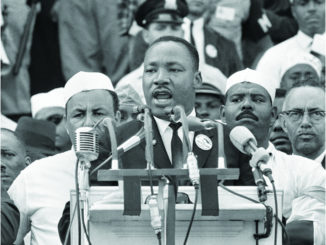
Near the end of the Birmingham campaign, in an effort to draw together the multiple forces for peaceful change and to dramatize to the country and to the world the importance of solving the U.S. racial problem, King joined other civil rights leaders in organizing the historic March on Washington. On August 28, 1963, an interracial assembly of more than 200,000 gathered peaceably in the shadow of the Lincoln Memorial to demand equal justice for all citizens under the law. Here the crowds were uplifted by the emotional strength and prophetic quality of King’s famous “I Have a Dream” speech, in which he emphasized his faith that all men, someday, would be brothers.
The rising tide of civil rights agitation produced, as King had hoped, a strong effect on national opinion and resulted in the passage of the Civil Rights Act of 1964, authorizing the federal government to enforce desegregation of public accommodations and outlawing discrimination in publicly owned facilities, as well as in employment. That eventful year was climaxed by the award to King of the Nobel Peace Prize in Oslo in December. “I accept this award today with an abiding faith in America and an audacious faith in the future of mankind,” said King in his acceptance speech. “I refuse to accept the idea that the ‘isness’ of man’s present nature makes him morally incapable of reaching up for the eternal ‘oughtness’ that forever confronts him.”
Challenges of the final years of Martin Luther King, Jr.
The first signs of opposition to King’s tactics from within the civil rights movement surfaced during the March 1965 demonstrations in Selma, Alabama, which were aimed at dramatizing the need for a federal voting-rights law that would provide legal support for the enfranchisement of African Americans in the South. King organized an initial march from Selma to the state capitol building in Montgomery but did not lead it himself. The marchers were turned back by state troopers with nightsticks and tear gas. He was determined to lead a second march, despite an injunction by a federal court and efforts from Washington to persuade him to cancel it. Heading a procession of 1,500 marchers, Black and white, he set out across Pettus Bridge outside Selma until the group came to a barricade of state troopers. But, instead of going on and forcing a confrontation, he led his followers to kneel in prayer and then unexpectedly turned back. This decision cost King the support of many young radicals who were already faulting him for being too cautious. The suspicion of an “arrangement” with federal and local authorities—vigorously but not entirely convincingly denied—clung to the Selma affair. The country was nevertheless aroused, resulting in the passage of the Voting Rights Act of 1965.
Throughout the nation, impatience with the lack of greater substantive progress encouraged the growth of Black militancy. Especially in the slums of the large Northern cities, King’s religious philosophy of nonviolence was increasingly questioned. The rioting in the Watts district of Los Angeles in August 1965 demonstrated the depth of unrest among urban African Americans. In an effort to meet the challenge of the ghetto, King and his forces initiated a drive against racial discrimination in Chicago at the beginning of the following year. The chief target was to be segregation in housing. After a spring and summer of rallies, marches, and demonstrations, an agreement was signed between the city and a coalition of African Americans, liberals, and labour organizations, calling for various measures to enforce the existing laws and regulations with respect to housing. But this agreement was to have little effect; the impression remained that King’s Chicago campaign was nullified partly because of the opposition of that city’s powerful mayor, Richard J. Daley, and partly because of the unexpected complexities of Northern racism.
In Illinois and Mississippi alike, King was now being challenged and even publicly derided by young Black-power enthusiasts. Whereas King stood for patience, middle-class respectability, and a measured approach to social change, the sharp-tongued, blue jean-clad young urban radicals stood for confrontation and immediate change. In the latter’s eyes, the suit-wearing, calm-spoken civil rights leader was irresponsibly passive and old beyond his years (King was in his 30s)—more a member of the other side of the generation gap than their revolutionary leader. Malcolm X went so far as to call King’s tactics “criminal”: “Concerning nonviolence, it is criminal to teach a man not to defend himself when he is the constant victim of brutal attacks.”
In the face of mounting criticism, King broadened his approach to include concerns other than racism. On April 4, 1967, at Riverside Church in New York City and again on the 15th at a mammoth peace rally in that city, he committed himself irrevocably to opposing U.S. involvement in the Vietnam War. Once before, in early January 1966, he had condemned the war, but official outrage from Washington and strenuous opposition within the Black community itself had caused him to relent. He next sought to widen his base by forming a coalition of the poor of all races that would address itself to economic problems such as poverty and unemployment. It was a version of populism—seeking to enroll janitors, hospital workers, seasonal labourers, and the destitute of Appalachia, along with the student militants and pacifist intellectuals. His endeavours along these lines, however, did not engender much support in any segment of the population.
Meanwhile, the strain and changing dynamics of the civil rights movement had taken a toll on King, especially in the final months of his life. “I’m frankly tired of marching. I’m tired of going to jail,” he admitted in 1968. “Living every day under the threat of death, I feel discouraged every now and then and feel my work’s in vain, but then the Holy Spirit revives my soul again.”
King’s plans for a Poor People’s March to Washington were interrupted in the spring of 1968 by a trip to Memphis, Tennessee, in support of a strike by that city’s sanitation workers. In the opinion of many of his followers and biographers, King seemed to sense his end was near. As King prophetically told a crowd at the Mason Temple Church in Memphis on April 3, the night before he died, “I’ve seen the promised land. I may not get there with you. But I want you to know tonight that we, as a people, will get to the promised land.” The next day, while standing on the second-story balcony of the Lorraine Motel, where he and his associates were staying, King was killed by a sniper’s bullet. The killing sparked riots and disturbances in over 100 cities across the country. On March 10, 1969, the accused assassin, a white man, James Earl Ray, pleaded guilty to the murder and was sentenced to 99 years in prison.
“The great force of history comes from the fact that we carry it within us, are unconsciously controlled by it in many ways, and history is literally present in all that we do.”― James Baldwin
December 31
December 31st – New Year’s Eve, the final evening of the Gregorian calendar year, traditionally a night for merry-making to welcome in the new year.
December 31, 1781 – The first bank in the U.S., the Bank of North America, received its charter from the Confederation Congress. It opened on January 7, 1782, in Philadelphia.
Thomas Edison
December 31, 1879 – Thomas Edison provided the first public demonstration of his electric incandescent lamp at his laboratory in Menlo Park, New Jersey.
December 31, 1971 – Austrian Kurt Waldheim became U.N. Secretary-General following the retirement of U Thant. Waldheim served until 1981 then resumed his career in Austrian politics. In 1986, he ran for the presidency. During the campaign, it was revealed he had likely given false information concerning his military service in the German Army during World War II. He claimed he left the army in 1942 after being wounded on the Russian Front, but allegations arose that he was actually lieutenant in 1943-44 stationed in the Balkans when Greek Jews were rounded up and sent to Nazi death camps and when atrocities were committed against Yugoslav resistance fighters.
Birthday – George C. Marshall (1880-1959) was born in Uniontown, Pennsylvania. He had genius for organization and served as Chief of Staff of the U.S. Army throughout World War II, expanding the Army from 130,000 to 8,300,000 men. He then served as Secretary of State under President Truman and designed the Marshall Plan for the relief of war-torn Europe and to halt the spread of Communism.
January 1
New Year’s Day – The most celebrated holiday around the world.
January 1, 1502 – Portuguese explorers landed at Guanabara Bay on the coast of South America and named it Rio de Janeiro (River of January). Rio de Janeiro is currently Brazil’s second largest city.
January 1, 1660 – Samuel Pepys began his famous diary in which he chronicled life in London including the Great Plague of 1664-65 and the Great Fire of 1666.
January 1, 1776 – During the American Revolution, George Washington unveiled the Grand Union Flag, the first national flag in America.
January 1, 1801 – Ireland was added to Great Britain by an Act of Union thus creating the United Kingdom of Great Britain and Ireland.
January 1, 1863 – The Emancipation Proclamation by President Abraham Lincoln freed the slaves in the states rebelling against the Union.
Queen Victoria
January 1, 1877 – Queen Victoria was proclaimed Empress of India.
January 1, 1892 – Ellis Island in New York Harbor opened. Over 20 million new arrivals to America were processed until its closing in 1954.
January 1, 1901 – The Commonwealth of Australia was founded as six former British colonies became six states with Edmund Barton as the first prime minister.
January 1, 1915 – During World War I, the British Battleship Formidable was hit by a torpedo in the English Channel, killing 547 crewmen.
January 1, 1942 – Twenty-six countries signed the Declaration of the United Nations, in Washington, D.C., reaffirming their opposition to the Axis powers and confirming that no single nation would make a separate peace.
January 1, 1958 – The EEC (European Economic Community) known as the Common Market was formed by Belgium, France, West Germany, Italy, Luxembourg and The Netherlands in order to remove trade barriers and coordinate trade policies.
January 1, 1959 – Fidel Castro seized power in Cuba after leading a revolution that drove out Dictator Fulgencio Batista. Castro then established a Communist dictatorship.
January 1, 1973 – Britain, Ireland and Denmark became members of the Common Market (EEC).
January 1, 1975 – During the Watergate scandal, former top aides to President Nixon including former Attorney General John Mitchell, Domestic Affairs Advisor John Ehrlichman and Chief of Staff H.R. Haldeman, were found guilty of obstruction of justice.
January 1, 1979 – China and the U.S. established diplomatic relations, 30 years after the foundation of the People’s Republic.
January 1, 1993 – Czechoslovakia broke into separate Czech and Slovak republics.
January 1, 1999 – Eleven European nations began using a new single European currency, the Euro, for electronic financial and business transactions. Participating countries included Austria, Belgium, Finland, France, Germany, Ireland, Italy, Luxembourg, Netherlands, Portugal and Spain.
Birthday – American Patriot Paul Revere (1735-1818) was born in Boston, Massachusetts. Best known for his ride on the night of April 18, 1775, warning Americans of British plans to raid Lexington and Concord.
Birthday – Betsy Ross (1752-1836) was born in Philadelphia, Pennsylvania. She was a seamstress credited with helping to originate and sew the Stars and Stripes flag of America in 1776.
January 2
January 2, 1905 – The Russians surrendered to the Japanese after the Battle of Port Arthur during the Russian Japanese War. A peace conference was later held in Portsmouth, New Hampshire, with President Theodore Roosevelt serving as a mediator. In September of 1905, the Russians agreed to the Treaty of Portsmouth yielding Port Arthur and the Liaodong Peninsula to Japan. Russia also agreed to evacuate Manchuria and recognize Japan’s interests in Korea.
January 2, 1942 – During World War II in the Pacific, the Japanese captured the Philippines capital of Manila and the nearby air base at Cavite.
John F. Kennedy
January 2, 1960 – In Washington, D.C., Senator John F. Kennedy announced his intention to seek the Democratic presidential nomination.
January 3
January 3, 1777 – During the American Revolution, General George Washington defeated the British at Princeton and drove them back toward New Brunswick. Washington then established winter quarters at Morristown, New Jersey. During the long harsh winter, Washington’s army shrank to about a thousand men as enlistments expired and deserters fled.
January 3, 1924 – British Egyptologist Howard Carter found the sarcophagus of Tutankhamen in the Valley of the Kings near Luxor after several years of searching.
January 3, 1946 – An Englishman known during World War II as “Lord Haw Haw” (William Joyce) was hanged for treason in London. Joyce had broadcast Nazi propaganda via radio from Germany to Britain during the war.
January 3, 1959 – Alaska was admitted as the 49th U.S. state with a land mass almost one-fifth the size of the lower 48 states together.
January 3, 1961 – President Dwight D. Eisenhower broke off diplomatic relations with Cuba two years after Communist dictator Fidel Castro had seized power and just weeks before John F. Kennedy was inaugurated as the next president.
January 3, 1990 – Manuel Noriega, the deposed leader of Panama, surrendered to American authorities on charges of drug trafficking after spending 10 days hiding in the Vatican embassy following the U.S. invasion of Panama.
January 3, 1993 – President George Bush and Russian President Boris Yeltsin signed the Start-II (Strategic Arms Reduction Talks) Treaty, eliminating about two-thirds of each country’s long range nuclear weapons.
January 4
January 4, 1790 – President George Washington delivered the first State of the Union address.
January 4, 1974 – President Richard Nixon rejected subpoenas from the Senate Watergate Committee seeking audio tapes and related documents.
Louis Braille
Birthday – Louis Braille (1809-1852) was born in France. Blinded as a boy, he later invented a reading system for the blind using punch marks in paper.
January 5
January 5, 1919 – German Communists in Berlin led by Rosa Luxemburg and Karl Liebknecht attempted to take over the government by seizing a number of buildings. However, ten days later, they were both assassinated by German soldiers.
January 5, 1919 – The German Workers’ Party (Deutsche Arbeiterpartei) was founded by Anton Drexler in Munich. Adolf Hitler became member No. 7 and changed the name in April of 1920 to the National Socialist German Workers’ Party (Nationalsozialistische Deutsche Arbeiterpartei) commonly shortened to Nazi or Nazi Party.
January 5, 1925 – Nellie Tayloe Ross of Wyoming became the first female governor inaugurated in the U.S.
January 5, 1968 – Alexander Dubcek became first secretary of Czechoslovakia’s Communist Party. He introduced liberal reforms known as “Communism with a human face” which resulted in Soviet Russian troops invading Prague to crack down.
January 5, 1972 – President Richard Nixon signed a bill approving $5.5 billion over six years to build and test the NASA space shuttle.
January 5, 1976 – In Cambodia, the Khmer Rouge led by Pol Pot announced a new constitution which legalized the Communist government and renamed the country as Kampuchea. During the reign of Pol Pot, over 1 million persons died in “the killing fields” as he forced people out of the cities into the countryside to create an idyllic agrarian society. Educated and professional city people were especially targeted for murder and were almost completely annihilated. In January of 1979, the Pol Pot was overthrown by Cambodian rebels and Vietnamese troops.
Birthday – King Juan Carlos I of Spain was born in Rome on January 5, 1938. He was chosen by Francisco Franco to inherit his right-wing dictatorship and was sworn in as King on November 22, 1975, two days after Franco’s death. The new King then announced his intention to mold Spain into a broadly based democratic society.
January 6
January 6, 1066 – Harold, Earl of Wessex, was crowned King of England following the death of his brother-in-law Edward the Confessor. Harold II was England’s last Anglo-Saxon king. In October of 1066, Harold met the invading army of William the Conqueror at Hastings and died on the field of battle.
January 6, 1941 – President Franklin Roosevelt delivered his State of the Union address to Congress asking for support for the lend-lease program aiding Allies fighting the Axis powers. Roosevelt also defined four essential freedoms worth defending; freedom of speech, freedom of worship, freedom from want, and freedom from fear.
January 6, 1990 – Poland’s Communist Party disbanded and then reorganized as the Social Democratic Party, an opposition party to Solidarity.
Capitol in Washington is attacked
January 6, 2020-President Donald Trump’s supporters stormed the Capitol in Washington with the intention of disrupting the certification of election results by the Congress. The violent mob assaulted law enforcement officers, vandalized property and occupied the building for several hours. Five people died either shortly before, during, or following the event: one was shot by Capitol Police, another died of a drug overdose, and three died of natural causes. Many people were injured, including 138 police officers. Four officers who responded to the attack died by suicide within seven months.
Joan of Arc
Birthday – Joan of Arc (1412-1431) was born in France. After a series of mystic visitations by saints, she inspired French troops to break the British siege at Orleans and win several important victories during the Hundred Years’ War (1337-1453) between France and Britain. She was eventually captured and sold to the British who tried her for heresy and burned her at the stake. In 1920, Joan of Arc was canonized a saint by the Roman Catholic Church.
Signup to our Newsletter!
Don’t miss out on all the happenings around the world