Tag: Johns Hopkins-SAIS

  • Indian Americans regularly encounter discrimination and polarization: Survey by YouGov

    Indian Americans regularly encounter discrimination and polarization: Survey by YouGov

    WASHINGTON (TIP): Indian-Americans, who constitute the second-largest immigrant group in the US, regularly encounter discrimination and polarization, according to a survey released on Wednesday.

    The report, ‘Social Realities of Indian Americans: Results from the 2020 Indian American Attitudes Survey’ draws on the Indian-American Attitudes Survey (IAAS) — a collaboration between the Carnegie Endowment for International Peace, Johns Hopkins-SAIS, and the University of Pennsylvania.

    The findings of the report are based on a nationally representative online survey of 1,200 Indian-American residents in the US — the 2020 IAAS — conducted between September 1 and September 20, 2020, in partnership with the research and analytics firm YouGov, it said in a statement. “Indian-Americans regularly encounter discrimination. One in two Indian Americans reports being discriminated against in the past one year, with discrimination based on skin color identified as the most common form of bias.

    “Somewhat surprisingly, Indian-Americans born in the United States are much more likely to report being victims of discrimination than their foreign-born counterparts,” said the report.

    According to the report, Indian-Americans exhibit very high rates of marriage within their community.

    While eight out of 10 respondents have a spouse or partner of Indian-origin, US-born Indian-Americans are four times more likely to have a spouse or partner who is of Indian-origin but was born in the United States.

    The survey found that religion plays a central role in the lives of Indian-Americans but religious practice varies.

    While nearly three-quarters of Indian-Americans state that religion plays an important role in their lives, religious practice is less pronounced.

    Forty per cent of respondents pray at least once a day and 27 per cent attend religious services at least once a week.

    The report notes that roughly half of all Hindu Indian-Americans identify with a caste group. Foreign-born respondents are significantly more likely than US-born respondents to espouse a caste identity. The overwhelming majority of Hindus with a caste identity — more than eight in 10 — self-identify as belonging to the category of General or upper caste. “Indian-American” itself is a contested identity. While Indian-American is commonly used shorthand to describe people of Indian-origin, it is not universally embraced. Only four in 10 respondents believe that “Indian-American” is the term that best captures their background, the report said.

    Civic and political engagement varies considerably by one’s citizenship status. Across nearly all metrics of civic and political participation, US-born citizens report the highest levels of engagement, followed by foreign-born US citizens, with non-citizens trailing behind.

    Other people of Indian-origin heavily populate Indian-Americans’ social communities. Indian-Americans — especially members of the first generation — tend to socialize with other Indian-Americans.

    Internally, the social networks of Indian-Americans are more homogenous in terms of religion than either Indian region (state) of origin or caste.

    The report says that polarization among Indian-Americans reflects broader trends in the American society.

    “While religious polarization is less pronounced at an individual level, partisan polarization — linked to political preferences both in India and the United States — is rife. However, this polarization is asymmetric: Democrats are much less comfortable having close friends who are Republicans than the converse,” it said.

    The same is true of Congress Party supporters’ as compared to the supporters of the BJP.

    “To some extent, divisions in India are being reproduced within the Indian-American community. While only a minority of respondents are concerned about the importation of political divisions from India to the United States, those who identify religion, political leadership and political parties in India as the most common factors,” the report added.

    Indian-Americans comprise slightly more than 1 per cent of the total US population-and less than 1 per cent of all registered voters.

    Indian Americans are the second-largest immigrant group in the United States. There are 4.2 million people of Indian origin residing in the United States, according to 2018 data.

  • Indian Americans divided, polarization increasing: Survey

    Indian Americans divided, polarization increasing: Survey

    The survey — “How Do Indian Americans View India?” — was conducted in collaboration between the Carnegie Endowment for International Peace, Johns Hopkins-SAIS and the University of Pennsylvania.

    The Indian diaspora in the United States is deeply divided over the direction India is headed, according to a first-of-its-kind survey of Indian Americans that was released early this month.

    It also shows that religious polarization is increasing among Indian Americans, one of the authors of the survey told indica News. The survey — “How Do Indian Americans View India?” — was conducted in collaboration between the Carnegie Endowment for International Peace, Johns Hopkins-SAIS and the University of Pennsylvania.

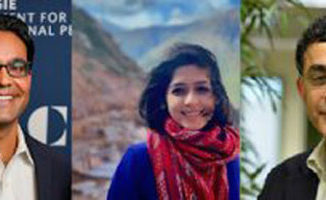
    It is authored by University of Pennsylvania professor Sumitra Badrinathan, Devesh Kapur of Johns Hopkins-SAIS, and Milan Vaishnav, director and senior fellow, South Asia Program, Carnegie Endowment for International Peace.

    Vaishnav told indica News that they fielded a nationwide survey in September 2020 in partnership with YouGov. That survey had three modules: one on US politics, one on Indian domestic affairs, and one on Indian-American social identity and social relations.

    “Our plan is to release one report on each,” Vaishnav said. “We hope to publish our third and final report of this series in May 2021.”

    Asked what prompted the survey, Vaishnav said: “There have been surveys of Americans about India and surveys of Indians about America but there have not been, to our knowledge, surveys of Indian Americans about India.

    “Prime Minister Narendra Modi has made outreach to the diaspora a critical element of his foreign policy, but we know very little about how Indian Americans view their ancestral homeland. So that really was the inspiration,” he added. The survey had questions on how Indians in America regard India, how do they remain connected to developments there, what are their attitudes toward Indian politics and changes underway in their ancestral homeland, and what role, if any, do they envision for the US in engaging with India.

    Vaishnav said they interviewed 1,200 Indian Americans across the country, ages 18 and older, and wanted to make sure that the sample contained both US citizens and non-citizens given that the latter constitute a significant share of the overall diaspora population.

    The survey shows that 44 percent of US-born Indian Americans believe the country is on the wrong track, compared to 36 percent of foreign-born Indian Americans. Roughly 25 percent of respondents expressed no opinion. However, many Indian Americans hold ‘relatively more conservative’ views on Indian policies — such as those affecting protection of religious minorities, immigration, and affirmative action.

    As an example, 90 percent of respondents supported treating members of all faiths equally. Of these, 60 percent expressed opposition to the ‘Muslim travel ban’ imposed by Donald Trump but only 49 percent opposed the Indian government’s controversial citizenship law.

    Similarly, 69 percent supported the idea of more liberal immigration policies in the US and 55 percent supported less stringent policies. However, only 45 percent indicated they were opposed to the controversial all-India National Register of Citizens exercise proposed by the Indian government.

    The report shows 18 percent believed government corruption to be India’s most pressing challenge, followed by 15 percent who listed the economy as their area of concern. Another 10 percent of respondents cited religious majoritarianism as the country’s most important challenge.

    Indian Americans are also divided about US action to strengthen India’s military as a check against China, which only 7 percent of respondents saw as the top challenge facing the Narendra Modi government today.

    Only 53 percent of foreign-born respondents and 38 percent of US-born respondents supported that move, with the rest either in disagreement or expressing no opinion.

    The division over support for the US strengthening India’s military also plays out politically — 69 percent of Indian Americans who identify as Republican support this, as compared to only 41 percent of Democrats; they are also more likely to say they do not want the US to provoke China. Despite their misgivings about where India was headed, 49 percent of the respondents gave a thumbs-up to Modi’s performance as prime minister. The survey said that 32 percent disapproved of him, while the rest said they had no opinion.

    Asked what surprised him in the outcome of the survey, Vaishnav said: “A few things surprised us. First, 30 percent of Indian Americans favor the BJP while just 12 percent support the Congress party.”


    He also said that 40 percent do not espouse a partisan identity when it comes to Indian politics.


    “We were especially struck by how low the Congress party number was. Rahul Gandhi and the Congress party rate very poorly compared to Modi, the BJP, and even the RSS. Second, we were also surprised at the mixed views on India’s trajectory,” Vaishnav said.


    “Respondents were nearly evenly split as to whether India is currently on the right track or headed down the wrong track. This is not the picture one gets from most media narratives.”


    He also said: “I think we are seeing really striking evidence of polarization within the community, especially on religious grounds.


    “On a number of issues, Hindus and non-Hindus hold pretty diverging views on politics, especially back in India,” Vaishnav said.


    “The polarization we view in India is clearly seeping into the diaspora as well. This means a more fragmented, heterogeneous community going forward.”

    (Courtesy Indica / Ritu Jha)