Tag: JP Morgan

  • JP Morgan says unsecured loans to China developers a ‘risky move’

    JP Morgan says unsecured loans to China developers a ‘risky move’

    Beijing (TIP) – Any step by China to allow banks to provide unsecured loans to eligible developers “would be a risky move” for the lenders, JPMorgan Chase & Co has said.
    Such a measure “would be negative for banks as it would raise concerns about national-service risk and credit risk in the medium term,” the bank’s analysts wrote in a note. The analysts, including Katherine Lei and Karl Chan, added that implementation “would be challenging, as banks could circumvent such guidance due to credit-risk concerns”.
    China is considering allowing lenders to issue loans not backed up by collateral to some builders, which could potentially free up capital for debt repayment, Bloomberg News reported on Thursday (Nov 23), citing sources.
    Analysts have said that Beijing’s ramping up the pressure on banks to support the struggling real estate sector is a signal that President Xi Jinping’s tolerance for property sector pain is nearing its limit.
    The rescue moves are aimed at easing the real estate industry’s cash crunch, sources said, underscoring the anxiety among China’s top leadership over the protracted crisis. Beijing also wants to ensure developers have enough cash to finish the millions of homes under construction, even if it means added risks for its banks.
    The optimistic take is that if firms like Country Garden Holdings can use the cash infusion to finish homes and avoid more headline-grabbing defaults, buyers will regain confidence and sales will rebound. Banks could even avoid losses if the sector stabilises.
    The unprecedented move, part of a package of new measures, are aimed at tackling a crisis marked by numerous defaults and fears of contagion in financial markets. The authorities are reportedly finalising a draft list of 50 developers eligible for financial aid, including Country Garden Holdings and Sino-Ocean Group.
    Though the developments sparked a rally in property shares as well as the broader China market on Thursday, stocks fell again on Friday. A Bloomberg Intelligence gauge of developer stocks retreated more than 2 per cent on Friday; a broader index of Chinese stocks traded in Hong Kong dropped as much as 1.8 per cent.
    Bank shares have remained under pressure, as the latest report adds to investor concerns about their profitability and asset quality. Chinese lenders have been battling with shrinking margins and rising bad loans since they were drafted by the authorities to backstop the struggling economy and prevent risk spillover from the sluggish property sector.
    The brokerage suggests going long property shares and shorting banks if the report on unsecured loans eventually pans out. Continuous positive news flow may support property shares in the short-term, the analysts said, but they warned that it may not be sustainable. More liquidity support to private developers may come only selectively and conditionally, they added.
    Banks have been the weak link in China’s rescue attempts so far. Despite government exhortations since late last year for them to lend more, property loans fell year on year in the third quarter – the first time this has happened. Banks made 2.4 trillion yuan (S$450 billion) in property development loans in the first three quarters, according to China’s financial regulator. Source: Bloomberg

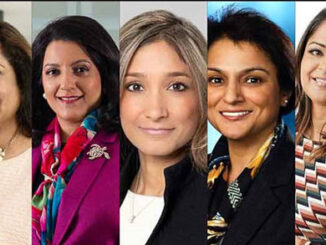
  • Five Indian American women among Barron’s 100 most influential women in US finance

    Five Indian American women among Barron’s 100 most influential women in US finance

    NEW YORK (TIP): Five Indian American women figure in Barron’s fourth annual list of the 100 Most Influential Women in US Finance honoring “women who have achieved positions of prominence in the financial services industry and are helping to shape its future.” Chosen by a panel of Barron’s writers and editors based on external and internal nominations, the list includes executives at major US companies, investment managers and securities analysts, and public servants and policy makers.
    Indian Americans on the list are Anu Aiyengar, Global Head, Mergers and Acquisitions, JP Morgan, Rupal J Bhansali, Chief Investment Officer & Portfolio Manager, Global Equities, Ariel Investments, Meena Lakdawala-Flynn, Co-Head, Global Private Wealth Management, Goldman Sachs Group, Sonal Desai, Chief Investment Officer, Fixed Income, Franklin Templeton, and Savita Subramanian, Head of US Equity & Quantitative Strategy, Bank of America Securities.
    Anu Aiyengar has been in mergers and acquisitions from early in her career, according to her Barron’s profile. She is the only person of color and the sole woman to carry this position on Wall Street.
    Since 1999, she has advised both domestic and international clients on over $500 billion worth of transactions including mergers, acquisitions, divestitures/separations, leveraged buyouts, proxy contests, unsolicited transactions and special committee assignments. She also serves on JP Morgan’s fairness and valuation committee. As the co-chair of the Investment Bank’s women network Aiyengar is involved with several initiatives across JP Morgan and Wall Street to recruit, mentor and develop women.
    She is also co-chair of the Smith Business Advisory Network. Aiyengar lives in New York City with her husband. She has a BA in economics from Smith College and an MBA from Vanderbilt University.
    Rupal J. Bhansali, 55, broke through the glass ceiling and now uses her position as a senior leader to help other women succeed in finance. “My mantra is: I want women to earn money, learn money, manage money, and multiply money,” she told Barron’s. Bhansali manages more than $7 billion, including Ariel’s International Fund and Global Fund. This is her third appearance on Barron’s 100 list.
    After joining the board of the nonprofit 100 Women in Finance, she launched the webinar series “Candid Conversations with CIOs,” to give women an insider’s view of what it takes to become a chief investment officer and to show the impact that investors can have when managing billions of dollars in funds.
    “It’s said that women can’t be what they can’t see, so this is my effort of giving female CIOs more visibility and trying to showcase to our industry at large that this is what you can be,” she told the magazine.
    She earned a Bachelor of Commerce in accounting and finance, as well as a Master of Commerce in international finance and banking from the University of Mumbai. She later earned an MBA in finance from the University of Rochester, where she was a Rotary Foundation Scholar.
    Sonal Desai, 58, is responsible for overseeing Franklin’s Municipal, Corporate Credit, Floating Rate, Multisector, Global (including Emerging Markets), and Money Market Fixed Income teams.
    She is also a portfolio manager for a number of strategies. A member of Franklin Resources’ executive committee, a small group of the company’s top leaders responsible for shaping the firm’s overall strategy, she also serves on the firm’s Management and Investment Committees.
    Before her current role, she served as a portfolio manager with Dr Michael Hasenstab for the flagship Templeton Global Bond and Templeton Global Total Return strategies, as well as director of research for Templeton Global Macro.
    Desai started her career as an assistant professor of economics at the University of Pittsburgh and then worked for over six years at the International Monetary Fund in Washington, DC.
    Following this, she joined the private financial sector and worked for about five years as director and senior economist for Dresdner Kleinwort Wasserstein in London.
    Desai joined Franklin Templeton in 2009. She holds a Bachelor of Arts in economics from Delhi University and a PhD in economics from Northwestern University.
    Savita Subramanian, 50, is head of US Equity Strategy & US Quantitative Strategy and a managing director at Bank of America Merrill Lynch. She is responsible for determining forecasts for the S&P 500, recommending US sector allocations and themes, and developing and marketing the firm’s US equity strategy product to institutional and individual clients.
    Subramanian is also a member of the firm’s Research & Recommendations Committee and a member of the Bank of America Merrill Lynch Diversity & Inclusion Council.
    She has received high ranks in industry surveys including the Institutional Investor All America Research Team (ranked for the past 6 years) Greenwich Research survey, and Bloomberg Markets World’s Top Analysts.
    Subramanian frequently appears in television and print journalism and is a member/board member of Q Group, Chicago Quantitative Alliance, the Society of Quantitative Analysts and Women on Wall Street.
    Before joining Merrill Lynch in 2001, Subramanian was an analyst at Scudder Kemper Investments in New York and San Francisco. She received a Bachelor of Arts degree with a double major in Mathematics and Philosophy with Honors from UC Berkeley and an MBA degree from Columbia University. Meena Flynn’s career in finance began soon after a sports injury, according to Barron’s. A zealous gymnast who at one point wanted to compete in the Olympics, Flynn had to stay at George Washington University one summer to rehabilitate her knee.
    She did an internship at Friedman, Billings, Ramsey Group, working on the institutional equity sales desk. “The moment I stepped foot onto that trading floor, it was competitive juices flowing,” recalls Flynn, co-head of global private wealth management at Goldman Sachs Group. “I just loved the markets and how micro and macro come together from an investing perspective.” Flynn, 45, joined JPMorgan Chase in 1999. The following year, Flynn moved to Goldman Sachs, becoming a partner in 2014. Today she wears several hats, including co-chairing the global inclusion and diversity committee. She recently attended a marquee event in California for a program called In the Lead, which caters to ultrahigh-net-worth women.

  • Future of U.S.  Economy

    Future of U.S. Economy

    By Ven Parmeswaran

    “America’s 20 trillion economy will rebound from third quarter and shock the world in the fourth quarter. The stock market will make a new high this year. Jamie Dimon, chairman of JP Morgan, a staunch Democrat, says U.S. economy will witness “quite rapid recovery” from Coronavirus pandemic”, says the author.


    The stock market is a leading indicator of American economy.  After President Trump was elected in 2016, the Dow Jone’s Average has jumped from 18,000 to almost 30,000.  Because of Coronavirus and subsequent locked-in, the market plunged back to 18,000 by March 23, 2020.  From March 23, 2020 to May 27, 2020, the Dow Jone’s has recovered 7540 points in a matter of two short months.  This kind of rapid recovery has been unprecedented in the history of the stock market.   This is highly remarkable and a very significant factor to gauge future economy.  The NASDAQ dominated by trillion-dollar technology companies (Microsoft, Apple, Amazon, Google) have performed even better than the Dow Jone’s.  The Nasdaq is now only 5% from its all-time high reached in February before the Coronavirus.

    Never before, the stock market has performed breaking all past records.  President Trump and his policies have been credited by the investors and all Americans who have their pension funds invested in the market (401-K).  Once the market performs, nobody can challenge because all Americans believe in higher wages and prosperity.  Americans are wondering how the market could go up so big and so rapidly when the economy has been shut and the unemployment has exceeded historical record of over 20%. How can the market go up when the business of travel, restaurants, retail sales, manufacturing, and others have been stopped because of locked-ins?

    The Federal Reserve cut the interest rate to zero per cent.  The Federal Reserve is an independent agency.  But President Trump pressured its Chairman Powell to lower the interest rate to zero.  Now he has asked him to lower it further into negative interest rate so that it will grow the economy.    The Federal Reserve has flooded the financial markets, commercial and investment banks, asset management firms, and large hedge funds with approximately 7 trillion dollars.  What the Fed has done is unprecedented.  Powell, the Fed Chairman has assured the captains of the industry that the Fed will employ all tools available in its hand to help the economy grow.   With generous tax cuts and heavy deregulations by President Trump, potential for corporate profits have expanded.   In addition, President Trump’s recommendation to the Congress to approve $3 trillion in fiscal support to all Americans, small businesses, and other businesses in distress have helped enormously in recovery of the economy.   Generous unemployment compensation of $1200 per week has created unbelievable security and is perking the economy.

    Americans received $1200 each and the government postponed filing of tax returns to July from April 15.  Proof of climbing retail sales is the result of President Trump’s fiscal support.  President Trump and the Congress are working on issuing second installment of $2000 each to drum up the economy.

    The combined support from the Fed Reserve and the Congress is equal to 50% of America’s annual GDP of 20 trillion dollars.   I would speculate that a substantial amount from this has gone into investing in stocks.  Can we not ask how can the stocks skyrocket like this when the economy has been shut down and more than 40 million are unemployed?    When the real economy is not generating any income based on productivity, how can the stock go up?     President Trump has said that the economy he created is a solid and sound economy.  Therefore, when the locked in is over, the economy will rebound and the stock market will go up like a rocket.  Proof of the pudding lies in the eating of it.  It appears now that President Trump’s prophesies are coming true.

    Has the Fed Chairman Powell succeeded in playing magic?  Or, is this artificial? Who knows?  Let me analyze the comments of some vehement Democrats, economists, and industry captains.

    JPMorgan Chairman, Jamie Dimon, a staunch Democrat and a candidate for the Secretary of the Treasury in Biden administration stated that the government has been pretty responsive, big companies have the means, hope we keep the small companies alive.”  “growing stocks” from the Fed Reserve had helped small business.  He said the U.S. economy could see a rapid recovery in the 3rd quarter.    He said: “you can already see the positive effects of the current opening, at least for the economy.”    The same Jamie Dimon has been highly critical of President Trump just for political purposes.  But when his own company and stocks of major banks and financial firms go up, he cannot but tell the truth.

    Michael Darda, MKM Partners Chief Market Strategist and Chief Economist said: “The market has been making a V-pattern upward and there has been a tremendous amount of skepticism around that but we are just starting now to see some evidence in the data turning some better than expected Housing numbers.  As reopening gets underway, virtually all states now we are starting to see activity bounce off of very low levels.”

    On Wednesday, May 27, the Mortgage Bankers Association reported a sixth straight weekly rise in mortgage applications.  Data released Tuesday showed NEW HOME SALES in April topped estimates.  Sales of new U.S. SINGLE FAMILY HOMES increased by 623,000 in April, beating estimates of 490,000.

    Wharton School of Business Professor Jeremy Siegel told that new stock market highs this year is a ‘REAL POSSIBILITY’.   Absent a second wave of Coronavirus later in the Fall, it is “even a likelihood that we will reach “fresh record highs.”     This kind of over optimism from conservative and liberal economists is unprecedented.

    “One of the unfortunate things about the lockdown is we have actually improved the prospects of the very companies in the stock markets.” Siegel added.     “In fact, given no serious second wave, which could mean just effective therapeutics without even a universal vaccine, my feeling is it is even a likelihood that we will reach fresh record highs.” Siegel said.

    (The author is a former President & CEO, First Asian Securities Corporation, NYC.  His successful trading strategies on the day of 1987 stock market crash was highlighted by the WSJ.  He lives in Scarsdale, N.Y. He can be reached at vpwaren@gmail.com)

  • Indian American Surgeon Atul Gawande Appointed CEO Of Amazon-JP Morgan Venture

    Indian American Surgeon Atul Gawande Appointed CEO Of Amazon-JP Morgan Venture

    NEW YORK(TIP): Indian American surgeon, writer and public health innovator Atul Gawande has been named as the CEO of a new US employee health care company, a joint venture between Amazon, Berkshire Hathaway and JPMorgan Chase, the three American majors announced on June 21.

    Mr Gawande, 52, will take over as the Chief Executive Officer of the company from July 9. The new company will be headquartered in Boston and will operate as an independent entity that is free from profit-making incentives and constraints.

    Mr Gawande said he was “thrilled” to be named the CEO of the health care initiative.

    “I have devoted my public health career to building scalable solutions for better health care delivery that are saving lives, reducing suffering and eliminating wasteful spending both in the US and across the world,” he said.

    “Now I have the backing of these remarkable organizations to pursue this mission with even greater impact for more than a million people, and in doing so incubate better models of care for all. This work will take time but must be done. The system is broken, and better is possible,” he said.

    Mr Gawande practices general and endocrine surgery at Brigham and Women’s Hospital and is Professor at the Harvard TH Chan School of Public Health and Harvard Medical School.

    He is founding executive director of the health systems innovation center, Ariadne Labs and is also is a staff writer for The New Yorker magazine.

    Mr Gawande has written four New York Times bestsellers: Complications, Better, The Checklist Manifesto, and Being Mortal and has received numerous awards for his contributions to science and health care.

    Berkshire Hathaway Chairman and CEO Warren Buffett said talent and dedication were manifest among many professionals the trio interviewed. “All felt that better care can be delivered and that rising costs can be checked. Jamie, Jeff and I are confident that we have found in Atul the leader who will get this important job done,” he said.

    Chairman and CEO of JPMorgan Chase Jamie Dimon said in a statement that as employers and as leaders, addressing health care was one of the most important things that can be done for employees and their families, as well as for the communities.

    “Together, we have the talent and resources to make things better, and it is our responsibility to do so. We’re so grateful for the countless statements of support and offers to help and participate, and we’re so fortunate to have attracted such an extraordinary leader and innovator as Atul,” he said.

    “We said at the outset that the degree of difficulty is high, and success is going to require an expert’s knowledge, a beginner’s mind, and a long-term orientation,” said Jeff Bezos, founder and CEO of Amazon.

    “Atul embodies all three, and we’re starting strong as we move forward in this challenging and worthwhile endeavor,” he said.

    Buffet, Dimon and Bezos had announced the partnership in January to tackle rising health-care costs.