Tag: Judiciary

  • 2025 Supreme Court Review: Key judgments on women’s reservation, presidential reference, constitutional rights

    2025 Supreme Court Review: Key judgments on women’s reservation, presidential reference, constitutional rights

    The year 2025 proved to be a landmark one for the Supreme Court of India. As the nation grappled with social change, governance debates, and questions of constitutional authority, the apex court delivered a series of rulings that left an enduring imprint on Indian law, politics, and society. From clarifying the powers of the President and Governors, to advancing women’s representation in legal institutions, to reinforcing fundamental rights, the Court’s judgments reflected a careful balancing of tradition, equity, and constitutional principles.
    Presidential Reference on Assent Powers: Upholding Institutional Independence
    In November, the Supreme Court issued its advisory opinion on a Presidential Reference regarding the powers of the President and Governors to grant assent to bills passed by state legislatures. The Court clarified that no fixed timeline can be imposed on the President or Governors for assenting to legislation, holding that the concept of “deemed assent” was incompatible with the Constitution’s basic structure.
    The judgment was a strong reaffirmation of the separation of powers, ensuring that constitutional authorities retain independent discretion without being coerced by deadlines or political pressure. Legal analysts hailed this opinion as an important milestone in safeguarding federal balance and the deliberative processes of democracy.
    Women’s Reservation in State Bar Councils: Advancing Gender Equity
    Another socially transformative ruling came in the form of a mandate for 30 percent representation of women in State Bar Councils. The Court ordered that 20 percent of seats be filled through elections, with 10 percent through co-option by existing council members.
    This judgment addressed the stark under-representation of women in legal governing bodies, and was widely celebrated as a progressive step toward substantive equality. Advocates argued that it would not only empower female legal professionals but also reshape decision-making and policy formulation in India’s legal institutions.
    Balancing Culture and Environment: Firecracker Regulations
    Ahead of Diwali, the Court modified earlier restrictions on firecrackers in the Delhi-NCR region, allowing licenced traders to sell NEERI-certified “green crackers” under regulated conditions. This ruling demonstrated the Court’s nuanced approach, balancing environmental concerns with cultural and religious practices, and underscored its role as a mediator between social values and ecological responsibility.
    Tribunal Reforms Act: Protecting Judicial Independence
    In a pivotal judgment on administrative law, the Supreme Court struck down key provisions of the Tribunal Reforms (Rationalisation and Conditions of Service) Act, 2021, reiterating that tribunals must remain insulated from executive interference. By safeguarding the impartiality of adjudicatory bodies outside regular courts, the Court reinforced a core tenet of constitutional governance: that justice institutions must operate free from undue influence to maintain public trust.
    Criminal Justice: Upholding the Standard of Proof
    The apex court also delivered a critical criminal law judgment in the Nithari serial killings case. Reversing the conviction of Surendra Koli, the Court underscored that suspicion cannot replace proof beyond reasonable doubt. The ruling reaffirmed that convictions must be anchored in solid evidence, not expediency or public sentiment, emphasizing the judiciary’s role as a guardian of fair trial and due process.
    Judicial Service Eligibility: Emphasizing Practical Experience
    In 2025, the Court reinstated the requirement of three years of practical legal practice for candidates seeking judicial service, emphasizing that courtroom experience is essential for competent adjudication. This decision reinforced professional standards in the judiciary and highlighted the importance of experience in administering justice effectively.

    Animal Welfare and Public Safety: Stray Dog Sterilization
    Demonstrating sensitivity to public health and animal welfare, the Court directed that sterilized, vaccinated, and dewormed stray dogs should be returned to their locality, rather than confined indefinitely in shelters. Exceptions applied to aggressive or rabies-suspected animals. This judgment reflected a balanced approach to rights, safety, and humane treatment.
    2025 in Retrospect: Constitutional Rights, Social Justice, and Judicial Oversight
    Taken together, the Supreme Court’s 2025 judgments reflect a judiciary conscious of its constitutional mandate, social responsibilities, and role in governance. Whether clarifying presidential powers, promoting gender equality, or protecting fundamental rights, the Court consistently reinforced principles of democracy, fairness, and institutional integrity.
    Legal scholars have described the year’s rulings as a demonstration of judicial foresight-where courts did not merely interpret law, but actively shaped the contours of governance, justice, and social equity.
    2025 will be remembered as a year when the Supreme Court not only clarified legal ambiguities but also advanced the cause of social justice, gender equity, and constitutional safeguards, reaffirming its position as the guardian of India’s democratic framework.

  • India’s journey of triumphs, trials and transformation

    India’s journey of triumphs, trials and transformation

    When the clock struck midnight on August 15, 1947, a newly free India stepped into the unknown-scarred by Partition, burdened by poverty, yet fuelled by an unyielding spirit. As Pandit Nehru spoke of the nation’s “tryst with destiny,” few could have imagined that within eight decades, this struggling colony would emerge as a global powerhouse-economically dynamic, technologically advanced, and democratically resilient.
    But progress has not been even. India’s post-independence journey has been a tale of two realities: extraordinary achievements on one hand, and stubborn challenges on the other.
    Achievements: Building a Modern Nation
    Democracy: India’s Greatest Triumph
    Universal Adult Franchise from Birth: Unlike many new nations that restricted voting to the educated or wealthy, India trusted its citizens fully. Every adult, regardless of caste, gender, or literacy, had a vote.
    Stable Democratic Institutions: Over seventeen general elections and hundreds of state polls, India has witnessed peaceful transfers of power-even after deeply divisive campaigns.
    Robust Judiciary and Free Press: The Supreme Court’s power of judicial review and an independent media have kept governments in check. Historic judgments-from Kesavananda Bharati (1973) protecting constitutional supremacy to Navtej Johar (2018) decriminalizing homosexuality-reflect India’s evolving social contract.
    Innovation in Electoral Processes: Electronic Voting Machines, Voter ID programs, and massive voter awareness drives have made India’s electoral process both efficient and inclusive.
    Agricultural Transformation:
    From Famine to Surplus
    Green Revolution (1960s-70s): Led by M. S. Swaminathan and supported by Prime Minister Lal Bahadur Shastri’s call to “Jai Jawan, Jai Kisan,” India introduced high-yield crop varieties, irrigation expansion, and fertilizer use.
    Result: India went from importing food under PL-480 aid programs to self-sufficiency in grain production by the 1970s, and today is a leading global exporter of rice and wheat.
    White Revolution: Operation Flood, spearheaded by Verghese Kurien, transformed India into the largest producer of milk, empowering rural farmers.
    Economic Growth and Global Integration
    Planned Economy to Liberalization: Post-independence India followed Nehruvian socialism, building public-sector heavy industries, dams, and premier institutions (IITs, AIIMS).
    – 1991 Economic Reforms: Facing a severe foreign exchange crisis, PM P. V. Narasimha Rao and Finance Minister Manmohan Singh dismantled the License Raj, liberalized trade, and attracted foreign investment.
    – Results: GDP growth accelerated, millions entered the middle class, and India emerged as a hub for IT, outsourcing, and software exports. By 2023, India became the fifth-largest economy globally.
    – Digital India Revolution: In the 2010s, Aadhaar biometric ID, UPI payment systems, and massive telecom penetration brought financial inclusion to millions, changing everyday life.
    Science, Technology and Strategic Power
    Space Achievements:
    – Aryabhata (1975)-first satellite launch.
    – Mangalyaan (2014)-world’s lowest-cost Mars mission.
    – Chandrayaan-3 (2023)-soft landing on Moon’s south pole.
    – Nuclear and Defense Programs: India developed indigenous nuclear capability (Smiling Buddha test in 1974, Pokhran-II in 1998) and built advanced missiles under the Integrated Guided Missile Development Program.
    – Healthcare and Pharma: India became known as the “pharmacy of the world”, supplying affordable medicines and vaccines globally, particularly during the COVID-19 pandemic.
    Social Justice and Inclusion
    – Abolition of Untouchability (Article 17): Legal equality laid the foundation for social reforms.
    – Affirmative Action: Reservations in education and employment uplifted Scheduled Castes, Tribes, and OBCs.
    – Education Expansion: Literacy rose from 12% in 1947 to over 77% today, driven by schemes like Sarva Shiksha Abhiyan and Mid-Day Meals.
    – Women in Leadership: From Indira Gandhi to President Droupadi Murmu, women have assumed the highest offices, while legal reforms improved inheritance, workplace equality, and political participation.
    Challenges: The
    Unfinished Agenda
    – Poverty, Inequality, and Unemployment
    – Progress but Uneven: Extreme poverty dropped sharply-from 45% in 1983 to under 10% today-yet income inequality has widened, with wealth concentrated among a few.
    – Jobless Growth: While GDP has surged, employment generation has lagged, creating frustration among India’s vast youth population.
    Population Pressure and
    Infrastructure Deficit
    – Demographic Dividend at Risk: India’s young workforce (median age \~28) could fuel economic growth-but only with adequate jobs, skills, and infrastructure.
    – Urban Overcrowding: Cities like Delhi and Mumbai face congestion, housing shortages, and pollution, reflecting planning gaps.
    Governance and Corruption
    – Institutional Weaknesses: Despite RTI laws and digital transparency, high-profile scams (Bofors, 2G spectrum, coal allocations) have eroded public trust.
    – Bureaucratic Inefficiency: Delays, red tape, and inconsistent policies continue to discourage investment and reforms.
    Social Harmony Under Strain
    – Caste, Religious, and Regional Tensions: Violence, discrimination, and political polarization challenge the vision of “unity in diversity.”
    – Need for Inclusive Nationalism: Social cohesion must rise above divisive rhetoric to ensure long-term stability.
    Environmental and Climate Crisis
    – Pollution and Resource Stress: India is home to some of the most polluted cities, and rivers like the Ganga remain under stress despite cleanup efforts.
    – Climate Vulnerability: Erratic monsoons, droughts, and heatwaves threaten agriculture and health. Sustainable energy and urban planning are critical for the future.
    The Road Ahead: Vision for 2047
    As India approaches its centenary of independence in 2047, the nation has set an ambitious goal: to become a developed country. Achieving this vision requires a multi-pronged strategy:
    Inclusive Economic Growth
    – Invest heavily in education, vocational training, and entrepreneurship to turn the youth bulge into a demographic dividend.
    – Strengthen manufacturing through initiatives like Make in India and build global supply chain integration.
    Good Governance and
    Institutional Strengthening
    – Deepen transparency using e-governance, AI-powered services, and judicial reforms.
    – Ensure federal balance, empowering states to innovate while maintaining national cohesion.
    Sustainable Development
    – Aggressively expand renewable energy (solar, wind) to meet climate goals.
    – Implement urban reforms to create smart, liveable cities with better public transport and waste management.
    Social Harmony and Equality
    – Expand affirmative action into quality education and skill-building programs, not just quotas.
    – Promote dialogue, cultural exchange, and inclusive nationalism to reduce caste and communal divides.
    Global Leadership
    – Use India’s position in G20, BRICS, and the Quad to shape global economic, security, and climate policies.
    – Leverage India’s soft power-Bollywood, yoga, diaspora, IT leadership-for cultural diplomacy.
    A Nation Still in Motion
    India’s journey since 1947 is a testament to resilience. From a country battling famine to a spacefaring power and global economic leader, its achievements are undeniable. Yet, poverty, inequality, and social divisions remind us that independence is not a destination but an ongoing project.
    As the world’s largest democracy marches toward its centenary, India must marry growth with justice, modernity with tradition, and power with compassion. The promise of 1947 still shines bright-waiting to be fully realized by 2047.

  • Centre to soon collect MPs’ signatures for motion to remove Justice Varma

    Centre to soon collect MPs’ signatures for motion to remove Justice Varma

    New Delhi (TIP)- Prominent opposition parties have given their in-principle approval to support the motion to remove Allahabad High Court judge Yashwant Varma and the process of collecting signatures could begin soon, Union Minister Kiren Rijiju said on Thursday, July 3. He said the government was yet to decide whether the motion would be brought in the Lok Sabha or Rajya Sabha. For the Lok Sabha, signatures of a minimum 100 MPs is required. For the Rajya Sabha, the requirement is the support of at least 50 MPs.

    He said the signatures would be collected after the government decides on the House where the motion will be brought.

    The monsoon session will commence from July 21 and end on August 21.

    According to the Judges (Inquiry) Act of 1968, once a motion to remove a judge is admitted in any of the Houses, the Speaker or the Chairman, as the case may be, will constitute a three-member committee to investigate the grounds on which the removal (or, in popular term, impeachment) has been sought.

    The committee consists of the Chief Justice of India (CJI) or a Supreme Court judge, the Chief Justice of one of the 25 high courts and a “distinguished jurist”. Rijiju said since the matter involves corruption in the judiciary, the government wants all political parties to be on board.

    On being asked about the report of the in-committee which proved the cash discovery incident at Justice Varma’s official residence here, he said the report of the three-judge panel had not indicted Justice Varma and was meant to recommend future course of action as Parliament can only remove a judge.

    A fire incident at Justice Varma’s residence in the national capital in March, when he was a judge at the Delhi High Court, had led to the discovery of several burnt sacks of banknotes in the outhouse. Though the judge claimed ignorance about the cash, the Supreme Court-appointed committee indicted him after speaking to a number of witnesses and recording his statement. Source: PTI

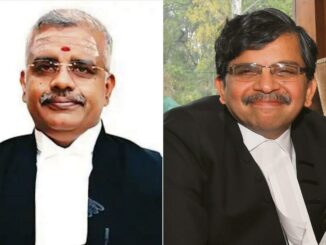
  • Tributes pour in for Justice Kuldip Singh, Justice Harjit Singh Bedi

    Tributes pour in for Justice Kuldip Singh, Justice Harjit Singh Bedi

    Justice Kuldip Singh

    Justice Harjit Singh Bedi

    Tributes poured in for two stalwarts of the Indian judiciary – Justice Kuldip Singh and Justice Harjit Singh Bedi – who passed away in November this year.
    Justice Harjit Singh Bedi died on November 21, followed closely by Justice Kuldip Singh on November 25.
    “Their passing has created an irreplaceable void, but their contributions and values will continue to inspire us as we move forward,” a resolution, signed by former judges, including Justice S S Sodhi, Justice M S Liberhan, Justice Mehtab Singh Gill, Justice S S Saron, Justice Ranjit Singh Randhawa, Justice Nawab Singh, Justice Rajiv Narain Raina, Justice Nirmaljit Kaur, Justice Jaishree Thakur, and Justice Sabina, expressed deep sorrow at the untimely passing of both luminaries within days of each other, stated.
    Justice Kuldip Singh
    (1 Jan 1932 – 25 Nov, 2024)
    Justice Kuldip Singh was a renowned jurist and former judge of the Supreme Court of India, recognized for his unwavering commitment to environmental protection and human rights. His tenure in the judiciary left a significant impact on Indian jurisprudence, particularly in public interest litigation (PIL) and environmental law. Below is a detailed profile of his illustrious career and contributions.
    Early Life and Education
    Justice Kuldip Singh was born on January 1, 1932, in Punjab, India. He pursued his education with distinction, earning his degree in law from Panjab University, Chandigarh. After completing his studies, he embarked on a legal career that would see him rise to prominence in the Indian legal system.
    Legal Career
    Justice Singh began practicing law in the early 1950s, specializing in constitutional, civil, and corporate law. His expertise and dedication earned him widespread respect within the legal fraternity. Over the years, he was involved in several landmark cases, which helped cement his reputation as an advocate of justice and fairness.
    He was designated as a Senior Advocate by the Punjab and Haryana High Court, a recognition of his legal acumen and skill. Subsequently, he served as the Advocate General for the state of Punjab, a role in which he provided legal counsel to the state government on critical legal and constitutional matters.
    Appointment to the Supreme Court
    Justice Kuldip Singh was appointed as a judge of the Supreme Court of India on December 14, 1988. During his tenure, which lasted until December 21, 1996, he delivered several landmark judgments that have had a lasting impact on Indian law and society.
    Landmark Contributions
    Justice Singh’s judicial philosophy was marked by his emphasis on social justice and environmental sustainability. His notable contributions include:
    Environmental Jurisprudence
    Justice Singh is often referred to as the “Green Judge” for his landmark rulings in environmental cases. Under his watch, the Supreme Court actively employed the principle of sustainable development to balance environmental protection with economic progress.
    In cases like Vellore Citizens Welfare Forum v. Union of India (1996), he emphasized the importance of the “precautionary principle” and the “polluter pays principle” in managing environmental challenges.
    He also played a pivotal role in directing measures to control industrial pollution, protect forest cover, and preserve biodiversity.
    Public Interest Litigation (PIL)
    Justice Singh was a strong proponent of PILs as a tool to address societal inequities. Through his judgments, he expanded the scope of PILs to include issues like environmental degradation, human rights violations, and corruption. His rulings empowered ordinary citizens to approach the judiciary for redressal of public grievances.
    Human Rights Advocacy
    Justice Singh demonstrated a profound commitment to upholding human rights. He authored judgments that safeguarded the rights of marginalized communities, upheld personal liberties, and strengthened the implementation of constitutional guarantees.
    Electoral Reforms
    Justice Singh was instrumental in advocating for transparency and fairness in the electoral process. His judgments stressed the need for free and fair elections, ensuring the sanctity of democratic institutions.
    Legacy and Recognition
    Justice Kuldip Singh’s judicial career left a deep imprint on the Indian legal system. His proactive approach to environmental and social justice earned him widespread recognition, both domestically and internationally. He is celebrated for bringing environmental issues into the mainstream of judicial discourse in India.
    Post-retirement, he continued to contribute to legal and social causes. He chaired various committees and commissions, including one on electoral reforms, where he made significant recommendations to enhance transparency and accountability in India’s democratic processes.
    Justice Kuldip Singh is known for his humility and dedication to public service. Despite his high-profile career, he remained grounded, focusing on issues that affect the common man.
    Justice Kuldip Singh’s legacy as a jurist lies in his progressive judgments and his commitment to the ideals of justice, equality, and environmental sustainability. His contributions continue to inspire legal practitioners, environmentalists, and social activists in India and beyond.

    Justice Harjit Singh Bedi
    (Sept 5, 1946 – Nove 21, 2024)
    Justice Harjit Singh Bedi (September 5, 1946 – November 21, 2024) was a distinguished Indian jurist who served as a judge of the Supreme Court of India. His legal career was marked by significant contributions to the Indian judiciary, characterized by fairness, integrity, and a deep commitment to justice.
    Early Life and Education
    Born in Sahiwal (formerly Montgomery), now in Pakistan, Justice Bedi hailed from a family of agriculturists. Notably, he was a direct descendant of Guru Nanak, the founder of Sikhism, being 17th in the line. Following the partition of India, his family settled in Fazilka, a township near the India-Pakistan border. His father, Tikka Jagjit Singh Bedi, served as a judge on the Punjab and Haryana High Court until his retirement in 1969.
    Justice Bedi completed his schooling at Bishop Cotton School in Shimla, obtaining his Senior Cambridge certificate in 1962. He pursued higher education in law, which laid the foundation for his illustrious legal career.
    Legal Career
    Enrolled as an advocate with the Bar Council of Punjab & Haryana on July 17, 1972, Justice Bedi practiced in civil, criminal, and writ matters. Between 1974 and 1983, he also served as a part-time lecturer in the Department of Laws at Panjab University, Chandigarh, demonstrating his dedication to legal education.
    His career in public service began with his appointment as Deputy Advocate General for Punjab in 1983. He was designated as a Senior Advocate in 1987 and subsequently served as Additional Advocate General until 1989. In 1990, he was appointed Advocate General of Punjab, a position he held for about a year.
    Judicial Appointments
    Justice Bedi’s judicial career commenced with his appointment as an Additional Judge of the Punjab and Haryana High Court on March 15, 1991. He became a permanent judge on July 8, 1992. His judicial acumen led to his elevation as the Chief Justice of the Bombay High Court on October 3, 2006. Shortly thereafter, on January 12, 2007, he was appointed as a judge of the Supreme Court of India, where he served until his retirement in 2011.
    Notable Contributions
    Beyond his tenure on the bench, Justice Bedi was entrusted with significant responsibilities post-retirement. In 2012, the Supreme Court appointed him as the Chairman of a Special Task Force monitoring committee to oversee investigations into custodial deaths in Gujarat. His report, submitted in 2019, identified misconduct in several cases, underscoring his unwavering commitment to human rights and accountability.
    Additionally, he was tasked by the Jammu and Kashmir Government to probe the mysterious death of National Conference activist Mohammad Yousuf Shah, approaching the assignment with the tenacity and care that defined his career.
    Justice Bedi’s personal life was deeply rooted in his family’s legal tradition. His son, Justice Jasjit Singh Bedi, continues the legacy, serving as a judge of the Punjab and Haryana High Court.
    Colleagues and friends remember Justice Bedi as a gentleman judge, whose judgments were known for their clarity and compassion. His demeanor combined gentle firmness with a profound sense of humanity, leaving an indelible mark on Indian jurisprudence.

  • Guiding spirits of the judiciary

    Guiding spirits of the judiciary

    It’s important to publicize decisions of judges who cannot be swayed by dangling carrots

    The judiciary and the armed forces of Bharat are our last refuge for justice and security. They have not succumbed yet, unlike the police, the civil services and the media. But the onslaught is severe and relentless. We must salute those judges who are true to their conscience.

    “If disturbed citizens don’t bemoan this disregard for judicial integrity due to a fear of reprisal in the form of contempt of court proceedings, our country will never be the same. It is the ‘suicide’ of justice that the citizens of Bharat should dilate upon. It is of utmost urgency that concerned citizens shed the fear they now harbor of raising their voices lest they are sent to jail for doing their duty to their motherland. Citizens are constantly told to excise dynasties from the political system. It is much more urgent to excise questionable means that serve political ends and breed dishonesty and corruption. Dynasties will die their natural deaths when more non-dynasts like Modi enter the political arena.”

    By Julio Ribeiro

    The Madras High Court should be proud of Justice Anand Venkatesh, who suo motu ordered the reopening of a corruption case against Tamil Nadu Higher Education Minister K Ponmudy last month. Justice Venkatesh also ordered the reopening of another case of corruption, involving possession of assets disproportionate to known sources of income, against TN Revenue Minister KKSSR Ramachandran and Finance Minister Thangam Thennarasu. All is not lost. The judiciary and the armed forces are our last refuge for justice and security.

    The case against Ponmudy was to be heard in a court in Villupuram. It was transferred by the administrative side of the Madras High Court to the court of the principal judge of Vellore for reasons not known to the public. Justice Venkatesh felt that the court in Vellore was “too hurried to be natural” and did not give any cogent reason for the minister’s acquittal.

    The cases against Ramachandran and Thennarasu ended in their discharge by the Special Court at Villiputhur in Virudhunagar district. The cases had been adjourned for months and years, during which the two accused ministers were reinstated in the DMK Cabinet. The investigating police officer who had filed the chargesheets was replaced by another, who whitewashed the original findings, established when the AIADMK was in power.

    It was apparent that the truth changed according to who was in power. If this is how the rule of law is going to be enforced in Bharat that was India, we, the citizens, will be forced to “cry for our beloved country”. The trend is truly frightening.

    Take the case against Congress leader Rahul Gandhi in the Surat district court over a cheap joke he cracked without giving it a thought. The case came up before the Chief Judicial Magistrate. The prosecution obviously found the magistrate uncooperative. It approached the High Court in Ahmedabad and sought a stay on the proceedings, which was granted. When the Chief Judicial Magistrate was transferred, the prosecution got the High Court’s permission to resume the original proceedings.

    We all know that for that poor joke, Rahul Gandhi was sentenced to two years in prison. He had to approach the Supreme Court for redress after failing to get it in the Gujarat High Court. The Supreme Court remarked caustically that there was something wrong with the High Court in Gujarat. Rahul, it is hoped, must have learnt a lesson from that episode.

    But what are we to conclude about our judicial system from these two cases? A common thread that runs through both cases, one from Tamil Nadu where a government aligned to the Opposition’s INDIA bloc rules, and the other from Gujarat, where a ‘double-engine’ government is in power, is that the ruling party in a state can influence certain decisions. It is disturbing to find that criminal trials can be “derailed by the active design of those at the helm of political power,” as Justice Venkatesh observed in his order.

    If disturbed citizens don’t bemoan this disregard for judicial integrity due to a fear of reprisal in the form of contempt of court proceedings, our country will never be the same. It is the ‘suicide’ of justice that the citizens of Bharat should dilate upon. It is of utmost urgency that concerned citizens shed the fear they now harbor of raising their voices lest they are sent to jail for doing their duty to their motherland. Citizens are constantly told to excise dynasties from the political system. It is much more urgent to excise questionable means that serve political ends and breed dishonesty and corruption. Dynasties will die their natural deaths when more non-dynasts like Modi enter the political arena.

    All is not lost as yet. There are many upright, honest and conscientious judges like Justice Venkatesh in most states of the Union. We must celebrate them, like we celebrate upright, honest and conscientious civil servants and police officials who are true to their oath of serving the people. It is important that we publicize the decisions of such judges who cannot be swayed by dangling carrots.

    When a calculated false propaganda was unleashed on maulvis, many from foreign countries, accusing them of spreading the Covid virus in India after attending a markaz in Delhi, Justices TV Nalawade and MG Sewlikar of the High Court of Bombay, sitting on a Division Bench in Aurangabad, discharged the accused and passed severe strictures against the government agency that brought them to trial unjustly. It required extraordinary courage to go against the ruling party’s propaganda machine. The judgment restored the citizens’ faith in the administration of justice.

    Justice S Muralidhar of the Delhi High Court ordered the Delhi Police to register FIRs against a minister in Modi’s government and two other BJP leaders for spewing hate against those who were opposing the CAA and the NRC in Delhi. However, Justice Muralidhar was hurriedly transferred to the Punjab and Haryana High Court. He retired as the Chief Justice of the Orissa High Court. The government did not agree to give him the more important charge of the Madras High Court, which the Supreme Court Collegium had recommended. In 2018, the same judge had sentenced Congress leader Sajjan Kumar to life imprisonment in a 1984 Delhi riots case.

    The judiciary and the armed forces of Bharat are our last refuge for justice and security. They have not succumbed yet, unlike the police, the civil services and the media. But the onslaught is severe and relentless. We must salute those judges who are true to their conscience.
    (The author is a former ambassador and a highly decorated retired Indian Police Service (IPS) officer)

  • Pakistan’s Ex-Prez Musharraf laid to rest; several including military officers attend funeral

    Pakistan’s Ex-Prez Musharraf laid to rest; several including military officers attend funeral

    KARACHI (TIP): Pakistan’s divisive former military ruler Pervez Musharraf was buried on February 7 in a muted funeral that was never officially announced. The country’s serving army chief, the prime minister and the president all stayed away from the event, with media blocked from covering it and local television not airing the service.

    Musharraf, who became a key US ally during Washington’s “war on terror” after the September 11 attacks, died exiled in Dubai on Sunday aged 79, having suffered a long illness.

    In Pakistan, where the military is supremely powerful, Musharraf remains a controversial figure who left many Pakistanis with a deep distaste for direct military rule.

    Prayers were held at the grounds of a military compound in Karachi in a funeral ceremony attended by around 10,000 people, mostly retired and serving military officers, an AFP reporter observed.

    “He was not given the honour that he deserved… the government has done nothing — it should have arranged the funeral at the national stadium,” Rubina Mazhar, a herbal medicine doctor, told AFP after the prayers.

    Wajid Noor, a 71-year-old retired government official, said “thousands of people wanted to participate in the funeral but no details were provided.”

    The body was later transported to a nearby military graveyard where the coffin, draped in the national flag, was buried as hundreds of people watched surrounded by tight security. A junior army officer at the site who asked not to be named said a gun salute was given to the former leader.

    Economic boom, democratic decline

    The four-star general seized power in a 1999 bloodless coup and was acting simultaneously as Pakistan’s army chief, chief executive, and president when the 9/11 attacks on the United States took place.

    He became Washington’s chief regional ally during the invasion of neighbouring Afghanistan, a decision which put him in the crosshairs of Islamist militants, who made several attempts on his life. But it also brought a huge influx of foreign aid, which bolstered the economy and helped modernise Pakistan.

    The general twice suspended the constitution and was accused of rigging a referendum shoring up his power as well as rampant rights abuses including rounding up opponents during his nearly nine-year rule.

    In 2007, Musharraf ordered troops to storm a mosque in Islamabad where more than a hundred students calling for the imposition of sharia law were killed, sparking a major militant backlash.

    In the same year, he attempted to challenge the independence of the judiciary, leading to widespread protests and was accused of involvement in the assassination of opposition leader Benazir Bhutto. He became increasingly isolated before ultimately losing power in 2008. In an editorial published by Pakistan’s leading English-language newspaper on Monday, Musharraf was described “as something of an enigma as his authoritarian rule was also interspersed with liberal reforms.”

    “Yet the late general’s mistakes were considerable, the biggest and most unforgivable being the derailing of the constitutional order.” (AFP)

  • Constitution of India

    Constitution of India

    January 26 marks the date on which the Constitution of India came into effect in 1950 and is celebrated as Republic Day. On this date, India became a sovereign nation free from the British Monarchy. On the 72nd anniversary of Republic Day, we look at some key facts about the Indian Constitution.

    HISTORY

    The Constitution of India became the supreme law of this nation, replacing the Government of India Act of 1935, adapted from the Parliament of the United Kingdom. After India’s independence from British rule in 1947, The Constituent Assembly of India got elected to create the Constitution of India. It was passed and adopted on November 26, 1949, and came into force on January 26, the following year.

    The Drafting Committee was headed by its chairman, Dr. BR Ambedkar, the jurist, economist and social reformer who worked to uplift the Dalits of India. K.M. Munshi, Alladi Krishnaswamy Iyer, Muhammed Saadullah, N Madhava Rao and Gopala Swami Ayyangar were the other six members of the committee. Dr. Rajendra Prasad, the first President of India, was the president of the Drafting Committee.

    FEATURES

    The Indian Constitution is the longest one in the world and is the second-largest active Constitution. It has 470 articles in 25 parts and 12 schedules with five appendices. It had 395 articles in 22 parts and 8 schedules, originally. Additions took place through amendments or changes to the Constitution.

    SEPARATION OF POWERS

    The Constitution of India lays down the distinctions in the political power structure in the country between the Centre and the states. It provides for the checks and balances between the organs of the government, namely, the Judiciary, the Executive and the Legislature, to prevent the concentration of power in one particular branch.

    DEMOCRACY

    The preamble to the Constitution of India declares India to be a ‘Sovereign Socialist Secular Democratic republic,’ having a parliamentary governance system. Six fundamental rights, namely, the right to equality, liberty, right against exploitation, freedom of religion, cultural and educational rights, and right to constitutional remedies, are recognised by the Indian Constitution.

    Background

    The major portion of the Indian subcontinent was under British rule from 1857 to 1947. When the Constitution of India came into force on 26 January 1950, it repealed the Indian Independence Act. India ceased to be a dominion of the British Crown and became a sovereign democratic republic. The date of 26 January was chosen to commemorate the Purna Swaraj declaration of independence of 1930.

    Articles 5, 6, 7, 8, 9, 60, 324, 366, 367, 379, 380, 388, 391, 392, 393 and 394 of the Constitution came into force on 26 Nov 1949 and the remaining articles on 26 Jan 1950.

    Previous legislation used as sources

    It is drawn from many sources. Keeping in mind the needs and conditions of India its framers borrowed different features freely from previous legislation viz. Government of India Act 1858, Indian Councils Act 1861, Indian Councils Act 1892, Indian Councils Act 1909, Government of India Act 1919, Government of India Act 1935 and the Indian Independence Act 1947. The last legislation which led to the creation of the two independent nations of India and Pakistan provided for the division of the erstwhile Constituent Assembly into two, with each new assembly having sovereign powers transferred to it, to enable each to draft and enact a new constitution, for the separate states.

    Constituent assembly

    It was drafted by the Constituent Assembly, which was elected by elected members of the provincial assemblies. The 389 member Constituent Assembly took almost three years (two years, eleven months and eighteen days to be precise) to complete its historic task of drafting the Constitution for independent India, during which, it held eleven sessions over 165 days. Of these, 114 days were spent on the consideration of the draft Constitution. On 29 August 1947, the Constituent Assembly set up a Drafting Committee under the Chairmanship of Dr. B.R. Ambedkar to prepare a draft Constitution for India. While deliberating upon the draft Constitution, the assembly moved, discussed and disposed of as many as 2,473 amendments out of a total of 7,635 tabled. Dr B.R. Ambedkar, Sanjay Phakey, Jawaharlal Nehru, C. Rajagopalachari, Rajendra Prasad, Sardar Vallabhbhai Patel, Kanaiyalal Munshi, Ganesh Vasudev Mavalankar, Sandipkumar Patel, Maulana Abul Kalam Azad, Shyama Prasad Mukherjee, Nalini Ranjan Ghosh, and Balwantrai Mehta were some important figures in the assembly. There were more than 30 members of the scheduled classes. Frank Anthony represented the Anglo-Indian community, and the Parsis were represented by H. P. Modi. The Chairman of the Minorities Committee was Harendra Coomar Mookerjee, a distinguished Christian who represented all Christians other than Anglo-Indians. Ari Bahadur Gurung represented the Gorkha Community. Prominent jurists like Alladi Krishnaswamy Iyer, Benegal Narsing Rau and K. M. Munshi, Ganesh Mavlankar were also members of the Assembly. Sarojini Naidu, Hansa Mehta, Durgabai Deshmukh, Rajkumari Amrit Kaur and Vijayalakshmi Pandit were important women members

    The first temporary 2-day president of the Constituent Assembly was Dr Sachchidananda Sinha. Later, Rajendra Prasad was elected president of the Constituent Assembly.The members of the Constituent Assembly met for the first time on 9 December 1946.

    Drafting

    On the 14 August 1947 meeting of the Assembly, a proposal for forming various committees was presented. Such committees included a Committee on Fundamental Rights, the Union Powers Committee and Union Constitution Committee. On 29 August 1947, the Drafting Committee was appointed, with Dr B. R. Ambedkar as the Chairman along with six other members assisted by a constitutional advisor. These members were Pandit Govind Ballabh Pant, Kanaiyalal Maneklal Munshi (K M Munshi, Ex- Home Minister, Bombay), Alladi Krishnaswamy Iyer (Ex- Advocate General, Madras State), N Gopalaswami Ayengar (Ex-Prime Minister, J&K and later member of Nehru Cabinet), B L Mitter (Ex-Advocate General, India), Md. Saadullah (Ex- Chief Minister of Assam, Muslim League member) and D P Khaitan (Scion of Khaitan Business family and a renowned lawyer). The constitutional advisor was Sir Benegal Narsing Rau (who became First Indian Judge in International Court of Justice, 1950-54). Later B L Mitter resigned and was replaced by Madhav Rao (Legal Advisor of Maharaja of Vadodara). On D P Khaitan’s death, T T Krishnamachari was included in the drafting committee. A draft Constitution was prepared by the committee and submitted to the Assembly on 4 November 1947, which was debated and over 2000 amendments were moved over a period of two years. Finally on 26 November 1949, the process was completed and the Constituent Assembly adopted the Constitution. 284 members signed the document and the process of constitution making was complete. This day is celebrated as National Law Day or Constitution Day.

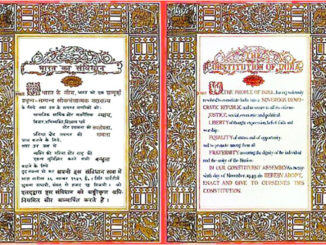
    The assembly met in sessions open to the public, for 166 days, spread over a period of 2 years, 11 months and 18 days before adopting the Constitution, the 308 members of the assembly signed two copies of the document (one each in Hindi and English) on 24 January 1950. The original Constitution of India is hand-written with beautiful calligraphy, each page beautified and decorated by artists from Shantiniketan including Beohar Rammanohar Sinha and Nandalal Bose. The illustrations on the cover and pages represent styles from the different civilisations of the subcontinent, ranging from the prehistoric Mohenjodaro civilisation, in the Indus Valley, to the present. The calligraphy in the book was done by Prem Behari Narain Raizda. It was published in Dehra Dun, and photolithographed at the offices of Survey of India. The entire exercise to produce the original took nearly five years. Two days later, on 26 January 1950, the Constitution of India became the law of all the States and territories of India. Rs.1,00,00,000 was official estimate of expenditure on constituent assembly. It has undergone many amendments since its enactment. The original 1950 Constitution of India is preserved in helium cases in the Parliament house, New Delhi. There are two original versions of this – one in Hindi and the other in English.

    Preamble to the Constitution of India

    India on Sunday, Jan 23,  kicked off its Republic Day celebrations with ‘Parakram Diwas,’ a day dedicated to iconic freedom fighter Netaji Subhash Chandra Bose. January 23 is also Netaji’s birth anniversary.

    January 26th is significant for the country’s political history as it is the day when the country formally adopted its constitution in 1950. It replaced the Government of India Act (1935) as the governing document of India and thus, turning the nation into a newly formed republic.

    What is Preamble to the Constitution of India?

    The Preamble to the Constitution of India is an introductory statement that presents the key principles of the Constitution. It was adopted on 26 November 1949 by the Constituent Assembly and came into effect on 26 January 1950, celebrated as the Republic day in India.

    Full text of Preamble to the Constitution

    WE, THE PEOPLE OF INDIA, having solemnly resolved to constitute India into a SOVEREIGN SOCIALIST SECULAR DEMOCRATIC

    REPUBLIC and to secure to all its citizens:

    JUSTICE, social, economic and political;

    LIBERTY of thought, expression, belief, faith and worship;

    EQUALITY of status and of opportunity; and to promote among them all

    FRATERNITY assuring the dignity of the individual and the unity and integrity of the Nation;

    IN OUR CONSTITUENT ASSEMBLY this twenty-sixth day of November, 1949, do HEREBY ADOPT, ENACT AND GIVE TO OURSELVES THIS CONSTITUTION.

    Preamble embodies Constitution’s vision

    The Preamble manifests the vision of the draftspersons of the Constitution. In adopting it after the draft Constitution was approved, the Constituent Assembly ensured that the Preamble exhibited conformity with the provisions of the Constitution. Yet, the content of the Preamble traces its origins to even before the task of drafting the Constitution began. The foundations of the Preamble were laid down in the Objectives Resolution moved by Jawaharlal Nehru before the Constituent Assembly in December 1946.

    The purpose of the resolution was to “proclaim India as an Independent Sovereign Republic and to draw up for her future governance a Constitution”, which would secure “to all the people of India justice, social, economic and political; equality of status, of opportunity, and before the law; freedom of thought, expression, belief, faith worship, vocation, association and action”, among other goals. Seconding the resolution, one member remarked that equality was “its underlying theme”. Another member supporting the resolution firmly believed that the Indian Republic would “be both democratic and socialist”. The resolution was enthusiastically supported by most of the members and was adopted in January 1947.

    Later, Nehru pointed out that Objective Resolution could be adopted with certain changes as the Preamble. The Drafting Committee headed by BR Ambedkar felt that the Preamble should be restricted to defining the essential features of the new State and its basic socio-political objectives and that the other matters dealt with in the resolution could be more appropriately provided for in the substantive parts of the Constitution.

    The Committee modified the content of the Objectives Resolution to formulate the Preamble, while clarifying that it followed the spirit and, as far as possible, the language of the resolution. The Committee adopted the expression “Sovereign Democratic Republic” instead of “Sovereign Independent Republic”, as it considered independence to be implied in the word “Sovereign”. The Committee introduced a clause on “Fraternity” to emphasize upon the need for fraternal concord and goodwill in India, which was specifically greater than ever, after the Partition.

    The draft Preamble, as it is in current form, was tabled before the Constituent Assembly in October 1949. One member sought to include “In the name of God” in the beginning of the Preamble. The Assembly rejected the proposed amendment. Another member argued that inclusion of God would amount to compulsion of faith and violate the fundamental right to freedom of faith. Another member stated that invoking the name of God in the Preamble would resemble “a narrow, sectarian spirit, which is contrary to the spirit of the Constitution.” The Assembly adopted the Preamble as presented by the Drafting Committee.

    The Preamble recognizes and proclaims that the Constitution has its root, its authority, and its sovereignty, from the people. “Sovereign Democratic Republic” reflects the establishment of a democratic form of government, where ultimate power is vested with the public and exercised through universal adult franchise. Commenting upon this aspect of the Preamble, Acharya Kriplani observed that “democracy is inconsistent with caste system”, and that we must do away with castes and classes. “Justice, social, economic and political” symbolizes the commitment of the framers to put an end to status quo of inequalities and historical injustices and to replace fundamental wrongs with fundamental rights. As Kriplani remarked, “Liberty of thought, expression, belief, faith and worship” can only be guaranteed on the basis of non-violence and mutual respect for each other. “Equality of status and of opportunity”, in Ambedkar’s words, means absence of glaring inequalities and discrimination in the society. The expression “to promote among them all” is linked with “Fraternity”. Ambedkar defined “Fraternity” as “a sense of common brotherhood of all Indians” and “an attitude of respect and reverence towards fellow men”, which give “unity and solidarity to social life”. The principles of liberty, equality and fraternity would ensure dignity of each individual, thus leading to unity of the nation. Ambedkar considered liberty, equality and fraternity to be forming “a union of trinity in the sense that to divorce one from the other is to defeat the very purpose of democracy”.

    The addition of the words “Socialist” and “Secular” into the Preamble by the 42nd constitutional amendment during the Emergency in 1976 did not alter its nature or identity. It merely provided a label to what was already in existence. There are three key points in support of this contention. First, in support of Nehru’s Objectives Resolution, one member explained that the content of economic democracy and rejection of the existing social structure reflected through the phrases “justice, social, economic and political” and “equality of opportunity” represent the socialist aspect of the Resolution, without providing it with an open label. These phrases were later adopted into the Preamble. Second, by rejecting inclusion of any phrase on God in the Preamble, the Assembly adopted a secular document instead of a sectarian one. Third, the Preamble embodies the philosophy of the Constitution, which is reflected through its provisions and the basic structure. As Justice DY Chandrachud held in one of his judgments, the addition of the word “secular” solidified the basic structure of the Constitution, which enshrines secularism in the fundamental rights chapter.

    The Court has often engaged with interpretation of the Constitution by relying upon the vision and values contained in the Preamble. While the flourishing of a constitutional order demands an active institutional role of courts, it also requires a responsive participation of the citizenry. The response of the citizens to their elected representatives has a powerful role in giving a meaning to the words of the Constitution. The content of the Preamble not only embodies events which predate the adoption of the Constitution, but also incorporates the citizens’ experiences in the unfolding of the Constitution over the past seventy years. The hopes and aspirations of the people enshrined in the Preamble have sustained due to years of practice, effort, and experience to make society work with those values. The recent events of claiming the Preamble and the Constitution by the citizens as their very own resemble a path towards the professed collective destiny of India.

  • UK to consider sanctions against China for breaching Hong Kong treaty

    UK to consider sanctions against China for breaching Hong Kong treaty

    London (TIP): Britain on Thursday said China had broken its main bilateral treaty on Hong Kong by imposing new rules to disqualify elected legislators in the former British colony, cautioning that it would consider sanctions as part of its response. The British flag was lowered over Hong Kong when the colony was handed back to China in 1997 after more than 150 years of British rule — imposed after Britain defeated China in the First Opium War. Hong Kong’s autonomy was guaranteed under the “one country, two systems” agreement enshrined in the 1984 Sino-British Joint Declaration signed by then Chinese Premier Zhao Ziyang and British Prime Minister Margaret Thatcher.

    “Beijing’s imposition of new rules to disqualify elected legislators in Hong Kong constitutes a clear breach of the legally binding Sino-British Joint Declaration,” Foreign Secretary Dominic Raab said.

    “China has once again broken its promises and undermined Hong Kong’s high degree of autonomy,” Raab added.

    Britain summoned China’s ambassador, Liu Xiaoming, to express its deep concerns and Raab’s deputy, Nigel Adams, told the Parliament that it was considering possible sanctions on individuals over China’s actions.

    “We will continue to consider designations under our Magnitsky-style sanctions regime,” said Adams, Britain’s minister for Asia. He was asked by lawmakers if Britain would sanction Hong Kong Chief Executive Carrie Lam.

    Adams said it would not be helpful to speculate on names at this stage. China’s embassy did not immediately respond to a request for comment. The European Union called on Beijing to immediately reverse the new rules which it said undermined Hong Kong’s autonomy.

    MAKING A STAND

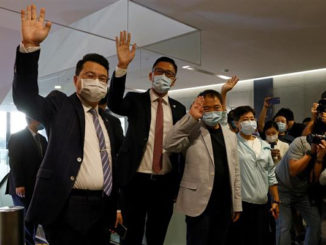
    Hong Kong’s pro-democracy opposition lawmakers said on Wednesday they would resign in protest against the dismissal of four of their colleagues from the city assembly after Beijing gave local authorities new powers to further curb dissent. The Chinese Parliament earlier adopted a resolution allowing the city’s executive to expel lawmakers deemed to be advocating Hong Kong independence, colluding with foreign forces or threatening national security, without having to go through the courts.

    Opposition members of the Hong Kong assembly say they have tried to make a stand against what many people in Hong Kong see as Beijing’s whittling away of freedoms and institutional checks and balances, despite a promise of a high degree of autonomy. China denies curbing the rights and freedoms in the global financial hub but authorities in Hong Kong and Beijing have moved swiftly to stifle dissent after anti-government protests flared in June last year and plunged the city into crisis. Britain now considers China has broken the Joint Declaration three times, including with the national security legislation for Hong Kong introduced this year.

    “The UK will stand up for the people of Hong Kong, and call out violations of their rights and freedoms,” Raab said, adding: “With our international partners, we will hold China to the obligations it freely assumed under international law.” The national security law punishes what China broadly defines as subversion, secession, terrorism and collusion with foreign forces with up to life in prison. Critics of the law fear it will crush freedoms, including the freedom to protest and an independent judiciary. Supporters say it will bring stability after last year’s sometimes violent anti-government and anti-China unrest. Reuters

  • German police search homes of four suspected of ties to Vienna attacker

    Berlin (TIP): German police on Friday searched the homes and businesses of four people believed to have had ties to the man who went on a deadly rampage in Vienna this week, officials said.

    The 20-year-old convicted jihadist who killed four people on Monday was shot dead by police within nine minutes of opening fire on bystanders and bars. He was later identified as Kujtim Fejzulai, a native of Vienna. “There is no initial suspicion that the four people affected by today’s measures took part in the attack but there are believed to have been links with the suspected attacker,” Germany’s BKA criminal police said on Twitter.

    The BKA said a federal judge had issued search warrants for the homes and businesses in the German towns of Osnabrueck, Kassel and in the district of Pinneberg near Hamburg after the Austrian judiciary transferred some of its findings on the attack to German prosecutors.

    The suspects had had contact with Fejzulai online and had met him in person, Germany’s interior ministry said. Nobody was arrested as part of Friday’s searches, it added.

    Austrian authorities have arrested 15 people who interior ministry officials said were part of the radical Islamist scene. Switzerland has also arrested two men in connection with the attack. Austrian Interior Minister Karl Nehammer said on Thursday Austria was in close contact with another unspecified country in its investigation. – Reuters

  • U.S.  Senate  Judiciary Committee  approves Barrett  for  Supreme Court

    U.S.  Senate  Judiciary Committee  approves Barrett  for  Supreme Court

    Incensed  Democrats boycott

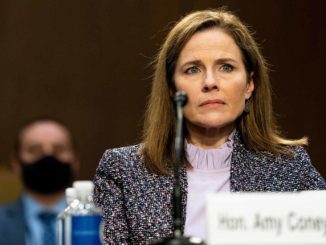
    WASHINGTON  (TIP): As expected, the  Republican-led U.S. Senate Judiciary Committee on Thursday, October 22,  approved President Donald Trump’s nomination of Amy Coney Barrett to a lifetime Supreme Court seat clearing the way for a final Senate confirmation vote planned for Monday, October 26. By a 12-0 vote, the panel approved Barrett with all Republican members voting yes and the 10 committee Democrats boycotting the meeting after calling the confirmation process a sham. With Trump’s fellow Republicans holding a 53-47 Senate majority, Barrett’s confirmation appears certain. The empty seats for the Democratic committee members had posters placed upon them bearing photographs of people who they argue would be hurt if the Affordable Care Act healthcare law, also known as Obamacare, is struck down as Trump has sought in a case to be argued before the justices on Nov. 10. Barrett, 48, has been a federal appeals court judge since 2017 and previously was a legal scholar the University of Notre Dame in Indiana. Her confirmation would give the top U.S. judicial body a 6-3 conservative majority, including three justices named by Trump. “The Senate majority is conducting the most rushed, the most partisan and the least legitimate process in the long history of Supreme Court nominations,” Senate Democratic leader Chuck Schumer told reporters after the vote.

    Judiciary Committee Chairman Lindsey Graham said the Democratic boycott was “their choice.”

    “It will be my choice to vote the nominee out of committee. We’re not going to allow them to take over the committee,” Graham said. Schumer called the Republican hurry to confirm Barrett “a naked power grab” through a “sham vote,” arguing that Republicans broke the committee’s own rules by approving the nomination without Democrats present. No nominee to the Supreme Court has ever been confirmed by the Senate this close to a presidential election. More than 45 million ballots already have been cast. Majority Leader Mitch McConnell has planned a confirmation vote on the Senate floor on Monday, October 26.

  • The fall of the ‘last Citadel’ of justice: Supreme Court of India

    The fall of the ‘last Citadel’ of justice: Supreme Court of India

    Former Chief Justice of India (CJI) Ranjan Gogoi takes oath as Rajya Sabha MP during the ongoing Budget Session of Parliament, in New Delhi, Thursday, March 19, 2020. (RSTV/PTI Photo)(PTI19-03-2020_000012B)

    “I am surprised as to how Justice Ranjan Gogoi, who once exhibited such courage of conviction to uphold the independence of the judiciary, has compromised the noble principles on the independence and impartiality of the judiciary,” said retired Justice Kurian Thomas.

    He was reacting to the appointment of recently retired Chief Justice of the Supreme Court to the Rajya Sabha by the Modi Administration. “Mr. Gogoi’s decision to accept the nomination to Rajya Sabha has certainly shaken the confidence of the common man on the independence of the judiciary,” Mr. Joseph added.

    It is to be noted that not so long ago, on January 12, 2018, to be exact, Mr. Gogoi was part of the four-member Supreme Court Justices along with Justice Kurian Joseph, who held an unprecedented news conference to warn about dangers of political interference in the judiciary. “The four of us are convinced that unless this institution is preserved and it maintains its equanimity, democracy will not survive in this country,” Justice Jasti Chelameswar said during the press conference held at his home.

    Since independence, the Supreme Court remained a firewall against abuse of power by the Executive branch or the elites in the ruling class. The integrity of judges has been a critical component in rendering impartial decisions that have far-reaching effects on every segment of society. Judicial independence is vital in reassuring the public that judges would dispense cases with honesty and impartiality only in accordance with the law and evidence presented to them. The Supreme court must be free of fear and favor from the Executive, then only it would be trusted by the public.

    If we look at the record of Gogoi as the Chief Justice, he has headed a five-member constitution bench that delivered a historical and unanimous judgment deciding the fate of the Babri Masjid land in Ayodhya in favor of Hindus and also headed the bench that put SC’s stamp of approval on the Rafale fighter jet deal between India and France clearing the BJP government of serious corruption charges from the Opposition. Moreover, Supreme Court headed by Gogoi appeared to have dragged its feet in setting up a quick hearing on the violations of the civil rights of Indian citizens in Kashmir after the abrogation of Article 370 by the Modi Administration.

    Therefore, his nomination to the Rajya Sabha raises a serious question of quid pro quo that would have a diminishing effect on the judges who serve in the Court and debilitating impact on the Institution and its Independence the public have come to rely on for its final word. One may argue that Mr. Ranjan Gogoi’s nomination to Rajya Sabha is not unprecedented as it has happened under the rule of the Congress Party as well. When Justice Rangnath Mishra, the former Chief Justice of India, was nominated to Rajya Sabha in 1998, most observers also saw it as a case of quid pro quo. Two wrongs don’t make it right.

    There are indeed widespread criticisms around this nomination, and some of the prominent citizens have spoken out loud. “What concerns me is that Justice Gogoi had relinquished charge as the CJI as recently as on November 17, 2019, exactly four months ago. In my view, offering the higher members of the judiciary nominated positions such as the Governor of a State or a Membership in the Rajya Sabha undoubtedly sets an unhealthy precedent, as it tends to weaken the institution of the judiciary,” wrote E.A.S Sarma, a former IAS officer of 1965 batch in a letter written to President Ram Nath Kovind.

    Some others are also wondering about the evolution of Ranjan Gogoi from an independent justice who has spoken out against the tyranny of the executive interference in the judiciary to a vassal of a Machiavellian ruling hierarchy that is hellbent on controlling the judicial process promoting their political agenda. As soon as Mr. Gogoi was nominated to the position of CJI, a 35-year-old junior court assistant wrote to 22 Justices in the Supreme Court, accusing him of sexual harassment. Later, a three-member Supreme Court panel investigating the allegations gave a clean chit to Gogoi in the matter. The woman who filed the charges was fired, and her family was said to be harassed. In a statement, the complainant said, “Today, my worst fears have come true, and all hopes of justice and redress from the highest Court of the land have been shattered. “However, in a curious and shocking twist and turn to the whole story, the woman was magically reinstated after Gogoi has vacated his office. One indeed wonders who is behind this entire drama and how the justice may have been compromised!

    When those four justices, including Gogoi, conducted that famous 2018 press conference, they were expressing their disapproval about how then Chief Justice Dipak Misra was assigning the cases, especially the one pertaining to a petition seeking an independent investigation into the mysterious circumstances surrounding the death of BH Loya in 2014. At the time of death, Loya was presiding over the Sohrabuddin encounter case, in which the current Home Minister was a prime accused. In November 2017, the caravan reported the shocking claims raised by the family of Judge Loya.

    In Expressing their strong disapproval of the process, on behalf of the four Justices, Mr. Chelameswar said “they don’t want another twenty years later some very wise men in the country to say that Chelameswar, Ranjan Gogoi, Madan Lokur and Kurian Joseph sold their souls; they didn’t take care of their institution; they didn’t think of the interest of the nation. So, we place it before the people of the country,”

    Only time will tell whether Mr. Ranjan Gogoi has sold his soul or compromised the noble principles. Still, his actions during his tenure as CJI and now his acceptance of Rajya Sabha seat from BJP has indeed cast a cloud suspicion around him and may have irreparably damaged the independence of the institution he was sworn to protect and proclaimed to defend. Moreover, for the people India, it is a steep and tragic fall of the ‘last citadel’ of justice and a threat to freedom itself!

    (Writer is a former Chief Technology Officer of the United Nations and Vice-Chairman of the Indian Overseas Congress, USA)

  • Census citizenship question blocked by Supreme Court: Trump seeks 2020 Census delay

    Census citizenship question blocked by Supreme Court: Trump seeks 2020 Census delay

    WASHINGTON (TIP): In a setback for the Trump administration, the Supreme Court on Thursday, June 27,  rejected its stated reason for adding a question on citizenship to the census, leaving in doubt whether the question would appear on the census forms sent to every household in the nation next year., says New York Times.

    Chief Justice John G. Roberts Jr., writing for the majority, said the explanation offered by the Trump administration for adding the question “appears to have been contrived.” But he left open the possibility that it could provide an adequate answer.

    Executive branch officials must “offer genuine justifications for important decisions, reasons that can be scrutinized by courts and the interested public,” the chief justice wrote. “Accepting contrived reasons would defeat the purpose of the enterprise. If judicial review is to be more than an empty ritual, it must demand something better than the explanation offered for the action taken in this case.”

    The practical impact of the decision was not immediately clear. While the question is barred for now, it is at least possible that the administration will be able to offer adequate justifications for it. But time is short, as the census forms must be printed soon.

    President Trump commented on Twitter, writing that he had “asked the lawyers if they can delay the Census, no matter how long, until the United States Supreme Court is given additional information from which it can make a final and decisive decision on this very critical matter.”

    “We do not hold that the agency decision here was substantively invalid,” the chief justice wrote. “But agencies must pursue their goals reasonably. Reasoned decision-making under the Administrative Procedure Act calls for an explanation for agency action. What was provided here was more of a distraction.”

    Justices Ruth Bader Ginsburg, Stephen G. Breyer, Sonia Sotomayor and Elena Kagan joined the key part of the chief justice’s opinion.

    In dissent, Justice Clarence Thomas said the majority had done something extraordinary. “For the first time ever,” he wrote, “the court invalidates an agency action solely because it questions the sincerity of the agency’s otherwise adequate rationale.”

    Justices Neil M. Gorsuch and Brett M. Kavanaugh joined Justice Thomas’s partial dissent.

    Justice Samuel A. Alito Jr. filed his own partial dissent.

    “To put the point bluntly,” he wrote, “the federal judiciary has no authority to stick its nose into the question whether it is good policy to include a citizenship question on the census or whether the reasons given by Secretary Ross for that decision were his only reasons or his real reasons.”

    Government experts predicted that asking the question would cause many immigrants to refuse to participate in the census, leading to an undercount of about 6.5 million people. That could reduce Democratic representation when congressional districts are allocated in 2021 and affect how hundreds of billions of dollars in federal spending are distributed.

    Long Island Advocates React to Supreme Court Decision on the Citizenship Question

    MELVILLE,NY . Government and nonprofit leaders gathered at the Health & Welfare Council of Long Island’s office , June 27,  in response to the Supreme Court ruling that the explanation for inclusion of the Census question was inadequate.

    The decision will now be handed back down to the lower courts siting sufficient reason for concern about why the Department of Commerce wanted to add the question, and insufficient explanation.

    “While a partial and temporary victory- this is still a win. In these times in which we are living where there is assault after assault on our neighbors- every win- every moment, when humanity is reaffirmed, must be recognized.” Said Rebecca Sanin, President/CEO of the Health & Welfare Council of Long Island.

    “I welcome the news that all communities on Long Island will receive their fair share from the Federal Government and we must make sure that everyone is counted on Long Island.” Said New York State Senator Monica Martinez.

    “This is a significant win for making sure every person in Nassau County can be counted,” said Nassau County Comptroller Jack Schnirman. “We must keep up the pressure on Washington so that we have a fair and accurate count and get the resources our communities deserve. The stakes are too high for the entire region.”

    There are still significant challenges to ensuring that Long Island has a complete and accurate count in the 2020 Census. From anti-immigrant rhetoric to raids, to suburban sprawl, there is a lot to overcome less than a year out from the Census. To address these significant challenges, Nassau & Suffolk Complete Count Committees have been convening community leaders across the Island to understand the hurdles ahead, pool resources and knowledge bases, and devise strategies we can utilize to achieve a Complete Count in 2020.

    “Let us all come together today and be ambassadors of the Census,” said, Rebecca Sanin, President/CEO of the Health & Welfare Council of Long Island. “Let us use this momentary victory as a call to action- to start speaking to everyone we encounter about the need to be counted, about how every human counts, and let’s create a sustainable, inclusive and hopeful future for all Long Islanders.”

    Census Facts:

    • An undercount of more than .6 percent, could result in New York losing representation in Washington.
    • 800 billion dollars is allocated based on Census data in this country.
    • Suffolk & Nassau County are the fourth and fifth hardest to count counties in all of New York State.
    • Over 800,000 people on Long Island live in hard to count areas.
    • $73 billion is allocated from 55 spending programs based on the Census-including Medicaid, school funding, Headstart, WIC, school breakfast, Title 1 and special education.

    BIG WIN! The Citizenship Question will NOT be added to the 2020 Census: SALDEF

    WASHINGTON: The Supreme Court ruled that the Citizenship Question will not be added to the census, “‘saying that the administration’s explanation for adding it is insufficient’”. The unprecedented citizenship question has now been put on halt until further notice. While the U.S. Census Bureau is bound by Title 13 of the United States Code, prohibiting the information on the census from being disclosed. Inclusion of a citizenship question in the future has the potential to spark fear in immigrant communities.

    SALDEF Executive Director Kiran Kaur Gill said, “we are thrilled by the win today at the Supreme court and hope that all will now feel safe in participating in the Census. I encourage all individuals to take part in the 2020 Census to ensure a complete representation of the Sikh community and all communities.”

    The reinstatement of the citizenship question was introduced by Commerce Secretary Wilbur Ross in March 2018. Since then, Ross has been accused of trying to depress minority responses for political purposes. The citizen question sparked fear by immigrant groups of targeted harassment including deportation, that would have resulted in an undercount of the actual number of people living in a community. The count is used to allocate federal funding for communities, and resources such as food stamps, public schooling, and assistance programs. Giving a distorted count to the Census Bureau may leave immigrant communities with insufficient federal resources.

    The Asian Americans Advancing Justice group recognizes that along with federal funding, the Census data allocates the number of representatives communities will receive. The data provides communities an opportunity to “engage their elected officials in advocating for support and solutions for their community’s needs.” With distorted Census data, the voices of and concerns of immigrant communities will be suppressed. Lastly, the census data is used for redistricting and not giving immigrant communities substantial political power due to inaccurate Census data may falsify the outcomes of state-level elections.

    Meanwhile, Trump is asking his lawyers whether Census can be delayed for the Citizenship question.

    Washington Post  says President Trump said Thursday, June 27,  that he is seeking to delay the constitutionally mandated census to give administration officials time to come up with a better explanation for why it should include a citizenship question.

    Trump’s announcement, in tweets sent from Japan, came hours after the Supreme Court put on hold his administration’s plan to add a citizenship question to the 2020 Census, saying it had provided a “contrived” reason for wanting the information. He said  census would be ‘meaningless’ without citizenship question.

  • Religious freedom conditions continued to deteriorate in India, says US Report

    Religious freedom conditions continued to deteriorate in India, says US Report

    WASHINGTON (TIP): The United States Commission on International Religious Freedom (USCIRF), that researches and monitors international religious freedom issues, in its latest report slammed ruling BJP and Hindu nationalist groups for perpetrating violence against religious minority communities.

    USCIRF’s 2017 annual report which was released on Aug 15, pointed out that “In 2016, religious tolerance and religious freedom conditions continued to deteriorate in India.”

    “Hindu nationalist groups—such as the Rashtriya Swayamsevak Sangh (RSS), Sangh Parrikar, and Vishal Hindu Perished (VHP)—and their sympathizers perpetrated numerous incidents of intimidation, harassment, and violence against religious minority communities and Hindu Dalits. These violations were most frequent and severe in 10 of

    India’s 29 states. National and state laws that restrict religious

    conversion, cow slaughter, and the foreign funding of nongovernmental organizations (NGOs) and a constitutional provision deeming Sikhs, Buddhists, and Jains to be Hindus helped create the conditions enabling these violations.”

    The report criticized the ruling party as well. “While Prime Minister Narendra Modi spoke publicly about the importance of communal tolerance and religious freedom, members of the ruling party have ties to Hindu nationalist groups implicated in religious freedom violations, used religiously divisive language to inflame tensions, and called for additional laws that would restrict religious freedom. These issues, combined with longstanding problems of police and judicial bias and inadequacies, have created a pervasive climate of impunity in which religious minorities feel increasingly insecure and have no recourse when religiously motivated crimes occur”, it said. Based on these concerns, in 2017 USCIRF again places India on its Tier 2, where it has been since 2009.

    USCIRF suggested following recommendations to the US government:

    • Integrate concern for religious freedom into bilateral contacts with India, including the framework of future Strategic Dialogues, at both the federal and provincial levels, and encourage the strengthening of the capacity of state and central police to implement effective measures to prohibit and punish cases of religious violence and protect victims and witnesses;
    • Increase the U.S. Embassy’s attention to issues of religious freedom and related human rights, including through visits by the ambassador and other officials to areas where communal and religiously motivated violence has occurred or is likely to occur, and through meetings with religious communities, local governmental leaders, and police
    • Press the Indian government to allow USCIRF to visit the country, and urge the Indian government to invite the United Nations Special Rapporteur on freedom of religion or belief to visit India
    • Urge India to boost training on human rights and religious freedom standards and practices for the police and judiciary, particularly in states and areas with a history or likelihood of religious and communal violence;
    • Urge the central Indian government to press states that have adopted anti-conversion laws to repeal or amend them to conform with internationally recognized human rights standards; and
    • Urge the Indian government to publicly rebuke government officials and religious leaders who make derogatory statements about religious communities.


  • Indian American Congresswoman Jayapal, Congressman Cicilline Introduce Resolution of Inquiry for Release of Documents Pertaining to Possible Obstruction of Justice

    Indian American Congresswoman Jayapal, Congressman Cicilline Introduce Resolution of Inquiry for Release of Documents Pertaining to Possible Obstruction of Justice

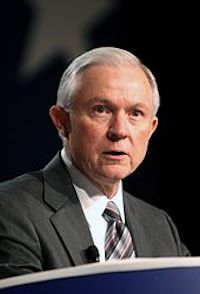
    WASHINGTON (TIP): After the Department of Justice released a heavily redacted, single-page document confirming that Attorney General Jeff Sessions lied to the FBI about his contacts with the Russian government, House Judiciary Committee members, Representatives Pramila Jayapal (WA-07) and David Cicilline (RI-01) introduced a resolution of inquiry requesting the Trump administration release any and all information pertaining to Attorney General Sessions’ involvement in the firing of FBI director James Comey in violation of his recusal and related matters.

    “For six months, we have watched the Trump administration make a mockery of our laws and the highest office in our land while our Republican colleagues refuse to allow hearings on obstruction of justice and collusion with Russia,” said Rep. Jayapal. “Our resolution of inquiry will force the House Committee on the Judiciary to consider allegations of obstruction of justice involving the Justice Department. The Senate Judiciary Committee is taking action on the matter. We need the Republicans on our committee to wake up and take these issues seriously. We have a duty as members of Congress and the Judiciary Committee to exercise oversight over the administration and the Justice Department.”

    “We’ve known for a while now that Paul Ryan and the Republicans don’t want to work with us on just about anything. That’s true for jobs, tax fairness, infrastructure, workforce training, and health care,” said Rep. Cicilline. “But what’s most outrageous is that they don’t even want to work with us to make sure the American people know the truth about allegations of obstruction of justice involving the Justice Department. There is no more serious responsibility than protecting our democracy and the American people deserve members of Congress who take this responsibility seriously.”

    The two representatives demanded that House Republicans wake up and conduct oversight of the Trump administration. Attorney General Sessions has failed to disclose his meetings with the Russian government, largely ignored his recusal from the Russia investigation and helped to fire the FBI Director under false pretext. On July 13, the Department of Justice released a document that suggests the Attorney General failed to disclose any contacts with foreign governments on his security clearance application.

    The Jayapal-Cicilline Resolution is designed to obtain information about these and other systemic problems at the highest levels of the Trump administration. The Majority has refused to conduct even basic oversight of the Department of Justice. This resolution will force the issue, and leave each member to choose whether the House Judiciary Committee will begin to address these urgent problems or continue to be complicit in the administration’s undermining of justice.

    Jayapal and Cicilline will closely follow ongoing developments specifically pertaining to the role of Donald Trump Jr. and Jared Kushner in potential collusion between the Trump campaign and Russia. If the administration fails to be more forthcoming about these troubling developments, Jayapal and Cicilline plan to amend the resolution to demand more transparency and accountability to the American people.


  • Indian American confirmed to key Judicial Post

    Indian American confirmed to key Judicial Post

    US Senate confirms Judge Amul Thapar for the 6th US Circuit Court of Appeals

    WASHINGTON (TIP): The US Senate has confirmed Indian-American Judge Amul Thapar to a key judicial position on the powerful US court of appeals.

    The first Indian-American to be nominated by US President Donald Trump for the 6th US Circuit Court of Appeals, Thapar was confirmed by the Senate 52-44, a vote which took place on party lines.

    With this, Thapar becomes the second South Asian judge to be on a US Circuit Court of Appeals, which hears appeals from Kentucky, Tennessee, Ohio and Michigan.

    “Judge Thapar will make an outstanding addition to the US Appeals Court for the Sixth Circuit,” said senate majority leader Mitch McConnell on Thursday, May 25.

    Currently a US District Court Judge, Thapar was nominated by Trump on March 21. Thapar was among the 20 judges whose names Trump had released during his presidential campaign as shortlisted candidates for his Supreme Court nominees.

    McConnell said Thapar has a reputation as a qualified judge with an impressive legal mind who will fairly apply the law to all who enter his courtroom.

    “Judge Thapar has been recognized for his work on the bench, and the most recent edition of the Almanac of the Federal Judiciary quoted attorneys who agreed that Thapar has excellent legal ability,” he added.

    McConnell said that the American Bar Association, which prominent Senate Democrats have called “the gold standard” for evaluating judges, awarded Thapar its highest rating.

    The South Asian Bar Association of North America (SABA) also congratulated Judge Thapar on his confirmation to the Sixth US Circuit Court of Appeals. “On behalf of SABA, I congratulate Judge Thapar who is a proven asset to the federal judiciary, the people of the commonwealth of Kentucky whom he’s served for almost a decade, and the South Asian legal community,” said SABA president Vichal Kumar.

    “Judge Thapar’s confirmation further cements his legacy as a pioneer, esteemed jurist and dedicated public servant. We anticipate that Judge Thapar’s renowned dedication to his craft and commendable judicial temperament will serve him well in this integral position,” he said.

    Indian-American attorney Ravi Batra said that unlike Sri Srinivasan, Amul Thapar has been elevated while thinking that law is “devoid of equity or compassion”. “There is a difference between reality and a reality show, the latter is fiction. One hopes that he will find the moral compass of the late great Justice Antonin Scalia,” said Batra.

    In 2007, the then George W Bush nominated him to be a United States District Judge for the Eastern District of Kentucky. At that time, the Senate confirmed his nomination by a voice vote, and Judge Thapar became the first South Asian American federal judge in the history of the US.

    Prior to joining the bench, Thapar, winner of SABA’s Pioneer Award, served as the US attorney for the Eastern District of Kentucky from 2006-2007, where he was one of the first American Attorneys of South Asian descent.

    During that period, Thapar was appointed to the attorney general’s advisory committee (AGAC) and chaired the AGAC’s Controlled Substances and Asset Forfeiture subcommittee. He also served on the Terrorism and National Security subcommittee, the Violent Crime subcommittee, and Child Exploitation working group. He has also taught at the University of Virginia School of Law, Vanderbilt Law School, and the Northern Kentucky University Chase College of Law. Thapar received his undergraduate degree from Boston College and his law degree from the University of California, Berkeley.


  • Iran votes for reform

    Iran votes for reform

    “Mr. Rouhani’s decisive victory is a shot in the arm for the moderates coming after the elections in February last year for the Parliament and the Assembly of Experts where the moderates and the reformists had registered significant gains”, says the author.
    By Rakesh Sood

    After a difficult campaign, President Hassan Rouhani won a crucial second term in Iran’s presidential elections held on May 19. A high turnout of 73% helped him score a convincing victory over his principal challenger Ebrahim Raisi, a conservative cleric, in the first round itself, winning 57% of the votes compared to Mr. Raisi’s 38.5%. More than two-thirds of Iran’s voters are in urban areas and most of them are Rouhani supporters; therefore, as voting hours got extended to midnight indicating a high turnout, the mood in the Rouhani camp turned jubilant.

    A DIFFICULT CAMPAIGN:

    In 2013, Mr. Rouhani had campaigned and won on a platform that focused on bringing sanctions to an end,which he was able to achieve in July 2015 with the Joint Comprehensive Plan of Action (JCPOA), a nuclear agreement concluded with the P-5 + 1. The sanctions relief has had a positive impact on the economy with oil exports up and GDP growth hitting 6% last year though expectations were higher. In a TV debate in the run-up to the election, Mr. Raisi described the JCPOA as ‘a check that Rouhani had failed to cash’. Opinion polls had favored Mr. Rouhani, because Mr. Raisi, though close to the Supreme Leader,Ayatollah Ali Khamenei, was considered a relative newcomer to politics. However, concern grew when Mohammad Bagher Ghalibaf, a former Iranian Revolutionary Guards Corps (IRGC) pilot and the Mayor of Tehran since 2005, withdrew from the race in support of Mr. Raisi, who had spent most of his life in the judiciary before being appointed custodian of the shrine of Imam Reza in Mashhad last year. He also controls Astan-e-Quds Razavi, one of the wealthiest foundations, and is seen a possible successor to the present Supreme Leader who is 77 and in poor health.

    Therefore Mr. Rouhani’s decisive victory is a shot in the arm for the moderates coming after the elections in February last year for the Parliament and the Assembly of Experts where the moderates and the reformists had registered significant gains.

    ROUHANI’S CONSTRAINTS:

    However, given Iran’s complex governance structures, President Rouhani will have to tread carefully as his powers and those of the directly elected 290- member Parliament are constrained by the non-elected authorities. The key power center is the Supreme Leader who is appointed by the Assembly of Experts and in turn appoints the heads of radio and TV, the armed forces and the IRGC, the Supreme National Security Council, the 51-member Expediency Council and the higher judiciary. He also chooses six members of the powerful Guardian Council, with the other six nominated by the judiciary. The Guardian Council in turn vets candidates for all elections, presidential, parliamentary and the 88-member Assembly of Experts. It cleared only six candidates out of the more than 1,600 who filed nominations for the presidential contest; rejections included former President Mahmoud Ahmadinejad’s nomination. In addition, it approves all legislation passed by Parliament to ensure its consistency with Islamic jurisprudence. A dispute between Parliament and the Council is resolved by the Expediency Council. The Assembly of Experts is directly elected and its primary role is to appoint the Supreme Leader, critical during Mr. Rouhani’s second term.

    Mr. Rouhani’s principal challenge will be to sustain economic growth and nudge the reform process forward in order to tackle unemployment, currently running at over 12%, and higher among the youth. He has promised to expand individual and political rights, enlarge women’s role and ensure greater accountability.

    Some of these will be challenged. While his victory margin is a clear endorsement for reform, the Supreme Leader will play a critical balancing role. It is interesting that, in his immediate remarks, he praised the Iranian people for the impressive turnout, but did not congratulate the winner.

    In foreign policy, Mr. Rouhani will present the image of a moderate and more outward-oriented Iran. He is no stranger to Iran’s complex politics. From 1989 to 2005, he was Secretary of the Supreme National Security Council, reporting to the Supreme Leader, and handled the nuclear negotiations during 2003-05.

    During this period, he also served a term each as Deputy Speaker of Parliament and as member of the Expediency Council. Following Mr. Ahmadinejad’s election in 2005, he quit. After being elected in 2013, he persuaded the Supreme Leader to shift responsibility for the nuclear negotiations to the Foreign Ministry and let Foreign Minister Mohammad Javad Zarif take the lead.

    In addition to managing his home front, the other challenge for Mr. Rouhani will be keep the JCPOA going in the face of the U.S. Congress’s and now President Donald Trump’s declared hostility.

    DEALING WITH TRUMP:

    During the election campaign, Mr. Trump had called it the ‘worst deal ever’ and threatened to tear it up as soon as he was elected! Subsequently, he seems to have modified his position, realizing perhaps that it is not just a bilateral agreement with Iran but also includes Russia, China, the U.K., France, Germany and the European Union. In April, the Trump administration certified that Iran was abiding by its obligations but Secretary of State Rex Tillerson added that a 90- day policy review would be undertaken in view of ‘Iran’s alarming ongoing provocations’.

    More recently, on May 17, the Trump administration continued the sanctions waiver (under Section 1245 of the National Defense Authorization Act 2012), needed every 120 days even while imposing sanctions on seven Iranian and Chinese individuals and entities on account of missile proliferation activities.

    In April, a slew of human rights related sanctions were imposed. In mid- June another waiver, this time under the Iran Freedom and Counter-Proliferation Act, will need to be renewed if the JCPOA is to be sustained. These are necessary because in 2015, the Republican-dominated Congress rejected the JCPOA and U.S.

    President Barack Obama used executive authority to waive U.S. sanctions but these waivers need to be renewed periodically. The JCPOA was the outcome of protracted negotiations over more than a decade, during which Iran had steadily built up its nuclear capabilities, especially in the enrichment domain, and in 2015 was estimated to be only months away from acquiring enough Highly Enriched Uranium to produce one device (approximately 25 kg) though Iran consistently maintained that its program was exclusively for peaceful purposes. Given deep suspicions however, the JCPOA with its extensive inspection and reporting obligations was the best way to prevent Iran from developing a military nuclear capability for the next 10-15 years.

    Opponents say that while cheating is unlikely, they fear that Iran will retain its nuclear appetite after abstaining during the 10-15 year period and resume its activity once the inspection obligations expire.

    THE SAUDI FACTOR:

    Perhaps the most troubling problem is the new embrace of Saudi Arabia that was in evidence during Mr. Trump’s visit. It raises the prospects of greater U.S. involvement in the war in Yemen and can push relations with Iran into a confrontation. In 2016, there were 19 ‘incidents at sea’ between U.S. and Iranian vessels in the Persian Gulf. The most serious was in January 2016 when the IRGC held two U.S. vessels and 10 servicemen, accused of trespassing in Iranian waters. The crisis was resolved within hours, thanks to some quick phone conversations between U.S. Secretary of State John Kerry and Mr. Zarif. That link is missing today.

    It is all the more ironic because Iran is the one country that is opposed to the Islamic State. Yet the U.S. is keener to bless the Saudi-created Islamic Military Alliance to Fight Terrorism, a grouping of 41 Sunni nations, under the command of former Pakistani Army Chief, General Raheel Sharif. It remains unclear what the role of this coalition is, to fight the IS or Iran or in Yemen, or to secure the Gulf monarchies!

    For the last quarter century, the U.S. practiced dual containment of Iran and Iraq, a policy that suited both Israel and Saudi Arabia. Mr. Obama’s push for the JCPOA was driven by a desire to extricate U.S. policy from this stranglehold and expand options. If a return to the Saudi embrace creates additional tensions and a collapse of the JCPOA, it could push Iran to cross the nuclear threshold with much wider regional implications.Mr. Rouhani’s challenges are just beginning.

    (The author is a former diplomat and currently Distinguished Fellow at the Observer Research Foundation. He can be reached at rakeshsood2001@yahoo.com)

  • US appeals court refuses to reinstate travel ban

    US appeals court refuses to reinstate travel ban

    WASHINGTON (TIP): In blow to Trump, US appeals court refuses to reinstate travel ban. In a stinging rebuke to President Donald Trump, a US appeals court refused on Thursday to reinstate his travel ban on people from six Muslim-majority nations, calling it discriminatory and setting the stage for a showdown in the Supreme Court.

    The decision, written by Chief Judge Roger Gregory, described Trump’s executive order in forceful terms, saying it uses “vague words of national security, but in context drips with religious intolerance, animus, and discrimination.” Attorney General Jeff Sessions said in a statement that the government, which says the temporary travel ban is needed to guard against terrorist attacks, would seek a review of the case at the Supreme Court.

    “These clearly are very dangerous times and we need every available tool at our disposal to prevent terrorists from entering the United States and committing acts of bloodshed and violence,” said Michael Short, a White House spokesman. He added that the White House was confident the order would ultimately be upheld by the judiciary. In its 10-3 ruling, the US 4th Circuit Court of Appeals said those challenging the ban, including refugee groups and individuals, were likely to succeed on their claim that the order violates the US Constitution’s bar against favoring one religion over another.

    Gregory cited statements by Trump during the 2016 presidential election calling for a Muslim ban. During the race, Trump called for “a total and complete shutdown of Muslim’s entering the United States” in a statement on his website. The judge wrote that a reasonable observer would likely conclude the order’s “primary purpose is to exclude persons from the United States on the basis of their religious beliefs.” The government had argued that the court should not take into account Trump’s comments on the campaign trail since they occurred before he took office on Jan. 20. But the appeals court rejected that view, saying they provide a window into the motivations for Trump’s action in government. (AP)

  • Tensions rise between Saudi rulers and clerics over cultural reforms

    Tensions rise between Saudi rulers and clerics over cultural reforms

    Tensions rise between Saudi rulers and clerics over cultural reforms

    JEDDAH (TIP): When senior Saudi cleric Abdulaziz al-Tarifi told his almost one million Twitter followers that musical instruments were ungodly, it helped spark a hashtag among likeminded Saudis that “the people reject music academies”.

    The hashtag, echoing the language of Arab Spring revolts elsewhere, captured the hostility to reforms that introduced entertainment events from rock concerts and comedy shows to kickboxing into the conservative kingdom.

    But Nora Shanar, a writer at Saudi newspaper Elaph, spoke for swathes of people when she shot back to defend a shake-up of the Saudi cultural scene: “Don’t speak in the name of the people.” “Speak in the name of those who don’t love life and forbid music when God himself did not.”

    Such exchanges highlight strains between the ruling family’s alliance with conservative clerics which have been exposed as a reformist and powerful prince works to diversify the economy away from oil and permit new freedoms among Saudis steeped in cleric-imposed puritanism.

    The entertainment events aimed at creating more jobs were allowed by Deputy Crown Prince Mohammed bin Salman, head of the royal court, defence minister and son of King Salman, as a matter of economic survival as well as entertainment for Saudi citizens, dependent for decades on welfare state benefits. The changes are also intended to capture up to a quarter of the $20 billion currently spent overseas by Saudis, who are accustomed to travelling abroad to see shows and visit amusement parks in nearby tourist hub Dubai or further afield.

    But the price for the Al Saud and for a powerful business class that supports modernisation and a greater role for women has been tensions with traditionalist clerics upon whose support the ruling family relies for its legitimacy.

    The Wahhabi religious establishment has had a symbiotic relationship with the Al Saud dynasty since the mid 18th century, offering its rule Islamic legitimacy in return for influence over important chunks of the state such as education and the judiciary, and a network of mosques and universities.

    The clergy suspect bold initiatives conceived by the prince in leisure and tourism presage sweeping reforms in education, a bastion of conservativism where clerical control is believed by Western nations to have encouraged Islamist radicals – not just in Saudi Arabia but across the Muslim and Arab worlds. As a result, resistance to reforms like women’s employment and the encouragement of teaching on technical subjects persists in many corners of Saudi Arabia, the birthplace of Islam, propelled by clerics with vast social media followings.

    REFORMS AIM TO BOOST ECONOMY:  Bernard Haykel, professor of Near Eastern Studies at Princeton, expected the “overwhelmingly powerful” Saudi state could drive its social and economic reforms through despite conservative unease, using the argument they were vital for economic survival.

    “The interesting thing about this moment is that you see, in effect, social liberalisation but not for ideological reasons but for purely economic, fiscal and budgetary reasons,” he said.

    Haykel suggested there was a risk that any future popular economic discontent might be manipulated or mobilised by disaffected religious conservatives or opponents of MbS, as the 31-year-old deputy crown prince, is known. (AP)

  • Senate Republicans exercise Nuclear option to confirm Gorsuch

    Senate Republicans exercise Nuclear option to confirm Gorsuch

    WASHINGTON (TIP): Senate Majority Leader Mitch McConnell, R-Ky., set a new precedent in the Senate that will ease the confirmation for President Trump’s Supreme Court nominee Neil Gorsuch on Friday, after 30 more hours of debate on the floor.

    “This will be the first, and last, partisan filibuster of a Supreme Court justice,” said McConnell in a closing floor speech.

    Senate Democrats voted against ending debate on Gorsuch’s nomination on a near party-line vote, leaving Republicans shy the 60-vote hurdle required by Senate rules to move on to a final confirmation vote.

    Democrats opposed Gorsuch for a variety of reasons, including his conservative judicial philosophy, dissatisfaction with his answers during his confirmation hearings and a simmering resentment towards McConnell’s decision to block any consideration of President Obama’s nominee Merrick Garland last year.

    “We believe that what Republicans did to Merrick Garland was worse than a filibuster,” said Senate Minority Leader Charles Schumer, D-N.Y.

    So, McConnell then, as promised, used the power of his position and with all of his GOP colleagues lined up behind him, to essentially change the rules of the Senate – to lower that threshold on Supreme Court nominations to end debate from 60 to 51 votes. The change did not affect the legislative filibuster.

    McConnell made a point of order that ending debate on the nomination only requires a simple majority. The motion was not sustained by the chair because Senate rules required 60 votes, so McConnell then made a motion to overturn that ruling. And once that motion passed on a party-line vote, the Gorsuch nomination only needed 51 votes to clear the hurdle.

    That mild-sounding parliamentary maneuver has the most destructive nickname, “the nuclear option,” because it contains sweeping impact on the Senate, President Trump and all of his successors -and the nation as a whole.

    By essentially eliminating the filibuster for Supreme Court nominees – an extension of the 2013 nuclear option triggered by then-Senate Majority Leader Harry Reid, D-Nev., for all lower court and executive branch nominees – all presidential nominees will now face a far easier path navigating through the Senate confirmation process. It also could make it easier for presidents to appoint more overtly partisan justices to the Supreme Court. The change will also test the character of the Senate and the people who serve in it, and lay bare whether the upper chamber is slowly lurching towards becoming more like the majority-driven and reactionary House of Representatives, where the minority party has little substantive role.

    Opponents of easing the filibuster warn that the next and likely step is to eliminate the legislative filibuster, which allows any one senator to hold up a piece of legislation and requires a 60-vote threshold to break the logjam and move such a bill forward. Critics of the filibuster say the maneuver is abused and used so regularly that it has rendered the Senate incapable of acting on even routine legislative matters.

    The filibuster and the rights it gives to individual senators and the minority party are reasons why the Senate has long considered itself “the greatest deliberative body in the world.”

    But the use of filibusters and the polarization between the two parties have dramatically increased in the past two decades, making it harder and harder for the Senate to reach bipartisan consensus even on matters like the annual 12 spending bills.

    “Today’s vote is a cautionary tale about how unbridled partisan escalation can ultimately overwhelm our basic inclination to work together, and frustrate our efforts to pull back, blocking us from steering the ship of the Senate away from the rocks,” Schumer said.

  • SUPREME COURT GETS FIVE NEW JUDGES

    SUPREME COURT GETS FIVE NEW JUDGES

    New Delhi, February 17 – The Supreme Court on Friday got five new judges, taking its strength to 28, which is still three short of its sanctioned strength of 31.

    The new judges were administered oath of office by Chief Justice of India JS Khehar at 10.30 am.

    Those elevated to the Supreme Court are Madras High Court Chief Justice Sanjay Kishan Kaul, Rajasthan High Court Chief Justice Naveen Sinha, Kerala High Court Chief Justice Mohan M Shantanagouder, Chhattisgarh High Court Chief Justice Dipak Gupta and Karnataka High Court Judge S Abdul Nazeer.

    The top court–which has almost 60,000 cases pending–had been functioning with only 23 judges. The appointments were stuck due to differences in the collegium as Justice J Chelameswar raised the issue of lack of transparency in its functioning.

    President Pranab Mukherjee had signed the Warrants of Appointment for the five judges earlier this week. Four of the judges elevated to the top court were chief justices of state high courts while one was a high court senior judge.

    Chief Justice of India JS Khehar, Justice Pinaki Chandra Ghose and Justice Prafulla Chandra Pant are due to retire later this year.


  • Major Setback for Trump — Ninth Circuit Appeals Court unanimously upholds Federal Judge’s stay on travel ban

    Major Setback for Trump — Ninth Circuit Appeals Court unanimously upholds Federal Judge’s stay on travel ban

    A US federal appeals court early Sunday rejected a request by the Department of Justice to immediately reinstate President Donald Trump travel ban. Twice bitten but not shy Trump took to his favorite Twitter to express his reaction: “SEE YOU IN COURT, THE SECURITY OF OUR NATION IS AT STAKE!”

    A defiant Trump tweets: “SEE YOU IN COURT, THE SECURITY OF OUR NATION IS AT STAKE!”

    In a major setback for President Donald Trump administration’s first major attempt to carry out its anti-terrorism agenda, a federal appeals court on February 9 refused to reinstate Trump’s executive order barring travelers from seven predominantly Muslim nations from entering the U.S. On January 27,Trump bannedcitizens of seven Muslim-majority countries hailing from Iraq, Syria, Iran, Libya, Somalia, Sudan and Yemen from entering the US for at least the next 90 days by executive order. It sparked chaos at airports and protests worldwide as at least 60,000 visas were voided, including those held by doctors, engineers and students who were caught outside the U.S. visiting relatives abroad.

    U.S. District Judge James L. Robart issued a temporary restraining order blocking enforcement of the order last week after concluding that a challenge by the states of Washington and Minnesota was likely to succeed. The Seattle-based judge, appointed by President George W. Bush, also concluded that halting the ban – at least for a while – would cause no undue harm to the country.

    A three-judge panel of the U.S. 9th Circuit Court of Appeals ruled that Judge James L. Robart’s earlier restraining order on the new policy should remain in effect while the judge further examines its legality. The three judges, two Democratic appointees and a Republican, unanimously said the administration had not shown an urgent need to have the order go into effect immediately. The judges on the Ninth Circuit panel were Judge Michelle T. Friedland, appointed by President Barack Obama; Judge William C. Canby Jr., appointed by President Jimmy Carter; and Judge Richard R. Clifton, appointed by President George W. Bush.

    “No one is above the law, not even the president,” Washington Attorney General Bob Ferguson, who brought the lawsuit against the executive order along with the state of Minnesota, said in a statement. “The president should withdraw this flawed, rushed and dangerous Executive Order, which caused chaos across the country.”

    The ruling was the first from an appeals court on the travel ban, and it was focused on the narrow question of whether it should be blocked while courts consider its lawfulness. The decision is likely to be quickly appealed to the United States Supreme Court.

    That court remains short-handed and could deadlock. A 4-to-4 tie in the Supreme Court would leave the appeals court’s ruling in place. If the Supreme Court decides not to review the 9th Circuit decision or can’t muster a majority vote, the ruling from the San Francisco court will remain in place while the Seattle judge further examines its legality.

    But Trump was defiant in response to the ruling against his travel ban.

    Minutes after the ruling was issued Thursday night, Trump tweeted a message in all caps: “SEE YOU IN COURT, THE SECURITY OF OUR NATION IS AT STAKE!”

    The American Civil Liberties Union, one of the many plaintiffs around the nation who have sued the administration over the travel ban, said this was just the first step.

    Former Republican Arkansas Gov. Mike Huckabee accused the court of protecting terrorists.

    The Council on American-Islamic Relations, which is opposed to the ban, greeted the ruling with a sigh of relief.

  • Cauvery water row: Defiant Karnataka heads for constitutional crisis

    Cauvery water row: Defiant Karnataka heads for constitutional crisis

    BENGALURU (TIP): A constitutional crisis is brewing with Karnataka preparing to defy the latest Supreme Court order directing it to release 6,000 cusecs of Cauvery water per day to Tamil Nadu till September 27.

    The special legislature session on Friday is expected to adopt a resolution that the SC order cannot be implemented as it’s contrary to public interest. By projecting it as a legislature-judiciary confrontation, Siddaramaiah hopes to escape the charge of contempt of court.

    Many in Karnataka are astonished at the Centre’s silence. “The Centre cannot be a bystander just because the issue is before SC. PM Narendra Modi should step in to prevent a constitutional crisis. It’s his duty to protect the federal structure,” says former advocate-general Ravi Varma Kumar.

    Former advocate general B V Acharya says: “I don’t know what’s going to happen at the session, but the state is certainly heading for a constitutional crisis. I just hope the Centre acts.”

    The Karnataka government cannot be held responsible for holding the session, Ravi Varma Kumar adds, since it had no other option. “I hope the legislature demonstrates what really prompted them to hold the session. Whatever decision is taken, it cannot be seen as an act of defiance but as the helplessness of a state ravaged by an unimplementable court order.”

    A senior lawyer, who doesn’t want to be named, observes that the resolution passed at the session holds the key. “If Karnataka defies the SC order, there are serious risks for several such river-sharing agreements. Tensions between Karnataka and Tamil Nadu will grow since both states are feeling the pressure. The Centre, therefore, cannot allow the current developments to set an unhealthy precedent.”

    Another legal expert says:”If the legislature decides to defy the SC order and passes a resolution, they should ensure it’s carefully phrased. Outright defiance of SC may boomerang and set an extremely dangerous precedent. Tamil Nadu will be hoping Karnataka makes a mistake so the state can be hauled up again.” Karnataka law and parliamentary affairs minister T B Jayachandra refused to comment on the implications of deferring the release of water. “We will discuss such aspects at the session and arrive at a consensus. I hope that legislators will stand united.”

  • Obama administration to launch new effort on heroin crisis

    Obama administration to launch new effort on heroin crisis

    WASHINGTON (TIP): The Justice Department is preparing to launch a renewed strategy to address the unrelenting scourge of heroin and opioid addiction, in part by placing greater emphasis on identifying links between over-prescribing doctors and distribution networks across the country, reports USA TODAY.

    The plan, outlined by Attorney General Loretta Lynch in an interview with USA TODAY, is part of an eleventh-hour push by the Obama administration against a public health crisis that continues to claim nearly 100 people each day in the United States.

    In a memo that is expected to be circulated next week to all 94 U.S. attorney offices, Lynch said prosecutors are being urged to more readily share information across state lines about prescription drug abuses by physicians that could identify traffickers and far-flung trafficking routes more quickly.

    At the same time, Lynch said federal prosecutors will be directed to coordinate their enforcement efforts with public health authorities in their districts as part of an overall strategy that puts equal emphasis on prevention and treatment.

    “I’m not calling anybody out, because I think the people who look at this problem realize quickly how devastating it has been to families, to communities, to public health dollars, to law enforcement resources,” the attorney general said. “There is no one magic bullet for this.”

    While opioid and heroin addiction have earned the distinction as the single greatest drug threat in the U.S., largely due to a casualty rate that has nearly quadrupled since 1999, the federal government’s effort to counter it – or even slow it – has been spotty.

    Earlier this year, the Obama administration requested nearly $1.1 billion as part of a plan to pay for drug treatment, invoking a common refrain that drug overdoses – driven increasingly by heroin and other opioids, such as oxycodone, hydrocodone and methadone – are responsible for more deaths than car crashes. Yet after Congress approved landmark legislation in July for expanded drug addiction treatment and prevention, it did not include the $181 million to actually fund the measure.


  • Barack Obama Nominates Indian-American Diane Gujarati to the US District Court bench in New York

    Barack Obama Nominates Indian-American Diane Gujarati to the US District Court bench in New York

    US President Barack Obama has nominated a 47-year-old Indian-American woman attorney to the US District Court bench in New York, the White House has said.

    “I am pleased to nominate Diane Gujarati to serve on the United States District Court bench. I am confident she will serve the American people with distinction,” Obama said in a statement yesterday.

    Gujarati, the Deputy Chief of the Criminal Division of the US attorney’s office for the southern district of New York since 2012, has been nominated on the US District Court for the Eastern District of New York. She will serve as a federal judge after approval from the Senate.

    She is the daughter of Damodar M Gujarati, a professor of economics at the US Military Academy at West Point. Her father received M.Com degree from the University of Bombay in 1960 and Ph.D from the University of Chicago in 1965. Her mother is Ruth Pincus Gujarati.

    A well-known federal prosecutor, she served as an Assistant US Attorney in the Criminal Division since 1999.

    Prior to her tenure as Deputy Chief of the Criminal Division from 2008 to 2012, she served as Deputy Chief and then Chief of the White Plains Division of the United States Attorney’s Office for the Southern District of New York.

    From 2006 to 2008, Gujarati was Deputy Chief of the Appeals Unit in the Criminal Division of the United States Attorney’s Office for the Southern District of New York.

    She began her legal career as a law clerk to the Honourable John M Walker, Jr of the United States Court of Appeals for the Second Circuit from 1995 to 1996.

    Gujarati received her JD from Yale Law School in 1995 and her BA summa cum laude from Barnard College of Columbia University in 1990.

  • Turkey to release 38000 prisoners ‘to make room for coup plotters’

    Turkey to release 38000 prisoners ‘to make room for coup plotters’

    ANKARA (TIP): Turkey issued a decree on August 17 paving the way for the conditional release of 38,000 prisoners, the justice minister said, an apparent move to reduce its prison population to make space for thousands of people who have been arrested as part of an investigation into last month’s failed coup.

    The decree allows the release of inmates who have two years or less to serve of their prison terms and makes convicts who have served half of their prison term eligible for parole. Some prisoners are excluded from the measures: people convicted of murder, domestic violence, sexual abuse or terrorism and other crimes against the state.

    The measures would not apply for crimes committed after July 1, excluding any people later convicted of coup involvement.

    Justice Minister Bekir Bozdag said on his Twitter account the measure would lead to the release of some 38,000 people. He insisted it was not a pardon or an amnesty but a conditional release of prisoners.

    The government says the July 15 coup, which led to at least 270 deaths, was carried out by followers of the movement led by US-based Muslim cleric Fethullah Gulen who have infiltrated the military and other state institutions. Gulen has denied any prior knowledge or involvement in the coup but Turkey is demanding that the United States extradite him.

    The Turkish government declared a state of emergency and launched a massive crackdown on Gulen’s supporters in the aftermath of the coup. Some 35,000 people have been detained for questioning and more than 17,000 of them have been formally arrested to face trial, including soldiers, police, judges and journalists.

    Tens of thousands more people with suspected links to Gulen have been suspended or dismissed from their jobs in the judiciary, media, education, health care, military and local government.

    The government crackdown has raised concerns among European nations and human rights organizations, who have urged the Turkish government to show restraint. (AP)