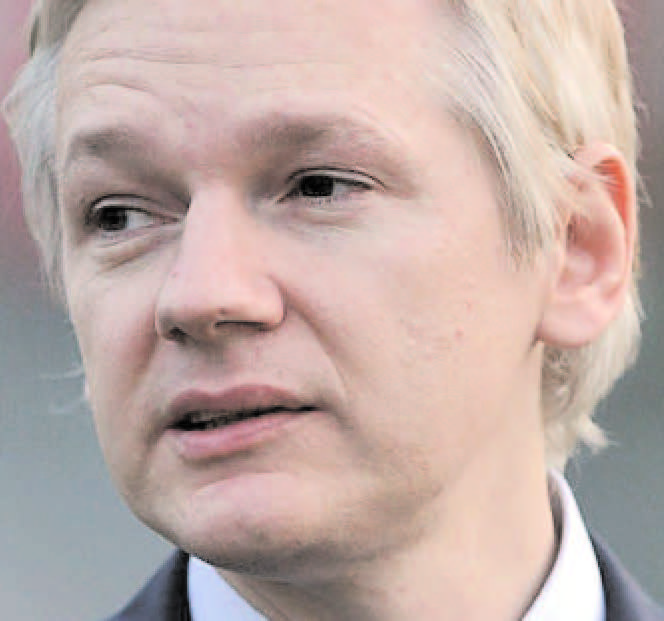
CANBERRA (TIP): WikiLeaks founder Julian Assange returned to his homeland Australia aboard a charter jet and raised a celebratory clenched fist as his supporters cheered on June 26, hours after pleading guilty to obtaining and publishing U.S. military secrets in a deal with Justice Department prosecutors that concludes a drawn-out legal saga.
Assange told Prime Minister Anthony Albanese in a phone call from the capital Canberra’s airport tarmac that Australian government intervention in the U.S. prosecution had saved his life, Assange lawyer Jennifer Robinson said.
Assange embraced his wife Stella Assange and father John Shipton who were waiting on the tarmac, but avoided media at a news conference less than than two hours after he landed.
“Julian wanted me to sincerely thank everyone. He wanted to be here. But you have to understand what he’s been through. He needs time. He needs to recuperate and this is a process.” Stella Assange told reporters.
Assange was accused of receiving and publishing hundreds of thousands of war logs and diplomatic cables that included details of U.S. military wrongdoing in Iraq and Afghanistan. His activities drew an outpouring of support from press freedom advocates, who heralded his role in bringing to light military conduct that might otherwise have been concealed from view and warned of a chilling effect on journalists. Among the files published by WikiLeaks was a video of a 2007 Apache helicopter attack by American forces in Baghdad that killed 11 people, including two Reuters journalists.
The case came to a surprise end in a most unusual setting with Assange, 52, entering his plea in a U.S. district court in Saipan, the capital of the Northern Mariana Islands. The American commonwealth in the Pacific is relatively close to Assange’s native Australia and accommodated his desire to avoid entering the continental United States.
Albanese said Assange told him during their phone call he was looking forward to playing with his sons, conceived while the father was in self-exile in the Ecuadorian Embassy in London for seven years.
“He described it as a surreal and happy moment, his landing here in our national capital, Canberra,” Albanese told reporters in Parliament House. “I had a very warm discussion with him this evening. He was very generous in his praise of the Australian government’s efforts.” (AP)
Tag: Julian Assange
-
WikiLeaks founder Julian Assange returns to Australia a free man after US legal battle ends
-

USA must drop charges against Julian Assange: Amnesty International
LONDON (TIP)– Authorities in the USA must drop the espionage and all other charges against Julian Assange that relate to his publishing activities as part of his work with Wikileaks. The US government’s unrelenting pursuit of Julian Assange for having published disclosed documents that included possible war crimes committed by the US military is nothing short of a full-scale assault on the right to freedom of expression.
Julian Assange is currently being held at Belmarsh, a high security prison in the UK, on the basis of a US extradition request on charges that stem directly from the publication of disclosed documents as part of his work with Wikileaks. Amnesty International strongly opposes any possibility of Julian Assange being extradited or sent in any other manner to the USA. There, he faces a real risk of serious human rights violations including possible detention conditions that would amount to torture and other ill-treatment (such as prolonged solitary confinement). The fact that he was the target of a negative public campaign by US officials at the highest levels undermines his right to be presumed innocent and puts him at risk of an unfair trial.
Julian Assange’s publication of disclosed documents as part of his work with Wikileaks should not be punishable as this activity mirrors conduct that investigative journalists undertake regularly in their professional capacity. Prosecuting Julian Assange on these charges could have a chilling effect on the right to freedom of expression, leading journalists to self-censor from fear of prosecution.
Sign the petition now and protect the right to freedom of expression.
https://www.amnesty.org/en/petition/julian-assange-usa-justice/
Urge the US authorities to drop the charges against Julian Assange that stem solely from his publishing activities with Wikileaks. -

UK court says Assange can’t be extradited on espionage charges until US rules out death penalty
LONDON (TIP): A British court ruled March 26 that Julian Assange can’t be extradited to the United States on espionage charges unless U.S. authorities guarantee he won’t get the death penalty, giving the WikiLeaks founder a partial victory in his long legal battle over the site’s publication of classified American documents.
Two High Court judges said they would grant Assange a new appeal unless U.S. authorities give further assurances within three weeks about what will happen to him. The ruling means the legal saga, which has dragged on for more than a decade, will continue — and Assange will remain inside London’s high-security Belmarsh Prison, where he has spent the last five years.
Judges Victoria Sharp and Jeremy Johnson said the U.S. must guarantee that Assange, who is Australian, “is afforded the same First Amendment protections as a United States citizen, and that the death penalty is not imposed.”
The judges said that if the U.S. files new assurances, “we will give the parties an opportunity to make further submissions before we make a final decision on the application for leave to appeal.” The judges said a hearing will be held May 20 if the U.S. makes those submissions.The U.S. Justice Department declined to comment Tuesday.
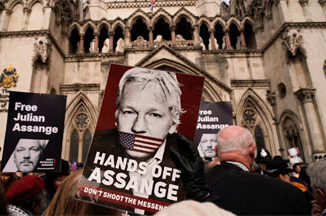
Demonstrators hold placards after Stella Assange, wife of Wikileaks founder Julian Assange, released a statement outside the Royal Courts of Justice, in London, Tuesday, March 26, 2024.
After years of avoiding extradition, Julian Assange’s appeal is likely his last chance. Here’s how it might unfold
Assange’s supporters say he is a journalist protected by the First Amendment who exposed U.S. military wrongdoing in Iraq and Afghanistan that was in the public interest.
Assange’s wife Stella Assange said the WikiLeaks founder “is being persecuted because he exposed the true cost of war in human lives.”
“The Biden administration should not issue assurances. They should drop this shameful case, which should never have been brought,” she said outside the High Court in London.
The ruling follows a two-day hearing in the High Court in February, where Assange’s lawyer Edward Fitzgerald said American authorities were seeking to punish him for WikiLeaks’ “exposure of criminality on the part of the U.S. government on an unprecedented scale,” including torture and killings.
The U.S. government said Assange’s actions went beyond journalism by soliciting, stealing and indiscriminately publishing classified government documents that endangered many people, including Iraqis and Afghans who had helped U.S. forces. (AP) -

Julian Assange wins right to appeal extradition in UK Supreme Court
London (TIP): WikiLeaks Founder Julian Assange was on January 24 granted permission from the Supreme Court to appeal against his extradition order to the US. The 50-year-old is wanted in America over the leak of thousands of classified documents related to the wars in Iraq and Afghanistan. His lawyers argued that he should not be taken to the US because of a real and “oppressive” risk of suicide.
Last month, the US authorities won an appeal against a previous court ruling that he could not be extradited due to concerns over his mental health.
US authorities later provided assurances that the WikiLeaks founder would not face the severely restrictive conditions that his lawyers said would put his physical and mental health at risk.
The High Court overturned the lower court’s decision in December, noting American “solemn undertakings” were enough to guarantee Assange would be treated humanely. Now, Assange has secured the right to seek appeal against that ruling in the Supreme Court based on a point of law that is of “general public importance”, which could potentially have a far-reaching impact of setting fresh precedent in extradition cases. (PTI)
-

US Justice Department for Assange’s arrest
WASHINGTON (TIP): The arrest of WikiLeaks founder Julian Assange is a US “priority,” attorney general Jeff Sessions said April 20, as media reports indicated his office was preparing charges against the fugitive anti-hero.
“We are going to step up our effort and already are stepping up our efforts on all leaks,” Sessions, America’s top cop, said at a news conference in response to a reporter’s question about a US priority to arrest Assange.
The Justice Department chief said a rash of leaks of sensitive secrets appeared unprecedented.
“This is a matter that’s gone beyond anything I’m aware of. We have professionals that have been in the security business of the United States for many years that are shocked by the number of leaks and some of them are quite serious,” he said.
“Whenever a case can be made, we will seek to put some people in jail.”
Prosecutors in recent weeks have been drafting a memo that looks at charges against Assange and members of WikiLeaks that possibly include conspiracy, theft of government property and violations of the Espionage Act, the Washington Post reported, citing unnamed US officials familiar with the matter.
Several other media outlets also cited unnamed officials as saying US authorities were preparing charges against Assange. The Justice Department declined to comment on the reports.
Assange, 45, has been holed up at the Ecuadoran embassy in London since 2012 trying to avoid extradition to Sweden where he faces a rape allegation that he denies.
He fears Sweden would extradite him to the United States to face trial for leaking hundreds of thousands of secret US military and diplomatic documents that first gained attention in 2010.
Assange’s case returned to the spotlight after WikiLeaks was accused of meddling in the US election last year by releasing a damaging trove of hacked emails from presidential candidate Hillary Clinton’s campaign and the Democratic party.
US officials say the emails were hacked with the aid of the Russian government in its bid to influence the US election.
Critics say their release late in the race helped to tip the November 8 election to Republican Donald Trump.
Trump and his administration have put heat on WikiLeaks after it embarrassed the Central Intelligence Agency last month by releasing a large number of files and computer code from the spy agency’s top-secret hacking operations.
The documents showed how the CIA exploits vulnerabilities in popular computer and networking hardware and software to gather intelligence.
Supporters of WikiLeaks say it’s practicing the constitutional right of freedom of speech and the press.
CIA Director Mike Pompeo last week branded WikiLeaks a “hostile intelligence service,” saying it threatens democratic nations and joins hands with dictators.
Pompeo focused on the anti-secrecy group and other leakers of classified information like Edward Snowden as one of the key threats facing the United States.
“WikiLeaks walks like a hostile intelligence service and talks like a hostile intelligence service. It has encouraged its followers to find jobs at CIA in order to obtain intelligence… And it overwhelmingly focuses on the United States, while seeking support from anti-democratic countries and organizations,” said Pompeo.
“It is time to call out WikiLeaks for what it really is- a non-state hostile intelligence service often abetted by state actors like Russia.”
The day before Pompeo spoke, Assange published an opinion piece in The Washington Post in which he said his group’s mission was the same as America’s most respected newspapers: “to publish newsworthy content.”
“WikiLeaks’s sole interest is expressing constitutionally protected truths,” he said, professing “overwhelming admiration for both America and the idea of America.” (AP)
-

Sweden drops some sex cases against Julian Assange
HELSINKI (TIP): Swedish prosecutors on Aug 13 dropped cases of lesser sexual misconduct against WikiLeaks founder Julian Assange but said they still want to question him on accusations of rape made after his visit to Stockholm five years ago.
The Swedish Prosecution Authority said it has been unable to charge the 44-year-old Australian, who escaped a Swedish arrest warrant by taking refuge in the Ecuadorean Embassy in London in 2012, because it has not been possible to question him.
The agency said it has stopped investigating a case of sexual molestation and one of unlawful coercion that expired Thursday, and a third case of sexual molestation, which would have seen its statute of limitations expire on Aug. 18. However, it said Assange — who has not been indicted in Sweden — was still wanted for questioning on allegations of rape that expire in 2020.
Public prosecutor Marianne Ny said she has tried to interview Assange since autumn 2010, but that “he has consistently refused to appear.”
“I still hope, however, that I will be able to arrange for an interview, as there are ongoing negotiations between Sweden and Ecuador,” Ny said in a statement on the agency’s website.
The allegations of sexual misconduct and rape by two women stem from a 2010 visit to Stockholm by Assange who drew crowds to his meetings. After having separate sexual encounters with him, the women went together to the police in Stockholm.
Assange was questioned by the police, denied all allegations, and said he had consensual sexual encounters with the women. Police passed on the case to the prosecutor who ordered his arrest, but he escaped to England.
Assange has refused to go back to Sweden for fear of being extradited to the United States because of an investigation into WikiLeaks’ dissemination of hundreds of thousands of classified US documents. In March, a US federal court confirmed there are “active and ongoing” attempts to prosecute him and WikiLeaks in an investigation involving espionage, conspiracy, and computer fraud.
After failing to fight extradition to Sweden through the British courts, Assange took refuge in June 2012 inside Ecuador’s small diplomatic mission. British police stand guard around the clock ready to detain him if he steps out, in an operation believed to have cost so far some 12 million pounds ($19 million).
Swedish prosecutors initially refused to travel to London to question Assange at the embassy, but changed their minds in March as the statute of limitations approached. However, prosecutors have not heard back from the embassy after attempting to contact it in March and June, according to spokeswoman Karin Rosander.
The Ecuadorean embassy in turn has said that “on no occasion has any representative of the Kingdom of Sweden presented themselves at the embassy in relation to the Assange matter.”
The British government on Thursday protested Ecuador’s refusal “to support legal process” in the case.
“Ecuador must recognize that its decision to harbor Mr. Assange more than three years ago has prevented the proper course of justice,” Hugo Swire, minister in charge of the Foreign and Commonwealth Office, said. “It is completely unacceptable that the British taxpayer has had to foot the bill for this abuse of diplomatic relations.”
Sweden and Ecuador are starting discussions on a general agreement on mutual legal assistance in criminal matters that may permit the questioning of Assange in the embassy, officials from the two countries said.
However, in order to question Assange, Sweden would first need to accept in writing that he has been granted exile by Ecuador and that Ecuadorean jurisdiction applies, Ricardo Patino, who recently stepped down as Ecuador’s foreign minister, was quoted as saying Thursday by the country’s official Andes news agency.
Patino, who remains close to President Rafael Correa, said he believed the talks would be held in early September.
In a statement Thursday, Ecuador’s Foreign Ministry said it welcomes the conversations but “deplores the continued inaction of British and Swedish authorities over nearly 1,000 days of asylum in the embassy, a time during which they all ignored the proposals and calls of Ecuador’s foreign ministry for dialogue.”
Assange said in London that he was “extremely disappointed” at the Swedish prosecutor’s decision to continue an investigation against him.
“There was no need for any of this. I am an innocent man,” he said in a statement. “From the beginning I offered simple solutions. Come to the embassy to take my statement or promise not to send me to the United States.”
Assange’s lawyer in Sweden, Thomas Olsson, said he had expected Thursday’s decision by the prosecutor. “It will not change anything … as the most serious suspicion against him remains,” he said.
-

Now, Assange on a catwalk
LONDON (TIP): WikiLeaks founder Julian Assange who has been holed up in the Ecuadorean Embassy for over two years is expected to make his London Fashion Week debut this September. Assange will model for Vivienne Westwood’s son Ben Westwood at a fashion show which will take place inside the Ecuadorean Embassy so that the Scotland Yard can’t arrest him. Ben said, “Julian’s been in the embassy for two years and it’s important that he doesn’t slip into obscurity. I want to highlight his plight. What happened to him is totally unfair.”
“I’ve designed something for him along those lines and will be getting him to wear it,” he added. Scotland Yard has posted guards outside the embassy so that they can arrest Assange as soon as he steps out and puts his feet on British soil. Britain has spent nearly £6 million till now in guarding the Ecuadorean Embassy in London. Scotland Yard admitted it has spent £4.9 million of this total bill on diverting officers from normal duties to prevent the 42-year-old escaping his west London sanctuary.
Around £1 million additionally was spent on overtime for officers guarding the building round the clock. According to figures obtained under the Freedom of Information Act, the daily cost of policing the building is over £9,000. Assange has been holed up in the embassy since June 2012 avoiding extradition to Sweden where he is wanted over sexual offence allegations. Ecuador has said it will continue to provide asylum to Assange even as Britain refused to give him safe passage to travel to the South American country.
-

WikiLeaks chief Julian Assange marks 2nd year in Ecuador’s embassy
LONDON (TIP): The gathering at the Ecuadorean embassy in London has the feel of something which may become an annual fixture. For the second time in as many years, journalists were invited on Thursday to the embassy to mark the anniversary of WikiLeaks chief Julian Assange’s stay there a bid to escape extradition to Sweden, where he is wanted over allegations of sexual misconduct, and to the United States, where an investigation into WikiLeaks’ dissemination of hundreds of thousands of classified US documents remains live.
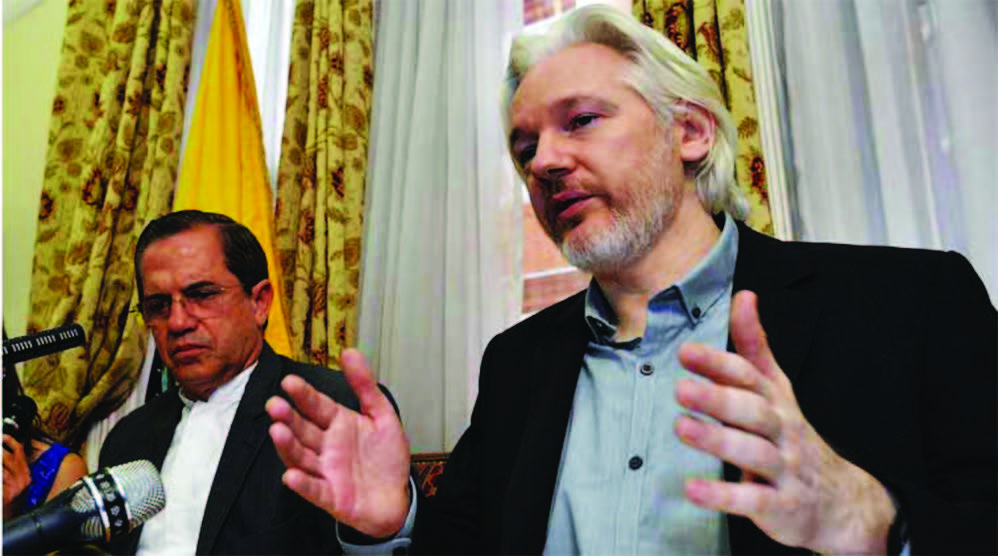
Supporters including one with a figure of Assange on a crucifix chanted slogans outside the embassy. Inside, Assange said he has no intention of going to Sweden because he has no guarantee he wouldn’t subsequently be sent to the US. Dressed in a suit and sneakers and appearing relaxed, he traded pleasantries with Ecuadorean foreign minister Ricardo Patino as reporters crowded around to listen in on the banter. “I can see that your beard is longer now,” Patino joked via videolink from Ecuador, referring to Assange’s wispy white stubble.
Assange in turn paid tribute to Ecuador’s “robust resistance” to pressure from outside powers which he said is why “I have a liberty to work today.” Assange had been under a form of supervised release in the UK, but shortly after losing his battle in Britain’s highest court he jumped bail and applied for asylum at the Ecuadorean Embassy on June 19, 2012.
British police on guard outside the embassy have orders to arrest him should he ever step out. That doesn’t seem likely. Patino told journalists that negotiations with Britain over Assange’s fate were at an impasse and that there would be no attempt to force him back to Sweden. “We will protect Julian Assange for as long as necessary,” he said.
-

UK Wikileaks’ Julian Assange ‘threat’ over, says Ecuador
LONDON (TIP):
Britain has given up its threat to enter Ecuador’s London embassy to arrest Wikileaks founder Julian Assange, Ecuador’s president has said, says an August 26 BBC report.
Rafael Correa told reporters “we consider this unfortunate incident over”, following assurances by the UK.
A diplomatic row broke out after Ecuador granted asylum to Mr. Assange, who faces extradition to Sweden to face questions over alleged sexual offences. He denies any wrongdoing.
The UK says it never made any threats.
The Foreign Office (FCO) said it sent the Ecuadorean embassy an official letter on Friday, aimed at “calming things down” and allowing talks to resume.
Speaking at a press conference on Sunday, August 26, Mr. Correa said: “We consider this unfortunate incident over, after a grave diplomatic error by the British in which they said they would enter our embassy.”
Ecuador’s government also said it had received “a communication from the British Foreign Office which said that there was no threat to enter the embassy”.
Ecuador had accused Britain of threatening to enter its London embassy and seize Mr. Assange – who remains inside the building – after UK officials said a 1987 law gave police the power to enter diplomatic premises.
‘Constructive discussions’
Former computer hacker Mr. Assange, 41, has been taking refuge at the embassy since June.
The FCO says the UK has a legal obligation to extradite him to Sweden, and he will be arrested if he leaves the embassy.
In a statement on Sunday, it said it remained “committed to the process of dialogue we entered into in good faith some weeks ago.
“We invite the government of Ecuador to resume, as early as possible, the constructive discussions we have held on this matter to date.”
It also reiterated a statement made in a letter sent to the Ecuadorean embassy on Friday that said “at no time has the UK government made any threat against the embassy of Ecuador.
“Respect for, and compliance with, international law is at the heart of the conduct of the foreign policy of the United Kingdom.”
In 2010, two female ex-Wikileaks volunteers accused Mr. Assange of committing sexual offences against them while he was in Stockholm to give a lecture.
Mr. Assange says the sex was consensual and the allegations are politically motivated.
He says he fears onward extradition to the US if extradited to Sweden because of his website’s publication of confidential documents.
But in May, the UK Supreme Court dismissed Mr. Assange’s bid to reopen his appeal against extradition and gave him a two-week grace period – during which he entered Ecuador’s embassy – before extradition proceedings could start.
Meanwhile, the US is carrying out an investigation into Wikileaks, which has published a mass of leaked diplomatic cables, embarrassing several governments and international businesses.