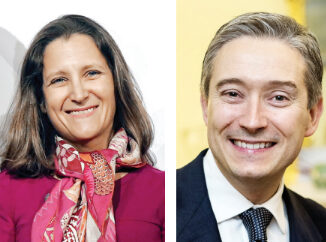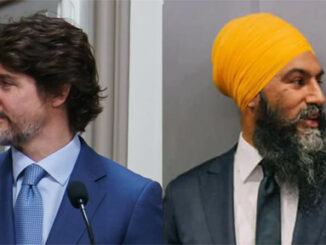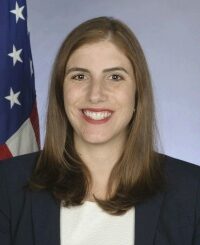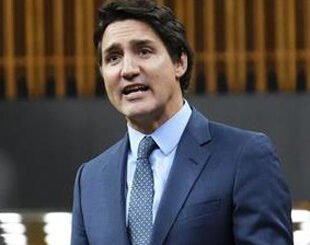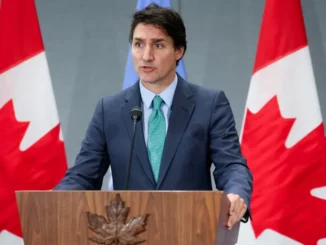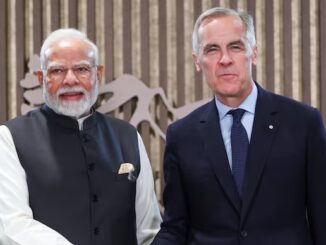
OTTAWA (TIP): While former Deputy Prime Minister and Finance Minister Christina (Chrystia) Alexandra Freeland made public her exit from Federal Politics within hours of the new Finance Minister François-Philippe Champagne announcing that the new Liberal government under Mark Carney will table its first federal budget on November 4.
Early in the day, Chrystia Freeland announced her departure from federal politics, confirming she will step down from Cabinet and not seek re-election.
In a letter to constituents she expressed gratitude for the trust placed in her over five terms representing University–Rosedale riding in Greater Toronto Area. She thanked both Prime Ministers Justin Trudeau and Mark Carney for the opportunity to serve in Cabinet, as well as her colleagues, staff, and family for their support.
It was her resignation on the day in December last year she was to present her fiscal report during the previous Liberal Government under Justin Trudeau, that rocked the federal politics. She had then resigned both as Deputy Prime Minister and Finance Minister.
She joined the race to head the Liberal Government after Justin Trudeau quit but lost it to the incumbent Prime Minister Mark Carney. She contested the last federal elections on April 28 and won comfortably.
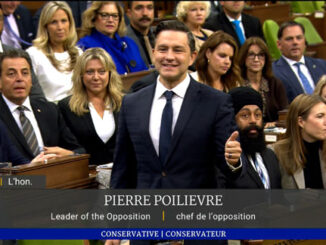
Interestingly, while the Leader of Opposition Pierre Poilievre, after losing the April 28 elections, made a triumphant entry to House of Commons by winning a byelection from Alberta, Chrystia Freeland, made public her decision to quit federal politics.
Incidentally, she has been appointed international envoy to Ukraine and will help as an envoy in its reconstruction.
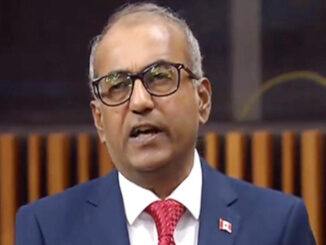
After she quit Justin Trudeau’s Cabinet, a Liberal MP of Indian origin, Chandra Arya, became the first member of the Liberal caucus to propose the name of Chrystia Freeland for the Prime Ministers’ office. Interestingly, he himself became the first candidate to join the race for the party leadership. However, the party high command rejected his credentials for the leadership race.
It did not end there. Subsequently, his nomination as a Liberal candidate from Nepean riding in Ottawa was also turned down. Instead, it is Mark Carney, the Prime Minister, contested successfully from there. It may be just a coincidence that in the current House of Commons, both Chandra Arya and Chrystia Freeland, would be missing from members’ list.
Freeland highlighted key accomplishments during her tenure, including trade negotiations with Europe, the renegotiation of NAFTA, economic protections during the pandemic, infrastructure investments, and Canada’s support for Ukraine.
Explaining her decision, Freeland said the demands of public office had become too great and that she wishes to dedicate more time to her family. She emphasized her pride in serving Canadians and expressed confidence in the country’s resilience.
“Canada has faced great challenges, but it will emerge stronger than ever,” she wrote.
When she quit in December last year, she called out her own government’s economic stewardship and “costly political gimmicks.” Her exit escalated caucus pressure on Trudeau to resign, triggering a leadership race that she ran in, but that ultimately made Mark Carney leader. The Liberals would go from 20 points behind the Conservatives to a comeback win in April’s election.
She’s attracted ire from Trump, who called her “toxic,” and from Russia, which sanctioned her back in 2014.
Sources say Canada-U.S. Trade Minister Dominic LeBlanc will absorb Freeland’s internal trade duties and government House leader Steve MacKinnon will take on transport.
Meanwhile, Finance Minister François-Philippe Champagne announced that the Liberals would table the federal budget on November 4.
The Opposition has been criticizing the Liberals for delaying the budget. Even on the first day of resumption of Parliament, the Conservatives mounted attacks that instead of much delayed budget, it was now being shifted to November instead of October.
The long-awaited spending plan will be the federal Liberals’ first under Prime Minister Mark Carney.
It will also be the first budget as finance minister for Champagne, who announced the date during question period Tuesday.
He billed the plan as a “generational investment” in Canada’s future.
“We’re going to present a great budget in this house on the fourth of November, mister speaker,” he said.
“We’re going to build this country, mister speaker, we’re going to protect our communities, we’re going to empower Canadians.”
Carney has billed the budget as one of both cost-cutting and investment as Ottawa looks to protect Canada’s economy against U.S. trade disruption.
The federal budget typically arrives in the spring but the Liberals delayed it until the fall.
The minority Liberal government will need support from at least one other party to pass the budget in the fall session of Parliament.
Carney has announced a series of big-ticket spending items since the spring election, including billions of dollars in new spending on defense and infrastructure.
The federal government also cut personal tax rates in the lowest tax bracket by a percentage point as of July and has announced an expenditure review to trim day-to-day spending across the public service.
Many fiscal observers are expecting the federal deficit to balloon in the fall budget. Carney has pledged to balance the operating side of the budget within three years even as capital spending is expected to grow.
(Prabhjot Singh is a Toronto-based senior journalist)
Justin Trudeau to collect two pensions, $104K in severance
The former PM is entitled to one pension for his nearly 17 years as a Member of Parliament and a second for his decade as Prime Minister
By Prabhjot Singh
“Should a retiring Prime Minister get two pensions?,” is the subject of an animated debate that has been set in motion by the Canadian Taxpayers Federation (CFT) as it released its calculations about the estimated pension and severance payments to be paid to 110 Members of Parliament who were either defeated or did not see re-election to the 45th House of Commons.
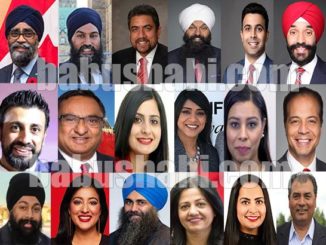
At least six members of the outgoing House of Indian descent who either lost the April 28 elections or decided not to seek re-election are among the beneficiaries. They are Chandra Arya, George Chahal, Kamal Khera, Harjit Singh Sajjan, Jagmeet Singh and Arif Virani.
While Chandra Arya, Harjit Singh Sajjan and Arif Virani did not contest, the remaining three – Jagmeet Singh, Kamal Khera and George Chahal – were defeated in the last federal elections held on April 28.
While releasing its calculations, the CFT said that “defeated or retiring MPs will collect about $5 million in annual pension payments, reaching a cumulative total of about $187 million by age 90. In addition, about $6.6 million in severance cheques will be issued to some former MPs.
“Former Prime Minister Justin Trudeau will collect two taxpayer-funded pensions in retirement. Combined, those pensions total $8.4 million, according to CTF estimates. Trudeau also takes a $104,900 severance payout because he did not run again as an MP.
“The payouts for Trudeau’s MP pension will begin at $141,000 per year when he turns 55 years old. It will total an estimated $6.5 million should he live to the age of 90. The payouts for Trudeau’s prime minister pension will begin at $73,000 per year when he turns 67 years old. It will total an estimated $1.9 million should he live to the age of 90,’ the CFT said in its statement.
Going by the statement, it not only gave details of all 110 Members of Parliament who will no longer sit in the House of Commons but has also raised a pertinent question as to whether a retiring Prime Minister should be entitled to two pensions or the government should promulgate a law to end the second pension for all Prime Ministers.
“Taxpayers shouldn’t feel too bad for the politicians who lost the election because they will be cashing big severance or pension cheques,” said Franco Terrazzano, CTF Federal Director. “Thanks to past pension reforms, taxpayers will not have to shoulder as much of the burden as they used to. But there is more work to do to make politicians pay affordable for taxpayers.”
“Taxpayers need to see leadership at the top, and that means reforming pensions and ending the pay raises MPs take every year,” Terrazzano said. “A Prime Minister already takes millions through his/her first pension, he/she should not be billing taxpayers more for his/her second pension.
“The government must end the second pension for all future prime ministers.”
There are 13 former MPs who will collect more than $100,000-plus a year in pension income. The pension and severance calculations for each defeated or retired MP can be found.
Going by the CFT statement, four of the six members of the outgoing House of Indian descent, will be entitled to severance payments varying between Can $74000.00 and Can $ 1,54,000 besides getting a pension between Can $ 45000 and Can $ 77000.
George Chahal, who lost the election, would get a severance payment of Can $ 1,04,900. Kamal Khera, who was a federal minister and lost the April 28 election, would get the highest severance payments among MPs of Indian descent as she would be entitled to draw Can $ 1,54,850 as a severance payment.
Harjit Singh Sajjan, who also remained a federal minister in Justin Trudeau’s government, would draw the lowest severance payment as his entitlement has been worked out to be Can $ 74000.
Only MP of Indian descent to head a national party, Jagmeet Singh, who lost the April 28 election from Burnaby Centre in British Columbia, would get a severance payment of Can $ 1,40,300.00. Another federal minister in Justin Trudeau’s government, Arif Virani, would get a severance payment of Can $ 1,04,900.00.
Chandra Arya, whose candidature as Liberal candidate from Nepean was revoked, would now draw a pension of Can $ 53000, while pension of Jagmeet Singh will be Can $ 45000. The pension is calculated on the number of years a Member has served. Former federal ministers – Kamal Khera (Can $ 68000), Harjit Singh Sajjan (Can $ 77000) and Arif Virani (Can $ 66000) would also get pensions as former MPs.
Jagmeet Singh’s pension remained a subject of regular debates in the House of Commons when it took up no-confidence motions moved by the Conservatives against the minority Liberal government headed by Justin Trudeau. NDP led by Jagmeet Singh twice bailed out the government while the House took up no-confidence motions moved by the Leader of the Opposition, Pierre Poilievre, Incidentally, Pierre Poilievre, was also among the 110 MPs who either lost or did not contest the April 28 elections.
(Prabhjot Singh is a Toronto-based award-winning independent journalist. He was celebrated by AIPS, the international body of sports journalists, for covering ten Olympics, at its centennial celebrations held at UNESCO Centre in Paris during the 2024 Olympic Games. Besides, he has written extensively about business and the financial markets, the health industry, the public and private sectors, and aviation. He has worked as a political reporter besides covering Sikh and Punjab politics. He is particularly interested in Indian Diaspora and Sikh Diaspora in particular. His work has also appeared in various international and national newspapers, magazines, and journals. He can be reached at prabhjot416@gmail.com)
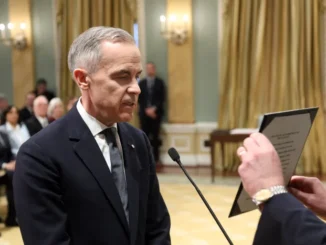
OTTAWA (TIP): Mark Carney, who was sworn in as Canada’s 24th Prime Minister on Friday, has three citizenships: Canada, Ireland, and Great Britain. He has already initiated steps to renounce the last two. Earlier, Justin Trudeau resigned as the 23rd Prime Minister of Canada. Born in Fort Smith, NWT, and raised in Edmonton, the 59-year-old renowned banker is an economist who attended Harvard and Oxford. He has led two countries’ central banks: Canada’s from 2008 to 2013 and Britain’s from 2013 to 2020.
His wife, Diana Fox Carney, is a British economist. They first met at Oxford and have four daughters: Sophia, Amelia, Tess, and Cleo. Has never run for Parliament but is known to many people in the Liberals who held key portfolios in the Trudeau government.
Interestingly, one of his Oxford friends married Chrystia Freeland, who was Justin Trudeau’s finance minister. Catherine McKenna, the former environment minister, and Anita Anand, the current Transport Minister, are also counted among friends of the new Prime Minister.
The role he played in weathering the 2008 financial crisis in Canada and the 2016 Brexit shock in Britain made him a sought-after expert on another emergency, the pandemic. It led to his installation as an informal adviser on COVID-19 economic strategy.
He became so indispensable that Justin Trudeau toyed with the idea of making him finance minister in place of Chrystia Freeland. However, the move created ripples. Chrystia Freeland surprised everyone with her resignation hours before she was to present the fall Financial Report in the House of Commons. It also helped trigger the leadership race that brought Mark Carney the top job. Chrystia Freeland has known Mark Carney for years, as has her husband, Graham Bowley, who studied with him at Oxford.
In his run for the Liberal Party leadership, Mark Carney maintained that he would retaliate dollar for dollar against U.S. tariffs and help Canada weather the shock by reducing its internal trade barriers and exploring new international markets. He also declared that he would phase out carbon pricing at the consumer and business level but not the industrial level.
Before his carnation, Mark Carney has divested all assets, other than cash and real estate, into a blind trust, a spokesperson told media without divulging how much those assets were worth, so it was not clear how wealthy the former corporate executive was before entering politics.
Going by indications, he is likely to call a snap election within days, setting up a fierce battle of ballots between his Liberals and Pierre Poilievre’s Conservatives in late April or early May for political supremacy in Canada for the next four years. Soon after assuming office, he is expected to travel to London and Paris for talks, including with British Prime Minister Keir Starmer, as Europe and Canada have much to discuss to retaliate against steel and aluminium tariffs by the United States.
Meanwhile, before relinquishing office, Justin Trudeau posted a goodbye video to social media, saying he leaves the prime ministership “proud to have served a country full of people who stand up for what’s right.”
After braving two no-confidence motions in November and December last year, Trudeau announced his decision to step down as Prime Minister after his party had chosen his successor this past weekend. Mark Carney, as expected, downsized his Cabinet, while retaining Mélanie Joly in Foreign Affairs, David McGuinty in Public Safety, and Dominic LeBlanc in Finance so that they continue to concentrate on the Canada-U.S. trade dispute. In January, the Governor-General had, at Justin Trudeau’s request, prorogued Parliament until March 24, suspending all House business that could bring the minority government down while the leadership race was in progress.
The new Prime Minister has the option to call a snap election before the House of Commons resumes its sitting. He may do this the week before the prorogation ends.
Political circles are agog with speculations that April 28 or May 5 may be election dates under consideration, giving parties just more than a month on the campaign trail, a fairly standard length for federal elections.
Groups supporting “Made in Canada”; while in Canada “Buy Canada”; “Donald Trump Canada is no US Dump”; and “Canada First” have been gaining both popularity and acceptability as more than 3600 American brands of alcohol have started disappearing from Liquor shops and vends in Ontario and British Columbia.
By Prabhjot Singh
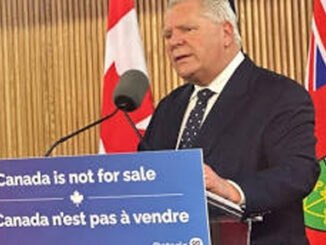
TORONTO (TIP): They say power—electricity—has no color, but it can color the economies of manufacturing hubs, provinces, and nations. US President Donald Trump has decided to proceed with his long-threatened tariffs on Canadian goods. Ontario Premier Doug Ford, fresh from his third consecutive mandate, is determined to color the electricity flowing into the United States with a 25 percent surcharge.
The tariff war is getting “livid” with the outgoing Canadian Premier Justin Trudeau supported by Premiers of various provinces and territories making no secret of their intentions to resort to “tit for tat”. They have already started imposing “tariffs” on most American goods, with Justin Trudeau announcing a 25 per cent tariff on imports worth US $ 30 billion.
Mark Carney, who is the front runner to succeed Justin Trudeau as Canadian Premier, sent a message to his supporters saying: Canada is at a crossroads. The world is more uncertain, more dangerous, and more divided than it has been in decades. The next Liberal leader must be ready to meet this moment with serious leadership and a serious plan.
That’s why I stepped forward in this race—to fight for a strong, independent, and competitive Canada. One that invests in its people, grows its economy, and builds a better future. We need a leader who will put Canada first. We need a leader who will invest in Canadians. We need a leader who will build a stronger economy because a strong economy means a strong Canada.
The truth is we are now facing the most serious crisis in our lifetime. Donald Trump is back in the White House. The world is shifting fast, and Canada must be ready to stand strong.
Pierre Poilievre is the wrong person at the worst time. He takes his cues from Trump. He tears things down instead of building. His reflex is always to cut and destroy, never to strengthen and invest, Mark Carney said.
Canada is scheduled to get its new Prime Minister on March 9.
Groups supporting “Made in Canada”; while in Canada “Buy Canada”; “Donald Trump Canada is no US Dump”; and “Canada First” have been gaining both popularity and acceptability as more than 3600 American brands of alcohol have started disappearing from Liquor shops and vends in Ontario and British Columbia.
Ontario has also threatened to rip up its $100-million deal with Elon Musk’s Starlink internet provider. The U.S. companies will also be banned from procurement contracts as part of the province’s response to President Donald Trump’s tariffs on Canadian goods.
Premier Doug Ford, who is the chair of the Federation of Canadian Premiers, has been on the forefront in “tariff war” taking it across the international borders by warning lawmakers in New York, Michigan and Minnesota that if the trade war “persists” Ontario will put a 25 per cent surcharge on electricity flowing into the states and potentially cut the flow off entirely.
Ontario supplies roughly 1.5 million customers in the border states with electricity.
“This is not the outcome anyone wanted,” Ford said at Queen’s Park in Toronto. “We could have poured our efforts into making Canada and the U.S. the two richest, most successful, safest, most secure two countries on the planet. Unfortunately, one man — President Trump — has chosen chaos instead.”
Just after midnight, Trump moved ahead with long-threatened 25 per cent tariffs on most Canadian goods. A 10 per cent tariff will similarly be applied to all Canadian energy exports heading south of the border.
The “tariff war” could wreak havoc on vital Ontario industries like auto manufacturing and steel production, as well as drive up retail prices and fuel more inflation. Auto giants based in the province have warned that plants could be forced to halt production within five to eight days.
Intriguingly, Donald Trump, as president who signed the most recent free trade deal with Canada and Mexico, said in 2020 that it was “the best and most important trade deal ever made by the USA.”
Prime Minister Justin Trudeau announced Canada’s retaliatory response that included matching tariffs on $155 billion worth of U.S. goods — roughly $30 billion worth of goods right away and the remaining $125 billion in 21 days to give Canadian companies time to adjust their supply chains. He added that he believes Trump’s ultimate goal is to weaken the Canadian economy so he can try to annex the country.
“First of all, that is never going to happen. Canada will never be the 51st state,” he continued.
Doug Ford says he will ‘spare no expense to protect Ontario workers,’ while highlighting a slew of retaliatory measures in response to sweeping tariffs imposed by Donald Trump. Ford has also threatened to surcharge or cut off critical mineral exports to the U.S. should the trade war linger.
“We also need to be ready to dig in for a long fight,” Ford said. “We need to be ready to escalate using every tool in our tool kit.”
Ford spoke just after hours Ontario’s primary liquor wholesaler and retailer confirmed it will stop purchasing and selling U.S. alcohol. The LCBO previously offered some 3,600 American products sourced from 35 states, amounting to roughly $1 billion in annual sales. As the province’s main booze distributor, it means grocery and convenience stores, bars and restaurants, and other retailers will no longer be able to buy U.S. alcohol.
Ontario is pulling 3,600 U.S. products off LCBO shelves in response to Trump’s tariffs, with Premier Doug Ford encouraging people to buy Canadian brands instead.
He added that he believes Trump’s ultimate goal is to weaken the Canadian economy so he can try to annex the country.
“First of all, that is never going to happen. Canada will never be the 51st state,” he continued.
Ford has previously expressed support for the federal government to go “dollar for dollar” with retaliatory tariffs against U.S. goods.
The premier said American companies will not be able to bid on the $30 billion worth of procurement contracts the province awards each year or bid on contracts related to his $200-billion infrastructure plan to build highways, tunnels, transit, hospitals and jails.
“U.S.-based businesses will now lose out on tens of billions of dollars in revenues,” Ford said. “They only have President Trump to blame.”
As for the deal with Starlink to provide high-speed internet to northern Ontario, rural and remote First Nation communities, “it’s done, it’s gone,” he said.
Doug Ford has also cautioned against tough times ahead.
“Businesses and families will feel the pain of this needless fight, but together we’re going to stand up for Canada,” he said. “We’re going to get through this more united than ever before.”
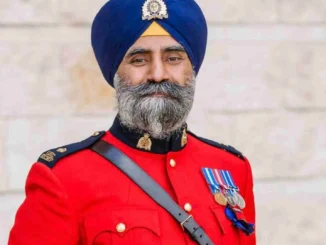
Baltej Dhillon, the first turban-wearing Sikh to become a Royal Canadian Mounted Police officer in 1991, is one of the three new independent members appointed to the Canadian Senate. Baltej Dhillon represents British Columbia while Martine Herbert (Quebec) and Todd Lewis (Saskatchewan) are the other new Senators named by Prime Minister Justin Trudeau.
Baltej, who recently contested unsuccessfully in British Columbia assembly elections, is the second turbaned Sikh after Sebi Marwah, to become a Senator in Canada.
An official communique from the office of the Prime Minister, Justin Trudeau, said that the Governor General, Mary Simon, has appointed Baltej Dhillon, for British Columbia, Martine Hébert, for Quebec, and Todd Lewis, for Saskatchewan as independent senators to fill vacancies in the Senate. Baltej Dhillon is a retired career police officer, a community leader, and a lifelong advocate for diversity and inclusion.
In 1991, Baltej Dhillon made history as the first Royal Canadian Mounted Police (RCMP) officer to wear a turban. He went on to have a successful 30-year career with the RCMP, playing a key role in several high-profile investigations. Since 2019, he has worked with British Columbia’s anti-gang agency, while remaining active in his community as a youth leader.
In 2013, Baltej Dhillon led the Sikh Leadership and Police Committee on Gang Violence to support youth prevention strategies within the Sikh Community. Since retiring from the RCMP in 2019, he has worked as Program Manager for the Crime Guns Intelligence and Investigations Group with the Combined Forces Special Enforcement Unit of British Columbia, the province’s anti-gang agency.
Mr. Dhillon is also deeply involved in community service. He serves on various committees and has led youth camps. He has received numerous distinctions and awards, including the Lifetime Achievement Award from The Times of Canada, the Queen Elizabeth II Diamond Jubilee Medal, the Queen Elizabeth II Golden Jubilee Medal, and the RBC Top 25 Canadian Immigrant Award.
Besides his extensive police education and training, Baltej Dhillon is the recipient of honorary Doctor of Laws degrees from McMaster University and Kwantlen Polytechnic University.
Martine Hébert is a renowned economist, former Quebec diplomat, and public figure with over 25 years of experience in economic relations, governance, and public affairs. She has made significant contributions to the economic development of Quebec and Canada, notably during her time as Quebec’s Delegate to Chicago and later to New York City. She is also the former Senior Vice-President and National French Spokesperson for the Canadian Federation of Independent Business.
Todd Lewis is a fourth-generation farmer and a dedicated champion for Saskatchewan’s agricultural community. He is the former President of the Agricultural Producers Association of Saskatchewan and currently serves as the first Vice-President of the Canadian Federation of Agriculture. A lifelong volunteer, he has been a strong voice for his community on numerous boards and working groups, and he continues to give back through his work as a municipal councilor.
These new senators were recommended by the Independent Advisory Board for Senate Appointments and chosen using a merit-based process open to all Canadians. Introduced in 2016, this process ensures senators are independent and able to tackle the broad range of challenges and opportunities facing the country.
In a message, Justin Trudeau said “Congratulations to Mr. Dhillon, Ms. Hébert, and Mr. Lewis on their appointment as Parliament’s newest independent senators. Their broad range of experience will be a great benefit to the Senate, and I am confident they will continue to be strong voices for their communities.”
The Senate is the Upper House in Canada’s parliamentary democracy. For appointment, candidate submissions are reviewed by the Independent Advisory Board for Senate Appointments, which provides recommendations to the Prime Minister. The Board is guided by public, transparent, non-partisan, and merit-based criteria to identify highly qualified candidates for the Senate.
With today’s announcement, there have been 93 independent appointments to the Senate made on the advice of Prime Minister Justin Trudeau. All of them were recommended by the Board.
Under the Canadian Constitution, the Governor General appoints individuals to the Senate. By convention, senators are appointed on the advice of the Prime Minister.
Once appointed by the Governor General, new senators join their peers to examine and revise legislation, investigate national issues, and represent regional, provincial territorial, and minority interests – important functions in a modern democracy.
(Prabhjot Singh, is a Toronto-based award-winning independent journalist, He was celebrated by AIPS, the international body of sports journalists, for covering ten Olympics at its centennial celebrations held at UNESCO Centre in Paris during the 2024 Olympic Games. Besides, he has written extensively about business and the financial markets, the health industry, the public and private sectors, and aviation. He has worked as a political reporter besides covering Sikh and Punjab politics. He is particularly interested in Indian Diaspora and Sikh Diaspora in particular. His work has also appeared in various international and national newspapers, magazines and journals)
TORONTO (TIP): Chandra Arya, Liberal MP from Nepean, sprang a surprise on Friday, January 10 by declaring his candidature for the position of Prime Minister of Canada.
In a social media post, Arya announced his candidature, holding that he was “ready to lead a small, more efficient government to rebuild our nation and secure prosperity for future generations.”
While the process to choose a successor to Justin Trudeau is still to be formally initiated, he has become the first candidate to make public his intent. He is known for his “pro-India stance” as he has been openly opposing any proposals or motions brought up on the floor of the House in support of Sikh separatism or “anti-India campaigns.”
Justin Trudeau often faced criticism by the Government of India for not taking any action against those performing “anti-India activities carried out from the Canadian soil.”
When Deputy Prime Minister and Finance Minister Chrystia Freeland sprang a major surprise by sending a stunning resignation letter to Justin Trudeau on December 17, hours before she was to present her fall Financial Statement in the House of Commons, Chandra Arya was the first member of the Liberal caucus to declare his support to her as replacement of Justin Trudeau.
He was also the first Liberal MP of South Asian descent to ask Justin Trudeau to step down as he claimed he had a “difference of opinion” with the Prime Minister on various contagious issues. He posted a letter on his social media handles within a few hours after Justin Trudeau rejigged his Cabinet following Chrystia Freeland’s resignation.
“I am running to be the next Prime Minister of Canada to lead a small, more efficient government to rebuild our nation and secure prosperity for future generations. We are facing significant structural problems that haven’t been seen for generations and solving them will require tough choices.
“I have always worked hard for what is best for Canadians, and for the sake of our children and grandchildren, we must make bold decisions that are necessary. If elected as the next Leader of the Liberal Party, I offer my knowledge and expertise to do so. We have a perfect storm: many Canadians, especially younger generations, face significant affordability issues.
“The working middle class is struggling today, and many working families are retiring directly into poverty. Canada deserves leadership that is not afraid to make the big decisions. Decisions that rebuild our economy, restore hope, create equal opportunities for all Canadians, and secure prosperity for our children and grandchildren.
“Bold political decisions are not optional—they are necessary. With prudence and pragmatism as my guiding principles, I am stepping forward to take on this responsibility and lead Canada as its next Prime Minister. Join me in this journey. Let us rebuild, revitalize, and secure the future. For all Canadians, for generations to come,” he said in his social media post.
He said that more details, including his policy proposals, were in the statement next in the thread. You can also visit my website http://AryaCanada.ca which will be operational later today,” he concluded.
(Prabhjot Singh, is a Toronto-based award winning independent journalist, He was celebrated by AIPS, the international body of sports journalists, for covering ten Olympics at its centennial celebrations held at UNESCO Centre in Paris during the 2024 Olympic Games. Besides, he has written extensively about business and the financial markets, the health industry, the public and private sectors, and aviation. He has worked as a political reporter besides covering Sikh and Punjab politics. He is particularly interested in Indian Diaspora and Sikh Diaspora in particular. His work has also appeared in various international and national newspapers, magazines and journals)
For Justin Trudeau and his minority Liberal government, there has been no running away from the ignominy of no-confidence motions. The House of Commons that broke for the holidays from December 18 till January 27 may have its Public Accounts Committee meeting in the first week of the New Year to discuss the possibility of early tabling of the no-confidence motion. Normally, the Opposition parties have to wait for the Opposition days to table their motions. The Business Advisory Committee of the Commons fixes opposition days. Besides the Conservatives, the NDP also declared that it would bring up a no-confidence motion against the Justin Trudeau government after the House of Commons resumes its sitting in the last week of January.
While Prime Minister Justin Trudeau is holidaying in British Columbia, Conservatives, the main opposition party, have been working overtime on modalities to bring down the Liberal government at the earliest to advance the federal elections. After their earlier three attempts of toppling the government failed, the Conservatives now intend to convene the House of Commons public accounts committee early in the new year to table a non-confidence motion aiming to make optimum use of its popularity wave for replacing Liberals as the ruling party.
According to the latest opinion polls, the Conservatives are 20 points ahead of the Liberals. They do not want this advantage to go to waste.
The chairman of the Public Accounts Committee (PAC), John Williamson of the Conservative Party, took to his social media channels a day after Boxing Day to announce that a meeting of the PAC is being recalled on January 7 to discuss a motion of non-confidence. He said the motion is to be tabled in Parliament when the House returns from its holiday break on January 27. A vote on the PAC motion could take place as early as January 30.
In a Press Release, the Tories said the motion would simply read, “the Committee report to the House the following recommendation: That the House has no confidence in the Prime Minister and the Government.” Williamson further said in his letter that all three opposition parties—the Tories, NDP, and Bloc Québécois—agree they do not have confidence in the Liberal government. If any Liberal committee member attempts to filibuster and delay the motion’s passage, he will respond by scheduling additional meetings throughout January, Williamson added.
The mandate of the PAC is to oversee government spending. Like other Committees of the House, it can also adopt reports or make recommendations to the House of Commons to take action. In case the committee were to pass a motion with such a recommendation, the House may choose to debate and vote on it, which would make it an official motion of non-confidence.
During the last sitting of Parliament, the Conservatives introduced three non-confidence motions to bring down the Liberal government and trigger an election, all of which were unsuccessful. While the New Democrats voted against all three of the motions, their leader Jagmeet Singh announced on December 20 that his party would bring a no-confidence motion to bring down the government after the House resumes its sitting on January 27.
Events have been overtaken by the developments. The announcement by the NDP leader Jagmeet Singh came at the end of a tumultuous week that saw Deputy Prime Minister and Finance Minister Chrystia Freeland resign from cabinet hours before she was set to table the Fall Economic Statement. Her resignation acted as a catalyst in bringing together all Opposition leaders to call the Prime Minister to quit.
NDP leader Jagmeet Singh, a rock-solid supporter of Trudeau government, finally deserted him and declared NDP will vote to oust Trudeau government.
Incidentally, the NDP had been supporting the major Liberal government in return for its Supply and Confidence Agreement (SACA), under which it had been supporting the minority ruling party in exchange for legislation like free dental care and pharmaceutical care programs. The NDP, however, tore this SACA on September 4, maintaining that it would decide on a case-to-case basis how to vote on future confidence motions.
After the House adjourned for holidays, Conservative Leader Pierre Poilievre, wanted to grab the opportunity of exploiting to the fullest the growing revolt within the Liberals after Deputy Prime Minister and Finance Minister Chrystia Freeland sent a stunning resignation letter to Justin Trudeau. Another Minister, Sean Fraser, had declared his intentions to quit the Cabinet on December 18 to devote more time to his family. After Freeland’s resignation letter that shocked not only the Liberal caucus but also all political parties, things have not been going the way Justin Trudeau had imagined or planned.
His plans were further aggravated by US President-elect Donald Trump threatening a 25 per cent tariff on all imports from Canada. Pierre Poilievre chose the developments to send a letter to Governor General Mary Simon to urge her to recall the House as early as possible for a non-confidence vote, given the stated lack of confidence in the government from all opposition parties. Many felt that his letter would be outside the prerogative of the governor-general, who is normally inclined to act on advice from the prime minister and not the leader of the Opposition.
Justin Trudeau visited the US President-Elect Donald Trump at Mar-a-Lago to plead with him against raising tariffs on Canadian goods coming into America.
Justin Trudeau was quick to name a replacement for Chrystia Freeland and reshuffled his Cabinet by inducting eight new faces, his problems did not end there. The dissent within the Liberal caucus has been growing since then. At least two MPs, including Chandra Arya, openly came out in support of Chrystia Freeland as a replacement for Trudeau.
Though Trudeau did address a meeting of the caucus and also held discussions with his Cabinet colleagues on the US developments, he has been exercising restraint in addressing issues concerning his leadership.
Meanwhile, one of his existing advisers Gerald Butts was quoted by the media saying Trudeau may soon be stepping down.
Butts, who now works for the think tank Eurasia Group, wrote an article on the political developments since Chrystia Freeland’s resignation from cabinet and growing revolt within the Liberal Party, inferring “If, as is now widely expected, Mr Trudeau’s resignation is imminent, the only way forward is a real leadership race.”
Butts argued against the Liberal caucus anointing Freeland as the new leader after she quit in dramatic fashion hours before she was scheduled to deliver the Fall Economic Statement.
Butts said Freeland’s team now believes she will be thanked for Trudeau’s job after having done the Liberal Party and the country a “favour by ringing a loud buzzer alarm into the ear of a Prime Minister who was sleepwalking toward electoral oblivion.”
“Chrystia Freeland was the first person recruited to Team Trudeau to help shape that agenda and make it real for people,” Butts wrote about how the Liberal Party soared back to power in 2015 promising to boost the middle class.
Butts, who served as principal secretary to Trudeau from 2015 to 2019, added he had not expected the political partnership between Freeland and Trudeau would “end in tears.”
This development makes it more likely Trudeau won’t lead the Liberal Party in the next election, Butts said, with the election now likely coming sooner and with greater odds of a Conservative majority.
Freeland, known as a politician of few words, has not spoken to the media after her resignation. She, however, said in her resignation letter that she will run in the next election, unlike the other five ministers who have recently left the cabinet and announced to quit federal politics after the next election.
Pressure has been building up on Trudeau to step down since the Liberal Party lost a couple of its stronghold ridings in Ontario, Quebec and British Columbia.
(Prabhjot Singh, is a Toronto-based award-winning independent journalist, He was celebrated by AIPS, the international body of sports journalists, for covering ten Olympics at its centennial celebrations held at UNESCO Centre in Paris during the 2024 Olympic Games. Besides, he has written extensively about business and the financial markets, the health industry, the public and private sectors, and aviation. He has worked as a political reporter besides covering Sikh and Punjab politics. He is particularly interested in Indian Diaspora and Sikh Diaspora in particular. His work has also appeared in various international and national newspapers, magazines and journals.)
2024 turned out to be a tumultuous year for Canada. Nothing went right. Acknowledged as one of the best countries to live in, Canada slid into one of the worst years in recent history. Its bilateral relations with India touched a new low. Before the end of the year, its long-time ally and biggest trade partner and neighbor, the USA, threatened a 25 per cent import tariff on anything Canadian.
To top it all, the minority Liberal government was rocked by internal strife and external pressure to quit and pave the way for an advanced federal election.
Who could better describe the country’s situation than its own Prime Minister?
In his Christmas message Justin Trudeau gave vent to his spleen saying “For you, the holidays may be a time of big family gatherings and feasts, of gifts and celebrations. But maybe it is a very hard time. If you are grieving, worried, or alone, this can be the toughest time of the year. It can be the loneliest. So let us all check in on the people in our lives who have not had an easy time this year, and who may need us more than we know.
“As we reflect on the past year and look to the future, let us continue to show love and kindness – to ourselves and to those in need. Let us also take a moment to thank those who give so much of themselves to make Canada the place we are proud to call home, including the brave members of our Canadian Armed Forces, the dedicated first responders and essential workers, and the countless volunteers. Thank you, to all of you.”
How true? How precisely did he put his inner feelings in a message that normally is delivered to join festivities on the sacred occasion as he said at the beginning of his message “This is such a special time of year. It is a time to gather with loved ones, to celebrate the spirit of the season, and to give thanks for all that is good in the world.
“For Christians, it’s a time to celebrate the birth of Jesus Christ and think about his story of kindness, forgiveness, and faith. The lessons of his life are universal, and they inspire and comfort people every time they’re told – and retold.”
It was not at the far end of the year. Troubles for Justin Trudeau and his minority Liberal government started much earlier. He survived three no-confidence motions, thanks to unrelenting support from the fourth-largest party in the House of Commons, the New Democrats.
Chaos in immigration, growing inflation, unemployment, rising bank rates, homelessness, longer queues outside foodbanks, an alarming increase in gun violence and continuous loss in popularity as revealed by by-elections held during the year virtually cornered Justin Trudeau and his government midway in the year. The situation was further aggravated by the accompanying political turmoil, more so after ally New Democrats Party led by Jagmeet Singh tore down its Supply and Confidence Agreement (SACA) putting the minority government in limbo.
Things started turning sour for Justin Trudeau after the killing of a Sikh leader Hardeep Singh Nijjar outside a Gurdwara in Surrey. Since the Liberals led by Justin Trudeau never had good times with India ever since coming to power in 2015, the killing of Hardeep Singh Nijjar, which saw Justin Trudeau raising accusation fingers at India, brought to thaw the bilateral relations.
India and Canada have enjoyed for more than a century strong people-to-people relations. These relations did not match the bilateral relations the two countries always aspired to have over the years, including good times. Instead, this unfortunate development, the killing of a Canadian on Canadian soil, suspected at the instance of a foreign hand, led to a diplomatic spat. Sizes of the diplomatic corps were shrunk leading to the temporary suspension of the counsellor and other services. Accusations and counter-accusations flew high.
Though Prime Ministers of Canada and India met on the sidelines during various international summits, their conduct was more remorse than friendly sending wrong signals to people back home. As the issue snowballed into a controversy, Canada’s Royal Canadian Mounted Police (RCMP) came out with startling revelations suggesting the involvement of the government of India agents in the assassination of Hardeep Singh Nijjar. Better sense prevailed after an initial flare-up as both sides took to caution than aggression to gradually push the issue to the side-lines.
As relations with India receded to the background, Canada had yet another nightmare unfold. The election of the US President, which was watched with considerable interest the world over, put the Canadians under stress. President-elect Donald Trump got into offensive mode, and his first promulgations made Canadians scurry under cover. Donald Trump accused Canada as a source of both Fentanyl and human smuggling. How serious are these problems?
Donald Trump spared no opportunity to bash Canada for its porous borders that paved the way for the smuggling of synthetic Fentanyl. He wanted his immediate neighbors – Mexico and Canada – to act fast and stop smuggling, both Fentanyl and illegal aliens.
Gauging the gravity of the Fentanyl accusations by the US, the leader of the Opposition in the Canadian House of Commons, Pierre Poilievre, moved a resolution urging Prime Minister Justin Trudeau to “protect our people from dangers of drugs”. Though the motion was defeated 210-121, it did evoke an animated debate before it was put to vote. The Conservative Leader held that after nine years, the NDP-Liberal Government’s radical hard drug liberalization has spread death and disorder across Canada. Since Justin Trudeau became Prime Minister, 47,000 Canadians have died of drug overdoses, representing a 200 per cent increase since 2016.
The Common Sense Conservatives had put forward a motion in the House of Commons, calling on Trudeau to protect people from dangerous drugs. The motion also wanted to reverse the catch-and-release Bill C-5, which eliminated mandatory jail time for certain violent offenders. It also advocated for longer jail sentences for drug kingpins, besides demanding a ban on the importation of fentanyl precursors. The government should stop buying dangerous opioids which were diverted to teenagers and other vulnerable Canadians, the motion said, demanding that Canadian ports be secured against fentanyl by buying high-powered scanners and putting more boots on the ground there to stop fentanyl and its ingredients from coming into our country.
In the 12 months ending September this year, Pierre Poilievre said, US border agents seized about 11,600 pounds of drugs entering the United States from Canada. Seizures of fentanyl doses more than tripled between 2023 and 2024, rising from 239,000 doses to 839,000. A year ago, CSIS told Trudeau that they had identified more than 350 organized crime groups actively involved in the domestic illegal fentanyl market. And just last month, the RCMP uncovered a “super lab” operating in rural British Columbia that was capable of producing 95 million lethal doses of fentanyl. Incidentally, the kingpin of this lab has been a person of South Asian descent.
The tirade of opposition campaigns apart, attacks from within the Liberal party started mounting on the Prime Minister. A section of the Liberal caucus revolted against him asking him to go. Trudeau, however, managed to put aside the dissensions on the plea that in spite of tough resistance from the Opposition that wanted cuts on all programs, including dental care for seniors, saying he and his party were committed to working for Canadians.
His pleas did not cut ice with many of the party dissenters. Some announced that they would not contest the ensuing election to the House of Commons, and a few others quit even their Cabinet positions to express their resentment.
Internal strife climaxed when the Deputy Prime Minister and Finance Minister Chrystia Freeland, in her stunning resignation letter hours before she was to present her Fall Financial Report, shook the shaky Trudeau Government to its bones. The report was tabled. Left with no choice, the Prime Minister named a new Finance Minister and ordered a reshuffle of his Cabinet.
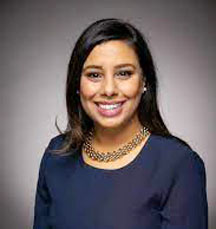
Since Liberal MPs of South Asian descent stood by Justin Trudeau throughout his tough times, he inducted Brampton MP Ruby Sahota, to raise the number of South Asians in the 38-member Cabinet to six. She was named Minister for Democratic Institutions and Minister Responsible for the Federal Economic Development Agency for Southern Ontario.
Within a few hours of the reshuffling of the federal Cabinet, Chandra Arya, Liberal MP from Nepean, fired a salvo asking Prime Minister Justin Trudeau to quit. He is the first Liberal MP of South Asian descent to express his dissent in the leadership of Justin Trudeau.
Besides, four Conservative MPs of Indian descent, including Tim Uppal, Jasraj Singh Hallan, Arpan Khanna, and Shuvaloy Majumdar, who have been part of three non-confidence motions, Jagmeet Singh, Leader of the New Democrats, became the first MP of South Asian descent to ask Justin Trudeau to quit. And for the ruling Liberals, Chandra Arya is the first South Asian from the Liberal caucus to revolt against Trudeau’s leadership.
While time and fate will decide the future of Justin Trudeau and his Liberal Government in 2025, it is the 2-million-strong South Asian community continues to await difficult and uncertain times ahead.
Will the turn of the year bring back cheers to members of the community who proudly acclaim themselves to be “Canadians”? only time will tell.
Meanwhile, I wish all Canadians a Happy New Year.
(Prabhjot Singh, is a Toronto-based award-winning independent journalist, He was celebrated by AIPS, the international body of sports journalists, for covering ten Olympics at its centennial celebrations held at UNESCO Centre in Paris during the 2024 Olympic Games. Besides, he has written extensively about business and the financial markets, the health industry, the public and private sectors, and aviation. He has worked as a political reporter besides covering Sikh and Punjab politics. He is particularly interested in Indian Diaspora and Sikh Diaspora in particular. His work has also appeared in various international and national newspapers, magazines and journals.)
OTTAWA (TIP): With the induction of Brampton MP Ruby Sahota, the number of South Asians in the 38-member Cabinet of Justin Trudeau has gone up to six. She will be the Minister for Democratic Institutions and Minister Responsible for the Federal Economic Development Agency for Southern Ontario.
Never before have MPs of South Asian descent had such a good representation in the federal Cabinet. Questions were being asked about the longevity of the reshuffled Cabinet as all the three Opposition parties – Conservatives, Bloc Quebecois and New Democrats – are out baring their knives to kill the government at the first possible opportunity.
The American threat of a 25 per cent tariff looms large in the air as President-elect Donald Trump is scheduled to assume office on January 20.
After Ruby Sahota’s inclusion, other MPs of South Asian descent on the Canadian Cabinet are Anita Anand, Minister of Transport and Internal Trade, as she sheds the portfolio of President of the Treasury (that goes to Ginette Petitpas Taylor), Jaffna-born Gary Anandasangaree, Minister of Crown-Indigenous Relations and Northern Affairs and Minister responsible for the Canadian Northern Economic Development Agency, Kamal Khera, Minister of Diversity, Inclusion and Persons with Disabilities, Harjit S. Sajjan, President of the King’s Privy Council for Canada and Minister of Emergency Preparedness and Minister responsible for the Pacific Economic Development Agency of Canada, and Arif Virani, Minister of Justice and Attorney General of Canada.
While the Prime Minister, Justin Trudeau, announced changes to the Ministry, in his declared intent to continue till the next federal election in October of next year, both the Leader of Opposition, Pierre Poilievre, and the Liberals ally, Jagmeet Singh of New Democrats, made clear their stands to bring down the minority Liberal government at the early possible opportunity to force an early election.
Pierre Poilievre, who earlier in the day taunted the NDP leader Jagmeet Singh for his open letter to the Canadians, took to X to say that he has written to the Governor-General “confirming that the Prime Minister has lost the confidence of the House and that Parliament must be recalled to hold a vote before the end of the year on triggering an Axe The Tax election. I am asking the NDP leader to match his actions to his word and send a letter to Her Excellency asking for the same.”
In an earlier post on X, Pierre Poilievre said: “Ha! Now that Parliament is closed there is no chance to introduce any motion for months—until after you get your pension. You did the same stunt in September, claiming you would no longer prop Trudeau up. Then you went back on your word and voted 8 times against an election and for your boss Trudeau. Just 11 days ago you voted against a non-confidence motion filled with your own words. Had you voted the other way, we would be almost halfway through the election now. Only common-sense Conservatives can and will replace this costly NDP-Liberal clown show.
Hours before the swearing-in ceremony at Rideau Hall, Jagmeet Singh took to X and announced that “Justin Trudeau failed in the biggest job a Prime Minister has: to work for people, not the powerful. The NDP will vote to bring this government down, and give Canadians a chance to vote for a government who will work for them.”
In an open letter to Canadians that he shared on X, Jagmeet Singh said that he “called Justin Trudeau to resign and he should. He cannot fix health care. He cannot build homes you can afford. He cannot lower your bills.
“I have always fought like hell to get dental care, free birth control and diabetes medication. I did not give up when Justin Trudeau said no. And I won’t let Pierre Poilievre take it all away.
“The next fight is a big one. Pierre Poilievre and the Conservatives will give CEOs and big businesses anything they want, and make callous cuts to pay for it. They will cut health care, childcare, housing and people’s pensions.”
Meanwhile, the Prime Minister’s office released a statement saying that the new Ministry will deliver on what matters most.
It said “Building on the work done since 2015 to invest in Canadians, the team will continue to move forward on housing, childcare, and school food while working to put more money back in people’s pockets.
“The changes to the Ministry are as follows:
Anita Anand becomes Minister of Transport and Internal Trade, Gary Anandasangaree becomes Minister of Crown-Indigenous Relations and Northern Affairs and Minister responsible for the Canadian Northern Economic Development Agency, Steven MacKinnon becomes Minister of Employment, Workforce Development and Labour, and Ginette Petitpas Taylor becomes President of the Treasury Board
“The Prime Minister also welcomed the following new members to the Ministry:
Rachel Bendayan becomes Minister of Official Languages and Associate Minister of Public Safety, Élisabeth Brière becomes Minister of National Revenue, Terry Duguid becomes Minister of Sport and Minister responsible for Prairies Economic Development Canada, Nate Erskine-Smith becomes Minister of Housing, Infrastructure and Communities, Darren Fisher becomes Minister of Veterans Affairs and Associate Minister of National Defence, David J. McGuinty becomes Minister of Public Safety,· Ruby Sahota becomes Minister of Democratic Institutions and Minister responsible for the Federal Economic Development Agency for Southern Ontario, and Joanne Thompson becomes Minister of Seniors.
“These new ministers will work with all members of Cabinet to deliver real, positive change for Canadians. They join the following ministers remaining in their portfolio:
Terry Beech, Minister of Citizens’ Services
Bill Blair, Minister of National Defence
François-Philippe Champagne, Minister of Innovation, Science and Industry
Jean-Yves Duclos, Minister of Public Services and Procurement and Quebec Lieutenant
Karina Gould, Leader of the Government in the House of Commons
Steven Guilbeault, Minister of Environment and Climate Change
Patty Hajdu, Minister of Indigenous Services and Minister responsible for the Federal Economic Development Agency for Northern Ontario
Mark Holland, Minister of Health
Ahmed Hussen, Minister of International Development
Gudie Hutchings, Minister of Rural Economic Development and Minister responsible for the Atlantic Canada Opportunities Agency
Marci Ien, Minister for Women and Gender Equality and Youth
Mélanie Joly, Minister of Foreign Affairs
Kamal Khera, Minister of Diversity, Inclusion and Persons with Disabilities
Dominic LeBlanc, Minister of Finance and Intergovernmental Affairs
Diane Lebouthillier, Minister of Fisheries, Oceans and the Canadian Coast Guard
Lawrence MacAulay, Minister of Agriculture and Agri-Food
Soraya Martinez Ferrada, Minister of Tourism and Minister responsible for the Economic Development Agency of Canada for the Regions of Quebec
Marc Miller, Minister of Immigration, Refugees and Citizenship
Mary Ng, Minister of Export Promotion, International Trade and Economic Development
Harjit S. Sajjan, President of the King’s Privy Council for Canada and Minister of Emergency Preparedness and Minister responsible for the Pacific Economic Development Agency of Canada
Ya’ara Saks, Minister of Mental Health and Addictions and Associate Minister of Health
Pascale St-Onge, Minister of Canadian Heritage
Jenna Sudds, Minister of Families, Children and Social Development
Rechie Valdez, Minister of Small Business
Arif Virani, Minister of Justice and Attorney General of Canada
Jonathan Wilkinson, Minister of Energy and Natural Resources,” the statement said.
(Prabhjot Singh is a Toronto-based award-winning independent journalist, He was celebrated by AIPS, the international body of sports journalists, for covering ten Olympics at its centennial celebrations held at UNESCO Centre in Paris during the 2024 Olympic Games. Besides, he has written extensively about business and the financial markets, the health industry, the public and private sectors, and aviation. He has worked as a political reporter besides covering Sikh and Punjab politics. He is particularly interested in Indian Diaspora and Sikh Diaspora in particular. His work has also appeared in various international and national newspapers, magazines and journals)
Canada PM Trudeau looks set to lose power after key ally vows to topple him
OTTAWA (TIP): Canadian Prime Minister Justin Trudeau on Friday looked set to lose power early next year after a key ally said he would move to bring down the minority Liberal government and trigger an election.
New Democratic Party leader Jagmeet Singh, who has been helping keep Trudeau in office, said he would present a formal motion of no-confidence after the House of Commons elected chamber returns from a winter break on Jan. 27. If all the opposition parties back the motion, Trudeau will be out of office after more than nine years as prime minister and an election will take place.
A string of polls over the last 18 months shows the Liberals, suffering from voter fatigue and anger over high prices and a housing crisis, would be badly defeated by the official opposition right-of-center Conservatives.
The New Democrats, who like the Liberals aim to attract the support of center-left voters, complain Trudeau is too beholden to big business.
“No matter who is leading the Liberal Party, this government’s time is up. We will put forward a clear motion of non-confidence in the next sitting of the House of Commons,” said Singh.
The leader of the Bloc Quebecois, a larger opposition party, promised to back the motion and said there was no scenario where Trudeau survived.
The Conservatives said they would ask Governor General Mary Simon – the personal representative of King Charles, Canada’s head of state – to recall Parliament to hold a no-confidence vote before the end of the year. Constitutional experts say Simon would reject such a move.
“We cannot have a chaotic clown show running our government into the ground. What is clear is that Justin Trudeau does not have the confidence of Parliament,” Conservative leader Pierre Poilievre told reporters. Shortly after Singh issued his letter a smiling Trudeau, under growing pressure to quit after the shock resignation of his finance minister this week, presided over a cabinet shuffle. Trudeau’s office was not immediately available for comment.
Trudeau, who has not publicly spoken about Freeland’s exit, usually addresses reporters after cabinet shuffles but left without saying a word. Major domestic media organizations said his office had canceled traditional end-of-year interviews.
Votes on budgets and other spending are considered confidence measures. Additionally, the government must allocate a few days each session to opposition parties when they can unveil motions on any matter, including non-confidence. Singh’s move is a political risk, since the polls showing a bad defeat for the Liberals also have bad news for the NDP.
Darrell Bricker, CEO of polling firm Ipsos-Reid, said Singh saw a chance to replace the Liberals as the first choice for voters who opposed the Conservatives.
“Waiting to give the Liberals and even Trudeau a chance to get off the mat is ill-advised,” he said by email.
Before Singh made his announcement, a source close to Trudeau said the prime minister would take the Christmas break to ponder his future and was unlikely to make any announcement before January.
Liberal leaders are elected by special conventions of party members, which take months to arrange.
Singh’s promise to act quickly means that even if Trudeau were to resign now, the Liberals could not find a new permanent leader in time for the next election. The party would then have to contest the vote with an interim leader, which has never happened before in Canada.
So far around 20 Liberal legislators are openly calling for Trudeau to step down but his cabinet has stayed loyal.
The timing of the crisis comes at a critical time, since U.S. President-elect Donald Trump is due to take office on Jan. 20 and is promising to impose a 25% tariff on all imports from Canada, which would badly hurt the economy.
The premiers of the 10 provinces, seeking to create a united approach to the tariffs, are complaining about what they call chaos in Ottawa.
(Agencies)
TORONTO (TIP): Canadian Prime Minister and members of his delegation who had a closed-door meeting with the US President-elect Donald Trump last Friday, November 29, were reportedly stunned when, during the deliberations on the 25 per cent import tariff, the host surprised everyone by suggesting that Canada should become the 51st state of the US.
According to media reports, Donald Trump said in a lighter vein that if Justin Trudeau did not like the tariff, perhaps Canada could become the 51st state and Trudeau could serve as its governor. Trudeau laughed nervously at the apparent joke, the media reports said.
Yesterday, when the House of Commons resumed its sitting, the issue of border security was raised by the Leader of Opposition, Pierre Poilievre, saying that his party had been asking the Prime Minister to wake up and regain control of the order but he continues to do the opposite. Pierre said that in 2015, the number of unprocessed asylum claims was under 10,000. Today, there were over 260,000.oration with provincial police forces to crack down on the human trafficking, illegal entry, drug production and trafficking.
These are the issues because of which the US President-elect Donald Trump had been threatening to impose 25 per cent duty on items imported from Canada and Mexico.
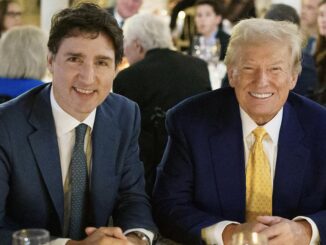
After talking to Donald Trump on the phone early last week, the Canadian Prime Minister accompanied by some senior functionaries of his Government, air dashed to Florida last weekend. The Canadians met Donald Trump and his team over a dinner meeting that reportedly lasted three hours. It was during this meeting that Donald Trump made that comment of suggesting Canada to become 51st state.
Media reports quoting an insider who was at the meeting said :“We are told that when Trudeau told President-elect Trump that new tariffs would kill the Canadian economy, Trump joked to him that if Canada cannot survive without ripping off the U.S. to the tune of $100 billion a year, then maybe Canada should become the 51st state and Trudeau could become its governor”.
Media reports further said that someone at the table noted that a Canadian state in the U.S. would be liberal, prompting Trump to say that the territory could be divided into two states, one liberal and one conservative. That reportedly drew more laughter.
Donald Trump’s humor-veiled bombast last weekend was somewhat reminiscent of his wish during his term of Presidency. At that time he had made public his wish to purchase Greenland.
While responding to issues raised by Pierre Poilievre, Canadian Minister Dominic LeBlanc, who was with Justin Trudeau in the meeting with Donald Trump, the previous weekend, said that the Canadian delegation had had a very cordial and constructive conversation with our American partners on Friday evening. “We talked about security at the Canada-U.S. border over the decades and the integration of Canadian police forces with their American partners. We talked, for example, about the important work that the RCMP is doing in the fight against fentanyl, which has led to drug seizures and significant arrests, often in partnership with our American allies.
Another Conservative MP, while joining the debate in the House of Commons, said that President-elect Trump just asked the Prime Minister to do something. “We have been asking for the same thing over here for nine years. We are calling for additional measures to stop gun smuggling, drug trafficking and auto theft. He never listened. Gun smuggling and auto theft are a scourge in Quebec. We have suggested enhanced surveillance at the Port of Montreal and at the border, but nothing has changed.
Dominic LeBlanc retorted back, saying “we have worked with our law enforcement. We have invested more to reverse the cuts made by the former Conservative government. If my colleague is serious about our country’s national security, I suggest that he encourage his boss to obtain the security clearance needed to access information that will help protect his political party and caucus. For example, when it comes to India’s foreign interference, it might be a good idea for the Leader of the Opposition to do that.
OTTAWA (TIP): After losing the first two battles to bring down the minority Liberal government, Conservatives, the Official Opposition Party, tabled its third successive no-confidence motion in the penultimate week sitting of the House of Commons. The House of Commons will adjourn for holiday break at the end of next week. Unmindful of the earlier failed attempts to topple Justin Trudeau’s Government and force an early election to the House of Commons, Conservative Leader Pierre Poilievre tabled his motion before the House of Commons on Thursday.
Structuring its no-confidence motion on the past criticisms, especially the quotes from the statements the NDP leader Jagmeet Singh made while tearing down the supply and confidence agreement with the Liberals.
Earlier no-confidence motions moved by Conservatives in September and October failed. The minority Liberals are likely to survive the third no-confidence motion as well as the NDP leader had already declared that his party would not play Pierre Poilievre’s game. The Liberals need the support of one of the other parties – Bloc Quebecois or NDP – in the House of Commons to continue in the saddle in the New Year. Voting on the no-confidence motion will take next week when the House of Commons resumes its sitting on Monday.
While introducing the motion on Thursday afternoon, Pierre Poilievre said he was presenting this motion in the “spirit of non-partisanship.”
The language of the motion refers to a statement the NDP Leader Jagmeet Singh made when he announced in September that his party was pulling out of the supply-and-confidence agreement with the Liberal government.
Pierre Poilievre said, “I rise today in the spirit of non-partisanship, put our differences aside and take a good idea and a good perspective no matter where it comes from.” He further commented, “Too often in this place, we refuse to accept ideas or input from other people and so I thought I would remedy that by taking the words and the message of the leader of the NDP and putting them in a Conservative motion so that all of us could vote for the very wise things that he said.”
“Whereas the NDP Leader said, ‘the Liberals are too weak, too selfish and too beholden to corporate interests to fight for people,’” the motion states in the preamble and continues to ask that: “Therefore, the House agrees with the NDP Leader and the House proclaims it has lost confidence in the Prime Minister and the Government.”
The motion further includes Singh’s comment criticizing the Liberal government for imposing binding arbitration to end the railway shutdown in August.
The minority Liberals are likely to survive the third no-confidence motion as the NDP leader had already declared that his party would not play Pierre Poilievre’s game.
As the debate on the motion started, the Conservatives held that the next federal election would be an axe Carbon tax election that would bring face-to-face the Conservatives vs the rest – the Liberals, NDP, Bloc Quebecois and Greens. Pierre Poilievre while moving the motion held that Labour Minister Steven MacKinnon’s order to impose binding arbitration on railway workers violated their right to strike. In a debate that followed the tabling of the motion, MacKinnon accused Poilievre of backing anti-union bills.
“On the other hand, Mr. Speaker, Liberals have been there for workers from day one. On this side of the House, we stand on our record, not an empty slogan,” MacKinnon said.
Since the NDP leader Jagmeet Singh was not at the debate, NDP MP Matthew Green criticized Poilievre’s stance on workers’ rights. “Despite all this cosplay we see in front of us … has this member ever once in his life visited a picket line?” he asked. To which Poilievre responded: “Yes, Mr. Speaker.”
Early this week, when the Conservative leader revealed the content of the next no-confidence motion, Jagmeet Singh reacted by saying he won’t play Conservative Leader Pierre Poilievre’s games. He maintained he was not going to vote non-confidence and trigger an election as he believed Pierre Poilievre would cut programs the NDP fought for, like dental care and pharma care.
“I am not going to be playing Pierre Poilievre’s games. I have no interest in that. We are frankly not going to allow him to cut the things that people need. I want to have dental care expanded, I want people to start to benefit from the pharma care legislation we passed,” Singh said.
Another two Conservative motions would be heard Monday, December 9 and Tuesday, December 10, with both set for a vote on Tuesday, December 10, barring changes to those plans.
(Prabhjot Singh is a Toronto based award-winning senior journalist. He can be reached at prabhjot416@gmail.com)
OTTAWA (TIP) : Canada is already examining possible retaliatory tariffs on certain items from the United States, should President-elect Donald Trump follow through on his threat to impose sweeping tariffs on Canadian products, a senior official has said.
Trump has threatened to impose tariffs on products from Canada and Mexico if the countries don’t stop what he called the flow of drugs and migrants across southern and northern borders. He said he would impose a 25 per cent tax on all products entering the US from Canada and Mexico as one of his first executive orders.
But Trump posted Wednesday, November 27, evening on Truth Social that he had a “wonderful conversation” with new Mexican President Claudia Sheinbaum and she “agreed to stop Migration through Mexico”.
“Mexico will stop people from going to our Southern Border, effective immediately. THIS WILL GO A LONG WAY TOWARD STOPPING THE ILLEGAL INVASION OF THE USA. Thank you!!!” Trump posted. It was unclear what impact the conversation will have on Trump’s plan to impose tariffs.
However, The Mexican President Claudia Sheinbaum Pardo denies country is closing border despite Trump claims.
In Canada, a government official said on Wednesday, November 27 that Canada is preparing for every eventuality and has started thinking about what items to target with tariffs in retaliation. The official stressed that no decision has been made. The person spoke on condition of anonymity as they were not authorized to speak publicly.
When Trump imposed higher tariffs during his first term in office, other countries responded with retaliatory tariffs of their own. Canada, for instance, announced billions of new duties in 2018 against the US in a tit-for-tat response to new taxes on Canadian steel and aluminum.
Many of the US products were chosen for their political rather than economic impact. For example, Canada imports USD 3 million worth of yogurt from the US annually and most comes from one plant in Wisconsin, home state of then-House Speaker Paul Ryan. That product was hit with a 10 per cent duty.
Another product on the list was whiskey, which comes from Tennessee and Kentucky, the latter of which is the home state of then-Republican Senate leader Mitch McConnell.
Trump made the threat Monday, November 25, while railing against an influx of illegal migrants, even though the numbers at Canadian border pale in comparison to the southern border.
The US Border Patrol made 56,530 arrests at the Mexican border in October alone — and 23,721 arrests at the Canadian one between October 2023 and September 2024.
Canadian officials say lumping Canada in with Mexico is unfair but say they are ready to make new investments in border security and work with the Trump administration to lower the numbers from Canada. The Canadians are also worried about an influx north of migrants if Trump follows through with his plan for mass deportations.
Trump also railed about fentanyl from Mexico and Canada, even though seizures from the Canadian border pale in comparison to the Mexican border. US customs agents seized 43 pounds of fentanyl at the Canadian border last fiscal year, compared with 21,100 pounds at the Mexican border.
Canadian officials argue their country is not the problem and that tariffs will have severe implications for both countries.
Canada is the top export destination for 36 US states. Nearly USD 3.6 billion Canadian (USD 2.7 billion) worth of goods and services cross the border each day.
About 60 per cent of US crude oil imports are from Canada, and 85 per cent of US electricity imports are from Canada. Canada is also the largest foreign supplier of steel, aluminum and uranium to the US and has 34 critical minerals and metals that the Pentagon is eager for and investing in for national security.
Prime Minister Justin Trudeau held an emergency virtual meeting on Wednesday, November 27, with the leaders of Canada’s provinces. He stressed they need to present a united front.
“I don’t want to minimize for a moment the gravity of the challenge we now face,” Deputy Prime Minister Chrystia Freeland said. “Now is really a moment for us not to squabble amongst ourselves.”
The provincial premiers want Trudeau to negotiate a bilateral trade deal with the United States that excludes Mexico. Sheinbaum, Mexico’s president, said earlier Wednesday, November 27, that her administration is already working up a list of possible retaliatory tariffs “if the situation comes to that.” She later said she talked to Trump and had “an excellent conversation”.
(Agencies)
OTTAWA (TIP): Canadian Prime Minister Justin Trudeau suffered an unexpected blow on Wednesday, September 4, when the small party helping keep his minority Liberal government in power withdrew its automatic support, forcing him to attempt new alliances to govern, says a Reuters report.
Promising to continue governing and pushing through social programs, Trudeau dismissed talk of early elections after the left-leaning New Democratic Party’s leader Jagmeet Singh said he was “ripping up” a deal struck between the two men in 2022.
But the move leaves Trudeau reliant on support from other opposition lawmakers to survive confidence votes in the lower chamber of parliament at a time when polls show he will lose badly if an election were held now. An election must be held by the end of October 2025 under Canadian law.
“An election will come in the coming year, hopefully not until next fall, because in the meantime, we’re going to deliver for Canadians,” Trudeau told reporters at a school where he had arrived to talk about expanding lunch programs.
“I really hope the NDP stays focused on how we can deliver for Canadians, as we have over the past years, rather than focusing on politics.”
Trudeau, 52, first took office in November 2015 but has over the last two years struggled to fend off attacks from the opposition center-right Conservatives, who blame him for high inflation and a housing crisis.
With the NDP’s support, his government has pushed through social programs designed to address the cost of living.
But the NDP’s Singh had expressed growing frustration with Trudeau in recent months, especially over what he said was the Liberals’ failure to deal with high prices at grocery stores.
“Justin Trudeau has proven again and again he will always cave to corporate greed,” Singh said in a video posted on social media where he also declared that he would run for prime minister in the next election. “Liberals have led people down – they don’t deserve another chance.”
Establishing independence
Polls indicate the same voter fatigue plaguing Trudeau has also spread to the NDP, which despite successfully pushing the Liberals to introduce measures such as a national dental program is languishing far behind in third place. Under the 2022 deal, the NDP agreed to keep Trudeau in power until mid-2025 in return for more social spending.
Conservative leader Pierre Poilievre reiterated his call for an early election to break up what he called a Liberal-NDP coalition driving up prices for Canadians.
The House of Commons resumes work on Sept. 16, after which the Conservatives will have the ability to propose a vote of confidence. Trudeau’s Liberals could still survive if the NDP abstained on such a vote.
A statement from the NDP said the party would decide on an issue-by-issue basis whether to support the Liberals on confidence votes, suggesting it may continue to prop up Trudeau if his fate hung in the balance.
A key moment for Trudeau’s government will be its budget update later this year, which, if voted down by legislators would trigger a new election.
A senior journalist Prabhjot Singh, in a report filed late Thursday night, says Immediate Battle is for by- and not Federal elections. While Elmwood-Transcona and LaSalle-Emard-Verdun to vote on September 16, two more- Cloverdale-Langley City and Halifax – wait for the by-election.
In less than 24 hours of the death of the NDP-Liberal deal, politics in Canada have taken a turn, putting the nation back on two prestigious, by-elections scheduled to coincide with the next sitting of the House of Commons on September 16.
Interestingly, Jagmeet Singh of NDP, who ripped the NDP-Liberal deal yesterday, looks more focused on two by-elections scheduled for September 16 than forcing the federal elections for which the leader of Opposition and Conservative party chief, Pierre Poilievre, has been instigating him to vote out minority Liberal government.
In a message to his party workers and volunteers on Thursday, Jagmeet Singh, said, “I am pretty sure you know this by now, but I am deeply committed to defeating Conservatives in the next election.
“But it doesn’t happen all at once. It happens one riding, one volunteer shift, and one phone call at a time.
“The by-election in Elmwood-Transcona is a crucial step on our path to defeating Conservatives. Will you commit to walking that path with me?” asks Jagmeet Singh.
The Elmwood-Transcona was held by his party’s Daniel Blaikie who quit the House of Commons riding on March 31 this year. The NDP has now put up Leila Dance in a field of six contestants. Others in the fray are Sarah Couture (People’s Party of Canada), Nicolas Gaddert (Green Party), Ian McIntyre (Liberal), Colin Reynolds (Conservative) and Zbig Strycharz (Canadian Future Party).
Another riding going to poll on September 16 is LaSalle-Emard-Verdun in Quebec. The incumbent David Lametti resigned on February 1 this year to force this by-election. As of today, there are 90 candidates, 80 of them Independent or non-affiliated in the run besides nominees of all major parties like Liberals, Green, Conservatives, Canadian Future Party, Christian Heritage Party of Canada, NDP, Bloc Quebecois, People’s Party of Canada and Marxist-Leninist Party of Canada.
The situation is intriguing. On one hand, the main opposition party, Conservatives, is working overtime to force an early Federal election, while on the other, no party is taking any chances with the September 16 by-elections, winners of which may hardly get any fruitful time to sit in the lower House of Canadian Parliament.
By-elections are primarily a litmus test for the popularity of a government. In the eight by-elections during the current term of the House of Commons, the Liberals could retain only three of four seats it held earlier while the Conservatives extended their hold from four to five seats.
Two more by-elections – Cloverdale-Langley City and Halifax – are also in the offing. Experts, on the other hand, hold that though the Liberal-NDP deal is dead, it does not necessarily mean a fall election. Yesterday’s development puts PM Trudeau in a tight spot. Still, everything is not over for him as he has options.
No doubt the Liberal government is now on shakier ground. It cannot now rely with certainty on the NDP to prop it up on confidence votes in a Parliament where it has been reduced to a minority of the seats.
The rapidly changing political environment does not mean the government would soon collapse on a confidence vote as the Liberals could still convince NDP or Bloc Quebecois MPs for support on issues that PM Trudeau feels are “important for Canadians.”
Focus on by-elections is yet another indication that NDP is not as keen as Conservatives are to force a no-confidence motion at the earliest possible opportunity.
The liberals could still engage in some horse-trading with the NDP or one of the other opposition parties to cobble together enough votes to get its legislation through Parliament and stave off an election. An opposition party could support the government’s agenda piecemeal, and not through a formal agreement like the one that was ripped up today.
Whatever the thinking of major political parties, the Liberal government’s future is on a knife’s edge — it could be brought down at any time through a non-confidence vote when Parliament returns later this month. video saying he ‘ripped up’ NDP deal with Liberals
Under Canada’s Westminster system of parliamentary democracy, the Prime Minister and his government must enjoy the confidence of a majority of MPs to remain in office.
This can be tested through a confidence vote. The government can designate any vote as a confidence vote, while any bill related to the government’s budget is usually regarded as a confidence vote. An individual MP can also table a motion of non-confidence at any time to try and topple the government.
If the Liberal government wants to win those votes, Trudeau and his cabinet will have to convince at least one of the major opposition parties to vote their way.
Conservative Leader Pierre Poilievre has signaled he will not back the government — riding high in the polls, he wants an election sooner rather than later. He tabled a non-confidence motion in the spring but it was defeated.
The NDP may not go all out with the Conservatives in toppling the minority government as it still wants to get more out of the Liberal government before the next election.
That means the NDP could offer limited support on confidence votes in this sitting of Parliament in exchange for some more policy commitments. It already has pushed the government to enlarge the social safety net through new pharma care and dental programs. It wants more.
WASHINGTON, D.C. (TIP): The allegations that India was involved in the assassination attempts in the US and Canada are very concerning, a senior academician nominated to a top human rights diplomatic position in the State Department has told lawmakers.
“Yes, it is very concerning what happened on US soil and Canadian soil,” Dafna Hochman Rand, nominee to be Assistant Secretary of State for Democracy, Human Rights, and Labor, told members of the Senate Foreign Relations Committee during her confirmation hearing on Thursday.
She was responding to a question from Senator Ben Cardin, Chairman of the powerful Senate Foreign Relations Committee. “I want to raise India… We know about a plot to assassinate… on US soil and Canadian soil. I’d like to hear your commitment to how you would get engaged in those types of efforts to make sure that type of conduct does not take place,” Cardin asked. “First and foremost, it’s clear that India is a critical ally, the oldest democracy there, the biggest democracy, but it is those shared values, the democratic values that we need that bind this alliance. And as if confirmed, as DRL’s Assistant Secretary, I will be a voice in the administration, making sure that we’re not abashed,” Rand said in response to the question.
India has described as a “matter of concern” the US linking an Indian official to a man charged with conspiring to kill a Sikh separatist on American soil, and asserted that follow-up action will be taken based on findings of a panel investigating the allegations.
India has already constituted a probe team to investigate the allegations relating to the foiled plot to kill Gurpatwant Singh Pannun, a Sikh extremist who is an American and Canadian citizen.
Regarding Canadian Prime Minister Justin Trudeau’s allegations that there was a “potential” involvement of Indian agents in the killing of Khalistani separatist Hardeep Singh Nijjar in a Vancouver suburb in June.
The Ministry of External Affairs spokesperson said the main issue with Ottawa has been that of activities of anti-India elements in that country.
“Insofar as Canada is concerned, they have consistently given space to anti-India extremists and violence. That is at the heart of the issue. Our diplomatic representatives have borne the brunt of this,” he said.
On other issues, Rand said, “We are not afraid to talk about our concerns about human rights, democracy and of course these troubling trends towards what we’re seeing…Again, I’m not in the administration, so I don’t know all the details of what happened. And I understand the DOJ and FBI are working on it, but I think it’s critical that even as we strengthen our relationship with India as part of our Indo-Pacific strategy, we make human rights and democracy the center of that relationship,” Rand said.
“We talk truth in this relationship and we speak frankly about our concerns. So I’m not shy and I will be a voice at the State Department and in the administration making that clear,” said Rand who on November 9 last was nominated by the president to this position.
Rand currently serves as a Distinguished Resident Fellow in Strategic Affairs at Georgetown University’s Institute for the Study of Diplomacy and as a Lecturer at Princeton’s School of Public and International Affairs.
She has spent the past two decades in public service, including most recently as the Director of the Office of Foreign Assistance at the Department of State. Previously, she was the Vice President of Policy and Research at Mercy Corps, a non-governmental humanitarian organization serving communities in over 40 countries.
Earlier in her career, Rand served as a Deputy Assistant Secretary of State in the Bureau of Democracy, Human Rights, and Labor, as well as on the staff of the State Department’s Office of Policy Planning and the National Security Council. She is the former Deputy Director of Studies at the Centre for a New American Security and a former professional staff member of the US Senate Select Committee on Intelligence.
She started her career in government as the foreign policy and defense Legislative Assistant to Senator Frank R. Lautenberg from New Jersey. Her research has focused on international security and governance in the Middle East and North Africa, including two books on the subject. A native of Massachusetts, she earned her undergraduate degree at Harvard University and her PhD in political science at Columbia University.
(Source: PTI)
OTTAWA (TIP): Indian High Commissioner to Canada Sanjay Kumar Verma has said that New Delhi was “convicted” even as the investigation into the killing of Khalistani terrorist Hardeep Singh Nijjar on Canadian soil had not fully concluded. Urging Canada to release evidence to back up its allegations in connection with the killing, the Indian envoy maintained that New Delhi would look into anything “very specific and relevant” communicated to them to back up Justin Trudeau’s allegations.
In an interview with CTV news channel, the high commissioner was asked about the allegations raised by Canadian Prime Minister Trudeau of possible Indian government’s involvement in Nijjar’s killing.
Responding to this, Verma said, “There are two points on that. One is that, even without the investigation being concluded, India was convicted. Is that a rule of law?” On being asked “how was India convicted”, the high commissioner said, “Because India was asked to cooperate and if you look at the typical criminal terminology, when someone asks to cooperate, it means you have already been convicted and you better cooperate”.
“So, we took it in a very different interpretation. But, we have always said that if there is anything very specific and relevant, and communicated to us, we will look into it,” the Indian envoy added.
(Source; ANI)
“We are there to work constructively with India,” said the Canadian Prime Minister
OTTAWA (TIP): Canada shared evidence that Indian government agents were potentially involved in the murder of Sikh separatist leader Hardeep Singh Nijjar in British Columbia with New Delhi weeks ago, Prime Minister Justin Trudeau said on Friday, September 22, according to a Reuters report.
“Canada has shared the credible allegations that I talked about on Monday with India. We did that many weeks ago,” Mr. Trudeau told a news conference in Ottawa. “We are there to work constructively with India. We hope that they engage with us so that we can get to the bottom of this very serious matter.”
Mr. Trudeau said on Monday, September 18, that Ottawa had credible intelligence linking Indian government agents to the murder in June of Hardeep Singh Nijjar, prompting an angry reaction from New Delhi. Nijjar, 45, was a Canadian citizen. The Canadian government has amassed both human and signals intelligence in a months-long investigation into the Sikh separatist leader’s murder, CBC News reported separately on Thursday, September 21, citing sources. The report said the intelligence included communications of Indian officials present in Canada, adding that some of the information was provided by an unidentified ally in the Five Eyes alliance.
Five Eyes is an intelligence-sharing network that includes the U.S., the UK, Canada, Australia and New Zealand.
However, Mr. Trudeau has not provided any details about what Canada’s spy agencies have collected, and his office has not confirmed or denied the CBC report.
U.S. Secretary of State Antony Blinken said on Friday, September 22, the United States wanted to see “accountability” over the killing. “We are deeply concerned about the allegations that Prime Minister Trudeau has raised,” Mr. Blinken told reporters in a press briefing. The White House has raised similar concerns, but Mr. Blinken is the most senior U.S. official to have commented on the issue thus far.
TORONTO (TIP): Canadian Prime Minister Justin Trudeau and his wife, Sophie, are separating after 18 years of marriage. The two said in statements posted on Instagram that they made the decision after “many meaningful and difficult conversations.”
A statement from the prime minister’s office said they both have signed a legal separation agreement.
Trudeau, the 51-year-old scion of one of Canada’s most famous politicians, was sworn into office in 2015. Sophie Trudeau is a former model and TV host. The couple were married in 2005.
Together, they brought star power to the prime minister’s office and appeared in the pages of Vogue magazine. They have three children, 15-year-old Xavier, 14-year-old Ella-Grace and 9-year-old Hadrien.
“As always, we remain a close family with deep love and respect for each other and for everything we have built and will continue to build,” the two said on Instagram.
An official familiar with the matter said Trudeau will continue to live at Rideau Cottage in Ottawa, where he has lived since 2015, and the children will primarily live there to maintain stability.
The official said she has moved to a separate Ottawa home but will spend time at Rideau Cottage at times including when he is travelling. The official spoke on condition of anonymity because they were not authorized to speak publicly.
She has played a less visible role in recent years, rarely travelling with the prime minister on official trips. The two were seen together publicly at Canada Day events in Ottawa last month.
“They remain a close family, and Sophie and the prime minister are focused on raising their kids in a safe, loving and collaborative environment,” the statement from Trudeau’s office said. “The family will be together on vacation, beginning next week.”
His office requested respect for their privacy.
Justin Trudeau and Sophie Gregoire met as children when she was a classmate of his youngest brother, Michel, and they reconnected as adults when they co-hosted a 2003 charity gala.
Trudeau is the second prime minister to announce a separation while in office.
His father, Pierre Trudeau, and mother, Margaret Trudeau, separated in 1977 and divorced in 1984 during the elder Trudeau’s final year in the prime minister’s office.
Margaret Trudeau wrote in her memoir that she had a romance with Senator Ted Kennedy. During a 1977 visit to Washington, D.C. with Pierre, she sat listening to her husband’s speech before Congress while feeling “torn between an intense need for him and a longing for Ted Kennedy.” Margaret wrote she became infatuated with Kennedy after meeting him a few years earlier. She told Kennedy that he “had not destroyed my marriage but that I had used him to help me destroy a marriage that was already over.”
Just weeks later Margaret, who had then-undiagnosed mental illness, left her husband to party with the Rolling Stones in Toronto. The marriage ended soon after that.
Justin, who was a child when his parents separated, wrote in his 2014 book “Common Ground” that public life took its toll. “I knew, even then, that the demands imposed by the life my parents were leading affected them far more than the ordinary stress of parenthood,” he wrote. (AP)
World leaders pay Tributes; “She defined an era”, says Biden
I.S. Saluja
LONDON (TIP): Queen Elizabeth II, Britain’s longest-reigning monarch and a symbol of stability in a turbulent era that saw the decline of the British empire and embarrassing dysfunction in her own family, died Thursday, September after 70 years on the throne. She was 96, an AP report said.
The palace announced she died at Balmoral Castle, her summer residence in Scotland, where members of the royal family had rushed to her side after her health took a turn for the worse.
A link to the almost-vanished generation that fought World War II, she was the only monarch most Britons have ever known. Her 73-year-old son Prince Charles automatically became king and will be known as King Charles III, it was announced. British monarchs in the past have selected new names upon taking the throne. Charles’ second wife, Camilla, will be known as the Queen Consort.
The BBC played the national anthem, “God Save the Queen,” over a portrait of Elizabeth in full regalia as her death was announced, and the flag over Buckingham Palace was lowered to half-staff as the second Elizabethan age came to a close.
The impact of her loss will be huge and unpredictable, both for the nation and for the monarchy, an institution she helped stabilize and modernize across decades of enormous social change and family scandals, but whose relevance in the 21st century has often been called into question.
The public’s abiding affection for the queen has helped sustain support for the monarchy during the scandals. Charles is nowhere near as popular. Since Feb. 6, 1952, Elizabeth reigned over a Britain that rebuilt from a destructive and financially exhausting war and lost its empire; joined the European Union and then left it; and made the painful transition into the 21st century.
She endured through 15 prime ministers, from Winston Churchill to Truss, becoming an institution and an icon — a reassuring presence even for those who ignored or loathed the monarchy.
She became less visible in her final years as age and frailty curtailed many public appearances. But she remained firmly in control of the monarchy and at the center of national life as Britain celebrated her Platinum Jubilee with days of parties and pageants in June.
That same month she became the second longest-reigning monarch in history, behind 17th-century French King Louis XIV, who took the throne at age 4. On Tuesday, she presided at a ceremony at Balmoral Castle to accept the resignation of Boris Johnson as prime minister and appoint Truss as his successor. When Elizabeth was 21, almost five years before she became queen, she promised the people of Britain and the Commonwealth that “my whole life, whether it be long or short, shall be devoted to your service.”
It was a promise she kept across more than seven decades. Despite Britain’s complex and often fraught ties with its former colonies, Elizabeth was widely respected and remained head of state of more than a dozen countries, from Canada to Tuvalu. She headed the 54-nation Commonwealth, built around Britain and its former colonies.
Married for more than 73 years to Prince Philip, who died in 2021 at age 99, Elizabeth was matriarch to a royal family whose troubles were a subject of global fascination — amplified by fictionalized accounts such as the TV series “The Crown.” She is survived by four children, eight grandchildren and 12 great-grandchildren.
Through countless public events, she probably met more people than anyone in history. Her image, which adorned stamps, coins and banknotes, was among the most reproduced in the world.
But her inner life and opinions remained mostly an enigma. Of her personality, the public saw relatively little. A horse owner, she rarely seemed happier than during the Royal Ascot racing week. She never tired of the companionship of her beloved Welsh corgi dogs.
Elizabeth Alexandra Mary Windsor was born in London on April 21, 1926, the first child of the Duke and Duchess of York. She was not born to be queen — her father’s elder brother, Prince Edward, was destined for the crown, to be followed by any children he had.
But in 1936, when she was 10, Edward VIII abdicated to marry twice-divorced American Wallis Simpson, and Elizabeth’s father became King George VI.
Princess Margaret recalled asking her sister whether this meant that Elizabeth would one day be queen. ”’Yes, I suppose it does,’” Margaret quoted Elizabeth as saying. “She didn’t mention it again.”
Elizabeth was barely in her teens when Britain went to war with Germany in 1939. While the king and queen stayed at Buckingham Palace during the Blitz and toured the bombed-out neighborhoods of London, Elizabeth and Margaret spent most of the war at Windsor Castle, west of the capital. Even there, 300 bombs fell in an adjacent park, and the princesses spent many nights in an underground shelter. She made her first public broadcast in 1940 when she was 14, sending a wartime message to children evacuated to the countryside or overseas.
“We children at home are full of cheerfulness and courage,” she said with a blend of stoicism and hope that would echo throughout her reign. “We are trying to do all we can to help out gallant soldiers, sailors and airmen. And we are trying, too, to bear our own share of the danger and sadness of war. We know, every one of us, that in the end all will be well.”
In 1945, after months of campaigning for her parents’ permission to do something for the war effort, the heir to the throne became Second Subaltern Elizabeth Alexandra Mary Windsor in the Auxiliary Territorial Service. She enthusiastically learned to drive and service heavy vehicles.
On the night the war ended in Europe, May 8, 1945, she and Margaret managed to mingle, unrecognized, with celebrating crowds in London — “swept along on a tide of happiness and relief,” as she told the BBC decades later, describing it as “one of the most memorable nights of my life.”
Queen Elizabeth II and husband Prince Philip at their wedding. (File photo)
At Westminster Abbey in November 1947 she married Royal Navy officer Philip Mountbatten, a prince of Greece and Denmark whom she had first met in 1939 when she was 13 and he 18. Postwar Britain was experiencing austerity and rationing, and so street decorations were limited, and no public holiday was declared. But the bride was allowed 100 extra ration coupons for her trousseau. The couple lived for a time in Malta, where Philip was stationed, and Elizabeth enjoyed an almost-normal life as a navy wife. The first of their four children, Prince Charles, was born in 1948. He was followed by Princess Anne in 1950, Prince Andrew in 1960, and Prince Edward in 1964. In 1952, George VI died at 56 after years of ill health. Elizabeth, on a visit to Kenya, was told that she was now queen. Her private secretary, Martin Charteris, later recalled finding the new monarch at her desk, “sitting erect, no tears, color up a little, fully accepting her destiny.”
“In a way, I didn’t have an apprenticeship,” Elizabeth reflected in a BBC documentary in 1992 that opened a rare view into her emotions. “My father died much too young, and so it was all a very sudden kind of taking on and making the best job you can.”
The young Queen Elizabeth II wearing a Tiara in this 1960 picture. (File photo)
Her coronation took place more than a year later, a grand spectacle at Westminster Abbey viewed by millions through the still-new medium of television. Prime Minister Winston Churchill’s first reaction to the king’s death was to complain that the new queen was “only a child,” but he was won over within days and eventually became an ardent admirer.
In Britain’s constitutional monarchy, the queen is head of state but has little direct power; in her official actions she does what the government orders. However, she was not without influence. The queen, officially the head of the Church of England, once reportedly commented that there was nothing she could do legally to block the appointment of a bishop, “but I can always say that I should like more information. That is an indication that the prime minister will not miss.”
The extent of the monarch’s political influence occasionally sparked speculation — but not much criticism while Elizabeth was alive. The views of Charles, who has expressed strong opinions on everything from architecture to the environment, might prove more contentious.
She was obliged to meet weekly with the prime minister, and they generally found her well-informed, inquisitive and up to date. The one possible exception was Margaret Thatcher, with whom her relations were said to be cool, if not frosty, though neither woman ever commented.
The queen’s views in those private meetings became a subject of intense speculation and fertile ground for dramatists like Peter Morgan, author of the play “The Audience” and the hit TV series “The Crown.” Those semi-fictionalized accounts were the product of an era of declining deference and rising celebrity, when the royal family’s troubles became public property.
And there were plenty of troubles within the family, an institution known as “The Firm.” In Elizabeth’s first years on the throne, Princess Margaret provoked a national controversy through her romance with a divorced man.
In what the queen called the “annus horribilis” of 1992, her daughter, Princess Anne, was divorced, Prince Charles and Princess Diana separated, and so did her son Prince Andrew and his wife, Sarah. That was also the year Windsor Castle, a residence she far preferred to Buckingham Palace, was seriously damaged by fire. The public split of Charles and Diana — “There were three of us in that marriage,” Diana said of her husband’s relationship with Camilla Parker Bowles — was followed by the shock of Diana’s death in a Paris car crash in 1997. For once, the queen appeared out of step with her people. Amid unprecedented public mourning, Elizabeth’s failure to make a public show of grief appeared to many to be unfeeling. After several days, she finally made a televised address to the nation. The dent in her popularity was brief. She was by now a sort of national grandmother, with a stern gaze and a twinkling smile. Despite being one of the world’s wealthiest people, Elizabeth had a reputation for frugality and common sense. She turned off lights in empty rooms, and didn’t flinch from strangling pheasants. A newspaper reporter who went undercover to work as a palace footman reinforced that down-to-earth image, capturing pictures of the royal Tupperware on the breakfast table and a rubber duck in the bath. Her sangfroid was not dented when a young man aimed a pistol at her and fired six blanks as she rode by on a horse in 1981, nor when she discovered a disturbed intruder sitting on her bed in Buckingham Palace in 1982.
The image of the queen as an exemplar of ordinary British decency was satirized by the magazine Private Eye, which called her Brenda, apparently because it sounded working-class. Anti-monarchists dubbed her “Mrs. Windsor.” But the republican cause gained limited traction while the queen was alive. On her Golden Jubilee in 2002, she said the country could “look back with measured pride on the history of the last 50 years.”
“It has been a pretty remarkable 50 years by any standards,” she said in a speech. “There have been ups and downs, but anyone who can remember what things were like after those six long years of war appreciates what immense changes have been achieved since then.”
A reassuring presence at home, she was also an emblem of Britain abroad — a form of soft power, consistently respected whatever the vagaries of the country’s political leaders on the world stage. It felt only fitting that she attended the opening of the 2012 London Olympics alongside another icon, James Bond. Through some movie magic, she appeared to parachute into the Olympic Stadium. In 2015, she overtook her great-great-grandmother Queen Victoria’s reign of 63 years, seven months and two days to become the longest-serving monarch in British history. She kept working into her 10th decade, though Prince Charles and his elder son, Prince William, increasingly took over the visits, ribbon-cuttings and investitures that form the bulk of royal duties.
The loss of Philip in 2021 was a heavy blow, as she poignantly sat alone at his funeral in the chapel at Windsor Castle because of coronavirus restrictions. And the family troubles continued. Her son Prince Andrew was entangled in the sordid tale of sex offender businessman Jeffrey Epstein, an American businessman who had been a friend. Andrew denied accusations that he had sex with one of the women who said she was trafficked by Epstein.
The queen’s grandson Prince Harry walked away from Britain and his royal duties after marrying American TV actress Meghan Markle, who is biracial, in 2018. He alleged in an interview that some in the family -– but pointedly not the queen -– had been less than welcoming to his wife.
She enjoyed robust health well into her 90s, although she used a cane in an appearance after Philip’s death. Months ago, she told guests at a reception “as you can see, I can’t move.” The palace, tight-lipped about details, said the queen was experiencing “episodic mobility issues.”
She held virtual meetings with diplomats and politicians from Windsor Castle, but public appearances grew rarer. Meanwhile, she took steps to prepare for the transition to come. In February, the queen announced that she wanted Camilla to be known as “Queen Consort” when “in the fullness of time” her son became king. It removed a question mark over the role of the woman some blamed for the breakup of Charles’ marriage to Princess Diana in the 1990s. May brought another symbolic moment, when she asked Charles to stand in for her and read the Queen’s Speech at the State Opening of Parliament, one of the monarch’s most central constitutional duties. Seven decades after World War II, Elizabeth was again at the center of the national mood amid the uncertainty and loss of COVID 19 — a disease she came through herself in February.
Queen Elizabeth II, smiles as she leaves a service of Thanksgiving to mark the Centenary of the Royal British Legion at Westminster Abbey, in London, Oct. 12, 2021. (File photo)
In April 2020 — with the country in lockdown and Prime Minister Boris Johnson hospitalized with the virus — she made a rare video address, urging people to stick together.
She summoned the spirit of World War II, that vital time in her life, and the nation’s, by echoing Vera Lynn’s wartime anthem “We’ll Meet Again.”
“We should take comfort that while we may have more still to endure, better days will return. We will be with our friends again. We will be with our families again. We will meet again,” she said.
World mourns Britain’s Queen Elizabeth II
Condolences poured in from around the world Thursday, September 8, after the death of Queen Elizabeth II, who became a global icon of calmness and fortitude through decades of political upheaval and social changes at home and abroad. Elizabeth had been on the throne since 1952, when the nation was still rebuilding from the destruction of World War II.
Canada’s Prime Minister Justin Trudeau saluted the Queen’s “wisdom, compassion and warmth.” (File photo)
In Canada, where the British monarch is the country’s head of state, Prime Minister Justin Trudeau saluted her “wisdom, compassion and warmth.” In India, once the “jewel in the crown” of the British empire, Prime Minister Narendra Modi tweeted: “She personified dignity and decency in public life. Pained by her demise.”
Elizabeth, who is Canada’s head of state, visited the country 22 times as monarch. U.S. President Joe Biden called her a “stateswoman of unmatched dignity and constancy who deepened the bedrock alliance between the United Kingdom and the United States.” In India, once a British colony, Prime Minister Narendra Modi called her “a stalwart of our times.” “She personified dignity and decency in public life,” Modi tweeted. “She lived history, she made history. And with her passing, she leaves a magnificent, inspirational legacy,” Israeli President Isaac Herzog said.
Russian President Vladimir Putin sent a telegram to Elizabeth’s eldest son, now known as King Charles III. “For many decades, Elizabeth II rightfully enjoyed the love and respect of her subjects, as well as authority on the world stage. I wish you courage and perseverance in the face of this heavy, irreparable loss.” At the United Nations, the Security Council stood in silent tribute at the start of a meeting on Ukraine. France’s U.N. Ambassador Nicolas De Riviere, the council president, sent condolences on behalf of its 15 members. Queen Elizabeth II presided “over a period of historic changes both for her country and the world,” he said. “Her life was devoted to the service of her country.” Caribbean leaders from Bermuda to Dominica and beyond mourned her death. “Her passing ends an iconic 70-year reign and is a profound loss for the commonwealth of nations and the world,” tweeted Roosevelt Skerrit, Dominica’s prime minister. Bermuda Premier David Burt noted that her reign “has spanned decades of such immense change for the United Kingdom and the world.” Former U.S. President Donald Trump said on his social media platform that Elizabeth “will always be remembered for her faithfulness to her country and her unwavering devotion to her fellow countrymen and women.”
“Melania and I will always cherish our time together with the queen, and never forget Her Majesty’s generous friendship, great wisdom, and wonderful sense of humor. What a grand and beautiful lady she was – there was nobody like her!”
In Washington, U.S. Sen. Tim Kaine recalled how Elizabeth had joked with him when she visited Virginia in 2007 while he was governor.
He asked the queen’s security detail whether he should offer the queen his arm while going up a steep set of Capitol steps. They assured him she’d be fine. But when she arrived a few weeks later, she looked at him and deadpanned, “they expect me to go up this?”
The remark momentarily flustered Kaine. “She was just pulling my leg. She just walked up just as fast as can be,” Kaine said. The queen’s visit came not long after a gunman at a Virginia university, Virginia Tech, killed dozens of people. The queen asked to meet with people from the university and well as grieving family members. “That really meant a lot,” Kaine said.
Elton John said in a tweet that she was “an inspiring presence to be around, and lead the country through some of our greatest, and darkest, moments.” The acclaimed musician reworked his hit “Candle in the Wind” as a tribute to Princess Diana when she died unexpectedly in 1997. In the UK, politicians united in tribute to queen as Britain mourned her death.
British Prime Minister Liz Truss in her statement regarding the death of Queen Elizabeth II outside Downing Street in London, Thursday, Sept. 8, 2022, said, “She was the very spirit of Great Britain – and that spirit will endure”.
British politicians across the political spectrum united in sorrow Thursday, September 8, at the death of Queen Elizabeth II, a passing that brought the country’s usually fractious politics to a halt.
The queen’s death at age 96 will be marked with 10 days of national mourning, culminating in a state funeral for the monarch. Essential government functions will continue, but much of the routine business of politics will be put on pause. Parliamentary business will give way to two days of tributes from lawmakers in the House of Commons on Friday and Saturday.
New Prime Minister Liz Truss, who was told of the news about 90 minutes before it was made public, said the country was “devastated” by the death of the monarch on Thursday, calling her “the rock on which modern Britain was built.” “We are now a modern, thriving, dynamic nation,” Truss said outside her 10 Downing St. residence in London. “Through thick and thin, Queen Elizabeth II provided us with the stability and the strength that we needed.
“She was the very spirit of Great Britain – and that spirit will endure,” Truss said. She ended her statement with words that no British leader has said for 70 years: “God save the king.”
In a statement, Charles called his mother’s death “a moment of the greatest sadness for me and all members of my family,” adding: “I know her loss will be deeply felt throughout the country, the Realms and the Commonwealth, and by countless people around the world.” The changing of the guard comes at a fraught moment for Britain, which has a brand-new prime minister and is grappling with an energy crisis, double-digit inflation, the war in Ukraine and the fallout from Brexit.
Prime Minister Liz Truss, appointed by the queen just 48 hours earlier, pronounced the country “devastated” and called Elizabeth “the rock on which modern Britain was built.”
British subjects outside Buckingham Palace wept when officials carried a notice confirming the queen’s death to the wrought-iron gates of the queen’s London home. Hundreds soon gathered in the rain, and mourners laid dozens of colorful bouquets at the gates.
“As a young person, this is a really huge moment,” said Romy McCarthy, 20. “It marks the end of an era, particularly as a woman. We had a woman who was in power as someone to look up to.” World leaders extended condolences and paid tribute to the queen.
Ottawa (TIP): Canada said on August 5 it would temporarily ban the import of restricted handguns from August 19 in a move designed to indirectly achieve goals of a gun control legislation proposed in May. The import ban would stay in place until a national freeze on handguns comes into force, the Canadian government said in a statement. Prime Minister Justin Trudeau’s ruling Liberal government introduced bill C-21 in May to fight gun violence.
The gun control package, which includes a national freeze on the sale and purchase of handguns among other measures, is yet to be implemented. The Canadian parliament is currently on summer break until September. Canadians rushed to buy guns after the freeze was announced and the government now wants to prevent gun sellers from restocking their inventory with this import ban, Foreign Minister Melanie Joly told reporters at a briefing. The foreign ministry has the authority to deny trade permits.
“The import ban announced today will help to keep guns stay off our streets as we work towards implementing Bill C-21, reducing gun violence in the immediate term,” Joly said. Canada has much stricter gun laws than the United States, but Canadians are allowed to own firearms providing they have a license. Restricted or prohibited firearms, like handguns, must also be registered. “Given that nearly all our handguns are imported, this means that we’re bringing our national handgun freeze into effect even sooner,” said Canadian Public Safety Minister Marco Mendicino, speaking alongside Joly. While Canada’s gun homicide rate was a fraction of the rate in the United States in 2020, it is still higher than the rates of many other rich countries and has been rising, according to data from Statistics Canada. Official data show that handguns were the main weapon used in the majority of firearm-related violent crimes between 2009 and 2020. Reuters
Indo-Canadian politicians after establishing their credibility at the community level, and now, on the basis of their track record, are emerging as a strong political entity with their growing presence on the provincial and federal stage. When Ontario goes to polls in first week of June, they will be major playmakers, says Prabhjot Singh, holding their past record since their entry in provincial politics in British Columbia in 1986 has been a success story that every immigrant community across the globe should emulate.
After making a dent in the political scenario of the province of British Columbia in Canada in the early 80s when they sent Moe Sihota to the state legislature as an elected MLA on the New Democratic Party ticket, South Asian politicians have come a long way. They have not only scripted a success story but are a vibrant and rapidly growing political entity that has successfully spread its wings as both federal and provincial lawmakers.
Born in Duncan, Moe – Munmohan Singh – Sihota has been the second generation politician of Indian origin who served on the BC Cabinet in different capacities before heading the BC NDP. “Immigrants from South Asia take more interest in politics back home than flex theirpolitical sinews in the new countries of their domicile. They, somehow, do not get assimilated in their new political environments.” This observation, made by one of the scholars-cum-writers on the Indian diaspora about 30 years ago, now needs to be revised.
The South Asian politicians are now more into Canadian politics at all levels – from municipal to federal – than remaining involved in politics back home. Their diminishing interest in politics back home was evident from their token presence in the just concluded Punjab Vidhan Sabha elections that gave a landslide win to the Aam Aadmi party with 92 of 117 seats.
South Asian immigrants now not only occupy 20 odd seats in the House of Commons but also have one of them as the leader of a major federal party, the NDP. It is this leader, Jagmeet Singh, who earlier sat in the Ontario Provincial Parliament for nearly two terms, signed an agreement with the minority Liberal Government of Justin Trudeau to keep it in office till the completion of its term in 2024, for getting important demands of NDP, including free dental care, accepted.
What started as a single seat in the British Columbia Provincial Parliament in October 1986 has now spread to five Provincial Parliaments that have South Asian politicians as members. The latest on the list is Saskatchewan that had in 2020 elected its first ever Indo-Canadian Gary Grewal from Regina.
The South Asian politicians in general and Indo-Canadians in particular will now be sending 50-odd candidates for the ensuing elections to the Ontario Provincial Parliament in the first week of June. Besides representing the ruling Conservatives, they will also be contesting under the banners of Liberal, NDP, Green and other parties.
Interestingly, most of these candidates are not only second generation Canadians but are also well qualified professionals, including lawyers, teachers, nurses, engineers and social activists with degrees from top universities in Canada. Only a handful of first generation politicians will be in fray for the June polls. The growth of Indo-Canadian politicians has been phenomenal. Fourteen years after Moe Sihota was elected to British Columbia Provincial Parliament, Ujjal Dosanjh earned the distinction of becoming the first Indo-Canadian to take oath as Premier of British Columbia. The Indo-Canadian community, especially Punjabis, have, since then, not looked back.
Though initial political successes came in British Columbia under the banner of NDP, the South Asian politicians jumped on the Liberal bandwagon for rapid strides in Canadian politics.
The 1990 Calgary Convention of the Liberal Party, leading to the election of Jean Chretien as its leader, was a milestone, for it formed a solid, loyal voting block for the future Prime Minister of Canada. It was the first time the community organized itself as a political force. Some still believe that the events back home in 1984 was a strong factor that mobilized a small but highly vociferous community into a political group.
Now 30 years later, the Indo-Canadian community not only boasts of Indo-Canadian as Defense Ministers of Canada in Harjit Singh Sajjan or Anita Anand or a Punjabi as the first woman Leader of the House of Commons in Bardish Chagger or first Punjabi Premier of British Columbia in Ujjal Dosanjh but also several ministers starting with Herb Dhaliwal, Navdeep Bains, and Amarjit Sohi ; Gurbax Malhi, the first turbaned Sikh as Member of the House of Commons for five successive terms; and Grewals, Gurmant and wife Neena, as the first Punjabi couple in Parliament, but also several Punjabis sitting in Provincial Parliaments of Ontario, British Columbia, Manitoba, Alberta and Saskatchewan.
In Ontario , Raminder Gill, who represented the Conservative Party, was one of pioneers of Punjabi politicians to be elected as a Member of the Provincial Parliament. Since then, the number of Punjabi politicians as MPPs (Members of Provincial Parliament or MLAs in common parlance) has been growing with every election.
Dr Gulzar Cheema has the distinction of sitting in both Manitoba and British Columbia Provincial Parliaments.
Besides the 1990 Calgary convention of the Liberals, the emergence of this new phenomenon of ethno-politics in Canada is also linked more to the election of three Indo-Canadians to the House of Commons in 1993 — Herb Dhaliwal, Gurbax Singh Malhi and Jag Bhaduria — it has been gradually gaining ground to what the Canadian media used to describe as the “apna factor”, symbolizing a movement that was gaining strength using the “block voting” technique.
Arguments given in favor of the “apna factor” and “block voting” techniques were substantiated by the fact that most of the political success stories, for example in Ontario, came from the suburbs of major cities like Brampton, Mississauga and Scarborough of the Greater Toronto Area. It is true that not many politicians of South Asian origin have won from the main cities. But things are changing.
Late Deepak Obhrai, who won from Calgary East for a record number of times, used to attribute the influence of the Indo-Canadian community to a passion for politics that he believed was rooted in a movement that led to India’s Independence from Britain in 1947.
It is pertinent to mention here that Kamagata Maru or the Ghadar Movement, too, took off from the shores of British Columbia in Canada, the region from where the battle for political recognition began. The then Indo-Canadians or Indian immigrants worked as lumberjacksand participated in development projects, before getting together and heading homewards to get their motherland freed.
It was argued that the freedom movement galvanized the whole nation as every cross-section of society was involved. It infused Indians with an intense interest in politics that is still palpable in the Indo-Canadian community, which has been called the “most politically active ethnic group in Canada now.”
Interestingly, the Indo-Canadian community mostly supported the NDP inBritish Columbia in provincial elections. It also ensured that Sukh Dhaliwal now and HerbDhaliwal earlier retained their seat in the House of Commons as Liberals. In Alberta, the Indo-Canadian community, though small in number, elected more Reform or Conservative MPs. In Ontario, initially they used to go with Liberals in Federalelections but gradually started supporting Conservatives also. It has supported both Liberals and Conservatives in the provincial elections.
That diversity of view is seen at the elected level, where there are MPPs or MPs with the Reform, Liberals, NDP and Conservative parties. Some former Canadian MPs of Punjabi origin, including Gurbax Malhi, used to attribute the success of Indo-Canadian politicians totiming rather than to the “apna factor”. They argued that Indo-Canadian politicians had spent many years establishing their credibility at the community level, and now on the basis of their track record, they are getting widespread voter support to jump to the provincial or federal stage.
(To be concluded)
(Prabhjot Singh is a veteran journalist with over three decades of experience covering a wide spectrum of subjects and stories. He has covered Punjab and Sikh affairs for more than three decades besides covering seven Olympics and several major sporting events and hosting TV shows. For more in-depth analysis please visit probingeye.com or follow him on Twitter.com/probingeye. He can be reached at prabhjot416@gmail.com)
On the brink of a new year, the world faces a daunting array of challenges: the resurgent Covid-19 pandemic, the climate emergency, the struggle between democracy and authoritarianism, humanitarian crises, mass migration, and trans-national terrorism. There is the risk of new inter-state conflicts, exacerbated by the breakdown of the rules-based international order, and the spread of lethal autonomous weapons. All in all, for most people on Earth – and a handful in space – 2022 will be another year of living dangerously.
Middle East
Events in the Middle East will make global headlines again in 2022 – but for positive as well as negative reasons. A cause for optimism is football’s World Cup, which kicks off in Qatar in November. It’s the first time an Arab or a Muslim country has hosted the tournament. It is expected to provide a major fillip for the Gulf region in terms of future business and tourism – and, possibly, more open, progressive forms of governance.
But the choice of Qatar, overshadowed by allegations of corruption, was controversial from the start. Its human rights record will come under increased scrutiny. Its treatment of low-paid migrant workers is another flashpoint. The Guardian revealed that at least 6,500 workers have died since Qatar got the nod from Fifa in 2010, killed while building seven new stadiums, roads and hotels, and a new airport.
Concerns will also persist about Qatar’s illiberal attitude to free speech and women’s and LGBTQ+ rights in a country where it remains dangerous to openly criticise the government and where homosexuality is illegal. But analysts suggest most fans will not focus on these issues, which could make Qatar 2022 the most successful example of “sports-washing” to date.
More familiar subjects will otherwise dominate the regional agenda. Foremost is the question of whether Israel and/or the US will take new military and/or economic steps to curb Iran’s attempts, which Tehran denies, to acquire capability to build nuclear weapons. Israel has been threatening air strikes if slow-moving talks to revive the 2015 nuclear deal fail. Even football fans could not ignore a war in the Gulf.
Attention will focus on Turkey’s authoritarian president, Recep Tayyip Erdogan, whose neo-Islamist AKP party will mark 20 years in power in 2022. Erdogan’s rule has grown increasingly oppressive at home, while his aggressive foreign policy, rows with the EU and US, on-off collusion with Russia over Syria and chronic economic mismanagement could have unpredictable consequences.
Other hotspots are likely to be Lebanon – tottering on the verge of becoming a failed state like war-torn Yemen – and ever-chaotic Libya. Close attention should also be paid to Palestine, where the unpopular president, Mahmoud Abbas’s postponement of elections, Israeli settler violence and West Bank land-grabs, and the lack of an active peace process all loom large.
Asia Pacific
The eyes of the world will be on China at the beginning and the end of the year, and quite possibly in the intervening period as well. The Winter Olympics open in Beijing in February. But the crucial question, for sports fans, of who tops the medals table may be overshadowed by diplomatic boycotts by the US, UK and other countries in protest at China’s serial human rights abuses. They fear the Games may become a Chinese Communist party propaganda exercise.
The CCP’s 20th national congress, due towards the end of the year, will be the other headline-grabber. President Xi Jinping is hoping to secure an unprecedented third five-year term, which, if achieved, would confirm his position as China’s most powerful leader since Mao Zedong. There will also be jostling for senior positions in the Politburo and Politburo standing committee. It will not necessarily all go Xi’s way.
Western analysts differ sharply over how secure Xi’s position truly is. A slowing economy, a debt crisis, an ageing population, huge environmental and climate-related challenges, and US-led attempts to “contain” China by signing up neighbouring countries are all putting pressure on Xi. Yet, as matters stand, 2022 is likely to see ongoing, bullish attempts to expand China’s global economic and geopolitical influence. A military attack on Taiwan, which Xi has vowed to re-conquer by any or all means, could change everything.
India, China’s biggest regional competitor, may continue to punch below its weight on the world stage. In what could be a symbolically important moment, its total population could soon match or exceed China’s 1.41 billion, according to some estimates. Yet at the same time, Indian birth rates and average family sizes are falling. Not so symbolic, and more dangerous, are unresolved Himalayan border disputes between these two giant neighbours, which led to violence in 2020-21 and reflect a broader deterioration in bilateral relations.
The popularity of Narendra Modi, India’s authoritarian prime minister, has taken a dive of late, due to the pandemic and a sluggish economy. He was forced into an embarrassing U-turn on farm “reform” and is accused of using terrorism laws to silence critics. His BJP party will try to regain lost ground in a string of state elections in 2022. Modi’s policy of stronger ties with the west, exemplified by the Quad alliance (India, the US, Japan, Australia), will likely be reinforced, adding to China’s discomfort.
Elsewhere in Asia, violent repression in Myanmar and the desperate plight of the Afghan people following the Taliban takeover will likely provoke more western hand-wringing than concrete action. Afghanistan totters on the brink of disaster. “We’re looking at 23 million people marching towards starvation,” says David Beasley of the World Food Programme. “The next six months are going to be catastrophic.”
North Korea’s nuclear brinkmanship may bring a showdown as Kim Jong-un’s paranoid regime sends mixed signals about war and peace. The Philippines will elect a new president; the foul-mouthed incumbent, Rodrigo Duterte, is limited to a single term. Unfortunately this is not the case with Scott Morrison, who will seek re-election as Australia’s prime minister.
Europe
It will be a critical year for Europe as the EU and national leaders grapple with tense internal and external divisions, the social and economic impact of the unending pandemic, migration and the newly reinforced challenges, post-Cop26, posed by net zero emissions targets.
More fundamentally, Europe must decide whether it wants to be taken seriously as a global actor, or will surrender its international influence to China, the US and malign regimes such as Vladimir Putin’s Russia.
The tone may be set by spring elections in France and Hungary, where rightwing populist forces are again pushing divisive agendas. Viktor Orbán, the authoritarian Hungarian leader who has made a mockery of the EU over rule of law, democracy and free speech issues, will face a united opposition for the first time. His fate will be watched closely in Poland, the Czech Republic, Slovenia and other EU member states where reactionary far-right parties flourish.
Emmanuel Macron, the neo-Gaullist centrist who came from nowhere in 2017, will ask French voters for a second term in preference to his avowedly racist, Islamophobic rivals, Marine Le Pen and Éric Zemmour. Polls put him ahead, although he also faces what could be a strong challenge from the centre-right Republicans, whose candidate, Valérie Pécresse, is the first woman to lead the conservatives. With the left in disarray, the election could radicalise France in reactionary ways. Elections are also due in Sweden, Serbia and Austria.
Germany’s new SPD-led coalition government will come under close scrutiny as it attempts to do things differently after the long years of Angela Merkel’s reign. Despite some conciliatory pledges, friction will be hard to avoid with the European Commission, led by Merkel ally Ursula von der Leyen, and with France and other southern EU members over budgetary policy and debt. France assumes the EU presidency in January and Macron will try to advance his ideas about common defence and security policy – what he calls “strategic autonomy”.
Macron’s belief that Europe must stand up for itself in a hostile world will be put to the test on a range of fronts, notably Ukraine. Analysts suggest rising Russian military pressure, including a large border troop build-up and a threat to deploy nuclear missiles, could lead to renewed conflict early in the year as Nato hangs back.
Other trigger issues include Belarus’s weaponising of migration (and the continuing absence of a humane pan-European migration policy) and brewing separatist trouble in Bosnia-Herzegovina and the Balkans. The EU is planning a China summit, but there is no consensus over how to balance business and human rights. In isolated, increasingly impoverished Britain, Brexit buyers’ remorse looks certain to intensify.
Relations with the US, which takes a dim view of European autonomy but appears ambivalent over Ukraine, may prove tense at times. Nato, its credibility damaged post-Afghanistan, faces a difficult year as it seeks a new secretary-general. Smart money says a woman could get the top job for the first time. The former UK prime minister Theresa May has been mentioned – but the French will not want a Brit.
South America
The struggle to defeat Jair Bolsonaro, Brazil’s notorious rightwing president, in national elections due in October looks set to produce an epic battle with international ramifications. Inside Brazil, Bolsonaro has been widely condemned for his lethally negligent handling of the Covid pandemic. Over half a million Brazilians have died, more than in any country bar the US. Beyond Brazil, Bolsonaro is reviled for his climate change denial and the accelerated destruction of the Amazon rainforest.
Opinion polls show that, should he stand, Luiz Inácio Lula da Silva, the former president who was jailed and then cleared on corruption charges, would easily beat Bolsonaro. But that assumes a fair fight. Concern is growing that American supporters of Donald Trump are coaching the Bolsonaro camp on how to steal an election or mount a coup to overturn the result, as Trump tried and failed to do in Washington a year ago. Fears grow that Trump-style electoral subversion may find more emulators around the world.
Surveys in Europe suggest support for rightwing populist-nationalist politicians is waning, but that may not be the case in South America, outside Brazil, and other parts of the developing world in 2022. Populism feeds off the gap between corrupt “elites” and so-called “ordinary people”, and in many poorer countries, that gap, measured in wealth and power, is growing. In Cuba, Nicaragua, Haiti and Venezuela, supposed champions of the people have become their oppressors, and this phenomenon looks set to continue. In Chile, the presidential election’s first round produced strong support for José Antonio Kast, a hard-right Pinochet apologist, though he was ultimately defeated by Gabriel Boric, a leftist former student leader, who will become the country’s youngest leader after storming to a resounding victory in a run-off.
Argentina’s president, Alberto Fernández, faces a different kind of problem in what looks like a tough year ahead, after elections in which his Peronists, one of the world’s oldest populist parties, lost their majority in Congress for the first time in nearly 40 years. Mexico’s president, Andrés Manuel López Obrador, will face ongoing tensions with the US over trade, drugs and migration from Central America. But at least he no longer has to put up with Trump’s insults – for now.
North America
All eyes will be on the campaign for November’s mid-term elections when the Democrats will attempt to fend off a Republican bid to re-take control of the Senate and House of Representatives. The results will inevitably be viewed as a referendum on Joe Biden’s presidency. If the GOP does well in the battleground states, Donald Trump – who still falsely claims to have won the 2020 election – will almost certainly decide to run for a second term in 2024.
Certain issues will have nationwide resonance: in particular, progress (or otherwise) in stemming the pandemic and ongoing anti-vax resistance; the economy, with prices and interest rates set to rise; and divisive social issues such as migration, race and abortion rights, with the supreme court predicted to overrule or seriously weaken provisions of the landmark 1973 Roe v Wade decision.
The Democrats’ biggest problem in 2022 may be internal party divisions. The split between so-called progressives and moderates, especially in the Senate, undermined Biden’s signature social care and infrastructure spending bills, which were watered down. Some of the focus will be on Biden himself: whether he will run again in 2024, his age (he will be 80 in November), his mental agility and his ability to deliver his agenda. His mid-December minus-7 approval rating may prove hard to turn around.
Also under the microscope is Kamala Harris, the vice-president, who is said to be unsettled and under-performing – at least by those with an interest is destabilising the White House. Pete Buttigieg, the transportation secretary who sought the Democratic nomination in 2020, is a man to watch, as a possible replacement for Harris or even for Biden, should the president settle for one term.
Concern has grown, meanwhile, over whether the mid-terms will be free and fair, given extraordinary efforts by Republican state legislators to make it harder to vote and even harder for opponents to win gerrymandered congressional districts and precincts with in-built GOP majorities. One survey estimates Republicans will flip at least five House seats thanks to redrawn, absurdly distorted voting maps. This could be enough to assure a Republican House majority before voting even begins.
Pressure from would-be Central American migrants on the southern US border will likely be a running story in 2022 – a problem Harris, who was tasked with dealing with it, has fumbled so far. She and Biden are accused of continuing Trump’s harsh policies. Belief in Biden’s competence has also been undermined by the chaotic Afghan withdrawal, which felt to many like a Vietnam-scale humiliation.
Another big foreign policy setback or overseas conflagration – such as a Russian land-grab in Ukraine, direct Chinese aggression against Taiwan or an Israel-Iran conflict – has potential to suck in US forces and wreck Biden’s presidency.
In Canada, Prime Minister Justin Trudeau is expected to push new policy initiatives on affordable childcare and housing after winning re-election in September. But in 2021’s snap election his Liberals attracted the smallest share of the popular vote of any winning party in history, suggesting the Trudeau magic is wearing thin. Disputes swirl over alleged corruption, pandemic management, trade with the US and carbon reduction policy.
Africa
As befits this giant continent, some of 2022’s biggest themes will play out across Africa. Among the most striking is the fraught question of whether Africans, still largely unvaccinated, will pay a huge, avoidable price for the developed world’s monopolising of vaccines, its reluctance to distribute surpluses and share patents – and from the pandemic’s myriad, knock-on health and economic impacts.
This question in turn raises another: will such selfishness rebound on the wealthy north, as former UK prime minister Gordon Brown has repeatedly warned? The sudden spread of Omicron, first identified in South Africa, suggests more Covid variants could emerge in 2022. Yet once again, the response of developed countries may be to focus on domestic protection, not international cooperation. The course of the global pandemic in 2022 – both in terms of the threat to health and economic prosperity – is ultimately unknowable. But in many African countries, with relatively young populations less vulnerable to severe Covid harms, the bigger problem may be the negative impact on management of other diseases.
It’s estimated 25 million people in Africa will live with HIV-Aids in 2022. Malaria claims almost 400,000 lives in a typical year. Treatment of these diseases, and others such as TB and diabetes, may deteriorate further as a result of Covid-related strains on healthcare systems.
Replacing the Middle East, Africa has become the new ground zero for international terrorism, at least in the view of many analysts. This trend looks set to continue in 2022. The countries of the Sahel, in particular, have seen an upsurge of radical Islamist groups, mostly home-grown, yet often professing allegiance to global networks such as al-Qaida and Islamic State.
Montreal (TIP): Canadian Prime Minister Justin Trudeau defended his decision to call an election during the pandemic in first debate of the campaign for this month’s election.
Trudeau is facing a tough re-election battle against his Conservative Party rival, Erin O’Toole. The vote is on September 20.
“Why did you trigger an election in the middle of a fourth wave?” O’Toole asked Trudeau at the French-language debate in Montreal.
Trudeau said he needs a mandate from voters. “We must give Canadians the choice,” he said.
He criticised O’Toole for not requiring his candidates to be vaccinated.
O’Toole said he believes the country can find reasonable accommodations for those who are unvaccinated, like rapid testing and social distancing.
Four provinces including Quebec and Ontario, Canada’s largest, are bringing in vaccine passports that require citizens to be vaccinated to enter places like restaurants and gyms.
Trudeau called the election last month seeking to win the majority of seats in Parliament but polls show that is unlikely and that he might even lose power to O’Toole and the Conservative party. AP
The Komagata Maru incident involved the Japanese steamship Komagata Maru, on which a group of people from British India attempted to immigrate to Canada in April 1914, but most were denied entry and forced to return to Calcutta, where at least 19 people were killed in a clash with British soldiers. IN 2017, the Akal Takht, the highest temporal seat of the Sikhs, accorded the status of martyrs upon those killed in Komagata Maru tragedy.
On May 20, 2016, Canadian Prime Minister Justin Trudeau rendered an apology in Parliament, saying ‘More than a century ago, a great injustice took place.’ This was one of the rare occasions when a sitting public ofcial apologised publicly for a controversial historic event. What he wasapologising for was the SS Komagata Maru incident of 1914, when aship laden with Indian immigrants was refused entry at the Canadian ports.
It was a time when Canada’s immigration policies were an actively racialised endeavour. The objective of the Canadian government was to attract more British and American immigrants, as well as immigrants from the ‘preferred countries’ of central and northern Europe. This strict hierarchy continued till the Second World War, with a more inclusive policy only being adopted in the 1960s.
Suffice it to say, Indians and other ‘Asians’ were on the bottom deck, actively kept out due to Western paranoia about them coming and taking up local jobs and introducing their ‘ways of life.’
As per the Canadian government’s 1908 Continuous Passage Act, all potential immigrants had to make a continuous journey to Canada, with no stops. A later amendment stated that no immigrant of ‘Asiatic’ origin would be permitted unless they were in possession of $200, a signicant sum even today.
Canada at the time was actually seeing a period of increased migration from Europe, with its more direct routes. A journey from law. This was, therefore, just another case of ‘smart discrimination,’ part of a concerted Asian-exclusion policy by the Canadian Government, to keep the ‘unwanted’ out.
Matters came to a head with the Komagata Maru incident.
The story begins in 1913. Gurdit Singh was a well-to-do Sikh contractor from Amritsar, who had also lived variously in south-east Asia. During a visit to Hong Kong in 1913, he came across a large contingent of Sikhs who were looking to immigrate to the United States or Canada.
The ship set sail from Hong Kong on April 4, 1914, with 165 passengers, and more joining in Shanghai and Yokohama. It left Yokohama on May 3 with 376 passengers and sailed into Burrard Inlet, near Vancouver, on May 23. The Canadian authorities, however, citing the policy, refused permission to dock and the passengers were detained on board. A two-month stalemate followed, with negotiations, political manoeuvring and talks taking place. Conditions aboard were abysmal for the passengers, with a shortage of food and water.
‘Shore’ committees were formed to help the passengers with provisions, both food and legal, by Indians in Vancouver. Protest meetings were also held in the city. But on July 23, the ship was forced to turn back, with only 20 people satisfying the authorities to
stay back and the rest having their dreams shattered.
The ship’s departure, however, was just the beginning of the saga though—the passengers faced the iron st of the British authorities, to much more violent ends, on the return voyage.
It was the time when the revolutionary Ghadar movement was sweeping across the Indian diaspora in the USA and Canada. Theleaders planned to return to India and foment a revolution. Clarion calls were sounded across Indian student societies across the Pacic Coast, including California and Oregon, urging Indians to ‘go home’.
The British were not in the dark about what was brewing. They were ell-prepared for it, and the passengers of the Komagata Maru had to bear the brunt of the response. They even passed an ordinance restricting the liberties of any Indian returning to the country after September 5, 1914, and the ship’s passengers were one of the first to be charged. The SS Komagata Maru arrived at the Budge Budge dock in Calcutta on September 27, only to be welcomed by British gunboats at the entry into the port. The passengers were charged as political agitators who had acted illegally. A riot ensued, as the police stepped in to capture Gurdit Singh and other leaders. In the ruckus, 19 passengers were shot and killed, the rest were incarcerated or kept under house arrest until WWI ended. Gurdit Singh escaped, but eventually gave himself up and served a ve-year term.
Komagata Maru was an incident that not only shaped Indian immigration but galvanised Indian nationalism, particularly with the Ghadar movement. The confrontation became a rallying point in a diasporic movement for social justice and a springboard for an international, anti-colonial sentiment.
In 1952, the Indian government erected a monument to the martyrs of Komagata Maru at Budge Budge. September 29 is marked as memorial day when Sikhs visit Budge Budge to pay homage.
While remembered as a dark phase in Canadian history, the story still remains largely forgotten in India.
TORONTO (TIP): Canadian PM Justin Trudeau has made a former astronaut his new foreign minister in a Cabinet reshuffle sparked by the sudden resignation of high-profile Indian-origin Canadian Sikh minister Navdeep Bains.
He is unlikely to run in the next election.
According to reports, Navdeep Bains, who is considered to be a strong supporter of the Khalistan movement, stepped down as Minister of Innovation, Science, and Industry claiming that he wanted to ‘spend more time with his family’. However, in reality, Navdeep Bains, who played a key role in Justin Trudeau’s first term since 2013, was forced to resign from the cabinet after he was exposed to a massive corruption scandal in Canada. The resignation of Bains is being seen as an attempt by the ruling Liberal Party to save itself from frequent embarrassments on corruption charges.
In November 2018, a Canada-based media outlet had exposed the news of corruption involving Navdeep Bains. According to the report, an irregularity had occurred land deal concerning a piece of land measuring 20-acre between Navdeep Bains and another liberal MP Raj Grewal. The expose had shocked Canada after a brazen corruption scandal involving lawmakers surfaced. Subsequently, the local authorities had ordered a third-party investigation into the matter and sent its details to the Royal Canadian Mounted Police (RCMP).
The case of corruption in the land deal is itself an interesting one highlighting how two liberal MPs had indulged in act of corruption without any fingers pointing at them. The pro-Khalistan Navdeep Bains and another Liberal MP had purchased that specific piece of land from the Ontario Province and then sold it to the Brampton City at a much higher price than what the City was planning to offer initially.
The land the city was planning to purchase for an amount of $3.3 million, eventually was sold to them by Bains $4.4 million – an extra $1.1 Million on accounts of the public exchequer. Interestingly, the company involved in the land deal was Goreway Heaven and one of its directors, Bhagwan Grewal, accompanied Prime Minister Trudeau to his infamous trip to India in 2018. Besides, about half of its directors have been making handsome donations to the Liberal Party. Reportedly Grewal is a former MP, was a history-sheeter in corruption and has been practicing it on a blanket basis at various levels.
Navdeep Bains, a pro-Khalistan sympathizer and member of World Sikh Organization
Reportedly, Navdeep Bains is considered to be one of the aggressive Khalistani sympathizers within the Canadian government. Bains has been groomed by the pro-Khalistani radical outfit World Sikh Organization (WSO), which is accused of radicalizing the Sikh community and making efforts to divide it.
Canada-based World Sikh Organization (WSO), a body of Sikhs formed in July 1984 post-Operation Bluestar, has been openly raising the demand for Khalistan. In fact, the Sikh diaspora in Canada has themselves labeled WSO an extremist organization.
Not just in Canada alone, but across North America and Europe, radical Sikh elements belonging to WSO have used the political climate in their respective countries to build up a political support base for their ideology. Along with another pro-Khalistan terror group Sikh for Justice (SFJ) the World Sikh Organization and Sikhs for Justice has been funding the Khalistan movement and also does social media propaganda to revive the Khalistan cause.
Incidentally, Navdeep Bains’s father is also a prominent leader of the WSO and is also associated with the Dixie gurdwara — an epicenter of anti-India activities. Bains also has direct connections with Khalistan terrorists as his father-in-law Darshan Singh Saini was listed by the Canadian authorities as a witness for investigating the 1985 Air India bombing case. In fact, during a debate on anti-terrorism legislation in the House of Commons in February 2007, the then Canadian PM Stephen Harper highlighted the connection of Bains’ father-in-law with the Air India bombing in which 329 people were killed including Canadian, British, and Indian citizens.
The then PM Harper had said that the opposition of the anti-terrorism legislation by Bains was a tactic to protect his father-in-law from appearing in before the RCMP as the Conservatives argued about using the law to use it for investigating the Air India 1985 bombing case. Earlier, the Vancouver Sun had reported that Bains’ father-in-law was on the list of potential witnesses in the bombing case.
Bains was also targeted by Punjab Chief Minister Captain Amarinder Singh for what he termed as their “well known for their leanings towards the Khalistani movement”. Apart from Canadian defense minister Harjit Singh Sajjan and Former Sikh MP Raj Grewal, the Punjab CM had also referred to Navdeep Bains as a Khalistani sympathizer in 2018.
Bains involved in illegal immigration from India
Apart from sponsoring the Khalistani terror network, Bains is involved in several other alleged corrupt deals. Navdeep Bains’s name emerged in the infamous Fort Erie gurdwara scam last year as well. The gurdwara has sponsored three religious preachers from India and got them special visas from the Ottawa administration.
Later, it was revealed that the gurdwara was not operational at all and was used as a cover by Bains and his associates to sneak in immigrants illegally from India to Canada. Since then, the Canadian authorities have not able to find the traces of three Indian priests sponsored by Navdeep Bains as they have now disappeared after landing in Canada. According to locals, Bains had forged details of a gurdwara on papers to bring in immigrants illegally under the cover of religious activities, which in turn, make huge financial profits. The gurdwara is controlled by Bains through his father Balwinder Bains and is seemingly a money-making machine for the family. An investigative report had suggested that Fort Erie gurdwara was nothing but a long-abandoned motel surrounded by scrubland overgrown with weeds.
The Liberal leader has also been using other institutional structures of the Sikh community to his advantage. Father of Bains, who enjoys a stronghold over the administration of gurdwaras, had appointed men close to him as the directors of Fort Erie gurdwara, a prominent Mississauga gurdwara that is in the constituency represented by Bains. Most importantly, the Bains family has been allegedly making massive amounts of money through corruption in Sikh institutions in Canada for ages now. It is alleged that Bains is making a lot of money by not sparing even the Gurdwaras. Locals highlight that Bains and his father run an immigration nexus consisting of IELTS coaching centers in India and colleges and gurdwaras in Canada.
he father-son duo used to facilitate illegal immigration by offering seats to students in these institutions, most of which only exist on paper.
Telecom lobbying and favored Chinese companies in Canada
Bains is also accused by Canadian civil society groups of favoring certain telecom groups while serving as a minister. He is facing allegations of favoring the telecom companies to hike internet prices. Bains is also accused of siding with the big telecom companies on their appeal to the lowered wholesale rates.
During his tenure as a minister in Trudeau’s government, Navdeep Bains had given the green signal to multiple Chinese companies with a dark track record and connections to the CCP, without proper national security review. Bains is also believed to be providing back support before allowing Chinese telecom giant Hytera to enter Canada without a proper national security review as well.
Furthermore, the Canadian leader has also been allegedly involved in corruption in the procurement of public goods. Bains is accused in a public procurement irregularity worth $200 million. Bains is facing charges of providing the tender to a company that did not have a manufacturing facility at all.
Shockingly, the pro-Khalistani Canada leader Navdeep Bains had also expressed his solidarity with the protestors in India, who have now camped on the streets of Delhi to oppose farm reforms initiated by the Modi government. It is a known fact today that the so-called ‘farmer’ protestors have been hijacked by the Khalistani elements, who are trying to incite the protestors to fight against the Indian government.
For Jatin
Categories: Front Page, Breaking News, Indo Canadian , Indian Abroad, Indian Origin, India, Politics
Tags: Justin Trudeau, Canada, Liberal Party, Sikh Minister, Khalistan, Corruption
Signup to our Newsletter!
Don’t miss out on all the happenings around the world