Tag: Karwa Chauth

  • Ahoi Ashtami Vrat: A mother’s prayer for her children’s well-being

    Ahoi Ashtami Vrat: A mother’s prayer for her children’s well-being

    Ahoi Ashtami, one of the most significant fasting days observed by Hindu mothers, is a festival of devotion, maternal love, and faith. Celebrated eight days before Diwali and four days after Karwa Chauth, this sacred vrat (fast) is dedicated to Goddess Ahoi, an incarnation of Goddess Parvati. On this day, mothers observe a strict fast and offer prayers for the long life, prosperity, and happiness of their children. Deeply rooted in traditional values and emotions, Ahoi Ashtami symbolizes the strength of a mother’s love and her unshakeable devotion to her family’s well-being.

    The Mythological Origin of Ahoi Ashtami

    According to popular legend, there once lived a mother of seven sons. As Diwali approached, she went into the forest to bring soil to renovate her house. While digging, her spade accidentally killed a small cub of a lioness (or a hedgehog, as some versions say). The mother was heartbroken, but soon after, all her sons died mysteriously, one after another. Overwhelmed with grief, she sought forgiveness from the divine. Pleased with her sincere repentance, Goddess Parvati appeared before her and blessed her, reviving her sons and releasing the family from misfortune.

    Since that day, women began observing Ahoi Ashtami Vrat to seek the blessings of Goddess Ahoi Mata and protect their children from harm and untimely death. The word Ahoi itself means “to spare” or “to forgive,” and this fast embodies a mother’s heartfelt plea for divine protection and forgiveness.

    When is Ahoi Ashtami Observed?

    Ahoi Ashtami is observed on the Ashtami Tithi (eighth day) of the Krishna Paksha in the month of Kartik (October-November) as per the Hindu lunar calendar. The festival occurs just before Diwali, often coinciding with the Sankashti Chaturthi Vrat observed by devotees of Lord Ganesha.

    Women observe the fast from sunrise to the appearance of stars in the evening. In some regions, the fast is broken after sighting the stars, while others wait for the moonrise to perform the concluding rituals.

    Rituals and Observances of Ahoi Ashtami

    The day of Ahoi Ashtami begins early, as mothers wake up before sunrise, take a holy bath, and vow to observe the fast for their children’s health and happiness. Traditionally, the fast is nirjala (without water), reflecting the depth of a mother’s sacrifice and devotion.

    During the day, women refrain from eating or drinking. They spend their time in prayer, decorating the Ahoi Mata’s image on a wall or on paper using geru (red ochre) and kajal. The image usually depicts Goddess Ahoi, along with seven sons or seven small dots, representing her divine blessing upon children. Sometimes, the picture also includes animals like lioness and cubs, symbolizing fertility and protection.

    In the evening, during puja muhurat, women place a kalash (holy pot) filled with water in front of the Ahoi Mata image. A silver pendant called Ahoi or Syau, often shaped like a porcupine or animal, is also placed near the idol and worshipped. Offerings of roli, rice, milk, sweets, and jaggery are made.

    A thread with seven knots is tied around the kalash, and women listen to the Ahoi Mata Vrat Katha (story), which recounts the legend of the mother and her sons. After the puja, they look at the stars or the reflection of the moon in water, offer arghya (water offering), and then break their fast.

    In many households, the eldest woman of the family blesses the younger mothers, and offerings are shared with other married women and children.

    Ahoi Ashtami Puja Vidhi

    –           Purification: Take a morning bath and clean the puja area.

    –           Sankalp (Vow): Make a vow before the goddess to fast sincerely for the well-being of your children.

    –           Ahoi Mata Drawing: Draw or install an image of Ahoi Mata on the wall facing east or west. Depict stars, animals, and seven small dots or sons.

    –           Kalash Sthapana: Place a water-filled kalash near the image with a thread tied around it.

    –           Lighting the Diya: Light a diya of ghee or mustard oil throughout the puja.

    –           Offerings: Present milk, rice, roli, and sweets as offerings.

    –           Story Reading: Recite or listen to the Ahoi Mata Vrat Katha with devotion.

    –           Star/Moon Sight: Once the stars (or moon) are visible, offer arghya and food to the goddess.

    –           Breaking the Fast: After offering prayers, eat prasad and break the fast.

    Regional Variations and Traditions

    In North India, particularly in Delhi, Haryana, Uttar Pradesh, and Punjab, Ahoi Ashtami is observed with great enthusiasm. Mothers often visit temples dedicated to Goddess Parvati or Ahoi Mata and light diyas near Ahoi Kunds (sacred ponds). In Maharashtra and Gujarat, the festival coincides with Ahoi Aatham and is observed in similar reverence.

    Some women observe the fast for sons only, while others do it for both sons and daughters. The essence, however, remains the same – the mother’s heartfelt prayer for her children’s long life and happiness.

    Spiritual Significance

    Ahoi Ashtami is not merely a ritualistic fast; it’s a celebration of motherhood and divine protection. It signifies a mother’s selflessness and her deep emotional and spiritual bond with her children. The festival also teaches the importance of repentance and forgiveness – as the legend shows, sincere remorse and devotion can wash away past sins.

    Fasting is considered a way to cleanse the body and mind, allowing one to focus entirely on prayer and gratitude. The sighting of stars at the end of the fast represents hope and renewal – a mother’s faith shining bright amidst the challenges of life.

    Ahoi Mata: The Divine Protector

    Goddess Ahoi, believed to be an aspect of Goddess Parvati, is revered as the divine protector of children. Her blessings are invoked to guard families from misfortune, illness, and premature death. Women worship her not only for their children’s health but also for peace and harmony in the household.

    Many devotees keep a silver Ahoi pendant at home and use it annually during the puja. It is considered auspicious and believed to bring prosperity and fertility.

    Modern Relevance

    Even in today’s modern age, where life is fast-paced and technology-driven, Ahoi Ashtami continues to hold emotional significance. For many women, the day offers a moment of spiritual pause – a time to connect with tradition, express gratitude for their children, and strengthen family bonds. The ritual also serves as a reminder of the timeless truth that a mother’s love and faith can move mountains.

  • Karwa Chauth

    Karwa Chauth

    Karwa Chauth is considered to be a very special day in the life of a married woman. It is a one day festival in which married women observe fast from sunrise to moonrise with much fervor and gaiety. The day falls on the fourth day of Kartik month in Hindu calendar, about nine days before Diwali in the month of either October or November. On this day, the married women specially pray to Goddess Gauri (Parvati) seeking the well-being, prosperity and safety of their husband. The preparations of Karwa Chauth begin well in advance. Women buy special ornaments and dresses for this special occasion. On this day, married women get up early in the morning before sunrise and pray for the longevity and prosperity of their husbands. They then take a special meal called as Sargi, which consists of grains, sweets and fruits, generally given by women’s mother-in-law. Their fast begins at sunrise. On this special occasion, women dress up in beautiful traditional attires like sari, lehenga, salwar-kameez etc. They also adorn themselves with bangles, bindis on forehead and decorate their hands with hennas. The fast continues throughout the day until moonrise.
    Origin
    Karva is another word for ‘pot’ (a small earthen pot of water) and chauth means ‘fourth’ in Hindi (a reference to the fact that the festival falls on the fourth day of the dark-fortnight, or krishna paksh, of the month of Kartik).
    The festival originated and came to be celebrated only in the northwestern part of the Indian subcontinent. The hypothesis is that military campaigns were often conducted by Hindus who were defending India against Mughal invaders, they would often leave their wives and children to go off to war. Their wives would often pray and celebrate a day of socialising, with other women, by preparing special meals, and dressing up in their finest regalia, and having what would today be deemed as a romantic evening with their husband before he went off to war.
    Women whose husbands had already gone off to war, join the fast to pray for the safety of their husbands at this time as they ventured away from home to defend India. The festival coincides with the wheat-sowing time (i.e., the beginning of the Rabi crop cycle). Big earthen pots in which wheat is stored are sometimes called Karvas, so the fast may have begun as a prayer for a good harvest in this predominantly wheat-eating region.
    There is another story about the origin of this festival. Earlier, girls sometimes barely teenagers used to get married, go and live with their in-laws in very remote villages. Everyone would be a stranger there for the new bride. In case she had any problems with her husband or in-laws, she would have no one to talk to or seek support from. Her own parents and relatives would be quite far and unreachable. Telephones, buses and trains were not heard of in those days. People had to walk almost a whole day to go from one place to other. Once the girl left her parent’s home for in-laws, she might not be back before long. Thus the custom started that, at the time of marriage, when bride would reach her in-laws, she would befriend another woman there who would be her friend (kangan-saheli) or sister (dharam-behn) for life. It would be similar to god-friends or god-sisters.
    Their friendship would be sanctified through a small Hindu ceremony right during the marriage. The bride’s friend would usually be of the same age (or slightly older), married into the same village (so that she would not go away) and not directly related to her in-laws (so there was no conflict of interest later).
    Emotionally and psychologically, it would be very healthy and comforting for the bride to have her own ‘relative’ near her.Once the bride and this woman had become god-friends or god-sisters, they would recognize their relation as such. They would treat each other like real sisters. During any issues later in life, involving even the husband or in-laws, these women would be able to confidently talk or seek help from each other. Moreover, the bride’s parents would treat her friend just like their own daughter. Thus Karva Chauth started as a festival to celebrate this special bond of friendship between the brides and their god-friends. A few days before Karva Chauth, married women would buy new karvas (spherical clay pots) — 7″-9″ in diameter and 2-3 litres capacity-and paint them on the outside with beautiful designs. Inside they would put bangles and ribbons, home-made candy and sweets, make-up items, and small clothes. The women would then visit each other on the day of Karva Chauth and exchange these karvas.
    Rituals
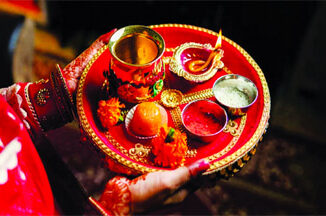
    Women begin preparing for Karva Chauth a few days in advance, by buying cosmetics (shringar), traditional adornments or jewelry, and puja items, such as the Karva lamps, matthi, henna and the decorated puja thali (plate).Local bazaars take on a festive look as shopkeepers put their Karva Chauth related products on display.On the day of the fast, women from Punjab awake to eat and drink just before sunrise. In Uttar Pradesh, celebrants eat soot feni with milk in sugar on the eve of the festival. It is said that this helps them go without water the next day. In Punjab, sargi is an important part of this pre-dawn meal and always includes fenia. It is traditional for the sargi to be sent or given to the woman by her mother-in-law. If the mother-in-law lives with the woman, the pre-dawn meal is prepared by the mother-in-law.
    The fast begins with dawn. Fasting women do not eat during the day. In traditional observances of the fast, the fasting woman does no housework. Women apply henna and other cosmetics to themselves and each other. The day passes in meeting friends and relatives. In some regions, it is customary to give and exchange painted clay pots filled with put bangles, ribbons, home-made candy, cosmetics and small cloth items (e.g., handkerchiefs). Since Karva Chauth follows soon after the Kharif crop harvest in the rural areas, it is a good time for community festivities and gift exchanges. Parents often send gifts to their married daughters and their children.
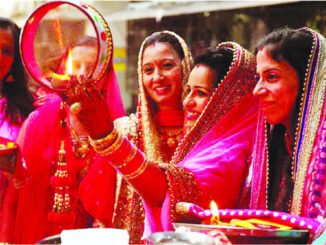
    In the evening, a community women-only ceremony is held. Participants dress in fine clothing and wear jewellery and henna, and (in some regions) dress in the complete finery of their wedding dresses. The dresses (saris or shalwars) are frequently red, gold or orange, which are considered auspicious colors. In Uttar Pradesh, women wear saris or lehangas. The fasters sit in a circle with their puja thalis. Depending on region and community, a version of the story of Karva Chauth is narrated, with regular pauses. The storyteller is usually an older woman or a priest, if one is present. In the pauses, the Karva Chauth puja song is sung collectively the singers perform the feris (passing their thalis around in the circle).
    The fera ceremony concluded, the women await the rising of the moon. Once the moon is visible, depending on the region and community, it is customary for a fasting woman, with her husband nearby, to view its reflection in a vessel filled with water, through a sieve, or through the cloth of a dupatta.
    Water is offered (arka) to the moon (som or chandra, the lunar deity) to secure its blessings. She then turns to her husband and views his face indirectly in the same manner. In some regions, the woman says a brief prayer asking for her husband’s life. It is believed that at this stage, spiritually strengthened by her fast, the woman can successfully confront and defeat death (personified by Yama). In Rajasthan the women say “Like the gold necklace and the pearl bracelet, just like the moon may my suhaag always shine brightly.”
    The husband now takes the water from the thali and gives his wife her first sip and feeds her with the first morsel of the day (usually something sweet).

  • Karwa Chauth

    Karwa Chauth

    Karwa Chauth is considered to be a very special day in the life of a married woman. It is a one day festival in which married women observe fast from sunrise to moonrise with much fervor and gaiety. The day falls on the fourth day of Kartik month in Hindu calendar, about nine days before Diwali in the month of either October or November. On this day, the married women specially pray to Goddess Gauri (Parvati) seeking the well-being, prosperity and safety of their husband.

    Origin

    Karva is another word for ‘pot’ (a small earthen pot of water) and chauth means ‘fourth’ in Hindi (a reference to the fact that the festival falls on the fourth day of the dark-fortnight, or krishna paksh, of the month of Kartik).

    The festival originated and came to be celebrated only in the northwestern part of the Indian subcontinent. The hypothesis is that military campaigns were often conducted by Hindus who were defending India against Mughal invaders, they would often leave their wives and children to go off to war. Their wives would often pray and celebrate a day of socialising, with other women, by preparing special meals, and dressing up in their finest regalia, and having what would today be deemed as a romantic evening with their husband before he went off to war. Women whose husbands had already gone off to war, join the fast to pray for the safety of their husbands at this time as they ventured away from home to defend India. The festival coincides with the wheat-sowing time (i.e., the beginning of the Rabi crop cycle). Big earthen pots in which wheat is stored are sometimes called Karvas, so the fast may have begun as a prayer for a good harvest in this predominantly wheat-eating region.

    There is another story about the origin of this festival. Earlier, girls sometimes barely teenagers used to get married, go and live with their in-laws in very remote villages. Everyone would be a stranger there for the new bride. In case she had any problems with her husband or in-laws, she would have no one to talk to or seek support from. Her own parents and relatives would be quite far and unreachable. Telephones, buses and trains were not heard of in those days. People had to walk almost a whole day to go from one place to other. Once the girl left her parent’s home for in-laws, she might not be back before long. Thus the custom started that, at the time of marriage, when bride would reach her in-laws, she would befriend another woman there who would be her friend (kangan-saheli) or sister (dharam-behn) for life. It would be similar to god-friends or god-sisters. Their friendship would be sanctified through a small Hindu ceremony right during the marriage. The bride’s friend would usually be of the same age (or slightly older), married into the same village (so that she would not go away) and not directly related to her in-laws (so there was no conflict of interest later).

    Emotionally and psychologically, it would be very healthy and comforting for the bride to have her own ‘relative’ near her.Once the bride and this woman had become god-friends or god-sisters, they would recognize their relation as such. They would treat each other like real sisters. During any issues later in life, involving even the husband or in-laws, these women would be able to confidently talk or seek help from each other. Moreover, the bride’s parents would treat her friend just like their own daughter. Thus Karva Chauth started as a festival to celebrate this special bond of friendship between the brides and their god-friends. A few days before Karva Chauth, married women would buy new karvas (spherical clay pots) — 7″-9″ in diameter and 2-3 litres capacity-and paint them on the outside with beautiful designs. Inside they would put bangles and ribbons, home-made candy and sweets, make-up items, and small clothes. The women would then visit each other on the day of Karva Chauth and exchange these karvas.

    Rituals

    Women begin preparing for Karva Chauth a few days in advance, by buying cosmetics (shringar), traditional adornments or jewelry, and puja items, such as the Karva lamps, matthi, henna and the decorated puja thali (plate).Local bazaars take on a festive look as shopkeepers put their Karva Chauth related products on display.On the day of the fast, women from Punjab awake to eat and drink just before sunrise. In Uttar Pradesh, celebrants eat soot feni with milk in sugar on the eve of the festival. It is said that this helps them go without water the next day. In Punjab, sargi is an important part of this pre-dawn meal and always includes fenia. It is traditional for the sargi to be sent or given to the woman by her mother-in-law. If the mother-in-law lives with the woman, the pre-dawn meal is prepared by the mother-in-law. The fast begins with dawn. Fasting women do not eat during the day. In traditional observances of the fast, the fasting woman does no housework. Women apply henna and other cosmetics to themselves and each other. The day passes in meeting friends and relatives. In some regions, it is customary to give and exchange painted clay pots filled with put bangles, ribbons, home-made candy, cosmetics and small cloth items (e.g., handkerchiefs). Since Karva Chauth follows soon after the Kharif crop harvest in the rural areas, it is a good time for community festivities and gift exchanges. Parents often send gifts to their married daughters and their children.

    In the evening, a community women-only ceremony is held. Participants dress in fine clothing and wear jewellery and henna, and (in some regions) dress in the complete finery of their wedding dresses.  The dresses (saris or shalwars) are frequently red, gold or orange, which are considered auspicious colors. In Uttar Pradesh, women wear saris or lehangas. The fasters sit in a circle with their puja thalis. Depending on region and community, a version of the story of Karva Chauth is narrated, with regular pauses. The storyteller is usually an older woman or a priest, if one is present. In the pauses, the Karva Chauth puja song is sung collectively the singers perform the feris (passing their thalis around in the circle).

    The fera ceremony concluded, the women await the rising of the moon. Once the moon is visible, depending on the region and community, it is customary for a fasting woman, with her husband nearby, to view its reflection in a vessel filled with water, through a sieve, or through the cloth of a dupatta. Water is offered (arka) to the moon (som or chandra, the lunar deity) to secure its blessings. She then turns to her husband and views his face indirectly in the same manner. In some regions, the woman says a brief prayer asking for her husband’s life. It is believed that at this stage, spiritually strengthened by her fast, the woman can successfully confront and defeat death (personified by Yama). In Rajasthan the women say “Like the gold necklace and the pearl bracelet, just like the moon may my suhaag always shine brightly.” The husband now takes the water from the thali and gives his wife her first sip and feeds her with the first morsel of the day (usually something sweet). The fast is now broken, and the woman has a complete meal.