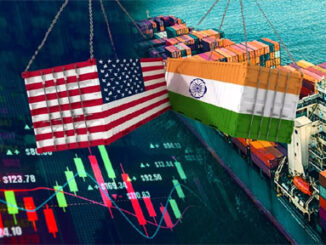
New Delhi (TIP)- The Centre may partially compensate exporters for their US shipments under Donald Trump’s punitive tariff regime, three people aware of the discussions said.
With the dawn of steep tariffs, Indian exporters are compelled to reduce prices to stay competitive, which makes a direct hit on their business. The government is now looking to bear 10-15% of the price cuts to help exporters stay in the game, the people cited above said on the condition of anonymity.
The relief, limited to US-bound consignments, will remain in force until the issue is settled through trade talks, which have been delayed but remain under discussion.
The proposal is being coordinated between the ministries of finance and commerce to address the mounting pressure on manufacturers and exporters, particularly those in labour-intensive sectors, which are struggling to execute confirmed orders. The Centre may support some of the affected sectors with 10-15% for the price sacrifice they make to keep their US business going, one of the two people cited above said, though the sectors had asked for even higher support. This aid will help exporters continue to execute their orders and keep the manufacturing process going, the person added.
Given that US importers must pay tariffs on goods imported from India, they are asking their Indian suppliers to reduce prices to compensate for the tariff burden, exporters have said. However, doing so would be an additional burden to the Indian exporter.
The matter was discussed in separate meetings held on Thursday with finance minister Nirmala Sitharaman and commerce minister Piyush Goyal, where stakeholders highlighted the challenges in meeting deadlines for the upcoming spring season.
The government has assured that there is no need to worry about the possible impact of the US tariffs on Indian goods exported to the US, stating the issue is being closely looked at.
The relief package is being explored for labour-intensive goods such as textiles, gems and jewellery, engineering goods, leather and footwear, seafood, among others, the people cited earlier said. “The finance minister sounded positive, stressing that exporters will not be left to face the storm on their own. While she didn’t reveal what specific measures the government is taking, she assured that the government is seized of the matter and will step in to provide support,” said Pankaj Chadha, chairman, Engineering Export Promotion Council. “The 50% tariff undeniably dents cost competitiveness, but it also pushes Indian manufacturers to think beyond pricing. For us, the way forward is twofold-strengthening technology and design leadership so clients see value in performance, and building diversified global linkages that reduce overdependence on any one market,” said Sarvadnya Kulkarni, chief executive officer of General Instruments Consortium, an engineering company. Queries sent to the spokespersons of the Prime Minister’s Office, and the ministries of finance and commerce remained unanswered.
According to a report by Global Trade Research Initiative, the damage could be substantial if the tariff remains in place for long. Once competitors gain ground in the US market, it will be very difficult for Indian exporters to reclaim lost space, and New Delhi will need to step up its engagement with Washington, it stated. Countries such as China, Vietnam, Mexico, Turkey, and even Pakistan, Nepal, Guatemala and Kenya stand to benefit from the US action, potentially locking India out of key markets even after the tariffs are rolled back.
As reported by Mint on 21 August, New Delhi is also exploring the possibility of joining China-led Regional Comprehensive Economic Partnership to mitigate potential losses arising from supply chain disruptions amid strained trade relations with the US.
On Wednesday, Aug 27, Peter Navarro, a top aide to US president Donald Trump, characterized the Russia-Ukraine conflict as “Modi’s war,” arguing that India’s continued purchase of discounted Russian oil is funding Moscow’s military efforts. He also criticized India for its high tariffs and for “getting in bed with authoritarians” by aligning with Russia and China.
“India, you are getting in bed with authoritarians. China invaded Aksai Chin and all your territory. They are not your friends. And Russia? Come on!” Navarro told Bloomberg Television in an interview.
Tag: Kenya
-

India may absorb some of tariff heat for US-bound shipments
-

The rise and contributions of the Indian diaspora
The Indian diaspora is one of the largest and most diverse global communities, with an estimated 32 million people of Indian origin living across the world. From the shores of the Caribbean islands to the bustling cities of North America, Europe, the Middle East, Southeast Asia, and beyond, Indians have built thriving communities that are often key to the economic, social, and cultural fabric of their host nations. Over the past few centuries, the Indian diaspora has experienced remarkable growth, playing an influential role in shaping the world’s geopolitical landscape, global markets, and cultural exchanges. This article aims to explore the rise of the Indian diaspora, their historical journey, the factors contributing to their migration, and their diverse and substantial contributions to their host countries and to India itself.
Historical Background of Indian Emigration
Early Waves of Migration
Indian migration has a rich history that spans centuries. The earliest recorded instances of Indian emigration occurred during the ancient and medieval periods, with Indians settling in Southeast Asia, Africa, and the Arabian Peninsula. Traders, scholars, and missionaries often traveled across the Indian Ocean, leaving behind traces of Indian culture and religion.
During the British colonial period (18th–20th centuries), however, emigration from India significantly increased. The indentured labor system, implemented by the British after the abolition of the transatlantic slave trade, became the primary mechanism for the large-scale migration of Indians. Millions of Indians were transported to various colonies such as Mauritius, Fiji, the Caribbean islands, and South Africa to work on sugar plantations, railways, and in other industries. This wave of migration laid the foundation for the development of vibrant Indian communities in these regions, some of which still maintain strong cultural ties to their Indian roots.
Post-Independence Migration
After India’s independence in 1947, migration patterns began to shift. Many Indians sought better economic opportunities abroad, especially in Western countries such as the United States, the United Kingdom, Canada, and Australia. The 1960s and 1970s saw the rise of skilled Indian professionals, including doctors, engineers, and IT specialists, migrating to meet labor shortages in these nations. By the 1980s and 1990s, the expansion of India’s global footprint, coupled with economic liberalization, further accelerated the migration of professionals seeking better opportunities in growing economies.
Factors Driving Indian Migration
Economic Opportunities
The most significant factor driving Indian migration has been the search for better economic prospects. As India’s population grew and its economic landscape evolved, many Indians faced limited opportunities for career advancement, education, and financial stability at home. Countries with burgeoning economies and labor shortages, such as the Gulf states, the United States, Canada, and the United Kingdom, offered higher wages, better living standards, and improved career prospects.
In the post-1991 liberalized economy, India’s economic growth allowed many to take advantage of international opportunities. The rise of the Indian information technology (IT) sector also played a crucial role in facilitating the migration of highly skilled professionals to countries like the United States and Canada.
Educational Pursuits
The pursuit of education has also been a driving force for migration. Indian students have flocked to institutions abroad for higher education, particularly in fields like engineering, medicine, management, and the sciences. The United States, United Kingdom, Australia, and Canada remain top destinations for Indian students, who not only benefit from quality education but also gain exposure to international networks, knowledge, and skills.
Political and Social Factors
In some cases, migration was driven by political instability, persecution, or limited opportunities in India. For example, during the period of political turmoil in India during the 1970s and 1980s, large numbers of people sought refuge or better prospects abroad. In countries like Uganda, Fiji, and Kenya, political events (such as Idi Amin’s expulsion of Indians from Uganda) forced many to leave.
Additionally, factors such as religious intolerance, caste-based discrimination, and economic inequalities led to waves of migration from certain regions within India to more developed countries, where better social mobility and opportunities were available.
Indian Diaspora’s Contribution to Global Economies
Economic Impact and Remittances
One of the most important contributions of the Indian diaspora has been in the form of remittances. According to the World Bank, India has been the largest recipient of remittances globally, receiving over $87 billion in 2020 alone. Remittances sent by Indian expatriates to their families back home have been a vital source of income for millions, contributing significantly to poverty alleviation, education, healthcare, and overall economic growth.
The economic footprint of the Indian diaspora extends beyond remittances. Indian entrepreneurs and professionals have made substantial investments in their host countries, contributing to the growth of industries ranging from technology to real estate, hospitality, and retail. The Indian diaspora has played a key role in the global technology boom, especially in sectors like software development, finance, and telecommunications.
Business and Entrepreneurship
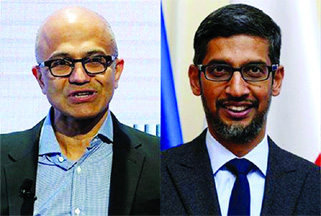
Indians have been instrumental in the development of several industries worldwide. In countries like the United States, the United Kingdom, Canada, and Australia, Indian entrepreneurs have built successful businesses that employ thousands of people. In Silicon Valley, Indian-origin entrepreneurs have become some of the most prominent figures in the tech industry, with individuals like Sundar Pichai (CEO of Google), Satya Nadella (CEO of Microsoft), and Vinod Khosla (co-founder of Sun Microsystems) leading major global tech firms.
In the United States, Indian immigrants have made their mark in the healthcare sector, particularly in the fields of medicine and biotechnology. Indian-origin doctors, researchers, and health professionals are highly respected for their expertise and have contributed to the development of cutting-edge medical technologies.
Indian businesses have also flourished in the Gulf states, where large communities of Indians work in construction, retail, and hospitality. Moreover, successful Indian businesspeople, such as Lakshmi Mittal, who heads ArcelorMittal, the world’s largest steel producer, and Mukesh Ambani, the chairman of Reliance Industries, have become global symbols of entrepreneurship.
Contributions to Culture and Society
Cultural Diplomacy and Soft Power
The Indian diaspora has been a powerful vehicle for the spread of Indian culture across the globe. Whether through Bollywood films, traditional dance forms like Bharatanatyam and Kathak, or global cuisine, the Indian diaspora has brought India’s rich cultural heritage to the forefront of global consciousness. Cultural festivals, such as Diwali and Holi, are celebrated by communities of Indian origin in many countries, fostering a greater understanding of Indian traditions and values.
In countries like the United States, the United Kingdom, Canada, and Australia, the Indian diaspora has been at the center of intercultural dialogues, promoting diversity, tolerance, and understanding. The popularity of yoga and meditation in the West is also largely attributed to the Indian diaspora’s efforts in sharing these practices with the world.
Philanthropy and Social Causes
Indian diaspora communities have also made significant contributions to charitable causes and social development, both in their host countries and in India. Many members of the Indian diaspora have been involved in philanthropy, supporting causes such as education, healthcare, and disaster relief.
The Indian diaspora has also been active in promoting educational initiatives, providing scholarships to students in need, and supporting schools and universities in India. The contributions of Indian-origin individuals to international organizations such as the United Nations and the World Health Organization further highlight the global impact of the Indian diaspora.
Political Influence and Advocacy
Engagement in Host Country Politics
The Indian diaspora’s political engagement has grown significantly over the years. In countries like the United States, the United Kingdom, Canada, and Australia, Indian-origin individuals have been elected to high political offices, contributing to the political landscape of their respective nations. Notable figures include Kamala Harris, the Vice President of the United States, and Priti Patel, the Home Secretary of the United Kingdom, both of whom have Indian heritage.
Indian-origin politicians have advocated for the interests of the diaspora, building bridges between their home country, India, and their adopted nations. In the United States, for example, Indian-Americans have emerged as a significant voting bloc, influencing political campaigns, policy decisions, and international relations.
Strengthening India’s Global Presence
The Indian diaspora has also played a crucial role in strengthening India’s global influence. By acting as a bridge between their host countries and India, the diaspora has contributed to enhancing India’s diplomatic, economic, and cultural ties with the world. Indian-origin politicians, business leaders, and community organizers have often acted as ambassadors for India, lobbying for greater trade and investment, fostering bilateral partnerships, and promoting India’s interests on the global stage.
The Future of the Indian Diaspora
As the world becomes increasingly interconnected, the role of the Indian diaspora is expected to grow even further. In the coming decades, the Indian diaspora will continue to be a critical factor in fostering India’s global standing. The rise of India as an economic powerhouse, along with its expanding influence in global politics, will provide new avenues for the diaspora to contribute to their home country’s growth.
Moreover, as the Indian diaspora becomes more integrated into the societies in which they live, their contributions will likely become more visible and impactful. The focus will likely shift from simple remittances and labor to more complex forms of collaboration, such as joint ventures, innovation partnerships, and global research initiatives. -

Two nurses from India shortlisted for Global Nursing Award
LONDON (TIP): Two nurses from India are in the running for a prestigious USD 250,000 Global Nursing Award, organized by Dubai-headquartered private healthcare service provider Aster DM Healthcare to honor the contributions of nurses worldwide.
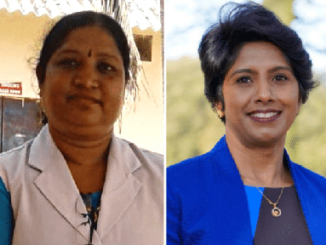
Shanti Teresa Lakra, who works among Particularly Vulnerable Tribal Groups (PVTGs) in the Andaman and Nicobar Islands, and Kerala-born and Ireland-based Jincy Jerry are among 10 worldwide finalists undergoing a public voting process before being evaluated by a grand jury judging panel for the award.
The winner will be awarded at a ceremony in London on May 12, which is marked worldwide as International Nurses Day.
“The Aster Guardians Global Nursing Award was started because we felt a necessity to celebrate the nurses and recognize them,” said Dr Azad Moopen, India-born Founder Chairman and Managing Director of Aster DM Healthcare, which operates healthcare services in India and the Gulf.
“We have about 8,000 nurses in our own organization, and we have seen the way in which they put their heart and soul into serving and saving the patients. Being a doctor, I have seen and appreciated their hard work for the healthcare system at large and most recently over the COVID challenges. They were the frontline soldiers in that fight,” he said.
Shanti Teresa Lakra, from the G.B. Pant Hospital in Port Blair and a Padma Shri recipient for her nursing service over the years, has spent considerable time within the tribal community of Andaman and Nicobar to gain their trust and assist with their healthcare needs.
In 2004, when the tsunami hit the Ongee Island habitat and drove them deep into the jungle, she made her home with them and lived in an open tent. She now works for all the major tribes in the region, something which brought her to the attention of the global award.
“I work as a grassroots level worker in a very remote area and my whole world belongs to the tribals residing in a very interior and isolated part of Andaman and Nicobar islands. To be a finalist in these awards is overwhelming because I never dreamt of it,” said Lakra, in an interview ahead of the award ceremony.
She pointed to language and other socio-economic barriers that make her work on the island quite challenging but fulfilling at the same time. “They are very shy by nature, and it isn’t easy for them to share information about their health problems. I strive to provide the best care I possibly can,” she said. The other nurse from India in the running for the public vote is Jincy Jerry of Mater Misericordiae University Hospital in Dublin, who serves as Assistant Director of Nursing for Infection Prevention and Control.
Her work in designing an appropriate software solution to cut down on the potential for human error while collating results from laboratories is among the factors behind her being shortlisted. Jerry, who is also part of the Infection Prevention Society UK, firmly believes that innovation is a way to increase quality and patient safety.
“In 2020, I introduced robotic process automation to the hospital. Our workload was very high at the time, so we introduced the system to counter that. Currently, I am working on around eight projects in the pipeline including work on using artificial intelligence (AI) to assist, train and modify behaviors on hygiene,” said Jerry, whose work has also been recognized by the Irish Healthcare Awards.
“If we have the right technology, we can save so much valuable time. It’s crucial that the nursing profession benefits from it,” she added.
Besides the nurses from India and Ireland, high-achieving nurses from England, the UAE, Kenya, Tanzania, Panama, Singapore, Portugal and the Philippines make up the finalists in the public vote stage of the vote before the winner is announced in London on Friday. Aster DM Healthcare said it chose the UK capital for the 2023 award ceremony for its strong healthcare tradition in the state-funded National Health Service (NHS) and as the birthplace of Florence Nightingale – the founder of modern nursing. -

Indian American Kash Patel named Chief of Staff to Acting US Defense Secretary
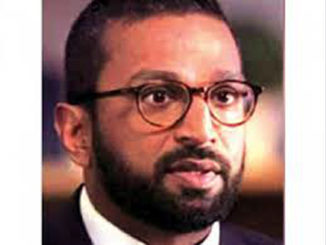
WASHINGTON (TIP): (TIP): Indian American Kash Patel has been named as the Chief of Staff to the Acting US Defense Secretary Chris Miller, the Pentagon has announced.
The new appointment from the Pentagon comes a day after Donald Trump fired Defense Secretary Mark Esper and designated the National Counter Terrorism Center Director, Chris Miller, as the Acting Secretary of Defense. Chris Miller took over the functions and responsibilities of the new role on Monday, the Pentagon said on Tuesday.
Kash Patel, currently on the National Security Council staff, has been named by Acting Secretary Chris Miller as his Chief of Staff, the Pentagon announced on Tuesday. He replaces Jen Stewart, who resigned earlier in the day. Acting Under Secretary of Defense for Policy Dr. James Anderson, Under Secretary of Defense for Intelligence and Security Joseph Kernan have submitted letters of resignation. Kashyap Pramod Patel, popularly known as Kash Patel, had previously served as senior counsel for counterterrorism at the House Permanent Select Committee.
In June 2019, Patel, 39, was appointed as senior director of Counter-terrorism Directorate of the National Security Council (NSC) in the White House.
New York-born Kash Patel has his roots in Gujarat. However, his parents are from East Africa mother from Tanzania and father from Uganda. They came to the US from Canada in 1970. The family moved to Queens in New York which is often called as Little India – in the late 70s.
After his schooling in New York and college in Richmond, Virginia, and law school in New York, Kash Patel went to Florida where he was a state public defender for four years and then federal public defender for another four years.
From Florida, he moved to Washington DC as a terrorism prosecutor at the Department of Justice. Here he was an international terrorism prosecutor for about three and a half years. During this period, he worked on cases all over the world, in America in East Africa as well as in Uganda and Kenya. While still employed by the Department of Justice, he went as a civilian to join Special Operations Command at the Department of Defense.
At the Pentagon, he sat as the Department of Justice’s lawyer with Special Forces people and worked inter-agency collaborative targeting operations around the world.
After a year in this sensitive position, Congressman Davin Nunes, Chairman of the House Permanent Select on Intelligence Committee, pulled him as senior counsel on counterterrorism.
-

Overseas Indian sportsmen have done their homeland proud

By Prabhjot Singh The year 1984 may have been a tumultuous year for the Punjabi community in general and Sikh community. It may not be easy for anyone to put behind the dastardly and tragic events that rocked not only Punjab but also the Punjabi community elsewhere. As the community was drowning in gloom, two overseas Punjabis -Alexi Singh Grewal and Kulbir Singh Bhaura – provided the silver lining by telling the world how enterprising the community was. Not only they entered the history annals as first overseas Indians to win Olympic medals but they also set a new trend in motion that has been kept afloat by enterprising overseas Indian community ever since.
At the overall overseas Indian community has done exceedingly well in the world of sports, including Olympic games, Commonwealth games and cricket.
Their heroic deeds scripted a new chapter describing it as the launch of “Brand India”. Before 2016 ended, yet another overseas Indian – Rajeev Ram – kept the “Brand India” flame alive by winning an Olympic medal, a Silver in Rio Olympic games.
Contribution by overseas Indian community cannot by undermined for it has won cockles of many a heart in the contemporary sports world. In December when a field hockey team from Canada went to play in the 2016 Junior World Cup Hockey Tournament in Lucknow, 11 of its 16 members were of Indian origin.

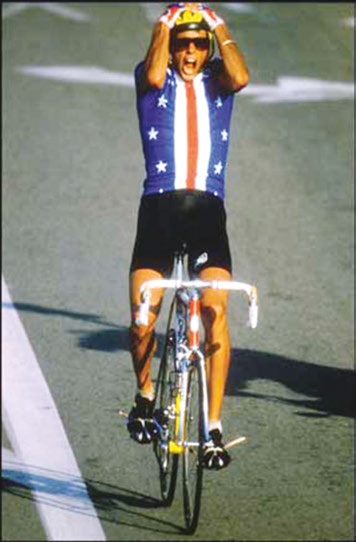
Alexi Singh Grewal became the first American to win an Olympic gold medal in cycling, at the 1984 Games in Los Angeles. Photo: Todd Buchanan These players -Brandon Pereira, Harbir Sidhu,Parmeet Gill, Rohan Chopra, Rajan Kahlon, Kabir Aujla, Balraj Panesar (captain), Ganga Singh, Gavin Bains, Arshjit Sidhu and Iqwwinder Gill – need to be complemented as they self-financed their participation in the prestigious Lucknow tournament.
And the Australian team, too, had one player of Indian origin, Kiran Arunasalam. It is after a long time that any player of Indian origin is playing for Australia in hockey.
At the overall overseas Indian community has done exceedingly well in the world of sports, including Olympic games, Commonwealth games and cricket.
You name any sport in which the overseas Indian community has not won laurels for the countries of its present abode. Needless to say, that 17 countries, including Canada, the US, Australia, Malaysia, England, Kenya, Uganda and Hong Kong, have been represented by overseas Indians in Olympic games.
Kulbir Bhaura, who represented Great Britain in field hockey, is the only overseas Indian to have two Olympic medals to his credit, a bronze in Los Angeles and a gold in Seoul.
Then there is Shiv Jagday, a former Indian Universities colour holder; he had the distinction of working as National Coach of Field Hockey Canada. He also coached the US national team besides being on the panel of the select FIH coaches. His son Ronnie Jagday also played for Canada in Sydney Olympic games. One must not forget the contribution of Malkiat Singh Saund who was one of the best forwards of the 1972 Munich Olympic games. Malkiat represented Uganda. Now he is settled in England.
Sutinder had the distinction of leading England in one match in the Mumbai World Cup Hockey Tournament in 1981-82. He played for England and Great Britain for a number of years.
If Australia is a world power in field hockey, it is all because of efforts of Pearce brothers who immigrated to Australia from India and represented their new country of abode in Olympic games.
Hardial Singh Kular, besides playing for Kenya, also rose to be the Vice-President of the International Hockey Federation (FIH). He was one of many Indian expatriates who represented Kenya in 60s and 70s of the last centenary.
He stands tall with Alexi Grewal, the first overseas Indian, to win an individual Olympic gold medal. In the 1984 Olympic games, he won the road race event in cycling in style. His father, a Sikh, had migrated to the US.
Interestingly, Alexi Grewal’s individual gold, though for the US, came 24 years before Abhinav Bindra won the country’s first ever-individual gold medal in Olympic games.
The latest from the overseas Indian community to get on to the Olympic medallist list is tennis player Rajeev Ram who won a silver medal in mixed doubles in the 2016 Olympic games in Rio.
While the overseas Indians have done the country and the overseas Indian community proud, the Indian government is yet to reciprocate. Though it started organizing #PravasiBharatiyaDivas (PBD) where outstanding members of the overseas Indian community are felicitated, sportsmen and women are yet to get their due.
Besides Alexi Singh Grewal, Kulbir Singh Bhaura and Rajeev Ram, there are a large number of other sportsmen and women, who have done the overseas community and India proud.
Rajeev Ram has to his credit a silver medal. In partnership with Venus Williams,
Rajeev Ram, finished runners-up in mixed doubles event in Tennis. Thirty-two- year-old Rajeev is first generation American. His parents moved to States in 1981 and Rajeev was born in 1984.
Rajeev won his first major Tennis title in Chennai in 2009. Rated as one of the top doubles players in tennis, silver in Olympics has been his highest achievement. In the semi-finals, Rajeev and Venus had defeated Sania Mirza and Rohan Bopanna.
After Rajeev Ram, another athlete of Indian origin doing well for a country other than India is shutter Rajiv Ousef. Born in Indians dominated Hounslow area in England, Rajiv has already qualified for quarterfinals of men’s singles in Rio. On his way to last eight Rajiv have beaten Tommy Sugiarto of Indonesia, Sasaki Sho of Japan and Koukel Petr of Czech. At 30, this has been perhaps best ever performance by him in a major sporting event. He had won a silver medal in the 2010 Commonwealth games in New Delhi.
Cricket is a game that every person of Indian origin follows. Monty Panesar scripted a new chapter when he became the first turban-wearing player to represent a country other than India in Test cricket. Monty played for England. Ravi Bopara followed him.
Since I have been following the overseas community closely, I wrote the following piece in The Tribune in November 2010 talking about emerging “Icons” of the Indian community. My piece was re-read by many as the President-elect, Donald Trump, named Nikki Haley, as the US Ambassador to the United Nations,
My piece read:
“What do Nikki Haley Randhawa, Bobby Jindal and Arjan Bhullar have in common?They all belong to the second-generation Punjabi Diaspora of North America.
While Randhawa and Jindal share the rare distinction of being the first Indian Americans to be Governors in the US, Bhullar has become the first Indo-Canadian to win a gold medal for his adopted homeland in the just- concluded Commonwealth Games in New Delhi.
They all are now icons of successful second generation young overseas Punjabis — 20-40 age group– who have brought laurels to the motherland of their parents after scripting extraordinary success stories in their chosen fields.
Interestingly, both Randhawa and Jindal are almost of the same age group — both succeeding in their race for gubernatorial posts even before they turned 40.
Though Piyush Subhas Chandra Amrit Bobby Jindal created history in 2008 by getting elected as Governor of Louisiana at the age of 37, Nimrata Nikki Haley Randhawa, will be almost 39 when she assumes charge as Governor of Carolina in the New Year.
Similarities are not only limited to the age group but also extend to other areas. Parents of both Jindal and Randhawa migrated to the US in the early 70s. And fathers of both Jindal and Randhawa were university teachers before they decided to leave India for good.
While the Jindals belonged to the Malerkotla area in Punjab, Rancheria’s family moved from Amritsar to the United States.
Mothers of both Jindal and Randhawa have the same first name — Raj. If similarities can be taken a step further, “A” is the initial of their fathers’ first name, Amar Jindal and Ajit Randhawa. Both belonged to the middle-class families before getting lured by the greener pastures of the US.
Interestingly, Jindal married Supriya Jolly, also an Indian-American, Randhawa married an American, Michael Haley.
Like their parents, both Bobby and Nikki charted out their own ways to success and glory with their sheer hard work, determination and commitment.
Bhullar has been on a different turf. Born in a family of wrestlers — his father Avtar Singh Bhullar was a known wrestler of his times who contested against Asian games champion Kartar Singh – in Vancouver in British Columbia, Arjan had to choose between soccer and wrestling in his school days. Now while pursuing higher studies at Simon Fraser University in British Columbia, he is focused on wrestling and wants to make it to the podium at the 2012 Olympic games in London.
Never before any Indo-Canadian had won a gold medal for his or her adopted homeland in any international meet of the level of Commonwealth Games, Pan American games or the Olympic Games.”
Now coming to many other sports personalities who also deserve appreciation and honour for flying the Indian flag flying overseas.
Hockey Olympian Avtar Singh Sohal played for Kenya in 1960, 1964, 1968 and 1972 Olympics, captaining Kenya in the last three editions of the Olympic games. He went to 1984 Olympics as Chief Coach of Kenya Besides Avtar also played for Kenya in the inaugural 1971 World Cup as Captain. In the second World Cup (1973) in Amsterdam, he went as Assistant Coach. Avtar is also the FIH Coach and also a member of the FIH Development and Coaching Committee. No one in the history of Olympic hockey has captained a national team for three consecutive times. In India, Pargat Singh has the distinction of leading India in two Olympic games.
Avtar Singh was in Rio Olympic games on his own to watch the hockey competition and other events.
Naaz Shah belongs to select band of Indian women hockey players who played for India in the Olympic games. When India was represented in women’s hockey competition in the Moscow Olympics, she was a member of the team. She was also a member of the gold medal winning Indian team in the 1982 Asian Games. Now settled in Hamilton, NZ she continues to be passionate about hockey.
Four of her trainees represented New Zealand in the New Delhi Junior World Cup Hockey Tournament. In the 2016 Junior World Cup Hockey Tournament in Lucknow, another batch of her trainees also represented New Zealand. Naaz also went to Rio as a Volunteer where she had the distinction of becoming flag-bearer of Indian hockey team in one of its pool matches. Now she has been a coaching youngster, both boys and girls in Hamilton where she works as a teacher. While she won laurels for India, her contribution to hockey and sports have remained unrecognised.
Let us talk about the World’s richest league, NBA. It is in this league that members of the overseas Indian community have made dents.
Gursimran “Sim” Bhullar, Canada born Punjabi boy, has the distinction of becoming the first ever player of Indian origin to play in NBA. Though Satnam Singh Bhamara and Palpreet Singh, both Punjab born basketball players have been subsequently drafted into NBA, they too have brought good name to Indian sports worldwide.
-

US man jailed for 40 years for abusing Kenyan orphans
OKLAHOMA CITY (TIP): A former missionary from Oklahoma convicted of sexually abusing children at an orphanage in Kenya was sentenced on March 7 to 40 years in a federal prison. US district judge David L Russell handed down the sentence to Matthew Lane Durham, 21, who had faced up to 30 years on each of four counts of engaging in illicit sexual conduct in foreign places. He also ordered Durham, of Edmond, to pay restitution of $15,863.
“These were heinous crimes committed on the most vulnerable victims. He was their worst nightmare come true,” Russell said. Durham, wearing an orange prison-issued jumpsuit, read a statement before sentencing in which he asked the court for mercy but did not express remorse for the offenses he was convicted of. Durham showed no emotion when the sentence was issued. Prosecutors alleged Durham targeted orphans while volunteering at the Upendo Children’s Home in Nairobi between April and June 2014. Durham had served as a volunteer since 2012 at the orphanage, which specializes in caring for neglected children.
“All I wanted was to follow God’s plan for me,” Durham told the judge. He said he will try to commit himself to serving others while he serves his prison sentence. Although Durham claims he is innocent of the charges, he said he was sorry that the accusations against him had damaged the orphanage and those it cares for. “The Upendo kids do not deserve this,” Durham said.
In a sentencing memorandum, prosecutors said Durham’s actions have had a chilling effect on the lives of dozens of foreign volunteers in Kenya and elsewhere “who must now live under the cloud of suspicion, distrust and apprehension when they volunteer their time, talent and resources for the betterment of children in East Africa and beyond.”
-

Pakistan loses UN Human Rights Council election
ISLAMABAD / UNITED NATIONS (TIP): Pakistan failed to win a re-election to the top UN human rights body, garnering just 105 votes in the 193-member General Assembly.
The General Assembly on Oct 27 elected 18 members of the UN Human Rights Council through a secret ballot.
Pakistan’s current term at the council is set to expire on December 31 and it was seeking re-election to the 47-member Human Rights Council.
Sources said the loss came as a setback to the Pakistani delegation that had appeared confident of winning the seat.
The sources attributed the loss to the way the Pakistani delegation fought the election, adding that it could not lobby effectively for the vote.
The new members, who will start their three-year terms beginning January 1 next year, are Belgium, Burundi, Cote d’Ivoire, Ecuador, Ethiopia, Georgia, Germany, Kenya, Panama, Kyrgyzstan, Mongolia, Philippines, Republic of Korea, Togo, Slovenia, Switzerland, United Arab Emirates and Venezuela.
Pakistan lost the seat in the Asia-Pacific category in which five seats were vacant.
India is also a member of the council and its term will end in 2017.
Members of the council are elected directly and individually by secret ballot by the majority of the members of the General Assembly.
Geneva-based non-governmental human rights group UN Watch welcomed the defeat of Pakistan, terming it as a “major surprise.”
Days before the vote, several human rights bodies had opposed the re-election of Venezuela, Pakistan and UAE to the UN Human Rights Council due to widespread criticism of these governments for egregious human rights violations.
According to a report by UN Watch, Human Rights Foundations, and the Lantos Foundation, Pakistan, UAE, Burundi and Ecuador were cited by human rights groups for having committed serious violations of numerous articles of the Universal Declaration of Human Rights, including curbs on the freedoms of speech, press, religion, and assembly, along with disregard for fundamental due process.
The candidate countries were also found to have voted against UN resolutions taking action for victims of human rights abuses in various hotspots, UN watch said.
Sources in the Indian mission to the UN here welcomed the election of Mongolia and Kyrgyzstan against the backdrop of historical visits undertaken by Prime Minister Narendra Modi to these nations earlier this year.
-

HAB Bank Felicitates Muhammad Habib and Customers
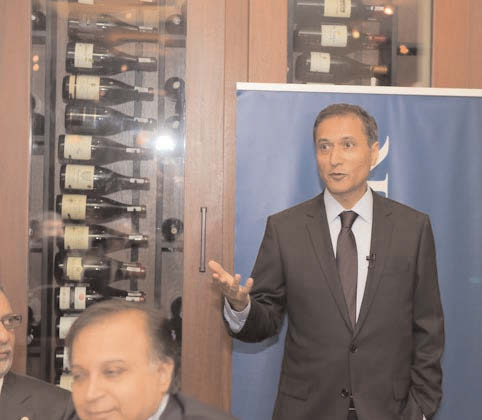
NEW YORK CITY, NY (TIP): HAB Bank invited some key clients to a business lunch with Mr. Muhammad Habib (Owner of Habib Bank) on October 13th, 2015 at Junoon Restaurant in Manhattan.
Mr. Saleem Iqbal, President & CEO of HAB Bank extended a word of welcome. In his brief address , Mr. Iqbal spoke highly of the accomplishments of Mr. Muhammad Habib, owner of Habib Bank and a number of other enterprises. He also spoke about the stellar performance of HAB Bank which has grown at a fast pace, despite the 2008 economic melt down. He disclosed that the bank had the best rating which is 5 star. Mr. Iqbal also recognized the senior staff of his bank.
Mr. Muhammad Habib chose not to speak about business or banking. “I don’t want to talk about banking or business. You already know a lot about it”, he said. He spoke of the need to uplift community. He said his family had all along worked to spread education. He has supported educational institutions and offered scholarships to students. And this philanthropy is not limited to one country. It extends to many countries in the world- US, UK, Pakistan, India, Kenya, South Africa, Hong Kong, and so on.

Mr. Muhammad Habib went round and exchanged greetings Some customers of HAB Bank who had known Me. Muhammad Habib also spoke, praising Mr. Habib, the HAB Bank and its officials.
Mr. Rizwan Qureshi Sr. VP of HAB Bank acquitted himself well as Master of Ceremonies. Nassir Khan received a pat from Mr. Saleem Iqbal for having organized the event so well.
-

Nestle to burn $50 million worth of noodles
New York (TIP): Nestle has issued multiple statements some contradicting their own top executive in the last few days. It is yet to be ascertained whether Nestle’s decision to burn Maggi packets recalled from the Indian Market & in its factories is a result of the Indian ban or Australia’s suspension of import from India.
As per Nestle’s global website, Nestle India currently exports small quantities of Maggi noodles to the US, Canada, UK, Australia, Singapore and Kenya.
Nestle has said it will burn $50 million worth of Maggi noodles in concrete incinerators after they were banned by India’s food safety regulator for containing too much lead.
The food regulator has accused Nestle of not complying with food safety laws.
Nestle continues to insist that the noodles are safe and that the ban is the result of issues with the interpretation of the law.
It has however started to recall the product and burn it in incinerators at five cement factories across the country.
According to the Indian paper AFP live, Nestle has 8 factories across India, five of which produce Maggi noodles.
Nestle has 38 distribution centres, where products are stored before being sent to distributors
63 Percentage of the noodle market owned by Nestle. Nestle dominates the Indian noodle market, according to Euromonitor. Nestle has been the market leader there since 2009.
Almost 28,000 tonnes, or $32 million-worth, of Maggi noodles were in the market on June 5, when the product was decided to be recalled. Another $17 million-worth of noodles are still in factories.
50 million dollars-worth of noodles will be burned. “These are broad estimates because it is impossible to calculate the final figure while the withdrawal is taking place,” Nestle said. It added that additional costs from bringing stock to the market and transporting it to incinerators to be destroyed had not yet been accounted for.
-

Two Indian cities at high risk of terror strike
LONDON (TIP): Two Indian cities -Imphal (ranked 32) and Srinagar (ranked 49) have been named to be at “extreme risk” of a terrorist attack, mainly aiming to cause mass casualty and destroy public transport networks.
According to an analysis of the terror risk to 1,300 commercial hubs and urban centres around the world, populations and businesses in 113 Indian cities have been identified to be at some risk – high, medium or low risk of facing terrorist attacks.
The next major Indian city after these two that faces a terrorist threat is Chennai even though the risk quotient has been marked as medium risk.
Bangalore is the fourth most prone city even though it is placed at 204th in the global threat list followed by Pune and Hyderabad at 206th and 207th respectively
Cities like Nagpur (ranked 2010) and Kolkata (2012) have been found to face a higher risk of a mass attack by terrorists that the usually expected targets like Delhi (447) and Mumbai (298).
Around 64 cities around the world are at “extreme” risk, with most in the Middle East and Asia – and three in Europe.
London ranked as low as at 400 due to the lack of a terror incident since the 7/7 bombings while Paris has soared into the top 100 cities following the Charlie Hebdo shooting, according to Verisk Maplecroft’s new Global Alerts Dashboard (GAD).
Arvind Ramakrishnan, head of Maplecroft India said “When it comes to Imphal and Srinagar, terrorist attacks aren’t on commercial targets as much as against the security forces. However n most of the other metropolitan cities, the targets are both to cause mass casualty and cripple its commercial hubs. Public transport networks in India are also prime targets”.
Ramakrishnan added “The Mumbai attack in 2008 was the turning point for India. But lack of intelligence sharing among states is a big worry. Law and order is still a state subject in India and political rivalries across states leads to state intelligence agencies not sharing actionable data. Virtually all police forces in India lack modern equipment and adequate manpower to counter a terrorist threat. This brings down the overall morale of the force. India does not face threats from cross border terror organisations but also from home grown ones like the Indian Mujahideen”.
Charlotte Ingham, head of security analytics at Maplecroft UK said in total, 64 cities are categorised as
‘extreme risk’ in an online mapping and data portal that logged analysed every reported terrorism incident since 2009.Based on the intensity and frequency of attacks in the 12 months following February 2014, combined with the number and severity of incidents in the previous five years, six cities in Iraq top the ranking.
Over this period, the country’s capital, Baghdad, suffered 380 terrorist attacks resulting in 1141 deaths and 3654 wounded, making it the world’s highest risk urban centre, followed by Mosul, Al Ramadi, Ba’qubah, Kirkuk and Al Hillah. Ingham said “just because a city in India hasn’t seen a terrorist attack in a while does not mean it isn’t potentially facing one. The rankings are based on the frequency and intensity of attacks.
Belfast has been named as the most dangerous city in Europe while Baghdad topped the list worldwide.
Outside of Iraq, other capital cities rated ‘extreme risk’ include Kabul (13th most at risk), Mogadishu in Somalia (14th), Sana’a in Yemen (19th) and Tripoli in Libya (48th).
However, with investment limited in conflict and post-conflict locations, it is the risk posed by terrorism in the primary cities of strategic economies, such as Egypt, Israel, Kenya, Nigeria and Pakistan that has the potential to threaten business and supply chain continuity.
“An estimated 80% of global GDP is generated from cities,” states Ingham. “Visibility of the sub-national differences in terrorism levels should be an imperative for multinational organisations looking to understand and price the risks to assets, employees and supply chains”.
As Africa’s largest economy, Nigeria’s role as a commercial hub is central to economic growth across the region. Because of Boko Haram 13 out of the 24 Nigerian cities experienced a significant increase in the intensity and frequency of terrorist attacks compared to the previous quarter.
Paris (97th and ‘high risk’) has experienced one of the steepest rises in the ranking, reflecting the severity of the terrorist attack in January 2015 that left 17 people dead. The risk level in Paris is representative of a wider trend for Western countries, including Belgium, Canada and Australia, where the level of risk in key urban centres is substantially higher than elsewhere in the country”.
-

AL SHABAAB MILITANTS KILL 147 AT UNIVERSITY IN KENYA
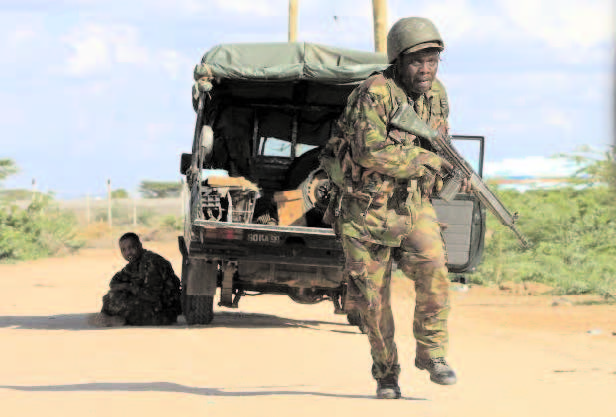
GARISSA, KENYA (TIP): Al Shabaab gunmen rampaged through a university in northeastern Kenya at dawn Thursday, killing 147 people in the group’s deadliest attack in the East African country. Four militants were slain by security forces to end the siege just after dusk.
The masked attackers armed with AK-47s singled out non-Muslim students at Garissa University College and then gunned them down without mercy, survivors said. Others ran for their lives with bullets whistling through the air.
The men took dozens of hostages in a dormitory for several hours as they battled troops and police before the operation was ended after about 13 hours, witnesses said.
Al Shabaab spokesman Ali Mohamud Rage said fighters from the Somalia-based extremist group were responsible for the bloodshed. The al-Qaida-linked group has been blamed for a series of attacks in Kenya, including the siege at the Westgate Mall in Nairobi in 2013 that killed 67 people, as well as other violence in the north.
Most of the 147 dead were students, but the two security guards, one policeman and one soldier also were killed in the attack, said interior minister Joseph Nkaissery.
At least 79 people were wounded at the school 145 kilometers (90 miles) from the Somali border, Nkaissery said. A dusk-to-dawn curfew was ordered in Garissa and three nearby counties. One suspected extremist was arrested as he tried to flee, Nkaissery told a news conference in Nairobi.
Police identified a possible mastermind of the attack as Mohammed Mohamud, who is alleged to lead Al Shabaab’s cross-border raids into Kenya, and they posted a $220,000 bounty for him. Also known by the names Dulyadin and Gamadhere, he was a teacher at an Islamic religious school, or madrassa, and claimed responsibility for a bus attack in Makka, Kenya, in November that killed 28 people.
One of the survivors of Thursday’s attack, Collins Wetangula, said he was preparing to take a shower when he heard gunshots coming from Tana dorm, which hosts both men and women, 150 meters (yards) away. The campus has six dorms and at least 887 students, he said.When he heard the gunshots, he locked himself and three roommates in their room, said Wetangula, who is vice chairman of the university’s student union.
“All I could hear were footsteps and gunshots. Nobody was screaming because they thought this would lead the gunmen to know where they are,” he said.
He added: “The gunmen were saying, `Sisi ni Al Shabaab,”‘ — Swahili for “We are Al Shabaab.”He heard the attackers arrive at his dormitory, open the doors and ask if the people who had hidden inside were Muslims or Christians.”If you were a Christian, you were shot on the spot,” he said. “With each blast of the gun, I thought I was going to die.”
The gunmen then started shooting rapidly, as if exchanging fire, Wetangula said.
“The next thing, we saw people in military uniform through the window of the back of our rooms who identified themselves as the Kenyan military,” he said. The soldiers took him and around 20 others to safety.
The attack began about 5:30 a.m., as morning prayers were underway at the university mosque, where worshippers were not attacked, said Augustine Alanga, a 21-year-old student.
At least five heavily armed, masked gunmen opened fire outside his dormitory, turning intense almost immediately and setting off panic, he told the AP by telephone.
The shooting kept some students indoors but scores of others fled through barbed-wire fencing around the campus, with the gunmen firing at them, he said.
“I am just now recovering from the pain as I injured myself while trying to escape, Alanga said. I was running barefoot,” Alanga said.As terrified students streamed out of buildings, arriving police officers took cover. Kenya’s National Police Service said a “fierce shootout” ensued as police guarded the dorms.
Three of the dorms were evacuated, with the gunmen holed up in a fourth, the National Disaster Operations Center said, and Kenya Defense Forces surrounded the campus.
“I am saddened to inform the nation that early today, terrorists attacked Garissa University College, killed and wounded several people, and have taken others hostage,” President Uhuru Kenyatta said in a speech to the nation while the siege was still going on.
Michael Bwana, a 20-year-old student, said he and other survivors tried to call their friends trapped in a dormitory, but their phones were switched off — either by their owners to keep them from ringing or by the gunmen who have seized them.
“Most of the people still inside there are girls,” Bwana said, referring to the dorm where gunmen are believed to be holding an unknown number of captives.
Wetangula, who was rescued by troops, said one soldier instructed a group of students to run and to dive for cover at their command as they ran to safety.
“We started running and bullets were whizzing past our heads, and the soldiers told us to dive,” Wetangula said. The soldier told students later that Al Shabaab snipers were perched on a three-story dormitory called the Elgon, he said.Some of the more seriously wounded were flown to Nairobi for treatment, authorities said. Kenyatta has been under pressure to deal with insecurity caused by a string of attacks by Al Shabaab.
In his speech to the country, he said he had directed the police chief to fast-track the training of 10,000 police recruits because Kenya has “suffered unnecessarily due to shortage of security personnel.” Kenya’s northern and eastern regions near the Somali border have seen many attacks blamed on Al Shabaab. The group has vowed to retaliate against Kenya for dispatching troops to Somalia in 2011 to fight the militants following cross-border attacks.
-

Gift of Life (New Delhi) India
20 percent of infant mortality is due to Congenital Heart Diseases (CHD). Poor children have no access to quality medical care and cannot afford high cost of surgery. 3000 children (India, Uganda, Kenya, Sudan, El Salvador, Sri Lanka, Nepal, Pakistan) benefited from GOL India New Delhi project alone. PRID Rtn Sushil Gupta (Advisor), PDG Ravi Bhooplapur (Chair) and Dr AC Peter (National Coordinator) monitor this life saving project. Rotary (Delhi NCR) Gift of Life Trust is auxiliary. This project was launched in New Delhi India in July 2005. Our partner hospitals are Escorts, NHI and PCH in Delhi. PRID Jackson Hsieh, D3460 to D3520 are also MG Donors. Children were given medicine, food and accommodation, conveyance etc. free of cost. Rotarians visit the children in the hospital and offer motherly care. Past and current RI Presidents, TRF Trustee, Ministers, Ambassadors etc visited the project. This is truly an international peace project signifying “service above self”
-

Commemorative Event hosted by India at the United Nations to mark the contribution of Indian soldiers in the First World War
UNITED NATIONS (TIP):
The Permanent Mission of India to the United Nations organized a Special Commemorative Event to highlight the sacrifices of Indian soldiers who lost their lives in the First World War. Ten other Missions to the United Nations including the Missions of Belgium, Egypt, France, Greece, Iraq, Jamaica, Kenya, Nigeria, South Africa and Tanzania joined as co hosts of the special event.
The immense sacrifices and widespread destruction caused by the War resulted in the decision of the participants in the Paris Peace Conference of 1919 to establish the world’s first intergovernmental organization, the League of Nations. As a signatory of the Treaty of Versailles, India became a founder – member of the League of Nations, the precursor of today’s United Nations. The Event featured an audio visual presentation of the various War Memorials in Europe, West Asia and Africa where Indian soldiers are commemorated.
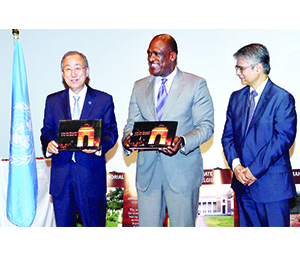
On the occasion, the UN Secretary General H.E. Ban ki Moon and the President of the UN General Assembly H.E. John Ashe jointly released a publication “Indian War Memorials of the First World War”, which was conceived and edited by the Permanent Representative of India to the United Nations, Ambassador Asoke K Mukerji. Speaking on the occasion, Mr. Ban kimoon, UN Secretary General reminded the distinguished audience to “never forget the roll call of carnage” of the First World War.
Quoting excerpts from an Indian Garhwali solider, the UNSG recounted the sacrifices of more than 60000 Indian soldiers who had given their lives, and stated “history often ignores such sacrifices”. Full text of his remarks at Ambassador John Ashe, President of the 68th UN General Assembly in his remarks highlighted the key lessons from the First World War, which had impacted on people across the world, primarily that of loss, and termed the war as being a “great tragedy”.
Ambassadors of over 60 countries, senior UN officials, and members of civil society attended the Event, which was followed by a Photo Exhibition of the First World War Memorials attended by Mr. Jan Eliasson, Deputy Secretary-General of the United Nations.
The Event was organized on the eve of the hundredth anniversary of Mahatma Gandhi’s historic letter of 14 August 1914 to the British Government in which Gandhiji had stated that India’s assistance to the War effort was guided by the idea “to share the responsibilities of membership of this great Empire, if we would share its privileges.” -

US discloses secret Somalia military presence, up to 120 troops
WASHINGTON (TIP): US military advisors have secretly operated in Somalia since around 2007 and Washington plans to deepen its security assistance to help the country fend off threats by Islamist militant group al Shabaab, US officials said.
The comments are the first detailed public acknowledgement of a US military presence in Somalia dating back since the US administration of George W. Bush and add to other signs of a deepening US commitment to Somalia’s government, which the Obama administration recognized last year.
The deployments, consisting of up to 120 troops on the ground, go beyond the Pentagon’s January announcement that it had sent a handful of advisors in October. That was seen at the time as the first assignment of US troops to Somalia since 1993 when two US helicopters were shot down and 18 American troops killed in the “Black Hawk Down” disaster.
The plans to further expand US military assistance coincide with increasing efforts by the Somali government and African Union peacekeepers to counter a bloody seven-year insurgent campaign by the al Qaeda-linked al Shabaab to impose strict Islamic law inside Somalia.
Those US plans include greater military engagement and new funds for training and assistance for the Somali National Army (SNA), after years of working with the African Union Mission in Somalia, or AMISOM, which has about 22,000 troops in the country from Uganda, Kenya, Sierra Leone, Burundi, Djibouti and Ethiopia.
“What you’ll see with this upcoming fiscal year is the beginning of engagement with the SNA proper,” said a US defense official, who declined to be identified. The next fiscal year starts in October. An Obama administration official told Reuters there were currently up to 120 US military personnel on the ground throughout Somalia and described them as trainers and advisors.
“They’re not involved in combat,” the official told Reuters, speaking on condition of anonymity, adding that until last year, US military advisors had been working with AMISOM troop contributors, as opposed to Somali forces. President Barack Obama last year determined that Somalia could receive US military assistance.
Another official said American forces over the years had provided advice and assistance in areas related to mission planning, small unit tactics, medical care, human rights and communications. The official said US forces in Somalia have also facilitated coordination, planning and communication between AMISOM troop contributors and Somali security forces
Special operations
The comments expand upon a little noticed section of a speech given early in June by Wendy Sherman, under secretary of state for political affairs. She publicly acknowledged that a “small contingent of US military personnel” including special operations forces had been present in parts of Somalia for several years.
Still, it was not immediately clear from her remarks the extent to which US personnel had been operating. US special operations forces have staged high-profile raids in the past in Somalia, including an aborted attempt in October to capture an al Shabaab operative in the militant group’s stronghold of Barawe. US officials have acknowledged Washington’s support for AMISOM and Somalia’s struggle against al Shabaab.
US Central Intelligence Agency officials have been known to operate in the country. US troop numbers on the ground in Somalia vary over time, the officials told Reuters. Deployments are “staggered” and “short-term,” one official said. But the Obama administration official added that there was overlap in the deployments to allow for a persistent presence on the ground.
-

Two US security officers found dead in Seychelles
NAIROBI, KENYA (TIP): Two American security officers have been found dead on a ship made famous when it was hijacked by Somali pirates, according to a statement on Wednesday by Seychelles police.
The two Americans, Jeffrey Reynolds and Mark Kennedy, both 44, were found dead Tuesday in a cabin on the Maersk Alabama, the ship hijacked by pirates in 2009, an event dramatized in the movie “Captain Phillips” starring Tom Hanks, according to a statement issued by police in the Indian Ocean island nation of Seychelles.
The police gave no cause of death but said a post mortem has been scheduled. The US Coast Guard stated from its headquarters in Washington that it is also investigating the deaths.
-

South Sudan to try rebel leaders, risking ceasefire
JUBA (TIP): South Sudan released seven rebel detainees January 30 but vowed to put on trial key leaders accused of launching weeks of fighting, a move likely to threaten a fragile ceasefire.
The sides implemented the ceasefire last Friday, but combat has only eased, not ended, with reports of continuing clashes and a worsening humanitarian crisis that has left thousands dead and forced almost 800,000 to flee their homes. Four leaders remain in custody in South Sudan, facing trial for attempting to topple President Salva Kiir after fighting broke out in the capital Juba on December 15.
Kiir accused his sacked deputy Riek Machar and other former officials of fomenting a coup against his government. Eleven ex-officials were arrested, while Machar — who denied any coup plot — fled. Fighting quickly spread across the country. Aid groups say up to 10,000 people have been killed in the conflict, although many fear more may have died. United Nations aid chief Valerie Amos wrapped up a three-day visit Wednesday to the war-torn country, where she saw the results of over six weeks of bloodshed, with horrific atrocities reported to have been committed by both sides.
“The future of South Sudan rests on all the people being able to work together,” she said, after a tour in which she saw food stores looted of tonnes of food aid, in devastated towns where workers were still burying those recently killed in the fighting. The fighting has seen waves of brutal revenge attacks, as fighters and ethnic militia use the violence to loot and settle old scores. South Sudan’s Justice Minister Paulino Wanawila said Tuesday that the four men in detention will face trial while three others, including Machar, will face justice if caught.
“If someone violates the law you don’t go and torture that person, you prosecute that person according to the law,” he said. ‘Things may get worse before they get better’ But the release of all the prisoners has been a key demand of the rebels, and Kenya’s foreign ministry said it was “still negotiating for the release of the remaining four.” The United States urged Juba to free the remaining detainees to help boost political reconciliation, as it welcomed the releases as an “important step towards an inclusive political dialogue”. John Luk Jok, a former justice minister, spoke on behalf of those released, who appeared in apparent good health.
“We don’t feel bitter, we only feel sad that the crisis in our country is happening just after our independence,” he said. “We don’t see our president as our enemy.” Many fear the conflict has slid out of the control of political leaders, with ethnic violence and revenge attacks between the Dinka people of Kiir and the Nuer of Machar, the country’s two largest groups. Over 76,000 civilians are still sheltering inside UN peacekeeping bases. Government and opposition rebels are still fighting for control in key areas, with the United Nations calling the situation “fragile”.
-

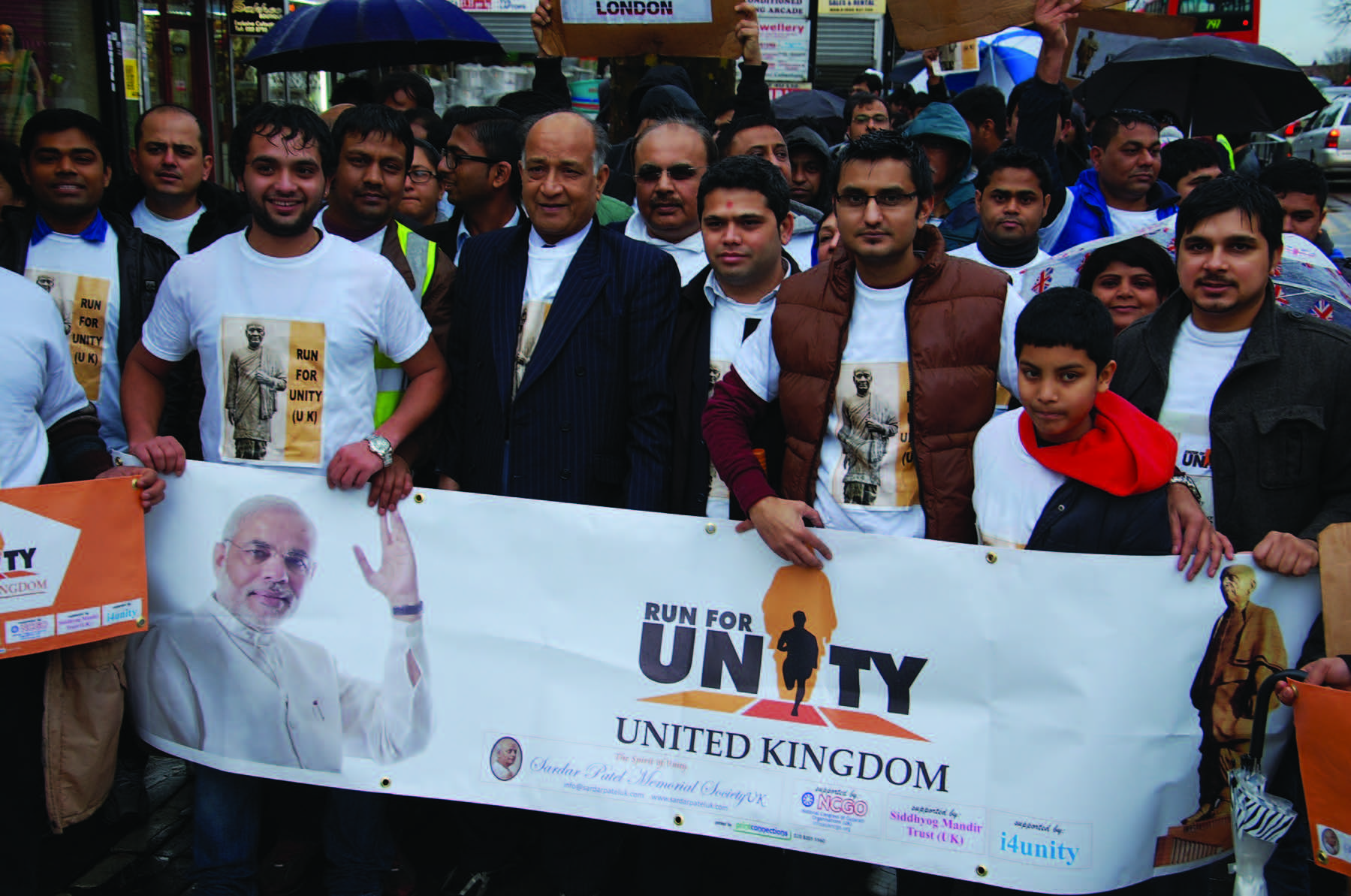
London ‘Run for Unity’a Grand Success: Jolly
Gujarat Leader Amit Thaker mandated for organizing ‘Run for Unity’ globally
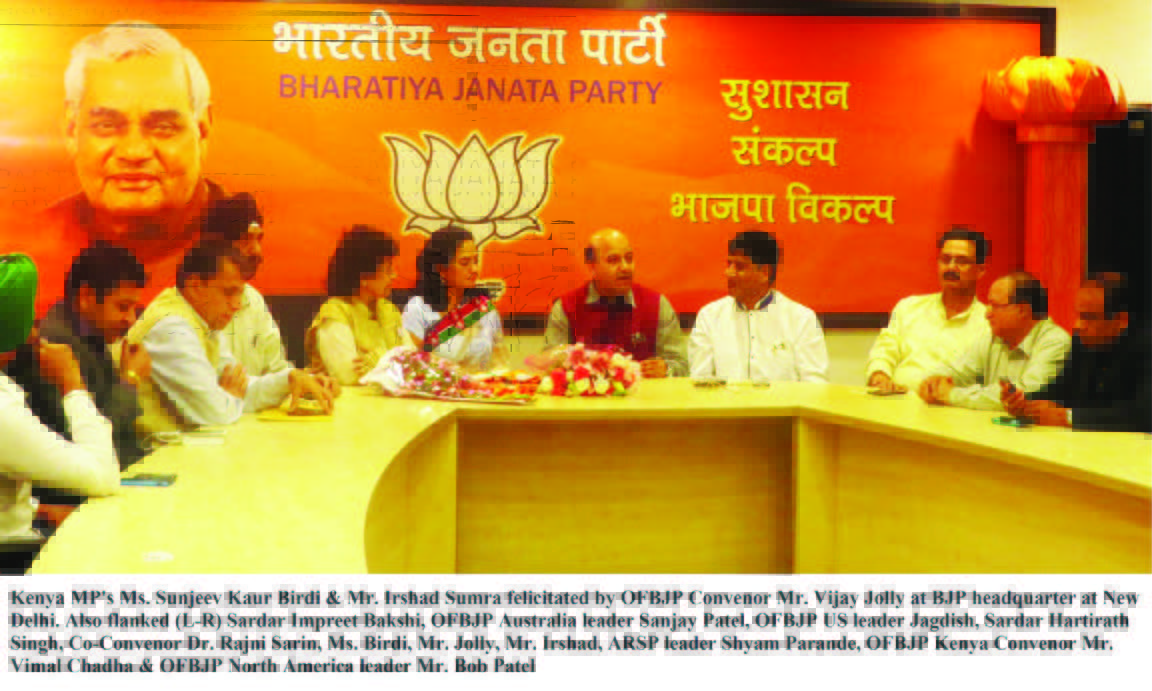
NEW DELHI (TIP): Encouraged by the success of London Run for Unity, OFBJP Convener Vijay Jolly announced January 29 that “Run for Unity” programs will be organized in various countries soon.
Jolly mandated OFBJP Co-Convenor & Gujarat leader Amit Thaker to coordinate globally the “Run for Unity” programs. Thaker will plan, propose, organize & coordinate all such programs in close association with OFBJP units in USA, UK, Norway, Sweden, Denmark, Nepal, Mauritius, Canada, Kenya, Nigeria etc.
Jolly claimed that “RUN FOR UNITY” recently organized in London attracted a large crowd of NRI’s. The UK program was organized by “14 – Unity” a young professional group in UK led by dynamic Nachiket Joshi, OFBJP Central Committee Member (Bharat) and permanently based in London. Gujarati, Punjabi and English British leaders participated along with young boys & girls.
Over 1000 strong crowd and participants walked in pouring rain wearing raincoats & carrying umbrellas in severe cold London weather, stated OFBJP leader Vijay Jolly. Cheering for “Modi” and national unity, wearing T-shirt of Sardar Patel’s image, the ‘London Run for Unity’ was flagged off by Bob Blackman, British MP & Chairman of All Party Parliamentary Group for British Hindus.
Bob, in his speech on the occasion pledged British support for Modi and hoped that trade between UK & India will increase “ten -times” in case Narendra Modi became PM of India. Muhammad Butt, leader of London Council, Lord Sardar Singh, Virendra Sharma South Hall MP, C.B. Patel Chairman Asian Voice & Gujarat Samachar, Lalu Bhai Parekh (OFBJP, UK President), Councilor Darshan Grewal (OFBJP-UK Vice President), P.G. Patel Chairman SPMS, UK, Mahendra Jadeja Sec. Gen. of NCGO, C.J. Robheru, Narendra Thakran, Vinod Halai, Dr. M. Ambekar etc. participated in the historic program in London.
-

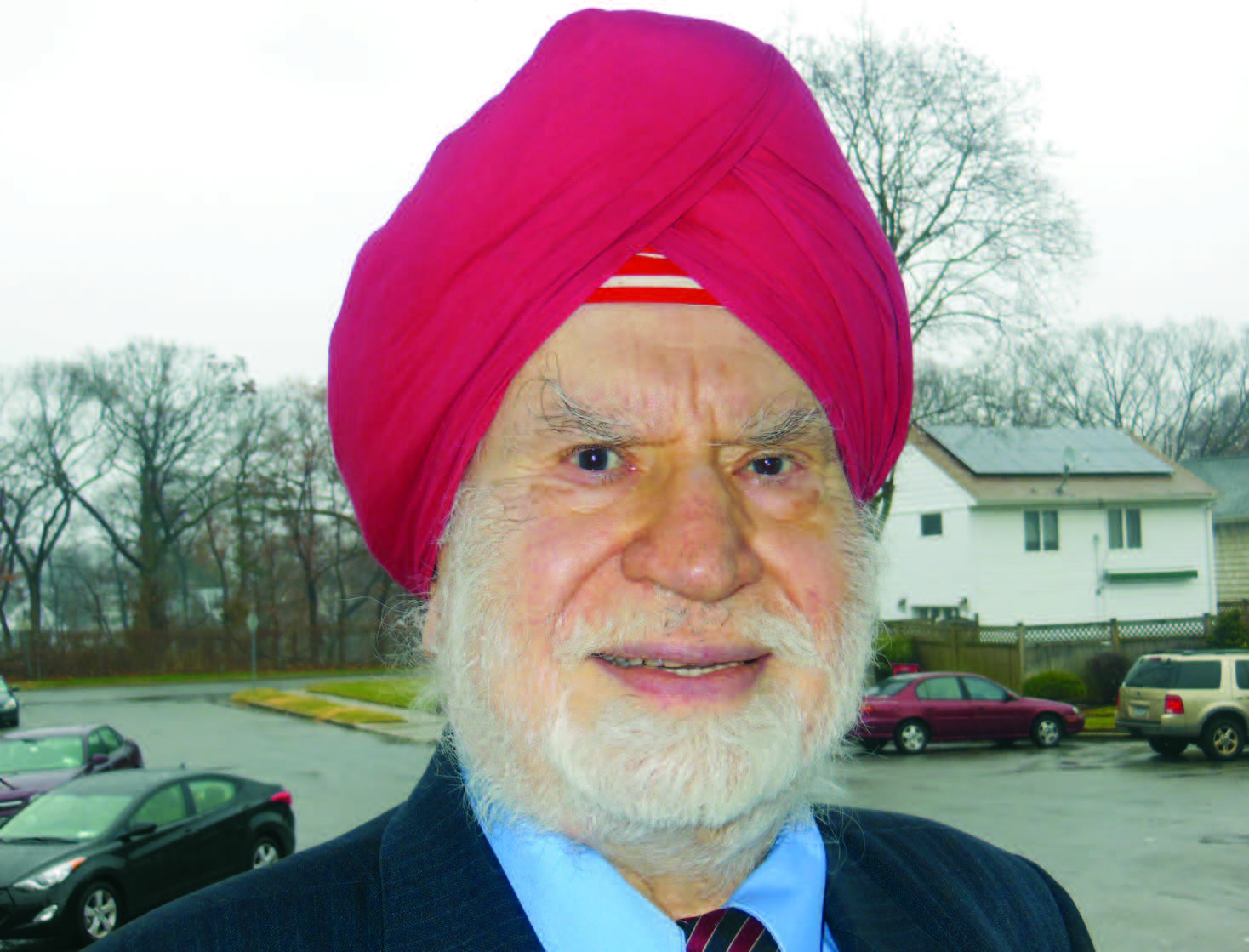
Dr. Jit Chandan – A Game Changer
Most people read history. Few people write history. Very few people make history. Extremely few people change the direction of history. Dr. Jit Chandan is one of those few people whose efforts at making change for the better are well recorded by history. His contributions in the service of community are deeply written in the sands of time, not to be erased by time or winds of change. By the time Dr. Chandan was about 20 years of age, and after completing his B. Sc. degree from Punjab University at Hoshiarpur, Punjab, he left for England in 1957 to pursue higher studies. In the 1950s, there were very few Indians in UK. There were just a few Indian students, a few businessmen and a few immigrants from Kenya. The only Gurudwara in the country was two floors in a 5-6 story building owned by Maharaja of Patiala, in the area of Shepherds Bush in London.
There were other groups of Sikhs in various cities and especially in Birmingham, Leeds, Wolverhampton, Southall and perhaps at some other places where they celebrated Guru Nanak Dev Ji’s birthday and other religious functions such as Baisakhi in rented halls. Dr. Chandan was the main religious speaker at these functions. He spoke about the lives and teachings of our Gurus. He strongly felt that we should have our own Gurudwaras to promote our religious philosophies among ourselves and among locals. The local Sikh community enthusiastically responded to these dreams and suggestions. Sometime in early 1960, Dr. Chandan formed The Sikh Missionary Society (currently known as Sikh Cultural Society) and started a quarterly Sikh journal “The Sikh Courier”, along with Dr. Ajit Singh Battu (currently in Sudbery, Canada).

Among the many who are Dr. Chandan’s friends is the present Prime Minister of India, Dr. Manmohan Singh. (A file photo)
It was a tough journey and it created many financial difficulties. However, with the grace of God and financial help from the Sikh community, the journal kept on going. Mrs. Pamela Wylam joined the editorial board and the journal grew in quantity and quality. Dr. Chandan delivered motivational speeches at Grupurab functions urging Sikhs to contribute one week’s wages to build Gurudwaras. With much effort a beautiful and spacious Gurdwara was built at Birmingham. That was a good beginning. Now Sikhs have over 250 Gurudwaras in the country. As destiny would have it. Dr. Chandan was awarded a coveted and meritorious King George VI Memorial Fellowship award to study at Columbia University in New York in 1963. This Fellowship was unique in the sense that it was the only scholarship awarded to students of Commonwealth countries studying in England and this year was India’s turn.
When Dr. Chandan left England for America, the management of the Sikh Cultural Society and that of the journal The Sikh Courier was taken over by S. Amar Singh Chhatwal with S. Tirath Singh Lalvani being the President of the Society. Mr. Chhatwal served the interests of the journal and the Sikh community with great devotion for many years until his death a few years ago. When Dr. Chandan came to America to study at Columbia University in New York in 1963, there were very few Indian families and even fewer Sikh families and there was no Gurudwara in the city. Only two Sikh names come to mind, namely Mr. D. W. Singh and Mr. S. S. Sarna. Mr. Sarna was a well established business man with the company name being “Bells of Sarna”. Sikhs celebrated Guru Nanak’s birthday in Indian Consulate in 1963. A few Indian students formed an Indian Students Association at Columbia University and Indian movies were shown on Sundays at the campus.
The year 1964 brought in a few more Sikhs at the World’s fair and a few more at the Indian Consulate. From that point onwards they started talking about founding their own Gurudwara. Some of the original Sikh thinkers in this regard were Dr. Harbans Singh, Mr. Kirat Singh Sethi. Mr. J. S. Premi, Dr. Jodh Arora, Mr. Bhalla, Mr. I. J. Singh, Mr. S. S. Sarna, Dr. Gurcharan Singh and Dr. Chandan, of course. They started to hold Sunday meetings in St. Michael’s church in Flushing and then at Knights of Columbus, also in Flushing. Sometime in late 60s or early 70s they negotiated and acquired a church on 118 Street in Richmond Hills and converted it into a Gurudwara. They also formed the Sikh Cultural Society with S. S. Sarna as President and Dr. Chandan as Secretary. They also started a journal “The Sikh Message” with Dr. Chandan as the editor. Dr. Chandan was instrumental in promoting the Sikh faith through the Gurudwara as well as through speaking at various churches.
Dr. Chandan continues his endeavors in the service of Sikh community and the Sikh faith, and Indian community at large in America as well as in India. He has set himself a goal to serve the poor children of India in providing them with resources for quality education. In fact, his desire to serve the poor and the needy to have education dates back to the 80’s when he associated himself with Delhi based Relief Committee that supports the education of poor children. This committee, formed in the wake of anti-Sikh riots in Delhi and elsewhere, with the primary objective of supporting the families of those killed in the riots, is managed by Nishkam Seva Center, headed by Bhai Mohan Singh. In 2012, there were 350 such students from all religions, who were being educated by Niskam Seva Center. Speaking about the quality of being charitable, Dr. Chandan said, “I can relate charity to my faith- Sikhism. The primary principles of my faith are- Kirat karni, vand chhakna and naam japna.
It is interesting to note that naam japna comes after honest living and sharing with others. “Another well known phrase in our social parlance is dasan nohan dee kirat kamayee karnawhich means following the highest work ethics. I follow my faith, to that extent. I am always ready to help the needy.” Dr. Chandan says, after he retires, he plans to get actively involved in India, particularly in Punjab and the neighboring states to providing primary education to poor children. Asked how he would achieve his objective, he said, “I have earmarked some financial resources for this purpose. I will seek the help of such institutions as Akal Academy, Nishkam Seva Center and others to assist me in utilizing these resources honestly and for the sole purpose of educating poor children.” To the question whether or not he was spiritual and how very important it was to be spiritual, Dr. Chandan said, “There is a lot more intended to look within to have the qualities of a spiritual person.
I am spiritual, to an extent”. And he added,” With the current state that the world is in where materialistic comfort is considered to be supreme by any means, the sense of contentment is missing. It is a sense of spirituality that brings contentment which is the source of all other qualities that make a human being decent. We all want a peaceful world, and spirituality is the sine qua non for it”. Dr. Chandan is currently a full tenured professor of strategic management at Medgar Evers College, City university of New York and served as the chair of the Department of Business Administration at the college. He is known to be a very successful professor and is respected as a motivational lecturer. Dr. Chandan has authored and co-authored 12 books in the various areas of management. He also writes Punjabi poetry as a hobby and is an active member of such Punjabi organizations as Punjabi Sahit Academy and Punjabi Sahit Sabha. Both organizations hold monthly poetry recital meetings. He is highly community oriented and worked closely with Dr. Surinder Malhotra in Indian National oversees Congress (INOC) in the service of community and developing closer ties between India and America. Dr. Chandan was born in 1937 in Jahania Mandi in district Multan, which now forms part of Pakistan. His father, Gurdit Singh, a landlord, moved to Hoshiarpur in Punjab in India in the wake of partition of India in 1947. Chandan got his school and college education in Hoshiarpur. Having done his B.Sc. from Panjab University in 1956, he moved to England for higher education. Married in 1968 to Sandesh, the couple has a son and a daughter.


Mike Ghouse : The author is a community consultant, social scientist, thinker, writer, news maker, and a speaker on Pluralism, Interfaith, Islam, politics, terrorism, human rights, India, Israel-Palestine and foreign policy.