Tag: Kerala

  • Cong plans Kerala poll strategy, plays down Tharoor’s absence

    Cong plans Kerala poll strategy, plays down Tharoor’s absence

    New Delhi (TIP)- With the Kerala Assembly elections approaching, the Congress leadership on Friday held a strategy meeting with senior leaders from the state to fine-tune its poll roadmap, strengthen coordination within the United Democratic Front (UDF) and project unity ahead of the high-stakes contest expected in April.
    The meeting, chaired by Congress president Mallikarjun Kharge at his residence, was attended by Leader of the Opposition in the Lok Sabha Rahul Gandhi and most members of the party’s top leadership from Kerala.
    However, the absence of senior leader and Thiruvananthapuram MP Shashi Tharoor triggered speculation about possible discontent within the state unit. The Congress leadership dismissed such suggestions, saying Tharoor had informed the party well in advance about his inability to attend due to prior commitments. Party leaders said discussions centred on election preparedness, campaign messaging, alliance management within the UDF and consolidating gains made in recent local body elections. Those present included AICC general secretary (organisation) K C Venugopal, Kerala in-charge Deepa Dasmunshi, senior observers Sachin Pilot and K J George, former state Congress president Ramesh Chennithala, Leader of the Congress Legislature Party V D Satheesan and newly appointed Kerala Pradesh Congress Committee president Sunny Joseph.
    Chennithala said that seat-sharing within the UDF was discussed and cited the alliance’s performance in recent panchayat elections as indicative of public support. He rejected reports of internal discord, stating that Tharoor had prior engagements in Kozhikode, which he had communicated earlier.
    He also criticised Prime Minister Narendra Modi over the Sabarimala gold loss issue, alleging inaction by the Centre.
    Party sources, however, said certain developments in recent weeks had contributed to perceptions of Tharoor’s dissatisfaction. Earlier this month, Rahul Gandhi did not acknowledge Tharoor on stage at a public event in Kochi. However, Tharoor’s office reiterated that his absence was solely due to his participation in the Kerala Literature Festival in Kozhikode.

  • THE KERALA CENTER HONORS 7 INDIVIDUALS AT THE 2025 ANNUAL AWARDS CEREMONY

    ELMONT, NY (TIP): Indian American Kerala Cultural and Civic Center, Inc. (The Kerala Center) celebrated its 33rd Annual Awards Dinner at the Center’s auditorium in Elmont, NY on Saturday, October 25, 2025. The Center honored seven individuals who made notable contributions in their professions and to society with their selfless dedication.

    Kerala Center Awardees, From l. to r.: Koshy O. Thomas, Joharath Kutty, Diya Mathew Esq., Dr. Nandini Menon, Dr. Priscilla Samuel and Jayan Varghese.

    This year’s honorees and their categories of recognition were: Inspector Shibu Madhu – Govt. and Public Service; Diya Mathews – Legal Service; Priscilla Samuel – Nursing; Jayan Varghese – Pravasi Malayalam Literature; Koshy O. Thomas – Community Service; Nandini Menon – Education; and Joharath Kutty – Engineering. The keynote speaker was Dr. Suresh U. Kumar.

    The program commenced with introductory remarks and welcoming of the MC, Daisy Stephen Pallipparambil, by G. Mathai, Trustee and Program Chairman. Following the remarks by the MC, American National anthem was sung by Bailey Stephen and Indian National Anthem by Amisha Jaimon. President Alex K. Esthappan welcomed everyone and provided a brief description of the activities and goals of the Kerala Center. New York Senator John Liu, Assemblymembers Michaelle Solages & Edward Braunstein, former Senator Kevin Thomas and Ragini Srivastava, North Hempstead Town Clerk were the dignitaries present to say felicitations and present awards.

    After president’s welcome, Dr. Thomas Abraham, Chairman of the Trustee Board and Award Committee member made his remarks and introduced the keynote speaker, Dr. Suresh Kumar. In his speech Dr. Kumar talked about the concept of Indian Civilizational Intelligence that has the potential to propel India to be a number one or two economy of the world.

    The Board and Award Committee chairman Dr. Madhu Bhaskaran explained the process of selecting the awardees prior to the award presentation. In addition to the Kerala Center awards, Assembly members presented their own certificates and proclamations honoring the awardees.

    The award for excellence in community service went to Koshy O. Thomas. He was introduced by Samuel Joseph, youth forum secretary of the Kerala Center, and Assemblyman Braunstein presented the award in the presence of Sen. John Liu and Assemblywoman Michaelle Solages. Koshy currently serves as Special Assistant and Community Liaison to New York State Assemblyman Edward Braunstein and also serves as the Chairman of the India Day Parade Committee in Queens.

    New York State legislators with Awardee Koshy O. Thomas. From l. to r.: Assemblyman Edward Braunstein, Sen. John Liu, Koshy Thomas and Assemblywoman Michaelle Solages.

    The award for excellence in Nursing leadership went to Priscilla Samuel. Priscilla was introduced by Baily Stephen, and Varkey Abraham presented the award in the presence of Assemblywoman Solages. Dr. Priscilla Samuel is a nationally recognized leader in advanced practice nursing, currently serving as Vice President of Advanced Practice Nursing at the Mount Sinai Health System. With a career spanning clinical practice, academic leadership, and health system innovation, Dr. Samuel remains committed to advancing the role of nurse practitioners and shaping the future of healthcare delivery.

    The award for notable contribution to Pravasi Malayalam Literature went to Jayan Varghese. He was introduced by Raju Thomas, General Secretary of Kerala Center, and Ragini Srivastava, North Hempstead Town Clerk presented the award. Jayan is the author of ten books published in various genres of literature, like poetry and drama.

    The award for excellence in legal service went to Diya Mathews. Diya was introduced by Dr. Anna George, and Attorney Appen Menon, Kerala Center Trustee, presented the award. Diya is a trailblazing attorney, business leader, and community advocate whose career bridges law, entrepreneurship, and service. As Partner in Charge of Chugh LLP’s New York and New Jersey offices, she leads a thriving practice focused on business immigration law and corporate compliance. She is widely recognized for her expertise in the Child Status Protection Act (CSPA). As she is admitted to practice law in both New York and India, she brings a truly global perspective to her work. She is the incoming President of The Indus Entrepreneurs (TiE) – New Jersey Chapter.

    Dancers at the Kerala Center Awards Banquet

    The award for excellence in engineering went to Joharath Kutty. She was introduced by Nazeem Beena, and former Sen. Kevin Thomas presented the award. Joharath is a Senior Director of System Engineering at New York Power Authority (NYPA) with over 20 years of experience in the electric utility industry. Her career spans Power Generation & High Voltage Transmission, Substation design, Grid Modernization, Power System Operation & Control, Transmission Operations Planning, and has been involved in every aspect of transmission expansion projects. In her current role, she provides overall leadership and technical direction as “Chief Engineer”, for the Long Island transmission expansion project (Propel NY Energy).

    Kerala Center Awardees with Kerala Center officials and Past Awardees.

    The award for excellence in education went to Dr. Nandini Ambat Menon. She was introduced by Jose Stephen, Kerala Center member and NYC school teacher, and Dilip Varghese, Kerala Center Founder Grand Patron, presented the award. Nandini is the Founder and Chief Education Officer of Cedar Hill Preparatory School in Somerset, New Jersey. She also contributes to the broader education and entrepreneurial community through her service on the Board of the NJ Academy of Sciences, the Indian American Women Entrepreneur Association, and as Co-Chair of TiE NJ Next Gen and a committee member of TiE Global Nxt Gen.

    The awardee for excellence in Govt. and public service, Inspector Shibu Madhu, could not attend the ceremony due to family emergency.

    A view of the gathering in the packed room.

    The ceremony was attended by leaders of several community organizations including Pioneer Club, Sarga Vedi, INANY, GOPIO, FOMAA, and FOKANA. As part of the Award Ceremony, a souvenir was released by the souvenir committee that consisted of Jose Cheripuram, Jose Kadapuram and Dr. Teresa Antony, by giving a copy to Susamma Abraham, a Grand Patron of the Center.

    The Kerala Center Executive and Board members Raju Thomas, Abraham Thomas, Mathew Vazhappally and John Paul coordinated the event. The MC of the program, Daisy Stephen Pallipparambil, impressed everybody with her outstanding performance. Indian classical dances performed by Chandrika Kurup’s Noopura School of Dance made the awards night a colorful one. Associate Secretary Mary Philip concluded the ceremony with a vote of thanks to honored guests, awardees, sponsors, photographers, audience and everyone worked so hard to make it a successful event. With dinner catered by Spice Gardens, the 2025 Award Night came to an end.
    (Based on a press release issued by Dr. Thomas Abraham)

  • THE FIRST INDIA DAY PARADE IN SEATTLE SHOWCASES ALL 28 STATES OF INDIA

    THE FIRST INDIA DAY PARADE IN SEATTLE SHOWCASES ALL 28 STATES OF INDIA

    SEATTLE (TIP): As part of the 79th Independence Day celebrations, the Consulate General of India in Seattle, in partnership with the City of Seattle, organized the First India Day Parade in Downtown Seattle on 16 August 2025. It showcased the rich cultural diversity of all states of India, including their cultural dance performances, along with an India Pavilion that put-on display ODOP (One District One Product) of each state and union territory of India.

    Participants representing Kashmir at the First India Day Parade in Seattle.
    Float and participants representing Kerala at the First India Day Parade in Seattle.

    Several dignitaries graced the occasion as Guests of Honor, including Hon’ble Mayor of Seattle Bruce Harrell, US Congressman Adam Smith, Seattle Port Commissioner Sam Cho, Seattle Parks & Recreation Superintendent/Director Mr. A P Diaz, King County Councilmember Claudia Balducci, US Coast Guard’s Northwest District Commander Rear Admiral Arex Avanni, Washington Supreme Court Justice Steven Gonzalez, along with Mayors of Mercer Island, Normandy Park, Sammamish and North Bend.

    Float and participants portraying culture of West Bengal at the First India Day Parade in Seattle.
    Performance representing celebration of Janmashtami in Uttar Pradesh at the First India Day Parade in Seattle.

    The inaugural ceremony began with a prayer invocation from the Vedas, followed by flag hoisting of India and national anthems of India and the United States. A vibrant cultural performance, Natyam: A Dance Mosaic of Bharat, showcasing the diverse dance traditions from across India, enthralled the audience. Consul General, along with Mayor of Seattle and other participating dignitaries ceremonially flagged off the India Day Parade, with tricolor balloons rising in the sky and marking the start of the grand procession.

    Float representing Rajasthan at the First India Day Parade in Seattle.
    Mayor of Seattle Bruce Harrell addressing the participants and visitors of the First India Day Parade in Seattle.

    Addressing the gathering of over 2000 attendees, Mayor of Seattle Bruce Harell welcomed the opening of the Indian Consulate in Seattle as a landmark development and noted that Seattle was diverse and a city of technological repute because of the contributions of Indian Americans and that Seattle City was honored to co-host the first-ever India Day Parade. He added that USA needs to learn India’s message of love, compassion and non-violence. U.S. Congressman Adam Smith, in his address, emphasized that peace and security across the globe are of paramount importance, noting that the United States has no better partner in working towards those goals than India.

    Participants representing Gujarat booth in India Pavilion as part of the First India Day Parade in Seattle.
    Visitors at Chhattisgarh booth in India Pavilion as part of the First India Day Parade in Seattle.

    In the true Indian spirit of Unity in Diversity, thousands of Indian-Americans from across all States of India took part in the parade through floats and performances that showcased their region’s unique culture, languages, and art forms. Each float and performance was coordinated by community groups led by prominent Indian-American community leaders. While WATA (Washington Telangana Association) was the community lead, some highlights included Gujarat’s vibrant Garba, Maharashtra’s spirited Lavani folk dance, Andhra Pradesh’s graceful Kuchipudi, Odisha’s Boita Bandana with Vande Utkala Janani, and West Bengal’s float depicting the values of Swami Vivekananda.

    One District One Product (ODOP) items in Rajasthan booth in India Pavilion as part of the First India Day Parade in Seattle.
    Booths representing the States of India in India Pavilion as part of the First India Day Parade in Seattle.

    Alongside the States and regional representations, thematic performances added further depth—such as Indian Heritage Arts, which displayed traditional paintings created by young Indian-Americans, and Gurukul, which celebrated India’s vast linguistic diversity, and an energetic performance by Beats of Washington depicting the valor and legacy of Chhatrapati Shivaji among many others.

    Visitors witnessing the flag hoisting at the First India Day Parade in Seattle.
    Float representing Telangana at the First India Day Parade in Seattle.
    Float representing Janmashtami at the First India Day Parade in Seattle.
    Uttar Pradesh booth in India Pavilion as part of the First India Day Parade in Seattle.

    A major attraction of the event was the “India Pavilion,” where more than 30 booths were set up to represent the 28 States of India along with several thematic exhibits. Each booth showcased distinctive One District One Product (ODOP) items, accompanied by descriptions highlighting their cultural and historical significance. Dignitaries and visitors also enjoyed sampling regional culinary specialties and exploring cultural artifacts, offering a vivid glimpse into India’s heritage and traditions.

    (Based on a press release issued by Soumith Raju K, Consul, Press, Information & Culture, Consulate General of India, Seattle)

    Beats of Washington representing the legacy of Chhatrapati Shivaji at the First India Day Parade in Seattle.


  • Nimisha Priya execution: Won’t grant pardon, says family of Yemeni victim

    Nimisha Priya execution: Won’t grant pardon, says family of Yemeni victim

    MALAPPURAM / NEW YORK (TIP): The family of Talal Abdo Mahdi, the deceased Yemeni national, remains firm in their demand for retribution even as attempts to convince them to pardon Kerala nurse Nimisha Priya are under way.

    An intervention by All India Jamiyyathul Ulama general secretary and Sunni leader Kanthapuram A.P. Aboobacker Musliar through his close friend and respected Yemeni Sufi scholar Sheikh Habib Omar bin Hafiz had positive results, with the Yemeni authorities postponing the July 16 execution of Nimisha Priya.

    Mr. Musliar said talks had been under way with Talal’s family to persuade them to pardon Nimisha Priya, despite their strong desire for retribution.

    However, social media posts purportedly by Talal’s brother Abdul Fatah Mahdi indicated the family’s resolute stance on retribution as per the Islamic law rather than accepting the blood money and pardon Nimisha Priya.

    Mr. Fatah Mahdi said, “justice would prevail” and affirmed that “retribution would come regardless of any delays in the execution.”

    In a separate post, he said the family would not grant pardon to Nimisha Priya “in spite of interventions by anybody.”

    Mr. Fatah Mahdi ended his post saying, “the pens have been lifted, and the papers have been dried”, an Arabic idiom meaning the matter has been settled forever. This phrase is interpreted as the family’s resolution to ensure retribution.

    According to sources in Yemen, the family insists on “implementing God’s law in Quisas,” which means retribution in kind as per the Islamic law, instead of pardoning and accepting the blood money called ‘diya’.

    Meanwhile, certain people opposing Mr. Musliar on ideological, organizational and political grounds have further complicated the situation.

    They have been fueling the controversy by posting negative comments on social media, specifically targeting Talal’s family members. These online comments have likely exacerbated tensions, contributing to the complexity of the issue.

    They launched personal attacks on Mr. Musliar while persuading Talal’s family to reject Nimisha Priya’s pardon. In their comments, they argued that accepting blood money would “tarnish the family’s reputation and dishonor Talal’s memory.”
    (Agencies)

  • Global Virus Network issues guidance on new Covid-19 variant, vaccine protection

    Global Virus Network issues guidance on new Covid-19 variant, vaccine protection

    The newly identified Covid-19 variant, named NB.1.8.1, is spreading rapidly across parts of Asia including India and other regions such as the United States.
    While the variant has sparked concern due to its rising numbers, global health experts are urging caution, not panic.
    The Global Virus Network (GVN) – an international coalition of top virologists and research centres – which is closely tracking the situation, says there is no current evidence that NB.1.8.1 causes more severe illness than earlier variants.
    However, its growing presence has led the World Health Organisation (WHO) to list it as a ‘Variant Under Monitoring.’
    The variant, a sub-lineage of the Omicron family, was first detected in January 2025 and has now been found in 22 countries.
    As of May 18, 2025, NB.1.8.1 accounted for 10.7% of global Covid-19 virus samples submitted to the international database GISAID, global science initiative and primary source for freely sharing genomic data of viruses, especially influenza viruses.
    This is a sharp rise from just 2.5% four weeks earlier. In India, active Covid-19 cases have climbed to 6,491 (as of June 9), with more than 500 new infections reported in the past 24 hours.
    States such as Delhi, Kerala, Gujarat, Uttar Pradesh, and West Bengal are reporting steady increases in cases.
    Other countries are also seeing a rise. In Taiwan, hospital visits due to Covid-19 symptoms rose by 78% in one week, with nearly 6,000 people seeking care between April 27 and May 3.
    In the United States, more than a dozen cases of NB.1.8.1 have been reported, initially detected through airport screenings in California, Washington, Virginia, and New York. The variant has since been found in Ohio, Rhode Island, and Hawaii.

  • 2024 was the year India became the talk of America

    2024 was the year India became the talk of America

    America went to polls this year, and chose its former president and Republican Donald Trump 47th President. The election was preceded by an entire year of campaigning, and a neck-and-neck competition between the Democrats and the Republicans. As Democrat nominee and US Vice-President Kamala Harris and Trump vied for the White House, India became the talk of the election.

    With 2.6 million eligible Indian-American voters — according to data from the Carnegie Endowment for International Peace — the Indian diaspora’s growing political significance was felt in key US swing states. These states, which were won by Trump, accounted for a significant number of Indian-American votes.
    Data suggested that there was a shift in the attitude of US voters of Indian origin this year. A large number of them shifted from Democratic Party to Republican Party in this election.
    Indian-Americans didn’t just leave a mark by casting their votes though. They were also seen making headlines across both popular political parties in the US. From Presidential contenders of Indian origin to several top leaders with India connection, India came in the spotlight.
    As this year comes to an end,we recap how politicians of Indian origin made waves in the US Presidential election.
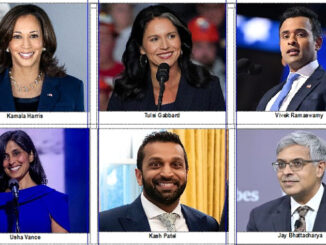
    Kamala Harris
    She is no stranger to the world. Harris made global headlines in 2020 when she was chosen by Joe Biden as his running mate during his Presidential campaign. She became the first woman in America’s history to sit on the Vice President’s chair, and also the first person of Indian descent to occupy a top position in the US. Harris’s mother, Shyamala Gopalan, was a revered Indian-American scientist who had migrated to the US from India at the age of 19. Her Jamaican-origin father, Donald Jasper Harris, is an economist and professor at Stanford University. During her Presidential campaign, Harris prominently shared her memories of her mother. Harris conceded defeat on November 4, 2024, but her Presidential bid gave prominence to India in the US.
    Tulsi Gabbard
    Born in Hawaii, Tulsi Gabbard is not of Indian origin but has a connection with India due to her Hindu religion. It was her name and identity as a Hindu that confused people the world over about her origin. Gabbard has been a Congresswoman for decades, since she won her first election in 2002. It was earlier this year that she made headlines for quitting the Democratic party to back Trump. In November, Trump chose her as Director of National Intelligence. The rise of Tulsi in the American politics also brought to light her Hindu religion.
    Vivek Ramaswamy
    Biotech entrepreneur Vivek Ramaswamy came to prominence when he challenged Trump as a Republican contender for President earlier this year. A 39-year-old politician with roots in Kerala, Ramaswamy holds a degree in Biology from Harvard University and a law degree from Yale Law School. A staunch follower of Hinduism, he is set to co-lead a new initiative aimed at reducing government bureaucracy. Alongside tech mogul Elon Musk, Ramaswamy will head the Department of Government Efficiency (DOGE).
    Usha Vance
    Usha Chilukuri Vance is set to make history as the first Indian-origin Second Lady of the United States. The wife of Vice President-elect JD Vance, Usha came to the global spotlight when she introduced her husband at the Republican National Convention in July this year. Born to Indian immigrant parents in San Diego, Usha married Vance in 2014 in a Hindu ceremony. She had built a career as a litigator before leaving her job to support her husband as he transitioned to politics from the world of practising law. When Trump chose JD Vance as his running mate, Usha’s life, beliefs and Indian connection were widely covered in the media.
    Kash Patel
    Kashyap “Kash” Patel, a former federal prosecutor and a trusted ally of Trump, has been named Director of the Federal Bureau of Investigation (FBI). Patel, born in New York to Indian-origin immigrants from Uganda, rose to prominence for his work on intelligence reform and national security during Trump’s first term. Kash as the FBI head is a very polarising choice by Trump since Kash is seen as a bold man out to reform the FBI and purge it of deep state actors. His name drills fear amiong top Republican leaders and deep state actors just as he is hugely popular among Trump fanbase due to his vow to dismantle the deep state.
    Jay Bhattacharya
    Kolkata-born Jayanta “Jay” Bhattacharya, a renowned health policy expert and Stanford University professor, has been appointed Director of the National Institutes of Health (NIH), the US ‘s leading medical research agency. Bhattacharya, known for his controversial stance against covid restrictions, has advocated for policies focusing on individual liberty in public health. The eminent epidemiologist was censored by social media platforms, allegedly at the behest of the Biden adminsitration, for his contrarian stance on the pandemic restrictions. As the new NIH Director, Bhattacharya will oversee a budget of nearly $47.3 billion.
    Harmeet Kaur Dhillon
    Republican lawyer Harmeet Kaur Dhillon has been nominated by Trump as the Assistant Attorney General for Civil Rights. She became an influential figure in the Republican Party for filing lawsuits over election integrity issues and backing Trump’s legal efforts to overturn Presidential election results in 2020. She also filed lawsuits against covid restrictions. She was a legal adviser on the Trump 2020 campaign. Born in Chandigarh, Dhillon found her own law firm in San Francisco.

  • Modi returns, Rahul finds foothold: Revisiting the grand political tamasha India witnessed this year

    Modi returns, Rahul finds foothold: Revisiting the grand political tamasha India witnessed this year

    The year 2024 was significant for Indian politics as the Election Commission carried out the world’s largest electoral exercise with 642 million people voting to decide who would rule the nation for the next five years.
    The elections were carried out in seven phases between April and June with thousands of government functionaries — who were manned by an even greater number of security forces — managing a whopping 10.5 lakh polling booths across the country.
    The year also witnessed several states electing their new governments, with all but two retaining those in power. The opposition also got a new lease of life this year despite being on the losing side in the general elections.
    Congress leader Rahul Gandhi became the Leader of Opposition in Lok Sabha as his party won 99 seats, nearly double the number it had scrambled to in 2019. The grand old party celebrated the performance like a win against the larger-than-life figure of Narendra Modi, who became the Prime Minister for the third consecutive time, though with figures far below the BJP’s expectations.
    In the national capital, the tug of war between the Centre and the elected Aam Aadmi Party government witnessed strong pulls and drags this year. The tension peaked when AAP chief Arvind Kejriwal was jailed in March for his alleged role in the Excise Policy Scam. He functioned as Delhi Chief Minister behind bars for the next seven months until the Supreme Court granted him bail with conditions, following which he quit, paving the way for his party leader Atishi to take over as Delhi CM.
    The resignation, arrest, and return of Hemant Soren in Jharkhand, the fall of the Biju Janata Dal government in Odisha after 24 years, the return of Chandrababu Naidu as Andhra Pradesh Chief Minister, the maiden Assembly Elections in the Union Territory of Jammu and Kashmir, and the NDA’s landslide victory in Maharashtra Elections were some of the other major political developments the country witnessed in 2024.
    Here is a sneak peek into these and other landmark events in Indian politics this year.
    Hemant Soren’s Fall And Rise
    Four-time Jharkhand Chief Minister, Hemant Soren dogged it out against the central government in the very first month of 2024 but managed to retain power amid a high-decibel political drama at the fag end of the year.
    The gripping political potboiler saw Soren quitting as chief minister hours before he was arrested by the Enforcement Directorate in a land scam case on January 31. Ahead of his arrest, the agency could not confirm his whereabouts for around 24 hours before he showed up in Ranchi. Soren claimed the charges against him were nothing but a vindictive action on the part of the BJP-led central government.
    His chosen replacement Champai Soren functioned as Jharkhand CM for barely five months till Hemant was released on bail on June 28. Less than a week later, Champai Soren resigned as CM, making way for Hemant who took oath as CM on July 4. The move did not go down well with Champai Soren who quit JMM and joined the BJP on August 30.
    In the November Assembly Elections, Hemant Soren signed off the year with flying colours as the JMM-led alliance won 56 seats, the party’s best performance since inception. Soren was unanimously elected as leader of the legislature party and again took oath as Chief Minister on 28 November.
    Delhi CM Arvind Kejriwal Is Jailed
    Embroiled in controversies that saw him running the Delhi government from behind bars for several months, Aam Aadmi Party National Convener Arvind Kejriwal was on a political roller-coaster in 2024.
    With several of his key party members and ministers in the Delhi government already arrested in the alleged excise policy scam, Kejriwal also was on the Enforcement Directorate’s radar.
    He managed to dodge multiple summons by the central agency before he was arrested on March 21 after the Delhi High Court rejected his plea for anticipatory bail. Kejriwal knew his arrest was around the corner and had time and again mentioned it in his prior public speeches.
    The BJP were all but sure of him resigning from his post but Kejriwal stayed put and ran the Delhi government from jail for several months. He attempted to get bail from the Delhi High Court however the same was rejected multiple times.
    During his jail time, Kejriwal’s legal battles took several twists and turns. He was granted interim bail by the Supreme Court from May 10 to June 1, 2024, to allow him to campaign for the Lok Sabha elections. After his interim bail expired, Kejriwal surrendered at Tihar Jail on June 2.
    Delhi Rouse Avenue Court granted him bail on June 20. However, the Enforcement Directorate challenged the trial court order before the Delhi High Court which stayed the bail order on June 21. Five days later, the CBI arrested Kejriwal in a different case linked to the alleged excise policy scam.
    The Supreme Court granted Kejriwal interim bail on July 12, but he remained in jail due to the CBI arrest. He was finally granted bail by the Supreme Court on September 13, 2024, after spending over five months in prison.
    The bail, however, came with certain conditions including prohibiting him from making public statements about his arrest by the CBI. He was also ordered not to enter the office of the Delhi Chief Minister and sign any official files in his capacity as the Chief Minister.
    Just four days later, on September 17, Kejriwal resigned as the Chief Minister of Delhi. He made it clear that he would only consider taking up the role again if he received a public mandate. On September 21, Atishi, the Delhi education minister till then, replaced Kejriwal as the youngest woman CM of Delhi.
    2024 General Elections:
    A Mammoth Exercise
    India witnessed its 18th general elections this year as the entire country voted to choose the next central government. Of the 96.8 crore (968 million) people who were eligible to vote, 64.2 crore exercised the right including 312 million women, the highest-ever participation by female voters.
    The 44-day electoral exercise was the second longest in country after the first parliamentary elections of 1951-52, which lasted for more than four months. The polls were conducted in seven phases beginning April 19 and ending June 1. The results were declared on June 4.
    The BJP-led NDA alliance won the elections with Narendra Modi returning as Prime Minister for the third consecutive time. The BJP’s performance, however, was below expectations and it had to heavily rely on two main allies—the Telugu Desam Party of Andhra Pradesh and Janata Dal (United) of Bihar—to form a coalition government.
    Eyeing 400 of the 543-seat Lok Sabha, BJP managed to win only 240 while its main partners TDP and JD(U) won 16 and 12 seats respectively. Overall, the NDA won 293 seats.
    In 2019, the BJP won 303 seats with the NDA’s final tally at 353. In contrast, Congress recorded a turnaround winning 99 seats, nearly double its 2019 tally of 52, thereby coming back as a potent opposition.
    Narendra Modi Takes Oath As PM For Third Consecutive Time
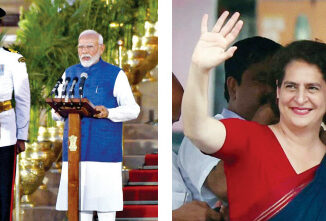
    On June 9, Narendra Modi took oath as the Prime Minister of India for the third consecutive time after his BJP-led NDA alliance registered a victory in the 2024 Lok Sabha elections.
    The ruling party’s rallies ahead of the elections were powered by the ‘Modi ki Guarantee’ campaign, which managed to help it win 240 seats, a lacklustre performance but strong enough to form a coalition government with the BJP as its most powerful constituent.
    Three days after the results were declared on June 4, Modi confirmed the support of 293 MPs to President Droupadi Murmu after which he was sworn-in as the Prime Minister for the third time on June 9.
    As for his individual performance from the Varanasi Lok Sabha seat, PM Modi had a shocking start on the result day as Congress’ Ajay Rai was seen leading in the first hour of vote counting.
    PM Modi raced past in the second half defeating Rai by a margin of 1,52,513 votes. It was the second-lowest-ever victory margin (in percentage points) for a sitting prime minister and a steep fall for Modi compared to his 2019 margin of 4.5 lakh votes.
    In his victory speech, Prime Minister Modi pledged to work with all states, regardless of the party in power, to build a developed India. He also laid out his vision for the third term saying it would be a tenure of big decisions and a key emphasis would be on uprooting corruption. He thanked TDP supremo Chandrababu Naidu and Bihar Chief Minister Nitish Kumar, his NDA allies for the electoral successes in Andhra Pradesh and Bihar.
    Rahul Gandhi’s Resurgence As LoP, Priyanka’s Debut in Parliament
    Ridiculed as ‘Shehzada’ and dismissed as ‘Pappu’, Congress leader Rahul Gandhi had the last laugh in the 2024 Lok Sabha election as he managed to gain big even though his party lost the elections.
    Gandhi contested from Kerala’s Wayanad and Uttar Pradesh’s Rae Bareli, winning the southern seat by 3.64 lakh votes against his nearest rival Annie Raja of CPI and the northern one by 3.9 lakh votes against BJP’s Dinesh Pratap Singh. Rahul retained Rae Bareli and his sister Priyanka fought and won from Wayanad by an even greater margin in the by-elections later in the year, making her Parliament debut as she took oath as Lok Sabha MP on November 28.
    Congress credited its spirited performance in the general elections to Rahul Gandhi for a campaign that focussed on people’s issues and welfare measures. The party lauded Gandhi for creating a new narrative through his Bharat Jodo Yatras, the on-foot marches he undertook from one end of the nation to another during which he was seen meeting people on the ground and getting to know about the real issues facing mainland India.
    Even the harshest of his critics would concede that Gandhi’s 2024 campaign was by far his best one as he focussed on bread-and-butter issues and the party’s welfare guarantees which struck a chord with a section of the voters.
    With Congress winning 99 seats in the elections (more than the requisite 55 or 10 per cent of the 543 seats), it meant that for the first time since 2014, it had the opportunity to pick a Leader of Opposition (LoP) in Lok Sabha. As an obvious choice, the party nominated Gandhi who was appointed the LoP on June 24, his maiden constitutional position since his entry into politics in 2004.
    As LoP Gandhi was accorded a Cabinet Minister’s rank, enhancing his position in the protocol list. The work of the Leader of the Opposition in the Lok Sabha is opposite to that of the Leader of the House.
    TDP Wins Andhra Elections,
    Naidu Returns As CM
    Andhra Pradesh saw a power transfer in 2024 as the ruling YSR Congress party lost the Assembly Elections to Telugu Desam party-led NDA. The elections were held in a single phase on May 13 with counting of votes on June 4. The polls were held simultaneously with the Lok Sabha elections.
    The incumbent Jagan Mohan Reddy’s YSRCP faced a crushing defeat as it won just 11 seats against 151 in 2019. In contrast, the TDP won 135 seats in the 2024 elections against just 23 in 2019.
    TDP Chief N Chandrababu Naidu returned as Chief Minister, taking oath on June 12. His last term as CM was from 2014 to 2019. Before the state bifurcation, he served as the CM of United Andhra Pradesh twice – 1995-99 and 1999-2004.
    The other highlights of the 2024 Andhra Elections were Naidu’s son Nara Lokesh and Janasena leader Pawan Kalyan entering the Assembly for the first time. The BJP got a much-needed boost with the NDA alliance winning 21 out of the total 25 Lok Sabha seats in the state. YSRCP got just four MP seats.
    Analysts said strong anti-incumbency coupled with a united fight by the opposition parties routed the ruling YSRCP. Though the Reddy-led government shelled out Rs 2.60 lakh crore towards doles over the last five years, there was no perceivable development in the state.
    BJP Wins Odisha, Naveen
    Patnaik’s 24-Year Rule Ends
    Odisha crossed a political milestone in the 2024 Assembly Elections as the electors voted for the BJP, ending the 24-year Biju Janata Rule (BJD) rule. Naveen Patnaik’s party could manage only 54 seats in the elections, a huge dip from 113 in the previous elections.
    BJP, on the other hand, secured a simple majority, winning 78 seats in the 147-seat Legislative Assembly. Held simultaneously with Lok Sabha elections, the elections were carried out in four phases with the first on May 13 and the last on June 1. The BJP also made significant gains, winning 20 out of 21 Lok Sabha seats in Odisha marking one of the strongest wins for the saffron party in the general elections.
    As for Naveen Patnaik, the BJD leader contested from two seats – Hinjili and Kantabanji. He won from Hinjili with 66,459 votes, defeating BJP candidate Sisir Kumar Mishra by a narrow margin of 4,636 votes.
    The election campaign by the BJP was intense, with Prime Minister Narendra Modi addressing several rallies and holding two road shows in Bhubaneswar and Puri. The BJP’s high-profile electioneering seemed to overshadow the BJD’s campaign, which was largely led by Patnaik and his aide VK Pandian.
    2024 Tripura Peace Accord
    On September 4, India’s northeast region witnessed a historic moment when the 35-year-long insurgency in Tripura came to an end following the signing of an agreement between the Centre, the Tripura government and two insurgent outfits of the state–the National Liberation Front of Tripura (NLFT) and All Tripura Tiger Force (ATTF).
    The agreement was signed at North Block in the presence of Union Home Minister Amit Shah, Tripura Chief Minister Dr Manik Saha, and top leaders of both NLFT and ATTF. As per the agreement, the Centre sanctioned a special economic development package amounting to Rs 250 crore for a period of four years to be implemented by the state government for the overall development of tribals of Tripura.
    “The Government of India and the Government of Tripura have been making concerted efforts to engage the tribal armed groups of Tripura in order to bring peace and harmony in the state, and rehabilitate the cadres so as to enable them to lead a normal life in the society,” the agreement stated.
    The agreement stated that NLFT and ATTF would not extend any support to any other militant or armed groups by way of training, supply of arms, providing protection or in other manner.
    Jammu And Kashmir UT Gets Maiden Elected Government
    The Union Territory of Jammu and Kashmir flipped a page in its political history in 2024 as it witnessed its first assembly elections after the abrogation of Article 370 and downgrading of the state into two federally controlled territories in 2019.
    The long-pending elections were finally carried out in three phases from September 18 to October 1 with counting of votes on October 8. They were held in the backdrop of the Supreme Court direction in December 2023 in which it had asked the Election Commission to “restore the democratic process” in the union territory by September 2024.
    The opposition bloc led by the National Conference in the Union Territory won the elections bagging 49 of the 90 Assembly seats. NC emerged as the single largest party winning 41 seats followed by BJP (29) and Congress (6). Mehbooba Mufti-led PDP was able to win only three seats, the worst performance by the party since it was founded by Late Mufti Sayeed 25 years ago.
    Former CM and National Conference leader Omar Abdullah was sworn in as the first Chief Minister of the J&K UT on October 16. Interestingly, a few months before the election dates were announced, the Ministry of Home Affairs increased the powers of the L-G Manoj Sinha-led administration by amending the Jammu and Kashmir Reorganisation Act, 2019.
    The amendment entrusted more powers to the L-G for making decisions on police, all-India services officers and appointment of advocates and other law officers. He was also given powers for sanctioning prosecution in certain cases and taking decisions on anti-corruption bureau-related matters.
    BJP’s Hat-Trick In Haryana
    Buoyed by its success in Odisha, BJP recorded a hat-trick win in Haryana leaving the opposition stunned while managing to overcome anti-incumbency with ease.
    The single-phase elections were held on October 5 and the votes were counted on October 8. The victory in Haryana was a significant milestone for the BJP as, despite predictions of a Congress-led alliance win, the saffron secured a majority with 48 seats in the 90-member Assembly, marking its third consecutive win in the state.
    The election saw a high voter turnout of 67.90 per cent, with the BJP winning 39.94 per cent of the popular vote. The Congress, led by Bhupinder Singh Hooda, won 37 seats with 39.09 per cent of the popular vote.
    Nayab Singh Saini, the 54-year-old OBC leader who was made CM in March to replace Manohar Lal Khattar in an unexpected appointment, took oath as the new Haryana Chief Minister for the second term on October 17.
    The BJP’s victory was attributed to its strong campaign and the popularity of its leaders. The party’s decision to contest the election without a chief ministerial face also seemed to have worked in its favour.
    The Congress, on the other hand, faced internal conflicts and was unable to capitalize on the anti-incumbency factor. The party’s alliance with the Communist Party of India (Marxist) also failed to yield the desired results.
    The Jannayak Janta Party (JJP), which had allied with the BJP in the previous election, contested the election alone but failed to win any seats. The Indian National Lok Dal (INLD) also failed to make a significant impact, winning only two seats.
    Mahayuti’s Landslide Victory In Maharashtra, Fadnavis Returns As CM
    The BJP-led Mahayuti alliance registered a landslide victory in Maharashtra as the key western state went to polls on November 20. In the 288-seat Legislative Assembly, the BJP won 132 and its allies Shiv Sena and NCP bagged 57 and 41 seats respectively. The opposition Maha Vikas Aghadi (MVA) was handed one of the worst defeats in recent history as the three main constituents of the alliance could manage wins in just 50 seats–Congress 16, Shiv Sena (UBT) 20, and NCP (SP) 10.
    The BJP was at the forefront of this spectacular performance, comprehensively managing to buck the anti-incumbency and emerge as the largest party in the state pocketing 132 of the 149 seats it contested in the politically significant western state. BJP’s success was led by its senior leader and state deputy CM Devendra Fadnavis, who eventually became the Chief Minister for the third time after some hiatus on the part of the Eknath Shinde-led Shiv Sena.
    Fadnavis’ name was finalised for the Maharashtra Chief Minister post at a key meeting on December 4. A day later, he took an oath as the Chief Minister for the third time. The swearing-in ceremony was attended by Prime Minister Narendra Modi and other top political figures of the country. The results came as a fillip for the BJP after the unprecedented hat-trick in Haryana and helped the party overcome some of its setbacks in the general elections where it bagged just 240 seats.
    Voters in the politically significant western state of Maharashtra, which sends 48 MPs to the Lok Sabha and gave the MVA a decisive 30 seats, clearly decided to go against the trend of that parliamentary victory just five months ago.

  • Natural disasters that rocked the world in 2024

    Natural disasters that rocked the world in 2024

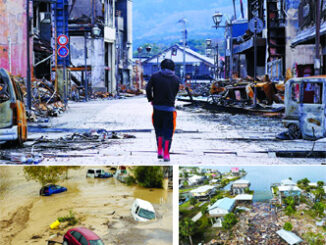
    The year 2024 has seen a horrifying variety of natural disasters resulting in tragic deaths and destruction that have shocked the world. Events, including everything from earthquakes to hurricanes and landslides, have left in their wake grieving survivors and destroyed homes and livelihoods. Of course, natural disasters have afflicted humanity since the dawn of time—but now we have a sinister extra factor to contend with: climate change.
    Noto Earthquake
    A powerful earthquake struck on New Year’s Day, heralding a disastrous start to 2024 for the people of the Noto Peninsula in western Japan. NASA’s Earth Observatory reported, “The 7.5 magnitude main shock was followed by dozens of strong aftershocks in the following minutes, hours, and days.” The principal quake struck at 4:10 in the afternoon.Just to make a bad situation worse, there was heavy snowfall in the immediate aftermath of the earthquake and the resulting fires, hampering rescue efforts. NASA geophysicist Eric Fielding said that some areas of the Noto Peninsula were lifted as much as 13 feet (4 meters). Around 84,000 homes were damaged, leaving a repair bill that may be as high as $17.6 billion, with 14,000 people directly affected by the destruction. And grimly, 281 people lost their lives, with many more badly injured.
    Spain Floods
    On October 29, as much as 20 inches (51 cm) of rain fell on the southeastern Spanish province of Valencia in just eight hours. Unsurprisingly, this massive deluge resulted in flash floods and devastating destruction. The city of Valencia, which lies on the Mediterranean coast, and the surrounding towns and farmland were heavily flooded, and a total of 216 people died, almost half of them over the age of 70. The rain turned streets into rivers, and cars were tossed aside as if they were toys.NASA’s Earth Observatory reports that the exceptionally high levels of rainfall “came from a high-altitude low-pressure weather system that became isolated from the jet stream.” This happened when a cold front collided with warm air over the Mediterranean. In the aftermath of the floods, public outrage at a perceived lack of warning and poor response from rescue services spilled over into angry demonstrations. When King Felipe VI and Queen Letizia visited Valencia, angry survivors pelted the royal couple with mud as they toured the streets.
    Uganda Garbage Landslide
    The Kiteezi garbage dump, clearly visible on Google Maps satellite view, is the only place to dispose of garbage in Uganda’s capital city, Kampala. The satellite pictures also reveal the fact that there are homes nestled cheek-by-jowl with the festering mountain of trash, which covers a 36-acre site in the city. Some of the residents of those homes were the victims of a garbage landslide in August when torrential rain caused a substantial portion of the trash mountain to collapse.Around 1,000 people were forced to leave their homes, but it turns out that by escaping with their lives, they were the fortunate ones, even though many lost everything. Meanwhile, rescuers dug their way through tons of garbage in a desperate effort to locate survivors. A few days after the Kiteezi disaster, the Kampala police announced a confirmed death toll of 35, with 28 people still unaccounted for.
    Hurricane Helene
    Helene, the deadliest hurricane since Katrina 20 years ago, swept in from the Atlantic in late September, making landfall in Florida. From there, it worked its way across Georgia, both Carolinas, Virginia, Tennessee, and Alabama. As it tracked across the southeastern states, it left a terrible trail of destruction in its wake. Rescue and recovery efforts continued for days after Helene had completed its bout of devastation.More than a week after the hurricane had blown through, the Associated Press reported that more than 230 people had lost their lives in the fearful storm. Those who survived Helene had to cope with widespread power outages, intense flooding, and massive destruction of infrastructure. North Carolina’s Governor Roy Cooper highlighted the ferocious strength of Helene, saying, “We knew storms could cause damage, but we weren’t expecting the magnitude of this one – water raging in rivers all over in a way we’ve never seen before.”
    Wayanad Landslide
    In July, it was the Wayanad district in India’s Kerala region on the country’s southwestern coast that experienced just how devastating the forces of nature can be. Torrential rain, 22 inches (56 cm) in two days, caused landslides, and by early August, the grim death toll had risen to 392, with 150 people reported as being missing. The casualties came in small villages on steep hillsides where many of the inhabitants worked on local tea plantations.The Hindu website told the tragic story of two of the villages that were engulfed by the landslide, Mundakkai and Chooralmala, both places previously best known for their “scenic landscapes and waterfalls.” However, in the massive landslide, which originated in a nearby mountaintop and barreled some 5 miles (8 km) down the course of the Iruvaniphuza River, these two villages were virtually wiped out. Weeks later, the gruesome task of identifying bodies continued, with some of the dead only identified with the use of DNA testing.
    Indonesian Volcano
    Volcanic Mount Lewotobi Laki-Laki on Indonesia’s Flores Island erupted in early November, sending hot ash soaring 6,500 feet (1,981 meters) into the skies. A flow of deadly lava and cascading rocks hit villages on the mountain’s slopes, about 2 miles (3.2 km) from the eruption. The Indonesian Center for Volcanology and Geological Disaster Mitigation called for a complete evacuation for all those living within a four-mile radius of Mount Lewotobi Laki-Laki “due to the ejection of incandescent material.” The evacuation came after ten people had already lost their lives.BBC News reported that a video shot by people at the scene of the eruption showed survivors “covered in volcanic ash, rock showers and homes ablaze, as well as the scorched aftermath of the disruption.” In fact, there had been considerable advance warning of a likely eruption as Mount Lewotobi Laki-Laki had been emitting clouds of smoke and ash since December 2023. As a result, many people had previously left the area or the casualty level would almost certainly have been higher.
    Typhoon Yagi
    Typhoon Yagi raged across several Asian countries in early September, including Laos, Thailand, and Myanmar, but Vietnam was the worst affected country. The overall death toll of Yagi was 600, with 42 fatalities in Thailand, 242 in Myanmar, and 300 in Vietnam. The majority of the casualties were caused by flash floods and landslides resulting from the extreme rainfall that Yagi brought to the region. The Center for Disaster Philanthropy (CDP) reported that there were “still people missing who are presumed dead.”CDP cited the case of one especially tragic incident in the Vietnamese village of Lang Nu in Lao Cai province. There, the torrential rain caused a landslide, which overwhelmed the hamlet’s population of 158. At least 48 of the villagers lost their lives, while a further 17 were injured. Some 39 were missing and assumed to be dead, so that less than half the people of the village had survived to tell the horrifying tale. As well as a high death toll overall, Vietnam also suffered the destruction of around 237,000 homes.
    Drought in Zambia
    A severe drought got underway in the African nation of Zambia in January 2024, and the following month, the African country’s president, Hakainde Hichilema, declared an official national disaster. The United Nations has said that the landlocked South African nation experienced the worst water shortage during the growing season in three decades. This has caused food shortages in Zambia, but it’s not just the agricultural sector that has been damaged.Up to 80% of Zambia’s electric power is generated by one hydroelectric scheme, the Kariba Dam, with its mighty 420-foot (128-meter) wall creating the world’s largest man-made lake. But thanks to the drought, water levels have fallen too low to power the turbines fully, severely curtailing the electricity supply. In November, the Guardian reported that the drought continued with no sign of rains, and that meant the Kariba generator might have to close altogether. Already, Zambians are reduced to just three hours of electricity each day.
    Ethiopian Landslide
    It was on July 21 and 22 that two massive landslides, triggered by torrential rainfall, engulfed several Ethiopian villages in the Gofa Zone region. Within a couple of days of the catastrophe, the death toll stood at 257, with the UN warning that the total number of fatalities was likely to increase to perhaps as high as 500. Some 15,000 people were evacuated from the Kencho Shacha Gozdi district as further landslips were a distinct possibility. Harrowing reports emerged of survivors desperately digging through deep mud with their bare hands in an effort to find those buried by the disastrous landslides. Speaking to Agence France-Presse, survivor Tseganesh Obole told how she and her six children had been buried in the mud. Although she had escaped with two of her youngsters, a distraught Tseganesh explained that “four of my children died and remained buried.”
    Las Vegas Heat Wave
    Las Vegas residents know that summer inevitably brings high temperatures that can be hard to bear. But the heatwave that baked the city in 2024 was way beyond normal. During the three summer months—June, July, and August—the average daily temperature was 96.2°F (35.7°C), the hottest summer Las Vegas has experienced since records began in 1937. Weather service meteorologist Morgan Stessman told the Las Vegas Review-Journal that, “We blew [the summer] record out of the water.”In December, the Las Vegas Review-Journal reported that the Clark County coroner’s office had confirmed that 491 deaths could be attributed to the exceptionally hot summer, up from 309 heat fatalities in 2023. Grimly, the coroner’s office also pointed out that nearly all of those killed by heat and aged under 40 had a contributing cause of death of drug or alcohol abuse.

  • One Nation, One Election: An idea fated to fail

    One Nation, One Election: An idea fated to fail

    “The idea of ‘one nation, one election’ is based on the premise that there should be countrywide elections to the state Assemblies and the Lok Sabha once in five years. It does not allow for the fact that party positions at the Centre and in the states would fluctuate, and there could be mid-term elections anytime. There was a mid-term election in Kerala in 1960 after the Communist Party government, which came into power in 1957, was brought down by the Congress. And there was a mid-term election in Bihar in 1969, and again in 1972. Similarly, West Bengal had gone through three elections in quick succession — 1967, 1969 and 1971. The instability came about because no party could get a majority and the elections had to be held till the decisive vote came. That is the way democracy functions.”

    The Prime Minister’s tendency to simplify complex issues is at the root of the problem. He wants to eliminate complexity and uncertainty. That is indeed the way of authoritarianism and it comes in the garb of utopianism — an orderly republic with once-in-five-years elections across the country, and no hiccups in the process. If there are hurdles, they will be removed in the favor of those who are in power. So, the dance of democracy or the play of democracy, which we have been celebrating for the past several decades, is under threat.

    By Parsa Venkateshwar Rao Jr.

    A countrywide election to the state Assemblies and the Lok Sabha was held every five years from 1951-52 to 1967. The cycle was disrupted when Indira Gandhi called an election in 1971, a year earlier than it was due, even as most of the states had their elections in 1972. The Lok Sabha election, which was due in 1976, took place in 1977 because of the Emergency. There were elections to the Lok Sabha in 1980 because the Morarji Desai-led Janata Party government fell in 1979, and Chaudhary Charan Singh, who had subsequently assumed charge as PM, could not prove his government’s majority.
    The idea of ‘one nation, one election’ does not allow for the fact that party positions at the Centre and in the states would fluctuate, and there could be mid-term elections anytime.
    In 1989, the VP Singh-led National Front formed the government, but it fell in 1990; Chandra Shekhar, too, had a short-lived tenure as Prime Minister. There were elections in the summer of 1991. Later, there were back-to-back elections in 1998 and 1999. The United Front government of IK Gujral was brought down by the Congress in 1998, and Atal Bihari Vajpayee-led National Democratic Alliance (NDA) formed the government, which lasted just a year as Jayalalithaa’s AIADMK withdrew support. In October 1999, the NDA came back to power under Vajpayee. It was at this time that election fatigue set in and there was talk that Parliament must have a fixed tenure. It was an idea mooted by the BJP.
    The idea of ‘one nation, one election’ is based on the premise that there should be countrywide elections to the state Assemblies and the Lok Sabha once in five years. It does not allow for the fact that party positions at the Centre and in the states would fluctuate, and there could be mid-term elections anytime. There was a mid-term election in Kerala in 1960 after the Communist Party government, which came into power in 1957, was brought down by the Congress. And there was a mid-term election in Bihar in 1969, and again in 1972. Similarly, West Bengal had gone through three elections in quick succession — 1967, 1969 and 1971. The instability came about because no party could get a majority and the elections had to be held till the decisive vote came. That is the way democracy functions.
    The idea of a fixed tenure — and ‘one nation, one election’ does not work if this is not the case — needs a lot of changes in the party system. In France, several governments rise and fall as coalitions change and the majority fluctuates. That is one way, a messy way. But the French are making it work. They do not go for an election once the government loses majority or is defeated on a legislative measure.
    Then there is the example of the United States. The House of Representatives, with its two-year term, works because in the two-party system a few members cross over from the minority side to vote for the passage of laws. There is no anti-defection law and members of the Opposition who vote for the ruling party are not expelled.
    And the same principle of compromise and cross-voting across the aisle works in the Senate with its six-year term. So, in these two systems, the fixed tenure is the rule, but conventions and traditions have been evolved to deal with the legislative business. The British system, like the Indian one, works on the majority principle. Once the party loses majority, elections are called.
    Prime Minister Narendra Modi has been working on the BJP idea of a fixed tenure for Parliament so that a change in the party positions in Parliament does not necessitate an election before five years are over.
    So, the BJP has not really worked out the idea of ‘one nation, one election’. And the ideologues who support the idea have no clue as to how to deal with the nitty-gritty to make it doable. The Prime Minister and his supporters believe that there is a need to eliminate political confusion. They fail to realize that it is the people of the country who are holding back from giving any one party an absolute majority.
    The new system would require that one of the parties will have to have an assured majority, and one of the ways of doing it is to have a run-off, where a candidate has to get a minimum of 50 per cent of the vote. So, there would be run-offs for all Assembly and Lok Sabha seats. People will be forced to cast their vote for a person whom they do not approve of because they have to choose between two candidates and not more. In France, the run-off is only for the President’s post. It is indeed a debatable issue. There has to be a widespread debate and the people must have a say in the matter — perhaps through a referendum. Or the Modi government should fight the 2024 General Election on the plank of ‘one nation, one election’. But the government has to present before the people a detailed plan for implementing the idea.
    The Prime Minister’s tendency to simplify complex issues is at the root of the problem. He wants to eliminate complexity and uncertainty. That is indeed the way of authoritarianism and it comes in the garb of utopianism — an orderly republic with once-in-five-years elections across the country, and no hiccups in the process. If there are hurdles, they will be removed in the favor of those who are in power. So, the dance of democracy or the play of democracy, which we have been celebrating for the past several decades, is under threat.
    PM Modi wants an ordered and orderly democracy. And that is what the middle class wants, too. However, the people at large are likely to throw out the idea — if not now, then most probably in the future.
    (The author is a senior journalist)

  • Indian-origin man stabbed to death outside an apartment block in UK

    Indian-origin man stabbed to death outside an apartment block in UK

    LONDON (TIP): A 38-year-old Indian-origin man was stabbed to death outside an apartment block in south London and a 25-year-old man has been charged with his murder, as the Scotland Yard said its Specialist Crime Command is leading the investigation.
    Aravind Sasikumar died after being found with stab injuries outside a residential property in Southampton Way in Southwark on Friday, June 16. The Metropolitan Police launched a murder investigation and charged Salman Salim (25) with murder on Saturday, when he appeared before Croydon Magistrates’ Court to be remanded in custody.
    Salim is scheduled to appear at the Old Bailey court in London on Tuesday.
    “The police were called at 1:27 hrs. (local time) on Friday after a man was found with stab injuries outside a residential address in Southampton Way,” the Met Police said, adding the family of Sasikumar, reportedly originally from Kerala, have been informed.

  • Rahul Gandhi speaks his mind on his visit to the US

    Rahul Gandhi in US

    Rahul Gandhi gets a warm reception on arrival at the San Francisco airport on May 30, 2023. Seen among others is IOC USA President Mohinder Gilzian in white turban (Photo / PTI

    I.S. Saluja

    NEW YORK (TIP): On his first visit abroad after being disqualified from the Lok Sabha, Rahul Gandhi spoke candidly on a number of national and international issues at a number of events which included a National Press Club appearance in Washington, D.C. , meetings with students at universities, and with the public in California and Washington D.C.
    On a six-day visit to the US, Rahul Gandhi was in California on May 30 and 31 on the first leg of his tour where he spoke at the ‘Mohabbat Ki Dukaan’ event organized by Indian Overseas Congress USA in Santa Clara on Tuesday, May 30.
    On May 31, he held interactions with Silicon Valley AI experts and startup entrepreneurs.
    Rahul Gandhi was in Washington, D.C. on June 1 and 2 where he appeared at a number of events including the National Press Club appearance , held meetings with students, business and trade representatives, the Indian Diaspora organizations and with US lawmakers.
    He would arrive in New York on June 3 on the last leg of his tour where the Indian Overseas Congress USA has planned a huge public meeting at the Javits Center in Manhattan on Sunday, June 4, and before that, on June 3, a dinner has been organized where Rahul Gandhi will meet people in an informal setting.
    During his stay in New York, he will be meeting with representatives of various organizations and have interactions with a number of delegations . He will also speak to students.

    Indian Overseas Congress chairperson Sam Pitroda said Gandhi’s visit is aimed at promoting shared values and a vision of “real democracy”.

    “The purpose of his (Gandhi’s) trip is to connect, interact and begin a new conversation with various individuals, institutions and media, including the Indian diaspora that is growing in numbers in the United States and abroad to promote the shared values and vision of the real democracy with a focus on freedom, inclusion, sustainability, justice, peace and opportunities world over,” Pitroda said in a statement on Sunday, May 28. The Indian Panorama brings you below the media coverage of Rahul Gandhi’s visit to the US from May 30 to June 2, 2023.

    BJP can be defeated if Opposition is ‘aligned properly’: Rahul Gandhi

    @RahulGandhi Interacts with activists, academics and civil society at University of California, Santa Cruz (Twitter photo)

    SANTA CLARA, CA (TIP): The ruling BJP can be defeated if the Opposition is “aligned properly” and the Congress party is working towards it and it is “coming along very nicely”, Rahul Gandhi has told Indian Americans here, citing his party’s emphatic victory in the recent assembly elections in Karnataka.

    Responding to questions from the moderator and the audiences at an event at the Silicon Valley Campus of the University of California in Santa Cruz on Tuesday, Gandhi said he can clearly see “vulnerabilities” in the BJP.

    “As a political entrepreneur, I can clearly see vulnerabilities in the BJP… The BJP can be defeated if the Opposition is aligned properly,” he said.

    “If you look at the Karnataka elections, the general sense is that the Congress Party fought the BJP and defeated the BJP. But what is not well understood is the mechanics that we used,” he said.

    The Congress party used a completely different approach to fighting an election and building a narrative, Gandhi said, adding that elements of what happened in Karnataka came out of the ‘Bharat Jodo Yatra’.

    In the May 10 elections to the 224-member Karnataka Assembly, the Congress won 135 seats, while incumbent BJP and the former prime minister H D Deve Gowda-led Janata Dal (Secular) got 66 and 19, respectively.

    Gandhi said in the Karnataka elections, the BJP spent 10 times more money than the Congress party.

    He said the country needed an alternative vision to defeat the ruling Bharatiya Janata Party (BJP), in addition to having a united Opposition in the 2024 general elections.

    “On the matter of opposition unity, we are working towards it and it is coming along very nicely. But I think in order to defeat the BJP, you need more than just opposition unity. Just opposition unity, in my opinion, is not going to be enough to do the job. I think you need an alternative vision to the BJP,” he said.

    “Part of Bharat Jodo Yatra was the first step in proposing such a vision. It’s the vision that all opposition parties are aligned with. No opposition party would disagree with the idea of the Bharat Jodo Yatra,” he said.

    Bharat Jodo Yatra (Unite India March) was a Gandhi-led mass movement aimed at uniting India. The yatra began on September 7 from Kanyakumari, passed through 12 states and culminated in Jammu and Kashmir on January 31. During the course of the yatra, Gandhi, 52, addressed 12 public meetings, over 100 corner meetings and 13 press conferences. He had over 275 planned walking interactions and more than 100 sitting interactions.

    “So, I think bringing the opposition together is important, but also aligning the opposition and making the people of India understand that there is not just a group of opposition parties that have combined but a proposed way forward for the country. And we’re working on those things,” Gandhi said.

    The ex-Wayanad MP said it is the president of the Congress party who will decide the prime ministerial candidate.

    “We believe that everybody in India, regardless of who they are, whichever part of the society they come from, they should have a voice that voice should be respected, to be listened to be appreciated. And I think that voice is an asset,” he said.

    In his address, Gandhi also took a dig at the ruling BJP government, saying it is “threatening” the people and “misusing” the country’s agencies.

    “The BJP is threatening people and misusing government agencies. The Bharat Jodo Yatra started because all the instruments that we needed to connect with the people were controlled by the BJP-RSS,” he said.

    “We were also finding that in some way, it had become quite difficult to act politically. And that’s why we decided to walk from the southernmost tip of India to Srinagar,” he said.

    Gandhi said the yatra carried the spirit of affection, respect and humility.

    “If one studies history, it can be seen that all spiritual leaders — including Guru Nanak Dev ji, Guru Basavanna ji, Narayana Guru ji — united the nation in a similar way,” he said.

    Gandhi said India is not what is being shown in the media which likes to promote a political narrative that is far from reality, asserting that there is a “huge distortion”.

    “It was very clear to me in the Yatra that it’s in the media’s interest to project these things, it helps the BJP. So, don’t think that everything you see in the media is the truth,” he said.

    “India is not what the media shows. The media likes to show a particular narrative. It likes to promote a political narrative that is actually not what is going on in India,” he said.

    The Congress leader arrived here on Tuesday, May 30 on a three-city US tour during which he will interact with the Indian diaspora and meet American lawmakers.

    He had a first-hand experience of the American immigration system as he had to wait for about two hours along with his other co-passengers on the Air India flight because of the common shortage of staff at the US airports.

    People were seen taking selfies with him and asking him questions. He was seen interacting and mingling with other traveler’s at the San Francisco airport.
    (Source: PTI)

    Rahul Gandhi says PM Modi thinks he knows more than God, calls him ‘specimen’

    SANTA CLARA, CA (TIP): There are people in India who think they know more than God and Prime Minister Narendra Modi is “one such specimen”, Congress leader Rahul Gandhi has said.

    Speaking at the ‘Mohabbat Ki Dukaan’ event organized by Indian Overseas Congress USA in Santa Clara in the US state of California on Tuesday, May 30, Gandhi said these people are “absolutely convinced” that they know everything and can explain history to historians, science to scientists and warfare to the army.

    “The world is too big and complicated for any person to know everything. That is the disease…There is a group of people in India who are absolutely convinced they know everything. They think they know even more than God.

    “They can sit with God and explain to him what’s going on. And of course, our prime minister is one such specimen. If you sat Modiji with God, he would explain to God how the universe works and God will get confused about what have I created,” he said, evoking peals of laughter from hundreds of his Indian American supporters.

    “They think they can explain history to historians, science to scientists and warfare to the army. But at the core of it is mediocrity. They’re not ready to listen!” he said.

    Gandhi’s event was attended by community members not only in Silicon Valley but also from Los Angeles and Canada. Gandhi told the Indian Americans that the idea of India was under attack and is being challenged.

    He applauded the Indian Americans for holding up the Indian flag in America, showing the American people what it means to be an Indian by respecting their culture and learning from them while also allowing the Americans to learn from them.

    “You make us all proud. When we think of our country, you are all our ambassadors. When America says Indian people are extremely intelligent. Indian people are masters of IT, Indian people are respectful. All these ideas that have come, they’ve come because of you and because of your actions and your behaviors,” he said.
    (Source: PTI)

    Rahul Gandhi says his disqualification from Lok Sabha has given him huge opportunity

    Congress @INCIndia
    Scenes from @RahulGandhi ji’s interaction with the Indian diaspora in San Francisco, California, in the United States.
    Twitter photo

    SAN FRANCISCO (TIP): Congress leader Rahul Gandhi has said that he did not imagine his disqualification from Lok Sabha was possible when he joined politics but asserted that it has given him a “huge opportunity” to serve the people.

    Gandhi, who is in the US for a three-city US tour, made the remarks on Wednesday, June 31 night in response to a series of questions from Indian students at the prestigious Stanford University Campus in California.

    The Wayanad (Kerala) Member of Parliament was disqualified from Lok Sabha earlier this year after he was convicted by a Surat court in a 2019 criminal defamation case over his “Modi surname” remark.

    In his remarks, Gandhi said that when he joined politics in 2000, he never imagined this is what he would go through. What he sees is going on now is way outside anything that he had thought when he joined politics.

    Referring to his disqualification from Lok Sabha as a Member of Parliament, Gandhi, 52, said he didn’t imagine that something like this was possible.

    “But then I think it’s actually given me a huge opportunity. Probably much bigger than the opportunity I would have. That’s just the way politics works,” he said.

    “I think the drama started really, about six months ago. We were struggling. The entire opposition is struggling in India. Huge financial dominance. Institutional capture. We’re struggling to fight the democratic fight in our country,” he said, adding that at this point in time, he decided to go for the ‘Bharat Jodo Yatra’.

    “I am very clear, our fight is ours fight,” he said. “But there is a group of young students from India here. I want to have a relationship with them and want to talk to them. It’s my right to do it,” he said during his interaction with Indian students and academicians of Indian origin at the University here.

    He also emphasized in his frequent foreign trips like this, he is not seeking support from anybody.

    “I don’t understand why the prime minister doesn’t come here and do it,” Gandhi asked amidst applause from the audience who had packed the entire auditorium at Stanford.

    The moderator said that the Prime Minister is welcome to come to Stanford anytime and interact with the students and academicians.

    Some of the students were denied entry as the auditorium was packed. Students started queuing up two hours before the event started. In the last one and a half years, several Indian ministers have interacted with Indian students.
    (Source: PTI)

    Rahul Gandhi holds interactions with Silicon Valley AI experts, startup entrepreneurs

    SUNNYWALE, CA (TIP): Congress leader Rahul Gandhi Wednesday, May 31 spent the first half of his day with Silicon Valley-based startup entrepreneurs, known for doing path-breaking work in the field of Artificial Intelligence and cutting-edge technologies.Sitting in the front row of the Plug and Play auditorium along with Indian Overseas Congress chairperson Sam Pitroda and some other key aides who have been travelling with him from India, Gandhi was seen engrossed in the panel discussion of experts on various aspects of artificial intelligence, big data, machine learning and their implications on mankind in general and on issues like governance, social welfare measures and also disinformation and misinformation.

    Based out of Sunnyvale in California, the Plug and Play Tech Centre is one of the largest incubators of startups. According to its CEO and Founder Saeed Amidi, more than 50 per cent of the startups founder at Plug and Play have been Indians or Indian Americans. Amidi told PTI after the event that Gandhi has shown a deep understanding of the IT sector and his knowledge of the latest and cutting edge technologies are quite impressive.

    Participating in a fireside chat with Amidi and Shaun Shankaran, founder of FixNix Startup, Gandhi tried to link all the technologies with the impact this would have on the common man in the remote villages of India.

    “If you want to spread any technology in India, you have to have a system where power is relatively decentralized,” he said in response to a question and then went on to share with the select group of invited entrepreneurs about his personal experience of drone technology and its regulation, which, according to him, “faced massive bureaucratic hurdles”.

    Data, Gandhi said, is the new gold and countries like India have realized the real potential of it. “There is need to have appropriate regulations on data safety and security”. However, on the issue of Pegasus spyware and similar technologies, Gandhi told the audience he is not worried about it. At one point of time he said he knows his phone is being tapped. And jokingly said, “Hello! Mr Modi” on his iPhone.

    “I presume my iPhone is being tapped. You need establish rules with regard to privacy of data information as a nation and also as an individual,” he said.

    “If a nation state decides that they want to tap your phone, no one can stop you. This is my sense,” he said. “If the nation is interested in tapping phone, then this is not a battle worth fighting. I think whatever I do and work, is available to the government,” he claimed.

    Shankaran, who hosted Gandhi for the AI event at Plug and Play, said he is very much impressed about the knowledge he has shown about the latest developments in technology.
    (Source: PTI)

    India, China relationship is going to be ‘tough’, says Rahul Gandhi

    Rahul Gandhi speaks at a gathering during his US visit (Photo / ANI)

    SAN FRANCISCO (TIP): Congress leader Rahul Gandhi has asserted that India cannot be pushed around by China as he underlined that the relationship between the two neighbors is going to be “tough” and not an easy one.

    Gandhi, who is in the US for a three-city US tour, made the remarks on Wednesday, May 31 night in response to a question from Indian students at the Stanford University Campus in California.

    “How do you see the India-China relationship evolving in the next 5-10 years?” he was asked.

    Gandhi replied, “It’s tough right now. I mean, they’ve occupied some of our territory. It’s rough. It’s not too easy (a relationship).” “India cannot be pushed around. That something is not going to happen,” Gandhi said.

    India and China are also locked in a lingering border standoff in eastern Ladakh for three years.

    The bilateral relationship came under severe strain following the deadly clash in Galwan Valley in eastern Ladakh in June 2020.

    India has maintained that the bilateral relationship cannot be normal unless there is peace in the border area.

    During his interaction at Stanford University, Gandhi supported New Delhi’s policy of having its relationship with Russia in the context of the Ukrainian war, despite the pressure it feels from the West.

    “We have a relationship with Russia, we have certain dependencies on Russia. So, I would have a similar stance as the Government of India,” Gandhi said in response to a question when asked does he supports India’s neutral stance on Russia. At the end of the day, India has to look for its own interest. India, he said, is a big enough country whereby it generally will have relationships with other countries.

    It’s not so small and dependent that it will have a relationship with one and nobody else, he added.

    “We will always have these types of relationships. We will have better relationships with some people, evolving relationships with other people. So that balance is there,” the former Congress president said.

    Supporting a strong relationship between India and the United States, Gandhi underscored the importance of manufacturing and both countries collaborating in emerging fields like data and artificial intelligence. Simply focusing on the security and defense aspect of this bilateral relationship is not enough he said.
    (Source: PTI)

    BJP will be ‘decimated’ in the next three-four assembly elections: Rahul Gandhi

    WASHINGTON, D.C. (TIP): Rahul Gandhi has said that the BJP will be “decimated” in the next three-four assembly elections by the Congress, emphasizing that they have the basic requirements that are needed to defeat the ruling party which do not have the support of the vast majority of the Indian population.

    These remarks were made by Gandhi, who is in the US for a three-city US tour, on Thursday, June 1, at a reception hosted for him by eminent Indian American Frank Islam.

    “There is a tendency of people to believe that this sort of juggernaut of the RSS and the BJP is unstoppable. This is not the case. I’ll make a little prediction here. You will see that the next three or four elections that we fight directly with the BJP will be decimated,” Gandhi said in response to a question at the reception.

    “I can give it to you right now, that they’re gonna have a really tough time in these assembly elections. We’ll do to them the very similar stuff that we’ve done in Karnataka. But if you ask the Indian media that’s not going to happen,” he said.

    The Congress secured a comfortable majority and ousted the BJP from power in Karnataka in the May 10 assembly elections. The visiting leader told the invited group of Indian Americans, members of the think-tank community and lawmakers that the Indian press is currently giving a highly favorable version of the BJP.

    “Please realize that 60 per cent of India does not vote for the BJP, does not vote for Narendra Modi. That’s something you have to remember. The BJP has the instruments of noise in their hand, so they can shout, they can scream, they can distort, they can yell, and they are much better at doing that. But they do not have the vast majority of the Indian population (supporting them),” he said.

    Responding to another question, Gandhi said that he is convinced that the Congress will be able to defeat the BJP.

    Assembly elections will be held in five states — Madhya Pradesh, Chhattisgarh, Rajasthan, Telangana and Mizoram — later this year, setting the stage for the crucial general elections in 2024.

    “Rebuilding the democratic architecture is not gonna be easy. It’s gonna be difficult. It’s gonna take time. But we are absolutely convinced that we have the basic requirements that are needed to defeat the BJP,” the 52-year-old former Congress party President said.

    “You will hear from the media that Modi is impossible to defeat. A lot of it is exaggerated. Modi is actually quite vulnerable. There’s huge unemployment in the country, a massive increase in prices in the country, and these things in India, pinch people, very, very quickly and very hard,” he said.

    “But it’s been a very interesting time for me to see how this process plays out. I would’ve never imagined that this is how democracy is attacked. This is the method of attacking a democracy. It has been very good for me,” he said responding to a question on his disqualification as an MP.

    The Wayanad (Kerala) Member of Parliament was disqualified from Lok Sabha earlier this year after he was convicted by a Surat court in a 2019 criminal defamation case over his “Modi surname” remark.

    “These are good things for me because they teach me and they crystallize exactly what I’m supposed to do and how I’m supposed to do it. I thank all of you for your support, your love and affection. It means a lot to me, especially coming to the United States and seeing that there are many, many people who are ready to fight for Indian democracy and protection,” he said.
    (Source: PTI )

    Indian democracy is a ‘global public good’; its ‘collapse’ will have an impact on world says Rahul Gandhi

    Rahul Gandhi at the National Press Club in Washington D.C. Photo / PTI

    WASHINGTON, D.C. (TIP): Asserting that Indian democracy is a “global public good”, Congress leader Rahul Gandhi has said that its “collapse” will have an impact on the world and is not in America’s national interest.

    At the same time, Gandhi, who is currently on a six-day tour of the United States, said in multiple settings that the issue of democracy is an internal matter of the country, and he is committed to fighting against it.

    “It’s our job, it’s our business, and it’s our work to fight the battle for democracy in India. “And it’s something that we understand, we accept, and we do,” he told reporters at a news conference here at the National Press Club on Thursday, June 1.

    “But the thing to remember is that Indian democracy is a global public good. Because India is large enough that a collapse in democracy in India will affect…will have an impact on the world. So that is for you to think about how much you have to value Indian democracy. But for us, it’s an internal matter, and it’s a fight that we are committed to, and we are going to, we are going to win,” Gandhi said. He gave a similar answer to questions on democracy at a reception hosted for him by eminent Indian American Frank Islam.

    Responding to a question, Gandhi said that there is a need to broaden the India-US relationship and it should not be restricted to just defense relationships alone. “India has to do what’s in its interest. And that’s what will guide us… So, I am not entirely convinced about the sort of autocratic vision that is being promoted. I think that it’s very important that democracy is protected on the planet. So, India has a role there. India, of course, has its view on things, and I think that that view should be put on the table, but I don’t think one should think about these things as the center of things. I think that’s, that would be arrogant,” he said.

    “We understand the strengths that we bring to the table: democratic values, data, these are some of the things that technology, a highly educated, technically educated population. These are our strengths. I think we have to chart our course based on these strengths,” he said in response to a question on the India-US relationship.

    During an interaction with the media at the National Press Club, Gandhi said that “the US and India have synergies, that if they come together can be very powerful. What we are facing is a particular vision of the world, the Chinese vision of the world that offers productivity, and prosperity, but under a non-Democratic field.”

    “That’s not acceptable to us, because we simply cannot thrive under non-democratic. So, we have to think about productive production and prosperity in a Democratic field. And I think that’s where the bridge between India and the United States can play a very important role for us and for you,” he said.

    Responding to a question on China, at a dinner reception, Gandhi said the Chinese system offers prosperity, but under a non-democratic system. “I feel that an alternative vision needs to be put on the table. I think that’s the real challenge facing the United States and India and other democracies. What exactly does a countervailing vision look like and what are the core elements of that vision?” he said.

    “I think we are in the midst of a number of transitions. We are in the midst of a transition in mobility, a transition in energy, a transition in communication. How do we, how do we think about those transitions? I think those are really the big questions. Of course, uh, with regards to the United States, we have cooperation on defense, and that’s very important, but I think it’s equally important to widen the relationship and make it broader so it’s more secure,” Gandhi said.
    China is occupying Indian territory, the former Congress party chief claimed.

    “It’s an accepted fact. I think 1,500 square kilometers of land the size of Delhi is occupied by them. It’s absolutely unacceptable. The Prime Minister seems to believe otherwise. Maybe he knows something that we don’t know,” he said at the National Press Club.
    (Source: PTI)

  • India logs 7,533 new Covid cases, active infections above 53,000-mark

    India recorded 7,533 new coronavirus cases, raising the tally to 4.49 crore, while the active cases decreased to 53,852, the Union Health Ministry said on Friday, April 28.
    The death toll has increased to 5,31,468 with 44 deaths, which included 16 fatalities reconciled by Kerala, data updated by the ministry at 8 am stated. The active cases now comprise 0.12 per cent of the total infections, it said.
    The national COVID-19 recovery rate was recorded at 98.69 per cent, according to the data shared on the ministry’s website. The number of people who have recovered from the disease surged to 4,43,47,024, while the case fatality rate was recorded at 1.18 per cent. India has so far recorded a total of 4.49 crore Covid cases.
    According to the ministry’s website, a total of 220.66 crore doses of Covid vaccine have been administered in the country so far under the nationwide COVID-19 inoculation drive.

  • Indian American-led company gets USD 5 million to develop ‘zero-pressure’ tires for US Army

    Indian American-led company gets USD 5 million to develop ‘zero-pressure’ tires for US Army

    WASHINGTON, D.C. (TIP): An Indian American-led company has received USD 5 million in funding to develop and manufacture path-breaking ‘zero-pressure’ tires for the US Army, it said in a statement.

    The Ohio-based American Engineering Group (AEG), headed by Kerala-born Abraham Pannikottu, has developed an innovative carbon fiber pressure zero tire technology, which the Pentagon now wants it to manufacture for its armed forces, the company said on Friday, November 25. The first pressure zero tire will be delivered in 2023, AEG founder and CEO Pannikottu said. AEG said it has received the award for the Department of Defense project to manufacture carbon fiber tires that will continue to run even after being shredded by roadside bombs or gunfire.

    Though military vehicle tires are now equipped with run-flat inserts, the DOD wants to upgrade to a zero-pressure tires as it can carry heavier loads and help move soldiers quickly out of harm’s way.

    The new AEG Zero Pressure Tire will withstand a minimum speed of 50 mph for 300 miles once it’s punctured, the statement said. Though military vehicles outfitted with “run-flat” tires are supposed to travel at least at 30 mph for 30 miles (the minimum DOD requirement), field performance of current run-flat tires hit by roadside bombs were reported to be much lower, it said. According to AEG, the Pressure Zero Tire has been around for a long time, with major drawbacks such as bumpy rides and overheating. The company said its prototype dissipates heat and has the tire flexibility and strength to support the heavy military pick-up weight while providing a relatively smooth ride, it asserted. “Defense vehicle weight requirements are increased so much that the current tires cannot support the load and the DOD wants to create a tire that extends the mobility of the vehicle as well as the survivability and maintainability, that is where AEG’s new zero pressure tire comes to rescue,” the company’s president and community leader Dr. Thomas Abraham said. AEG has a patent and a trademark for the Zero Pressure Tire technology, the statement added.


  • Domestic terror poses challenges for democracies

    Domestic terror poses challenges for democracies

    The US, which claims to be the prime target of global terrorism and has 67 ‘foreign terrorist organizations’ covered under its laws, has no provision like ours to ban domestic seditious organizations. Like India after the repeal of POTA and TADA, the US uses other penal laws for prosecution as it doesn’t have any law to make domestic terrorism a punishable crime. In India, we use IPC and UAPA for prosecuting terrorists. With legal limitations, there are worries over getting convictions in the Capitol Hill attack case against those who had indulged in violence. Reuters

    By Vappala Balachandran

    On September 30, former IPS officer SR Darapuri, now vice-president of the People’s Union for Civil Liberties in Uttar Pradesh, described the Union Home Ministry’s ban on the Popular Front of India (PFI) as ‘premature’ as the proscription was imposed before court verdicts. An English daily opined that the ban could “only end up strengthening the sense of disquiet at the treatment of minorities” with the danger of further radicalization as a clear case-to-case judicial process was not followed.

    On the same day, a National Investigation Agency (NIA) court in Mumbai acquitted Arshi Qureshi, in jail for six years, of all charges under the Unlawful Activities (Prevention) Act (UAPA). In 2016, he had allegedly influenced some individuals from Kerala to go abroad to join the Islamic State (IS) on behalf of Zakir Naik’s Islamic Research Foundation (IRF). The media said Qureshi’s attempt was cited as one of the reasons to ‘ban’ the IRF in 2016.

    Meanwhile, on September 27, Stewart Rhodes, founder of American far-right group ‘Oath Keepers’, went on trial with four others in Washington DC for “seditious conspiracy and use of force on January 6, 2021, to prevent the transfer of presidential power to Joe Biden”. The prosecutors alleged that ‘Oath Keepers’ had stashed “guns just outside Washington DC for a quick reaction force to rush into the city.”

    These seemingly unconnected incidents are relevant for ascertaining whether a ‘case-to-case judicial process’ is more effective than a ‘ban’ in checking seditious elements such as the PFI. Qureshi’s case would underline the difficulty of expecting favorable results in terror-related prosecutions in India as a prerequisite for such bans.

    The US, which claims to be the prime target of global terrorism and currently has 67 “foreign terrorist organizations” (FTOs) covered under its laws, has no provision like ours to ban domestic seditious organizations. Like India after the repeal of the Prevention of Terrorism Act (POTA) and the Terrorist and Disruptive Activities Prevention Act (TADA), the US uses other penal laws for prosecution as it does not have any law to make domestic terrorism a punishable crime. In India, we use IPC and UAPA for prosecuting terrorists. However, the US is handicapped, as it has no ‘domestic terror crime,’ nor the power to ‘ban.’

    Contrastingly, FTOs can be ‘sanctioned’ (‘banned’) under Section 219 of the Immigration and Nationality Act (INA). This, along with the Department of Treasury notifications, would result in ordering entry restrictions, freezing of assets and imposing other financial impediments to prevent them from spreading their influence into the US. Besides, any US citizen providing support to an FTO is liable to be sentenced to 15 years in prison under Section 2339A of US Code No. 18, which could be enhanced to life term if deaths are caused by the FTO. Section 2331 defines ‘international terrorism’ and ‘domestic terrorism’ but lays down no criminal penalties for the latter. Consequently, the FBI and other agencies use other penal provisions to deal with threats from white supremacists like the January 6, 2021, Capitol Hill insurrection.

    To us, in India, this situation may appear chaotic. It is for this reason that President Joe Biden had promised to enact a domestic terrorism law during his 2020 campaign. It is also learnt that the FBI Agents’ Association, which represents nearly 14,000 agents, has been lobbying with the Congress to pass a federal law on domestic terrorism, making it punishable. However, progress even now is tardy.

    The reason for this is the fierce opposition from academics and human rights groups such as American Civil Liberties Union to put fetters on domestic organizations even if they are found to be taking liberties with the law, in which case only normal penal laws should be applied. They feel any other action like a ‘ban’ will violate the First Amendment. Even a leading ‘progressive’ Democrat, Alexandria Ocasio-Cortez, a Bernie Sanders follower who was vice-chairwoman of a house committee, had opposed special laws. This difficulty in formulating ‘domestic terrorism’ laws came to the fore during investigations by the US House Select Committee, which started public hearings on July 27, 2021, regarding the Capitol Hill violence. Yet, a draft Bill, Domestic Terrorism Prevention Act of 2022, reintroduced after the racially motivated mass killing of 10 persons in a Buffalo supermarket in May, was passed only with a narrow majority in the lower house on May 18, but its fate in the Senate is uncertain.

    With all these legal limitations, there are worries over getting convictions in the Capitol Hill attack case against ‘Oath Keepers’ and ‘Proud Boys,’ the pro-Trump white supremacists, who had indulged in violence, challenging the very essence of the US democratic system. This is also, because under the 1807 Insurrection Act, the US President could order even private ‘militias’, presently numbering 200, to put down any violence — and don’t forget, President Trump was in office on that day.

    A similar federal prosecution for sedition against a far-right militia, ‘Hutaree,’ in Michigan for plotting to kill policemen had failed in 2012, as the prosecution could not prove that they had done anything beyond expressing ‘hatred’. This was despite FBI’s long-infiltration operation into ‘Hutaree’ before prosecution.

    The point is that other democratic countries are also experiencing serious domestic terror situations and not all of them are able to choose the easy way of ‘banning’ such organizations. Besides, the ban on the PFI is 12 years late — it should have come immediately after July 4, 2010, when its members chopped off Prof TJ Joseph’s hand. As to the question whether such bans would check future seditious activities, the answer is ‘no.’ The government admits that banned SIMI cadres had migrated to ISS-NDF-PFI and SDPI, thus exposing the difficulties of checking seditious elements that way.

    (The author is Ex-Special Secretary, Cabinet Secretariat, Government of India)

  • The bewildering inner dynamics of Congress

    The bewildering inner dynamics of Congress

    There are signs, however faint, that the popularity of PM Modi is fraying at the edges and people are not too happy with the govt indulging in political games, even as they are feeling the pinch in terms of inflation and lack of jobs. And this is the time for Opposition parties, especially the Congress, to get a foot in the door. Bharat Jodo Yatra is expected to be the grand strategy to achieve a breakthrough. Time will tell whether the march has been worthwhile.

    By Parsa Venkateshwar Rao Jr

    Two major things are happening simultaneously in the Congress at a time when its friends and critics gave it up as being irredeemable. First, party’s former president Rahul Gandhi, who refused to take over as the chief despite the cringing pleas made by sycophants, has set out on a marathon padayatra based on the theme of ‘Bharat Jodo’ (unite India). Optimists believe that this move would revive the party, and party insiders and those who support the Nehru-Gandhi family believe that this would also show the challengers and the sceptics in the party as to who commands popular support in the country.

    In many ways, the party’s presidential election has been almost reduced to a sideshow. The contest for the party’s top post is between seasoned Mallikarjun Kharge, who is seen as the Sonia-Rahul candidate — though ‘strenuous’ efforts were made to show that the family had not endorsed his name — and the party MP from Thiruvananthapuram, Shashi Tharoor.

    This was preceded by the tragicomedy of Rajasthan Chief Minister Ashok Gehlot leading a last-minute protest rally by the party’s MLAs in Jaipur, which showed the chinks in the Nehru-Gandhi armor and forced the family to adopt a tough stance towards the family loyalist. The attempt of former Madhya Pradesh Chief Minister and Rajya Sabha member Digvijaya Singh to enter the fray failed once Kharge entered the fray. It is quite clear that the contest between Kharge and Tharoor, interestingly both from south India — one from Kerala and the other from Karnataka — is no epic battle like the one between Subhas Chandra Bose and Mahatma Gandhi’s nominee Pattabhi Sitaramayya in 1938. This year’s Congress presidential contest is not even like the one that took place in 1996 between Sitaram Kesri, Sharad Pawar and Rajesh Pilot because at that time Sonia Gandhi had not entered politics. Jitendra Prasada challenging Sonia in the 2000 party presidential election was indeed a non-event. The contest between Kharge and Tharoor is not evenly balanced. Kharge, apart from the ‘tacit’ support from the Nehru-Gandhi family, is considered by many Congress people as one of them because he has been in the party for decades now. Tharoor, despite being a three-time MP, is viewed as an unreliable newcomer, if not a total outsider. The former international civil servant, with all his proven savvy, has no advantages with the Congress and its convoluted factionalism.

    The fact that the Congress needs new ideas and a revamp is not a priority for the Rahul and Sonia camps; it is necessary to recognize that there are two camps, and the Congress deadlock since 2019 has been due to the tussle between the two groups. Tharoor does not belong to either of them. And it appears that the Rahul camp may tolerate Kharge better than they would Tharoor. The Nehru-Gandhi family should have favored Tharoor, but they are not sure of his loyalty quotient. Or, Sonia should have asked Sachin Pilot, the Gehlot rival in Rajasthan, to contest the presidential election. But it seems that they do not like the ‘ambitious’ Pilot, and his failed attempt to bring down the Gehlot government and his flirtation with the BJP have alienated him from the family. The palace intrigues of the Congress are indeed endless and they are not relevant when the question arises as to whether the Congress can revive itself sufficiently under Rahul to put up a credible fight against the Narendra Modi-Amit Shah BJP in the 2024 Lok Sabha elections. There are signs, however faint, that the popularity of Prime Minister Modi is fraying at the edges, and people are not too happy with the government indulging in political games, even as the people are feeling the pinch in terms of inflation and lack of jobs. And this is the time, indeed, for the Opposition parties, especially the Congress, to get a foot in the door. The Bharat Jodo Yatra is expected to be the grand strategy to achieve the breakthrough. Time will tell whether it has been worthwhile.

    A member of G-23, the dissident faction inside the Congress, has remarked that the Bharat Jodo Yatra will help rebrand Rahul; and strengthening of the Congress is incidental. But many would say that if Rahul is successful in rebranding his image, it would amount to rebranding the Congress.

    But Congress members of all camps should pay heed to what Union Home Minister Amit Shah told BJP members over a month ago; he advised the Union Cabinet Ministers to give time to the party work and party members. He said PM Modi was indeed popular across the country, but Modi would not be able to win the election if the party organization was not strong. It is a lovely commentary on the ruthlessly realistic approach of the BJP towards Modi and to elections in general.

    It seems that the strategy of the Nehru-Gandhi family as well as other leaders in the party camp is to strengthen the brand image of Rahul and of the family, so that it helps the party. But Rahul seems to be working on a Mahatma Gandhi-like mass contact program. It is an idealistic plank that will work on the realistic plane of day-to-day politics as well, but the party has to close its ranks and present a united front.

    Rahul is apparently focusing on making the Congress the lone alternative to the BJP because he seems to realize that Opposition unity is just a chimera. But he cannot ignore the imperative of making the party strong and broaden the base of inner-party consultation. A G-23 member’s complaint is that before 2019, Rahul did not like to have anything to do with the people above the age of 50, and now he has conceded to talk to people between the age group of 50 and 60. So, 80-year-old Kharge and 66-year-old Tharoor do not fall in this category.

    (The author is a Senior Journalist)

  • An Open Letter to Sonia Gandhi

    By George Abraham

    Hon. Sonia Ji,

    It is with sadness that I write this letter as we watch several stalwarts who labored for the Congress party over the years say goodbye. The 2024 national elections are fast approaching. The Congress party has a monumental task ahead if we are to stand any chance against the Modi juggernaut.

    Since Mr. Rahul Gandhi has resolved not to run for any party post, I make the following case below. Without casting blame against anyone for the current fiasco, let me state that INC can redeem itself in the nation’s eye while giving a fresh start if we select/elect someone of a great stature who can make an immediate impact. That person is none other than Dr. Shashi Tharoor. Anyone chosen else from the inner circle will have minimum impact and will be perceived only as an underling of the current system of governance. The Congress party can ill-afford to keep losing the perception battle.

    Why should Shashi Tharoor be a candidate for the president of the AICC 

    Sonia Gandhi and Shashi Tharoor discuss a weighty issue.

    First and foremost, the road to Delhi for the next non-BJP Government runs through South India. The Hindi belt is irretrievably lost for now and will take decades of work to rebuild. Therefore, selecting a leader like Mr. Shashi Tharoor from the South will only be advantageous in coalescing other reluctant leaders of the regional parties in the South and the East to join the fray.

    Mr. Shashi Tharoor is considered by many to be a dynamic leader with scholarship, charisma, a pan-Indian appeal, and the wisdom to lead the party from the current doldrums. Shashi is a true admirer of Jawaharlal Nehru and a great proponent of the Nehruvian vision for India. He is a great advocate of secularism and argues strongly for a pluralistic India as a foundational philosophy for the society-at-large. He is known as a thinker in the Nehruvian mode and has authored several books and written extensively through articles and columns in several countries.

    Shashi Tharoor’s speech at Oxford stands out as a masterpiece.

    He is a master communicator who speaks several languages, including Hindi and Bengali, other than his native tongue Malayalam. His linguistic skillset in English is quite unrivaled. He is known to speak French as well. His oratorical skills are unmatched by very few, even in the international arena; his speech at Oxford stands out as a masterpiece. His debating skills and way with words are pretty evident across the visual and social media worldwide and will give any opponent a run for the money.

    He has proved himself a great parliamentarian willing to do the research necessary to debunk many of the Government’s assertions. His learning skills are spectacular, and his speeches at the Lok Sabha reflect how well he analyzes data and disseminates the information for easy consumption by the public. No wonder he has won three times from a parliament seat in Kerala that the CPM could have easily captured.

    We all know that he is someone who has run for the office of the Secretary-General of the United Nations and has a wealth of knowledge and experience in world affairs with friendship with several world leaders who are his peers. He possesses strong leadership skills as he has administered the international peacekeeping operation under Secretary-General Kofi Annan and was the head of the Department of Public Information for the United Nations before leaving the U.N. He is considered a mass leader who would attract a crowd anywhere he appears. The great demand for his participation during campaigns across India clearly indicates his mass appeal. His possible appointment will motivate millions of young people to take a fresh look at the Congress party and may sway others who were estranged during the last decade.

    He is a 24×7 workaholic with the willpower to outwork any opponent or adversary toward achieving goals. He appears to be willing to delegate and is not at all defensive about issues as regard public policies. He relates well to people with diverse backgrounds in society and is empathetic to the plight of the poor and disadvantaged. He maintains excellent relationships with all religious groups and heads of religious organizations and firmly believes that a secular India is not hostile to any religion. Although religion is no bar to holding the title, he considers himself a proud Hindu while rejecting the exclusive Hindutva philosophy promoted by ultra-nationalists and Hindu fundamentalists. Finally, he is considered a man of integrity and honor who has served his constituency with ultimate dedication with a proven track record of an impressive body of work with a long-lasting impact on the lives of ordinary citizens. He has the maturity, knowledge, and skillset to lead the Congress party to a new horizon. It will also forever put to rest the dynasty and nepotism issue BJP is counting on exploiting to garner votes.

    Yours and Rahul Ji’s support is crucial in this regard, and Mr. Tharoor can never shadow your position and influence in the party, but rather it would be complimentary. Mr. Tharoor, by nature, is a trust-worthy individual who has spoken of the deep respect he has for you, has defended Mr. Gandhi on several occasions, and believes in the dream of your husband, Prime Minister Rajiv Gandhi, and his dream of “an India, strong, self-reliant and in the front ranks of the nations of the world.” This dream is systematically being demolished by those in the sitting Government with a reckless disregard for the sacrifices of not just our founding fathers but also Prime Minister Rajiv Gandhi, who was one of the last of the foundation layers of modern India.

    After speaking with many people both in India and abroad and gathering their personal views, I am writing to share a nation’s hopes, aspirations, and pulse at a precipice. Congress must lead the way forward out of the deep abyss the country is sliding into by near destruction of our most cherished democratic principles.

    I personally beseech you, on behalf of a nation under siege, to consider Mr. Shashi Tharoor as a candidate for the position of the Presidency of the AICC and urge, guide, and lead the Congress party to support Mr. Tharoor. Time is of the most critical essence. The Congress party must be audible and visible in the nation’s mind for all the right reasons. The news media are now abuzz with what they describe as a “dysfunctional” party that learns no lessons. Mr. Tharoor becoming President of AICC will start to turn the tide of perception in favor of the Congress party.

    Mr. Tharoor is Gandhian in principle, Nehruvian in vision, Patel-esque in will. All these traits will endear him to the masses, the daughters of India, the young, the aspiring, the creative, the captains of industry, and the reasonable thinkers who are aghast at the demolition of our hard-fought democratic, secular republic.

    We must do all we can to strengthen the Congress party so that it presents a formidable alternative before the 2024 elections. Congress will not survive another loss. And India will change its face as we know it. Congress must lead the way. Mr. Tharoor’s Presidency of the AICC will be a step in that direction.

    India is pining. India is waiting.

    If not now, then when? If not Congress, then who?

    Thank you.

    Yours Sincerely,

    George Abraham, Vice-Chair- Indian Overseas Congress, USA

    New York,  August 26, 2022

  • FIA Chicago is celebrating 75 years of Independent India under the banner of “The Azadi Ka Amrit Mahotsav

    FIA Chicago is celebrating 75 years of Independent India under the banner of “The Azadi Ka Amrit Mahotsav

    CHICAGO, IL (TIP): : Federation of Indian Association, Chicago is celebrating 75 years of Independent India under the banner of “The Azadi Ka Amrit Mahotsav”. Independence Day is always memorable – the day to rejoice in the glory of what India has been able to achieve and to remember the contributions, battles, and sacrifices of all the people who helped achieve it. During the past 75 years, India has emerged as a mature democracy. This is very special for all of us as INDIA completes 75 years of independence. FIA celebrations include the grand India Day Parade at the Devon Ave, Chicago on Saturday, 6th August at 11 pm. The Indian National flag rising will be on 15th August at the prestigious Daley Center in Chicago Downtown, and there will be a patriotic Gala Banquet on Friday, 12th August to commemorate and recognize the people who have been serving the community selflessly. “The entire Indian diaspora living the United States is very excited and looking forward to FIA annual India day Parade and celebrating Azadi Ka Amrit Mahotsav”, said Rakesh Malhotra, President of the Federation of Indian Associations, Chicago

    Celebrating Indian Independence Day 2022

    FIA has been organizing these events for the past forty years here in Chicago, in which the spirit of the freedom movement, honor to the martyrs, and their vow to develop India can be experienced. “It is important to make the new generation aware of India’s freedom struggle and the contributions made by the freedom fighters to get India its independence. Our goal is to inspire the young generation to connect with their roots, values, and rich heritage and work hard to make India Vishwa Guru Again”, said Rakesh Malhotra, President of the Federation. Miss India Worldwide Khushi Patel has been invited to India Day Parade. Indian diaspora living from Chicago land are excited about participation in the Grand Parade. Multiple community-based organizations representing various Indian states like Bengal, Punjab, Uttar Pradesh, Madhya Pradesh, Chhattisgarh, Maharashtra, Telangana, Andhra Pradesh, and Kerala will be showcasing their decorative floats during the grand parade to commemorate 75 years of Independence. Consul General of Chicago Amit Kumar, US Congressman Danny Davis, Congressman Raja Krishnamurthy, Congressman Brad Schneider, Alderman Debra Silverstein, Alderman Shweta Baid, Prominent Community leaders including Dr Bharat Barai, Dr Darshan Sigh Dhaliwal,  Mr Santosh Kumar, Executive Director MAFS , Dr. Ram Chakroborty, founder of Chicago Kali Bari and Mrs. Smita Shah President & CEO of Spaan Tech. are likely to attend the FIA India@75-day events.  Aparna Chakravarty, Mrs India Worldwide 2ndRU will be joining the Chicago Kali Bari colorful float to reflect the spirit of community and festivity

    Connecting with the roots

    To engage the young students, a poster and painting contest on the theme of “My Idea of India” is being organized so that the younger generation can express their impression and vision of India. Likewise, a “Rangoli Making” competition for all age groups has also been organized.  Participation in these contests is free and entries can be submitted digitally. FIA Chicago proudly shares that all plaques and trophies to be given during its annual India@75 Gala are handmade in India by Tribal from the State of Chhattisgarh.

    Federation of Indian Associations, Chicago will be also releasing India@75 souvenir on this momentous occasion to commemorate the glory of India. “Souvenir will capture iconic moments that shaped India”, informed Rakesh Malhotra. Young students, women and professionals are amongst the contributors.

    About the Federation of Indian Associations, Chicago

    Federation of Indian Associations (FIA), Chicago is the largest non-profit Indian American organization. It was established in 1980 to primarily serve the community and promote and educate Indian Cultural Heritage while making meaningful contributions to America’s growth. More than 50 Illinois-based community organizations and nonprofits are members of the Federation. Besides engagement with various organizations across Chicago land, the FIA also takes a lead role in bringing the community together to celebrate various events of historical importance to both the United States and India.

    (Press release and photo /Asian Media USA)

  • INDIAN CHRISTIAN DAY: A DAY OF UNITY AND SPIRIT TO CELEBRATE INDIAN CHRISTIAN HERITAGE

    ELMONT, NY (TIP): The Indian Christian Day (Jesus Bhakti Divas) organized to celebrate the Indian heritage and Christian spirit to show solidarity with persecuted Christians in India, has made history. As Christians from all Indian states gathered, read the Bible in their own language and sang prayer songs, it became a bright union of fervent faith.  The program was attended by Indian Christians from New York, New Jersey, and Connecticut. The event was organized by the Federation of Indian American Christian Organizations of North America (FIACONA), a forum of Christian organizations in response to the insidious attempts to alienate and attach the Christians through the propaganda that the Christian faith was left behind by British colonialism in India, despite its two thousand years of tradition. The event also coincided with the 1950th anniversary of the martyrdom of Saint Thomas.  Historically, July 3rd is celebrated as St. Thomas day by Christians across India. However, starting from 2021, the day is being celebrated as Indian Christian Day in India and among the global Diaspora of Christians. In the United States, it is estimated that Christians from India constitute about 20% of the Diaspora, which amounts to close to a million non-resident Indians and people of Indian origin.

    The gathering, which was blessed with the presence of bishops and priests from various churches, began with a chendamela and a procession. St. Vincent de Paul Malankara Catholic Church in Elmont became a platform for Christian unity. The conference started with the bishops lighting the lamp as a symbol of Indian heritage and patriotism. Fiacona President Koshy George pointed out  in his welcome speech that our established belief is that Saint Thomas has brought the gospel to India and was martyred in AD 72.  To mark its 1900 years, the government of India issued a postage stamp in 1972. So, this year marks the 1950th anniversary of the martyrdom of Saint Thomas. Mr. Koshy also expessed his deep concern growing persecution of Christians in India as the fundamental religious freedom guaranteed under India’s constitution is no longer guaranteed under the BJP rule under the Indian Courts’ eyes.   Last year alone 761 cases of persecution have been identified which have been published in a book form by FIACONA.  He said that the purpose of the meeting is to express our pain against such atrocities. Rt. Rev. Dr. Dharmaraj Rasalam, the Moderator of the Church of South India, spoke about how the arrival of St. Thomas not only impacted the lives of Christians and paid tribute to the sacrifices of the Christian community to the nation in uplifting the poor and oppressed. Rev. Dr. Ruben Mark, the Deputy moderator Bishop spoke about the love Indian Christians in the Diaspora have for India and encouraged them to continue with the unity they have exhibited at the gathering. He described how the arrival and activities of St. Thomas influenced India. The work of St. Thomas is crucial in the Christian faith. He also extolled the diaspora’s love for India.  He said that we are proud to be Indian Christians.  He said the willingness to sacrifice for the faith was part of the Christian faith.  Despite being a persecuted community, Christians are not united.  But today, all the sects of Christians are happy to attend this event.

    Bishop Johncy Itty, Bishop of the Episcopal Church in Long Island, New York, said that India, along with the rest of the world, is going through a serious crisis today.  However, our faith should sustain us in such a time as this.  He pointed out that India and the world are in various conflicts. There is no time in life without conflict. But now it is too much. But God leads us by the hand. We may not be able to change the times, but we can make changes. Rev. Dr. Itty Abraham of the Indian Pentecostal Church, in his speech, encouraged Christians to be steadfast and said, “It is Christ that built the Church, and no forces would be able to undo it. The propaganda to paint Christianity in India as part of the colonial legacy is ill-conceived and will not gain footing.” Father John Thomas representing Orthodox Church, urged his fellow Christians to follow the path of St. Thomas in taking the message of Christ across the people.Christ had many followers. But in the end only a few remained. Faithful men like St. Thomas did not hesitate to sacrifice themselves. The situation can be dire. But trust in God. Let the cross of Jesus guide us, he said. The persecution against Christians is increasing Rev. Dr. Itti Abraham pointed out. But it won’t break us. Christ builds the church. No evil shall prevail against it. Jesus himself said that there will be such persecutions. In such situations, we need to move forward with unity. He said that it is wrong to think that the Indian Christianity is a faith arisen from British colonialism.

    CSI Church General Secretary Adv. Fernandez Rathinaraja pointed to Saint Thomas as a social reformer.  It was work against human sacrifice and caste system that led to his martyrdom.  Secularism is enshrined in the preamble of the Indian Constitution. There have been concerted efforts to undermine it. Religion should not be a part of political life. The state should be neutral in religious matters. Protests against these are taking place in the states of Tamil Nadu, Andhra and Kerala. He pointed out that the administration is able to suppress the voice of protest in other states. Fr. John Thomas  pointed out that we should be able to preach the gospel and bear witness like St. Thomas. Bishop Mar Joy Alappatt who has just been elevated to the head of Syro Malabar Eparchy of Saint Thomas the Apostle of Chicago expressed his thrill to participate in the program which he thought he had participated in ecumenical functions in New York and Chicago, this was the first time he was participating in one of this kind.   just been elevated to the Bishop of the Syro Malabar diocese of Chicago.   This gathering on St. Thomas Day is significant. We become Christian people through the mission work of Thomas. The contribution of Christians to the development of India is inestimable. We are saddened that Christians are being persecuted not only in India but all over the world. Prayer is our weapon against it. Christian faith strengthens us for martyrdom. Jesus himself has said that there will be such persecutions. But He has also assured that He will always be with us. So don’t be afraid. We do not hesitate to suffer. But persecution caused by injustice is unacceptable. We must question it. Through his own life and death, Thomas has shown us the way. So, we must strengthen our faith.

    Saint Thomas is one of the strongest characters in the Bible. Especially in the Gospel of John. St. Thomas is mentioned there three times. In Chapter 11, Thomas arrives to comfort Martha and Mary’s family. They are mourning the death of their brother Lazarus. Thomas forces Jesus to visit Bethany. Thomas also witnessed a miracle when Jesus came. We see the bravery of St. Thomas in the Bible. But today’s Christians have lost that courage. We dare not bear witness to Christ.Likewise, we must strive for our unity should be willing to testify to Christ with prayer – he said. The General Secretary of Church South India, in Chennai, Adv. Fernandas Rathaniraja, in his speech, warned the audience about the concerted efforts vested interests are making to remove the word secularism from the constitution and transform India into a Hindu Rashtra and urged vigilance.George Abraham, one of the leading organizers of the program began his vote of thanks by repeating from Bible “how good andpleasant it is when God’s people live together in the unity”.  He said that we have witnessed an extraordinary manifestation of unity, unit of Christians from India, across regions and languages despite the denominational differences. The program was enriched Bible readings in Malayalam, Telugu, English, Tamil, Punjabi, Kannada, Hindi, and Gujarati and prayer songs by choirs from Saint Mary’s Syro Malabar Catholic Church, St. Paul’s International Lutheran Church, CSI Jubilee Memorial Church, Immanuel Lutheran Church, and Bethlehem Punjabi Church. A group of nurses from Saint Mary’s Syro Malabar Church entertained with a Marggam Kali, a traditional Christian dance from Kerala.  The program was moderated by Shre John and Leno Thomas.

  • Know how President of India is elected

    Know how President of India is elected

    On July 18, elected MLAs and MPs across the country will vote to elect India’s 15th President. Under Article 62(1) of the Constitution, “an election to fill a vacancy caused by the expiration of the term of office of President shall be completed before the expiration of the term”. President Ram Nath Kovind’s tenure ends on July 24. The counting of votes will take place on July 21 and the new president will take oath on July 25.

    The notification for the presidential election has been issued on June 15 and the last day of filing a nomination will be June 29. The papers will be scrutinised on June 30. The last day to withdraw the nomination papers will be July 2.

    “The Election Commission, in consultation with the Central Government, appoints the Secretary General of Lok Sabha and Rajya Sabha, by rotation, as the Returning Officer,” the EC said.

    “Accordingly, the Secretary General, Rajya Sabha will be appointed as the Returning Officer for the present election to the Office of the President,” it added.

    Here’s the process of electing a President

    According to Article 55 of the Constitution, the President of India is elected by members of the Electoral College consisting of elected Members of Parliament and that of all the state assemblies including the National Capital Territory of Delhi and the Union Territory of Puducherry. It follows the system of proportional representation utilising a single transferable vote system and secret ballots.

    Nominated members of Parliament, state assembly and members of legislative council are not eligible to vote.

    Importantly, the members who are nominated to either House of Parliament or the Legislative Assemblies of State including NCT of Delhi and UT of Puducherry are not eligible to be included in the Electoral College.

    This year, a total of 776 Members of Parliament and 4,033 MLAs will vote in the Presidential elections. The total value of votes is 10,86,431. The value of votes of MLAs is 5,43,231 and MPs are 5,43,200.

    Who is eligible?

    To be eligible for the election, the person: must be a citizen of India; have completed the age of 35 years; and is qualified for election as a member of the House of the People (Article 58).

    The person will not be eligible if he/she holds any office of profit under the Government of India or the Government of any State or under any local or other authority that is controlled by any of the state governments.

    What’s the process?

    The process starts with the nomination. The Presidential candidate should get his nomination paper subscribed by at least 50 electors as proposers and at least 50 electors as seconders. Importantly, the elector should not subscribe to more than one nomination paper either as a proposer or as a seconder. The candidate is required to deposit security, which is Rs 15,000. It is supposed to be made along with the nomination paper. More than four nomination papers can not be filed by or on behalf of a candidate or received by the Returning Officer.

    Where does the voting take place?

    Voting for the Presidential election will take place in Parliament and the premises of state assemblies, while Rajya Sabha Secretary-General will be the returning officer. MPs cast their vote in Parliament and MLAs in their respective state assemblies.

    Process of voting

    The election follows proportional voting which means that the value of each vote varies as it based on the post. The value of each vote based on the population is also predetermined for an MLA vote. This year, the total number of electors for the election will be 4,809 – 776 MPs and 4,033 MLAs.

    Who will be India’s next President?

    India’s President does not exercise executive powers, but all executive decisions are carried out in her name. She is required by the Constitution to act on the advice of the council of ministers led by the Prime Minister.

    But the President can ask the government to reconsider actions and offer advice. In matters of legislation, for example. So, it would be wrong to say that the role is only ceremonial or that the President is a mere figurehead or rubber stamp. Presidents like Pranab Mukherjee have been quite assertive, especially while dealing with mercy petitions from death row convicts. One of the most crucial roles of the President is seen when no party is able to get a parliamentary majority in a national election.

    So, the presidential election is crucial, and you should care about it. The election is indirect, but the result does indicate how much popular support both camps, the government and the opposition, have in the country.

    On your mind could be several key questions, from the poll process to front-runners to the numbers game, and to possible scenarios. But first let’s get some important dates out of our way.

    The President is elected by members of the Electoral College comprising elected members of both Houses of Parliament, and elected members of the Legislative Assemblies of all states and the National Capital Territory of Delhi and the Union Territory of Puducherry.

    This means nominated members of the Rajya Sabha and the Lok Sabha or Legislative Assemblies of states are not part of the Electoral College. Similarly, members of Legislative Councils also do not participate in the election process.

    The value of votes of MPs and MLAs varies based on the population of states they come from.

    It is mandatory for 50 MPs to propose the candidate, followed by another 50 seconding the candidature.

    Polling will be held in the Parliament House and on the premises of the State Legislative Assemblies.

    The election is held by secret ballot. A single transferable vote is used per the system of proportional representation.

    On the ballot paper, there are two columns. The names of candidates are listed in the first column, and the order of preference is listed in the second column.

    THE NUMBERS GAME

    The Electoral College has 4,809 electors, including 776 Members of Parliament (MPs) and 4,033 Members of Legislative Assemblies (MLAs).

    The total value of votes will be 10,86,431. To win, a candidate must get at least 5,43,216 votes.

    In the last election in 2017, Ram Nath Kovind of the NDA defeated joint Opposition candidate Meira Kumar. Kovind polled 7,02,000 votes compared with Kumar’s 3,67,000, out of a total of 10,69,358 votes.

    Roughly speaking, the ruling BJP-led National Democratic Alliance (NDA) has 48 per cent of the votes this time. It is 23 per cent for the Congress-led United Progressive Alliance (UPA).

    So, the NDA should not have any problem in getting its candidate elected. But the contest will become tight if all non-BJP parties unite (this explains hectic consultations on both sides). Then the opposition will have about 51 per cent of the votes.

    This is unlikely. Some reports say that “independents” such as Andhra Pradesh’s ruling YSRCP and Odisha’s ruling BJD may support the NDA. The BJP’s Tamil Nadu ally, the AIADMK, may also do so.

    The BJP has authorised its party president JP Nadda and Union minister Rajnath Singh to hold consultations with constituents of the NDA and the UPA, besides other political parties, as well as independent members. A consensus candidate is always preferable.

    PROBABLE CANDIDATES

    The general impression is that the BJP is unlikely to re-nominate Kovind. Rajendra Prasad was the only President to get two full terms. Both camps have not named their candidates yet. But that does not mean we’re short of suggestions. Former West Bengal Governor and Mahatma Gandhi’s grandson, Gopalkrishna Gandhi, has been approached by some leaders to be a joint Opposition candidate. He is the Left’s suggestion. There is talk about NCP chief Sharad Pawar exploring the possibility of pushing dissident Congress leader Ghulam Nabi Azad as the Opposition nominee. On the other hand, NDA probables may include Kerala Governor Mohammad Arif Khan, former Jharkhand Governor and tribal leader from Odisha Draupadi Murmu, Chhattisgarh Governor and tribal leader Anusuiya Uikey, Telangana Governor Tamilsai Soundararajan, Karnataka Governor and Dalit leader Thawar Chand Gehlot, former Lok Sabha Speaker Sumitra Mahajan, and Odisha’s tribal leader Jual Oram

    A disclaimer: The BJP remains capable of surprising everyone, like when it nominated APJ Abdul Kalam in 2002. The name of TMC leader Yashwant Sinha (though Bengal’s ruling party TMC has indicated none of its own members will be a candidate) is also being talked about. Earlier reports said that the Congress, the TMC, the AAP and the Shiv Sena wanted Pawar to be the opposition’s candidate, but he has declined the offer.

    JD(U) leader and Bihar minister Shravan Kumar has said party chief and Bihar CM Nitish Kumar could be a good candidate. Maharashtra minister and NCP spokesperson Nawab Malik has said Kumar’s candidature as an opposition choice can be considered if the latter snaps ties with the BJP/NDA in Bihar. On his part, Nitish Kumar has clarified that he never wanted to, and will not, contest the President’s election.

    CRACKS IN OPPOSITION

    Cracks have appeared in the opposition camp. The Congress is currently preoccupied with rallying support for its leader Rahul Gandhi, being questioned by the Enforcement Directorate in the National Herald money-laundering case.

    Actually, there is no one opposition camp. There is the Congress-led United Progressive Alliance (UPA). But that’s mostly the Congress with non-ruling allies like the RJD of Bihar. The Congress rules Rajasthan and Chhattisgarh and is a junior partner in states such as Maharashtra, Jharkhand and Tamil Nadu.

    West Bengal Chief Minister and TMC leader Mamata Banerjee has met Sharad Pawar, whose party NCP is part of Maharashtra’s ruling coalition MVA, led by the Shiv Sena and also comprising the Congress. Banerjee is trying to bring everyone on a single platform but Congress, while attending consultations driven by her, does not want to be overshadowed by a former Congresswoman. The grand old party is also holding its own meetings.

    The Left is not happy with Banerjee’s “unilaterally” organised deliberations. Delhi Chief Minister Arvind Kejriwal’s AAP (which is also ruling Punjab) has been a Congress critic and cautious of Banerjee in matters of national politics. On the other hand, Telangana Chief Minister K Chandrashekar Rao of TRS has his own ambitions.

    The Congress has asked its leader Mallikarjun Kharge to hold talks with all like-minded parties on the possibility of fielding a joint candidate. Kharge met NCP chief Sharad Pawar at the latter’s residence in Mumbai on June 9.

    Congress president Sonia Gandhi has herself reached out to Opposition leaders, including DMK chief MK Stalin, Pawar, CPM’s Sitaram Yechury. Banerjee and Telangana CM K Chandrashekar Rao, both non-UPA leaders, have also met leaders of the MVA. On June 15, Banerjee held a meeting with Opposition leaders in Delhi where no one from the AAP, the TRS and the BJD came despite invitations. Those who attended the meeting convened to prepare a joint strategy included Pawar, PDP’s Mehbooba Mufti, NC’s Omar Abdullah and SP’s Akhilesh Yadav, besides some Congress leaders including Kharge.

    Looks like a fractured opposition may again end up helping the BJP in an important election. Unless, of course, the mirage of oft-cited total opposition unity finally becomes a reality.

  • India records 302 more Covid deaths, 13,166 new cases

    New Delhi (TIP)-India logged 13,166 new coronavirus infections, taking the total tally of Covid cases to 4,28,94,345, while the active cases declined to 1,34,235, according to the Union Health Ministry data updated on Friday, Feb 25.

    The death toll climbed to 5,13,226 with 302 fresh fatalities, the data updated at 8 am said.

    The daily Covid cases have remained less than one lakh for 19 consecutive days. The active cases comprised 0.31 per cent of the total infections, while the national recovery rate had further improved to 98.49 per cent, the ministry said.

    A reduction of 14,124 cases has been recorded in the active Covid caseload in a span of 24 hours. The daily positivity rate was recorded as 1.28 per cent while the weekly positivity rate was recorded as 1.48 per cent, according to the ministry. The number of people who have recuperated from the disease surged to 4,22,46,884 while the case fatality rate was recorded as 1.2 per cent.

    The cumulative doses administered in the country so far under the nationwide Covid vaccination drive has exceeded 176.86 crore.

    The 302 new fatalities include 212 from Kerala and 19 each from Maharashtra and Karnataka.

    A total of 5,13,226 deaths have been reported so far in the country including 1,43,675 from Maharashtra, 64,803 from Kerala, 39,885 from Karnataka, 37,997 from Tamil Nadu, 26,115 from Delhi, 23,446 from Uttar Pradesh and 21,165 from West Bengal.

    Source: PTI

  • Wrong signal: On MediaOne

    HC order accepting national security bogey to shut down channel is concerning

    The Kerala High Court judgment upholding the Government’s revoking the broadcasting permission given to Malayalam news channel MediaOne is plainly wrong. The I&B Ministry did not renew the channel’s permission to uplink and downlink signals after the Union Home Ministry declined security clearance. The company and some employees challenged the action. The court seems to have endorsed the Government’s stand that it was a national security issue and, therefore, there was no need to observe the principles of natural justice. The Government claimed there were sufficient reasons, even though they were not disclosed. It is unfortunate that the court chose to accept the submission of documents in a sealed cover and agree with the authorities that there were intelligence inputs that warranted the denial of security clearance, without the petitioners being shown the contents. The court’s decision goes against emerging jurisprudence that any restriction on fundamental rights must not only be reasonable, as permitted in the Constitution, but also withstand the test of proportionality. In this case, broadcasting involves the inter-connected rights concerning media freedom, freedom to disseminate information and the freedom to consume information. All these fall under the framework of freedom of speech and expression. The court seems to have accepted the restriction without examining its reasonableness in any way. It has negated not only the channel’s right to broadcast but also its viewers’ right to know.

    It is astounding that the court dismissed the precedent set in a recent case that national security cannot be used as a pretext to avoid any judicial examination of restrictions imposed by the state. Raising the specter of national security did not give a free pass to the Government, the court had noted in the case involving allegations of the use of Pegasus, a spyware, against citizens. By claiming that it was in a case that involved the ‘right to privacy’ and not germane to the MediaOne case, the judge seems to have erred. The need for circumspection against the bogey of national security being raised to deny or curtail fundamental rights is a general principle, and not confined to a particular right. Further, it is plainly unacceptable that the much-derided form of ‘sealed cover’ justice is being used as an aid to adjudication. Even though courts recognize that the scope for judicial review in matters of national security is limited, any claim that a particular action was based on that ground ought to be substantiated by the Government, even if it is reluctant to disclose all details. If this practice of using confidential intelligence claims to revoke the permission given to a channel to operate is encouraged, freedom of the media will be in great peril.

    (The Hindu)

  • India records 1.49 lakh new Covid cases, 1,072 more deaths

    India records 1.49 lakh new Covid cases, 1,072 more deaths

    New Delhi (TIP)-India added 1,49,394 new Covid cases, taking the total tally to 4,19,52,712, while the active cases further declined to 14,35,569, according to the Union Health Ministry data updated on Friday, Feb 4. The death toll climbed to 5,00,055 with 1,072 fresh fatalities, the data updated at 8 am stated. The active cases comprised 3.42 per cent of the total infections, while the national Covid recovery rate improved to 95.39 per cent, the ministry said. A reduction of 98,352 cases has been recorded in the active Covid caseload in a span of 24 hours. The 1,072 new fatalities include 601 from Kerala and 75 from Maharashtra.

    Of the 601 deaths in Kerala, 36 were reported in the last 24 hours, 124 were those which occurred in the last few days but were not recorded due to late receipt of documents and 441 were designated as Covid deaths after  receiving appeals based on the new guidelines of the Centre and the directions of the Supreme Court, the state government said on Thursday.

    A total of 5,00,055 deaths have been reported so far in the country including 1,42,859 from Maharashtra, 56,701 from Kerala, 39,197 from Karnataka, 37,666 from Tamil Nadu, 25,932 from Delhi, 23,277 from Uttar Pradesh and 20,723 from West Bengal.

    3rd Covid wave affected youngsters more, sore throat commonest sign: ICMR

    The third wave of Covid 19 affected younger people more with sore throat emerging the commonest symptom.

    An ICMR analysis of 1,520 (564 fully jabbed and 956 unvaccinated or half jabbed) Covid 19 patients admitted to 37 hospitals between November 15, 2021 and January 17, 2022 revealed the mean age of the hospitalised at 44 years against 55 years in the second wave.

    Nearly half – 46 pc—of the hospitalised young had comorbidities and all symptoms were less severe as compared to the second wave.

    Among fully vaccinated, 10.2 pc died and 91 pc of these had comorbidities.

    Proportion of deaths among unvaccinated was much higher at 22 pc with 83 pc reporting comorbidities.

    Oxygen requirement was lesser among jabbed (36.1 pc needed oxygen) as against the unvaccinated (45.5 pc needed Oxygen.).

    Percentage of the vaccinated requiring mechanical ventilation was 5.4 pc as against 11.2 pc un-vaccinated.

                    Source: PTI and TNS

  • Disasters that rocked India

    Disasters that rocked India

    While India was already battling with the COVID-19 pandemic this year, climate change-induced natural disasters like floods, cyclones have also been making lives miserable for people in India and sometimes even life-threatening. A flashback at the natural disasters that hit different parts of India this year.

    Tamil Nadu floods

    The Indian Meteorological Department (IMD) had predicted heavy rainfall in parts of Tamil Nadu, and it came true from November 1. The flooding was caused by extremely heavy downpours, killing at least 41 people.

    Several red alerts were issued for many areas in Tamil Nadu, including Cuddalore, Sivaganga, Ramanathapuram, Karaikal, Tiruvallur, Chennai, Kanchipuram, Chengalpattu, Viluppuram, and Tiruvannamalai for November 10-11. Over 11,000 were displaced due to the incessant rainfall.

    Maharashtra floods

    Starting on 22 July, Maharashtra saw heavy rainfall in many of its western districts and recorded the highest rainfall in the month of July in 40 years.

    Around 251 people died and over 100 were missing due to floods and landslides in Maharashtra.

    Its neighbouring state Goa also witnessed the worst floods in decades.

    Kerala floods

    Between October 12 and 20, after heavy rains caused rivers to overflow, cutting off towns and villages, 42 people died and 217 houses were destroyed. Out of the 42 people who lost their lives in the floods, five were children.

    Kottayam and Idukki were two of the worst affected districts in the state, where days of heavy rainfall had caused deadly landslides.

    Cyclone Tauktae

    It was a powerful, deadly and damaging tropical cyclone in the Arabian Sea that became the strongest tropical cyclone to make landfall in the Indian state of Gujarat since the 1998 Gujarat cyclone and one of the strongest tropical cyclones to ever affect the west coast of India.

    Started on May 14, the storm displaced over 200,000 people in Gujarat and killed 174 people with 80 people still missing.

    Tauktae brought heavy rainfall and flash floods to areas along the coast of Kerala and Lakshadweep. There were reports of heavy rain in the states of Goa, Karnataka and Maharashtra as well.

    Cyclone Yaas

    It was a relatively strong and very damaging tropical cyclone that made landfall in Odisha and brought significant impact to West Bengal in May. Yaas formed from a tropical disturbance that the Indian Meteorological Department first monitored on May 23.

    Around 20 people across India and Bangladesh died due to the cyclone and West Bengal was one of the most impacted states in India due to Yaas, with a loss of approximately $2.76 billion, according to several media reports.

    Cyclone Gulab

    The third storm in India that impacted eastern India, was formed on September 24 in Bay of Bengal. On September 26, Gulab made landfall in India’s Andhra Pradesh, but weakened over land. The storm overall brought heavy rains and strong winds throughout India and the Middle East, killing at least 39 people.

    Over 30,000 individuals were evacuated into safety as a result of the cyclone. This number further increased to 46,075 people as the storm further moved inland.

    Assam earthquake

    On April 28, a 6.4 magnitude earthquake jolted Assam. The quake resulted in two fatalities and at least 12 people were injured. The quake struck at a depth of 34 kilometres and 140 kilometres north of Guwahati.

    The earthquake occurred as a result of oblique-slip faulting at a shallow depth just at the foothills of the Himalayas. Analysis by India’s National Centre for Seismology revealed that the earthquake involved a slip along the Kopili Fault, near the Main Frontal Thrust.

    Uttarakhand floods

    At least 54 people died in various incidents triggered by heavy rains and subsequent flash floods in Uttarakhand in October this year.

    Melting glaciers

    In February, a ferocious flash flood hurtled down a remote Himalayan valley, sweeping away homes, a hydro plant and around 200 people. Only 60 bodies have been found.

    The flash floods in Uttarakhand was due to the collapse of a hanging glacier, initial observations by scientists at the Wadia Institute of Himalayan Geology suggests. A hanging glacier is a body of ice that breaks off abruptly at the edge of a precipice or steep slope.

    Experts believe the cause was a massive chunk of a glacier — 15 football fields long and five across — breaking off high in the mountains.

    In the Himalayas, about 10,000 glaciers are receding at a rate of 30 to 60 metres (100 to 200 feet) per decade as global temperatures rise. In 2013, a flash flood in the same area killed 6,000 people.

  • Kerala: God’s own country

    Kerala: God’s own country

    Popularly known as “God’s Own Country”, Kerala is one of the most sought after tourist destinations in the world. This exotic land is renowned for its rich cultural heritage, tropical climate, palm fringed beaches, misty hill stations, health resorts, wild life sanctuaries, enchanting art forms, grand festivals and, the serenity of the backwaters and the emerald blue Arabian Sea which promise an unforgettable holidaying experience to travellers. According to “National Geographic Travel”, the leading travel Magazine, Kerala is one of the 50 must see destinations of a lifetime and one of the 10 paradises of the World.

    Kovalam

    Kovalam is a lovely little beach town in Kerala. Translating to mean ‘a grove of coconut trees’, Kovalam’s name is truly deserved as many coconut trees surround the city. Kovalam’s three sandy beaches, separated by rocks, draw several tourists to this picturesque little town. These beaches are the Samudra Beach, Hawa Beach and the Lighthouse Beach. \r\nApart from these beautiful beaches, Kovalam is also famous for being a wellness hotspot. Most of the resorts in Kovalam offer Ayurvedic massages, as well as yoga, herbal body toning, and meditation sessions. \r\nThe Kovalam Surf Club on Lighthouse Beach provides basic lessons on how to surfboard, as well as rents out surfboards for those interested. Several interesting cultural programmes are hosted in Kovalam. These include the Swati Thirunal Music Festival, the Nishagandhi Dance Festival, Fandango (food festival), the Elephant Festival, and the Village Fair of Kovalam. Catamaran cruises are also quite popular among tourists visiting Kovalam.

    Thekkady

    Thekkady is a small area within the Idukki district of Kerala and is known for the multiple places of tourist interest within the region. Periyar National Park and Periyar Tiger Reserve are one of the major tourist attractions in Thekkady. With a total area of over 770 square km, of which around 360 square kilometers are evergreen forest, Periyar National Park provides a lot of opportunities for exploration, nature rambling, and wildlife viewing. Some of the species that inhabit the area are elephants, sambar, tigers, gaur or Indian bison, langurs, and macaques. \n\nApart from the reserve, there are other attractions close by such as the Mangala Devi Kannagi Temple, the Cardamom Hills, Chellar Kovil waterfalls and many others. Thekkady is close to the Western Ghats, and thus there are many picturesque areas around it which can be visited directly for basking in the beauty of the hills. It also provides great opportunities for treks and hikes through its many misty hills. The Periyar river flows through the park, and the Mullaperiyar Dam creates a reservoir on one end of it. This area, thus also provides excellent panoramic views of the river as well as of the tank.

    Kumarakom

    Kumarakom is a lovely little village in the Kuttanad region of Kerala. Often referred to as the rice bowl of India, Kumarakom has evolved from a fertile land of farmers to a beautiful village that draws several tourists from all over the world. Most tourists come to Kumarakom to enjoy the serenity and splendour of the famous backwater cruises available here. There are several other interesting places to visit in and around the village. The Kumarakom Bird Sanctuary is truly a birdwatcher’s paradise. It is home to kingfishers, woodpeckers, and owls among others. Several migratory birds such as the Siberian crane can be spotted here as well. \nThe Kumarakom Beach is another tourist hotspot that offers many sporting activities. In addition to swimming, you can also indulge in a lot of adventure activities like boating, parasailing and windsurfing. The resorts around the beach are famous for their Ayurvedic massages and spa treatments. The Bay Island Driftwood Museum holds many unique collections of articles made from driftwood. Also, worth visiting is the beautiful 1000-year old mosque, Juma Masjid.

    Munnar

    With the seemingly unending expanse of tea estates that cover the rolling hills and valleys wreathed in a cool mist, Munnar is a favored vacation spot in South India. Located at an altitude of almost 6000 ft. in Idukki district of Kerala, this enchanting town offers visitors a relief from the summer heat and provides breathtaking sceneries and a slice of adventure. Home to exotic flora and fauna, and nestled among the mountains of the Western Ghats, this hill station offers a sanctuary to many endangered species of animals, at Eravikulam National Park and Kurinjimala Sanctuary. \r\n\r\nWitness the majesty of Anamudi Peak, the highest peak in South India, which can be seen from Munnar. The rare and beautiful ‘Neelakurinji’ flower blossoms on the slopes of the hills in Munnar, once in every twelve years. Munnar also has several pristine lakes and reservoirs surrounded by tall mountains that exude a serene aura, that calms your spirit and kindles the fires of romance in your heart.

    Thiruvananthapuram

    The capital of Kerala, Thiruvananthapuram, which was formerly known as Trivandrum is a major tourist destination for both domestic and foreign tourists. A business and a commercial hub, Thiruvananthapuram has a rich cultural history which is primarily evident in its architecture, both from pre-colonial as well as post-colonial times. Settlements in and around this area date as far back as 1000 BCE. Even, before colonial times, Thiruvananthapuram was an important center on the Arabian Sea trade route. \n\nTourist attractions in Thiruvananthapuram include its numerous beaches which are close to the city such as the Kovalam beach and the Shankumugham beach. Being a major transit point within Kerala, there are many places of attraction close by which either have a natural appeal, is a manmade marvel or have religious importance. Thiruvananthapuram itself has many such attractions such as museums and zoos, and religious sites such as temples and churches which may interest visitors. Ayurveda therapy centers and Spas within Thiruvananthapuram is a big attraction as well. Thiruvananthapuram attracts many visitors throughout the year and ranks as one of the top destinations for foreign tourists in India.

  • Road trips to explore the best of Western Ghats

    Road trips to explore the best of Western Ghats

    A 1,200 km long mountain range with endemic flora and fauna interspersed with green plantations and splendid hill stations- the Western Ghats of India hide many gems of destinations.

    Recognized as one of the world’s eight “hottest hotspots” of biological diversity and as a UNESCO listed World Heritage Site, the place attracts various kinds of travelers every year and offers them an experience like no other.

    To slowly familiarize yourself with these mountain ranges, here is a list of some destinations you can visit to explore the best of the Western Ghats.

    Madikeri, Coorg (Karnataka)

    If you’re someone who dreams of reconnecting with nature and in turn yourself during the upcoming getaway, then Coorg is just the right destination for you. Lush green landscapes.

    Aromatic tea and coffee plantations. Magnificent waterfalls. Mouth-watering cuisine. Misty hills. Exotic flora and fauna. Be it the food lover in you or the curious geographer, the wandering traveller or the nature enthusiast- Coorg is a gem that attracts thousands every year, leaving them with no other option other than to pay a visit to the place.

    Alternatively known as the ‘Scotland of India’, Madikeri is a picturesque hill-town in Southern India. Framed by the Western Ghats range, it is an extremely beautiful plantation town with rich culture and warm locals. With its haven of dense forests, misty peaks, magnificent waterfalls and soothing streams- it offers a heavenly retreat from a cluttered life.

    You can spend the day walking around Chikli Hole or stay at cozy homestays and meet great hosts. You can try the amazing cuisine or go waterfall-hopping, spending a day mesmerized by all the beauties. A trip to Coorg is the relaxing long drive that will put you in a good mood.

    Mahabaleshwar (Maharasthra)

    Mahabaleshwar is a hill station in India’s forested Western Ghats range, south of Mumbai. The beautiful hill-station has something to offer to everyone.

    For the adventurous spirits, you have the option of going jungle trekking in unique hamlets like Tapola. To calm your spirit and encounter a soothing ambiance, you can ride a shikhara in the Venna Lake, as you watch the sun paint a million hues on the blue canvas. If you are a history buff or want to take a trip down the nostalgia lane, you can always visit popular heritage sites like Pratapgad Fort and the Mahabaleshwar Temple. To get some picture-perfect frames for your Instagram posts, elevated viewing points, such as Arthur’s Seat or nature’s beauties like Lingmala Waterfall provide the perfect muse.

    The famous strawberries of Mahabaleshwar, the centuries-old forts, the soothing rivers, and culturally rich temples- be it a nature-lover, a budding photographer; an artist searching for inspiration or a frequent trekker, Mahabaleshwar, its scenic beauty and its mountains offer a home to everyone. Once you get a taste of this place, you would not want to come back.

    Mollem (Goa)

    Goa is the go-to destination for most people when you want to enjoy all the benefits of the modern world and have the time of your life. Very few people associate Goa with a place that can help one seek spirituality, oneness, and proximity to nature.

    However, Mollem is a small village in Goa that serves the purpose of breaking all these predetermined notions. Situated in South India on National Highway 4 near the border with Karnataka in the foothills of the Sahyadri Mountain range at the beginning of Anmod Ghat- Mollem is a place that introduces you to stunning waterfalls and rich, wild forests.

    It is the primary entry point for Bhagwan Mahaveer Sanctuary and Mollem National Park. If you plan to visit Goa anytime soon, you cannot miss out on the opportunity to visit this place.  The sanctuary spread over an area of 240 sq. km, it is home to an impressive diversity of flora and fauna and ancient temples. It takes you to the breath-taking Dudhsagar Falls. A drive through this forest will certainly rejuvenate your senses and make you look forward to the next day, even more.

    Kalpetta,Wayanad (Kerala)

    Kalpetta is the main town in Wayanad and one that attracts travelers every year but hasn’t been affected by excessive commercialization yet. It is all about its beautiful countryside, magnificent waterfalls, green landscapes, tea-gardens, and rich flora and fauna. Wayanad literally means ‘Land of Paddy Fields’ and brings out the true beauty of Kerala. It is the ideal place to be in for a serene drive amidst beauty of a kind.

    Coonoor (Tamil Nadu)

    Coonoor is one of those unexplored gems that will leave you spellbound. Completely surrounded by Nilgiri Hills, the region is mainly known for its tea plantations and mystical beauty. To get a taste of Coonoor, drive through the beautiful roads hugging the hills with a mesmerizing view of tea plantations around you. Drive to Kotagiri or Ooty or head up into the hills and take the toy train or the century-old mountain railway up the hills.