Tag: Kerala

  • COALGATE PROBE REACHES STATES

    COALGATE PROBE REACHES STATES

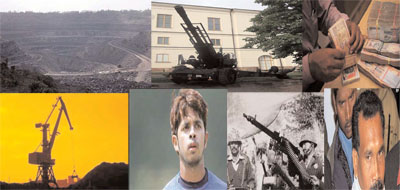
    NEW DELHI (TIP): The courtmonitored investigation into alleged irregularities in coal block allocations expanded beyond the corridors of the coal ministry with the Centre, under pressure from the Supreme Court, issuing notification permitting CBI to take the probe to Jharkhand and Kerala. Attorney general GE Vahanvati informed a bench of Justice RM Lodha, Justice Madan B Lokur and Justice Kurian Joseph that the department of personnel and training (DoPT) had issued the requisite notification that would empower CBI to investigate coal scamrelated issues in the two states. During the August 29 hearing, CBI had informed the court that the coal scam probe could touch as many as 20 states where it wanted to question several officials of public sector undertakings.

    However, only Kerala and Jharkhand gave their consent to the agency to question PSUs officials and conduct investigations, CBI said while complaining that the Centre had not issued the requisite notification despite receiving consent from the two states. The bench had inquired from Vahanvati what impeded issuance of notification to permit CBI to carry on investigations in consenting states. The AG had assured that the notification would be issued soon. But what had annoyed the court was that though CBI had sent the request for permission to extend its probe into states in February, the DoPT had not shown seriousness in dealing with it. Though Vahanvati informed the bench about the notifications for Jharkhand and Kerala, the Centre did not give any information about the status of the CBI’s request for permission to take its investigations to 18 other states. The bench too did not ask the Centre about it. With the probe expanding into states, senior advocate Amarendra Saran requested the court on CBI’s behalf that the agency would need more manpower to deal with the increasing workload and given the court’s desire that the probe should be completed by the end of the year. Saran said CBI would move an application by September 10 seeking three more SP/DSP level officers to bolster the investigating teams headed by three DIGs — Ravi Kant, Amit Kumar and V Murugesan.

  • INDIA’S HIGHS AND THE LOWS

    INDIA’S HIGHS AND THE LOWS

    The transition of India from a British colony to a sovereign, secular, and democratic nation was indeed historical. It was a long journey of around two decades that started with the conceptualisation of the dream in 1930 to its actual realization in 1950. A look into the journey that led to the birth of Indian Republic will make our celebrations more meaningful.

    Lahore Session of the Indian National Congress The seeds of a republican nation were sowed at the Lahore session of the Indian National Congress at the midnight of 31st December 1929. The session was held under the presidency of Pt. Jawarhar Lal Nehru. Those present in the meeting took a pledge to mark January 26 as “Independence Day” in order to march towards realizing the dream of complete independence from the British. The Lahore Session paved way to the Civil Disobedience movement.

    It was decided that January 26, 1930 would be observed as the Purna Swaraj (complete Independence) Day. Many Indian political parties and Indian revolutionaries from all over the country united to observe the day with honour and pride.

    Indian Constituent Assembly Meetings
    The Indian Constituent Assembly, which was constituted as a result of the negotiations between the Indian leaders and members of the British Cabinet Mission, had its first meeting on December 9, 1946.The Objective of the Assembly was to give India a constitution, which would serve a lasting purpose and hence appointed a number of committees to thoroughly research the various aspects of the proposed constitution. The recommendations were discussed, debated and revised many times before the Indian Constitution was finalized and officially adopted three years later on November 26, 1949.

    Constitution came into force
    Though India became a free nation on August 15, 1947, it enjoyed the true spirit of Independence on January 26, 1950 when the Constitution of India finally came into force. The Constitution gave the citizens of India the power to govern themselves by choosing their own government. Dr. Rajendra Prasad, took oath as the first President of India at the Durbar Hall in the Government House and this was followed by the Presidential drive along a five-mile route to the Irwin Stadium, where he unfurled the National Flag.

    Ever since the historic day, January 26 is celebrated with festivities and patriotic fervor all around the country. The day owes its importance to the constitution of India that was adopted on this day. On this Republic Day, read what the great Constitution of India, that propounds liberal democracy, has in its store. Let’s also feel proud in pronouncing what the Preamble to our Constitution (External website that opens in a new window) says.

    1971 Indo Pak War As in the 1965 Indo-Pak War, the main battles in 1971 between armoured formations was relegated to Chamb and Shakargarh sectors – located in the Western Theatre. Sporadic tank battles took place in the East Theatre, but these were one-sided battles weighed heavily in India’s favour. No action had taken place in the Punjab sector, but the South-Western sector in Rajasthan did see much activity. An offensive by the Pakistanis was blunted here solely on the use of air power.

    The Indian Army had two armoured regiments and three independent armoured squadrons supporting Lieutenant General Jagjit Singh Aurora’s Eastern Command’s thrust into East Pakistan. India had one T-55 tank regiment in the northern sector supporting the XXXIII Corps’ offensive in the Hilli-Bogra area, with one PT-76 regiment in the western area supporting the II Corps’ thrust.

    Finally three independent armoured squadrons (one PT-76, one AMX- 13 and one Ferret armoured car) were supporting the IV Corps’ offensive from the east. Opposing them were a Pakistani armoured force of a regiment of M-24 Chafees in the Bogra area, countering India’s T-55 regiment and two squadrons of Chafeee tanks supporting the west and Dacca sectors.

    When full scale hostilities began, half the tanks were either knocked out or captured by the time the Indian troops were on the outskirts of Dacca. After which the rest of the tanks were finally accounted for, as part of the surrender deal. In it’s offensive, Indian losses were heavy. At least thirty PT-76 tanks were destroyed or damaged, another four T-55s had their tracks blown up over mines.

    The high loss rate among the PT-76 tanks was due to the fact that this type of tank had very thin armour plating to help assist its amphibious capabilities and was an easy target for mines. However all, but eleven, of the PT-76s were repaired after the war. The AMX-13s did not see much action and the Ferrets had no battle casualties. One very interesting situation, had the tank squadron of the 7th Light Cavalry recovering one of their own tanks lost to the Pakistan Army during the 1965 War, which was displayed at the East Bengal Regimental Center as a war trophy.

    The tank was then handed to the Army Ordnance Corps, which in turn handed it back to the East Bengal Regimental Center! The Battle of Basantar took place during the 1 Corps’ offensive in the Shakargarh Sector. India employed two armoured brigades to support its offensive by three infantry divisions and the Pakistani reaction was swift. On December 16th and 17th, when Indian infantry captured certain villages at the River Basantar, Pakistan sent in an armoured brigade.

    The 17 Poona Horse equipped with the Centurion tank, blunted the Pakistani armoured offensive. One particular action at Barapind saw one lone tank troop (three tanks) of the 17 Poona Horse – Indian Army take on an entire squadron of Pattons of the 13th Cavalry – Pakistan Army. When one of the tanks was hit & disabled and another tank’s gun was jammed, the troop commander, Captain V Malhotra gave the order for the last remaining tank to withdraw.

    But this tank led by Second Lieutenant Arun Khetarpal, stuck to its position and kept firing at the Pattons till the last moment when Second Lieutenant Khetarpal was hit and killed. These three tanks accounted for more than the ten tanks out of the squadron. So impressed were the Pakistanis with this action, that the Squadron Commander of Pakistan’s 13 Cavalry – Major Nissar came over to the Indian lines after the ceasefire to talk to the tank commanders who had blunted his offensive.

    At the end of which, 66 Pakistani tanks were claimed as destroyed. Indian casualties were about 23 tanks, however the efforts of the EME (Electrical & Mechanical Engineers) saw to that all, but 10 of the tanks, were back on the road again.

    Period of Liberalization
    The arrival of the East India Company in India caused a huge strain to the Indian economy and there was a twoway depletion of resources.The British would buy raw materials from India at cheaper rates and the finished goods were sold at higher than normal price in Indian markets. During this phase India’s share of world income declined from 22.3% in 1700 AD to 3.8% in 1952. Post Colonial Indian Economy: After India got independence from colonial rule in 1947, the process of rebuilding the economy started. For this various policies and schemes were formulated. First five year plan for the development of Indian economy came into implementation in 1952.

    These Five Year Plans, started by Indian government, focused on the needs of the Indian economy. If on one hand agriculture received the immediate attention on the other hand the industrial sector was developed at a fast pace to provide employment opportunities to the growing population and to keep pace with the developments in the world. Since then the Indian economy has come a long way.

    The Gross Domestic Product (GDP) at factor cost, which was 2.3 % in 1951-52 reached 6.5 in the financial year 2011-2012 Trade liberalization, financial liberalization, tax reforms and opening up to foreign investments were some of the important steps, which helped Indian economy to gain momentum. The Economic Liberalization introduced by Man Mohan Singh in 1991, then Finance Minister in the government of P V Narsimha Rao, proved to be the stepping-stone for Indian economic reform movements.

    To maintain its current status and to achieve the target GDP of 10% for financial year 2006-07, the Indian economy has to overcome many challenges. Challenges before Indian economy: Population explosion:The rising population is eating into the success of India. According to 2011 census of India, the population of India has crossed one billion and isgrowing at a rate of 2.11% approx. Such a vast population puts lots of stress on economic infrastructure of the nation.

    Thus India has to control its burgeoning population. Poverty:As per records of National Planning Commission, 36 crore people are living below the poverty line in India in 2012. Unemployment:The increasing population is pressing hard on economic resources as well as job opportunities. Indian government has started various schemes such as Jawahar Rozgar Yojna, and Self Employment Scheme for Educated Unemployed Youth (SEEUY). But these are proving to be a drop in an ocean. Rural Urban Divide:It is said that India lies in villages, even today when there is lots of talk going about migration to cities, 70% of the Indian population still lives in villages.

    There is a very stark difference in pace of rural and urban growth. Unless there isn’t a balanced development Indian economy cannot grow. These challenges can be overcome by the sustained and planned economic reforms. These include: Maintaining fiscal discipline Orientation of public expenditure towards sectors in which India is faring badly such as health and education. Introduction of reforms in labour laws to generate more employment opportunities for the growing population of India. Reorganization of agricultural sector, introduction of new technology, reducing agriculture’s dependence on monsoon by developing means of irrigation. Introduction of financial reforms including privatization of some public sector banks.

    Scams That Rocked India
    Ever since India has achieved her freedom, she has also been known as a corrupted land. The extend of corruption has increased to such an extend that, any person joining political parties does have an intention of making easy and fast money within the shortest period of time. If all the amounts that have been disclosed, for every scam till date is pooled up, I guess , India is most richest country and the power and strength She holds could not be compared with any other.

    However, since people are getting more and more selforiented, when it comes to progress and wiping away poverty, nobody is least bothered. A few of the top scams that have taken place since the year 1947 is discussed here, just to bring to the notice of the public where we stand and how things are working. Let us get from the latest to the oldest.
    1. The Indian Coal Allocation Scam: This is one among the latest scams that has occurred concerning the Indian government’s allocation of the nation’s coal deposits to public sector entries and private companies. According to the CAG (Comptroller and Auditor General of India), the Indian Government was accused of allocating coal blocks, in an in-efficient manner during the period 2004-2009.

    The reason for this allegation was because, the Government had the authority to check on the allocation of coal blocks by a process of competitive bidding, but they failed to do so, resulting in lower payment by the public sector enterprises and the private firms. According to the CAG report, an amount of near to Rs. 185,591 crore (USD $ 35.08 billion) was lost to the government because of this improper screening in procedures, which might have happened due to bribery is what studies says. Whatever it may be, loosing such a huge amount by the Government is a fall from the Governments side.
    2. The 2G Spectrum Scam: This scam was one which involved the politicians and government officials equally. The scam involved in issuing frequency allocation licenses by the telephone companies in re-creating 2G subscriptions for cell phones. When valued by the Comptroller and Auditor General ( CAG ) of India about the money composed from the 2G licenses , the defeat for the exchequer was Rs. 176,369 crore ( USD $ 39.16 billion ). The issuing of licenses began in 2008; however it came to public attention when the Indian Income tax Department conducted an investigation on the political campaigner Niira Radia.

    The Supreme Court on February 2012 declared cancellation of all licenses issued in 2008 during the tenure of A. Raja, who was the minister of telecom then. There were about 122 licenses that were cancelled. The actual plan for awarding the licenses was on a first come first served policy. However, A. Raja manipulated the rules and instead pf the first who applied for the licenses, it was first who tipped Raja got the license. 3.

    Commonwealth Games Scam:
    This was a scam that was harshly criticized by several well-known social activists and politicians as billions of dollars were being spent on sporting event, although the fact that we have the leading concentration of poor people. Some of the other major problems that was being highlighted was grave corruption by the games organizing committee, delay in the erection of the main Games venues, and infrastructural compromise. Indian businessman Azim Premji called the Commonwealth games a “drain on the public funds” and also said that hosting such an expensive game event was not the priority for India, and India had other priorities to look into like education, public health and infrastructure.

    4. Satyam Scam:
    In the history of the corporate, Satyam Computer Services Scandal is biggest ever and the chairman, Ramalinga Raju confessed that the company’s accounts were falsified. For near to a decade, Raju kept the accounts details in the dark by pumping up revenues and earning up figures of Satyam. He confessed that , as per the balance sheet of 30th September 2008, the company had exaggerated figures for cash and bank balances of Rs. 5040 crore ( USD $ 1.12 billion ) as next to Rs. 5361 Crore ( USD $ 1.19 billion ) in the book thus acquiring an interest of Rs. 376 Crore , which was not existing.This scam was in tune of near to Rs. 14000 Crore.

    5. Bofors Scam:
    This scandal is also known as the hallmark of Indian Corruption. This was a most important corruption during the 1980`s where the then Prime Minister Rajiv Gandhi and quite a few others which also includes a powerful NRI family named the Hindujas were accused of receiving bribe from Bofors AB for engaging a proposal to supply India’s 155 mm field howitzer. The scale of the corruption was so worse that it led to the crush of Gandhi’s ruling in the Indian national Congress party.

    It was hypnotized that the level of the scandal was tuned to be about Rs. 400 million. The middle man who was associated with this scandal was an Italian businessman named Ottavio Quattrocchi and who also represented the petrochemicals firm, Snamprogetti. Quattrocchi was very intimate to the family and emerged as a influential broker in the 1980`s between big business and the Government of India. Despite the controversy, the Bofor gun was used extensively during the Kargil War with Pakistan and gave India ‘an edge’ over Pakistan according to battlefield comrades.

    6. The Fodder Scam:
    This scam involved the misappropriation of about Rs. 950 crore (USD $ 179.55 million) from the government treasury, of Bihar. The scheme involved the manufacture of ‘vast herds of invented stock’ for which food, medicines and animal husbandry equipment was apparently acquired. In this scam even the Chief Minister of Bihar, Laloo Prasad Yadav was included then which finally led to his resignation. The scam had its origins in small scale by some government employees by submitting false expense reports, which grew in magnitude and drew additional elements over a period of time which ultimately led to the forming of a mafia. This scam still continues to be exposed by the media due to the widespread links between tenured bureaucrats, elected politicians and businesspeople involved.

    7. The Hawala Scandal:
    This was an Indian political scandal, which involved payments allegedly acknowledged by politicians through four hawala brokers, mostly the Jain brothers. It was about $ 18 million bribery humiliation. In an arrest linked to the militants in Kashmir is what gave way to the raid of the hawala brokers and the scandal through them, which revealed large scale payments to national politicians.

    8. The IPL Scam:
    Cricket is a game where lot of commotions occur and there hare many hurdles to cross over and the IPL (Indian Premier League) is no better at it. The BCCI (Board of Control for Crocket in India) has found itself in the middle of many conflicts with the coming of IPL. The IPL had set forth many terms at many occasions, which were not accepted and had to be terminated. There were conflicts with the Cricket Club of India, with the England and Wales Cricket board, with Cricket Australia and many more. The IPL chairman Lalit Modi was suspended in 2010 for alleged act of individual transgression by the BCCI. There was also spot fixing among the players during the IPL in 2012.

    9. Harshad Mehta Scam:
    Mehta was a famous stockbroker of his time. He was well known for his high record breaking profits from the stock market and trading and later was involved in the scandal worth Rs. 5000 crore ( USD $ 945 million) in Bombay Stock Exchange. He had a great way in convincing the public that through the banking system he could finance his buying. Two small and little known banks helped him in this and he made a great fraudulent price hikes in the stock markets. By the time the scandal came to limelight, many banks were left blank and in fact Managers from two reputed banks committed suicide.

    10. Kinetic Finance Limited Scam:
    In this scam, various banks lost about Rs. 200 crore (USD $ 37.8 million). The promoters of kinetic finance limited borrowed about Rs. 145 crore from an association of banks led by SBI, and Bank of Baroda. After borrowing the money, they used it for other purposes of the Kinetic group and eventually the promoters resigned and the firm was renamed in another name. A special Investigation Audit was conducted and based on the report it was found that about five banks filed criminal cases against the promoters.

    11. Adarsh Housing Scam
    In this scam, land was allotted to the war widows of Kargil war and also for the retired personal of The continued on page 48 Defense Services. Over a period of 10 years, the top politicians and bureaucrats bend several rules and commit various acts of commission and omission to have the building in order and finally they got themselves allotted with flats at the premium locality at a much cheaper cost. This scam is noticeable as it took keen planning and almost 10 years to execute this kind of brutality to the poor and left alone in the defense.

    12. Citibank Fraud:
    This was a fraudulent done by the bank employee by promoting false promises to the customers. Shivraj Puri, the Relationship manager of Gurgaon branch had convinced his customers to invest in a fake scheme that gave high interests. He made forged circulars from SEBI. He opened joint accounts in several names and made customers deposit into those accounts and he invested in places of his interests. This was bought to lime light when customers started complaining about being asked to invest in a scheme that was not available to the bank.

    13. Madhu Koda Scandal:
    Madhu Koda is the ex-chief Minister of Jharkhad. He was bought to limelight by the IT department by charging for laundering money for about Rs. 4000 crore and other disproportionate income. Almost five currency counting machines were seized from his residence. The amount was used to purchase hotels, mines, and companies, in foreign countries like Thailand, Liberia, Dubai and many other places. With this kind of laundering and investments, he builds an empire, but bigger to the most successful businessmen within a short period of time.

    14. Barak Missile Scandal:
    This is a case of alleged defense corruption which was related to the purchase of Barak 1 Missile Systems by India from Israel. The contracts have been signed by the Indian government to procure seven Barak systems at a total cost of Rs. 199.50 million. This was done despite objections raised by several groups, including members of the team that had actually visited Israel to observe the performance of the missile.

    15. Kargil Coffin Scam:
    This is one of a kind of scam, where even the coffins for the soldiers who died in the Indo-Pak war, were bought for low quality and at higher price. The government had paid about $2500 per coffin, which was earlier purchased for $172 per coffin. And moreover the quality was very poor. This led to range among the public and led to the resignation of the defense minister.

    16. Mining Scam in India:
    This scam is related to the ore-rich states of India and has generated controversies in India which spans encroachment of forest areas, underpayment of government royalties, and conflict with tribal regarding land-rights.

    17. Sukh Ram Telecom Scam:
    Sukh Ram is a former union communication minister in Indian National Congress Government. He was the telecom Minister during the P.V. Narasimha Rao`s cabinet. He was caught with allegations regarding irregularities in awarding a telecom contract. The CBI seized around Rs. 3.6 crores from his residence. He has been imprisoned for the fraud that he has done.

    18. SNC Lavalian Scam:
    This is a financial scam related to the government with a Canadian company. A loss of about Rs. 374.50 crores, for the renovation and modernization of the hydroelectric power stations at Pallivasal, Sengulam, and Panniar (The PSP Project as it is called) at the Idduki district in Kerala.

    19. Belekeri Port Scam:
    This scam relates to about 3.5 million of sequester iron ore that was exported illegally from Belekeri Port in Karnataka. This scam is said to be worth about Rs. 60,000 crore (USD $ 12 billion). The iron ore was illegally mined after giving a minimal pay to the government.

    20. Telgi Scandal: The Telgi scandal is after the great Abdul Karim Telgi who issued counterfeit stamp papers. Had appointed about 300 people as agents to sell these counterfeit stamp papers to bulk purchasers like banks, insurance companies, and share broking firms. The size of the scam is about 20,000 crores (USD $3.78 billion). In this scam, many high ranked governmental officials were also recorded.

  • MOVERS & SHAKERS

    MOVERS & SHAKERS

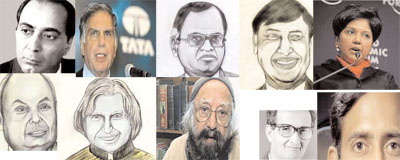
    Famous Indian nuclear physicist Homi Jehangir Bhabha was born on 30 October 1909 in Mumbai. Bhabha played a key role in the development of the Indian atomic energy program. Widely referred to as the father of India’s nuclear weapons program, Bhabha had his education at the Elphinstone College and the Royal Institute of Science before obtaining his doctorate from the University of Cambridge in 1934.

    He was influenced greatly by the legendary Paul Dirac. Bhabha was a research scientist at the Cavendish Laboratories at Cambridge. When he was stranded in India as a result of the Second World War, he set up the Cosmic Ray Research Unit at the Indian Institute of Science, Bangalore under Nobel Laureate C. V. Raman in 1939. Dr. Bhabha is credited with establishing the Tata Institute of Fundamental Research(TIFR) with the help of eminent industrialist J. R. D. Tata.

    After India won independence from the British, Bhabha established the Atomic Energy Commission of India in 1948. He represented India in various international forums including the United Nations and his tenure represented a high in terms of the progress of India’s atomic energy programme. The climax of this programme came on May 18, 1974 when India exploded a nuclear device at Pokhran, Rajasthan joining a select club of nations.

    Ratan Tata
    Ratan Tata is one of the most well-known and respected Indian businessman. He served as the Chairman of the Tata Group from 1991 till 2012. As a Mumbaibased conglomerate, he is also a member of the prominent Tata family of Indian industrialists and philanthropists. Ratan Tata was born on December 28, 1937 in Mumbai. When he was a child his parents separated and he was brought up by his grandmother Lady Navajbai.

    He went to Campion School in Bombay, Bishop Cotton School in Shimla and finished his schooling from Cathedral and John Connon School in Mumbai. He graduated with a degree in Architecture and Structural Engineering from Cornell University in 1962 and also did the Advanced Management Program from Harvard Business School in 1975. He is also a member of the Alpha Sigma Phi fraternity of Yale University, United States. In 1962, Ratan Tata began his career in the Tata group.

    At first he used to work on the shop floor of Tata Steel, shoveling limestone and handling blast furnace. In 1991, JRD Tata stepped down as the chairman of Tata Industries and named Ratan Tata as his successor. Under Ratan’s stewardship, Tata Tea attained Tetley, Tata motors attained Jaguar Land Rover and Tata Steel attained Corus. These triumphs turned Tata from a large India-centric company into a global business with 65% revenues from abroad. He also contributed in the development of Indica and Nano.

    Ratan Tata has also served in various organizations in India and abroad. He is a member of the Prime Minister’s Council on Trade and Industry and he is also on the board of governors of the East-West Center, which is the advisory board of RAND’s Center for Asia Pacific Policy. He also serves on the program board of the Bill & Melinda Gates Foundation’s India AIDS initiative. He was awarded the Padma Bhushan by the Government of India in January 2000.

    He serves on the boards of several leading organizations, both in the public as well as the private sector in India. He is a member of the International Investment Council set up by the President of South Africa and serves on the programme board of the Bill & Melinda Gates Foundation’s India AIDS initiative. Ratan Tata is credited for leading Tatas’ successful bid for Corus, an Anglo-Dutch steel and aluminum producer, which was acquired for an estimated £6.7 billion by Tata Sons.

    N.R. Narayanamurthy
    N.R. Narayana Murthy, the founder of Infosys Technologies is one of the most famous personalities in India’s I-T sector. Born on August 20, 1946, he obtained a degree in electrical engineering from the National Institute of Engineering under University of Mysore in 1967 and went on to do his Masters from IIT Kanpur in 1969. He joined Patni Computer Systems in Pune. While at Pune, he met his wife Sudha Murty.

    In 1981, he founded Infosys alongwith with six otherpeople. He served as president of the National Association of Software and Service Companies, India from 1992 to 1994. Murthy was the CEO of Infosys for twenty years, and was succeeded by Nandan Nilekani in March 2002. He functioned as the Executive Chairman of the Board and Chief Mentor from 2002 to 2006.

    Dhirubhai Ambani
    Dhirajlal Hirachand Ambani was born on 28 December 1932, at Chorwad, Junagadh in Gujarat, When he was 16 years old, he moved to Aden,Yemen. Initially, Dhirubhai worked as a dispatch clerk with A. Besse & Co. Married to Kokilaben. Dhirubhai also worked in Dubai for sometime. He returned to India and founded the Reliance Commercial Corporation with an initial capital of Rs 15000.

    Dhirubhai set up the business in partnership with Champaklal Damani from whom he parted ways in 1965. Dhirubhai started his first textile mill at Naroda, near Ahmedabad in 1966 and started the brand “Vimal”. Dhirubhai Ambani is credited with having started the equity cult in India.With the passage of time, Dhirubhai diversified into petrochemicals and sectors like telecommunications, information technology, energy, power, retail, textiles, infrastructure services, capital markets, and logistics.

    Lakshmi Nivas Mittal
    Lakshmi Nivas Mittal was born on June 15, 1950 in Sadulpur, Rajasthan, India and is presently the CEO & Chairman of Arcelor Mittal. Lakshmi Nivas Mittal was listed in the Forbes List of Billionaires in 2006 as the the richest Indian and the fifth richest man in the world with an estimated wealth around of $25.0 billion and is the richest man in the United Kingdom. Young Lakshmi Nivas Mittal spent his first years in Sadulpur, before his father moved to Kolkata. Lakshmi graduated from St. Xavier’s College, Calcutta. He founded Mittal Steel in 1976, which soon became a global steel producer with operations on 14 countries. His success mantra lies in the identification, acquisition and turnaround of many loss making steel companies all across the world.

    Dr. A.P.J. Abdul Kalam
    Dr. A.P.J. Abdul Kalam, former President of India, graduated in aeronautical engineering from the Madras Institute of Technology in 1958 and joined the Defense Research and Development Organization (DRDO). In 1962, Kalam joined the Indian Space Research Organization (ISRO). In 1982, he rejoined DRDO as the Chief Executive of Integrated Guided Missile Development Programme (IGMDP). Dr. Kalam is credited with the development and operationalization of India’s Agni and Prithvi missiles.

    He worked as the Scientific Adviser to the Defence Minister and Secretary, Department of Defence Research & Development from 1992 to 1999. During this period, the Pokhran-II nuclear tests were conducted. Dr. Kalam held the office of the Principal Scientific Advisor to the Government of India from November 1999 to November 2001. Dr. Kalam has received a host of awards both in India and abroad. He was awarded the Padma Bhushan in 1981, Padma Vibhushan 1990 and the Bharat Ratna in 1997.

    He is of the view that we should work wholeheartedly to make India a developed nation by 2020. Besides being a bachelor, Kalam is a strict disciplinarian, a complete vegetarian and teetotaler. Among the many firsts to his credit, he became India’s first President to undertake an undersea journey when he boarded the INS Sindhurakshak, a submarine, from Visakhapatnam. He also became the first president to undertake a sortie in a fighter aircraft, a Sukhoi-30 MKI.

    Khushwant Singh
    One of the most prominent novelists and journalists of India, Khushwant Singh was born on 2 February 1915 in Hadali, presently in Pakistan. He writes a weekly column, “With Malice towards One and All”, published in several leading newspapers all over the country. He graduated from Government College, Lahore before studying law at King’s College, London. He has been the editor of Yojana, The Illustrated Weekly of India, The National Herald and the Hindustan Times.

    He also served as a member of the Rajya Sabha. Though he was awarded the Padma Bhushan in 1974, he returned it in 1984 to protest the siege of the Golden Temple by the Indian Army. He was awarded the Padma Vibhushan in 2007. Some of his notable works include: The Sikhs; Train to Pakistan; The Sikhs Today; Ranjit Singh: The Maharajah of the Punjab; Delhi: A Novel; Sex, Scotch and Scholarship: Selected Writings; Not a Nice Man to Know: The Best of Khushwant Singh; Paradise and Other Stories; Death at My Doorstep; The Illustrated History of the Sikhs etc.

    Amartya Sen
    Nobel Prize winner Amartya Sen was born on 3 November 1933 in Santiniketan, West Bengal. Besides being a worldrenowned economist, Amartya Sen is also a philosopher. He served as a Master at the Trinity College at Cambridge University, the first Asian academic to head an Oxbridge college. Currently the Lamont University Professor at Harvard University, Amartya Sen traces his roots to an illustrious lineage. His father, Ashutosh Sen, taught chemistry at the Dhaka University.

    Amartya completed his high-school education from Dhaka in Bangladesh in 1941. After his family migrated to India in 1947, Sen studied at the Presidency College, Kolkata and at the Delhi School of Economics before moving over to the United Kingdom to complete his higher studies. He earned his doctorate from the Trinity College, Cambridge in 1959. He has taught at various reputed Universities including the University of Calcutta, Jadavpur University, Oxford, London School of Economics, Harvard and many others. His works helped to develop the theory of social choice.

    In 1981, he published his famous work Poverty and Famines: An Essay on Entitlement and Deprivation, where he showed that famine occurs not only due to shortage of food, but from inequalities in the mechanisms for distributing food. He had personally witnessed the Bengal famine of 1943. He has done valuable work in the field of development economics, which has had a tremendous influence on the formulation of the United Nations Development Programme’s Human Development Report.

    Sabeer Bhatia
    Sabeer Bhatia-co-founder of Hotmail, is one among select group of people who have made it big in America’s Silicon Valley. Born in Chandigarh, Sabeer Bhatia did his schooling from St. Joseph’s Boys’ High School, Bangalore. He graduated from Caltech and went to Stanford to pursue his MS in Electrical Engineering. Sabeer attended many lectures by famous like Steve Jobs and was determined to make it big. After completing his Masters, he joined Apple computers. He left Apple soon after.

    He teamed up with his partner to create a web-based e-mail system Microsoft bought Hotmail on December 30th, 1997, for a reported sum of $400M. After the success of Hotmail, Bhatia in April 1999, he started another venture, Arzoo Inc, which however had to be shut down. In 2006, Arzoo was relaunched. Bhatia has won many awards. Among the notable ones include the “Entrepreneur of the Year” awarded by the venture capital firm Draper Fisher Jurvetson in 1997, the “TR100” award, presented by MIT to 100 young innovators expected to have the greatest impact on technology in the next few years. Besides, he was named by TIME magazine as one of the “People to Watch” in International Business in 2002.

    Indra Nooyi
    Indra Nooyi is the president and chief executive officer of PepsiCo and is the highest-ranking Indian-born woman in corporate America. She helped to start PepsiCo’s fast-food chains in 1997. After a Bachelor’s degree from Madras Christian College and a Post Graduate Diploma in Management from the Indian Institute of Management Kolkata, she moved on to the Yale School of Management.

    She started her career with The Boston Consulting Group (BCG), moving on to companies like Motorola and Asea Brown Boveri.She serves on the board of directors of several organizations. In August 2006, she succeeded Steve Reinemund as chief executive officer of PepsiCo. She has been named the Most Powerful Woman in Business in 2006 by Fortune Magazine. Her name was included in the Wall Street Journal’s list of 50 women to watch in 2005.

    Kiran Bedi
    The first woman to join the coveted Indian Police Service (IPS) in 1972, Kiran Bedi was born on 9 June 1949 in Amritsar, Punjab. Recently appointed as Director General of India’s Bureau of Police Research and Development, Kiran Bedi has had an illustrious career, earning widespread adulation for her no-nonsense attitude and devotion to work. She served as Police Advisor in the United Nations peacekeeping department and was honored with the UN medal for outstanding service. She earned the nickname ‘Crane Bedi’ for towing away the then Indian PM Indira Gandhi’s car for parking violation.

    Kiran Bedi graduated in English before securing a Master’s degree in Political Science from Punjab University, Chandigarh. This gutsy police officer went on to secure an LL.B degree in 1988 from Delhi University and a Ph.D. from the Indian Institute of Technology, New Delhi, even while she was in service. She was good at sports too, having been an all- India and all-Asian tennis champion.

    She has served creditably in a host of appointments ranging from Deputy Inspector General of Police, Mizoram, Advisor to the Lieutanent Governor of Chandigarh, Director General of Narcotics Control Bureau and many others.

    Rakesh Sharma
    The first Indian to fly into space, Rakesh Sharma was born on January 13, 1949 in Patiala, Punjab. He was a squadron leader with the Indian Air Force, when he flew into space in 1984 as part of a joint programme between the Indian Space Research Organisation (ISRO) and the Soviet Intercosmos space program.

    He spent eight days in space on board the Salyut 7 space station. He joined two other Soviet cosmonauts aboard the Soyuz T- 11 spacecraft which blasted off on April 2, 1984. He was awarded the Hero of Soviet Union award on his return from space. The Government of India honoured him with the Ashok Chakra. He retired with the rank of Wing Commander. He joined the Hindustan Aeronautics Limited in 1987 and served as Chief Test Pilot in the HAL Nashik Division until 1992, before moving on to Bangalore to work as the Chief Test Pilot of HAL. He retired from test flying in 2001.

    Dr. Verghese Kurien
    The “father of the white revolution” in India, Dr. Verghese Kurien is acknowledged worldwide as the brain behind the success of the largest dairy development programme in the world by the name of Operation Flood. Also known as the “Milkman of India”, he was the chairman of the Gujarat Co-operative Milk Marketing Federation Ltd. (GCMMF) and his name became synonymous with the Amul brand. Born on November 26, 1921 in Kozhikode, Kerala, he graduated in Physics from Loyola College, Madras in 1940 and pursued a B.E.(Mechanical) course from the Madras University. He was instrumental in the success story of AMUL.

  • Federation Of Indian Associations NY/NJ/CT (FIA) Is Not A Representative Organization Of Indian Americans

    Federation Of Indian Associations NY/NJ/CT (FIA) Is Not A Representative Organization Of Indian Americans

    “The organization that claims to organize the India Day Parade is far from being Indian in character. Look at the people in FIA Trust and Executive. See the list of Trustees and Executive Members on FIA website www.fianynjct.org. You will find they all are, with the exception of one or two, from one community and one state of India. Is this organization truly representative of Indians and India?” asks the author.

    Federation of Indian Associations (FIA) came into being in 1977 after changing the name of umbrella organization “Joint Committee of Indian Organizations” founded in 1975, under the leadership of Rajan Ghosh. The main goal of this organization was to celebrate India’s Independence and Republic days in Tristate area by bringing under one roof Indian students organizations: India Club of New York University, India Club of Columbia University and Association of Indians in America, The Bharathi Society of America and the Tagore Society of America.

    A laudable step to celebrate and project united India. The Global Organization of People of Indian Origin (GOPIO) Founder, Thomas Abraham, a Christian from Kerala, was elected First President of FIA in 1977 and continued till 1981 when in March that year Sureshwar Prasad Singh took over and initiated the first India Day Parade in 1982 in New York . He was succeeded by H. C. Chandershekar for the 1982-83 term. Sudha Acharya took over for the term 1983-84 and introduced Bollywood to the Parade.

    It was the first time that a Bollywood actor- Sunil Dutt- was invited as the Grand Marshal of the Parade and from then on it became a tradition to have a Bollywood actor as Parade’s Grand Marshal. Sudha Acharya was also instrumental in bringing 17 more organizations under FIA. With the Presidency of Ram Gadhvi in 1985, the hold on FIA of people from one religion and one region started getting stronger.

    With the arrival on scene of the present Chairman, Ramesh Patel in mid 80’s, this group consolidated its position further and came to have absolute control of FIA. By now the organization which aimed at bringing together Indian American students associations and various regional organizations and communities to celebrate India’s Independence and Republic days had lost its focus. The degeneration of FIA had set in Also, the objective of showcasing Indian culture has been lost sight of.

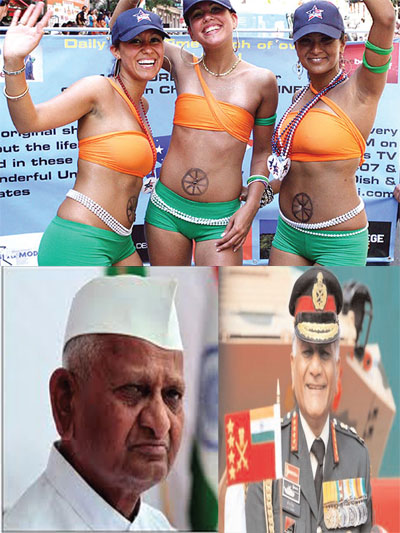
    Vulgar displays became the favorite projections of “the Indian culture”. (See picture of cheerleaders in tricolor bikinis on top). Display of Indian history and depiction of Indian freedom movement have clearly not been the themes with the coterie of 20 to 30 people from one community and from one state of India. The rot further set in with the entertainment industry people, keen on promoting their personal business, having Bollywood actors as Grand Marshals.

    Two of the trustees -Yashpal Soi and Kanu Chauhan- have been pillars of entertainment industry for the last many decades and they have been at the helm of arranging Bollywood actors. What a lowly way to achieve a level of self aggrandizement! The organization that claims to organize the India Day Parade is far from being Indian in character. Look at the people in FIA Trust and Executive. See the list of Trustees and Executive Members on FIA website www.fianynjct.org. You will find they all are, with the exception of one or two, from one community and one state of India.

    Is this organization truly representative of Indians and India? A Not-for -Profit organization is expected to value democracy and transparency. In the case of FIA, both democratic temper and values, and transparency are absent. A coterie of 20 to 30 persons from one community and one region of India, under the tutelage of Ramesh Patel, the Chairman of FIA, who has been donning various colors at different times, has been clutching , what should be the people’s organization, in their jaws and fangs.

    This in the cradle of democracy, the United States of America! This in the land of the people who prize democracy and liberty the most! This in the land of the Lady of Liberty! This in the land of Martin Luther King, Jr. who drew inspiration from Father of the Indian Nation, Mohandas Karamchand Gandhi, whom we revere as Bapu and as Mahatma Gandhi! All this is being done by the sons of the land of Gandhi! What a shame! Money talks.

    Money walks. Who knows it better than Ramesh Patel? It is with the patronage of government of India, donations from people and sponsorships manly from Indian banks, organizations and businesses that the FIA India Day parade walks and talks. But the organizers have scant respect for government of India representatives here.

    Not long ago, it was widely reported in the media how Ambassador Hardeep S. Puri, the then Permanent Representative of India to the United Nations and the then Consul General of India in New York, Ambassador Prabhu Dayal were humiliated and not allowed to join the Grand Marshall in the front row during the parade. The Indian Panorama had, in particular, taken umbrage and raised the issue of humiliation of government of India at India Day Parade, and condemned the FIA.

    As for transparency in functioning and financial wheeling dealing of FIA, it is a matter that needs to be looked in to by IRS and concerned US administration agencies. There are many a skeleton in the FIA cupboard which will tumble out once its doors are opened. It is for the donors, sponsors and government of India institutions who dole out large sums for the glory of India to ask the organizers how the money was being spent. We, on our own, do not mind coming up with the financial misadventures of FIA.

    FIA has its own share and burden of criminals, some proven, some under cloud. We will not name any who has not been proved guilty. But we will let our readers know who have already been through criminal proceedings. Without going in to smaller matters which can be ignored, we will name at least two cases. One of Nirav Mehta, who was President of FIA in the year 2010 and was a Trustee until a few months ago. He was a proclaimed offender in India against whom there was a red corner notice.

    He knows it. Ramesh Patel knew about it. Government of India outpost in New York knows about it. Another, more recent case is of Sarvesh Kumar Dharayan, Chair of the Reception Committee of FIA 2013 who was arrested from his home in New Jersey on July 17, in a multi-million fraud, and charged with one count of conspiracy to commit honest services fraud, which carries a maximum term of 20 years in prison, one count of conspiracy to violate the Travel Act, which carries a maximum term of five years in prison and one count of conspiracy to commit money laundering, which carries a maximum term of 20 years in prison.

    FIA has been having such illustrious people at the helm of affairs. And to keep company with such illustrious people, we are having another few illustrious people from India at FIA Parade on August 18, 2013. Do we not feel wronged when a champion against corruption decides to come to this parade organized by not so clean an organization? Anna Hazare should know he is no ordinary person, that all his activities are being watched and interpreted by billions who love and admire him as another Gandhi.

    He should know the high hopes people of Indian origin the world over have from him. He will only be promoting corruption and strengthening the unjust coterie by coming to India Day Parade in New York. The worthy retired General of Indian army, V.K. Singh, one hopes, has not forgotten the strict protocol that he has been following in his long military career.

    Before you accept an invitation, know where you are going. Before meeting a person, know who you are meting with. The least that this newspaper expects of him is that he turns his back on FIA India Day Parade in New York and never again accepts an invitation from such an organization. For the people from entertainment industry, from the hot and the most sought after siren of Bollywood, Vidya Balan, to the South Indian film world “supreme star” Sarath Kumar and “Queen of Indian TV” Radhika Sharat Kumar, I would say, “New York welcomes you. You are here to make money and showcase your talent.

    You are here to entertain and in return win applause which will add up to your personal satisfaction, popularity and rating. I will not ask you not to show up because I will not like to snatch a person’s means of sustenance. Good luck to you!” But all who have been invited in the name of Bharat Mata must know where they are, in whose company they are, and what the intentions of the people behind FIA are.

    Congratulations on the 66th anniversary of Independence of India, the largest democracy of the world, in the land of the oldest democracy of the world! Jai Hind!

  • ANDHRA PRADESH

    ANDHRA PRADESH

    Andhra Pradesh Tourism has always been the frontrunner in attracting greatest number of tourists, inland and foreign, as it boasts of a naturally, ecologically, culturally and religiously rich and diverse variety of tourist destinations that are treasures of visual treat where one can continuously explore new experiences of visitor gratification and delight. The state of Andhra Pradesh having the longest eastern coastline and with a trail of Buddha Period glory, houses and holds many heritage sites adorned with pristine splendor, the forts, citadels and architectural masterpieces built by the past Royal hegemony and its noble Emperors.

    The magnificent palaces and places, monuments, memorials, tombs and stately structures built by them reflect the art and craftsmanship, architecture and culture that originated on this land. There are beautiful dams, valleys, hills and ridges with the scenic dale, tranquil lake waters, swirling beach waves, meadows, resorts, hill stations, caves, virgin forests, sanctuaries and national parks which a visitor can enjoy to his heart’s content.

    Temples and shrines of pilgrimage are the important destinations of tourist traffic and are a big source of revenue flow. Museums and archaeological treasure houses with different galleries showcase historic and amazing collections of antiques, artifacts, weaponry and a wide range of objects that symbolize the history and culture and marvels of the territory.

    Charminar
    The Charminar, built in 1591 AD, is as much the signature of Hyderabad as the Taj Mahal is of Agra or the Eiffel Tower is of Paris. The English name is a transliteration and combination of the Urdu words Char and Minar, translating to “Four Towers”; the eponymous towers are ornate minarets attached and supported by four grand arches. The landmark has become a global icon of Hyderabad, listed among the most recognized structures of India.

    The Charminar is on the east bank of Musi river. To the northeast lies the Laad Bazaar and in the west end lies the granite-made richly ornamented Makkah Masjid. Charminar has the signature style of Islamic architecture. This great tribute to aesthetics looks sturdy and solid from a distance and, as one moves closer, it emerges as an elegant and romantic edifice proclaiming its architectural eminence in all its detail and dignity. Charminar is a beautiful and impressive square monument.

    History
    Sultan Muhammad Quli Qutb Shah, the fifth ruler of the Qutb Shahi dynasty built Charminar in 1591 AD, shortly after he had shifted his capital from Golkonda to what is now known as Hyderabad. He built this famous structure to commemorate the elimination of a plague epidemic from this city. He is said to have prayed for the end of a plague that was ravaging his city and vowed to build a masjid (Islamic mosque) at the very place where he was praying. It is said that, during the Mughal Governorship between Qutb Shahi and Asaf Jahi rule, the south western minaret “fell to pieces” after being struck by lightning and “was forthwith repaired” at a cost of Rs 60,000. In 1824, the monument was replastered at a cost of Rs 100,000.

    Structure
    The Charminar is a square edifice with each side 20 meters (approximately 66 feet) long, with four grand arches each facing a cardinal point that open into four streets. At each corner stands an exquisitely shaped minaret, 56 meters (approximately 184 feet) high with a double balcony. Each minaret is crowned by a bulbous dome with dainty petal like designs at the base.

    A beautiful mosque is located at the western end of the open roof and the remaining part of the roof served as a court during the Qutb Shahi times. There are 149 winding steps to reach the upper floor. Once atop, the solitude and serenity of the beautiful interior is refreshing. The space in the upper floor between the minarets was meant for Friday prayers. There are forty-five prayer spaces.

    The structure is made of granite, limestone, mortar and pulverised marble. Initially the monument with its four arches was so proportionately planned that when the fort was opened one could catch a glimpse of the bustling Hyderabad city as these Charminar arches were facing the most active royal ancestral streets. There is also a legend of an underground tunnel connecting the Golkonda to Charminar, possibly intended as an escape route for the Qutb Shahi rulers in case of a siege, though the location of the tunnel is unknown.

    Surroundings
    In its heyday, the Charminar market had some 15,000 shops. Today the famous markets known as Laad Baazar and Pather Gatti, near the Charminar, are a favour, of tourists and locals alike for jewellery, especially known for exquisite bangles and pearls respectively. The Traditional Food, like Biryani, Haleem, Mirchi ka salan, Double Ka Meetha etc. is available around Charminar. The area is also famous for its variety of shops. During the season of Sankranthi, the area is completely crowded with vendors selling kites. In 2007, Hyderabadi Muslims living in Pakistan constructed a small-scaled quasi replica of the Charminar at the main crossing of the Bahadurabad neighborhood in Karachi.

    Tirupati Temple
    The world famous Tirumala Temple is located in the hill town of Tirumala in Tirupati, Chittoor District. Tirupati is famous for Sri Venkateswara Swamy temple dedicated to Lord Venkateswara. It is around 600 km (370 mi) from Hyderabad, 138 km (86 mi) from Chennai and 291 km (181 mi) from Bangalore. Tiru means ‘Holy’ or ‘Sacred’ and mala means hills/mountain in Dravidian languages. Therefore it translates as Holy mountains. The Tirumala Hill is 853m above sea level and is about 10.33 square miles (27 km2) in area.

    It comprises seven peaks, representing the seven heads of Adisesha, thus earning the name Seshachalam. The seven peaks are called Seshadri, Neeladri, Garudadri, Anjanadri, Vrushabhadri, Narayanadri, and Venkatadri. The temple is on Venkatadri (also known as Venkatachala or Venkata Hill), the seventh peak, and is also known as the “Temple of Seven Hills”. The presiding deity of the temple is Lord Venkateswara, a form of the Hindu god Vishnu. Venkateswara is known by other names: Balaji, Govinda, and Srinivasa. The temple lies on the southern banks of Sri Swami Pushkarini, a holy water tank.

    The temple complex comprises a traditional temple building, with a number of modern queue aand pilgrim lodging sites. The temple is the richest pilgrimage center, after the Sree Padmanabhaswamy Temple in Thiruvananthapuram, Kerala, of any faith (at more than INR 50,000 crore) and the most-visited place of worship in the world. The temple is visited by about 50,000 to 100,000 pilgrims daily (30 to 40 million people annually on average), while on special occasions and festivals, like the annual Brahmotsavam, the number of pilgrims shoots up to 500,000, making it the most-visited holy place in the world. There are several legends associated with the manifestation of the Lord in Tirumala. According to one legend, the temple has a murti (deity) of Lord Venkateswara, which it is believed shall remain here for the entire duration of the present Kali Yuga.

    Medieval history
    Tirumala was under the rule of the Vijayanagara emperors, during which time the temple’s assets were accumulated. Coronation ceremonies of the emperors were also held at Tirupati. In 1517 Krishnadevaraya, on one of his many visits to the temple, donated gold and jewels. It enabled the Vimana (inner shrine) and the roofing to be plated with gold. The Maratha general Raghoji Bhonsle set up a permanent administration for the conduct of worship in the temple. The rulers of Mysore and Gadwal endowed large gifts to the temple.

    The Pallavas of Kanchipuram (9th century AD), the Cholas of Tanjore (10th century), and Vijayanagara pradhans (14th and 15th centuries) were committed devotees of Lord Venkateswara. During the invasion of Srirangam by Malik Kafur in 1310-11 AD, the Ranga Mandapam of the temple served as the shelter for the presiding deity of Srirangam, Ranganatha Swamy. Later, under the rule of the Vijayanagara emperors, was when the temple gained most of its current wealth and size, with the donation of diamonds and gold.

    In 1517 Vijayanagara ruler Sri Krishna Deva Raya, on one of his many visits to the temple, donated gold and jewels, enabling the Vimana (inner shrine) roofing to be gilded. Statues of Sri Krishna Deva Raya and his spouse stand in the premises of the temple. After the decline of Vijayanagara Empire, kings from states such as Mysore and Gadwal worshiped as pilgrims and gave ornaments and valuables to the temple.

    Maratha general Raghoji I Bhonsle (died 1755) visited the temple and set up a permanent administration for the conduct of worship in the temple. There is an idol of Raja Todar Mal who was the revenue minister of Akbar, greeting pilgrims in the premises of the temple.

  • Visiting Parliamentarians Felicitated

    Visiting Parliamentarians Felicitated

    LONG ISLAND, NY (TIP): At a special gathering held on 25th June 2013 here Mrs. and Subba Rao Anumolu hosted the Telugu Association of North America (TANA)’s felicitation of 12 Indian parliament members who were visiting USA. The distinguished group of parliamentarians included CM Ramesh (Andhra Pradesh), Shadilal Batra (Haryana), Bharat Kumar Raut (Maharastra), Bhubaneswar Kalita (Assam), Mrs. Poonam Jat (Gujarat), Mrs. Smriti Z Irani(Gujarat), Vivek Gupta (West Bengal), YS Chowdary (Andhra Pradesh), Harish Choudhary( Rajasthan), Modugula Venugopala Reddy(Andhra Pradesh), Ramesh Chandran (Kerala), and Badnore VPS (Rajasthan).

    These parliamentarians had attended the Leadership and Management Training Program at Yale University in New Haven and upon the request of TANA attended the facilitation event in Long Island before their departure to India. Mohan Nannapaneni, President of Telugu Association of North America (TANA) welcomed the Parliament members and thanked them for attending the event despite their hectic schedule. Nannapaneni introduced the host, Rao Anumolu who has an outstanding record of professional achievements, philanthropy and community service which have been already being recognized with the highest honor and acclaim in USA. Vijayawada’s Anumolu is the President & CEO of Long Island (New York) based, internationally known, high tech firm – ASR International Corporation.

    Anumolu is the only Asian Indian to have been cited by the US Congress for the contributions made towards homeland security in USA. He is also the recipient of the 2010 Ellis Island Medal of Honor. This prestigious award, highest civilian award for immigrants, recognizes recipients for outstanding contributions to their communities, their nation and the world. Both the United States House of Representatives and Senate have officially recognized the Ellis Island Medal of Honor and the recipients are read into the Congressional Record. Past medalists include six US Presidents.

    Anumolu has the unique distinction of being the only Asian Indian to have the dual honor of being cited by the US Congress and also the recipient of the Ellis Island Medal of Honor. Mrs. Smriti Irani, on behalf of the group, expressed deep condolences for the flood victims of Uttarkhand, and the audience observed a moment of silence. The parliament members addressed the gathering and expressed their vision for India in the near future. They predicted that India would become a dominant contributor for world economic and energy development within the next decade. All the parliament members were felicitated by TANA, with a shawl and a memento. The reception to visiting parliamentarians was attended by many well known Indian Americans from various walks of life. Jayasekhar Talluri, Chairman TANA Foundation conveyed vote of thanks to the attendees.

  • NRI Doctor In Bid To Solve Water Problem In Kerala

    NRI Doctor In Bid To Solve Water Problem In Kerala

    DUBAI: A Dubai-based NRI doctor who is also an entrepreneur has initiated a campaign in his native state to promote preservation of water using a cheap rain harvesting device made by a local Keralite, amid acute drinking water crisis in Kerala during summers. Azad Moopen, who heads the DM Healthcare, a leading healthcare conglomerate in the Middle East, believes that the current water shortage in Kerala can easily be solved even if a small section of the population preserves the rain water that goes into the Arabian Sea due to the peculiar slanting topography of the state, the Khaleej Times report said.

    Moopen decided to test it out in his home village of Kalpakanchery, where the wells and ponds dry by January every year. People in the village have been sourcing water from far off places in tankers paying Rs 600 for 2,000 litres. Moopen found a cheaper solution in an indigenous rain harvesting device, developed by Perumalparampil Jaleel, that seeks to harvest rain water from rooftops. Under the system, rain water from the roof is sourced to a plastic drum through PVC pipes. The drum acts as a filter as it is filled with pure river sand, charcoal and baby metal.

    After filtering, the harvested rain water is driven to the well through another PVC pipe. In most cases, the water stored in the well is enough to meet the dry season demand. Moopen’s campaign to propagate the device has evoked massive response from the villagers, who are now queuing up to install the device in their homes, the report said, adding that 4-5 well recharging filters were being installed on a daily basis now. Kerala’s acute drinking water crisis is surprising to many because the state, with 50,000 million cubic metres of fresh water in 44 rivulets, 19 lakes, more than 900 ponds, and 300cm rainfall for 120 days in a year in normal conditions, is considered as the wettest state in the country.

  • RAJASTHAN MINISTER INAUGURATES RAJASTHAN CHAPTER OF INOC (I)

    RAJASTHAN MINISTER INAUGURATES RAJASTHAN CHAPTER OF INOC (I)

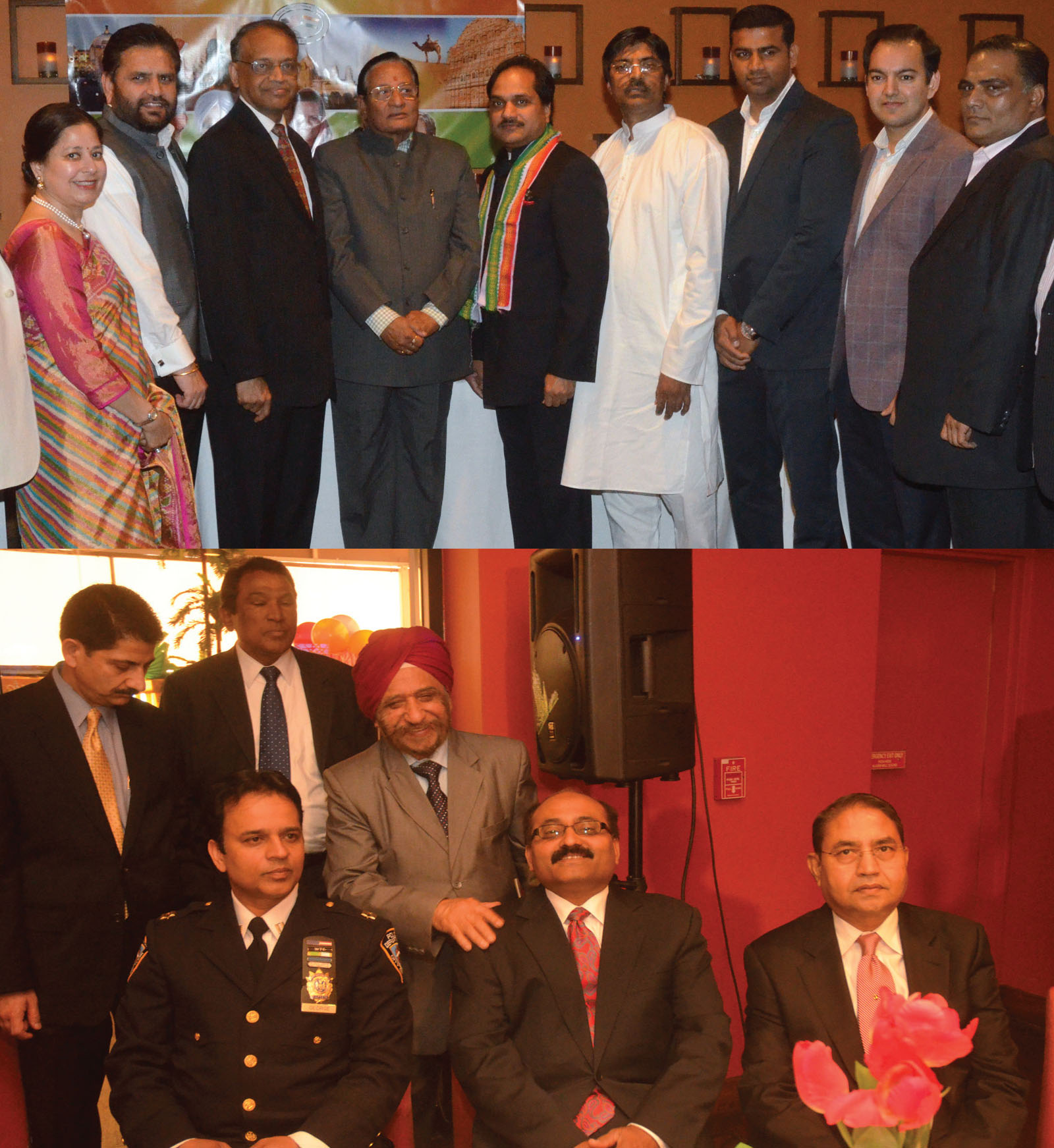
    NEW YORK (TIP): Rajasthan government Minister for Urban Development and Housing Shanti Dhariwal inaugurated on May 25 Rajasthan chapter of Indian National Overseas Congress (I) at Mint Restaurant in Long Island, New York. Inaugurating the chapter, the Minister said Rajasthan has been making all-round progress in many fields under the able leadership of Chief Minister Ashok Gehlot.

    He said the party is sure to return to power in view of numerous welfare measures undertaken by the Congress government. He took pains to describe various schemes undertaken for the weaker sections and the middle classes. Tom Suozzi, former Executive of Nassau County, in his remarks praised the role of Indian-Americans for their hard work and dedication in making Nassau County a better place to live.

    He introduced four of his running mates of which three are Indian-Americans and the other – an American with an Indian connection and who had worked with Mother Teresa in Kolkata. George Abraham, president of Indian National Overseas Congress (I) who presided over the function said that Rajasthan was the 12th chapter to be formed since the inception of INOC in 2000 and the INOC has become the voice of the Indian Diaspora. He said following the story of the massive victory in Karnataka will surely be repeated in the state elections to be held soon.

    The INOC-I will be playing its part to ensure the success, he said. Shudh Parkash Singh, senior vice president of INOC-I, said the Diaspora Indians will work hard to bring back the Congress to power in federal and state level elections. The Minister honored five prominent personalities – Jagdish Chandra, head of ETV Hindi and Urdu TV channels; Padam Mehta, chief editor and publisher of Manak; Capt. Stanley George of New York Police Department; Kanak Golia, a prominent businessman and Naveen C Shah, CEO of Navika Group of Companies.

    Stanley George was promoted to Captain of New York Police Department (NYPD) in 2007, the largest police department in the world. He is the first Indian Malayalee to reach the position and is currently the only captain of NYPD. After his graduation in Kerala, he migrated to the US and began his career as a civilian accountant in NYPD in 1989. He joined the Police Academy and graduated as police officer – he became Sergeant in 2000, Lieutenant in 2003 and Captain in 2007.

    He had worked in various units such as counterterrorism, criminal justice and patrol service bureau. He was recognized by President APJ Abdul Kalam in New York for his rescue and recovery service during the 9/11 tragedy. Kanak Golia is the president and CEO of Perfume Center of America, a multinational global company he founded in 1993. A wholesale distributor that prides itself on service, its clientele is worldwide.

    The company stocks over 4,000 major designer brands from France, Italy, Germany, Spain and the US. He has been distinguished as a recipient of the Top 10 Asian American Business Awards. Golia grew up in Johdpur, Rajasthan with his brother and three sisters. While managing his father’s business, he continued his academic career in accounting and law and served as Vice President of the Department of Law at the University of Rajasthan.

    Golia also serves as a Board of Trustee of New York Hospital for Queens; he and his wife Prabha Golia are instrumental in developing new cancer center and they were bestowed with Pacesetter Award, New York Hospital’s highest honor. They had established Kanak and Prabha Golia Foundation focused on women’s education, medical care for the disabled and orphanages. Naveen C. Shah is a prominent CPA and President and CEO of Navika Group of Companies, a premier commercial, real estate and hospitality enterprise in the US.

    He is also a partner of accounting and tax associates. Shah migrated to the US in 1982 and became a CPA in 1984. He has served as Board of Director of many professional and banking institutions and had been on the business banking advisory board of Wells Fargo and South Asian Business Advisory Board of Merrill Lynch. He is the founding member and past president of Rajasthan Association of North America (RANA); Indian Association of Long Island (IALI), Nargis Dutt Memorial Foundation to name a few.

    Shah founded Navika Capital Group LLC in 2005 with an objective to invest capital in commercial real estate and branded hotels in the US. Under his stellar leadership, the Navika Group has excelled in its performance and currently has substantial real estate and hospitality asset base under its ownership. It has an ownership stake in 43 prime real estate properties including 35 branded hotels in high value markets and is the direct result of Shah’s business acumen. Chandra Prakash Sukhwal, vice president of Rajasthan chapter, said Congress Party had made India a super power in the comity of nations and provided a strong and stable government in the center.

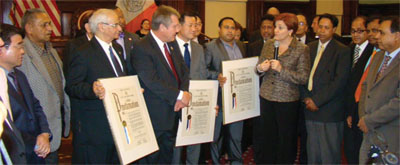
    He said a new slogan “Chalo Rajasthan, Jeeto Rajasthan” has been coined by Rajasthani non- residents to ensure the victory of Congress Party in Rajasthan. Sukhwal was a senior Congress leader who had worked with Indira Gandhi and Rajiv Gandhi before migrating to the US. Minister was presented Proclamations from Nassau County Chief Executive Edward Mangano and another from New York State Senate by Dilip Chauhan on behalf of the New York State Senator Toby Stavisky. Sushil Goyal, President of Rajasthan chapter of INOC-I welcomed the gathering. Sushma Kotahwala, Secretary, acted ably as emcee of the event.

  • GOPIO Organizes Community Interactive Session with Minister of Overseas Indian Affairs

    GOPIO Organizes Community Interactive Session with Minister of Overseas Indian Affairs

    NEW YORK (TIP): The Global Organization of People of Indian Origin (GOPIO), in collaboration with several community organizations and groups in the New York/New Jersey/Connecticut tri-state area, hosted a luncheon and interactive session on issues of interest to NRIs/PIOs with Vayalar Ravi, Minister of Overseas Indian Affairs (MOIA). The event held here on May 27 was well attended and the issues raised and questions posed to Minister Ravi concerned the Indian communities regionally and nationally.

    Preceding a formal welcome, GOPIO International president Ashook Ramsaran requested everyone to observe “a moment of silence on this Memorial Day to remember and pay homage to all who served and sacrificed for their country as well as for the victims of Chattisgargh and other tragedies”. Ramsaran then welcomed Minister Ravi and Ambassador D. Mulay, India’s Consul General in New York, as well as all attendees.

    GOPIO’s secretary J. Nami Kaur and Director of Diaspora Development Mridul Pathak presented to Minister Ravi GOPIO’s memorandum of community issues and matters of interest which were developed from various inputs, suggestions and recommendations received from chapters, membership and other organizations among the Indian American community in the United States.

    “Development of this memorandum is also based on GOPIO’s extensive knowledge, experience and interaction within GOPIO as well as with other individuals and groups in the Indian community regionally, nationally and globally”, said Ramsaran.

    The issues in the GOPIO memorandum included: OCI Card uniformity for all; Alternate documentation for PIO Card; OIC scheme; Changes in IDF procedures; alternate sites (US) for MBBS exams; NRI Tax beyond 60-day stay; uniformity of information, policies and practices; Reciprocity from India regarding US Immigration Bill for spousal employment; NRI Property Rights and Fast Track Judiciary; Research Visa, OCI/PIO Card holders; Indian Indenture Arrival Commemoration Plaques in PIO Countries; GOPIO’s support and collaboration on community outreach and feedback.

    There were other memoranda presented to Minister Ravi: one by Federation of Kerala Association (FOKANA) and another by Malayalee Organizations of New York. These memoranda focused primarily on OCI cards and associated issues. Following remarks by Ambassador Mulay and H. R. Shah, and introduction by GOPIO’s founding president Dr Thomas Abraham, Minister Ravi responded to all the issues and concerns raised in a very active and participatory session with attendees and the press.

    He was receptive to the questions posed and expressed appreciation to the NRI/PIO populations and their concerns for improving the procedures. “I will do all I can in my ministry (MOIA) to get you answers to your questions and help in any way I can”, said Ravi. The general consensus is that NRIs and PIOs look to MOIA to be the advocacy ministry in the Government of India to address Indian Diaspora issues of interest and concern with respective ministries within the Government of India as well as foreign governments – to seek remedy and redress to resolve current, critical issues affecting people in the Indian Diaspora.

    The issues raised have been hanging fire for a long time. In each interactive session with the minister the same issues have been raised and the minister has more often than not, been evasive and, at best has come up with what he said at this session: “I will do all I can in my ministry (MOIA) to get you answers to your questions and help in any way I can”.

  • More Than 6,500 Indians Languish In Foreign Jails

    More Than 6,500 Indians Languish In Foreign Jails

    CHENNAI (TIP): More than 6,500 Indians are living an uncertain life in prisons in 80 foreign countries, half of them in three Gulf countries. The Gulf countries have the largest number of Indian prisoners, with 1,691 in Kuwait, 1,161 in Saudi Arabia and 1,012 in the UAE. Among the neighbours, Pakistan holds 253 Indians in its prisons, China has 157 of them and Sri Lanka 63. Languishing in the Nepal prisons are 377 Indians. Italy, a country that recently raised a huge uproar demanding special guest house and home-made food for its two citizens arrested on charges of killing two Indian fishermen off the Kerala coast, has 121 Indian citizens in its prisons. The United Kingdom has 426 Indian inmates in their jails, thanks to a fast growing migration of skilled and unskilled labourers.

    There are 155 Indians in the US prisons. The statistics, obtained through RTI by Kochi-based NGO Human Rights Defense Forum, shows 6,569 Indians are in foreign prisons. On Indian prisoners in 30 countries, the ministry of external affairs said it had ‘nil report.’ The RTI reply also says “this figure keeps changing,” and gives no details about the prisoners or the charges against them. In 2007, it was reported that the number of Indian prisoners abroad had come down from 6,730 in 2005 to around 6,000. The RTI reply given by the ministry last month shows the number has gone up again. T P Sreenivasan, former ambassador of India to the United Nations, said ordinary crimes, drug trafficking and domestic violence land Indians in jails in European countries.

    “But a large number of prisoners in the Gulf countries are arrested for badly formulated contracts, illegal stay and migration,” he said. In Malaysia (187 Indian prisoners) and Singapore (156), most of the Indians have been arrested for immigration violations and a few for criminal cases like drug trafficking. In Pakistan, Bangladesh and Sri Lanka, most of the arrests are made on charges of violation of immigration laws. Sreenivasan said different factors, including delay in ensuring justice, communication between the local government and the Indian offices abroad play a major role in the number and duration of detentions.

  • Chittoor’s Horsley Hills Touch The Clouds

    Chittoor’s Horsley Hills Touch The Clouds

    The quaint hill station of Horsley Hills in Chittoor district is the perfect refuge for weekend holidayers. Pristine air, panoramic views of the surrounding hillocks and dense forests, perfect weather and tranquillity — can one ask for more? Standing at a dizzying height of 4,312 feet (1,314 meters) above sea-level, the unspoilt and tranquil environs of Horsley Hills in Chittoor district command breath-taking, panoramic views of the lush expanse of the broken hill ranges of the Southern portion of the Eastern Ghats. Located near the South Western border of Andhra Pradesh and Karnataka, this “Andhra Ooty”, with its rich foliage, wildlife and pleasant climate is undoubtedly one of the underrated hill stations in the country. It is a little known fact that the hills, called Archeans, are geologically some of the oldest. The idyllic hill station has temperatures that range from 5 degrees celcius to a maximum of 32 degrees celcius. And on most days, the occasional clouds that pass by you, leave you in awe. Situated at a distance of 56 kms from Madanapalle, it is well-connected to Hyderabad, Tirupathi, Bangalore and Chennai, and boasts of several tourist spots and adventure sports in the vicinity. The area is a treasure trove of deciduous flora and fauna and rich in eucalyptus, silver oak, mahogany, coffee, jacaranda, allamanda, gulmohar and flowering plants. It is also famous for red sanders and sandalwood. The dense forests are home to several wild animals and birds. Panthers, sambars, wildboars, bears, four-horned antelopes, jungle-fowls, porcupine are found in the ravines. The environs of the charming hill station is home to several species of birds. Great Indian bustard for one, is the more famous and fast-disappearing species found here. The hills are also frequented by migratory birds like the red-throated flycatcher, Montagu’s harrier, blue-headed rockthrush, ultramarine lycatcher etc. The invigorating scent of the eucalyptus trees, the soul-stirring sights of the underlying expanse, the echoing chirp of exotic birds and the tranquil aura that encompasses the hill station make it the perfect getaway for adventure-loving friends, couples and families alike.

    Steeped in history
    The hillocks got their name from WH Horsley, a British civil servant who served as the Collector of Cuddapah (Kadapa) between 1863-1867. In awe of the idyllic environs, he built the first building here — a summer bungalow — in 1862, that is now called ‘Forest Bungalow’. The tiles used for flooring were imported from England in 1863. Originally, the hillock was called Yenugu Mallamma Konda by locals and the name has a rather interesting folklore history associated with it. According to local folklore, it got its name from Mallamma, who was a saintly lady, raised by elephants in these hills around 300 years back. A temple in her name, exists 20 kms from Horsley Hills. Also situated 20 kms outside Horsley Hills, en route Madanapalle, are three hillocks situated in a straight line that house three Mallikarjunaswamy temples on their respective summits. The famed Rishi Valley School that was founded by Madanapalle-born philosopher Jiddu Krishnamurti, is located at the foot of the very hills.

    Environmental Park
    The Environmental Park, known as EEC centre, was built by Hyderabadi environmentalist Balijepalli Venkata Subba Rao. The lush park is a mini-ecosystem in itself, complete with trees, coffee plants, a crocodile enclosure, a mini-zoo, lake Mansarovar and a nature study centre. The study centre has a museum and also an AV room where one can watch videos on wildlife, apart from a library.

    Gaali banda/Wind rock
    The hillock that boasts of a cliff slope, made of a single rock that extends several thousand feet downwards, is worth a visit. One can walk down the entire hillrock, admiring the unobstructed view of the lowlying expanse. Enjoy the rejuvenating heavy winds as they blow past you.

    Highview seeing point
    It is the most popular spot located at the highest summit, that offers allencompassing view of the underlying ravines, valleys, broken hillocks and dense forests. The view of the endless expanse, dotted by hills and forests is in itself worth the trip to the hill station. Don’t miss the sunset from this point — it is truly a spectacle not to be missed. Kalyani tree Do visit the 148-year -old eucalyptus tree — ‘Kalyani’ — that is visible from the Kadiri-Madanapalle road, that is 70 kms away, on clear days. Planted by WH Horsley in 1859, the tree was awarded the Maha Vriksha Puraskar a few years ago.

    Lake Gangotri and Mansarovar
    Gangotri is located at the entry of the hills, while Manasarovar is found next to the study centre in the Environ-mental Park. Folklore has it that both lakes never dry up.

    TOURIST SPOTS World’s largest Banyan tree
    Thimmamma Marrimanu banyan tree, that is located at a distance of 75 kms from Horsley Hills, was awarded the Guinness Record title of the ‘World’s biggest banyan tree’ in 1989. Spread over eight acres, the sprawling banyan tree is named after Thimmamma, a lady who jumped into the funeral pyre of her husband and transformed into the tree with her husband, according to folklore. The tree houses a temple and Thimmamma’s samadhi. The temple is very popular and is known to bestow the miracle of birth upon childless couples. The place is open from 6 am to 9 pm and the Tirumala Tirupati Devasthanams (TTD) management is all set to take over the maintenance of the temple, that is currently overlooked by the village committee.

    The famed temples
    Three temples atop three hillocks that are aligned in a straight line around Horsley Hills and Madanapalle are popular tourist spots in the Chittoor district. Devotees throng the temple on Maha Shivatri and full-moon nights. The Sri Akanda Malleswara Swamy Devasthanam is perched atop the Malliah Konda — the middle hill — located in Angallu near Madanapalle.

    Where to stay
    The most popular choice with visitors is the AP Tourism Hill Resorts that is perched atop the hills. The resorts is a comfy haven, equipped with modern-day amenities and services. Apart from cottages, rooms, the resort boasts of a swimming pool surrounded by hills, a Kerala ayurveda centre that is a unit of Santhigiri Ashram, a bar, a full-fledged restaurant, a kids play area, a conference complex and adventure sports facilities.

    Adventure sports area
    People can choose from a wide array of exciting activities like zorbing, rappelling and trekking that can be booked for a minimum batch of 10 participants. Burma bridge, earthquake, spider web, rope sliding, horizontal ladder are some of the high rope activities one can opt for, besides the trampoline, archery, etc. The adventure sports are open from 7 am to 6 pm and anyone above 5 years are eligible.

    Swimming pool
    Nestled between scenic hills, the swimming pool is open from 8 am to 6 pm. Two adults and a child staying at the resort, are entitled to one hour of swimming at no extra cost. One can also opt for fun activities like water-walking in the swimming pool.

  • Death penalty possible?

    Death penalty possible?

    Italy says will wait to see charges by NIA
    NEW DELHI (TIP): India’s anti-terrorism agency will investigate the case of two Italian marines accused of murdering two Indian fishermen, the Supreme Court said on April 26, raising the possibility once more of the men facing the death penalty.

    The accused, Massimiliano Latorre and Salvatore Girone, are charged with murder in connection with the shooting of fishermen off the coast of the southern state of Kerala last year while serving as security guards on a cargo ship. The two say they fired warning shots at a fishing boat believing it to be a pirate vessel with armed men onboard. Italy maintains the incident happened in international waters and that the men should be tried on home soil. Last week, Italy opposed India’s decision to appoint the anti-terrorism National Investigation Agency (NIA) to investigate the case, saying that the NIA only had the jurisdiction to investigate terrorist crimes.

    It fears the NIA will invoke a maritime security law that attracts a mandatory punishment of death, which would violate an assurance given by India that the men would not be sent to the gallows. On Friday, Italy said it would wait to see if the NIA invoked the maritime security law before deciding whether to challenge the court’s decision. “The order says the NIA will continue on the case, but let’s see what charges are framed on the men.

    That will determine our course of action,” said a lawyer representing Italy, who did not want to be named. Tensions between India and Italy have escalated over the case since the shooting, peaking last month when Italy refused to send the marines back from a home visit. Outraged, the apex court briefly barred the Italian envoy from leaving the country. Rome returned the marines for trial after New Delhi promised them the men would not face the death sentence. Italy’s foreign minister resigned after the marines returned to India, saying he did not agree with the decision to send them back. Italy abolished the death penalty in 1947. In the past six months, India has hanged two men convicted of militant attacks.

  • Confusion over charges on Italian marines; case may be given to CBI

    Confusion over charges on Italian marines; case may be given to CBI

    NEW DELHI (TIP): Confusion prevails over the laws under which the Italian marine duo, accused of killing two Kerala fishermen, are to be prosecuted amid indications that the high-profile case may be handed over to CBI from NIA. Government sources said as per the assurance given by India to Italy, the marines will not be given death sentence and hence the stringent Suppression of Unlawful Acts Against Safety of Maritime Navigation and Fixed Platforms on Continental Shelf Act, 2002 slapped against the duo will be dropped.

    Under this Act, offence of murder is punishable only with death sentence. However, if Massimiliano Lattore and Salvatore Girone are not prosecuted under this law, the National Investigation Agency, which has been assigned to investigate the case, cannot probe it as the agency is mandated to investigate only scheduled offences.

    Therefore, sources said, if the stringent law is dropped, the NIA will have to give away the case and the case has to be handed over to another federal investigating agency – most probably CBI – for prosecuting the duo under IPC and CrPC. Sources said no decision has been taken on it yet as both Home Minister Sushilkumar Shinde and Home Secretary R K Singh are away in Russia on a bilateral visit.

    A decision on the issue is expected only after April 16 when the Centre will give its submission on the case before Supreme Court. On March 22, after the return of the marines from Italy, External Affairs Minister Salman Khurshid had told Parliament that India has given an assurance to that country that the two will not face death penalty nor will they be liable for arrest if they return by the deadline set by the Supreme Court.

  • New Saudi Work Policy To Impact Thousands Of Indians

    New Saudi Work Policy To Impact Thousands Of Indians

    THIRUVANANTHAPURAM/NEW DELHI: Thousands of Indians, especially Malayalis employed in Saudi Arabia, may be impacted by a new work policy of the kingdom that seeks to reserve a certain percentage of jobs for locals. According to the new Nitaqat policy – or Saudisation programme – of the kingdom, 10 percent of jobs are to be reserved for locals. The policy is aimed at expanding employment opportunities for Saudi nationals. There are over two million Indians working in Saudi Arabia, including 576,000 from Kerala alone.

    External affairs minister Salman Khurshid said on Monday evening there was no need to panic and the Indian government would provide assistance to Indians forced to return from Saudi Arabia. “If somebody has to go to another country, he has to satisfy the rules of that country.

    But if there is inconvenience caused to any Indian citizens, then whatever assistance we can give, we will provide,” Khurshid assured. “The Kerala government is setting up help desks at the three international airports at Thiruvananthapuram, Calicut and Kochi and 24-hour call centres to help people in distress,” an official of the department of Non-Resident Keralites Affairs (NORKA) told mediapersons. “Around 576,000 people from Kerala are working in Saudi Arabia. We are requesting for general amnesty and request a review of the ban on reentry of workers,” the official added, declining to be named. C P John, member of the Kerala State Planning Board, said that thousands of Indian workers, especially Malayalis, would be affected “if the Saudi government makes the Nitaqat policy very strict”. “A few hundred Keralites have returned to India following implementation of the policy,” John told IANS.

    However, he said that “there was no clear idea of how many Malayalis would to be affected. There is no real picture, we are continuously waiting for real numbers with work permits”. “Some will have to come back, some will be expelled from their workplaces. We hope they can carry on and get absorbed in other companies in the kingdom,” he added. “Saudis are not accustomed to working like Indians. It is very expensive to employ a Saudi. But the managers will be forced to employ one Saudi, who will work for eight hours and his pay will be 10 percent higher than an Indian’s.

    The Saudis would be forced to rely on cheaper and more efficient Indians, who work for up to 15 hours,” John said. Minister of State for External Affairs E. Ahamed discussed the issue with Saudi Arabia’s Assistant Foreign Minister Prince Abdul Azees Bin Abdullah Al Saud in Tajikistan Saturday.

    According to reports, street cleaning and other sanitation works have been hit hard by the Saudisation programme as almost 100 per cent of the workers in this sector are foreigners, mostly Indians. Many of them are illegal immigrants. Labour inspectors and police have begun conducting raids on enterprises suspected of employing illegal workers. Employers complying with the Nitaqat norms would be rewarded with incentives while those failing would have to shut shop as the work permits of their expatriate workers would not be renewed, according to Saudi reports. The work permit is mandatory for getting the residential permit.

  • President Confers Padma Awards

    President Confers Padma Awards

    NEW DELHI (TIP): President PranabMukherjee on April 5 conferred Padma Awards, the country’s highest civilian awards, to 108 personalities. The awards comprise 4 PadmaVibhushan, 24 PadmaBhushan and 80 PadmaShri Awards on Friday. 24 of the awardees are women and the list also includes 11 people in the category of foreigners, NRIs, PIOs and posthumous awardees. Noted physicist Yash Pal and space scientist Roddam Narasimha were chosen the second highest civilian honour Padma Vibhushan. Batting great Rahul Dravid and Olympic bronze medallist MC Mary Kom and late Bollywood actor Rajesh Khanna were named for the prestigious Padma Bhushan award, the third highest civilian award of the country. Renowned sculptor Raghunath Mohapatra and painter S Haider Raza were chosen for Padma Vibhushan.

    The list of 108 Padma awardees for this year also includes actress Sridevi, actors Nana Patekar and Malayalam star Madhu of Chemmeen fame and Olympians Yogeshwar Dutt and Vijay Kumar. Nobody was named for Bharat Ratna for this year too. The last awardee was late Bhimsen Joshi in 2008. Satirist Jaspal Bhatti, who died in a road accident last year, film maker D Rama Naidu, noted South Indian playback singer S Janaki, Bharatnatyam dancer Saroja Vaidyanathan, missile scientist Dr A Sivathanu Pillai of BrahMos programme, Industrialist Adi Godrej and R Tyagarajan, former bureaucrat M K Bhan were among the 24 Padma Bhushan awardees. In all four personalities were awarded Padma Vibhushan, 24 for Padma Bhushan and 80 Padma Shri. Of the awardees 24 are women, 11 belong to the category of foreigners, NRI, PIOs and posthumous.

    Padma Awards, the country’s highest civilian awards, are conferred in three categories, namely Padma Vibhushan, Padma Bhushan and Padma Shri.

    PADMA VIBHUSHAN
    Raghunath Mohapatra, Art, Orissa
    S Haider Raza, Art, Delhi
    Prof Yash Pal, Science and Engineering, Uttar Pradesh
    Prof Roddam Narasimha, Science and Engineering,Karnataka

    PADMA BHUSHAN
    Dr Ramanaidu Daggubati, Art, Andhra Pradesh
    Sreeramamurthy Janaki, Art, Tamil Nadu
    Dr (Smt) Kanak Rele, Art, Maharashtra
    Sharmila Tagore, Art, Delhi
    Dr (Smt) Saroja Vaidyanathan, Art, Delhi
    Abdul Rashid Khan, Art, West Bengal
    Late Rajesh Khanna, Art, Maharashtra
    Late Jaspal Singh Bhatti, Art, Punjab
    Shivajirao Girdhar Patil, Public Affairs, Maharashtra
    Dr Apathukatha Sivathanu Pillai, Science, Engineering,Delhi
    Dr Vijay Kumar Saraswat, Science and Engineering,Delhi
    Dr Ashoke Sen Science and Engineering,Uttar Pradesh
    B N Suresh, Science and Engineering, Karnataka
    Prof Satya N Atluri, Science and Engineering, USA
    Prof Jogesh Chandra Pati, Science and Engineering,USA
    Ramamurthy Thyagarajan, Trade and Industry,Tamil Nadu
    Adi Burjor Godrej, Trade and Industry, Maharashtra
    Dr Nandkishore Shamrao Laud, Medicine,Maharashtra
    Mangesh Padgaonkar, Literature and Education,Maharashtra
    Prof Gayatri Chakravorty Spivak, Literature & Education USA
    Hemendra Singh Panwar, Civil Service,Madhya Pradesh
    Maharaj Kishan Bhan, Civil Service, Delhi
    Rahul Dravid, Sports, Karnataka
    H Mangte Chungneijang Mary Kom, Sports, Manipur

    PADMA SHRI
    Gajam Anjaiah, Art, Andhra Pradesh
    Swami G C D Bharti alias Bharati Bandhu, Art,Chhattisgarh
    B Jayashree, Art, Karnataka
    Sridevi Kapoor, Art, Maharashtra
    Kailash Chandra Meher, Art, Orissa
    Brahmdeo Ram Pandit, Art, Maharashtra
    Vishwanath D Patekar alias Nana Patekar, Art,Maharashtra
    R Nageswara Rao alias Surabhi Babji, Art, Andhra Pradesh
    Lakshmi Narayana Sathiraju, Art, Tamil Nadu
    Jaymala Shiledar, Art, Maharashtra
    Suresh Dattatray Talwalkar, Art, Maharashtra
    P Madhavan Nair alias Madhu, Art, Kerala
    Apurba Kishore Bir, Art, Maharashtra
    Ghanakanta Bora Borbayan, Art, Assam
    Hilda Mit Lepcha, Art, Sikkim
    Sudha Malhotra, Art, Maharashtra
    Ghulam Mohammad Saznawaz, Art,Jammu and Kashmir
    Ramesh Gopaldas Sippy, Art, Maharashtra
    Mahrukh Tarapor, Art, Maharashtra
    Balwant Thakur, Art, Jammu and Kashmir
    Puran Das Baul, Art, West Bengal
    Rajendra Tikku, Art, Jammu and Kashmir
    Pablo Bartholomew, Art, Delhi
    Shri S Shakir Ali, Art, Rajasthan
    S K M Maeilanandhan, Social Work, Tamil Nadu
    Nileema Mishra, Social Work, Maharashtra
    Reema Nanavati, Social Work, Gujarat
    Jharna Dhara Chowdhury, Social Work, Bangladesh
    Late Dr Ram Krishan, Social Work, Uttar Pradesh
    Late Manju Bharat Ram, Social Work, Delhi
    Prof Mustansir Barma, Science and Engineering,Maharashtra
    Avinash Chander, Science and Engineering, Delhi
    Sanjay Govind Dhande, Science and Engineering,Uttar Pradesh
    Prof (Dr) Sankar Kumar Pal, Science, Engineering,West Bengal
    Deepak B Phatak, Science and Engineering,Maharashtra
    Dr Mudundi Ramakrishna Raju, Science and Engg,Andhra Pradesh
    Prof Ajay K Sood, Science and Engineering, Karnataka
    Prof Krishnaswamy Vijayraghavan, Science & Engg,Karnataka
    Dr Manindra Agrawal, Science and Engineering,Uttar Pradesh
    Dr Jayaraman Gowrishankar, Science & Engineering,Andhra Pradesh
    Prof Sharad Pandurang Kale, Science & Engineering,Maharashtra
    Vandana Luthra, Trade and Industry, Delhi
    Rajshree Pathy, Trade and Industry, Tamil Nadu
    Hemendra Prasad Barooah, Trade and Industry,Assam.
    Milind Kamble, Trade and Industry, Maharashtra
    Kalpana Saroj, Trade and Industry, Maharashtra
    Dr Sudarshan K Aggarwal, Medicine, Delhi
    Dr C Venkata S Ram alias Chitta, Venkata Sundara Ram, Medicine, Andhra Pradesh
    Dr Rajendra Achyut Badwe, Medicine, Maharashtra
    Dr Taraprasad Das, Medicine, Orissa
    Prof (Dr) T V Devarajan, Medicine, Tamil Nadu
    Prof (Dr) Saroj Chooramani Gopal, Medicine,Uttar Pradesh
    Dr Pramod Kumar Julka, Medicine, Delhi
    Dr Gulshan Rai Khatri, Medicine, Delhi
    Dr Ganesh Kumar Mani, Medicine, Delhi
    Dr Amit Prabhakar Maydeo, Medicine, Maharashtra
    Dr Sundaram Natarajan, Medicine, Maharashtra
    Prof Krishna Chandra Chunekar, Medicine,Uttar Pradesh
    Dr Vishwa Kumar Gupta, Medicine, Delhi
    Prof (Capt) Dr M Sharaf-eAlam, Literature & Education, Bihar
    Dr Radhika Herzberger, Literature & Education,Andhra Pradesh
    J Malsawma, Literature and Education, Mizoram
    Devendra Patel, Literature & Education, Gujarat
    Dr Rama Kant Shukla, Literature & Education, Delhi
    Prof Akhtarul Wasey, Literature & Education, Delhi
    Prof Anvita Abbi, Literature & Education, Delhi
    Nida Fazli, Literature & Education, Madhya Pradesh
    Surender Kumar Sharma, Literature & Education,Delhi
    Dr Jagdish Prasad Singh, Literature & Education,Bihar
    Late Shaukat Riaz Kapoor Alias Salik Lakhnawi,
    Literature & Education, West Bengal.
    Prof Noboru Karashima, Literature & Education, Japan
    Christopher Pinney, Literature & Education, UK
    Premlata Agrawal, Sports, Jharkhand
    Yogeshwar Dutt, Sports, Haryana
    Hosanagara Nagarajegowda Girisha, Sports,Karnataka
    Subedar Major Vijay Kumar, Sports, Himachal Pradesh
    Ngangom Dingko Singh, Sports, Maharashtra
    Naib Subedar Bajrang Lal Takhar, Sports, Rajasthan
    Ritu Kumar, Fashion Designing, Delhi
    Dr Ravindra Singh Bisht, Archaeology, Uttar Pradesh.

  • NIA slap murder charges on marines; Italian PM talks to Salman Khurshid

    NIA slap murder charges on marines; Italian PM talks to Salman Khurshid

    NEW DELHI (TIP): Concerned over NIA slapping murder charges against two Italian marines, Italy’s Prime Minister Mario Monti on April 5 called up External Affairs Minister Salman Khurshid, who apprised him of the recent developments in the case. The call by Monti followed a meeting between Khurshid and Italian Deputy Foreign Minister Staffan de Mistura who asked India to keep his government posted on the developments in the matter.

    The meeting comes in the backdrop of NIA registering murder case against the two Italian Marines for allegedly killing two Indian fishermen off Kerala coast last year. The charge entails maximum punishment of death penalty. However, Khurshid, in Parliament last month, had ruled out that case will attract death penalty. “…according to well settled Indian jurisprudence, this case would not fall in the category of matters which attract the death penalty, that is to say the rarest of rare cases. Therefore, there need not be any apprehension in this regard,” Khurshid had said while informing Parliament about Italy reversing its initial decision of not sending the marines back. Khurshid provided Mistura an update of the developments since their meeting last month, including the lifting of travel restriction on the Italian envoy by the Supreme Court, official sources said. He also informed the Minister of the steps being taken in compliance with the Supreme Court directions at the last hearing and intentions of the government to inform the apex court on April 16 of the efforts made to constitute a Special Court, the sources added.

    Following the meeting, Italian Prime Minister, who is also holding charge of Foreign Ministry, had a telephonic conversation with Khurshid on the same subject, the sources said. The Supreme Court had on April 2 vacated its order restraining Italian Ambassador Daniele Mancini from leaving India following the return of the two Italian marines to face trial here as per his commitment to the court. A bench headed by Chief Justice Altamas Kabir vacated its March 14 order by which it had restrained the Ambassador from leaving the country after the Italian government had refused to send back the marines.

  • Get Set For A Seaplane Ride in Kerala

    Get Set For A Seaplane Ride in Kerala

    Kerala will soon start a seaplane service for tourists, the first of its kind in the country. Houseboat cruises are passe. Take a trip on a seaplane instead! By the end of this month, tourists visiting Kerala can take a flight cruise, which will have landing points at water dromes in Bakel, Bolghatty, Punnamada, Ashtamudi and Kumarakom, besides the three airports in the state. More landing points are in the pipeline, say officials. “It was after an extensive research that the state government concluded that the water bodies here are ideal for seaplanes. It is very popular in foreign countries where there is water connectivity. And of course, there is no other state in India which is so well connected through water,” says Umesh Kammath, GM of a private company with which the government has tied up. Two planes, a six-seater and a 10-seater, will be introduced in the first stage, after which they plan to introduce an 18-seater as well. The authorities are planning to set up floating jetties at the landing points for a safe landing. “Tourists will have to take houseboats and speedboats to reach the land,” says Umesh and adds that foreign pilots will be helming the planes initially, after which the company plans to train and recruit Indian pilots. If all goes well, the service will be functional by the end of April, after a trial run and other safety and security checks. However, the trip will be a bit expensive. The charges are expected to be around `5000 per person for an hour. “Tourists can avail themselves of extra facilities, like landing near the resort they stay in or take a customised trip to their preferred destination,” says Umesh.

    The officials say they are particularly targeting cruise ship passengers. “Usually, cruise ships dock in Kochi for just about a day, and hence the passengers are not able to do much sight-seeing. But with the seaplane, they can take a trip around the whole of Kerala in a day,” says Umesh. Apparently, Goa and other tourist destinations in the country are eyeing the seaplane, and are watching out its viability in Kerala.

  • Muslim Women Can’t Go For Haj Alone: Kerala Govt

    Muslim Women Can’t Go For Haj Alone: Kerala Govt

    KOCHI (TIP): Muslim women are not allowed to travel alone for the Haj pilgrimage to avoid risking their safety, the state government has informed the Kerala high court. The government clarified its stance on a petition filed by a Muslim woman questioning the Haj Committee of India’s denial of permission to her to travel with a female companion.

    According to the committee’s rules, Muslim women have to be accompanied by a male family member to perform Haj. The petitioner, 64-year-old Aminakutty Mohammed of Kadalundi in Malappuram district, is demanding a court order permitting her to travel with a female companion. Opposing this, senior government counsel Sajid T P told the court of Justice Antony Dominic that it was in view of the safety and security risks involved in permitting Muslim women to travel alone that the Haj committee was insisting that they be accompanied by a male family member.

    The counsel also opposed the plea on the ground that the decision of the Haj committee would fall under the realm of government policy. As per the rules framed by the Haj committee, women performing Haj should be accompanied by a male member of the family whom she cannot marry.

    Such a male member is termed as ‘mehram’ in Sharia, the moral code and religious law of Islam. Questioning the Haj committee’s denial of permission for want of a ‘mehram’, the woman has alleged that it amounts to gender-based discrimination. The Haj committee’s decision is violation of Article 14 of the Constitution, which guarantees right to equality before law and prohibits discrimination on grounds of religion, race, caste, sex, or place of birth, her petition said.

  • Bharat Bandh: Nation-Wide Two-Day Trade Union Strike Hits Banking, Transport Services

    Bharat Bandh: Nation-Wide Two-Day Trade Union Strike Hits Banking, Transport Services

    NEW DELHI (TIP): Bharat Bandh:Nation-wide strike hit banking andtransport sector day two of nationwidestrike. While banking services were onFebruary 21 paralysed with ATMs runningout of cash in metro cities and publictransport disrupted during the Centraltrade unions sponsored strike whichevoked a mixed response in most statesbarring Kerala where normal life was hit.Life remained normal in West Bengalthough banking services were crippled withnationalised and private banks closed andATMs remaining non-functional.Transport services were normal andshops, markets and businessestablishments opened in the state.

    In the national capital, commuters facedhardships for the second consecutive day asmajority of auto-rickshaws and taxis stayedoff the road in support of the strike.Various industrial units and banks eitherremained closed or witnessed thinattendance while markets and commercialareas were open.In Maharashtra, majority of ATMs driedup in the financial capital Mumbai.”A majority of ATMs have dried up while(bank) branches are shut. Additionally,there has not been any cheque clearing aspersonnel from RBI too joined the strike. Itwill take at least 2-3 working days to clearthe backlog for banks”, said All India BankEmployees Association Vice PresidentVishwas Utagi.Suburban railway, the city’s life line,functioned normally and road trafficremained unaffected.

    In Kerala, normal life was paralysed dueto the strike with workers from mostsectors ranging from transport to bankingkeeping away from work.Reports from across the state said busesand taxis were off the roads and marketsremained shut. Train and air services werenot affected.Attendance in government offices wasthin and educational institutions remainedclosed as pro-Left service and teachersunions joined the strike. Universities havecancelled examinations scheduled for thelast two days.

    The unions have put forward a charter of10 demands such as urgent steps to controlprice rise, strict enforcement of labourlaws in all places of work, social securitynet for workers in the unorganised sector,end to disinvestment in PSUs and raisingminimum wage to Rs 10,000 a month.However, the strike had no major impactin most parts of Karnataka.Though banking services were hit, manybuses, taxis and autos plied and shopsremained opened. However, schools andcolleges were closed.Employees of banks and public sectororganisations in Andhra Pradeshcontinued their protests on the second dayof the strike.In Tamil Nadu, banking and postalservices remained affected while shopsremained open and transport services pliednormally.Members of the protesting trade unionsstaged demonstrations in various parts ofChennai.

    Though there were reports that somelabour unions representing employees ofMaruti Udyog at its plants in Manesar andGurgaon had joined the strike along withUnions of HeroMotoCorp, workers of thecompany attended duty in the state.According to Union representatives ofHyundai Motor India Employees and FordMotor India, which has manufacturingfacilities at Sriperumbudur andMaraimalai Nagar, they have decided toconduct a mass rally today in view of thestrike.Transaction of cheques worth of Rs 3000crore in Chennai were affected while mostof the ATMs of several banks have driedout due to lack of cash.In the north, public transport andbanking services continued to be affectedin Punjab, Haryana and Chandigarh due tothe strike.

    Reports pouring in from various placessuggest that majority of state owned busesplying on inter-state routes and inter-cityroutes in Punjab, Haryana and Chandigarhdid not ply.With bank employees observing strike,banking transactions were hit, causinginconvenience to customers.Industrial production in Punjab andHaryana was unaffected.A report from Hisar has said activists ofdifferent trade unions staged dharnas infront of their respective offices.Normal life was partially affected inseveral parts of Odisha due to the strike.People faced difficulties in commuting asbuses, taxis auto-rickshaws remained offthe roads, leaving a large number ofpassengers stranded at different places.

    Bank services in Mumbai hit
    Mumbai: Majority of ATMs have driedup in the financial capital of Mumbai andbanking operations across the city were hiton the second day of the general strikecalled by central trade unions for variousdemands.”A majority of ATMs have dried up whilethe (bank) branches are shut. Additionally,there has not been any cheque clearing aspersonnel from RBI too joined the strike. Itwill take at least 2-3 working days to clearthe backlog for banks”, said All India BankEmployees Association Vice PresidentVishwas Utagi.The strike witnessed near cent per centparticipation by employees from bankingand insurance sector in the financial hub,leaving their operations completelyparalysed.our demands, including the one for notallowing private sector participants intothe fray for which we are holding thebandh”, Utagi said.Suburban railway, the city’s life line,functioned normally and road trafficremained unaffected, though there werefewer passengers using public transport.Flight operations at the Mumbai airportwere also normal despite a section ofairport unions declaring their support tothe strike, an airport spokesperson said.

    AP: Bank, govt employees hold protests
    Hyderabad: Employees of banks andpublic sector organisations in AndhraPradesh today continued their protestson the second day of the two-day strikecalled by Central trade unions in supportof their various demands.The personnel of variousorganisations, who stayed away fromwork yesterday, began their protests inHyderabad and other places in AndhraPradesh.The employees of various PSU banksand workers in the unorganised sectortook out protest rallies in Hyderabad andother parts of the state.Services in banking and other PSUorganisations were badly affected on thefirst day of the 48-hour general strikeyesterday.AITUC state unit president and MLC P JChandrasekhar Rao had claimed that thestrike was being held in an unprecedentedmanner with staff of the state-run minerSingareni Collieries, Andhra Pradesh StateRoad Transport Corporation (APSRTC)joining the stir.He claimed that 75 per cent of RTC buses,the principal mode of public transport inAP, remained off the roads yesterday.

    Life unaffected in KarnatakaBangalore:
    The two-day nationwidestrike called by 11 Central trade unionshadno major impact in most parts ofKarnataka today.Though banking services were hit, manybuses, taxis and autos plied and shops andhotels remained opened here.However, schools and colleges wereclosed.No violence was reported from any partof the state, police said.Services at many hospitals in the citywere not hit, as also in IT companies.Several PSUs including HAL, BHEL andBEL, besides a host of other industrialunits in Bangalore were functioningnormally.There was improvement in attendance ingovernment offices, police said.There has been no impact on normal lifedue to the strike in Belgaum district,sources said.Visvesvaraya Technological Universitypostponed Mtech, MCA and MBAexaminations scheduled for today.

    Partial impact in Odisha
    Normal life was partially affected inseveral parts of Odisha today on the lastday of the two-day nation-wide strike calledby central trade unions.People faced difficulties in commuting asbuses, taxis auto-rickshaws remained offthe roads, leaving a large number ofpassengers, including women and children,stranded at different places.In the state capital here, some threewheelerswere seen plying in many areassince this morning, giving respite to thecommuters who had a tough time travellingon February 21.Shops, markets, business establishmentsand petrol pumps remained closed, whileeating joints and kiosks were found opentoday. Small traders and retailers alsoresumed their business operations, officialsources said.Banks remained closed with employeespicketing and demonstrating at differentplaces, while most educational institutions,including schools, were open.

  • President Pranab Mukherjee May Turn Down 5 More Mercy Pleas

    President Pranab Mukherjee May Turn Down 5 More Mercy Pleas

    NEW DELHI (TIP): The Union homeministry is learnt to have recommendedrejection of mercy petitions in five morecases as it seeks to speedily dispose of allthe cases of death row convicts pendingwith it.Seeking to have a swift closure on thecases of those who have filed mercy pleasagainst capital punishment awarded tothem, the ministry has sent all the pendingfiles to President Pranab Mukherjee for afinal call.Sources said that seven cases involvingthe fate of nine people have been sent to thePresident, with the ministryrecommending rejection of the mercy pleasin five cases. It has and left the tworemaining ones open for commutation ofdeath sentence to life imprisonment withthe rider that the life term means jail forthe entire life of the convict and not just 20years or 14 years in prison.

    The President had sent the files to Unionhome minister Sushilkumar Shinde onOctober 30 for his review and opinion.Shinde sent the files back within 100 daysin a major shift from the pattern wheredecisions on mercy petitions wereindefinitely delayed with files shuttlingbetween the home ministry and theRashtrapati Bhavan.Though the case-wise recommendationsfor convicts were not known as both thehome ministry and Rashtrapati Bhavancontinue to remain tightlipped on mercypetition files, the seven cases relate tomultiple murders, including one in which arape convict out on bail killed five membersof the victim’s family.

    While two files were sent to RashtrapatiBhavan on February 9 (the day ParliamentHouse attack case convict Afzal Guru washanged), the remaining five files weredispatched last month.The mercy files, which have beenpending for years while moving to and frobetween Rashtrapati Bhavan and the homeministry, saw unprecedented movement oflate, resulting in two quick hangings(Ajmal Kasab and Afzal Guru) within lessthan three months. Mukherjee had rejectedthe mercy plea of Kasab on November 5,and Guru on February 3.The files, which are now with PresidentMukherjee, include the longest pendingcase of Gurmeet Singh of Uttar Pradesh,who was convicted for killing 13 membersof a family on August 17, 1986.

    The otherscases are of Suresh and Ramji, also fromUP, who were convicted for killing fivemembers of their brother’s family andDharampal from Haryana, who hadmurdered five members of the family of agirl he had raped in 1993. He had murderedthe family while on bail in the rape case.The other cases are of Sonia, daughter ofa former Haryana MLA, and her husbandSanjeev, who drugged and killed eight ofher family in Hisar in 2001, including herparents. Sunder Singh from Uttarakhand isconvicted for rape and murder on June 30,1989, Jafar Ali from Uttar Pradesh who wasconvicted for killing wife and five daughterin 2002 and Praveen Kumar of Karnataka,convicted for killing four members of afamily on February 23, 1994.

    Mukherjee has so far disposed of mercypetitions of eight death row convicts in fivecases.The President has also rejected themercy petitions of Saibanna NingappaNatikar (Karnataka: convicted for killingwife and daughter) and mercy petitions ofslain forest brigand Veerappan’s associatesGnanaprakash, Simon, ‘Meesai’ Madaianand Pilavendran, who were sentenced todeath for killing 22 police personnel in 1993.However, the mercy petition of Atbir(Delhi), who was convicted for murder ofhis step-mother, step-sister and step-brotherover property, was commuted to lifeimprisonment by the President.

    Strained mercy:
    1,455 persons awarded death penaltyin India from 2001 to 2011Sentences for 4,321 persons werecommuted from death penalty to lifeimprisonment during the same period.Highest number of death penalty wasimposed in Uttar Pradesh (370)followed by Bihar (132), Maharashtra(125), Karnataka and Tamil Nadu (95each), Madhya Pradesh (87),Jharkhand (81), West Bengal (79),Delhi (71), Gujarat (57), Rajasthan (38),Kerala (34), Odisha (33), Haryana (31),Assam (21), Jammu & Kashmir (20),Punjab (19), Chhattisgarh (18),Uttarakhand (16), Andhra Pradesh (8),Meghalaya (6), Chandigarh and Daman& Diu (4 each), Manipur and HimachalPradesh (3 each), Tripura andPondicherry (2 each) and Goa (1)No death penalty imposed inArunachal Pradesh, Mizoram,Nagaland and Sikkim and UnionTerritories of Andaman & NicobarIslands, Dadra & Nagar Haveli andLakshadweepSentences of 4,321 persons werecommuted from death penalty to lifeimprisonment in the country during2001-11.

  • India: The Growth Story

    India: The Growth Story

    Analysis of the Central Intelligence Agency indicates that India is projected to possess the fourth most capable concentration of power by 2015. According to a report published by the US Congress, India is the developing world’s leading arms purchaser. Despite efforts, however, India’s over reliance on foreign suppliers for military equipment has led to the armed forces Research & Development (R&D) expenditure being cut in real terms, while the armed forces still face the challenge of ageing equipment and the slow pace of modernisation.

    In a leaked letter to Prime Minister, General Singh raised the issue of shortcomings within the armed forces. It was found that; the Indian Army lacked sufficient ammunition across its main battle tank fleet while its infantry forces were “crippled with deficiencies” and were lacking key equipment. Additionally, the Army’s Air-defence systems were found to be 97% obsolete and special forces were under-equipped and lacking essential weapons. India is investing 9,970.16 crore (US$1.8 billion) to build a dedicated and secure optical fiber cable (OFC) network for exclusive use of the Army, Navy and Air Force. This will be one of the world’s largest closed user group (CUG) networks.
    Education
    Education in India is provided by the public sector as well as the private sector, with control and funding coming from three levels: central, state, and local. The Nalanda University was the oldest university-system of education in the world. Western education became ingrained into Indian society with the establishment of the British Raj. Education in India falls under the control of both the Union Government and the states, with some responsibilities lying with the Union and the states having autonomy for others.

    The various articles of the Indian Constitution provide for education as a fundamental right. Most universities in India are controlled by the Union or the State Government. India has made progress in terms of increasing primary education attendance rate and expanding literacy to approximately two thirds of the population.[3] India’s improved education system is often cited as one of the main contributors to the economic rise of India.[4] Much of the progress, especially in higher education and scientific research, has been credited to various public institutions. The private education market in India is merely 5%[citation needed] although in terms of value is estimated to be worth $40 billion in 2008 and will increase to $68-70 billion by 2012.

    However, India continues to face stern challenges. Despite growing investment in education, 25% of its population is still illiterate; only 15% of Indian students reach high school, and just 7% graduate.[6] The quality of education whether at primary or higher education is significantly poor as compared with major developing nations. As of 2008, India’s post-secondary institutions offer only enough seats for 7% of India’s college-age population, 25% of teaching positions nationwide are vacant, and 57% of college professors lack either a master’s or PhD degree. As of 2011, there are 1522 degreegranting engineering colleges in India with an annual student intake of 582,000,[8] plus 1,244 polytechnics with an annual intake of 265,000. However, these institutions face shortage of faculty and concerns have been raised over the quality of education.

    Overview
    India’s education system is divided into different levels such as pre-primary level, primary level, elementary education, secondary education, undergraduate level and postgraduate level.

    The National Council of Educational Research and Training (NCERT) is the apex body for curriculum related matters for school education in India.[20] The NCERT provides support and technical assistance to a number of schools in India and oversees many aspects of enforcement of education policies.

    In India, the various curriculum bodies governing school education system are: The state government boards, in which the majority of Indian children are enrolled.

    The Central Board of Secondary Education (CBSE). CBSE conducts two examinations, namely, the All India Secondary School Examination, AISSE (Class/Grade 10) and the All India Senior School Certificate Examination, AISSCE (Class/Grade 12).

    The Council for the Indian School Certificate Examinations (CISCE). CISCE conducts three examinations, namely, the Indian Certificate of Secondary Education (ICSE – Class/ Grade 10); The Indian School Certificate (ISC – Class/ Grade 12) and the Certificate in Vocational Education (CVE – Class/Grade 12). The National Institute of Open Schooling (NIOS).

    International schools affiliated to the International Baccalaureate Programme and/or the Cambridge International Examinations. Islamic Madrasah schools, whose boards are controlled by local state governments, or autonomous, or affiliated with Darul Uloom Deoband. Autonomous schools like Woodstock School, The Sri Aurobindo International Center of Education Puducherry,Auroville, Patha Bhavan and Ananda Marga Gurukula. In addition, NUEPA (National University of Educational Planning and Administration)[22] and NCTE (National Council for Teacher Education) are responsible for the management of the education system and teacher accreditation.[23]

    Literacy
    According to the Census of 2011, “every person above the age of 7 years who can read and write in any language is said to be literate”. According to this criterion, the 2011 survey holds the National Literacy Rate to be around 74.07%. Government statistics of 2001 also hold that the rate of increase in literacy is more in rural areas than in urban areas. Female literacy was at a national average of 65% whereas the male literacy was 82%.

    Within the Indian states, Kerala has shown the highest literacy rates of 93% whereas Bihar averaged 63.8% literacy. The 2001 statistics also indicated that the total number of ‘absolute nonliterates’ in the country was 304 million.

    Budget
    As a part of the tenth Five year Plan (2002-2007), the central government of India outlined an expenditure of 65.6% of its total education budget of 438.25 billion (US$7.98 billion) i.e. 287.5 billion (US$5.23 billion) on elementary education; 9.9% i.e. 43.25 billion (US$787.15 million) on secondary education; 2.9% i.e. 12.5 billion (US$227.5 million) on adult education; 9.5% i.e. 41.765 billion (US$760.12 million) on higher education; 10.7% i.e. 47 billion (US$855.4 million) on technical education; and the remaining 1.4% i.e. 6.235 billion (US$113.48 million) on miscellaneous education schemes.

    Public expenditure on
    education in India During the Financial Year 2011-12, the Central Government of India has allocated Rs 38,957 crores for the Department of School Education and Literacy which is the main department dealing with primary education in India. Within this allocation, major share of Rs 21,000 crores, is for the flagship program ‘Sarva Siksha Abhiyan’. However, budgetary allocation of Rs 21,000 crores is considered very low in view of the officially appointed Anil Bordia Committee recommendation of Rs 35,659 for the year 2011-12.

    This higher allocation was required to implement the recent legislation ‘Right of Children to Free and Compulsory Education Act, 2009.

    In recent times, several major announcements were made for developing the poor state of affairs in education sector in India, the most notable ones being the National Common Minimum Programme (NCMP) of the United Progressive Alliance (UPA) government. The announcements are; (a) To progressively increase expenditure on education to around 6 percent of GDP. (b) To support this increase in expenditure on education, and to increase the quality of education, there would be an imposition of an education cess over all central government taxes. (c) To ensure that no one is denied of education due to economic backwardness and poverty. (d) To make right to education a fundamental right for all children in the age group 6-14 years. (e) To universalize education through its flagship programmes such as Sarva Siksha Abhiyan and Mid Day Meal. However, even after five years of implementation of NCMP, not much progress has been seen on this front. Although the country targeted towards devoting 6% share of the GDP towards the educational sector, the performance has definitely fallen short of expectations.

    Expenditure on education has steadily risen from 0.64% of GDP in 1951-52 to 2.31% in 1970-71 and thereafter reached the peak of 4.26% in 2000-01. However, it declined to 3.49% in 2004-05. There is a definite need to step up again.

    As a proportion of total government expenditure, it has declined from around 11.1 per cent in 2000-2001 to around 9.98 per cent during UPA rule, even though ideally it should be around 20% of the total budget.

    A policy brief issued by [Network for Social Accountability (NSA) titled “[NSA Response to Education Sector Interventions in Union Budget: UPA Rule and the Education Sector][104]” provides significant revelation to this fact.

    Due to a declining priority of education in the public policy paradigm in India, there has been an exponential growth in the private expenditure on education also. [As per the available information, the private out of pocket expenditure by the working class population for the education of their children in India has increased by around 1150 percent or around 12.5 times over the last decade

  • Indian NRIs’ Properties Back Home Becoming Targets Of Greedy Relatives And Dubious Developers

    Indian NRIs’ Properties Back Home Becoming Targets Of Greedy Relatives And Dubious Developers

    DUBAI (TIP): Greedy relatives and shady agents are unlawfully grabbing the properties of Indian expatriates living in Dubai. Caught in this miserable scenario, many Indian expatriates in Dubai are seemingly fighting the unending legal battles back home. According to Gulf News, and it is not easy to pay hassle-free frequent visits to India, and go through the notoriously lengthy legal process in the country. Some cannot even put on combat gear as the enemy, in many cases, is there own parents or siblings. According to lawyers, the misuse of power of attorney is rampant across India.

    Invariably, NRI owners top the list of victims. Chokshy, a seasoned lawyer with over 30 years of experience in Gujarat civil courts, said he has seen many NRIs go through bitter experiences where their parents or siblings have grabbed their property. According to the report, the illegal grabbing, occupation or confiscation of properties have long been a pressing issue for Indians residing out of the country, so much so that a US-based Global Organisation of People of Indian Origin (GOPIO) has demanded the establishment of fast-track courts for speedy disposal of their property disputes.

    The organization said that many USbased NRIs owning houses and land in Kolkata, New Delhi, Punjab and Kerala have been struggling for years to reclaim properties usurped by friends, families or caretakers. The increasing number of illegal and forceful land grabbing cases was also a topic of concern at the recently concluded 11th Pravasi Bharatiya Divas (PBD) conducted by the Ministry of Overseas Indian Affairs between January 7 and 9 in Kochi, Kerala. According to lawyers in India and the UAE, expatriates are particularly vulnerable to fraudulent elements back home because of time constraints and lack of legal support in fighting their cases.

    NRIs are at a great disadvantage as they reside far away from their home country and civil cases in India can take 15-20 years or even more due to an overloaded judicial system. So alarming is the situation that an army of ‘property managers’ have mushroomed in big cities in India like Mumbai, Delhi, Pune, Ahmedabad, Mangalore, Chennai and Kochi to manage the assets of NRIs, the report added.

  • Kerala Fishermen’s Killing: Special Court To Try Italian Naval Guards, SC Says

    Kerala Fishermen’s Killing: Special Court To Try Italian Naval Guards, SC Says

    NEW DELHI (TIP): The Supreme Court has said that the Kerala government or police have no jurisdiction to deal with the case arising from shooting of two Indian fishermen by Italian naval guards. The apex court said on Friday that the shooting of two Indian fishermen by Italian naval guards is a federal crime and hence only the central government can have jurisdiction to deal with the case. The SC also directed the Centre to constitute a special court in consultation with the Chief Justice of India for the trial of the two marines accused of killing two Indian fishermen.

  • 2 Women From Kerala Fall In Boiling Water In Ajmer Dargah

    2 Women From Kerala Fall In Boiling Water In Ajmer Dargah

    AJMER (TIP): A girl and her mother, both belonging to Kerala, were on January 17 critically injured when they fell into boiling water in a cauldron, known as ‘deg’, in Ajmer dargah in Ajmer, police said. “Sarina (23) and her mother Sulfat (58) fell into the ‘deg’ which is around 7-8 ft deep. Preparations for cooking rice was going on and water was boiling when the incident occurred,” police officer Bhawani Singh said. “Both received critical burn injuries and were rushed to JLN government hospital where their condition is stated to be serious,” he said. He said it was not immediately clear whether they fell accidentally or jumped into it. A big and a small ‘deg’ are installed in the Dargah for cooking of ‘Niaz’ (vegetarian food prepared with rice, ghee, sugar, nuts, saffron) by pilgrims and the women fell into the small ‘deg’ which has a cooking capacity of 2,400 kg.

  • Dr. Prasad Bags Gia International Excellence Award

    Dr. Prasad Bags Gia International Excellence Award

    WASHINGTON (TIP): Dr C. Prasad, an eminent psychiatrist of Washington DC was conferred with the prestigious International Excellence Award 2013 by Global Indian Association (GIA) on the sidelines of Pravasi Bharatiya Divas in Kochi, Kerala for his contribution to the field of medicine by Andhra Pradesh Minister for Information Technology and Communications Ponnala Lakshmaiah at a grand function held at Hotel Crowne Plaza in Kochi last week. Global Indian Association (GIA) headquartered in New Delhi has been serving the Non- Resident Indians such as launching a campaign to legalize Postal Voting System for them around the world under the supervision of Indian Embassies / Consulates.

    Lakshmaiah in his address praised the services of Dr Prasad and said he was proud that the recipient of the award also hails from Andhra Pradesh. The Minister said Andhra Pradesh has been a forerunner in attracting NRI investments. One out of every three software professionals globally is from India and that one out of every three such Indians is from Andhra Pradesh. In fact, IT can be coined as Indian Talent. Andhra Pradesh continues to be a favorite destination for industrial investment from all over the world. Industrial investment in the state is consistently growing and the investments received during 2010-11 stands at Rs 29,995 crores recording a growth of 67 percent over 2009-10, he said.

    K. Babu, Kerala Minister for Fisheries said GIA has been working to extend legal and possible intervention besides bring up the matter to the Indian authorities and pressurize the Indian authorities leading to the release of hapless Indians languishing in jails in Gulf countries. Rajeev Joseph, founder-president of the Association said GIA will act as a pressure group to speed up the welfare activities for NRIs initiated by Government of India through Indian Embassies and Consulates in all countries. GIA will also open institutions of higher learning to help children of NRIs returning home with the help of GIA volunteers as stake holders. Indians around the world to be a part of a network extending help to Indians in distress at various countries GIA work for unity and amalgamation of Indian Associations around the globe to serve the Indian Diaspora in a multi-pronged way.

    Dr. Prasad did his MD and PhD and working as attending psychiatrist at Crossroads Professional Counseling Centers in Annandale, VA. Dr. Prasad was made Distinguished Fellow 0f the American Psychiatric Association (DFAPA) and also American Board of Psychiatry and Neurology in 2011, American Board of Addiction Medicine, American Board of Physician Specialists, American Board of Psychiatric Medicine, American Board of Pain Management, and National Association of Certified Hypnotherapists. In 2007, the Global Organization for People of Indian Origin (GOPIO) presented him with an award him for outstanding professional presentation on mental health issues facing India and unswerving and undaunted support for the vision and mission of GOPIO. In 2010, he received Maryland India Business Round Table award for excellence in Psychiatry and also Maryland Governor’s Citation 2011 in recognition of leadership in promoting business, trade and job growth in Maryland.

    Dr. Prasad contributed to a training DVD as an Examining Physician of a Patient Interview for the mock exam Vol. 3. This 75 minute DVD was prepared by American Physician Institute for Advanced Professional Studies (Beat the Boards!) which was distributed to over 3000 candidates taking Psychiatry Part II board exam in the United States. He was also given National leadership Award by National Republican Congressional Committee in recognition of outstanding service and commitment to Republican ideals and in particular for assistance and guidance administered to the Republican Leadership in the area of Health Care Reform. He is the member of American Psychiatric Association, Washington Psychiatric Society, American Association of Physicians of Indian origin (AAPI); Virginia Association of Physicians of Indian Origin; American Association of Addiction Medicine, American Association of Pain Management and International Society of Addiction Medicine.