“The issue of the ‘basic structure’ of the Constitution is a fight about the fundamental rights included in Part III of the Constitution. The Kesavananda Bharati case also shows that there is no conflict between the fundamental rights of Part III and the directive principles of state policy of Part IV, and that fundamental rights do not have to give way to create an egalitarian polity. The Preamble eloquently states the ideals of justice, liberty, equality and fraternity. The legal hair-splitting over the status of the Preamble, whether it is part of the Constitution or not seems unnecessary. The Constitution has served as a torchbearer of democratic freedoms in the last 72 years, and it is necessary to defend the Constitution against predatory politicians.”
By Parsa Venkateshwar Rao Jr.
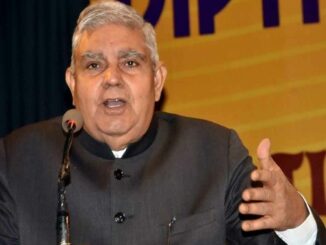
Addressing the 83rd Presiding Officers’ Conference in Jaipur last month, Vice-President and Rajya Sabha Chairman Jagdeep Dhankhar said the legislature’s autonomy could not be encroached either by the judiciary or the executive. And it is in this context that he questioned the ‘basic structure’ doctrine that the Supreme Court had expounded in the 1973 Kesavananda Bharati case.
Without offending the constitutional status that he holds as the Chairman of the Rajya Sabha, it seems that Dhankhar has misunderstood the intent and purport of the Kesavananda Bharati case, which spelt the ‘basic structure’ of the Constitution principle, and sought to make it into a criterion for reviewing the constitutional amendments passed by Parliament. It is not about the courts coming in the way of legislature and restricting the scope of the legislatures to enact laws. It is not about Parliament pitted against the judiciary or the other way round. It might sound like a doctrine, but it is not one. It is a thumb rule evolved by the Supreme Court for purposes of judicial review.
The Kesavananda Bharati case also did not set out a new principle of interpretation. It was following the distinctions made in the earlier pronouncements of the Supreme Court in the cases of Sankari Prasad Deo vs Union of India and State of Bihar (1952), Sajjan Singh vs State of Rajasthan (1965), and the definitive direction laid down in the IC Golaknath vs State of Punjab (1965) case. The issue was whether Parliament can amend the fundamental rights of Part III of the Constitution. There were no unanimous answers from the court. While some of the judges felt that that powers of Parliament to amend the Constitution given in Article 368 were unrestricted, and that Parliament can abridge, and even abrogate, fundamental rights, there were others who felt that the fundamental rights should remain inviolable.
It is necessary to remember that all these cases arose from challenges to the land reforms legislation in different states, and these laws were passed by the state legislatures, and these were protected by the constitutional amendments brought in by Parliament.
Article 31, which was about the right to property, and which was part of Part III or fundamental rights, was removed from the section through the 44th Amendment of the Constitution in 1978, but the questions that came up before the court in the above cases were related to the ‘right to property’. The courts discussed it in terms of fundamental rights and not specifically about the right to property.
In the Sajjan Singh case of 1965, then Chief Justice PB Gajendragadkar, who wrote the majority judgment, said: “The power conferred by Article 368 includes the power to take away the fundamental rights guaranteed by Part III…The fundamental rights guaranteed by Part III could not have been intended to be eternal, inviolate and beyond the reach of Article 368 for, even if the powers to amend the fundamental rights were not included in the Article, Parliament can by a suitable amendment of the Article take those powers.” It would seem that Gajendragadkar and the court were concerned about the social and economic challenges faced by a government in a developing country, and the view was that necessary social and economic reforms should not be obstructed by taking shelter behind fundamental rights. It was a dangerous position that the Gajendragadkar court had adopted. Fundamental rights were not just about the right to property.
It is in the Golaknath case that the court of Chief Justice Koka Subba Rao took a firm position on the issue of fundamental rights, or was it confined to the issue of the right to property? The majority statement delivered by Subba Rao is crystal clear on the issue: “Our Constitution accepted the theory that the right to property is a fundamental right though perhaps it was an error to do so if socialization was desired. It treated property rights as inviolable except through law for public good and payment of compensation….As there is apprehension that the erosion of right to property may be practiced against other fundamental rights, it is necessary to call a halt. An attempt to abridge or take away fundamental rights by a constituted Parliament even through an amendment of the Constitution can be declared void. The court has the power and the jurisdiction to do so. The opposite view expressed in the Sajjan Singh’s case is wrong.”
In the Kesavananda Bharati case, Chief Justice Sikri reiterated the essential point of the Golaknath case that fundamental rights are important and though Parliament has extensive powers to amend the Constitution, it cannot encroach upon the fundamental rights of the people. Sikri delivering the majority judgment wrote: “On a careful consideration of the various aspects of the case, we are convinced that Parliament has no power to abrogate or emasculate the basic elements or fundamental features of the Constitution such as the sovereignty of India, the democratic character of our polity, the unity of the country and the essential features of the individual freedoms secured to the citizens. Nor has Parliament the power to revoke the mandate to build a welfare state and egalitarian society. These limitations are only illustrative and not exhaustive.”
Between Golaknath and Kesavananda Bharati judgments, it is the Golaknath judgment that underscores fundamental rights as the raison d’etre of a democratic polity in an unambiguous language. Indians will have to choose between Gajendragadkar who had argued that fundamental rights are not eternal and not inviolable on the one side, and Subba Rao and Sikri on the other who had underlined the importance of democratic rights of people against the potential political tyranny of parliamentary majorities.
The issue of the ‘basic structure’ of the Constitution is a fight about the fundamental rights included in Part III of the Constitution. The Kesavananda Bharati case also shows that there is no conflict between the fundamental rights of Part III and the directive principles of state policy of Part IV, and that fundamental rights do not have to give way to create an egalitarian polity. The Preamble eloquently states the ideals of justice, liberty, equality and fraternity. The legal hair-splitting over the status of the Preamble, whether it is part of the Constitution or not seems unnecessary. The Constitution has served as a torchbearer of democratic freedoms in the last 72 years, and it is necessary to defend the Constitution against predatory politicians.
To suggest that the basic structure doctrine is by itself unsanctioned is to place the Constitution at the legislature’s whim
“Since its judgment in Kesavananda, the Supreme Court has identified several features that are immutable. There is no doubt that on occasion, the Court’s interpretation of these features has suffered from incoherence. But to suggest that the basic structure doctrine is by itself unsanctioned is to place the Constitution at the legislature’s whim. When taken to its extreme, accepting the Vice-President’s claims would mean that, in theory, Parliament can abrogate its own powers and appoint a person of its choice as the country’s dictator. Consider the consequences.”
By Suhrith Parthasarathy
Come April and it will be 50 years since the Supreme Court of India delivered its verdict in Kesavananda Bharati vs State of Kerala. The judgment is widely recognized as a milestone in India’s history. In holding that Parliament’s power to amend the Constitution was not plenary, that any change that damages the document’s basic structure would be declared void, the Court, it was understood, had helped preserve the essence of our republic.
In the years since the verdict – if not in its immediate aftermath – its importance has been recognized by successive governments. During this time, most criticism of the doctrine has been confined to the manner of its application rather than its legitimacy. But last week, India’s Vice-President Jagdeep Dhankhar launched a salvo of attacks at the Supreme Court, by calling into question the ruling’s correctness. Faced as we are with far greater issues of civic concern, this debate might well be regarded as tedious, if only the arguments made against the judgment were not part of what appears to be a concerted effort at undermining the judiciary’s importance.
Collegium as target
Over the course of the last few months, not a day has gone by without one member or the other of the political executive excoriating the Court over its apparent excesses. Much of this criticism has been aimed at the functioning of the collegium — a body of senior judges that makes binding recommendations on appointments and the transfer of judges. The Union Minister of Law and Justice, Kiren Rijiju, and indeed Mr. Dhankhar, have repeatedly doubted the Court’s judgment in 2015, in which it struck down efforts to replace the collegium with a National Judicial Appointments Commission (NJAC). That criticism has now turned sharper, with the Vice-President’s diatribe against Kesavananda.
In his maiden address to the Rajya Sabha in December 2022, Mr. Dhankhar claimed that the striking down of the NJAC had no parallels in democratic history. A “duly legitimized constitutional prescription,” he claimed, “has been judicially undone.” Speaking on January 11 at the 83rd All India Presiding Officers (Assembly Speakers) Conference in Jaipur, Rajasthan, he said that “in a democratic society, the basic of any basic structure is supremacy of people, sovereignty of parliament…The ultimate power is with the legislature. Legislature also decides who will be there in other institutions. In such a situation, all institutions must confine to their domains. One must not make incursion in the domain of others.”
Mr. Dhankar then heightened his criticism by doubting the legitimacy of the basic structure doctrine. The correctness of the Court’s view, he said, “must be deliberated…Can Parliament allow that its verdict will be subject to any other authority? In my maiden address after I assumed the office of Chairman of Rajya Sabha, I said this. I am not in doubt about it. This cannot happen.”
To be sure, genuine criticism of both the Collegium’s functioning and the Court’s judgment upholding the body’s legality ought to be welcomed. But seeing as the Government, as Mr. Rijiju confirmed in Parliament last month, has no plans to implement any systemic change in the way we appoint judges, and given that the Government itself has done little to promote transparency in the process, the present reproach is, at its best, unprincipled, and, at its worst, an attempt at subverting the judiciary’s autonomy. That it is likely the latter is clear from the fact that the Vice-President has now carried his denunciation to a point where his admonishments are reserved not just for the collegium but also for the ruling in Kesavananda.
The foundation of the Constitution
Were we to begin with the elementary premise that India’s Constitution, as originally adopted, comprises a set of principles that together lend it an identity, we will see that the raison d’etre for the basic structure doctrine is not difficult to grasp. On any reasonable reading of constitutional history, one can see that the Constitution is a product of a collective vision. That vision was built on distinct, if interwoven, ideals: among others, that India would be governed by the rule of law, that our structure of governance would rest on Westminster parliamentarianism, that the powers of the legislature, the executive and the judiciary would be separate, that the courts would be independent of government, and that our States would have absolute power over defined spheres of governance.
Now, ask yourself the following questions: what happens when an amendment made to the Constitution harms one or more of these principles in a manner that alters the Constitution’s identity? Would the Constitution remain the same Constitution that was adopted in 1950? Should Parliament amend the Constitution to replace the Westminster system with a presidential style of governance, would the Constitution’s character be preserved? Or consider something rather more radical: can Parliament, through amendment, efface the right to life guaranteed in Article 21? Would this not result in the creation of a document of governance that is no longer “the Constitution of India?”
It is by pondering over questions of this nature that the majority in Kesavananda found that there was much that was correct in the German professor Dietrich Conrad’s address in February 1965 at the Banaras Hindu University, Varanasi. There, Conrad had pointed out, that “any amending body organized within the statutory scheme, howsoever verbally unlimited its power, cannot by its very structure change the fundamental pillars supporting its constitutional authority”.
On ‘amendments’
As the Court would later explained in Minerva Mills vs Union of India (1980) — and incidentally at stake there was the very survival of the idea that fundamental rights are inviolable — “Parliament too is a creature of the Constitution”. Therefore, it can only have such powers that are expressly vested on it. If those powers are seen as unlimited, Parliament, the Court found, “would cease to be an authority under the Constitution”; it would instead “become supreme over it, because it would have power to alter the entire Constitution including its basic structure”. In other words, the principle that Parliament is proscribed from changing the Constitution’s essential features is rooted in the knowledge that the Constitution, as originally adopted, was built on an intelligible moral foundation.
On this construction, it is possible to see the basic structure doctrine as implicit on a reading of the Constitution as a whole. But it is also deductible, as Justice H.R. Khanna wrote in his controlling opinion in Kesavananda, through an interpretation of the word “amendment”. The dictionary defines “amendment” to mean a “minor change or addition designed to improve a text”. As Justice Khanna saw it, when the Constitution that emerges out of a process of amendment as stipulated in Article 368 is not merely the Constitution in an altered form but a Constitution that is devoid of its basic structure, the procedure undertaken ceases to be a mere amendment.
Since its judgment in Kesavananda, the Supreme Court has identified several features that are immutable. There is no doubt that on occasion, the Court’s interpretation of these features has suffered from incoherence. But to suggest that the basic structure doctrine is by itself unsanctioned is to place the Constitution at the legislature’s whim. When taken to its extreme, accepting the Vice-President’s claims would mean that, in theory, Parliament can abrogate its own powers and appoint a person of its choice as the country’s dictator. Consider the consequences.
(Suhrith Parthasarathy is an advocate practising in the Madras High Court)
Signup to our Newsletter!
Don’t miss out on all the happenings around the world