Tag: Khalistani

  • India must address US concerns on murder plot against Gurpatwant Pannun, say 5 Indian-American US Lawmakers

    India must address US concerns on murder plot against Gurpatwant Pannun, say 5 Indian-American US Lawmakers

    White House gives classified briefing on alleged murder plot

    • I.S. Saluja

    WASHINGTON, D.C. (TIP): Indian-American lawmakers have expressed deep concern over an Indian being charged with an alleged plot to kill Khalistani Gurpatwant Singh Pannun, an American-Canadian citizen.

    If the issue is not addressed appropriately, it could cause significant damage to the US-India partnership, they warned after a classified briefing by the Biden administration on Nikhil Gupta’s indictment.

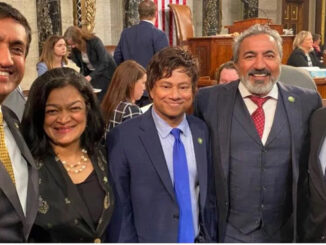
    Gupta was detained at the Prague airport in June in an action that came at the request of the US, the Czech government spokesman said on Friday, December 15. The US had submitted an extradition request two months later, they said. Friday’s classified briefings were attended by US Representatives Ami Bera, Pramila Jayapal, Ro Khanna, Raja Krishnamoorthi, and Shri Thanedar.

    “We believe the US-India partnership has made meaningful impact on the lives of both of our people, but we are concerned that the actions outlined in the indictment could, if not appropriately addressed, cause significant damage to this very consequential partnership,” they said in a statement.

    The US Congress members said the charges were deeply concerning and the safety of their constituents are their most important priority. They welcomed India’s move to form an enquiry committee but said it should assure the US that such incidents will not happen again.

    “We welcome the Government of India’s announcement of a Committee of Enquiry to investigate the murder plot and it is critical that India fully investigate, hold those responsible, including Indian government officials, accountable, and provide assurances that this will not happen again,” they said.

    Gupta, 52, moved the Supreme Court on Friday, December 15, via a family member and claimed multiple violations of fundamental rights, including threats to himself and his family, and requested the Indian government to intervene in his extradition to the US. The hearing has been adjourned till January 4.

    He claimed he was intercepted by “American agents” on his arrival in Prague, then bundled into a black SUV and interrogated for three hours while being driven around the foreign city. He claimed he was “forced” to eat only pork and beef during his first few days in the prison.

    Nikhil Gupta has been charged by US federal prosecutors with working with an Indian government employee in the foiled plot to kill Pannun, a designated terrorist in India.

    In September, Canadian Prime Minister Justin Trudeau had alleged the role of Indian agents in the June murder of another Khalistani terrorist, Hardeep Singh Nijjar, a Canadian citizen. India had rejected the allegations as “motivated”. However, the murder plot of another Khalistani, Gurpatwant Singh Pannun in the US, and US administration’s tough stand on the issue, has lent credence to the claims of Canadian Prime Minister that Indian agents were responsible for Nijjar’s murder. More and more people as also governments across the world do not seem to buy India government’s denials of involvement.
    (With inputs from agencies)

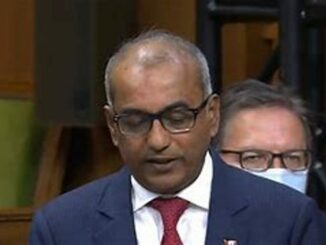
  • Indian-origin Canadian MP Chandra Arya slams posters by Khalistani supporters; says they continue to reach a new low

    Indian-origin Canadian MP Chandra Arya slams posters by Khalistani supporters; says they continue to reach a new low

    TORONTO (TIP): An Indian-origin MP in Canada has slammed the provocative pro-Khalistani posters labelling some senior Indian diplomats as “killers” and warned that the “snakes in our backyard are raising their heads and hissing.” Chandra Arya, a Liberal Party politician, who hails from Karnataka, also underlined that it was only a question of time when they would bite to kill, an apparent reference to the growing menace posed by Khalistan supporters in Canada.

    Tweeting a poster announcing the so-called ‘Khalistan Freedom Rally’ on July 8, Arya, who represents the Nepean constituency in Ontario province, said: “Khalistanis in Canada continue to reach (a) new low in abusing our Charter of Rights and Freedom by promoting violence and hate.”

    “Emboldened by non-criticism from elected officials of a recent Brampton parade portraying and celebrating the assassination of Indian Prime Minister Indira Gandhi by her bodyguards, they are now openly calling for violence against India diplomats,” Arya tweeted.

    “While it is good to see Canadian authorities are noticing, we should note the snakes in our backyard are raising their heads and hissing. It is only a question of time when they bite to kill,” the 59-year-old MP wrote on Twitter.

    The Khalistani poster has sparked outrage across India by calling India’s High Commissioner to Ottawa Sanjay Kumar Verma and Consul General in Toronto Apoorva Srivastava as “killers” of the Khalistan Tiger Force chief Hardeep Singh Nijjar.

    It came a month after Khalistanis, marking the 39th anniversary of Operation Blue Star, put up a tableau of late Prime Minister Indira Gandhi with blood on her clothes and a poster that read, “Revenge of attack on Shri Darbar Sahib”.

    India summoned the Canadian envoy in New Delhi on Monday and issued a demarche over the increasing activities by pro-Khalistani elements in Canada.

    It is learnt that India has also asked the Canadian authorities to take appropriate measures in view of planned protests by pro-Khalistan groups outside Indian missions in Canada on July 8.

    Canada on Tuesday assured India of the safety of its diplomats, a day after External Affairs Minister S Jaishankar said India has asked its partner countries such as Canada, the UK and the US not to give space to “extremist Khalistani ideology” as it is “not good” for relations.

    A statement by Canadian Foreign Minister Melanie Joly on Tuesday termed the “promotional material” circulating ahead of the Khalistan rally “unacceptable”.

    Joly, in the statement highlighting Canada’s adherence to the Vienna Conventions, said: “Canada takes its obligations under the Vienna Conventions regarding the safety of diplomats very seriously.”

    Joly also emphasized that the actions of a few individuals “do not speak for an entire community or Canada”.

    Jaishankar, when asked about reports of Khalistani posters in Canada naming Indian diplomats, said the issue will be raised with the government of that country. The “radical, extremist Khalistani ideology” is not good for India or its partner countries such as the US, Canada, the UK and Australia, he told reporters in New Delhi on Monday.

    The Khalistani issue has impacted ties between the two countries in many ways in the last few years, he said. India has been asking Canada against giving space to pro-Khalistani separatists and extremist elements, Jaishankar had said. India also summoned the Canadian High Commissioner Cameron MacKay on Tuesday to discuss the issue.

    Hardeep Singh Nijjar, the Khalistan Tiger Force (KTF) chief, was shot dead outside a gurdwara in Canada last month. Nijjar was one of India’s most-wanted terrorists and carried a cash reward of Rs 10 lakh on his head.

  • Another low: On the latest provocation by Canadian Sikh separatist groups in Canada

    Canada is doing very little to address India’s concerns on Sikh extremism

    A tableau, in Brampton, Canada, glorifying the assassination of former Prime Minister Indira Gandhi, has expectedly caused outrage across the polity in India. The tableau was part of an annual parade by Canadian Sikh separatist or “Khalistani” groups to mark their protest against Operation Bluestar, in 1984. An accompanying poster termed the killing as an act of “revenge”. Political leaders in India have called for Canada to apologize and to acknowledge the dangers of the rise of anti-Indian separatist and extremist forces. External Affairs Minister S. Jaishankar said the incident was part of a broader pattern, indicating that these forces pose a real challenge not only to the India-Canadian relationship but also to Canada itself. He suggested that the failure to act against these groups was due to a desire to cater to Canadian “vote-banks” that the much broader community of about 8,00,000 Sikhs constitute. He added that the culture of validating violence as an acceptable form of protest was one that should concern Canada’s leadership as well, given past incidents such as the bombing of an Air India flight in 1985. India-Canada relations have been fraught over similar issues, as India has been protesting incidents of vandalism and anti-India and anti-Modi graffiti on temples and community centers there, as well as over Canadian Prime Minister Justin Trudeau’s remarks criticizing the Narendra Modi government’s treatment of Punjab farmers who were protesting the 2020 agriculture Bill. As a result, India had called off high-level engagements and virtually snapped communications between New Delhi and Ottawa for several months before they were restored.

    The latest provocation could well lead to another such spiral, and both governments need to resolve the issues diplomatically if they want to avoid another nadir in bilateral ties. While the Canadian government is within its rights to protect free speech and expression in its country, it must understand India’s concern that tableaus that glorify the assassination of a Prime Minister constitute inflammatory hate speech and could fuel radicalism. Meanwhile, instead of seeking to shut down protests which are legal, or issuing démarche over every act of vandalism, it would be more productive if New Delhi is able to cooperate and share evidence of the extremist activity and terrorist acts such groups are conspiring on. Given that Khalistani protests have been seen in Australia, the United Kingdom, the United States and parts of Europe, the Modi government must now chalk out a broader diplomatic strategy to ensure a more effective way of dealing with the problem, which could even be discussed with the leaders of all these countries, who are expected to visit India in September for the G-20 summit.
    (The Hindu)