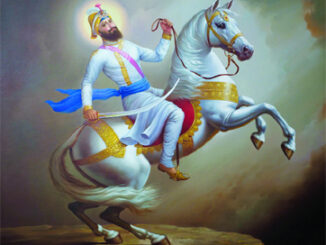
Tag: Khalsa Panth

  • Sikh leaders submit report to PM on safekeeping of Jore Sahib of Guru Gobind Singh and Mata Sahib Kaur

    Sikh leaders submit report to PM on safekeeping of Jore Sahib of Guru Gobind Singh and Mata Sahib Kaur

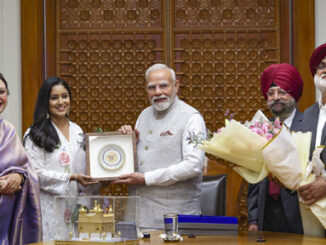
    NEW DELHI (TIP): Union Minister Hardeep Singh Puri, accompanied by prominent Sikh leaders, met with Prime Minister Narendra Modi on Friday, September 19, 2025, and submitted recommendations regarding the safekeeping and appropriate exhibition of the Jore Sahib relics — footwear attributed to Guru Gobind Singh and Mata Sahib Kaur that are believed to be 300 years old.

    In an X post, Mr. Puri stated that “along with a committee of several eminent and well-known members of the Sikh Sangat, I was deeply privileged to call on Hon’ble PM Sh @narendramodi Ji to submit the recommendations of the committee for the safekeeping and befitting display of holy ‘Jore Sahib’, belonging to the founder of Khalsa Panth, Dasam Pita Sri Guru Gobind Singh Ji Maharaj and his wife Mata Sahib Kaur Ji.

    “The holy ‘Jore Sahib’ are a footwear each of Guru Gobind Singh Ji Maharaj (right foot 11″ by 3½”) and his revered wife Mata Sahib Kaur Ji (left foot 9″ by 3″).

    The Puri family has been immensely blessed and fortunate to perform seva of these holy relics from the time these were bestowed upon our ancestors by Guru Sahib and Mata Ji themselves more than 300 years ago.

    Our ancestor had the great divine blessing to be in the direct service of Dasam Pita. Legend has it that pleased with his seva, Guru Maharaj commanded him to ask for any reward in return.
    Our ancestor requested Guru Sahib to kindly grant him his divine permission to keep the sacred ‘Jore Sahib’ so that the direct blessings of Guru Sahib and Mata Ji continue in his family and their generations to follow.

    The last custodian of the ‘Jore Sahib’ was my late cousin Sardar Jasmeet Singh Puri Ji who lived in Delhi’s Karol Bagh on a street which was subsequently named ‘Guru Gobind Singh Marg’ to honor the sanctity of the precious holy relics.

    Since I am one of the eldest members of the family now, his wife Manpreet Ji wrote to me to find an appropriate home for these holy relics so that the faithful could pay their obeisance to the revered ‘Jore Sahib’ in greater numbers.

    Subsequently, with utmost humility and reverence, I had the holy relics carefully examined by the Ministry of Culture. Carbon testing has also been done to establish their authenticity and supreme religious and spiritual importance.

    Members of the committee have made their recommendations and have presented a report for a decision befitting the holy ‘Jore Sahib’ to PM Modi Ji who has always expressed respect towards teachings of our Guru Sahibs and affection towards members of the Sikh Sangat.

    PM Modi Ji’s unmatched affection towards our Sangat reflects in several compassionate & visionary decisions taken under his farsighted leadership in the last transformative eleven years.
    PM Modi Ji has also taken keen personal interest in matters pertaining to enhancement of several Sikh religious places and in ensuring better connectivity and accessibility to these centers of pilgrimage.

    Posting about his meeting with Sikh community leaders, the PM wrote on X that he is very happy with the meeting in which he was given recommendations with regard to the safekeeping and display of the “immensely sacred and invaluable holy Jore Sahib of Sri Guru Gobind Singh Ji, and Mata Sahib Kaur Ji.”

    “Holy relics as significant and spiritually important as the Jore Sahib are as much a part of the glorious Sikh history as they are of the cultural ethos of our nation,” the PM added.

  • Guru Gobind Singh: The Founder of Khalsa Panth

    Guru Gobind Singh: The Founder of Khalsa Panth

    The establishment of the Khalsa Panth by Guru Gobind Singh Ji on 13 April 1699 (Baisakhi) marked a transformative moment in Sikh history. It was a revolutionary initiative aimed at empowering the Sikh community, uniting them under a common identity, and preparing them to confront religious persecution and social injustices. This section explores the events leading to the formation of the Khalsa, its rituals and significance, and its impact on Sikhism and society.
    Context Leading to the Creation of the Khalsa
    The political and religious environment in India during Guru Gobind Singh’s time was rife with oppression. The Mughal Emperor Aurangzeb pursued aggressive policies to enforce Islamic supremacy, resulting in widespread persecution of non-Muslims.
    – Religious Oppression: The Mughal administration imposed jizya (religious tax) on Hindus and sought to convert them forcibly. Temples were destroyed, and religious practices were restricted.
    – Guru Tegh Bahadur’s Sacrifice: The execution of Guru Gobind Singh’s father, Guru Tegh Bahadur, for defending the rights of Hindus and Sikhs, was a pivotal moment. It underscored the need for a community prepared to resist tyranny.
    – Internal Challenges: The Sikh community faced fragmentation and lacked a unified identity. Guru Gobind Singh recognized the need to strengthen their spiritual and martial resolve.
    Preparations for the Khalsa
    Guru Gobind Singh spent years preparing the Sikh community for the creation of the Khalsa. Anandpur Sahib became a center for spiritual and martial training, attracting followers from various regions.
    – Building Unity: Through teachings, hymns, and discourses, the Guru instilled a sense of equality, courage, and devotion among his followers.
    – Martial Training: Sikhs were encouraged to learn combat skills, ensuring they were prepared to defend themselves and others.
    – Symbolism of Equality: The Guru emphasized the oneness of humanity, rejecting caste-based discrimination and promoting social justice.
    The First Baisakhi of the Khalsa
    The historic event took place on 13 April 1699 at Anandpur Sahib. Guru Gobind Singh organized a grand congregation, inviting Sikhs from across India.
    – The Sword and the Call for Sacrifice: The Guru stood before the assembled crowd, holding a sword, and asked, “Who is willing to give their head for the faith?”
    – After an initial moment of hesitation, Daya Ram (later Bhai Daya Singh) stepped forward, offering his life. The Guru took him into a tent and later emerged with a blood-stained sword. This process was repeated with four more volunteers: Dharam Das, Himmat Rai, Mohkam Chand, and Sahib Chand.
    – The Five Beloved Ones (Panj Pyare): These five men, from diverse backgrounds and castes, were the first initiates of the Khalsa. They became known as the Panj Pyare, symbolizing the elimination of caste and social distinctions.
    The Initiation Ceremony: Amrit Sanchar
    Guru Gobind Singh introduced the Amrit Sanchar (baptism) ceremony, where the Panj Pyare were initiated into the Khalsa.
    – Preparation of Amrit: The Guru stirred water and sugar crystals in an iron bowl using a double-edged sword (Khanda) while reciting five sacred hymns from Sikh scripture.
    – Initiation Process: The initiates drank the Amrit, symbolizing their commitment to the Khalsa ideals, and were sprinkled with it five times on their hair and eyes.
    – Code of Conduct: The Guru instructed the Khalsa to adhere to a strict moral and spiritual code, including daily prayers, ethical conduct, and readiness for self-defense.
    The Five Ks (Panj Kakkars)
    Guru Gobind Singh mandated that every Khalsa Sikh adopt five articles of faith, known as the Five Ks. These symbols served as a constant reminder of their commitment to the Guru’s teachings.
    – Kesh (uncut hair): Symbolizing spirituality and acceptance of God’s will.
    – Kangha (wooden comb): Representing cleanliness and discipline.
    – Kara (iron bracelet): Signifying unity with God and restraint in actions.
    – Kirpan (sword): Denoting courage and the responsibility to protect the weak.
    – Kachera (cotton undergarments): Symbolizing modesty and self-control.
    The New Identity: Singh and Kaur
    Guru Gobind Singh bestowed a new identity upon his followers, erasing distinctions of caste, class, and gender.
    – Singh and Kaur: Men were given the surname Singh (lion), and women were given Kaur (princess). This affirmed their equality and regal dignity.
    – Transformation of the Individual: The Khalsa was envisioned as a saint-soldier, combining spiritual wisdom with martial prowess.
    Guru Gobind Singh’s Own Initiation
    In a remarkable act of humility, Guru Gobind Singh asked the Panj Pyare to initiate him into the Khalsa. This act emphasized the equality of all members of the Khalsa and demonstrated his commitment to the principles he had established.
    Objectives of the Khalsa
    The creation of the Khalsa was not merely a religious initiative but a socio-political revolution aimed at empowering the oppressed.
    – Defense of Dharma: The Khalsa was tasked with protecting the rights and freedoms of all people, regardless of religion or caste.
    – Promotion of Equality: By erasing social distinctions, the Khalsa fostered unity and brotherhood.
    – Spiritual Discipline: Members were encouraged to live righteous lives, adhering to the principles of Sikhism.
    Impact of the Khalsa on Sikhism
    The establishment of the Khalsa had a profound and lasting impact on Sikhism.
    – Unity and Strength: The Khalsa provided a unified identity and a sense of purpose to the Sikh community.
    – Resistance to Oppression: The Khalsa became a formidable force, challenging Mughal tyranny and inspiring other oppressed communities.
    – Legacy of Leadership: The principles and institutions established by the Khalsa continue to guide Sikhs worldwide.
    Challenges and Sacrifices
    The formation of the Khalsa brought with it significant challenges. Members faced persecution and had to endure immense sacrifices to uphold their principles. However, their resilience and dedication became a source of inspiration for generations to come.

    The establishment of the Khalsa by Guru Gobind Singh was a defining moment in Sikh history, symbolizing the union of spirituality and courage. By creating the Khalsa, the Guru empowered his followers to stand against injustice and to live with dignity and purpose. The Khalsa remains a cornerstone of Sikh identity, embodying the values of equality, justice, and selfless service.
    Guru Gobind Singh: Literary Contributions and Philosophy
    Guru Gobind Singh was not only a spiritual leader and warrior but also a prolific scholar and poet. His literary works, composed in multiple languages including Punjabi, Braj, Persian, and Sanskrit, reflect his philosophical depth, spiritual wisdom, and vision for a just society. This section delves into the Guru’s literary contributions, their themes, and their enduring significance.

  • Guru Gobind Singh: The Saint Soldier and founder of Khalsa Panth

    Guru Gobind Singh: The Saint Soldier and founder of Khalsa Panth

    Guru Gobind Singh Sahib, the 10th master of the Sikhism, was born on 7th day of the month of POH, samvat 1723, (22nd December, 1666 AD ) at Patna Sahib in Bihar. Guru ji was a great revolutionary whose greatest achievement was the creation of the Khalsa Panth on Baisakhi Day of 1699 at Anandpur Sahib in Punjab. Guru ji was a linguistic familiar with many languages Iike, Persian, Arabic, Sanskrit as well as his native Punjabi. Guru ji codified Sikh law,wrote martial poetry and music ,fought many battles and won. Guru ji wrote the renowned holy Granth called the Dasam Granth.The noted prayers included in this Granth are Jaap Sahib, Chandi Di Vaar, Tav-Prasad Savaiye, Zafarnamah, Bachittar Natak, Akal Ustat, Chaupai Sahib and more.
    Guru Gobind Singh Sahib Ji was a revolutionary prophet who practiced his spiritual ideals to counter the forces of tyranny and injustice. Tyranny in all its forms – social, political, and religious was to be countered and annihilated. A state which could not provide basic human rights, social justice, equality and religious freedom was to be opposed. A God oriented person, owed primary allegiance to God, truth, conscience and morality. Guru Gobind Singh was concern were universal, integrated and without any boundaries. The martyrdom of Guru ji’s father, mother, four sons and hundreds of followers for the lofty ideals of freedom, justice and righteousness were unique in the annals of human history. Guru Gobind Singh Ji ignited that spark in human nature that inspired mankind to build lives of compassion, love and commitment to justice and also to suffer and make sacrifices for the cause of righteousness.
    Sir J. D.Cunningham, the noted author of the book “, History Of The Sikhs”,wrote about Guru Gobind Singh Sahib Ji as under:
    A living spirit possess the whole Sikh people and the impression of Guru Gobind Singh Ji has not only elevated and attired the constitution of their minds but has operated materially and given amplitude to their physical frames ,”The Khalsa ideals transformed the life, outlook and aspirations of the people and imparted a new direction to Indian history”.
    In the words of Gurudev Rabindra Nath Tagore, “Guru Gobind Singh Ji appeared on the Indian National scene with the message of militarism of the community for the defence of social equality and religious freedom. In order to execute his plan, Guru Gobind Singh Sahib Ji unified the Sikhs, taught them how to face any crisis calmly and boldly and generated a new hope and confidence “.
    Guru Gobind Singh Sahib Ji came to reside Anandpur Sahib along with his parents, when he was a child of 7 years old. After some years, a deputation of Kashmiri Pandits came to Anandpur Sahib and met his father, the 9th Sikh Guru, Shree Guru Tegh Bahadur Sahib ji. They narrated the cruel acts of Mughal rulers towards the Hindu community and sought Guru Ji’s help. Guru Tegh Bahadur Ji became silent and was absorbed in deep thoughts. Guru Gobind Singh ii,who was, at that time, a child of just 9 years of age, asked his father about the reason for his silence. Guru Tegh Bahadur Ji explained that these helpless people from Kashmir had no one to protect their Dharma. The sacrifice of a great and brave soul was needed.The child, Guru Gobind Singh Ji, immediately Said ,”Who can be more brave and greater than you? Please have mercy on them and do what is necessary to protect “Hindu Dharma “.
    Guru Tegh Bahadur Ji was pleased to hear this and went to Delhi to sacrifice his life only to save the Hindu Dharma. The Mughal emperor Aurangzeb asked Guru Ji to either embrace Islam or face death.Guru Tegh Bahadur ji replied, “My religion is most dear to me. I am not afraid of death ” At this, Aurangzeb ordered the execution of Guru Tegh Bahadur Ji.
    Guru Ji was to be beheaded at the Main Bazar of Chandni Chowk, Delhi.At the Chandni Chowk in Delhi, where the great Gurudwara Sri Sisganj Sahib stands today, was the place chosen for Guru Ji’s execution. Guru Tegh Bahadur Ji died a hero’s death. Guru ji’s execution only strengthened the resistance against Aurangzeb’s religious fanaticism. When Guru Gobind Singh was told that no one came forward to protest because of the fear of death, Guru Ji declared that he would lay the foundation of the Khalsa Panth and would train it in such a way that it’s members would be ready to sacrifice everything for the right cause.
    Guru Gobind Singh Ji’s creation of Khalsa Panth in 1699 AD , on the Baisakhi day at Anandpur Sahib was an event of world significance. Noted historian Arnold Tonybee has called it the precursor and forerunner of Lennin’s communist party two centuries later in the history, an idealistic minority fighting with the weapons of adversity in the name of God , for the sake of majority.
    Guru ji baptised the 5 chosen Sikhs by administering Amrit ,prepared by a double edged sword,sweetened by dissolving “Battashas ” in to the water, to them.They were called as the five chosen loved ones, Panj Pyare.
    They were given the surname of Singh, and were called as Khalsa, the army of lord God:
    “Khalsa Akalpurkh Ki Fauj,
    Pargatiyo Khalsa,
    Parmatam Ki Mauj!’
    (KHALSA is the army of the eternal God raised by him out of his pleasure)
    Guru ji held his Chosen five in so high esteem that he knelt before them and asked them to initiate himself into the Khalsa Panth in the same manner as he had done them. Guru ji was then administered Amrit in the same way and was given the surname Singh (Previously Guru ji’s name was Gobind Rai)
    The Khalsa, with God’s light shining within was meant to be a global society. They were not to form a separate denomination as that was totally against the Guru Ji concept of universal brotherhood. The creation of the Khalsa Panth was a crowning event of Guru Gobind Singh ji’s life. Ideologically, the creation of the KHALSA PANTH aimed at a well balanced combination of the ideals of Bhakti and Shakti, of moral spiritual excellence and militant valour and heroism of the highest order. They were expected to salute one another with words,
    “Wahe Guru Ji Ka Khalsa
    Wahe Guru Ji Ki Fateh!”
    This was meant to remind that they were knighted as God’s soldiers to carry out his mission and that victory was theirs.
    But the Khalsa, the ‘Singhs”, were not to be merely soldiers. It was imperative that they must at the same time be saints deeply devoted to God, singing his hymns as composed by Sikh Gurus, observing the daily religious discipline prescribed in Rahit Maryaada of the Khalsa Panth and bearing a high moral character. Guru Gobind Singh Ji, though, was a matchless warrior, always remained a Saint at heart.Guru ji was a Saint who had dedicated himself to God,a God intoxicated philosopher Guru ji was a sincere lover of mankind who wanted to see all manmade differences created by barriers of formal religion and social distinctions brought in by caste, to be oblitered from the society.
    Guru ji left for his heavenly abode on October 7th, 1708 at a place, Naded, in Maharashtra due to a conspiracy hatched against him by Nawaab Wazir Khan of Punjab. Guru ji,before leaving for his heavenly abode, declared that the Sikh community be guided by the decisions of “Panj Piayrey”, the chosen five, chosen from among the devotees. Guru ji handed over the stewardship of the Sikh Panth, the Sikh way of life, to holy Guru Grant Sahib Ji .Those, who wished to seek God ,can find him in the holy Guru Grant Sahib. Ji.
    In conclusion, it can be said that Guru Gobind Singh Sahib Ji, the son of martyred Guru Tegh Bahadur Ji, the great grandson of 5th Sikh Guru, Shree Guru Arjan Dev Ji, who also attained martyrdom at Lahore .(Guru Arjan Dev Ji was martyred for compiling the 1st official version of the holy scripture called the Adi Granth, which later was expanded in to the holy Guru Granth Sahib Ji.), laid at the altar of Almighty, all that that he could call his own, his father, mother, his four sons and even his entire life for the freedom of all including those who considered themselves his enemy.
    The man and his philosophy
    A divine messenger, a warrior, a poet, and a philosopher, Guru Gobind Singh molded the Sikh religion into its present shape, with the institution of the Khalsa fraternity, and the completion of the sacred scripture, the Guru Granth Sahib, in the final form that we find today. Before leaving his mortal body in 1708, Guru Gobind Singh decreed the Guru Granth Sahib as the next and perpetual Guru of the Sikhs.
    It may not be out of context to consider that throughout the chronicles of human history, there has been no individual who lived a life more inspirational than Guru Gobind Singh. He is variously revered as Sarbans Dani (the merciful donor, who sacrificed his all), Mard Agamra (man without any parallels), Shah-e-Shahenshah (emperor of emperors), Bar do Alam Shah (ruler of both worlds), amongst others.
    It is said that after the martyrdom of his father, Guru Teg Bahadur, the tenth Master declared that he would create such a Panth (community/society), which would challenge the tyrant rulers in every walk of life to restore justice, equality and peace for all of mankind. Via institution of the Khalsa in 1699, Guru Gobind Singh Ji infused the dual spirit of a saint and a soldier in the minds and hearts of his followers to fight oppression in order to restore righteousness (Dharma) and to uplift the down-trodden people in this world.
    As a prophet, the Guru is unique. His teachings are very scientific and most suitable for all times. Unlike many other prophets he never called himself God or ‘the only son of God.’ Instead he called all people the sons of God sharing His Kingdom equally. For himself he used the word ‘slave’ or servant of God.
    A splendid Divine Light shone in the darkness of the night. Pir Bhikan Shah a Muslim mystic performed his prayers in that Easterly direction (instead of towards the West, contrary to his daily practice), and guided by this Divine Light, he travelled with a group of his followers until he reached Patna Sahib in Bihar. It was here that Gobind Rai was born to Mata Gujri. It is said that Pir Bhikan Shah approached the child and offered two bowls of milk and water, signifying both the great religions of Hinduism and Islam. The child smiled and placed his hands on both bowls. The Pir bowed in utter humility and reverence to the new Prophet of all humanity.
    Gobind Rai was born with a holy mission of which he tells us in his autobiography “Bachitar Natak” (Wonderous Drama). In it Guru Ji tells us how and for what purpose he was sent into this world by God. He states that before he came into this world , as a free spirit he was engaged in meditation in the seven peaked Hemkunt mountain.
    Early Life
    Gobind Rai’s father, Guru Teg Bahadur, the Ninth Guru, was then travelling across Bengal and Assam. Returning to Patna in 1670, he directed his family to return to the Punjab. On the site of the house at Patna in which Gobind Rai was born and where he spent his early childhood now stands a sacred shrine, Sri Patna Sahib Gurdwara, Bihar.
    Gobind Rai was escorted to Anandpur (then known as Chakk Nanaki) on the foothills of the Sivaliks where he reached in March 1672 and where his early education included reading and writing of Punjabi, Braj, Sanskrit and Persian. He was barely nine years of age when a sudden turn came in his life as well as in the life of the community he was destined to lead.
    Kashmiri Brahmins come to Anandpur
    Early in 1675, a group of Kashmiri brahmins under the leadership of Pandit Kirpa Ram, mad in desperation by the religious fanaticism of the Mughals General, Iftikar Khan, (he had threatened them with forced conversion to Islam) visited Anandpur to seek Guru Teg Bahadur’s advice. Aurangzeb had ordered the forced conversion of all Hindus and thought that if the respected Kashmiri brahmans accepted Islam, others in the country would be easily converted. They had been given six months to decide or suffer the consequences. Time was running out!
    As the Guru sat reflecting what to do, young Gobind Rai, arriving there in company with his playmates, asked why he looked so preoccupied. The father, as records Kuir Singh in his Gurbilas Patshahi 10, replied, “Grave are the burdens the earth bears. She will be redeemed only if a truly worthy person comes forward to lay down his head. Distress will then be expunged and happiness ushered in.” “None could be worthier than you to make such a sacrifice,” remarked Gobind Rai in his innocent manner. Guru Teg Bahadur advised the brahmins to return to their village and tell the authorities that they would accept Islam if Guru Teg Bahadur could first be persuaded to do so.
    Soon afterwards the Guru with a few followers proceeded to the imperial capital, Delhi. After watching the tortured deaths of three of his followers he, as well, refused to convert and was beheaded on November 11, 1675. The 13 year old Gobind Rai, ordained as the next Guru before his father departed Anandpur, was formally installed as Guru Gobind Singh on the Baisakhi day of March 1676. In the midst of his engagement with the concerns of the community, he gave attention to the mastery of physical skills and literary accomplishment. He had grown into a comely youth spare, lithe of limb and energetic.
    He had a natural genius for poetic composition and his early years were assiduously given to this pursuit. The Var Sri Bhagauti Ji Ki, popularly called Chandi di Var. written in 1684, was his first composition and his only major work in the Punjabi language. The poem depicted the legendary contest between the gods and the demons as described in the Markandeya Purana. The choice of a warlike theme for this and a number of his later compositions such as the two Chandi Charitras, mostly in Braj, was made to infuse martial spirit among his followers to prepare them to stand up against injustice and tyranny.
    For the first 20 years or so of his life, Guru Gobind Singh lived peacefully at Anandpur practicing arms and exercises to complete his training as a soldier.
    He also studied Persian and Sanskrit and engaged 52 poets to translate the Hindu epics. Stories of ancient heroes were translated into Punjabi in order to create the martial spirit among the Sikhs. The Guru also wrote several compositions including Jaap Sahib, Akal Ustat and Sawayas during this period. He also established a Gurdwara at Paonta Sahib on the banks of the river Jamna.
    Stay at Paonta Sahib
    Much of Guru Gobind Singh’s creative literary work was done at Paonta he had founded on the banks of the River Yamuna and to which site he had temporarily shifted in April 1685. Poetry as such was, however, not his aim. For him it was a means of revealing the divine principle and concretizing a personal vision of the Supreme Being that had been vouchsafed to him. His Jap Sahib, Swayas and the composition known as Akal Ustat are in this tenor.
    Through his poetry he preached love and equality and a strictly ethical and moral code of conduct. He preached the worship of the One Supreme Being, deprecating idolatry and superstitious beliefs and observances. The glorification of the sword itself which he eulogized as Bhagauti was to secure fulfillment of God’s justice. The sword was never meant as a symbol of aggression, and it was never to be used for self-aggrandizement. It was the emblem of manliness and self-respect and was to be used only in self-defence, as a last resort.
    Martial training
    During his stay at Paonta, Guru Gobind Singh availed himself of his spare time to practice different forms of manly exercises, such as riding, swimming and archery. His increasing influence among the people and the martial exercises of his men excited the jealousy of the neighbouring Rajput hill rulers who led by Raja Fateh Chand of Garhwal collected a host to attack him. But they were worsted in an action at Bhangam, about 10 km north-east of Paonta, in September 1688. Soon thereafter Guru Gobind Singh left Paonta Sahib and returned to Anandpur. The Guru and his Sikhs were involved in a battle with a Mughal commander, Alif Khan, at Nadaur on the left bank of the Beas, about 30 km south-east of Kangra, in March 1691.
    Describing the battle in stirring verse in Bachitra Natak, he said that Alif Khan fled in utter disarray “without being able to give any attention to his camp.” Among several other battles that occurred was the Husain battle (20 February 1696) fought against Husain Khan, an imperial general, which resulted in a decisive victory for the Sikhs.
    Following the appointment in 1694 of the liberal Prince Muazzam (later Emperor Bahadur Shah) as viceroy of north-western region including Punjab, there was however a brief respite from pressure from the ruling authority. In Sambat 1756 (1699 A.D), Guru Gobind Singh issued directions to Sikh sangats or communities in different parts not to acknowledge masands, the local ministers, against whom he had heard complaints. He asked the Sikhs to send their offerings directly to Anandpur.
    The Masands
    The Guru received various complaints against the priests, masands who robbed the poor Sikhs and misappropriated the collections. Guru Sahib abolished this order and severly punished the miscreants. Hereafter, the faithful were to bring their offerings directly to the Guru at the time of the annual Vaisakhi fair. The Guru wanted to create a strong self-respecting community. He inspired the Sikhs with courage and heroism and a life of simplicity and hard work. He started an arms factory at Anandpur in order to manufacture swords and lances needed for his soldiers. Once when the Brahmins insisted that he should offer worship to goddess Durga in order to seal victory, he agreed and kept up the farce till nothing came out of it. At the crucial moment, the Guru unsheathed his sword exclaiming, “The sword is the Durga which will give us victory over our enemies.
    Sikhs, he instructed, should come to Anandpur straight without any intermediaries. The Guru thus established direct relationship with his Sikhs. The institution of the Khalsa was given concrete form on 30 March 1699 when Sikhs had gathered at Anandpur in large numbers for the annual festival of Baisakhi.
    Creation of the Khalsa
    An open air diwan was held in Kesgarh Sahib at Anandpur. The Guru drew his sword and in a thundering voice said, “I want one head, is there any one who can offer me?”
    This most unusual call caused some terror in the gathering and the people were stunned. There was dead silence. The Guru made a second call. Nobody came forward. There was still more silence. On the third call there raised Daya Ram, a khatri of Lahore who said, “O true king, my head is at your service.”
    The Guru took Daya Ram by the arm and led him inside a tent. A blow and thud were heard. Then the Guru, with his sword dripping with blood, came out and said, “I want another head, is there anyone who can offer?” Again on third call Dharam Das, a Jat from Delhi came forward and said, “O true king! My head is at thy disposal.” The Guru took Dharam Das inside the tent, again a blow and thud were heard, and he came out with his sword dripping with blood and repeated, “I want another head, is there any beloved Sikh who can offer it?”
    Upon this some people in the assembly remarked that the Guru had lost all reason and went to his mother to complain. Mohkam Chand, a calico priner/tailor of Dwarka (west coast of India) offered himself as a sacrifice. The Guru took him inside the tent and went through the same process. When he came out, he made a call for the fourth head. The Sikhs began to think that he was going to kill all of them.
    Some of them ran away and the others hung their heads down in disbelief. Himmat Chand, a cook of Jagan Nath Puri, offered himself as a fourth sacrifice. Then the Guru made a fifth and the last call for a fifth head. Sahib Chand, a barber of Bidar (in central India), came forward and the Guru took him inside the tent. A blow and thud were heard.
    The last time he stayed longer in the tent. People began to breathe with relief. They thought may be the Guru has realised “his mistake” and has now stopped.
    The panj pyare
    The Guru now clad his five volunteers in splendid garments. They had offered their heads to the Guru, and the Guru had now given them himself and his glory. When they were brought outside, they were in the most radiant form. There were exclamations of wonder and the sighs of regret on all sides. Now people were sorry for not offering their heads.
    Since the time of Guru Nanak, Charan Pauhal had been the customary form of initiation. People were to drink the holy water which had been touched or washed by the Guru’s toe or feet. The Guru proceeded to initiate them to his new order (Khande di Pauhal) by asking the five faithful Sikhs to stand up. He put pure water into an iron vessel or Bowl (Batta of Sarbloh) and stirred it with a Khanda (two edged small sword). While stirring the water with Khanda, he recited Gurbani (Five Banis- Japji, Jaap Sahib, Anand Sahib, Swayas, and Chaupai). Sugar crystals called ‘Patasas’ which incidently the Guru’s wife, Mata Sahib Kaur, had brought at that moment, were mixed in the water.
    Amrit Sanchar
    The Guru then stood up with the sacred Amrit (nectar) prepared in the iron bowl. Each of the five faithful, by turn, each kneeling upon his left knee, looked up to the Master to receive the divine amrit. He gave five palmfuls of Amrit to each of them to drink and sprinkled it five times in the eyes, asking them to repeat aloud with each sprinkle, “Waheguru Ji ka Khalsa, Waheguru Ji Ki Fateh.” (This means: Khalsa belongs to God and all triumph be to His Name) Then he anointed with five sprinkles in the hair.
    In this way Amrit was administered to the five faithful from the same bowl. After that he asked them to sip Amrit from the same bowl to signify their initiation into the casteless fraternity of the Khalsa. All the five faithful were baptized in this way by the Guru who then called them the ‘PANJ PYARE’ or Five Beloved Ones.
    He gave them the appellation of Singhs (Lions) and they were named from Daya Ram to Daya Singh, Dharam Das to Dharam Singh, Mohkam Chand to Mohkam Singh, Himmat Chand to Himmat Singh, and Sahib Chand to Sahib Singh. The Guru then addressed them as the supreme, the liberated ones, pure ones and he called them The Khalsa.
    Guru asks for Amrit
    After the Guru had administered Amrit to his Five Beloved Ones, he stood up in supplication and with folded hands, begged them to baptize him in the same way as he had baptized them. He himself became their disciple (Wonderful is Guru Gobind Singh, himself the Master and himself the disciple). The Five Beloved Ones were astonished at such a proposal, and represented their own unworthiness, and the greatness of the Guru, whom they deemed God’s Vicar upon earth. They asked him why he made such a request and why he stood in a supplicant posture before them. He replied,” I am the son of the Immortal God. It is by His order I have been born and have established this form of baptism. They who accept it shall henceforth be known as the Khalsa. The Khalsa is the Guru and the Guru is the Khalsa. There is no difference between you and me. As Guru Nanak seated Guru Angad on the throne, so have I made you also a Guru. Wherefore administer the baptismal nectar to me without any hesitation.” Accordingly the Five Beloved Ones baptized the Guru with the same ceremonies and injunctions he himself had employed.
    The rise of the Khalsa
    The Guru was then named Gobind Singh instead of Gobind Rai. Guru Gobind Singh was the first one to take Amrit from the Khalsa, the Five Beloved Ones. About 80,000 men and women were baptized within a few days at Anandpur. “The creation of the Khalsa was the greatest work of the Guru. He created a type of superman, a universal man of God, casteless and country less. The Guru regarded himself as the servant of the Khalsa. He said, “To serve them pleases me the most; no other service is so dear to my soul.” The Khalsa was the spearhead of resistance against tyranny.” (Miss Pearl, S. Buck)
    The creation of the Khalsa created a sense of unity among the Sikhs and their supporters. This unity and the resulting perceived strength in the Sikhs did not go well with the local rulers. The continuous gatherings at Anandpur sahib and the presence of many thousands of the congregation, some armed with fierce weapons caused anguish with the surrounding hill Rajas. These developments most alarmed the caste ridden Rajput chiefs of the Sivalik hills. They perceived the Sikhs as lower caste beings who had posed no danger to their authority. However, the creation of the Khalsa changed that. Firstly, it disturbed their system of discrimination and division; secondly, they could see that the forces of the Guru were becoming dangerous in number and in armaments.
    Siege of Anandpur
    They hence rallied under the leadership of the Raja of Bilaspur, in whose territory lay Anandpur, to forcibly evict Guru Gobind Singh from his hilly citadel. Their repeated expeditions during 1700-04 however proved abortive. The Khalsa forces were too strong to be dealt with by the hill Rajas. They at last petitioned Emperor Aurangzeb for help. In concert with contingents sent under imperial orders by the governor of Lahore and those of the faujdar of Sirhind, they marched upon Anandpur and laid a siege to the fort in May 1705.
    Over the months, the Guru and his Sikhs firmly withstood their successive assaults despite insufficient amounts of food resulting from the prolonged blockade. While the besieged (Sikhs) were reduced to desperate straits, the besiegers (governor of Lahore) too were exhausted at the courage of the Sikhs. At this stage the besiegers offered, on Oath (promise) of the Qur’an, safe exit to the Sikhs if they quit Anandpur. At last, the town was evacuated during a night of December 1705. But as the Guru and his Sikhs came out, the hill monarchs and their Mughal allies set upon them in full fury.
    Sikhs tricked by the Mughals
    In the ensuing confusion many Sikhs were killed and all of the Guru’s baggage, including most of the precious manuscripts, was lost. The Guru himself was able to make his way to Chamkaur, 40 km southwest of Anandpur, with barely 40 Sikhs and his two elder sons. There the imperial army, following closely on his heels, caught up with him. His two sons, Ajit Singh (born. 1687) and Jujhar Singh (born. 1691) and all but five of the Sikhs fell in the action that took place on 7 December 1705. The five surviving Sikhs commanded the Guru to save himself in order to reconsolidate the Khalsa.

  • Contributions of Guru Gobind Singh

    Guru Gobind Singh succeeded his father Guru Teg Bahadur at the age of 9. His teachings were different from his predecessors’ – he believed that no power could exploit the Sikhs.
    He spent his childhood years studying Persian and Sanskrit, and was skilled in the art of war. His mission was to uphold right in every place and destroy sin and evil. In 1699 he chose the festival day of Vaisakhi as the occasion to transform the Sikhs into the Khalsa, a family of soldier saints. Guru Gobind Singh introduced many of the customs that Sikhs practise today.
    Sikhs who have been through the Amrit ceremony of initiation become Amritdhari, initiated Sikhs. They take new names and wear the 5 Ks – five physical symbols that Sikhs must wear.
    He declared the the Sikh holy book as his successor instead of a human being. The Guru Granth Sahib would thus be the Sikhs’ guide forever. Sikhs give it the same status and respect as a human Guru.
    In 1699 the tenth guru, Guru Gobind Singh, chose Vaisakhi as the occasion to transform the Sikhs into a family of soldier saints, known as the Khalsa Panth.
    Guru Gobind Singh founded the Khalsa in front of thousands at Anandpur Sahib.
    During the Vaisakhi festival Guru Gobind Singh came out of a tent carrying a sword. He challenged any Sikh who was prepared to give his life to come into the tent. The Guru returned alone with his sword covered in blood. He then requested another volunteer and repeated the same action four times until five men disappeared into the tent. The crowd was very concerned until they saw five men return wearing turbans with the Guru.
    These five men became known as the Panj Piare, or ‘Beloved Five’.
    The men were then baptised into the Khalsa by the Guru. He sprinkled them with Amrit (‘immortalising nectar’: the Sikh term for holy water) and said prayers. This is the basis of the Sikh baptism ceremony.
    Vaisakhi is celebrated in much the same way as Gurpurbs. Gudwaras are decorated and visited. Parades, dancing and singing happen throughout the day. Many Sikhs choose to be baptised into the Khalsa brotherhood on this day.
    The festival is marked with nagar kirtan processions: processions through the streets (nagar means “town”) which form an important part of Sikh culture and religious celebrations.
    Kirtan is a term meaning the singing of hymns from the Guru Grath Sahib, the Sikh holy book. Celebrations always include music, singing and chanting scriptures and hymns.
    The processions are led by traditionally dressed Panj Piaras.
    The Guru Granth Sahib will be carried in the procession in a place of honour.
    Amrit Ceremony
    Sikhs who have been through the Amrit Ceremony of initiation, or Amrit Sanskar, become baptised Sikhs, take new names, and wear the 5 Ks.
    The Amrit Ceremony is the initiation rite introduced by Guru Gobind Singh when he founded the Khalsa in 1699. A Sikh can go through this initiation as soon as they are old enough to understand the full committment that they are making.
    The ceremony takes place in a Gurdwara, before the Guru Granth Sahib, and in the presence of 5 initiated Sikhs (who represent the Panj Piyaras, the first 5 Sikhs to be initiated). During the ceremony, hymns are recited from the Sikh scripture, prayers are said, and the principles of Sikhism are affirmed. Then amrit is prepared. Amrit is a mixture of sugar and water that has been stirred with a double-edged sword. The candidates for initiation drink some of the amrit from the same bowl, and have it sprinkled on their eyes and hair.
    Each then recites the Mool Mantra (the fundamentals of Sikhism). There are readings from the Guru Granth Sahib and an explanation of rules of Sikhism.
    The ceremony ends with the eating of the ceremonial karah parshad. Parshad is a sweet tasting food which has been blessed. It is made from semolina, sugar and ghee.
    Khalsa initiation
    The 5 Ks date from the creation of the Khalsa Panth by Guru Gobind Singh in 1699.
    The Guru introduced them for several reasons:
    – Adopting these common symbols would identify members of the Khalsa
    – Because all members of the Khalsa wear the 5 Ks the members of the community are more strongly bound together
    – Each K has a particular significance. The meaning of the 5 Ks
    The 5 Ks taken together symbolise that the Sikh who wears them has dedicated themselves to a life of devotion and submission to the Guru. The 5 Ks are 5 physical symbols worn by Sikhs who have been initiated into the Khalsa.
    The five Ks are:
    – Kesh (uncut hair)
    – Kara (a steel bracelet)
    – Kanga (a wooden comb)
    – Kaccha – also spelt, Kachh, Kachera (cotton underwear)
    – Kirpan (steel sword)
    Various reasons and symbolisms have been put forward for the Sikh practice of keeping hair uncut.
    – Throughout history hair (kesh) has been regarded as a symbol both of holiness and strength.
    – One’s hair is part of God’s creation. Keeping hair uncut indicates that one is willing to accept God’s gift as God intended it.
    – Uncut hair symbolizes adoption of a simple life, and denial of pride in one’s appearance.
    – Not cutting one’s hair is a symbol of one’s wish to move beyond concerns of the body and attain spiritual maturity.
    – A Sikh should only bow his head to the Guru, and not to a barber.
    – It is a highly visible symbol of membership of the group.
    – It follows the appearance of Guru Gobind Singh, founder of the Khalsa.
    – Sikh women are just as forbidden to cut any body hair or even trim their eyebrows, as Sikh men are forbidden to trim their beards.
    Kara – a steel bracelet
    – A symbol of restraint and gentility.
    – A symbol that a Sikh is linked to the Guru.
    – It acts as a reminder that a Sikh should not do anything of which the Guru would not approve.
    – A symbol of God having no beginning or end.
    – A symbol of permanent bonding to the community-being a link in the chain of Khalsa Sikhs (the word for link is ‘kari’).
    – The Kara is made of steel, rather than gold or silver, because it is not an ornament.
    Kanga – a wooden comb
    – This symbolises a clean mind and body; since it keeps the uncut hair neat and tidy.
    – It symbolises the importance of looking after the body which God has created. This does not conflict with the Sikh’s aim to move beyond bodily concerns; since the body is one’s vehicle for enlightenment one should care for it appropriately.
    Kachha – special underwear
    – This is a pair of breeches that must not come below the knee. It was a particularly useful garment for Sikh warriors of the 18th and 19th centuries, being very suitable for warfare when riding a horse.
    – It’s a symbol of chastity.
    Kirpan – a ceremonial sword
    There is no fixed style of Kirpan and it can be anything from a few inches to three feet long. It is kept in a sheath and can be worn over or under clothing.
    The Kirpan can symbolise:
    – Spirituality
    – The soldier part of the Soldier-Saints
    – Defence of good
    – Defence of the weak
    – The struggle against injustice
    – A metaphor for God
    For a Sikh the fact that the Guru has instructed the Sikhs to wear the 5 Ks is an entirely sufficient reason, and no more need be said. The symbols have become greatly more powerful with each passing year of Sikh history. Every Sikh remembers that every Sikh warrior, saint, or martyr since 1699, and every living member of the Khalsa, is united with them in having adopted the same 5 Ks.

  • Sikh History This Week- March 3, 2023, to March 9, 2023

    3rd March

    1644       Sixth Patshah, Guru Hargobind Ji departed from this planet at Kirtapur. This is the actual date of Joti Jot, although it is observed on a different date by Guru Khalsa Panth.

    1762       Ahmad Shah Abdali, upon reaching Lahore, displays the heads of Sikhs by hanging them on doors and walls.

    1921       Speaking at Shaheedi Diwan, Gandhi sought to integrate the Gurudwara reform movement into the national movement against colonialism. He wanted them “to dedicate their martyrdom to Bharat mata and belive that the Khalsa can remain free only in a free India.” With this event Ghandhi, in his immitable style took politics into religion which the Central Sikh League, a political organisation, had carefully avoided by leaving the reform movement to the SGPC. Ghandhi was a “Hindu holy man with political cloak” in quest for power. Siks weren’t immediately taken in. However, the damage had been done. Gandhi had sown the seeds of division in the Tat Khalsa which sprouted only a few months later.

    1923       Dacoity at Jamser railway station ius committed by the Babbar Akalis.

    1924       3rd Shahidi Jatha of 500 valiant Akali Satyagrahies, led by Sardar Santa Singh of Chuck No. 133, Sargodha, courted arrest at Jaito.

    1947       Muslim League asked to form government in the Punjab. Sikh leaders met in the chamber of Assembly, Lahore. A mammoth crowd raised provocative slogans. At this point, Master Tara Singh came out, unleashed his sword and said “we shall lay down our lives but won’t concede Pakistan.” With this, it became famous that Master Tara Singh had cut off the Pakistan Flag. In actuality, Master Tara Singh did not tear any flag. However, being a fiery speaker, it was perceieved that he did.

    4th March

    1716 Marked the killing of Sikhs in Delhi, under the protection of Sarabrah Khan. 100 Sikhs were killed on the first day.

    1953 Akali led government of PEPSU province dismissed without any ground.

    1988 Jasbir SIngh Rode, a nephew of Jarnail Singh Bhindrawalae, who had been nominated as the Chief Granthi of Sri Akal Takhat, was won over by Rajiv Gandhi, while he was in jail. Under a secret agreement he was released on this day. He tried to confuse the Sikh masses as planned but the Sikh nation rejected him in the same manner as Ragi Darshan Singh. He called a meeting of Sarbat Khalsa at Talwandi Sabo on APril 13, 1988. Even this congregation declated that the Sikh nation would not compromise its freedom.

    5th March

    1716       Marks the begining of systematic execution of 740 Sikh soliders. After their surrender at the fort of Gurdas Nangal, Banda Singh Bahadhur, the valiant Sikh General and his 740 solidiers were taken to Delhi. From Mar. 5 through Mar. 11, these solidiers along with Banda Bahadhur were executed in groups of 100. They were given the option to adopt Islam and escape execution. However, each one of these solidiers refused the offer and instead willingly accepted shahadet with unflinching faith and fortitude.

    1748       Khalsa Panth gathered at Anandpur Sahib for Holla Mehla observations and resolved to gather in Amritsar for Vaisakhi celebrations.

    1892       The foundation stone for Khalsa College, a Shiromani education institution for Sikhs, was laid in Amritsar by J.B. Loyal. Prof. Gurmukh Singh was instrumental its establishment after more than a decade of tireless efforts. The College Council was controlled by its Vice-President Sit Attar Singh Bhadaur with Jawahar Singh serving as General Secretary.

    1921       Gurudwara Sach Khand (Chuharkana) Sahib was forcibly taken over and brought under the control of SGPC.

    1948       Khalsa Panth gathered at Anandpur Sahib for Holla Mehla observations and resolved to gather in Amritsar for Vaisakhi celebrations.

    1955       Punjabi Suba Conference was held at Patiala.

    1971       Elections to Indian Lower House were held. Akali Dal won 1 of the 13 Punjab seats.

    6th March

    1752       The cooperation between Sikhs and Mir Mannu snapped as a result of Kaura Mal’s death. This was evident from action during Abdali’s third invasion. The Sikhs under the patronage of Diwan Kaura Mal, a Khulasa Sikhs, had cooperated with Mir Mannu. henceforth, Mir Mannu as a nominee of Afghans pursued the policy of extirpating Sikhs. If nothing else, their women and children were taken to Nakhas, Lahore, in hundreds, and were subjected to gruesome torture and martyred. In 18 months, he killed about 30,000 Sikhs. The peasentry crushed, because of the Afghan depredations and roving provincial troops in search of the Sikh families, joined the Khalsa fold in large numbers who offered them protection.

    1752       Diwan Kodha Mal, also known as Mitha Mal, died while fighting in Lahore.

    1834       Peshawar occupied by Sikhs. Ranjit Singh sent a force under Hari Singh Nalwa, Ventura and Court under nominal command of Prince Nau Nihal Singh. Pathan chiefs sent their families away as they were aware of the duplicity Of Shah Shujah and Ranjit Singh’s intention to occupy Peshawar. They agreed to enhance the tribute but the Sikh army occupied Peshawar on the pretext that the Prince wanted to see the town and the Pathan chiefs left the city. Hari Singh Nalwa was appointed Governor of Peshawar along with the Governorship Of Hazara. British did not appreciate Sikh occupation of Peshawar. Sikh coins struck from Peshawar.

    1921       Gurudwara Manak Sahib was forcibly taken over and brought under the control of SGPC.

    7th March

    1921       Gurudwara Tham Sahib was forcibly taken over and brought under the control of SGPC.

    1959       SGPC at its general meeting accepted the announcement of Sri Damdama Sahib as Guru Khalsa Panth’s fifth Takhat.

    1966       The formation of Punjabi Suba was declared.

    1966       On the occasion of Hola Mohalla festival at Takhat Sri Kesgarh, Sri Anandpur Sahib, Khalsa Panth declared that all Hindi letters from the official boards, signs, and milestones be obliterated throughout the state and the Sikhs removed all those.

    8th March

    1644       Patshahi Seventh, Sri Guru Har Rai Sahib Ji, ascended to Guruship. Guru Hargobind had five sons, three of whom had died during his life time. Of the two who had survived him, SUraj Mal, born in 1617, was a worldly man, with only a moderate interest in religion, and Tegh Bahadhur, born in 1621, was a recluse. So by the command of Guru hargobind, the young Har Rai, grandson of the Guru, who was fourteen years old, was anointed as the seventh Guru of the Sikhs. The ceremony was performed by Baba Bhana, son of Baba Budha. Just before his death, Guru Hargobind put five paisas and a coconut before Har Rai, bowed to him and Baba Bhana put on his forehead the saffron mark and declared him to be the seventh Guru of the Sikhs.

    1758       Sikhs attacked Lahore. Taemur escaped to Kabul. Adina Begh became the new Governor and initiated atrocities against Sikhs.

    1853       Maharaja Dalip Singh coverted to Christianity. Christian missionaries had spread their network to Lahore, Amritsar and other parts of the Punjab after its annexation. They saw hopeful signs of conversion of the Sikhs and made them a special target.

    9th March

    1783 Sikh forces, under Jassa Singh Ahluwalia and Baghel Singh attacked Delhi and ransacked Houz Khaas after breaking the Mori Gate. Sabzi Mandi, Malkagunj and Pahari Dhiraj areas were plundered. Sikhs set up their headquarters at Majnu Tilla, out-skirts of Delhi. During this attack the Sikh forces captured Delhi. Sardar Baghel Singh returned to Punjab only after getting some major concessions for the Sikhs, raising Kesri Flag on Red Fort and constructing seven historical Gurudwaras connected with Sikh Gurus, including Sis Ganj and Rakab Ganj as memorials to the martydom of Sri Guru Tegh Bahadhur.

  • Legacy of saint-soldier Guru Gobind Singh, founder of Khalsa Panth

    Legacy of saint-soldier Guru Gobind Singh, founder of Khalsa Panth

    Guru Gobind Singh was the last of the 10 Gurus, the one who transformed the Sikh faith. His birth anniversary falls on January 20

    Guru Gobind Singh was the last of the ten Gurus, the one who transformed the Sikh faith. In 1699 he created the Khalsa (Pure), a community of the faithful who wore visible symbols of their faith and trained as warriors. Today the Khalsa comprises all practising Sikhs.

    Contributions

    Guru Gobind Singh succeeded his father Guru Teg Bahadur at the age of 9. His teachings were different from his predecessors’ – he believed that no power could exploit the Sikhs.

    He spent his childhood years studying Persian and Sanskrit, and was skilled in the art of war. His mission was to uphold right in every place and destroy sin and evil. In 1699 he chose the festival day of Vaisakhi as the occasion to transform the Sikhs into the Khalsa, a family of soldier saints.

    Guru Gobind Singh introduced many of the customs that Sikhs practise today.

    Sikhs who have been through the Amrit ceremony of initiation become Amritdhari, initiated Sikhs. They take new names and wear the 5 Ks – five physical symbols that Sikhs must wear.

    He declared the the Sikh holy book as his successor instead of a human being. The Guru Granth Sahib would thus be the Sikhs’ guide forever. Sikhs give it the same status and respect as a human Guru.

    In 1699 the tenth guru, Guru Gobind Singh, chose Vaisakhi as the occasion to transform the Sikhs into a family of soldier saints, known as the Khalsa Panth.

    Guru Gobind Singh founded the Khalsa in front of thousands at Anandpur Sahib.

    During the Vaisakhi festival Guru Gobind Singh came out of a tent carrying a sword. He challenged any Sikh who was prepared to give his life to come into the tent. The Guru returned alone with his sword covered in blood. He then requested another volunteer and repeated the same action four times until five men disappeared into the tent. The crowd was very concerned until they saw five men return wearing turbans with the Guru.

    These five men became known as the Panj Piare, or ‘Beloved Five’.

    The men were then baptised into the Khalsa by the Guru. He sprinkled them with Amrit (‘immortalising nectar’: the Sikh term for holy water) and said prayers. This is the basis of the Sikh baptism ceremony.

    Vaisakhi is celebrated in much the same way as Gurpurbs. Gudwaras are decorated and visited. Parades, dancing and singing happen throughout the day. Many Sikhs choose to be baptised into the Khalsa brotherhood on this day.

    The festival is marked with nagar kirtan processions: processions through the streets (nagar means “town”) which form an important part of Sikh culture and religious celebrations.

    Kirtan is a term meaning the singing of hymns from the Guru Grath Sahib, the Sikh holy book. Celebrations always include music, singing and chanting scriptures and hymns.

    The processions are led by traditionally dressed Panj Piaras.

    The Guru Granth Sahib will be carried in the procession in a place of honour.

    Amrit Ceremony

    Sikhs who have been through the Amrit Ceremony of initiation, or Amrit Sanskar, become baptised Sikhs, take new names, and wear the 5 Ks.

    The Amrit Ceremony is the initiation rite introduced by Guru Gobind Singh when he founded the Khalsa in 1699. A Sikh can go through this initiation as soon as they are old enough to understand the full committment that they are making.

    The ceremony takes place in a Gurdwara, before the Guru Granth Sahib, and in the presence of 5 initiated Sikhs (who represent the Panj Piyaras, the first 5 Sikhs to be initiated). During the ceremony, hymns are recited from the Sikh scripture, prayers are said, and the principles of Sikhism are affirmed. Then amrit is prepared. Amrit is a mixture of sugar and water that has been stirred with a double-edged sword. The candidates for initiation drink some of the amrit from the same bowl, and have it sprinkled on their eyes and hair.

    Each then recites the Mool Mantra (the fundamentals of Sikhism). There are readings from the Guru Granth Sahib and an explanation of rules of Sikhism.

    The ceremony ends with the eating of the ceremonial karah parshad. Parshad is a sweet tasting food which has been blessed. It is made from semolina, sugar and ghee.

    Khalsa initiation

    The 5 Ks date from the creation of the Khalsa Panth by Guru Gobind Singh in 1699.

    The Guru introduced them for several reasons:

    – Adopting these common symbols would identify members of the Khalsa

    – Because all members of the Khalsa wear the 5 Ks the members of the community are more strongly bound together

    – Each K has a particular significance

    The meaning of the 5 Ks

    The 5 Ks taken together symbolise that the Sikh who wears them has dedicated themselves to a life of devotion and submission to the Guru.

    The 5 Ks are 5 physical symbols worn by Sikhs who have been initiated into the Khalsa.

    The five Ks are:

    – Kesh (uncut hair)

    – Kara (a steel bracelet)

    – Kanga (a wooden comb)

    – Kaccha – also spelt, Kachh, Kachera (cotton underwear)

    – Kirpan (steel sword)

    – Various reasons and symbolisms have been put forward for the Sikh practice of keeping hair uncut.

    – Throughout history hair (kesh) has been regarded as a symbol both of holiness and strength.

    –              One’s hair is part of God’s creation. Keeping hair uncut indicates that one is willing to accept God’s gift as God intended it.

    –              Uncut hair symbolizes adoption of a simple life, and denial of pride in one’s appearance.

    –              Not cutting one’s hair is a symbol of one’s wish to move beyond concerns of the body and attain spiritual maturity.

    –              A Sikh should only bow his head to the Guru, and not to a barber.

    –              It is a highly visible symbol of membership of the group.

    –              It follows the appearance of Guru Gobind Singh, founder of the Khalsa.

    –              Sikh women are just as forbidden to cut any body hair or even trim their eyebrows, as Sikh men are forbidden to trim their beards.

    Kara – a steel bracelet

    –              A symbol of restraint and gentility.

    –              A symbol that a Sikh is linked to the Guru.

    –              It acts as a reminder that a Sikh should not do anything of which the Guru would not approve.

    –              A symbol of God having no beginning or end.

    –              A symbol of permanent bonding to the community-being a link in the chain of Khalsa Sikhs (the word for link is ‘kari’).

    –              The Kara is made of steel, rather than gold or silver, because it is not an ornament.

    Kanga – a wooden comb

    –              This symbolises a clean mind and body; since it keeps the uncut hair neat and tidy.

    –              It symbolises the importance of looking after the body which God has created. This does not conflict with the Sikh’s aim to move beyond bodily concerns; since the body is one’s vehicle for enlightenment one should care for it appropriately.

    Kachha – special underwear

    –              This is a pair of breeches that must not come below the knee. It was a particularly useful garment for Sikh warriors of the 18th and 19th centuries, being very suitable for warfare when riding a horse.

    –              It’s a symbol of chastity.

    Kirpan – a ceremonial sword

    There is no fixed style of Kirpan and it can be anything from a few inches to three feet long. It is kept in a sheath and can be worn over or under clothing.

    The Kirpan can symbolise:

    –              Spirituality

    –              The soldier part of the Soldier-Saints

    –              Defence of good

    –              Defence of the weak

    –              The struggle against injustice

    –              A metaphor for God

    For a Sikh the fact that the Guru has instructed the Sikhs to wear the 5 Ks is an entirely sufficient reason, and no more need be said.

    The symbols have become greatly more powerful with each passing year of Sikh history.

    Every Sikh remembers that every Sikh warrior, saint, or martyr since 1699, and every living member of the Khalsa, is united with them in having adopted the same 5 Ks.

    Guru Gobind Singh : The man and his philosophy

    Guru Gobind Singh (January 5, 1667 – 21 October, 1708), born “Gobind Rai” at Patna Sahib, Bihar, India, was the tenth and last of the human form Gurus of Sikhism. He became Guru on November 24, 1675, at the age of nine, following the martyrdom of his father, the ninth Guru, Guru Teg Bahadur.

    A divine messenger, a warrior, a poet, and a philosopher, Guru Gobind Singh molded the Sikh religion into its present shape, with the institution of the Khalsa fraternity, and the completion of the sacred scripture, the Guru Granth Sahib, in the final form that we find today. Before leaving his mortal body in 1708, Guru Gobind Singh decreed the Guru Granth Sahib as the next and perpetual Guru of the Sikhs.

    It may not be out of context to consider that throughout the chronicles of human history, there has been no individual who lived a life more inspirational than Guru Gobind Singh. He is variously revered as Sarbans Dani (the merciful donor, who sacrificed his all), Mard Agamra (man without any parallels), Shah-e-Shahenshah (emperor of emperors), Bar do Alam Shah (ruler of both worlds), amongst others.

    It is said that after the martyrdom of his father, Guru Teg Bahadur, the tenth Master declared that he would create such a Panth (community/society), which would challenge the tyrant rulers in every walk of life to restore justice, equality and peace for all of mankind. Via institution of the Khalsa in 1699, Guru Gobind Singh Ji infused the dual spirit of a saint and a soldier in the minds and hearts of his followers to fight oppression in order to restore righteousness (Dharma) and to uplift the down-trodden people in this world.

    As a prophet, the Guru is unique. His teachings are very scientific and most suitable for all times. Unlike many other prophets he never called himself God or ‘the only son of God.’ Instead he called all people the sons of God sharing His Kingdom equally. For himself he used the word ‘slave’ or servant of God.

    Birth of a Star

    A splendid Divine Light shone in the darkness of the night. Pir Bhikan Shah a Muslim mystic performed his prayers in that Easterly direction (instead of towards the West, contrary to his daily practice), and guided by this Divine Light, he travelled with a group of his followers until he reached Patna Sahib in Bihar. It was here that Gobind Rai was born to Mata Gujri. It is said that Pir Bhikan Shah approached the child and offered two bowls of milk and water, signifying both the great religions of Hinduism and Islam. The child smiled and placed his hands on both bowls. The Pir bowed in utter humility and reverence to the new Prophet of all humanity.

    Gobind Rai was born with a holy mission of which he tells us in his autobiography “Bachitar Natak” (Wonderous Drama). In it Guru Ji tells us how and for what purpose he was sent into this world by God. He states that before he came into this world , as a free spirit he was engaged in meditation in the seven peaked Hemkunt mountain.

    Early Life

    Gobind Rai’s father, Guru Teg Bahadur, the Ninth Guru, was then travelling across Bengal and Assam. Returning to Patna in 1670, he directed his family to return to the Punjab. On the site of the house at Patna in which Gobind Rai was born and where he spent his early childhood now stands a sacred shrine, Sri Patna Sahib Gurdwara, Bihar.

    Gobind Rai was escorted to Anandpur (then known as Chakk Nanaki) on the foothills of the Sivaliks where he reached in March 1672 and where his early education included reading and writing of Punjabi, Braj, Sanskrit and Persian. He was barely nine years of age when a sudden turn came in his life as well as in the life of the community he was destined to lead.

    Kashmiri Brahmins come to Anandpur

    Early in 1675, a group of Kashmiri brahmins under the leadership of Pandit Kirpa Ram, mad in desperation by the religious fanaticism of the Mughals General, Iftikar Khan, (he had threatened them with forced conversion to Islam) visited Anandpur to seek Guru Teg Bahadur’s advice. Aurangzeb had ordered the forced conversion of all Hindus and thought that if the respected Kashmiri brahmans accepted Islam, others in the country would be easily converted. They had been given six months to decide or suffer the consequences. Time was running out!

    As the Guru sat reflecting what to do, young Gobind Rai, arriving there in company with his playmates, asked why he looked so preoccupied. The father, as records Kuir Singh in his Gurbilas Patshahi 10, replied, “Grave are the burdens the earth bears. She will be redeemed only if a truly worthy person comes forward to lay down his head. Distress will then be expunged and happiness ushered in.”

    “None could be worthier than you to make such a sacrifice,” remarked Gobind Rai in his innocent manner. Guru Teg Bahadur advised the brahmins to return to their village and tell the authorities that they would accept Islam if Guru Teg Bahadur could first be persuaded to do so.

    Soon afterwards the Guru with a few followers proceeded to the imperial capital, Delhi. After watching the tortured deaths of three of his followers he, as well, refused to convert and was beheaded on November 11, 1675. The 13 year old Gobind Rai, ordained as the next Guru before his father departed Anandpur, was formally installed as Guru Gobind Singh on the Baisakhi day of March 1676. In the midst of his engagement with the concerns of the community, he gave attention to the mastery of physical skills and literary accomplishment. He had grown into a comely youth spare, lithe of limb and energetic.

    He had a natural genius for poetic composition and his early years were assiduously given to this pursuit. The Var Sri Bhagauti Ji Ki, popularly called Chandi di Var. written in 1684, was his first composition and his only major work in the Punjabi language. The poem depicted the legendary contest between the gods and the demons as described in the Markandeya Purana. The choice of a warlike theme for this and a number of his later compositions such as the two Chandi Charitras, mostly in Braj, was made to infuse martial spirit among his followers to prepare them to stand up against injustice and tyranny.

    For the first 20 years or so of his life, Guru Gobind Singh lived peacefully at Anandpur practicing arms and exercises to complete his training as a soldier.

    He also studied Persian and Sanskrit and engaged 52 poets to translate the Hindu epics. Stories of ancient heroes were translated into Punjabi in order to create the martial spirit among the Sikhs. The Guru also wrote several compositions including Jaap Sahib, Akal Ustat and Sawayas during this period. He also established a Gurdwara at Paonta Sahib on the banks of the river Jamna.

    Stay at Paonta Sahib

    Much of Guru Gobind Singh’s creative literary work was done at Paonta he had founded on the banks of the River Yamuna and to which site he had temporarily shifted in April 1685. Poetry as such was, however, not his aim. For him it was a means of revealing the divine principle and concretizing a personal vision of the Supreme Being that had been vouchsafed to him. His Jap Sahib, Swayas and the composition known as Akal Ustat are in this tenor.

    Through his poetry he preached love and equality and a strictly ethical and moral code of conduct. He preached the worship of the One Supreme Being, deprecating idolatry and superstitious beliefs and observances. The glorification of the sword itself which he eulogized as Bhagauti was to secure fulfillment of God’s justice. The sword was never meant as a symbol of aggression, and it was never to be used for self-aggrandizement. It was the emblem of manliness and self-respect and was to be used only in self-defence, as a last resort.

    Martial training

    During his stay at Paonta, Guru Gobind Singh availed himself of his spare time to practice different forms of manly exercises, such as riding, swimming and archery. His increasing influence among the people and the martial exercises of his men excited the jealousy of the neighbouring Rajput hill rulers who led by Raja Fateh Chand of Garhwal collected a host to attack him.

    But they were worsted in an action at Bhangam, about 10 km north-east of Paonta, in September 1688. Soon thereafter Guru Gobind Singh left Paonta Sahib and returned to Anandpur. The Guru and his Sikhs were involved in a battle with a Mughal commander, Alif Khan, at Nadaur on the left bank of the Beas, about 30 km south-east of Kangra, in March 1691.

    Describing the battle in stirring verse in Bachitra Natak, he said that Alif Khan fled in utter disarray “without being able to give any attention to his camp.” Among several other battles that occurred was the Husain battle (20 February 1696) fought against Husain Khan, an imperial general, which resulted in a decisive victory for the Sikhs.

    Following the appointment in 1694 of the liberal Prince Muazzam (later Emperor Bahadur Shah) as viceroy of north-western region including Punjab, there was however a brief respite from pressure from the ruling authority. In Sambat 1756 (1699 A.D), Guru Gobind Singh issued directions to Sikh sangats or communities in different parts not to acknowledge masands, the local ministers, against whom he had heard complaints. He asked the Sikhs to send their offerings directly to Anandpur.

    The Masands

    The Guru received various complaints against the priests, masands who robbed the poor Sikhs and misappropriated the collections. Guru Sahib abolished this order and severly punished the miscreants. Hereafter, the faithful were to bring their offerings directly to the Guru at the time of the annual Vaisakhi fair.

    The Guru wanted to create a strong self-respecting community. He inspired the Sikhs with courage and heroism and a life of simplicity and hard work. He started an arms factory at Anandpur in order to manufacture swords and lances needed for his soldiers. Once when the Brahmins insisted that he should offer worship to goddess Durga in order to seal victory, he agreed and kept up the farce till nothing came out of it. At the crucial moment, the Guru unsheathed his sword exclaiming, “The sword is the Durga which will give us victory over our enemies.

    Sikhs, he instructed, should come to Anandpur straight without any intermediaries. The Guru thus established direct relationship with his Sikhs. The institution of the Khalsa was given concrete form on 30 March 1699 when Sikhs had gathered at Anandpur in large numbers for the annual festival of Baisakhi.

    Creation of the Khalsa

    An open air diwan was held in Kesgarh Sahib at Anandpur. The Guru drew his sword and in a thundering voice said, “I want one head, is there any one who can offer me?”

    This most unusual call caused some terror in the gathering and the people were stunned. There was dead silence. The Guru made a second call. Nobody came forward. There was still more silence. On the third call there raised Daya Ram, a khatri of Lahore who said, “O true king, my head is at your service.”

    The Guru took Daya Ram by the arm and led him inside a tent. A blow and thud were heard. Then the Guru, with his sword dripping with blood, came out and said, “I want another head, is there anyone who can offer?” Again on third call Dharam Das, a Jat from Delhi came forward and said, “O true king! My head is at thy disposal.” The Guru took Dharam Das inside the tent, again a blow and thud were heard, and he came out with his sword dripping with blood and repeated, “I want another head, is there any beloved Sikh who can offer it?”

    Upon this some people in the assembly remarked that the Guru had lost all reason and went to his mother to complain.

    Mohkam Chand, a calico priner/tailor of Dwarka (west coast of India) offered himself as a sacrifice. The Guru took him inside the tent and went through the same process. When he came out, he made a call for the fourth head. The Sikhs began to think that he was going to kill all of them.

    Some of them ran away and the others hung their heads down in disbelief. Himmat Chand, a cook of Jagan Nath Puri, offered himself as a fourth sacrifice. Then the Guru made a fifth and the last call for a fifth head. Sahib Chand, a barber of Bidar (in central India), came forward and the Guru took him inside the tent. A blow and thud were heard.

    The last time he stayed longer in the tent. People began to breathe with relief. They thought may be the Guru has realised “his mistake” and has now stopped.

    The panj pyare

    The Guru now clad his five volunteers in splendid garments. They had offered their heads to the Guru, and the Guru had now given them himself and his glory. When they were brought outside, they were in the most radiant form. There were exclamations of wonder and the sighs of regret on all sides. Now people were sorry for not offering their heads.

    Since the time of Guru Nanak, Charan Pauhal had been the customary form of initiation. People were to drink the holy water which had been touched or washed by the Guru’s toe or feet. The Guru proceeded to initiate them to his new order (Khande di Pauhal) by asking the five faithful Sikhs to stand up.

    He put pure water into an iron vessel or Bowl (Batta of Sarbloh) and stirred it with a Khanda (two edged small sword). While stirring the water with Khanda, he recited Gurbani (Five Banis- Japji, Jaap Sahib, Anand Sahib, Swayas, and Chaupai). Sugar crystals called ‘Patasas’ which incidently the Guru’s wife, Mata Sahib Kaur, had brought at that moment, were mixed in the water.

    Amrit Sanchar

    The Guru then stood up with the sacred Amrit (nectar) prepared in the iron bowl. Each of the five faithful, by turn, each kneeling upon his left knee, looked up to the Master to receive the divine amrit. He gave five palmfuls of Amrit to each of them to drink and sprinkled it five times in the eyes, asking them to repeat aloud with each sprinkle, “Waheguru Ji ka Khalsa, Waheguru Ji Ki Fateh.” (This means: Khalsa belongs to God and all triumph be to His Name) Then he anointed with five sprinkles in the hair.

    In this way Amrit was administered to the five faithful from the same bowl. After that he asked them to sip Amrit from the same bowl to signify their initiation into the casteless fraternity of the Khalsa. All the five faithful were baptized in this way by the Guru who then called them the ‘PANJ PYARE’ or Five Beloved Ones.

    He gave them the appellation of Singhs (Lions) and they were named from Daya Ram to Daya Singh, Dharam Das to Dharam Singh, Mohkam Chand to Mohkam Singh, Himmat Chand to Himmat Singh, and Sahib Chand to Sahib Singh. The Guru then addressed them as the supreme, the liberated ones, pure ones and he called them The Khalsa.

    Guru asks for Amrit

    After the Guru had administered Amrit to his Five Beloved Ones, he stood up in supplication and with folded hands, begged them to baptize him in the same way as he had baptized them. He himself became their disciple (Wonderful is Guru Gobind Singh, himself the Master and himself the disciple).

    The Five Beloved Ones were astonished at such a proposal, and represented their own unworthiness, and the greatness of the Guru, whom they deemed God’s Vicar upon earth. They asked him why he made such a request and why he stood in a supplicant posture before them. He replied,” I am the son of the Immortal God. It is by His order I have been born and have established this form of baptism. They who accept it shall henceforth be known as the Khalsa.

    The Khalsa is the Guru and the Guru is the Khalsa. There is no difference between you and me. As Guru Nanak seated Guru Angad on the throne, so have I made you also a Guru. Wherefore administer the baptismal nectar to me without any hesitation.” Accordingly the Five Beloved Ones baptized the Guru with the same ceremonies and injunctions he himself had employed.

    The rise of the Khalsa

    The Guru was then named Gobind Singh instead of Gobind Rai. Guru Gobind Singh was the first one to take Amrit from the Khalsa, the Five Beloved Ones. About 80,000 men and women were baptized within a few days at Anandpur. “The creation of the Khalsa was the greatest work of the Guru. He created a type of superman, a universal man of God, casteless and country less. The Guru regarded himself as the servant of the Khalsa. He said, “To serve them pleases me the most; no other service is so dear to my soul.” The Khalsa was the spearhead of resistance against tyranny.” (Miss Pearl, S. Buck)

    The creation of the Khalsa created a sense of unity among the Sikhs and their supporters. This unity and the resulting perceived strength in the Sikhs did not go well with the local rulers. The continuous gatherings at Anandpur sahib and the presence of many thousands of the congregation, some armed with fierce weapons caused anguish with the surrounding hill Rajas. These developments most alarmed the caste ridden Rajput chiefs of the Sivalik hills. They perceived the Sikhs as lower caste beings who had posed no danger to their authority. However, the creation of the Khalsa changed that. Firstly, it disturbed their system of discrimination and division; secondly, they could see that the forces of the Guru were becoming dangerous in number and in armaments.

    Siege of Anandpur

    They hence rallied under the leadership of the Raja of Bilaspur, in whose territory lay Anandpur, to forcibly evict Guru Gobind Singh from his hilly citadel. Their repeated expeditions during 1700-04 however proved abortive. The Khalsa forces were too strong to be dealt with by the hill Rajas. They at last petitioned Emperor Aurangzeb for help. In concert with contingents sent under imperial orders by the governor of Lahore and those of the faujdar of Sirhind, they marched upon Anandpur and laid a siege to the fort in May 1705.

    Over the months, the Guru and his Sikhs firmly withstood their successive assaults despite insufficient amounts of food resulting from the prolonged blockade. While the besieged (Sikhs) were reduced to desperate straits, the besiegers (governor of Lahore) too were exhausted at the courage of the Sikhs. At this stage the besiegers offered, on Oath (promise) of the Qur’an, safe exit to the Sikhs if they quit Anandpur. At last, the town was evacuated during a night of December 1705. But as the Guru and his Sikhs came out, the hill monarchs and their Mughal allies set upon them in full fury.

    Sikhs tricked by the Mughals

    In the ensuing confusion many Sikhs were killed and all of the Guru’s baggage, including most of the precious manuscripts, was lost. The Guru himself was able to make his way to Chamkaur, 40 km southwest of Anandpur, with barely 40 Sikhs and his two elder sons. There the imperial army, following closely on his heels, caught up with him. His two sons, Ajit Singh (born. 1687) and Jujhar Singh (born. 1691) and all but five of the Sikhs fell in the action that took place on 7 December 1705. The five surviving Sikhs commanded the Guru to save himself in order to reconsolidate the Khalsa.