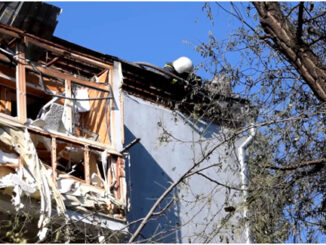
KYIV, Ukraine (TIP): Russian missiles slammed into Ukraine’s second-largest city in the northeast of the country and killed at least six civilians early May 23, officials said, as Kyiv’s army labored to hold off an intense cross-border offensive by the Kremlin’s larger and better-equipped forces.
At least 16 people were injured as S-300 missiles struck the city of Kharkiv, regional Gov. Oleh Syniehubov said. The sound of 15 explosions reverberated around the city of some 1 million people.
Ukrainian President Volodymyr Zelenskyy called the attack “extremely cruel.” He expressed renewed frustration at not getting enough air defense systems from the country’s Western partners to prevent the barrages after more than two years of unrelenting war.
The city of Kharkiv, which is the capital of the region of the same name, lies about 20 kilometers (12 miles) from the Russian border. Moscow’s troops have in recent weeks captured villages in the area as part of a broad push, and analysts say they may be trying to get within artillery range of the city.
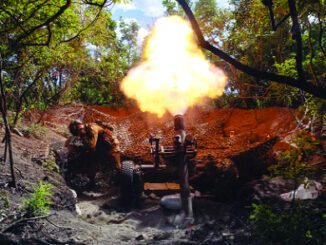
In what is shaping up to be Ukraine’s biggest test since Russia’s full-scale invasion in February 2022, outnumbered and outgunned Ukrainian forces are being pressed at several points along the about 1,000-kilometer (600-mile) front line that snakes from north to south along the eastern side of the country.
With Ukraine short of air defenses and waiting for more Western military support that recently started trickling in, its army has been pushed backwards in places while Russia has pounded its power grid and civilian areas. Kyiv endured further power outages Thursday.
Zelenskyy said the main hotspots in recent fighting have been Kharkiv and the neighboring Donetsk region, where in February Ukraine’s defenders withdrew from the stronghold of Avdiivka. For the Kremlin, taking control of all of partially occupied Donetsk is a war priority.
At the same time, and in an apparent effort to stretch Ukraine’s depleted forces, Russian troops have made incursions in the northern Sumy region.
Nearly 1,500 people, including 200 children, have been evacuated from the towns of Bilopillia and Vorozhba in that region, according to regional Gov. Volodymyr Artiukh.
“The main focus (of the fighting) is on the entire border area,” Zelenskyy said in his nightly video address Wednesday.
Ukraine has also trained its sights on Russian regions across the border. Russia’s defense ministry said Thursday that 35 Ukrainian rockets and three drones were shot down over the Belgorod region. Regional Gov. Vyacheslav Gladkov said one drone struck a house and exploded after being shot down, killing a woman. (AP)
Tag: Kharkiv
-

Russian missiles kill 6 in Ukraine’s second-largest city where Moscow’s troops are pressing
-
Beyond weapons: On Ukraine President Zelensky’s visit to Washington
- The United States should push Ukraine to find a solution to the conflict with Russia
Ukraine President Volodymyr Zelensky’s visit to Washington, his first overseas travel since Russia’s invasion on February 24, and the Biden administration’s decision to send a new $1.8 billion military aid package, including Patriot missile defense systems and precision-guided missiles, are a testament to the deep relationship Ukraine and the U.S. share in the time of war. Ukraine has already received American financial and military funding from approved assistance worth around $54 billion. The U.S. supply of long-range missiles (HIMARS) has played a major role in Ukraine’s recent battlefield advances in Kharkiv and Kherson, after its heavy losses in Donbas. The Patriot missile system is expected to strengthen Ukraine’s air defenses at a time when Russia is bombarding the energy grid and water supplies. In Washington, President Joe Biden discussed a 10-point peace formula with Mr. Zelensky (the details are unknown) and also promised continued support “for as long as it takes”. Both leaders tried to send out a message of unity amid concerns of cracks in the western alliance as the war is continuing indefinitely with its massive economic costs.
The U.S. has gradually stepped up its supply of weapons to Ukraine, but is still wary of sending offensive weapons out of fears of escalating the conflict. Ukraine has relentlessly campaigned for more advanced weapons, including U.S. aircraft, tanks and long-range tactical missiles. While Mr. Biden said his administration would continue to back Ukraine, he also warned of the risks of sending offensive weapons to Ukraine, which could “break up NATO, the EU and the rest of world”. Currently, Ukraine has a battlefield advantage, recapturing swathes of territories in the northeast and south. But Russia has air superiority. The Patriot missiles could offer some protection to Ukraine but could also prompt Russia to carry out heavier attacks. This leaves Mr. Biden in a dilemma. He is ready to bolster Ukraine’s defense but does not want to provoke a wider war between Russia and NATO. His Ukraine policy should not be an open-ended weapons supply package. The U.S. could help its ally but it should also push for a sustainable solution to the conflict. It should use its continued support to Ukraine to mount pressure on Russia — as its weapons play a critical role in Kyiv’s counterattacks — and persuade Ukraine to resume direct negotiations. At this point, no military solution seems likely. Unless there is a credible push for talks, the war is likely to continue for the foreseeable future.
(The Hindu)
-

Twenty killed as Russia rains rockets on Kharkiv
Kyiv/Kharkiv (TIP): Russian forces pounded Ukraine’s second largest city Kharkiv and surrounding countryside with rockets, killing at least 20 people in what Kyiv called a bid to force it to pull resources from the main battlefield to protect civilians from attack. Inside Russia, a fire tore through an oil refinery just 8 km (5 miles) from the Ukrainian border, after what the refinery described as a cross border attack by two drones.
In the main battlefield city of Sievierodonetsk, where Russia has claimed to have Ukrainian forces surrounded since last week, scenes filmed by a freelance journalist made clear the battle was not over, with Ukrainian troops able to resupply their garrison by crossing a river in inflatable rafts.
The Russian strikes on Kharkiv, throughout Tuesday and continuing on Wednesday morning, were the worst for weeks in the area where normal life had been returning since Ukraine pushed Russian forces back in a major counter-offensive last month.
“It was shelling by Russian troops. It was probably multiple rocket launchers. And it’s the missile impact, it’s all the missile impact,” Kharkiv prosecutor MikhailoMartosh told Reuters amid the ruins of cottages struck on Tuesday in a rural area on the city’s outskirts.
Medical workers carried the body of an elderly woman out of the rubble of a burnt-out garage and into a nearby van.
“She was 85 years old. A child of the war (World War Two).
She survived one war, but didn’t make it through this one,” said her grandson Mykyta. “There is nowhere to flee to. Especially grandmother herself, she didn’t want to go anywhere from here.” Ukrainian authorities said 15 people were killed and 16 wounded on Tuesday in the Kharkiv region, and regional governor OlehSinegubov described shelling incidents on Wednesday morning that had killed at least another five.
“Russian forces are now hitting the city of Kharkiv in the same way that they previously were hitting Mariupol – with the aim of terrorising the population,” Ukrainian presidential adviser OleksiyArestovych said in a video address.
“And if they keep doing that we will have to react—and that is one way to make us move our artillery,” he said. “The idea is to create one big problem to distract us and force us to divert troops. I think there will be an escalation.” The main battlefield is now to the south of Kharkiv in the Donbas region, which Moscow has been trying to seize on behalf of its separatist proxies, with the worst fighting concentrated in the devastated city of Sievierodonetsk.
Russian forces have made only slow progress using overwhelming artillery in some of the heaviest ground fighting in Europe since World War Two.
Moscow says Ukrainian forces in Sievierodonetsk are trapped and ordered them to surrender or die last week after the last bridge over the Siverskyi Donets river was destroyed.
But OleksandrRatushniak, a freelance photographer who reached Sievierodonetsk with Ukrainian forces in recent days, filmed reinforcements crossing in an inflatable raft.
Inside the ruins of the frontline industrial zone, the Ukrainian troops fired from a tank’s main gun. They smoked cigarettes as they hid from Russian artillery exploding outside.
An abandoned dachshund the troops nicknamed “Bullet” scampered with them through the rubble.
A regular day’s work, said one soldier: “For us, this like digging up potatoes.”
DRONE STRIKE
There was no immediate Ukrainian comment about the apparent drone strike which suspended production at Russia’s Novoshakhtinsk oil refinery, on the Russian side of the frontier with Donbas territory controlled by pro-Russian separatists.
Video footage posted on social media appeared to show a drone flying towards the refinery, before a large ball of flame billowed up into the summer sky. The local emergency service, cited by Interfax, said no one was hurt and the blaze was put out.
Ukraine generally does not comment on reports of attacks on Russian infrastructure near the border, which in the past it has called “karma” for Russian attacks on Ukraine.
In a separate incident, Russian authorities said four people were killed after a shell exploded at an ammunition depot deep inside Russia.
In southern Ukraine, officials said seven Russian missiles had struck the port of Mykolaiv, killing at least one person and causing several major fires. Global grain trader Viterra said its grain terminal in the southern Ukrainian port of Mykolaiv was hit and was ablaze.
Wednesday was marked in both Russia and Ukraine as the “Day of Remembrance and Sorrow”, anniversary of the day Hitler’s Germany attacked the Soviet Union. Russian President Vladimir Putin laid flowers at a memorial flame for the dead.
World War Two, which killed 27 million Soviet citizens, plays a prominent role in Russian commentary on the Ukraine invasion, which Putin calls a “special operation” to root out “Nazis”. Kyiv and the West call that a baseless justification for a war to wipe out Ukraine’s identity as a separate nation.
“Psychiatrists of the future will examine: how after building the WWII cult for years, Russia began to recreate bloody pages of the history and Nazis’ each step,” Ukrainian presidential adviser MykhailoPodolyak tweeted.
Moscow repeated threats on Wednesday to take unspecified retaliation for a decision by Lithuania to block rail shipments of some goods to Russia’s Kaliningrad enclave on the Baltic Sea.
Lithuania says it was required to block the shipments under EU sanctions that took effect on Saturday.
“We are convinced that the illegal sanctions adopted by the European Union are absolutely unacceptable in this situation,” Kremlin spokesperson Dmitry Peskov said in a call with reporters, adding that countermeasures were being prepared. Reuters