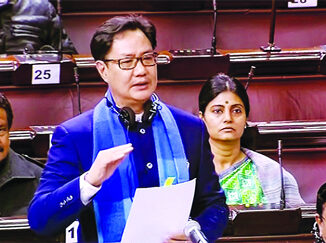
NEW DELHI (TIP): Amid the Income Tax ‘surveys’ at BBC offices that concluded on Thursday, Union Law Minister Kiren Rijiju hit out at those criticizing the move, saying some people trusted foreign news outlets but not Indian investigative agencies, a TNS report says. Sharing an opinion piece by former Prasar Bharti CEO Shashi Shekhar Vempati, who argued that the outrage over the BBC tax ‘survey’ was misplaced, he said: “These people trust foreign news agencies but they won’t trust Indian agencies. They swear by the BBC but they won’t believe Indian courts. They’ll even abuse the Supreme Court if one adverse judgment is passed,” he tweeted.
The operation, that began at the BBC offices in Delhi and Mumbai at 11.30 am on Tuesday, February 14, ended just after 10 pm on Thursday, February 16, clocking about 60 hours. The ‘surveys’ were carried out to look into issues related to international taxation and transfer pricing of BBC subsidiary companies. The survey teams, which sought answers on financial transactions, the company’s structure and other details, copied data from electronic gadgets to collect evidence, officials said. Opposition parties have denounced the action against the London-based broadcaster calling it “political vendetta” while questioning the timing — weeks after the BBC had aired a two-part documentary on the Prime Minister and the 2002 Gujarat riots.
Meanwhile, there has been no official statement from the Income Tax Department so far.
(Source: TNS)
New Delhi (TIP)- Asserting that the Government can seek reconsideration on names recommended by the Supreme Court Collegium (SCC) for appointment as judges of constitutional courts, Union Law Minister Kiren Rijiju on Thursday, February 2, informed Parliament that it has asked the Collegium to reconsider 18 proposals.
“Government can seek reconsideration of names recommended by the SCC, and as on 31.01.2023 there are a total 18 proposals on which reconsideration of SCC has been sought. SCC decided to reiterate 06 cases, in 07 cases SCC has desired updated inputs from the High Court Collegiums, and 05 cases have been decided to be remitted by the SCC to the High Courts,” Rijiju told the Rajya Sabha.
Responding to questions from MPs John Brittas and Raghav Chadha, he said as on January 30, 2023, against the sanctioned strength of 34 Judges, 27 Judges are working in the Supreme Court leaving seven vacancies. In response to a question from MP Ram Nath Thakur, he said the Centre had on January 6 suggested inclusion of a government nominee on a ‘Search-cum-Evaluation Committee’ which could assist the Supreme Court and High Court Collegiums in appointment of judges.
“Out of these 7 vacancies, a proposal for appointment of 5 judges in the Supreme Court is under consideration with the Government and in the meantime a proposal for remaining 02 (two) vacancies has been received on 31.01.2023 from the Supreme Court Collegium,” the Law Minister said.
Amid ongoing stand-off with the Government over judicial appointments, the Supreme Court Collegium had on Tuesday recommended elevation of Allahabad High Court Chief Justice Rajesh Bindal and Gujarat High Court Chief Justice Aravind Kumar as judges of the top court.
However, the Government continued to sit over its December 13 recommendation for the elevation of Rajasthan High Court Chief Justice Pankaj Mithal, Patna High Court Chief Justice Sanjay Karol, Manipur High Court Chief Justice PV Sanjay Kumar, Patna High Court Judge Ahsanuddin Amanullah and Allahabad High Court Manoj Misra for appointment as judges of the Supreme Court.
Regarding high courts, he said, as on January 30 this year, against the sanctioned strength of 1108 judges in various high courts, 775 judges were working while 333 posts were vacant.
“Against these vacancies 142 proposals recommended by the High Court Collegiums (HCC) are at various stages of processing with the Government,” Rijiju said.
While 67 proposals recommended by HCC were in the process of being sent to SCC, 74 HCC recommendations sent to SCC and recommended by SCC were under various stages of processing, he said, adding 11 proposals have been deferred by SCC.
As on January 30, recommendations in respect of 236 vacancies (191 existing and 45 anticipated vacancies during the next 06 months) were yet to be received from HCCs, which were in breach of a six months advance timeline for making recommendations for anticipated vacancies, he said.
As per records, from 2019 to January, 2023, 22 judges were appointed in the Supreme Court and 446 judges were appointed in various High Courts. Source: TNS
To suggest that the basic structure doctrine is by itself unsanctioned is to place the Constitution at the legislature’s whim
“Since its judgment in Kesavananda, the Supreme Court has identified several features that are immutable. There is no doubt that on occasion, the Court’s interpretation of these features has suffered from incoherence. But to suggest that the basic structure doctrine is by itself unsanctioned is to place the Constitution at the legislature’s whim. When taken to its extreme, accepting the Vice-President’s claims would mean that, in theory, Parliament can abrogate its own powers and appoint a person of its choice as the country’s dictator. Consider the consequences.”
By Suhrith Parthasarathy
Come April and it will be 50 years since the Supreme Court of India delivered its verdict in Kesavananda Bharati vs State of Kerala. The judgment is widely recognized as a milestone in India’s history. In holding that Parliament’s power to amend the Constitution was not plenary, that any change that damages the document’s basic structure would be declared void, the Court, it was understood, had helped preserve the essence of our republic.
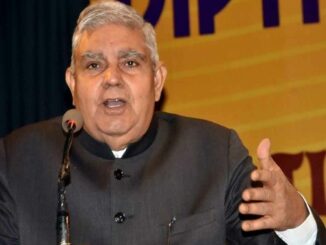
In the years since the verdict – if not in its immediate aftermath – its importance has been recognized by successive governments. During this time, most criticism of the doctrine has been confined to the manner of its application rather than its legitimacy. But last week, India’s Vice-President Jagdeep Dhankhar launched a salvo of attacks at the Supreme Court, by calling into question the ruling’s correctness. Faced as we are with far greater issues of civic concern, this debate might well be regarded as tedious, if only the arguments made against the judgment were not part of what appears to be a concerted effort at undermining the judiciary’s importance.
Collegium as target
Over the course of the last few months, not a day has gone by without one member or the other of the political executive excoriating the Court over its apparent excesses. Much of this criticism has been aimed at the functioning of the collegium — a body of senior judges that makes binding recommendations on appointments and the transfer of judges. The Union Minister of Law and Justice, Kiren Rijiju, and indeed Mr. Dhankhar, have repeatedly doubted the Court’s judgment in 2015, in which it struck down efforts to replace the collegium with a National Judicial Appointments Commission (NJAC). That criticism has now turned sharper, with the Vice-President’s diatribe against Kesavananda.
In his maiden address to the Rajya Sabha in December 2022, Mr. Dhankhar claimed that the striking down of the NJAC had no parallels in democratic history. A “duly legitimized constitutional prescription,” he claimed, “has been judicially undone.” Speaking on January 11 at the 83rd All India Presiding Officers (Assembly Speakers) Conference in Jaipur, Rajasthan, he said that “in a democratic society, the basic of any basic structure is supremacy of people, sovereignty of parliament…The ultimate power is with the legislature. Legislature also decides who will be there in other institutions. In such a situation, all institutions must confine to their domains. One must not make incursion in the domain of others.”
Mr. Dhankar then heightened his criticism by doubting the legitimacy of the basic structure doctrine. The correctness of the Court’s view, he said, “must be deliberated…Can Parliament allow that its verdict will be subject to any other authority? In my maiden address after I assumed the office of Chairman of Rajya Sabha, I said this. I am not in doubt about it. This cannot happen.”
To be sure, genuine criticism of both the Collegium’s functioning and the Court’s judgment upholding the body’s legality ought to be welcomed. But seeing as the Government, as Mr. Rijiju confirmed in Parliament last month, has no plans to implement any systemic change in the way we appoint judges, and given that the Government itself has done little to promote transparency in the process, the present reproach is, at its best, unprincipled, and, at its worst, an attempt at subverting the judiciary’s autonomy. That it is likely the latter is clear from the fact that the Vice-President has now carried his denunciation to a point where his admonishments are reserved not just for the collegium but also for the ruling in Kesavananda.
The foundation of the Constitution
Were we to begin with the elementary premise that India’s Constitution, as originally adopted, comprises a set of principles that together lend it an identity, we will see that the raison d’etre for the basic structure doctrine is not difficult to grasp. On any reasonable reading of constitutional history, one can see that the Constitution is a product of a collective vision. That vision was built on distinct, if interwoven, ideals: among others, that India would be governed by the rule of law, that our structure of governance would rest on Westminster parliamentarianism, that the powers of the legislature, the executive and the judiciary would be separate, that the courts would be independent of government, and that our States would have absolute power over defined spheres of governance.
Now, ask yourself the following questions: what happens when an amendment made to the Constitution harms one or more of these principles in a manner that alters the Constitution’s identity? Would the Constitution remain the same Constitution that was adopted in 1950? Should Parliament amend the Constitution to replace the Westminster system with a presidential style of governance, would the Constitution’s character be preserved? Or consider something rather more radical: can Parliament, through amendment, efface the right to life guaranteed in Article 21? Would this not result in the creation of a document of governance that is no longer “the Constitution of India?”
It is by pondering over questions of this nature that the majority in Kesavananda found that there was much that was correct in the German professor Dietrich Conrad’s address in February 1965 at the Banaras Hindu University, Varanasi. There, Conrad had pointed out, that “any amending body organized within the statutory scheme, howsoever verbally unlimited its power, cannot by its very structure change the fundamental pillars supporting its constitutional authority”.
On ‘amendments’
As the Court would later explained in Minerva Mills vs Union of India (1980) — and incidentally at stake there was the very survival of the idea that fundamental rights are inviolable — “Parliament too is a creature of the Constitution”. Therefore, it can only have such powers that are expressly vested on it. If those powers are seen as unlimited, Parliament, the Court found, “would cease to be an authority under the Constitution”; it would instead “become supreme over it, because it would have power to alter the entire Constitution including its basic structure”. In other words, the principle that Parliament is proscribed from changing the Constitution’s essential features is rooted in the knowledge that the Constitution, as originally adopted, was built on an intelligible moral foundation.
On this construction, it is possible to see the basic structure doctrine as implicit on a reading of the Constitution as a whole. But it is also deductible, as Justice H.R. Khanna wrote in his controlling opinion in Kesavananda, through an interpretation of the word “amendment”. The dictionary defines “amendment” to mean a “minor change or addition designed to improve a text”. As Justice Khanna saw it, when the Constitution that emerges out of a process of amendment as stipulated in Article 368 is not merely the Constitution in an altered form but a Constitution that is devoid of its basic structure, the procedure undertaken ceases to be a mere amendment.
Since its judgment in Kesavananda, the Supreme Court has identified several features that are immutable. There is no doubt that on occasion, the Court’s interpretation of these features has suffered from incoherence. But to suggest that the basic structure doctrine is by itself unsanctioned is to place the Constitution at the legislature’s whim. When taken to its extreme, accepting the Vice-President’s claims would mean that, in theory, Parliament can abrogate its own powers and appoint a person of its choice as the country’s dictator. Consider the consequences.
(Suhrith Parthasarathy is an advocate practising in the Madras High Court)
NEW DELHI (TIP): No proposal is under consideration of the government to provide proxy voting facility to NRIs, the Lok Sabha was informed on Friday, December 16.
“…no such proposal is under consideration,” said Law Minister Kiren Rijiju in a written reply while responding to a question on whether the government is considering to provide the facility of proxy voting to Non-Resident Indians (NRIs). In August 2018, the previous Lok Sabha had passed a Bill to allow proxy voting rights to eligible overseas Indians. But the Bill could not be brought in the Rajya Sabha.
In 2020, the Election Commission had proposed to the Law Ministry to extend the Electronically Transmitted Postal Ballot System (ETPBS) facility, so far available only to service voters, to eligible overseas Indian voters as well.
It would require changes in the election rules. But the government has so far not taken a call on the issue.
The EC had told the government that it has been receiving several representations from the Indian diaspora residing abroad to facilitate voting through postal ballots since such overseas electors are not in a position to be present in their polling area as travelling to India for this purpose is a costly affair, and they cannot leave the country of their residence owing to specific compulsions of employment, education or other engagements.
As of now, overseas Indians have to register as voter, come to India, go to their constituency with the original passport issued to them when they had gone abroad and cast their votes.
Asian Games gold medal-winning former boxer Dingko Singh died on Thursday, June 10, after a long battle with liver cancer. He was 42 and had been fighting the disease since 2017.
“I’m deeply saddened by the demise of Shri Dingko Singh. One of the finest boxers India has ever produced, Dinko’s gold medal at 1998 Bangkok Asian Games sparked the Boxing chain reaction in India. I extend my sincere condolences to the bereaved family. RIP Dinko,” Sports Minister Kiren Rijiju tweeted.
The Manipur-based former boxer endured a long battle with cancer and even fought Covid-19 last year. “My sincerest condolences on this loss May his life’s journey & struggle forever remain a source inspiration for the upcoming generations. I pray that the bereaved family finds the strength to overcome this period of grief & mourning #dinkosingh,” tweeted India’s first Olympic-medallist in boxing Vijender Singh.
Dingko won the Asian Games gold in 1998 and was bestowed the Arjuna award the same year. In 2013, he was honoured with the Padma Shri for his contribution to the sport. Dingko, who was employed with Navy, had taken to coaching after hanging up his gloves.
New Delhi (TIP): Chandro Tomar, better known as ‘Shooter Dadi’, who became one of the oldest woman shooters in the world after taking up the sport in her 60s, died on April 30 after battling Covid-19 over the last few days.
The 89-year-old was being treated at a hospital in Meerut since April 26.
“Mera saath chhoot gaya, Chandro kaha chali gayi? (She has left me, Chandro where have you gone?),” her sister-in-law Prakashi Tomar, who is also one of the oldest female shooters in the world, wrote on her Twitter page.
Chandro was hospitalised after complaining of difficulty in breathing. Tests revealed she had contracted Covid-19. She battled for her life for four days in hospital before succumbing to the virus.
Hailing from the Baghpat village in Uttar Pradesh, Tomar was in her 60s when she picked up the gun for the first time. She went on to win many national competitions for veterans, her feats inspiring the award-winning Hindi movie Saand ki Aankh, released in 2019.
“Devastated by the news of Chandro Dadi’s demise. Feels like a part of me is gone. She made her own rules & paved the path for many girl to find their dream. Her legacy will live on in them. Condolences to the family. Am lucky I got to know and be her,” actor Bhumi Pednekar, who played Chandro in Saand ki Aankh, tweeted.
“I’m deeply saddened by tragic demise of our most lovable Dadi Chandro Tomar ji. She was inspiration for millions and will continue to inspire forever. May her soul rest in peace. Om Shanti,” Union Sports Minister Kiren Rijiju wrote on Twitter.
NEW DELHI (TIP): With a view to “neutralizing” narratives critical of the Narendra Modi government, a Group of Ministers (GoM), formed to fine-tune “government communication”, has come out with various suggestions, including tracking “50 negative and 50 positive influencers” on the social media and to “neutralize the people who are writing against the Government without facts and set false narratives/spread fake news”, according to media reports. It emerges that the decisions to cap FDI (foreign direct investment) at 26% for the digital media and the new IT rules that have a separate section dealing with a code of ethics for Over The Top (OTT) platforms such as Netflix and Amazon Prime were the result of the GoM’s deliberations. The FDI cap was essential, the GoM felt, to constrict foreign influence on the Indian media. As a result of this capping, Huffington Post, which had been publishing reports critical of the Modi regime, shut its operations in India.
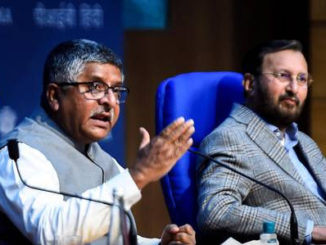
Information Technology (IT) Minister Ravi Shankar Prasad, Women and Child Development Minister Smriti Irani, Information and Broadcasting (I&B) Minister Prakash Javadekar, External Affairs Minister S Jaishankar, Minority Affairs Minister Mukhtar Abbas Naqvi, Sports Minister Kiren Rijiju, Urban Development Minister Hardeep Singh Puri, Minister of State (MoS) for Finance Anurag Thakur and MoS for the Environment Ministry Babul Supriyo were part of the GoM, which met six times between June 14 and July 9 last year.
The GoM’s report was first reported by Caravan magazine. There is so far no official word on its contents.
The GoM report quotes suggestions made by the Ministers. For instance, Prasad suggested, “A list of media personnel and prominent persons, who are pro our line of thought – both nationally and globally, should be prepared. Few eminent academicians, Vice Chancellors, retired Indian Foreign Service officers etc should be identified who can write our achievements and project our viewpoint.” Irani, who held the I&B portfolio in the previous Modi government, recommended, “We should track 50 negative and 50 positive influencers.” The suggestion has been accepted by the GoM and the I&B Ministry has been tasked with implementing it.
Naqvi suggested direct action against those writing against the government. “We should have a strategy to neutralize the people who are writing against the Government without facts and set false narratives / spread fake news,” he advised.
Among other action points recommended by the GoM include enlarging the Prasar Bharati News Service into a “main line news agency”. Among the long- term agreed strategies include “coordination with schools of journalism as present students are the future journalists.”
Puri told the GoM that the journalists who are supportive of the government, even if they are now unemployed, should be roped in. As per the report, this suggestion would also be acted upon. Thakur wanted the BJP and the Modi government to reach out to right-wing parties across the world to arrive at a common ground.
Supreme Court favors regulation of OTT platforms
The Supreme Court on Thursday, March 4, made it amply clear to OTT (over-the-top) platforms like Netflix and Amazon that it is in favor of “screening” content shown by them. It said some of the films hosted by the platform were pornographic. “Traditional film viewing has become extinct. Now films and web series are viewed by the public on these platforms. Should there not be some screening? We feel there should be some screening… There is pornography in some films,” Justice Ashok Bhushan, leading a Bench, also comprising Justice R. Subhash Reddy, observed. Senior advocate Mukul Rohatgi, appearing for Amazon producer Aparna Purohit’s bail, said this “was not about pornography but the right to freedom of expression”.
“But a balance has to be struck,” Justice Bhushan retorted.
Solicitor General Tushar Mehta said the content included “filthy abuses”. The hearing was based on a plea by Purohit, Amazon Prime’s commercial head, against the Allahabad High Court decision to deny her pre-arrest bail in connection with the probe into Tandav, a web series hosted by the platform. The FIR said the series ridiculed Hindu gods and the country’s political power corridors.
Justice Bhushan said the court wanted to consider Purohit’s case in the light of the new guidelines notified by the government to hold social media and OTT platforms accountable for their content. The Bench asked the guidelines to be placed on record and scheduled a hearing for March 5.
The Information Technology (Guidelines for Intermediaries and Digital Media Ethics Code) Rules of 2021 requires streaming platforms to comply with a new three-tier self-regulatory complaint redressal system. It also includes an independent self-regulatory body headed by a retired high court or Supreme Court judge, which will decide on matters related to content.
Meanwhile, the Information & Broadcasting Ministry on March 4, clarified that none of the OTT platforms will have to register with the government and no government nominee will be present in the self-regulatory body. The statement was issued after I&B Minister Prakash Javadekar had an interaction with representatives of OTT platforms
Signup to our Newsletter!
Don’t miss out on all the happenings around the world