Tag: KPMG

  • Indian American Golfer Sahith Theegala wins Sahalee Players Championship

    Indian American Golfer Sahith Theegala wins Sahalee Players Championship

    SAN JOSE (TIP): Indian American Golfer Sahith Theegala of Chino Hills, Calif. birdied the first playoff hole to win the 23rd Sahalee Players Championship (SPC), outlasting Min Woo Lee of Australia.

    The elite amateur championship was held at Sahalee Country Club in Sammamish, Wash.

    After 72 holes, the two players were tied at 3-under par, and went back to play the par-5 18th hole again. Theegala hit his second shot to the back edge of the green, hole high. Lee flared his second shot into the trees on the right, and after a free drop from an embedded lie punched a remarkable 150-yard shot through the trees to 45 feet from the hole. Lee then two-putted for par, and Theegala dropped a 5-footer for birdie and the win.

    Theegala started final round with a five-shot lead, but with the swirling winds adding to already difficult final-round playing conditions, the day quickly became a game of survival. The scoring average for the final round was 77.27.

    Theegala is a rising junior at Pepperdine, finishing his sophomore year as WCC Co-Player of the Year and selected as semifinalist for the Jack Nicklaus Award. He qualified for this year’s U.S. Open at Erin Hills, and in two weeks will compete in the 51st Pacific Coast Amateur Championship, being held at Chambers Bay in University Place, Wash.

    The SPC was rated an “A” event in the World Amateur Golf Rankings (WAGR) before taking a hiatus last year while the club hosted the KPMG Women’s PGA Championship, and each year the event draws an international field of the finest amateur players.

    Five of the previous 13 SPC champions have gone on to win the Ben Hogan Award, given to the nation’s top collegiate golfer and the list of previous SPC participants now playing on the PGA Tour continues to grow each year.

    Past champions of this prestigious amateur championship include Kyle Stanley, Casey Martin, Peter Uihlein, Nick Taylor, Daniel Summerhays, Ryan Moore, Chris Williams, Arron Oberholser and Jason Gore, among others, all of whom would go on to win on the PGA or European tours. The SPC scoring record at Sahalee is the 16-under 272 (68-69-68-67) shot in 2004 by Moore, a native of Puyallup, Wash.

    Sahalee Country Club has been the site of the SPC since 1992, and has hosted numerous top-level events in golf, including the 1974 PNGA Men’s Amateur, 1978 Pacific Coast Amateur, 1998 PGA Championship, 2002 WGC-NEC Invitational, 2010 U.S. Senior Open, and 2016 KPMG Women’s PGA Championship.

  • Indian American Ashish Masih to become President and CEO of Encore Capital Group

    Indian American Ashish Masih to become President and CEO of Encore Capital Group

    SAN DIEGO, CA (TIP): Encore Capital Group announced that Ashish Masih will become Encore’s President and CEO as current President and CEO Ken Vecchione will be leaving the company to become the President of Western Alliance Bancorporation. Mr. Vecchione will remain in his role at Encore until the 2017 annual stockholders meeting on June 15, 2017, to ensure a smooth transition of his duties to Mr. Masih. At the upcoming 2017 stockholders meeting, Mr.

    Vecchione will not stand for re-election to the Board of Encore, and Mr. Masih will be appointed as a director following the meeting. “I look forward to leading Encore and its more than 6,700 employees around the world,” said Mr.Masih. “I’m well prepared and highly confident in our consumer-centric approach, our demonstrated success in driving improved liquidations, and our strong capital stewardship.We have a bright future.”

    “The Board is pleased to have Ashish serve as Encore’s next President and Chief Executive Officer. We have worked with Ashish for many years, and his diverse background and demonstrated competence in operations, corporate strategy, regulatory affairs and technology continue to impress us,” said Chairman of the Board Willem Mesdag. “We are equally excited by the expansion of Paul’s role and his continued oversight of our international strategies and holdings. The company is wellserved by his intellect and experience in the industry.”

    Mr. Masih joined Encore in 2009, and is responsible for internal call centers, decision science and analytics, legal collections, marketing, and all other domestic operations. Mr. Masih also oversees Encore’s Asset Reconstruction Company, which is now operational and is purchasing debt portfolios in India. Prior to joining Encore, Mr. Masih was at Capital One Financial Corporation where he held various collections-related roles, as well as serving as the CFO/Head of Analytics for a business unit. Previously, he was an Associate Principal at McKinsey & Company and a Manager at KPMG Consulting.Mr.

    Masih earned an MBA from The Wharton School of the University of Pennsylvania, a Master of Science in Manufacturing Systems Engineering from Lehigh University and a bachelor’s degree in Mechanical Engineering from the Indian Institute of Technology in New Delhi, India.

  • Indian American Official in Obama administration Arun M. Kumar elected Chairman & CEO of KPMG in India

    Indian American Official in Obama administration Arun M. Kumar elected Chairman & CEO of KPMG in India

    KPMG in India announced the election of Arun M. Kumar as Chairman and Chief Executive Officer of the firm for a five-year term, beginning February 5, 2017.

    Arun Kumar succeeds Richard Rekhy, who led the firm as CEO for over four years. Arun Kumar was elected by the KPMG India Board and ratified by the India Partners. The firm executed a well-defined governance process for the selection of the CEO that aligns with the objective of building on its success as well as attracting the best talent available for this role.

    Arun Kumar brings a wealth of international leadership experience to KPMG India, including his tenure in public service in the United States for the last three years as Assistant Secretary of Commerce for Global Markets and Director General of US and Foreign Commercial Service in the Obama Administration. In that role, he led a global organization of senior professionals present in 78 countries and all the 50 states in the US and served with distinction. On behalf of the US Government, Arun also worked to strengthen commercial ties between India and the United States and played a key role in establishing the India-US Strategic & Commercial Dialogue and a renewed India-US CEO Forum.

    Arun spent the majority of his career with KPMG in the US, including serving on the KPMG US and KPMG Americas Boards from 2008-2013. He led Management Consulting / Finance Management, for the West region of KPMG, US from 2005 to 2013. He has also served on KPMG’s Global Management Consulting leadership team.

    On his appointment, Arun Kumar said: “I am honored to have been elected as the Chairman and CEO of KPMG in India. I have worked closely with the people of KPMG India for many years and have always been impressed by their world class talent. I am excited to have this opportunity to work with the KPMG team in India to continue to build an organization that is recognized for their quality and for the impact they have on our clients, our people and the community in general.”

    John Veihmeyer, Chairman, KPMG International said: “Our global clients recognize the increasing significance of India as the fastest growing major economy in the world. I am delighted to welcome Arun back to KPMG. He is a trusted leader, who is recognized for his integrity, strategic vision and enduring relationships and I am confident that under Arun’s leadership, KPMG India will continue to provide exceptional service to our clients, enhance our brand and further strengthen our reputation for the highest quality”.

  • New accounting norms may add to banks’ bad loans

    MUMBAI (TIP): There is a new twist to the issue of rising bad loans in the banking sector. Under the new global accounting norms that banks have to adopt from April 1, 2018, the gross level of non-performing assets (NPAs) for banks and non-banking finance companies
    (NBFCs) could rise significantly. Companies have to migrate to the new norms from April 1,2016.

    The quantum of these bad loans would not only affect banks’ profits, but also eat into their capital, raising concerns among RBI and finance ministry officials, who are already grappling with the issue of injecting fresh capital into banks.

    According to people familiar with the matter, the RBI is trying to address the issue by asking banks and NBFCs to internally adopt the new system — Ind AS— early on so that everybody gets a head-start on the extent of the problem and tries to resolve it.

    “Evaluation and recording of credit losses under Ind AS is significantly different from that used under current accounting norms,” said Jamil Khatri, partner, KPMG. “This could likely lead to a rise in gross NPAs and an increase in the level of provisioning. Ind AS follows an expected loss model which is based on judgment and is significantly different from the norm-based provisioning model under the current system.”

    The RBI recently formed a panel to suggest measures to address challenges arising out of implementation of Ind AS by banks. The report, which was submitted to the RBI on Wednesday, suggests change in loan loss provisioning but is silent on the impact on capital adequacy. The central bank has sought comments on the report by November end.

    Prime Minister Narendra Modi recently said that the government plans to infuse Rs 70,000 crore into public sector banks to address the issue of bad loans.

  • Black money: Government collects Rs 3,770 crore

    Black money: Government collects Rs 3,770 crore

    New Delhi (TIP): The disclosure of a meagre Rs 3,770 crore in black money held abroad by 638 declarants has raised serious doubts about the efficacy of government’s compliance scheme.

    The Finance Ministry today said 638 declarations received under the one-time compliance window, which opened on July 1 and ended on September 31, had brought out undisclosed foreign assets amounting to Rs 3,770 crore under the Black Money (Undisclosed Foreign Income and Assets) and Imposition of Tax Act. These figures were subject to final reconciliation.

    Tax at the rate of 30 per cent and penalty at the rate of 30 per cent will have to be paid by December 31 on these declarations.

    The Congress attacked the government and Prime Minister Narendra Modi for making false claims on the quantum of black money and bringing it back to the country. Party chief spokesperson Randeep Surjewala said Modi had claimed more than Rs 80 lakh crore in black money was stashed abroad and that he would bring it back within 100 days of coming to power and deposit Rs 15 lakh in everyone’s bank account.

    Tax consultants say the response to government’s scheme has been much below expectations. Girish Vanvari, National Head of Tax, KPMG in India said: “Seeing the quantum of declarations made, one can question as to whether the black money law has been successful. Expectations were of a much higher number. The low response can be attributed to uncertainty of the process and lack of clarity.”

    While comparisons may be not be strictly applicable, the service tax amnesty scheme launched by the UPA government in 2013 yielded around Rs 7,700 crore to the exchequer. The Voluntary Compliance Encouragement Scheme (VCES) was launched in May 2013 to enable service tax defaulters to pay dues without penalty or late payment charges.

    While various estimates of black money have been floating around, the government has said in Parliament there is no official estimate regarding the amount of black money generated in the country.

    Finance Minister Arun Jaitley had said in Parliament varying estimations of the amount of black money had been reported by different persons and institutions.

    He had said such estimations were based on different sets of facts, data, methods, assumptions leading to varying inferences.

    The question remains that given the low level of disclosures under the black money compliance window, either the humongous figures have been faulty or the black money abroad has been routed in a way that it has become legitimate through financial structures. The Supreme Court-appointed special investigation team (SIT) on black money headed by Justice MB Shah in its recent report had raised doubts if participatory notes (P-notes) being used by foreign portfolio investors are being used to funnel unaccounted wealth into India.

    “How can Cayman Islands with a population of less than 55,000 invest Rs 86,000 crore in a single country like India?” the SIT had stated in its report. It had expressed the suspicion that P-notes being used by foreign investors in the stock markets could be unaccounted wealth in the guise of FII money.

    Registered foreign institutional investors issue P-notes to overseas investors who wish to invest in the Indian stock markets without registering themselves with market regulator Securities and Exchange Board of India.

    The SIT report had raised concerns that some of the money coming into the market via P-notes could be the unaccounted wealth camouflaged under the guise of FII investment. The SIT had suggested that obtaining information on “beneficial ownership” of P-notes was of crucial importance to prevent their misuse.

    Industry had voiced concerns that the black money law was creating fear and panic. Industry chamber Assocham had said the compliance window in the black money law had created more confusion and fear in the minds of industry leaders, professionals, and trading entrepreneurs.

  • Transnationals | Tax Havens | Terrorism

    Transnationals | Tax Havens | Terrorism

    “Westphalian sovereignty is the principle of international law that each nation state has sovereignty over its territory and domestic affairs, to the exclusion of all external powers. The principle of non-interference in another country’s domestic affairs, and that each state (no matter how large or small) is equal in international law is recognized. This doctrine is named after the Peace of Westphalia, signed in 1648, which ended the Thirty Years’ War.” 

    “It is ironical that Terror organizations on one side and Tax havens on the other have completely undermined Westphalia consensus. In that context countries like India have every right to exercise its freedom to pursue terrorists who are undermining its existence whether sponsored by foreign countries or home grown. The concept of territorial jurisdictions and sovereignty are no more valid in the context of terror organizations since they damage both India and its own host countries over period of time. India must protect its national interests and institutions by challenging inimical forces wherever they are located without worrying about Westphalia consensus”.


    In the context of the strikes made against terror camps on the border of Manipur/Nagaland by the Indian Army; there has been number of discussions about national sovereignty and the role of individual States. Actually in the last few decades the activities of transnational corporations aided by tax havens on one side and terrorists on the other side have destroyed the concept of nation state and its sovereignty evolved after the 30 years’ war in 1648 in Westphalia. Westphalian sovereignty is the principle of international law that each nation state has sovereignty over its territory and domestic affairs, to the exclusion of all external powers. The principle of non-interference in another country’s domestic affairs, and that each state (no matter how large or small) is equal in international law is recognized. This doctrine is named after the Peace of Westphalia, signed in 1648, which ended the Thirty Years’ War .After that war major continental European states – the Holy Roman Empire, Spain, France, Sweden and the Dutch Republic – agreed to respect one another’s territorial integrity. As European influence spread across the globe, the Westphalian principles, especially the concept of sovereign states, became central to international law and to the prevailing world order.

    Scholars of international relations have identified the modern, Western-originated, international system of states, multinational corporations, and organizations, as having begun at the Peace of Westphalia. Henry Kissinger in his important book on “world Order” says:

    “No truly global “world order’ has ever existed. What passes for order in our time was devised in Western Europe nearly four centuries ago, at a peace conference in the German region of Westphalia, conducted without the involvement or even the awareness of most other continents or civilizations. A century of sectarian conflict and political upheaval across Central Europe had culminated in the Thirty Years’ war of 1618-48- a conflagration in which political and religious disputes commingled, combatants resorted to “total war” against population centers, and nearly a quarter of the population of Central Europe died from combat, disease, or starvation. The exhausted participants met to define a set of arrangements that world stanch the bloodletting. Religious unity had fractured with the survival and spread of Protestantism; Political diversity was inherent in the number of autonomous political units that had fought to a draw. So it was that in Europe the conditions of the contemporary world were approximated: a multiplicity of political units, none powerful enough to defeat all others, many adhering to contradictory philosophies and internal practices, in search of neutral rules to regulate their conduct and mitigate conflict.

    “The Westphalian peace reflected a practical accommodation to reality, not a unique moral insight. It relied on a system of independent states refraining from interference in each other’s domestic affairs and checking each other’s ambitions through a general equilibrium of power. No single claim to truth or universal rule had prevailed in Europe’s contests. Instead, each state was assigned the attribute of sovereign power over its territory. Each would acknowledge the domestic structures and religious vocations of its fellow states as realities and refrain from challenging their existence. With a balance of power now perceived as natural and desirable, the ambitions of rules would be set in counterpoise against each other, at least in theory curtailing the scope of conflicts. Division and multiplicity, an accident of Europe’s history, became the hallmarks of a new system of international order with its own distinct philosophical outlook. In this sense the European effort to end its conflagration shaped and prefigured the modern sensibility: it reserved judgment on the absolute in favor of the practical and ecumenical; it sought to distill order from multiplicity and restraint.

    “The seventeenth-century negotiators who crafted the peace of Westphalia did not think they were laying the foundation for a globally applicable system. They made no attempt to include neighboring Russia, which was then reconsolidating its own order after the nightmarish “Time of Troubles” by enshrining principles distinctly at odds with Westphalian balance; a single absolute ruler, a unified religious orthodoxy, and a program of territorial expansion in all directions. Nor did the other major power centers regard the Westphalian settlement (to the extent they learned of it at all) as relevant to their own regions.1

    The three core principles on which the consensus rested are:

    1. The principle of the sovereignty of states and the fundamental right of political self determination
    2. The principle of legal equality between states
    3. The principle of non-intervention of one state in the internal affairs of another state

    Interestingly, all three are questioned by contemporary leaders of West and radical Islam.

    Tony Blair the then Prime Minister of UK in his famous Chicago Address -1999-suggests

    “The most pressing foreign policy problem we face is to identify the circumstances in which we should get actively involved in other people’s conflicts. Non -interference has long been considered an important principle of international order….

    “But the principle of non-interference must be qualified in important respects. Acts of genocide can never be a purely internal matter. When oppression produces massive flows of refugees which unsettle neighboring countries then they can properly be described as “threats to international peace and security”.2

    The NATO intervention in Kosovo and Afghanistan as well as US intervention in Iraq provide recent examples of breakdown of idea of Westphalia. Similar is the humanitarian crisis faced by India regarding refugees from East Pakistan.

    Interestingly Radical Islam also considered that the world order based on Westphalian consensus will collapse. “In the aftermath of the 11 March 2004 Madrid attacks, Lewis ‘Atiyyatullah, who claims to represent the terrorist network al-Qaeda, declared that “the international system built up by the West since the Treaty of Westphalia will collapse; and a new international system will rise under the leadership of a mighty Islamic state.”3

    The spread of ISIS across countries and activities of Boko Haram based in Nigeria in Kenya and Chad re-emphasis this point. Radical Islam do not accept territorial boundaries since it works for a global regime for global Ummah.

    The recruitment by these terror organizations is also across continents and countries which does not respect territorial sovereignty. The talk about Caliphate indicates that they are trans-border organizations.

    On the other side we find global corporations transcending sovereignty in search of global profits. For this they use tax havens as a tool.

    Tax havens–numbering more than 70 jurisdictions–facilitate bank facilities with zero taxes and no-disclosure of the names and in many cases anonymous trusts holding accounts on behalf of beneficiary. Basically lawyers and Chartered accountants will deal with mattes. Sometimes a post box alone will be operative system. In the case of Bahamas one building seems to have had tens of thousands of companies registered there.

    Luxemburg (population half a million!) registered companies of various countries have evaded taxes significantly from their legal jurisdiction. The key findings of the activities of transnational companies cutting across territorial jurisdiction is given below.

    • Pepsi, IKEA, AIG, Coach, Deutsche Bank, Abbott Laboratories and nearly 340 other companies have secured secret deals from Luxembourg that allowed many of them to slash their global tax bills.
    • PricewaterhouseCoopers has helped multinational companies obtain at least 548 tax rulings in Luxembourg from 2002 to 2010. These legal secret deals feature complex financial structures designed to create drastic tax reductions. The rulings provide written assurance that companies’ tax-saving plans will be viewed favorably by Luxembourg authorities.
    • Companies have channeled hundreds of billions of dollars through Luxembourg and saved billions of dollars in taxes. Some firms have enjoyed effective tax rates of less than 1 percent on the profits they’ve shuffled into Luxembourg.
    • Many of the tax deals exploited international tax mismatches that allowed companies to avoid taxes both in Luxembourg and elsewhere through the use of so-called hybrid loans.
    • In many cases Luxembourg subsidiaries handling hundreds of millions of dollars in business maintain little presence and conduct little economic activity in Luxembourg. One popular address – 5, rue Guillaume Kroll – is home to more than 1,600 companies.
    • A separate set of documents reported on by ICIJ on Dec. 9 expanded the list of companies seeking tax rulings from Luxembourg to include American entertainment icon The Walt Disney Co., politically controversial Koch industries and 33 other firms. The new files revealed that alongside PwC tax rulings were also brokered by Ernst & Young, Deloitte and KPMG, among other accounting firms.4

    The big four accounting firms namely KPMG/E&Y/Deloitte and PwC have facilitated the movement of funds of clients across borders and territories to make tax “planning” easier for these companies. USA is literally waging war with major Giants like Amazon/Google/Microsoft etc. for not paying adequate taxes in USA in spite of being US based companies. Most of these companies have moved their profits to other Tax Havens.

    Global firms such as Starbucks, Google and Amazon have come under fire for avoiding paying tax on their British sales. There seems to be a growing culture of naming and shaming companies. But what impact does it have?5

    Royal Commission into tax loopholes a must—says a report in Australia.6

    There is an increasing clamor in USA about Congress Should Pass the Stop Tax Haven Abuse Act to Combat International Tax Avoidance. This has been highlighted by both TAX justice network as well as Global Financial Integrity.

    A simple method of trade mis-invoicing by global companies using tax-havens have impacted developing countries nearly 730Billion USD in 2012 says Global Financial integrity. Another interesting finding by GFI is about terror financing using Tax haven route.

    Because of the increasing wariness of MNCs using Tax havens for avoidance of taxes and the opaque ways of functioning of these off-shore structures, demands are growing about their activities and even closing down of these tax havens by European parliament etc.

    Due to relentless pressure from OECD as well as G20 many of these secretive jurisdictions are becoming more transparent.

    But the fact of the matter is these Trans National Companies and Tax Havens together have significantly undermined the concept of sovereignty and territorial jurisdictions.

    It is ironical that Terror organizations on one side and Tax havens on the other have completely undermined Westphalia consensus. In that context countries like India have every right to exercise its freedom to pursue terrorists who are undermining its existence whether sponsored by foreign countries or home grown. The concept of territorial jurisdictions and sovereignty are no more valid in the context of terror organizations since they damage both India and its own host countries over period of time. India must protect its national interests and institutions by challenging inimical forces wherever they are located without worrying about Westphalia consensus.

    (The author is Professor of Finance at IIM-Bangalore)

  • Maharashtra CM Devendra Fadnavis creates vision of  his State as a top destination for investments

    Maharashtra CM Devendra Fadnavis creates vision of his State as a top destination for investments

    NEW YORK (TIP): Maharashtra Chief Minister, Devendra Phadnavis was given a rousing welcome, June 29, by the Indian American community at a Community Reception, appropriately named  ‘Maharashtra meets Manhattan’. The reception in his honor was  hosted by Friends of Maharashtra and Consulate General of India at the Taj Pierre in New York City, where  Prime Minister Modi was hosted last year.

    Maharashtra Chief Minister lauded the contribution of NRI’s. He said, “The success of Indians here gives me immense pride. But now it’s time to give back.”

    Phadnavis spoke of the demographic advantage of India where 50% population is below the age of 25. He said  India was in a position to provide human resource to the entire world and the time to fulfill the dream of becoming the topmost nation of the world had arrived.

    Pitching for ‘Make in Maharashtra’, he mentioned that his government has reduced the number of permissions from 148 to 20 to make Maharashtra investor friendly. He also spoke about different upcoming projects undertaken by him like coastal road, Mumbai-New Mumbai connecting  road, and second international airport near Navi Mumbai. He said the projects of roads and bridges the government was contemplating would decongest entire Western Mumbai. He also spoke of the project to have 30 smart cities, each with a different theme and another project, an automobile hub in Aurangabad.

    “Maharashtra is full of possibilities. There are huge opportunities”, he said. He invited the gathered Indian Americans to invest in Maharashtra and assured them of his personal attention to their needs . He said he works 24/7 and is available 365 days of the year.

    Others who spoke included Consul General Dnyaneshwar Mulay who welcomed the Chief Minister and the Industries Minister Subhash Desai who outlined the opportunities for investors in the industries sector in his State.

    Earlier, in the day, a group of U.S. industry executives from the U.S.-India Business Council (USIBC) met with him for a discussion about investment opportunities in the state.

    The Chief Minister engaged with senior business executives on important topics that have dominated the bilateral commercial relationship in recent months and addressed areas such as Maharashtra’s comparative edge as an investment destination, regulatory reform measures that have been undertaken by the government to promote ease of doing business in the state, and cultural dialogues that can enhance the bilateral relations between India and the United States.

    Emphasizing the investment opportunities that are available in Maharashtra, Chief Minister Fadnavis said, “The Government has taken a variety of measures to promote ease of doing business in the state and we want to be viewed as a top destination for both domestic as well as international investments. The state eagerly awaits the formation of joint ventures in critical projects such as the Delhi – Mumbai Industrial corridor, Smart Cities and in sectors such as manufacturing, agriculture, aviation, engineering and IT. Our Government is committed to providing a boost to both Make in India and Make in Maharashtra campaigns, provide business to both medium and small enterprises and create much-needed jobs. We invite investors from the United States to be a part of Maharashtra’s growth story.”

    Lauding the vision of Chief Minister Fadnavis, Mukesh Aghi, President of USIBC, said, “The Council’s member companies have been encouraged by the ease of doing business in Maharashtra. Many of the companies have significant investments in the state. Therefore, appropriate and timely policy measures are critical. USIBC and member companies look forward to participating in the state’s investment opportunities that will not only promote entrepreneurship, but also inclusive growth, positioning it as a model state both in India and globally. I have no hesitation in saying that the state has the potential to emerge as a high ranking state on the ease of doing business index.”

    Ashok Vasudevan, Chairman and CEO of Preferred Brands International, manufacturer and marketer of the natural foods brand, Tasty Bite, said, “Tasty Bite has been operating in Maharashtra since the early 90’s and has become one of India’s largest exporter of prepared foods. The state is remarkably resilient due to its diversified base of industry that includes energy, agriculture, food processing, entertainment, engineering, chemicals, pharmaceuticals and financial services. The infrastructure, a mature workforce, a series of business friendly administrations over the last few decades makes it an attractive FDI destination.”

    The event was also attended by companies and senior leaders from every major sector of business- Monsanto, Taj Hotels, HSBC, Caterpillar, Cargill, Johnson and Johnson, KPMG, Baker & McKenzie, Citi, New Silk Route and Pfizer.

  • India builds first smart city as urban population swells

    GANDHINAGAR (TIP): India’s push to accommodate a booming urban population and attract investment rests in large part with dozens of “smart” cities like the one being built on the dusty banks of the Sabarmati river in Gujarat.

    So far, it boasts modern underground infrastructure, two office blocks and not much else.

    The plan, however, is for a meticulously planned metropolis complete with gleaming towers, drinking water on tap, automated waste collection and a dedicated power supply – luxuries to many Indians.

    With an urban population set to rise by more than 400 million people to 814 million by 2050, India faces the kind of mass urbanisation only seen before in China, and many of its biggest cities are already bursting at the seams.

    Ahead of his election last May, Prime Minister Narendra Modi promised 100 so-called smart cities by 2022 to help meet the rush.

    At a cost of about $1 trillion, according to estimates from consultants KPMG, the plan is also crucial to Modi’s ambition of attracting investment while providing jobs for the million or more Indians who join the workforce every month.

    His grand scheme, still a nebulous concept involving quality communications and infrastructure, is beginning to take shape outside Gandhinagar, capital of Gujarat, with the first “smart” city the government hopes will provide a model for India’s urban future.

    “Most (Indian) cities have not been planned in an integrated way,” said Jagan Shah, director of the National Institute of Urban Affairs which is helping the government set guidelines for the new developments.

    Among the challenges to getting new cities built or existing cities transformed is the lack of experts who can make such huge projects work and attracting private finance.

    “To get the private sector in, there is a lot of risk mitigation that needs to happen because nobody wants a risky proposition,” he told Reuters, stressing the need for detailed planning.

  • Aamir Khan and Kamal Hassan inaugurate FICCI FRAMES 2015 in Mumbai

    Aamir Khan and Kamal Hassan inaugurate FICCI FRAMES 2015 in Mumbai

    MUMBAI (TIP): It’s that time of the year again. The onset of a much-awaited spring in New York and a long, hot summer in Mumbai.

    The 16th Annual FICCI FRAMES conference on the Media & Entertainment (M&E) industry is back at the Rennaissance Hotel & Convention Centre situated on the picturesque Powai lake in Mumbai.

    It’s Wednesday, March 25th 2015; Day 1 of the event, and in addition to the locals, NRIs and other business visitors from USA, UK, Canada, Australia and other countries are here again in full strength; veterans from the media business, aspirants in the field of entertainment, panelists, delegates, you name it, the conference has them all.

    About FICCI FRAMES 2015

    FICCI FRAMES is Asia’s largest global conference on the business of Media and Entertainment. Spanning three days, the conference covers the entire spectrum of the M&E industry, with back-to-back presentation sessions, panel discussions & master-classes focused on micro-specializations such as film, television, radio, print, internet/digital media, animation and gaming among others. This highly-anticipated & most-respected industry event currently draws over 2,500 participants from all over the world, with India & USA together accounting for over 90% of the attendees.

    The list of known names at the conference reads like a virtual Who’s Who of the global M&E industry. Attendees get to rub shoulders and interact one-on-one with top achievers in the business; for 2015, the list of presenters & panelists boasts includes Aamir Khan, Kamal Hassan, Ayushmann Khurana, Abhishek Bachchan, Irrfan Khan, Vishal Dadlani, Abhay Deol, Kalki Koechlin, Rohan Sippy, Siddharth Roy Kapur, Arjun Kapoor, Vikas Bahl, Suhel Seth, Ramesh Sippy, Guneet Mongia, Devendra Fadnavis, Rajyavardhan Singh Rathore, Gen. V. K. Singh, Harit Nagpal, Sudhanshu Vats, Gaurav Gandhi, Mukesh Bhatt, Ashish Kulkarni, Sundeep Nagpal, Viraf Patel, Karan Bedi, Kamlesh Pandey, Anjum Rajabali, to name a few.

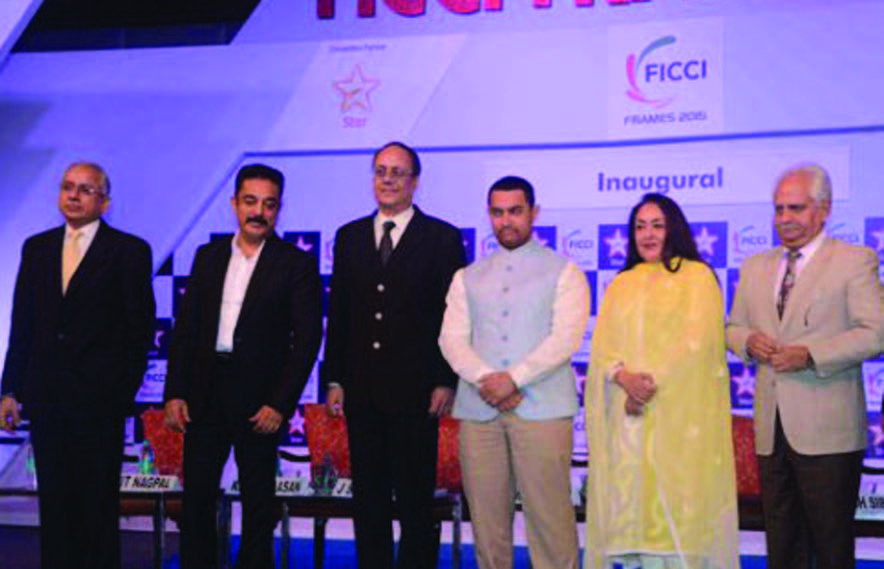
    Day 1 of the event saw the inauguration with Aamir Khan lighting the ceremonial lamp. This was followed by the welcome address from Jyotsna Suri, Vice President, FICCI. Harit Nagpal, CEO & MD, TataSky, delivered the theme address next.

    The FICCI-KPMG 2015 report on the Indian Media & Entertainment industry was officially released after Harit’s address; the highlight of this report is the growth registered by various disciplines within the industry.

    This was followed by opening remarks from Ramesh Sippy, Co-chair, FICCI Entertainment Committee, and Kamal Hassan. Aamir Khan was next with an interactive session with the audience.

    This inaugural session was followed by a series of presentations, panel discussions & master-classes. Detailed coverage of these sessions along with interviews of key presenters & panelists will be provided at the end of the conference.

    The list of media corporations at this year’s convention includes BBC, Discovery Networks, Disney India, Fox Star Studios, Phantom Films, NDTV, Excel Entertainment, Star India, Dharma Productions, TataSky, Viacom 8, Zee TV and Balaji Telefilms, among several others.

    The convention also features national and international government bodies such as the Consul General of USA, Consul General of Canada and the Ministry of Information and Broadcasting (India).

    Finally, there are a number of M&E-centric corporations with booths at the event, looking to showcase a wide range of industry tools & accessories such as film-making & broadcasting equipment, studio apparatus, animation tools, software solutions & related technology.

    About FICCI

    Established in 1927, FICCI (Federation of Indian Chambers of Commerce & Industry) is the largest and oldest apex business organization in India. FICCI’s history is closely interwoven with India’s struggle for independence and subsequent emergence as one of the most rapidly growing economies globally. FICCI plays a leading role in policy debates that are at the forefront of social, economic and political change.

    A non-government, not-for-profit organization, FICCI is viewed as one of the major voices of India’s business and industry. It works closely with the government on policy issues, enhancing efficiency, competitiveness and expanding business opportunities for industry through a range of specialized services and global linkages. Partnerships with countries across the world carry forward it’s initiatives in inclusive development, which encompass critical issues such as health, education, livelihood, governance & skill development.

    Through its 400 professionals, FICCI is active in 38 sectors of the economy. FICCI’s stand on policy issues is sought out by think tanks, governments and academia. Its publications are widely read for their in-depth research and policy prescriptions. FICCI has joint business councils with 79 countries around the world. Its publications are widely read for their in-depth research and policy prescriptions.

    The Media & Entertainment Division of FICCI serves a vital link between the media & entertainment industry, Information & Broadcasting Ministry and global interests in this vibrant sector.

    Media & Entertainment Division is an active division organizing the FICCI-FRAMES, conducting & releasing pioneering studies in the sectors, assisting in policy decisions and helping scale up the industry through various initiatives.

    This division is guided by the chairman Mr. Uday Shankar and co-chairman Mr. Ramesh Sippy.

  • CEMENT PRICES LIKELY TO GO UP AS RAILWAYS INCREASE FREIGHT RATES

    CEMENT PRICES LIKELY TO GO UP AS RAILWAYS INCREASE FREIGHT RATES

    MUMBAI (TIP): Cement prices across the country are likely to go up by Rs 3-5 per 50 kg bag following railway minister Suresh Prabhu’s proposal to increase freight rates in his maiden budget. Cement producers will, however, take a call on increasing prices only after studying the Union Budget on February 28.

    Prabhu has hiked freight rates by Rs 21 per tonne of cement transportation and also announced increase in freight rates of coal and slag, by Rs 45.70 per tonne and Rs 20.9 a tonne, respectively. Although unhappy with the move, cement manufacturers said they would wait for the main Budget to take a final call on raising prices which are already subdued as demand has not picked up.

    “The industry was looking for some incentive from the Rail Budget. The impact of the freight hike would vary from company to company based upon their dependency on rail. Back of the envelop calculations suggest that our cost of production is likely to go up by Rs 7-10 per bag of 50 kg due to the proposed freight hike on various inputs and commodities,” a CEO of a leading cement firm said on conditions of anonymity.

    The coal and steel sectors, on the other hand would see only a marginal impact depending on the location of the plant frpm the raw material source. Despite increase in freight rates of coal, industry sources did not see the possibility of an increase in power tariffs. Ravi Uppal, MD & CEO, Jindal Steel and Power Ltd (JSPL) believes the 6.3% hike in freight rates for coal will dent a range of industries and is also out of whack with the Make in India spirit. Sanjeev Churiwala, CFO, Ambuja Cement believes that the proposed hike in freight of raw materials and cement will increase product prices between Rs 20 and and Rs 60 per tonne of cement. “It will be too early to say if the increased cost will be passed on to consumers as prices are already depressed and demand is yet to pick up,” Churiwala said, while adding that in case the cement firms are not able to pass on the increased cost to consumers, it will further erode their EBIDTA margins by 1%.

    “The freight increase will majorly impact cement prices as urea, LPG and kerosene prices are regulated and subsidised by the government so there won’t be any increase in prices of these commodities,” said Rajaji Meshram, director, Transport at KPMG.

    “It is surely inflationary in nature but that could have been avoided by focusing on internal efficiency improvements. Companies will tend to pass on a portion of this to end consumers. A lot depends on how the overall demand picks up in the near term, however, as long as we have higher growth, nobody would complain,” GV Subrahmanyam, partner, Grant Thornton India LLP said. According to Parikshit Arya, Jt. MD, Rhenus Logistics, the increase in freight rates will impact the manufacturing industry as these are their key ingredients. “Ultimately the manufacturing cost increase due to freight rise will be passed on to the end users. Also the consumer of these raw materials may move cargo by road rather than railways, if the rail freight is not competitive enough,” said Arya.

  • Paswan favours regulator for direct marketing industry

    Paswan favours regulator for direct marketing industry

    NEW DELHI (TIP): The consumer affairs ministry is keen to set up a regulator for the over Rs 7,000 crore direct marketing industry and on Thursday minister Ram Vilas Paswan added his stamp of approval to the idea. Following demand from the industry, the government has constituted an inter-ministerial group (IMG) to look into the issue and the first meeting is scheduled next week.

    The committee has members from corporate affairs and department of industrial policy and promotion (DIPP) and is headed by consumer affairs secretary Keshav Desiraju. Direct selling is offering goods and services to consumers outside of the fixed retail outlet channels through sellers. Addressing a conference organized by the industry body FICCI, Paswan said, “I think the demand for regulator for direct selling sector is quite relevant and legitimate. We are considering it.” However, he cautioned, “There are dangers in the methods of direct selling, some companies are forming pyramid structure in the name of direct selling.

    Many such cases have come in light, where the consumers were cheated by the companies in the name of direct selling. They vanished overnight by collecting their money.” Paswan said his ministry is taking the demands of the direct marketing sector seriously as to whether a specific regulator or set of regulations is required for the sector. Sources said while the industry has been demanding a separate regulator under the consumer affairs department, the corporate affairs ministry believes the business can be regulated within the available framework. “Since there are different viewpoints we have formed this IMG,” said a consumer affairs ministry official.

    Desiraju said that there is a need to differentiate direct selling from other fraudulent schemes masquerading in the market as direct selling. “With internal trade falling under the consumer affairs ministry as per the allocation of business, the ministry seeks to play an important role in regulating activities which impact consumers. The industry needs to have a regulator to look at its issues more closely and resolve them.” According to a KPMG report, direct selling is one of the fastest growing non-store retail formats in India, recording double digit growth of more than 20% over the past five years. In 2012-13, it has been estimated to contribute taxes of INR 1,000 crore to the exchequer.

  • NEW BANKING LICENCES LIKELY TO WIDEN FINANCIAL INCLUSION PROCESS

    NEW BANKING LICENCES LIKELY TO WIDEN FINANCIAL INCLUSION PROCESS

    MUMBAI (TIP):
    The new banking licences issued to IDFC and Bandhan Financial Services Private Limited and the Reserve Bank’s intention to consider the application of Department of Posts separately in consultation with the Central Government are likely to widen the scope for financial inclusion. “It was a long process and the RBI has done a careful evaluation, using all filters, quantitative and qualitative, while selecting the entities for banking licences,” said Shashwat Sharma, Partner-Financial Services, KPMG in India.

    The RBI was convinced that these entities would be able to do justice to the central bank’s declared slogan ‘financial inclusion’, he pointed out. “While the RBI has been conservative in granting in-principle approval to only two applicants in this round, what is very heartening to note is the stated outlook to review the guidelines and make this a regular process moving towards an ‘on-tap’ policy, including differentiated licences,” said Mr. Sharma. The new banks added in 1993-94 were only obligated to open branches in rural areas. The banks added subsequently in 2003-04 were required to have 25 per cent branches in semi-urban and rural locations.

    The current guidelines require new banks to set up 25 per cent branches in un-banked rural locations with population up to 9,999. “If we carefully look at the developments in the two decades, this clearly indicates the focus RBI is having towards inclusive growth and financial inclusion,” said Rishi Gupta, COO & ED, FINO PayTech, the largest business correspondent in India offering a bouquet of financial services. “Bandhan is well-established in rural parts of Eastern India. It essentially caters to the “entrepreneurial / bankable” masses by extending them credit via joint liability group (JLG) model.

    Whereas other typical corporate banks find it difficult to make rural branches profitable, Bandhan should be able to leverage its rural presence effectively, said Gupta. “What needs to be seen is how it is able to cater to the banking needs of the BPL sections of rural India,” he added.

    Emerging competition
    “We believe new entrants will take time to scale up their branch and liability networks and will not pose significant threat to the strong deposit/retail franchises created by other larger banks,” said Hatim Broachwala, Analyst, Karvy Stock Broking, while talking on newly emerging competition in the sector. The RBI has also reiterated that the new bank licences will be an on-tap process from here on. and guidelines for the same will be issued soon. Mr. Broachwala said that the process of gradual entry of banks over a period of time would smoothen out future competition in the sector and also reduce risks of failure of new banks.

    “We have a strong starting position in corporate banking. As a bank, we will be able to deliver to our existing clients wider array of products. That should reduce our dependency on term loans and allows us to broaden our revenue base from corporate banking. In parallel, it is our goal to build a depository franchise, which we intend also to enter the space of retail banking… to reach the goal of an universal bank,” said Rajiv B. Lall, Executive Chairman, IDFC. “We will also have a particular focus on building up banking footprints in Bharat….going to smaller towns and reach the unbanked,” Lall added.

  • IPL 7 SUSPENSION COULD LEAD TO RS 20K CRORE LOSS

    IPL 7 SUSPENSION COULD LEAD TO RS 20K CRORE LOSS

    NEW DELHI (TIP): With the Supreme Court proposing the suspension of Chennai Super Kings and Rajasthan Royals from IPL 7 over the spot-fixing and betting scandal, India’s biggest and hottest sports property and BCCI’s most sumptuous cricket tournament faces a potentially unprecedented crisis.

    If the IPL 7 is fully scrapped, the total loss of business could amount to Rs 20,000 crore, according to consultancy firm KPMG in India, which has estimated that a season of IPL generates combined revenues of around $3.2 billion for various sectors. However, if only CSK and RR are made to stay away from this year’s edition, the loss would be around Rs 9,000 crore.

    If CSK and RR are forced to quit this edition, reducing to a six-team, home-andaway league, the number of games will drop from 60 to 34; almost 45% fewer games. “It would negatively impact viewership, ad inventory, jersey sponsorships, licensing and merchandising deals and channel partnerships. This would also have a cascading impact on hospitality, travel, security and associated sectors. Considering IPL teams generate Rs 1.5-Rs 3 crore per match, the total value lost just on account of gate revenues alone would be around Rs 40-78 crore,” says Jaideep Ghosh, head, sports advisory services at KPMG in India.

    There could be other issues emerging as well. For instance, players’ payments for the year are scheduled to begin shortly. “Not paying them could create legal complications,” an IPL business insider said. Most teams have already invested in promotional material worth crore of rupees, he added. Industry insiders also mention that PepsiCo, IPL’s title sponsor, might try to renegotiate its deal with the BCCI depending on the final judgment. In 2012, PepsiCo had beaten telecom major Bharti Airtel to become the league’s title sponsor, with a bid of Rs 396.8 crore for five seasons starting 2013.

    Interestingly, CSK’s skipper MS Dhoni is also a brand ambassador for the New York-based food and beverage giant. PepsiCo, however, refused to speculate on what could be at this stage. “The matter is sub-judice. We would not like to offer any comment,” said a PepsiCo India spokesperson. Another major sponsor, Vodafone, also declined to comment. Moving the first half of IPL 7 to UAE has also galled companies. “Sponsors are noticeably worried about their investments in the IPL this time. Stadiums in UAE are smaller than the ones here. For starters, instadia sales will be lower,” says Ghosh.

    Advertising revenues will also be hit significantly if the IPL gets stalled. According to Navin Khemka, managing partner of ZenithOptimedia, a media-buying firm that represents consumer goods major Reckitt Benckiser among others, Rs 700 crore to Rs 1,000 crore of advertising revenues will be affected. “A 10-second spot is being sold for Rs 4.5-5 lakh. If the two teams don’t play, with a lesser number of matches, broadcasters will be forced to bring the ad rates down and we could see smaller advertisers coming in,” he says.

    Prasana Krishnan, business head of Multi Screen Media’s (MSM) sports entertainment channel Sony Six, which has the television broadcasting rights of the IPL, sounds wary as he says, “Give us a few more days. We are also watching the space.” IPL teams such as, Delhi Daredevils, Kolkata Knight Riders (KKR) and Rajasthan Royals shied away from sharing their views on the impending scenario. While CEO and MD of KKR Venky Mysore and CEO of Delhi Daredevils Hemant Dua were not available for comment, a spokesperson for Rajasthan Royals preferred not to comment when contacted by TOI. “We would prefer to wait and watch before airing our views.”

  • Indian Americans ensure a full house at FICCI FRAMES 2014 in Mumbai

    Indian Americans ensure a full house at FICCI FRAMES 2014 in Mumbai

    The 15th Annual FICCI FRAMES conference on the Media & Entertainment (M&E) industry is back at the Rennaissance Hotel & Convention Centre situated on the picturesque Powai Lake in Mumbai. It’s Wednesday, March 12th 2014; Day 1 of the event, and the Indian American community is here again in full strength; veterans from the media business, aspirants in the field of entertainment, panelists, delegates, you name it, the conference has them all.

    About FICCI FRAMES 2014
    FICCI FRAMES is Asia’s largest global conference on the business of Media and Entertainment. Spanning three days, the conference covers the entire spectrum of the M&E industry, with back-to-back presentation sessions, panel discussions & master-classes focused on microspecializations such as film, television, radio, print, internet/digital media, animation and gaming among others. This highly-anticipated & most-respected industry event currently draws over 2,500 participants from all over the world, with India & USA together accounting for over 80% of the attendees.

    The list of known names at the conference reads like a virtual Who’s Who of the global M&E industry. Attendees get to rub shoulders and interact one-on-one with top achievers in the business; for 2014, the list of presenters & panelists boasts (in alphabetical order of first name) Abhay Deol, Abhishek Bachchan, Anupam Kher, Arnab Goswami, Ajit Pai, Andy Paterson, Collin Burrows, Farhan Akhtar, Guneet Monga, Hiromichi Masuda, Javed Akhtar, Jim Egan, Kajol, Kazutaka Akimoto, Kirron Kher, Lakshmi Praturi, Mark Eyers, Michael Best, Nancy Silberkleit, Priyanka Chopra, Punit Goenka, Rajeev Masand, Rakeysh Omprakash Mehra, Ramesh Sippy, Roger Fisk, Sanjay Gupta, Shanker Tucker, Siddharth Roy Kapur, Sonam Kapoor, Shaan, Sudhanshu Vats, Sudhir Mishra, Stuart Haskayne, Stuart Sender, Uday Shankar and Vikram Chandra, to name a few.

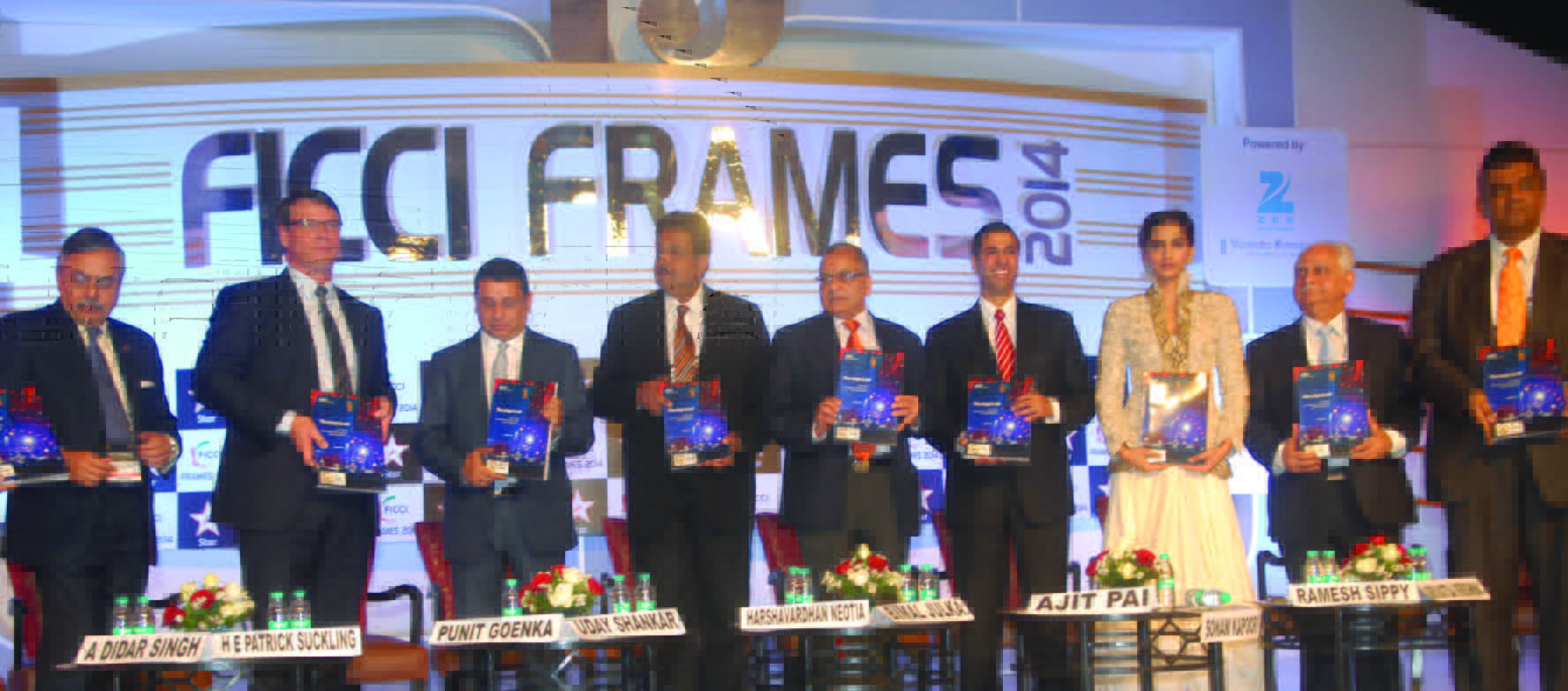
    Day 1 of the event saw the inauguration by actress Sonam Kapoor lighting the ceremonial lamp. This was followed by the welcome address from Harshavardhan Neotia, Vice President, FICCI. Harshvardhan highlighted critical developments within the M&E industry over the past 15 years. He spoke about the digitization of cable television, privatization of FM radio, clarifications in GST, introduction of a single window clearance system and future trends such as FDI in media, the mobile internet and simplification of policies. He ended his address by emphasizing the role of media in corporate governance and social responsibility. This was followed by opening remarks from Uday Shankar, Chairman, FICCI and also CEO, Star India.

    He discussed the role of government in the industry. Uday stated that government and the media needed to work together to sustain the vibrancy of the industry. He stressed that media’s role has evolved from mere reporting to seeking accountability & transparency from elected office-bearers of the nation. He also touched upon obstacles faced by the media when it published or broadcast coverage critical of the government of the day. He ended with the hope that the new government elected in May 2014 would look at media as a partner and not as an adversary. Punit Goenka, CEO, Zee Entertainment delivered the theme address next. He was followed by the vision statement from Bimal Julka, Secretary, Ministry of Information & Broadcasting.

    Bimal dwelt on the importance of censorship in the Indian media. Srivatsa Krishna, Secretary, Government of Karnataka (partner state for FRAMES 2014) was next; he emphasized the various initiatives being undertaken by his government in the field of media & entertainment. Finally, it was the turn of Ajit Pai, the dynamic young Commissioner of the FCC, USA (Federal Communications Commission). A second-generation Indian American, he shared insights about the role of FCC in America and the way in which the American government facilitates innovation within the M&E industry. He provided instances of successful partnerships between the government and key players from within the private sector in USA, which helps in enabling worldclass infrastructure for the industry. His address was very well-received by the audience.

    The FCC is an independent agency of the United States government, created by Congressional statute to regulate interstate and international communications by radio, television, wire, satellite, and cable in all 50 states, DC and US territories. The FICCI-KPMG 2014 report on the Indian Media & Entertainment industry was officially released after Ajit’s address; the highlight of this report is the growth registered by various disciplines within the industry. This inaugural session was followed by a series of presentations, panel discussions & master-classes. Detailed coverage of these sessions along with interviews of key presenters & panelists will be provided at the end of the conference.

    The list of media corporations at this year’s convention includes Archie Comics, BBC, Bloomberg, CNN IBN, Discovery Networks, Disney India, Fox Star Studios, Google, India Today, INK Salon, Microsoft, NBA, NDTV, Reliance Entertainment, Sony, Star India, Shochiku (Japan), Times Now, Turner International, TV France, Viacom18 and Zee Entertainment. The convention also features government bodies or political organizations such as the Australian High Commission (partner country for FRAMES 2014), BJP, CBFC, FCC (USA), INC, Ministry of Information & Broadcasting (India) and Obama’s Presidential Campaign Team for 2008 & 2012. Finally, there are a number of M&Ecentric corporations with booths at the event, looking to showcase a wide range of industry tools & accessories such as filmmaking & broadcasting equipment, studio apparatus, animation tools, software solutions & related technology.

    About FICCI
    Established in 1927, FICCI (Federation of Indian Chambers of Commerce & Industry) is the largest and oldest apex business organization in India. FICCI’s history is closely interwoven with India’s struggle for independence and subsequent emergence as one of the most rapidly growing economies globally. FICCI plays a leading role in policy debates that are at the forefront of social, economic and political change. A non-government, not-for-profit organization, FICCI is viewed as one of the major voices of India’s business and industry.

    It works closely with the government on policy issues, enhancing efficiency, competitiveness and expanding business opportunities for industry through a range of specialized services and global linkages. Partnerships with countries across the world carry forward it’s initiatives in inclusive development, which encompass critical issues such as health, education, livelihood, governance & skill development. Through its dedicated team of over 400 professionals, FICCI is active in 38 sectors of the global economy. FICCI’s stand on policy issues is sought out by think tanks, governments across the world and academia; it has joint business councils with 79 nations.

    Its publications are widely read for their in-depth research and policy prescriptions. FICCI’S Entertainment Division serves as the vital link between the Media & Entertainment industry, the Ministry for Information & Broadcasting (India) and global players. In addition to organizing FICCI FRAMES annually, this division conducts & releases pioneering studies related to the industry, assists in policy decisions and helps in scaling up the industry through various initiatives. The division is currently headed by Uday Shankar (Chairman) and Ramesh Sippy (Co-chairman).

  • Global Tax Heads Convene for Dialogue on Multilateral Issues

    Global Tax Heads Convene for Dialogue on Multilateral Issues

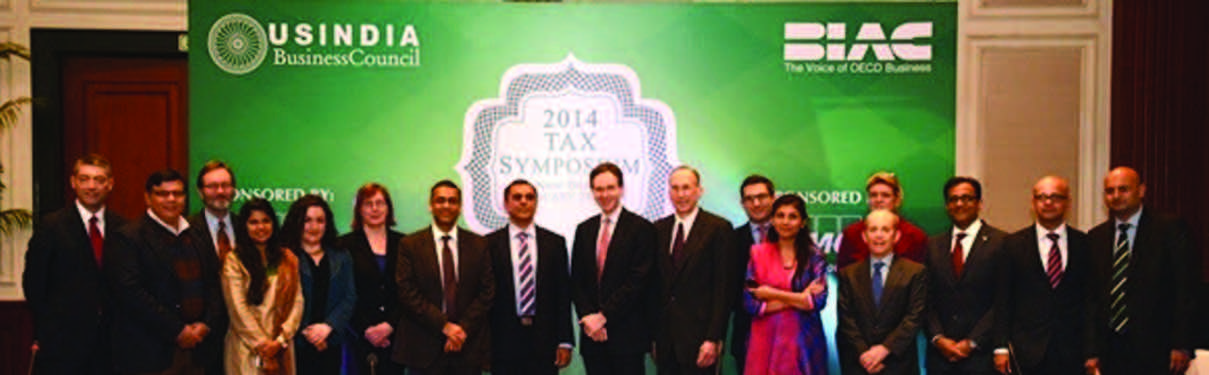
    NEW DELHI (TIP): The U.S.-India Business Council concluded a highprofile mission comprised of top tax executives from global multinationals who engaged in a dialogue with senior officials from the Government of India as well as private sector counterparts to improve India’s tax climate for foreign investment.

    The prestigious group featured the Organization for Economic Cooperation and Development (OECD)’s Business and Industry Advisory Committee (BIAC) official Taxation Bureau. BIAC, the voice of business of the OECD, serves as an industry conduit for the international government body of developing countries which sets global norms for tax and transfer pricing.

    The USIBC executives met on behalf of global industry with top officials in the Ministry of Finance, including Central Board of Direct Taxes member RK Tewari, Competent Authority Joint Secretary Akhilesh Ranjan, and Chairman of India’s Tax Administration Reform Commission Dr. Parthasarathi Shome. In addition, they met with the International Monetary Fund (IMF) to discuss macroeconomic issues, as well as with senior representatives of the Federation of Indian Chambers of Commerce and Industry (FICCI) and Confederation of Indian Industry (CII).

    The discussions on the OECD Base Erosion and Profit Shifting (BEPS) proposal were especially timely given the concurrent G20 discussions in Australia in which Finance Minister Chidambaram participated. The program’s capstone was the inaugural USIBC International Tax Symposium, where CFOs and tax leaders from domestic and global business in India met with the delegation to share insights and develop a constructive strategy of collaboration.

    The event, hosted by KPMG LLP’s Rishi Chugh, Partner in-charge of the U.S.- India Practice, covered domestic tax, advance pricing agreements (APAs), transfer pricing, and dispute resolution issues. The global delegation, which included the tax heads of General Electric, Genpact, Goldman Sachs, JP Morgan Chase, Microsoft, Shell, Siemens, and Unilever, among others, is part of a continued strategy of engagement by USIBC to increase constructive dialogue on multilateral tax issues facing foreign investors in India.

    The head of the delegation, Will Morris, Chair of the BIAC Committee on Taxation and Fiscal Policy, and Director of Global Tax Policy at General Electric (GE), said, “India is by far one of the most important investment destinations for all of our companies. Our experience is that an open and constructive dialogue between the global investment community, Government of India, and Indian industry partners will be the only way forward in alleviating current tax challenges.

    We think it a positive development that India, as a key player in the G20, is fully engaged in the G20/OECD BEPS project which holds the prospect of more uniform international tax rules.” He continued, “As a major global economic power, it is imperative to the global tax system that India’s tax laws and administration are in harmony with international norms. These discussions have been a very productive first step for BIAC to engage with India on OECD tax issues and we’re grateful to our Ministry of Finance hosts.”

    Formed in 1975 at the request of the U.S. and Indian governments, the U.S.- India Business Council (USIBC) is the premier business advocacy organization advancing U.S.-India commercial ties. Today, USIBC is the largest bilateral trade association in the United States, headquartered in Washington, DC, with liaison presence in New York, Silicon Valley, and New Delhi, comprised of more than 350 of the top-tier U.S. and Indian companies. Ajay Banga, President & CEO of MasterCard, is USIBC’s chairman.

  • DIESEL PRICES TO BE DEREGULATED IN 6 MONTHS

    DIESEL PRICES TO BE DEREGULATED IN 6 MONTHS

    NEW DELHI (TIP): Petroleum Minister Veerappa Moily on November 20 said that diesel prices will be deregulated in six months with gradual price increases. He said the small monthly increases in rates will continue as planned and there was no plan for a one-time steep hike of Rs 3 or 4 per litre to bridge the gap. “In six months, the diesel sector will be deregulated,” he said at the KPMG Energy Conclave. The government had in January allowed oil companies to increase the price of diesel by up to 50 paisa a litre every month to gradually eliminate subsidies on the fuel. Stateowned fuel retailers, who control 95 per cent of the petrol pump sales, sell diesel at government-fixed rates, which are way lower than the cost of production.

    “Under-recoveries had come down to Rs 2.50 because of monthly increases, but they soared to Rs 14 as the rupee depreciated sharply. Currently, under-recoveries on diesel are at about Rs 9.28 per litre,” Moily said. At current rates, it will take 19 months to wipe off all the losses on diesel sales, but the Petroleum Minister is pinning hopes on the rupee appreciating and international oil prices cooling down for reducing this time window to six months. Wiping out the under-recoveries would help in the deregulation of diesel.

    “We are already going in the direction of deregulating diesel prices. If the rupee appreciates against the dollar and international oil prices drop, we will be in a position to completely deregulate,” he said. Speaking at the conference earlier, Moily said India was the fourth largest consumer of energy in the world after China, US and Russia and is expected to become the third largest by 2025. India consumed 157.057 million tonnes of petroleum products in 2012-13.

    Ever-widening gap
    Under-recoveries (loss on diesel sales) currently stand at a massive Rs 9.28 a litre This figure had come down to Rs 2.50 because of monthly increases, but it soared to Rs 14 as the rupee depreciated sharply It will take 19 months at current rates to wipe off all the losses on diesel sales The government had in June 2010 freed both petrol and diesel prices from its control

  • 2013 New York Indian Film Festival Awards Announced

    2013 New York Indian Film Festival Awards Announced

    SHAHID, ANUMATI, and COLOR OF SKY Win Top Awards
    NEW YORK, NY (TIP): The New York Indian Film Festival (NYIFF) announced May 6, the winners of its competition categories at a ceremony at the prestigious Skirball Center, in the final event for the monumental festival, which ran April 30 – May 4. The winners were chosen from 18 narrative, 10 documentaries (feature length or shorter) and 8 shorts from the Indian subcontinent and its diaspora.

    Top honors were awarded to Anumati directed by Gajendra Ahire, for Best Feature Film as well as Best Actor in a Feature Film for Vikram Gokhale’s impressive turn as a desperate husband, Ratnakar, on a mission to save his dying wife.The award for Best Feature Film was jointly presented by Consul General of India, Ambassador Mulay and Ambassador Manjeev Puri. Top Chef judge Padma Lakshmi presented the Best Actor award.

    Director Hansal Mehta took home the Best Director of a Feature Film award for his compelling film Shahid, which traces the true story of slain human rights activist lawyer Shahid Azmi. The director, in addition to receiving an award, presented an award that night, alongside Farooque Sheikh, to the Best Young Actor in a Feature Film. Suraj Negi was honored for his role as the titular character in Hansa.

    Deepti Naval was also honored in her role as Leela Krishnamoorthy, a middle aged widow, in debut filmmaker Avinash Kumar Singh’s Listen Amaya. This film reunited Farooque Sheikh and Deepti Naval as a romantic screen pair after over two decades. The award was fittingly presented by renown actor Aasif Mandvi and beloved actress Sarita Choudhury. Respected Malayalam cinema filmmaker/writer Dr. Biju was awarded for Best Screenplay by presenter Monica Dogra for his vision in Kashathinte Niram (Color of Sky), and the Best Documentary award went to The Only Real Game, directed by Mirra Bank, with the award presented by Sujata Thakur, Incredible India.

    Best Short Film went to Khaana, directed by Cary Sawhney. The award was presented by House of Cards actress Sakina Jaffrey. This year the Festival also had an award for the one-minute cell phone Bollywood short film. Created under the supervision of Professor Karl Bardosh, NYU students were tasked with creating Music Videos to popular Bollywood sound tracks, culminating in an impressive batch of viral mobile films, all in consideration for the esteemed award. Yi Su was presented with the prize, by Professor Karl Bardosh himself, for his one-minute Gangnam/Bollywood mashup.

    “We are so happy to honor these talented filmmakers for their achievements,” said Aroon Shivdasani, IAAC founder. “These films left me thinking about its themes and subjects well after the screening itself,” commented NYIFF’s film festival director Aseem Chhabra. “This year’s line-up made it difficult to choose just one award winner per category.”

    The jurors who were challenged to select the award recipients for each category were comprised of today’s most revered filmmakers, scholars, and industry leaders, including La Frances Hui, Claus Mueller, Muriel (Mike) Peters, Zenobia Shroff, Parag Amladi, Ashish Avikunthak, Tejaswini Ganti, Udayan Gupta, Joseph Mathew, Myrna Moncayo-Iyengar, Jaideep Punjabi, and Nilita Vachani. The voting process was audited by the respected firm, KPMG. A star-studded after party, which included presenters, winners, jurors, and guests, immediately followed the awards ceremony.

    Below is the full list of winners as well as the presenters who honored the recipients with an award: BEST FEATURE FILM Narrative Anumati, directed by Gajendra Ahire. The award was jointly presented by Consul General of India, Ambassador Mulay and Ambassador Manjeev Puri.

    BEST DIRECTOR OF A FEATURE FILM (Narrative)
    Hansal Mehta for Shahid. The award was presented to the director by Feroz Khan and Avinash Kumar Singh. BEST ACTOR IN A FEATURE FILM Vikram Gokhale as Ratnakar in Anumati, winner of Best Feature Film, directed by Gajendra Ahire. The award was presented by Padma Lakshmi.

    BEST ACTRESS IN A FEATURE FILM
    Deepti Naval as Leela Krishnamoorthy, a middle aged widow, in debut filmmaker Avinash Kumar Singh’s Listen Amaya. This award was presented by actor Aasif Mandvi & actress Sarita Choudhury

    BEST YOUNG ACTOR IN A FEATURE FILM
    Suraj Negi in Hansa. The award was presented by Hansal Mehta and Farooque Sheikh. BEST SCREENPLAY Dr. Biju for Kashathinte Niram (Color of Sky). The award was presented by Monica Dogra.

    BEST DOCUMENTARY FILM
    The Only Real Game, directed by Mirra Bank. The award was presented by Sujata Thakur, Incredible India. BEST SHORT FILM Khaana, directed by Cary Sawhney. The award was presented by Sakina Jaffrey.

    BEST ONE MINUTE CELL PHONE FILM
    Bollywood Style directed by Yi Su. The award was presented by Professor Karl Bardosh. About the New York Indian Film Festival (NYIFF): The New York Indian Film Festival is the oldest, most prestigious Indian film festival in the United States. It is dedicated to showcasing, promoting and building an awareness of Independent, art house, alternate and diaspora films from/about/connected to the Indian subcontinent.

    Our mission is to encourage filmmakers to tell their stories, to educate North America about them and their talent and to facilitate the making and distribution of these films. NYIFF boasts five days of premiere screenings of feature, documentary & short films, industry panels, special events, retrospectives, red carpet galas, an award ceremony, packed audiences and amazing media coverage. About the Indo- American Arts Council (IAAC): The Indo-American Arts Council is a registered 501(c)3 notfor- profit, secular service and resource arts organization charged with the mission of promoting and building the awareness, creation, production, exhibition, publication and performance of Indian and crosscultural art forms in North America.

    The IAAC supports all artistic disciplines in the classical, fusion, folk and innovative forms influenced by the arts of India. We work cooperatively with colleagues around the United States to broaden our collective audiences and to create a network for shared information, resources and funding. Our focus is to work with artists and arts organizations in North America as well as to facilitate artists and arts organizations from India to exhibit, perform and produce their works here.