Tag: Kulbushan Jadhav

  • India demands consular access to Kulbhushan Jadhav

    India demands consular access to Kulbhushan Jadhav

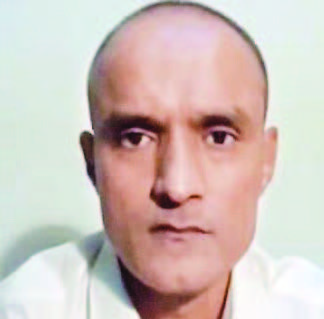
    ISLAMABAD (TIP): India on Tuesday demanded consular access to Kulbhushan Jadhav who has been sentenced to death by a Pakistani military court for alleged spying.

    This was conveyed by Indian high commissioner in Islamabad Gautam Bambawale to Pakistan foreign secretary Tehmina Janjua during a meeting sought by him.

    On April 19, a meeting between Bambawale and Janjua was rescheduled.

    Pakistan has denied India’s request for consular access to 46-year-old Jadhav over a dozen times in the last one year.

    Pakistan army has already rejected any chance of granting consular access to Jadhav who was sentenced to death for espionage and subversive activities.

    On April 14, Bambawale had met with the Pakistani foreign secretary, showing increasing concern of India about the fate of Jadhav.

    He told media after his meeting that he had asked for list of charges and authentic copy of verdict of military tribunal against Jadhav to launch appeal against his conviction.

    He also said that India was seeking consular access on the basis on international law humanitarian grounds.

    Pakistan Foreign Office has said that during the period of trial of Jadhav, due judicial process was followed and he was provided a lawyer in accordance with relevant laws and the Constitution of Pakistan.

    Jadhav was awarded death sentence by the Field General Court Martial earlier this month, evoking a sharp reaction in India which warned Pakistan of consequences and damage to bilateral ties if the “pre-meditated murder” was carried out.

    Pakistan claims its security forces had arrested Jadhav from the restive Balochistan province on March 3 last year after he reportedly entered from Iran. It also claimed that he was “a serving officer in the Indian Navy.”

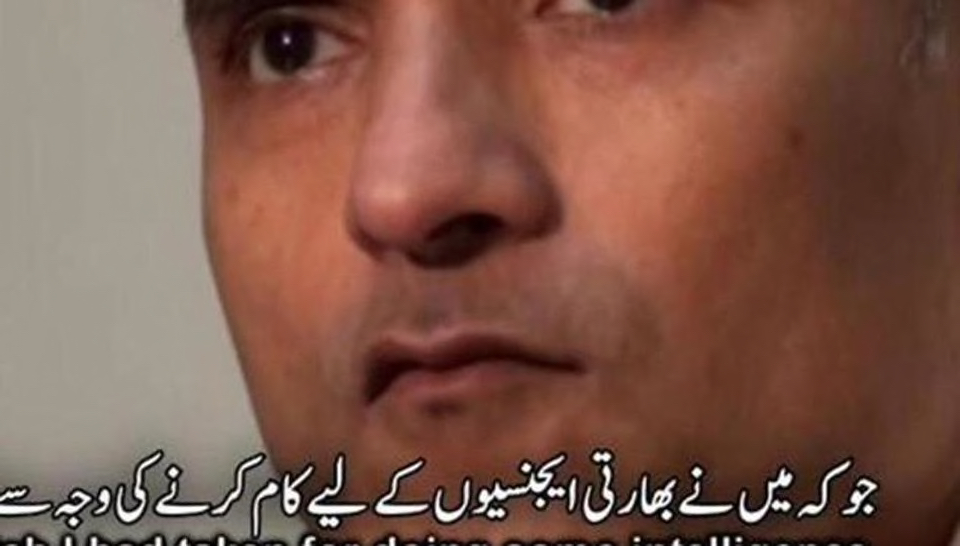
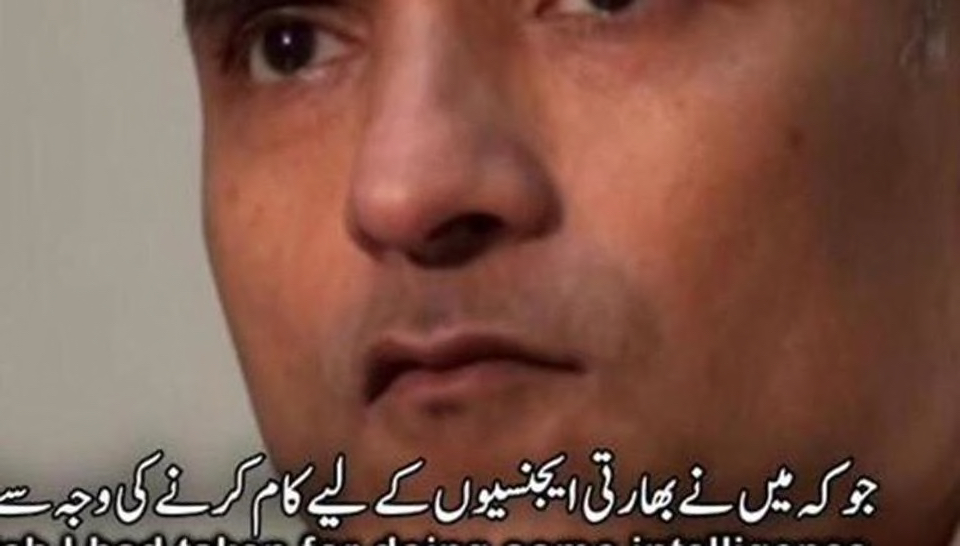
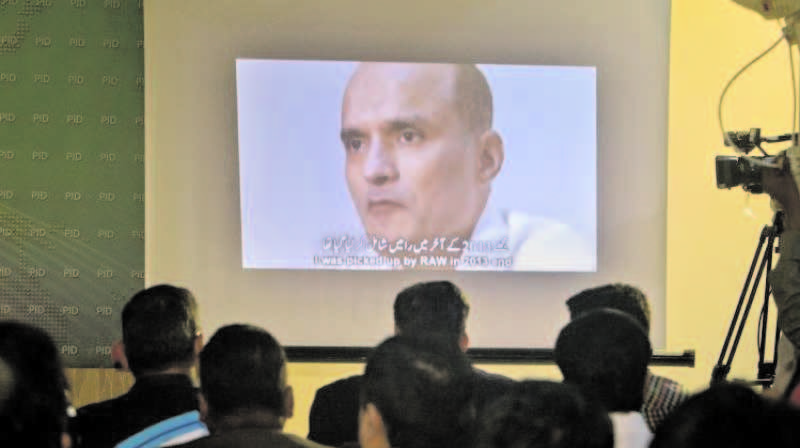
    The Pakistan army had also released a “confessional video” of Jadhav after his arrest.

    However, India denied Pakistan’s contention and maintained that Jadhav was kidnapped by the Pakistan authorities.

    India had acknowledged that Jadhav had served with the navy but denied that he has any connection with the government. (PTI)


  • INDIA WANTS PAK TO GIVE CERTIFICATE ON JADHAV’S HEALTH

    INDIA WANTS PAK TO GIVE CERTIFICATE ON JADHAV’S HEALTH

    NEW DELHI (TIP): India on April 27 asked Pakistan for a certificate on the health condition of Kulbhushan Jadhav, who has been awarded death sentence by a military court in Islamabad after it found him guilty of espionage.

    Expressing concern over the wellbeing of Jadhav, the Ministry of External Affairs said since Jadhav had been in Pakistan’s custody for over a year now, India was anxious to know his wellbeing.

    Only yesterday, India’s High Commissioner to Pakistan Gautam Bambawale met the Pakistan foreign secretary for the 16th time and sought consular access to Jadhav. “We have asked Pakistani government earlier also, and yesterday our High Commissioner (to Pakistan Gautam Bambawale) made a request on providing a report on his medical condition. So we await Pakistan’s response,” MEA spokesperson Gopal Baglay said today. Baglay also said the government was yet to receive a copy of the charge sheet against Jadhav, and did not even know who had defended him in the military court that sentenced him the death sentence. Denying consular access to Jadhav, Pakistan has consistently stuck to the line that the Indian national is a spy arrested by the Pakistan military from the restive Baluchistan area. India, while accepting the fact that Jadhav is indeed a former Indian Naval officer, has denied the charges of him being a spy.

    Islamabad says no to 26/11 reinvestigation

    Pakistan has told India that a reinvestigation of the Mumbai attack case was “not possible” as the trial was at an advanced stage and demanded “concrete” evidence against Hafiz Saeed, the mastermind of 26/11 assault, for putting him on trial

    “All proceedings (in the case) have been finalised except recording of 24 Indian witnesses’ statements… if India wants conclusion of the case, it should send witnesses to Pakistan to record their statements, a senior official of the Pakistan interior ministry said. Source: The Tribune


  • The strange case of Kulbhushan Jadhav – As I See It

    The strange case of Kulbhushan Jadhav – As I See It

    Perhaps the backdrop explains the dynamics at play more than just details of his incarceration

    “The fact that despite specific provisions in the Vienna Convention on Consular Relations, India was denied access to Mr. Jadhav only confirms that Pakistan does not want the truth to be revealed about the place and manner of arrest. India also argues that spies and operatives are not sent carrying their own passports”, says the author – KC Singh.

    The military trial and summary sentencing to death of Kulbhushan Jadhav in Pakistan, with the Indian High Commission denied consular access to him, has plunged India-Pakistan relations into a crisis again. Mr. Jadhav is not the first Indian to be caught and sentenced as a spy by Pakistan, but the first retired middle-level naval officer. The context and background of this need examination.

    A diplomatic leap in the dark

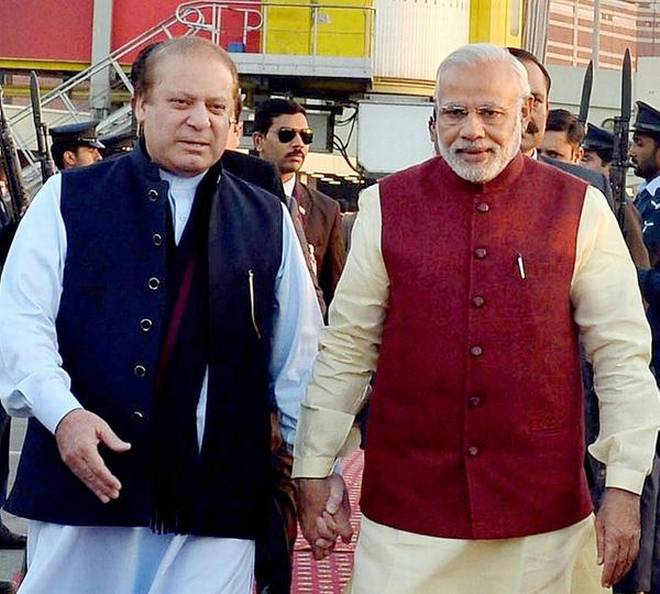
    The current cycle of bilateral engagement and acrimony runs from the dramatic visit by Prime Minister Narendra Modi to Lahore on Christmas in 2015. The occasion was Pakistan Prime Minister Nawaz Sharif’s granddaughter’s wedding, but really it was a diplomatic leap in the dark. As in the past, beginning with Prime Minister Atal Bihari Vajpayee’s Lahore bus journey, theatrical moves rattle anti-India forces in the Pakistani military and jihadi organisations, who then unleash retributive terrorist acts. Within a week of Mr. Modi and Mr. Sharif socialising, the Pathankot airbase was attacked. Tragically, within days of that, Mufti Mohammad Sayeed, the Chief Minister of Jammu and Kashmir, who headed the Peoples Democratic Party’s alliance with the Bharatiya Janata Party, died. The stage was set for instability in the Kashmir Valley.

    While Mufti sahib’s daughter Mehbooba Mufti dithered for nearly three months whether or not to succeed her father, the situation in Pakistan was drifting too. Prime Minister Sharif, marginalised by his namesake, the Pakistani Army chief, undermined by the Panama Papers revelations and suffering from heart trouble, left for the U.K. for medical treatment in April 2016. He returned to Pakistan in July. By then, Ms. Mufti had barely been in office when Burhan Wani, a self-styled commander of the Hizbul Mujahideen, was killed, inflaming an already restive Valley. From that point onwards, Indo-Pak relations slid downwards.

    Kulbhushan Jadhav alias Hussein Mubarak Patel was arrested by Pakistan in March 2016, allegedly in Balochistan, for espionage and abetting terror. This was a windfall for Pakistan as since the 2008 Mumbai attacks and the confessions of Pakistan-born American operative David Headley, it had been seeking moral equivalence by alleging complicity of India’s external intelligence agency, the Research and Analysis Wing (R&AW), in almost every major attack, particularly by the renegade Tehreek-e-Taliban Pakistan. In fact, the joint statement of Prime Ministers Manmohan Singh and Yousaf Raza Gilani at Sharm el-Sheikh in 2009 was widely condemned in India for unnecessarily allowing Pakistan to introduce Balochistan in the statement to discuss an alleged Indian hand in the Baloch uprising.

    Gaps in stories

    There is the usual Indo-Pak disagreement over facts. India claims Mr. Jadhav was conducting business out of Chabahar, Iran, for many years after retiring from the Navy, and that he has been abducted by Pakistani state or non-state actors from within Iran. The fact that despite specific provisions in the Vienna Convention on Consular Relations, India was denied access to Mr. Jadhav only confirms that Pakistan does not want the truth to be revealed about the place and manner of arrest. India also argues that spies and operatives are not sent carrying their own passports. On the other hand, it is unclear why Mr. Jadhav was operating under a Muslim name, and if he did convert, why the government keeps referring to him by his earlier name. India has not challenged the authenticity of his passport, implying that it was not obtained by fraud or faked by Pakistan. With the debate in India now enveloped in jingoism, such lacunae in stories paraded by both sides are beyond examination.

    The truth may never be known, but “Doval-isation” of India’s approach to Pakistan has been obvious for some time. Prime Minister Modi’s espousal of the cause of Balochis and the residents of Gilgit from the ramparts of the Red Fort on August 15, 2016 only confirmed Pakistani fears that India abets terror and secession in Pakistan. However, recent signals from Pakistan via Track II events were that the new Army chief, Gen. Qamar Javed Bajwa, wanted to reorient his Army’s approach towards India and would endorse the civilian government’s lead in crafting its India policy. He was apparently getting a pushback from entrenched interests raised on India baiting. There were unconfirmed reports that National Security Adviser Ajit Doval had spoken to his Pakistani counterpart to acknowledge the signal and create an environment for resuming political contact. Why then did Pakistan change tack and with sudden alacrity, devoid of transparency, sentence Mr. Jadhav?

    One trigger could have been the disappearance of an ex-ISI Pakistani military officer in Nepal. Another may be a desire to stoke further unrest in the Kashmir Valley. It could also be some re-balancing between the civilian and military authorities as Prime Minister Sharif awaits court judgement on the Panama Papers charges. At any rate, Pakistan has succeeded in capturing media space and the Indian government’s attention and thus mainstreaming its grouses even as a new U.S. president shapes his foreign policy.

    The Indian opposition has adopted a jingoistic pitch to entrap a government mixing politics, religion and nationalism. If assurances in Parliament are that the government will do “all” in its power to rescue Mr. Jadhav, either it is confident of a Cold War-style exchange of spies, provided they have managed to secure the asset that went missing from Nepal, or it is upping the ante hoping that Pakistan will not want to escalate tensions further.

    India’s perception of Pakistan

    India misperceives Pakistan, as the 19th century French statesman Talleyrand said the world did Russia, as it is neither as strong as it seems nor as weak as we think. For instance, it is not isolated, as policymakers in South Block assume. Pakistan would have seen rising Chinese rhetoric over the Dalai Lama’s visit to Tawang. It also would read U.S. President Donald Trump’s intervention in Syria and the dropping of the ‘mother of all bombs’ in Afghanistan as the U.S. returning to business as usual and restoring the primacy of its Sunni allies, i.e. Turkey, Saudi Arabia, plus the Gulf Cooperation Council, Pakistan, and Egypt. Pakistan is familiar with the generals now ruling the roost after White House chief strategist Stephen Bannon’s fall.

    A Sino-Pak alliance now fed by China’s open hostility and not countered by the U.S.’s words of restraint may entrap India into a regional morass. Many assumptions on which the Modi government has functioned in diplomacy are being rewritten. The challenge is to steer India through this maze with more than jingoism, theatre, and domestic electoral needs.

    (The author is a former Secretary, Ministry of External Affairs, Government of India) British English
  • Spy games making peace with India difficult: ex-Pak diplomat

    Spy games making peace with India difficult: ex-Pak diplomat

    WASHINGTON (TIP): Former Pakistan ambassador to the US, Hussain Haqqani, has criticised the death sentence awarded to retired Indian navy officer Kulbhushan Jadhav, saying Islamabad’s “spy games” are making it tougher for the two South Asian neighbours to even explore peace.

    Haqqani said Jadhav’s conviction for espionage would have been more convincing had it resulted from an open trial.

    “But as with much about Pakistan, the trial’s short and secretive timeline may have more to do with internal dynamics than with the merits of the case itself,” he wrote in an op-ed in The Wall Street Journal.

    Haqqani, who currently is the director for South and Central Asia at the Hudson Institute, a top American think-tank, said putting an Indian on death row was an easy way to scuttle momentum for new talks.

    “At a time when India is also sliding into Hindu religious fervour, with vigilante violence threatening the country’s minorities over protecting cows that are considered sacred, Pakistan’s spy games can only make it tougher for the two South Asian neighbours to even explore peace, let alone find it,” Haqqani said. “(Pakistan Prime Minister Nawaz) Mr Sharif had recently renewed calls for improving relations with India. Putting an Indian on death row is an easy way to scuttle momentum for new talks,” he added.

    In his op-ed, the former Pakistani diplomat also alleged that Islamabad is unlikely to change its policy of using terrorist groups for its national security. “Unwilling to change its policy of supporting jihadist groups as an instrument of regional influence, Pakistan’s military-intelligence combine wants to ensure the primacy of its worldview at least within Pakistan,” Haqqani said.

    (PTI)

  • US, AMNESTY, PAK GROUPS BACK INDIA ON JADHAV

    US, AMNESTY, PAK GROUPS BACK INDIA ON JADHAV

    NEW DELHI (TIP): Pakistan Army’s decision to execute alleged Indian spy Kulbhushan Jadhav seems to have found little support globally. Not only has Amnesty International slammed the decision but also the civil rights groups within Pakistan.

    Top US think-tanks have questioned the secrecy of trial and the US NSA visit here next weekend is expected to see some plain speak by India on its ties with Pakistan, hinted people familiar with the developments.

    Neighbouring Iran, from where Jadhav has been doing business for over a decade, had earlier snubbed Islamabad for its attempt to drive a wedge between New Delhi and Tehran using the so called “spy card”.

    Iran has not supported Pakistan in the ongoing episode. “The death sentence given to Kulbushan Jadhav shows yet again how Pakistan’s military court system rides roughshod over international standards,” said Biraj Patnaik, South Asia director of Amnesty International.

    “What the Pakistan Army has done is to embarrass both the Sharif and the Modi governments,” said a civil activist from Pakistan. Yet another Pak activist described the decision of the military court as a sham and Pakistan military may be using this to seek concessions from Delhi after feeling the pressure over India’s growing support in West Asia and strong opposition to the China-Pakistan-Economic-Corridor.

    Officials also referred to the successful visit of Bangladesh PM Sheih Hasina and momentum in BIMSTEC process as factors that have further isolated Pakistan within the South Asian region. There is also an opinion that China may have influenced Pak decision after the Dalai Lama’s visit to Arunachal.

  • Pak army brass discusses Kulbhushan Jadhav case, rules out compromise

    Pak army brass discusses Kulbhushan Jadhav case, rules out compromise

    New Delhi/Islamabad (TIP):  The Pakistan army brass decided after a discussion on April 13 that there would be no compromise on the issue of the death sentence+ awarded to retired Indian Navy commandant Kulbhushan Jadhav, an Inter-Services Public Relations (ISPR), the Pak army’s media wing, said in a statement. Also, the Pakistan foreign office officially acknowledged that one of its retired army officers was missing in Nepal.

    The Jadhav issue was discussed at the corps commanders’ conference held in the army’s General Headquarters in the garrison city of Rawalpindi, and presided over by the chief of army staff, Gen Qamar Javed Bajwa. The participants were briefed about Jadhav+ , who was sentenced to death by a field general court martial earlier this week, the ISPR presser said. The unprecedented April 10 decision has sparked a major diplomatic row between the two hostile neighbours.

    The Pakistan authorities also warned against the linking of its missing ex-army officer in Nepal with the Jadhav issue.

  • At the crossroads — US, China, Pakistan — India has its hands full

    At the crossroads — US, China, Pakistan — India has its hands full

    Jingoism may work for domestic electoral cycles, but can be dangerous internationally. Confronting the Sino-Pak combine, assuming Trump as a credible pro-India counterweight, is risky at best. Pliny the Elder’s advice to avoid ‘brutum fulmen’ or ‘senseless thunderbolt’ is perennially sound. PM Modi needs to send his ‘Rasgotra’ to Pakistan and avoid public fist-clenching, says the author – KC Singh.

    Harold Wilson’s quip that a week is a long time in politics comes to mind reviewing last fortnight’s developments. The US rained missiles on Syrian air base at Shayrat, near Qoms, in retaliation for the alleged Syrian use of sarin gas, notified as a chemical weapon, against civilians in Khan Sheikhoun. Pakistan upped the ante sentencing to death, for espionage and terrorism, Kulbhushan Jadhav, a former Indian Naval officer, allegedly apprehended in Balochistan. India ignored Chinese threats over the Dalai Lama visiting Tawang, which has the second holiest Buddhist monastery after Lhasa, and the birthplace of the sixth Dalai Lama.

    Taking them serially, Trump’s decision to punish Syria’s Assad regime surprised both his “Alt-right” allies, who felt betrayed by his neo-interventionism, as too his critics in own party and among Democrats, who were elated. Trump was recanting from his election rhetoric of distancing the US from geopolitical cesspools. He perhaps had multiple motives. He was able to jettison charges of cosiness, if not actual complicity, between the Russian government and his election campaign. It is speculated that the US gave Russians a heads-up to avoid direct conflict by ensuring no Russian lives were lost. Careful target selection by avoiding living quarters and attacking in the dead of night, when plane hangars were unmanned, also had the same objective.

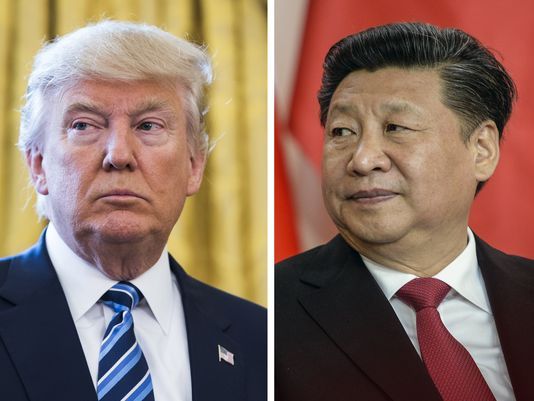
    Chinese President Xi Jinping did not get the same courtesy as Trump, having ordered the Tomahawks fired, sat down for dinner with him at his Mar-a-Lago resort in Florida, informing him of the decision only post meal. Trump thus altered the dynamics between Xi and himself, demonstrating the resolve to defend the global order, which his withdrawal from the Trans-Pacific Partnership (TPP), flip-flop on ‘one-China’ policy and election rhetoric, urging isolationism, seemed to question. Xi swallowed the embarrassment but the Chinese media — after he left the US — lambasted the breach of Syrian sovereignty.

    Analysts are wondering if this was a mere knee-jerk reaction, or the first move towards replacing the Assad regime. If the latter is true, there is yet no evidence that Russia is ready to abandon the Iran-Assad-Hezbollah alliance sine qua non to re-balance the Shia alliance. In any case, to force a ceasefire and realign half-a-dozen Sunni groups which oppose the Assad regime and hold parts of Syrian territory, ranging from effective Kurds — whose success Turkey resists — to Al Qaida associates and the IS, would be impossible without an international force, ideally with the UN Security Council imprimatur and the US and NATO participation. But such a force would be an anathema to Russia and China. Clearly, the generals manning critical positions in the Trump administration are finally getting to influence policy choices.

    Prime Minister Nawaz Sharif Of Pakistan
    Prime Minister Nawaz Sharif Of Pakistan

    This may not augur well for India-Pakistan relations as Pakistan gets emboldened the minute it gets access to influential US presidential aides. Trump’s revision of the Obama doctrine to use the Shias, led by Iran, to counter the IS by attempting to separate Russia from the Shia alliance has resurrected the demoralized Sunni brigade, led by Saudi Arabia. Pakistan allowing its former army chief Gen Raheel Sharif to head the Sunni alliance forces conducting operations in Oman indicates re-convergence of Pakistani, GCC and US interests.

    That leads to the next issue of Pakistan suddenly pronouncing the death sentence on Kulbhushan Jadhav. The Indian public reaction and uproar in Parliament is perfect reading by Pakistan to get Indian attention. The exact motive is difficult to decipher at present, but may be multi-fold. It could have been triggered by a former Pakistan ISI officer going missing in Nepal, allegedly abducted by India. The desire to exploit the spring offensive by protesters in the Kashmir valley, whose protests have seen unprecedented success by forcing the negation of the electoral process, is a perennial factor. The Central government’s inability to understand this dynamic is inexplicable, particularly that the rise of Yogis as commissars will feed the paranoia of the Muslim majority in a sensitive state and that an alliance with the BJP has rendered the PDP politically irrelevant in the Valley. The Pakistan army may also have concluded that PM Nawaz Sharif is vulnerable to indictment in the Panama Papers case and political instability seems real. Finally, after the initial trepidation about how Trump led to the detention of Hafiz Saeed in a fit of delayed contrition, Pakistan now has a measure of Trump the interventionist, at whose court Pakistan will present itself as the nuclear weapon-wielding mercenary.

    Finally, the Indian decision to test China by a more forward policy is laudable, but the timing may be inappropriate if it is based on the assumption of continued US assessment that a stronger India was in US interests to balance a rising China. This has been the US assumption since after the initial brouhaha over Indian nuclear tests of 1998. Although the Trump-Xi summit in Florida was overshadowed by the Syrian imbroglio, the two leaders seem to have bought time to negotiate differences over imbalanced trade, North Korea and South China Sea, etc. The statement by US ambassador to UN Nikki Haley about US mediation in India-Pakistan dispute raises questions whether Pakistan is really as isolated as the BJP claims.

    Finally, the Indian reaction to the Kulbhushan episode, with External Affairs Minister Sushma Swaraj promising all in India’s power, is hyperbolic. Hostage takers are best dealt with by quiet threats, which should be credible, and carrots that are tangible. By minimizing Indo-Pak contact there are few carrots that India holds. The only credible threat, short of a war, can be that abducting each other’s citizens and conducting mock trials is letting security agencies override diplomacy. Former foreign secretary MK Rasgotra recalls calling on President Zia-ul-Haq to convey Indira Gandhi’s message that if Pakistan did not stop abetting the hijacking of planes — which was assuming epidemic proportions in the early 1980s — India would do likewise. The gambit worked as differential of power between the two states had not yet been levelled by Pakistan possessing nuclear weapons.

    Jingoism may work for domestic electoral cycles, but can be dangerous internationally. Confronting the Sino-Pak combine, assuming Trump as a credible pro-India counterweight, is risky at best. Pliny the Elder’s advice to avoid ‘brutum fulmen’ or ‘senseless thunderbolt’ is perennially sound. PM Modi needs to send his ‘Rasgotra’ to Pakistan and avoid public fist-clenching.

    (The author is a former Secretary, Ministry of External Affairs, Government of India)

  • Kulbushan Jadhav death sentence: Risky, ill-considered

    Kulbushan Jadhav death sentence: Risky, ill-considered

    Pakistan’s sudden announcement on Monday, April10, that former Indian naval officer Kulbhushan Jadhav has been sentenced to death by a Field General Court Martial is a development fraught with danger.

    It could lead to a rapid escalation in bilateral tensions that the region can ill afford.

    The trial, sentencing, and its confirmation by the Pakistan Army chief, General Qamar Javed Bajwa, were carried out so secretly that the news took many in Pakistan as well by surprise. There are glaring holes in the procedures followed by Pakistan’s government and military in the investigation and trial of Mr. Jadhav.

    His recorded confession that was broadcast at a press conference within weeks of his arrest in March 2016 appeared to have been spliced. At various points in the tape, and in the transcript of the confession made available, Mr. Jadhav contradicts his own statements, suggesting that he had been tutored. Even if the confession was admissible in a court of law, little by way of corroborative evidence has been offered by Pakistan to back up the claim that Mr. Jadhav, who was allegedly arrested in Balochistan last year, had been plotting operations against the China-Pakistan Economic Corridor.

    Foreign Minister Sushma Swaraj’s statement in Parliament detailing 13 requests by the government for consular access, and replies from the Pakistan government that made the access conditional on India cooperating in the investigation, further casts the procedures followed in a rather poor light.

    International human rights agencies too have criticized them. Mr. Jadhav must be allowed a retrial, preferably in a civil court and with recourse to appeal.

    New Delhi must step up its responses in the matter, as it seems to have kept it on the backburner, confining itself to fruitless, repeated representations. India must also pursue the issue with Iran, where Mr. Jadhav is believed to have been based for more than a decade, and investigate how he was brought, by force or otherwise, into Pakistan.

    The timing of the announcement of the death sentence is also being seen in a spy versus spy context, with the recent disappearance of a former Pakistan Army officer in Nepal. These are matters best left to security agencies at the highest level, but the questions around Mr. Jadhav’s arrest need to be dispelled.

    Moreover, this escalation highlights the consequences of the breakdown in the India-Pakistan dialogue process, limiting the channels of communication between the two governments to sort out matters in a sober manner.

    The government has stood fast on its decision to not hold bilateral talks after the Pathankot attack in January 2016, but this policy is hardly likely to bring the desired results when a man’s life hangs in the balance.

    The Jadhav case requires a proactive three-pronged response from India: impressing on Pakistan that the death sentence must not be carried out, explaining to the international community the flawed trial process, and sending interlocutors to open backchannels for diplomacy for Mr. Jadhav’s safe return home.