Tag: L1 Visa

  • USCIS suspends Premium Processing for All H-1B Petitions

    USCIS suspends Premium Processing for All H-1B Petitions

    Starting April 3, 2017, U.S. Citizenship and Immigration Services will temporarily suspend premium processing for all H-1B petitions, a statement issued by the USCIS stated. This suspension may last up to 6 months. While H-1B premium processing is suspended, petitioners will not be able to file Form I-907, Request for Premium Processing Service for a Form I-129, Petition for a Non-immigrant Worker which requests the H-1B nonimmigrant classification. We will notify the public before resuming premium processing for H-1B petitions.

    The premium processing service allows an applicant or his potential employer to pay $1,225 to receive a response to his petition within 15 days. If USCIS has not responded within 15 days, the fee is refunded, though the application still receives expedited processing, according to a bulletin issued by the agency March 3. H-1B visas are used by U.S. employers to temporarily employ foreign workers, most often from India, in specialty occupations.

    “This temporary suspension will help us to reduce overall H-1B processing times. By temporarily suspending premium processing, we will be able to process long-pending petitions, which we have currently been unable to process due to the high volume of incoming petitions and the significant surge in premium processing requests over the past few years; and prioritize adjudication of H-1B extension of status cases that are nearing the 240 day mark,” said the agency in a bulletin.

    USCIS has said the temporary suspension of premium processing could last as long as six months. The agency has said it will reject any form I-907 – request for premium processing – filed with an H-1B petition. If a check is issued to cover both applications, USCIS noted it will have to reject the H-1B application as well.

    “Since FY18 cap-subject H-1B petitions cannot be filed before April 3, this suspension will apply to all petitions filed for the FY18 H-1B regular cap and master’s advanced degree cap exemption (the ‘master’s cap’),” noted USCIS, adding that the suspension also applies to petitions that may be cap-exempt.

    H-1B petitioners can still expedite their applications if they meet one of the following criteria: a severe financial loss to company or  person;   an emergency situation; humanitarian reasons; a non-profit organization whose work benefits the cultural and social interests of the U.S., certain Defense Department situations; or USCIS errors. Such requests will be reviewed on a case-by-case basis. The temporary suspension does not apply to other non-immigrant classifications. The United States Citizenship and Immigration Services has ruled that Green Card holders and visa holders, like those on H-1B, L-1, J or F-1, H4 visa, and even those having an Employment Authorization Card (EAD) must carry legal documents papers when traveling in and out of the country and at all times within the United States, or face the risk of being fined or imprisoned, or even both.

    With a large-scale immigration crack-down on undocumented foreigners imminent after President Donald Trump’s new executive orders, it’s important for all documented residents in the US to keep proof of their legal status in the country.

    And for those in the pipeline for a Green Card, a misdemeanor charge could have terrible repercussions when it comes to being adjudicated for legal permanent resident status. The same applies for Green Card holders who wish to become US citizen.

    The United States Citizenship and Immigration Services rule states: ‘Every alien, eighteen years of age and over, shall at all times carry with him and have in his personal possession any certificate of alien registration or alien registration receipt card issued to him pursuant to subsection (d). Any alien who fails to comply with the provisions of this subsection shall be guilty of a misdemeanor and shall upon conviction for each offense be fined not to exceed $100 or be imprisoned not more than thirty days, or both.’

    Another sub-section of the rule says: ‘Notwithstanding any other provision of law, the Attorney General is authorized to require any alien to provide the alien’s social security account number for purposes of inclusion in any record of the alien maintained by the Attorney General or the Service.’

  • Trump’s H-1B Visa Bill spooks India’s IT companies

    Trump’s H-1B Visa Bill spooks India’s IT companies

    It may not be a good time to be a non-American in Trump’s America.

    India, the largest exporter of IT workforce to the US, could be jolted if the H-1B Visa Bill, which was tabled in the House of Representatives, becomes a law.

    The country’s biggest IT companies, TCS, Infosys, Wipro and others, that enjoy significant cost advantages by sending Indian engineers to the US, are likely to be hit if the minimum salary cap for H-1B visas is raised to $130,000 from its current $60,000.

    In anticipation of the eventuality, India’s top four IT company stocks plunged on the Bombay Stock Exchange today. Mashable India reached out to these companies but they declined comment.

    Meanwhile, NASSCOM, the industry body for software and services companies, was not pleased with the development. “The bill does not treat all IT service companies with H-1B visa holders equally, and the provisions are biased against H-1B dependent companies,” it said in a statement.

    “The bill does nothing to address the underlying shortage of STEM-skilled workers, which has led all companies to have a calibrated strategy of hiring locally and bridging the skills gap by bringing skilled workers on non-immigrant visas including H-1Bs,” it added.

    The US issued more than a million visas to Indians in 2016, which accounted for 70% of all H1B visas issued worldwide.

    India happens to be the largest receiver of H-1B visas in the world. The US issued more than a million visas to Indians in 2016, which accounted for 70% of all H1B visas issued worldwide, according to news reports.

    IT analysts reckon that the new law, if and when it passes, will have far-reaching implications not only on Indian companies but on the US economy as well since most US-based Fortune 500 organizations are “deeply invested and dependent” on Indian IT services providers.

    “Skilled foreign workers who come to work in the US by the route of H1-B visas don’t just directly supplement the US IT industry with specialized skillsets, they also contribute indirectly to other industries in the US. Often H1-B workers bring their families along and thereby bring additional business for other industries like real estate, banking, hospitality to name a few. The effects of this announcement will impact the GDP and the overall business economy and growth of US,” says Sanchit Vir Gogia, chief analyst at Greyhound Research

    While the final outcome of the Bill is yet to be known, NASSCOM said it will continue to engage with the US administration and legislators both directly and through the Government of India. The focus would be on highlighting the value contribution of India’s IT sector as a “net creator” of jobs in the US.

    FUN FACT: The CEOs of both Microsoft and Google are of Indian origin.

  • IMMIGRATION UNDER TRUMP ADMINISTRATION: EXECUTIVE ORDERS UNDER REVIEW

    IMMIGRATION UNDER TRUMP ADMINISTRATION: EXECUTIVE ORDERS UNDER REVIEW

    In less than a month in the Oval Office, President Trump has issued few Executive Orders (EO), each of which has potential to stir extreme vetting, racial profiling and deportations. We briefly discuss some of the EO below and their immediate impact.

    Protecting the Nation from Foreign Terrorist Entry Into The United States: This EO placed a 90-day ban on the issuance of US visas and to entry into the United States of any one who is a national of one of the seven “designated” countries – Iran, Iraq, Libya, Somalia, Sudan, Syria and Yemen, suspended the US Refugee Admission Program for 120 days (for Syrian refugees, the ban was indefinite), suspended visa interview waiver program and extensive review by Department of Homeland Security of any individual, from their country to determine their visa, admission or other immigration benefit and that they are not threat to security or public safety.

    Current Impact: The impact of this EO is currently neutered. The US District Judge James Robart granted Temporary Restraining Order on a “nationwide basis” and the Ninth Circuit unanimously refused to reinstate EO. If Supreme Court takes up the case, it will be a split decision and Ninth Circuit’s decision would stand. But is believed the Trump administration may reintroduce this EO with some changes in it. Nevertheless, this EO created climate of chaos and confusion and clearly showcased discrimination based on religion. We hope this stays on hold permanently.

    Enhancing Public Safety in the Interior of the United States: This EO directs the Executive departments and its agencies to employ all lawful means, to enforce the immigration laws of the United States. It sets aliens on priority who have criminal backgrounds, committed crimes, abused public taxpayer benefits or are a national security concern. Federal grants will not be given to sanctuary cities. The Department of Homeland Security will deputize state and local law enforcement officers to perform functions of federal immigration agents.

    Current Impact: This EO may cause greatest danger to the unauthorized immigrants. The local police will transform in to Immigration and Custom Enforcement (ICE) officers. The “enforcement priority” will effectively include all the unauthorized immigrants in the United States, irrespective of their criminal record. An instance of this was witnessed on February 14, 2017, when ICE agents near Seattle, WA, detained and threatened to deport a 23 years old immigrant who is currently under the DACA program with no criminal background. This arrest appears to be arbitrary and denial of administrative and constitutional rights. The past week also observed raids by ICE agents throughout the country and detaining people with criminal background.

    We are hopeful checks and balances are placed on the President’s power and the Government policies adhere to the American values!

  • Trump’s Next Executive Order on Immigration may cause H-4 Visa holders to lose work permit

    Trump’s Next Executive Order on Immigration may cause H-4 Visa holders to lose work permit

    Indian Americans overwhelmingly use H1-B or the work visa. Most recently, under Obama administration their spouses, who are on H-4 visa were allowed to work. However, things are changing with the new Trump administration at the healm and Republicans and some Democratic lawmakers consider that high-tech Indian workers are stealing away American jobs.

    The Trump administration, media reports suggest, has launched a sweeping overhaul of the nation’s immigration policies, especially on the H-4 visa holders — spouses of H-1B visa-holders.

    President Donald Trump said to be considering an executive order that would rescind employment authorization for H-4 visa holders, leaving 180,000 women, mostly from India, frantic about their ability to continue to work in the U.S.

    H-4 visas are given to the spouses of H-1B visa holders, highly-skilled foreign workers, the majority of whom are from India. Until 2015, H-4 visa holders – who often had skill levels comparable to their spouses – were not allowed to work. In 2015, U.S. Citizenship and Immigration Services announced that some H-4 visa holders, whose spouses were on track for permanent residency in the U.S., would be able to work.

    “Allowing the spouses of these visa holders to legally work in the United States makes perfect sense,” USCIS Director León Rodríguez said in February 2015. “It helps U.S. businesses keep their highly skilled workers by increasing the chances these workers will choose to stay in this country during the transition from temporary workers to permanent residents. It also provides more economic stability and better quality of life for the affected families.”

    At a press briefing on February 8th organized by New America Media, Sally Kinoshita, deputy director of the Immigrant Legal Resource Center, told reporters that a leaked memo from the Trump administration proposes to end work authorization for H-4 visa holders. “H-4s are vulnerable because the Department of Homeland Security extended work permits to them under the regulations in 2015 and this draft memo seeks to rescind those regulations,” she said.

    A leaked draft of an executive order titled “Protecting American jobs and workers by strengthening the integrity of foreign worker visa programs” appeared on the New York Times Web site Jan. 27. In the draft, Trump proposes sweeping changes to several highly-skilled foreign worker visa programs, including H-1B workers.

  • USCIS to increase scrutiny of Indian IT firms, L-1 visa holders will be under the scanner

    USCIS to increase scrutiny of Indian IT firms, L-1 visa holders will be under the scanner

    WASHINGTON, DC (TIP) – US is getting ready to crack down on the number of foreign workers brought into the country with L-1 visas over the course of this year, meaning that Indian IT companies with branches in the US will see a significant uptick in federal government scrutiny.

    Indian companies already lead firms of any other nationality in the number of L-1A and L-1B petitions they filed in the US. Over the course of fiscal years 2002-2011, seven of the top 10 L-1 visa employers were either founded, headed, or based in India or by Indians – in fact, it wasn’t just any seven, it was the top seven. IBM India, Wipro, Infosys, Satyam, and HCL all combined for a staggering 66,119 L-1 visa petitions over that 10 year period.

    As a whole, the top 10 petitioned for 70,227 L-1 visas. This means that companies with ties to India ended up accounting for a whopping 94% of total L-1 visa petitions during that time frame. TCS alone accounted for 25,908 petitions, or just under 37%. Cognizant, which is based in the US, founded by Kumar Mahadeva, and has its headquarters in Chennai, tallied 19,719 petitions, equaling about 28%.

    India is also one of the largest beneficiaries of the H-1B short-term work visa program, which will open its 2017 application window on April 1. Industry insiders expect the already sizeable cap of 65,000 visas to be reached in a matter of just days. Over the past few months, the US Citizenship and Immigration Services (USCIS) has said that it will now investigate L-1 petitions and holders as much as it does for H-1Bs.

    Speaking to the Economic Times, Murthy Law Firm founder Sheela Murthy said that the USCIS scrutiny will affect all companies and that the crackdown will severely curtail the number of Indian employees that corporations are able to send between the two nations. Couple this with the proposed fees of as much as $10,000 for each worker visa petition in the immigration reform bill, and the US is clearly trying to keep IT job hiring as domestic as possible.

    IT companies hiring Indians and other foreign workers have already felt the effects of Uncle Sam breathing down their necks. Infosys paid $34 million in an out-of-court settlement with the Department of Justice over alleged abuse of the visa system in bringing workers into the country, while Oracle has also come under fire in recent weeks for allegedly paying foreign workers as much as $50,000-$60,000 less than American ones.

    In total, the outsourcing industry is said to be worth as much as $108 billion per year, according to some estimates.

    The immigration reform bill could significantly impact how visas to highly skilled workers are given out. The legislation has gotten new wind under its wings now that 2017 is underway, and President Barack Obama’s State of the Union address Tuesday night may touch on the Commander-in-Chief’s resurgent desire to get the legislation passed this year.

  • H1B visa curbs: Sleepless nights for Indian techies

    H1B visa curbs: Sleepless nights for Indian techies

    US President Donald Trump is yet to unroll the “America First” doctrine. But worryingly for India, Democrats are competing with him in imposing restrictions on low-cost foreign IT workers.

    The US House of Representatives has taken up a Bill for reforming H1B visas.

    Indians account for one lakh such visas every year, besides another 1.25 lakh that are renewed. The sponsor of the Bill is a veteran Democrat representing the Silicon Valley, indicating that the notion of Indian “cyber-coolies” is widespread.

    Officially, the Indian Government has withheld comment because similar Bills in the past have sunk into oblivion. But deep inside there must be considerable concern. The failure to create jobs inside India is being compounded by the inability to defend jobs for Indians abroad.

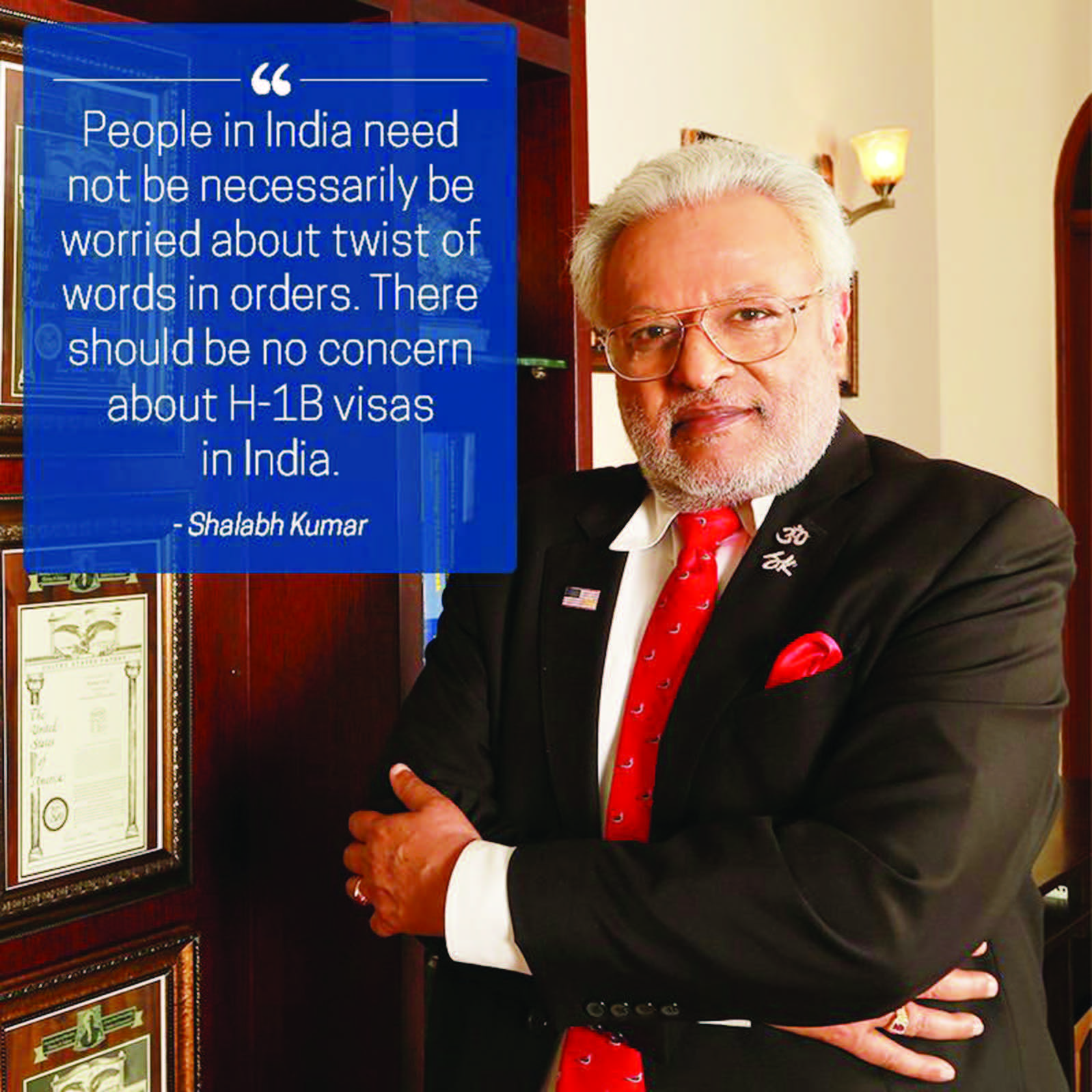
    The Trump administration has no plans to come out with an executive order on H-1B visas, Shalabh Kumar "Shally", a prominent Indian-American donor and supporter of the US President claimed.
    The Trump administration has no plans to come out with an executive order on H-1B visas, Shalabh Kumar “Shally”, a prominent Indian-American donor and supporter of the US President claimed.

    Currently, the US President is beyond the call of reason. In due course, he will appreciate that trade in services with India is not a one-way street. If India raked in $19 billion from the US last year, the corresponding figure was $12 billion. This is set to increase because of $28 billion US investment in this sector. Trump will also not be unaware that India’s $25 billion annual trade surplus in goods with the US may shrink. His predecessor has set the stage for increased US involvement in India’s infrastructure sector and energy supplies, both fossil and solar based.

    If those are not enough reasons to go slow on clamping down on H1B visas, three of Trump’s Cabinet picks were CEOs of Fortune 500 companies, the very section that has benefited the most from low-cost IT labor from India. Would they not be counselling their President against such a move? On the world stage, the US needs India because of its tensions with Pakistan and China and close ties with Japan, Singapore, Vietnam, Indonesia and Australia. The Obama days will not return anytime soon when India’s trade surplus and work visas had doubled. While fighting to retain the quota of H1B visas, India will also have to take a call on how long its corporates will make money on the back of modestly paid techies?

    (Tribune, India)

  • Trump not planning any executive order on H-1B visas: Shalabh ‘Shalli’ Kumar

    Trump not planning any executive order on H-1B visas: Shalabh ‘Shalli’ Kumar

    The Trump administration has no plans to come out with an executive order on H-1B visas, a prominent Indian-American donor and supporter of the US President claimed today, contradicting media reports that have generated anxiety in India. “There will be a need of more H-1B visas. The number of people on H-1B from India is certainly going to increase,” Chicago-based Shalabh ‘Shalli’, Kumar and head of the Republican Hindu Coalition, told reporters at a news conference.

    Responding to a volley of questions, Kumar claimed that contrary to the reports in the media, there is no executive order being worked upon by the White House on H-1B visa. For the American economy to grow, IT would have to play an important role.

    “As such I visualize need of more IT workers in the US,” he said, adding that the US has huge shortage of IT workers which can be filled up only by Indian IT professionals. Of the view that the Trump Administration would be working to ensure that there is no fraud and abuse of H-1B visas, Kumar said he believes that the White House would work to eliminate country-quota towards allocation of green cards for legal permanent residents.

    “This would be of great help Indian IT professionals,” he said, adding that the current wait time for Indians to get a green card could be as many as 35 years.

    According to reports, President Donald Trump may soon crack down on US temporary work visas including the H-1B and L-1 visas that are used widely by Indian tech companies.

    The H1B visa is a non-immigrant visa that allows US firms to employ foreign workers in specialty occupations that require theoretical or technical expertise in specialized fields. The technology companies depend on it to hire tens of thousands of employees each year.

    During his campaign, Trump had promised to increase oversight of our H-1B and L-1 visa programs.

    Supporting the executive orders of Trump on immigration and visa ban, Kumar said he would prefer this to be expanded to other countries like Pakistan. Kumar said the US Government is currently reviewing the list of countries, and if Pakistan does not start co-operating with the US, there is very high probability of it being included in the list of visa ban countries. Pakistan needs to act against terrorism.

    “There cannot be any difference between what it says and what it does. Trump would not tolerate that,” he said. In response to a question, he did not altogether rule out the possibility of him becoming the next US Ambassador to India.

  • New bill proposes H1B & L1 visa reforms

    New bill proposes H1B & L1 visa reforms

    BENGALURU: The US is set to pass a bill on immigration with major implications for the Indian IT sector and its employees. The bill seeks to prohibit companies from hiring H-1B employees if they employ more than 50 people in the US and more than 50% of those employees are H-1B and L-1 visa holders.

    49799498.cmsThe Bipartisan legislation, if passed, all U.S. companies looking to hire workers with H-1Bs would be required to first search for a U.S. citizen to fill the position. Companies of more than 50 people in which over half of the workforce in made up of H-1B and L-1 visa holders would be banned from hiring any new workers with H-1Bs. (L-1 visas allow for the relocation of specialized workers to U.S.-based departments of international companies). This move will place severe restrictions on larger Indian IT companies that are the largest users of H-1B visas. Though companies do not disclose the data, it is believed that the large Indian IT companies have more than 50% of their employees on H-1Bs and L-1s.

    The bill was introduced by Republican Iowa senator Chuck Grassley, who is also chairman of the Senate Judiciary Committee, and Democratic Illinois senator Dick Durbin.

    The Wall Street Journal reports that India’s outsourcing firms, and subsequently the country’s economy, have already been facing challenges because of cloud computing. This bill would add to their troubles.

    The Bill also gives the labour department enhanced authority to review, investigate, and audit employer compliance with programme requirements, as well as to penalize fraudulent or abusive conduct. It requires the production of extensive statistical data about the H-1B and L-1 programmes, including wage data, worker education levels, place of employment and gender. “If this Bill is enacted, US companies would be prohibited from hiring foreign workers under the H-1B and L-1 visa categories if at least 50% of their employees have already been employed on such visas. The Bill also gives wide powers to the law enforcement authorities to investigate and penalize for non-compliances,” Shroff said.

  • US Immigration Bill S – 744 set to damage Indian Business Interests: Shalabh Kumar

    US Immigration Bill S – 744 set to damage Indian Business Interests: Shalabh Kumar

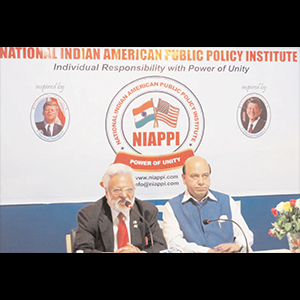
    NEW YORK (TIP): Shalabh Kumar, Chairman Indian American Advisory Council of House of Republican Conference of US Parliament & NIAPPI expressed grave concern over the US Immigration Reform Bill S-744 as a prominent NRI based in Chicago, US. The Border Security, Economic Opportunity & Immigration Modernization Act – 2013 or S744 was a bill drafted with the aim of reforming the immigration system in United States, stated Kumar at a press conference in New Delhi, India.

    Chairman NIAPPI Shalabh Kumar stated that S744 was introduced in US Senate on 16th April 2013. This bill was prepared by a bipartisan group of eight senators known as “gang of eight” comprising of Senator John McCain, Charles, Lindsey Graham, Richard Durbin, Marco Rubio, Robert Menendez, Jeff Flake and Michael Bennet. This bill was passed in the US Senate on 27th June 2013, which is controlled by Democratic Party headed by President Barak Obama. Now the bill is pending in US House of Representatives awaiting consideration. Once it is approved, the bill will become a law.

    Kumar stated that this bill shall damage Indian business and IT industry in India. It shall affect around 5 Lakh engineers from India. This bill shall cause loss to the tune of Rs. 1.875 Lakh crore in Indian exports to United States on a yearly basis. It shall have adverse restrictions on Indian H1B & L1 visa holders. It shall break the back bone of Indian export industry alleged US based NRI Shalabh Kumar.

    If the bill is passed then Indian firms will be forced to cut down on sending their employees from India. It shall reduce the GDP of India and its dollar reserves almost to the tune of 1 to 1.5% of Indian GDP. Kumar termed this bill as a major challenge for the newly elected Indian govt. US NRI Shalabh Kumar noted with appreciation the efforts of Vijay Jolly Convener OFBJP Global Affairs for voicing the strong opposition of Bharatiya Janata Party (BJP) on the anti-Indian provisions of the bill. Jolly had recently written a letter to the US Ambassador in India demanding that US House of Representative should not approve the anti-Indian S744 bill.

  • BJP Has Sound Plans To Jumpstart The Stalled Indian Economy- Rajnath Singh

    BJP Has Sound Plans To Jumpstart The Stalled Indian Economy- Rajnath Singh

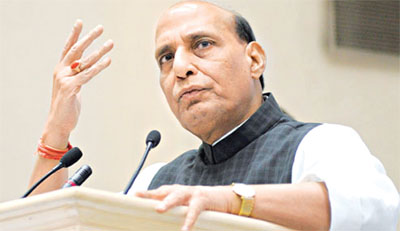
    NEW YORK, NY (TIP): “The BJP-led NDA government created 67 million jobs in less than five years whereas the Congress led UPA created less than 2.7 million jobs between 2004 and 2009. These figures are from the data collected by the federal government controlled agencies and not a figment of imagination”, Rajnath Singh said.

    He was speaking on what BJP will do to jumpstart the stalled Indian economy at a function organized by India-America Chamber of Commerce, July 25. Rajnath Singh who was in Washington for three days said he had discussions with the Congressmen and administration officials on the issue of difficulties faced by candidates in H1B and L1 visa to work legally in the US. The GDP cost burden will go up by 0.3 to 0.4 percent due to increase in fees.

    “We had lodged our protest against the comprehensive immigration reforms bill and they had raised the issue of patents and compulsory drug license issues. There was only one case under these CDL whereas Indonesia had six cases and Canada four cases,” he added. The US would do well to share its latest technology on green energy with nations such as India so that it can benefit the humanity. Once these inventions are ashared, they would help us more in a very rapid manner, he said.

    The BJP government will strengthen the village economy as over 70 percent of the people live in rural areas. We will do our best to stop urbanization and create more jobs in the rural areas as was done in the previous NDA government under the PURA scheme. More than 55 percent of the jobs for youth are in rural areas and there is a need to strengthen this sector. Turning to climate change, the BJP leader said while US that has been preaching, has a carbon emission rate of 20 ton per capita per annum, India has only 1.5 per ton per capita per annum.

    The global average is only 4.5 ton per capita per annum. You now decide who is on the right side and who is not. Addressing the members of the India- America Chamber of Commerce in Manhattan, he said India is now facing a serious financial crisis of grave magnitude despite the fact that no one in the global economy can ignore India. The economy of India is not something that makes us feel comfortable or feel proud of.

    But India was regarded as third largest economy of the world, he said. When the NDA government led by Atal Behari Vajpayee stepped down in 2004, the fiscal deficit was 2.5 percent and current account deficit was surplus. The revenue deficit was less than one percent. The economy witnessed a boom period during 1999 to 2004 when the country was ruled by the NDA and the slide started in 2004. “The boom that we created lasted till 2008 and then we are now witnessing is one of the worse economic downturns,” Singh said.

    “When I mentioned to the Speaker of the House yesterday at Washington that we had a surplus current account when we left power, he was surprised. There was a revenue deficit that went up from 4.5 percent to 6 percent in 2008. The current account of deficit shot to 6 percent. We passed the fiscal responsibility bill in the parliament and hence were able to bring some fiscal discipline.

    Inflation is now hovering around 7.7 percent,” he said. The rupee value has depreciated drastically to the US dollar from Rs 37 a dollar in 2008 to Rs 60 in 2013 almost doubling in five years. We thought this would be offset by increase in exports and that also did not happen; it went up by just one percent. It’s very unfortunate that savings that have been the biggest strength of India as it provided capital is now falling at a very rapid rate.

    The small businesses tend to grow with the increase in savings and in the absence they take a major hit. Savings drop and growth rates drop and what else to drop. The success of Indian story is over. The success story of India is waiting for the BJP to return to power. The UPA has ruined the economic structure of the country. How will the BJP restore investors’ confidence and fix the broken economy once it comes to power? We will do what we did from 1999 to 2004 and we had a unique development model which is not only a model for India to feel proud of but came as a surprise to the world.

    When we handed over the reins of the government to the Congress-led UPA, India’s growth rate was 8 to 9 percent and rate of inflation was around three percent. More than 50 percent of the highways were built during the Vajpayee government and the present Congress dispensation had admitted this in the court. Where had all the developments gone now? The BJP created a success story only to be mauled by the Congress, he added.

    We have proved in the BJP-ruled states how we prioritize economic reforms and Gujarat is a shining example of India. The whole world is now talking about Gujarat and foreign governments are keen to study the success story. Take the case of Madhya Pradesh that was considered a sick state with no economic development before the BJP Government took over. Agricultural growth rate has gone up to 19.1 percent in the state as against 4 percent of the federal government.

    Madhya Pradesh has replaced as country’s largest supplier of food grains to the central pool. In Chhattisgarh, more than 90 percent of the population is covered under the Public Distribution System and people enjoy social security compared to mass suicide by farmers in the Congress-ruled states. Goa is the only state in India where petrol is cheaper than diesel similar to what we see in the US.

    Do we have to prove anything more to assure the people that our first priority will be to fix the problems and take India on a different plane?, he asked. The average GDP of BJP-ruled governments is about 10 percent whereas the nation is only experiencing a growth rate of less than five percent. There are only two models – BJP model for growth and Congress model for destruction, he added. Earlier, Rajiv Khanna, President, India-America Chamber of Commerce welcomed Rajnath Singh and introduced the subject of talk.

    He pointed out that Indian economy has been weakening and this had caused considerable doubts in the minds of investors and wanted Singh to speak on how his party, if it came to power would jumpstart the stalled Indian economy. The talk by Rajnath Singh was followed by an interesting Q & AA session. Singh candidly answered the few questions put to him.