Tag: Lakhimpur Kheri

  • Lakhimpur Kheri violence witness attacked in UP

    Lakhimpur Kheri violence witness attacked in UP

    Lakhimpur Kheri (TIP)- BKU leader Dilbag Singh, a witness in the Lakhimpur Kheri violence case, was allegedly attacked by two men here, police said on Wednesday, June 1. The attack took place on Tuesday night when the Bhartiya Kisan Union (Tikait) district president was returning home from Aliganj-Muda road in Gola kotwali area in his SUV when the bike-borne miscreants opened fire on him. Singh did not receive any injury.
    Singh is one of the witnesses in the Tikunia violence of October 3, 2021 in which eight people, including four farmers and a journalist, had died. Union minister Ajay Mishra’s son Ashish Mishra was arrested in the case.
    Talking to PTI over phone, the BKU leader said the miscreants punctured a tyre of his SUV following which he had to stop the vehicle. “The assailants tried to open the doors and windows of the SUV. Having failed to do so, they fired two shots at a windowpane,” he said. Singh said he was driving the SUV and was alone. He said sensing the intentions of the attackers he folded the driver seat and bent down.
    As the windows were covered with a dark film, the attackers could not locate him in the SUV and fled the scene. Source: PTI

  • Lakhimpur Kheri: How violence broke and why

    Lakhimpur Kheri: How violence broke and why

    A violent-clash between farmers and BJP workers in Lakhimpur Kheri of Uttar Pradesh claimed eight lives of which four were claimed to be farmers and the rest, BJP workers.

    The incident took place ahead of UP Deputy Chief Minister Keshav Prasad Maurya’s visit. Protests were held all over Uttar Pradesh. Images of cars and other vehicles being set ablaze by an angry mob dotted the internet. While many opposition party members tried to reach the spot, they were blocked and detained. How did the events roll out at Lakhimpur Kheri on October 3? Why did clashes break out between farmers and BJP workers in the first place?

    Call For Protest

    Farmer unions such as the Samyukta Kisan Yojana had reportedly given a call for protest against the visit of UP Deputy Chief Minister Keshav Prasad Maurya and MoS (Home) Ajay Mishra Teni. They were on a visit to inaugurate a few government schemes in Banbirpur village.

    Car Hits Protesters

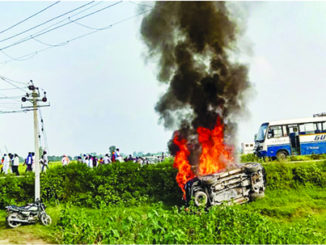
    When the convoy of SUVs carrying the Deputy CM and the union minister was crossing Tikonia, one of the vehicles mowed down protestors – as was alleged by farmers. As per reports of local bystanders and farmers, the SUVs arrived at high speed and hit the farmers, resulting in death and injury. The cars later turned turtle.

    SUVs Set Ablaze

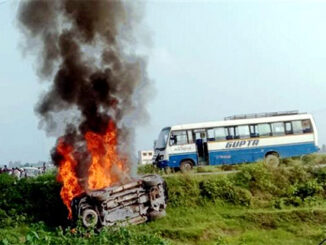
    Following the incident, farmers allegedly set fire to two SUVs. Eight lives were lost in the incident. As per reports, four of the deceased were farmers while the other four were persons in the car. According to reports, farmers have alleged that the union minister’s son Ashish Mishra was driving the car that mowed down the protesting farmers. Ajay Mishra, however, has since denied the charges and said that his son was not present in the convoy but was instead at the inauguration event. As news of the incident broke on social media and videos of injured farmers went viral, Opposition leaders took up the issue.

    WHO DIED?

    The farmers’ bodies claimed that four farmers identified as Nakshatra Singh (55), Daljeet Singh (35), Lavepreet Singh (20) and Gurvendra Singh (18) died as vehicles mowed the protesters down on the Tikunia-Banbirpur road.

    Four other deaths were reported from the Bharatiya Janata Party’s (BJP) camp. They were travelling in a car and were allegedly dragged out of the car and lynched by the protesters.

    NINTH DEATH

    While the local administration, the farmers’ body and the BJP leaders have confirmed eight deaths in the Lakhimpur Kheri violence, reports have said a journalist identified as Ratan Kashyap died in the incident.

    Kashyap, working with a TV news channel, was covering the incident of violence. He was reportedly hit by a speeding vehicle.

    Heavy Security Deployment

    Monday, October 4,  saw a heavy deployment of security in Lakhimpur Kheri where internet services were snapped following Sunday’s incident. Normal life appeared affected, not only in Tikonia, but the entire Lakhimpur Kheri district. Prohibitory orders under Section 144 of CRPC has been imposed. Personnel from the Sahastra Seema Bal (SSB) and UP State Police were deployed in large numbers in Tinsukia to maintain normalcy.

    Politicians Detained

    Several political leaders were stopped from visiting Lakhimpur Kheri to meet the families of the deceased farmers.

    Congress leader Priyanka Gandhi Vadra headed toward Lakhimpur Kheri early on Monday but was detained by UP police en route. She was later detained at a guest house in Sitapur. Videos of her asking the police for a warrant or documentation went viral. In Lucknow, former UP CM and Samajwadi Party leader Akhilesh Yadav was put under house arrest and detained by UP police when he tried to stage a sit-in outside his house. Chhattisgarh CM Bhupesh Baghel was detained at Lucknow airport.

    State-wide Protests

    Protests and demonstrations were reported from various districts, including Banda, Chitrakoot, Mahoba, Hamirpur, Fatehpur, Jalaun and Lalitpur in the Bundelkhand region, besides Shahjahanpur, Pilibhit and Chief Minister Yogi Adityanath’s home turf Gorakhpur.

    Ex gratia

    The UP government has announced Rs 45 lakh compensation for families of farmers killed in Sunday’s violence.

    What triggered Oct 3 clashes?

    According to reports, the incident on Sunday was not isolated but the culmination of a series of incidents. Tension brewed last week after a video of Ajay Mishra Teni (who had visited Lakhimpur Kheri district earlier) warning protesters opposing the centre’s three farm laws to mend their ways went viral. He also allegedly threatened the protesters that he will make them mend their ways if they didn’t stop. The UP government on Monday grappled with the aftermath of violence. A case has been lodged against Union minister Ajay Mishra’s son.

    Ashish Mishra denied bail, two more arrested

    A local court in Lakhimpur Kheri on Wednesday, Oct 13,  denied bail to Ashish Mishra, the main accused in the murder of four farmers and a journalist who were allegedly run over by a convoy of SUVs, including a Thar jeep owned by his father and Union minister Ajay Mishra.

    The Special Investigation Team (SIT) of UP Police, meanwhile, arrested two more persons — 38-year-old Ankit Das and 37-year-old Lateef alias Kala — in connection with the incident, taking the total number of arrests in the case to six. Ankit Das, a resident of Lucknow, is a close aide of Ashish Mishra and nephew of former Rajya Sabha MP Akhilesh Das.

    Lateef alias Kala, a resident of Lakhimpur Kheri, is an accountant of Ankit Das, said police, adding that he and Ankit Das were in one of the three vehicles in the convoy that ran over the protesting farmers.

    Both were later produced before a local court which sent them to three-day police custody, beginning Thursday, 14.

    In a video that went viral in the aftermath of the incident, a man with head injuries was heard telling a policeman that he was in the vehicle with four other people, including Ankit Das. The man in the video provided the registration number of the vehicle — described as a Toyota Fortuner — and claimed that it belonged to Ankit Das. “Since police have arrested Ankit Das and Lateef we would request the court to expunge surrender application,” said advocate Awadesh Kumar Singh.

    What are the charges

    against Ashish Misra?

    In its FIR on the Lakhimpur Kheri incident, Uttar Pradesh Police has stated that Ashish Misra alias Monu was sitting in the car that mowed down protesting farmers on Sunday. However, Ashish Misra denied being present inside the car that mowed down protesting farmers in Lakhimpur Kheri last week.

    As per the FIR, four of the victims were mowed down by a vehicle allegedly being driven by Ashish Mishra.

    The FIR has been filed under Indian Penal Code (IPC) Sections 302 for murder, 304-A for causing death due to reckless driving, 120-B for criminal conspiracy, 147 for rioting, 279 for rash driving, 338 for causing grievous injuries to any person by doing any act so rashly or negligently as to endanger human life, along with other sections at the Tikunia police station.

    The FIR states that the whole incident was ‘premeditated’ and that the entire ‘conspiracy was hatched by the BJP minister and his son’, who committed the act in a display of ‘hooliganism’. The FIR also mentions 15-20 unnamed persons as accused.

    The FIR further read, “The incident took place at around 3 pm when Mishra, along with 15-20 others, who were armed with weapons, came to the protest site in Banbirpur in 3 speeding four-wheelers. Monu Mishra, who was sitting on the left side of his Mahindra Thar vehicle, opened gunfire, mowed down the crowd and went ahead. The firing led to the death of farmer Gurvinder Singh, son of Sukhwinder, a resident of Matronia in Nanpara.”

    The FIR also alleges that the vehicle of the BJP MP’s son overturned on the side of the road and this caused injuries to several other people present on the side of the road and thereafter Mishra opened fire, escaped from his car, and hid in the nearby sugarcane field.

    The FIR also states that a video has already gone viral on social media, in which the BJP minister could be allegedly seen warning protesters who were opposing the Centre’s three farm laws. In the video, he allegedly asked the protesters to mend their ways.

    On October 3, several farmers were holding protests against the visit of Uttar Pradesh Deputy Chief Minister Keshav Prasad Maurya to Lakhimpur Kheri, when four protesting farmers were killed after they were mowed down by an SUV.

    Allegedly, the SUV was part of the convoy of Union minister Ajay Mishra Teni.

    According to legal experts, the FIR has been lodged under the stringent sections of the Indian Penal Code, demanding immediate arrest of the accused. The sections levelled against Ashish Mishra are non-bailable.

    What lead to Ashish

    Mishra’s arrest

    Ashish Mishra’s arrest finally came on Oct 9 night, a day after the Supreme Court expressed dissatisfaction over the state government’s action in the case. The police reportedly questioned him for 11 hours to try and cornered him on the following four points:

    –              His claim that he was at the Banbirpur village wrestling event at the time of the incident

    –              Another contrasting claim by some of his supporters that he was at a sugar mill in the vicinity

    –              Why was his vehicle at the crime scene when police had diverted the movement of BJP leaders to another route

    –              Whether he or anyone in his team/security detail own a point .315 bore gun since empty cartridges were recovered from his vehicle

    Ashish was arrested after his replies on the above four counts failed to hold up to basic scrutiny or provide him a watertight alibi in the case.

    DIG Upendra Agarwal, who is heading the special investigation team (SIT) of Uttar Pradesh Police probing the case, told reporters that Ashish Mishra was not cooperating during the interrogation.

    “We are taking him in custody on grounds of non-cooperation and evasive replies. He will be produced in court and sustained custodial interrogation will follow,” he said.

    With reference to the first point, while Ashish had been maintaining that he was at a wrestling event around four to five kilometres from the scene of the violence, multiple witnesses and some video evidence placed him at the scene of the crime while statements of police personnel posted at the said wrestling event showed that the minister’s son was missing between 2 and 4 pm.

    Both Ashish and his father had claimed otherwise. “In the programme, there were thousands of people including police and administration. My son was there since 11 am and continued to stay there till the conclusion of the programme. So there is no chance of my son being present at the spot,” MoS Ajay Mishra was quoted as saying by ANI.

    On the second point, an NDTV report cited sources to claim that when Ashish was shown evidence that his phone’s mobile tower location at the time of crime indicated that he was in the vicinity of the crime scene, he changed his claims about his whereabouts. He told the police that he was in his rice mill at the time which is closer to the crime scene under the same tower, but contrasting claims regarding his alibi did little to help his case.

    Mishra also could not provide a satisfactory answer to justify why his vehicle was at the crime scene when the police had clearly re-routed the BJP leaders’ convoy.

    A farmer, who was undergoing treatment after the injuries he sustained after coming under the BJP leader’s vehicle, told News18, “We were told at 3 pm that their route has changed. We started going back peacefully. Suddenly, speeding cars hit us from behind. The car was at over 100 km/hour speed. They ran us over on purpose. Ajay Mishra’s son and his men were in the car. Then I lost consciousness.”

    Though the Union Minister’s son admitted that the SUV that ran over farmers belongs to him, he maintained that he was not in it. Aged around 35, Ashish Mishra looks after the political activities of his father in his Kheri Parliamentary constituency.

    While his son was facing questioning by the SIT, Ajay Mishra was in his MP’s office in Lakhimpur city with lawyers and later came out to calm his supporters, who had assembled in large number outside the house and were shouting slogans in favour of him and his son, The minister told them that Ashish was innocent and would come out clean. After two men were arrested  in the case, police had put up a notice outside Ashish’s house asking him to appear before it.

  • Nirmala Sitharaman condemns Lakhimpur Kheri violence

    Nirmala Sitharaman condemns Lakhimpur Kheri violence

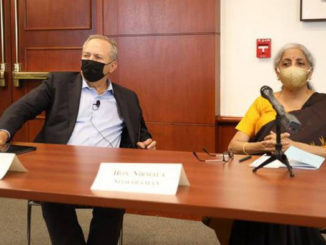
    BOSTON (TIP): Finance Minister Nirmala Sitharaman was asked why there is no word on this from the Prime Minister, senior Ministers and why there is a “defensive reaction” when somebody asks questions about such things. The Lakhimpur Kheri violence, in which four farmers were killed, is “absolutely condemnable,” Finance Minister Nirmala Sitharaman has said, emphasizing that there are issues of such nature happening in other parts of India equally which should be raised “when they happen and not when it suits others” because there is a BJP government in Uttar Pradesh.

    Ms. Sitharaman, who is on an official visit to the U.S., was responding to a question during a conversation at Harvard Kennedy School on October 12 about the killing of four farmers in Lakhimpur Kheri and the arrest of Ashish Mishra, son of Union Minister of State for Home Ajay Mishra.

    She was asked why there is no word on this from the Prime Minister, senior Ministers and why there is a “defensive reaction” when somebody asks questions about such things.

    “No, absolutely not… It’s nice of you to have picked up that one incident which is absolutely condemnable, every one of us say that. Equally there are instances happening elsewhere, is my concern.

    “India has issues of such nature happening in very many different parts of the country equally. I would like you, and many others, including Dr. Amartya Sen, who all know India, to raise it at every time when it happens, not just raise it when it suits us because it’s a State where BJP is in power, one of my Cabinet colleague’s son is in probably trouble, and also assume that it’s actually them who did it and not anybody else. Due course of justice will also have a complete inquiry process to establish it,” she said.

    “And it’s not being defensive about my party or my Prime Minister. It’s being defensive about India. I will talk for India; I will talk for justice for the poor. I will not be mocked at. And if it is mocking, I will be defensive to stand up and say ‘Sorry, let’s talk on facts’. That’s my answer for you,” she said.

    Mr. Ashish Mishra was named in an FIR following allegations that he was in one of the vehicles that mowed down four farmers protesting over U.P. Deputy Chief Minister Keshav Prasad Maurya’s visit on October 3.

    Farm laws

    To a question on the farmers’ protests, Ms. Sitharaman said that the three acts which the government brought in were discussed by the various parliamentary committees over a decade.

    She said all the three acts have been discussed variously by the State governments, by the Centre after the BJP came into power in 2014.

    “This has been in the making for a decade now. Every stakeholder has been consulted,” she said.

    “When the farm laws were brought in the Lok Sabha, there was an elaborate discussion and the agriculture minister gave his reply as well. It was only when it came to the Rajya Sabha, there was a lot of noise and disturbance,” she said.

    Thousands of farmers from Punjab, Haryana and several other States have been protesting on various borders of Delhi since November 26 last year, seeking repeal of three farm laws enacted in September.

    Dubbing these laws as “anti-farmer”, these farmers claim that the newly enacted legislations would pave the way for the dismantling of the minimum support price system, leaving them at the “mercy” of big corporations.

    Ms. Sitharaman said the protesters belong to one State and some parts of other States — “Punjab, Haryana and some parts of western Uttar Pradesh”. She said the government has been saying that it is willing to talk with the protesters and has been engaging with them.

    The government has asked pointedly what is that one aspect in any one of the three laws which have been passed to which the protesters object, she said.

    “We are willing to talk about it, tell us that one particular aspect in any one of the three laws. Till date, we have not had even one particular aspect which is being questioned. And therefore, the protesters are not sure on what score they are protesting, what is it that they are objecting.

    “Then there’s this issue about the minimum support price to be given to farmers,” she said, adding that the MSP are announced well in time and the farmers can decide whether they want to grow a crop or not and they can otherwise choose to grow something else. She said once the farmers choose to grow any of these, for which a minimum support price is announced and procurements are done, through direct benefit transfer using technology, money is deposited as a lump sum into their accounts. “The highest amount of procurement, the largest ever payment per farmer under the minimum support price which is declared has happened in the last seven years after Prime Minister [Narendra] Modi has come. Highest ever.

    “The number of farmers, the total quantum of money, total quantum of grain procured in each one of them — the highest as has happened season after season in the last seven years,” she said.

    Highlighting that there are recorded conversations “which you can see of farmers even from Punjab, even from Haryana”, she said farmers have got the entire amount into their account.

    “This is verifiable, not a claim which I’m making. You can go and check it out. Highest amount and the entire amount is given into the account directly the day after procurement is done. No staggering, no delaying,” she said.

    “So we have not been told what it is that they’re protesting against as yet and the Minister is willing to talk even today.”

    (Source: PTI)

  • A probe after prodding: On Lakhimpur Kheri violence

    U.P. police must do a credible probe to inspire public confidence in farmers’ killing case

    The arrest of Ashish Mishra, son of Union Minister of State for Home, Ajay Mishra, appears to be a course of action impelled mainly by the intervention of the Supreme Court, which voiced its dissatisfaction with the way the Uttar Pradesh police were handling the killing of four farmers and four others during a protest. By taking cognizance of the incidents that took place during a farmers’ protest at Tikonia in Lakhimpur-Kheri district, the Court may have helped infuse some much-needed impetus to the investigation. The Bench gave enough time until its next hearing on October 20 to the police to pursue the probe diligently, but not without thinking aloud on whether any other agency ought to take it over and asking the State police chief to preserve the evidence. The arrest of the Minister’s son, coming after he had skipped an earlier summons and was questioned for long hours once he appeared, is largely in response to the Court’s criticism. The Bench, headed by the Chief Justice of India, N.V. Ramana, wondered how investigators in a murder case could merely issue summons to the prime suspect instead of taking steps to apprehend him. Skepticism about the intentions of the State police is not misplaced. It is not the first time that the initial response is one of hesitancy and obfuscation, but once an incident blows up enough to occasion judicial intervention, there is some action.

    What is known so far is that vehicles in the Minister’s convoy ploughed through a group of farmers, causing four deaths. Three others may have died in retaliatory violence by the infuriated mob, while Raman Kashyap, a television reporter, may also have been run over. Initial reports that the driver lost control after being hit by a hail of stones have been superseded by footage that seems to show the vehicle being driven into a group of unsuspecting people. The FIR says Ashish Mishra was in one of the cars, even though he claims to have been elsewhere. The role of the Union Minister should also be subjected to scrutiny, as some reports suggest he may have made a provocative speech earlier to the effect that the protesting farmers should either mend their ways or he would set them straight. The mention of a ‘conspiracy’ in the FIR gives scope to the police to examine this angle. It is regrettable that the Union government is noticeably silent, and there appears to be no effort to advise Mr. Ajay Mishra to step down until his and his son’s names are cleared. It is difficult to see how an impartial probe can go on as long as he is in office, and his party’s government in the State is seen to be soft on the accused. The onus is on the Uttar Pradesh police now to conduct a credible investigation, if the Court does not replace the present set of investigators.

    (The Hindu)

  • Uttar Pradesh all stirred up

    Uttar Pradesh all stirred up

    Smaller players may hold the key this time in poll-bound state

    By Radhika Ramaseshan

    “The mowing down of four protestors, whose only ‘crime’ was to wave black flags before a UP minister signified a low in the ongoing agitation. Not only has the unrest spilled from the west to Avadh in central UP, the issues have gone beyond the refusal to ratify the Centre’s farm ‘reforms’ and the state government’s small one-time payment hike for sugarcane growers to the rise in agricultural inputs, power tariffs, uneven irrigation facilities and the continuous preying on fields and standing crops by rogue cattle. The range of issues affects every farmer, big, marginal and small. No longer is the agitation about the ‘prosperous’ sugar-cane Jat farmers of the west. It spans the peasants in the other districts, cutting across caste and class divisions. Against such a fluid backdrop, Tikait’s role will be closely monitored by the SKM as well as the Opposition to see if he gets closer to the BJP or whether his engagement with Adityanath and his apparatchiks was a limited one.”

    The brutality and horror of Lakhimpur Kheri, marked by a callous Central regime, a slippery UP Government which survives on chicanery and repression, and an Opposition that arose belatedly from sleepwalking, brought other twists and turns to the state’s politics as well before the elections. An interesting aspect that emerged was the unpredictability of the smaller players, who have not yet launched their parties, as well as the minor political entities who punch above their weight, giving the impression that they are more sought after by the mainline parties this time. One of them is Rakesh Tikait, the BKU spokesperson, who was thrust into the spotlight once the farmers’ protest picked up steam in west UP, his home ground.

     Where does Lakhimpur Kheri fit into this jumbled picture? It does, if only farmers form a cohesive federation based on their economic interests and not caste allegiances.

    Tikait wore his celebrity-hood with assumed reluctance, as though his head felt heavy wearing the crown, although he savored every moment of the attention he drew from politicians and the media. If he had political ambitions that were blown away in the past because he lacked conviction in the cause he supposedly espoused, this time he did not reveal a thing. Sanjeev Balyan, the MP from Muzaffarnagar, tempted Tikait to float a party when the BJP, Balyan’s party, was in hot water. Tikait didn’t bite the bait but he possibly did a bigger favor to the BJP and the Yogi Adityanath government when he accepted the brief to mediate and quell tensions in Lakhimpur Kheri after the farmers’ killings and the reprisals. Tikait partially delivered on the mandate set by the CM but probably lost face among his colleagues in the Samyukt Kisan Morcha (SKM), who span the ideological circumference from the left to the center and right of center.

    The mowing down of four protestors, whose only ‘crime’ was to wave black flags before a UP minister signified a low in the ongoing agitation. Not only has the unrest spilled from the west to Avadh in central UP, the issues have gone beyond the refusal to ratify the Centre’s farm ‘reforms’ and the state government’s small one-time payment hike for sugarcane growers to the rise in agricultural inputs, power tariffs, uneven irrigation facilities and the continuous preying on fields and standing crops by rogue cattle. The range of issues affects every farmer, big, marginal and small. No longer is the agitation about the ‘prosperous’ sugar-cane Jat farmers of the west. It spans the peasants in the other districts, cutting across caste and class divisions. Against such a fluid backdrop, Tikait’s role will be closely monitored by the SKM as well as the Opposition to see if he gets closer to the BJP or whether his engagement with Adityanath and his apparatchiks was a limited one.

    What accounts for the salience of once peripheral individuals like Tikait? The state Opposition lay dormant for the better part of Adityanath’s tenure, although issues came thick and fast. No Opposition leader raised his or her voice, fueling a perception that they were nonchalant, scared of a counterstroke if they spoke aloud, or risked alienating the Hindus of UP. The last factor was premised on a belief that Hindus had voted almost en bloc for the BJP since the 2014 Lok Sabha elections and the leader in saffron robes who presides over North India’s richest monastic order in Gorakhpur consolidated his position as the new ‘monarch of the Hindu heart’.

    On the ground, people, Hindus and Muslims, Jat, Yadav, Saini and Dalit, rich, middle-class and poor, urban and rural, had reasons to not just worry but despair. The Opposition was not around to tap the sentiments and funnel them into a movement against the establishment. When the winds of an agrarian uprising blew from Punjab and Haryana to UP, the farmers of the west divined the potential to vent their problems and organized themselves, almost spontaneously. The BKU, and later the RLD, headed by Jayant Chaudhary, were default beneficiaries of the signals beamed from Punjab and Haryana and not the catalysts. It’s a reflection of popular desperation and disillusionment that people were ready to resurrect a has-been like Tikait.

    If indeed the impending contest is bilateral and not multi-polar as in the recent past, why is a politician like Om Prakash Rajbhar — courted, co-opted, dumped and wooed again by the BJP — hot property? Om Prakash, who represents the backward caste Rajbhars, tried to band together the most backward and extremely backward castes as well as Muslims into an umbrella outfit called the Bhagyadari Sankalp Morcha (BSM). The BJP was partially successful in attracting some of these castes into its fold since 2014. However, Adityanath, who allegedly carried his patronage of the Rajputs, the caste to which he belongs, to inordinate lengths, might have antagonized not just the Brahmins but the backward castes too. Om Prakash was approached not by Adityanath but state BJP leaders whose only pre-condition to him was excluding Asaduddin Owaisi’s All India Majlis-e-Ittehadul Muslimeen from his front. Om Prakash indicated that he would reveal his roadmap at a mahapanchayat in east UP on October 27. Simultaneously, the Samajwadi Party that has positioned itself as the BJP’s direct rival is soliciting the support of parties which addressed specific castes to widen its backward caste base.

    Where does Lakhimpur Kheri fit into this jumbled picture? It does, if only UP’s farmers form a cohesive federation, underpinned by their economic interests and not caste allegiances. It nearly happened in Madhya Pradesh in the 2018 elections. Will MP repeat itself in UP?

    (The author is a senior journalist)

  • Lakhimpur Kheri violence: 2 arrested; SC seeks status report on accused

    Lakhimpur Kheri violence: 2 arrested; SC seeks status report on accused

    New Delhi (TIP): The Supreme Court on Thursday, October 7,  directed the UP Government to file a status report in 24 hours on the action taken by it, including the arrest of all accused named in the FIRs for murder, with regard to the Lakhimpur Kheri violence in which eight persons, including four farmers, had been killed, even as two accused were arrested and Ashish Mishra, son of MoS Ajay Mishra, was summoned for questioning.

    However, Ashish Misra, who was summoned after being booked in the Lakhimpur Kheri case, has failed to appear before the authorities for questioning. A Bench led by CJI NV Ramana said the report should give details on the arrest of the accused in the murder cases, including that of a journalist.

    Terming the incident as “extremely unfortunate”, the Bench, also comprising Justice Surya Kant and Justice Hima Kohli, asked the UP Government to provide immediate medical treatment to the mother of deceased Lovepreet Singh. “Get her admitted to the nearest government hospital,” UP Additional Advocate-General Garima Prashad was told. “We direct the learned Additional Advocate-General to look into the matter personally and provide best medical treatment to the mother of the deceased in a reputed government medical college/hospital,” the Bench ordered.

    Prashad told the court an SIT was probing the matter and the state government had set up a commission of inquiry headed by Justice Pradeep Kumar Srivastava (retd) of the Allahabad High Court. The Bench asked her to mention everything, including information regarding PILs on the issue pending in the Allahabad High Court, in the report to be filed by the state government and posted the case for further hearing on Friday. The case could not be taken up at the first call as advocates Shiv Kumar Tripathi and CS Panda, who wrote to the CJI on the Lakhimpur violence, failed to turn up for the hearing. However, they showed up at the second call. Tripathi, who could barely manage to address the Bench due to poor Internet connection, complained of violation of farmers’ human rights and said the matter should be investigated thoroughly.

    During the brief hearing, the CJI clarified that it was supposed to be a PIL on the basis of the letter written by the two advocates. “Doesn’t matter, we’ll hear it nonetheless,” he said. Later, the Bench directed the court’s Registry “to convert this suo motu writ petition into a PIL immediately.” Senior advocate Harshvir Pratap Sharma, who appeared for an intervenor, raised the issue of the death of journalist Raman Kashyap.

    Judicial panel set up

    UP Addl Advocate-General Garima Prashad said an SIT is probing the matter and the UP Govt has set up an inquiry commission headed by Justice PK Srivastava, who had retired from the Allahabad High Court.

    Why are you silent on Lakhimpur incident, Kapil Sibal asks PM Modi

    Senior Congress leader Kapil Sibal on Friday, October 8, questioned Prime Minister Narendra Modi’s silence over the Lakhimpur Kheri incident, saying just “one word of sympathy” was needed from him. In a tweet, Sibal said, “Lakhimpur Kheri Horror. Modi ji, Why are you silent? We need just one word of sympathy from you. That should not be difficult!”

  • Will India be another Germany under Hitler?

    Prof. Indrajit S. Saluja

    India has undergone much change since 2014 when Narendra Modi came in as the Prime Minister of India. The nation is now better known abroad for a mix of reasons. To Modi supporters, India has gained popularity because of Modi’s charisma and the great work he has done. To Modi’s detractors, India has gained more notoriety than popularity. They cite lynchings of a minority community members, atrocities on minorities, including rape of Dalit women, and frequent violation of human rights.

    An objective analysis reveals a terrifying pattern reminiscent of Hitler’s times. Hitler spoke of the superiority of German race. One cannot miss the same message coming from the BJP and its supporting Hindu organizations- the RSS, the Vishwa Hindu Parishad and many more. The hatred of Hitler’s Nazi party for the Jews is comparable with the hatred of the BJP combine mentioned above, for Muslims who have been target of lynchings ever since Modi came to power.

    The Hindutva group in power is speaking the language of Hitler when it comes to punishing Muslims who they describe as anti- national, unpatriotic and even Pakistanis. Just as Hitler put thousands to death in gas chambers, the Hindutva group wants Muslims to be annihilated. The process was initiated much before Modi became Prime Minster. He was then Chief Minister of Gujarat. In the now infamous massacre of Muslims in the post -Godhra incidents Modi was seen as the promoter of violence against Muslims. Several police and civil officers besides the credible community witnesses recorded evidence of involvement of Chief Minister Modi, Home Minister Shah and other BJP and Hindutva leaders in the mayhem.

    The disturbing reports reaching the then Prime Minister Atal Behari Vajpayee made him make a statement in the Indian parliament on the grim situation and violence against one community called upon Chief Minister Modi to follow the “Raj Dharma” – the duty of the king to treat all equally and to protect all equally.

    The pattern, I said earlier above, is quite clear and disturbing. What is different from Hitler pattern in India is the scope of Hindutva hatred which extends to other minorities, too. Christians are as much a target of hatred and violence, as the Muslims.

    Add to the list the Dalits and the hundreds of tribes living a subhuman existence who are not considered Hindus by the Hindutva groups which are dominated and controlled by the Caste Hindus. They are tolerated because they have votes which the BJP is always eager to grab. What happened to the farmers, mostly Sikhs, in Lakhimpur Kheri was to happen, anyways. The kind of language of hate which has been coming from BJP chief Ministers in UP and Haryana was enough to prepare the BJP/RSS/ VHP Hindutva cadres to go into action.  It is just a warning shot.  As they say, the teaser. The full drama is yet to come from the BJP. And, it falls to a pattern in much the same way as a calculated military strike against an enemy. Imagine a government which looks upon some of its citizens as enemies and treats them as such!

    Any just government would not allow a minister accused of homicide to continue in the government. But it happens in Modi government. Any just administration would not let a man accused of brutal killing of people under a vehicle roam free. But it happens in the Yogi government of UP. The BJP Chief Ministers of UP and Haryana behave like autocrats denying people entry into the State without any valid reason. And, what’s more, arresting people at will, again without any valid reason. You talk of human rights. Wait and see, you will find them telling people they have no right to life until specifically granted by them.

    It all bodes ill for democracy in India. Let the politicians in opposition to the BJP governments know if they don’t see the threat to democracy in India now, they may find it too late in one or two years. I only hope, there are enough people in India who would remember the sacrifices made by thousands upon thousands to achieve freedom from foreign yoke and bring to masses the sweet taste of democracy. And I hope they will value the sacrifices of liberators of India and do all that they can to preserve the liberty of each Indian in a functional democracy.

  • George Abraham, Vice-Chair of IOCUSA, condemns the attack on farmers and detention of Priyanka Gandhi

    NEW YORK (TIP):  Vice-Chair of IOCUSA George Abraham has condemned the attack on farmers in Lakhimpur-Kheri and detention of Priyanka Gandhi Vadra by the authorities in UP. “There is a total breakdown of democratic process in the state of Uttar Pradesh. Isn’t it strange that the BJP leaders who incited the riots or the son of a union minister who ran the vehicle over the farmers are remaining free-at-large while a political leader who went to investigate and empathize with the victims is in detention?  We strongly condemn the attack on farmers and detention of Priyanka Gandhi from visiting and empathizing with the bereaved families. The incident in Lakhimpur Keri in Uttar Pradesh shows that the BJP government’s anti-farmer stand has taken an even uglier turn. Holding a peaceful protest is a fundamental right and it cannot be denied,” said George Abraham. A purported video of Union Minister of State for Home Ajay Kumar Mishra in which he is heard telling farmers that he would discipline them in two minutes appears to have upset the farmers before the violent incident. “Face me, it will take just two minutes to discipline you fellows,” the two-time BJP MP from Kheri is heard purportedly saying on social media. Haryana Chief Minister Manohar Lal Khattar also made a controversial remark recently that encouraged violence while speaking at a farmers’ event in the state. He called upon 1000 volunteers from different regions to pick up sticks and fight “furious farmers.” This has become a pattern of BJP governance where various leaders of their party often make highly provocative and reprehensible statements that result in violence and lives lost.  It is a shame that the Modi government that raises FIR against innocuous statements by ordinary citizens appears indifferent to eschewing their cadre’s own inflammatory comments. Priyanka Gandhi also tweeted, “the BJP government is doing politics of crushing the farmers and finishing them. Today’s incident shows that this government is using politics to mow down farmers. This is the farmer’s country.” IOCUSA calls upon the BJP government to reestablish the dialogue with farmers and bring this long-simmering dispute to an end.

    (Based on a press release)

  • Is Lakhimpur Kheri a watershed moment for the BJP in UP?

    Is Lakhimpur Kheri a watershed moment for the BJP in UP?

    By George Abraham

    What we are witnessing is a total breakdown of the law enforcement mechanism in the State of Uttar Pradesh. The government is yet to arrest Ashish Mishra, the son of the union minister, although an FIR was filed by police themselves while the political leaders who went to empathize with the bereaving families were either arrested or blocked from entering Lakhimpur. The U.P. government detained Priyanka Gandhi Vadra, a General Secretary of the All-India Congress Committee, for more than 24 hours before being arrested. It is indeed a clear violation of the rights of India’s citizens. Section 144 of the law allows restricting the movement of more than four people if there are valid reasons. However, the illegal detention and arrests point to authorities who lack any respect for the laws of the land or the constitutional rights of its citizens.

    The heinous and barbaric killings of four farmers protesting peacefully in Lakhimpur have again shown the world the slide towards anarchy and lawlessness in Uttar Pradesh, a state ruled by Yogi Adityanath, a hardcore Hindutva leader as its Chief Minister. The resultant revenge killings are also a blot on a democracybased on rule of law where people should not take the law into their own hands.

    As seen in video footage on social media, a speeding jeep accompanying other vehicles runs over the farmers from behind appears to be an intentional act to harm the victims. It is alleged that the son of India’s Minister of State for home affairs was involved in this incident, and there are reports of shots being fired during the melee. Angry farmers were then said to have killed the three occupants, BJP workers, of the vehicle that was set ablaze.

    What we are witnessing is a total breakdown of the law enforcement mechanism in the State of Uttar Pradesh. The government is yet to arrest Ashish Mishra, the son of the union minister, although an FIR was filed by police themselves while the political leaders who went to empathize with the bereaving families were either arrested or blocked from entering Lakhimpur. The U.P. government detained Priyanka Gandhi Vadra, a General Secretary of the All-India Congress Committee, for more than 24 hours before being arrested. It is indeed a clear violation of the rights of India’s citizens. Section 144 of the law allows restricting the movement of more than four people if there are valid reasons. However, the illegal detention and arrests point to authorities who lack any respect for the laws of the land or the constitutional rights of its citizens.

    In addition, the union minister of State Ajay Kumar Mishra continues to serve in the ministry at the pleasure of Prime Minister Modi despite his deep involvement with his son in this nefarious scheme to teach the protesting farmers a lesson.  A purported video of Union Minister of State for Home in which he is heard telling farmers that he would discipline them in two minutes appears to have upset the farmers before the violent incident. “Face me, it will take just two minutes to discipline you fellows,” the two-time BJP MP from Kheri is heard purportedly saying on social media.

    Ajay Kumar Mishra, member from Kheri Lok Sabha constituency in Uttar Pradesh. Lower court acquitted Mr. Mishra in 2004 but the criminal appeal in a murder case is still pending before the Allahabad High Court. (Photo / loksabhaph.nic.in/Members)

    Incidentally, Ajay Kumar Mishra is no stranger to crime. Before he entered State-level electoral politics, Mr. Mishra was in the year 2000 accused of murdering a youth leader of the Samajwadi Party in Tikunia. A local sessions court acquitted him and three others in March 2004 in the murder case of Prabhat Gupta alias Raju.

    A criminal appeal filed by Prabhat Gupta’s brother Rajeev Gupta is pending before the Allahabad High Court, which had in March 2018 reserved the judgment in the appeal, but since it could not be delivered later that year, Gupta’s family prayed for it to be heard again. The last hearing in the case was on February 5, 2019.

    Haryana Chief Minister Manohar Lal Khattar also made a controversial remark recently that encouraged violence while speaking at a farmers’ event in the State. He called upon 1000 volunteers from different regions to pick up sticks and fight “furious farmers.” This has become a pattern of BJP governance where various leaders of their party often make highly provocative and reprehensible statements that result in violence and lives lost.  It is a shame that the Modi government that raises FIR against innocuous statements by ordinary citizens appears indifferent to eschewing their cadre’s own inflammatory comments.

    In addition, the internet is cut in the area to prevent people from communicating with each other. Now the government becomes the judge of what the people should listen to. In a democracy, these political leaders are supposed to serve the people. However, they have become the overlords now deciding and deciphering what is in our best interest, what news we should watch, and what messages we should read.

    There is no doubt that the Lakhimpur violence marked an escalation in continuing protests of the farm laws that the farmers say would affect their livelihoods. The government shows no urgency in resuming dialogue, although over 600 farmers lost their lives during this ten-month-old protest that some characterized as the longest and biggest in history.  It is a shame that a democratic government shows a total disregard to the aspirations of India’s farmers, and 85 percent of them are small and marginal.

    This ongoing pandemic has been devastating to the Indian economy.  However, the country averted mass starvation only because the government’s granaries (Food corporation of India) were overloaded, and the poor and downtrodden were the big beneficiaries of the generous food distribution. Now that the collection and storage under the current fam laws will be handed over to a bunch of crony capitalists, a future crisis may bring unintended but inevitable consequences for the people of India.

    Throughout history, voices of the people, the poor and the powerless, have been crushed under the wheels of the State, and their protests were being shut down. However, every time, it would only embolden the masses, and for the U.P. government under Yogi Adityanath, Lakhimpur Kheri may be a watershed moment to face an awakened voter in the not-so-distant future.

    (The author is a former Chief Technology Officer, the United Nations and Vice Chair of Indian Overseas Congress USA. He can be reached at gta777@gmail.com)