Tag: Lal Bahadur Shastri.

  • Remembering the diminutive victor

    Remembering the diminutive victor

    Lal Bahadur Shastri won a victory over Pakistan in 1965

    In the pantheon of India’s leaders, Lal Bahadur Shastri stands as a figure of quiet strength, humility, and unflinching determination. Often overshadowed by towering personalities like Mahatma Gandhi, Jawaharlal Nehru, and Indira Gandhi, Shastri’s life and leadership nevertheless left an indelible mark on the destiny of modern India. Known for his simplicity and honesty, he was a man of small stature but giant moral courage-a “diminutive victor” who proved that leadership lies not in volume or grandeur, but in conviction and character.
    Early Life: Humble Roots, High Ideals
    Lal Bahadur Shastri was born on 2 October 1904 in Mughalsarai, a small railway town in Uttar Pradesh-the very same date that would forever be remembered as Mahatma Gandhi’s birthday. His father, Sharada Prasad Srivastava, a schoolteacher and clerk, died when Shastri was just a toddler, leaving his mother Ramdulari Devi to raise him and his siblings under challenging circumstances.
    Growing up in modest conditions, young Lal Bahadur displayed qualities of honesty, resilience, and a keen sense of responsibility. The family was poor, and he often walked miles to attend school, barefoot, to save money for his family. Despite hardships, he excelled in his studies and developed a deep interest in India’s struggle for freedom.
    Rejecting caste-based surnames, he dropped “Srivastava” and adopted “Shastri”-a title awarded for his scholarly achievements at Kashi Vidyapeeth. This decision was not just symbolic but reflected his lifelong opposition to social divisions and his embrace of simplicity.
    Entry into the Freedom Struggle
    Shastri’s awakening to politics coincided with the rise of Mahatma Gandhi. Inspired by the call for non-cooperation, he joined the Indian independence movement at a young age, participating in protests and courting imprisonment. He became a member of the Servants of the People Society, an organization founded by Lala Lajpat Rai to train young leaders in social service and national work.
    Shastri was arrested several times during the freedom struggle. Yet, unlike some fiery contemporaries, his style of resistance was calm, methodical, and deeply disciplined. He worked quietly, often away from the limelight, but his contributions built a reputation of trustworthiness and integrity among the Congress ranks.
    The Leader in Free India
    After independence in 1947, Lal Bahadur Shastri steadily rose in political stature. He served in various capacities, demonstrating administrative acumen and humility that made him a favorite among colleagues and the public.
    – As Minister of Railways (1951-56), he introduced reforms aimed at improving safety and welfare, including the introduction of third-class compartments for passengers. When a railway accident caused the loss of lives, Shastri offered his resignation, accepting moral responsibility-a rare gesture in Indian politics that won him immense respect.
    – He later served as Minister of Transport and Communications, Minister of Commerce and Industry, and Minister of Home Affairs, displaying efficiency, humility, and consensus-building skills.
    Shastri’s reputation was that of a leader who believed in accountability, service, and the idea that public office was a trust to be honored-not a privilege to be enjoyed.
    Prime Ministership: A Short but Defining Era
    When Jawaharlal Nehru passed away in 1964, Shastri was chosen as India’s second Prime Minister. At first, many doubted whether this mild-mannered, soft-spoken leader could fill Nehru’s shoes. But Shastri soon proved that quiet resolve could achieve victories where fiery rhetoric could not.
    Food Crisis and “Jai Jawan Jai Kisan”
    India was facing a severe food shortage in the mid-1960s. Shastri urged citizens to practice self-reliance and famously encouraged people to skip one meal a week to conserve grain. His slogan, “Jai Jawan Jai Kisan” (Hail the Soldier, Hail the Farmer), captured the spirit of the times-honoring both the guardians of India’s borders and the farmers who fed the nation.
    The Indo-Pak War of 1965
    Shastri’s greatest test came with the Indo-Pakistani War of 1965. Despite India’s military disadvantages, Shastri led the nation with calm determination, bolstering morale and ensuring unity. His leadership during the war elevated him from a modest administrator to a national hero.
    The war ended with the Tashkent Agreement in January 1966, brokered by the Soviet Union. Tragically, Shastri died in Tashkent soon after signing the accord-under circumstances still debated. His sudden death robbed India of a leader whose simplicity masked immense strength.
    Legacy of a Diminutive Victor
    Lal Bahadur Shastri’s legacy lies not in dramatic speeches or flamboyant gestures, but in his quiet integrity and his example of leadership rooted in service. He demonstrated that greatness is not measured by height, volume, or charisma, but by honesty, courage, and the ability to inspire trust.
    His slogan “Jai Jawan Jai Kisan” continues to resonate, reminding us that the strength of a nation rests on the shoulders of both its soldiers and its farmers.
    In remembering Shastri, we honor not just a Prime Minister but a man who taught us that simplicity is strength, humility is leadership, and true victory lies in service to the people.
    Lal Bahadur Shastri was diminutive in appearance, but he was a giant in spirit. A victor not through force of arms, but through the force of character. His life remains a guiding light in an age still searching for leaders of integrity.

  • Gandhian Society hosts Gandhi Jayanti celebration at the Indian Consulate

    Gandhian Society hosts Gandhi Jayanti celebration at the Indian Consulate

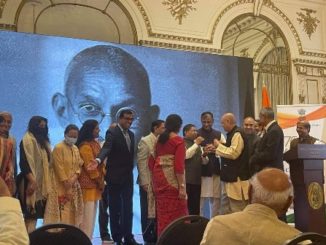
    NEW YORK CITY (TIP): The Gandhian Society in partnership with the Indian Consulate in NY hosted the Gandhi Jayanthi celebrations in the Indian Consulate on October 2nd to celebrate the Birth Anniversary of Mahatma Gandhi and Late Prime Minister Shri Lal Bahadur Shastri. The event was well attended.

    The program started with some favorite Bhajans of Mahatma Gandhi (Bapu) by Varsha Joshi Gandhi. The Gandhian Society has been doing a lot of charitable services in India and USA and some of the donors were recognized during the event for their contributions to sending ambulances to tribal and rural areas. Some of the donors who were recognized were Mukund Thakar, Gita Butala, Hasmukh Patel, Asha Samant, Magan Patel, Dalpat Patel, Ravinder Thota, Dr. Prabhu Rachakonda, Bhadra Butala and others.

    There was a digital museum presentation of the proposed Mahatma Gandhi Museum by Balaji Jilla who walked thru the various digital museums that were created in partnership with Birla Group and other donors by Birad Yagnik from India, who will also be working on the proposed project in USA.

    The consul General Shri Randhir Jaiswal lauded the services of Gandhian Society in taking forward the ideology of Mahatma Gandhi amongst the diaspora and committed his support to the proposed Digital Museum in New Jersey (USA). He said that the values of Mahatma Gandhi are timeless and universal and one should learn from his vision and simple and good life.

    The Deputy Consul General Dr. Varun Jeph who recently took over his duties was warmly welcomed by Rajendar Dichpally on behalf of the Gandhian Society. The Deputy Consul General agreed to attend another event by the society on the request of Mahesh Wani to welcome him and honor him and pledged his support to the activities of the Society. Mr. Vipul Dev (Consular Services – Political Affairs) also attended the event and praised the Gandhian Society for all its humanitarian work.

    Hasmukh Patel thanked all the volunteers, donors and attendees including Dr. Deepak Naran, Sonal Gadhvi, Gunjesh Desai, Shravan Natakala, Shiva Kumar, and others. The event ended with the singing of the national anthem and light refreshments.

    (Based on a press release)