Yoga is an ancient physical, mental and spiritual practice, for humankind, that originated in India thousands of years ago. The word ‘yoga’ derives from Sanskrit and means to join or to unite, symbolizing the union of body and consciousness.
Today it is practiced in various forms around the world and continues to grow in popularity.
Recognizing its universal appeal, on 11 December 2014, the United Nations proclaimed 21 June as the International Day of Yoga by resolution 69/131. 193-member nations approved the proposal with a record of 177 countries establishing Summer Solstice as the IDY. Since then the IDY has been celebrated annually by member countries of the UN with great enthusiasm.
The International Day of Yoga aims to raise awareness worldwide of the many benefits of practicing yoga.
Yoga had gained worldwide popularity due to its immense health benefits. It is in keeping with that thought that the theme of the event this year is ‘Let Yoga Govern Your Life.’
“Yoga” derives from Sanskrit and means to join or to unite, symbolizing the union of body and consciousness.
To celebrate the 4th International Day of Yoga (Yoga Day) on 16th June 2018, the Indian Consulate had a Yoga Day event at the historic Governor’s Island, New York. About 200 were in attendance. People of all ages enthusiastically celebrated the day.
The historic setting of Governor’s Island, a 72-acre island in the New York harbor, in many ways exemplified the eternal values of yoga. Perhaps, signifying the global influence of yoga, the famous skyline of downtown Manhattan and the Statue of Liberty formed the backdrop of the event.
US Congresswoman Carolyn Maloney was the chief guest for the event. While complimenting the organizers, she spoke of the benefits that yoga has on contemporary lifestyles. The event featured performances from the Hindu Temple, Indian Cultural Association, Mallakhambh Federation, Sam Katz (David Lynch Foundation), The Art of Living Foundation, The Isha Foundation, the World Yoga Community and the Battery Dance Company.
The performances included demonstration of yoga mudra, salutations, common yoga protocol, Yoga asanas on the pole, Transcendental Meditation, desktop yoga, Yogic music and musical performances from the Salon Di Virtuosi and a dance performance by the Battery Dance Company.
Various organizations have independently celebrated the International Day of Yoga (Yoga Day) in New Jersey since 2015, the year of its inception. In 2018, the 4th Year of Yoga Day, for the first time, many like-minded organizations had formed a coalition to celebrate the Day with more fervor and strength. So was born the concept of a Yogafest NJ 2018!
As a continuation of Yoga Day celebrations, many events were held in the NJ and NY areas between June 21 and 24.
Mayor Brian C. Wahler (Township of Piscataway) reading the citation for YogaFest
Yogafest New Jersey 2018
On 24th June 2018, New Jersey saw one of its largest 4th International Day of Yoga Day celebrations. This year for the first time, many like-minded organizations formed a coalition to celebrate Yogafest New Jersey.
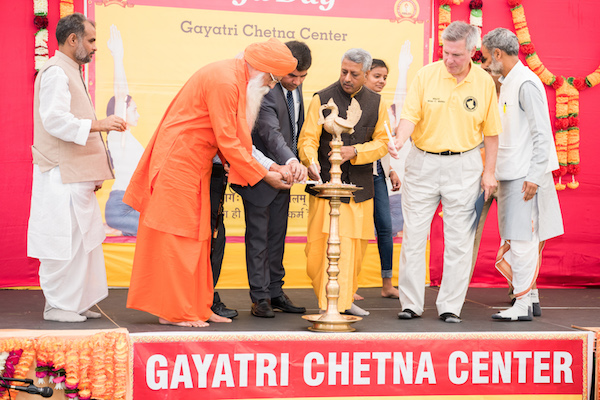
This Yogafest 2018 was held at the Gayatri Chetna Center, Piscataway, NJ. The event started with a lamp lighting ceremony in the presence of representatives of Ananda Marg (a global spiritual and social service organization), India; Consulate General of India, New York; Mayor of Piscataway and council representatives of the township of Piscataway; Representatives of Edison Township and, Representative from Woodbridge township board of Ed.
Citations for the event were presented to the partnering organizations by Townships of Piscataway and Edison.
Representatives of partner and supporting organizations: (left to right): Vijay Mallapati (Sewa); Pradeep & Poonam Gupta (Let’s Do Yoga); Mahesh Wani (Mallakambh Federation of USA); Vijay Kumar (Vihangam Yoga), Ganesh Ramakrishnan (Hindu Swayamsevak Sangh), Rajashree Kotekar (Isha Foundation), Parth Desai (Gayatri Chetna Center)
Over 600 people attended this event. Volunteers from partnering organizations joined hands with Gayatri Parivar volunteers to organize and setup the event.
The 2-hour long free event had parallel sessions running for adults in the outdoor tent, for kids in the temple hall and for seniors in the classroom.
Kids following Pranayama instruction at YogaFestParticipants meditating at YogaFest
The yoga and meditation sessions were presented by yoga proponents from various partner organizations. There was also a demonstration from Mallakhamb.
Light snacks, lunch / Prasadam was served by the Gayatri Parivar.
The event was well covered by media: TV Asia, Ebox TV, V6 News Telugu and Telugu NRI Radio.
Partnering organizations were Gayatri Pariwar, Hindu Swayamsevak Sangh (HSS), Vegetarian Vision, Isha Foundation, Mallakhamb Federation of USA and Vihangam Yoga.
Further support was given by the Vishwa Hindu Parishad of America, Sewa International, Hasya Yoga, Consulate General of India, Township of Piscataway, Township of Edison and Township of Woodbridge.
Yoga Day Celebrations in the Catskills Mountains
Participants of Yoga Day celebrations at Peace Village, NY Photos / Vaibhav Nakhawa
To celebrate and reflect on Yoga Day 2018, as in the past, the International Organization of the Brahmakumaris (BKs) hosted and organized a Yoga Retreat at Peace Village in the Catskills Mountains, New York, a 3-day event from June 21 to 23. The theme of this year’s event was The Power of Yoga: A Day to Reclaim Your Inner Spirit.
The program was facilitated by BK Susan, Raja Yoga teacher at Peace Village. Sr. Binny of the BKs of the Mount Abu, India, headquarters and international speaker-mentor Dr. Paula Fellingham were chief guests. Dr. Paula Fellingham and several other Brahmakumaris from India and the USA, at the workshops, shared their experiences of reclaiming inner strength through Yoga. BK Rick spoke and conducted a variety of excellent yoga exercises. BK Dorothy, Program Director at Peace Village, explained and conducted a meditation of Raja Yoga, and Carrie Dugo (a local resident) and family conducted a silent healing yogic walk around the Peace Village labyrinth. A local student continued to enhance the atmosphere with her singing bowls and powerful vibrational gong.
Toli (sweet) and blessings cards were given to every attendee as a finale to the spiritual program enjoyed by all.
Sadhguru on Yoga Day: Yoga for Soldiers
The Isha Foundation Salutes Our Soldiers
“Those who live for the nation, those who are willing to die for the nation must get the maximum empowerment that can happen” – Sadhguru
#YogaForSoldiers @BSF_India
On the International Day of Yoga, Isha Foundation salutes our Indian soldiers who are protecting the nation.
Since December 2017, over 300 soldiers have been trained by Isha Foundation to teach Hatha Yoga within the armed forces #yogaforsoldiers
Watch the following bi-lingual video, initiated by mystic-yogi Sadhguru, where the Inspector General of the Border Security Forces (BSF) and India’s brave soldiers, speak of their experiences using yoga to do their onerous task at India’s borders.
“Those who live for the nation, those who are willing to die for the nation must get the maximum empowerment that can happen” – Sadhguru
#YogaForSoldiers @BSF_India
(Mabel Pais writes on The Arts and Entertainment, Social Issues, Health and Wellness, and Spirituality)
WASHINGTON(TIP): Indian Origin Amul Thapar, 49 is one of the potential Supreme Court nominees to replace Justice Kennedy.
Amul Thapar, 49, a McConnell favorite, was handpicked by Senate Majority Leader Mitch McConnell to serve as the US attorney for the Eastern District of Kentucky. In 2006, he went on to a seat on the US District Court for the Eastern District of Kentucky.
Trump nominated Thapar to the 6th US Circuit Court of Appeals in 2017. He was born in Michigan and served in government as well as private practice. In 2007, Thapar was the first American of South Asian descent to be named to an Article III federal judgeship.
Justice Anthony Kennedy, a longtime member of the Supreme Court and frequent swing vote, announced Wednesday that he will retire, giving President Donald Trump the chance to fill his seat.
The opportunity will allow Trump to make a major, lasting mark on the nation’s highest court by putting in place a second justice, after his choice to elevate Neil Gorsuch to the Supreme Court last year following the death of Justice Antonin Scalia in 2016.
Trump, reacting to the news at the White House, said he had spoken with Kennedy earlier Wednesday and asked the outgoing justice about possible contenders to replace him.
“(We) had a very deep discussion. I got his ideas on things,” Trump said in the Oval Office. “I asked him if he had certain people he had great respect for that could potentially take his seat.”
During his remarks, Trump pointed to a list of potential picks for the court that he had maintained during the campaign and updated last fall.
Here are a few names of possible contenders for the vacancy. Brett Kavanaugh, former Kennedy clerk; Amy Coney Barrett, former Notre Dame professor; Raymond Kethledge, former Kennedy clerk; Mike Lee, Utah senator; and Thomas Hardiman, runner-up for Gorsuch seat.
Will discuss Syria, Ukraine and “many other subjects”: Trump
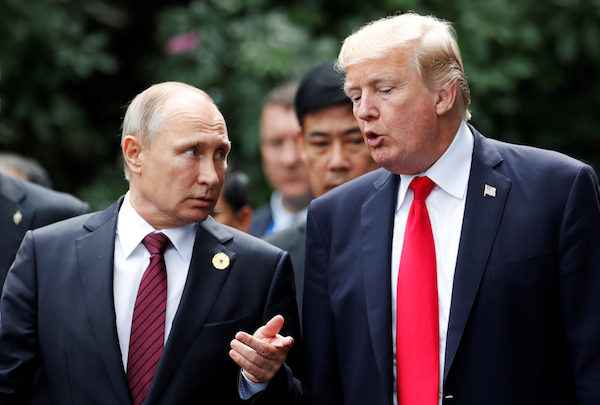
WASHINGTON/MOSCOW(TIP): US President Donald Trump and Russian President Vladimir Putin will hold a summit in Helsinki on July 16, the White House and the Kremlin announced Thursday, June 28.
The brief statement issued in Moscow said the two presidents will discuss bilateral issues and international relations.
The announcement comes a day after Trump’s National Security Adviser John Bolton held talks with Russian officials in Moscow to lay the groundwork for the summit.
“I’ve said it from day one, getting along with Russia and with China and with everybody is a very good thing,” Trump said Wednesday. “It’s good for the world. It’s good for us. It’s good for everybody.”
He said they would discuss Syria, Ukraine and “many other subjects.”
NEW DELHI(TIP): Pakistan becoming a haven for terror groups cannot be tolerated and the US has already delivered the message to Islamabad, US Ambassador to the UN Nikki Haley said here June 28.
“We cannot turn a blind eye to those harboring terrorists… Communicating to Pakistan that this cannot be tolerated,” she said while delivering a lecture at the Observer Research Foundation- a Think Tank.
She also said that India and the US must be global leaders in the fight against terrorism adding “we can and must do more.”
Touching upon a variety of issues, she said freedom of religion is very important and that a nation such as “ours can only be held together by tolerance.”
On China, she said the country was important but noted that its expansion in the region has been a matter of concern for the US and many other countries as Beijing does not share democratic values.
Referring to Prime Minister Narendra Modi’s recent remarks at the Shangri-La dialogue in Singapore to ensure freedom of navigation and stability in the Indo-Pacific, she said President Donald Trump also believes in this vision.
Haley said the US supports India’s membership in Nuclear Suppliers Group as it is a nuclear state which is widely respected.
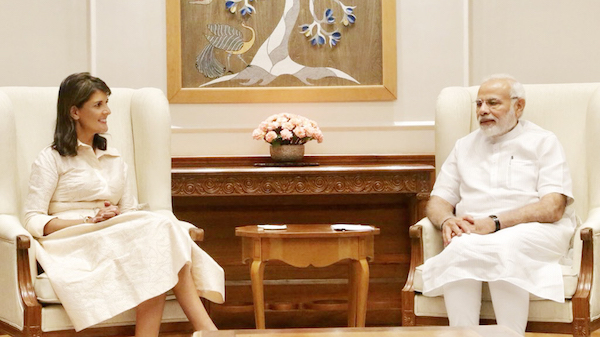
Haley who is on a 3-day visit to India called on Prime Minister Narendra Modi and External Affairs Minister Sushma Swaraj.
She also visited a church, a mosque, a temple and the Sikh Gurdwara Sis Ganj Sahib in Delhi where she and US Ambassador to India Kenneth Juster went to Langar Hall and rolled chapatis. Delhi Gurdwara Prabandhak Committee President Manjit Singh GK showed them round and explained how langar was being distributed free to thousands every day without any distinction of caste and creed.
JERUSALEM(TIP): Israeli Prime Minister Benjamin Netanyahu’s wife Sara was charged, June 21, with fraud and breach of trust after a long police probe into allegations she falsified household expenses, the justice ministry said. “The Jerusalem district prosecutor a short time ago filed charges against the prime minister’s wife,” the ministry said.
The allegations announced last year are that she and an aide falsely declared there were no cooks available at the prime minister’s official residence and ordered from outside caterers at public expense.
The cost amounted to “over 350,000 shekels ($97,000))”, the justice ministry said. She has denied any wrongdoing. Her husband is himself under investigation on suspicion of corruption offences.
In one case, he and family members are suspected of receiving one million shekels ($285,000) worth of luxury cigars, champagne and jewelry from wealthy personalities in exchange for financial or personal favors.
In the other case, investigators suspect the premier of trying to reach an agreement with the owner of Yediot Aharonot, a top Israeli newspaper, for favorable coverage. Netanyahu has protested his innocence and vowed to remain in power.
WASHINGTON(TIP): House Republican leaders further delayed vote on GOP immigration bill until next week in the face of opposition. Earlier, the House of Representatives on June 21 voted down a conservative immigration bill introduced by Judiciary Chairman Bob Goodlatte (R-Va.).
House Republican leaders abruptly postponed a high-stakes vote Thursday on GOP immigration legislation that appeared headed to defeat, despite President Trump’s last-minute lobbying.
Several GOP hard-liners said Thursday, June 21, there was nothing leaders could do to convince them to vote for the bill. “I’m a big fat ‘no,’ capital letters,” said Rep. Lou Barletta (R-Pa.). “It’s amnesty, chain migration, and there’s no guarantee the wall will be built.”
Republican leaders had set up two votes on their GOP bills — one on a hardline measure, the other on a compromise negotiated by conservatives and moderates.
In the first vote, the House rejected the hardline measure that would have imposed limits on legal immigration and provided temporary relief to young undocumented immigrants. The vote was 231-193.
As the vote occurred on a chaotic day on Capitol Hill, word circulated that the second vote would be postponed.
The legislation would have provided a pathway to citizenship for young undocumented immigrants, imposed limits on legal immigration and provided $25 billion for Trump’s border wall. The bill also would have kept migrant families together at the border in detention centers.
Neither bill was negotiated with Democrats or was expected to garner any Democratic votes. The separations crisis has prompted Democrats to dig in against the Republican immigration efforts barring a complete reversal of Trump’s “zero tolerance” policy.
“Democrats are dedicated to securing our border, but we don’t think putting children in cages is the way to do it,” Minority Leader Nancy Pelosi (D-Calif.) said Thursday. “This is outside the circle of human behavior.”
As prospects on Capitol Hill appeared to dim, Trump teed off on Democrats during the outset of a Cabinet meeting at the White House, suggesting that they were standing in the way of Republican success on immigration reform.
“They say no to everything,” Trump said. “They’re obstructionists because they think that’s good politically. I think it’s bad politically — for them, I think it’s bad politically. We’ll see.”
Trump attacked Pelosi and Senate Minority Leader Charles E. Schumer (D-N.Y.) as “extremist open-border Democrats” but also said he would welcome their presence at the negotiating table.
“We should be able to do a bill,” Trump said. “I’d invite them to come over to the White House anytime they want.”
The White House has made a last-minute push to pass legislation amid the brewing border crisis prompted by the family separations that resulted on the U.S.-Mexico border from Trump’s “zero tolerance” immigration policy.
Trump, Attorney General Jeff Sessions and Homeland Security Secretary Kirstjen Nielsen have all appeared on Capitol Hill this week to urge Republican lawmakers to pass legislation. They have not specifically urged passage of one alternative, which stands to end with Republicans split on their preference and neither bill passing.
‘From Dehradun to Dublin, Shanghai to Chicago, yoga’s everywhere’
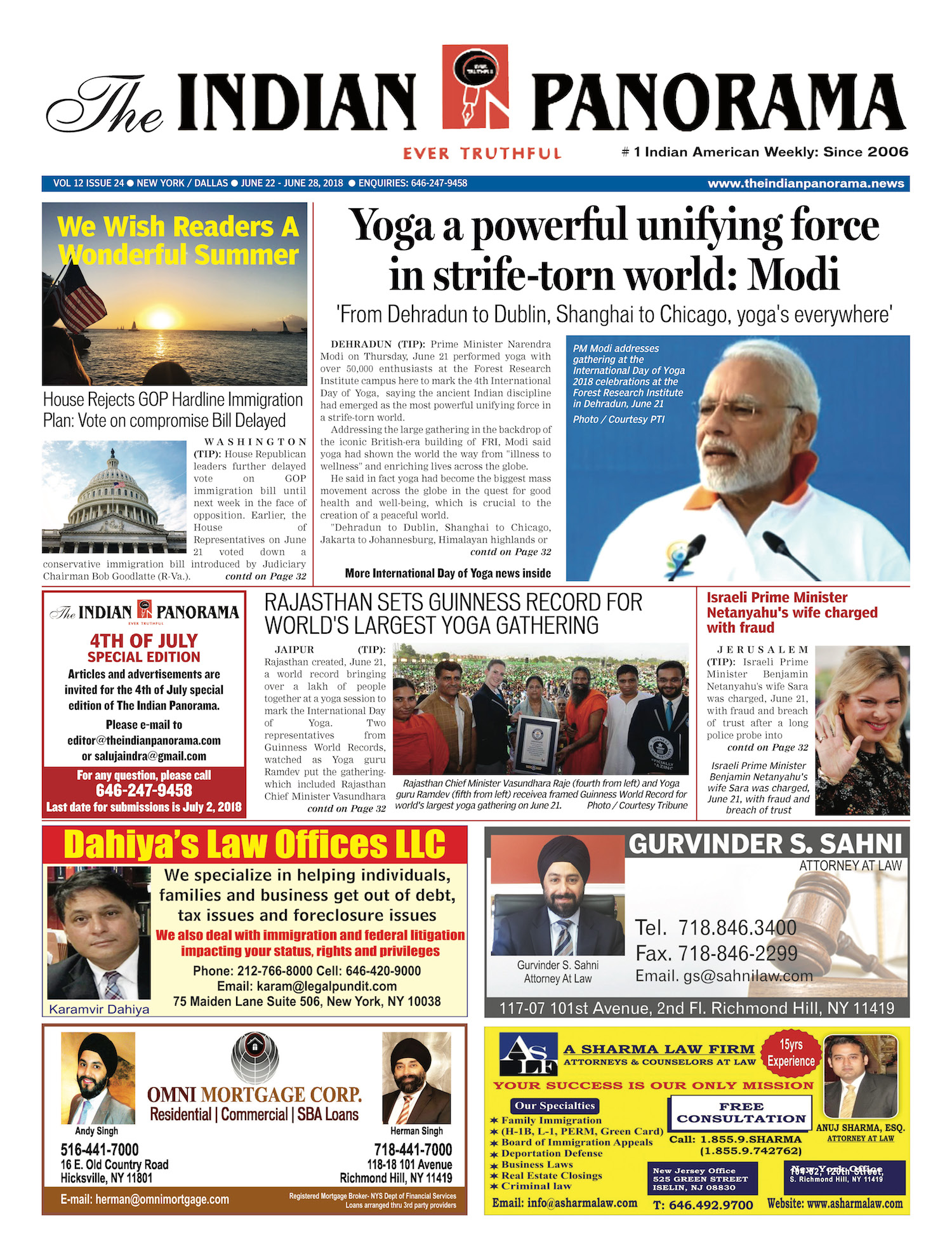
DEHRADUN(TIP): Prime Minister Narendra Modi on Thursday, June 21 performed yoga with over 50,000 enthusiasts at the Forest Research Institute campus here to mark the 4thInternational Day of Yoga, saying the ancient Indian discipline had emerged as the most powerful unifying force in a strife-torn world.
Addressing the large gathering in the backdrop of the iconic British-era building of FRI, Modi said yoga had shown the world the way from “illness to wellness” and enriching lives across the globe.
He said in fact yoga had become the biggest mass movement across the globe in the quest for good health and well-being, which is crucial to the creation of a peaceful world.
“Dehradun to Dublin, Shanghai to Chicago, Jakarta to Johannesburg, Himalayan highlands or sunburnt deserts, yoga is enriching millions of lives all over the world.
“Yoga fosters amity in societies which can form the basis of national unity,” the Prime Minister said.
He said the proposal for the Yoga Day at the UN was accepted in record time with a majority of nations supporting it.
Today people all over the world had come to look upon yoga as something which belonged to them, Modi said.
He also asked people to learn to honor their own legacy and heritage if they wanted the rest of the world to respect them.
“If we don’t take pride in our own legacy and heritage no one else will. We should not hesitate in honoring the gems of our own heritage.”
He said the way to lead a calm, creative and content life was yoga.
“In yoga, we have the perfect solution to the problems we face, either as individuals or in our society,” the Prime Minister said.
“Instead of dividing, yoga unites. Instead of further animosity, yoga assimilates. Instead of increasing suffering, yoga heals,” he said.
Modi said yoga presented a ray of hope for future of the world. “Yoga is beautiful because it is ancient yet modern, it is constant yet evolving,” he said.
“India’s legacy of which yoga is a significant part is unique and rich. We must take pride in it,” the Prime Minister said, adding that it had the power to promote universal brotherhood as it united and assimilated instead of dividing.
“From Tokyo to Toronto, from Stockholm to Sao Paulo, yoga has become a positive influence in the lives of millions,” Modi said.
He asked people to embrace yoga not just for a healthy but happy and peaceful life.
The growing popularity of yoga across the globe had brought India closer to the world and this position is going to get strengthened in times to come, he said.
The Prime Minister had arrived here on Wednesday night to participate in the main event on the International Yoga Day.
Elaborate security arrangements were made and nearly 3,000 security personnel deployed in and around the venue.
Modi arrived at the FRI at around 6.30 am and addressed the people before performing asanas with them.
The Prime Minister had earlier participated in yoga celebrations at Rajpath in New Delhi in 2015, the Capitol Complex in Chandigarh in 2016, and the Ramabai Ambedkar Sabha Sthal in Lucknow in 2017.
On Wednesday, while greeting yoga enthusiasts across the world, the Prime Minister had said that this exercise is one of the most precious gifts given by the ancient Indian sages to humankind.
“Yoga is not just a set of exercises that keeps the body fit. It is a passport to health assurance, a key to fitness and wellness. Nor is yoga only what you practice in the morning. Doing your day-to-day activities with diligence and complete awareness is a form of yoga as well,” a statement quoting Modi had said.
NEW DELHI(TIP): India has asked the UK to clarify whether fugitive jeweler Nirav Modi has permission to stay indefinitely in that country even as the Enforcement Directorate plans to file extradition requests with multiple countries as Modi has changed his location frequently in the past few months.
Sources said India has asked the UK home office if Modi has been granted an ‘ILR’ (indefinite leave to remain). That would be a critical piece of the jigsaw puzzle.
An ILR is like a long-term visa that grants a person legal protection against deportation. In simpler terms, Modi’s status in the UK would, with an ILR, be similar to that of Vijay Mallya, and would require India to file for extradition under the bilateral treaty.
If, however, Modi has not been granted such a privilege, India would be on much stronger ground to seek his deportation. The UK has not yet responded to the query.
The government had revoked Modi’s passport in February. However, he had more than one passport and is believed to have travelled to the UK and Belgium on a different Indian passport. His second passport has also been revoked.
Modi does not qualify for asylum, sources said, because India doesn’t feature in the list of countries which persecute their citizens enabling them to seek asylum in other countries. In addition, it has been established that Modi did indeed commit large-scale fraud, which would also rule out any grant of asylum.
Meanwhile, the ED is ready with legal paperwork for its extradition requests, having filed a chargesheet against Modi and obtaining a non-bailable warrant from a special Mumbai court two days ago. The agency has received information about Modi’s presence in Belgium after his recent trip to London.
However, a source said it was contemplating filing extradition requests with multiple countries since the diamantaire was constantly switching locations.
Modi and his uncle Mehul Choksi of Geetanjali Gems are accused in the Rs 13,000 crore PNB swindle. Both fled the country with their family members just before PNB filed a case against them with the CBI. Immediately after, the ED registered a money laundering case against them under Prevention of Money Laundering Act.
The ED has received information that Modi travelled to the UK multiple times using his revoked Indian passport in March. The ED had given details of Modi’s six passports to the foreign ministry. However, it could not be ascertained how he travelled on a revoked passport.
The ED has also approached Interpol through the CBI for a red corner notice against Modi. The agency has seized assets worth over Rs 3,000 crore belonging to Modi and his associates. A source said Mehul Choksi is currently in the US and a similar extradition request against him will be filed after the ED files a chargesheet against him.
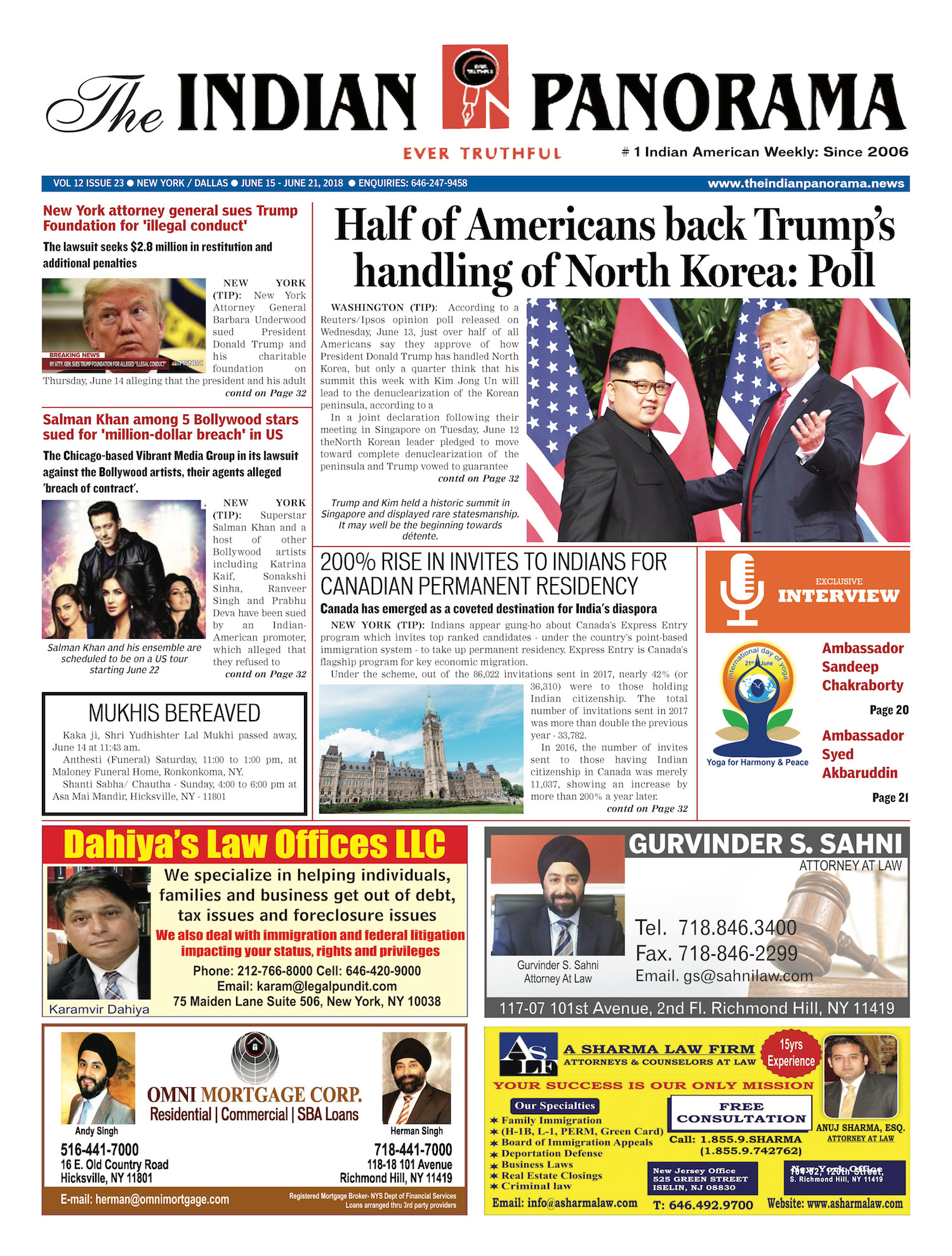
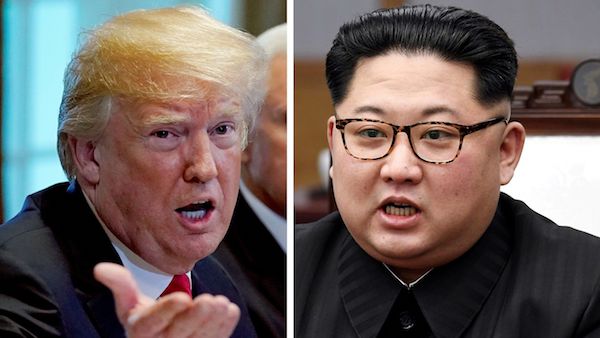
WASHINGTON(TIP): According to a Reuters/Ipsos opinion poll released on Wednesday, June 13, just over half of all Americans say they approve of how President Donald Trump has handled North Korea, but only a quarter think that his summit this week with Kim Jong Un will lead to the denuclearization of the Korean peninsula, according to a
In a joint declaration following their meeting in Singapore on Tuesday, June 12 the North Korean leader pledged to move toward complete denuclearization of the peninsula and Trump vowed to guarantee the security of the United States’ old foe. Forty percent of those polled said they did not believe the countries would stick to their commitments.
Another 26 percent said they believed the United States and North Korea would meet their commitments, while 34 percent said they did not know whether they would follow through.
Thirty-nine percent believe the summit has lowered the threat of nuclear war between the United States and nuclear-armed North Korea, slightly more than the 37 percent who said they did not believe it changed anything.
Trump has pursued what he calls a “maximum pressure” campaign” against Pyongyang to force it to give up its nuclear weapons. He toughened up international sanctions to further isolate North Korea and then agreed to meet directly with Kim after South Korea’s president convinced him that the North was committed to giving up its nuclear weapons.
The Reuters/Ipsos poll suggests the Republican president has broad support for one of his biggest foreign policy efforts, despite criticism from non-proliferation experts that Trump had exacted few concrete commitments from Kim on Tuesday on dismantling his nuclear arsenal.
Republicans appear much more enthusiastic than Democrats about the potential benefits of the summit. The poll found that Republicans were twice as likely as Democrats to say that the meeting lowered the threat of nuclear war, and they were three times as likely to say that both sides would follow through on their commitments.
Democrats typically give Trump low approval ratings – only 12 percent approve of his overall job performance. But about 30 percent said they approved of his handling of North Korea.
Trump, who returned to Washington early on Wednesday, hailed the meeting with Kim, the first between a sitting US president and a North Korean leader, as a success that had removed the North Korean nuclear threat. Their seemingly friendly meeting was in sharp contrast to their tit-for-tat insults and bellicose rhetoric late last year while Pyongyang carried out its biggest nuclear and missile tests.
In the poll, Trump received a 51 percent approval rating for his handling of North Korea and also led the list of leaders who should take the most credit for the summit and the joint pledge. Forty percent say the former real estate developer should take the most credit, followed by South Korean President Moon Jae-in with 11 percent. Kim was third with 7 percent.
Trump has repeatedly touted his role in bringing the reclusive North Korea to the negotiating table, a feat that he says his predecessors were unable to pull off.
Trump has offered India 100% access to all US Technologies and treat India as the closest ally
By Ven Parameswaran
“Close alignment with the US will strengthen India’s national security and protect its sovereignty. China will think twice before threatening to attack India. Future wars will be won by whoever has superior technology”, says the author
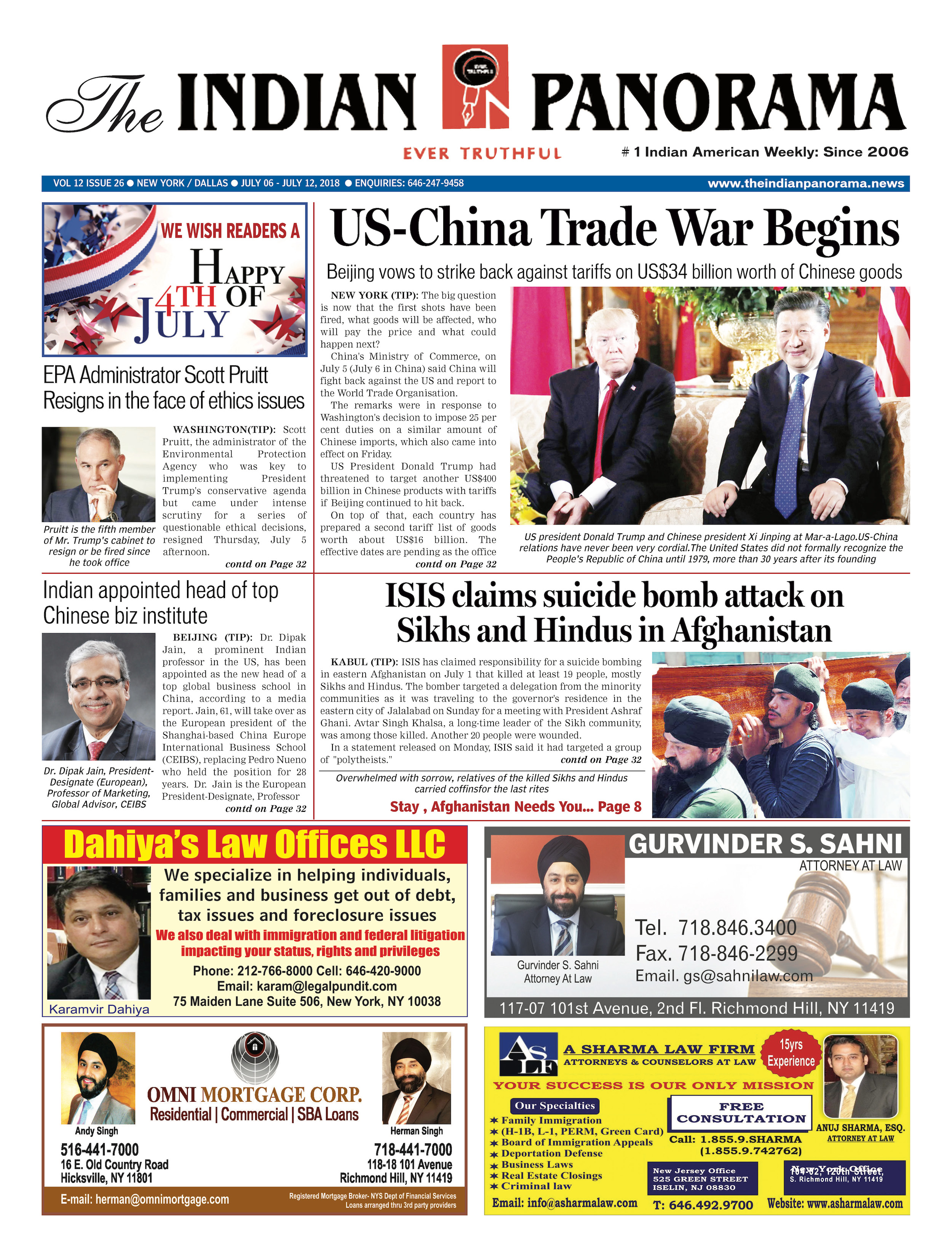
The US spends half a trillion dollars a year on scientific research—more than any other nation on Earth—but China has pulled into second place, with the European Union, third and Japan, a distant fourth. China is on track to surpass the US by the end of this year, according to the National Science Board. In 2016, annual scientific publications from China outnumbered those from the US for the first time.
“There seems to be a sea change in how people are talking about Chinese science,” said Alanna Krolikowski, a Chinese science expert at Missouri University of Science and Technology. Foreign observers, many of whom were once condescending, now “are rather in awe at what the Chinese policies have accomplished.”
The scientific advances are a small piece of China’s larger ambitions. President Xi Jinping aims to supplant the USA as the world’s economic superpower within three decades. In October Xi vowed to produce “a world-class army by 2050.” Meanwhile, China is spending more on infrastructure than the US or Europe, and the middle class has ballooned – making relocation more attractive.
India was ahead of China in nuclear development and could have tested before 1964, when China tested. India was foolish to wait for China to test first; and tested only in 1974. The US punished India with severe sanctions. Indian scientists were shut off from all international scientific conventions. India further tested in 1998 and the US punished with more sanctions. Thanks to George W Bush for offering India civil nuclear agreement that lifted the sanctions of 3 decades. India was shut off for 30 years. Nehru may be held responsible for enabling China to advance ahead of India.
There is something dangerously wrong with Indian policies. After 71 years of independence, India is unable to deliver water and electricity 24/7 to all Indians. Why? The Indian Institute of Technology is branded No.1 in the world. At least 50,000 of IIT alumni have settled in the US. As citizens of the USA many of them have performed par excellence in different fields.
Prime Minister Modi must take aggressive steps to transform India from backwardness to modernization. He should liberalize policies to encourage the USA to invest and participate in the Indian economy. Modi physically embraced Trump at the White House. He must follow up by India embracing the US and seek full alignment with the USA. Chester Bowles, American Ambassador to India during Truman’s and Kennedy’s era fell in love with India and recommended a strong partnership with the USA. But Nehru turned down the offer. India pretended nonalignment, but it was aligned with the Soviet Union.
Prime Minister Modi must capitalize on the opportunity President Trump has offered to India in technology, defense, and economic development. If India gives carte blanche to the USA, India will be modernized within the shortest possible time enabling the US to import consumer and industrial products from India instead of from China.Full access to the latest U.S. technology and investing in research and development can make India compete with China. India is the youngest country in the world. India is also the largest English speaking country in the world, second being the USA. India should be able to create huge employment opportunities for its large supply of engineers, scientists and management professionals.
Close alignment with the US will strengthen India’s national security and protect its sovereignty. China will think twice before threatening to attack India. Future wars will be won by whoever has superior technology. In this context, India should continue to align with Israel, besides, of course, its close alignment with the US.
(The author, 64 year resident of USA; MBA, Columbia Business School, is a Diplomat-in-Residence and Senior Adviser to Imagindia Institute. a think tank in New Delhi. He can be reached at vpwaren@gmail.com)
The two-day meeting will be dominated by the possibility of a trade war – prompted by the US levies of 25 per cent on steel and 10 per cent on aluminum
WASHINGTON(TIP): After initial dithering, President Trump is heading for G7 Summit at Charlevoix, Canada on Friday, June 8. Following the session on Women’s Empowerment, Trump will travel directly to Singapore from Canada in anticipation of his upcoming meeting with North Korea’s leader Kim Jong Un, Tuesday, June 12.
Deputy Assistant to the President for International Economic Affairs Everett Eissenstat will represent the United States for the remaining G7 sessions, White House Press Secretary Sarah Sanders said.
The annual G7 (Group of Seven) summit kicks off in Charlevoix, Quebec on Friday, June 8 and the stage is set for a major showdown between the US and its allies.
The leaders of the G7, an informal bloc of some of the world’s most powerful industrialized countries, including Germany, the UK, and Japan, get together every year to discuss collaboration on issues like global security, the international economy, and climate change.
At the end of the summit, they aim to sign a joint statement detailing the policy positions and initiatives they agree on.
But there’s a decent chance that might not happen this year.
That’s because President Donald Trump has so badly rattled the other members with his recent heavy steel and aluminum tariffs and other divisive new policies that it might be impossible for the group to reach a consensus on any substantive issue.
The two-day meeting will be dominated by the possibility of a trade war – prompted by the US levies of 25 per cent on steel and 10 per cent on aluminum.
Angela Merkel, the German chancellor, has predicted a big fight at the summit, triggering suggestions it has become a “G6+1” – with the US president isolated and alone.
The EU is poised to impose tariffs on US imports ranging from Harley-Davidson motorbikes and jeans to bourbon, peanut butter, cranberries and orange juice, from next month.
Brussels is still finalizing the list it will submit to the World Trade Organisation (WTO), which will be on top of tit-for-tat tariffs on about £2.5bn of US steel.
A French official told Bloomberg that French President Emmanuel Macron wants to make progress with President Trump on smoothing tensions over trade, the US’s withdrawal from the Iran nuclear deal, and climate policy — and if that doesn’t happen, France may refuse to sign.
Then there’s the fact that Trump himself is reportedly contemplating not signing the joint statement to show that the US is perfectly happy to go its own way if the other members give it too much trouble during talks. The divide has become so stark that staffers and observers of the G7 have started to call it the “G6 plus one.”
“What this G7 is going to show is that the United States are alone against everyone, and especially alone against their allies,” French Finance Minister Bruno Le Maire told reporters last week.
The G7 summit is usually a boring meeting of broad consensus. Not anymore.
The G7 summit, which includes Canada, France, Germany, Italy, Japan, and the United Kingdom, plus the European Union (which is not technically part of the G7 but participates), is typically a pretty straightforward affair.
The official themes for this year’s summit include “investing in growth that works for everyone,” “preparing for the jobs of the future,” and “advancing gender equality.” Against the backdrop of these deliberately anodyne themes, world leaders can hobnob and try to move the ball forward on issues like a new free trade agreement or cooperative climate policy.
But Trump has departed sharply from the G7 consensus on issues like these in the past by, for instance, pulling out of the Paris climate agreement and withdrawing from the Trans-Pacific Partnership.
And White House officials say he is planning to strike a confrontational posture at the summit. “There are disagreements. He’s sticking to his guns, and he’s going to talk, talk to them,” National Economic Council Director Larry Kudlow told reporters on Wednesday. Trump is also reportedly considering implementing a fresh round of tariffs against Canada — the host of the summit.
European countries could also shun the final statement. Their biggest priority is likely going to be getting Trump to consider some kind of compromise on his recent protectionist trade policies, the most controversial one being his imposition of sweeping tariffs on foreign steel and aluminum. Currently, those tariffs hit exports from every other member of the G7.
Trump is also apparently not looking forward to what could be a tense and awkward meeting. According to the Washington Post, Trump has reportedly complained to advisers about having an “uneasy rapport” with German Chancellor Angela Merkel and sees British Prime Minister Theresa May as “too politically correct.”
And Trump has apparently told advisers that he doesn’t want to be “lectured” by other world leaders, especially as he tries to prepare for an upcoming high-stakes summit with North Korea next week.
If the final joint statement for the G7 is missing signatories this weekend when the summit wraps up, it won’t be the end of the world. It’s a symbolic show of unity, not a binding document with concrete policy effects. But it will be yet another sign of how far the US is drifting from many of its most trusted friends in the world.
Says any attempt to define India through religion, intolerance will dilute its existence
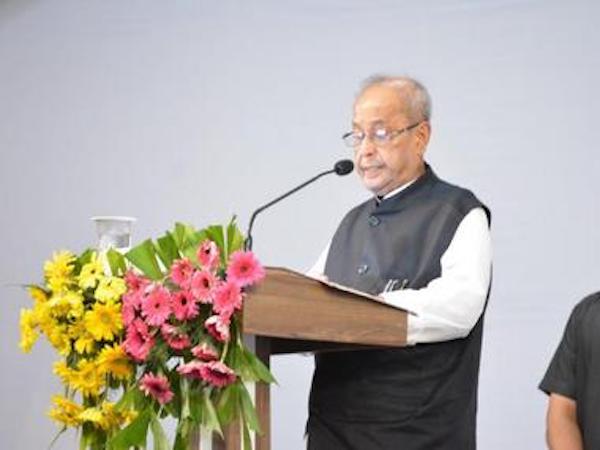
NAGPUR, INDIA(TIP): Highlighting the pluralistic and secular strengths of “our democracy” former President of India and Congress veteran Pranab Mukherjee on Thursday, June 7 spoke from an RSS platform to declare nationalism was not bound by race or religion.He cautioned that any attempt to define India through “religion, dogma or intolerance” would only dilute the country’s existence.
His half-an-hour address had a lesson for everyone. To the RSS, the former President recalled “vasudhaiv kutumbakam” (the world is one family) as the soul of Indian nationalism; to new Sangh recruits he spoke of the need for harmony; to his parent party Congress, he emphasized the need for dialogue and to PM Narendra Modi, he quoted Kautilya’s lessons in governance.
Unfazed by the fact that he was standing with people he had ideologically opposed all his life, Mukherjee used the occasion to drive home “diversity and acceptance” as the bedrock of Indian nationalism and to remind the pracharaks of the need for unity.
“We derive our strength from tolerance. We accept and respect our pluralism. We celebrate our diversity. Any attempt at defining our nationhood in terms of dogmas and identities of religion, region, hatred and intolerance will only lead to dilution of our national identity,” the former President said.
To sceptics, including his daughter Sharmishtha, the ex-President said informed public engagement was essential in democracy. “A dialogue is necessary not only to balance competing interests, but also to reconcile them. We may argue, may agree, may not agree but we cannot deny the existence of multiplicity of opinions,” he said.
Wading through India’s past, Mukherjee spoke of how through 3,500 years of being ruled by dynasts, India’s 5,000 years of civilizational unity remained unchanged while foreign elements were absorbed to create a new synthesis of national unity.
“Multiplicity of cultures, faith and languages makes us special,” Mukherjee repeated to 707 pracharaks, passing out after rigorous RSS training. He carefully dotted his speech with quotes from S Radhakrishnan, Rabindranath Tagore, Mahatma Gandhi, Jawaharlal Nehru and Bal Gangadhar Tilak to hammer home his point. “When Tilak spoke of swaraj, he meant a swaraj for people encompassing all castes and religions and languages.”
He lauded the Constitution at a gathering full of RSS sympathizers, saying, “For us, democracy is not a gift, but a sacred trust… The Constitution is not a legal document but a Magna Carta for the socio-economic transformation of society. From our Constitution flows our nationalism.”
The former President also commented on the “routine of violence” in the country, saying India may be the fastest growing economy but it was lagging on the World Happiness Index.
“You are young. I must tell you that manifestations of rage are tearing our social fabric. We must free public discourse of violence, both physical and verbal. We must move from anger and conflict to love and harmony. Our motherland is asking for happiness. Our motherland deserves happiness,” Mukherjee said as he marveled the fact that 1.3 billion Indians used 120 languages, 1,600 dialects, followed seven major religions, belonged to three ethnic groups and still stood united under one flag, one Constitution and one identity.
“This is Bhartiyata,” the former President said at the RSS headquarters after he had paid tributes to Sangh founder KB Hedgewar, calling him a “great son of Mother India”. Earlier, RSS chief Mohan Bhagwat spoke of the irrelevance of controversy around Mukherjee’s visit.
Veiled message to PM
“When we go to Parliament, just above the lift at gate no. 6 is inscribed Kautilya’s quote “In the happiness of people lies the happiness of the king, their welfare is his welfare. The State is for the people. People are at the center of all activities of the State and nothing should be done to divide them. The aim of the State should be to galvanize them to fight a concerted war against poverty, disease and deprivation. Only then can we create a nation where nationalism flows automatically.”
Message to Sangh
“India’s nationhood is not one language, one religion and one enemy. It is perennial universalism of 1.3 billion people who use 122 languages and 1,600 dialects… practice 7 major religions… live under one system, one flag and one identity of being Bharatiya and have no enemies”.
Bhagwat on visit
RSS Chief Mohan Bhagwat said on Mr. Mukherjee’s address: “Pranab Mukherjee will remain what he is and the Sangh will remain the Sangh even after the event. The RSS wants to unify the entire society, and no one is an outsider for it. People may have different views, but they are all children of mother India.”
Congress comments
Hours after Congress leaders had slammed former President Pranab Mukherjee for attending an RSS event, the party on Thursday praised him for showing “mirror of truth” to the Sangh by reminding it of India’s pluralism, tolerance, secularism and inclusiveness as an article of faith and soul of the country.
The party also said Mukherjee reminded the Prime Minister Narendra Modi of his ‘Rajdharma’ and that “Indian nationalism is constitutional patriotism”.
Congress spokesperson Randeep Singh Surjewala said Mukherjee’s visit to the RSS headquarters had caused wide-ranging discussion, comment, concern and even consternation amongst a large section of Indians, who have an innate belief in foundational values of democracy, pluralism, and diversity.
His statement came soon after Mukherjee had delivered his nearly 30-minute address at the RSS headquarters during its third year annual training camp.
Earlier, several Congress leaders, including Ahmed Patel and Anand Sharma, had slammed Mukherjee for attending an RSS event in Nagpur. Patel, who is UPA chairperson Sonia Gandhi’s confidant and has been her political secretary, voiced his view on Twitter, in reply to Mukherjee’s daughter who too spoke out against the decision of the former President to address the RSS event. “I did not expect this from Pranab da!” Patel tweeted.
Congress senior spokesperson Anand Sharma also took to Twitter to express his anguish after Mukherjee’s images attending an RSS event in Nagpur appeared on television. “The images of Pranab Da, veteran leader and ideologue at RSS Headquarters have anguished millions of Congress workers and all those who believed in pluralism, diversity and the foundational values of the Indian Republic,” he said. “Dialogue can only be with those who are willing to listen, absorb and change. There is nothing to suggest that RSS has moved away from his core agenda as it seeks legitimacy,” he added.
‘Dirty tricks at play’
Tagging a morphed picture showing Pranab sporting the RSS cap, his daughter and Congress leader Sharmishtha Mukherjee said: “See, this is exactly what I was fearing and warned my father about. Not even few hours have passed, but BJP/RSS dirty tricks dept is at work in full swing!”
Mr. Mukherjee came, spoke and left. But his visit to RSS headquarters is now a part of contemporary and future history of India. For long, political parties and political analysts will be commenting over the 30-minute speech of one of the most experienced and best-known politicians of our times.
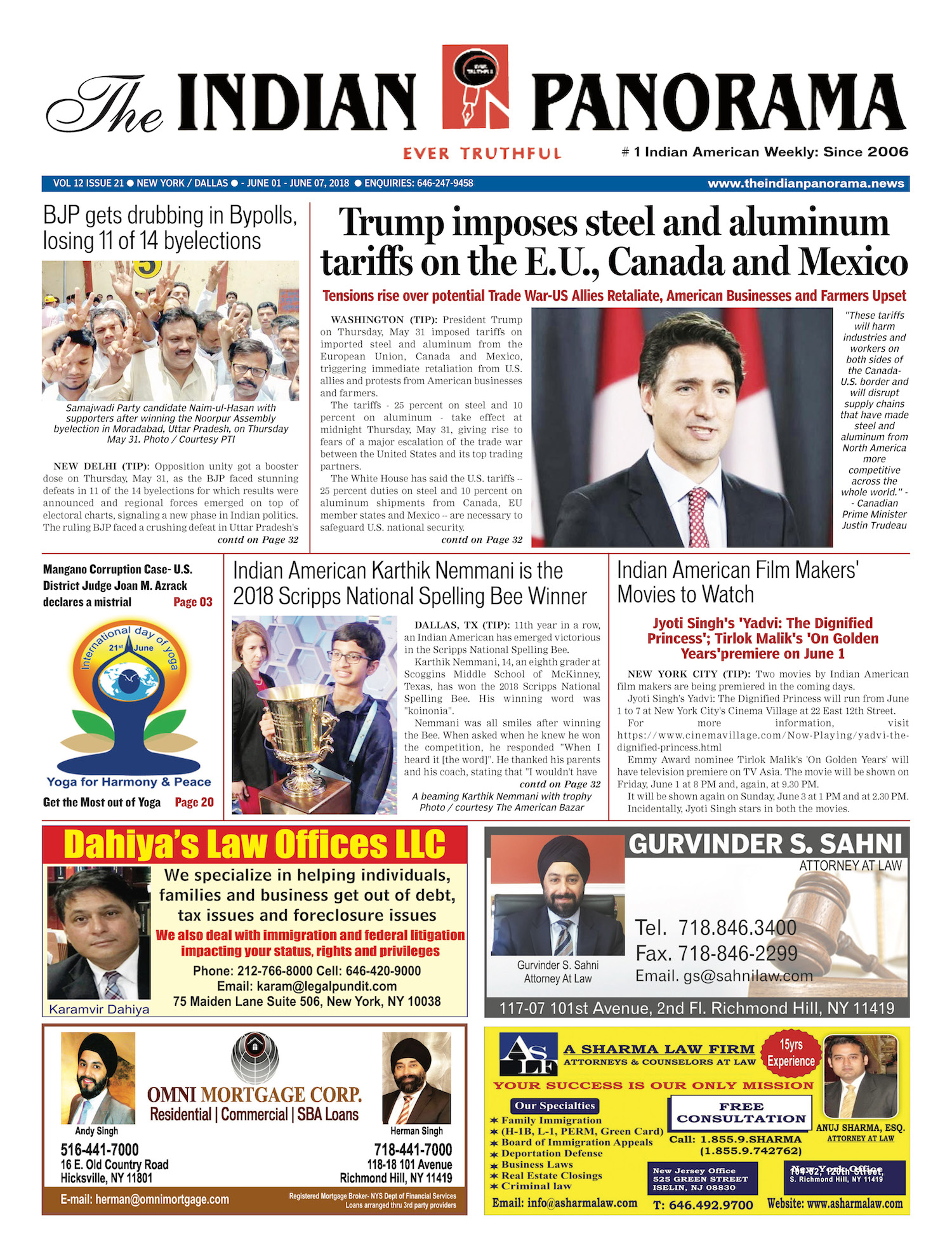
DALLAS, TX(TIP): 11th year in a row, an Indian American has emerged victorious in the Scripps National Spelling Bee.
Karthik Nemmani, 14, an eighth grader at Scoggins Middle School of McKinney, Texas, has won the 2018 Scripps National Spelling Bee. His winning word was “koinonia”.
Nemmani was all smiles after winning the Bee. When asked when he knew he won the competition, he responded “When I heard it [the word]”. He thanked his parents and his coach, stating that “I wouldn’t have been able to do it without her [his coach]”.
Spelling Bee veteran, Nayasa Modi, 11, a seventh grader from Texas, finished second. She was stumped by the word “Bewusstseinslage,” which she spelled “bewustsseinslage.” Nemmani however, seemed to know the word, nodding along to every letter Modi spit, shaking his head once he knew she spelled it incorrectly.
Nemmani will walk away with a cash prize of $40,000 and a trophy from SNSB, a $2,500 cash prize and complete reference library from Merriam-Webster, a trip to New York City to appear on Live with Kelly and Ryan, a trip to Hollywood to appear on ABC’s Jimmy Kimmel Live! and a pizza party for his school sponsored by Pizza Hut and Book It!
Eleven-year-old Abhijay Kodali, the youngest speller of the evening, finished third. He was eliminated after misspelling “aalii.”
The commencement of round 11 saw 7 spellers, all of whom were Indian American. 11 of the 16 finalists tonight were Indian American.
The 2018 Scripps National Spelling Bee was held at the Gaylord National Resort & Convention Center in National Harbor, Maryland from May 29-31.
NEW DELHI(TIP): Opposition unity got a booster dose on Thursday, May 31, as the BJP faced stunning defeats in 11 of the 14 byelections for which results were announced and regional forces emerged on top of electoral charts, signaling a new phase in Indian politics.
The ruling BJP faced a crushing defeat in Uttar Pradesh’s Kairana parliamentary segment where Tabassum Hasan, the joint nominee of Rashtriya Lok Dal and Samajwadi Party — backed by Bahujan Samaj Party and Congress — defeated Mriganka Singh of the saffron fold by around 50,000 votes. BJP’s loss in the communally sensitive Kairana stood out considering it had won the segment by over two lakh votes in the 2014 General Election when the Narendra Modi wave swept UP.
Of the four Lok Sabha seats where bypolls were held on May 28, the BJP managed to retain only Palghar in Maharashtra, where it defeated a Shiv Sena candidate. Kairana went to the kitty of a united Opposition; Congress’ UPA partner NCP snatched Bhandara-Gondia in Maharashtra from the BJP and the Nationalist Democratic Progressive Party, a BJP ally in the North-East, bagged the Nagaland segment.
While the trend of BJP’s losses in parliamentary byelections is not new (it has only won five of 27 Lok Sabha bypolls since its historic 2014 landslide), shockwaves for the saffron party came from states where regional satraps convincingly halted the BJP in nine of the 10 Assembly byelections.
The BJP managed to retain only Tharali in Uttarakhand. In UP, it lost the Noorpur seat to SP’s Naim-ul-Hasan, who was propped up by the joint Opposition. Lalu Prasad’s RJD claimed sweet revenge in Bihar by wresting the Jokihat seat from the Nitish Kumar-led JD(U), which deserted the Opposition ranks some time ago to go and settle with the BJP.
Maheshtala in West Bengal went to the Mamata Banerjee-led TMC though the BJP was second, pushing the state’s old players CPM and Congress far behind. In Kerala’s Chengannur, the ruling CPM-led LDF won comprehensively while Silli and Gomia in Jharkhand went to the Jharkhand Mukti Morcha. In Punjab’s Shahkot also, the Congress dealt a severe blow to BJP ally Akali Dal.
An emboldened Opposition saw a clear message in BJP’s multiple defeats. “Victory of a united Opposition,” said Congress’ Pramod Tewari. The results equally established the emergence of a new leader — RJD’s Tejashwi Yadav in Bihar.
Though signaling a receding Modi wave, Home Minister Rajnath Singh put a spin on the saffron losses by saying, “You have to take two steps back for a big leap.” Overall, it was a day of defense for the BJP, whose spokesman Sambit Patra came up with this reasoning: “We won 325 seats in UP and formed a government. How did we lose bypolls and win later… because bypoll is fought on local issues.”
That said, ahead of the 2019 General Election, Thursday’s most abiding message is that the time for bipolar politics may be over. A senior politician (name withheld) commented:” BJP ke acche din jaane wale hain”.
Tensions rise over potential Trade War-US Allies Retaliate, American Businesses and Farmers Upset
WASHINGTON(TIP): President Trump on Thursday, May 31 imposed tariffs on imported steel and aluminum from the European Union, Canada and Mexico, triggering immediate retaliation from U.S. allies and protests from American businesses and farmers.
The tariffs — 25 percent on steel and 10 percent on aluminum — take effect at midnight Thursday, May 31, giving rise to fears of a major escalation of the trade war between the United States and its top trading partners.
The White House has said the U.S. tariffs — 25 percent duties on steel and 10 percent on aluminum shipments from Canada, EU member states and Mexico — are necessary to safeguard U.S. national security.
Stung by the U.S. action, the allies quickly hit back.
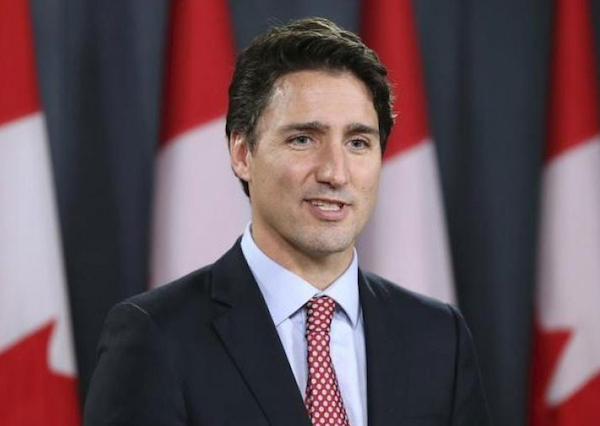
In announcing his country’s response, Canadian Prime Minister Justin Trudeau said it was “inconceivable” that Canada “could be considered a national security threat to the United States,” noting that U.S. fighter planes and tanks contain Canadian steel.
“These tariffs will harm industries and workers on both sides of the Canada-U.S. border and will disrupt supply chains that have made steel and aluminum from North America more competitive across the whole world,” he said in a press conference in Ottawa.
Effective July 1, Canada will impose tariffs of 25 percent on shipments of U.S. steel and 10 percent on aluminum, as well as on other products, such as playing cards, inflatable boats and yogurt. Canada’s finance ministry estimated the value of the U.S. goods subject to those tariffs at up to C$16.6 billion ($12.8 billion),
Jean-Claude Juncker, president of the European Commission, said the European Union also will apply news tariffs on American goods, with the trading bloc signaling it would target products made in states represented by key Republican leaders. The EU has said it would respond with tariffs on $3.3 billion in American imports as early as June 20.
“The U.S. now leaves us with no choice but to proceed with a [World Trade Organization] dispute settlement case and with the imposition of additional duties on a number of imports from the U.S. We will defend the Union’s interests, in full compliance with international trade law,” Juncker said in a statement.
The E.U. said it would impose import taxes on politically sensitive items like bourbon from Senate Majority Leader Mitch McConnell’s home state of Kentucky. Mexico said it would levy tariffs on American farm products, while Canada zeroed in on the same metals that Trump has targeted.
The Mexican government said it would levy import taxes on U.S. exports of pork bellies, apples, cranberries, grapes, certain cheeses and various types of steel.
Thursday’s action was driven by the president’s conviction that allies and adversaries routinely take advantage of the United States and that efforts to resolve trade disputes are doomed unless he wields a big tariff stick.
“The United States has been taken advantage of for many decades on trade,” Trump said in a statement. “Those days are over. Earlier today, this message was conveyed to Prime Minister Justin Trudeau of Canada: The United State[s] will agree to a fair deal, or there will be no deal at all.”
Officials from the three trading partners — among Washington’s closest allies for decades — have dismissed the idea that their shipments to American customers endanger the United States — and some prominent Republicans attacked the tariffs as wrongheaded.
At home, some have expressed doubts about the position Trump has taken.
Sen. Ben Sasse was blunter in criticizing the tariffs.
“This is dumb. Europe, Canada and Mexico are not China, and you don’t treat allies the same way you treat opponents,” the Nebraska Republican said in a statement. “We’ve been down this road before — blanket protectionism is a big part of why America had a Great Depression. ‘Make America Great Again’ shouldn’t mean ‘Make America 1929 Again.’ “
India’s regional reset won’t be complete without a change in its Pakistan policy
By Rakesh Sood
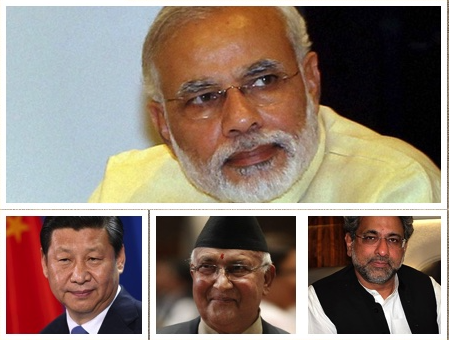
“Even Prime Minister Narendra Modi’s critics acknowledge his uncanny ability to take bold decisions and this reflects in his foreign policy initiatives. Interestingly, he is also demonstrating an ability to undertake course corrections. The informal summit at Wuhan, China, last month and a visit to Nepal this month reflect a change aimed at reviving the ‘neighborhood first’ policy, announced in 2014. The big challenge, however, will be providing a sense of direction to the policy on Pakistan which has oscillated between ‘jhappi’ and ‘katti’.”
Mr. Modi had received Chinese President Xi Jinping in September 2014 in Gujarat reflecting his personalized diplomacy even though the ongoing stand-off in Chumar in eastern Ladakh cast a shadow on the visit. The personalized diplomacy was reciprocated the following year when Mr. Modi visited China and Mr. Xi received him in Xian, but its limits soon became apparent.
In mid-2016, China blocked India’s bit to join the Nuclear Suppliers Group (NSG) despite a meeting between the two leaders in Tashkent on the margins of the Shanghai Cooperation Organisation (SCO) summit. This was followed by China vetoing Masood Azhar’s listing as a terrorist in the UN Security Council even though the Jaish-e-Mohammed (JeM) is a banned entity. China’s veto continued even after the Uri Army camp attack by JeM cadres later that year, adding to India’s growing annoyance. Hydrological data sharing stopped amid reports of diversion of Brahmaputra river waters. The 73-day stand-off at Doklam last year and accompanying rhetoric reflected a marked downturn. India responded through all this by voicing skepticism regarding Mr. Xi’s Belt and Road Initiative (BRI), stepping up maritime engagement with the U.S. and Japan and reviving the Quad (with Australia) in Manila last year.
Both leaders soon realized the risks of the downward spiral of confrontation and were pragmatic enough to understand the need to restore a degree of balance to the relationship. Mr. Xi had emerged stronger after the 19th Communist Party Congress and the decision by the Central Committee to remove the restriction of two terms for a President made it clear that he would continue beyond 2023.
Significant messages were carried by Foreign Minister Wang Yi and Politburo member Yang Jiechi last December during their visits to Delhi. Follow-up visits to Beijing by Foreign Secretary Vijay Gokhale, National Security Adviser Ajit Doval, Foreign Minister Sushma Swaraj and Defense Minister Nirmala Sitharaman earlier this year prepared the ground for the informal summit meeting in Wuhan last month. The leak of the government circular advising officials to stay away from events commemorating 60 years of Dalai Lama’s exile in India and declining Australia’s suggestion to participate in Malabar naval exercises indicated Indian interest in a reset.
The Wuhan summit was projected as ‘informal’ (something the Chinese have engaged in with U.S. Presidents Barack Obama and Donald Trump), without an agenda. Over two days, the two leaders met for 10 hours, four times one-on-one and twice with their delegations. Instead of a customary Joint Statement, there were separate briefings by Mr. Gokhale and Chinese Vice Foreign Minister Kong Xuanyou indicating the key takeaways. It is clear that messages have gone out to the Army to improve communications and understanding and prevent the stand-offs that were becoming frequent. Both sides have agreed to undertake a joint project in Afghanistan. No softening of Chinese position on the NSG or India’s reservations on the BRI was visible though these issues would have figured in the discussions. However, with three more meetings likely during the SCO, G-20 and BRICS summits later this year, it is clear that there is an effort to bring the relationship on track.
Rebuilding trust with Nepal
A similar exercise appears to be under way with Nepal. Mr. Modi’s visit in 2014 had generated considerable goodwill but subsequent decisions queered the pitch. India’s public display of unhappiness with Nepal’s new Constitution and support for the Madhesi cause created ill-will. The economic impact caused by the disruption of supplies of essential items such as liquefied petroleum gas, petroleum products and medicines fed the anti-Indian sentiment which K.P. Oli effectively exploited to score a decisive electoral victory late last year. Clearly, Delhi was disappointed with the election outcome but decided that the relationship with Nepal was too important to let past misunderstandings fester. A new beginning was necessary.
A couple of phone calls between Mr. Modi and Mr. Oli followed in December-January and Foreign Minister Sushma Swaraj was in Kathmandu even before Mr. Oli was sworn in as Prime Minister to convey congratulations and an invitation from Mr. Modi to visit India. Mr. Oli responded positively, and much was made of the fact that in keeping with tradition, he made Delhi his first foreign destination last month. A surprise one-on-one meeting with Mr. Modi on the first day provided the two leaders an opportunity to clear the air about the past and rebuild a degree of trust.
A return visit by Mr. Modi to Nepal within a month (on May 11-12) indicates that both sides are keen to show positive movement. Expectations are being kept low key, but the optics of positive messaging are evident. Included in the itinerary are a visit to Janakpur to offer prayers at Janaki Mandir and a public address which will announce the inauguration of the Ramayana pilgrimage circuit linking Ayodhya and Janakpur. The same idea had been shot down earlier when the Nepali authorities had cited ‘security issues’. In addition, Mr. Modi will visit Muktinath and the pension paying office at Pokhara, highlighting the historical, cultural and religious ties between the peoples of the two countries. Undoubtedly, the fact that he begins his visit to Nepal by landing in Janakpur, capital of the sole Madhes-ruled province will give comfort to the Madhesi community, but Mr. Modi realizes that his challenge is to repair ties with the wider Nepali community.
The Pakistan challenge
With Pakistan, after the opening when the then Prime Minister, Nawaz Sharif, visited Delhi in 2014 and Mr. Modi dropped in to have tea with him in Lahore in December 2015, relations stalled in 2016 following the Pathankot and Uri attacks. Firing across the Line of Control (LoC) has intensified leading to higher casualties on both sides, both civilian and military. In September 2016, India launched ‘surgical strikes’ as retaliation for the Uri attack but this has not reduced infiltration. Since Burhan Wani’s death, local recruitment by radical groups is also on the rise. India has successfully stalled the South Asian Association for Regional Cooperation (SAARC) summit since 2016 and Mr. Trump’s tweets criticizing Pakistan have given Delhi satisfaction. But limits to the policy of isolating Pakistan are also apparent.
Elections are likely in July and the Army would prefer to keep Mr. Sharif’s PML(N) out of power. Mr. Sharif’s dismissal and disqualification for life from politics by the Supreme Court makes it clear that the Army is determined to control the political transition. Pakistan Army Chief Qamar Javed Bajwa has, on more than one occasion, emphasized the need for improving relations with both India and Afghanistan.
The resumption of the stalled Track II Neemrana Dialogue last month in Islamabad indicates that a shift may be likely. Pakistan realizes that the time frame for a shift is limited before India goes into election mode. The question is whether Gen. Bajwa can make good on his suggestion by showing forward movement on the issues flagged by India — curbing the Lashkar-e-Toiba and JeM, the Kulbushan Jadhav and 26/11 trials, etc. Faced with a similar situation, Gen. Pervez Musharraf had gone in for a unilateral ceasefire on the LoC in 2003. The guns fell silent, tensions were defused, and Pakistan hosted the SAARC summit in 2004.
A change in the Pakistan policy may well be the reset to enable Mr. Modi to reclaim his ‘neighborhood first’ policy.
(The author is a former diplomat and is presently Distinguished Fellow at the Observer Research Foundation. E-mail: rakeshsood2001@yahoo.com)
LONDON(TIP): The General Data Protection Regulation (GDPR) comes into force on Friday, May 25, giving EU citizens new rights over how their personal data is used. It has been billed as the biggest shake-up of data privacy laws since the birth of the web
The pan-EU law aims to give its citizens more rights to control over their online information. It has a list of technically demanding requirements, and threatens fines of up to 4% of a company’s annual revenue for serious infringements
The law covers companies that collect large amounts of customer data, including Facebook and Google. It won’t be overseen by a single authority but instead by a patchwork of national and regional watchdogs across the 28-nation bloc
The new privacy law (GDPR) seeks to harmonize the scattered data protection laws in the EU and envisages stringent penalties under it. It replaces the existing EC Data Protection Directive (95/46/EC). GDPR seeks to enhance the data privacy rights of users and imposes certain new responsibilities upon data controllers and processors.
The new law endeavors to create a model for a data protection and privacy framework that will be able to keep pace with rapid advancements in technology. Most importantly, GDPR attempts to give back to individuals control over their personal data, while recognizing the protection of one’s personal data as a fundamental right. Here are some key elements of GDPR:
New definition of personal data
Under the GDPR, personal data is anything that relates to an identified or identifiable individual. For example: name, address, email address, location data or computer IP address. Sensitive data, such as religious beliefs, racial or ethnic origin, sexual orientation or trade union membership, are subject to extra protections.
Higher penalties
The GDPR foresees fines of 2 to 4 per cent of a company’s annual revenues or 20 million euros ($24 million), whichever is higher.
Stricter rules on consent
Companies will need to get freely given, specific, unambiguous and informed consent from individuals to process their data. They will also need users to opt in to the processing of their data – simply giving them an opt out will not be valid. In other words, companies will no longer be able to ask consumers to tick a box after a long set of terms and conditions that most people never read.
Global scope
The GDPR will apply to any company that has customers in the EU, whether the firm was established in the bloc or not.
New rules for data processors
The GDPR distinguishes between data “controllers” and data “processors”. A data controller determines why personal data must be collected and processed as well as how. A data processor only processes personal data on behalf of the controller and is usually a third-party company.
For example: A retailer that hires a human resources company to handle payroll and other functions is the data controller, while the human resources company is the data processor.
Under GDPR, data processors must guarantee the same standards as controllers and ensure they meet the requirements of the law. There must be a legal contract between a processor and a controller, and a processor may not engage another company to process data without the controller’s consent.
Data breach notifications
Companies must notify data protection authorities of data breaches within 72 hours of becoming aware of it, if it is likely to impact the rights of individuals. If the breach carries a high risk for individuals, then the company must notify the affected people without undue delay.
One-stop shop
The GDPR introduces a “one-stop shop” mechanism to make it easier for companies operating across the EU, for example Facebook, Google and Mastercard. Companies processing data across the bloc will have a lead authority in the country where they have their main establishment, for example Facebook in Ireland.
The lead authority will be the main point of contact for the company and responsible for ensuring its compliance with GDPR. In cases involving citizens from several countries the lead authority will coordinate with other “concerned” authorities. If there are disputes between authorities, a new body, the European Data Protection Board (EDPB), can make binding decisions. — Reuters
Lawfulness of data processing
Companies processing personal data must ensure it is lawful, fair and transparent. They may not use data for purposes other than those for which it was collected, with limited exceptions. Data processing is lawful if:
An individual has consented to it
It is necessary for the performance of a contract
It is necessary to meet a legal obligation under EU or national law
It is necessary to protect the vital interests of an individual
It is necessary to carry out a task in the public interest under EU or national law
It is in the company’s legitimate interest, as long as it does not override an individual’s fundamental rights and freedoms
If a company collected data on the basis of consent, then it may not use it for other purposes
Stronger rights for Europeans
People living in the European Union will get the right to:
Receive clear and understandable information about who is processing their data and why
Access data an organization holds about them
Ask for personal data to be erased if there is no longer any legitimate reason to keep it
Have data corrected if it is incorrect
Move data from one service provider, such as an email service or social network, to another
Trump’s announcement came hours after North Korea carried out what it said is the demolition of its nuclear test site.
WASHINGTON(TIP): US President Donald Trump on Thursday, May 24, called off a historic summit with North Korean leader Kim Jong Un scheduled for next month, even after North Korea followed through on a pledge to blow up tunnels at its nuclear test site.
Trump announced his abrupt withdrawal from what would have been a first-ever meeting between a serving US President and a North Korean leader in Singapore on June 12 in a letter to Kim.
A White House official said a North Korean official’s condemnation of US Vice-President Mike Pence as a “political dummy” was “the last straw” that led to cancelling the summit.
“Sadly, based on the tremendous anger and open hostility displayed in your most recent statement, I feel it would be inappropriate, at this time, to have this long-planned meeting,” Trump wrote to Kim.
“Please let this letter serve to represent that the Singapore summit, for the good of both parties, but to the detriment of the world, will not take place.” Trump called it “a missed opportunity” and said he still hoped to meet Kim someday. However, the chances for a quick rescheduling appear remote and cancellation of the summit will renew fears of a return to conflict on the Korean peninsula.
Earlier on Thursday, North Korea had repeated a threat to pull out of the summit with Trump next month and warned it was prepared for a nuclear showdown with Washington if necessary.
South Korea’s presidential Blue House appeared taken off guard by Trump’s letter and an official said it was “trying to figure out what President Trump exactly meant.” South Korean President Moon Jae-in had met with Trump at the White House on Tuesday, May 22, to urge him to follow through on the summit and not let a rare opportunity with reclusive North Korea slip away.
A few hours before Trump announced the cancellation, a small group of international media selected by North Korea witnessed the demolition of tunnels at the Punggye-ri site on Thursday, May 24, which Pyongyang said was proof of its commitment to end nuclear testing.
Meanwhile, alarm bells began to ring at the world body. Antonio Guterres, UN Secretary-General said, “I am deeply concerned by the cancellation of the planned meeting in Singapore between the President of the United States and the leader of the Democratic People’s Republic of Korea. Both the parties must continue their dialogue so as to find a path to the peaceful and verifiable denuclearization of the Korean peninsula”.
Signup to our Newsletter!
Don’t miss out on all the happenings around the world