BRUSSELS (TIP): Brexit talks have made little progress, the European Union’s negotiator said on Thursday, meaning he cannot yet recommend broadening the negotiations beyond the focus on the terms of Britain’s exit to include key issues such as future trade relations.
Michel Barnier said that despite the “constructive spirit” shown in this week’s fifth round of talks, “we haven’t made any great steps forward.” On the question of how much Britain has to pay to settle its financial commitments, he said: “We have reached a state of deadlock, which is disturbing.”
Barnier said he would not be able to recommend to EU leaders meeting next week that “sufficient progress” has been made to broaden the talks to future EUBritish relations, including trade.
The leaders meet in Brussels on Oct. 19-20, and with time short to seal a deal it had been hoped they would agree to widen the talks.
The EU says this can only happen when there has been progress on the issues of the financial settlement, the rights of citizens affected by Brexit and the status of the Northern Ireland- Ireland border.
But Britain says these issues are closely intertwined with their future relations like trade and must be discussed together.
“I hope the member states will see the progress we have made and take a step forward” next week, British Brexit envoy David Davis told reporters.
“We would like them to give Michel the means to broaden the negotiations. It’s up to them whether they do it. Clearly I think it’s in the interests of the United Kingdom and the European Union that they do,” Davis said. Barnier said the two sides would work to achieve “sufficient progress” in time for a subsequent meeting of EU leaders in December.
Britain must leave the EU on March 29, 2019, but the negotiations must be completed within about a year to leave time for EU states’ national parliaments to ratify the Brexit agreement.
Many businesses are worried that Britain could leave the EU without a trade deal in place, which would mean tariffs on U.K. goods entering, reams of red tape and chaos at ports. The pound fell Thursday on news of the slow progress, trading 0.6 percent lower at $1.3145.
European estimates on the size of the divorce bill have varied from around 60 billion euros to 100 billion euros ($70-120 billion), but Prime Minister Theresa May’s government has rejected such numbers without clearly explaining how the amount should be calculated.
“The UK repeated that it was still not ready to spell out these commitments,” Barnier said. “There have therefore been no negotiations on this subject.”
With the clock ticking, Barnier reaffirmed that parting with “no deal will be a very bad deal.”
“To be clear, on our side, we will be ready to face any eventualities, and all the eventualities,” he said.
The British government is under pressure from euroskeptic lawmakers to increase planning for a “no deal” Brexit, in which the U.K. leaves the bloc without a trade agreement.
Pro-Brexit lawmakers are urging May’s government to set aside money for new customs posts and other infrastructure that would be needed in the event of no deal. Some even say Britain should walk away from the negotiations if the EU does not agree to start the next phase by the end of the year. (AP)
NEW DELHI (TIP): The Himachal Pradesh Assembly elections will be conducted in a single phase on November 9 while the counting of votes will take place on December 18, the Election Commission announced today.
The commission, however, chose to defer the announcement of the poll schedule for Gujarat although the tenure of the state Assembly ends on January 22, just two weeks after that of Himachal.
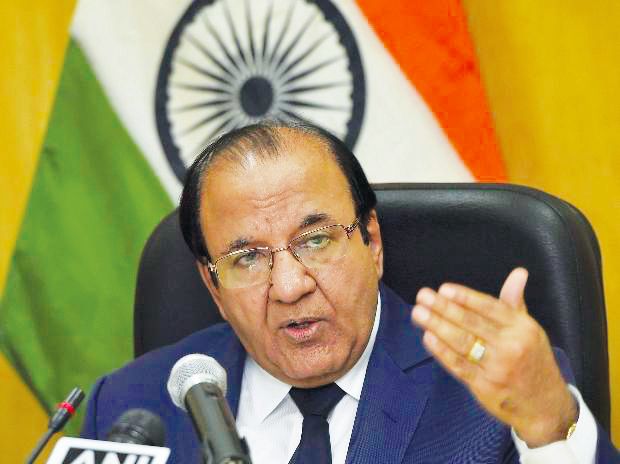
Chief Election Commissioner AK Joti, though, indicated that Gujarat would go to the polls before December 18.
“This is being done to ensure the voting pattern of one state does not affect the other,” he said. Asked why elections in Gujarat were not announced simultaneously, Joti said, “We have received communication from the state government about ongoing relief and rehabilitation operations following the floods. The administration has sought time before being fully prepared for the elections.”
Joti said elections to the two states were announced separately in the past too. “The model code of conduct comes into force immediately,” said Joti, who was flanked by Election Commissioners OP Rawat and Sunil Arora. As per rules, the code will be applicable for the state government as well as the Centre in matters related to Himachal. The poll notification will be issued on October 16.
For the first time ever, the Election Commission will set up 136 all-woman managed polling booths in Himachal, with each constituency having two of them. Also, Himachal will be the second state after Goa where voting will take place with 100 per cent VVPAT (voter verified paper trail) coverage. The paper trail machines will be deployed along with EVMs at all 7,521 polling stations, including 42 auxiliary polling stations at remote places.
The Chief Election Commissioner said VVPAT machines from one polling booth in each of the 68 Assembly segments will be tallied with EVM results to check the vote count.
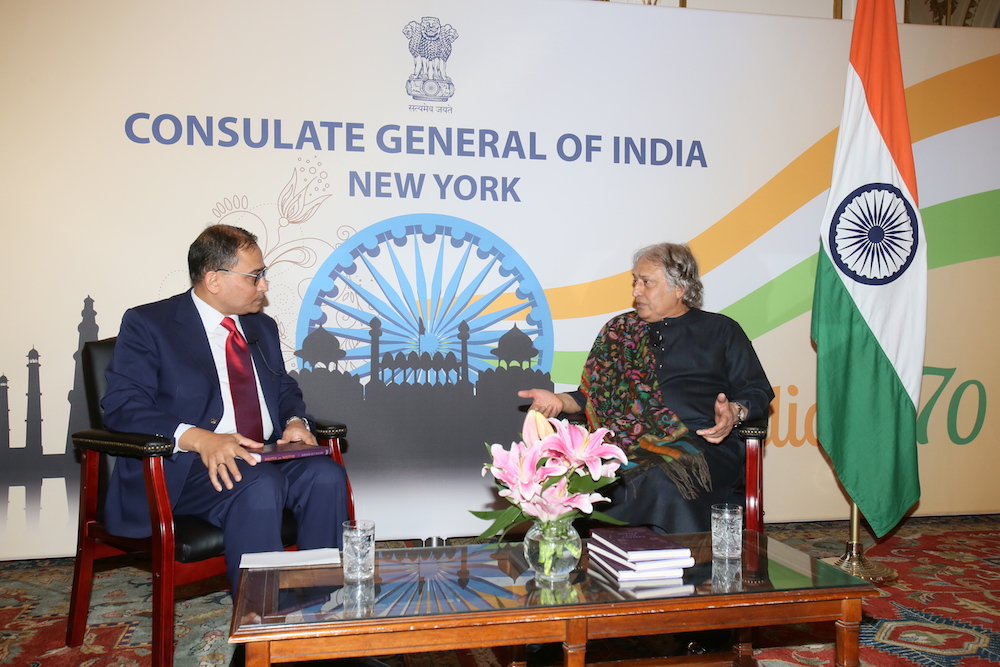
NEW YORK CITY (TIP): Veteran musician and Sarod maestro Ustad Amjad Ali Khan expressed hope that the new generation understands the spiritual nature of Indian classical music and will continue to keep the tradition alive. The maestro was addressing the audience in New York on October 5 at an interactive session moderated by India’s Consul General Sandeep Chakravorty, on his new book ‘Master on Masters’, which released in March this year in India.
‘Master on Masters’ is a ‘deeply personal book’ about the lives and times of some of the greatest icons of Indian classical music. Having known these stalwarts personally, Maestro recalls anecdotes and details about their individual musical styles, bringing them alive.
Twelve eminent musicians of the twentieth century appear in the book – Bade Ghulam Ali Khan, Amir Khan, Begum Akhtar, Alla Rakha, Kesarbai Kerkar, Kumar Gandharva, M.S. Subbulakshmi, Bhimsen Joshi, Bismillah Khan, Ravi Shankar, Vilayat Khan and Kishan Maharaj.
In writing about them, Amjad Ali Khan transcends the Gharana and north-south divide, and presents portraits of these great artists that are drawn with affection, humor and warmth. Through pictures, anecdotes and personal experiences the book provides interesting insights into lives of the stalwarts who contributed to the glory of the Indian classical musical tradition in India.
Talking about the inspiration behind writing this book, he said, “My father (Haafiz Ali Khan) used to say, always find out quality of other musicians. That is what I have done. We had difference of opinions and fought with each other for our different gharanas. But I had great personal bond with them (the 12 maestros). I miss their presence. This is my humble homage to the greats.”
Ustad Amjas Ali Khan also spoke about the individual musical styles of the twelve musicians featured in his book. Highlighting the spirituality of Indian classical music, he said, “I hope the new generation understands the spiritual nature of the Indian classical music and continues to keep the tradition alive.”
His two sons Amaan Ali Bangash and Ayaan Ali Bangash were also present at the event. Ustad Amjad Ali Khan will perform in New York on Saturday, November 4, 2017 at the Carnegie Hall.
Air Chief Marshal BS?Dhanoa said his force is capable of countering China; any decision on surgical strike involving the IAF has to be taken by the government
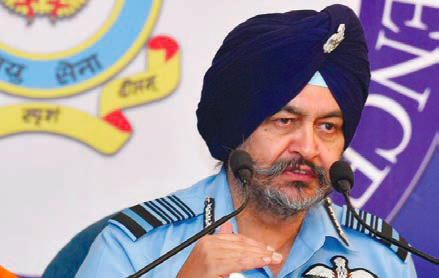
NEW DELHI (TIP): The Indian Air Force is capable of effectively countering any threat from China while engaging in a two-front war that also involves Pakistan, Air Chief Marshal B.S. Dhanoa said today and indicated that tension still prevailed between Chinese and Indian troops in Doklam.
He also said India was ready to disarm Pakistan of its nuclear arsenals, if necessary.
The IAF chief said Chinese troops were currently present in Chumbi Valley in the Doklam plateau, and added that a peaceful resolution of border issues would be in the interest of both countries.
“The two sides are not in a physical face-off as we speak. However, their forces in Chumbi Valley are still deployed and I expect them to withdraw as their exercise in the area gets over,”
Dhanoa told reporters ahead of IAF Day, marked on October 8. Indian and Chinese troops were locked in an over two-month-long standoff after India stopped the construction of a road by Chinese soldiers in Doklam, which both China and Bhutan claim as their own.
Asserting that the IAF was capable of a two-front war to counter China and Pakistan, Dhanoa, however, added that the possibility of such a scenario was “low”.
At the same time he said India’s response had to be based on the enemy’s capabilities as intentions could change overnight.
“We need a strength of 42 squadrons to carry out full spectrum operations in a two-front (war) scenario. It does not mean that we are not capable of fighting a two-front (war) as we speak. We have a Plan B,” Dhanoa said.
Asked about concerns over Pakistan’s nuclear weapons and whether the IAF would be able to disarm Islamabad of its nuclear arsenals if necessary, Dhanoa said his force had the capability of locating, fixing and striking across the border.
The army chief, General Bipin Rawat, had said last month that India should be prepared for a two-front war, insisting that China had started “flexing its muscles”, while there seemed to be no scope for a reconciliation with Pakistan.
The IAF has 33 fighter squadrons and Dhanoa said the force would get the authorised strength of 42 by 2032.
Asked whether the IAF was ready for a surgical strike across the border, he said it could deal with any challenge and a call on such an operation would have to be taken by the government.
“A surgical strike is a decision that has to be taken by the government. The IAF has the capability to carry out the full spectrum of air operations,” Dhanoa said.
He said a war-like situation might arise if the IAF crossed the border.
On whether the IAF provided support to the army for the surgical strike last year and during the Doklam face-off, Dhanoa said: “Whatever was asked from the air force was provided”.
The IAF chief, however, said no air force assets were involved during the Myanmar operation and the surgical strike across the LoC in Jammu and Kashmir last year.
“The IAF is prepared to fight at a short notice in full synergy with the other two sister services, should the need arise,” Dhanoa said, adding that the force was in a high state of readiness to fight a war.
About a possible confrontation with China, he said India’s air power was “adequate”. Source: PTI
WASHINGTON (TIP): As the deadline for President Trump to re-certify the Iran nuclear deal comes up in just over a week, the White House appears to be laying the groundwork for an announcement, expected Oct. 12th or Oct. 13th, that the deal will be decertified, according to media reports.
“You’ll be hearing about Iran very shortly,” President Trump told reporters during a meeting with military leaders Thursday, October 5 night.
President told reporters last month that he had “decided” on the Iran deal, though he did not announce his decision. The president still has a few options on how he might proceed before the announcement, however.
The internal friction within the Trump administration over how to handle Iran is evident. Secretary of State Rex Tillerson, Defense Secretary James Mattis, and Joint Chiefs Chairman Joseph Dunford have all recently publicly stated that it is in the U.S. national security interest not to endanger the deal.
Ambassador to the U.N., Nikki Haley, however, has become one of the loudest voices arguing for a more complicated scenario which would have the president decertify it without immediately withdrawing from it.
PANAJI (TIP): Tejpal, who then ran Tehelka, was accused of rape by a junior colleague in 2013. The charges against him include Sections 376(2)F and 376(2)K, which lay down stricter punishment for a person who uses a position of power or trust to abuse a woman.
Rape cases normally carry a minimum sentence of 7 years if convicted. Tejpal has pleaded not guilty to the rape charge, public prosecutor Francisco Tavera said. He has pleaded guilty to charges under Sections 341 and 342 (wrongful restraint) and 354 (sexual harassment) of IPC, he said.
The next date of hearing in the trial court is November 20- 21, by which time a high court decision on Tejpal’s challenge against the trial is expected.
“It has been a positive day for us. All the charges we were pleading against Tejpal have been approved by the court. We now wait for the matter which is in the high court,” said Tavera.
Earlier in the court of Vijaya D Pol, Tejpal’s lawyer Rajeev Gomes argued at length to delay the framing of charges as a decision on the matter is pending with the high court.
The judge rejected this request and stated that the proceedings of the trial court will continue but a status report on the matter in high court be submitted before her on the next date of hearing.
“The matter cannot be delayed much as already a lot of delay has happened. As per the Supreme Court guidelines, we have to go ahead with the trial within 8 months of the accused being given bail. This matter however was delayed as Tejpal’s lawyer kept on asking us for clone copies of the footage which not many laboratories in the country provide.
It took us a long time to furnish these copies and therefore the delay happened” said Tavera.
“They were arguing that the charges be not framed but the high court had clearly not put a stay on the case. Therefore the court went ahead with its proceedings,” he added. Gomes said he is confident that the high court will dismiss the matter as his client is not guilty.
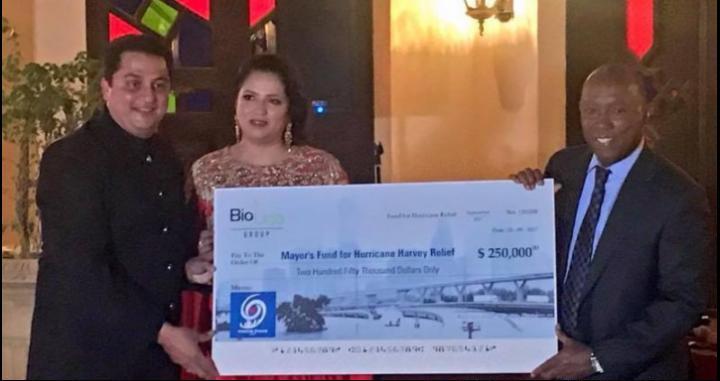
HOUSTON (TIP): An Indian American couple donated USD 250,000 to Houston Mayor’s Hurricane Harvey Relief Fund at a private event on Sept 24. Houston Indian American Amit Bhandari and his wife Arpita Brahmbhatt Bhandari contributed the donation to the Harvey relief fund set up by Houston’s Mayor Sylvester Turner, on behalf of the Greater Houston Community Foundation of which he is a premium member.
Hurricane Harvey hit the Gulf Coast of USA on August 25, 2017 and left South Texas with a massive burden of devastation worth over $180 billion. The damage to public and private properties caused by #HurricaneHarvey2017 in and around South Texas includes the destruction of 200,000 homes (50,000 in Houston only), which may take five years to be rebuilt, according to the Governor of Texas.
Amit Bhandari is a Houston-based entrepreneur. He is the CEO and Chairman of BioUrja Group which trades in energy and agricultural commodities across the globe. His wife, Arpita Bhandari is the Vice President of Human Resources in the company.
The leading members of the Houston Indian community joined Mayor Sylvester Turner to thank the Indian American couple for having donated a lump sum to the Hurricane Harvey relief fund, and pledged more contributions to financially ease the relief work. Notably, Greater Houston Indian Americans have been trying all possible means to raise USD 1 million for the relief and rehabilitation fund.
Acknowledging the generosity of Indian Americans in general, Houston Mayor Sylvester Turner said, “Indian Americans have golden hearts. They always come up with voluntary aid during hard times like Hurricane Harvey. Their contributions are not limited to the Harvey relief and rehabilitation fund. They have been making great efforts for the welfare of Houston for a long time. The Indian community is vital to Houston and will help make the city what it was before prior to Hurricane Harvey 2017.”
The Consul General of India in Houston, Dr. Anupam Ray lauded the Indian American community for their humanitarian efforts and generous contributions while thanking Amit Bhandari and Arpita Bhandari for donating $250,000 to the relief fund. He added, “Your generosity makes India proud. A community is great if it rises above its suffering. You have demonstrated that by contributing toward Hurricane Harvey relief.”
Amit Bhandari said that volunteers of the Greater Houston Community Foundation helped rescue 700 victims of Hurricane Harvey in Houston. The community has also donated $1.5 million to several charitable organizations involved in Hurricane Harvey relief and rehabilitation.
NEW YORK (TIP): Special counsel Robert Mueller’s investigation into Russian attempts to influence the 2016 election and possible connections to the Trump campaign is zeroing in on the spread of fake information on Facebook and Twitter, Bloomberg reports.
Social media is a “red-hot” focus of Mueller’s, U.S. officials familiar with the matter told Bloomberg. Mueller’s office declined to comment, Bloomberg said.
Facebook last week said it found about $100,000 in ad spending connected to fake accounts probably run out of Russia that sought to sow political division in the run-up to the election. That followed an April report by the company that detailed campaigns by “information operators” to sway public opinion.
The vulnerability of social media to political manipulation troubles U.S. officials. According to Bloomberg, federal agencies including the Office of the Director of National Intelligence and the Federal Bureau of Investigation are looking into how to prevent future attempts to manipulate voters, including the 2018 midterm election.
Congress is also concerned and says social media companies must provide more information.
The Senate Intelligence Committee Chairman Richard Burr said Tuesday that it’s “probably more a question of when” than if there will be a hearing with Facebook officials as part of his panel’s probe, according to Bloomberg.
“We’re cooperating with the relevant investigative authorities looking into this subject,” Facebook said in a statement to USA TODAY.
The Silicon Valley company declined to say what information it provided investigators. It has also declined to disclose the ads it discovered, saying doing so would violate its data policy and federal law.
Separately, Facebook said September 27, it would tighten controls over who can advertise on its platform, according to Reuters. The change comes in response to the election ads linked to Russia.
Protesters at the UN call Pakistan “epicenter and exporter of terrorism in the region
I.S. Saluja
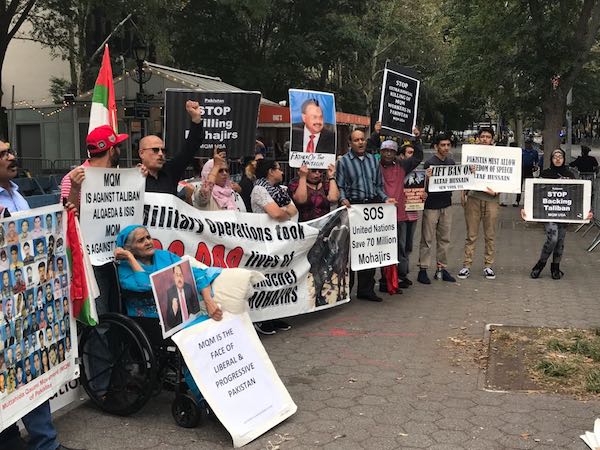
NEW YORK CITY, NY (TIP): On September 21, around 50 MQM members gathered in front of the UN to protest the genocide of Mohajirs by Pakistan Army. The MQM chose to protest during the time when the Pakistan PM was addressing the UNGA.
Carrying placards, big and small, they shouted slogans “Mohajirs demand right of self-determination”; “Pakistan Army is killing Mohajirs”; “Stop genocide of Mohajirs”.
Anjum Arif of New York who is a Member of MQM Central Organizing Committee and Rukunuddin Taj, a Member of Central Co-ordination Committee demanded that United Nations should intervene and stop genocide of Mohajirs and suppression of minorities.
The speakers spoke at length about their grievances and demands.
Calling Pakistan as the “epicenter of Terrorism” the speakers said that Pakistan had provided sanctuary to terrorist outfits and that ISI was supporting extremism and terrorism in the region. They pledged to lend their full support to the US, the UN and the world in eliminating terrorist sanctuaries in Pakistan.
One of their demands was the right to self-determination. They demanded that the United Nations take note of the genocide of Mohajirs in Pakistan and facilitate the process of self-determination.
They said the census conducted earlier this year in Karachi and urban areas of Sind was rigged. They demanded a fresh census under the supervision of the UN.
They demanded that the UN intervene to stop the genocide of Mohajirs in Sind. They alleged Pakistan army had killed 22000 Mohajirs since 1992 and 170 persons were still missing. There are 70 million Mohajirs in Pakistan who all live in fear of being eliminated by Pakistan army.
Another allegation of the speakers was that there was a blanket media ban on their leader Altaf Hussain who was living in self-exile in Britain. They demanded that the illegal and undemocratic ban be lifted.
They announced that a bigger rally will be held on Saturday, September 23 at the same venue to make their grievance and demands once again. They said more MQM leaders will be coming to address the protesters
Mohajirs are Moslems who migrated from India at the time of partition of India in 1947. The majority settled in the port city of Karachi and urban areas of Sind province of Pakistan.
They follow Islam and speak Urdu. They are secular, liberal and progressive. Some of the Mohajirs have been quite famous in various fields. The first Prime Minister of Pakistan, Liaquat Ali Khan was a Mohajir. So was a former Army General and President Parvez Musharraf. There have been many artists, scholars, intellectuals, scientists whose contribution has been immense.
“Mohajirs look to the US, the United Nations and justice and peace-loving nations of the world to deliver them from Pakistan”, said a spokesman of MQM.
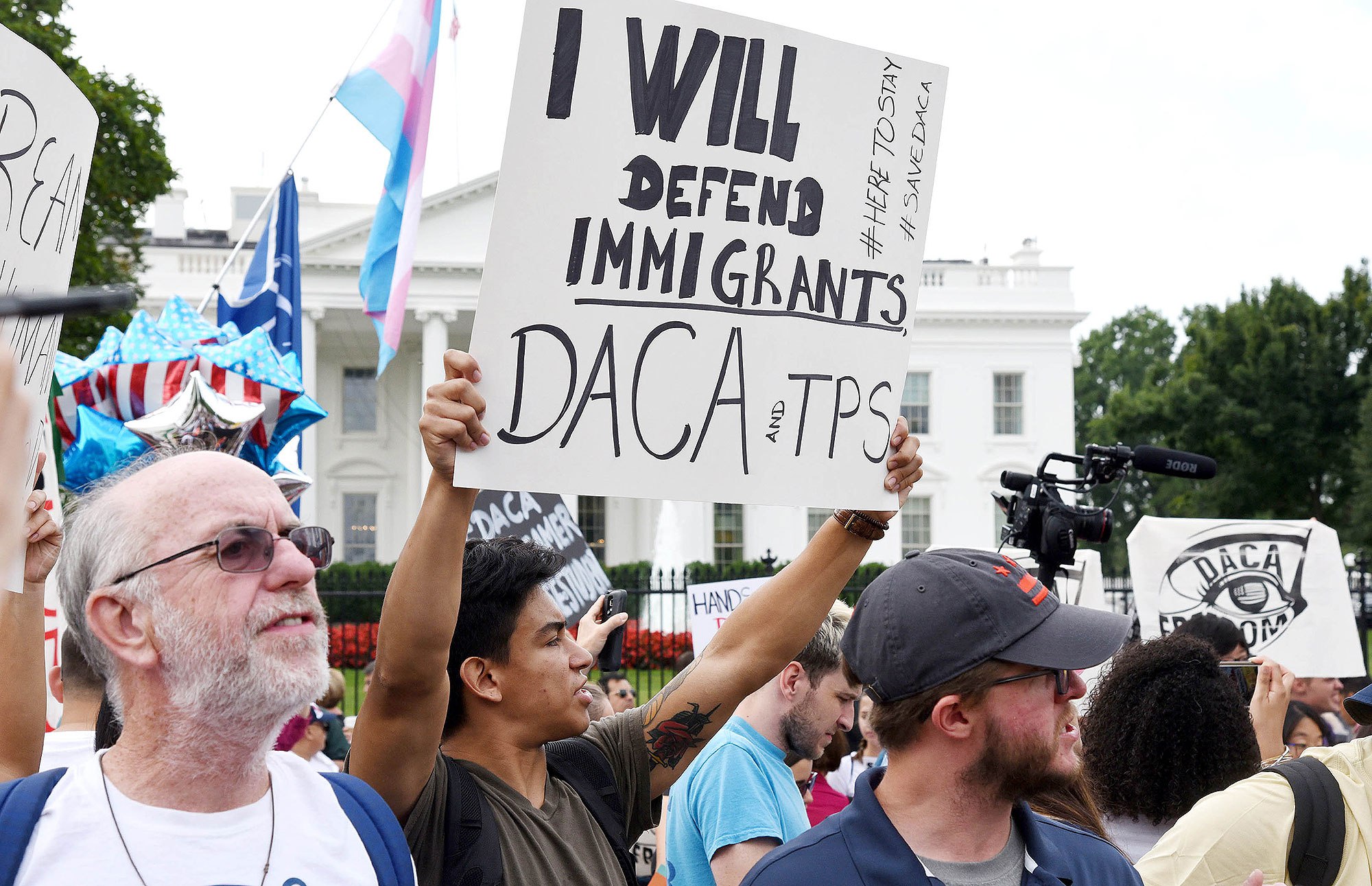
WASHINGTON (TIP): US President Donald Trump said on Thursday, September 14, that he was looking to allow people to stay here, but not ready for citizenship or amnesty, an announcement that may benefit 8,00,000 young immigrants, including those from India.
Trump’s statement came a day after top Democratic lawmakers Chuck Schumer and Nancy Pelosi claimed that they had reached a deal with the president to protect about 8,00,000 young immigrants who came to America illegally as children and were given protection by the Obama-era Deferred Action for Childhood Arrivals (DACA) program.
Trump had scrapped the DACA program earlier this month.
“We are not looking at citizenship. We are not looking at amnesty. We are looking at allowing people to stay here,” Trump told reporters.
Trump said he is very close to a deal on DACA.
“I just spoke with Paul Ryan, everybody’s on board… We are talking about taking care of people, people who were brought here, people who have done a good job. We will only do it if we get extreme security, not only surveillance but everything that goes with surveillance. If there is not a wall, we are doing nothing,” he said.
In a statement after dinner with Trump at the White House, Schumer and Pelosi said that they have reached a deal with him on DACA.
“We had a very productive meeting at the White House with the president. The discussion focused on DACA. We agreed to enshrine the protections of DACA into law quickly, and to work out a package of border security, excluding the wall, that is acceptable to both sides,” Schumer and Pelosi said.
In a tweet early this morning, Trump however said that no deal has been reached.
“No deal was made last night on DACA. Massive border security would have to be agreed to in exchange for consent.
“Would be subject to vote,” he said, refuting claims being made by the Democratic leaders.
Pelosi tended to disagree at a news conference at the Capitol Hill.
“I do believe that there is an understanding that down the road, there is an eventual path to citizenship in the DREAM Act, and that overwhelmingly, the American people support that,” she said.
“In a poll today, over 50 per cent, and then, you know, 12 per cent want to send them back, and then others somewhere in the middle. But it came up in the context of the suggestion that there might be other bills to be considered, and that did not last long,” Pelosi said.
The atmosphere during the White House dinner last night, she said, was very friendly.“We made it clear from the start that there were certain concerns that we had about some of the president’s statements relating to the Muslim ban, Charlottesville, DACA decision and that we needed to establish some trust and confidence as we go forward.
“One path to building that confidence and trust would be the DREAM Act, DACA. The president likes to call it DACA. I believe that we have had enough conversation with the President with enough reiteration of his commitment to protect the dreamers, in fact, publicly. You saw his statements, today, that it would not be wise to send these young people back,” Pelosi added.
WASHINGTON (TIP): The U.S. Chamber’s U.S.-India Business Council (USIBC) on Sept 12 hosted the inaugural ‘Road to Global Entrepreneurship’ Summit, part of its Global Entrepreneurship Conclave, in Washington, D.C. The summit brought together key stakeholders, including U.S. government officials, government of India officials, and industry leaders from across sectors to renew the two countries’ key linkages and advance their mutual interests.
Participants from the U.S. and India discussed the power of innovation and entrepreneurship to accelerate economic growth, create jobs, and encourage groundbreaking ideas in order to serve the citizens of both nations. U.S. Commerce Secretary Wilbur Ross addressed the summit, which is the first in a series, and he discussed the importance of the bilateral ties between the U.S. and India. Secretary Ross said the U.S. administration is encouraged by India’s economic reforms, and he highlighted the important role that the U.S.-India Business Council has played in furthering the commercial partnership over its 42-year existence.
“The U.S.-India strategic and commercial partnership is unique and complementary in nature,” said Khush Choksy, acting president of the USIBC. “These discussions at the Global Entrepreneurship Summit are timely and necessary because we believe that the next phase of the bilateral relationship will be determined by the necessity to expand job creation, economic growth, and innovation in both countries.”
The summit included remarks from Ambassador Alice Wells, Acting Assistant Secretary of State for South and Central Asian Affairs and Acting Special Representative for Afghanistan and Pakistan, U.S. Department of State; Ambassador of India to the United States Navtej Sarna; Ambassador of Israel to the United States Ron Dermer; and Rep. Raja Krishnamoorti (D-IL).
The event also included a panel discussion on building communities through private-sector collaboration, with participation from Monique Meche, vice president of global public policy for Amazon; Angela Baker, director of Qualcomm Wireless Reach; and Reggie Aggarwal, founder and CEO of Cvent. The discussion focused on advancing policy frameworks to grow entrepreneurship, especially in emerging markets, and the role of women in growing jobs and economies.
“Many women in emerging economies have the ideas and ambitions needed to succeed, but are held back by a lack of access to business skills, education, networks, and capital,” said Baker. “Mobile technology can break down common barriers of skill and access and connect entrepreneurs to information, resources, and consumers. By fostering and investing in programs that use wireless solutions, we are enabling women entrepreneurs to participate in the flourishing mobile economy in India and around the world.”
“Amazon is pleased to contribute to the Global Entrepreneurship Conclave to discuss innovation, entrepreneurship, and the empowerment of women in India – which are all at the heart of Amazon’s business in India,” said Meche.
“As an entrepreneurial company, Cvent recognizes that bringing people together and fostering innovation regardless of borders is a key to success,” said Aggarwal. “We are proud to be part of a summit that will encourage entrepreneurship around the world.”
Formed in 1975 at the request of the U.S. and Indian governments, the U.S.-India Business Council is the premier business advocacy organization, comprised of 350 top-tier U.S. and Indian companies advancing U.S.-India commercial ties. USIBC is the largest bilateral trade association in the United States, with liaison presence in New York, Silicon Valley, and New Delhi.
The U.S. Chamber of Commerce is the world’s largest business federation representing the interests of more than 3 million businesses of all sizes, sectors, and regions, as well as state and local chambers and industry associations. Its International Affairs division includes more than 70 regional and policy experts and 25 country- and region-specific business councils and initiatives. The U.S. Chamber also works closely with 117 American Chambers of Commerce abroad.
Emergency has been declared in India. Maharani Gitanjali(Ileana) from one of Rajasthan’s princely states has already lost her privy purse. Now, she fears that she will lose the last treasure chest of gold which has been forcibly taken away from her. So she asks her trusted lieutenant, Bhawani (Ajay) to step in and plan a heist.
REVIEW
On paper, Baadshaho may have had the merit of a Hollywood heist thriller like Ocean’s Eleven. This would seem like why Ajay Devgn agreed to be a part of this multi-starrer– that attempts to make outlaws look like Robin Hood. However good intention is defeated, when the execution offers zero novelty.
Anyway, mastermind, Bhawani, who is madly in love with Gitanjali promises her that he will win her pot of gold back. So he lovingly handpicks his crew—a lock picker, Tikla(Sanjay), a daredevil all-rounder, Daliya(Emraan), a `I-bite-bullets-forbreakfast’ kinda gal, Sanjana(Esha) who along with him, form the quartet that sets out to outsmart the faujis taking the armoured truck from Rajasthan to Delhi. It’s the haraami v/s army clash.
The highlight of the film is the chase that ensues soon after Seher(Vidyut), an army officer alights from the train. You so wish that the film had maintained the same breakneck speed all through, but alas!
For a heist-thriller to work, the moves of the rural bandits should have been more calculated and precise. Instead, here you have buffoonery. Everyone is mouthing signature lines trying to constantly reiterate how “bad-ass” they are. However, if you’re in the mood, indulge them– these are Bollywood’s paisa-pheko, dialogue-suno moments.
Ajay burns the screen with his searing intensity; Ileana passes muster as the Maharani with hidden facets; Emraan’s takeaway is that he gets to shimmy with Sunny Leone and Vidyut gets an `interesting’ introduction.
Sunita Radia’s lens captures the expanse of the desert deftly showing scale. Certain shots even stay frozen in your memory.
The song Mere Rashke Qamar rekindles the magic of the voices of Nusrat Fateh Ali Khan and Rahat Fateh Ali Khan. If you’re an action junkie, this could be your weekend big-ticket ride.
WASHINGTON (TIP): After President Donald Trump and U.S. Secretary of Education Betsy DeVos named a former official of the fraudulent DeVry University to direct the Department of Education unit in charge of combating fraud, U.S. Senator Kamala D. Harris joined Senate Democrats in reintroducing the Students Before Profits Act, a bill to protect students from deceptive practices and bad actors in the for-profit college sector. The bill ensures students have access to important and accurate information, strengthens oversight and regulation, and holds for-profit schools and their executives accountable for violations and poor performance. In 2013, as Attorney General of California, Harris sued Corinthian Colleges for false and predatory advertising, securities fraud and intentional misrepresentations to students, winning a $1.1 billion judgment.
“For-profit colleges like Corinthian engaged in systemic fraud and preyed on students by falsely promising a meaningful education that would lead to a job. Corinthian’s predatory behavior lined its pockets with profit at the expense of shattered dreams and mountains of bad debt for its students,” said Harris. “That’s why I sued them as Attorney General, and then worked with the Department of Education to forgive the loans for those young adults. It’s clear this Administration believes a quality education is a privilege, not a right, so we must fight to protect our students from deceptive practices.”
Currently, for-profit colleges enroll 10% of all postsecondary students, but account for 35% of all student loan defaults. Since Corinthian Colleges, the infamous for-profit institution, closed its doors earlier this year after extensive allegations of fraud, the U.S. Department of Education has discharged $247 million in student loan debt held by former students. The Students Before Profits Act provides for new tools to recoup federal dollars from the owners and executives who reap huge profits from failed, fraudulent for-profit institutions.
The Students Before Profits Act:
Authorizes enhanced civil penalties on institutions and their executive officers if it is determined that the institution misrepresented its cost, admission requirements, completion rates, employment prospects or default rates, and uses those penalties to fund a Student Relief Fund to help defrauded students;
Improves oversight of default rate manipulation by requiring the Secretary of Education to use corrected data to recalculate student loan cohort default rates for institutions of higher education that have engaged in default manipulation and make determinations on whether an institution should be disqualified from participating in financial aid programs;
Makes college executives share the risk, giving the Department of Education broader discretion to require owners and executives to assume personal liability for financial losses associated with Title IV funds and including executives and owners among those against whom the Department can pursue a claim after discharging borrowers’ debts;
Prevents “repeat offenders” by prohibiting board members and executive officers of an institution against which the Department has brought an enforcement action from serving in leadership positions at another college.
WASHINGTON (TIP): S Shankar professor of English at the University of Hawaiʻi at Mānoa, received the prestigious Senior Fulbright-Nehru Academic and Professional Excellence Award (Teaching and Research) for 2017–18. He will soon head to India where he will teach at the Indian Institute of Technology-Madras, in Chennai, India, conduct research, and interact with students and faculty in India for the academic year.
The Fulbright-Nehru enables the most outstanding students, academics, and professionals in India and the United States to study, research and teach in the host country. The Fulbright-Nehru award poses an exciting opportunity for Shankar both personally and professionally. Originally from India and of Tamil heritage, Shankar is pleased to have the opportunity to share his Tamil and American cultures with others through this academic endeavor. He has experienced India’s emergence as an economic power and the growth of its citizens in many educational fields. In 1987, Shankar came to the United States to pursue graduate studies and received his PhD from the University of Texas at Austin. In 2002, he joined the Department of English the University of Hawaiʻi at Mānoa.
Shankar is a critic, novelist, and translator. His scholarly areas of interest are postcolonial literature (especially of Africa and South Asia), literature of immigration, film, and translation studies. He is Professor of English and Director of the Creative Writing Program. His most recent book is Flesh and Fish Blood: Postcolonialism, Translation, and the Vernacular (2012; U. of California P.; OrientBlackswan India). In a citation accompanying the award of Honorable Mention from the American Comparative Literature Association, the 2013 Rene Wellek Prize committee noted, “Over-all, Shankar’s book combines theoretical sophistication, deftness of interpretation and an impressive clarity and cogency of argument. It makes a compelling claim for rethinking postcolonialism within the framework of comparative vernacular literatures and makes a much needed case for a more capacious curriculum.”
Shankar’s novel No End to the Journey, published by Steerforth Press in 2005, is set in a village in South India and draws on the ancient East Indian epic the Ramayana. It tells the story of Gopalakrishnan and his difficult relationship to his son. In favorable reviews, Booklist compared it to Kazuo Ishiguro’s Remains of the Day and the Indian Express noted that “it packs a punch.” A Spanish translation of the novel appeared in 2009. In 2001, Shankar published his first volume of criticism, entitled Textual Traffic: Colonialism, Modernity, and the Economy of the Text (SUNY Press). The book has been positively reviewed for its explication of the relationship between colonialism and modernity and its innovations of critical methodology.
A Map of Where I Live (1997), Shankar’s first novel, intertwines a story of love and political intrigue set in Madras with the memoir of an Indian historian who discovers that Lilliput (as in Jonathan Swift’s Gulliver’s Travels) really exists. Shashi Tharoor called the novel “highly original, compelling, and vivid,” and World Literature Today described it as “a minor masterpiece.” Shankar is also co-editor of the anthology Crossing into America: The New Literature of Immigration (New Press, 2003), which brings together poems, excerpts from novels and memoirs, short stories, letters, and essays to present immigrant literature since 1965. This book, San Antonio Express News notes, is “a strong and diverse literary story of multicultural America… likely the most original and best introduction to the new immigration available today for its balanced, informative, moving, and comprehensive offerings.” The paperback edition of the anthology was published in 2005. The book has been used as common text in Freshman Experience programs.
Shankar is a translator from Tamil, including of the full-length Tamil play Water by Komal Swaminathan, published in 2001 in India by Seagull Press and in the US by Asian Theatre Journal, and of the famous 18th-century Krishna devotional “Alaipaayuthey,” which appears in No End to the Journey as “Restless as the Waves of the Ocean.” Shankar has published shorter pieces in a wide variety of scholarly and general interest periodicals in India and the US. His scholarly articles, poems, reviews, and literary essays have appeared in such academic journals and popular venues as PMLA, Tin House, Massachusetts Review, Outlook, The Hindu, Pioneer, Village Voice, and The Nation. “Midnight’s Orphans, or A Postcolonialism Worth Its Name,” a scholarly article appearing in Cultural Critique 56 (Winter 2004), has been widely read and cited. He has work forthcoming in PMLA and Comparative Literature.
Aside from being Professor in the Department of English, Shankar was Director of the Center for South Asian Studies at the University of Hawai‘i at Mānoa from 2004-2010. He was appointed Convener of XVIth Annual Convention of the Forum on Contemporary Theory (India) in 2013. He is 2016 Scholar-in-Residence at University of Houston-Downtown.
While serving as a Senior Fulbright Scholar, Shankar will undertake the research project, “Translation, Comparatism, and the Tamil Cultural Sphere.”
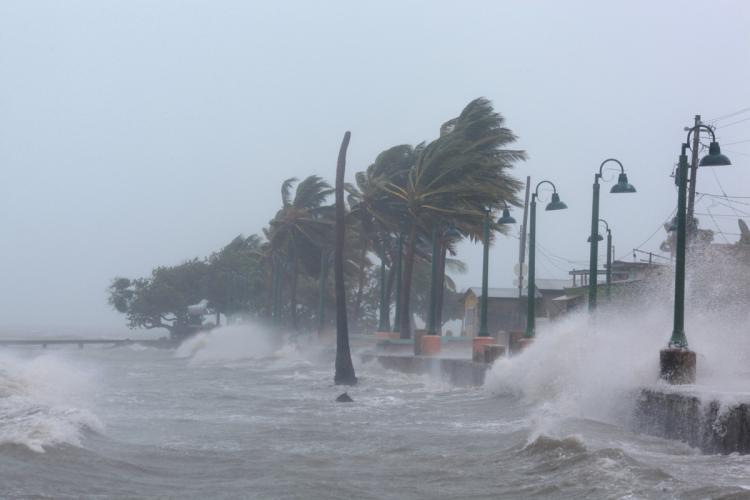
TAMPA, FL (TIP): Fast and furious large-scale Hurricane Irma is sweeping towards Florida. If the storm reaches its full potential, it could be one of the worst hurricanes in the state’s history.
It’s not clear exactly where the storm will make landfall, but winds well in excess of 100 mph could batter numerous population centers along Florida’s west coast. And coastal waters could rise 10 to 15 feet above normally dry land, completely inundating homes, businesses, and roads.
Hurricane warnings cover much the Florida peninsula’s coastal areas. Hurricanes watches extended farther north into coastal Georgia and South Carolina. 5 million have been told to flee.
DALLAS (TIP): Drivers in northern Texas are rushing to fill up their gas tanks as prices at the pump in the area rise and some stations run out of fuel altogether as Harvey continues to wreak havoc.
QuikTrip, a chain with 135 gas stations in the Dallas-Fort Worth area, is keeping about half of them without gas, said spokesman Mike Thornbrugh. “Our experience has been, if you try to keep every store full… you’ll run out,” he told CBS Dallas-Fort Worth. Strategically closing stations can help sustain supplies in different parts of the city, according to the company. QuikTrip maintains a list of stations that have gasoline available on its website.
Around Dallas, pumps at several service stations in places like Denton, McKinney and Little Elm are seeing gas shortages, leading customers to scramble.
“We heard there was going to be a shortage,” one driver told CBS Dallas-Fort Worth. “So, we hopped in the car and came and filled up.” A driver in Denton, northwest of Dallas, tweeted a photo of a line at the gas pump.
In downtown Dallas, some stations charged well over $3 for a regular gallon of gas Thursday, and one downtown Shell station charged $3.97, the Associated Press reported. At three gas stations in north Dallas, yellow bags or caution tape was wrapped around pumps just after noon.
The majority of North Texas gas stations are not expected to run out of gas, but costs are expected to rise. Gas prices in the region are up almost 20 cents from this time last week, CBS Dallas-Fort Worth reported. That jump comes just ahead of the Labor Day holiday weekend, which typically sees heavy driving.
U.S. Energy Secretary Rick Perry on Thursday announced a release of a million barrels of oil from the Strategic Petroleum Reserve, which, at a capacity of 713 million barrels, is the largest emergency crude oil supply in the world. The oil will be delivered to the Phillips 66 refinery in Lake Charles, Louisiana, according to the Energy Department. That refinery has not been affected by the storm.
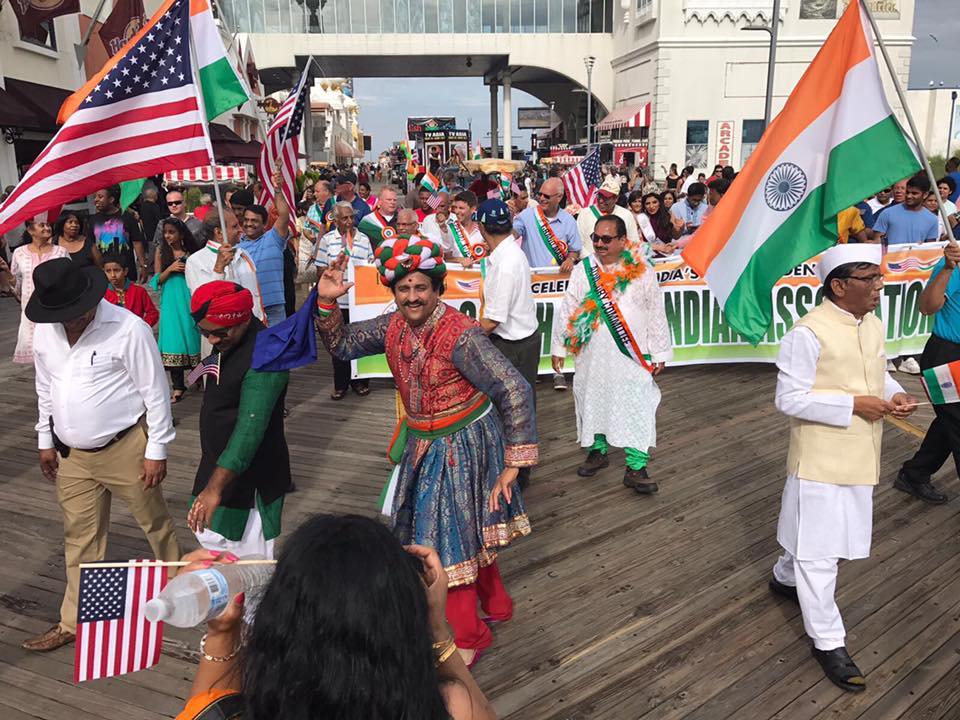
ATLANTIC CITY, NJ (TIP): Atlantic City: South Jersey Indian Association organized the 8th Annual India Day Parade on August 12th from Taj Mahal Casino to Kennedy Plaza here. A fun-filled carnival atmosphere was planned with rich highlights depicting our cultural heritage, diversity, dance, music, and food. The parade was held from 3 – 6PM followed by mela at Brighton Park (Behind Claridges).
Though there were showers earlier in the day, the weather cleared up just in time for the Parade.
The event featured floats traveling from the Showboat Hotel down to Kennedy Plaza. Along with six floats, there were food tastings, clothing and jewelry on sale and performances by children throughout the event. Bollywood music played, and one person dressed up as Spider-Man to entertain the children.
Romesh Ruthnaswamy, special adviser and one of the founders of SJIA, said the event was a celebration of culture and a way to promote the resort. Ruthnaswamy said visitors from New York, Pennsylvania, Delaware and more were in the city Saturday to see the parade travel down the Boardwalk. (News source: Pressofatlanticcity.com)
NEW DELHI (TIP): The landmark verdict of the Supreme Court ruling on right to privacy as a fundamental right was on August 24, 2017 welcomed by jurists and senior advocates who termed it as “progressive” and protective of “the basic right”.
They, however, said the verdict’s impact on Aadhaar scheme can be assessed once the full judgement and reasons given by the court are examined.
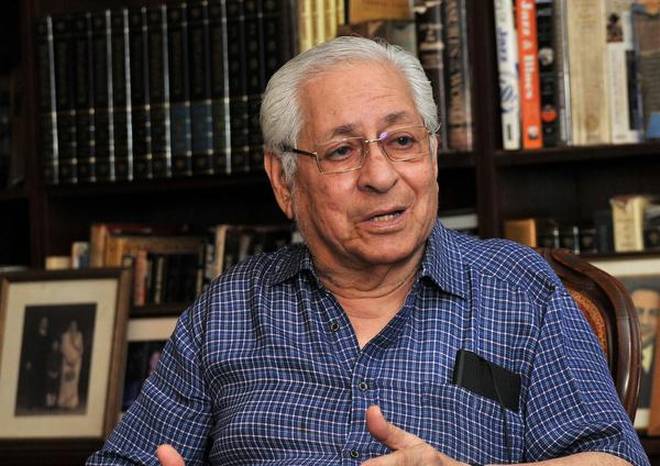
Lauding the unanimous verdict of the nine-judge bench, senior advocate Soli Sorabjee said it showed the “good approach” of the Supreme Court which does not hesitate in over-ruling its previous judgements.
The former Attorney-General said, “It is a very progressive judgement and protects the fundamental rights of the people. Privacy is a basic right which is inherent in every individual.”
“The unanimity of the bench in giving this decision shows a very good approach of the Supreme Court. Any judgement which enlarges the fundamental rights of the people should be welcome,” he added.
Expressing hope that the citizens of India would now be protected from any kind of snooping, senior advocate Indira Jaising said, “It is a day to celebrate.”
“Privacy is fundamental. It certainly has an impact on the day-to-day life. This verdict prevents any kind of snooping,” she said.
Mr. Sorabjee, on being asked about its impact on Aadhaar, said the reasoning of the apex court needs to be examined and one cannot say that Aadhaar will now be banned. “You cannot make a blanket and categorical statement that Aaadhaar will be banned or is unconstitutional. No fundamental right is absolute. It is always subject to reasonable restrictions.”
Ms. Jaising too said what impact it will have on Aadhaar was a separate issue but privacy cannot be compromised after this verdict.
Welcoming the decision, BJP spokesperson and senior advocate Aman Sinha, termed it a “good verdict” but with reasonable restrictions.
“We welcome this judgement. This is a good verdict. The Supreme Court has declared the Right to Privacy under Article 21 of the Constitution. But like other Fundamental Rights, this is also subject to reasonable restrictions. We are awaiting the full judgement,” Mr. Sinha said.
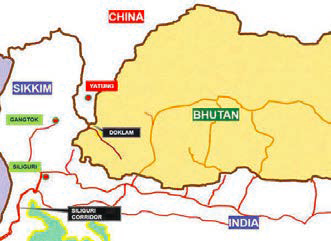
NEW DELHI (TIP): Japan came out in full support for India in its protracted military stand-off with China at Doklam, near the Sikkim-Tibet-Bhutan tri-junction, saying no country should use unilateral forces to change the status quo on the ground.
Acknowledging the situation at the Doklam Plateau, Japanese Ambassador to India Kenji Hiramatsu said, “We recognise Doklam is a disputed area between Bhutan and China and the two countries are engaged in border talks.
We also understand that India has a treaty understanding with Bhutan, that’s why Indian troops got involved in the area,” according to the local media.
The endorsement of the Indian position by Japan is a significant development at a regional level as China has violated agreements with Japan as well and not with only India and Bhutan.
It is pertinent to mention that Japan is also engaged with the sovereignty issue with China over East China sea. Reacting to the developments in Doklam, the Bhutanese Government had on June 29 issued a press release in which it clearly stated that the construction of the road inside the Bhutanese territory is a direct violation of the agreements and affects the process of demarcating the boundary between the two countries.
China is attempting to build a road through Doklam plateau, which is part of Bhutan, a development that would be a serious disadvantage to India’s military defences. Meanwhile, as the Doklam standoff is approaching its second month, China’s Foreign Ministry has reiterated that the People’s Liberation Army (PLA) troops would continue to defend Dong Lang, which is Chinese territory, and India should withdraw all its troops and equipment from there.
The stand-off began when China started constructing a road in the area. India objected to the road construction after the Chinese troops ignored Bhutanese protests, triggering the faceoff from June 16.
External Affairs Minister Sushma Swaraj has reiterated that India’s road map is peace and talks are going on to resolve the issue diplomatically. India has made its stance clear that that it stands for peace the border question can be solved diplomatically, not by war. Source: ANI
Bansi Shah, lovingly addressed as Bansi Bhai, a perfect gentleman, chose to say good bye for ever to his numerous friends and relations on August 10. He was 76.
Bansi Shah was a popular person, known for his zest for life and friendliness. He was one of the architects of the Society of Indian American Engineers and Architects having been its president for a couple of years. He was in to construction and real estate business.
For information on his last rites, please call his wife Kalpana Ben Patel or son, Akash Shah at 646-270-3680.
DALLAS (TIP)- A 60-year-old Dallas-area doctor has been sentenced to 35 years in prison for helping defraud Medicare and Medicaid out of almost $375 million.
A federal judge also ordered Dr. Jacques (ZHAWK) Roy on Wednesday to pay more than $268 million in restitution. A jury in April 2016 convicted the Rockwall physician of nine of 10 counts of defrauding a health care benefit program.
Roy owned Medistat Group Associates in the Dallas suburb of DeSoto.
Authorities say Roy and six co-defendants certified 11,000 Medicare beneficiaries through more than 500 home health providers between January 2006 and November 2011. Those numbers would have made Roy’s Medicare practice the busiest in the country.
With 58 seats in the Rajya Sabha, one more than the Congress, the BJP is the largest party in the Upper House of Parliament though it still remained in minority
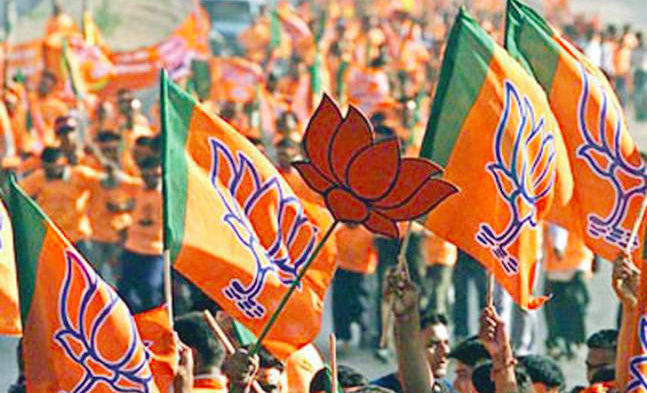
NEW DELHI (TIP): Sampathiya Uikey, the new lawmaker from Madhya Pradesh, has made history for the BJP by ending the Congress’ 65-year run as the Rajya Sabha’s biggest party. The BJP now has 58 members, the Congress has 57, though the BJP-led government is still short of a majority in the 245-seat Upper House of Parliament.
The Congress may have remained the largest party till 2018, but its numbers were depleted by the death this year of two lawmakers. Ms Uikey was elected unopposed in a by-election for the Rajya Sabha seat held by union minister Anil Madhav Dave, who died in May this year.
On Tuesday next, elections will be held for nine seats, six in West Bengal and three in Gujarat, but these may not affect the BJP’s lead. The party is set to win the two seats for which its MPs’ terms end in Gujarat and is also attempting to prevent the Congress’ senior leader Ahmed Patel from returning to the House.
In Bengal, the term of two Congress MPs ends, but the party can win back only one seat, with Mamata Banerjee’s Trinamool Congress set to send five lawmakers to the Upper House after a mammoth win in assembly elections last year.
A big boost will come next year when the BJP will win eight of nine Uttar Pradesh seats that will be vacated, after sweeping assembly elections in the state this year. Members of the Rajya Sabha are elected by legislators in a state.
While the BJP and its allies have a big majority in the Lok Sabha after they swept the national election three years ago, the government has struggled to push through reforms and legislation in the Rajya Sabha because it is in a minority. Big wins in state elections have helped it narrow the gap but it still relies on the support of friendly regional parties like Tamil Nadu’s AIADMK and the Biju Janata Dal.
The BJP’s new partnership with Nitish Kumar’s Janata Dal United in Bihar is expected to help too, though there has been no announcement yet of an alignment at the Centre. The JDU has 10 lawmakers in the Rajya Sabha.
Union Finance Minister Arun Jaitley, who is also Leader of the House in the Rajya Sabha, said the BJP becoming the Number 1 party is a “natural consequence of our support base increasing”. “We are in power in most states and since the Rajya Sabha is a council of the states, the strength of the BJP has to be reflected,” he said.
The minister was confident that his party’s “base will increase in every election”. The Congress’s senior leader Digvijaya Singh conceded it was a natural process. “They have won in the states and this is a house of states,” he said.
The DMK’s Kanimozhi said she hopes regional parties and the states’ views will be respected. Mr Jaitley has said the government will work with the opposition and will try to ensure that most bills in parliament are passed with consensus and not through a vote.
The government was embarrassed this week when the opposition forced changes in a bill that sought to amend the constitution and so needed the support of two-thirds of the members present. The government was also hit by the absence of about 30 lawmakers of the BJP and allies when the vote was held. The missing BJP lawmakers have been asked to explain their absence in writing to party chief Amit Shah.
NEW YORK CITY (TIP): Mr. Sandeep Chakravorty, a member of the Indian Foreign Service (IFS) since 1996, has taken over as Consul General of India in New York on August 3. He was India’s ambassador to Peru.
49-year-old Mr. Chakravorty has served in India’s Missions in Madrid, Bogota, Dhaka and Lima. In the Ministry of External Affairs of India, New Delhi, he worked on several desks including Press Relations Officer as well as Private Secretary to Minister of State for External Affairs. He also served in the Eurasia Division dealing with Central Asia and in the East Asia Division on China, Japan, Koreas and Mongolia. He was India’s Deputy High Commissioner in Dhaka, Bangladesh from July 2012 to June 2015. From July 2015 to July 2017 he was Ambassador of India to Peru and Bolivia with residence in Lima. He assumed charge as Consul General of India in New York on August 3, 2017.
He holds a Master’s Degree in Advanced Studies from Geneva University and has an MA in Sociology. He has a PG Diploma in Forestry Management from Indian Institute of Forest Management (IIFM), Bhopal. He graduated in Physics from Delhi University. He is fluent in Hindi, Bangla, English and Spanish.
He was born in 1968 and is married. The Chakravotys have twin daughters.
WHAT MAKES PRANAB MUKHERJEE’S TENURE AS PRESIDENT UNIQUE
As Pranab Mukherjee exits the Rashtrapati Bhavan to hand over the reins to Ram Nath Kovind – India’s 14th president, it is an appropriate time to look back to steps and actions that were taken by him that made his tenure unique from others
Ordinances and Mercy petitions
Pranab Mukherjee’s tenure’s biggest highlight could be the tough stance he took when it came to his judicial powers. Unlike many of his predecessors who seemed to think twice when it came to reviewing mercy petitions, Mukherjee was quite hands on. Of the 34 mercy petitions that were presented to him, he rejected 30, a number which is second only to G Venkataraman. He also promulgated or repromulgated 26 ordinances.
Peoples president
Under his tenure, many steps were taken to make Rashtrapati Bhavan closer to the common man. Steps were taken to reduce security checks within the Rashtrapati Bhavan to make it more inclusive for people. Many important events were shifted to the Rashtrapati Bhavan so that the public won’t suffer from security measures due to presidential movement.
Mukherjee also became the first president to take teaching classes for the school children. An in-residence program aimed at encouraging talented scholars and artists was also set up. The official twitter account of the Rashtrapati Bhavan was launched on July 1, 2014.
Brought an end to the colonial hangover
Perhaps one of the greatest achievement of Pranab Mukherjee was the fact that he brought an end to certain practices that were a product of the imperial rule in the country. He ended the practice of using the honorific title ‘His Excellency’ while addressing the President on the first anniversary of his term. Even governors were encouraged to follow this practice.
Welfare programs
A Smartgram pilot project was launched on July 2, 2016 with the aim of developing and modernising villages. At the initial stage, five villages from Haryana was included in the program. Under another initiative Mukherjee also launched the 4S initiative ie; samskriti, samagam, sparsh and sanskar aimed at overall welfare of senior citizens and children residing in the estate.
Re-development of the Rashtrapati Bhavan
A new museum was established in the estate’s carriage halls and stables building. Roof top solar panels, water harvesting and recycling programmes were initiated in the Bhavan to make it energy efficient and self-reliant. Also, measures were taken to re-introduce the heritage Buggy in the estate after a gap of over three decades. Pranab Mukherjee Public Library was also set up in the estate. This included the cataloguing and bar coding of the vast number of books as part of the EPustakalaya project. Apart from all this, the presidential retreat in Dehradun known as the Rashtrapati Ashiana was also renovated.
Source: Moneycontrol
In keeping with tradition, Prime Minister Narendra Modi presented a memento to outgoing President Pranab Mukherjee at the farewell hosted by him for the President at Hyderabad House , in New Delhi. (Source: PTI)
Pranab Mukherjee’s tenure as the 13th President of India ended n July 24, bringing to a close a political career spanning nearly five decades in government and in the Congress party, both extremely eventful and hugely successful.
Pranab Mukherjee’s political journey started in West Bengal in the 1969 by-election in Midnapore when he was the election agent for V K Krishna Menon, who ran as an independent candidate. He caught the eye of Siddhartha Shankar Ray who recommended him to prime minister Indira Gandhi,who gave him a Rajya Sabha seat. Thus at the age of 35, Pranabda entered the Rajya Sabha.
Within a short period he had gained Mrs Gandhi’sconfidence and became a minister of state in her government.
In the wake of Rajiv Gandhi’s tragic assasination, the Congress party emerged as the single largest party, but there was no clarity as to who would be Prime Minister.Pranabda was not an MP and PV Narasimha Rao had announced his retirement from active politics. Arjun Singh and Sharad Pawar became prime contenders. But as the number of MPs from south India was large, Narasimha Rao was called out of retirement and chosen to be Prime Minister.
During Cabinet formation, Narasimha Rao actively consulted his friend and colleague, Pranabda. It appeared certain that Pranabda would become the finance minister. But quite unexpectedly, he was left out of the Cabinet altogether and Dr Manmohan Singh was named finance minister. Pranabda was shocked. As consolation, Narasimha Rao asked Pranabda to take up the deputy chairmanship of the Planning Commission.
Now when a former finance minister is left out of the Cabinet and sent to the Planning Commission, it clearly signals the end of an active political career. Pranabda told the Prime Minister that he would think about the offer. Narasimha Rao is supposed to have remarked, “Take as much time as you like, but join on Monday.” Narasimha Rao assured Pranabda that he would one day tell him the reason for his exclusion from the Cabinet, but he never did.
One can describe Pranabda in one word – a survivor. His survival skills in politics are indeed remarkable. After Rajiv Gandhi became prime minister in 1984, he dropped Pranabda from the Cabinet and also from the Congress Working Committee. He was subsequently expelled from the Congress party itself, pushing Pranabda to launch his own party, the ‘Rashtriya Samajwadi Congress,’ in 1986. But his political career had clearly stalled.
He later admitted he was no mass leader. Within two years, he was back in favour with Rajiv Gandhi and merged his party in the Congress. Despite all the ups and downs, he always bounced back.
Pranabda is very good at keeping secrets. In fact, Indiraji used to say, “Whenever Pranabda is given any confidential information, it never comes out of his belly.What comes out is only the smoke from his pipe.” His excellent command over the English language, drafting skills, razor-sharp memory, vast knowledge of national and international affairs and mastery of parliamentary procedures made him indispensable in the cabinet and the Party.Whenever any complicated and contentious issue arose in the Cabinet, he was called upon to resolve it. He would invariably be asked to draft various AICC resolutions and chair different party committees.
In Dr Manmohan Singh’s cabinet,Pranabda was the de facto number two. He was the chairman of more than 95 GoMs and EGoMs (Empowered Group of Ministers). I was a member of many such groups dealing with Enron, spectrum, WTO, Bhopal disaster and disinvestment. One time the issue of amending the law to remove the domicile condition for contesting Rajya Sabha elections came up for discussion. Dr Manmohan Singh was elected from Assam and Pranabda had been once elected from Gujarat. The proposal was accepted after a brief discussion as was the proposal for open voting. I insisted that the same condition be made applicable to the legislative council elections in the states. But Pranabda strongly opposed this and my proposal was not accepted. Unfortunately, “horse trading” in legislative council elections continues unabated.
Pranabda worked under three Prime Ministers – Indiraji, Narasimha Rao and Dr Manmohan Singh. He is the only finance minister to have presented budgets both before the 1991 reforms in the license permit raj regime as well after the 1991 economic reforms. He took bold decisions after the global economic crisis of 2008 which helped shield the Indian economy. As commerce minister in 1993, Pranabda championed the cause of trade liberalisation. But as India dealt with GATT, especially its intellectual property rights regime, the fear was drug prices would increase. Pranabda’s skilful negotiations not only prevented that from happening, but also charted India’s entry into the WTO.
The Indo-US nuclear deal over 2005-8 was a landmark achievement of the Manmohan Singh government.Both countries wanted to get India out of the discriminatory nuclear world order, facilitate India’s participation in nuclear commerce and allow it benefits of clean nuclear energy. But because the Left parties supported the UPA government in power and the Left was against India joining hands with the US, a coordination committee between the UPA and the Left parties was constituted under Pranabda’s chairmanship – and myself as its convenor. The Committee succeeded in obtaining the consent of the Left, thanks only to the skilful leadership of Pranabda and his personal equation with its leaders.
He fulfilled the role of President of India with great dignity. Concerns were raised when the government changed after the 2014 election. But he did not needlessly confront prime minister Narendra Modi’s government and always went by the book. At the same time, he often publicly appealed for tolerance, lamented the poor quality of parliamentary debate, and urged protection of the Constitution and democratic values. He was certainly not a “rubber-stamp President”.
PATNA (TIP): Bihar’s murky politics witnessed another turn of the events, July 27. Fewer than 24 hours after resigning from the post of chief minister, Nitish Kumar was again in the position after he was sworn in on July 27 morning to form a government in the state, this time with the support of the BJP and the NDA.
Even as the ceremony was on, RJD workers in Patna set up blockades and protested Nitish forming the government with the BJP.
Also sworn in on Thursday morning, as deputy chief minister of Bihar, was the BJP’s Sushil Modi, considered by many to be the man who deflated the not-so-grand ‘mahagathbandhan’, or ‘grand alliance’. Until Wednesday, Modi’s post was held by the erstwhile alliance’s Tejashwi Yadav, son of RJD chief Lalu Prasad.
Tejashwi was the cause celebre cited by Nitish as the reason for his resigning as Bihar chief minister on Wednesday evening, hours after Lalu Prasad insisted his son wouldn’t resign after being named in a CBI corruption case.
Soon after Nitish’s resignation was accepted by Bihar governor Keshri Nath Tripathi, Sushil Modi submitted a letter to Tripathi pledging the support of 132 MLAs for Nitish to form the next government. Tripathi then set the time for Thursday’s swearing-in ceremony and said Nitish has to prove his majority in the state Assembly+ within two days of being sworn in.
Tejashwi and RJD leaders also met the governor+ on Wednesday to protest the governor’s decision to invite Nitish to form the government.
“RJD being the single largest party in the state should be given an opportunity to stake claim to form the government,” Tejashwi said.
The JD(U), BJP, their allies and supporting independent MLAs together account for 132 seats in the 243-member Bihar Assembly, 10 more than the magic figure of 122.
The RJD has 81 MLAs, and even if the Congress with 27 MLAs and the CPI-ML with 3 decide to back Tejashwi, their number would add up to just 110.
Signup to our Newsletter!
Don’t miss out on all the happenings around the world