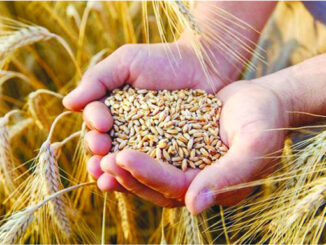
New Delhi (TIP)- India has banned wheat exports with immediate effect as part of measures to control rising domestic prices, according to official notification. However, the export shipments for which irrevocable letters of credit (LoC) have been issued on or before the date of this notification will be allowed, the Directorate General of Foreign Trade (DGFT) said in a notification dated May 13.
‘The export policy of wheat … is prohibited with immediate effect…,’ the DGFT said.It also clarified that wheat exports will be allowed on the basis of permission granted by the Government of India to other countries to meet their food security needs and based on the request of their governments.
In a separate notification, the DGFT announced the easing of export conditions for onion seeds.
‘The export policy of onion seeds has been put under the restricted category, with immediate fact,’ it said.
The export of onion seeds was earlier prohibited. Official data released this week showed that retail inflation surged to an eight-year high in April due to high prices of fuel and food items.
The ban on exports also comes amid disruption in global wheat supplies due to the ongoing war between Russia and Ukraine which are major exporters of the foodgrain. India’s wheat exports surged to 7 million tonnes, worth USD 2.05 billion, in 2021-22 due to strong global demand. Of the total wheat exports, around 50 per cent of shipments were exported to Bangladesh in the last fiscal, according to the DGFT data.
The country exported around 963,000 tonnes of wheat this year against 130,000 tonnes in the same period last year.
India was looking to export 10 million tonnes of wheat in 2022-23. The commerce ministry recently stated that India would send trade delegations to nine countries – Morocco, Tunisia, Indonesia, the Philippines, Thailand, Vietnam, Turkey, Algeria and Lebanon – to explore possibilities of boosting wheat shipments. India’s wheat purchase have also declined sharply by 44 per cent to 16.2 million tonnes as of May 1 in the current Rabi marketing season due to heavy lifting by private traders and low arrivals in Punjab and Haryana. The government had procured 28.8 million tonnes of wheat in the year-ago period. The rabi marketing season runs from April to March. Private players have bought wheat at a price higher than the minimum support price amid increased demand for the grain for export. The Centre has set a target to procure a record 44.4 million tonnes of wheat in the 2022-23 marketing year as against an all-time high of 43.34 million tonnes in the previous marketing year. Amid lower purchase for the central pool, the Centre has stopped the sale of wheat under the Open Market Sale Scheme (OMSS) to bulk consumers and asked them not to wait for recommencement of the scheme for buying the grain.
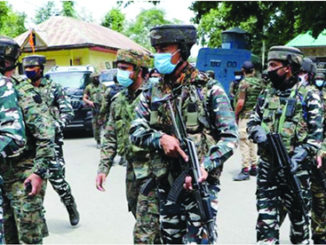
New Delhi (TIP)- TWO SOLDIERS who were killed fighting infiltrators along the Line of Control (LoC) in J&K and a Rifleman who chased two insurgents into the jungles and killed them during an operation in Assam are among six Army personnel who have been named for Shaurya Chakras this year. Shaurya Chakra is the country’s third highest peacetime gallantry award. President Ram Nath Kovind approved the list of awardees – six from Army and six from CRPF – on the eve of Republic Day. While five of the six from the Army have been awarded posthumously, for the CRPF, the number of posthumous awards is four.
Two of the Army’s posthumous awards have been given for the same operation. Naib Subedar Sreejith M and Sepoy Maruprolu Jaswanth Reddy, both from 17th Madras Regiment, were killed fighting infiltrators trying to cross the LoC in Sunderbani sector of J&K on July 8, 2021. They killed militants in face-to-face gunfights before they came under heavy fire and use of grenades.
Three others who were named for Sharya Chakra are Havildar Anil Kumar Tomar and Havildar Kashiray Bammanalli, both from 44 Rashtra Rifles, and Havildar Pinku Kumar from 34 Rashtra Rifles. They were killed in operations in the Valley in which each of them killed at least one militant before they were killed.
The only surviving Army person to get the Shaurya Chakra this year is Rifleman Rakesh Sharma, who during an operation on May 23 in an Assam village, chased two insurgents into the jungles and killed them despite coming under heavy fire.
Apart from them, six CoBRA commandos of the CRPF have been awarded the Shaurya Chakra.
Deputy Commandant Dilip Malik, posted in 205 CoBRA, who led his men in a fierce gunfight with Maoists after they came under head fire during a search operation in a Bihar forest has been named for the award. He killed at least three Maoists and “set the highest and exemplary standards of leadership” during the operation.
Three personnel of CoBRA also received the Shaurya Chakra posthumously for a separate anti-Maoist operation in Irrapalli.
The President also awarded ‘Mention-in-Despatches’ to 44 personnel from the Armed Forces. The largest set of 15 are for counter-insurgency and counter-terrorism operations in J&K. Fourteen personnel were awarded for the operations during the standoff in eastern Ladakh. Two of these are posthumous, awarded to Havildar Sudheesh Kumar S and Naik Ramarao Vanjarapu, both from Engineer Regiment.
Deobandi and Bareilvi alignments a challenge to governance and peace
India has done well to establish a back channel for talks with Pakistan’s military. A major result has been the signing of an agreement for a ceasefire across the LoC in J&K.
The two major schools of Islam, which emerged in the 19th century in the territories of present-day India, have traditionally been described as Deobandi and Bareilvi. The sects emerged from the efforts of many Muslim clerics and thinkers who fled from Delhi following their persecution by the British after the Mughal rule ended. Deobandi practices were widely adopted in Pakistan’s Khyber Pakhtunkhwa province, and by virtually all Pashtuns in Afghanistan. The Deobandis thus established a firm foothold amongst the Pashtun population in both Pakistan and Afghanistan. Most importantly, while the Bareilvis remained content with their influence in the subcontinent, the Deobandis reached out to people in the Arabian Peninsula in the 19th century. This was an initiative that has paid rich dividends through Saudi financial backing of Deobandi organizations.
Thanks to the FATF and actions by the US and its allies, Pakistan is being squeezed to end support to such groups.
The most far-reaching decision by India’s Deobandi leaders was to make common cause with the secular ideals of India, while supporting the struggle led by Mahatma Gandhi for India’s independence. The main center for study and learning of the Deobandi school of Islam was and remains the Darul Uloom, located at Deoband in UP. While sections of the Bareilvi leadership initially shared the views of their Deobandi compatriots, those mainly living in Pakistan, eventually chose to support the Partition. On November 3, 2009, Jamiat-i-Ulama-i-Hind, a group of Deobandi scholars, dedicated to the welfare of Muslims in India, met at Deoband and condemned suicide bombings and attacks targeting innocent civilians. This amounted to direct criticism of Pakistan’s propensity to use terrorism as an instrument of state policy.
The Bareilvi population in Pakistan’s Punjab province soon found that it had little political space to operate in. The military extended support to groups like the Lashkar-e-Taiba (LeT), the Jaish-e-Mohammed (JeM) and the Afghan Taliban that worked jointly with the military establishment. While the JeM organized the attack on the Indian Parliament in 2001, the 2008 Mumbai terrorist attack was masterminded by the LeT. Moreover, the ISI midwifed the close relations of these groups with the Taliban in Afghanistan. The Bareilvis were soon finding that despite their influence and political support in Pakistani Punjab, they were losing political relevance in Pakistan. Ever since the Soviet invasion of Afghanistan, the Pashtuns, who are predominantly Deobandi, dominated the attention and patronage of the ISI, and, indeed, in the world. The Taliban also have what they believe to be Deobandi credentials and collaborate closely with Wahhabi-oriented groups like the LeT and the JeM.
Pashtun Deobandis in Pakistan’s northwest and in southern Afghanistan became natural allies of Gen Zia-ul-Haq, after he overthrew and hanged ex-PM Zulfiqar Ali Bhutto. General Zia brought in a new phase of ‘Islamization’ of politics and developed close relations with radical Islamic elements in Pakistan, most notably the Jamaat-e-Islami in Punjab and Sind, and the Pashtun Deobandis in the north. The Soviet Union then made the folly of invading Afghanistan, enabling the US to join Pakistan in waging a Saudi-backed, Deobandi-oriented jihad against the Soviet forces. Wahhabi-oriented organizations in Pakistan joined this jihad. The ISI developed links with the Jamaat-e-Islami in J&K and used this Deobandi-oriented force to facilitate its jihad in J&K.
Given Bareilvi practices of virtually worshipping the Prophet, Saudi Arabia treats them as heretics. According to Najam Sethi, the Editor of Pakistan’s Friday Times, the Bareilvis in Pakistan, and particularly in the majority Punjab province, have responded to critics by actions ‘borne of the religious passion to defend and uphold the Prophet of Islam, from blasphemy by Muslims and non-Muslims alike, at home and abroad’. This led to the establishment of a politically oriented, militant organization called the Tehriq-e-Labaik, which soon swept across towns and villages, preaching religious intolerance in Pakistan’s military-dominated Punjab.
The first victim was a Punjabi Hindu woman, Asia Noreen, popularly known as Asia Bibi, who was convicted and sentenced to death for allegedly making blasphemous comments. She was arbitrarily handed the death sentence by hanging — a verdict that was overturned by the Supreme Court in 2011. She, thereafter, immediately fled to Canada.
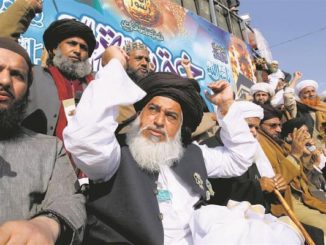
The Tehriq-e-Labaik attained notoriety, when one of its members, a security guard, assassinated the Governor of Punjab, Salman Taseer, for supporting Asia Bibi. The guard was treated like a revolutionary hero by the outfit. It now has substantial political clout in the Punjab province. It virtually brought Punjab to a standstill during recent demonstrations to demand the expulsion of the French ambassador, because of alleged disrespect shown in France to the Prophet.
Thanks to the threats of sanctions by the Financial Action Task Force and strong actions by the US and its European allies, Pakistan is being squeezed to end support to such groups. Pakistan is also realizing that faith alone cannot hold a nation together, especially in the face of sectarian differences. Neither the Tehriq-e-Taliban, which is now waging a low-intensity conflict within Pakistan, or even the Taliban leadership in Afghanistan has ever recognized the Durand Line as an international border.
India has done well to establish a back channel for talks with Pakistan’s military. A major result has been the signing of an agreement for a ceasefire across the LoC in J&K. Pakistan’s mercurial PM, Imran Khan, meanwhile, has rejected a proposal to import Indian agricultural products, which he had initiated and approved earlier. He certainly does not enjoy global popularity. The world has noted that it was General Bajwa who first met Crown Prince Salman in Saudi Arabia, before the Crown Prince gave an audience to Imran Khan last week. US President Biden is yet to meet or speak to Imran Khan.
(The author is Chancellor, Jammu Central University & former High Commissioner to Pakistan)
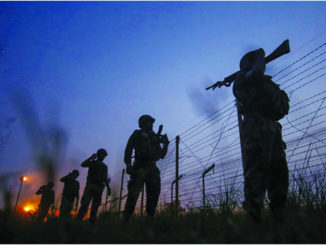
New Delhi (TIP): In a surprise development, Indian and Pakistani militaries announced on Thursday, February 25, that they had begun observing a ceasefire along the Line of Control (LoC) in Jammu and Kashmir from the midnight of February 24. A joint statement issued by the armies of both countries said the move followed a discussion between India’s Director General of Military Operations (DGMO), Lt Gen Paramjit Singh Sangha, and his Pakistani counterpart, Maj Gen Nauman Zakaria, over their established telephone hotline. The move comes at a time when the Indian military is largely focused on the standoff with China in Ladakh sector of the Line of Actual Control (LAC), which emerged in the open in May last year, though there has been no let-up in counter-terrorism operations in Jammu and Kashmir. During their discussion on the hotline, the two sides “reviewed the situation along the Line of Control and all other sectors in a free, frank and cordial atmosphere”, the joint statement said. “Both sides agreed for strict observance of all agreements, understandings and cease firing along the Line of Control and all other sectors with effect from midnight 24/25 Feb 2021,” the statement added.
The DGMOs also “agreed to address each other’s core issues and concerns which have propensity to disturb peace and lead to violence” in the interest of “achieving mutually beneficial and sustainable peace along the borders”.
The two sides further said that existing mechanisms of hotline contact and border flag meetings will be used to “resolve any unforeseen situation or misunderstanding”.
People familiar with developments said on condition of anonymity that the established convention of weekly contacts between officials of the Directorate General of Military Operations of the two countries had continued in recent months despite periodic flare-ups along the LoC. The DGMOs speak on the hotline when there is a specific request from one side, the people added.
Troops from the two sides have traded fire since relations between the two countries hit a low after the Pulwama suicide attack in February 2019 and India’s decision to scrap Jammu and Kashmir’s special status in August 2019.
The people said that while the Indian side had agreed on the ceasefire, there was no question of lowering the guard when it comes to operations to counter infiltration along the LoC or terrorism within Jammu and Kashmir.
“The main idea is to have peace along the LoC so that the local population doesn’t suffer,” said one of the people cited above.
India and Pakistan had agreed along a ceasefire on the LoC in November 2003 but it has been frequently violated in recent years. On Wednesday, the Indian Army chief, Gen MM Naravane, had said India wants peace and tranquillity along all its borders, be it the LAC, LoC or the frontier with Myanmar.
“With our continuous engagement with Pakistan, we will be able to prevail over them (for border peace)…as unsettled borders help no one,” he told a virtual seminar.
Naravane, however, said terror launchpads were active across the LoC, and the army will be prepared for a fresh influx of infiltrators in the summer. Source: HT
The killings of Bukhari and Aurangzeb were meant to provoke New Delhi, which decided to be seen as tough
By KC Singh
“If India and the US let domestic politics color their approach to the protection of human rights in the 70th year of the Universal Declaration of Human Rights, it would prove that terrorism and illegal immigration have succeeded in making the two major democracies less liberal”, says the author.
The 47-member Geneva-based UN Human Right Council and the UN High Commissioner for Refugees (UNHCR) have been in focus the past week. First came an unprecedented report by the UNHCR Zeid al-Hussein on Jammu and Kashmir (J&K), Pakistan Occupied Kashmir and Gilgit Baltistan. While Pakistani knuckles were rapped mildly, the report, as conceded in its executive summary, is really about “widespread and serious human rights violations’’ in J&K from the death of militant Burhan Wani in July 2016 to April 2018.
Under separate headings it holds India guilty on account of lack of access to justice and impunity; military courts and tribunals blocking this access, excessive use of force and pellet-guns, arbitrary arrests, including of minors, torture and enforced disappearances, and sexual violence, etc. All through, even UN-listed terror outfits are referred to as “armed groups”. A former Indian diplomat writing elsewhere calls it more akin to a report by Organisation of Islamic Conference than a UN high official. India strongly rebutted it and could have probably ignored it, except that Zeid is on record saying he would recommend to the UN Human Rights Council (UNHRC), which convened on June 18 for one of its three annual sessions, an investigation.
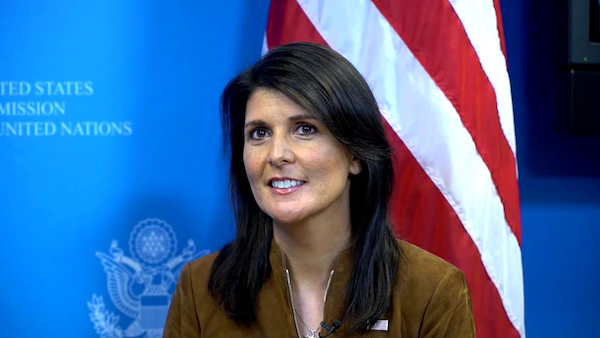
Two events impinge on this development. One, Jammu and Kashmir has been placed under Governor’s rule with the BJP withdrawing from the coalition government. Two, US Ambassador to UN Nikki Haley announced, at the State Department, US withdrawal from the UNHRC, alleging lack of reform and it having become a “protector of human rights abusers and cesspool of political bias”. Both need closer examination.
The Trump administration has been threatening to withdraw from the UNHRC for some time, but the decision came a day after Zeid slammed the US for separating children from parents on border with Mexico when apprehending illegal immigrants. The media is also reporting illegal immigrants from India, many from Punjab, held in detention centers under sub-human conditions.
Republican Senator John McCain, terminally ill with brain cancer but combative as always, tweeted that the “administration’s current family separation policy is an affront to the decency of the American people, and contrary to the principles and values upon which our nation was founded’’. He later went on to oppose Trump’s nomination of Ronald Mortensen to lead the US refugee and migration policy, alleging he lacked empathy for people fleeing oppression. Thus, while the US is right that election to the UNHCR of nations like Venezuela and Congo (though the US omitted mentioning China) hardly makes it the custodian of global conscience on human rights, but neither does the US by its xenophobic immigration control creating gulags for apprehended illegal immigrants qualify it to lecture the council.
The J&K imbroglio raises many similar questions about India’s trajectory in dealing with terrorism at home. The PDP-BJP alliance raised hope that their Agenda of Alliance would provide a template for resolution of the Kashmir issue. The death of Mufti Sayeed at the beginning of 2016 and a long hiatus before his daughter Mehbooba effectively took charge probably doomed the experiment, if at all had any chance to succeed.
At the root of the problem was the Modi government’s Pakistan policy of “no dialogue” unless terror ends. On the contrary, the PDP had got elected promising dialogue with Pakistan, more political space even for separatists and improved trade and people-to-people links with Kashmiris across the Line of Control (LoC). The Pakistan army exacerbated these fault lines by keeping up support to militancy, provocatively killing Indian soldiers and turning the LoC into free-fire zone. The Governor’s rule now denies India the argument that J&K has a popularly elected government which is a guardian of people’s rights scrutinizing, if not overseeing, counter-terror operations of security forces. Pakistan, currently a member of the UNHRC, shall use the High Commissioner’s tendentious report and collapse of the alliance to pillory India in coming weeks.
The Modi government must surely have assessed the profit-loss outcome of its decision. The domestic implications would dominate New Delhi’s thinking as the government heads into literally the last six months of effective rule before the Lok Sabha election process kicks-in. It needs to ensure that no major breakdown of security order in Kashmir occurs till election, particularly during the Amarnath pilgrimage.
There may be information that leading to parliamentary election in Pakistan in July its army, having a freer hand than normal with a caretaker government in position, is planning to fling every last terror asset across the LoC in a make-or-break gambit. The targeted killing of moderate journalist Shujaat Bukhari and the taped torture and execution of soldier Aurangzeb were intended to provoke New Delhi. A big attack on pilgrims, as has happened in the past, could make the Union Government look extremely ineffective. Governor’s rule is the counter-move to ensure that despite the debate in Geneva on India’s human rights record the Modi government is seen as strong at home.
If India and the US let domestic politics color their approach to the protection of human rights in the 70th year of the Universal Declaration of Human Rights, it would prove that terrorism and illegal immigration have succeeded in making the two major democracies less liberal. The latest survey by Freedom House, a US think-tank, is called “Democracy in Crisis”. Last year was the 12th consecutive year when nations suffering democratic setbacks outnumbered those gaining. According to Democracy Index of The Economist Intelligence Unit, 89 countries regressed in 2017 and only 27 improved. Globalization and technology in the West and Pakistan-sponsored terror in South Asia are derailing the quest for liberal, law-based democratic rule. If a four-year political alliance between the PDP and BJP, representing disparate views on Kashmir, cannot develop a consensus for bridging the divide, the future is indeed bleak. A fresh attempt at reconciliation seems unlikely until after parliamentary elections in Pakistan and India. Till then, geopolitical haze in South Asia will be thick as the dust that enveloped northern India a week ago.
(The author is a former Secretary, Ministry of External Affairs, India)
Signup to our Newsletter!
Don’t miss out on all the happenings around the world