Tag: Lok Sabha

  • US commends Indian govt, people on successful elections

    US commends Indian govt, people on successful elections

    WASHINGTON, D.C. (TIP): The US has commended the Indian government and the people for successfully participating and completing the Lok Sabha elections.

    Prime Minister Narendra Modi is poised to form the government for a third consecutive term with the BJP-led NDA getting a majority in the Lok Sabha, notwithstanding crushing losses in three Hindi heartland states after a bitterly fought election that was projected as a referendum on his popularity.

    The Election Commission of India has declared results for 542 of the 543 Lok Sabha constituencies, with the BJP winning 240 seats and the Congress 99. “On behalf of the United States, we want to commend the government of India and voters there for successfully completing and participating in such a massive electoral undertaking, and we look forward to seeing the final results,” State Department Spokesperson Matthew Miller told reporters at his daily news conference on Tuesday.

    He was responding to a question on the Lok Sabha elections in India, in which the ruling National Democratic Alliance (NDA) crossed the halfway mark of 272 seats, paving the way for a third consecutive term for Modi.

    “First of all, our understanding is that the election results have not been finalized. So, we will wait for the finalization of those election results before we offer any definitive comment,” Miller said when asked to comment on the results.

    “I’m also not going to comment on winners and losers in an election, as is our case around the world. What is important for us and what we have seen over the past six weeks is the largest exercise of democracy in history as the Indian people came to the polls,” he added.

    He also denied reports of external influence in Indian elections by Western powers, including the US.

    “We always will express our views clearly and openly. We express them with foreign governments privately and, when we have things that we are concerned about, we also express them publicly, including from this podium. That’s what I’ve done. But that, in no way, is an attempt to influence an election in India or anywhere else,” Miller said. He said he expects the close partnership between the US and India to continue.

    “There is a great partnership, both at the government level and at the people-to-people level, and I fully expect that to continue,” Miller said.

  • Aura of ‘invincibility’ around PM Modi ‘shattered’; opposition energized: World media on Indian election

    Aura of ‘invincibility’ around PM Modi ‘shattered’; opposition energized: World media on Indian election

    WASHINGTON, D.C. (TIP): The “aura of invincibility” around Prime Minister Narendra Modi has been “shattered” by the Indian voters who gave the Opposition a new lease on life, this is how the international media described the outcome of India’s general elections.

    According to the results for all Lok Sabha constituencies, the Bharatiya Janata Party (BJP) won 240 of the 543 seats and the Congress 99. The BJP-led National Democratic Alliance has comfortably crossed the majority mark of 272 in the 543-member Lok Sabha though the BJP lost its outright majority. India’s election results appeared as the top news among influential mainstream newspapers in the US.

    The New York Times started its report by noting, “Suddenly, the aura of invincibility around Narendra Modi has been shattered.”

    Terming the results as “unexpectedly sobering,” it noted that they were a “sharp reversal a decade into Mr. Modi’s transformational tenure.”

    “Modi’s Party Wins, but it’s far from a landslide,” said the second lead story on the front page of The NYT. “A sobering result for a Prime Minister on the Cusp of a 3rd term,” the daily said on its front page which carried a picture of Modi at the BJP headquarters in New Delhi after the election results were out.

    “India’s voters rebuke Modi,” said the lead story of The Washington Post, which is now owned by Jeff Bezos of Amazon, and added that the election results were a rare setback for Hindu nationalists. For the past decade, India has been “synonymous internationally with its prime minister, Narendra Modi. But on Tuesday, as final election results poured in, the electorate appeared to show dissatisfaction with the status quo and placed the serial winner onto shaky ground,” The Post wrote.

    There was “tepid support for his Hindu nationalist party, piercing the air of invincibility around the most dominant Indian politician in decades, it said.

    “Modi Declares Win but faces Setback,” said the lead story of The Wall Street Journal which also had a picture of the Prime Minister at the BJP headquarters in New Delhi along with the party president J P Nadda amidst showering of petals.

    Notably, all three major US newspapers had been very critical of Modi during the election campaign and had said that the country was headed towards a majoritarian and authoritarian regime. The exit polls and opinion polls before the election results had said that the BJP would easily cross the 300 mark in a Lok Sabha.

    Tuesday’s results showed that “India’s democracy is not as dead as we thought; that is for sure,” Devesh Kapur, a political scientist at the Johns Hopkins University School of Advanced International Studies was quoted as saying by The Post.

    “This electoral surprise shows that voters still have an independent mind. Otherwise, this juggernaut would not have stalled,” he said.

    The Editorial Board of The Wall Street Journal in its editorial said the election result suggests that Indians have high expectations for their leaders, and have again used the world’s largest democracy to warn those leaders to do better.

    “The question now will be whether Mr. Modi takes this election warning to heart, or retreats into even more sectarian and authoritarian methods,” it said.

    “While Modi’s Bharatiya Janata Party finished first and is still well positioned to form a government with its allies in the coming days, the BJP’s performance paled in comparison to its showing in 2014, when Modi swept to power on a wave of national anger over corruption, or 2019, when he was buoyed by nationalist sentiment over a border clash with Pakistan,” The Post wrote. Tuesday’s result is a humbling moment for a leader whose lead in the polls was lauded by supporters as unassailable, CNN commented.

    The election results show that Brand Modi has lost some of its shine, indicating that even Modi is susceptible to anti-incumbency. In other words, he is not as invincible as many of his supporters believed. This offers renewed hope to the Opposition, the BBC said. “This election is undoubtedly a rebuke for Modi and the BJP,” Time magazine quoted Milan Vaishnav, the Director of the South Asia Program at Carnegie Endowment for International Peace, as saying.

    “After ten years in power, it was in many ways a referendum on its track record in office and there are clearly many Indians who are feeling restless and uneasy.”

    Modi now faces a more powerful Opposition than at any point over the past decade, it said.

    “His (PM Modi) poorer performance will have political ramifications. At a minimum, the BJP will have to depend more on the junior members of its existent multi-party alliance.”

    The election results indicated Modi had not achieved the landslide victory many had predicted, a piece in The Guardian commented. “The Opposition alliance appeared to far outperform expectations,” the UK-based newspaper added.

    CBC News said the Congress Party was given ‘a new lease on life’ in the election.

    India’s election shows the world’s largest democracy is still a democracy, Vox Media, a US-based mass media company emphasized.

    “If the basic test of whether a country remains a democracy is that the party in power can still suffer a setback at the ballot box, India passed on Tuesday. Results from the nation’s parliamentary elections — the largest in the world — indicate a shocking electoral setback for Prime Minister Narendra Modi and his Hindu nationalist Bharatiya Janata Party (BJP),” it said.

    “Modi will continue to be the dominant force in Indian politics (and a significant force in global politics) for years to come, but his rise looks less inevitable and invincible than it did just a few days ago, and the world’s largest democracy’s politics look just a bit more democratic,” it said.

    In his third term, the Modi-led government might shift its focus to domestic issues, prioritizing public welfare and fair distribution of growth benefits, and even adopting a softer stance on Hindu nationalism, state-run China Daily said, citing analysts.

    Qian Feng, director of the research department at Tsinghua University’s National Strategy Institute, said in his third term, Modi is likely to stay consistent with his foreign policy.

    Qian said that the government could leverage global and regional shifts to boost India’s political, economic and diplomatic strength, enhancing its international presence.

    “Modi’s victory, even if diluted, is certainly not a good omen for Pakistan. Relations between the two countries hit a new low under the two previous Modi governments. It’s not surprising that the Indian prime minister had upped the ante against Pakistan on the election trail,” the Dawn newspaper wrote in its editorial titled ‘Weaker but still lethal’.

    India should reach out to Pakistan, and the state should respond positively to any Indian overtures. Naturally, rebuilding trust will take time, but long-term peace in South Asia is impossible without better Pakistan-India ties, it noted.

    “India cannot skirt around the Kashmir question; both sides should at least start talking, even if they agree to disagree. Let India’s incoming government start afresh with Pakistan,” the leading Pakistani newspaper hoped.

  • India Elections 2024: 19 April 2024 to 1 June 2024

    India Elections 2024: 19 April 2024 to 1 June 2024

    Polling to be held in 7 phases, result on June 4

    As India braces itself for what is anticipated to be the largest and longest general election in its history, the significance of the democratic process reverberates not only within the nation’s borders but resonates globally. With the Election Commission’s notification for the 18th Lok Sabha elections, slated to span from 19th April 2024 to 1st June 2024, India is poised to witness a monumental exercise in democratic participation. The sheer scale of these elections is unprecedented. Covering a vast electorate of approximately 960 million eligible voters out of a population of 1.4 billion, this election surpasses any previous in terms of sheer magnitude. Seven phases will unfold over 44 days, excluding the first general election in 1951-52, marking a testament to the democratic ethos entrenched within the Indian polity.The Indian Panorama will be covering the elaborate election exercise every week, starting from the April 5, 2024 edition.

    Polling for 543 Lok Sabha constituencies will be conducted in seven phases, between April 19 and June 1, followed by counting of votes on June 4.
    According to The Election Commission of India, Phase I will be held on April 19, Phase II on April 26, Phase III on May 7, Phase IV on May 13, Phase V on May 20, Phase VI on May 25, and Phase VII on June 1.
    Here is a breakup of the phases
    – Phase 1: Elections will be held on April 19 in 102 constituencies. This will be held in 21 States and Union Territories.
    – Phase 2: Elections will be held on April 26 in 89 constituencies. Second phase will cover 12 States and Union Territories.
    – Phase 3: Elections will be held on May 7 in 94 constituencies. The third phase will cover 12 States and Union Territories.
    – Phase 4: Elections will be held on May 13 in 96 constituencies. Fourth phase will cover 10 States and Union Territories.
    – Phase 5: Elections will be held on May 20 in 49 constituencies. The fifth phase will cover 8 States and Union Territories.
    – Phase 6: Elections will be held on May 25 in 57 constituencies. The sixth phase will cover 7 States and Union territories.
    – Phase 7: Elections will be held on June 1 in 57 constituencies. The seventh phase will cover 8 States and Union Territories.
    The model code of conduct has come into force starting the evening of March 16 and will remain in force even after the polling on June 1 till the entire process of counting is completed on June 4.
    Assembly elections in Andhra Pradesh, Sikkim, Arunachal Pradesh, and Odisha will also take place simultaneously, as will assembly bypolls for 26 vacant seats, ECI said.
    “After assessment in all states, we are confident of ensuring memorable, independent and impartial polls,” chief election commissioner Rajiv Kumar said at a press briefing. He said the body was determined to tackle the use of muscle, money, misinformation and violations of the poll code. “From wherever we receive the information of violence, we will take action against them.”
    The number of eligible voters stands at nearly 969 million, more than the population of the US, Russia and the European Union. The polls will take place in seven phases – on April 19, 26, May 7, 13, 20, 25 and June 1 – a testament to the daunting logistical and security challenges in overseeing an electorate stretching from the Himalayas in the north to deserts in the west, insurgent-infested tropical jungles in the centre and the coastal plains in the south.
    Three of India’s biggest states, Uttar Pradesh, Bihar and West Bengal will see elections across all seven phases. Two states – Maharashtra and Jammu and Kashmir – will vote in five phases, three states in four phases, two states in three phases, four in two phases, and 22 in a single phase.
    The first phase, on April 19, will be the biggest, across 102 seats and 21 states, and the fifth phase, across 49 seats and eight states on May 20, will be the smallest.
    “I urge parties to refrain from personal attacks and foul language. No-go areas in speeches are defined to maintain civility. Let us not cross lines in our rivalry,” Kumar said.
    The elections will see Prime Minister Narendra Modi seek a third consecutive term, which will make him only the second person in independent India after Jawaharlal Nehru to achieve the feat. He said the Bharatiya Janata Party (BJP) and the National Democratic Alliance (NDA) were fully prepared for elections.
    “The last decade was about filling gaps created by those who ruled for seventy years. It was also about instilling a spirit of self-confidence that yes, India can become prosperous and self-reliant. We will build on this spirit,” he said on X.
    The PM also took potshots at the Opposition, dubbing it “rudderless and issueless”.
    “Ten years ago, before we assumed office, the people of India were feeling betrayed and disillusioned thanks to INDI Alliance’s pathetic governance. No sector was left untouched from scams and policy paralysis. The world had given up on India. From there, it’s been a glorious turnaround,” he said.
    Opposition hits back
    “2024 Lok Sabha elections will open the ‘Door of NYAY’ for India. This would be perhaps the last chance to save democracy and our Constitution from dictatorship. We the people of India will together fight against hatred, loot, unemployment, price rise and atrocities,” said Congress chief Mallikarjun Kharge.
    Lok Sabha elections in India are a mind-boggling affair where leaders wrestle to weave narratives that bridge deep and complex divisions of caste, class, religion and region. In the last general elections in 2019, the BJP rode on a wave of Modi’s pan-Indian popularity and nationalistic fervour to a once-in-a-generation majority. The party won 303 seats, and along with its allies comprising the National Democratic Alliance (NDA) captured 336 seats in the 543-member Lower House. The Congress, saddled by the weight of past corruption and the lack of a charismatic leader, was reduced to 52 seats.
    This time, the BJP has set a target of 370 seats and 400 for the NDA on the back of welfare politics, development, and the Hindutva plank. Former allies have returned to the NDA ahead of the polls, as the BJP looks to defend its fortress in northern India and make inroads in eastern and southern India.
    The Opposition’s Indian National Democratic Inclusive Alliance (INDIA) hopes to cut into the BJP’s electoral track record and broad social coalition. But it is saddled with internal contradictions and still-deadlocked seat talks in key states.
    In 2019, the general elections recorded a turnout of 67%, the highest since the first election in 1951-52. The first election process in independent India in 1951 was a months-long process that spilled over into 1952. The turnout was just 45% as the authorities struggled to reach remote areas in a country where the vast majority of the electorate was illiterate. Since then, ECI has instituted a number of innovations, becoming a model for major democracies and extending its expertise to help conduct polls in countries such as Cameroon, Afghanistan and the Philippines.
    The women’s turnout in 2019 outstripped that of men – 67.18% to 67.01% – for the first time.
    A total of 26.3 million new electors – nearly the population of Australia – were added ahead of the 2024 national polls. Around 14.1 million new women voters surpassed the newly enrolled male voters (12.2 million) by 15%.
    “There are 12 such states where the gender ratio is over 1000 which means that number of women voters is more than males,” Kumar said.
    The number of third-gender voters increased from 39,680 in 2014 to a little over 48,000. Over 20 million young electors in the 18-19 and 20-29 age groups were added to the electoral rolls. At least 18.5 million voters were above 80. The number of centenarians (those who are 100 and above) stood at 238,000. Uttar Pradesh had the maximum number of voters at 153 million as of February 8 and Lakshadweep had the lowest – 57,000.
    Highlights of 7-phase voting 1.89 Cr first-time voters
    About 96.8 crore voters, comprising 49.7 crore men and 47.1 crore women, are eligible to cast their franchise across 543 constituencies at over 10.5 lakh polling stations in the country to elect the 18th Lok Sabha. The voters include 1.89 crore first time voters, including 85 lakh women. The term of incumbent 17th Lok Sabha is ending on June 16.The Bharatiya Janata Party, led by PM Modi, is seeking a record third term in the upcoming elections. Only Jawaharlal Nehru, the first Prime Minister, has had three back-to-back terms in office in India’s independent history so far.
    Target 370 for BJP, 400+ for NDA
    The BJP, and PM Modi, has kept a target of 370 seats for the party and 400+ seats for the National Democratic Alliance (NDA) for the upcoming polls. The ruling alliance is up against the INDIA bloc, an amalgamation of several opposition parties including the Congress.
    In 2019, the Lok Sabha poll dates were announced on March 10. The polling was held in seven phases from April 11 to May 19 to elect the members of the 17th Lok Sabha. Then the result, declared on May 23, 2019, saw a landslide victory for the Bharatiya Janata Party (BJP) under Prime Minister Narendra Modi, with 303 seats in the 543-member Lok Sabha.
    Assembly Elections
    The poll panel said that the elections to four state assemblies will also be held along the Lok Sabha elections. These include 175-member Andhra Pradesh assembly, 147-member Odisha assembly, 60-member Arunachal Pradesh assembly and 32-member Sikkim assembly. The term of these four assemblies also expires in June. The results of state assembly elections will also be declared on June 4. Jammu and Kashmir, which has been under President’s Rule since 2018, was not on the list of assembly elections, however.
    The commission also announced the schedule of by-elections to the 26 assembly seats to be held along the general elections.
    Vote-from home
    Senior citizens aged 85 years and above and persons with disabilities can opt for postal ballots and cast their votes from homes, Chief Election Commissioner Rajiv Kumar said on Saturday while announcing the schedule for the polls beginning April 19. As on March 10, 2024, there are 81,87,999 senior citizen electors above 85 years and 2,18,442 electors above 100 years in the country.
    Opinion poll predicts INDIA bloc’s debacle, Congress’ seats may fall even more
    Opposition bloc INDIA including Congress may fail to dent Prime Minister Narendra Modi’s bid for a third term in the upcoming Lok Sabha elections that are scheduled in seven phases beginning on April 19. Recent opinion polls predicted that the INDI alliance is expected to end up with 94 seats, while the BJP-led NDA can win 399 constituencies.
    According to India TV-CNX Opinion Poll, BJP is likely to secure 342 seats, Congress 38, Trinamool Congress 19 Lok Sabha seats, Dravida Munnetra Kazhagam (DMK) 18 constituencies, Janata Dal (United) 14, Aam Aadmi Party (AAP) 6, Samajwadi Party (SP) 3, Telugu Desam Party (TDP) 12, and others 91 seats. The Congress’ seat count can fall even more this time as the party has won 52 Lok Sabha seats in the 2019 general elections.
    The pre-poll survey stated that Congress and Bahujan Samaj Party (BJP) may draw a blank in Uttar Pradesh, while the BJP can win 73 seats and its alliance partners RLD and Apna Dal (S) are expected to secure two seats each.
    Congress can only win one seat in various states like Bihar, Chhattisgarh, Maharashtra, Manipur, Meghalaya, West Bengal, and Lakshadweep. The opinion poll predicted that the grand old party may also come empty-handed in Jammu and Kashmir, Uttar Pradesh, and Assam.
    The regional parties including TMC, DMK, YSRCP, TDP, and BJD can win a significant number of seats in their respective states. TMC may win 19 seats in West Bengal, DMK 18 seats in Tamil Nadu, BJD 11 seats in Odisha, and YSRCP and TDP may win 10 and 12 seats respectively in Andhra Pradesh.
    However, Sonia Gandhi-led Congress is expected to perform better in other states. It can win 7 seats in Kerala, 4 in Karnataka, 3 in Punjab, 8 in Tamil Nadu, and 9 in Telangana.
    A political party or coalition needs to secure at least 272 seats s in the 543-member Lok Sabha elections. In the 2019 general elections, the Bharatiya Janata Pary won 290 seats, and the NDA’s total seat count stood at 346 constituencies.

  • Bangladesh Prime Minister Sheikh Hasina lashes out at BNP’s ‘India Out’ campaign

    NEW DELHI / DHAKA (TIP): Bangladesh National Party (BNP) has been propogating an ‘India Out’ campaign for some time and has been asking people to boycott Indian products. Bangladesh’s Prime Minister Sheikh Hasina has lashed out at BNP for propagating this campaign.
    Challenging BNP, Sheikh Hasina sarcastically said, “Why they don’t burn their wives’ Indian sarees”, not use Indian spices in the kitchen.”
    This social media campaign against India surfaced on social media in January after their general elections.
    “How many Indian saris do their (BNP) wives have?,” PM Hasina said at an event organised on their Independence Day on March 26th.
    “When they burn their wives’ Indian saris in front of their party office, only then they will prove that they are truly committed,” she said making the audience laugh.
    After Maldives, Bangladesh is the second country where the opposition took up the ‘India Out’ campaign.
    Meanwhile, taking Sheikh Hasina’s stance of lashing out at the India Out campaigners, Bangladesh’s Foreign Minister, Dr Hasan Mahmud, spoke about the usage of Indian products.
    “They (BNP) eat food made with Indian onions, Sehri with Indian beef at night and wives wearing Indian saris when they go out. Which contradicts the call of Indian product boycotts.”
    Dr Mahmud criticized the BNP’s political stance stating that the actions do not benefit the country. He also said that the country’s image gets reflected badly overseas when such campaigns are run.
    India is the biggest trading partner of Bangladesh, in numerous industries. The relationship between both countries is marked by shared interdependence, as Bangladesh depends on India for essential imports including raw materials, machinery, and agricultural goods. At the same time, India gains from Bangladesh’s exports of garments, textiles, and medicines. Therefore, the implementation of the “India-Out” campaign requires strong support from citizens.
    Meanwhile, according to sources, PM Hasina is expected to visit Delhi in June after the conclusion of the upcoming Lok Sabha elections. (PTI)

  • The PMLA – a law that has lost its way

    The PMLA – a law that has lost its way

    The most serious aspect of the Prevention of Money Laundering Act is the inclusion of offences which have nothing to do with the original motive — namely, to combat the laundering of drug money.

    By P.D.T. Achary

    The Prevention of Money Laundering Act (PMLA), 2002 was enacted with a distinct objective. The humongous volume of black money generated through international drug trafficking posed a grave threat to the economy of many countries. There was widespread realization that the black money generated through the flourishing drug trade and integrated into the legitimate economy was likely to destabilize the world economy and endanger the integrity and sovereignty of nations.

    The background to the law is important
    The United Nations took serious note of this, and in 1988, held the United Nations Convention against Illicit Traffic in Narcotic Drugs and Psychotropic Substances. All countries were urged to take urgent steps to prevent the laundering of the proceeds of drug crimes and other connected activities. Subsequent to this, seven major industrial nations held a summit in Paris (July 1989) and established the Financial Action Task Force (FATF) to examine the problem of money laundering and recommend measures to tackle this menace. Thereafter, in 1990, the United Nations General Assembly adopted a resolution, namely, the Political Declaration and Global Programme of Action which called upon all member-countries to enact suitable pieces of legislation to effectively prevent the laundering of drug money.

    In pursuance of this resolution of the UN General Assembly, the Government of India used the recommendations of the FATF to formulate a legislation to prevent drug money laundering. As drug trafficking is a trans-border operation, the UN held a special session on June 10, 1998 on the theme ‘Countering World Drug Problem Together’ and made another declaration on the urgent need to combat money laundering. Accordingly, the Indian Parliament enacted the Prevention of Money Laundering Act in 2002. But it was brought into force in 2005.

    This narration of the history of this law is necessary in order to emphasize the original objective and the circumstances which lead to the enactment. As is clear from history, the main focus of the law is on combating the laundering of drug money. Accordingly, the Act of 2002 contained a few offences listed in the Indian Penal Code (IPC) and the Narcotic Drugs and Psychotropic Substances Act, 1985. The UN resolutions, and the FATF recommendations are all focused on the prevention of money from the laundering of drugs. However, the PMLA of India acquired a different character through amendments from time to time.

    The law on money laundering revolves around the “crime proceeds” which are laundered. Not only the persons involved directly in the crime and the generation of the crime proceeds but also persons who have nothing to do with the crime but who have some involvement at a later stage in the laundering process are also guilty under this law.

    But the most serious aspect of the PMLA is that it includes a large number of offences in the schedule which have nothing to do with the original purpose of this law — namely, combating the laundering of drug money. The UN resolution on the basis of which the law on laundering was enacted in India spoke only about the offence of the laundering of drug money. This was considered the most serious economic crime which had the potential to destabilize the world economy and endanger the sovereignty of nations, as highlighted above. The preamble to the PMLA endorses it. So, there was global consensus on the need to have a tough law to deal effectively with this crime. Thus, the raison d’etre of the PMLA is the crime of the laundering of a huge volume of black money generated from the international drug trade and the specter of destabilization of the world economy.

    The PMLA’s enactment
    Further, the PMLA was enacted by India’s Parliament under Article 253 which empowers it to make laws for implementing the international conventions. This Article indicates that a law Parliament makes to implement any decision of an international body will be confined to the subject matter of that decision. Item 13 in the Union list of the Seventh Schedule of the Constitution is specific on this point. Thus, the law on money laundering enacted under Article 253 and Item 13 of the Union list in the context of the UN resolution referred to above can only be on drug money. Various amendments made in this Act at different times bloated the schedule which now contains such offences which are either ordinary offences listed in the IPC or for which there are special laws in force. Since money laundering as an offence is linked to one of the scheduled offences, the offences contained in the schedule become the starting point of the whole process of operationalization of the PMLA.

    A close look at the schedule will convince a man of ordinary prudence that this law has deviated from its original scheme. The provisions contained in it are draconian which were meant to deal with the dangerous men involved in drug trafficking and the money chain. These provisions are now being used in other scheduled offences too without mitigating their rigor. Offences which by their very nature do not generate crime proceeds of a scale which can destabilize the economy and endanger the sovereignty of the nation are being tried under this law. One such example is the Prevention of Corruption Act, 1988 which is aimed at curbing corruption among public servants. This Act was added to the schedule of offences in 2009. The PMLA now applies with all its rigor to public servants. Thus, a public servant charged with corruption and a hard-core drug trafficker are treated alike. A very disturbing thing about the PMLA is that an accused under this law is presumed to be guilty until proved innocent.

    A fundamental principle of Anglo-Saxon jurisprudence is that a person is presumed innocent until proven guilty. PMLA turns this principle upside down. An accused will be denied bail by the entire hierarchy of courts because the bail provision contained in section 45 of the PMLA says that a judge can give bail only when he is satisfied that the accused is innocent. Which judge will take such a risk? So the person will rot in jail for years together without trial.

    The authority of ED and usage of PMLA
    The bail provision
    The bail provision of the PMLA Act (Section 45) is invested with a lot of political significance in present day India. It was held unconstitutional by a two-judge Bench of the Supreme Court of India in Nikesh Tarachand Shah vs Union of India (2018) as violating Article 14 and Article 21. However, Parliament, with great alacrity, restored this provision with certain amendments which was upheld by a three-judge Bench headed by Justice A.M. Khanwilkar in Vijay Madanlal Choudhary vs Union of India (2022). The top court held that this provision is reasonable and has direct nexus with the purposes and objects of the PMLA Act. Herein lies the problem.

    The object of the Act is to curb the laundering of black money and to save the economy from being destabilized. But what about less serious offences which have found a place in the schedule? The learned judges nearly said that inclusion of a particular offence in the schedule comes within the domain of the legislative policy.

    The present judicial approach to the issue of bail in PMLA cases appears to be very technical. The judicial perspective on bail was laid out by Justice V.R. Krishna Iyer back in 1978 under the following words in Gudikanti Narasimhulu And Ors vs Public Prosecutor, High Court Of Andhra: “Personal liberty, deprived when bail is refused, is too precious a value of our constitutional system recognized under Article 21 that the curial power to negate it is a great trust exercisable, not casually but judicially, with lively concern for the cost to the individual and the community”. From Justice V.R. Krishna Iyer to Justice A.M. Khanwilkar, the apex court has travelled a long distance.

    (The author is a former Secretary General, Lok Sabha)

  • Supreme Court nulls electoral bonds scheme, seeks info on donors

    Supreme Court nulls electoral bonds scheme, seeks info on donors

    February 15, 2024

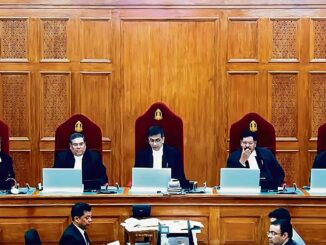
    NEW DELHI (TIP): Ahead of the 2024 Lok Sabha elections, the Supreme Court on Thursday, February 15,  declared “unconstitutional” the electoral bonds scheme that allowed individuals and companies to make unlimited anonymous donations to political parties. Noting that voters have right to know, a five-judge Constitution Bench led by CJI DY Chandrachud said the scheme violated Article 19(1)(a) of the Constitution, which guaranteed right to freedom of speech and expression and included right to information within its ambit.

    “We are of the opinion the information about funding to a political party is essential for a voter to exercise their freedom to vote in an effective manner. The electoral bonds Scheme and the impugned provisions to the extent that they infringe upon the right to information of the voter by anonymizing contributions through electoral bonds are violative of Article 19(1)(a) (right to freedom of speech and expression),” the Bench said. The Beach, which also included Justices Sanjiv Khanna, BR Gavai, JB Pardiwala and Manoj Misra, said the disclosure of information regarding electoral bonds was necessary to identify corruption and quid pro quo transactions in governance. “Such information is also necessary for exercising an informed vote,” it added.

    The top court ordered the State Bank of India to stop issuing electoral bonds immediately and submit all details by March 6 to the Election Commission which shall make all donations public by March 13. All electoral bonds within the 15-day validity period shall be returned by political parties to the purchasers, it added.

    Justice Khanna delivered a separate but concurring judgment. Welcoming the verdict, petitioner Association for Democratic Reforms’ counsel Prashant Bhushan said: “This is a salutary judgment which will enhance our democratic process.” The Constitution Bench also declared unconstitutional amendments made to the Representation of the People Act (RPA), 1951, the Income Tax Act, 1961, and the Companies Act, 2013, through the Finance Act, 2017, to facilitate introduction of the scheme.

    Earlier, political parties had to declare all contributions more than Rs 20,000 with no exceptions, and maintain a record of all donations exceeding Rs 20,000 for tax purposes. In a financial year, companies could contribute a maximum of 7.5% of their average net profits from the preceding three years. The amendments did away with the restrictions to allow political parties to receive funds through electoral bonds.

    Introduced through the Finance Act, 2017, an electoral bond is a bearer instrument like a promissory note which can be purchased by an Indian citizen or an Indian company whose identity would remain secret from everybody except the SBI from whom it has to be purchased. Once purchased, the buyer can give it to a political party, which could encash it using its bank account.

  • Takeaways from the Ayodhya spectacle

    Takeaways from the Ayodhya spectacle

    Prime Minister should follow in Lord Rama’s footsteps to ensure justice for all

    “Ram Mandir has succeeded in restoring Hindus’ pride in their religion. That is a positive development. What’s left is for Modi to follow the principles of good governance associated with Lord Rama for dispensing justice to all. There were no Muslims and Christians in Bharat in those ancient times. But they are there now. Their only prayer to Modiji is that they be counted as equal citizens of Bharat, as Lord Rama, the epitome of justice and good governance, would have done.”

    By Julio Ribeiro

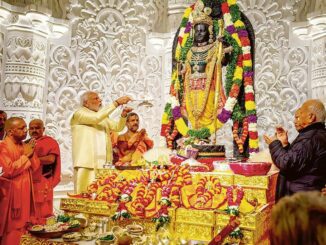
    It was awe-inspiring to watch the consecration of the Ram Janmabhoomi temple in Ayodhya. PM Narendra Modi stole the show with his march to the spot where the idol of Ram Lalla was installed and his unforgettable address to the 7,000-odd guests.

    I was moved to instruct my domestic help to light a diya, as our Prime Minister had requested. Even I, normally a critic of the government, was carried away by the moment!

    The sheer magic of the occasion, the unmistakable devotion on the faces of the invitees and the pride in being a Hindu that was reflected on the countenance of the diaspora worldwide lent a new dimension to the dharma of our people and our ancestors. I was moved to instruct my domestic help to light a diya, as our Prime Minister had requested. Even I, normally a critic of the government, was carried away by the moment!

    The temple will be completed in a year or so, but it has been consecrated ahead of the Lok Sabha elections. It is expected to play the role that the Balakot airstrikes did for the BJP in the 2019 Lok Sabha elections. PM Modi is expected to win a third term.

    If the INDIA bloc does not get its act together soon, the ‘mother of democracy’ (our PM’s words) will metamorphose into an autocracy. Even after Rahul Gandhi hinted that Congress chief Mallikarjun Kharge would lead the coalition, Mamata Banerjee announced that the Trinamool Congress would fight the Lok Sabha polls in West Bengal on its own.

    Nitish Kumar had expected himself to be anointed as ‘primus inter pares’ (first among equals). He is frustrated because he has to share the honor with Kharge. Arvind Kejriwal wants an all-India footprint for AAP. He demands seats in Gujarat, Haryana and Goa, where his party has a small presence.

    Even Akhilesh Yadav, who has been eclipsed by CM Yogi Adityanath in Uttar Pradesh, thought that his Samajwadi Party was entitled to representation in Madhya Pradesh. All in all, the INDIA bloc is hopelessly placed against the BJP’s juggernaut. And with the Ram Temple being projected as Modi’s baby instead of Lal Krishna Advani’s, to whom it legitimately belongs, the battle can be written off as far as INDIA is concerned.

    Yogi has captured the imagination of the residents of Uttar Pradesh (which has 80 Lok Sabha seats) with one major achievement — he has brought the state’s criminals to heel. In the beginning of his reign, he encouraged the use of unconventional, even illegal, methods to instill fear in the minds of the law-breakers. Wiser counsel later advised him to change tack. To all appearances, it seems that conventional methods (except the bulldozer) are currently at play.

    A newspaper article by a young IPS officer, Vrinda Shukla, currently SP of Bahraich (UP), quotes figures from the National Crime Records Bureau to show that because of “scaled-up monitoring at all levels”, conviction was obtained by the UP police in 71 per cent of the cases of crimes against women in which the trial was completed. The corresponding figures for Rajasthan and Maharashtra are 37.2 per cent and 11.2 per cent, respectively. Public prosecutors, who had stopped taking ownership of the cases and become unaccountable, have begun feeling the heat generated by Yogi, says Vrinda.

    Those who dream of forming a government in any state will need to adopt the UP CM’s attitude to corruption and the legal steps he has put in motion to control crime and criminals. More than ‘development’ that our Prime Minister harps on, citizens want security of life and property. He or she who can provide this will win.

    In the meantime, Modi will milk the devout Hindu’s devotion to Lord Rama for electoral gains. A politician can hardly be blamed for exploiting public sentiment to influence voters. The only regret a sensitive BJP follower can possibly have is that the originator of the Rath Yatra, Advani, was left out in the cold. But these are games ambitious politicians play. They dump their rivals in their own party when the opportunity beckons. Politics, after all, is a cut-throat enterprise. Only one who is adept at the game comes out on top.

    The media shows Modi feeding cows at his home and visiting temples in Kerala and Andhra Pradesh, both southern states where he is keen to open his party’s account. Public memory is notoriously short. The voter may forget our PM’s piety and opt for the communists or the Congress in Kerala and for CM Jagan Mohan Reddy or his sister YS Sharmila, who has taken on the responsibility of resuscitating the Congress in Andhra Pradesh.

    A group of 200-odd retired diplomats, civil servants and police officers, called the Constitutional Conduct Group (of which I am a part), had drafted an open letter to the PM, lamenting that he involved his high constitutional office and government agencies in the run-up to the idol’s installation in the Ayodhya temple. A secular country, constitutionally mandated to strictly separate religion from the State, had been subjected to the spectacle of its PM performing puja in South Indian temples and finally in Ram Mandir.

    There is no objection to the PM visiting and praying to his god as an individual. But to do so as the country’s pre-eminent elected leader and committing government resources to such an event is neither constitutionally acceptable nor ethical or moral. The Election Commission should decide whether this is permissible under the election laws on the use of religion for garnering votes.

    The founders of Pakistan used religion to secure for the Muslims a separate country. The military regime of Gen Zia-ul-Haq Islamized it to the hilt. The results of such religiosity are for all of us to see. Pakistan today needs the US and China to keep itself functioning. There are not many nations today that incorporate religion into governance. Those that follow this path have not prospered.

    Ram Mandir has succeeded in restoring Hindus’ pride in their religion. That is a positive development. What’s left is for Modi to follow the principles of good governance associated with Lord Rama for dispensing justice to all. There were no Muslims and Christians in Bharat in those ancient times. But they are there now. Their only prayer to Modiji is that they be counted as equal citizens of Bharat, as Lord Rama, the epitome of justice and good governance, would have done.

    (The author is a former governor and a highly decorated retired Indian Police Service (IPS) officer )

  • Repealing sedition law: Move welcome, but substitute shouldn’t be draconian

    Often misused against activists and journalists, the archaic sedition law is all set to become history. Union Home Minister Amit Shah — who introduced three Bills in the Lok Sabha on Friday to replace the Indian Penal Code (IPC), the Criminal Procedure Code and the Indian Evidence Act — announced that the sedition law had been proposed to be removed. The decision comes as a pleasant surprise as barely two months ago, the

    Law Commission had recommended retention of Section 124A (sedition) of the IPC and enhancement of punishment for the offence. Citing its misuse and the resultant ‘chilling effect’, the Supreme Court had in May last year put the sedition law on hold, pending a review. Absent from the original IPC, which was drafted by Lord Macaulay and came into force in 1862, the sedition law was added in 1870. It was widely used to suppress the freedom struggle after its ambit was expanded in 1898. The Punjab High Court had in Tara Singh Gopi Chand vs The State (1951) declared Section 124A IPC unconstitutional, but the Supreme Court upheld its validity in Kedarnath Singh (1962), while restricting its scope.

    However, the Bharatiya Nyaya Sanhita, 2023 — which will replace the IPC — proposes to have a provision that punishes ‘acts endangering sovereignty, unity and integrity of India’ with life imprisonment or imprisonment up to seven years and a fine. One hopes it’s not the sedition law by another name. Doing away with this law is not a standalone measure. It’s part of an overhaul of the criminal justice system undertaken by the government, two decades after Justice VS Malimath Committee on Reforms of Criminal Justice System submitted its report to the Home Ministry. There is a lot that can be changed in procedural laws. But the government should tread cautiously while redrafting the substantive criminal law.

    (Tribune, India)


  • Renuka Chowdhury to file defamation case against PM Modi over alleged ‘Surpanakha’ remark

    Renuka Chowdhury to file defamation case against PM Modi over alleged ‘Surpanakha’ remark

    NEW DELHI (TIP): Congress leader Renuka Chowdhury has said that she will be filing a defamation case against PM Modi over his alleged ‘Surpanakha’ remark made in Parliament back in 2018. The ex-MP took to Twitter to share a video of Modi’s speech where he linked her laughter to the Hindu epic Ramayana.
    Watch the video: https://twitter.com/i/status/1638927867018092545
    Chowdhury wrote, “This classless megalomaniac referred to me as Surpanakha on the floor of the house. I will file a defamation case against him. Let’s see how fast courts will act now.” In the video, PM Modi purportedly addresses other BJP parliamentarians where he asks them to let Chowdhury continue speaking as since the Ramayana serial, it is only today that they have got the privilege to hear the same famous laughter.
    Chowdhury’s charge against PM Modi comes amid the guilty verdict handed by a Surat court against Rahul Gandhi in the 2019 criminal defamation case over his Modi surname remark. He was disqualified as a lawmaker after a Surat court found him guilty of defamation and sentenced him to two years in prison, according to a Parliament notice.
    The case was filed against Gandhi for his alleged “how come all the thieves have Modi as the common surname?” comments on a complaint lodged by BJP MLA and former Gujarat minister Purnesh Modi. The court granted him bail and suspended the sentence for 30 days to allow him to appeal in a higher court, the Congress leader’s lawyer Babu Mangukiya said. The Lok Sabha MP from Wayanad made the remarks while addressing a rally at Kolar in Karnataka on April 13, 2019, during Lok Sabha poll campaigning.

  • Chilling effect: On defamation, free speech and the Rahul Gandhi case

    Congress leader Rahul Gandhi’s conviction and jail term flags need to abolish criminal defamation

    The rigors of the law and the tribulations of politics have come together to bedevil Congress leader Rahul Gandhi. An election-time jibe he had made in 2019 — ‘how come all of these thieves have Modi in their names?’ — has been declared by a court in Surat to be defamatory. Mr. Gandhi has been sentenced to two years in prison, the maximum sentence for criminal defamation, and disqualified from his membership in the Lok Sabha. Both the conviction and sentence raise legal questions. Does the remark amount to defaming anyone in particular, or to people with the surname ‘Modi’ as a group? Case law indicates that the expression ‘collection of persons’ used in Section 499 of the IPC, with reference to those who can be defamed, has to be an identifiable class or group and that the particular member who initiates criminal proceedings for defamation must demonstrate personal harm or injury by the alleged defamatory statement. It is difficult to sustain the argument that all those with the surname, and not merely the three individuals including Prime Minister Narendra Modi who were referred to, can be aggrieved persons. Also, it is not clear if the complainant, BJP MLA Purnesh Modi, had shown that he was aggrieved by the alleged slur either personally or as a member of the ‘Modi’ group.

    The maximum sentence is also troubling. Statutes prescribe maximum jail terms so that trial courts use their discretion to award punishments in proportion to the gravity of the crime. It is questionable whether attacking an indeterminate set of people with a general remark will amount to defamation, and even if it did, whether it is so grave as to warrant the maximum sentence. The correctness of the judgment will be decided on appeal, but the political cost to Mr. Gandhi in the form of disqualification from the House and from electoral contest will have a lasting impact, unless he obtains a stay on the conviction rather than mere suspension of sentence. In a country that often frets over criminalization of politics, corruption and hate speeches, it is ironic that criminal defamation should overwhelm the political career of a prominent leader. A modern democracy should not treat defamation as a criminal offence at all. It is a legacy of an era in which questioning authority was considered a grave crime. In contemporary times, criminal defamation mainly acts as a tool to suppress criticism of public servants and corporate misdeeds. In 2016, the Supreme Court upheld criminal defamation without adequate regard to the chilling effect it has on free speech, and to that, one must now add, political opposition and dissent. Opposition parties expressing dismay at the verdict against Mr. Gandhi should include abolishing criminal defamation in their agenda.

    (The Hindu)

  • Adani issue puts Opposition unity to test

    Adani issue puts Opposition unity to test

    The Opposition cannot function as a cohesive entity sporadically, especially a year before the next Lok Sabha polls, if it is to take on the BJP/NDA. Bringing the parties together into a front seems impossible now because it entails swaps and trade-offs, which the Congress is not willing to transact with the regional forces.

    “Apart from assailing Modi for his alleged nepotism, the Opposition picked on the money invested by the Life Insurance Corporation of India and the State Bank of India — two traditional sources of financial security for the middle class — in the Adani group as examples of ‘cronyism’ at the cost of jeopardizing the interests of the vulnerable salaried sections. The stress on the middle classes was significant, considering that they formed a strong support base of the BJP. Indeed, the Union Budget was billed as a bonanza for the middle-income groups. It has to be seen if the Congress and the Opposition sustain the momentum they generated in Parliament in the interregnum before the next leg of the Budget session.”

    By  Radhika Ramaseshan

    Bofors was the last major financial shell game with profound implications for the country’s security to shake up and eventually unseat a powerful ruling party, the Congress, and its leader Rajiv Gandhi. The over three years between the signing of the Rs 1,437-crore deal on March 24, 1986, with AB Bofors, a Swedish arms manufacturer, for the supply of 400 155-mm Howitzer guns for the Army and the Congress’s downfall in November 1989 were bestrewn with dramatic developments which foreshadowed the denouement.

    On April 16, 1987, a Swedish radio channel alleged that kickbacks were paid to sweeten the deal. That was enough of a spur to an Opposition — that had been squeezed into one corner of the Lok Sabha after the Congress earned a record mandate in the 1984 elections — to go for the jugular with whatever resources it had. The Opposition persistently clamored for a joint parliamentary committee (JPC) to investigate the charges.

    Then Prime Minister Rajiv Gandhi was unyielding to begin with and on April 20, 1987, he informed Parliament that no bribes were paid and no middlemen were involved. On August 6, 1987, the government relented and set up a JPC under former Union minister B Shankaranand. In February 1988, Indian investigators landed in Sweden to probe the issue. On July 18, 1989, the JPC submitted its findings. Soon thereafter, the CAG drilled the final nail in the Bofors coffin, questioning the process of selection and purchase of the gun. The last straw for Rajiv Gandhi came when Opposition MPs, including those from the BJP and the Left, resigned en masse, prompting Socialist leader Madhu Dandavate to indulge in hyperbole. “Now we need Comrade Vajpayee and Pandit Namboodiripad to work together to oust Rajiv,” Dandavate remarked.

    It is useful to chronicle the Bofors saga from a political perspective because the events proved that even a thundering popular mandate could wound a party irreparably and claim its leader. Maybe 1989 was a black swan event, like that of Indira Gandhi’s ouster in 1977.

    The Congress and Rahul Gandhi tried hard to implicate the Narendra Modi government in the purchase of 36 Rafale multi-role fighter aircraft from French manufacturer Dassault Aviation before the 2019 elections, but the charge of receiving huge bribes came unstuck. The Congress stood isolated in its campaign against Modi because there were no takers in the Opposition.

    There are harbingers that the Gautam Adani-Hindenburg issue — which principally concerns the alleged and overt patronage extended by the Modi government to Ahmedabad-based industrialist Adani whose spectacular rise and entry into the global club of who’s who provoked the West’s attention, interest and investigation — could regroup the Opposition in Parliament.

    Two factors have apparently catalyzed the situation. One, even regional parties that were considered ‘pro-Centre’ and ‘pro-Modi’, notably the Bharat Rashtra Samithi (BRS), find themselves pitted on their turfs against a rejuvenated BJP. In Telangana, for example, the BRS has Modi as its principal adversary and not a regional BJP leader or the Congress even in the Assembly election this year. Likewise, Mamata Banerjee, no friend of the BJP, is pitted against Modi in West Bengal. As much as Rahul and the Congress, provincial leaders, too, have looked for an opportune moment to corner Modi and they believe that the Adani case has given them the context to launch a campaign against the PM.

    Two, Rahul Gandhi, in a vastly amended — and some say refurbished — version of his old self after his Bharat Jodo Yatra, played his cards in Parliament tactfully. He ensured that Congress president and Rajya Sabha Opposition leader M Mallikarjun Kharge mobilized the Opposition parties before and during the now-adjourned Parliament session and stayed in the background so that nobody could call him an ‘entitled legatee’. However, he articulated the Congress’s views on Adani-BJP in his speech in the Lok Sabha and asked searing questions on the businessman’s alleged close relations with Modi that went unanswered. It appeared as though the Opposition, including the BRS and the Aam Aadmi Party, otherwise antagonistic towards the Congress, was happy to pass the baton of the attack on the BJP and Modi to Rahul. There were no suggestions that Rahul was feckless and inattentive towards Parliament. Of course, the question of allowing the Congress and him to helm an Opposition front closer to 2024 is another matter and one riddled with complications.

    Apart from assailing Modi for his alleged nepotism, the Opposition picked on the money invested by the Life Insurance Corporation of India and the State Bank of India — two traditional sources of financial security for the middle class — in the Adani group as examples of ‘cronyism’ at the cost of jeopardizing the interests of the vulnerable salaried sections. The stress on the middle classes was significant, considering that they formed a strong support base of the BJP. Indeed, the Union Budget was billed as a bonanza for the middle-income groups. It has to be seen if the Congress and the Opposition sustain the momentum they generated in Parliament in the interregnum before the next leg of the Budget session.

    The Opposition cannot function as a cohesive entity sporadically, especially a year before the next Lok Sabha polls, if it is to take on the BJP/NDA. The endeavor of bringing the parties together into a front seems impossible right now because it entails swaps and trade-offs, which the Congress is not willing to transact with the regional forces.

    The outcome of the elections that follow this year will demonstrate if the political messaging from the Adani controversy has percolated down to people the country over or if Modi and the BJP have retained popular goodwill and support.

    (The author is a senior journalist)


  • Budget Session 2022: Parliament adjourned sine die; 11 Bills passed by both houses

    Budget Session 2022: Parliament adjourned sine die; 11 Bills passed by both houses

    New Delhi (TIP)- The Budget Session, 2022 of Parliament, which commenced on, 31 January 2022, has been adjourned sine die today i.e. Thursday, 07 April 2022. Speaking about the Budget Session,  Union Minister for Parliamentary Affairs Pralhad Joshi stated that during the entire Budget Session, 2022 there were 27 sittings of Rajya Sabha and Lok Sabha. The Minister underlined that the Session, which was originally scheduled to have sittings till 8 April, 2022, was curtailed due to demand of Leaders of various political parties. The Minister of State for Parliamentary Affairs & Culture  Arjun Ram Meghwal and Minister of State for Parliamentary Affairs & External Affairs  V. Muraleedharan were also present in the press conference. The Budget Session, 2022 of Parliament which commenced on Monday, 31st January, 2022 has been adjourned sine die today i.e. Thursday, the 7th April, 2022. In between Rajya Sabha and Lok Sabha adjourned for recess on Friday, the 11th February, 2022 to reassemble on Monday, the 14th March, 2022 to enable Departmentally related Standing Committees to examine and report on the Demands for Grants relating to various Ministries/Departments.

    The first part of the Budget Session yielded a total of 10 sittings of Lok Sabha and Rajya Sabha.  In the second part of the Session, there were 17 sittings of both Houses. During the first part of the Session, keeping in mind Covid situation Lok Sabha has used Lok Sabha Chamber, Lok Sabha Public Gallery, Rajya Sabha Chamber and Rajya Sabha Public Gallery for its sittings while Rajya Sabha has used Rajya Sabha Chamber, Rajya Sabha Public Gallery and Lok Sabha Chamber for its sittings. Lok Sabha sat from 4 pm to 9 pm (with extended time, whenever required) daily except on 31.01.2022 and 1.02.2022 when they sat first. Rajya Sabha had its meetings from 9 am to 3 pm (with extended time, whenever required) daily except on 31.01.2022 and 1.02.2022 when they sat second. In the second part of the Session, the timing of the Houses was reverted back to the normal hours ie. from 11am to 6 pm (with extended time, whenever required) following all protocols.

    This being the first Session of the year, the President addressed both Houses of Parliament assembled together in terms of Article 87(1) of the Constitution, on 31st January, 2022. Motion of Thanks on the President’s Address in Lok Sabha was moved by Harish Dwivedi and seconded by Shri Kamlesh Paswan.  This item engaged the Lok Sabha for 15 Hours 13 minutes against allotted 12 Hours. In Rajya Sabha it was moved by Shrimati Geeta alias Chandraprabha and seconded by Shri Shwait Malik. This item engaged the Rajya Sabha for 12 Hours 56 minutes against allotted 12 Hours. The Motions of Thanks were discussed and adopted after reply from the Hon’ble Prime Minister by the two Houses during the first part of the Session.

    The Union Budget for 2022- 23 was presented on Tuesday, the 1st of February, 2022. General Discussion on the Union Budget was held in both Houses in the first part of the Session.  This engaged the Lok Sabha for 15 Hours 35 minutes against allotted 12 Hours and Rajya Sabha for 11 Hours 01 minute against allotted 11 Hours.

    In the Rajya Sabha the working of the Ministries of Development of North Eastern Region, Tribal Affairs, Railways and Labour and Employment were discussed.  The discussion of the working of Ministry of Labour and Employment, however, remained inconclusive. During this Session a total of 13 Bills (12 in Lok Sabha and 01 in Rajya Sabha) were introduced. 13 Bills were passed by Lok Sabha and 11 Bills were passed by Rajya Sabha. Total number of Bills passed by both Houses of Parliament is 11. Some of the major Bills passed by both Houses during the Session are as under :

    The Criminal Procedure (Identification) Bill, 2022, to authorise for taking measurements of convicts and other persons for the purposes of identification and investigation in criminal matters and to preserve records and for matters connected therewith and incidental thereto.

    The Delhi Municipal Corporation (Amendment) Bill, 2022 to (i) unify the three municipal corporations into a single, integrated and well equipped entity; (ii) ensure a robust mechanism for synergised and strategic planning and optimal utilisation of resources; (iii) bring about greater transparency, improved governance and more efficient delivery of civic service for the people of Delhi.

    The Constitution (Scheduled Tribes) Order (Amendment) Bill, 2022, to amend Part XV.—Tripura of the Schedule to the Constitution (Scheduled Tribes) Order, 1950 to insert “Darlong” community as a sub-tribe of “Kuki” after sub-tribe “(iii) Chhalya” in entry 9 in the list of Scheduled Tribes.

    The Constitution (Scheduled Castes and Scheduled Tribes) Orders (Amendment) Bill, 2022, to omit Bhogta community from the list of Scheduled Castes in relation to the State of Jharkhand and the Constitution (Scheduled Tribes) Order, 1950 for inclusion of certain communities in the lists of Scheduled Tribes in relation to the State of Jharkhand. Further, the Weapons of Mass Destruction and their Delivery Systems (Prohibition of Unlawful Activities) Amendment Bill, 2022 was also passed by Lok Sabha which seeks to— (a) prohibit financing of any activity in relation to weapons of mass destruction and their delivery systems; (b) empower the Central Government to— (i) freeze, seize or attach funds or other financial assets or economic resources for preventing such financing; (ii) prohibit making available funds, financial assets or economic resources for any prohibited activity in relation to weapons of mass destruction and their delivery systems.

    The productivity of Lok Sabha during the Budget Session, 2022 was approx. 129% and that of Rajya Sabha was 98%.

  • Tricolour found upside-down as Kerala Minister unfurls flag; probe ordered

    Tricolour found upside-down as Kerala Minister unfurls flag; probe ordered

    Thiruvananthapuram (TIP)- A probe has been ordered after the national flag was found upside-down when unfurled by Kerala Minister Ahamed Devarkovil on Republic Day in in Kasaragod district Wednesday, January 26. The minister, who holds the ports and archeology portfolios in the Left Democratic Front regime, was the chief guest at the Republic Day celebrations in Kasaragod district headquarters on Wednesday. After unfurling the flag, the minister watched the parade held at the municipal stadium. While he was delivering a speech at the event, media persons covering the ceremony pointed out the mistake. Subsequently, the Tricolour was brought down and unfurled again by the minister, who belongs to CPI(M) ally Indian National League. Congress MP Rajmohan Unnithan, who represents Kasaragod Lok Sabha seat, three legislators from the district, additional district magistrate A K Ramendran and district police superintendent Vaibhav Saxena were also present at the event.

    Budget session: Both Houses to convene in shifts : Both the Houses will function in two different shifts in a day during the coming Budget Session of Parliament, it was decided on Monday, as the country continues to remain in grip of the third wave of Covid-19 infections. The budget session begins on January 31. The protocols will be similar to the ones followed during the Monsoon Session of Parliament last year. Held in September 2020, the monsoon session was the first time parliamentary proceedings were held under strict Covid-19 protocol. The Rajya Sabha met in the first half of the day and the Lok Sabha during the second half. Members were seated in both the chambers to ensure social distancing. Similarly, this time around, the Upper House will convene in the morning and the Lok Sabha in the afternoon, a bulletin issued by the Lok Sabha Secretariat said on Monday.

  • Lok Sabha passes Triple Talaq Bill

    Lok Sabha passes Triple Talaq Bill

    Congress, AIADMK call for deliberation by select committee, walk out before voting

    NEW DELHI(TIP): The Lok Sabha on Thursday, December 27 passed The Muslim Women (Protection of Rights on Marriage) Bill, 2018, after a heated debate. The opposition Congress and All India Anna Dravida Munnetra Kazhagam (AIADMK) staged a walkout before the voting.

    The two parties through their floor leaders, Mallikarjuna Kharge and P. Venugopal of the AIADMK had earlier opposed the Bill during the debate and asked that it be referred to a Joint Select Committee for consideration rather than be debated and passed. However, Law Minister Ravi Shankar Prasad asked members to pass the Bill citing humanitarian considerations with regard to Muslim women suffering under triple talaq.

    The Bill to make the practice of triple talaq among Muslims a penal offence was introduced in the Lok Sabha on December 17 to replace an ordinance issued in September. Under the proposed law, giving instant triple talaq will be illegal and void, and will attract a jail term of three years for the husband. The fresh bill is proposed to supersede an earlier bill passed in the Lok Sabha and pending in the Rajya Sabha.

    In the face of strong objections by the opposition, led by leader of the Congress legislative party in the Lok Sabha, Mallikarjuna Kharge, Mr. Prasad in his reply said as many as 477 cases of triple talaq have been reported since January 2017 with over 200 coming after the Supreme Court verdict declaring Talaq-e-Bidat as void. He explained the penal provision in the Bill as a deterrent, stating, “deterrent is also important while combating a crime.”

    “I am surprised that this House says that triple talaq is wrong but that it wants to keep silent on combating it. When penal provisions were introduced for the Anti-Dowry Act, this House passed such a Bill, penal provisions are there in the Domestic Violence Act as well and this House passed it. So why that objection with regard to this Bill?” asked Mr Prasad.

    He said he had incorporated several suggestions made by the opposition during the debate last year on the Bill, including removal of the clause that neighbors of the victim could file a case. “Conditions for bail and mediation have also been added to the Bill as suggested by members,” he said.

    The Congress’ attack during the debate was led by president of its women’s wing Sushmita Dev who said the Bill would do nothing to ameliorate the condition of Muslim women other than saddling them with a criminal case.

    “This law is not about empowering Muslim women; it is about criminalizing a Muslim man,” Ms. Dev said.

    N.K. Premachandran of the Revolutionary Socialist Party (RSP) who also moved several amendments said his “strong objection was to the fact that the Bill criminalizes a civil wrong when it is not so among statutes regarding Hindu personal law or even [for] Christians.”

    Anwhar Raajhaa of the AIADMK demanded to know why Muslim men were being singled out for punishment under penal provisions. He also said educational and social backwardness was responsible for the condition of Muslim women far more than triple talaq. “Who will provide maintenance to the wife if the husband is in jail?” he asked.

    ‘Targeting minorities’

    All India Majlis-e-Ittehadul Muslimeen (AIMIM) chief Asaduddin Owaisi in an impassioned speech, accused the government of wanting to “go after” Muslim men. “Why have you decriminalized homosexuality and criminalizing triple talaq? Because it would be used against us. Sexual minority got choice in Section 377, then why not religious minorities,” Mr Owaisi said.

    “If your faith is your faith, then my faith should also be my faith. Your (Government) intentions are not clean. You can bring your own law, but we will not forfeit our religion,” Mr. Owaisi said.

    The government also saw ministerial interjections by Minister for Minority Affairs Mukhtar Abbas Naqvi and Textile Minister Smriti Irani. “There should be fear in the hearts of those who commit this crime, and the tendency to sell fatwas (religious interpretations) on the streets like vegetables should stop. This country runs on the Constitution and not Sharia law,” Mr. Naqvi said.

    The Bill was passed after the Congress and AIADMK walked out and will now be tabled in the Rajya Sabha.

    (Agencies)