Tag: M.K. Narayanan

  • The ‘Donroe doctrine’, a broken international order

    The ‘Donroe doctrine’, a broken international order

    It is a mixed bag as far as the global outlook for 2026 is concerned, marked by an updated version of the U.S.’s ‘shock and awe’ tactics

    By M K Narayanan

    The new year began with a stark reminder that the over 200-year-old ‘Monroe Doctrine’ is not merely alive but has been given a fresh dimension, in keeping with the personality of United States President Donald Trump. In a swift operation as 2026 unfolded, U.S. airborne troops abducted Venezuelan President Nicolás Maduro and his wife and incarcerated them in the U.S. on charges of undermining the security of the U.S. This action is being sanctified as the new ‘Donroe Doctrine’.

    Actions under the Trump administration

    Protests worldwide against the U.S.’s action in violating the sovereignty of Venezuela have, however, been rather muted. This seems to convey the belief that the post-1945 international order is dead, and what exists now is a ‘free for all’ in the global commons. Voices are also being heard ‘sotto voce’, that the latest action by the U.S. might well become a prelude for similar actions by nations such as China and Russia to lay claim to countries and regions falling within their zone of influence — China’s claim to Taiwan being one.

    The action carried out has been characterized by Mr Trump himself as a modern version of the (1823) Monroe Doctrine, viz., that the U.S. is the sole guarantor of security in the Western Hemisphere and would not brook any interference by powers outside the Hemisphere. A careful reading of President Trump’s latest U.S. National Security Strategy, or NSS (November 2025) — which unequivocally states that after years of neglect, the U.S. expects to reassert its pre-eminence in the Western Hemisphere, denying non-Hemispheric competitors the ability to position forces or threaten U.S. vital assets in the Hemisphere — would suggest that the Venezuelan operation was a carefully thought through maneuver, and an updated 21st century version of ‘US shock and awe’ tactics. There is even an implicit threat of actions similar to Venezuela against Cuba, Colombia and Mexico. There is again an implicit reference to taking control of Greenland which is viewed by the U.S. as a security necessity.

    From a U.S. perspective, it would seem that 2026 could see significant changes in different regions of the globe. Europe, for instance, which has come in for sharp criticism in the NSS document, has been excoriated on the ground that it had lost most, if not all, its sheen, alongside the suggestion that the U.S. could help Europe regain its former greatness if it backed patriotic European parties and ‘genuine democracy’. The NSS document wants Europe to assume ‘primary responsibility for its own defense’, alongside a veiled reference to achieving strategic stability with Russia.

    Going beyond Mr. Trump’s NSS, realistically speaking, it would seem that the conflict in Ukraine, which appears stalemated at present, could move toward resolution, but which could be unsatisfactory to both sets of antagonists. The alternative, according to U.S. policymakers, appears to be that otherwise, it could lead to further escalation, alongside fears that it would engulf more regions of Europe.

    The situation closer to India

    The situation in West Asia, it would seem, is beginning to resemble the proverbial curate’s egg, good in parts. Israel’s pogrom has come to an end for the present, but peace in the regime remains highly elusive. The situation in Gaza, in particular, remains highly sensitive and violence seems for the most part just round the corner.

    Meantime, the growing violence and unrest that have engulfed Iran and the Khamenei regime is acting as a catalyst for a fresh round of conflict in and across the region. Iran is witnessing widespread internal violence, and the declared that it is “fighting on four fronts, viz., an economic war, a psychological war, a military war against the US and Israel, and ‘a war on terrorism’”. The West has responded with warnings of imposing additional sanctions on Iran. Implicit in all this, is that both Israel and the U.S. see an opportunity to complete the unfinished conflict of 2025, and ensure that it reaches a ‘satisfactory conclusion’ in undermining the Khamenei regime in Iran.

    Northwest Asia, specially Afghanistan, is meanwhile, set to confront more troubles this year. The Tehreek-e-Taliban and other Afghan terrorist groups appear, of late, to have gained a fresh lease of life, and this spells problems for Pakistan as well. The Afghanistan-Pakistan border will, hence, continue to remain troubled during much of this year. So, 2026 is again, not likely to be a good year for democracy in Pakistan, with the military taking firmer control of the country’s affairs and Field Marshal Asim Munir eclipsing the importance of Prime Minister Shehbaz Sharif, striking another blow to the country’s democratic trajectory. However, Pakistan does appear to have gained a fresh lease of life, with the U.S. embracing it as an ally, promising a fresh tranche of state-of-the-art weapons, and in some ways being perceived as ‘the most favored nation of the US’ in this part of the world. Meantime, uncertainty about the future of democracy will continue to prevail in the highly troubled state of Bangladesh, notwithstanding the promise of fresh elections and restoration of an elected government.

    For China, 2025 seemed like a good year. While China-U.S. rivalry appeared to intensify, Beijing successfully withstood the tariff barrage unleashed by Mr. Trump, and even seemed to turn it to its advantage. China raised the value of its manufacturing and also demonstrated its hold over global supply chains.

    China’s restrictions on rare earth exports in the tussle with the U.S., seemed to enhance its ability to not only withstand U.S. pressures but also to convert the situation in its favor. While there were few opportunities for a trial of strength in the Pacific, China’s growing presence in Southeast Asia is adding to China’s importance in Asian and world affairs. It is increasingly becoming apparent as well that the Eastern Pacific is no longer a U.S. bailiwick. China’s presence in the Indian Ocean is also growing and represents not only a major threat to nations bordering the Indian Ocean but, more importantly, also a challenge to U.S. supremacy here.

    Notes for New Delhi

    As 2026 progresses, India appears to stand at the crossroads, unsure as to where it stands. There has been no letup in Mr. Trump’s tirade against India for continuing to import subsidized Russian oil, notwithstanding the fact that India is inclined to side with the U.S. on most matters. An implicit coldness in India-U.S. relations seems to be affecting India’s relations with many other countries, resulting in New Delhi’s relative isolation when it comes to conflict zones such as West Asia. Mr. Trump’s public endorsement of Field Marshal Munir and the lifting of restrictions on arms supplies to Pakistan is also not helping. Despite this, there have been some positive developments with regard to an expansion of India-U.S. cooperation in some areas. Several mini-lateral initiatives, such as the I2U2 (India, Israel, the U.S., the UAE) and the India–Middle East–Europe Economic Corridor appear to be progressing.

    As of now, Washington’s foreign policy calculus and Beijing’s disinterested approach to India are putting India at a disadvantage in political and economic terms, especially the latter. China’s tactical advantage in trade and tariff disputes leaves little room or scope for India to hedge against U.S. threats to further raise tariffs on trade, thus aggravating current anxieties. For India, there is again little room for comfort in the fact that China’s economic growth has not picked up of late, or that its domestic consumption remains stagnant. All this is notwithstanding an improvement in India-China ties following the Tianjin meeting of Prime Minister Modi and President Xi Jinping in 2025. A further stabilization of India-China ties does not, however, appear likely in 2026.

    Overall, 2026 may not have any great prospects for India. It may not, however, face any major terror attack during the year, but terrorism will remain an ever-present reality. West Asia having just undergone a sustained military campaign by Israel may be spared major terror attacks, but the upheaval in Iran and the attempt by Israel and the U.S. to wade into troubled waters could instigate some terror attacks. The Islamic State and al Qaeda seem better positioned in Africa as of now, but this is no reason to let one’s guard down, as, overall, more attacks by insurgent and terrorist entities can be anticipated in Asia, West Asia and Africa. Terrorism could, hence, be regarded as a critical national security threat during 2026.

    (M.K. Narayanan is a former Director, Intelligence Bureau, a former National Security Adviser, and a former Governor of West Bengal)

  • Under Trump 2.0, the world and the India outlook

    Under Trump 2.0, the world and the India outlook

    There is every reason to believe that U.S. President-elect Donald Trump would be inclined to view India more favorably than others

    By M K Narayanan

    Confirming the adage that the victor takes all, the stunning victory achieved by Donald Trump in the 2024 United States presidential election has transformed perceptions of him across the globe. There is many a reference to him being the most consequential American President since Franklin Delano Roosevelt, and of defining a new political era for America and the world. Similar hyperbolic statements have been made to the effect that following his latest victory, ‘the world lies at Trump’s feet’.

    President-elect Trump is an enigma, and may remain so even after he takes office. Whether he would fit the description of being an iconoclast remains to be seen, but he is known to challenge ‘cherished beliefs or venerated institutions on grounds that they are erroneous or pernicious’. Having also taken control of both the House of Representatives and the Senate, the incoming President seems unstoppable.

    With few restraints remaining, speculation is rife about what he may do, including whether he could strike a deal with Russian President Vladimir Putin, over Ukraine, impose still greater burdens on Iran to bring down the temperature in West Asia, and find ways and means to rein in Israel.

    It appears almost certain that Mr. Trump’s foreign policy priorities would be Europe, West Asia and China. Mr. Trump has been openly critical of the North Atlantic Treaty Organization, and even more so of Europe’s pusillanimous attitude to defense issues, but this does not mean that he will be ready to sacrifice Ukraine to ensure peace in Europe. His approach is also unlikely to be transactional in nature and, hence, giving up on Ukraine for ensuring peace in Europe appears highly unlikely. Mr. Trump would, however, expect Europe to contribute far more towards its defense, but is again unlikely to raise the stakes still higher, to avoid Ukraine turning into a conflict that implicitly takes on the character of a third world war.

    The incoming President’s approach to the West Asia crisis is likely to be still more circumspect, notwithstanding speculation to the contrary. While both Ukraine President Volodymyr Zelenskyy and Israel’s Prime Minister Benjamin Netanyahu have sought to ingratiate themselves with him, Mr. Trump is unlikely to be taken in by such maneuvers. Anyone who is familiar with Mr. Trump’s thinking and his family business dealings, would know what his priorities are likely to be and where they lie. On what specific terms Mr. Trump would agree to a modus vivendi in West Asia is still in the realm of speculation, but prolongation of the conflict on Israel’s terms appears highly unlikely.

    There is much greater certainty in what Mr. Trump’s approach and attitude towards China would be. China heads the list of Mr. Trump’s ‘enemies’, followed by North Korea and Iran, with Russia bringing up the rear. It is certain that as President, Mr. Trump would raise the stakes as far as China is concerned on economic and trade issues, including tighter export controls, and raising tariffs on Chinese exports to unprecedented heights. He is, however, likely to avoid any rash actions, conscious of the fact that China’s Peoples’ Liberation Army has been steadily preparing to confront the U.S. for quite some time and cannot be easily trifled with. The U.S. is also aware that China is known to possess the world’s largest hypersonic arsenal, having missiles that can fly and maneuver at more than five times the speed of sound. China may be Mr. Trump’s enemy number one, but this is no reason to think that he would resort to any rash moves, that may well lead to a wider conflagration.

    Taiwan would remain a potential flash point. Nevertheless, like Sumo wrestlers, the U.S. under Mr. Trump and China under President Xi Jinping are more likely to test the ground reality, before embarking on a conflict that will not stop with Taiwan, the Pacific region or East Asia. Existing U.S. alliances with nations in Asia and Australasia are certain to be strengthened, and already established links with Australia, Japan and South Korea would be further intensified. Yet, as President, Mr. Trump is unlikely to act as a guarantor of peace across the region, and one to be paid for by the U.S. exchequer. Notwithstanding the impatience that he displays at present, there will be certain limits as far as his actions as President are concerned.

    Among the more important countries across the world, there is every reason to believe that Mr. Trump would be inclined to view India more favorably than others. There are several reasons for this. The personality of Mr. Trump and Prime Minister Narendra Modi are in many ways not dissimilar; both demonstrate a ‘no nonsense’ approach to issues and problems and also appear to see them through a common prism. Both are powerful leaders who do not allow their political aides and others to change or alter the trajectory of their beliefs under any circumstances. Their dislike for China is visceral, and people in India are not likely to forget that in the wake of the Galwan incident in June 2020 (in which India lost 20 soldiers), Mr. Trump as U.S. President at the time appeared to support India.

    Capping the relationship between Mr. Trump, then President, and Mr. Modi was the ‘Namaste Trump’ event (in February 2020) in Ahmedabad. The event which attracted over a lakh of people was, perhaps, the largest gathering for a foreign leader visiting India. On this occasion, Mr. Modi had hailed Mr. Trump as a ‘true friend of India’ and a leader who was reshaping geopolitics.

    During Mr. Trump’s previous tenure, both he and Mr. Modi seemed to arrive at a common understanding on issues and concerns affecting the Asia-Pacific region. Little has changed since. If anything, the emphasis on cooperation between the two countries in defense, trade and counter-terrorism has only increased. On his previous visit to India as President, Mr. Trump had made a specific mention of the $3 billion military deal that existed between the two countries.

    As incoming President, Mr. Trump is certain to be gratified that one of his first acts would be to sign a $1.17 billion deal for equipping MH-60R helicopters. He would also be happy that India has firmed up its relationship with the Quad (comprising Australia, Japan, the U.S. and India), which is perceived as an anti-China alliance, even though India does not per se share the view that it is a security alliance.

    Mr. Trump has also endeared himself to many Indians and the Indian establishment by making common cause with India over the plight of the Hindu minority in Bangladesh, who are facing a great deal of hostility from sectarian Islamic entities in that country, and who had forced former Bangladesh Prime Minister Sheikh Hasina to flee the country. This has further helped build an atmosphere of cordiality and friendship which will stand the two countries in good stead.

    On the economic plane, India enjoys a slight advantage in terms of balance of payments, but this is nothing compared with what exists today between China and the U.S. In the case of U.S.-India relations, technology is certain to be a cementing rather than a divisive factor. Silicon Valley, which has a sizeable contingent of Indian tech entrepreneurs, could well serve as a vanguard to cement the relationship, quite contrary to the case of China. If innovation and dynamism is expected to be the hallmark of the new Trump Administration — with Elon Musk and others driving it — then the U.S.-India technological relationship is well set to approach the take-off point. India-U.S. relations will follow suit.

    (M.K. Narayanan is a former Director, Intelligence Bureau, a former National Security Adviser, and a former Governor of West Bengal)

  • Sobriety after the euphoria of the U.S. state visit

    Sobriety after the euphoria of the U.S. state visit

    India’s potential should be marshalled to act as a bridge between conflicting parties in the Indo-Pacific, in West Asia and in Europe. This could be the enduring legacy of the Prime Minister’s latest visit to the U.S., which has occasioned so much of interest not only in the U.S. and India, but across the world. It is for India to seize the moment and play its rightful role.

    By M K  Narayanan

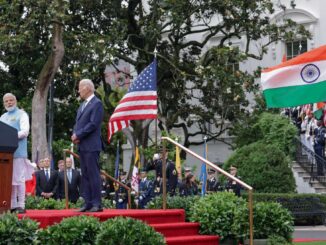
    The euphoria stemming from Prime Minister Narendra Modi’s state visit to the United States in June is yet to subside. All of India continues to savor the images that marked this highly publicized visit. Those with long memories of U.S.-India relations in the past are, hence, left to wonder whether this is the same U.S. that had let India down in the past at crucial moments.

    Two U.S. Presidents in particular, Lyndon B. Johnson in 1963 and Richard Nixon in 1971, are still remembered for their infamous roles in this respect. Johnson for denying aid to India in the wake of China’s perfidious attack on India in 1962, and Nixon during the India-Pakistan conflict in 1971 for sending the U.S. Seventh Fleet steaming up the Bay of Bengal in a show of force intended to deter India from supporting the ‘liberation struggle’ in East Bengal, which ultimately led to the birth of a new nation, Bangladesh.

    This time, there was no room, whatsoever, to doubt in which corner the U.S. stands in relation to India. The promise of the transfer of technology in several areas, most conspicuously in terms of producing fighter jet engines for the Indian Air Force, and holding out the promise of the initiative on Critical and Emerging Technology (iCET) marks a remarkable turn in the American attitude. All this, and with the many more agreements on critical technologies on the anvil, could lead to a quantum jump in India’s military and aerospace capabilities.

    Many are bound to view this as an attempt by the U.S. to persuade India to accept an alliance status, vis-à-vis, the U.S. The fine print on the recent negotiations does not, however, indicate this as a possibility at this time. Strategic ties are certain to attain a new dimension, and the U.S. side certainly hopes it could lead to “a deeper, more effective, and more diverse defense partnership”. Yet, and despite India’s attractiveness to the U.S. as a huge market for goods, and increasingly as a destination for state-of-the-art military items, there are ‘miles to go’ before India is viewed as an alliance partner.

    Perceptions on what constitutes a successful visit often vary, but all things considered, the Prime Minister’s visit to the U.S. this time should be deemed a major success, and as enhancing India’s position as a prime defense technological partner of the U.S. It is certain to not only favorably impact India-U.S. relations but also India’s standing in the world.

    Indian visits then and now

    Every Indian Prime Minister is, of course, entitled to his or her place in the sun. A good visit to the U.S. by an Indian Prime Minister is generally viewed as one clear index of India’s standing in the comity of nations. It is, hence, tempting to compare Mr. Modi’s latest visit with that of other Indian Prime Ministers since Independence. There were visits by Jawaharlal Nehru (he met with Harry S. Truman, Dwight D. Eisenhower and John F. Kennedy), and Lal Bahadur Shastri’s visit never happened in the end), while Indira Gandhi’s visit to Washington as Prime Minister was a disaster of sorts, with both India and the U.S. having their own versions of what transpired. Prime Minister Rajiv Gandhi’s visit was by all accounts deemed a success, breaking many previous shibboleths. Admittedly, none of them matched the euphoria created by the visit of two latter day Prime Ministers, Manmohan Singh and Mr. Modi.

    Only the most foolhardy would possibly attempt a comparison between the visits of Prime Minister Manmohan Singh during his tenure, specially the one in 2005, and Mr. Modi’s latest endeavor. The question uppermost in everyone’s minds would be whether ‘ending nuclear apartheid’ (imposed on India after the 1974 nuclear tests ‘Buddha is smiling’), or the defense technological breakthroughs achieved during the recent visit are more significant for India’s future.

    The civil nuclear deal marked a shift

    Admittedly, the opening up of civil nuclear cooperation between India and the U.S. marked the beginning of a tectonic shift in global affairs at the start of the 21st century, unmatched before or since. Securing a waiver under the Nuclear Non-Proliferation Treaty, and obtaining the approval of the U.S. Congress for the iconic 123 Agreement that paved the way for an India-specific Safeguards Agreement with the International Atomic Energy Agency (IAEA) subsequently, were not merely unprecedented, but one time achievements, the like of which have few equals in the annals of world history. As a result, India today has the freedom to maintain a select number of reactors outside IAEA Safeguards, enabling it to utilize them for military purposes. The freedom India currently enjoys for reprocessing and enrichment are other critical outcomes that stemmed from the visit.

    What is also interesting to note is that all this was achieved despite the entire U.S. Establishment (with the sole exception of President George Bush) being opposed to these concessions — a testimony to the nature of the personal relationship that existed between then U.S. President George W. Bush and Prime Minister Manmohan Singh. Seldom has such a shift been witnessed in the global arena, due solely to the personal chemistry between leaders of two countries — a testimony to the civilizational attributes of the two leaders at the time.

    During Dr. Manmohan Singh’s state visit to the U.S. in 2009, the pièce de résistance was the exchanges between two of the world’s most cerebral leaders at the time, viz., U.S. President Barack Obama and Dr. Manmohan Singh. Mr. Obama’s remarks at the start of his private meeting with Dr. Singh, ‘You are My Guru’, says it all. What followed was an avalanche of results, and there was no obvious quid pro quo expected or sought for. Both in 2005 and in 2009, it was evident that it was India’s reputation as a civilizational entity that seemed to weigh with U.S. leaders at the time.

    Be cautious, look at history

    The United States of the 21st century is certainly different in many respects from the U.S. in the late 20th century. In the euphoria that exists following Mr. Modi’s visit, it is, however, desirable for India to be cautious and heed the lessons of history. India certainly is not, at least at this stage, the kind of ally that the U.S. seeks or demands. Moreover, U.S. politics is currently in a state of flux — more so than at most times in the past. The individual preferences of the U.S. President in office and the ‘swing factor’ in U.S. foreign policy are other aspects that foreign countries, India included, can seldom comprehend adequately. India again is not unfamiliar with the way the U.S. changes its priorities, and friends.

    Consequently, and despite the warmth of the reception accorded to Mr. Modi in Washington, India should realize that it cannot at any time, be the kind of ally that the U.S. seeks. Sober leaders on both sides must also understand that the current euphoria in relations notwithstanding, the situation has been dictated due to circumstance rather than conviction. This must not be lost sight of by India in particular. For instance, India cannot possibly be part of an arrangement such as the AUKUS Pact that binds the U.S. with the United Kingdom and Australia. The fundamentals underlying the Quad (India, Japan, Australia and the U.S.) and AUKUS are very different.

    India must, instead, use the outcome of the Prime Minister’s visit to skillfully function as a ‘bridge power’. It is eminently suited to play such a role, and should not be inveigled — through blandishments such as defense ties — to play the role of a subordinate to the U.S. in the politics of the Asia-Pacific.

    India’s potential should be marshalled to act as a bridge between conflicting parties in the Indo-Pacific, in West Asia and in Europe. This could be the enduring legacy of the Prime Minister’s latest visit to the U.S., which has occasioned so much of interest not only in the U.S. and India, but across the world. It is for India to seize the moment and play its rightful role.

    (M.K. Narayanan is a former Director, Intelligence Bureau, a former National Security Adviser, and a former Governor of West Bengal)

  • Third World War talk that could be hyperbole

    Third World War talk that could be hyperbole

    M.K. Narayanan

    ‘Not all countries are in agreement with the West about the extent of Russian perfidy in the context of Ukraine’. ‘If the two sides were to engage in a nuclear conflict, there would be no victors, and it could only result in a nuclear Armageddon’.

    Apart from the grave consequences in an unlikely West versus Russia nuclear stand-off, there are other inhibiting factors Amidst signs of a further escalation in conflict levels, vis-à-vis the ongoing Russia-Ukraine war — and accompanying new rhetoric of an even wider conflagration in the offing — concerns about the possibility of a Third World War have gone up by several notches. During the past few days what is further evident is that both sides seem intent on enlarging the scale of the conflict, rather than trying to end it.

    Battle cry and response

    This past week, the United States and the North Atlantic Treaty Organization (NATO), buoyed by the perceived success of Ukraine’s resistance to Russia’s aggression, have further raised the stakes by pledging additional packages of lethal weapons to Ukraine (amounting to several millions of dollars), which the West had, till now, refrained from supplying Ukraine.

    Again, in what can only be perceived as a battle cry, the U.S. Defense Secretary, Lloyd Austin, at a meeting of 43 NATO and other countries (held at the Headquarters of the U.S. Air Forces in Europe) declared that what had transpired was a demonstration of the resolve of nations from around the world to support Ukraine in its fight against Russia’s aggression.

    Russia’s response has been equally threatening. When asked about the prospect of a Third World War, Russia’s Foreign Minister, Sergei Lavrov, is on record that the risk, including the possibility of nuclear war, was not inconsiderable and that the situation must not be underestimated. Mr. Lavrov added, “NATO, in essence, is engaged in a war with Russia through its proxy and is arming that proxy.”. He further added that “war means war”.

    The implicit threat by Russia of using nuclear weapons cannot be disregarded. Mr. Lavrov is not the only one to talk of nuclear weapons, for former Russian President, and currently Deputy Chairman of Russia’s Security Council, Dmitry Medvedev similarly warned Sweden and Finland (which are currently not members of NATO) that if they decide to join the U.S.-led military alliance, Russia would not hesitate to deploy nuclear weapons and hypersonic missiles to meet the threat this posed. He ominously added that in such an eventuality, there would be ‘no more talk of a nuclear free Baltic’.

    Nuclear weapon use is taboo

    All the signs are, hence, far from reassuring, and concerns about a nuclear holocaust appear real. Yet, it would be premature to arrive at the conclusion that a Third World War, accompanied by the use of nuclear weapons, is around the corner. One fact stands out loud and clear, viz., that since 1945, and despite occasional ‘nuclear sabre rattling’ by the nuclear weapon powers, the use of nuclear weapons has remained taboo.

    Since the first two atom bombs were dropped on Japan, the destructive potential of nuclear weapons has only increased multi-fold. Nuclear weapons are also no longer the monopoly of any one single power. A nuclear attack by any one of the major nuclear powers — Russia, the United States or China — would bring instant retaliation. Again, the nuclear balance today is unfavorable to the West, for Russia and China, between them, have a combined strength of nuclear weapons which is bigger than that of the West. More to the point, if the two sides were to engage in a nuclear conflict, there would be no victors, and it could only result in a nuclear Armageddon.

    Apart from grave consequences in the event of a nuclear stand-off, there are other inhibiting factors that make a Third World War an unlikely prospect. One current reality is that there are many degrees of separation as regards the Ukraine-Russia conflict, between the views held by the West and quite a few other countries across the world. Not all countries again are in agreement with the West about the extent of Russian perfidy in the context of Ukraine, and this segment includes sizeable sections of the emerging world. Even some countries in Europe not affiliated to NATO remain skeptical about the reasons adduced for U.S. support to Ukraine and hew to the view that the ulterior objective is to restore global belief and faith in U.S. authority and power and make ‘America great again’. There is even less support to the hackneyed theme that Russia today represents ‘the Empire of Evil’. A latent fear among such uncommitted countries is that all-out support to the West, and allowing it to act as judge, jury and executioner, could create problems for many of them in the future.

    Europe’s real concern

    Countries across Europe are also concerned about the costs of the war, more specifically, the cost of rebuilding Ukraine after the conflict. There are many little-known facts in this context on what a prolonged Russia-Ukraine conflict could mean for both Europe and the world that are worth mentioning. For instance, Ukraine and Russia are generally referred to as the ‘breadbasket’ of Europe. A prolonged conflict would have serious consequences for Europe as far as food security is concerned. Furthermore, Europe is still to recover from the adverse impacts of a prolonged novel coronavirus pandemic, and an extended war could damage the economies there even further. As it is, the WTO has downgraded Europe’s trade forecast to 3% from 4.7% for this year. Again, just two companies in Ukraine produce around 50% of the global total neon output — it is a critical gas required for the lasers used in a chip production process known as lithography, ‘where machines carve patterns onto tiny pieces of silicon’. Chip shortages are expected to cause production cuts in the audio, computer and electronic industries. Given all this, a Third World War is hardly the preferred choice of most people, more so in Europe.

    Signs of a Russian restraint

    There is little doubt that Russian President Vladimir Putin’s foray into Ukraine was a serious blunder — a point made by many western leaders, and quite a few others as well. Nevertheless, Russia has not since displayed the same degree of ‘foolhardiness’ that could provoke a wider conflagration. One instance of this that could be mentioned, and which might have led to a serious situation, is Russia’s restraint in the wake of its biggest war-time loss of a battleship since the Second World War (in which one sailor died and 27 are reportedly missing). That Russia demonstrated restraint even after it became known to the world at large that the missile cruiser was hit by a Ukrainian anti-ship missile speaks volumes. To much of Europe and the West, Russia’s response seemed unexpectedly low key. Whether such restraint would continue is a matter for conjecture, but for the present it is indicative of Russia’s unwillingness to enlarge both the area and the intensity of the conflict.

    As of now, Russia is concentrating — or at least seems more interested — in dismembering Ukraine, now that Ukraine’s membership of NATO has been put on the backburner. Moscow is currently eyeing large segments of Ukraine’s East and South, and seems to have given up plans for the present to ‘conquer’ the whole of Ukraine and make it a part of Russia. If Russia persists with its current thinking, then it would denote that Russia is not interested in getting embroiled in a Third World War. For their part, most countries of Europe — unlike NATO and possibly the U.S. — believe that they can continue to live with the new order of things.

    The problem with this latter objective is that it conflicts with the desire of both the U.S. and NATO to exploit the current war situation in Europe to weaken Russia militarily and politically, and incidentally decapitate Mr. Putin politically by undermining his authority and position. This explains the intensity with which the U.S. has mustered its — and NATO’s — capabilities to resist Russia’s invasion of Ukraine and inflict permanent economic and political damage on Russia, and diminish it militarily. That would meet at least two principal objectives that dominate U.S. thinking at present — revitalizing the U.S.-NATO partnership to make it the bulwark of European security and restoring U.S. image in Europe as also across the world.

    It is ‘sober and being softer’

    The current thinking in Europe appears more in line with a softer approach. The re-election of France President Emmanuel Macron was a matter of relief and satisfaction for the U.S. and Europe, but the display of strength by the Far Right is inducing a great deal of rethinking in ruling circles in Europe and underscoring the importance of taking a sober approach to policy issues, avoiding all or any kind of intemperate move. Yet, there are many unknowns that will still need to be dealt with. The West, and specially, the U.S., remains intent on enlarging NATO, and notwithstanding the current Ukraine war, is also probably complicit in the recent announcement by Sweden and Finland of their willingness to join NATO. Being well aware of Mr. Putin’s mind set, it is almost as if the West is daring Russia to react.

    The West and Russia both need to be careful and take due care to negotiate the many minefields that abound. The West should be thankful that Mr. Putin has not yet emerged as a Joseph Stalin, but at the same time they should realize that there are no Churchills, De Gaulles and FDRs [Franklin D. Roosevelt] on their side.


    (The author is a former Director, Intelligence Bureau, a former National Security Adviser and a former Governor of West Bengal)

  • India’s watchwords in a not so bright 2022

    India’s watchwords in a not so bright 2022

    By M.K. Narayanan

    There are risks that could be both domestic and geopolitical and New Delhi must take care to read the signals properly.

    Diplomatically, in 2022, India may find itself vulnerable in dealing with the turmoils which have occurred in two areas of strategic interest to it, viz. Central Asia and West Asia. Both areas are undergoing a churn — not all of it to India’s liking.

    An intense debate is on among political strategists and commentators about what is in store in 2022. Most hew to the view that a rules based international order is a remote possibility. Instead, uncertainty and impermanence are likely to be the dominant aspect in world affairs.

    Risks in 2022 could be both domestic and geopolitical, with many precepts that the world has been accustomed to being at risk. Democracy itself could face serious headwinds this year.

    A paramount issue as 2022 begins, is the future of democracy. Admittedly, the world has recently seen the rise of authoritarian rulers in many countries — though by itself this can hardly be viewed as a new phenomenon. What is worrisome is that democratic tenets which have been under attack in recent years appear set to face more onslaughts this year. Adding grist to concerns about democracy’s future, is that the United States, which was widely viewed as a major bulwark for democracy, appears to have developed certain pathological infirmities. This situation does not augur well for the future of democracy worldwide.

    China as disruptor

    Equally daunting as we enter 2022 are the geopolitical challenges and risks. The role of China is possibly the most disrupting one, given the challenge it poses to the existing international order. With a GDP of $15.66 trillion in 2020, its net worth today is estimated to be higher than that of the U.S.; and, hence, it demands to be recognized as much. Militarily, China is openly challenging U.S. supremacy in many areas, including ‘state-of-the-art weaponry’ such as hyper-sonic technology.

    China has abandoned the ‘one country two systems’ policy, stripping Hong Kong of its freedom and inviting international opprobrium. It is now threatening Taiwan, which could well become one of the flash points of conflict in 2022. The West meanwhile does not realize what could happen if the stakes of ‘cross-strait relations’ between China and Taiwan get higher in 2022. It might well be that in order to ‘save face’ with regard to Taiwan (which China regards as its territory); China could provoke a serious conflict.

    The dip in China’s economic profile in the past year and more (which China hardly acknowledges) could also lead to new tensions in the Asia-Pacific region in 2022. To outsiders, the Chinese economy has entered a period of relative uncertainty and is looking more vulnerable. Under Chinese President Xi Jinping, however, China is unlikely to acknowledge that this would entail any reduction in its military capabilities, at least as far the Asia-Pacific is concerned. Instead, it might well be tempted to demonstrate that it still has the ability to get the better of the U.S. in the Pacific region — where it holds more cards than the U.S. — and also demonstrate that it has the ability to ramp up its military capabilities, while the U.S. is reducing its forces in the Indo-Pacific region. Uncertainty per se, could constitute a serious risk.

    Russia-Ukraine conflict

    The other major risk of a war in 2022, stems from the ongoing conflict between Russia and Ukraine — the latter being backed by the U.S. and North Atlantic Treaty Organization (NATO) forces. It is difficult to discern as to which side is indulging in provocation, but what is not contested is that during the past three decades, NATO has expanded its reach almost 1,000 miles to the east in violation of an earlier tacit understanding. Russian President Vladimir Putin appears determined that Ukraine should be the ‘last frontier’ and, if need be, ensure this through military force. The situation has grave possibilities and could result in a series of cyclical outcomes with considerable damage potential.

    Apart from the grave risk of a possible war or conflict, what is also evident is that ‘peace is not at hand’ across vast regions of the globe in 2022. The current unrest in Kazakhstan, which till recently was one of the more stable Central Asian nations, is perhaps symptomatic of what is in store. Whether recent events in Kazakhstan reflect a new round of ‘color revolutions’ or not, it demonstrates a sharper cleavage between the U.S.-led West and its principal opponents, Russia and China. This bodes ill for a world already wracked by a series of coups or internecine strife as in Ethiopia, Libya and certain regions of West Asia and North Africa.

    Return of the Taliban

    Of particular significance to India is that the Taliban’s return to power in Afghanistan has led to a material shift in the balance of power in an already troubled region on India’s periphery. Notwithstanding the general belief that the Taliban’s return to power represents a significant victory for Pakistan, it has become evident, more lately, that this comes with a great deal of baggage — both for Pakistan and much of Asia. Developments in Afghanistan have fueled the ambitions of quite a few ‘anti-state militant groups’ across the region. Even in Pakistan, the Tehrik-e-Taliban Pakistan (TTP) has become energized and is enlarging its sphere of action to other parts of Asia, notably Kazakhstan. More important is that it is well known that the TTP is a by-product of al Qaeda jihadi politics and still has covert links with the al Qaeda. This will have an unsettling effect across large parts of Asia.

    Adding to such concerns is new evidence that on India’s eastern flank, viz. Indonesia, a resurgence of radical Islamist activities is taking place. The Jemaah Islamiyah has reportedly become more active in Indonesia. All this provides fertile ground for other radical Islamist terror groups to enlarge their activities across the Asian region, providing a fillip to groups like the Islamic State, especially the Islamic State of Khorasan.

    Border issues for India

    As 2022 dawns, India’s problems are only likely to intensify. The most serious issue that India confronts today is how to deal with a China that has become more confrontational. The transgressions across the Line of Actual Control in different sectors in Ladakh — which were till now seen as merely an attempt by China to restrict and limit India’s options — could well be expanded in 2022. India’s membership of the four nation Quad (the U.S., Japan, Australia and India) still rankles as far as China’s psyche is concerned, and during 2022, may well result in China embarking on new adventurist actions at many more points on the Sino-Indian border compelling India to react. Hence, 2022 is unlikely to see any reduction in tensions across Ladakh, Arunachal Pradesh and the Middle Sector.

    Additionally, India will need to determine how best to respond to China’s saber-rattling. India will need to develop a strategy on how to counter the publicity given by China to its low-yield nuclear weapons meant for battlefield use even during conventional military operations and against conventional targets. India would need to strengthen its military posture, both as a means to deter China and also to convince India’s neighbors that it can stand up to China. Simultaneously, India cannot avoid, in 2022, suitably positioning itself on how best to deter China’s naval force projection in the Indian Ocean Region and the publicity it has given to the additions made of new type nuclear power ballistic missile submarines to their existing fleet. In the battle of wits and strength, much will depend on how India responds to the situation.

    Diplomatically, in 2022, India may find itself vulnerable in dealing with the turmoils which have occurred in two areas of strategic interest to it, viz. Central Asia and West Asia. Both areas are undergoing a churn — not all of it to India’s liking. In Central Asia, India will be challenged on how best to manage its traditional friendship with Russia with the pronounced tilt seen more recently in India-U.S. relations. In West Asia, the challenge for India is how to manage its membership of the Second Quad (India, Israel, the United Arab Emirates and the U.S.) with the conflicting interests of different players in the region. Membership of the Quad makes India a key player in a region which has become a quagmire of intense rivalries notwithstanding the 2020 Abraham Accords. Indian diplomacy will be under severe test to manage the extant situation in both regions.

    Path to tread

    It is easy to say that what India and India’s foreign policy need to do is to demonstrate more flexibility to manage the contradictions that exist. However, this is hardly feasible in practical terms, in most instances. There is a limit to the kind of balancing act that India can perform, whether it be with regard to buying S-400 missile systems from Russia, risking potential sanctions from Washington under Countering America’s Adversaries Through Sanctions Act (CAATSA) or maneuvering between the Arab States, Israel, Iran and the U.S. in West Asia.

    For India, the outlook is, hence, not particularly bright in 2022. No grand strategy is evident as of now but it is important that India finds rational answers to a rash of problems that it cannot keep on the back burner for much longer. What India must do is avoid blind spots that arise due to cognitive bias and take care to read the signals properly. Facing a host of unprecedented challenges, India’s leaders and diplomats must not only take stock of the dangers that exist but also be ready on how to manage the risks that are well evident.

    (The author is a former Director, Intelligence Bureau, a former National Security Adviser and a former Governor of West Bengal)

  • The global war on terror grinds along

    The global war on terror grinds along

    Notwithstanding some temporary setbacks, the broad contours of terrorism remain much the same

    M.K. Narayanan

    “Two decades of the Global war on terror did not, however, eradicate terrorism. Notwithstanding leadership losses, including that of leaders like bin Laden and al Baghdadi, and despite organizational fracturing and territorial degradation, terror groups such as al-Qaeda and the IS today pose a persistent challenge. Hard intelligence on the myriad terror modules has been hard to come by and the absence of a single core for either al- Qaeda or the IS, is making it even more difficult to assess the true nature of the threat that looms. It would be tempting for intelligence agencies to think that the current low-tech attacks, involving small arms, the occasional use of Improvised Explosive Devices, and random ‘lone wolf’ attacks reflect the weakening of terror modules, including that of al-Qaeda and the IS. Nothing could be more misleading. Not only the major terror groups but even smaller terror modules currently retain the potential for both sophisticated and mass casualty attacks.”

    Two decades after September 11, 2001, when al-Qaeda carried out its most audacious attacks ever on American soil, leading to the Global war on terror and triggering the invasion of Afghanistan by the United States, it might be worthwhile to do a fact check on the outcome. More so given the latest turn of events, which has seen the return of the Taliban in Afghanistan, leading to the question as to whether the Global war on terror was a failure. Also, are there lessons to be learnt from it?

    A perspective

    In retrospect, it is possible to surmise that the 9/11 attacks were the sum total of a series of systemic and structural shortcomings of the U.S. security establishment. Seldom mentioned, it was also, perhaps, the failure of human imagination. No one in the U.S. establishment imagined that an attack on this scale could take place. It is unclear whether even today security agencies in the U.S. and elsewhere are better positioned in this respect.

    Historians surmise that Osama bin Laden’s actions were inspired as much by geopolitical as they were by religious objectives, and that he was obsessed by the ‘sufferings of Muslims’ in many far-flung regions. He believed — mistakenly — that delivering a decisive blow against the U.S. by an action such as 9/11 would force the U.S. to alter its policies in many areas of conflict.

    Osama bin Laden failed to succeed in his attempt, and over time it was al-Qaeda that faced the wrath of not only the U.S., but the rest of the world as well. Osama bin Laden’s aims to destroy the ‘myth of American invincibility’ failed, but since then, the world has witnessed prolonged periods of uncertainty as also the spawning of many more terror groups worldwide. The Global war on terror did, however, neutralize fears that terrorism was poised to create large-scale mayhem across the globe.

    Several reasons could be attributed to bin Laden’s failure. It would seem, in hindsight, that bin Laden and other leaders associated with al-Qaeda such as Ayman al-Zawahiri, other jihadi leaders such as Abu Bakr al-Baghdadi of the Islamic State (IS) or Mukhtar Abu Zubair of Al-Shabab, all lacked the centrality of vision or power so essential to sustain the momentum of an initiative of this kind. Moreover, while in the initial stages, Afghanistan — and to an extent, Pakistan — provided safe havens (which together with the presence of several disparate terror groups in a common milieu provided powerful unifying forces for disparate groups), the situation changed once the safe havens were no longer available. In addition, the lack of visibility of the leaders of the movement over time and diminished authority also contributed to dissipation of the terror momentum and the capacity for militancy and violence.

    Persistent challenge

    Two decades of the Global war on terror did not, however, eradicate terrorism. Notwithstanding leadership losses, including that of leaders like bin Laden and al Baghdadi, and despite organizational fracturing and territorial degradation, terror groups such as al-Qaeda and the IS today pose a persistent challenge. Hard intelligence on the myriad terror modules has been hard to come by and the absence of a single core for either al- Qaeda or the IS, is making it even more difficult to assess the true nature of the threat that looms. It would be tempting for intelligence agencies to think that the current low-tech attacks, involving small arms, the occasional use of Improvised Explosive Devices, and random ‘lone wolf’ attacks reflect the weakening of terror modules, including that of al-Qaeda and the IS. Nothing could be more misleading. Not only the major terror groups but even smaller terror modules currently retain the potential for both sophisticated and mass casualty attacks. History is, therefore, more relevant and important when assessing future threats such as terrorism. The broad sweep acquired by radical Islam in recent decades has, by no means, been eliminated. Terrorism, stemming from a mixture of religious fervor and fundamentalist aims, remains vibrant. The newer breed of terrorists may be less familiar with the teachings of the Egyptian, Sayyid Qutb or the Palestinian, Abdullah Azzam, but they are well-versed in the practical methodologies practicedby the Jalaluddin and Sirajuddin Haqqanis (the latter is a Minister in the Interim Afghan Government), Hafiz Saeed of the Lashkar-e-Taiba (LeT) and Maulana Masood Azhar of the Jaish-e-Mohammed (JeM), etc. Hence, it is possible to surmise that notwithstanding some temporary setbacks caused by the Global war on terror, the broad contours of terrorism, especially Islamist terrorism, remain much the same.

    A grim warning

    The return of the Taliban in Afghanistan, after humiliating the combined forces of the U.S., the North Atlantic Treaty Organization (NATO) and the Afghan Armed Forces is a grim warning of what lies in store for the neighborhood. Apart from giving radical Islam a fresh lease of life and a new thrust, it has come at a time when the democratic world is demonstrating a diminishing appetite to fight terror away from their own ‘locales’, thus leaving the field wide open to the forces of Terror Inc., of which the Taliban is an indispensable entity. Several terror groups which possess varying capabilities such as al-Qaeda, the IS, the Daesh across Asia, the LeT, JeM and the TRF (The Resistance Front, which is backed by the LeT) in India, the Al-Shabab in Africa, etc., are certain to feel energized and gain a fresh lease of life.

    In India

    One can already see emerging signs of what can be expected in Afghanistan given that its capital, Kabul, has been wracked by a series of bomb blasts, reflecting a more intensified intra-denominational strife which has the potential to become a ‘prairie fire’. Nearer home, Kashmir is beginning to see a new wave of terror attacks reviving grim memories of the 1990s. Targeted killings of minorities have begun to send shockwaves across not only Jammu & Kashmir (J&K), but many other pockets of the country. Given the prevailing scenario, the dice is heavily loaded against India, with J&K being in the cross-hairs of several terror factions, further complicated by Pakistan’s efforts to aid and abet them through the use of its ‘regulars’. That Sirajuddin Haqqani, a Pakistani acolyte, holds a key position in the new interim Government of Afghanistan, makes it easier for forces inimical to India in the region, essentially Pakistan, to wage an ‘undeclared war’ against India.

    While the past is often a good guide to the future in comprehending what shape terror could manifest itself going forward, it is even more important to recognize the paradigmatic changes beginning to take shape in the practice of violence in different parts of the world. The emerging shape of terror and terror attacks during coming periods is likely to be very different from what many of today’s experts possibly anticipate. While ‘Zero-day’ attacks like New York (9/11) and Mumbai (26/11) are still very much on the drawing board of terror groups, it is also known that a new breed of terrorists is experimenting with newer forms of terror, especially the possibility of ‘enabled or remote-controlled terror’. This is a frightening prospect.

    The forms of ‘new era’ terror

    Intelligence and terror specialists must begin to anticipate how to deal with ‘new era terrorists’, recruited over the Internet, who would thereafter be guided through different steps, over a sustained period, by anonymous handlers located elsewhere. This is not science fiction. There is already evidence of the existence of remote controllers who choose the targets, the actual operatives, the nature of the attack itself, and even the weaponry to be used, operating behind a wall of anonymity. Internet-enabled terrorism — a completely new genre of terrorism — would be very different from what we have seen so far.

    Linked to this is the threat posed by cyber-terrorism. Digital sabotage has already entered the armory of certain terror groups. Cyber sabotage is a distinct possibility in certain situations today. It is well-known that terror groups that have state backing, have the capacity today to employ cyber techniques to carry out hostile attacks on the ICT-enabled infrastructure of another country. While little is talked about these aspects, the reality is that the limits of human imagination have become the virtual parameters of terror threats today.

    (The author is a former National Security Adviser and a former Governor of West Bengal)