Tag: MADHYA PRADESH

  • Case against Giriraj Singh for racist remark

    Case against Giriraj Singh for racist remark

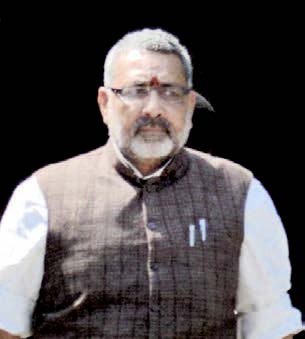
    NEW DELHI (TIP): A complaint was filed against Union Minister Giriraj Singh in a district court on April 2 by a Congress worker for his racist remarks against Congress president Sonia Gandhi.

    Sanjay Kumar Singh filed a complaint against Giriraj Singh in the court of Chief Judicial Magistrate Ved Prakash Singh, who transferred the case to the court of Sub-Divisional Judicial Magistrate Anju Singh.

    The SDJM directed Mithanpura police station to register a case against the minister on the basis of the complaint, Sumit Kumar, lawyer of the petitioner, said.

    The SDJM gave the order to Mithanpura police station under Section 166 of IPC (public servant disobeying law with intent to cause injury to any person).

    Meanwhile, Sonia Gandhi said she would not like to respond to people with narrow mindset. “I don’t think it is proper to respond to persons having narrow mentality,” Gandhi told reporters after surveying the damaged crops and meeting farmers in Neemuch district in Madhya Pradesh. Giriraj Singh had kicked up a row with his remarks asking whether Congress would have accepted Sonia Gandhi’s leadership had she not been white-skinned. “Had Rajiv Gandhi married a Nigerian woman and if she was not a white-skinned woman, would the Congress have then accepted her leadership?,” he told journalists on Tuesday. Various women leaders also attacked Singh, who is Minister of State for Micro, Small and Medium Enterprises, saying it reflected his racial mindset and attitude towards women. The Minister, who had courted controversies with remarks during Lok Sabha elections like people opposed to Narendra Modi can go to Pakistan, also mocked Rahul Gandhi’s absence from the political scene and likened it to the “missing Malaysian airliner”. Meanwhile, to a query on Congress Vice President Rahul Gandhi’s sabbatical, Sonia Gandhi said, “Rahul will come back soon and he will soon go in the midst of farmers.”

  • Strangers in their own land: Dilemma of the Christian populace in India

    Strangers in their own land: Dilemma of the Christian populace in India

    Mr. Julio Ribeiro, Retired IPS officer, former DGP of Mumbai and Gujarat recently said: ‘As a Christian, suddenly, I am a stranger in my own country’. He was merely reflecting on the recent dilemma of the Christian community in India since the ascendance of Mr. Narendra Modi as Prime Minister of India. It is indeed the anguish of a distinguished public servant who has served the country with great zeal and dedication to protect and preserve its territorial integrity.

    Today, scores of Indian Christians who have contributed in so many ways towards the development of India especially in the social and educational sectors are pained to feel the same way as Mr. Ribeiro does!As a Christian and a member of the Diaspora, I truly share the sentiment of Mr. Ribeiro and salute him for his forthrightness in speaking out.

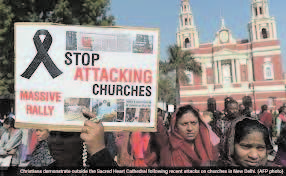
    What exactly has happened to bring about such anxiety and insecurity to such a small community that poses no harm to its fellow citizens? The latest reports from India point to two more attacks  targeting the Christian religious places of worship, one at St. George Church in Navi, Maharashtra and the other at St.Peter and Paul Church at Jabalpur, Madhya Pradesh, along with two schools that are managed by the churches. Incidentally, both Maharashtra and Madhya Pradesh states are governed by Prime Minister Modi’s party-BJP.

    These may have happened at the heel of another incident in Nadia district in West Bengal where a 72 year old Nun was gang raped by six individuals at the Jesus and Mary convent school. Reacting to the gang rape of the Nun, Surendra Jain, Joint Secretary of the Vishwa Hindu Parishad (VHP) blamed the ‘Christian Culture’ for the incident. He also justified the vandalizing of a Church in Haryana and stated that these attacks would continue if conversions do not stop.Church Attacks In India

    Several Churches in Delhi were vandalized and desecrated by religious extremists in the past months including St. Sebastian Church in Dilshad Garden which was reduced to ashes with its altar charred and Bibles strewn all over the ground. Archbishop Anil Couto said that the arson in St. Sebastian Church was condemnable not just because it was act of sacrilege and hate against the community and its faith, but because it could happen in the national capital which is recovering from a series of communal incidents. Also distressing to him is the sense of police impunity that long hours were lost, and possible evidence destroyed, before police finally came. Most of the culprits still remain at large and the law enforcement officials seem to show very little urgency in bringing them to justice.

    These incidents are not just limited to certain parts of India but happening across the country. The recent incident in a village in Chattisgarh reveals the fear and insecurity of those who have embraced Christianity as their faith. Sukhram Kashyap, a Christian from Chattisgarh, has not only seen his church vandalized but was denied food rations from the Hindu dominated village council and several of his friends were beaten up when they protested. Some of his fellow worshippers were reconverted in an aggressive campaign called ‘Ghar Wapasi’ by Hindu fundamentalists who have also banned any Christian clergy from entering the village.

    Breaking a long silence on this continuing onslaught by the Hindutva brigade on Christians and their Institutions around the country Prime Minister Modi said the following; ‘the tradition of welcoming, respecting and honoring all faiths is as old as India itself’. One wonders whether his ardent followers in BJP and RSS are listening!

    The President of Catholic Bishops Conference of India Cardinal Baselios Cleemis said that the recent attacks on churches and Christians in India have made many ‘feel that their Christian identity is being questioned and it gives a sense of sadness. It showed that not everybody had taken seriously the Prime Minister Narendra Modi’s assurance to minorities’. ‘Irrespective of their faiths, anybody being attacked was an Indian citizen and it was the government’s duty to protect them’ Cardinal added.

    In an interview to Karan Thapar on Headlines Today, Cardianal Cleemis also described as “very painful and sad” the comments of RSS head Mohan Bhagwat that Mother Teresa’s humanitarian works were driven by her motive to convert those she served. “It was very painful and very sad to hear about Mother Teresa whom the nation honored with Bharat Ratna,” he said.

    There is no doubt that that Cardinal Cleemis spoke on behalf of all Christians in India that may very well include many of the faithful in the Diaspora. Although he did not single out any organization over many of these incidents but went on to criticize the Modi government for observing Christmas as Good Governance Day, saying good governance should be done everyday and the Christian festival should be respected.

    One of the most astounding observations that can be made about these attacks on minorities in India is that there is a deafening silence on the part of the Diaspora in the US. Hindu American Foundation, Vishwa Hindu Parishad of America, and GOPIO along with many other organizations have decided to look the other way. Though relatively new as immigrants to this great country, Indians continue to demand our rightful place, justifiably so, at the table in sharing the riches and defending our values and traditions while not tolerating any injustice that offends our sensibilities. A huge segment of the community has indeed made tremendous strides in this short period realizing the American dream and integrating itself into the mainstream.

    However, Christians in India who have lived there for almost two Millennia are made to feel as if they are strangers in their own land. How a personal choice of faith that is guaranteed under the article 25 and 26 of the Constitution of India could make or break the ‘Indian ness’ of its citizenry is beyond the comprehension of any rational mind!  

    Undoubtedly, the forces of polarization and divisions have come out of the woodwork and kept themselves busy transforming India at the expense of the values and principles of inclusiveness and tolerance that brought the nation together. The current Government’s dual-track policy of providing good optics for the consumption of the global community while unleashing the extremist forces to undo the social progress of the last 65 years, mostly under the Congress rule, is troublesome and disheartening to most of its citizens!

    President Obama in his Siri Fort speech prodded the new Government ‘India will succeed so long as it is not splintered along the lines of religious faith, as long as it is not splintered along any lines and it is unified as a nation’. It sounds prophetic and to plainly put it, unless the Prime Minister reins in these extremist elements that run amok now, his dream of ‘modern India’ could be in increasing peril!

  • SWINE FLU TOLL REACHES 1,587, BUT SHARP FALL RECORDED IN DEATHS FROM DISEASE IN MARCH

    SWINE FLU TOLL REACHES 1,587, BUT SHARP FALL RECORDED IN DEATHS FROM DISEASE IN MARCH

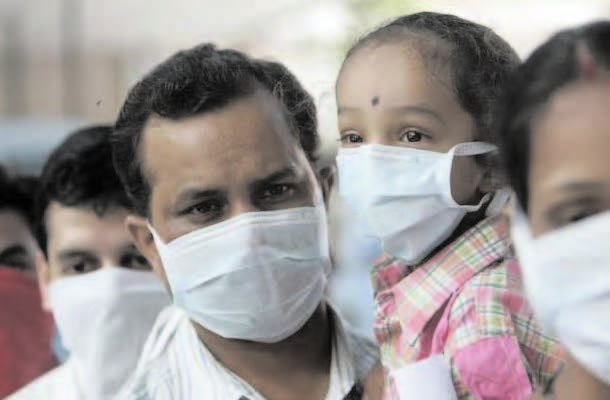
    NEW DELHI (TIP): India’s swine flu outbreak appears to be waning, with the week ending March 8 recording a sharp fall in weekly deaths, which had plateaued at around 270 since February 8, shows surveillance data from states.

    India reported 199 deaths last week, which is down by almost 25% over the numbers recorded over the past three weeks.

    Till March 11, 27,888 cases and 1,587 deaths have been reported from all 36 states and UTs except five, shows data from the Union Ministry of Health. Over the past 24 hours, 20 deaths were reported from across India.

    “Swine flu cases have registered a downward trend over the past 10 days, with deaths also declining during this period. The Union Ministry is in constant touch with states and is providing them the necessary support,” Union Minister of Health and Family Welfare Jagat Prakash Nadda.

    The only states/UTs untouched by swine flu with no cases or deaths are Arunachal, Meghalaya, Sikkim, Tripura and Lakshwadeep.

    People between the ages of 31 and 60 years accounted for two in three deaths, shows an analysis of 832 deaths for which data is available. Children under 12 years were the least affected in the current outbreak, accounting for 4% of overall swine flu deaths.

    The swine flu outbreak devastated five states, with Rajasthan, Gujarat, Maharashtra, Madhya Pradesh and Telangana accounting for 78% of the total deaths till March 8.

    Again, more than three in four infections (76%) were reported from five states: Rajasthan, Gujarat, Delhi, Maharashtra and Telangana.

    Delhi has emerged as the best-performing state in controlling infection – while the state 3,658 cases, only 10 deaths have been reported from Delhi and the NCR.

    Surveillance data shows that virus shows no gender bias and has affected an almost equal number of men and women: of the 832 deaths studied, 425 were men (51%) men and 407 (49%) women.

    Swine flu spreads through droplets expelled when an infected person coughs or sneezes or by touching surfaces contaminated by the droplets. You can protect yourself by staying away from infected persons, frequently washing hands with soap, and cleaning surfaces with disinfectant or warm water regularly.

    Symptoms include high fever, extreme breathlessness, lethargy, pain in the chest, loss of appetite and nausea or vomiting.

    Three pharma companies in India – Hetero, Natco and Strides Acrolab – are manufacturing oseltamivir, the drug used to treat swine flu. Having the anti-viral prescription drug oseltamivir (better known by one of its brand names, Tamiflu) shortens the duration and severity of illness if the taken within 48 hours of the symptoms appearing. It also makes people less contagious and prevents them from infecting others. Oseltamivir also protects against other strains of influenza, such as influenza A (H3N2) virus, which accounted for 87.5% influenza A cases in the northern hemisphere.

  • Adding Fuel to Fire – Congress claims ‘Secret pact’ between PDP, BJP over Masarat Alam

    Adding Fuel to Fire – Congress claims ‘Secret pact’ between PDP, BJP over Masarat Alam

    Senior Congress leader Abhishek Singhvi took to Twitter to take a dig at the Prime Minister and BJP over Alam’s release. “A party constantly speaking on nationalism & against separatism & terrorism in opposition now supine & impotent against coalition compulsions!,” he tweets.

    Uddhav Thackeray seeks criminal case against Mufti Sayeed, asks whether a CM has right to release people like Masarat Alam, say media reports.

    Madhya Pradesh Youth Congress stages a silent protest against Masarat Alam’s release.

    Members of various organizations including Shiv Sena, Kranti Dal hold protest in Jammu as they demand immediate re-arrest of Alam while asking the BJP to come clean on the issue.

    Life remains normal in the state despite a two-day shutdown call given by the Panthers Party in Jammu against the release of Masrat Alam at state Chief Minister Mufti Muhammad Sayeed`s orders.

    On Alam’s release, Communist Party India (CPI) leader D Raja says, “We have heard what our Prime Minister has said but the government in Jammu and Kashmir is a coalition government….The BJP cannot absolve its responsibility. The Bharatiya Janata Party (BJP) should own responsibility and explain its position.”

    Senior Congress leader Saifuddin Soz says, “Hurriyat shouldn`t go to the Pakistan High Commission to discuss politics because it is not going to benefit them. Hurriyat should instead talk to Government of India and the Government of India should also open a dialogue with them. That is the only option; there is no point in initiating dialogue with Government of Pakistan.”

    “I assure the House that after the clarification from the state government, if needed, we will issue a strong advisory,” Rajnath says in Lok Sabha.

    In an another tweet the HMO writes: “The Central govt is not satisfied with the J&K Home Dept. report. We have sought clarifications from the State.”

    The official twitter handle of Home Minister Rajnath Singh’s office (HMO) tweets: “Centre has got a report from J&K Home Dept on the release of Masrat Alam.It says he has been granted bail in all cases against him.”​

    BJP lawmakers in Jammu and Kashmir demand immediate arrest of hardliner Masarat Alam. “BJP strongly opposes and rejects the decision to release Masarat Alam and believes that the conduct of Alam, after his release and the statements made by him and situation existing now, are fresh inputs to consider his fresh detention under PSA immediately in the interest of the security of the state,” says state BJP General Secretary Rajiv Jasrotia.

    Criticising BJP for its “suicidal surrender and U-turn on its jingoistic rhetoric” on the release of hardline separatist leader Masarat Alam, Jammu and Kashmir National Panthers Party (JKNPP) says the party had compromised on all its policies for the sake of power. “We accuse BJP for its suicidal surrender and U-turn on its jingoistic rhetoric. The state unit of BJP owes an explanation to the people of state for its criminal silence over the spate of announcements and measures announced by PDP in furtherance of its highly controversial agenda,” JKNPP Chairman, Harsh Dev Singh tells reporters.


    In Srinagar, Masarat Alam tells reporters: “Mufti Sayeed should not try to take political mileage out of it. I was released through a normal legal procedure since my Public safety Act (PSA) detention was about to end in the next two to three days.” “What difference does it make if one person is released when there are thousands languishing in jails,” he adds while denying that he had been responsible for the killings of youths during the 2010 unrest in the Valley. “It was Omar Abdullah and not me who is responsible for those killings,” says Alam.  

    BJP legislators meet Jammu and Kashmir Chief Minister Mufti Mohammad Sayeed at his residence over Masarat Alam’s release. 

    Saying that Masarat Alam’s release is not a big deal, separatist leader Syed Ali Shah Geelani says the accusations against the Hurriyat hardliner are untrue.

    Talking to a news agency, Hurriyat Conference chairman Syed Ali Shah Geelani says India should accept the fact that Jammu and Kashmir is a disputed territory and not a part of India. Calling Jammu and Kashmir Chief Minister Mufti Mohammad Sayeed’s praise of Hurriyat as a mere political stunt, Geelani opined that there will be no change in Kashmir.

    Taking a jibe at the BJP, former Jammu and Kashmir chief minister Omar Abdullah says a CM has to be trusted to decide what is in the interest of his/her state. On microblogging website Twitter, Abdullah says:

  • INVESTMENT PROPOSALS DON’T MEET PROMISES

    INVESTMENT PROPOSALS DON’T MEET PROMISES

    NEW DELHI (TIP): Investment proposals by corporates are generally associated with improving business sentiment and often linked with the possibility of job creation. The comparison of proposed investment with actual implementation and job creation in the past 23 years, however, shows that the actual delivery has fallen well short of the promise.

    Data from the department of industrial policy and promotion shows that between August 1991 and March 2014, the government received about 94,000 investment proposals. These proposals include Industrial Investment Intentions through Entrepreneurs Memorandum — IEMs (delicensed sector) and Direct Industrial Licences (licensable sector).

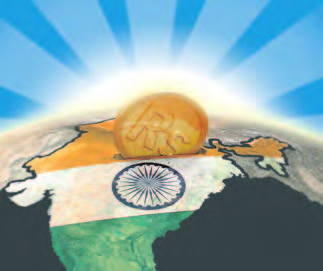
    Put together, these proposed the investment of more than Rs 102 lakh crore and were supposed to create 2.3 crore jobs. The data on actual implementation of these proposals shows that only Rs 5.1 lakh crore was actually invested and just 20.1 lakh jobs created. That’s less than 5% of the proposed investments and 8.9% of the promised jobs.

    A state-wise analysis of proposals shows that between August 1991 and March 2014 corporates proposed to invest Rs 15.4 lakh crore in Orissa —the highest in the country. It was followed by Gujarat and Chhattisgarh receiving over Rs 10 lakh crore of proposed investments and Maharashtra just a tad below that mark. Overall, there were 15 states, which were each supposed to get over Rs 1 lakh crore of investments in these 23 years.

    When one analyses actual investments, Haryana has been the most successful among these 15 states in converting proposals to reality as 18.9% of the proposed money actually reached the state. It is followed by Gujarat (12.6%) and Uttar Pradesh (11.4%). The states that fared the worst in this conversion are Bihar, Jharkhand, Chhattisgarh and Orissa, where less than 1% of the proposed money actually arrived.

    So, what is the investment to job creation ratio? Overall, the Rs 5 lakh crore actually invested created a little over 20 lakh jobs, which amounts to four jobs per crore of investment. There were 25 states which witnessed the actual investment of more Rs 1,000 crore. Among these states, Jammu and Kashmir witnessed the most labour intensive investments, while Gujarat had the most capital intensive ones. Every crore of rupee invested in Jammu and Kashmir created about 12 jobs, while in Gujarat a crore of investment yielded only two jobs.

    In the investment to job creation ratio, Jammu and Kashmir is followed by Goa, Uttarakhand, Kerala and Punjab, where ten or more jobs were created per crore of investment. The worst state/UTs in this list are Madhya Pradesh, Jharkhand, Daman & Diu, Uttar Pradesh and Gujarat.

  • 134 companies enter final coal block race

    NEW DELHI (TIP): Altogether 134 of the 176 companies that queued up for 21 producing coal mines have been found technically qualified to make their financial bid, coal secretary Anil Swarup said on Thursday.

    Adani group, Jindal Steel and Power Ltd, Balco, Essar Power MP Ltd, GMR Chhattisgarh Energy Ltd, GVK Power, JSW Energy, Reliance Cement Company Ltd, Ambuja Cement, Hindustan Zinc, Sesa Sterlite are some of the major companies whose bids have been found technically sound.

    Of the 134 bids that were qualified, 12 are for Gare Palma IV/7 mine in Chhattisgarh, making it the most sought-after block. Balco, Hindalco, JSPL, Jaiprakash Associates Ltd, Monnet Ispat & Energy Ltd, Rungta Mines Ltd, Ultratech Cement are among the 12 interested bidders.

    Amelia (North) block and Bicharpur mine, both in Madhya Pradesh, have attracted 10 bidders each.

    The government had initially planned to auction 23 mines in the first lot but has put on hold bidding for two mines due to litigations. Swarup said the coal ministry would go ahead with the auction as per schedule, though there have been some changes due to court cases.

    “Consequent to an interim order of Jabalpur (High Court), the auction of two mines has been put on hold in schedule II (producing mines). These are Gotitoria East and Gotitoria West,” Swarup said.

    The ministry, he said, had put both the blocks in the unregulated sector (steel, cment, captive power) but the court directed that they be considered for regulated sector (power). “This will require a lot of study … so right now (only) these two mines have been put on hold ….,” he said.

    Swarup said in case of Schedule III mines (ready to produce) there are three blocks that have been taken out of auction process consequent to the order of the Delhi High Court.

    “We are referring this to a technical committee which will re-examine it in the context and as per the directives of the high court,” Swarup said, adding that in all, five blocks have been impacted by two court orders.

  • Friends of MP Conclave draws thousands

    Friends of MP Conclave draws thousands

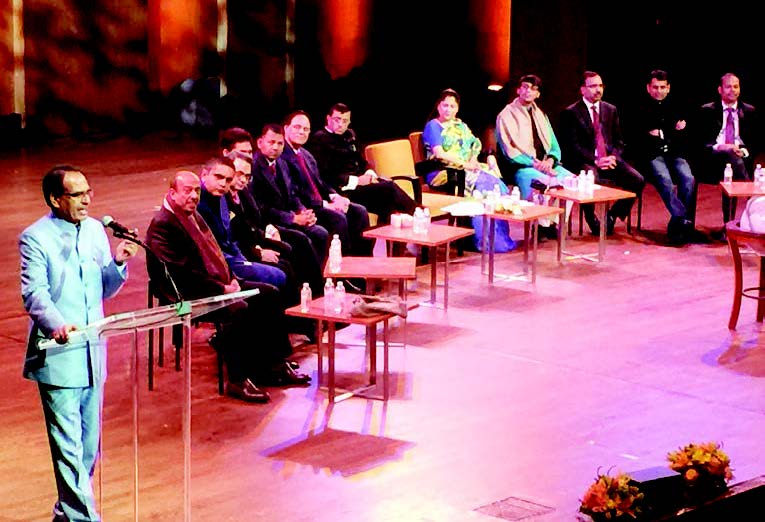
    NEW YORK CITY (TIP): “I am here to make friends”, said Madhya Pradesh Chief Minister Shivraj Singh Chauhan, amid applause from the audience, at the Friends of MP conclave at the iconic Avery Fisher Hall at Lincoln Center in New York City, February 1.


    Despite inclement weather more than 3000 people traveled to the centre of New York  to cheer Shivraj Singh Chouhan, when he arrived here to launch the initiative to connect the global  citizens with Madhya Pradesh and India. On the second day of his six-day visit to the tri-state area on  the US East Coast, Chauhan formally launched the Friends of Madhya Pradesh initiative (www.friendsofmp.com).


    The website is the  first of its kind of initiative by any state in the country following suggestion by  Prime Minister of India Narendra Modi that sought the creation of a global talent pool as a network of its friends anywhere in the world.


    Amid claps of a full house filled with NRIs, state senators, US congressmen and congresswomen, and other important business and community leaders from across New York, New Jersey, Long Island, Connecticut and other neighborhoods, beats of drums and dholaks, the fluttering of national flag, Chief Minister  and guests on the dais formally inaugurated the website friendsofmp.com by putting hands on the globe that symbolized the connected world and with that the site went live on a giant screen right above the stage.


    In his half-hour Hindi speech interrupted by loud applauses at several intervals and slogans in praise of Bharat Mata (Mother India) on various occasions, the chief minister stated that his government for the last decade has not only been undertaking welfare measures, but also useful employment-generating programs that have changed the face of the state.


    With GDP at  11.08 percent and more than 20%   rise in agricultural production in the last several years, the state has become one of the fastest growing states in the country.


    Citing estimates and positive outlook, he said India would soon overtake China in economic growth and Madhya Pradesh will take a significant part in that process.


    He mentioned that after Narendra Modi became the prime minister in May 2014, the self-confidence level of Indians-inside and outside the country-has risen in a significant way. Now  no longer the “policy paralysis”, the hallmark of the previous government, exists at the Center and in states.He added that Modi is not just the leader of India, but he is on the path to becoming a world leader. He spoke of the assets of his state-  a 24-hour power supply, availability of enough water, and calm and peaceful industrial climate. Around 26,000 hectares of land bank has been created to cater for potential investment and industrial opportunities. Steps are being taken to ensuring up to 30 percent police force is female in order to tackle more efficiently the crimes being perpetrated against women.


    He spoke about several issues that included religious harmony, America-India relations, and BJP’s determination in providing good governance and clean administration.


    Chief Minister  honored the recipients  of recent Padma awards on the occasion and praised their contributions and sought their services to India in general and the central state in particular.


    “I bring the best wishes of 7.5 crore (75 million) residents of Madhya Pradesh to you all,” he said. “You contributed to this society immensely and now you must do the same to India, your motherland.”


    A view of the gathering singing the American National Anthem Photos/ TIP- Prashant Desai-pradev98@yahoo.com 732-318-0130
    A view of the gathering singing the American National Anthem Photos/ TIP- Prashant Desai-pradev98@yahoo.com 732-318-0130
    Singing the national anthem
    Singing the national anthem

  • Friends of Madhya Pradesh Conclave on February 1

    Friends of Madhya Pradesh Conclave on February 1

    Friends of Madhya Pradesh Conclave on February 1 at Avery Fisher Hall, Lincoln Center


    NEW YORK CITY (TIP): The Government of Madhya Pradesh, India, in association with, the Consulate General of India, New York, will be organizing the “Friends of Madhya Pradesh Conclave” at the Avery Fisher Hall, 10 Lincoln Centre Plaza, New York, NY 10023, on Sunday, 1st of February, 2015.


    “Friends of MP” is a talent pool of individuals of Indian origin, or otherwise, living outside MP, who are passionate about becoming a part of the State’s success story. This initiative is aligned to the vision of the  Prime Minister of India, who suggested that each state should constitute its own global talent pool as a network of its friends —  wherever in the world they may be, and utilize their experience and talent for the country’s development.


    Madhya Pradesh has taken a lead in creating such a talent pool with the involvement of the vast and widespread well-wishers of MP all  over the world. Through a web-enabled platform, five sectors – education, health, skill development, rural development and tourism would initially be thrown open for engagement and would be further expanded in due course. The “Member Friends” can share an idea, sponsor a project or undertake volunteer work.


    The first conference of “Member Friends” is being held in the United States of America. Chief Minister of MP, Shri Shivraj Singh Chauhan, will be visiting the US and will launch the “Friends of MP” initiative at the “Friends of Madhya Pradesh Conclave” in New York city on 1st February 2015 at 10.00 am.


    All interested associations, groups and individuals are invited to join the Conclave. A simple registration process has been set up to facilitate the invitees. Please visit www.friendsofmp.com for further details.

  • PBD 2015 ROUND-UP

    PBD 2015 ROUND-UP

    Chief Ministers beckon overseas Indians to cash in on Investment opportunities in States

    GANDHINAGAR (GUJARAT) (TIP), January 9, 2015. Chief Ministers of as many as 9 States made a strong pitch for investments by overseas Indians as they laid bare the opportunities and facilities for investors here today at the CMs session on the concluding day of the three-day Pravasi Bharatiya Divas. Presiding over the session, Mr. Rajnath Singh, Union Home Minister, said that the real Bharat was the villages of India and therefore it was important to develop villages to ensure a balanced and an inclusive growth.

    He added that every state in India has a success story to tell and have been able to make a mark in one sector or the other. The Central government, he said, believed in promoting cooperative federalism and therefore the States and the Centre have to work in tandem to make India an economic super power. NRIs, he said, will have to play an important role in fulfilling the Centre’s

    ‘Make in India’ vision.

    GUJARAT: ‘Smart State’ is the mantra of the State Government for which a five-point agenda has been adopted. These are smart schemes for welfare, smart economy, smart governance, smart energy and smart human resources. These schemes are expected to help the Indian diaspora to channelize the flow of investments into the State, set up industrial units and contribute to the social sector schemes to light up the lives of the common man. Kerala: Some of the path-breaking projects being undertaken by the State Government are: e Kochi Metro Rail project, Smart City Project, Vizhinjam port development, Light Metro Rail, Kannur Airport Project, Surface Transport Development, National Waterway and a Student Entrepreneurship Programme. These projects demonstrate that this is the right time to invest in the State and be part of the overall growth of the State. The State Government will offer full support to all who extend their help in further developing the State. Kerala has seen a rapid increase in its growth performance. The state has the highest literacy rate, best human development indicators and has many structural advantages such as a vast coastal line and high productivity due to historical reasons.

    PUNJAB: The immediate investment opportunities in the State are in the fields of IT, bio-sciences and healthcare and futuristic development of 147 cities and towns. The focus areas of the government are agro and food processing, education & skills, electronics manufacturing, textiles & garments and infrastructure development. The top five reasons for investing in Punjab are: easiest place to do business, robust infrastructure, abundant skills and enterprise,responsive, accountable & transparent governance and fiscal incentives. A lot of facilities have been initiated for the NRIs in the State of Punjab. A special court has been set for NRIs in the State to expedite the process of litigation, special police thanas have been put in place and a special commission has been set up to address property related issues of the NRIs.Jharkhand: The State Government offers ample opportunities to investors to partner in sectors such as industry and industrial infrastructure, electronics & IT/ITeS, road & road transport infrastructure, skill development, knowledge & education, healthcare, power generation & distribution, tourism, hospitality, leisure & entertainment and urban infrastructure. The key enablers for attracting investments are nearness to natural resources, skilled manpower due to existing industrial base, investor friendly policies and land bank. To leverage these enablers through a comprehensive and partnering module, the Government of Jharkhand has focused on industrial and economic development of the state through implementation of various infrastructure projects on PPP format.

    MADHYA PRADESH: The State has come a long way from being counted amongst the BIMARU states. It has state-of-the-art infrastructure including roads, power, railways etc. The state has been witnessing double digit growth and has the most investment friendly environment. The industrial policy of the state is investor friendly, the state is very peaceful and there are no man day losses and has single window clearances. The State houses India’s best national parks and world heritage sites.

    ANDHRA PRADESH: The state of Andhra Pradesh has a long coast line and is the gateway to India and south east Asia, has 30 urban centres, extensive road and rail network, natural gas and 24X7 power, young and skilled population and deposits. The state is looking at building five grids- water, gas, power, road and fibre. It has a very strong agriculture and marine and diary sector besides having a niche in high technology sectors like information technology. The state has formulated specific policies to give customised impetus for thrust sectors like industry, port, electronics, textile and agro processing. Also, a land bank has been created with 400 thousandhectares of land. The state is ideally poised for river linking and has the potential to become a drought proof state in the next 5 years.

    MAHARASHTRA: The state of Maharashtra is a land of investment opportunities. The State Government has started fast tracking approvals, simplifying processes and initiated the process of reducing timelines to facilitate investors, inflow of FDIs and make the state conducive for ease of doing business. The state has commenced work in full earnest to take ahead Prime Minister Narendra Modi’s call for ‘Make in India’. The State offers immense opportunities for infrastructure development as the government is planning to create a new urban city which would be bigger than the city of Mumbai. Also, the Government looks forward to providing affordable housing to middle and lower strata of society, and hence the State invited the Pravasis to take advantage of these investment opportunities.

    GOA: The State possesses talented human resource, natural reserves, captivating beauty which makes a great tourism destination. The Goa Government has now identified thrust areas such as creation of knowledge hub, focus on R&D, pharmaceuticals, biotechnology, aviation, aerospace, defence, IT, agro-based & food processing industries, to synergize its efforts with the ‘Make in India’ campaign of the Prime Minister. The aim is that the fruits of development percolate to the underprivileged of the society.

    HARYANA: The state of Haryana witnessed rapid growth in various sectors and is also an integral part of Delhi’s National Capital Region. Earlier, known as an agricultural state, Haryana has come a long way and now witnesses the presence of some of the well-known multinational companies. Haryana is focusing on skill development for both its urban and rural population toprovide them with employment opportunities, particularly, in MSMEs. Known for achieving milestones in sports, the Government desires to establish Haryana as a ‘Sports Hub’.

  • Cabinet clears Rs 5 lakh compensation to 1984 anti-Sikh riot victims

    Cabinet clears Rs 5 lakh compensation to 1984 anti-Sikh riot victims

    NEW DELHI (TIP): A proposal to give Rs 5 lakh each to the kin of victims of the 1984 anti-Sikh riots, triggered after assassination of the then Prime Minister Indira Gandhi, has been approved by the government on December 10 night. The decision has been taken by the Union Cabinet at a meeting presided over by Prime Minister Narendra Modi. The compensation to the families of the riot victims will be given in addition to what they have so far received from the government and other agencies, official sources said. Of the 3,325 victims, 2,733 were killed in Delhi alone while rest of the victims were from Uttar Pradesh, Haryana, Madhya Pradesh, Maharashtra and other states.

    The Narendra Modi government had received several petitions from various Sikh organisations in the last three months. The fresh compensation, which will cost the exchequer Rs 166 crore, sources said. The anti-Sikhs riots were triggered following the assassination of the then Prime Minister Indira Gandhi by her Sikh bodyguards on October 31, 1984. In 2006, the UPA government led by Prime Minister Manmohan Singh had announced a package of Rs 717 crore which included monetary compensation of Rs 3.5 lakh to the kin of each killed in the riots besides financial assistance to the injured and those who had lost their property.

    Out of this only, Rs 517 crore had been spent and the remaining Rs 200 crore could not be distributed because of dispute over claimants. The most affected regions were the Sikh neighbourhoods in Delhi. Some of the anti-Sikh riot cases are still continuing in courts and many Sikh organisations have alleged that the key conspirators of the violence were at large and victims have not yet got justice. In 2005, then Prime Minister Manmohan Singh had apologised for the 1984 anti-Sikh violence saying Gandhi’s assassination was a “great national tragedy” and what happened subsequently was “equally shameful”. “I have no hesitation in apologising to the Sikh community. I apologise not only to the Sikh community, but to the whole Indian nation because what took place in 1984 is the negation of the concept of nationhood enshrined in our Constitution,” he had said.

  • Botched sterilizations: Fungus-laden anaesthesia used at health camp

    Botched sterilizations: Fungus-laden anaesthesia used at health camp

    RAIPUR (TIP): It was not just antibiotics laced with rat poison (zinc phosphide) that was administered on victims of botched surgeries at Bilaspur health camps, local anaesthesia injected on women at the Gaurella camp in the district were laden with fungus. One woman died after tubectomy at this camp. Sources said a few batches of fungus-ridden Lignocaine injection, used as anaesthesia, were supplied by Indore-based company Kabra Drugs. Though government withdrew the stock of contaminated injections from the government hospital and health centres, officials admit these injections were used at the Gaurella camp. Health commissioner Pratap Singh said though fungus was found in 3 batches of Lignocaine, vials were removed last September.

    He said the company had been blacklisted for 5 years. Pratap said Chhattisgarh Medical Services Corporation (CGMSC) had been procuring and supplying injections from the company since September, 2013, and the last batch was received earlier this month. “We do stability tests on stocks. It was a manufacturing glitch on vials, which developed spores and fungus was detected on Wednesday evening,” he said. Data available at CGMSC website show around 2.37 lakh vials (30 ml each) of Lignocaine injection from batches recalled by the government are still in stock. About 13,836 units are in the Bilaspur warehouse. This is the second instance in less than four months when drugs procured by CGMSC have been found contaminated with fungus. In July, the corporation recalled 98 batches of the intravenous fluid bottles manufactured by a Madhya Pradesh company, DJ Laboratory, after detection of fungus

  • Ex-coal secretary HC Gupta, two govt officials get bail

    Ex-coal secretary HC Gupta, two govt officials get bail

    NEW DELHI (TIP): Former coal secretary and four others, including two serving government officials, were today granted bail by a Special Court in connection with a coal blocks allocation scam case. The five accused including H C Gupta and two senior serving government servants K S Kropha and K C Samaria appeared before the court in pursuance to the summons issued against them and sought bail in the case. After hearing the arguments, Special CBI Judge Bharat Parashar granted bail to all the accused.

    Besides Gupta, the then Joint Secretary, Kropha, and the then Director (Coal Allocation-I section), Samaria, Managing Director of Madhya Pradesh-based firm Kamal Sponge Steel and Power Ltd (KSSPL) Pawan Kumar Ahluwalia, Chartered Accountant Amit Goyal and authorised representative of the company appeared before the court. All of them were already summoned as accused for offences under sections 120-B (criminal conspiracy), 409 (criminal breach of trust by public servant) and 420 (cheating) under the IPC. Only Gupta has been summoned before the offences punishable under the Prevention of Corruption Act.

    The court had summoned them as accused in the case while refusing to accept the closure report filed by the CBI in the case pertaining to alleged irregularities in the allocation of coal block to KSSPL. The court had yesterday allowed CBI to carry out further probe in the case, saying the agency may place records of the case before the authorities for grant of sanction to prosecute the public servants. The court had also asked CBI to file a progress report of its further investigation on December 15 and said the agency should be at a liberty to probe any other aspect of the matter if found necessary by them.

    On October 13, the court had summoned six accused including Gupta, Samaria, Kropha and KSSPL. Refusing to accept the CBI’s closure report, the special court had observed that the probe carried out by it was “sketchy” and its conclusion “apparently wrong”. The court, in its detailed order had noted that no cognisance of offences under the Prevention of Corruption Act could be taken against Kropha and Samaria for want of sanction as they are still in government service.

    The case pertains to alleged misrepresenting of facts, including inflated net worth, by KSSPL to acquire Thesgora-B/ Rudrapuri coal block in Madhya Pradesh. According to CBI, KSSPL had allegedly given false statement about its annual turnover for two financial years that is 2004-2005 and 2005-2006 in their application form while applying for coal block allocation. CBI had earlier told the court that officials of KSSPL had furnished unaudited balance sheet and had allegedly inflated its capacity to produce sponge iron by 25 per cent.

  • BJP TO ROLL OUT BIG GUNS FOR ASSEMBLY POLLS

    BJP TO ROLL OUT BIG GUNS FOR ASSEMBLY POLLS

    NEW DELHI (TIP): With Dussehra over, BJP will get into campaign mode for the Haryana and Maharashtra assembly polls on a war footing.

    Prime Minister Narendra Modi and his senior ministers will have little time for anything else, criss-crossing the two states over the next two weeks, addressing rallies. BJP plans to hold at least four big rallies a day in each state till campaign ends for the October 15 polls.

    Modi will begin his charge on Saturday morning from Karnal in Haryana and move to Maharashtra to address three rallies in Beed, Aurangabad and Mahalakshmi (Mumbai). The PM will address 8-10 rallies in Haryana and around 22 in Maharashtra.

    Two senior ministers — home minister Rajnath Singh and external affairs minister Sushma Swaraj — will be all over Haryana on Saturday, holding four rallies each in the state. Singh will be at Radaur, Kalayat, Julana and Jakholi Rai while Swaraj will address rallies in Kalka, Thanachhapar, Shahbad and Gohana. Singh will address about 15 rallies in each state.

    The party has decided to have Swaraj, who belongs to Haryana, focus on the state where BJP is contesting on its own and is aiming to replace the Congress government. Similarly, road transport minister Nitin Gadkari has been asked to concentrate on Maharashtra, his home state, where BJP is contesting without its 25-year-old partner Shiv Sena this time.

    Swaraj is scheduled to address about 22 rallies in Haryana and will be in Maharashtra only for a day on October 6, attending three rallies. She will take a break from campaigning as she is travelling abroad between October 8 and 10. Gadkari is expected to address about 36 rallies in Maharashtra.

    Party veteran L K Advani will address six rallies in Maharashtra and two in Haryana, while Murli Manohar Joshi will address two rallies in Maharashtra and one in Haryana.

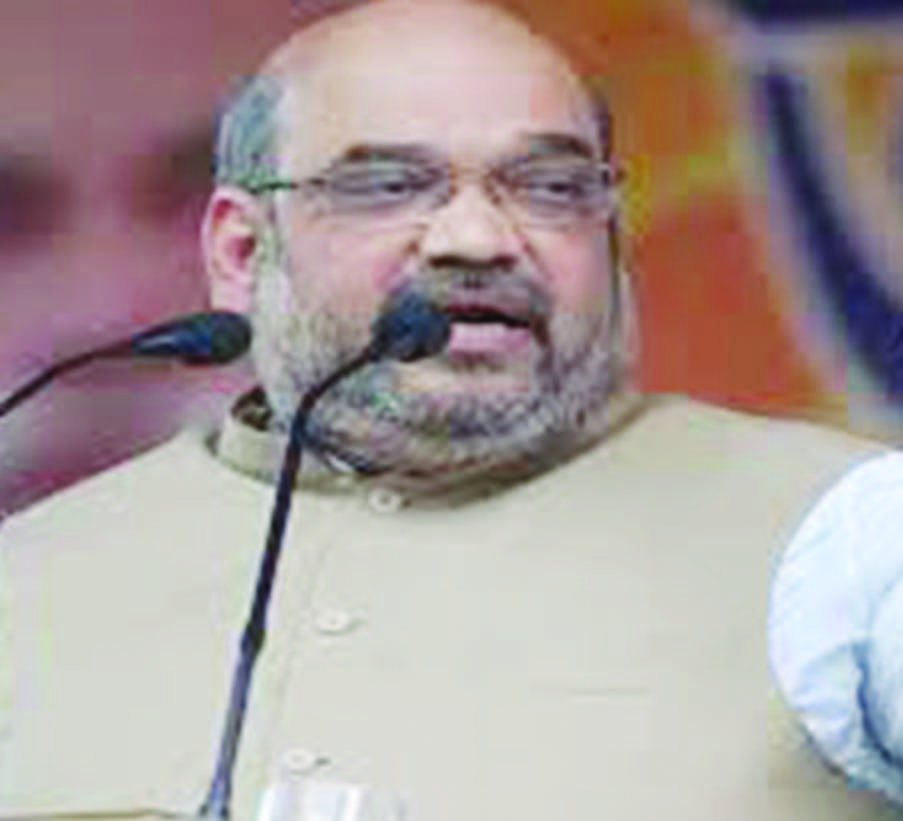
    Urban development minister M Venkaiah Naidu is slated to spend four days in Maharashtra and two in Haryana. Other ministers who will address a few rallies in both states are chemical and fertilizer minister Ananth Kumar, HRD minister Smriti Irani and social justice minister Thawar Chand Gehlot. Party chief Amit Shah will address about 15 rallies in each state.

    The party has roped in all its chief ministers to ensure its good governance campaign is showcased. Goa CM Manohar Parikkar will focus on Maharashtra while Madhya Pradesh CM Shivraj Singh Chouhan will spare three days for Maharashtra and one for Haryana. Rajasthan CM Vasundhara Raje has three days in Maharashtra and two days in Haryana, Chhattisgarh CM Raman Singh and Gujarat CM Anandiben Patel will each spend two days in Maharashtra. On an average, the chief ministers will address three rallies a day, party vice-president M A Naqvi said.

    Not to forget its star power, BJP has roped in actor-turned-MPs Hema Malini, Vinod Khanna and Shatrughan Sinha to campaign in both states.

  • By-poll results shock BJP

    By-poll results shock BJP

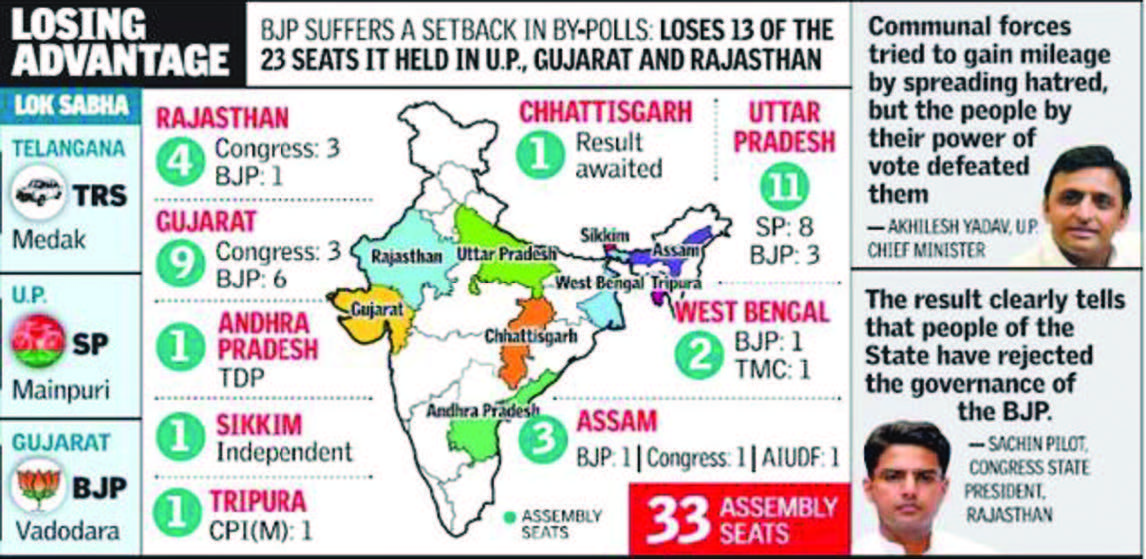
    New Delhi (TIP): The results of the Assembly byelections have come as a blow for the BJP in Uttar Pradesh, Rajasthan and Gujarat — the states it had swept in the Lok Sabha polls four months ago — losing 13 of the 24 seats held by it. Of the 32 Assembly seats across nine states for which counting of votes was held today, the BJP won 12, Congress seven and Samajwadi Party eight while TDP (Andhra), Trinamool Congress (West Bengal), AIUDF (Assam) and CPM bagged one each. One seat in Sikkim was won by an Independent.


    This is the third consecutive setback for the saffron party after its disappointing performance in Assembly byelections in Bihar, Uttarakhand, Karnataka and Madhya Pradesh in the past two months. All 11 seats in Uttar Pradesh, Gujarat (9) and Rajasthan (4) were held by the BJP and the bypolls were necessitated after the sitting MLAs were elected to the Lok Sabha. It was Uttar Pradesh — the party’s recently acquired stronghold where the BJP managed a near-total sweep in the LS elections — that delivered a humiliating blow to the saffron party as it lost seven of the 11 seats held by it, including the one held by its ally, the Apna Dal.


    The BSP’s absence in the byelections had made it a virtual straight fight between the SP and the BJP in the politically crucial state. BJP strongman Amit Shah was credited with crafting the spectacular win for his party in UP in the Lok Sabha polls. The party lost six out of 13 seats in Rajasthan and Gujarat, where it’s in power. Lost for words, BJP leaders could not even blame rival parties for playing foul in the elections. Senior BJP leader Rajiv Pratap Rudy said the results “deserve a small introspection”. “This is not a national mandate. It is a localised issue.


    Surely, it is a wake-up call for better planning in the upcoming Haryana and Maharashtra Assembly elections,” he said. Senior leader Uma Bharti dismissed questions about efficacy of the “Modi wave” saying “state leaders and workers need to introspect.” It was a significant comeback by the SP, which won eight out of 11 seats in Uttar Pradesh —and the Congress, which trounced BJP on three out of four seats in Rajasthan. “The people of the state have given a befitting reply to the communal forces and clearly expressed their desire for harmony and brotherhood,” said a beaming UP CM Akhilesh Yadav.


    Among BJP’s big losses is the Rohaniya seat, which falls within Modi’s parliamentary constituency Varanasi. The saffron party just about managed to hold to its own in Modi’s home state Gujarat, winning six out of nine seats. Rajasthan Chief Minister Vasundhara Raje was left re-faced as the Congress won three out of four seats. One of the seats — Surajgarh—was being contested by her close aide Digambar Singh who lost to Shravan Kumar of the Congress by 3270 votes.


    The BJP had swept the Lok Sabha and Assembly elections in the desert state earlier this year. High on the win, Rajasthan Congress chief Sachin Pilot advised the “BJP to take a lesson from these elections and introspect” The BJP retained Kota South, losing Surajgarh, Weir and Nasirabad to the Congress. The only silver lining for the BJP was the inroads into WB where it has won Basirhat Dakshin (South) seat.

  • BJP GETS THE JOLT IT DESERVED

    BJP GETS THE JOLT IT DESERVED

    The folly of polarization boomerangs

    Normally no great importance is attached to by-elections in this country which should explain why no Prime Minister has ever canvassed during them. Interestingly, Congress president Sonia Gandhi and her son and party vice-president Rahul Gandhi have stuck to this routine even after losing power. During the most recent by-elections to 33 assembly and three parliamentary seats, the Congress’ First Family chose to be abroad.


    38


    It must have regretted this because it lost the opportunity to celebrate the jolt the Bharatiya Janata Party has suffered exactly four months after its spectacular success in the parliamentary poll under Narendra Modi’s leadership. Particularly prominent is the saffron party’s overwhelming defeat in the politically key state of Uttar Pradesh where it had won 71 of the 80 Lok Sabha seats on May 16. This time around it has surrendered eight of 11 assembly seats to the Samajwadi Party that rules the state even though the latter’s own record is conspicuously poor.

    Even more hurtful to the BJP is that the Congress that was virtually wiped out in the Lok Sabha elections has wrested from it three assembly seats each in the BJP’s bastions, Rajasthan and Mr.Modi’s Gujarat. In UP, however, the Congress has drawn a complete blank. Having slid in nine of the 10 states where by-elections were held, the BJP has a cause for comfort only in West Bengal, where it has wrested a seat from Chief Minister Mamata Banerjee’s Trinamool Congress. From the day the Modi government came to power, there have been 50 by-elections across the country.


    39


    Of these the BJP and its allies have won only 18 and lost all others. The reason for this serious setback is crystal clear and it is writ large on the political landscape.Mr. Modi may have spoken about development and good governance in the past. Those in charge of the by-elections or chief campaigners in the by-elections never used these expressions. Arrogantly confident of coming to power in this most populous state in 1917, the BJP adopted the wrong, disruptive and dangerous strategy of polarization along religious lines. “Love jihad” was one of its favorite slogans.

    As time passed, the tone of the BJP’s UP leaders – such as the president of the party’s state unit, Lakshamikant Bajpai, and the saffron-clad Yogi Adityanath, a five-time MP and the principal campaigner in the state – became more provocative and indeed poisonous. It is noteworthy that neither Prime Minister Modi, nor party president Amit Shah, nor any other senior leader did anything to restrain the Hindutva hotheads. On the contrary, their silence greatly encouraged those spewing venom.

    The situation is not without irony. At a time when Bajpai and Yogi Adityanath were shouting hoarse about “love jihad”, an oxymoron that is supposed to mean that Muslims were busy luring Hindu women to marry them and then convert to Islam, the country’s Home Minister and a former president of the BJP, Rajnath Singh, told a press conference that he didn’t know what “love jihad” was. Exactly at that time, Sakshi Maharaj, another saffron-wearing BJP leader in UP, harangued his audience and the media not only about “love jihad” but also about “education in terrorism”.

    He thundered that madrasas were teaching “terrorism” to their pupils and “motivating” youth to lure women of other religions with “offers of cash awards – Rs 11 lakh for an affair with a Sikh girl, Rs 10 lakh with a Hindu girl and Rs 7 lakh for a Jain girl”. Not to be left behind, Usha Thakur, a BJP MLA in Madhya Pradesh who is also the vice-president of the party unit in the state, made another startling disclosure: At the prolonged Hindu festival of Garba, according to her, Muslims joined in large numbers. Consequently at the end of this festival every year, four and a half lakh Hindu women were converted to Islam.

    Yogi Adityanath reaffirmed that wherever in India the proportion of Muslims in the population was 35 per cent or more “non- Muslims could not be safe”. At this stage no less a person than Union Cabinet minister Maneka Gandhi intervened to declare that “profits made from the trade in slaughtered animals was financing terrorism” and to demand that the slaughter of all animals should be “banned completely”. If this strange and highly controversial statement went relatively unnoticed the reason is that by-election results had started coming and it was immediately obvious that the electorate in UP had rejected with contempt the BJP’s strategy to polarize and divide the country along religious lines.

    An accompanying development of significance is that the Election Commission took note of some of Yogi Adityanath’s “hate speeches” and “use of religion for electoral purposes”. He has been asked to explain why requisite action should not be taken against him. An earlier FIR against the BJP’s national president Amit Shah, issued by the UP police, was set aside by a district judge. The critically important need now is for the BJP to abandon its dangerously disastrous electoral strategy of polarization that has already boomeranged.

    So Mr. Modi must give priority to this for two reasons, and make up his mind on the subject because he alone can take crucial decisions. The first reason is that assembly elections are due in Maharashtra and Haryana very soon, and the saffron party would be courting huge trouble if it repeats in these two states what it did in UP. It should fully exploit the heavy anti-incumbency the Congress has piled up against itself in both these states. The second reason is that in view of the worsening of the overall situation, our duty is to promote communal harmony, not communal hatred.

    (The author is a senior journalist and editor.)

  • Advani, M M Joshi axed from BJP parliamentary board

    Advani, M M Joshi axed from BJP parliamentary board

    NEW DELHI (TIP): The generational shift in BJP was complete on August 26 with its founders Atal Bihari Vajpayee, L K Advani and Murli Manohar Joshi being dropped from the BJP parliamentary board, the highest decision-making body headed by BJP president Amit Shah, which has the stamp of Prime Minister Narendra Modi all over now.

    In a token gesture, ailing Vajpayee along with Advani and Joshi, for long the BJP’s ‘Trimurti’, now figure in the new five-member ‘margdarshak mandal’ (guiding group) after being associated with the party for nearly four decades. Three-time Madhya Pradesh chief minister Shivraj Singh Chouhan and party general secretary J P Nadda are the new entrants to the BJP parliamentary board which was reconstituted by newly-appointed chief Amit Shah. The two have also been included in BJP’s central election committee, which decides on the party candidates to be fielded in elections.


    42
    MM Joshi


    The 12-member parliamentary board chaired by Shah now has Modi, Rajnath Singh, Arun Jaitley, Sushma Swaraj, Venkaiah Naidu, Nitin Gadkari, Ananth Kumar, Thawarchand Gehlot, Shivraj Singh Chouhan, Jagat Prakash Nadda and Ramlal as its members. New BJP president Amit Shah initiated the changes after consultations with top BJP leaders and Prime Minister Narendra Modi. For the two veterans, who were not considered for positions of power in the new saffron regime because they were over 75 years, this will be a far more significant blow.

    For Advani, the exclusion from the board is part of a procession of setbacks that the veteran has suffered since he was overruled on whether Narendra Modi should be projected as the party’s PM candidate. The leadership had also shrugged aside the argument of Advani’s loyalists that he should be sponsored for the post of Lok Sabha Speaker. “When a generational shift has taken place and when need for accommodating fresh energy and ideas has finally been recognized, we need to make room for others who are more in tune with the requirements of the changed times,” a senior party leader said.

  • Cong hoarding wants Priyanka to lead party

    Cong hoarding wants Priyanka to lead party

    BHOPAL (TIP): A day after Union finance minister Arun Jaitley alleged that the Congress was facing a “palace coup”, the party in Madhya Pradesh added fuel to the fire by putting-up a hoarding of Priyanka Gandhi in a busy thoroughfare. Congress workers appealed in the poster that Priyanka Gandhi should join the party to strengthen the hands of AICC president Sonia Gandhi and party vice-president Rahul Gandhi.


    Congress workers Rahul Singh Rathore, Prashant Gurudev and Udayveer Singh (all of who are office-bearers of the Bhopal district Congress) put-up the hoarding at the Board Office square in the city appealing that it is the demand of lakhs of the party workers that Priyanka Gandhi should actively lead the party. At the PCC office, state Congress vice-president Manak Agarwal agreed with the demand displayed in the banner. He said, “The Congress party is headed by Sonia Gandhi and Rahul Gandhi. But Priyanka Gandhi should also become part of this leadership. It will only benefit the Congress party if she too leads from the front. And if she joins, the Congress will gain immensely in the upcoming assembly elections in five states.”

  • MPPEB scam: Most wanted Sudhir Sharma surrenders in court

    MPPEB scam: Most wanted Sudhir Sharma surrenders in court

    BHOPAL (TIP):

    Sudhir Sharma, a mining baron most wanted in Madhya Pradesh Professional Examination Board (MPPEB) scam turned himself in at Bhopal court on July 25 morning. He reached the court with his family members and a few ‘bouncers’ at 11.50am. On run since May, Sharma was given an ultimatum to present himself in court before July 28 by CJM Pankaj Singh Maheshwari during a last hearing on July 22.

    Special Task Force (STF), which is investigating the scam, had moved application in the court to attach Sharma’s properties under the Special Act after he failed to appear on the previous deadline July 21. A cash award of Rs 5000 was also declared on any information leading to his arrest by the probe agency. However his lawyer Pratulya Shandilya appeared in the court on the said date and sought extension of deadline for surrender on certain grounds, which was granted.

  • Lok Sabha site names Advani a journalist, Rahul a strategy consultant

    Lok Sabha site names Advani a journalist, Rahul a strategy consultant

    BHOPAL (TIP): Former deputy prime minister and BJP patriarch LK Advani is a journalist by profession and Congress vice-president Rahul Gandhi is a strategy consultant, according to the Lok Sabha website. Strangely, the nation’s top two politicians and members of the 16th Lok Sabha do not have politics as their profession in their profile on the portal. A Madhya Pradesh-based activist has written to Lok Sabha Speaker Sumitra Mahajan to check this crucial information and rectify it if found wrong.

    “When they contested elections, Advani stated in his affidavit he was a social worker by profession and Rahul said he was a member of Parliament,” activist Chandra Shekar Gaur said. “I have also requested the Speaker to ensure that contact details like email id and official phone number of Prime Minister Narendra Modi should also be provided on the website as he’s also an MP. If complete details of other MPs are provided, then why should Modi be an exception? It will help people to connect with the prime minister whom they have elected,” Gaur, a resident of Neemuch, said.

  • Juned Qazi is appointed President of INOC(I), USA

    Juned Qazi is appointed President of INOC(I), USA

    NEW YORK (TIP): Dr. Karan Singh, Chairman, Foreign Affairs Committee of All India Congress Party has communicated his acquiescence on the appointment of Juned Qazi as the new INOC(I) President effective June, 11, 2014, said George Abraham, Chairman of INOC (I), in a written statement sent to The Indian Panorama. Juned has been associated with the Congress Party for a long time.

    He was one of the aspirants for Aligarh Parliamentary seat in the just concluded elections. In USA, he is the founder President of Madhya Pradesh Chapter of INOC (I). George Abraham Congratulated Qazi on his appointment and offered his full support and wished him every success in the exercise of his mandate. Juned Qazi said he was grateful to Dr. Karan Singh for reposing his confidence in him and pledged to strengthen the organization and work in accordance with the established rules and procedures.

  • Sumitra Mahajan is elected 16th Lok Sabha Speaker

    Sumitra Mahajan is elected 16th Lok Sabha Speaker

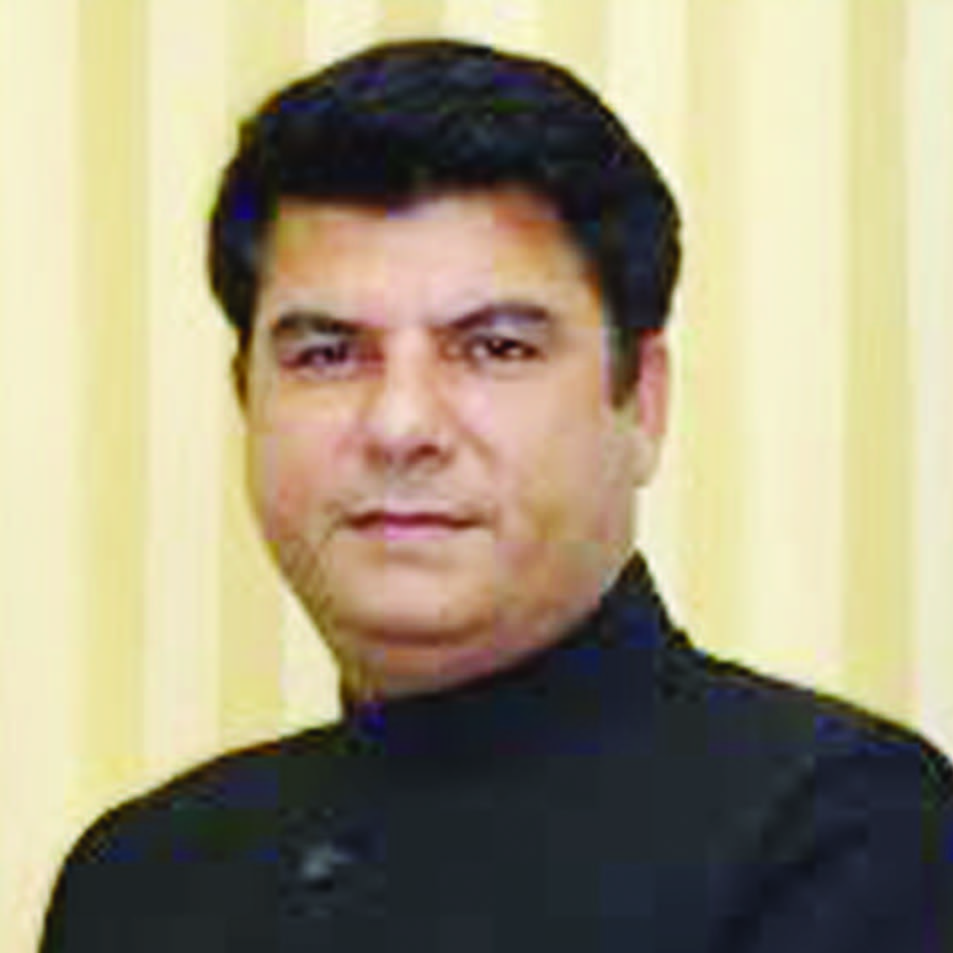
    NEW DELHI (TIP): The soft spoken “Tai” (elder sister) Sumitra Mahajan, an eight-time BJP MP, has been elected the 16th Lok Sabha Speaker. She is a battle hardened leader who has risen from the ranks to the top post. Interestingly, the official name of 71-year-old Mahajan, the eldest and senior-most among women Members of Parliament, in the 16th Lok Sabha MPs’ list is also mentioned as “Sumitra Mahajan (Tai)”.

    Mahajan will be the second woman after Meira Kumar to be elected to the august office of Lok Sabha Speaker. Starting her political life at the age of 39, Mahajan became the deputy mayor and then an MP from Indore in Madhya Pradesh. She was a Minister of State in the Atal Behari Vajpayee cabinet from 1999 to 2004, holding different portfolios of Human Resources, Communications and IT and Petroleum and Natural Gas.

    A lawyer-turned-politician, Mahajan is known for her trademark simplicity, honesty and clean image besides her impeccable winning record at the hustings. An active parliamentarian, she has not only headed important committees, but has also been a keen debater and avid questioner inside the House, often seen putting ministers on the mat with her calm but firm interventions. The mild-mannered Mahajan has over the years emerged as a force to reckon with in Indore where she never lost since she first became an MP in 1989 and a generation of opposition leaders have been waiting to trounce her.

    She, however, had lost the Indore Assembly election thrice before becoming an MP. Mahajan won her Lok Sabha seat for the eighth consecutive time in this election by an impressive margin of 4.67 lakh votes. Born on April 12, 1943 in Chiplun of Ratnagiri district in Maharashtra, Mahajan became a municipal corporator in 1982. Within the BJP, Mahajan has grown from being President of the BJP Mahila Morcha in Madhya Pradesh in 1990 to being the national general secretary in 1998.

  • BJP MAKES INROADS INTO NEW AREAS

    BJP MAKES INROADS INTO NEW AREAS

    The party has increased vote shares in states that are not its strongholds

    NEW DELHI (TIP): Announcing the BJP’s historic victory, party president Rajanth Singh quoted former Prime Minister Atal Bihari Vajpayee’s famous lines, “Andhera Chatega, Suraj Nikalega, Kamal Khilega [the darkness will dissipate, the sun will shine and the lotus will bloom]” and with unmistakable pride added: “Aaj kamal khil chuka hai aur asha ki nayi subah ho gayi hai [the lotus has bloomed and there is a new dawn of hope].”

    What the party has accomplished in Uttar Pradesh, Rajasthan and Madhya Pradesh is not as is its performance in States such as Tamil Nadu (5 per cent of votes polled), Odisha (21 per cent) , Jammu and Kashmir (32 per cent), Assam (36 per cent), and West Bengal (16 per cent). By winning Ladakh in Jammu and Kashmir for the first time, it has also stormed into the Congress and the National Conference bastion.

    This improved performance in areas that were not BJP strongholds is being attributed to the acceptance of Narendra Modi as a national leader and Prime Minister. “This is the love of the people from across the country that reflects in the increased vote share even in areas like the North East, East and South. Mr. Modi’s leadership converted the mood in these areas to a pro-BJP wave,” said senior leader Ravi Shankar Prasad. He said the “political witch-hunt” and “motivated campaigns” against Mr. Modi were not enough to block his ascend.

    “His promise of good governance attracted people to him. He was seen as the embodiment of hope and change.” The BJP’s revised election strategy in the Lok Sabha polls had been to cover the last mile. Extensive campaigns were undertaken in distant parts of the country and people were promised employment, development, security and growth. Separate manifestoes were drafted for each of the North-Eastern States and at rallies in the region Mr. Modi focused on development, protection of border areas, illegal immigration and even the ecology.

    For instance, in Manipur, where the party has a vote share of 11 per cent, construction of arterial roads has been promised, the contentious issue of the Armed Forces (Special Powers) Act, 1958 has been touched upon and decentralisation of administration has been spoken of. In West Bengal, between the Left and the Trinamool, it has managed to carve out a space for itself. Here again, the promise is of growth and a better economy.

    The BJP may not have bagged seats, but by securing 16 per cent of the votes it has made a beginning. Similarly, with a vote share of 10 per cent in Kerala, 32 per cent in Jammu and Kashmir, 36 per cent in Assam, 21 per cent in Odisha, eight per cent in Meghalaya and 11 per cent in Manipur, the BJP is no longer confined to the North, West and Central India and is staking its claim as a true national party.

  • Cox & Kings Global Services Pvt. Ltd. International is the new service provider for Indian missions support services in the U.S.

    Cox & Kings Global Services Pvt. Ltd. International is the new service provider for Indian missions support services in the U.S.

    NEW YORK, NY(TIP): The Embassy of India in the USA has awarded the new contract for providing Visa/OCI/PIO/Renunciation of Indian Citizenship Certificate application support services to the Cox & Kings Global Services Pvt. Ltd., to be operational from May 21st, 2014.

    The current Service Provider, BLS International Limited, will be closing all its operations with regard to Visa/OCI/PIO/Renunciation of Indian Citizenship Certificate support services in the evening of 20th May, 2014 at all locations in USA. Applications in person viz. ‘walk-in application” will be accepted by BLS International Ltd till the afternoon of 16th May 2014.

    Only Emergency Visa applications will be accepted by BLS till forenoon of 20th May 2014. Applications sent through mail upto 13th May 2014 and reaching the BLS International Ltd. on or before 15th May 2014 will be accepted. Thereafter, applicants, who propose to send their applications by mail, may send them, so as to reach offices of the Cox & Kings Global Services Pvt. Ltd. at jurisdictional locations on or after May 21st,2014. It may also be noted that Banker’s checks/ Money order accompanying these applications are drawn in favor of the new service provider Cox & Kings Global Services Pvt. Ltd with the revised service fee.

    From the 21st of May, 2014 all Visa/OCI/PIO/Renunciation of Indian Citizenship Certificate application support services will be provided by the Cox & Kings Global Services Pvt. Ltd. Applicants, who have already submitted their applications to BLS International Ltd, may check online status of their applications from BLS International Ltd website till May 20th, 2014. The status of these Pending applications will be available on the website of Cox & Kings Global Services Pvt. Ltd. from 21st May 2014 and can be tracked from their website. The website details and locations of the CKGS offices would be announced shortly.

    The Indian Panorama had from time to time reported the inefficient services provided and the corrupt practices indulged in by the BLS International. We have been demanding replacement of the agency. We strongly that public will continue to suffer at the hands of BLS until the outsourcing for passport services is also not withdrawn from BLS. The sooner it is done the better. Meanwhile, various organizations and individuals have welcomed the appointment of new service providers. Many said it was a good riddance from BLS who were thoroughly incompetent and were running a den of corruption.

    In a statement issued to the press, INOC Chairman George Abraham said, “INOC applauds the selection of Cox & Kings Global Services Pvt. Ltd. INTERNATIONAL to replace the BLS Services International as the new service provider for the visa/OCI/PIO/Renunciation support services with effect from May 21st, 2014. “May I take this opportunity to thank the Ministry of External Affairs for their prompt action in this regard” said George Abraham, Chairman, Indian National Overseas Congress (I), USA.

    “We are gratified that Government of India has responded to our recommendation on the removal of BLS, an agency which provided inefficient and deplorable services to the Indian Diaspora and to the American public in the past several months. The community indeed can breathe a sigh of relief while hoping for improved efficiency and faster turnaround time in the future” the statement continued.

    “Last February, a team headed by George Abraham along with Mr. Mohinder Singh Gilzian, Vice-President, Mr. Harbachan Singh, General Secretary, Mr. Sawaran Singh, Executive Committee Member, Mr. Juned Qazi, President of Madhya Pradesh Chapter & EC member visited the External Affairs Ministry and submitted a memorandum and met and lobbied with MoS. Shri E. Ahamed and Mos. Mrs. Preneet Kaur for a change of the service provider. Our efforts were in support of the Ambassador D.M. Mulay, the Consul General in New York who had already recommended the termination of the contract with BLS.

    “In our letter to Hon. Salman Khurshid. Union Minister for External Affairs said the following: “unfortunately, the atmosphere has deteriorated so badly that travelers often cannot travel on due dates of travel, due to documents being lost or misplaced and most of the time no timely response is received from them. Chronic delays are the order of the day and the whole operation is so disorganized and in disarrays that only some people seem to receive satisfactory services. The situation is so grave that we believe that your kind personal intervention is now necessary to provide appropriate assistance to the Consulate-General so that he can solve this well-known prevailing problem”.

  • Phase 5: Voter turnouts higher than 2009 poll figures

    Phase 5: Voter turnouts higher than 2009 poll figures

    NEW DELHI (TIP): Voter turnouts higher than the 2009 poll figures marked the fifth and biggest round of Lok Sabha elections covering 121 seats across 12 states amidst largely peaceful balloting on April 17. A good turnout is considered a strong sign of antiincumbency, a cause of worry for the Congress. While the Election Commission was yet to announce the final voting figures late on Thursday, nearly 65% of the eligible electors cast their ballot across the 12 states.

    The highest turnout of 81.57% was recorded in four constituencies in West Bengal, which has a total of 39 seats, while the lowest was recorded in Madhya Pradesh at 54%. While 80.6% had voted in the four seats in West Bengal in the 2009 general elections, the Madhya Pradesh figure stood at 46%. “After this phase, a large section of India has already voted,” said BJP’s prime ministerial candidate Narendra Modi. “People have voted in the heat and have voted for a strong government.”

    He added that the long queues of first-time and women voters “are positive steps”. In the key battleground state of Karnataka, where polling was held in the all the 28 seats, the voting percentage was 66% and in the 11 seats of Uttar Pradesh, electorally the most important state with 80 seats in the Lower House, the turnout was 62.52%, up from 2009’s 54.2%. A good show for Congress in Karnataka could help it check the BJP’s perceived surge nationally. In the previous Lok Sabha poll in the state, the BJP had won 18 seats in the state but is struggling this time. Maoists struck in Jharkhand, exploding a land mine at Bokaro in Giridih constituency and injuring four paramilitary troopers.

    They also blew up a school building and a rail track. Allegations of voter intimidation came from parts of Bihar and West Bengal. The Election Commission ordered repolling in nine polling stations in Bihar. Thursday’s election covered a vast part of the Indian landscape — from Jammu and Kashmir in the north to Karnataka in the south, from Maharashtra along the west coast to West Bengal in the east. Polling took place in all 28 Lok Sabha seats in Karnataka, 20 of the 25 in Rajasthan, 19 of the 48 in Maharashtra, 11 seats each in Odisha and Uttar Pradesh, 10 in Madhya Pradesh, seven in Bihar, six in Jharkhand, four in West Bengal, three in Chhattisgarh and one seat each in Manipur and Jammu and Kashmir.

    Simultaneous balloting was held for 77 of the 147 assembly seats in Odisha and two assembly bypolls in West Bengal. The BJP claimed it was confident of winning most seats contested on April 17. “We are sure of winning all 25 seats (in Rajasthan),” chief minister Vasundhara Raje said in Jaipur. Former central minister Ananth Kumar voiced confidence about the BJP’s ability to do well in Karnataka, where it is the main opposition party to the ruling Congress. Central ministers Sushilkumar Shinde and Jyotiraditya Scindia brushed aside the BJP’s claims. “There is no Modi wave,” Scindia said after voting in Guna in Madhya Pradesh. Shinde said in Sholapur: “There is no Modi wave here, only Shinde wave.”

    With Thursday’s round, polling has been completed in 232 of the 543 seats in the Lok Sabha. Thursday was important both for the BJP and the Congress, which held 40 and 36 of the Lok Sabha seats that went to the polls, as well as the Janata Dal-United, Jharkhand Mukti Morcha, Janata Dal-Secular, Shiv Sena, Maharashtra Navnirman Sena, Aam Aadmi Party, Biju Janata Dal, Samajwadi Party, Bahujan Samaj Party and Trinamool Congress. Around 70% votes — up from the 2009 figure of 44.9% — were polled in Jammu and Kashmir’s Udhampur seat where elections passed off peacefully. In Bihar, where polls were held in seven Lok Sabha constituencies, 56% voting was recorded as compared to 39.3% during 2009 Lok Sabha elections.

    Polling in Odisha saw 70% people vote as compared to 66.28% in 2009. In Chhattisgarh, 63.44% polling was reported. Polling in another important state, Maharashtra, which has a total of 48 seats, 19 constituencies which went to poll on Thursday saw a turnout of 61.7%. Prominent candidates in the fray included Ananth Kumar and Nandan Nilekani (Bangalore South), Jaswant Singh (Barmer), Sachin Pilot (Ajmer), Ashok Chavan (Nanded), Misha Bharti (Pataliputra), Supriya Sule (Baramati), BS Yeddyurappa (Shimoga), Ghulam Nabi Azad (Udhampur), Maneka Gandhi (Pilibhit), Shatrughan Sinha (Patna Sahib), M Veerappa Moily (Chikkaballapur), Sushilkumar Shinde (Solapur), V Balakrishnan (Banglaore Central), and SS Ahluwalia and Bhaichung Bhutia (Darjeeling).

    About 1.37 million staff oversaw the polling, watched over by hundreds of thousands of police and paramilitary personnel. April 17 saw the largest number of Lok Sabha seats in contention on any one day since the staggered balloting started April 7. Four more rounds of voting are due until May 12. The result will be declared May 16.

  • High voter turnout in 91 seats in LS polls, crosses the 2009 mark

    High voter turnout in 91 seats in LS polls, crosses the 2009 mark

    NEW DELHI (TIP): Marking a considerably high voter turnout as compared to the 2009 Lok Sabha elections, India voted for 91 constituencies in 14 states and Union Territories which went to polls in the third and substantial phase on April 10, with Chandigarh witnessing the highest percentage of 74.

    The national capital of Delhi, too, recorded a 64 per cent voter turnout in the mega-battle for seven Lok Sabha seats where a faction-ridden BJP tried to sail on ‘Modi wave’ while AAP and Congress attempted to regain the lost ground. A substantial increase of 12 per cent was seen in the voter turn in Delhi as compared to the 2009 polls. Muzaffarnagar and Shamli in Uttar Pradesh, which witnessed communal riots in August 2013, recorded “above average” voter turnout of 67.78 per cent and 70.85 per cent, respectively.

    The 10 seats of Uttar Pradesh, which went to polls on Thursday, reported a record turnout of 65 per cent as compared to 51.30 per cent recorded in the last LS polls. The turnout in Delhi was 64 per cent, up by 12 per cent as against 2009 elections. Chandigarh constituency recorded the highest turnout of 74 per cent, against 64 per cent in 2009 polls. Kerala, which went to polls in single phase, recorded 73.4 per cent voter turnout, up from 73.2 per cent last time. Chhattisgarh’s Bastar seat witnessed the lowest voter turnout among the 91 seats of 51.4 per cent.

    But it was higher as compared to 47.33 per cent recorded in the last LS polls. There was a voter turnout between 67 and 55.9 per cent for the 21 Lok Sabha seats in three states and a union territory, besides 70 Assembly constituencies in Odisha in eastern India. An estimated 50 per cent of the 191 million electorate had voted in eight hours of brisk polling, with men and women of all age groups queuing up at the 140,850 voting centres from the time they opened at 7 am. EC maintained that the turnout could be “much higher” in all the seats as final reports were yet to come in with voting still on after the stipulated hours in various areas.

    Although the polls were mostly peaceful, there were some incidents of violence reported from Chhattisgarh, Odisha and Bihar in Naxal related violence. In Bihar, two Central Reserve Police Force (CRPF) personnel were killed when Maoists exploded a concealed land mine in Munger district when they were on their way to neighbouring Jamui where polling was on. Maoists also blasted a school in Bihar’s Lakhisarai district. In Odisha, Maoists snatched EVMs and took away the battery of one voting machine. Though the staggered nine-phase balloting began April 7, the first two rounds involved only 13 constituencies from the country’s northeast where the BJP is not a major player. While the people of India have made their choice, the results will be known when the votes are counted on May 16.

    CONSTITUENCY-WISE VOTER TURNOUT FOR LS SEATS IN 2014

    BIHAR
    1. Sasaram – 54 per cent
    2. Karakat – 51 per cent
    3. Aurangabad – 47.5 per cent
    4. Gaya – 51.64 per cent
    5. Nawada – 49 per cent
    MAHARASHTRA
    1. Buldhana -44 per cent
    2. Akola -39 per cent
    3. Amravati – 46 per cent
    4. Wardha – 42 per cent
    5. Ramtek -40.3 per cent
    6. Nagpur – 48 per cent
    7. Bhandara-Gondiya – 53 per cent
    8. Gadchiroli-Chimur – 59 per cent
    9. Chandrapur -43.49 per cent
    10. Yavatmal-Washim -40 per cent
    JAMMU & KASHMIR
    1. Jammu – 68 per cent
    CHHATTISGARH
    1. Bastar – 47 per cent
    UTTAR PRADESH
    1. Saharanpur – 68.40 per cent
    2. Kairana – 64.90 per cent
    3. Muzaffarnagar – 63.53 per cent
    4. Bijnor – 62.96 per cent
    5. Meerut – 60.50 per cent
    6. Baghpat – 61.52 per cent
    7. Ghaziabad – 60.20 per cent
    8. Gautam buddha nagar – 47.20 per cent
    9. Bulandshahar – 61.60 per cent
    10. Aligarh – 55.60 per cent
    DELHI
    1. Chandni chowk – 66.8 per cent
    2. West Delhi – 65.64 per cent
    3. East Delhi – 65.59 per cent
    4. South Delhi – 62.67 per cent
    5. Northwest Delhi – 61.38 per cent
    6. North-East Delhi – 67.08 per cent
    HARYANA
    1. Ambala – 70.7 per cent
    2. Kurukshetra – 75.8 per cent
    3. Sirsa – 76 per cent
    4. Gurgaon – 70.02 per cent
    5. Faridabad – 60.08 per cent
    JHARKHAND
    1. Chatra – 53.88 per cent
    2. Kodarma – 60.97 per cent
    3. Lohardaga – 59 per cent
    4. Palamau – 59.30 per cent
    LAKSHADWEEP
    1. Lakshadweep – 71.36 per cent
    ANDAMAN & NICOBAR ISLANDS
    1. Andaman & Nicobar Island – 70 per cent
    MADHYA PRADESH
    1. Satna -53.77 per cent
    2. Rewa -53.99 per cent
    3. Sidh -56.45 per cent
    4. Shahdol -60.79 per cent
    5. Jabalpur -48.14 per cent
    6. Mandla -65.53 per cent
    7. Balaghat -62.52 per cent
    8 Chhindwara -70.93 per cent
    9. Hoshangabad -65.01 per cent