Tag: Mahakumbh

  • Mahakumbh: A Mighty Event, A Mighty Book

    Mahakumbh: A Mighty Event, A Mighty Book

    • Book Review by Usha Akella

    “Mega events such as the Mahakumbh… bring upon us the realization that humankind has one unifying divine core,” writes Yakub Mathew in his recently released coffee table book, ‘Seeking the Infinite’.

    In our times, wherein one feels pressured to cast her/his lot with Left or Right—and other fractured polarities—and be damned either way, a bold book arrived shining and fearless at the IAAC ((Indo-American Arts Council)) Literary Fest 2025 last November to announce the possibilities of reconciliation—and harmony. A mighty event rooted in a myth of nectar, and a mighty book exploring the infinite, no less—Seeking the Infinite redefines the Mahakumbh as one of humanity’s heritages, not solely Indian or Hindu. The book draws our attention to water as a fundamental metaphor of purification, unity, and surrender. In its pages the Mahakumbh is recognized as a clarion call from India of the truth of one ultimate religion—humanity. As a reader you can position yourself on the shore of this book, and marvel at the timeless ripples of faith ignited by hope for a healed world.

     Immortalizing the Mahakumbh in a book

    ‘Dedicated to the journey within’, Yakub Mathew’s book aims to capture the gravitas of the Mahakumbh—a once in 144 years riverine confluence termed Triveni Sangam (reflected in the skies by a rare astronomical configuration of Jupiter, Sun and Moon/the orbital revolution of Jupiter around the sun) in Prayagraj that welcomed an estimated 640 million devotees in 2025. The three rivers whose waters become a single stream are read symbolically in various fashions but mostly as an emblem of unity.

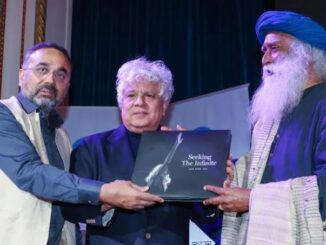
    Yakub Mathew with his book.

    That one of these rivers is mythical (Saraswati) does not hamper faith. And that a gathering of such staggering numbers rolled off peacefully, across nearly two months, is a miracle. A coffee table book with stunning photographs laid across 246 pages and lit by luminous quotes and narratives, Seeking the Infinite has immortalized the Mahakumbh as never before.

    The very dedication states the resolution and celebration of paradoxes—the outward pilgrimage is veritably the turning within to touch an ineffable shore we carry in our souls. The book in its scope, aim and production is a Mahakumbh of an undertaking unafraid to boldly go toward impeccable standards of production and embark on an archaeology of semantics of the event. Turning the pages of this book feels like mimicking the journey, by entering the preliminary waters of the first chapter of ‘Blessings’ by a mystic, Hindu yogis and a Cardinal (Sadhguru, Swami Avdeshanand Giri Maharaj, Maharaj Radhanath Swami and His Eminence Cardinal Oswald Gracias), onward to deeper waters of musings and explorations. Finally, the reader emerges refreshed by India’s eternal reverberating spiritual current, and  is reminded of a tenacious civilization that has neither been afraid to ask the deepest questions, nor hesitated to attempt to answer them. Answers that have buffeted along seemingly contradictory banks of form and formless, faith and agnosticism, ritual and dhyana—finally averring the human soul as the ultimate anthem of mystery. The overlapping waters of three rivers continue to transfer to the pages of this book asking for awakening from narrow and bigoted definitions of religion.

    Yakub Mathew states his vision early on casting the Mahakumbh as an inter-national heritage not constrained by geographical borders. Though he describes himself as an accidental author, Mathew is not an accidental seeker. The journey undertaken by a Syrian Christian New York-based banker with his beloved wife, and a bevy of 18 friends to celebrate his 60th birthday and life after a dire illness has spawned what will be an everlasting tribute to the Mahakumbh. That he sought such an experience to define a rite of passage in human life is an indicator of the predilections of his soul.

    Yakub has straddled temporal and spiritual worlds

    Raised by a mother widowed young in Delhi, his childhood is reminiscent with interactions and mentorship by Mother Teresa and His Holiness Bishop Paulos Gregorios. Perhaps the first seeds of faith were laid at this time. Also, raised by uncles (P.C. Alexander and P.M. Thomas) who were public servants brought Yakub into the ken of the political and powerful—thus the two worlds of temporal and spiritual spanned the orb of his growing years. Yakub Mathew was never to forget that a delicate balance of human and cosmic forces shapes a life. Schooled in St. Xavier’s and St Stephen’s College, a typical brand of Indian Christianity contoured by an Indian world view shaped his humanist values, and global perspective. After some world travels, he finally went on to navigate his worldly role as a banker in New York City, abiding also by his inner yearnings. A privileged life has not tainted his wonder of existence or barred his unceasing engagement with subtler mysteries.

    Sadhu blowing a conch: a picture from the book. (Photos / courtesy Yakub Mathew)

    The Kumbh till this visit was seared in his memory only as a theatrical event of human drama, but in 2025 it alchemized spiritually into an experiential landmark expressed as, “I was just an insignificant speck of dust on the soap bubble of universe.” The riotous burgeoning of sounds and sights around him during the two days were not cacophony but the very pulsations of his own soul; as he dipped into the waters as one of the multitudes, he felt blessed for the opportunity to offer prayers ‘for peace in this turbulent world.’ The mammoth spectacle of humanity and human endeavor brought forth an utterance, “Shakti in Bhakti!” from him, and the Mahakumbh translated into a riveting passage of transformation too deep for words—reaffirming the knowledge that the microcosm and the macrocosm vibrate together: My soul too sang along with the music of the spheres.

    A delightful potpourri of profound impressions rooted in personal experience, literary penmanship, academic scholarship, and spiritual insight suffuse the book. The musings uncover multi dimensions of the Mahakumbh from mythic to astronomic by luminaries in various fields such as spirituality, fashion, religion, administration, medicine, journalism, business, politics, theater, academia, sports, film, art, and music.

    The scintillating writerly roster

    The scintillating writerly roster of 55 names includes Pujya Swami Chidanand Saraswati, Ayaan Ali Bangash, Kabir Bedi, Harish Parvatheni, Satya Hinduja, Dr. Shashi Tharoor, George Mathew, Lord Meghnad Desai, Rev. Victor Lobo, Rev. Father Thomas V. Kunnukal, Dr. Navin Mehta, Farokh Engineer, Dr. Jagdish Bhagwati, Muzaffar Ali, Didi Krishna Kumari, Rakesh Kaul, Ashi Sonam Choden Dorji, Sadhvi Bhagwati Saraswati, Haji Syed Salman Chisty, Swami Swaroopananda, Anupam Kher, Swami Sarvapriyananda, Dr. Subramanian Swamy, Mokshapriya, Suhel Seth, Yogmata Keiko Aikawa, Radhe Jaggi, Barkha Dutt, and Ustad Hidayat Khan.

    Even technology played its part in the 2,750 AI driven CCTV cameras monitoring the festivities as we are reminded by Amitabh Kant. Dr. Dinesh Singh creatively interprets the legendary River Saraswati as the flow of humanity itself. Dr. Achintya Moulick brilliantly perceives his surgical work to be his own Mahakumbh—he understands it as another kind of confluence of science and faith where he has witnessed miracles; the ‘hospital a temple, every heartbeat a mantra’. Such creative and profound writerly narratives mark the book as a treasure house of fresh insights.

    Message of unity in diversity

    Usha Akella- reviewer of the book (Photo : Courtesy Usha Akella)

    But the book must not mistakenly be read as a page turner of the famous, high or mighty but rather viewed as the melding of voices to form one voice of homage to capture the mightiest sacred geo-astronomical occurrence in India—which in turn ignites a reexamination of India’s role in the world, and her eternal/everlasting (Sanatan) message of unity in diversity.

    Even though the tumult has quietened down, millions have returned home and the waters lap on in all those who dipped into the sangam. The pluralistic waters of the Mahakumbh are representative of the eternal seeking for the divine of various religious voices fired by the single current of—yearning for the transcendental. Water has no boundary, it surges and flows, turns corners, and erodes hardened hearts. The Mahakumbh demands all masks and attire are surrendered to her waters, to find a single skin underneath — humanity. It is a purification rite that restores the truth underlying all human narratives.

    Symbolically we can still dip in the pages of this book to relive the thrill of the event. For those such as myself, who could not attend the event early last year, reading the book is a reenactment of the ritual to experience its excitement and energy. The book has done a great service immortalizing the Mahakumbh, making it tangible for posterity. Finally, we grasp that Prayagraj, a holy site of pilgrimage like Mecca, Jerusalem or Kashi is the human heart where we discover the reconciliation of all contradictions and paradoxes. Where Love finally is the beginning, remainder, and the destination in all our inner and outer journeys. As is expressed so beautifully by His Eminence Cardinal Oswald Gracias: “This book will help us listen more deeply—to the longings of our own heart, to the silent music of creation, and to the voice of the One who speaks through both.”

    Author bio

    Usha Akella, Austin-based poet, has authored 11 books that include poetry and spiritual musical dramas. She has been invited to numerous international poetry festivals. She is the founder of the decade-old Matwaala (www.matwaala.com) that amplifies South Asian diasporic poets.

    Her editorial works include a ‘A House of Words’, a festschrift dedicated to Keki Daruwalla published by the Sahitya Akademi of India. Her travel articles have appeared in Indian Express, Swagat, etc., and she has also won acclaim for her astute interviews of various people in The Hindu, Parabola and on her own website of curated interviews www.the-pov.com.

  • Grand spiritual gatherings, unprecedented devotion mark the Mahakumbh at Prayagraj

    Grand spiritual gatherings, unprecedented devotion mark the Mahakumbh at Prayagraj

    PRAYAGRAJ (TIP): The first three days of the Mahakumbh Mela 2025 have witnessed a massive influx of devotees, spiritual fervor, and meticulous organization in the holy city of Prayagraj. The event, which only occurs once every twelve years, has already set the stage for a grand display of devotion, with millions making the sacred journey to the banks of the confluence of the Ganges, Yamuna, and mythical Saraswati rivers.

    Arrival and Inauguration

    The grand opening of the Mahakumbh Mela on January 14, 2025, saw an overwhelming crowd of devotees and tourists, all eager to immerse themselves in the spiritual significance of the event. The day began with a ceremonial bathing procession led by religious leaders and saints, setting the tone for the vast spiritual celebration to follow.

    Authorities reported the arrival of approximately 3 million pilgrims on the first day, all partaking in the ritual baths and praying at the temporary tented settlements that have sprung up along the riverbanks. As the day unfolded, the mesmerizing sight of pilgrims offering prayers and taking a holy dip in the Sangam resonated deeply with both locals and visitors. Special arrangements, including security and healthcare services, were put in place to ensure the safety and well-being of all attendees.

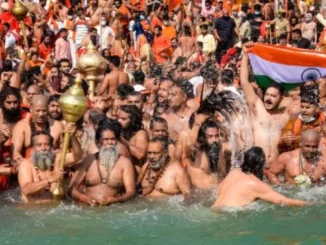
    An aerial view of the mammoth gathering of devotees at the Mahakumbh.

    The First Shahi Snan

    January 15 marked the first Shahi Snan (royal bath) of the Mahakumbh, a key moment in the Mela where ascetics, saints, and spiritual leaders take their ceremonial dips. This day attracted an estimated 5 million pilgrims, including thousands of Naga sadhus, the naked ascetics renowned for their fierce devotion. The sight of the Naga sadhus leading the procession to the river’s edge added a dramatic and powerful element to the event.

    The sacred bath is believed to purify the soul and cleanse sins, a tradition followed by millions who gathered from across the country and abroad. Many pilgrims were seen traveling on foot, some barefoot, through miles of sacred paths to reach the river. Several prominent spiritual leaders and gurus addressed the crowd, reinforcing the deep religious and cultural significance of the Mahakumbh Mela.

    Spiritual discourses and cultural celebrations

    On January 16, the crowd remained steady as devotees continued to arrive in large numbers. Temples and makeshift pandals (tents) filled with spiritual discourses, cultural performances, and religious activities offered a space for reflection and celebration. Pilgrims engaged in yoga sessions, meditation, and group chants, underscoring the spiritual essence of the Mela.

    In addition to the religious rituals, several cultural programs were organized throughout the day. Traditional dance, music, and art performances brought the vibrant cultural heritage of India to the forefront, adding to the sense of unity and collective spirituality. Many local artists and craftsmen also set up stalls to showcase their work, contributing to the lively atmosphere of the event.

    Infrastructure and logistics

    Authorities have made extensive arrangements to handle the massive crowds, with a focus on ensuring safety and comfort for the pilgrims. Over 50,000 police officers, paramedics, and volunteers are deployed to maintain order and provide assistance where needed. Special trains, buses, and temporary accommodation facilities have been set up to cater for the millions of visitors arriving daily. Clean drinking water, food stalls, and medical camps are also available across the venue.

    The Naga Sadhus in thousands descend at the Mahakumbh.

    With ongoing health and safety measures, including sanitation facilities, temperature checks, and COVID-19 monitoring, the administration is striving to provide a safe environment amidst the heavy footfall.

    The Mahakumbh Mela 2025 is expected to continue its spiritual and cultural momentum in the coming weeks, with several more significant bathing days and religious activities scheduled. The Mela will culminate with the final Shahi Snan on the auspicious day of Mauni Amavasya, expected to draw the largest crowd.

    For millions, the Mahakumbh is more than just an event—it is a journey of faith, purification, and renewal. As the first three days have shown, it is a living testament to India’s rich spiritual heritage, drawing people from all walks of life to experience a profound connection with the divine.

  • Take India Abroad, says PM Narendra Modi

    Take India Abroad, says PM Narendra Modi

    • It is time to spread a message about India’s rich and cultural heritage. As ambassadors of India, you must also look beyond some major cities and explore small towns and villages that make this country unique.
    • Wherever you live in any part of the world, plant a sapling in your mother’s name in the new city of your domicile. Spread a message about the philosophy, diversity and rich civilization you come from.
    • Institute awards to commemorate local heroes and Indian missions overseas will extend all possible support. When you come next time for the Pravasi Bharatiya Divas, bring along at least five people from your new neighborhoods.

    By Prabhjot Singh

    BHUBANESWAR (TIP): Prime Minister Narendra Modi, in his inaugural address to the 18th Pravasi Bharati Divas at Janata Maidan in Bhubaneshwar on Thursday, January 8 was accorded a standing ovation on his arrival at the nearly packed specially erected pandal.

    Though the verve and exuberance that usually accompany his addresses at such august gatherings were missing, he made up for it with his exclamations, appealing to the participating delegates to play a proactive role in projecting India abroad.

    More than 3000 delegates drawn from around the globe are participating in the biannual event held every year from January 8 to 10 to commemorate the return of the father of the nation, Mahatma Gandhi, from his stint in South Africa. The Pravasi Bharatiya Divas was started in 2003 and has served as a unique platform for overseas Indians to share their achievements and issues with people and governments of the country of their original domicile.

    A view of the gathering

    Prime Minister eulogized the contribution of the Indian Diaspora in making it the number one nation in the world for remittances back home. Stressing the need for connecting the new generation with its roots in India, Narendra Modi wanted the delegates to talk about India, its history, its culture, its diversity, and its progress not only with their children but also in their neighborhoods and workplaces.

    He exhorted them to work as ambassadors of India as the country was making rapid strides in all areas, including technology.

    Federation of Indian Associations, NY- NJ-CT-NE (FIA) Delegates at the PBD 2025 (Photo: Jay Mandal-on assignment)

    Prime Minister also remotely flagged off the inaugural journey of the Pravasi Bharatiya Express, a special Tourist train for the Indian diaspora, which will depart from the Nizamuddin Railway Station in Delhi and would travel to multiple destinations of tourist and religious importance in India for three weeks. The Pravasi Bharatiya Express will be conducted under the Pravasi Teertha Darshan Yojana of the Ministry of External Affairs.

    He also urged the delegates to visit all places of religious and historic significance, including Prayagraj, to avail themselves of a rare opportunity of attending the “Mahakumbh.”

    After inaugurating the convention, PM Modi also went around various exhibitions and put up different departments of both the Union Government and the host Odisha government to showcase the progress the country has made since attaining Independence in 1947.

    In 2047, when India completes its centenary of independence, it will be a superpower.

    Prime Minister Modi inaugurated and went round the 4 exhibitions at the PBD.

    Mr. Modi inaugurated four exhibitions – Vishwaroop Ram: The Universal Legacy of Ramayana – by ICCR; Diaspora’s Contribution to Technology– by MEA (curated by Dr Masooma Rizvi); “Bharat Bharatiya: Swadesh Pardes – Abhilekhiye Virasat – Launch of Oman collection”, by National Archives of India; and exhibition on Heritage and Culture of Odisha by Odisha government.

    Earlier, External Affairs Minister, Dr S. Jaishankar, and Odisha Governor, Hari Babu Kambhampati, Chief Minister, Mohan Charan Majhi, talked about the importance of the PBD and the role the Indian Diaspora has played in both rebuilding India and its image overseas.

    The Chief Guest, President of the Republic of Trinidad and Tobago, Christine Carla Kangaloo addressed the gathering virtually. During her address, she remembered with fondness and pride her Indian ancestry as well as the contribution of Indian diaspora in Trinidad and Tobago. (Photo: ANI)

    The Chief guest, the President of Trinidad and Tobago Christine Carla Kangaloo while addressing the august gathering remotely, talked about her own journey and also those of others in her country who migrated to Trinidad and Tobago more than a hundred years ago.