Tag: Maharashtra

  • Aruna Roy, over 100 AAP LS poll nominees to attend ‘Swaraj’

    Aruna Roy, over 100 AAP LS poll nominees to attend ‘Swaraj’

    The AAP rebel camp today claimed that rights activist Aruna Roy, a former comrade of Arvind Kejriwal from his RTI campaign days, would be attending a meeting called by them next week along with over 100 Lok Sabha poll nominees who had fought on the party’s ticket.

    A twitter account created by the rebel camp also claimed that veteran journalist Kuldip Nayar would be among those attending the meet.

    The group has claimed that it has received responses from around 3,591 people for the April 14 meet.

    It also said that social activist Medha Patkar, who had resigned from AAP as it was rocked by internal differences, is going to attend the meet.

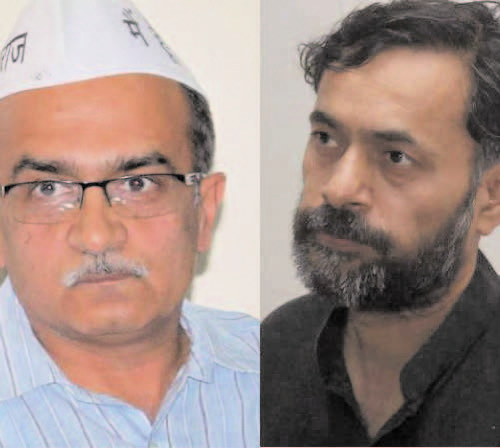
    Yogendra Yadav and Prashant Bhushan have also released a pre-invite for the event that is to be held at IFFCO Chowk at Gurgaon from 10 A.M. To 5 P.M., saying it involves “restarting” the journey of alternative politics so as to remain true to the “original spirit” of the ‘andolan’ (movement).

    The rebel camp claims to have garnered the support of 968 volunteers in Delhi, 661 from Uttar Pradesh, 329 from Bihar, 301 from Haryana and 200 from Maharashtra.

    The build-up to the April 14 meet has witnessed a series of allegations and counter-allegations with the dissident camp accusing Arvind Kejriwal loyalists of trying to scuttle the event while the party has issued a veiled warning to those intending to participate in the ‘Swaraj Samwad’.

    Bhushan and Yadav were ousted from the party’s top panels last month.

  • Strangers in their own land: Dilemma of the Christian populace in India

    Strangers in their own land: Dilemma of the Christian populace in India

    Mr. Julio Ribeiro, Retired IPS officer, former DGP of Mumbai and Gujarat recently said: ‘As a Christian, suddenly, I am a stranger in my own country’. He was merely reflecting on the recent dilemma of the Christian community in India since the ascendance of Mr. Narendra Modi as Prime Minister of India. It is indeed the anguish of a distinguished public servant who has served the country with great zeal and dedication to protect and preserve its territorial integrity.

    Today, scores of Indian Christians who have contributed in so many ways towards the development of India especially in the social and educational sectors are pained to feel the same way as Mr. Ribeiro does!As a Christian and a member of the Diaspora, I truly share the sentiment of Mr. Ribeiro and salute him for his forthrightness in speaking out.

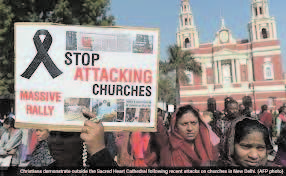
    What exactly has happened to bring about such anxiety and insecurity to such a small community that poses no harm to its fellow citizens? The latest reports from India point to two more attacks  targeting the Christian religious places of worship, one at St. George Church in Navi, Maharashtra and the other at St.Peter and Paul Church at Jabalpur, Madhya Pradesh, along with two schools that are managed by the churches. Incidentally, both Maharashtra and Madhya Pradesh states are governed by Prime Minister Modi’s party-BJP.

    These may have happened at the heel of another incident in Nadia district in West Bengal where a 72 year old Nun was gang raped by six individuals at the Jesus and Mary convent school. Reacting to the gang rape of the Nun, Surendra Jain, Joint Secretary of the Vishwa Hindu Parishad (VHP) blamed the ‘Christian Culture’ for the incident. He also justified the vandalizing of a Church in Haryana and stated that these attacks would continue if conversions do not stop.Church Attacks In India

    Several Churches in Delhi were vandalized and desecrated by religious extremists in the past months including St. Sebastian Church in Dilshad Garden which was reduced to ashes with its altar charred and Bibles strewn all over the ground. Archbishop Anil Couto said that the arson in St. Sebastian Church was condemnable not just because it was act of sacrilege and hate against the community and its faith, but because it could happen in the national capital which is recovering from a series of communal incidents. Also distressing to him is the sense of police impunity that long hours were lost, and possible evidence destroyed, before police finally came. Most of the culprits still remain at large and the law enforcement officials seem to show very little urgency in bringing them to justice.

    These incidents are not just limited to certain parts of India but happening across the country. The recent incident in a village in Chattisgarh reveals the fear and insecurity of those who have embraced Christianity as their faith. Sukhram Kashyap, a Christian from Chattisgarh, has not only seen his church vandalized but was denied food rations from the Hindu dominated village council and several of his friends were beaten up when they protested. Some of his fellow worshippers were reconverted in an aggressive campaign called ‘Ghar Wapasi’ by Hindu fundamentalists who have also banned any Christian clergy from entering the village.

    Breaking a long silence on this continuing onslaught by the Hindutva brigade on Christians and their Institutions around the country Prime Minister Modi said the following; ‘the tradition of welcoming, respecting and honoring all faiths is as old as India itself’. One wonders whether his ardent followers in BJP and RSS are listening!

    The President of Catholic Bishops Conference of India Cardinal Baselios Cleemis said that the recent attacks on churches and Christians in India have made many ‘feel that their Christian identity is being questioned and it gives a sense of sadness. It showed that not everybody had taken seriously the Prime Minister Narendra Modi’s assurance to minorities’. ‘Irrespective of their faiths, anybody being attacked was an Indian citizen and it was the government’s duty to protect them’ Cardinal added.

    In an interview to Karan Thapar on Headlines Today, Cardianal Cleemis also described as “very painful and sad” the comments of RSS head Mohan Bhagwat that Mother Teresa’s humanitarian works were driven by her motive to convert those she served. “It was very painful and very sad to hear about Mother Teresa whom the nation honored with Bharat Ratna,” he said.

    There is no doubt that that Cardinal Cleemis spoke on behalf of all Christians in India that may very well include many of the faithful in the Diaspora. Although he did not single out any organization over many of these incidents but went on to criticize the Modi government for observing Christmas as Good Governance Day, saying good governance should be done everyday and the Christian festival should be respected.

    One of the most astounding observations that can be made about these attacks on minorities in India is that there is a deafening silence on the part of the Diaspora in the US. Hindu American Foundation, Vishwa Hindu Parishad of America, and GOPIO along with many other organizations have decided to look the other way. Though relatively new as immigrants to this great country, Indians continue to demand our rightful place, justifiably so, at the table in sharing the riches and defending our values and traditions while not tolerating any injustice that offends our sensibilities. A huge segment of the community has indeed made tremendous strides in this short period realizing the American dream and integrating itself into the mainstream.

    However, Christians in India who have lived there for almost two Millennia are made to feel as if they are strangers in their own land. How a personal choice of faith that is guaranteed under the article 25 and 26 of the Constitution of India could make or break the ‘Indian ness’ of its citizenry is beyond the comprehension of any rational mind!  

    Undoubtedly, the forces of polarization and divisions have come out of the woodwork and kept themselves busy transforming India at the expense of the values and principles of inclusiveness and tolerance that brought the nation together. The current Government’s dual-track policy of providing good optics for the consumption of the global community while unleashing the extremist forces to undo the social progress of the last 65 years, mostly under the Congress rule, is troublesome and disheartening to most of its citizens!

    President Obama in his Siri Fort speech prodded the new Government ‘India will succeed so long as it is not splintered along the lines of religious faith, as long as it is not splintered along any lines and it is unified as a nation’. It sounds prophetic and to plainly put it, unless the Prime Minister reins in these extremist elements that run amok now, his dream of ‘modern India’ could be in increasing peril!

  • Ominous Legislation

    The Gujarat Control of Terrorism and Organised Crime (GCTOC) Bill 2015The Gujarat Control of Terrorism and Organised Crime (GCTOC) Bill 2015 carries disturbing echoes of draconian anti-terror laws such as the Terrorist and Disruptive Activities (Prevention) Act (TADA) and the Prevention of Terrorism Act (POTA). Both were considered failed experiments that led to gross abuse. More specifically, the Bill seems to be modelled on the provisions of the Maharashtra Control of Organised Crime Act (MCOCA) that was implemented in 1999 and continues to be in force today. In fact, since 2002 it has also been in force in Delhi after the police insisted that such a law was needed as ‘organised crime has no limits’.

    The common thread running through all these controversial pieces of legislation is the notion that regular process, as outlined by the Code of Criminal Procedure, is not enough to deal with a changed internal security situation. GCTOC is therefore the latest chapter in a long-running search to find an ‘ideal’ anti-terror law, but like its earlier versions it raises important questions about the lines the state crosses in its attempts to fight crime and terror. GCTOC, like MCOCA, allows confessions secured in police custody to be admitted as evidence in courts, a disturbing provision that is tantamount to legitimising custodial torture. Similarly, it allows the custody of an accused for 180 days rather than the 90 days provided under normal law. The most troubling aspect of MCOCA has been the way it enables the police to sidestep rigorous investigation. It has been used as a charge in all manner of cases ranging from real estate deals, prostitution and match-fixing, as the police seek to stack the odds in their favour in order to secure a conviction. This practice has repeatedly met with censure from the courts and there is no guarantee that GCTOC won’t go down the same path.

    The debate around GCTOC in the coming days will most likely take a political hue. When the UPA government first rejected Gujarat’s attempts to pass an anti-terror law the then Chief Minister Narendra Modi claimed that he was only presenting a ‘xerox copy’ of MCOCA. The UPA argued that the Gujarat law was at variance with its policy on terror laws as articulated in the Unlawful Activities (Prevention) Act. The new government may well have a different national policy. After all, permission for MCOCA was given under the last NDA government. A more useful debate though, is on the manner in which these special laws are created. TADA came into being during the years of the Punjab militancy and POTA after the Parliament attack of 2001, and the genesis of MCOCA was from the Mumbai serial blasts of 1993. Knee-jerk reactions lead to severe laws. The focus should rather be on better resources and training for investigators who can continue to work under the existing Code of Criminal Procedure, which is already comprehensive in scope.

  • SMART MOVES – Modi Government on US & China

    SMART MOVES – Modi Government on US & China

    [vc_row][vc_column][vc_column_text]

    “The Modi government will face the test of managing closer strategic relations with the US, which are in part directed against China, and forging closer ties with China that go against this strategic thrust, besides the reality that China has actually stronger ties with the US than it can ever have with India, though the underlying tensions between the two are of an altogether different order than between India and the US.”


    [/vc_column_text][/vc_column][/vc_row][vc_row][vc_column width=”1/2″][vc_column_text]

    [quote_box_center]China[/quote_box_center] 

    Prime Minister Modi has been quick to court both US and China. His first overtures were to China, prompted no doubt by his several visits there as Chief Minister of Gujarat, Chinese investments in his home state and his general admiration for China’s economic achievements. Beyond this personal element, many in the government and corporate sectors in India believe that our politically contentious issues with China, especially the unresolved border issue, should be held in abeyance and that economic cooperation with that country should be expanded, as India can gain much from China’s phenomenal rise and the expertise it has developed in specific sectors, especially in infrastructure. It is also believed that China, which is now sitting over $4 trillion of foreign exchange reserves, has huge surplus resources to invest and India should actively tap them for its own developmental needs. In this there is continuity in thinking and policy from the previous government, with Modi, as is his wont, giving it a strong personal imprint.

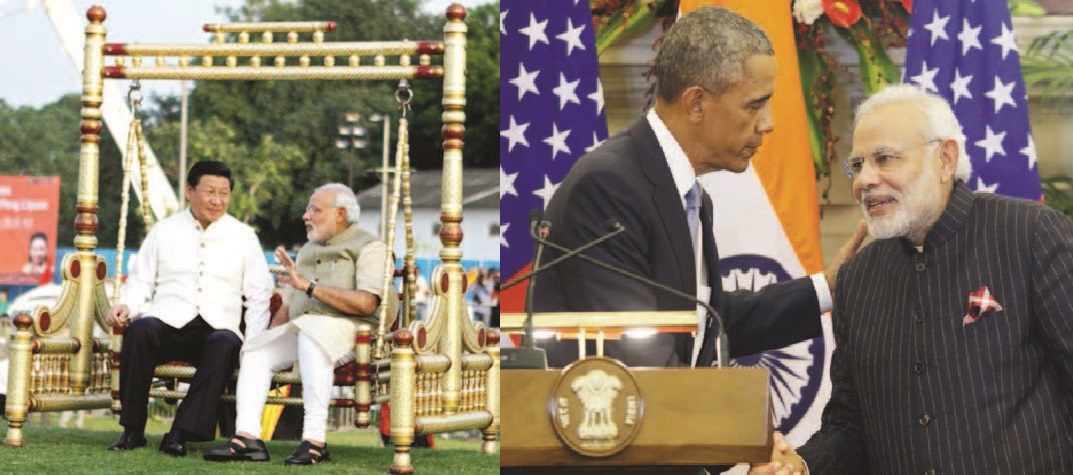
    The first foreign dignitary to be received by Modi after he became Prime Minister was the Chinese Foreign Minister, representing the Chinese President. This was followed by up by his unusually long conversation on the telephone with the Chinese Prime Minister. Our Vice-President was sent to Beijing to celebrate the 60th anniversary of the Panchsheel Agreement even though China has blatantly violated this agreement and India’s high level diplomatic endorsement of it only bolsters Chinese diplomacy, especially in the context of China-created tensions in the South China and East China Seas. Modi had occasion to meet President Xi Jinxing in July at the BRICS summit in July 2014, and this was followed up by the Chinese President’s state visit to India in September 2014, during which the Prime Minister made unprecedented personal gestures to him in an informal setting in Ahmedabad.

    The dramatics of Modi’s outreach to the Chinese aside, his objectives in strengthening economic ties with China, essentially imply a consolidation of the approach followed in the last decade or so, with some course correction here and there. In this period, China made very significant headway in our power and telecom sectors, disregarding obvious security concerns associated with China’s cyber capabilities and the links of Chinese companies to the Chinese military establishment. Many of our top companies have tapped Chinese banks and financial institutions for funds, and this has produced a pro-Chinese corporate lobby in our country. This lobby will obviously highlight the advantages of economic engagement over security concerns. The previous Prime Minister followed the approach of emphasizing shared interests with China rather than highlighting differences. The position his government took on the Depsang incident in May 2013 showed his inclination to temporize rather than confront. Externally, he took the line, which Chinese leaders repeated, that the world is big enough for India and China to grow, suggesting that he did not see potential conflict with China for access to global markets and resources. Under him, India’s participation in the triangular Russia-India-China format (RIC) and the BRICS format continued, with India-originated proposal for a BRICS Development Bank eventually materializing. Indian concerns about the imbalance in trade were voiced, but without any action by China to redress the situation. India sought more access to the Chinese domestic market for our competitive IT and pharmaceutical products, as well as agricultural commodities, without success. Concerns about cheap Chinese products flooding the India market and wiping out parts of our small-scale sector were voiced now and then, but without any notable remedial steps. The Strategic Economic Dialogue set up with China, which focused primarily on the railway sector and potential Chinese investments in India, did not produce tangible results.

    The Manmohan Singh government, despite China’s aggressive claims on Arunachal Pradesh and lack of progress in talks between the Special Representatives on the boundary issue as well as concerns about China’s strategic threats to our security flowing from its policies in our neighborhood, especially towards Pakistan and Sri Lanka, declared a strategic and cooperative partnership with that country. During Manmohan Singh’s visit to China in September 2013, we signed on to some contestable formulations, as, for example, the two sides committing themselves to taking a positive view of and supporting each other’s friendship with other countries, and even more surprisingly, to support each other enhancing friendly relations with their common neighbors for mutual benefit and win-win results. This wipes off on paper our concerns about Chinese policies in our neighborhood. We supported the BCIM (Bangladesh, China, India, Myanmar) Economic Corridor, including people to people exchanges, overlooking Chinese claims on Arunachal Pradesh and the dangers of giving the Chinese access to our northeast at people to people level. The agreement to carry out civil nuclear cooperation with China was surprising, as this makes our objections to China-Pakistan nuclear ties politically illogical. We also agreed to enhance bilateral cooperation on maritime security, which serves to legitimize China’s presence in the Indian Ocean when China’s penetration into this zone poses a strategic threat to us.

    As a mark of continuity under the Modi government, during President Xi Jinxing’s September 2014 visit to India, the two sides agreed to further consolidate their Strategic and Cooperative Partnership, recognized that their developments goals are interlinked and that their respective growth processes are mutually reinforcing. They agreed to make this developmental partnership a core component of their Strategic and Cooperative Partnership. The India-China Strategic Economic Dialogue was tasked to explore industrial investment and infrastructure development.

    To address the issue of the yawning trade imbalance, measures in the field of pharmaceuticals, IT, agro-products were identified and a Five-Year Development Program for economic and Trade Cooperation to deepen and balance bilateral trade engagement was signed. Pursuant to discussions during the tenure of the previous government, the Chinese announced the establishment of two industrial parks in India, one in Gujarat and the other in Maharashtra, and the “Endeavour to realize” an investment of US $ 20 billion in the next five years in various industrial and infrastructure development projects in India, with production and supply chain linkages also in view. In the railway sector, the two sides the two sides agreed to identify the technical inputs required to increase speed on the existing railway line from Chennai to Mysore via Bangalore, with the Chinese side agreeing to provide training in heavy haul for 100 Indian railway officials and cooperating in redevelopment of existing railway stations and establishment of a railway university in India. The Indian side agreed to actively consider cooperating with the Chinese on a High Speed Rail project. In the area of financial cooperation, the Indian side approved in principle the request of the Bank of China to open a branch in Mumbai.

    The Modi government has agreed to continue defense contacts, besides holding the first round of the maritime cooperation dialogue this year, even though by engaging India in this area it disarms our objections to its increasing presence in the Indian Ocean area, besides drawing negative attention away from its policies in the South China Sea as well as projecting itself as a country committed to maritime cooperation with reasonable partners. The joint statement issued during Xi Jinxing’s visit omitted any mention of developments in western Pacific, though it contained an anodyne formulation on Asia-Pacific. This becomes relevant in view of the statements on Asia-pacific and the Indian Ocean region issued during President Obama’s visit to India in January 2015.

    Our support, even if tepid, continues for the BCIM Economic Corridor. On our Security Council permanent membership, China continues its equivocal position, stating that it “understands and supports India’s aspiration to play a greater role in the United Nations including in the Security Council”. It is careful not to pronounce support for India’s “permanent membership”. During Foreign Minister Sushma Swaraj’s visit to China for the RIC Foreign Ministers meeting, China has maintained its equivocation, although the press has wrongly presented the formulation as an advance. China is openly opposed to Japan’s candidature in view of the sharp deterioration of their ties. In India’s case, it avoids creating a political hurdle to improved ties by openly opposing India’s candidature. “A greater role” could well mean a formula of immediately re-electable non-permanent members, of the kind being proposed by a former UN Secretary General and others.

    On counter-terrorism lip service is being paid to cooperation. On Climate Change, the two countries support the principle of “equity, common but differentiated responsibilities and respective capabilities”, although the US-China agreement on emission reduction targets has created a gap in Indian and Chinese positions, with the Modi government deciding to delink itself from China in international discussions to follow.

    In diplomacy, once concessions or mistakes are made, retrieval is very difficult unless a crisis supervenes. The Modi government, for reasons that are not too clear, repeated the intention of the two countries to carry out bilateral cooperation in civil nuclear energy in line with their respective international commitments, which has the unfortunate implication of India circumscribing its own headroom to object to the China-Pakistan nuclear nexus, besides the nuance introduced that China is observing its international commitments in engaging in such cooperation. The calculation that this might make China more amenable to support India’s NSG membership may well prove to be a mistaken one. Surprisingly, stepping back from the Manmohan government’s refusal towards the end to make one-sided statements in support of China’s sovereignty over Tibet when China continues to make claims on Indian territory, the new government yielded to the Chinese ruse in making us thank the “Tibetan Autonomous Region of the People’s Republic of China” as well as the Chinese Ministry of Foreign Affairs – as if both are independent of the Chinese government- for facilitating the Kailash Mansarovar Yatra and opening the new route through Nathu La, even though this is not the  most rational route because it involves a far longer journey, made easier of course by much better infrastructure. On receiving the flood season hydrological date the Chinese have stuck to their minimalist position.

    On the sensitive border issue, the disconnect between the joint statement which repeats the usual cliches and the serious incident in Chumar coinciding with Xi’s visit was obvious. China’s double game of reaching out to India- with greater confidence now as the gap between it and India has greatly widened and it has begun to believe that India now needs China for its growth and development goals- and staging a provocation at the time of a high level visit, continues. This is a way to remind India of its vulnerability and the likely cost of challenging China’s interests, unmindful that its conduct stokes the already high levels of India’s distrust of that country. It went to Modi’s credit that he raised the border issue frontally with XI Jinping at their joint press conference, expressing “our serious concern over repeated incidents along the border” and asking that the understanding to maintain peace and tranquility on the border “should be strictly observed”. He rightly called for resuming the stalled process of clarifying the Line of Actual Control (LAC). While this more confident approach towards China is to be lauded, we are unable to persuade China to be less obdurate on the border issue because we are signaling our willingness to embrace it nonetheless virtually in all other areas.

    That Modi mentioned “India’s concerns relating to China’s visa policy and Trans Border Rivers” while standing alongside Xi Jinping at the joint press conference indicated a refreshing change from the past in terms of a more open expression of India’s concerns. With regard to Bangladesh-China-India-Myanmar Economic Corridor that China is pushing hard, Modi rightly added a caveat by declaring that “our efforts to rebuild physical connectivity in the region would also require a peaceful, stable and cooperative environment”. He also did not back another pet proposal of Xi: the Maritime Silk Road, which is a re-packaged version of the notorious “string of pearls” strategy, as the joint statement omits any mention of it.

    Even as Modi has been making his overall interest in forging stronger ties with China clear, he has not shied away from allusions to Chinese expansionism, not only on Indian soil but also during his visit to Japan. After President Obama’s visit to India and the joint statements on South China Sea and Asia-Pacific issued on the occasion which can be construed as directed at China, Foreign Minister Sushma Swaraj’s recent visit there acquired more than normal interest in watching out for indications of China’s reaction. Her call on Xi Jinping was projected, quite wrongly, as going beyond normal protocol, when in actual fact the Chinese Foreign Minister gets access to the highest levels in India during visits. Swaraj seems to have pushed for an early resolution of the border issue, with out-of-the-box thinking between the two strong leaders that lead their respective countries today. Turning the Chinese formulation on its head, she called for leaving a resolved border issue for future generations.

    That China has no intention to look at any out-of-the-box solution- unless India is willing to make a concession under cover of “original thinking”- has been made clear by the vehemence of its reaction to Modi’s recent visit to Arunachal Pradesh to inaugurate two development projects on the anniversary of the state’s formation in 1987. It has fulminated over the Modi visit over two days, summoning the Indian Ambassador to lodge a protest, inventing Tibetan names for sub-divisions within Arunachal Pradesh to mark the point that this area has been under Tibetan administrative control historically. The Chinese Vice-Foreign Minister arrogantly told our Ambassador that Modi’s visit undermined “China’s territorial sovereignty, right and interests” and “violates the consensus to appropriately handle the border issue.” China is making clear that it considers Arunachal Pradesh not “disputed territory” but China’s sovereign territory. It is also inventing a non-existent “consensus” that Indian leaders will not visit Arunachal Pradesh to respect China’s position. There is a parallel between China’s position on the Senkakus where it accuses the Japanese government to change the status quo and inviting a Chinese reaction, and its latest broadside against India. This intemperate Chinese reaction casts a shadow on Modi’s planned visit to China in May and next round of talks between the Special Representatives (SRs) on the boundary question. If without a strong riposte these planned visits go ahead we would have allowed the Chinese to shift the ground on the outstanding border issue even more in their favor. It would be advisable for our Defense Minister to visit Tawang before Modi’s visit. A very categorical enunciation of our position that goes beyond previous formulations should be made by the Indian side. The Chinese position makes the SR talks pointless, as the terms of reference China is laying down cannot be agreed to by our side.

    [/vc_column_text][/vc_column][vc_column width=”1/2″][vc_column_text]

    [quote_box_center]UNITED STATES[/quote_box_center] 

    Prime Minister Modi, contrary to expectations, moved rapidly and decisively towards the US on assuming office. He confounded political analysts by putting aside his personal pique at having been denied a visa to visit the US for nine years for violating the US law on religious freedoms, the only individual to be sanctioned under this law. The first foreign visit by Modi to be announced was that to the US. Clearly, he believes that strong relations with the US gives India greater strategic space in foreign affairs and that its support is crucial for his developmental plans for India.

    To assess the Modi government’s policies towards the US, the results of his visit to Washington in September 2014 and that of Obama to India in January 2015 need to be analyzed, keeping in mind the approach of the previous government and the element of continuity and change that can be discerned.

    The joint statement issued during his US visit set out the future agenda of the relationship, with some goals clearly unachievable, but the ambitions of the two countries were underscored nonetheless. It was stated that both sides will facilitate actions to increase trade five-fold, implying US-China trade levels, which is not achievable in any realistic time-frame. They pledged to establish an Indo-US Investment Initiative and an Infrastructure Collaboration Platform to develop and finance infrastructure. An agreement on the Investment Initiative was signed in Washington prior to Obama’s visit to India, but bringing about capital reforms in India, which the Initiative aims at, is not something that can be realized quickly. India wants foreign investment in infrastructure and would want to tap into US capabilities in this broad sector, but the US is not in the game of developing industrial corridors like Japan or competitively building highways, ports or airports. Cooperation in the railway sector was identified, but it can only be in some specific technologies because this is the field in which Japan and China are competing for opportunities in India, whether by way of implementing high speed freight corridors or building high speed train networks in the country. India offered to the U.S. industry lead partnership in developing three smart cities, even if the concept of smart cities is not entirely clear. Some preliminary steps seem to have been taken by US companies to implement the concept. The decision to establish an annual high-level Intellectual Property (IP) Working Group with appropriate decision-making and technical-level meetings as part of this Forum was done at US insistence as IPR issues are high on the US agenda in the context of contentious issues that have arisen between the US companies and the Indian government on patent protection, compulsory licensing and local manufacturing content requirements.

    In his joint press briefing with Obama, Modi raised IT related issues, pressing Obama’s support  “for continued openness and ease of access for Indian services companies in the US market”, without obtaining a reaction from  the latter then or later when Obama visited India. On the food subsidy versus trade facilitation stand off in the WTO, Modi maintained his position firmly and compelling the US to accept a compromise. Modi’s firmness on an issue of vital political importance to India showed that he could stand up to US pressure if the country’s interest so demanded. He welcomed “the US defense companies to participate in developing the Indian defense industry”, without singling out any of the several co-development and co-production projects offered by the US as part of the Defense Technology and Trade Initiative (DTTI). Clearly, it was too early to conclude discussions on the US proposals before his September visit.

    The more broad based reference in the joint statement to India and the US intending to expand defense cooperation to bolster national, regional and global security was, on the contrary, rather bold and ambitious, the import of which became clearer during Obama’s January visit. While bolstering such cooperation for national security makes sense, regional security cannot be advanced together by both countries so long as the US continues to give military aid to Pakistan, which it is doing even now by issuing presidential waivers to overcome the provisions of the Kerry-Lugar legislation that requires Pakistan to act verifiably against terrorist groups on its soil before the aid can be released. As regards India-US defense cooperation bolstering global security, securing the sea lanes of communication in the Indian Ocean and the Asia-Pacific region is the obvious context. It was decided to renew for 10 years more the 2005 Framework for US-India Defense Relations, with defense teams of the two countries directed to “develop plans” for more ambitious programs, including enhanced technology partnerships for India’s Navy, including assessing possible areas of technology cooperation.

    The US reiterated its commitment to support India’s membership of the four technology control regimes: the Nuclear Suppliers Group (NSG), the Missile Technology Control Regime (MTCR), the Wassenaar Agreement and the Australia Group, with Obama noting that India met MTCR requirements and is ready for NSG membership, but without setting any time-tables. An actual push by the US in favor of India’s membership has been lacking because of issues of nuclear liability and administrative arrangements have remained unresolved until now and the US has wanted to use their resolution as a leverage. US support for India’s membership of these export control organizations was reiterated during Obama’s January visit, but how quickly the US will move remains unclear even after the political resolution of outstanding nuclear issues.

    The US at one time described India as a lynchpin of its pivot or rebalance towards Asia. The underlying motivation behind the pivot and US interest in drawing India into this strategy is China, though this is not stated publicly in such open terms. India has been cautious about the US pivot towards Asia as its capacity and willingness to “contain” Chinese power has been doubted because of the huge financial and commercial interdependence forged between the two countries. India seeks stable and economically productive relations with China and has wanted to avoid the risk of being used by the US to serve its China strategy that raises uncertainties in the mind of even the US allies in Asia. However, under the Modi government, India has become more affirmative in its statements about the situation in the western Pacific and the commonalities of interests between India and the US and other countries in the Indo-Pacific region. The government has decided to “Act East”, to strengthen strategic ties with Japan and Australia, as well as Vietnam, conduct more military exercises bilaterally with the US armed forces as well as naval exercises trilaterally with Japan. Modi has spoken publicly about greater India-US convergences in the Asia-Pacific region, to the point of calling the US  intrinsic to India’s Act East and Link West policies, a bold formulation in its geopolitical connotations never used before that suggested that India now viewed the US as being almost central to its foreign policy initiatives in both directions.

    On  geopolitical issues, India showed strategic boldness in the formulations that figured in the September joint statement. These laid the ground for more robust demonstration of strategic convergences between the two countries during Obama’s visit later. The reference in September to the great convergence on “peace and stability in the Asia Pacific region” was significant in terms of China’s growing assertiveness there. The joint statement spoke of a commitment to work more closely with other Asia Pacific countries, including through joint exercises, pointing implicitly to Japan and Australia, and even Vietnam. In this context, the decision to explore holding the trilateral India-US-Japan dialogue at Foreign Minister’s level- a proposition that figured also in the India-Japan joint statement during Modi’s visit there- was significant as it suggested an upgrading of the trilateral relationship at the political level, again with China in view.

    On the issue of terrorism and religious extremism, India and the US have rhetorical convergence  and some useful cooperation in specific counter-terrorism issues, but, on the whole, our concerns are  inadequately met because US regional interests are not fully aligned with those of India. The September joint statement called for the dismantling of safe havens for terrorist and criminal networks and disruption of all financial and tactical support for networks such as Al Qaeda, Lashkar-e-Taiba, Jaish-e-Mohammad, the D-company and the Haqqanis, but the Taliban were conspicuously omitted from the list. In any case, such statements against Pakistan-based terrorist groups have been made before but are ignored  by Pakistan in the absence of any real US pressure on it to curb Hafiz Saeed or credibly try Lakhvi despite repeated joint calls for bringing those responsible for the Mumbai terrorist massacre to justice.

    We had a paragraph on Iran in the joint statement in Washington, clearly at US insistence, which the Iranians would have noted with some displeasure. The Modi government is also willing to accommodate the US on Iran within acceptable limits. While the US supports India’s permanent membership of the UN Security Council, the support remains on paper as the US is not politically ready to promote the expansion of the Council.

    At Washington, India and the US agreed on an enhanced strategic partnership on climate change issues, and we committed ourselves to working with the US to make the UN Conference on Climate Change in Paris in December this year a success. This carried the risk of giving a handle to the US to ratchet up pressure to obtain some emission reduction commitments from India, encouraged  diplomatically by the US-China agreement.

    The unusually strong personal element in Modi’s diplomacy towards the US came apparent when during his Washington visit he invited Obama to be the chief guest at our Republic Day on January 26, 2015- a bold and imaginative move characteristic of his style of functioning. That this unprecedented invitation was made was surprising in itself, as was its acceptance by Obama at such short notice. Modi and Obama evidently struck a good personal equation, with the earlier alienation supplanted by empathy. Obama made the unprecedented gesture of accompanying Modi to the Martin Luther King Memorial in Washington, perhaps taking a leaf from the personal gestures made  to Modi in Japan by Prime Minister Abe.

    On the occasion of Obama’s January visit, Modi has moved decisively, if somewhat controversially, on the nuclear front, as this was the critical diplomatic moment to work for a breakthrough to underline India’s commitment to the strategic relationship with the US, which is the way that US commentators have looked at this issue. While in opposition the BJP had opposed the India-US nuclear agreement, introduced liability clauses that became a major hurdle in implementing the commitment to procure US supplied nuclear reactors for producing 10,000 MWs of power, and had even spoken of seeking a revision of the agreement whenever it came to power. During Obama’s  visit, the “breakthrough understandings” on the nuclear liability issue and that of administrative arrangements to track US supplied nuclear material or third party material passing through US supplied reactors, became the highlight of its success, with Modi himself calling nuclear cooperation issues as central to India-US ties. The supplier liability issue seems to have resolved at the level of the two governments by India’s decision to set up an insurance pool to cover supplier liability, as well as a written clarification through a Memorandum of Law on the applicability of Section 46 only to operators and not suppliers. On the national tracking issue the nature of the understanding has left some questions unanswered; it would appear that we have accepted monitoring beyond IAEA safeguards as required under the US law. However, the larger question of the commercial viability of US supplied reactors remains, a point that Modi alluded to in joint press conference. On the whole, whatever the ambiguities and shortfalls, transferring the subject away from government to company level to eliminate  the negative politics surrounding the subject is not an unwelcome development.

    For the US, defense cooperation has been another touchstone for the US to measure India’s willingness to deepen the strategic partnership. While the significant progress expected to be announced under the DTTI during Obama’s visit did not materialize, some advance was made with the announcement of four “pathfinder” projects involving minor technologies, with cooperation in the area of aircraft engines and aircraft carrier technologies to be explored later. The government has already chosen for price reasons the Israeli missile over the Javelin that was part of the several proposals made to India under the DTTI. As expected, the India-US Defense Framework Agreement of 2005 was extended for another 10 years, without disclosing the new text. It is believed  that India is now more open to discussions on the three foundational agreements that the US considers necessary for transfer of high defense technologies to India.

    The US-India Joint Strategic Vision for the Asia-Pacific and Indian Ocean Region signed during the visit is a major document which in the eyes of some reflects India’s move away from the shibboleths of the past associated with nonalignment and the obsession with strategic autonomy. Issuing a separate document was intended to highlight the growing strategic convergences between the two countries, with full awareness of how this might be interpreted by some countries, notably China. It affirms the “importance of safeguarding maritime security and ensuring freedom of navigation and overflight throughout the region , especially in the South China Sea”, while calling also on all parties to avoid the threat or use of force and pursue resolution of territorial and maritime disputes through all peaceful means in accordance with international law, including the Law of the Sea Convention. It speaks, in addition, of India and the US investing in making trilateral countries with third countries in the region, with Japan and Australia clearly in mind. This is a direct message addressed to China, reflecting less inhibition on India’s part both to pronounce on the subject and do it jointly with the US, irrespective of Chinese sensibilities. Some Chinese commentary has criticized this effort by the US to make India part of its containment strategy, without taking cognizance of how India views China’s maritime strategy in the Indian Ocean involving its strategic investments in Sri Lanka, Maldives, Pakistan and other countries. In the joint statement issued during  Obama’s visit, the two sides noted that India’s Act East Policy and the US rebalance to Asia provided opportunities to the two countries to work closely to strengthen regional ties, in what amounted to an indirect endorsement of the US pivot to Asia.

    Obama’s visit also demonstrated the consolidation of the good personal rapport established between him and Shri Modi, with embraces and first name familiarity- possibly overdone on Modi’s part- walk in the park and talk over tea, all of which boosted the prime minister’s personal stature as a man comfortable and confident in his dealings with the world’s most powerful leader on the basis of equality. This personal rapport should assist in greater White House oversight over the Administration’s policies towards India, which experience shows greatly benefits the bilateral relationship.

    Counter-terrorism is always highlighted as an expanding area of India-US cooperation because of shared threats. The joint statement in Delhi spoke dramatically of making the US-India partnership in this area a “defining” relationship for the 21st century. Does this mean that the US will share actionable intelligence on terrorist threats to us emanating from Pakistani soil? This is doubtful. The continued omission of the Afghan Taliban from the list of entities India and the US will work against is disquieting, as it indicates US determination to engage the Taliban, even when it knows that it is Pakistan’s only instrument to exert influence on developments in Afghanistan at India’s cost. The subsequent refusal of the US spokesperson to characterize the Taliban as a terrorist organization and preferring to call it an armed insurgency has only served to confirm this.

    On trade, investment and IPR issues, the two sides will continue their engagement with the impulse given to the overall relationship by the Obama-Modi exchanges. On a high standard Bilateral Investment Treaty the two sides will
    “assess the prospects for moving forward”, which indicates the hard work ahead. On the tantalization agreement the two will “hold a discussion on the elements requires in both countries to pursue” it, a language that is conspicuously non-committal. On IPRs there will be enhanced engagement in 2015 under the High Level Working Group.

    On climate change, we reiterated again the decision to work together this year to achieve a successful agreement at the UN conference in Paris, even when our respective positions are opposed on the core issue of India making specific emission reduction commitments. While stating  that neither the US nor the US-China agreement put any pressure on India, Modi spoke in his joint press conference about pressure on all countries to take steps for the sake of posterity. While  finessing the issue with high-sounding phraseology, he has left the door open for practical compromises with the US.

    As a general point, hyping-up our relations with the US is not wise as it reduces our political space to criticize its actions when we disagree. The previous government made this mistake and the Modi government is not being careful enough in this regard. Obama’s objectionable lecture to us at Siri Fort on religious freedom and his pointed reference to Article 25 of our Constitution, illustrates this. He showed unpardonable ignorance of Indian history and Hindu religious traditions in asking us to “look beyond any differences in religion” because “nowhere in the world is it going to more necessary for that foundational value to be upheld” than in India. To say that “India will succeed so long as it is not splintered around religious lines” was a wilful exaggeration of the import of some recent incidents  and amounted to playing the anti-Hindutva card by a foreign leader prompted by local Christian and “secular” lobbies. Reminding us of three national cinema and sport icons belonging only to minority religions- when their mass adulation is unconnected to their faith- was to actually encourage religiously fissured thinking in our society. On return to Washington Obama pursued his offensive line of exaggerating incidents of religious intolerance in India. On cue, a sanctimonious editorial also appeared in the New York Times. The government could not attack Obama for his insidious parting kick at Siri Fort so as not to dim the halo of a successful visit and therefore pretended that it was not directed at the Modi team. The opposition, instead of deprecating Obama’s remarks, chose to politically exploit them against Modi, as did some Obama-adoring Indians unencumbered by notions of self-respect.

    While giving gratuitous lessons on religious tolerance to the wrong country Obama announced $1 billion civil and military support to Pakistan that splintered from a united India because of religious intolerance in 1947 and has been decimating its minorities since. Obama has also invited the Chinese president to visit the US on a state visit this year, to balance his visit to India and the “strategic convergences” reached there on the Asia-Pacific region. Obama’s claim that the US can be India’s “best partner” remains to be tested as many contradictions in US policy towards India still exist.

    The Modi government will face the test of managing closer strategic relations with the US, which are in part directed against China, and forging closer ties with China that go against this strategic thrust, besides the reality that China has actually stronger ties with the US than it can ever have with India, though the underlying tensions between the two are of an altogether different order than between India and the US.

    [/vc_column_text][/vc_column][/vc_row]

  • BJP’s Goa CM opposes beef ban

    NEW DELHI (TIP): BJP-ruled Goa would not ban beef as it is an essential part of the cuisine of minority communities in the state, chief minister Laxmikant Parsekar told ET, adding that it had taken several years for his party to earn the trust of the state’s Christians and Muslims.

    “Regardless of what the Centre does -in Goa minorities are 3940% -if it is part of their food habits, why and how can we ban it? For people -especially minorities -eating beef is part of their food,” said Parsekar. The Goan CM’s comments assume significance as it comes days after Maharashtra and Haryana imposed blanket bans on beef. The move had also triggered speculation that the BJP-led Central government could be considering a nation-wide plan to ban beef distribution and consumption.

    Parsekar, a former state-level functionary of RSS, said that he is also conscious about the sentiments of a section of Hindus concerning slaughter of cows.

    “Sentiments are hurt with regards to killing cows, not in the case of oxen or bulls. We don’t permit killing of cows, and even oxen are not killed there (in Goa) now. It (beef) is brought from Karnataka and sold here, which we allow since it is a part of cuisine of Catholics and Muslims, and I feel it should not be banned,” he said.

    The Goa CM also felt that there was a concerted effort from some quarters, including media, to paint BJP as antiminority by blaming the recent attacks on churches on the party. Such incidents are happening even in states where BJP is not in power, but the party is being blamed, he said.

    Parsekar said the BJP managed to grow “gradually” and achieve a full majority government for the first time in the state because of it having “build confidence” among the minority community.

    “In fact, we favour the minorities,” he said, adding, “In Goa, we are always one step ahead (in reassuring the minority community). We favour the minorities -whether it is for (setting up their) institutions or any other help. For your information, exposition of the holy relics of Saint Xavier’s was organised this year. We spent a lot of money for raising infrastructure for that event. It went on for 45 days and 46 lakh people arrived from the world over. We had put up a secretariat comprising top officers for monitoring the event and spent more than Rs 50 crore at the campus.”


  • SWINE FLU TOLL REACHES 1,587, BUT SHARP FALL RECORDED IN DEATHS FROM DISEASE IN MARCH

    SWINE FLU TOLL REACHES 1,587, BUT SHARP FALL RECORDED IN DEATHS FROM DISEASE IN MARCH

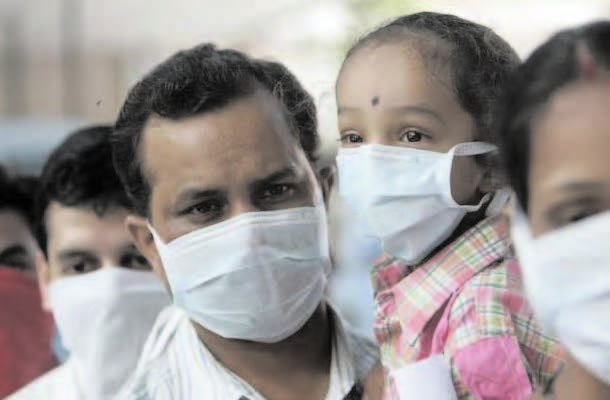
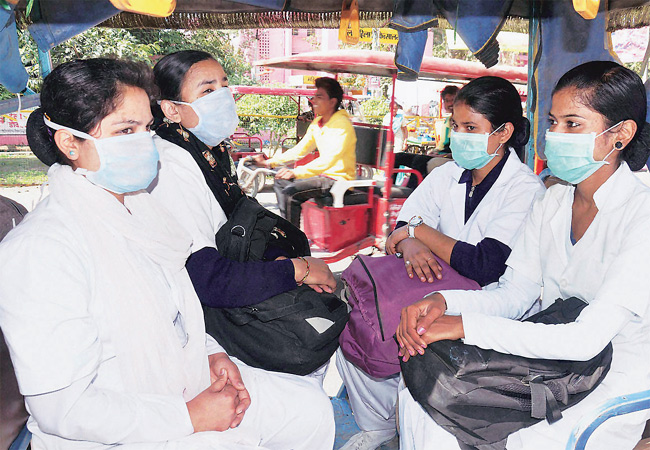
    NEW DELHI (TIP): India’s swine flu outbreak appears to be waning, with the week ending March 8 recording a sharp fall in weekly deaths, which had plateaued at around 270 since February 8, shows surveillance data from states.

    India reported 199 deaths last week, which is down by almost 25% over the numbers recorded over the past three weeks.

    Till March 11, 27,888 cases and 1,587 deaths have been reported from all 36 states and UTs except five, shows data from the Union Ministry of Health. Over the past 24 hours, 20 deaths were reported from across India.

    “Swine flu cases have registered a downward trend over the past 10 days, with deaths also declining during this period. The Union Ministry is in constant touch with states and is providing them the necessary support,” Union Minister of Health and Family Welfare Jagat Prakash Nadda.

    The only states/UTs untouched by swine flu with no cases or deaths are Arunachal, Meghalaya, Sikkim, Tripura and Lakshwadeep.

    People between the ages of 31 and 60 years accounted for two in three deaths, shows an analysis of 832 deaths for which data is available. Children under 12 years were the least affected in the current outbreak, accounting for 4% of overall swine flu deaths.

    The swine flu outbreak devastated five states, with Rajasthan, Gujarat, Maharashtra, Madhya Pradesh and Telangana accounting for 78% of the total deaths till March 8.

    Again, more than three in four infections (76%) were reported from five states: Rajasthan, Gujarat, Delhi, Maharashtra and Telangana.

    Delhi has emerged as the best-performing state in controlling infection – while the state 3,658 cases, only 10 deaths have been reported from Delhi and the NCR.

    Surveillance data shows that virus shows no gender bias and has affected an almost equal number of men and women: of the 832 deaths studied, 425 were men (51%) men and 407 (49%) women.

    Swine flu spreads through droplets expelled when an infected person coughs or sneezes or by touching surfaces contaminated by the droplets. You can protect yourself by staying away from infected persons, frequently washing hands with soap, and cleaning surfaces with disinfectant or warm water regularly.

    Symptoms include high fever, extreme breathlessness, lethargy, pain in the chest, loss of appetite and nausea or vomiting.

    Three pharma companies in India – Hetero, Natco and Strides Acrolab – are manufacturing oseltamivir, the drug used to treat swine flu. Having the anti-viral prescription drug oseltamivir (better known by one of its brand names, Tamiflu) shortens the duration and severity of illness if the taken within 48 hours of the symptoms appearing. It also makes people less contagious and prevents them from infecting others. Oseltamivir also protects against other strains of influenza, such as influenza A (H3N2) virus, which accounted for 87.5% influenza A cases in the northern hemisphere.

  • INVESTMENT PROPOSALS DON’T MEET PROMISES

    INVESTMENT PROPOSALS DON’T MEET PROMISES

    NEW DELHI (TIP): Investment proposals by corporates are generally associated with improving business sentiment and often linked with the possibility of job creation. The comparison of proposed investment with actual implementation and job creation in the past 23 years, however, shows that the actual delivery has fallen well short of the promise.

    Data from the department of industrial policy and promotion shows that between August 1991 and March 2014, the government received about 94,000 investment proposals. These proposals include Industrial Investment Intentions through Entrepreneurs Memorandum — IEMs (delicensed sector) and Direct Industrial Licences (licensable sector).

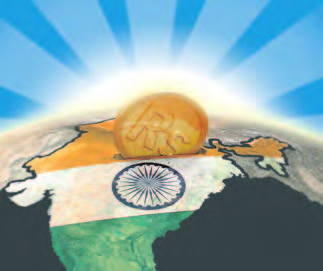
    Put together, these proposed the investment of more than Rs 102 lakh crore and were supposed to create 2.3 crore jobs. The data on actual implementation of these proposals shows that only Rs 5.1 lakh crore was actually invested and just 20.1 lakh jobs created. That’s less than 5% of the proposed investments and 8.9% of the promised jobs.

    A state-wise analysis of proposals shows that between August 1991 and March 2014 corporates proposed to invest Rs 15.4 lakh crore in Orissa —the highest in the country. It was followed by Gujarat and Chhattisgarh receiving over Rs 10 lakh crore of proposed investments and Maharashtra just a tad below that mark. Overall, there were 15 states, which were each supposed to get over Rs 1 lakh crore of investments in these 23 years.

    When one analyses actual investments, Haryana has been the most successful among these 15 states in converting proposals to reality as 18.9% of the proposed money actually reached the state. It is followed by Gujarat (12.6%) and Uttar Pradesh (11.4%). The states that fared the worst in this conversion are Bihar, Jharkhand, Chhattisgarh and Orissa, where less than 1% of the proposed money actually arrived.

    So, what is the investment to job creation ratio? Overall, the Rs 5 lakh crore actually invested created a little over 20 lakh jobs, which amounts to four jobs per crore of investment. There were 25 states which witnessed the actual investment of more Rs 1,000 crore. Among these states, Jammu and Kashmir witnessed the most labour intensive investments, while Gujarat had the most capital intensive ones. Every crore of rupee invested in Jammu and Kashmir created about 12 jobs, while in Gujarat a crore of investment yielded only two jobs.

    In the investment to job creation ratio, Jammu and Kashmir is followed by Goa, Uttarakhand, Kerala and Punjab, where ten or more jobs were created per crore of investment. The worst state/UTs in this list are Madhya Pradesh, Jharkhand, Daman & Diu, Uttar Pradesh and Gujarat.

  • Swine Flu outbreak in India with over 16,000 affected & section 144 imposed in Ahmedabad

    Swine Flu outbreak in India with over 16,000 affected & section 144 imposed in Ahmedabad

    Swine flu claimed 51 more lives, taking the death toll to 926. The H1N1 virus has, so far, affected more than 16,000 people across the country.

    According to collated data from the Health Ministry till February 24 this year, the total number of deaths due to the disease has reached 926 while the number of affected persons in various states stood at 16,235. The data released by the ministry on Tuesday had showed that 875 people had died due to the disease, while 15,413 people had been affected.
     
    Rajasthan continues to be the worst affected state, with 234 deaths till February 24 while the number of affected persons has risen to 4,884.  
     
    Ahmedabad district collector invoked the Criminal Procedure Code’s Section 144 here on Tuesday, prohibiting mass gatherings without prior permission in order to prevent swine flu, an official statement stated.

    “It has come to our notice that swine flu cases have been on the rise in Gujarat including Ahmedabad. The virus, which causes swine flu, is contagious and generally infects people by entering through nostrils and mouth mostly at crowded places,” the Ahmedabad district collectorate statement said.

     
    In Maharashtra, the death toll has risen to 112 while the number of affected persons was 1,221. Telangana, Karnataka and Punjab too have witnessed 54, 39 and 38 deaths respectively. In Delhi, the Health Ministry said that although the number of deaths is eight, there has been a rise in the number of affected persons which currently stood at 2,456, reported PTI.

    Assuring that the government was taking a serious view of the issue, Health Minister J. P. Nadda warned people to be careful but said there was no need for panic as medicines and facilities to tackle the disease were in place.

    While responding to members’ concerns in the Rajya Sabha, Mr. Nadda said the government would leave no stone unturned to tackle the issue while assuring that there was no shortage of medicines and swine flu testing facilities were being provided free of cost at specified government hospitals.

    Upping the ante against the government over the rising death toll due to swine flu, Congress accused it of approaching the issue in a “casual manner”.

    “Health Min statement on Swine Flu confirms our fear that government is taking a casual approach on an issue that qualifies as a public health crisis,” tweeted Ahmed Patel, political secretary to Congress president Sonia Gandhi.

  • Delhi to go to polls on February 7, counting on 10th

    Delhi to go to polls on February 7, counting on 10th

    NEW DELHI (TIP): The national capital will go to the polls on February 7 with the Aam Aadmi Party (AAP) hoping to beat its stunning debut performance a year ago, while the Bharatiya Janata Party (BJP) faces another big test of its popularity after back-to-back election wins at the Centre and in state assemblies.

    Results will be announced on February 10. Delhi has been under President’s Rule for almost a year since the Arvind Kejriwal-led AAP quit after just 49 days in office, most of them dominated by public sit-ins, conflicts with electricity, water and law enforcement agencies as well as a power struggle with the Centre.

    Most analysts see the election as a two-way contest between the BJP and AAP with price rise and women’s safety emerging as key electoral issues, though the Congress is also looking to revive its fortunes in the 70-member assembly following a string of defeats last year.

    BJP: Eyeing absolute majority

    Unable to get the magic number in 2013 assembly elections despite a strong anti-incumbency wave against the ruling Congress, the BJP was forced to sit in the opposition as AAP formed the government with outside support from the Congress.

    But with consecutive wins in the Lok Sabha polls and then assembly elections in Haryana, Maharashtra, Jharkhand and a good showing in J-K, the BJP has the momentum going. Also, the party won all seven parliamentary seats in Delhi. However, like the last time, the party is finding it difficult to project a

    chief ministerial candidate. With too many in the race for the top post, the party has decided to bank entirely on brand Modi to keep infighting at bay.

    The party’s campaign has been designed solely around Modi and the Prime Minister will address a rally each in all parliamentary constituencies. Unlike AAP and Congress, the BJP is yet to announce its candidates.

    With successive electoral reverses leaving the Congress weak, the party is in a direct contest with AAP. The Arvind Kejriwal party has taken the lead by announcing names for all 70 seats and going door-to-door seeking votes. Though pre-poll surveys are giving a clear majority to the BJP, it remains to be seen whether it lives up to the hype.

    AAP: Looking to better 2013 tally

    When the AAP came second in 2013 on its electoral debut, winning 28 seats in the 70-member Delhi assembly, volunteers looked ecstatic. Even many of their leaders shared, in private, that the result caught them by surprise as the party went on to rule Delhi for a brief period.

    But the decision to quit is something that has never stopped hurting AAP. It still enjoys support among the lower-middle class and the poor of Delhi. But many of those more affluent did not—and continue not to—approve leaving Delhi for national footprint.

    The party is projecting its “governance potentials” to demonstrate that it is prepared to stay the course. Through policy blueprints, it is fighting its image of a one-issue (corruption) party driven only by agitation.

    The party also has built an organisational structure and is trying to build a perception about the “good works” it did ‘with Congress’ in those 49 days. But this time around nothing short of a clear majority will do.

    The question is: will the party get there, as Delhi BJP hides behind party strongman and PM Narendra Modi? “I will not claim that we’re sure to win. It’s tough for us, but it’s no less tough for the BJP,” senior party leader Yogendra Yadav said in a recent address to AAP volunteers.

    Congress: Fighting survival battle
    Unlike the BJP and the Aam Aadmi Party, which are aiming to form a government with a clear majority, something that the either party failed to achieve in the 2013 polls, the fight for the Congress is that of survival.

    Despite ruling the Capital for three consecutive terms — between 1998 and 2013 — and a long list of infrastructure projects it completed during its 15-year rule that changed the face of Delhi on its election agenda, the party could not withstand the anti-Congress wave that swept across the city. Its seat tally came down from 43 in 2008 to just eight in 2013. The party’s poor run continued in the 2014 Lok Sabha elections when all seven sitting members of Parliament lost by huge margins, four of them forfeiting their security deposit.

    Not much seems to have changed for the Congress in the past few months. The poor, Dalits and the minorities, which were ardent followers of the Congress and had been voting for the party for the past several years, started gravitating towards the Aam Aadmi Party, which was fighting its debut election, in 2013. The trend continued in 2014 Lok Sabha elections too. The party faces an uphill task of bringing these voters back to its fold.

  • 18 ARMYMEN HELD IN NASHIK VIOLENCE CASE

    18 ARMYMEN HELD IN NASHIK VIOLENCE CASE

    MUMBAI (TIP): Eighteen Army personnel were arrested and remanded in magisterial custody on January 15 in connection with two incidents of violence in the cantonment town of Deolali in Nashik district.

    However, they were later released on bail by the Nashik Road court. Army’s Southern Command promised investigation and “exemplary action” against its errant personnel. The Nashik police reported the matter to the Maharashtra Police headquarters and the Home Department.

    The 18 personnel from the School of Artillery in Deolali camp were arrested and produced before a magistrate’s court, which remanded them in judicial custody. They moved for bail which was granted by the court, said advocate M Y Kale, who represents the accused.

    Meanwhile, Nashik Police Commissioner Kulwant Kumar Sarangal refuted reports and claims from the Army that their officer was manhandled first.

    “This is not the way you behave,” Sarangal said, taking serious note of the incident in which three police personnel reportedly sustained injuries, one women officer was threatened and the Upnagar police station was ransacked.

    The police claimed in the court that about 160 Army personnel were involved in the violence. The Army was guarded in its comments.

    “The Army and police are working closely in this case and all help is being extended by the School of Artillery in the ongoing investigations.

    As per the initial report, the reason for the altercation was the alleged detention and manhandling of an officer of School of Artillery on the night of January 13 by the police personnel of the Upnagar police station.

  • PBD 2015 ROUND-UP

    PBD 2015 ROUND-UP

    Chief Ministers beckon overseas Indians to cash in on Investment opportunities in States

    GANDHINAGAR (GUJARAT) (TIP), January 9, 2015. Chief Ministers of as many as 9 States made a strong pitch for investments by overseas Indians as they laid bare the opportunities and facilities for investors here today at the CMs session on the concluding day of the three-day Pravasi Bharatiya Divas. Presiding over the session, Mr. Rajnath Singh, Union Home Minister, said that the real Bharat was the villages of India and therefore it was important to develop villages to ensure a balanced and an inclusive growth.

    He added that every state in India has a success story to tell and have been able to make a mark in one sector or the other. The Central government, he said, believed in promoting cooperative federalism and therefore the States and the Centre have to work in tandem to make India an economic super power. NRIs, he said, will have to play an important role in fulfilling the Centre’s

    ‘Make in India’ vision.

    GUJARAT: ‘Smart State’ is the mantra of the State Government for which a five-point agenda has been adopted. These are smart schemes for welfare, smart economy, smart governance, smart energy and smart human resources. These schemes are expected to help the Indian diaspora to channelize the flow of investments into the State, set up industrial units and contribute to the social sector schemes to light up the lives of the common man. Kerala: Some of the path-breaking projects being undertaken by the State Government are: e Kochi Metro Rail project, Smart City Project, Vizhinjam port development, Light Metro Rail, Kannur Airport Project, Surface Transport Development, National Waterway and a Student Entrepreneurship Programme. These projects demonstrate that this is the right time to invest in the State and be part of the overall growth of the State. The State Government will offer full support to all who extend their help in further developing the State. Kerala has seen a rapid increase in its growth performance. The state has the highest literacy rate, best human development indicators and has many structural advantages such as a vast coastal line and high productivity due to historical reasons.

    PUNJAB: The immediate investment opportunities in the State are in the fields of IT, bio-sciences and healthcare and futuristic development of 147 cities and towns. The focus areas of the government are agro and food processing, education & skills, electronics manufacturing, textiles & garments and infrastructure development. The top five reasons for investing in Punjab are: easiest place to do business, robust infrastructure, abundant skills and enterprise,responsive, accountable & transparent governance and fiscal incentives. A lot of facilities have been initiated for the NRIs in the State of Punjab. A special court has been set for NRIs in the State to expedite the process of litigation, special police thanas have been put in place and a special commission has been set up to address property related issues of the NRIs.Jharkhand: The State Government offers ample opportunities to investors to partner in sectors such as industry and industrial infrastructure, electronics & IT/ITeS, road & road transport infrastructure, skill development, knowledge & education, healthcare, power generation & distribution, tourism, hospitality, leisure & entertainment and urban infrastructure. The key enablers for attracting investments are nearness to natural resources, skilled manpower due to existing industrial base, investor friendly policies and land bank. To leverage these enablers through a comprehensive and partnering module, the Government of Jharkhand has focused on industrial and economic development of the state through implementation of various infrastructure projects on PPP format.

    MADHYA PRADESH: The State has come a long way from being counted amongst the BIMARU states. It has state-of-the-art infrastructure including roads, power, railways etc. The state has been witnessing double digit growth and has the most investment friendly environment. The industrial policy of the state is investor friendly, the state is very peaceful and there are no man day losses and has single window clearances. The State houses India’s best national parks and world heritage sites.

    ANDHRA PRADESH: The state of Andhra Pradesh has a long coast line and is the gateway to India and south east Asia, has 30 urban centres, extensive road and rail network, natural gas and 24X7 power, young and skilled population and deposits. The state is looking at building five grids- water, gas, power, road and fibre. It has a very strong agriculture and marine and diary sector besides having a niche in high technology sectors like information technology. The state has formulated specific policies to give customised impetus for thrust sectors like industry, port, electronics, textile and agro processing. Also, a land bank has been created with 400 thousandhectares of land. The state is ideally poised for river linking and has the potential to become a drought proof state in the next 5 years.

    MAHARASHTRA: The state of Maharashtra is a land of investment opportunities. The State Government has started fast tracking approvals, simplifying processes and initiated the process of reducing timelines to facilitate investors, inflow of FDIs and make the state conducive for ease of doing business. The state has commenced work in full earnest to take ahead Prime Minister Narendra Modi’s call for ‘Make in India’. The State offers immense opportunities for infrastructure development as the government is planning to create a new urban city which would be bigger than the city of Mumbai. Also, the Government looks forward to providing affordable housing to middle and lower strata of society, and hence the State invited the Pravasis to take advantage of these investment opportunities.

    GOA: The State possesses talented human resource, natural reserves, captivating beauty which makes a great tourism destination. The Goa Government has now identified thrust areas such as creation of knowledge hub, focus on R&D, pharmaceuticals, biotechnology, aviation, aerospace, defence, IT, agro-based & food processing industries, to synergize its efforts with the ‘Make in India’ campaign of the Prime Minister. The aim is that the fruits of development percolate to the underprivileged of the society.

    HARYANA: The state of Haryana witnessed rapid growth in various sectors and is also an integral part of Delhi’s National Capital Region. Earlier, known as an agricultural state, Haryana has come a long way and now witnesses the presence of some of the well-known multinational companies. Haryana is focusing on skill development for both its urban and rural population toprovide them with employment opportunities, particularly, in MSMEs. Known for achieving milestones in sports, the Government desires to establish Haryana as a ‘Sports Hub’.

  • Fifty Shades of Saffron

    Fifty Shades of Saffron

    On December 11, 2014, when the U.N. General Assembly adopted June 21 as the International Day of Yoga, as recommended by Prime Minister Narendra Modi, India rejoiced. Never mind that the day before was the first Human Rights Day under his watch; this crept by unnoticed.

    At the SAARC Summit, Mr. Modi declaimed, “As we seek to build bridges to prosperity, we must not lose sight of our responsibility to the millions living without hope.” He was, as always, matchless as a kathakar, an artiste whose fabulous retelling of fables reinforces them in the minds of the faithful as fact. But while his performances have zero defects, on the lives of the multitudes hanging on to his words, believing in them and daring to hope, they have had zero effect so far, because the responsibility of which the Prime Minister spoke is usually ignored.

    In 1990, the U.N. launched the Human Development Report based on the challenging predicate that “people are the real wealth of a nation.” How wealthy are we really? After two decades of rapid GDP growth, we bestride SAARC like a colossus doing the splits, one foot splayed eastward to keep China out, the other westward to keep Pakistan down. We loom like a giant among midgets, but on every parameter that measures equity in development, there is little to choose between us and our neighbors.

    The Human Development Index (HDI) for 2014 ranks us at 135 among 187 countries; Sri Lanka at 73 did way better than us, and we were shadowed by Bhutan at 136, Bangladesh at 142, Nepal at 145 and Pakistan at 146. The fact that India was a stable democracy, as the others were not, that our economy had galloped along, as theirs had not, had made very little difference to the lives of our citizens.

    Within the HDI, the Gender Inequality Index which measures three critical parameters – reproductive health, women’s empowerment and their participation in the labor market – is particularly important because it shows how a society treats its more vulnerable half. Sri Lanka at 75 is well ahead of us, but so is Nepal at 98, Bhutan at 102 and Bangladesh at 115. India is in lock-step with Pakistan, both ranked at 127. The Criminal Law Amendment Act, which brought in far-reaching measures to protect women, is now almost two years old; sadly, it has made little difference.

    Depth of deprivation

    My five years on the National Human Rights Commission were a humbling experience. In 2009, we had 82,000 complaints, in 2013, a lakh. A five-member Commission could not possibly do justice to more than a fraction of these. We dismissed 60 per cent of complaints in limine, or at the outset, 11 per cent with directions to officials to act (but never had the time to check if they did) and transferred 6 per cent to the State Human Rights Commissions, which were mostly ramshackle.

    Our investigative visits to rural India were dives into the darkness that contained the mass of the iceberg of which the complaints coming to us were only the tip. In a country still largely illiterate, a terrible violation of human rights in itself, very few knew the NHRC existed. Those who did wondered if it would be able to help; many thought it would not. For every complaint that came to us, a hundred did not, but since so many were on systemic problems affecting entire communities, they brought home to us the range, depth and persistence of discrimination and deprivation in India. The two are often linked, and that is the real cause of worry with our new dispensation. The poorest and the most vulnerable – women, Scheduled Tribes, Scheduled Castes and Muslims – suffer because the social bias against them is rooted in Hindu belief and practice, and still so strong that the laws meant to protect them are impotent. Even under a secular government, public servants would plead with the NHRC that there would be law and order problems if they tried to implement these. The danger now is that under a government so overtly Hindu, these practices will flourish even more. The hate speeches of Cabinet members signal where this could lead us.

    “Discrimination and deprivation are often linked to one another, and that is the real cause of worry with our new dispensation”

    Mr. Modi wants his party to be careful with their words, but there are fifty shades of saffron around, most of it strident. He wants civil servants to be sensitive, but they always are, to the wishes of the powers that be. He wants the police to be SMART, but they already are, reporting to the National Crime Records Bureau that in 2013 there were only two incidents of human rights violations by their personnel. The same year, 33,753 complaints to the NHRC, a third of the total received, were against the police, detailing how they preyed on those they should protect.

    In Mr. Modi’s defense, these are national problems he has inherited, not created, but Gujarat is the template he holds up to the rest of India, and there are a range of impartial reports that show how cavalier it has been about the lives of the State’s people. A 2013 Lancet study found that among the 11 rich States, Gujarat had done the worst in bringing down the mortality rate of children under five, one of the Millennium Development Goals. The Census established that the sex ratio in Gujarat has declined from 934 in 1991 to 920 in 2001 to 918 in 2011. Not surprisingly, the NCRB data shows a high incidence of crimes against women. So too, the data shows, are crimes against Scheduled Castes, at levels higher than in the other developed States: Maharashtra, Punjab and Tamil Nadu. The ASER/Pratham Reports on Education show low percentages of students in Standard V who could read a Standard II text, and could do divisions. That is not a model to copy.

    Dreadful cost

    Despite what he said in Kathmandu, Mr. Modi’s record as Gujarat Chief Minister shows that his sights are set on prosperity, not on “the millions living without hope.” ‘Make in India’ is his priority, and there the signs are ominous. A few weeks back, ASSOCHAM issued an advertisement which announced, “Repeal of archaic laws is the need of modern times…ASSOCHAM has identified 105 laws for review, which can promote a better regulatory framework for successfully actualizing Mr. Modi’s vision of ‘Make in India’.” These include 43 laws that protect human rights and safeguard labor welfare, including the Bonded Labor System (Abolition) Act, Protection of Forest Rights Act, Inter-State Migrant Workers Act, Child Labor (Prohibition and Regulation) Act, and the Minimum Wages Act. If these are the voices he listens to, development will come at a dreadful cost.

    India’s governments have so far pursued development with a human face. Vast social welfare programs protect those whom the market forces savage, but these are riddled with huge problems. For instance, hardly any materials go into the rural employment guarantee projects, but each year material costs claimed are well over 20 per cent of its budget. A survey done for the NHRC showed that 60 per cent of the allocation for the Integrated Child Development Services was being stolen. The list goes on. The answer does not lie in jettisoning these programs, but in making them work better. Without them, rural India will empty out.

    Our Prime Minister’s many admirers believe that Sardar Patel’s mantle has descended on him. Vallabhbhai Patel made India, Narendra Modi can unmake it. But with his extraordinary talents, integrity and ability, our Prime Minister can also be the making of India, and make India, all of India, proud. That should be his tribute to his idol, not the monstrous statue of the Sardar now rising in Gujarat like a prelapsarian Ozymandias.

    By Satyabrata Pal

  • SC dismisses plea onMaratha reservation

    SC dismisses plea onMaratha reservation

    NEW DELHI (TIP): The Supreme Court on December 18declined to interfere with a Bombay High Court orderwhich stayed the Maharashtra government’s decisionproviding 16 per cent reservation to Marathas in jobs andeducational institutions.A bench presided over by Chief Justice H L Dattupointed out that it was just an interim order passed by thehigh court which would be taking up the matter forfurther consideration on January 5.“What is questioned here is only an interim order. Wedecline to entertain the special leave petition. We directthe high court to dispose of the matter expeditiously,” thebench said. Attorney General Mukul Rohatgi contendedbefore the court that an extraordinary case of stay wasmade out in the instant case as the high court, through aninterim measure, passed a detailed order against the moveinitiated for the welfare of the people of the state. “This isa sensitive issue as the people vying for jobs andadmission are denied the benefit,” he pleaded.The court, however, refused to entertain the plea sayingwhat may be going into the mind of the judges at the highcourt could be known only in the final judgment.

  • Cabinet clears Rs 5 lakh compensation to 1984 anti-Sikh riot victims

    Cabinet clears Rs 5 lakh compensation to 1984 anti-Sikh riot victims

    NEW DELHI (TIP): A proposal to give Rs 5 lakh each to the kin of victims of the 1984 anti-Sikh riots, triggered after assassination of the then Prime Minister Indira Gandhi, has been approved by the government on December 10 night. The decision has been taken by the Union Cabinet at a meeting presided over by Prime Minister Narendra Modi. The compensation to the families of the riot victims will be given in addition to what they have so far received from the government and other agencies, official sources said. Of the 3,325 victims, 2,733 were killed in Delhi alone while rest of the victims were from Uttar Pradesh, Haryana, Madhya Pradesh, Maharashtra and other states.

    The Narendra Modi government had received several petitions from various Sikh organisations in the last three months. The fresh compensation, which will cost the exchequer Rs 166 crore, sources said. The anti-Sikhs riots were triggered following the assassination of the then Prime Minister Indira Gandhi by her Sikh bodyguards on October 31, 1984. In 2006, the UPA government led by Prime Minister Manmohan Singh had announced a package of Rs 717 crore which included monetary compensation of Rs 3.5 lakh to the kin of each killed in the riots besides financial assistance to the injured and those who had lost their property.

    Out of this only, Rs 517 crore had been spent and the remaining Rs 200 crore could not be distributed because of dispute over claimants. The most affected regions were the Sikh neighbourhoods in Delhi. Some of the anti-Sikh riot cases are still continuing in courts and many Sikh organisations have alleged that the key conspirators of the violence were at large and victims have not yet got justice. In 2005, then Prime Minister Manmohan Singh had apologised for the 1984 anti-Sikh violence saying Gandhi’s assassination was a “great national tragedy” and what happened subsequently was “equally shameful”. “I have no hesitation in apologising to the Sikh community. I apologise not only to the Sikh community, but to the whole Indian nation because what took place in 1984 is the negation of the concept of nationhood enshrined in our Constitution,” he had said.

  • Cong disrupts RS over attempts to ‘glorify’ Nathuram Godse

    Cong disrupts RS over attempts to ‘glorify’ Nathuram Godse

    NEW DELHI (TIP): Congress Rajya Sabha MP Hussain Dalwai on December 11strongly condemned the alleged efforts to “glorify” Mahatma Gandhi’s assassin Nathuram Godse and demanded arrest of those involved in such exercise. “A person who has created an example of non-violence in the world and whom we called Father of the Nation was killed by Nathuram Godse,” Dalwai said outside Parliament. “Now some people are observing Nathuram Godse Shourya Diwas on November 15. It is absolutely wrong and the government should arrest them.

    Why is the government silent on the issue?” he asked. Dalwai said he has written to Maharashtra Chief Minister Devendra Fadnavis demanding action against persons involved in “glorifying” Godse. “Gandhi is accepted by people from all walks of lives including workers, peasants, dalit and women. I have written a letter to the state Chief Minister demanding action against these people,” he said. Earlier in the day, Rajya Sabha witnessed uproarious scenes with members from Congress lodging strong protest against eulogising of Godse at a function held in Maharashtra earlier this month. Under attack from the opposition members, Government disapproved of any such event hailing Mahatma Gandhi’s killer but said no organisation should be defamed.

    The Upper House saw two brief adjournments over the issue as Congress members protested holding placards in the aisles and raising slogans, while charging right-wing organisations with lending their support to it. Raising the issue during Zero Hour, Dalwai (Cong) said he has written to Maharashtra Chief Minister over hosting the event attended by some religious leaders and former MLAs. “Mahatma Gandhi’s killer is being eulogised by hosting his ‘Shaurya Diwas’ in Maharashtra…These people talk of development, but are trying to create a rift in society,” he said, accusing the right-wing organisations of indulging in such things, including religious conversions that created tension in society.

    Congress members created uproar over the issue and raised slogans while displaying placards of the event, even as Deputy Chairman P J Kurien tried to pacify the agitating members, asking them to take their seats and maintain peace. “Don’t make use of Zero Hour for this kind of display. This is gross indiscipline…To decide the culpability or otherwise, the courts are there, not me or you,” Kurien said. Minister of State for Parliamentary Affairs Mukhtar Abbas Naqvi said, “This is not acceptable. Mahatma Gandhi’s killer, whosoever it may be, we are against it…We do not accept any honour of Mahatma Gandhi’s killers.” As members continued their protest and the House witnessed acrimonious exchanges between both sides, Kurien adjourned the proceedings for 10 minutes just before noon.

    But, similar scenes were witnessed when the House met at noon, forcing the Chair to adjourn it again for 15 minutes. When the House reassembled, Anand Sharma (Cong) said, “It is not acceptable that some one eulogises him. I hope neither the House nor the Parliamentary Affairs Minister will approve of such an action. Let the House speak in one voice and condemn it.” Parliamentary Affairs Minister Venkaiah Naidu said, “There is no question of eulogising such a person. We should leave the matter there, but defaming an organisation is not acceptable.” It was after this that normal proceedings resumed.

  • TATA POWER BUYS PLANT FOR RS 3,000 CR

    TATA POWER BUYS PLANT FOR RS 3,000 CR

    MUMBAI (TIP): Tata Power, the power generator led by Cyrus Mistry, is buying a 540-megawatt (MW) thermal power plant in Maharashtra to ramp up capacity, highlighting how a lot of India’s recent merger and acquisition (M&A) deals are being driven by the power sector. Tata Power’s move comes close on the heels of JSW’s purchase of a 1,391-MW unit (from Jaypee), Adani’s acquisition of 1,200-MW and 600-MW plants (from Lanco and Avantha respectively) and GDF Suez’s deal for a 1,000-MW facility (from a Hyderabad-based infra company). Tata Power, part of the Tata business conglomerate, is acquiring the thermal-based power project from the promoters of IRB Infrastructure, which will increase its total capacity to 8,885 MW. It is learned that the Tata company has inked the deal for about $500 million (Rs 3,000 crore). However, it didn’t disclose the value of the proposed transaction.

  • Escalating tension is not good for either country

    Escalating tension is not good for either country

    While there will be no open war between India and Pakistan in the normally understood sense, this does not prevent Pakistan from activating its tools of terror

    There has been an escalation of tension between India and Pakistan in the recent few days. The Line of Control (LoC) has witnessed serious exchange of fire at the border for nearly a fortnight. Prime Minister Narendra Modi referred to the border firing in one of his election rallies in Maharashtra. Modi said that Pakistan was getting the befitting lesson and it would not dare to open fire on the border.

    It may be recalled that the cease-fire agreement between India and Pakistan came into effect in November 2003. Thereafter there had been periodic fire from Pakistan side, which had to be routinely returned by the Indian forces posted at the LoC. Union Home Minister, Rajnath Singh made a statement that Pakistan should understand that times have changed in India, an obvious reference to Bharatiya Janata Party under Narendra Modi coming to power at the centre with majority of its own.

    Reverting to the situation on the LoC, the Border Security Force (BSF) was handling the situation on the international border and it was BSF which was doing the firing across the LoC in Poonch, R.S. Pura and Arnia sectors. Reports say that instructions to Director General BSF, D.K. Pathak went out from the National Security Adviser Ajit Doval, who was in direct touch with DG, BSF over the period of 5 days in the first half of October 2014. The BSF reportedly fired more than 10,000 mortar shells, not to speak of countless ammunition, leading to an unprecedented situation in the border.

    Pakistan reported that 2 civilians were killed and about 100 injured on their side and also that scores of villages witnessed vacating of houses by the civilians moving away from the border. The former Chief of BSF E.N. Rammohan commented that earlier the exchange of fire was confined to LMGs and MMGs and now, mortars are being used which spelt danger to civilian lives who lived within 5000 meters range. He went on to comment, “civilians dying like this is absolutely absurd”.

    An analyst had written that the flare up on the border came at the height of campaigning for Assembly elections in Maharashtra and Haryana when Modi referred to Pakistan being taught lesson at a public rally in Maharashtra on October 9. A BSF Commandant said, “I am very proud, nobody, not even Indian Army has fired as much as we have into Pakistan since 1971 war. There were no restrictions this time and we kept on firing. Even the Army cannot boast of so much. At least no Army infantry battalion had fired mortars.”

    In Pakistan, Prime Minister, Nawaz Sharif was a worried man and he summoned all the senior army officers for taking stock of the situation. Nawaz Sharif also dispatched his trusted adviser Shahryar Khan to Delhi for back channel work and to bring out normalcy on the border. Khan is the President of the Pakistan Cricket Control Board and his visit to India was ostensibly to discuss cricket fixtures with India, did not go much beyond that level, since no senior Indian back channel representative met him during his stay in Delhi.

    Prime Minister Narendra Modi, meanwhile held a meeting attended by all senior Army commanders. Prime Minister Modi said that India had to be prepared for a changing world which demanded new thinking on economic, diplomatic and security policies. He asked them to be fully prepared for any eventuality. He also said that security challenges would be more unpredictable and invisible. On the Pakistan side, the Army Chief Gen. Raheel Sharif said at the Military Academy on October 18, that Pakistani forces are fully capable of meeting any external threat and that any aggression against Pakistan would get a befitting response.

    The Pakistani Army chief also digressed to the subject of Kashmir and said that the people of Kashmir should be allowed to decide their fate in the light of UN Resolutions. The growing tension between India and Pakistan had not escaped the attention of foreign observers. The Australian scholar Christopher Snedden, who has specialized on the subject of Kashmir and teaches at the Asia Pacific Centre for Security Studies, Honolulu, has commented that India’s new belligerence towards Pakistan is unhelpful and cited the cancellation of talks by the Indian Foreign Secretary with her counterpart in Pakistan over the Pakistan Ambassador’s meeting with Kashmiri separatists. Snedden went on to say that such meetings had routinely taken place in the past.

    Pakistan Prime Minister, Nawaz Sharif had attended Modi’s oath taking ceremony as the Prime Minister of India in New Delhi, on May 16, 2014, which he did ignoring the advice of the armed forces and hardliners, who were against his visiting India for the occasion. The border tensions and the disproportionate level of Indian reaction would lead to Pakistan analyzing and reviewing various options to retaliate against India. While there would not be any serious flare up between Indian and Pakistani forces in any sector. Pakistan Army Chief and the ISI Chief of Pakistan would be seriously exploring multiple ways of hurting India.

    At the diplomatic level, Pakistan had activated its diplomatic representative to brief UN members on the unfulfilled UN resolution for holding plebiscite in Kashmir for ascertaining views of the Kashmiri people regarding their options between India and Pakistan.

    While there will be no open war between India and Pakistan in the normally understood sense, that does not prevent Pakistan from activating its tools of terror like Lashkar-e-Toiba and Jaish-e-Mohammed in carrying out serious attacks within India. The National Security Guard (NSG) Chief J.N. Choudhury had warned on October 16 that the Al Qaeda and the ISIS may join hands with terror groups like Indian Mujahideen and carry out multicity multiple attacks in the country at the time of their choosing. Terror organizations like Lashkar-e- Toiba and Jaish-e- Muhammed will also be carried along in their dastardly scheme.

    The tensions between the two countries have to be seriously examined and ways and means to bring back normalcy should be worked out and implemented. India stands to lose much more if terrorist organizations are deployed in various cities in the country at a time of Pakistan’s choice. As this possibility is strong, this needs to be given serious consideration. Now that Prime Minister Narendra Modi has demonstrated his strength once again by decisively winning the elections in Maharashtra and Haryana, it is time for him to turn to the important issue of easing tensions between India and Pakistan.

    There was no meeting between Prime Ministers of India and Pakistan during the UN session in October as Modi was not interested in meeting with his Pakistani counterpart. The next opportunity comes up in November during the SAARC meeting in Nepal. It is hoped that the two Prime Ministers will have one to one meeting, with or without officials and work out a road map for future course of action.

  • Fadnavis to be sworn in as Maharashtra CM, October 31; Sena to boycott ceremony

    Fadnavis to be sworn in as Maharashtra CM, October 31; Sena to boycott ceremony

    MUMBAI (TIP): Bharatiya Janata Party leader Devendra Fadnavis will be sworn in as Maharashtra chief minister on Friday, October 31 at Wankhede stadium in Mumbai. The mega ceremony is likely to be attended by Prime Minister Narendra Modi and several VVIPs. As such, a thick security blanket has been thrown in and around Wankhede Stadium.But even as the BJP is getting ready for its moment of glory at the iconic Wankhede stadium, it’s former ally Shiv Sena will be conspicuous by its absence. As the party did not find any place in the government, sources said the Sena has already made up its mind to sit in the opposition.

    It is likely to announce its leader of opposition in the next few days. Names of senior leaders Ravindra Waikar, Dr Auti and Eknath Shinde are also doing the rounds. Sena leader Vinayak Raut said, “The party will not attend the swearing-in ceremony. The situation created is humiliating.” Senior BJP leader Rajiv Pratap Rudy said that Sena chief Uddhav Thackeray should attend the ceremony. “The BJP will go in to swearing-in ceremony with small cabinet. I don’t know whether Uddhav is coming or not but he should come.”

    More than 2,500 security personnel are being deployed in and around the iconic and sprawling cricket ground in South Mumbai. Over 1,100 traffic policemen will ensure smooth movement of VIP and VVIP vehicles around the stadium and along the roads leading to the venue from domestic airport. The stadium, hosting the first open air oath-taking ceremony, has been declared a no flying zone, police said. Under the supervision of Police Commissioner Rakesh Maria, about 2,500 security personnel, including members from Mumbai Police, Special Protection Group (SPG) and Quick Response Teams, will maintain a strict vigil during the highprofile event, said Joint Commissioner of Police (Law and Order) Dhananjay Kamalakar.

  • Black money: NDA moves to make names public, top politicians said to be on list

    Black money: NDA moves to make names public, top politicians said to be on list

    NEW DELHI (TIP): The NDA government has started filing charges against individuals having illicit accounts in overseas banks, clearing the way for disclosure of names of those who have stashed black money abroad, and triggering speculation that some prominent politicians may figure on the much-awaited list. Sources said that prosecution has been initiated against one foreign account holder, and will soon be extended to another 15-20 who are on the ‘HSBC Geneva list’.

    Swiss authorities have confirmed the identities of the persons on the list. Launch of prosecution in these cases will meet the condition laid down by Swiss authorities that names of account holders can only be shared with courts after charges are framed. Prosecution proceedings by the income tax department triggered speculation about the identity of the foreign account holders, with political circles discussing names of a former Union minister and the son of another, a former MP with family links to a leading business house, and the scion of a political dynasty which is currently passing through a lean patch.

    Significantly, finance minister Arun Jaitley did not deny the possibility of a former UPA minister being on the list. “I am neither confirming, nor denying. I am only smiling,” he said, attracting a hostile response from Congress. When pressed, Jaitley said, “If my opponent’s name is there, I will be very enthusiastic in declaring it.” Sources also said a fresh list of 19 persons having illegal accounts with Liechtenstein Bank will be shared with Supreme Court after Diwali.

    This will be followed by another 20-odd names from the HSBC list. Launch of prosecution come amid resumed fight between BJP and Congress over black money. Congress latched on to the government’s stand in SC last week that it could not disclose the names of foreign account holders against whom charges were not framed to say that the Modi government had done a U-turn on the issue. BJP hit back, with Jaitley saying they were hamstrung by treaties signed by the UPA which forbade the government from disclosing names of those not facing charges. On October 21, Jaitley scaled up the retaliatory strike by saying that Congress would be embarrassed when the names came out.

    The two sides traded fire again on October 22 with Jaitley saying, “In case charges are proved against some politician and he or she happens to be a member of a political party, the names will be made public.” It is learnt that the list shared by France of Indians having accounts in HSBC Bank, Geneva featured a few Congressmen and their scions with huge deposits at the time the list was leaked. Interestingly, a former UPA-2 minister, who was sent a notice to appear for questioning to explain his deposits, is believed to also have bank accounts in the UAE and later claimed that he had closed his Swiss accounts long ago.

    The government has so far recovered Rs 200 crore by way of tax and penalty from the names shared by Germany and France that included account holders in LGT Bank in Liechtenstein and HSBC Bank, Geneva. The total assessed income in the two cases has gone over Rs 600 crore so far. While prosecution is being launched against many account holders in the HSBC case, the income tax department had filed cases against 18 persons in the LGT Bank case.

    After the French government shared the HSBC Bank list having names of 700 Indians in 2011, the finance ministry had asked the Directorate of Criminal Investigation (DCI) to probe the case. DCI had questioned some top industrialists over deposits estimated to be upwards of Rs 800 crore. A few leading politicians, including the son of a former minister in UPA-2 and the son of an influential Maharashtra minister who faced a humiliating defeat in the recentlyconcluded assembly polls, were put on notice after their names figured on the list. The total tax and penalty in the LGT Bank case was estimated to go up to Rs 40- 45 crore, almost equivalent to the amount that had been spirited away by 19 Indians whose income has now been reassessed to Rs 40 crore, sources said.

  • Gadkari says happy in Delhi; Stage set for Fadnavis as Maharashtra CM

    Gadkari says happy in Delhi; Stage set for Fadnavis as Maharashtra CM

    NAGPUR (TIP): A potential crisis in Maharashtra BJP over the choice of leader for the post of chief minister seems to have blown over with Union minister Nitin Gadkari saying he has no differences with his colleague Devendra Fadnavis, considered as a front-runner for the post, and is happy in Delhi. “We have no differences. My political guru is Devendra’s father Ganghadharrao Fadnavis who was an MLC while I was instrumental in bringing Devendra into politics,” Gadkari said after Fadnavis called on him at his residence in Mahal area in the morning.

    According to sources, the closed door meeting between Gadkari and Fadnavis apparently sealed the deal in favour of the latter. “I am happy in Delhi. Fadnavis is my colleague and came to meet me on Diwali,” Gadkari told reporters when asked whether he intends to return to state politics. Though Fadnavis has maintained that his meeting with Gadkari was to extend Diwali greetings, the duo met again at BJP’s regional office in Dhantoli area, with some BJP leaders and office-bearers in attendance, in late afternoon. The sources said that the central leadership wanted to nip the feud between the two leaders from Nagpur in bud and might have asked Fadnavis to visit Gadkari.

    Though Gadkari had earlier clarified his stand about not returning to state politics, saying it was for the BJP’s central leadership to decide and that he would accept any responsibility given to him by the party, a group of 39 newly-elected BJP MLAs from Vidarbha region had met him here on Tuesday and pushed for him to be made the chief minister. Leaders present at the Dhantoli office,where Gadkari and Fadnavis stayed for some 15 minutes for Laxmi Pujan, said that they got clear indications that Fadnavis will emerge as a consensus choice for the coveted post.

    Speculations about Fadnavis being the choice of the top party leadership for the CM’s chair started when Prime Minister Narendra Modi, during one of his rallies in run-up to state Assembly elections, had described Fadnavis “as Nagpur’s gift for Maharashtra”. After a group of 39 newly-elected BJP MLAs from Vidarbha region met Gadkari here on Tuesday and demanded that he be made the state’s CM, Nagpur-East MLA Krishna Khopde had yesterday offered to quit and vacate his seat to pave way for his mentor Gadkari.

    Moreover, two more MLAs – Sudhakar Kolhe (Nagur-South) and Sameer Meghe (Hingana) – also offered to resign from their respective seats to pave way for the Union minister. Later, five independent MLAs -Vinayak Patil (Ahmednagar), Shirish Choudhary (Amalner), Ganpat Gaikwad (Kalyan-East), Mahesh Landge (Bhosari) and Ravi Rane (Badnera) – met both Gadkari and Fadanvis separately yesterday to offer support if the Chief Minister is chosen from Vidarbha region.

    Though senior BJP leaders and Gadkari acolytes Sudhir Mungantiwar and Vinod Tawde had raised their pitch in favour of Gadkari, former national president of BJP, another senior leader Eknath Khadse expressed his displeasure over the “pressure tactics” of Gadkari. BJP has emerged as the single largest party in recently held Maharashtra elections pocketing 123 seats, including one won by its ally Rashtriya Samaj Paksha, but has fallen short of forming government of its own as it faces the shortfall of 22 MLAs in the 288-member House.

  • DHANTERAS

    DHANTERAS

    THE FESTIVAL OF WEALTH

    The festival of Dhanteras falls in the month of Kartik (Oct-Nov) on the thirteenth day of the dark fortnight. This auspicious day is celebrated two days before the festival of lights, Diwali.

    How to Celebrate Dhanteras

    On Dhanteras, Lakshmi – the Goddess of wealth – is worshiped to provide prosperity and well being. It is also the day for celebrating wealth, as the word ‘Dhan’ literally means wealth and ‘Tera’ comes from the date 13th. In the evening, the lamp is lit and Dhan-Lakshmi is welcomed into the house. Alpana or Rangoli designs are drawn on pathways including the goddess’ footprints to mark the arrival of Lakshmi. Aartis or devotional hymns are sung eulogizing Goddess Lakshmi and sweets and fruits are offered to her. Hindus also worship Lord Kuber as the treasurer of wealth and bestower of riches, along with Goddess Lakshmi on Dhanteras. This custom of worshiping Lakshmi and Kuber together is in prospect of doubling the benefits of such prayers. People flock to the jewelers and buy gold or silver jewelry or utensils to venerate the occasion of Dhanteras. Many wear new clothes and wear jewelry as they light the first lamp of Diwali while some engage in a game of gambling.

    Diwali Shopping is Completed

    Dhanteras is observed differently by different communities. It is considered to be highly auspicious day to do new purchases and investment. Most people complete the Diwali shopping on the day. The first lamps of Diwali are lit on the day. People hang up paper lanterns with festoons and sends out the message of the arrival of Diwali.

    Get-Together of All Family Members

    Dhanteras is not all about material wealth it is also a time to develop spiritual wealth and family bonding. All family members arrive at ancestral home on the day. Grand Parents and Parents wait for the day as sons, daughters and grand children arrive from distant places.


    25


    Welcoming Goddess Lakshmi

    Goddess Lakshmi is welcomed into the house on Dhanteras day in many regions in the evening. Rangoli is drawn on doorways and tiny footprints of Lakshmi are drawn in vermilion to symbolize her arrival. Devotional songs dedicated to Goddess Lakshmi are sung in the evening. Sweets are offered to the Goddess on the day.

    Goddess Lakshmi Puja for Three Days

    In some regions Goddess Lakshmi Puja is performed for three days – Dhanteras, Choti Diwali and Diwali. On the first day, Dhanteras day, all family members especially men and women bathe after applying fragrance, medicinal herbs or preparation and fragrant oils. Murti – painting or idol or picture – of Goddess Lakshmi is washed with water and worshipped for three days commencing from Dhanteras.

    Buying Gold – Silver or Utensil

    Dhanteras – Dhan means ‘wealth’ and theras indicates ‘the thirteenth day’. In most places in North India, Gujarat and Maharashtra, Dhanteras is an auspicious day to buy precious metals like gold, platinum and silver. Women shop for gold or silver or at least one or two new utensils on the day. Precious metal bought on the day is seen as a sign of good luck.

    Earthern Diyas in the Evening

    Earthern diyas are lit on Dhanteras day in the evening to banish the evil spirits.

    Legend behind the Dhanteras and Naraka Chaturdashi:

    An ancient legend ascribes the occasion to an interesting story about the 16 year old son of King Hima. His horoscope predicted his death by snake-bite on the fourth day of his marriage. On that particular day, his newly-wed wife did not allow him to sleep. She laid out all her ornaments and lots of gold and silver coins in a heap at the entrance of the sleeping chamber and lit lamps all over the place. Then she narrated stories and sang songs to keep her husband from falling asleep.

    The next day, when Yama, the god of Death, arrived at the prince’s doorstep in the guise of a Serpent, his eyes were dazzled and blinded by the brilliance of the lamps and the jewelry. Yam could not enter the Prince’s chamber, so he climbed on top of the heap of gold coins and sat there the entire night listening to the stories and songs. In the morning, he silently went away.

    Thus, the young prince was saved from the clutches of death by the cleverness of his new bride, and the day came to be celebrated as Dhanteras. And the following days came to be called Naraka Chaturdashi (‘Naraka’ means hell and Chaturdashi means 14th). It is also know as ‘Yamadeepdaan’ as the ladies of the house light earthen lamps or ‘deep’ and these are kept burning throughout the night glorifying Yama, the god of Death. Since this is the night before Diwali, it is also called ‘Chhhoti Diwali’ or Diwali minor.

  • BHAI DOOJ: THE BOND OF BROTHERLY-SISTERLY LOVE

    BHAI DOOJ: THE BOND OF BROTHERLY-SISTERLY LOVE

    Nowhere is the bond of brotherly-sisterly love glorified with such grandeur as in India. Hindus celebrate this special relationship twice every year, with the festivals of Raksha Bandhan and Bhai Dooj.

    What, When & How

    After the high voltage celebrations of Diwali , the festival of lights and fire-crackers, sisters all over India get ready for ‘Bhai Dooj’ – when sisters ceremonize their love by putting an auspicious tilak or a vermilion mark on the forehead of their brothers and perform an aarti of him by showing him the light of the holy flame as a mark of love and protection from evil forces. Sisters are lavished with gifts, goodies and blessings from their brothers. Bhai Dooj comes every year on the fifth and last day of Diwali, which falls on a new moon night. The name ‘Dooj’ means the second day after the new moon, the day of the festival, and ‘Bhai’ means brother.

    Myths & Legends

    Bhai Dooj is also called ‘Yama Dwiteeya’ as it’s believed that on this day, Yamaraj, the Lord of Death and the Custodian of Hell, visits his sister Yami, who puts the auspicious mark on his forehead and prays for his well being. So it’s held that anyone who receives a tilak from his sister on this day would never be hurled into hell. According to one legend, on this day, Lord Krishna, after slaying the Narakasura demon, goes to his sister Subhadra who welcomes him the lamp, flowers and sweets, and puts the holy protective spot on her brother’s forehead. Yet another story behind the origin of Bhai Dooj says that when Mahavir, the founder of Jainism, attained nirvana, his brother King Nandivardhan was distressed because he missed him and was comforted by his sister Sudarshana. Since then, women have been revered during Bhai Dooj.


    22


    Bhai Phota

    In Bengal this event is called ‘Bhai Phota’, which is performed by the sister who religiously fasts until she applies a ‘phota’ or mark with sandal wood paste on her brother’s forehead, offers him sweets and gifts and prays for his long and healthy life. Every brother eagerly awaits this occasion that reinforces the bond between brothers and sisters and their affectionate relationship. It’s an opportunity for a good feast at the sister’s place, coupled with an enthusiastic exchange of gifts, and merriment amid the resounding of conch shells in every Bengali household.

    Underlying Significance

    Like all other Hindu festivals , Bhai Dooj too has got a lot to do with family ties and social attachments. It serves as a good time, especially for a married girl, to get together with her own family, and share the post- Diwali glee. Nowadays, sisters who are unable to meet their brothers send their tika – the spot of protection – in an envelope by post. Virtual tilaks and Bhai Dooj e-cards have made it even easier for brothers and sisters, who’re far away from each other, specially remember their siblings on this propitious occasion.

    Bhai Dooj In Uttar Pradesh

    In Uttar Pradesh, at first, sisters give a piece of cloth, knotted into a circular shape, full of batashas (sugar balls) to their brothers. This piece of cloth is called as ‘aabf’. For each brother, there are two aabf. After all the rituals, sisters apply a tika of roli and rice on the forehead of the brothers and then perform aarti, praying for the long and happy life of their brothers. At last, they offer sweets to them and then the story of Bhai Dooj is narrated.

    Bengal

    In Bengal this festival is called Bhai Phota. On this day, sisters observe fast till the time all the traditional customs have been performed. After this, they apply tika made of sandalwood paste, ghee and kohl (kajal) on their brothers’ forehead. Then the aarti is performed and sisters give sweets to their brothers to eat. Kheer and coconut laddus are the traditional sweets which are prepared on this day. At the time of applying tika, the sister chants the mantra which is as follows: “Bhratus tabaa grajaataaham Bhunksa bhaktamidam shuvam Preetaye yama raajasya Yamunaah Visheshatah.” This mantras means “I, your sister making you eat this holy rice for the pleasure of Yama and Yamuna”. In this way she prays God to bless her brother with the best in life.

    Bihar

    In the Bihar, the festival of Bhai Dooj is celebrated in the most unique way. The sisters curse their brothers in order to keep the evil spirits and dangers away from them. At first, they say very bad things to their brothers and then prick their own tongue with a wild prickly fruit as a punishment. By doing this, they ask their brothers to forgive them for the ill behaviour and mistakes which they have done till the date. Besides this, there is a unique custom in which brothers eat grains of bajri with water, from the hands of their sisters.

    Punjab

    In Punjab, the day after Diwali is celebrated as tika and on this day, sisters make a paste with saffron and rice and apply tika on their brothers’ forehead to keep away all the difficulties and dangers from them. After this, they exchange gifts and sweets among each other.

    Gujarat

    Bhai Dooj in Gujarat is known as Bhai Beej and on this auspicious occasion, sisters get up early in the morning and then the traditional tilak ceremony is held. After this, they perform aarti of their brothers and pray for their good fortune and life. Then they offer sweets to their brothers and in return the brothers bless them and exchange gifts.

    Maharashtra & Goa

    Marathi communities in Maharashtra and Goa called this festival as Bhav Bij. On this day, sisters draw a square on the floor in within the boundaries of which the brothers have to sit. After they are seated, it is a custom for to have a bitter fruit named Karith. After this, the rituals and applying the Tilak, traditional sweets such as Shrikhand Puri and Basundi Puri are served.

  • BJP front runner in Haryana, Maharashtra: Exit polls

    BJP front runner in Haryana, Maharashtra: Exit polls

    NEW DELHI/MUMBAI (TIP): At least three exit polls put the Bharatiya Janata Party (BJP) ahead but short of a clear majority in Maharashtra and Haryana on Wednesday, a ringing endorsement of the so-called ‘Modi magic’ that may have helped the party come into its own in the two politically crucial states. A fourth survey by Today’s Chanakya, which correctly predicted the results of the Lok Sabha polls this year, gave the party a clear majority in both states.

    The projections, if true, could touch off a round of intense haggling between the party and its estranged allies – the Shiv Sena in Maharashtra and Haryana Janhit Congress (HJC) – for control of the two states that the Congress has led for more than a decade, either on its own or with its partners. A BJP victory will reaffirm Modi’s appeal among voters and silence detractors of his new party leadership, which was blamed for a string of defeats in recent by-elections that tempered the euphoria of his Lok Sabha triumph. Modi campaigned extensively for the state elections, addressing 27 rallies in Maharashtra and 11 in Haryana in a bid to prop up the BJP’s fortunes after the by-election losses.

    A Times Now-C Voter poll predicted the BJP would bag 129 of 288 seats in the politically crucial state of Maharashtra despite the falling apart of its 25-year-old association with the Shiv Sena, which was projected to win in 56 constituencies. Times Now-C Voter predicted 37 seats for the BJP in the 90-member Haryana assembly. An ABP-Nielsen poll predicted 144 seats for the BJP and 77 for the Sena, while an India Today-Cicero exit poll saw the BJP winning 124 seats in Maharashtra. The poll says the Shiv Sena will be the second largest gainer in Maharashtra with 71 seats.

    The polls did not bring any cheer to the Congress party, already relegated to the political sidelines since its bruising defeat in the Lok Sabha polls. The Times Now-C Voter poll said the Congress was likely to win 43 seats in Maharashtra while ABP-Nielsen said it will bag just 30 seats. In Haryana, Times Now-C Voter gave the Congress 15 seats and ABP-Nielsen poll predicted the country’s main opposition party will get 10 seats. Today’s Chanakya predicted a clear majority of 151 seats for the BJP in Maharashtra and 52 in Haryana. Today’s Chanakya was on the money when it predicted a 300-plus sweep for the National Democratic Alliance (NDA) in the Lok Sabha elections.

    For the Congress, a poor result will possibly stoke further murmurs against Rahul Gandhi’s leadership. If the outcome on October 19 judgement day matches the predictions, it would mean the Congress would have to carry forward with its restructuring process to script a turnaround in the face of a saffron surge. Haryana saw a high turnout of 75.9%, while Maharashtra registered a turnout of 63.4% in the elections seen as a test of Prime Minister Narendra Modi’s popularity since he stormed to power in May and the BJP’s strategy to abandon long-standing allies in the states.

    The elections were mainly peaceful except for minor clashes between workers of the Indian National Lok Dal (INLD), BJP and others in Haryana. Analysts said the BJP had benefited from anger towards the Congress party, which has held power in Maharashtra for 15 years and Haryana for a decade. Both chief ministers, Prithviraj Chavan in Maharashtra and Bhupinder Hooda in Haryana, battled strong anti-incumbency with corruption being a major poll issue.

    The BJP took a big gamble on its popularity and campaigned alone in both states. It was in contention for power for the first time in Haryana, where it was a junior partner in the Indian National Lok Dal (INLD) government in 2000. Similarly in Maharashtra, the BJP had so far played second fiddle to the Shiv Sena, which led the coalition government in the state from 1995 to 1999. The Congress-NCP alliance ruled the state for 15 years from 1999. In case of a hung verdict, the shaping up of new political alliances promises to be another interesting chapter following the high-stakes elections.

  • Survey gives BJP, allies 154 seats in Maharashtra

    Survey gives BJP, allies 154 seats in Maharashtra

    NEW DELHI (TIP): A survey carried out in Maharashtra ahead of the October 15 assembly elections has given BJP and allies 154 of the 288 seats, but Shiv Sena leader Uddhav Thackeray tops the popularity chart as chief ministerial candidate.

    Incumbent Prithviraj Chavan is the second choice for chief minister though his party Congress is predicted to get an abysmally low 25 seats.

    Percentage wise, BJP has been placed way ahead of its rivals by 36.50 per cent votes followed by 17.10 per cent of Shiv Sena and 11.97 per cent of Congress.

    The survey conducted by ‘The Week’ and Hansa Research, paints a gloomy picture for Sharad Pawar’s NCP, which is projected to get only 17 seats and 5.85 per cent votes.

    Pawar is the fifth choice for the chief minister’s post and stands behind MNS leader Raj Thackeray and BJP’s Devendra Fadnavis.

    Shiv Sena is predicted to be the second largest party after BJP with 47 seats, while Maharashtra Navnirman Sena, according to the survey, is likely to get 10 seats. MNS is predicted to get 5.11 per cent votes. The survey has given 20 seats to Independents with 4.71 per cent votes and 15 to other parties with 6.79 per cent votes.

    After 15 years of running coalition government in Maharashtra, Congress and NCP have parted ways and BJP-Shiv Sena’s old alliance has also fallen apart paving the way for a five-cornered contest, with MNS being the fifth player which has recently made noises favourable to Shiv Sena.

    BJP is going to polls with smaller “Mahayuti” allies. It has worked out a seat-sharing deal with Mahadeo Jankar’s Rashtriya Samaj Paksha, Raju Shetty’s Swabhimani Shetkari Paksha, Shiv Sangram and RPI.

    PARTIES IN THE FRAY
    BJP, SHIV SENA, NCP, CONGRESS & MNS

  • BJP TO ROLL OUT BIG GUNS FOR ASSEMBLY POLLS

    BJP TO ROLL OUT BIG GUNS FOR ASSEMBLY POLLS

    NEW DELHI (TIP): With Dussehra over, BJP will get into campaign mode for the Haryana and Maharashtra assembly polls on a war footing.

    Prime Minister Narendra Modi and his senior ministers will have little time for anything else, criss-crossing the two states over the next two weeks, addressing rallies. BJP plans to hold at least four big rallies a day in each state till campaign ends for the October 15 polls.

    Modi will begin his charge on Saturday morning from Karnal in Haryana and move to Maharashtra to address three rallies in Beed, Aurangabad and Mahalakshmi (Mumbai). The PM will address 8-10 rallies in Haryana and around 22 in Maharashtra.

    Two senior ministers — home minister Rajnath Singh and external affairs minister Sushma Swaraj — will be all over Haryana on Saturday, holding four rallies each in the state. Singh will be at Radaur, Kalayat, Julana and Jakholi Rai while Swaraj will address rallies in Kalka, Thanachhapar, Shahbad and Gohana. Singh will address about 15 rallies in each state.

    The party has decided to have Swaraj, who belongs to Haryana, focus on the state where BJP is contesting on its own and is aiming to replace the Congress government. Similarly, road transport minister Nitin Gadkari has been asked to concentrate on Maharashtra, his home state, where BJP is contesting without its 25-year-old partner Shiv Sena this time.

    Swaraj is scheduled to address about 22 rallies in Haryana and will be in Maharashtra only for a day on October 6, attending three rallies. She will take a break from campaigning as she is travelling abroad between October 8 and 10. Gadkari is expected to address about 36 rallies in Maharashtra.

    Party veteran L K Advani will address six rallies in Maharashtra and two in Haryana, while Murli Manohar Joshi will address two rallies in Maharashtra and one in Haryana.

    Urban development minister M Venkaiah Naidu is slated to spend four days in Maharashtra and two in Haryana. Other ministers who will address a few rallies in both states are chemical and fertilizer minister Ananth Kumar, HRD minister Smriti Irani and social justice minister Thawar Chand Gehlot. Party chief Amit Shah will address about 15 rallies in each state.

    The party has roped in all its chief ministers to ensure its good governance campaign is showcased. Goa CM Manohar Parikkar will focus on Maharashtra while Madhya Pradesh CM Shivraj Singh Chouhan will spare three days for Maharashtra and one for Haryana. Rajasthan CM Vasundhara Raje has three days in Maharashtra and two days in Haryana, Chhattisgarh CM Raman Singh and Gujarat CM Anandiben Patel will each spend two days in Maharashtra. On an average, the chief ministers will address three rallies a day, party vice-president M A Naqvi said.

    Not to forget its star power, BJP has roped in actor-turned-MPs Hema Malini, Vinod Khanna and Shatrughan Sinha to campaign in both states.