Tag: Maharashtra

  • Thousands gather outside Latur airport for glimpse of Gopinath Munde

    Thousands gather outside Latur airport for glimpse of Gopinath Munde

    LATUR, MAHARASHTRA (TIP): The body of Union minister Gopinath Munde was flown here from Mumbai en route to his native place in Beed district of Marathwada for cremation later on June 4. The body was kept at the BJP office in Mumbai overnight after being flown from Delhi last evening.

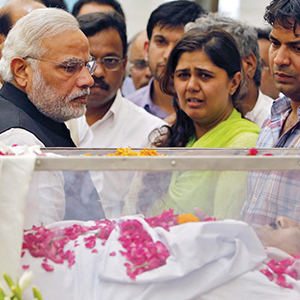
    The Indian Air Force aircraft carrying Munde’s body landed at Latur at around 10am. Senior BJP leaders including Rajiv Pratap Rudy were present at the Latur airport to receive the body, which will be later flown to Munde’s native place Parli, 70 kms from here. Thousands of Munde’s supporters gathered outside the Latur airport to have a last glimpse of their leader. In deference to the people’s wishes, the casket containing Munde’s body was kept on a raised platform outside the airport so that people could pay their last respects.

    Munde’s wife Pradnya and daughter Pankaja were at the airport and were consoled by his followers. Leaders of other parties, including Congress’s minister of state Amit Deshmukh and NCP’s cabinet minister Jitendra Awhad, were present at Latur airport. The body will be kept for “antim darshan” (last respects) at the Vaidyanath sugar factory premises near Parli and the funeral will take place after 2pm. The 64-year-old BJP veteran is survived by wife and three daughters. Munde died following a road accident in Delhi on Tuesday, a week after taking over as Union rural development minister in the Narendra Modi-cabinet.

  • Diwali at Times Square on September 20th, 2014

    Diwali at Times Square on September 20th, 2014

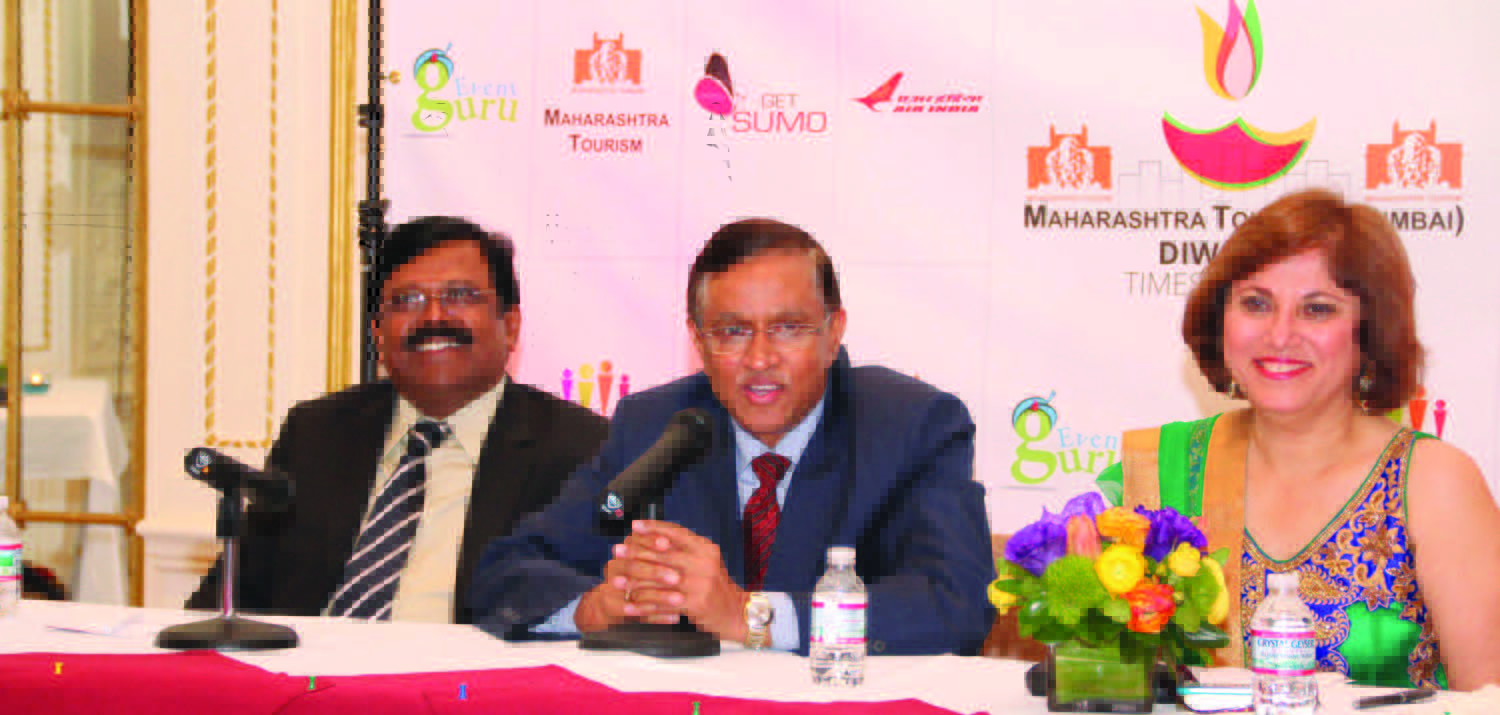
    NEW YORK (TIP): The Maharashtra Tourism sponsored Diwali will be celebrated at Times Square on September 20, 2014. This announcement was made at a press conference held at the Consulate General of India, May 22. Making the announcement, Consul General Mulay said, “It is wonderful to see this event come back to Times Square this year again.

    It’s a glimpse into India’s largest festival and we are going to celebrate it with the world right here in New York City!” Managing Director of Maharashtra Tourism Development Corporation (MTDC) Dr. Jagdish Patil stated “We are pleased to be back again to be part of this festival.


    11
    A view of the gathering

    This year Maharashtra Tourism Development Corporation will showcase to the world Maharashtra’s rich culture, cuisine, pristine beaches, historical and natural heritage preserved for thousands of years”. Mrs. Neeta Bhasin outlining the program said, “Diwali festivities will begin at noon and will include a wide variety of Indian food, dance classes, Indian arts and crafts, a fashion show, photo booths with ethnic outfits, celebrities and much more.

    In the evening, Event Guru will be bringing a “Light up Times Square” Concert”. Event Guru and ASB Communications, the masterminds behind “Diwali at Times Square”, are organizing and managing the event. Neeta Bhasin, President and CEO of Event Guru and ASB Communications, said “We want to show to the world how rich Indian culture and heritage are and how diversified India is.


    12
    Jackson Heights Indian Merchants’ Association Chairman Shiv Dass (extreme right), Mohinder Verma (second from right) and Subhash Kapadia (extreme left) presenting to Mrs. Neeta Bhasin a Congressional proclamation on behalf of Congressman Joseph Crowley.

    We couldn’t think of a better place than the center of the Universe – Times Square!” On the occasion, Mrs. Bhasin was honored with a Congressional proclamation from New York’s 14th Congressional District Congressman Joseph Crowley who also cochairs the Congressional Caucus on India and Indian-Americans.

    Neeta was recognized for her efforts and dedication to further the Asian Indian community in the United States as well as her invaluable contributions to the South Asian community in greater New York City.

    For more Information about Diwali at Times Square please visit:

    http://www.diwalitimessquare.com. For sponsorship or volunteer inquiries please email at info@diwalitimessquare.com (Based on a Press release)

  • MUMBAI TO HAVE A FLOATING HOTEL

    MUMBAI TO HAVE A FLOATING HOTEL

    MUMBAI (TIP): Adding one more attraction for Mumbai, the Maharashtra Tourism Development Corporation (MTDC), in partnership with WB International Consultants and AB Hospitality, has announced the launch of a first of its kind dining floating hotel (floatel), which will be docked at Bandra under the iconic Bandra-Worli Sea Link.

    The floatel, named ‘AB Celestial’, will be open to public from mid-August. The project is targeted at foreign and domestic tourists as well as food and fun loving Mumbaikars. ‘AB Celestial’ is a 3-tier luxury dinning facility with a sky deck, two galleys, and will have two multi-cuisine restaurants, including a club lounge, equipped with a 24-hour coffee shop.

    The overall capacity is 660 guests distributed across the four tiers of the vessel. The floatel, made and imported from the U.S. for an unspecified amount, will be docked at the Maharashtra Maritime Board’s jetty at Bandra, and will provide a 360-degree view of the city of Mumbai and the Sea Link.

    Profit sharing arrangement

    The entire investment for the project has been made by WB International and the floatel will be managed by AB Hospitality. The MTDC has a 10 per cent profit share arrangement, and will promote this project.

    “The Floatel concept was conceived and spearheaded by the Maharashtra State Government with numerous government bodies involved to make this a reality and jewel in the crown of Maharashtra. Maharashtra receives the maximum number of foreign tourists in India besides many domestic affluent tourists. This Floatel will certainly become a huge attraction for the tourists.” Chhagan Bhujbal, Tourism Minister, Maharashtra, said while inaugurating the Floatel.

  • Rewarding Democracy

    Rewarding Democracy

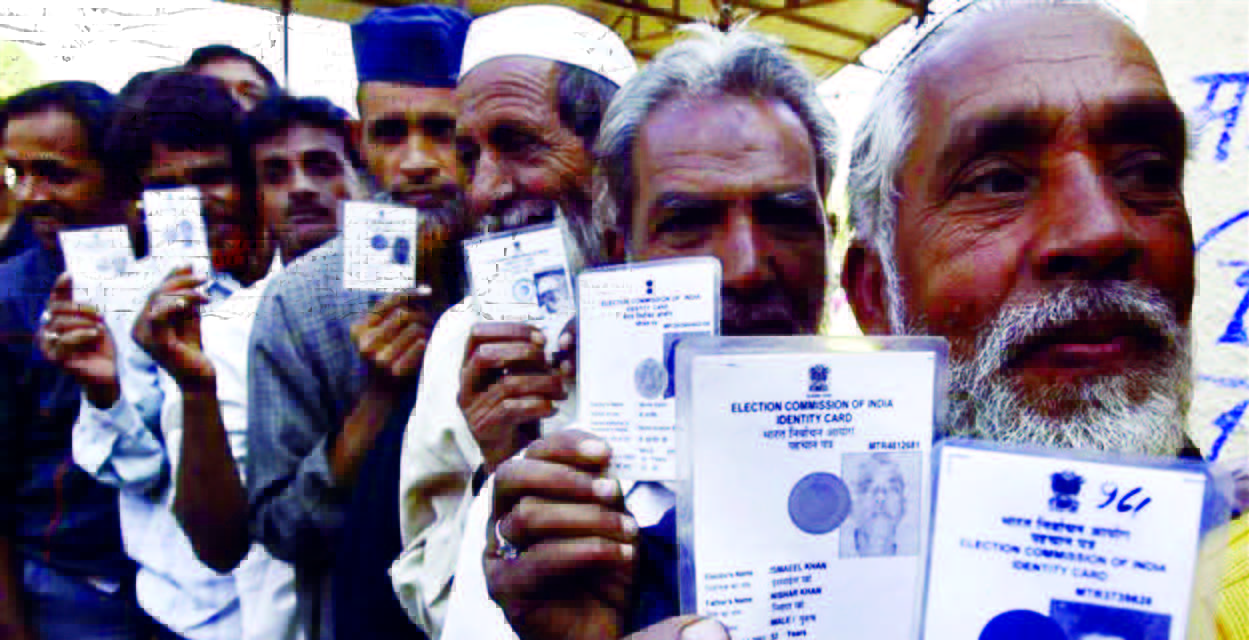
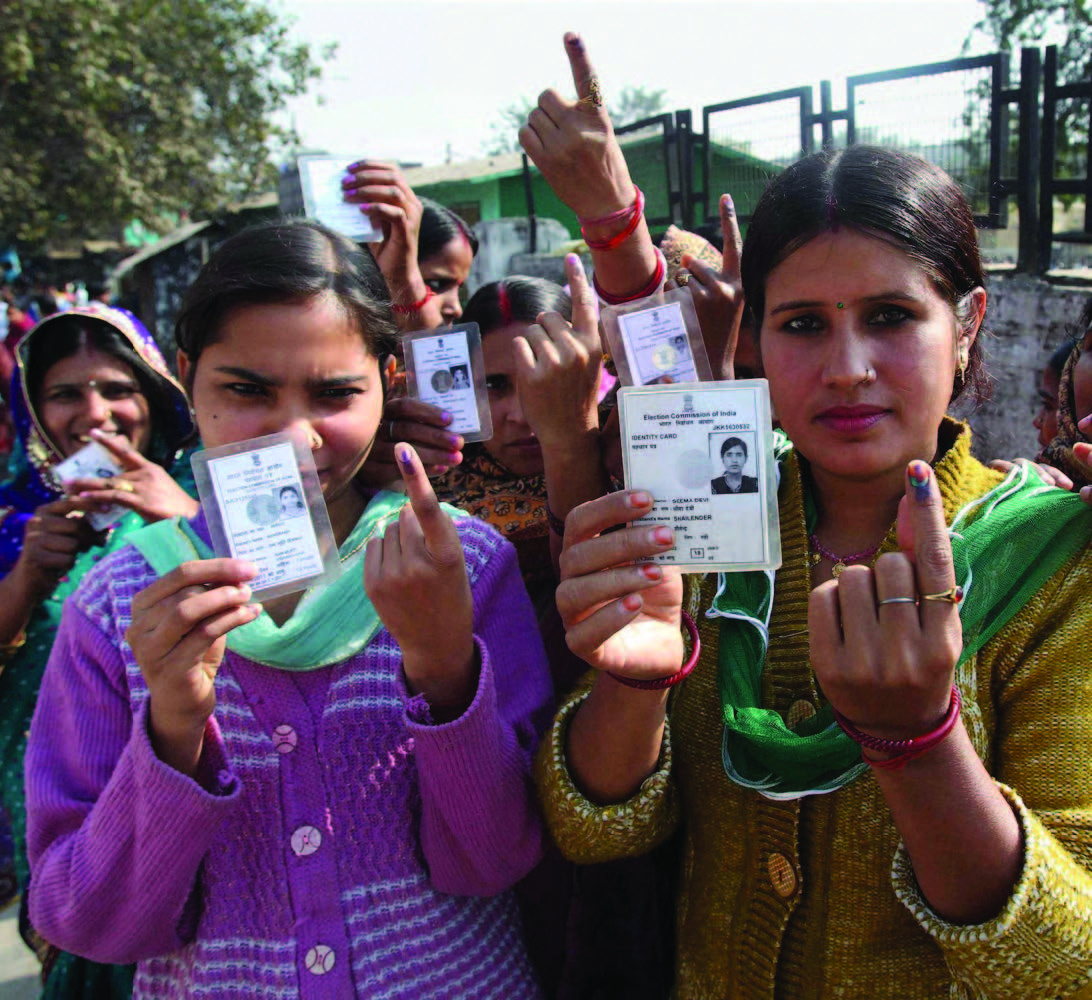
    One of the most encouraging aspects of the 2014 Lok Sabha elections has been the significantly high voter turnout in areas affected by Left-wing extremism. Bastar in Chhattisgarh, that remains severely affected by Maoist insurgency, saw a voter turnout of almost 60 per cent as opposed to 47.33 per cent in 2009.

    Here, as well as in other areas, the Maoists had called for a total boycott of elections. But in most areas, in spite of the violence perpetrated by the Maoist rebels, people have come out in large numbers to cast their vote. In Gadchiroli constituency in Maharashtra, that is a part of the Maoists’ foremost guerrilla zone, the Dandakaranya Special Zone Committee, over 68 per cent votes were cast as opposed to 65.21 per cent in the 2009 elections.

    Munger and Jamui in Bihar also saw a 10 per cent increase in voter turnout. The only affected area where the turnout was low is Orissa’s Malkangiri that recorded a voting percentage of 48 per cent. One reason attributed to the higher turnout is the enthusiasm of first-time voters who came out in large numbers. Also, in many Maoist-affected areas, people are tired of the long cycle of violence, and want things to change. The voter turnout in Bastar has left the Maoists worried.

    After the elections in Bastar on April 10, they have held meetings at several places with Adivasis to understand what prompted this high turnout. Even in the formerly Maoist-hit areas in West Bengal, that went to the polls on May 7, the turnout has been exceptional. West Medinipur, Purulia and Bankura registered a turnout of 81.41, 78.75, 80.55 per cent respectively till 5 p.m. In Jhargram, it was almost 88 per cent. The challenge for the new government would be to focus on the development of the red corridor, especially when people there have expressed their faith in democracy.

    One major reason why the Maoists were able to entrench themselves in these regions was that the Indian state had completely forsaken its people. The void left by the state was just filled by Maoists. The onus is on whosoever forms the next government in New Delhi to change the equation. In many areas, there is sympathy among the Adivasis for Maoists. Security operations in these areas may have put Maoists on the back foot, but this can only be a temporary trend.

    In the absence of a real developmental intervention by the new government, there will be no ebb in violence in Bastar and other Maoist-affected areas. One of the biggest challenges before the new government will be to instill a sense of security among the people. That will only happen if the people have confidence in the government – after which they will reject Maoism.

  • The United States and India: Global Partners in the Global Economy

    The United States and India: Global Partners in the Global Economy

    Remarks made by Nisha Desai Biswal, Assistant Secretary, Bureau of South and Central Asian Affairs, at Tampa Convention Center, Tampa, FL on April 25, 2014

    Thank you, Dr. Singh, for your warm welcome. It is a great honor to participate in the 2014 FICCI-IIFA Global Business Forum. Tampa is an ideal location to talk about the important and growing economic ties between the United States and India. Not only is Tampa the seventh-largest port in the United States by volume, it also handles the highest volume of goods headed to India.

    And FICCI is certainly the right partner for this conversation, as they have been such a key player in advancing our economic relationship. And how thrilling it is for the IIFA Awards to be held in the United States for the first time! Indian culture is increasingly influencing popular culture, not just in America but around the globe. I recall a moment some two decades ago,when I was a Red Cross volunteer in Tbilisi, Georgia, and I went to a local theater where Sholay was playing, dubbed in Russian.

    Imagine listening to some of the most iconic dialogues of Hindi cinema in Russian! And I will never forget the time I was in the small mountain town of Kutaisi and was asked to sing a folk song. I started singing “mera joota hai japani,” and the entire room of 200 Georgians started singing with me. They knew all the words! Indian art, culture, and film have global appeal. Every day, ethnic, linguistic, and cultural lines are blurred, because from Kabul to Kinshasa, from Moscow to Mumbai, from Tampa to Trivandrum,we are all under the thrall of Indian popular culture. But it isn’t just pop culture.

    It is the idea of India itself that holds such special appeal to so many around the world. As for the United States, we want to take what three successive presidents and two prime ministers and most importantly our 1.6 billion citizens have built in 15 years, in this defining partnership of the 21st century, and make it even better. Today, I want to discuss the opportunities that lie ahead as the U.S.-India economic relationship expands and matures, and as our two economies become increasingly intertwined and interdependent.We are living in a truly globalized world, brought closer by technology and trade – and yes, even movies! But despite the lightning speed of technological advances that are transforming so many aspects of our life for the better,we’re also contending with one of the most complex moments in world affairs with very real challenges, including conflict, poverty, and climate change.

    Nowhere is this more apparent than in Asia, which boasts nearly two-thirds of the world’s population, squeezed into only a third of its landmass. It is a region with tremendous promise and potential. As President Obama said in Tokyo yesterday,when he reiterated that we are and always will be a Pacific nation, “America’s security and prosperity is inseparable from the future of this region,” and that’s why we’ve made it a priority to renew American leadership in the Asia Pacific. By 2050, Asia may well comprise half of global GDP. But for the region to realize its potential, it must embrace strong, inclusive, and sustainable economic growth, one where the private sector, not government, leads economic development.

    It must defeat terrorism and counter violent extremism,while at the same time advancing human dignity and human rights. And in an age where citizens have more access to information and are demanding more accountability than ever, governments must promote effective and transparent governance. Despite these challenges,we’ve never been more optimistic about the future of Asia – and the role the United States and India will play in advancing prosperity and stability in the region. One reason is India’s growing economic connectivity – eastward with Bangladesh, Burma, and Southeast Asia; and we see promise in links westward with Pakistan, Afghanistan, and Central Asia. These are vital to the prosperity and stability of Asia.We are committed to supporting economic linkages that will cultivate new markets and knit these countries even closer together – and make them more integrated with the global economy. We’re advancing regional initiatives that do just that.

    First, there’s the historic opportunity to connect South and Southeast Asia into an integrated economic landscape. This Indo-Pacific Economic Corridor is a unique geography teeming with opportunity, but traditional northsouth trade still trumps east-west movement of goods and services by a factor of five. And through our New Silk Road initiative,we have been focused on creating regional energy markets that link Central Asia with South Asia; promoting trade and transportation routes and investing in critical infrastructure; improving customs and border procedures; and linking businesses and people. Today, Afghanistan and its neighbors are increasingly championing and owning that New Silk Road vision, creating new transit and trade routes that complement the very vibrant east-towest connections across Eurasia.

    And the region is making concrete efforts to reduce barriers to trade, invest in each other’s economies, and support development and cross-border projects. At the heart of all of that is India, because prosperity in South Asia hinges on dynamic growth of its economic powerhouse. The United States is committed to working with India to fully unlock the true potential of our economic ties. Today, the United States is one of India’s largest trade and investment partners. Our bilateral trade in goods and services has grown to nearly $100 billion. I think India’s excellent envoy in Washington, Ambassador Jaishankar, said it best recently when he noted that the extraordinary growth in our trade relations has “changed the chemistry of our ties.”

    Tectonic shifts in global economics have helped bring us to where we are today. And it didn’t happen overnight. After the Second World War, the creation of a rules-based trading system increased commerce, connectivity, and prosperity across the globe.While India’s economic transformation is more recent, its progress has been swift. Import tariffs on average are more than 30 times lower than they were in 1991,when then-Finance Minister Manmohan Singh began sweeping reforms. And since 2005 we have seen an increase in goods trade by 250%, in services trade by 350%. But we can do even better.

    As Vice President Biden said last July, there is no reason why our bilateral trade shouldn’t quintuple again if our countries work to grow together and remain candid with each other about the obstacles that exist. I believe $500 billion in total trade is entirely possible. Bilateral investment flows have also grown immensely, with foreign direct investment into India from the United States reaching $28.2 billion last year. Cumulative Indian FDI into the United States has also grown remarkably, from a negligible $96 million in 2000 to $5.2 billion by 2012. Even so,we still lack the investment diversity needed to fuel the growth of new and emerging sectors in our respective economies.

    India needs a transparent, straightforward way of attracting foreign investment, offering private capital a way to share in India’s opportunity. There must be a welcoming business environment that allows every dollar of investment to work efficiently. Currently, the United States and India are negotiating a Bilateral Investment Treaty, or BIT, which will be critical to deepening our economic relationship, improving investor confidence, and supporting economic growth in both countries. A BIT will go a long way toward bringing our economies closer and reducing the friction that’s only natural with two complex free-market systems such as ours. It will help us move past the choppiness that comes from not having an over-arching investment framework. And it will open up even more opportunities for American and Indian firms.

    Beyond our BIT, India’s investment and tax policies need to be designed to attract capital flows from across the world. Regulatory requirements need to be transparent and consistently enforced. Contracts must be upheld and honored across jurisdictions, and perhaps most importantly, intellectual property rights – based on international norms – must be recognized. And the future of India’s economy critically depends on the ability of people and goods to move where they are needed – efficiently and affordably. Soon, some sixty-eight Indian cities will have populations of over one million people each. India’s planned trillion-dollar commitment to infrastructure, with its strong emphasis on public-private partnerships, is both ambitious and admirable.

    No doubt infrastructure improvements will help to relieve the congestion on roads, railways, ports, airports, and in the power supply. American businesses are eager to participate – an effort the U.S. government fully supports. India’s future prosperity will also depend on one of our shared strengths – innovation. Increasingly, our two countries are putting our best minds together, to make growth more sustainable and inclusive and address 21stcentury challenges like climate change and energy security. That’s why we are so excited about the U.S.-India Technology Summit and Expo in November of this year in Delhi. The event will showcase our cooperation on science and technology, helping commercialize technology for economic growth and development, and shaping an ecosystem that incentivizes innovation.

    Policy-makers, industry leaders, educators, and scientists will discuss topics including manufacturing; life sciences and healthcare technologies; clean and renewable energy; IT; and earth science – all areas where U.S.-India collaboration can help us seize the opportunities, and respond to the challenges, of the 21st century. The Tech Summit is the idea place to showcase initiatives like the Millennium Alliance with FICCI,where we support Indian innovators and entrepreneurs who are coming up with new technologies to meet India’s development challenges. In March, I saw first-hand some of the most cutting-edge cooperation in science and technology,when I visited the Indian Space Research Organization, ISRO.NASA’s cooperation with ISRO on India’s Mars Orbiter Mission – India’s first inter-planetary space launch – and ongoing discussions about future joint initiatives, show that even the sky is not the limit when it comes to our partnership. And our energy partnership is changing the way our economies are powered.With 400 million people in India lacking reliable access to energy, the stakes for India’s future growth are enormous.

    We’re collaborating on clean and renewable energy, oil and gas, new technologies, energy efficiency, and civil nuclear energy. But real prosperity is only possible if it is also truly inclusive. That’s why ensuring women and girls are part of the conversation is a critical element to all these areas of partnership. Positive linkages between women’s engagement and a country’s economic status have been definitively proven, and the Obama Administration is determined to elevate the status of women and girls as a critical aspect of our foreign policy.We firmly believe that women’s rights are human rights, and women’s security is national security. While India is a leader in supporting women’s leadership across government, civil society and certainly in business, in many ways the potential of women and girls in India remains untapped and underutilized as a force for growth and development.

    This is why we support efforts like the Girl Rising Project to encourage public dialogue on gender and education issues to encourage community level interventions to help improve girls’ education. So I look forward to the next panel as a way to advance this discussion. In this area and in so many others, our relationship is much broader than our government and business ties. As the late Senator Edward Kennedy noted, our relations are not just government to government, but people to people, citizen to citizen, and friend to friend. Nowhere is that more evident than in the deep and rich ties between the people of the United States and India. Nearly 100,000 Indian students are studying at colleges and universities in the United States. Last year, almost 700,000 Indians visited the United States for business or tourism.

    It is these connections, between our entrepreneurs, scientists, scholars, and artists that make this partnership whole. We find that the relationship is also flourishing at the state and city level. And our cities and states are partnering more extensively than ever before, helping plant even deeper and stronger roots for our partnership. A growing number of states and cities are tailoring their international outreach efforts for India, with delegations from Arizona, Iowa, Indianapolis and San Francisco visiting the subcontinent over the last year. And these trips are yielding real results, opening new doors for business, educational exchanges, and workforce skill development.

    A great example is California and Maharashtra, home to the megacities of Los Angeles and Mumbai, sharing ideas on how to improve fuel quality for India’s fast-growing vehicle fleets. These efforts will not only improve the health of urban inhabitants, but help mitigate climate change. So in conclusion, let me say that I am bullish on this relationship because I believe in the strength and vibrancy of our two countries. I know there is no challenge that we can’t address, no problem that we can’t solve when we bring our two societies together. Thank you again for this opportunity. I would be happy to take a few questions.

  • Dr. Sudhir M. Parikh

    Dr. Sudhir M. Parikh

    Dear Prof. Saluja, It was great to be a part of the Vaisakhi celebration at the Consulate. Vaisakhi celebration is the celebration of Indian cultural heritage and the beginning of a brighter New Year. It coincides with Telugu, Kannada Maharashtra and Malayalam New Years.

    It also coincides with the Holi Celebrations in Gujarat. This is the time of jubilation for various ethnic groups in India, and all of them observe these holidays with great joy and fun. I wish everybody Happy Vaisakhi.

  • Phase 5: Voter turnouts higher than 2009 poll figures

    Phase 5: Voter turnouts higher than 2009 poll figures

    NEW DELHI (TIP): Voter turnouts higher than the 2009 poll figures marked the fifth and biggest round of Lok Sabha elections covering 121 seats across 12 states amidst largely peaceful balloting on April 17. A good turnout is considered a strong sign of antiincumbency, a cause of worry for the Congress. While the Election Commission was yet to announce the final voting figures late on Thursday, nearly 65% of the eligible electors cast their ballot across the 12 states.

    The highest turnout of 81.57% was recorded in four constituencies in West Bengal, which has a total of 39 seats, while the lowest was recorded in Madhya Pradesh at 54%. While 80.6% had voted in the four seats in West Bengal in the 2009 general elections, the Madhya Pradesh figure stood at 46%. “After this phase, a large section of India has already voted,” said BJP’s prime ministerial candidate Narendra Modi. “People have voted in the heat and have voted for a strong government.”

    He added that the long queues of first-time and women voters “are positive steps”. In the key battleground state of Karnataka, where polling was held in the all the 28 seats, the voting percentage was 66% and in the 11 seats of Uttar Pradesh, electorally the most important state with 80 seats in the Lower House, the turnout was 62.52%, up from 2009’s 54.2%. A good show for Congress in Karnataka could help it check the BJP’s perceived surge nationally. In the previous Lok Sabha poll in the state, the BJP had won 18 seats in the state but is struggling this time. Maoists struck in Jharkhand, exploding a land mine at Bokaro in Giridih constituency and injuring four paramilitary troopers.

    They also blew up a school building and a rail track. Allegations of voter intimidation came from parts of Bihar and West Bengal. The Election Commission ordered repolling in nine polling stations in Bihar. Thursday’s election covered a vast part of the Indian landscape — from Jammu and Kashmir in the north to Karnataka in the south, from Maharashtra along the west coast to West Bengal in the east. Polling took place in all 28 Lok Sabha seats in Karnataka, 20 of the 25 in Rajasthan, 19 of the 48 in Maharashtra, 11 seats each in Odisha and Uttar Pradesh, 10 in Madhya Pradesh, seven in Bihar, six in Jharkhand, four in West Bengal, three in Chhattisgarh and one seat each in Manipur and Jammu and Kashmir.

    Simultaneous balloting was held for 77 of the 147 assembly seats in Odisha and two assembly bypolls in West Bengal. The BJP claimed it was confident of winning most seats contested on April 17. “We are sure of winning all 25 seats (in Rajasthan),” chief minister Vasundhara Raje said in Jaipur. Former central minister Ananth Kumar voiced confidence about the BJP’s ability to do well in Karnataka, where it is the main opposition party to the ruling Congress. Central ministers Sushilkumar Shinde and Jyotiraditya Scindia brushed aside the BJP’s claims. “There is no Modi wave,” Scindia said after voting in Guna in Madhya Pradesh. Shinde said in Sholapur: “There is no Modi wave here, only Shinde wave.”

    With Thursday’s round, polling has been completed in 232 of the 543 seats in the Lok Sabha. Thursday was important both for the BJP and the Congress, which held 40 and 36 of the Lok Sabha seats that went to the polls, as well as the Janata Dal-United, Jharkhand Mukti Morcha, Janata Dal-Secular, Shiv Sena, Maharashtra Navnirman Sena, Aam Aadmi Party, Biju Janata Dal, Samajwadi Party, Bahujan Samaj Party and Trinamool Congress. Around 70% votes — up from the 2009 figure of 44.9% — were polled in Jammu and Kashmir’s Udhampur seat where elections passed off peacefully. In Bihar, where polls were held in seven Lok Sabha constituencies, 56% voting was recorded as compared to 39.3% during 2009 Lok Sabha elections.

    Polling in Odisha saw 70% people vote as compared to 66.28% in 2009. In Chhattisgarh, 63.44% polling was reported. Polling in another important state, Maharashtra, which has a total of 48 seats, 19 constituencies which went to poll on Thursday saw a turnout of 61.7%. Prominent candidates in the fray included Ananth Kumar and Nandan Nilekani (Bangalore South), Jaswant Singh (Barmer), Sachin Pilot (Ajmer), Ashok Chavan (Nanded), Misha Bharti (Pataliputra), Supriya Sule (Baramati), BS Yeddyurappa (Shimoga), Ghulam Nabi Azad (Udhampur), Maneka Gandhi (Pilibhit), Shatrughan Sinha (Patna Sahib), M Veerappa Moily (Chikkaballapur), Sushilkumar Shinde (Solapur), V Balakrishnan (Banglaore Central), and SS Ahluwalia and Bhaichung Bhutia (Darjeeling).

    About 1.37 million staff oversaw the polling, watched over by hundreds of thousands of police and paramilitary personnel. April 17 saw the largest number of Lok Sabha seats in contention on any one day since the staggered balloting started April 7. Four more rounds of voting are due until May 12. The result will be declared May 16.

  • No vote, no water: Ajit Pawar’s threat to farmers

    No vote, no water: Ajit Pawar’s threat to farmers

    Amethi (TIP): The Bharatiya Janata Party (BJP) on April 18 criticized Maharashtra Deputy Chief Minister Ajit Pawar for threatening farmers of a village in Baramati. Pawar is reported to have said that he would stop water supply to the farmers if they did not vote for the Nationalist Congress Party (NCP).

    “The Congress and its allies can very much see that they are going to lose in these elections. So, they have resorted to making such statements through which they can maintain their vote base,” said BJP leader Smriti Irani. “But, it has been decided that the Bharatiya Janata Party (BJP) will form its government in Delhi.

    Narendra Modi will definitely become the Prime Minister of the country. People want him to be the prime minister because they are confident that all development work will only happen in his reign,” she added.

  • High voter turnout in 91 seats in LS polls, crosses the 2009 mark

    High voter turnout in 91 seats in LS polls, crosses the 2009 mark

    NEW DELHI (TIP): Marking a considerably high voter turnout as compared to the 2009 Lok Sabha elections, India voted for 91 constituencies in 14 states and Union Territories which went to polls in the third and substantial phase on April 10, with Chandigarh witnessing the highest percentage of 74.

    The national capital of Delhi, too, recorded a 64 per cent voter turnout in the mega-battle for seven Lok Sabha seats where a faction-ridden BJP tried to sail on ‘Modi wave’ while AAP and Congress attempted to regain the lost ground. A substantial increase of 12 per cent was seen in the voter turn in Delhi as compared to the 2009 polls. Muzaffarnagar and Shamli in Uttar Pradesh, which witnessed communal riots in August 2013, recorded “above average” voter turnout of 67.78 per cent and 70.85 per cent, respectively.

    The 10 seats of Uttar Pradesh, which went to polls on Thursday, reported a record turnout of 65 per cent as compared to 51.30 per cent recorded in the last LS polls. The turnout in Delhi was 64 per cent, up by 12 per cent as against 2009 elections. Chandigarh constituency recorded the highest turnout of 74 per cent, against 64 per cent in 2009 polls. Kerala, which went to polls in single phase, recorded 73.4 per cent voter turnout, up from 73.2 per cent last time. Chhattisgarh’s Bastar seat witnessed the lowest voter turnout among the 91 seats of 51.4 per cent.

    But it was higher as compared to 47.33 per cent recorded in the last LS polls. There was a voter turnout between 67 and 55.9 per cent for the 21 Lok Sabha seats in three states and a union territory, besides 70 Assembly constituencies in Odisha in eastern India. An estimated 50 per cent of the 191 million electorate had voted in eight hours of brisk polling, with men and women of all age groups queuing up at the 140,850 voting centres from the time they opened at 7 am. EC maintained that the turnout could be “much higher” in all the seats as final reports were yet to come in with voting still on after the stipulated hours in various areas.

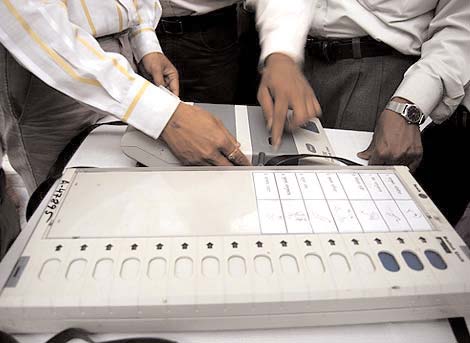
    Although the polls were mostly peaceful, there were some incidents of violence reported from Chhattisgarh, Odisha and Bihar in Naxal related violence. In Bihar, two Central Reserve Police Force (CRPF) personnel were killed when Maoists exploded a concealed land mine in Munger district when they were on their way to neighbouring Jamui where polling was on. Maoists also blasted a school in Bihar’s Lakhisarai district. In Odisha, Maoists snatched EVMs and took away the battery of one voting machine. Though the staggered nine-phase balloting began April 7, the first two rounds involved only 13 constituencies from the country’s northeast where the BJP is not a major player. While the people of India have made their choice, the results will be known when the votes are counted on May 16.

    CONSTITUENCY-WISE VOTER TURNOUT FOR LS SEATS IN 2014

    BIHAR
    1. Sasaram – 54 per cent
    2. Karakat – 51 per cent
    3. Aurangabad – 47.5 per cent
    4. Gaya – 51.64 per cent
    5. Nawada – 49 per cent
    MAHARASHTRA
    1. Buldhana -44 per cent
    2. Akola -39 per cent
    3. Amravati – 46 per cent
    4. Wardha – 42 per cent
    5. Ramtek -40.3 per cent
    6. Nagpur – 48 per cent
    7. Bhandara-Gondiya – 53 per cent
    8. Gadchiroli-Chimur – 59 per cent
    9. Chandrapur -43.49 per cent
    10. Yavatmal-Washim -40 per cent
    JAMMU & KASHMIR
    1. Jammu – 68 per cent
    CHHATTISGARH
    1. Bastar – 47 per cent
    UTTAR PRADESH
    1. Saharanpur – 68.40 per cent
    2. Kairana – 64.90 per cent
    3. Muzaffarnagar – 63.53 per cent
    4. Bijnor – 62.96 per cent
    5. Meerut – 60.50 per cent
    6. Baghpat – 61.52 per cent
    7. Ghaziabad – 60.20 per cent
    8. Gautam buddha nagar – 47.20 per cent
    9. Bulandshahar – 61.60 per cent
    10. Aligarh – 55.60 per cent
    DELHI
    1. Chandni chowk – 66.8 per cent
    2. West Delhi – 65.64 per cent
    3. East Delhi – 65.59 per cent
    4. South Delhi – 62.67 per cent
    5. Northwest Delhi – 61.38 per cent
    6. North-East Delhi – 67.08 per cent
    HARYANA
    1. Ambala – 70.7 per cent
    2. Kurukshetra – 75.8 per cent
    3. Sirsa – 76 per cent
    4. Gurgaon – 70.02 per cent
    5. Faridabad – 60.08 per cent
    JHARKHAND
    1. Chatra – 53.88 per cent
    2. Kodarma – 60.97 per cent
    3. Lohardaga – 59 per cent
    4. Palamau – 59.30 per cent
    LAKSHADWEEP
    1. Lakshadweep – 71.36 per cent
    ANDAMAN & NICOBAR ISLANDS
    1. Andaman & Nicobar Island – 70 per cent
    MADHYA PRADESH
    1. Satna -53.77 per cent
    2. Rewa -53.99 per cent
    3. Sidh -56.45 per cent
    4. Shahdol -60.79 per cent
    5. Jabalpur -48.14 per cent
    6. Mandla -65.53 per cent
    7. Balaghat -62.52 per cent
    8 Chhindwara -70.93 per cent
    9. Hoshangabad -65.01 per cent

  • How candidates cook books to spend crores over Election Commission limit

    How candidates cook books to spend crores over Election Commission limit

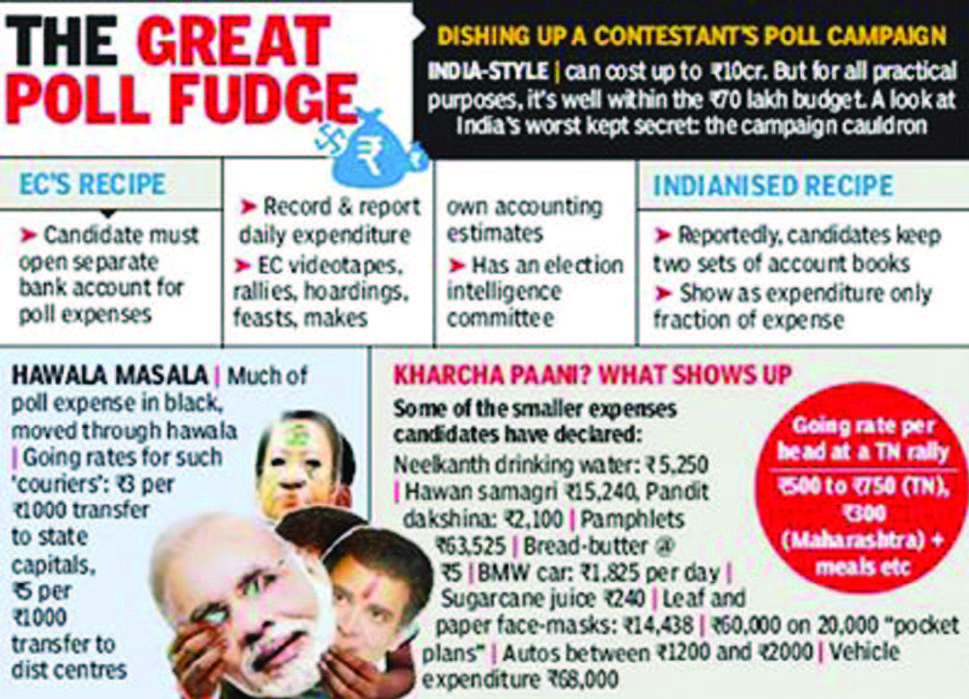
    NEW DELHI (TIP): Elections, it is said, are about spending big. This despite repeated poll panel efforts to curb candidate expenses. The EC rule book is clear: Each candidate is entitled to spend a maximum of Rs 70 lakh and it is mandatory for the nominee to file daily expenses. On the ground, a different story plays out and contestants find ways to beat the book. Politicians begin spending the day their names surface as a potential candidate.

    Many engage image consultants to get their projection right and build a “winnability” perception. After the contestant bags a ticket his election expenses start the day he files nomination. The EC requires candidates to open separate accounts only for their poll expense, and if that weren’t bother enough, to account for day-to-day expenses. For LS polls, a general category nominee must pay a Rs 25,000-security deposit.

    The meter starts ticking. “We fix heads under which we need to spend,” Vishwas Sarang, campaign manager for a BJP LS candidate in MP says. Typically these include daily campaign expenditure, spend on banners, and publicity material and, crucially, booth management on polling day. “Bhopal alone has 1,600 polling booths. To staff them adequately, we need manpower and resources,” Sarang says. But even the best of plans spin out of control as campaigning picks up. “It’s like budgeting for a wedding, things usually go wrong.

    There are so many imponderables,” campaign manager for a senior politician says. MP BJP leader Mahendra Singh Chouhan concedes: “It’s very difficult to earmark a particular percentage of Rs 70 lakh under a specific category. Expenses fluctuate.” A rival’s ability to spend and his/her visibility quotient dictate expenses. “Truth is if the rival is running a low-steam campaign, you also cut back on expense. But if the opponent is extravagant, you’re left with no option,” Chouhan says.

    Former MP from Chhattisgarh Chandrashekhar Sahu says travel and promotional material are major components of total expenses. But in practice, much is not accounted for. “Party workers need cars, fuel and food. These account for a lot of money, most of the spending under these heads don’t go into the books,” a Congressman says. So, how much does the candidate really disclose? Here are some startling figures to show how they dodge the watchdog body.

    In the 2011 Bengal assembly polls, candidate expense statements filed to EC showed three elected nominees held no public meetings, 163 of the 217 MLAs chose to simply ignore print and electronic media advertisement costs, 53 said they never paid a paisa to their campaign workers, even for food. Forget the Rs 70 lakh limit, truth is most contestants spend upwards of Rs 10 crore each.

    9

    A Tamil Nadu politician concedes: “By conservative estimates, a minimum of Rs 2.5 crore is a must to contest. On average there are 1,300 booths per constituency. I pay at least Rs 15,000 per booth (each booth as four agents) to ensure it’s well covered and my men are everywhere ensuring there’s no rigging — that alone works out to about Rs 2 crore. Over and above that, printing of pamphlets, flex boards cost roughly Rs 20 lakh. Fuel expenses and vehicle rentals notch up another Rs 20 lakh, ad campaigns an additional Rs 15 lakh to Rs 20 lakh.” Booth management is one of the biggest headaches and a big cost centre, politicians in Chhattisgarh agree.

    This expense can’t be shown in the accounts that are forwarded to EC else the prescribed spending limits would be breached by miles. So, it has to be adjusted or dressed up. “While filing returns, we hardly ever show the money spent on polling booth agents. While we disclose an expenditure of Rs 4 lakh to Rs 5 lakh per public meeting addressed by a senior leader, the actual expense could be well over Rs 2 crore to Rs 3 crore,” an election manager in MP says.

    Political observers in Karnataka claim each Narendra Modi rally in that state could have cost close to Rs 1.5 crore, all expenses are put together. You need sacks of liquid cash to bring crowds to rallies. “The current practice in TN is to pay those attending Rs 500 to Rs 750 per head,” a campaign manager informs. In Maharashtra, the rent-a-crowd rate in 2009 was Rs 100 per person. The going rate in the state now has shot up to Rs 300 and more.

    The person coming for the meeting expects to be fed a decent meal. These expenses are hidden and none of it goes into the accounts. All major parties concede that planning a senior leader’s logistics for a big election rally can send expenses through the roof. The national leader is a star campaigner. His hotel arrangements have to be made, transportation taken care of and security arranged.

    These are huge costs. The heat adds to the problem. Parties spend big on pandals and safe drinking water. Nobody will come if they’re made to sit in the open under the scorching sun.

  • BJP stands by Uddhav, dumps Raj

    BJP stands by Uddhav, dumps Raj

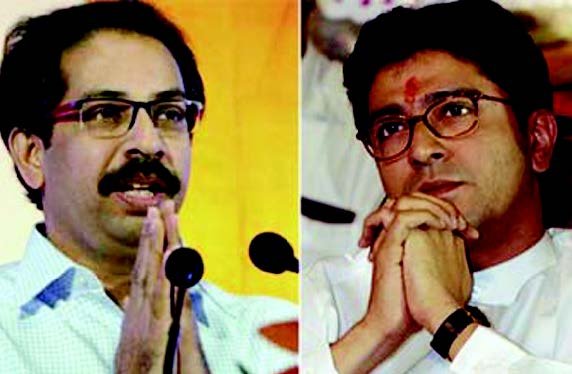
    PUNE (TIP): Unimpressed by Raj Thackeray’s support for its prime ministerial candidate Narendra Modi, the state BJP unit has decided to take on the Maharashtra Navnirman Sena (MNS) in the Lok Sabha elections. State BJP president Devendra Fadnavis said that the BJP leaders will campaign for Shiv Sena’s candidates to ensure the MNS’s defeat.

    “We stand by our alliance partner Shiv Sena. We are doing all to win every seat in the state. The MNS has opened a front against our alliance partner and we are going to resist every attack on the Sena. Our leaders will campaign for the Sena candidates and appeal to voters to defeat the MNS,” Fadnavis added. He said there was no confusion and though Raj has announced that his MPs will support Modi, they would are going to campaign against MNS candidates. Allegations about colluding with the MNS have been in the air. Fadnavis said there is no covert or overt understanding with the MNS.

    “The BJP values its old alliance partner Shiv Sena and there is no question of any understanding with the MNS. We are contesting the election as an alliance and it is our duty to abide by it,” he added. Senior BJP leader Gopinath Munde, speaking to local media persons in his hometown of Beed, said, “I had met Raj Thackeray and wanted him in our alliance. But things did not work out and the chapter was closed. There is no point in raking up the issue again.

    We are confident that the alliance will win the maximum seats in the state.” Munde said he would address a series of rallies with Uddhav across the state. The BJP’s support for Uddhav comes against Raj’s appeal to his party workers to “target Shiv Sena”. During his public rally in Pune on Monday, Raj announced a dozen public rallies to explain his stand on Shiv Sena and Uddhav. “I need to clarify that I was not against joining the BJP-Sena alliance. But Uddhav never wanted me in. I plan to reveal more such facts in the next few days,” Raj had said.

    City unit told to get its act together
    The BJP’s state president Devendra Fadnavis said he had asked the city unit leaders to set aside their differences and campaign for the party candidate Anil Shirole. “We don’t want to lose any seat because of infighting. We cannot afford any bickering at this moment. All party workers will work for Anil Shirole and we are confident of winning the Pune seat,” said Fadnavis. He added that MLA Girish Bapat and his supporters were actively campaigning for Shirole and senior state leaders would address public rallies in the city. Nitin Gadkari supporter Bapat had sought party nomination, but finally Munde supporter Shirole succeeded to fetch the ticket. Unhappy with the decision, Bapat and supporters had publically expressed unhappiness over the party’s decision.

    Mistry, Modi’s opponent in Vadodara, arrested
    VADODARA (TIP): Congress’s Vadodara candidate Madhusudan Mistry, who removed posters of the BJP prime ministerial candidate Narendra Modi, was on April 3 arrested by cops on charges of vandalism.Mistry, the Congress candidate was earlier detained for vandalism. Mistry, along with 100-odd Congress workers tried to remove posters of his rival and BJP’s prime ministerial candidate, Narendra Modi, in Vadodara.After detention, an unrepentant Mistry said he had no regrets for his action and said that he would continue to protest against Modi.

    Will your jijaji be India’s chowkidaar? Modi asks Rahul Gandhi
    KURUKSHETRA (TIP): Bharatiya Janata Party prime ministerial candidate Narendra Modi took on Congress vice president Rahul Gandhi in a rally in Kurukshetra in Haryana. Referring to Rahul’s brother-in-law Robert Vadra’s controversial land deals in Haryana, Modi attacked the Gandhi scion, calling him shehzada. He was quoted by NDTV as saying, “I had said the country needs a chowkidaar and I will serve you like a chowkidaar.

    Shehzada said the country needs 125 crore countrymen as chowkidaars. I ask him, will his jijaji (brotherin- law) be a chowkidaar too? Will he guard land?” In 2012, Vadra was accused by Arvind Kejriwal, an anticorruption crusader, of taking an interest-free loan of Rs 65 crores and heavy bargains on land from DLF Limited in exchange for political favours.Congress’ principal opponents, the Bharatiya Janata Party raked up the issue in the parliament and demanded a probe into the matter. In response to the controversies surrounding the deals, the Congress came in strong defence of Vadra, criticising the BJPfor targeting its president Sonia Gandhi’s family.

  • HOLI: FESTIVAL OF COLORS

    HOLI: FESTIVAL OF COLORS

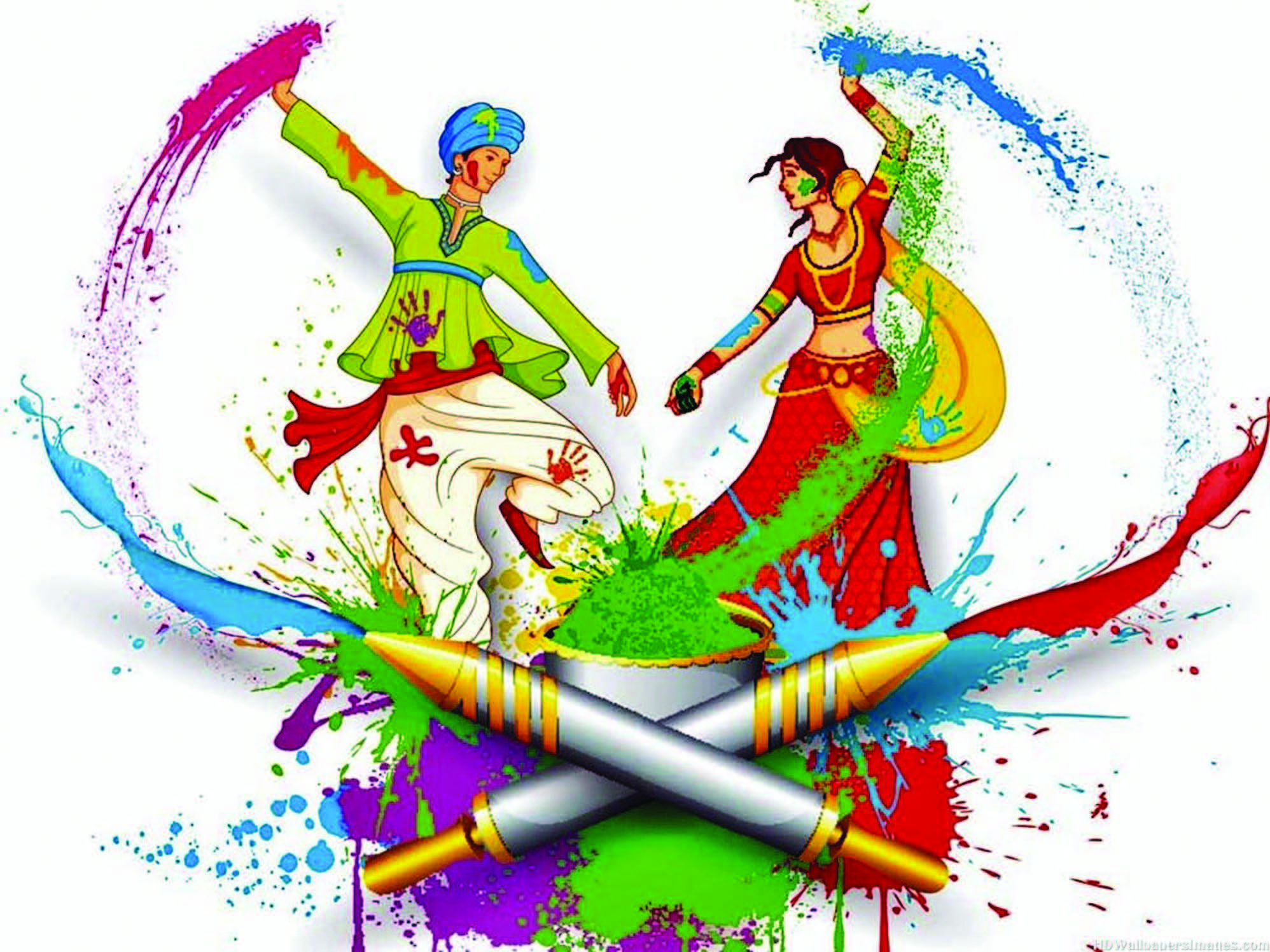
    As the brief spring warms the landscape, northern India cuts loose for a day of hijinx and general hilarity. The festival of Holi is celebrated on the day after the full moon in early March every year. Originally a festival to celebrate good harvests and fertility of the land, Holi is now a symbolic commemmoration of a legend from Hindu Mythology. The story centres around an arrogant king who resents his son Prahlada worshipping Lord Vishnu. He attempts to kill his son but fails each time. Finally, the king’s sister Holika who is said to be immune to burning, sits with the boy in a huge fire.

    However, the prince Prahlada emerges unscathed, while his aunt burns to death. Holi commemorates this event from mythology, and huge bonfires are burnt on the eve of Holi as its symbolic representation. This exuberant festival is also associated with the immortal love of Krishna and Radha, and hence, Holi is spread over 16 days in Vrindavan as well as Mathura – the two cities with which Lord Krishna shared a deep affiliation. Apart from the usual fun with coloured powder and water, Holi is marked by vibrant processions which are accompanied by folk songs, dances and a general sense of abandoned vitality. Today Holi is an excuse for Indians to shed inhibitions and caste differences for a day of spring fever and Big Fun.

    Teenagers spend the day flirting and misbehaving in the streets, adults extend the hand of peace, and everyone chases everyone else around, throwing brightly colored powder (gulal) and water over each other. The festival’s preamble begins on the night of the full moon. Bonfires are lit on street corners to cleanse the air of evil spirits and bad vibes, and to symbolize the destruction of the wicked Holika, for whom the festival was named. The following morning, the streets fill with people running, shouting, giggling and splashing. Marijuana-based bhang and thandai add to the uninhibited atmosphere.

    Promptly at noon, the craziness comes to an end and everyone heads to either the river or the bathtub, then inside to relax the day away and partake of candies. In the afternoon an exhausted and contented silence falls over India. Although Holi is observed all over the north, it’s celebrated with special joy and zest at Mathura, Vrindavan, Nandgaon, and Barsnar. These towns once housed the divine Krishna. Each area celebrates Holi differently; the Bhil tribesmen of western Madhya Pradesh, who’ve retained many of their pre-Hindu customs, celebrate holi in a unique way.

    In rural Maharashtra State, where the festival is known as Rangapanchami it is celebrated with dancing and singing. In the towns of Rajasthan, especially Jaisalmer, the music’s great, and clouds of pink, green, and turquoise powder fill the air. The grounds of Jaisalmer’s Mandir Palace are turned into chaos, with dances, folk songs, and coloredpowder confusion.

    History
    History of HoliHoli is an ancient festival of India and was originally known as ‘Holika’. The festivals finds a detailed description in early religious works such as Jaimini’s Purvamimamsa-Sutras and Kathaka-Grhya- Sutras. Historians also believe that Holi was celebrated by all Aryans but more so in the Eastern part of India. It is said that Holi existed several centuries before Christ. However, the meaning of the festival is believed to have changed over the years. Earlier it was a special rite performed by married women for the happiness and well-being of their families and the full moon (Raka) was worshiped.

    Calculating the Day of Holi
    There are two ways of reckoning a lunar month- ‘purnimanta’ and ‘amanta’. In the former, the first day starts after the full moon; and in the latter, after the new moon. Though the amanta reckoning is more common now, the purnimanta was very much in vogue in the earlier days. According to this purnimanta reckoning, Phalguna purnima was the last day of the year and the new year heralding the Vasantaritu (with spring starting from next day). Thus the full moon festival of Holika gradually became a festival of merrymaking, announcing the commencement of the spring season. This perhaps explains the other names of this festival – Vasanta-Mahotsava and Kama-Mahotsava.

    Reference in Ancient Texts and Inscriptions
    Besides having a detailed description in the Vedas and Puranas such as Narad Purana and Bhavishya Purana, the festival of Holi finds a mention in Jaimini Mimansa. A stone incription belonging to 300 BC found at Ramgarh in the province of Vindhya has mention of Holikotsav on it. King Harsha, too has mentioned about holikotsav in his work Ratnavali that was written during the 7th century. The famous Muslim tourist – Ulbaruni too has mentioned about holikotsav in his historical memories. Other Muslim writers of that period have mentioned, that holikotsav were not only celebrated by the Hindus but also by the Muslims.

    Reference in Ancient Paintings and Murals History of HoliThe festival of Holi also finds a reference in the sculptures on walls of old temples. A 16th century panel sculpted in a temple at Hampi, capital of Vijayanagar, shows a joyous scene of Holi. The painting depicts a Prince and his Princess standing amidst maids waiting with syringes or pichkaris to drench the Royal couple in coloured water. A 16th century Ahmednagar painting is on the theme of Vasanta Ragini – spring song or music. It shows a royal couple sitting on a grand swing, while maidens are playing music and spraying colors with pichkaris.

    There are a lot of other paintings and murals in the temples of medieval India which provide a pictoral description of Holi. For instance, a Mewar painting (circa 1755) shows the Maharana with his courtiers. While the ruler is bestowing gifts on some people, a merry dance is on, and in the center is a tank filled with colored water. Also, a Bundi miniature shows a king seated on a tusker and from a balcony above some damsels are showering gulal (colored powders) on him.

    Legends and Mythology
    In some parts of India, specially in Bengal and Orissa, Holi Purnima is also celebrated as the birthday of Shri Chaitanya Mahaprabhu (A.D. 1486-1533). However, the literal meaning of the word ‘Holi’ is ‘burning’. There are various legends to explain the meaning of this word, most prominent of all is the legend associated with demon king Hiranyakashyap. Hiranyakashyap wanted everybody in his kingdom to worship only him but to his great disappointment, his son, Prahlad became an ardent devotee of Lord Naarayana. Hiaranyakashyap commanded his sister, Holika to enter a blazing fire with Prahlad in her lap.

    Holika had a boon whereby she could enter fire without any damage on herself. However, she was not aware that the boon worked only when she enters the fire alone. As a result she paid a price for her sinister desires, while Prahlad was saved by the grace of the god for his extreme devotion. The festival, therefore, celebrates the victory of good over evil and also the triumph of devotion. Legend of Lord Krishna is also associated with play with colors as the Lord started the tradition of play with colours by applying colour on his beloved Radha and other gopis. Gradually, the play gained popularity with the people and became a tradition.

    Holi in Barsana
    Holi in Barsana Holi of Barsana, the birthplace of Radha, a village, 42 kms away from Mathura, is of particular interest. Here, men from Nandgaon, the land of Krishna come to play Holi with the girls of Barsana and hope of raising their flag over Shri Radhikaji’s temple. But, instead of colours they are greeted with sticks by the gopis. Hence, the Holi get its new name here- Lathmaar Holi. Smart enough, men come fully padded as they are fully aware what kind of welcome awaits them and also the fact that they are not allowed to retaliate on that day. In this mock battle of sorts, they try their best not to be captured.

    The unlucky one’s however, are forcefully led away and get a good thrashing from the women. Further, they are made to wear a female attire and dance in public. All in the spirit of Holi. Renowned poets like Surdas, Nand-das, Kumbhan-das and others have picturesquely described how Lord Krishna received similar treatment and was forced to don a sari and wear make-up and perform dance before being released by the gopies. The next day, it is the turn of men of Barsana. They reciprocate by invading Nandgaon and drench the womenfolk of Nandgaon in colours of kesudo, naturally occurring orange-red dye and palash. Today, the women of Nadagow beat the invaders from Barsana. It is a colourful site.

    However, in the interest of tourism and safety, the state tourist board has set up excellent vantage points for the public. A large open ground, on the outskirts of the town is specially set aside for the most magnificent display of the festivities. The week long Holi celebrations also continue in the various Krishna temples on different days. The celebrations are filled with clouds of colours and of course, much fun.

  • Irremediable Indian inequalities

    Irremediable Indian inequalities

    Inder Malhotra cites the example of frequent parole to Sanjay Dutt to pinpoint Indian inequalities

    All honor to the Bombay High Court for putting its foot down on the ease with which actor Sanjay Dutt, a convict for his role in the horrendous 1993 serial blasts in the western metropolis, has been able to get extension after extension of his parole, initially granted only for a month.

    The honorable judges have underscored that since going to Yerwada jail last year, he had spent 40 per cent of the time out of it because he was earlier allowed a month’s furlough. Obviously, all this has happened simply because of his clout and influence while the parole applications of sons of a lesser God have been gathering dust in one government office or the other.

    No wonder the court directed the state government to set up a committee under the chairmanship of the Chief Secretary to revise the existing rules for parole and furlough so that all prisoners could be treated fairly and equitably. Of course, no one knows how long the revision of the rules would take, especially at election time, and how effective the revised regulations would be.

    Meanwhile, under the existing rules that require only a favorable report by the police and its approval by the Divisional Commissioner, privileged convicts would go on getting a bonanza of paroles and furloughs. While the hearing of the PIL on the parole issue was in progress, Sanjay Dutt intervened, through his lawyer, to plead: “I am not alone to be on parole”.

    He was both profoundly wrong and partially right at the same time. He was utterly wrong because, according to the court’s record, 600 applications for parole had been pending for various lengths of time while the film actor’s parole was being extended from month to month. As if this wasn’t enough the Nagpur Bench of the High Court was driven to making some justifiably sharp remarks on the subject. Another convict in the same case, imprisoned in Nagpur, had petitioned the court that his daughter had died some time ago but the authorities were neither giving him parole nor denying it, thus dragging their feet.

    “Is there no humane consideration in such matters”, observed the judges, “or is such consideration reserved only for film stars?” And Sanjay Dutt is right only to the extent that in that he is not alone in enjoying the kind of parole privileges available to him. Others belonging to his class are doing equally well. For instance, a convicted murderer serving a life sentence in Delhi’s Tihar jail, a son of a powerful politician, also manages to be out of prison either on parole or on medical grounds whenever he likes.

    He is often seen attending marriages or dining in fivestar hotels. All protests against this state of affairs have been of no avail so far. It must be added that after his first trial this young man was set free. Only after huge protests in Delhi on behalf of the young lady he had shot dead a retrial was ordered. What an irony it is that at a time when even the richest and most powerful countries have woken up to the problem of great and growing inequalities and are trying to do something about it, the “Secular and Socialist” Republic of India – to borrow words from the amended Preamble of the Constitution — is a glaring exception.

    Here the governing doctrine among the privileged classes is that inequalities are meant to be preserved, and indeed expanded further. Nothing should happen to “people like us” for any reason whatsoever, and to hell with the rest. They deserve whatever they get. To be sure there has been some criticism of the too frequent paroles to Dutt, but among the movers and shakers of Indian society his critics have been denounced, even abused roundly for being “insensitive”.

    “Don’t these idiots realize that Sanjay’s wife is suffering from TB and needs his presence by her side?” said a socialite the other day. When asked whether the same consideration would apply to other convicts, she scornfully added: “They don’t matter”. The truth is that what is going on now is a relatively low-key repetition of the “our-poor-Sanju” lament that rent the sky exactly a year ago when the final judgment on the 1993 outrage was delivered by the Supreme Court 20 years after the ghastly blasts.

    There was a howl by not only movie moguls and Sanjay’s fans but also from crème de la crème of Indian elite demanding that the “great actor” must not be sent to jail even for a day; the sentence – mandatory in the case of his offence, according to the apex court — must be cancelled or commuted. In this cacophony, nothing else about the horrifying case was discussed, not even the inability of the Indian state to bring to book the mastermind of the massive slaughter and destruction of property, Dawood Ibrahim, who was merrily strutting around in Pakistan most of the time, while making short visits to Dubai.

    A former judge of the Supreme Court, then heading the Press Council, spent most of his time pleading for the remission of the punishment meted out to “Poor Sanju”. He wrote letters to the Governor of Maharashtra and the Government of India demanding that under no circumstances should “Sanju” be sent to prison.

    Almost all the movie moguls of Bollywood and “Sanjay fans” joined the outcry. One particularly loud boss in Indian filmdom argued that he had “reprimanded Sanjay sharply” and that should be enough! The most ridiculous argument for the immediate grant of pardon to Dutt came from the high and mighty among the elite. The famous actor, they said, had become a symbol of “Gandhigiri”. Therefore, he should be left free to continue playing this useful role.

    That was when some people were enraged enough to ask: “When Sanjay was visiting Dawood Ibrahim and his gang regularly and bringing in and storing deadly weapons for them, was he spreading the Mahatma’s message?” They also underscored that of the weapons brought in for D-company’s murderers, the actor had kept to himself three AK-56s. Having failed to get the sentence passed on Sanjay Dutt remitted, the movers and shakers are now busy ensuring that he stays out of jail for the maximum possible time by hook or by crook. Under these circumstances, please forget Article 14 of the Constitution that ensures every citizen complete equality.

  • BJP DECLARES 54 LOK SABHA CANDIDATES

    BJP DECLARES 54 LOK SABHA CANDIDATES

    NEW DELHI (TIP): The Bharatiya Janata Party (BJP) Thursday announced its first list of 54 candidates for the Lok Sabha elections and fielded former party president Nitin Gadkari from Nagpur. The list was announced after a meeting of the party’s central election committee.

    It includes candidates for Jammu and Kashmir, Arunchal Pradesh, Goa, Manipur, West Bengal, Odisha, Maharashtra and Himachal Pradesh and has several sitting and former parliamentarians. Former union minister Shanta Kumar has been fielded from Kangra in Himachal Pradesh while Anurag Thakur, president of Bharatiya Janata Yuva Morcha, has been retained as candidate from Hamirpur.

    In Jammu and Kashmir, the BJP fielded state chief Jugal Kishore Sharma from Jammu and state spokesman Jitender Singh from Udhampur. Other candidates from Jammu and Kashmir include Thunpsthan Chhweang (Ladakh), Mushtaq Ahmad Malik (Anantnag) and G.M. Meer (Baramulla). The BJP declared 17 candidates from West Bengal, including former lawmaker Tapan Sikadar (Dum Dum), state party president Rahul Sinha (Kolkata Uttar), and magician P.C. Sorcar Jr. (Barasat).

    Apart from Gadkari, 17 candidates declared from Maharashtra include sitting parliamentarians Gopinath Munde (Beed), Hansraj Ahir (Chandrapur), Dilip Gandhi (Ahmadnagar) and former MP Kirit Somaiya (Mumbai North East). The party fielded former lawmaker Kiren Rijiju from Arunachal West and another former parliamentarian Tapir Gao from Arunachal East. Shripad Y. Naik was retained from North Goa and Narendra K. Sawaikar has been fielded from South Goa. In Odisha, the BJP has fielded Jual Oram from Sundargarh and Sangeeta Kumari Singh Deo from Bolangir. The party declared six candidates from Odisha. The party retained Virender Kashyap as its candidate from Shimla.

  • MAHARASHTRA CM AGREES TO SHUT 22 TOLL PLAZAS, RAJ THACKERAY KEEPS UP THREAT

    MAHARASHTRA CM AGREES TO SHUT 22 TOLL PLAZAS, RAJ THACKERAY KEEPS UP THREAT

    MUMBAI (TIP): MNS chief Raj Thackeray on February 13 wangled a promise from CM Prithviraj Chavan to shut down 22 toll plazas immediately and unveil a new policy before the poll model code of conduct starts in the first week of March. After several more assurances in a two-hour meeting, Thackeray said he was calling off his morcha scheduled for February 21, but kept up the heat on the government by exhorting citizens not to pay toll till the new policy. The CM admitted serious irregularities in toll collection and said a new policy awaits the cabinet’s nod.

    ST buses would be exempted from toll, he added, and offered the same hope for BEST, which could reduce fares. A comprehensive policy submitted to the government suggested several people-friendly measures like toll booths only beyond 5km from civic limits, time-bound projects, calculation of toll on road length, etc. After Feb 13 meeting, officials said other than withdrawal of 22 toll booths which are recovering less than Rs 10 crore by paying Rs 124 crore, the state is checking if it could eliminate 20-25 more toll booths by spending another Rs 350-400 crore. It would be discussed at a cabinet meeting soon. “The state can spend a maximum Rs 500-600 crore to buy back toll booths in the interest of the angry people. Around 80 major toll booths will have to be retained as buying them out would be an unaffordable burden on the state,” said a senior official.

    Thackeray offered his suggestion to the government to ease toll pain: divert the Rs 100 crore meant for a mammoth statue of Chhatrapati Shivaji in the Arabian Sea. The meeting on Thursday took place as the CM had invited Thackeray for talks at Sahyadri, the state-owned guest house at Malabar Hill, following which the MNS leader had called off a rasta roko in Mumbai on Wednesday. Thackeray was accompanied by party legislators and a battery of toll experts led by the fiesty Sanjay Shirodkar. PWD minister Chhagan Bhujbal and MSRDC minister Jaydutt Kshirsagar submitted their viewpoints on toll before Chavan spoke.

    The meeting drew disparaging comments from other parties. “This is Raj Thackeray’s face-saving exercise,” said a BJP functionary. Both the Shiv Sena and the BJP have described the entire sequence of events of the last four days as “match-fixing” between Chavan and Thackeray. Asked about the success of his party’s agitation, Thackeray said: “Anna Hazare had also written to the government against toll. But since our party’s first agitation, 65 toll booths have been shut. This means the government understands our language, and not that of Hazare’s.”

    At the meeting, Chavan unveiled some more measures to provide relief to travellers and to make toll collection more transparent. He announced exemption to ST buses from toll. “We have written to the Centre… We have fine-tuned a new formula under which the state will claim 75% share from additional toll collection, while the private contractor will get 25%. There is need for greater coordination between the public works department, the national highway authority and the Maharashtra State Road Development Corporation,” the CM said.

    The MNS delegation pointed out that the Khed-Shivapuri toll booth on the Pune-Kolhapur road had recovered toll from 19 lakh vehicles in three years and was supposed to be closed by January 26 this year. But it was still in operation. Chavan said an independent decision would be taken on booths where recovery has been completed following a heavy rise in the number of vehicles. The CM asked people to come up with evidence against toll posts recovering money beyond their mandate and assured action.

    He added that future toll projects would be mandatorily based on electronic vehicle count to help decide transparently when recovery should end. Also, private toll contractors will have to acquire land to set up user facilities along the state highways. Toll expert Shirodkar suggested measures like traffic sampling, internal audit and linking toll with the wholesale price index to streamline toll collection.

  • SPECTRUM SALE EXCEEDS EXPECTATIONS

    SPECTRUM SALE EXCEEDS EXPECTATIONS

    NEW DELHI (TIP):
    After 10 days of intense bidding, eight telecom companies, including Bharti Airtel and Vodafone India, on Thursday, bought spectrum worth a total of Rs.61,162.22 crore against the government’s estimate of Rs.47,933 crore. The Finance Ministry will now get revenues to the tune of Rs.18,296 crore this fiscal from the auction against the initial projection of Rs.11,340 crore. The value of the premium 900 MHz band spectrum, available only in three metro circles of Delhi, Mumbai and Kolkata, stood at Rs.23,589.62 crore (85 per cent higher than the value of the reserve price). Here, Bharti Airtel and Vodafone India, whose licences are expiring this year, managed to get the desired quantity of radio waves to ensure uninterrupted services to their customers. In the 1800 MHz band, radio waves available in all 22 telecom circles, the net value was put at Rs.37,572.60 crore .

    All of 46 MHz spectrum in the 900 MHz band was sold, but 78 blocks of the 390 MHz spectrum in the 1800 MHz band remained unsold. Here, the top three circles in terms of net value are: Delhi (Rs.7,644 crore), Mumbai (Rs.6,364 crore) and Maharashtra (Rs.4,064 crore). While Assam surprised all by clocking the highest value for spectrum in percentage terms — Rs.411.54 crore, which is 515 per cent over its reserve price of Rs.79.80 crore. Terming the auction as ‘extremely successful’, Communications and IT Minister Kapil Sibal told journalists: “The total revenue that will come to the government is Rs.61,162.22 crore…To that extent, particular auction has been extremely successful.”

    When asked whether high valuation of spectrum would lead to hike in mobile tariffs, he said: “Auction will really be successful if we are able to provide efficient service to consumers…The ultimate objective if any auction which has to provide service is that the service must be provided efficiently and at a relatively affordable price. We hope the tariffs will remain reasonable in the years to come.” Stating that he did not foresee any impact on tariffs, Telecom Secretary M. F. Farooqui said companies would have factored in all aspects before bidding for spectrum.

    “Market sentiment, economic situation and clarity in regulatory framework impact (spectrum) prices…We only provided transparent environment. Companies know their business better…If they have bid, they must have calculated the value of spectrum,” he said, and added that the telecom sector was poised for another round of growth where data usage would see a spurt.

    Cos seek cut in levies
    Though successful companies did not talk about any immediate increase in tariffs, they rued about ‘unreasonable’ reserve prices and demanded cut in levies imposed on telecom service providers. Stating that higher spectrum prices could impact the objectives of the telecom policy related to rural penetration, broadband for all, internet access, Rajan S. Mathews, Director-General, Cellular Operators Association of India (COAI), which represents GSM operators, said: “It remains to be seen if the operators will have the financial resources to invest in networks and marketing after bearing the high spectrum costs…To help the industry overcome this huge financial burden, the government should address the high tax/levy structure on the industry.”

  • TANVI SHINDE-The Teen Talent

    TANVI SHINDE-The Teen Talent

    It was the great American poet, Robert Frost who once wrote the now famous lines: “Woods are lovely, dark and deep; But I have promises to keep; And miles to go before I sleep, and miles to go before I sleep”. Tanvi seems to be keeping those lines of Frost in her mind. Not content with a number of trophies and awards she has won, she told The Indian Panorama, in an interview, recently, “I want to continue on my journey with pageants because I believe that this is just the beginning; I still have a lot more to achieve in my life.

    I want to get a Bachelor of Fine Arts and become an astonishing creative director.” Look at all the honors she has got. Miss Teen India DFW 2012; Miss Popular 2012; Miss Teen South Asia Texas 2012; Miss Photogenic Miss Teen India USA 2012; Second runner up Miss Teen India USA 2012; Miss Over-All Photogenic winner 2013; Miss Talented Miss India USA 2013. As a child she wasn’t really aware of pageants, she had never even thought of being in one. But as a child she was involved in dancing and art. Her passion for dance and art began at a very young age. Her creativity comes from her dad’s side of the family.

    The Shinde family consists of great singers, artist and dancers. And this is what influenced her to become such a creative person overall. Tanvi’s father, Raj Shinde, is an accomplished creative director in advertising and mother is a teacher. Both played a key role in shaping their daughter’s ambition. However, it appears her father had a greater influence on her. She told The Indian Panorama, “In order to realize and achieve the goal I paid close attention to my father’s work since he himself is a phenomenal creative director. With his guidance and the company of my mom and her support I was able to experience and get more knowledge in the commercial field by acting in a few commercials and doing voice-overs.

    I made sure I was open-minded and ready to learn new things at every moment of my life.” In reply to a question as to what career she would like to adopt, she took no time to answer, “As far as career is concerned, I’ve always wanted to become a creative director and open up my own advertising agency. Along with that I also want to pursue modeling and acting.” When I congratulated her on her being one of the top 5 finalists in Miss India USA Pageant, she smiled, looked at her father and then said in a matter of fact style, “Success doesn’t come to you; you have to work hard for it.

    Nothing is impossible; if you can dream it you can achieve it. Be real, be yourself, be unique, be true, be honest, be humble and most of all is to be happy.” I asked her about the pageant- when and where it was held, how many participated etc. I love to quote her. “Several young women participated in the 32nd annual Miss India USA pageant which was hosted by IFC. It was held in New Jersey on November 23rd at Royal Albert’s Palace. Being the winner of the 2012 Miss Teen India DFW, I was a teen participant from Dallas, Texas. I represented Texas.


    33
    Tanvi Shinde (left)is crowned Miss Teen India USA

    I won the Miss Talented Miss India USA 2013 title in the 2013 Miss India USA pageant.” Visibly excited to recall the pageant, she continued, “The rounds that were included in the 2013 Miss India USA pageant were an Intro dance, Talent round, Indian Wear along with a self-introduction, Evening Wear, Top 5, and crowning. I was one of the top 5 finalists. She said, “I’ve always competed with the teens but this was my very first time competing with the miss girls, it was definitely a unique experience also a lot more challenging! Along with that I got to meet new people and make new friends.

    It also taught me several new things and increased my knowledge about the world of pageants. I would say that the 2013 Miss India USA pageant has impacted my life tremendously; it has brought great opportunities to me. It has given me a chance to help my community and be successful in my career. I couldn’t have gotten this far without my parents, and all of my family and friends; I would like to thank everyone with all my heart”. Born in Mumbai, Maharashtra India raised, and in Dallas, Texas USA, Tanvi is, to say the least, extremely talented. Imagine a young girl of 18 having command over such diverse aspects of talent.


    35

    36
  • Three students killed as bus collides with truck in Maharashtra

    Three students killed as bus collides with truck in Maharashtra

    BULDHANA (MAHARASHTRA) (TIP): Three school girls were killed and 14 others got injured when a speedy truck container hit a state transport bus near Malkapur in the district early on Friday, police said.The three teenaged girls were killed on the spot when the MSRTC bus, going from Kati to Malkapur, collided with the truck coming from the opposite direction, they said.

    The students were on their way to Chandak Vidyalaya in Malkapur and used to regularly take a bus to go to school. Police said 14 other bus passengers injured in the mishap were rushed to Malkapur and Buldhana civil hospitals.

  • Govt employees threaten to go on indefinite strike

    Govt employees threaten to go on indefinite strike

    KOHLAPUR (TIP): The state government employees have threatened to go on indefinite strike in February for their pending demands. The Rajya Sarkari Madhyavarti Karmachari Sanghatana (RSMKS), the state government employees’ association, made the announcement on January 9. The date of the strike will be decided at a meeting of the employees at Nashik in the third week of January. Anil Lavekar, secretary of the RSMKS, said, “There are around 20 lakh government, semi-government employees and teachers working at government-run schools. We have presented our demands to the state government several times since 2011.

    Whenever we agitate, the government assures us that they will look into the matter but has never taken any decision regarding our demands.” “Our demands are simple and the state government should not hesitate to accept them. This time, we will continue the strike till the government yields to our demands. This will be a state-wide strike, which will affect the functioning of the state when the machinery will be busy in preparing for Lok Sabha elections,” he said. The demands of the employees include, five-day week, increase the retirement age to 60 years, implementation of the Travelling Allowance and Educational allowance as applied to employees of central government and increase in the pension of the retired employees when they cross 80 years of age.

    “The state government recruits persons to fill up 50% of the total posts of naib tehsildar (NT) by direct recruitment through Maharashtra Public Service Commission (MPSC) exams and the remaining 50% through promotions. The union has demanded a rise in filling of posts of NT through promotions instead of recruitment through MPSC exams,” said Lavekar. “From the last three years, we are agitating in a democratic way by presenting our demands to state government.

    But we have received only assurance from them. Now, keeping in mind the upcoming Lok Sabah elections, we will go on an indefinite strike till our demands are accepted by the government. We have organised a meeting of the members of organisation in Nashik on the third week of January, where we will announce the date of our agitation,” he said. The other demands of the employees include hike in salaries, recruitment of persons for vacant posts, adequate stipend to employees doing overtime and regularization of work of contract as well as casual labourers.

  • CAG QUESTIONS RS 3,000 CRORE OF INVESTMENTS BY TWO TATA TRUSTS

    CAG QUESTIONS RS 3,000 CRORE OF INVESTMENTS BY TWO TATA TRUSTS

    NEW DELHI (TIP): A detailed audit by the Comptroller and Auditor General of India of some major trusts run by business houses and sports bodies has allegedly revealed misuse of income tax exemptions granted to them. Among them are at least two Tata trusts and a number of state cricket associations. The audit report, one of the first to be signed by the new CAG, S K Sharma, is to be tabled in Parliament in the winter session. In the meantime, the CAG has written to the finance ministry, which has advised the income-tax department to initiate action.

    In the report, ‘Exemptions to Charitable Trusts and Institutions’, the CAG has said that some of the trusts have invested, or transferred to other trusts, large surpluses instead of spending the money for charitable purposes. According to the CAG, Jamsetji Tata Trust and Navajbai Ratan Tata Trust together invested over Rs 3,000 crore in ‘prohibitive modes’, meaning investments that cannot be accepted as charitable in nature. In the wake of the CAG audit, the government has initiated steps to recover over Rs 1,000 crore from the two trusts. All the Tata trusts together hold 66% in Tata Sons, the holding company of the $100 billion salt-to-software-to-steel conglomerate. The CAG’s audit covered over 80,000 of the six lakh-odd registered trusts in India.

    A source close to the development said the two Tata trusts were the most prominent among them. The finance ministry has admitted to the CAG that the administration of Section 13(1)(d) of the Income Tax Act, which provides tax exemption to trusts, was flawed. Another 20 major trusts have illegally enjoyed IT exemption, the audit report said, but no details are as yet available. The section specifies that if a charitable trust has invested in ineligible securities, its income will not be tax exempt.

    In other words, the charitable trust will lose its tax exemption status. The audit also reports that four state cricket associations-Maharashtra, Saurashtra, Baroda and Keralahave engaged in commercial activities, linked mostly to telecast rights, and received “irregular exemptions”. The CAG has said that the illegal acts of the state boards have resulted in revenue loss of over Rs 38 crores.

    TATA’S RESPONSE:
    In response to a detailed questionnaire from TOI, AN Singh, managing trustee of the Sir Dorabji Tata Trust (of which the Jamsetji Tata Trust is an affiliate), said: “We are not aware of the recent audit of the CAG of India referred to by you. However, we confirm that a tax demand has been raised by the income-tax department against the trust in relation to the subject matter of your query. The department has stayed the recovery of demand against an interim tax payment made by the Trust, pending appellate proceedings.

    An appeal has been filed with the commissioner of I-T since there is a difference in opinion between the I-T department and the Trust on the legal interpretation of the relevant provisions of the Act. The proceedings are currently ongoing. It may also be mentioned here that the trust is governed by the provisions of the Bombay Public Trusts Act and had accordingly sought and obtained the prior approval of the Charity Commissioner as required by the Act before making the subject investment which was made to avail of an optimised and stable yield. In the opinion of the trust, there is no loss of revenue to the exchequer resulting from the said investment.”

  • Apply death penalty norms in dowry cases: SC

    Apply death penalty norms in dowry cases: SC

    NEW DELHI (TIP): In a fresh set of guidelines, the Supreme Court has asked trial courts and high courts to apply the principle of aggravating and mitigating factors — meant for commuting or upholding the death penalty — in dowry death cases which attract only imprisonment, ranging from a minimum of seven years to a maximum of life term under Section 304-B IPC. The guidelines are part of the effort to evolve standardised jurisprudential principles to replace the “highly individualised and judge-centric” sentencing, thereby minimising the “uncertainty” over the quantum of punishment, a Bench comprising Justices SJ Mukhopadhaya and Ranjan Gogoi explained. Applying the new principles, the Bench reduced the life sentence awarded to one Sunil Dutt Sharma in a case of dowry death which had happened in Delhi in May 1992 within two years of his marriage.

    Under the fresh guidelines, the Bench has advised the judiciary to first apply the principle of seven aggravating and five mitigating factors evolved by the Supreme Court over the years and culled out in a recent verdict — Shankar Kisanrao Khade vs State of Maharashtra. The Bench said it saw no reason as to why the principles of sentencing evolved by the Supreme Court in death penalty cases would not be applicable to cases involving lesser sentences extending from a single day to life term, particularly in the absence of sentencing guidelines in the statute. Unlike in some foreign jurisdictions where such principles were part the law, in India, it was left to the judiciary to evolve the principles, it noted. Second, the quantum of sentence should not be guided by the necessity to combat the menace of demand for dowry or to prevent atrocities on women and other social evils or to maintain the purity of social conscience as such factors were equally applicable to other crimes as well, the Supreme Court said. “The search for principles to satisfy the crime test in an offence under Section 304-B IPC must therefore lie elsewhere,” it explained.

  • India looks to the Diaspora with a lot of Expectations – BOB CMD Mundra

    India looks to the Diaspora with a lot of Expectations – BOB CMD Mundra

    Bank of Baroda Chairman and Managing Director, Mr. S.S. Mundra visited New York from September 16th to 18th. It was his first visit to New York after he took over as Chairman and Managing Director of the second largest public sector bank of India, second only to State Bank of India. Mr. Mundra met with customers and the Indian American community and also launched the internet banking. A reception to Mr. Mundra was hosted by the Indian Consulate where he met the Consul General Dnyaneshwar Mulay and a cross section of Indian American community.


    img49

    He also addressed the gathering and spoke about banking industry in general and, the Bank of Baroda operations in US in particular. He spoke about the synergy that can be developed through Bank of Baroda. Mr. S. S. Mundra was born on 18th July, 1954. After completing his Masters in Commerce, he joined Bank of Baroda as a Probationary Officer on 21st March, 1977. In his first stint in Bank of Baroda, he rose to the level of General Manager in 2007. During his illustrious career in Bank of Baroda, he held several challenging assignments which included a stint as Head of Bank’s Maharashtra & Goa Zone and Global Treasury Operations for over 5 years. During his overseas assignments, he served with Bank of Baroda (Uganda) Ltd. and was also Territorial Head of Bank’s European Operations, headquartered at London during the period 2008 – 2010.

    Mr. Mundra was elevated as Executive Director in Union Bank of India in September, 2010. During his tenure at Union Bank of India, he handled many important portfolios including Treasury, International, Large Corporate and Alternate Channels. On his elevation as Chairman and Managing Director on 21st January, 2013, he joined Bank of Baroda a premier Public Sector Bank (PSB) in India having a branch network of over 4000 branches including Bank’s overseas operations spread over 24 countries with a global business of over INR 8 trillion (USD 131 bn). Bank of Baroda is second largest Public Sector Bank of India only after State Bank of India in terms of Balance Sheet size.


    img51

    It has 100 branches/ offices outside India. He is on the Board of many national and international organizations which include EXIM Bank, National Institute of Bank Management (NIBM), Bank of Baroda (Uganda) Ltd., India International Bank Malaysia Bhd, Bank of Baroda (New Zealand) Ltd., BOBCARDS Ltd., India First Life Insurance, Baroda Pioneer Mutual Fund etc. He has remained Director on the Board of The Clearing Corporation of India Ltd. (CCIL), Central Depository Services (India) Ltd. (CDSL), MITCONConsulting and Engineering Services Ltd., BOB Asset Management Company, India Infrastructure Finance Corporation (UK) Ltd. (IIFCL), Star Union Dai-Ichi Life Insurance Company Ltd., National Payments Corporation of India Ltd (NPCI) and Bank of Baroda (Kenya) Ltd. He has also served on many Committees of RBI, IBA, NIBM, CII etc.

    He has also attended many training programs, seminar/ conferences both in India and abroad, in the area of Banking and Finance. He has widely traveled abroad. The countries he visited include UK, Belgium, France, USA, Japan, China, Hong Kong, Singapore, various African countries etc. With the blend of wide overseas and domestic banking exposure at top management level, he has immensely contributed to the improvement of policy framework of the banking industry. As recognition of his contributions in the field of banking, finance, industry and commerce, he has won many Awards and accolades, latest being his inclusion in the list of India’s top 100 CEOs in CD-ET (Corporate Dossier – Economic Times) Survey after a stringent process of selection while Bank of Baroda is also ranked as 20th Best Indian Brand by Brand Equity – Economic Times.

    The Indian Panorama chief editor Prof. Indrajit S Saluja interviewed Mr. Mundra. Here are excerpts from the interview.

    Q. You have launched internet banking. How does it help your customers?

    In today’s wired world, customers should have the right to have information in real time. At the moment, we are providing to our customers viewing facility. As of now, we are not providing transaction facility, which is a little complicated affair. However, there is no fee for the facility we are providing.

    Q. When, do you think, you will provide the real time transaction facility?

    There has to be an enhanced security level. Also, there has to be a higher comfort level for both the customers and the bank before we can go in for providing this facility. Q. Are there any legal or procedural difficulties in providing transaction facilities? Not so. Internet banking is an internationally accepted practice. There is no legal problem, as such. Yes, there could be procedural problems. There has to be a robust procedure that ensures the comfort level of customers. After all, the facility is meant to give comfort to customers.

    Q. What are your impressions of your meetings with customers here?

    I am glad our customers spoke highly of the services being provided by New York branch. All felt very happy with the staff and the cooperation they were getting.We look forward to long term relationship with our customers.We believe in making and cementing relationship. Of course, some suggested that we start retail banking. But then, there is no plan with the bank as of now.

    Q. We hear of banks in India committing irregularities and being pulled up. Did your bank ever face this kind of situation?

    We are a conservative bank, so to say.We are acutely compliant. There has never been a complaint about our not being compliant. However, there could some times be some small and inconsequential matters. But there always is room for improvement. Please remember, we are the second largest public sector bank, after State Bank of India.We have 42,000 employees and a customer base of 50 million. The total business of the bank, as on 31st march, 2013 , was 8 lac 50 thousand crore.

    Q. What do you think about the future of Indian economy?

    I believe the fundamentals of Indian economy are very strong. From a distance, the Diaspora may some times not be able to see the clear picture and have misgivings about the strength of the economy. But let me assure the Diaspora that Indian economy is strong and has the capacity to withstand knocks.

    Q. Your message to the NRIs?

    Indians abroad are doing very well. They are doing good to their genetic mother and also to their adopted mother. India is proud of them. And India looks up to them with great expectations.

  • KAAS PLATEAU

    KAAS PLATEAU

    Kaas Plateau, also known as Kaas Pathar is a volcanic plateau located in Maharashtra, a half an hour drive from Satara and around 130 km from the city of Pune. This 1000 hectare plateau has only recently gained popularity since it was declared a bio-diversity site by UNESCO in June 2012.


    img40

    By Road
    There is a pretty decent four-lane highway that connects Pune and Satara. You will pass very close to Mahabaleshwar on this highway as well. The 3 hour drive to Satara from Pune can be made easily in one’s own car or in a rented car. There are also buses that ply between Pune and Satara. The drive is pleasant most of the way with the views getting remarkably spectacular as you begin the last leg of the ascent to the top of the plateaus. The surroundings include distant views of the massive Shivsagar Lake and you can sometimes see the Sajjangadh Fort in the distance.
    Climate
    The monsoons and the period just post monsoon are the best times to go to Kaas. So we’re talking August, September and October. The climate is amazing at this time with light drizzles and lovely cloudy weather which makes long walks on the plateau not just easy but also quite pleasurable. Within this 3 month period, the span of 3 weeks between the second week of September and the first week of October are the best time to visit and see what can only be called a phenomenon. Kaas turns into a valley of wild flowers with huge patches of different colours visible even from the distance.
    Where to stay
    Kaas is recommend as a day trip because there aren’t really many stay options available here. Apart from a few homestays and a camping option, there are only villages surrounding the Kaas plateau so if you do choose to spend the entire weekend away from the city – Mahabaleshwar is your best bet (it is around an hour away). You could stay in Satara but it is a regular small town with nothing out of the ordinary.
    Food
    You will pass a few popular Maharashtrian towns enroute Satara. In Wai, stop for MisalPav or Wada Pav. There are a few tiny restaurants that are very famous for local cuisine. The rows of cars parked up on the highway should give you a good idea on where to pull over. On the plateau, you’re not allowed to carry any food but before you reach the top, there are a few tiny food and beverage stalls on the roadsides.
    Places of Interest
    Since the declaration of the Kaas plateau as a UNESCO bio-diversity heritage site, hundreds of thousands of tourists throng this tourist spot. Naturally, this increase is number of visitors has put this secluded spot in danger of being polluted. For this reason there are a few guards standing around at most entry points onto the plateau while most other areas are barricaded.
    Take a hike
    Yes, literally. Walk around this 1000 hectareplateau because that is one of the best things to do.During September and October, this entire flat land becomes a lush green carpet with beautiful pink, purple, yellow and white embroidery. Locals say the plateau gets its name from the native Kaasatree which has red leaves that turn green on maturity. Whatever the story, this is a beautiful place to spend a few hours unwinding from the hectic city life.
    Explore the Flora and Fauna
    The Kaas plateau is known to be home to around 850 varieties of plants of which around 600 are flowering plants. Having peculiar volcanic rock soil, the plateau has become home to many endemic species of plants – those that can only survive in this region. It was absolutely amazing to see so many different flowers with the slightest differences in hue, making the plateau a Technicolor carpet. I managed to spot around 15 varieties of popular flowers.
    Look for Rare Plants
    Kaas also has around 33 endangered species. These species are only found in rocky lands and are on the brink of extinction due to the changes in climatic and geological conditions.
    Sit by the Lake
    A little down-hill from the Kaas plateau is the moss green KaasTalav which usually has a lovely waterfall flowing into it in the peak of Monsoon. The shore of the lake is flat and sandy like the ocean shore making it a great place to hang out or even pitch a tent for the evening.
    Closure Line
    While it’s a great place for botanists and plant enthusiasts to study them and for kids to see our varied bio-diversity, Kaas is not so Khaas for general weekend tourists. To a regular tourist, it is hard to differentiate between the different types of flowers. Within the vast expanses of pink and purple that you see, there are actually multiple varieties of flowers.

  • 12 CRORE FIRST-TIME VOTERS HOLD KEY TO 2014 LOK SABHA POLLS

    12 CRORE FIRST-TIME VOTERS HOLD KEY TO 2014 LOK SABHA POLLS

    CHENNAI (TIP): Close to 12 crore youths will be eligible to vote for the first time in the 2014 Lok Sabha elections. To put that in perspective, no single party garnered more than 12 crore votes in the 2009 polls, showing how significant this segment can be if all of them register to vote. In the 2009 polls, the Congress polled 11.9 crore votes, the BJP 7.8 crore, BSP 2.6 crore and CPM 2.2 crore. No other party polled even a crore of votes across the country.

    79 crore eligible voters
    The draft electoral rolls published by various states at this stage show that the national total is just under 79 crore votes. Uttar Pradesh will have the highest potential firsttime voters with 2.3 crore young people crossing 18 in time for the polls. They will account for 17.6% of the state’s electorate of 12.9 crore. Maharashtra comes next with 1.05 crore first-time voters or 13.2% of the state’s electorate. Bihar is third with 94.3 lakh youths, followed by West Bengal with 90 lakh. These figures are derived from the age data released recently by the census, and are based on all those aged between 15 and 19 at the time of the 2011 census. All of them will be old enough to register to vote in 2014; none of them would have been eligible in 2009. The numbers have been reduced on the basis of the age-specific death rate for people between 15 and 19 years to account for people in this age group dying between 2011 and the polls. The state-wise numbers may vary slightly if one takes into account interstate migration from this age group, but the national number would be unaffected. “As per the latest census, UP and Bihar have the maximum number of children due to high birth rate. Naturally, there will be more young people eligible to vote,” said P Arokiasamy of the International Institute for Population Sciences. The Election Commission (EC) does a study to arrive at the number of eligible voters before every general election.

    “It examines the data of those in the 18 to 25 age group. If enrolment is low, state chief electoral officers conduct special campaigns to enlist more young people. On the other hand, if there are too many voters over the age of 80, officials check again to ensure that names of all dead voters have been deleted,” said N Gopalaswami, former chief election commissioner. Among the southern states, Andhra Pradesh will have more than 80 lakh potential first-time voters followed by Tamil Nadu with 62 lakh. Karnataka and Kerala could have 58 lakh and 26 lakh such voters respectively. Delhi, which goes to the assembly polls in December, has 16.6 lakh youths eligible to register as voters. Rajasthan has 72.9 lakh and Madhya Pradesh 74 lakh. Smaller states like Himachal Pradesh and Union territories will have less than 10 lakh first-timers each. “We have tied up with internet browsing centres to make it easy for first-time voters and others to be included in the electoral rolls,” said Tamil Nadu chief electoral officer Praveen Kumar. “Volunteers are running campaigns in universities and colleges to register eligible students to vote.”

  • PROGRESS BLOW TO GUJARAT

    PROGRESS BLOW TO GUJARAT

    Human indicators put state that brags about growth behind Tripura and Sikkim

    NEW DELHI (TIP): A new development index has identified Gujarat as a less developed state, while ranking Odisha and Bihar along with eight others as “least developed” and Goa and Kerala among the seven “relatively developed” states. A panel headed by Raghuram Rajan, now the RBI governor, which submitted its report to finance minister P Chidambaram, also recommended a fresh approach to devolution of funds to states and moved away from the special category classification to devise three categories – least developed, less developed and relatively developed. According to the index, there are 10 least developed states, 11 less developed and seven relatively developed states in the country. The slotting of Gujarat, which has attracted attention due to its development model, in the “less developed” category is likely to escalate the already bitter political debate on the ‘Gujarat model of development’.

    The other states in this category are Manipur, West Bengal, Nagaland, Andhra Pradesh, Jammu and Kashmir, Mizoram, Tripura, Karnataka, Sikkim and Himachal Pradesh. The least developed states include, apart from Odisha and Bihar, Madhya Pradesh, Chhattisgarh, Jharkhand, Arunachal Pradesh, Assam, Meghalaya, Uttar Pradesh and Rajasthan. The relatively developed states according to the index are Haryana, Uttarakhand, Maharashtra, Punjab, Tamil Nadu, Kerala and Goa. The panel has developed a multidimensional index of backwardness based on monthly per capita consumption expenditure, education, health, household amenities, poverty rate, female literacy, percent of SC-ST population, urbanisation rate, financial inclusion and connectivity.

    The panel said less developed states rank higher on the index and would get larger allocations based on the need criteria. “The committee has proposed a general method for allocating funds from the Centre to the states based on both a state’s development needs as well as its development performance,” Chidambaram told reporters. “The committee has recommended that each state may get a fixed basic allocation of 0.3% of overall funds, to which will be added its share stemming from need and performance to get its overall share,” Chidambaram said. The panel was set up after persistent demand from Bihar CM Nitish Kumar who insisted a the special category status to help access more funds for its development. This sparked off a demand from several other states such Odisha for the special category state status. While the new index will ensure more funds for Bihar from the central kitty, it has stopped short of conferring the “special category” tag on the state, Shaibal Gupta, seen as Nitish’s nominee on the panel to submit a 10-page dissent note.

    However on Thursday, Nitish concealed his disappointment, if any, to celebrate the recommendation as a triumph even as BJP taunted him for failing to have his way despite cozying up to Congress. “It is a very decent report. For example under this index Odisha is at the bottom of the list and then Bihar. Therefore it recognizes that Odisha, Bihar, Madhya Pradesh are among the most backward states of India. That is I think the demand,” Chidambaram said. “The demand of these states is please recognize the fact that for a variety of reasons we are the most backward states. I think this index captures the degree of backwardness and acknowledges that Bihar is among the most backward states of India. Special category is the present categorisation. Now they are moving away from that,” finance minister said while detailing the recommendations of the panel.

    “This is not an answer to all the demands of the states. This is meant only to be a way forward on how to devolve funds to the more backwards states and areas of India. He said the index better captures the stage of development in a state, how backward it is or how relatively less backward it is and is a good measure for planning and devolution of funds. “Because some states are small very limited resources it is necessary to have a threshold below which the devolution of funds does not fall. So the committee has recommended that each one of the states will get a basic allocation of 0.3%,” Chidambaram said. The finance minister said that the report will be examined by various stakeholders before being implemented. “It will not be in the current year. It has to go through the examination process and will be implemented in an appropriate time in the next financial year.

    To which funds this should be applied a decision will be taken,” Chidambaram said. The report said that the National Development Council had accorded the status of special category state to eleven out of 28 states. They were based on a number of characteristics such as hilly and difficult terrain, low population density and or sizeable share of tribal population, strategic location along the borders with neighbouring countries, economic and infrastructural backwardness and non-viable nature of state finances. State under this category have a low resource base and are not in a position to mobilise resources for their developmental needs even though the per capita income of some of these states is relatively high, the report said.