Tag: Mahatma Gandhi

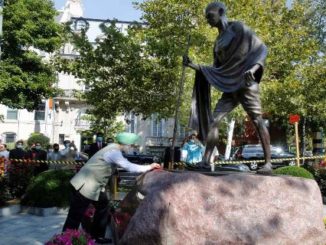
  • Unveiling of Mahatma Gandhi Bust at the Embassy of India by Hon’ble Vice President of Guatemala

    Unveiling of Mahatma Gandhi Bust at the Embassy of India by Hon’ble Vice President of Guatemala

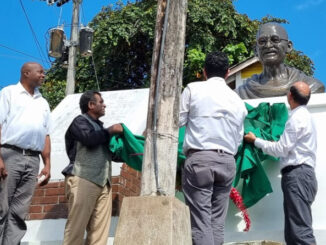
    GUATEMALA (TIP): In a landmark event symbolizing the enduring values of peace, non-violence, and India-Guatemala friendship, the Hon’ble Vice President of the Republic of Guatemala, Dr. Karin Herrera, and the Ambassador of India to Guatemala, H.E. Dr. Manoj Kumar Mohapatra, jointly unveiled a bust of Mahatma Gandhi at the Embassy premises today. The solemn and graceful ceremony was attended by around 200 distinguished guests, including Ambassadors and diplomats, senior government officials, dignitaries from various institutions, members of the Indian diaspora, and friends of India.

    The programme commenced with the national anthems of India and Guatemala, followed by the formal unveiling of the bust. Ambassador Dr. Mohapatra welcomed the guests and highlighted Mahatma Gandhi’s timeless relevance in today’s world, emphasizing that Gandhi’s ideals continue to resonate globally and inspire movements for justice, peace, and human dignity. In her remarks, Vice President Dr. Karin Herrera expressed admiration for Mahatma Gandhi’s life and legacy, underlining his influence on world leaders and his message of non-violence as particularly relevant to today’s interconnected yet divided world. The cultural segment of the programme featured soulful renditions of songs dedicated to Mahatma Gandhi and performances by local artists and members of the Indian community, creating a deeply reflective and festive atmosphere. The event concluded with light refreshments and interaction among attendees.

    Hon’ble Vice President H.E. Dr. Karin Herrera delivers her remarks during the unveiling ceremony, highlighting Mahatma Gandhi’s timeless legacy and the strong bonds between India and Guatemala.

    This bust is one of four recently received from the Indian Council for Cultural Relations, New Delhi, as part of India’s continued effort to promote the universal values embodied by Mahatma Gandhi. The other three busts were handed over to the Association of Don Bosco to be installed at their institutions across the Alta Verapaz region. With the addition of these four, Guatemala now hosts seven busts of Mahatma Gandhi in various prominent locations. The first Gandhi bust in Guatemala was installed in Tecpan. The second bust at the prestigious premises of the Ministry of Foreign Affairs was jointly unveiled by Hon’ble Minister of State for External Affairs, Smt. Meenakashi Lekhi, and the Guatemalan Foreign Minister in January 2023. The third was installed at the Municipality of Livingston and unveiled in December 2023 by Ambassador Dr. Mohapatra and Hon’ble Mayor Mr. Daniel Esaú Pinto Peña to mark the 50th anniversary of the establishment of diplomatic relations between India and Guatemala.  One the three busts handed over to Association of Don Bosco was unveiled on 23 June 2025 in Raxruha. Other two will be unveiled shortly.

    Ambassador Dr. Manoj Kumar Mohapatra addresses the gathering, emphasizing Mahatma Gandhi’s enduring relevance and the shared values of peace and non-violence that strengthen India-Guatemala relations. 

    The unveiling of this seventh Gandhi bust at the chancery premises today holds special significance. Positioned at the heart of India’s diplomatic presence in Guatemala, this installation stands as a permanent reminder of India’s moral and spiritual contribution to the world and serves as a source of inspiration for all visitors. Globally, busts and statues of Mahatma Gandhi have been placed in over 100 countries, including in front of parliaments, universities, and city squares. Each of these installations reinforces India’s commitment to the values of peace, non-violence, dialogue, and democratic coexistence. The presence of Gandhi’s likeness at the Indian Embassy in Guatemala is not only a tribute to the Mahatma’s philosophy but also a symbol of the deepening bilateral partnership between India and Guatemala.

    The event concluded with renewed commitment from both nations to uphold Gandhian values in international cooperation, people-to-people ties, and efforts to build a more peaceful and sustainable world.

  • Mahatma Gandhi’s Bust unveiled in Livingstone, Guatemala: A Symbol of Peace and Inspiration

    Mahatma Gandhi’s Bust unveiled in Livingstone, Guatemala: A Symbol of Peace and Inspiration

    GUATEMALA CITY (TIP): In a poignant ceremony on December 6, 2023, Ambassador Dr. Manoj Kumar Mohapatra, in collaboration with Mayor Daniel Esaú Pinto Peña of Livingstone, unveiled the bust of Mahatma Gandhi in Livingstone. The ceremony was attended by members of the Indian diaspora, local dignitaries, and residents of Livingstone, creating an atmosphere of unity and shared heritage. As the bust stands as a beacon of inspiration, it is expected to become a focal point for fostering dialogue and understanding between the diverse communities residing in Livingstone.

    Mahatma Gandhi, the towering figure of India’s independence movement, is revered globally for his philosophy of non-violence and his role in inspiring movements for civil rights and freedom across the world. The decision to install the busts in different cities of Guatemala reflects the universal appeal of Gandhi’s principles and their relevance beyond geographical boundaries.
    Livingstone, home to approximately 150 families of Indian origin, holds a unique cultural connection with India. The presence of a bust of Mahatma Gandhi in this city not only symbolizes the shared values of peace and non-violence but also pays tribute to the Indian diaspora’s contributions to the local community.

    Ambassador Dr. Manoj Kumar Mohapatra spoke about the profound impact of Gandhi’s teachings on the global stage.

    The unveiling ceremony was marked by a spirit of friendship and cultural exchange, with Ambassador Dr. Manoj Kumar Mohapatra expressing the profound impact of Gandhi’s teachings on the global stage. Mayor Daniel Esaú Pinto Peña echoed these sentiments, recognizing the significance of Gandhi’s legacy in promoting harmony and unity.

    Members of Indian community , local Guatemalans and friends of India attended the event in large numbers.

    This unveiling follows the installation of the first Mahatma Gandhi bust earlier in the year at the Ministry of Foreign Affairs office in Guatemala City which was unveiled by Hon’ble Minister of State H.E. Ms. Meenakashi Lekhi and Hon’ble Foreign Minister of Guatemala H.E. Mr. Mario Búcaro. The unveiling of these two busts in Guatemala is a celebration of the enduring values of peace, harmony, and justice. It is a testament to the strong cultural ties between India and Guatemala, encapsulating the spirit of friendship and mutual respect that characterizes the diplomatic relations between the two nations.

  • Embassy of India in Guatemala Celebrates Gandhi Jayanti and UN International Day of Non-Violence on 2nd October 2023

    Ambassador Dr. Manoj Kumar Mohapatra delivered a keynote address highlighting the enduring legacy of Mahatma Gandhi

    GUATEMALA CITY (TIP): The Embassy of India in Guatemala marked the occasion of Gandhi Jayanti, and the United Nations International Day of Non-Violence on 2nd October 2023. The event was held at the Embassy premises in Guatemala City, where Ambassador Dr. Manoj Kumar Mohapatra, members of the Indian community, and embassy officials came together to pay tribute to the Father of the Nation, Mahatma Gandhi.

    Gandhi Jayanti, celebrated annually on October 2nd, marks the birth anniversary of Mahatma Gandhi, a global symbol of peace and non-violence. The day is also observed as the UN International Day of Non-Violence, reaffirming the universal relevance of Gandhi’s principles of truth, tolerance, and non-violence in promoting a culture of peace and understanding. Mahatma Gandhi, referred as the “Father of the Nation” in India, played a pivotal role in India’s struggle for independence from British colonial rule. His life was a testament to his unwavering commitment to truth, non-violence, and social justice. Gandhi’s philosophy of non-violence, known as “Satyagraha,” inspired millions and became a powerful tool for social and political change.

    Ambassador Dr. Manoj Kumar Mohapatra delivered a keynote address highlighting the enduring legacy of Mahatma Gandhi and India’s contributions to the world in politics, trade, and tourism. He emphasized the relevance of Gandhi’s teachings in today’s world, emphasizing the importance of non-violence, tolerance, and harmony in resolving global conflicts. Mr. Harshu Patel, a prominent member of the Indian community, delivered a heartfelt speech underscoring the profound impact of Gandhi’s philosophy of non-violence. He stressed that Gandhi’s teachings continue to inspire people around the world to work towards a more peaceful and just society.

    Floral tribute led by Ambassador Dr. Mohapatra, members of the Indian community, and embassy officials at the statue of Mahatma Gandhi

    The event included a floral tribute led by Ambassador Dr. Mohapatra, members of the Indian community, and embassy officials at the statue of Mahatma Gandhi. This gesture symbolized the reverence and respect held for Gandhi’s ideals of peace and non-violence. A cultural program was organized as part of the celebration, featuring captivating performances by Mr. Javier Anand who played ‘Vaishnav Jan to Tene kahiye’, a mesmerizing favorite Bhajan of Mahatma Gandhi.

    Mr. Javier Anand played Vaishnav Jan to tene kahiye….., Bapu’s favorite song, to pay tribute to Mahatma Gandhi on his 154th birth anniversary.

    Ambassador Dr. Mohapatra expressed his gratitude to the Indian community in Guatemala for their active participation and support in commemorating this significant day. He highlighted the role of Mahatma Gandhi as a guiding light not only for India but for humanity as a whole.

    Dr. Shobhana Radhakrishna, a globally recognized speaker on Mahatma Gandhi’s principles, delivered a virtual lecture titled Mahatma Gandhi’s Transformational Leadership – An Inspiration for World Peace.

    In commemoration of Mahatma Gandhi’s Birth Anniversary, the Embassy conducted a series of seminars in collaboration with San Carlos University, the largest university in Central America. Dr. Shobhana Radhakrishna, a globally recognized speaker on Mahatma Gandhi’s principles, delivered a virtual lecture titled “Mahatma Gandhi’s Transformational Leadership – An Inspiration for World Peace.” This enlightening seminar drew extensive virtual participation, including students, faculty members, prominent figures from Guatemala, and members of the Indian community. It served as a platform to reflect on the enduring significance of Gandhi’s teachings in fostering global peace and non-violence.

    Mr. Harshu Patel, a prominent member of the Indian community, delivered a heartfelt speech underscoring the profound impact of Gandhi’s philosophy of non-violence.

    The celebration of Gandhi Jayanti and the UN International Day of Non-Violence is a testament to the enduring impact of Mahatma Gandhi’s teachings, which continue to resonate with people worldwide. As the world faces numerous challenges, the principles of non-violence, truth, and tolerance championed by Gandhi serve as a source of inspiration and a path toward a more peaceful and harmonious world.

  • Modi unveils bust of Mahatma Gandhi in Hiroshima

    Modi unveils bust of Mahatma Gandhi in Hiroshima

    Prime Minister Narendra Modi, who is in Japan at the invitation of Fumio Kishida to attend the G7 Summit, unveiled a bust of Mahatma Gandhi in Hiroshima on Saturday, May 20.
    After the bust was unveiled, PM Modi paid floral tributes to Mahatma Gandhi.
    Speaking to reporters in Hiroshima, after unveiling the bust of Mahatma Gandhi, PM Modi said that even today the world gets frightened when they listen to the word ‘Hiroshima’.
    He said, “I got the opportunity to unveil a bust of Mahatma Gandhi during my visit to Japan for the G7 Summit. The bust of Mahatma Gandhi in Hiroshima will take forward the idea of non-violence.”
    “It is a great moment for me to know that the Bodhi tree that I gifted to the Japanese PM has been planted here in Hiroshima so that people can understand the importance of peace when they come here. I pay my respect to Mahatma Gandhi,” PM Modi added.
    The G7 leaders are currently in Japan to attend the G7 Summit scheduled to be held in Hiroshima from May 19-21. Notably, Japan assumed the G7 Presidency in 2023.
    The Summit is an international forum held annually for the leaders of the G7 member states of France, the United States, the United Kingdom, Germany, Japan, Italy, and Canada (in order of rotating presidency), and the European Union (EU).
    Members of the Indian diaspora in Japan gathered at a hotel in Hiroshima as PM Modi arrived in the city on Friday, May 19.

  • Amid UN debate on Ukraine conflict, India to host event on Gandhian thought and philosophy

    Amid UN debate on Ukraine conflict, India to host event on Gandhian thought and philosophy

    NEW YORK (TIP): India will host an event on Gandhian thought and philosophy at the UN headquarters in New York to discuss how the fundamental values of pluralism, democracy and rule of law can be strengthened to build peaceful and inclusive societies.
    Thursday’s event comes as the UN Security Council is scheduled to hold a discussion on Ukraine on Friday, February 24.
    To be organized jointly by the Permanent Mission of India to the United Nations and the University for Peace at the Economic and Social Council Chamber, the event is expected to be attended by diplomats from across the world.
    Announcing the event in a tweet, India’s Permanent Mission to the United Nations said, “Join us tomorrow at UN for a thought-provoking initiative on the centrality of Mission Life & sustainable development to Gandhian thought as part of the India Roundtable series.”
    It also shared a quote by Gandhi: “In a gentle way, you can shake the world.” According to the UN’s website, the meeting will discuss examples of how sustainable lifestyles can be promoted to combat the adverse effects of climate and environmental degradation and how the fundamental values of pluralism, democracy and rule of law can be strengthened to build peaceful and inclusive societies. The objective of this meeting is to shine a light on Mahatma Gandhi’s doctrine of ‘Trusteeship’ and its relevance in today’s world with a focus on the concept of ‘Human Flourishing’ to promote sustainable lifestyles and enduring peace.
    The announcement comes as the UN General Assembly held an Emergency Special Session on Ukraine.
    UN Secretary-General Antonio Guterres said the one-year mark of the Russian Federation’s invasion of Ukraine stands as a grim milestone for the people of Ukraine and for the international community. “The invasion is a violation of the United Nations Charter and international law and is having dramatic humanitarian and human rights consequences,” he said.
    “The position of the United Nations is unequivocal: We are committed to the sovereignty, independence, unity and territorial integrity of Ukraine, within its internationally recognized borders,” Guterres said.
    Csaba Korosi, President of the General Assembly, said Wednesday marked the grim first anniversary of the war in Ukraine, highlighting the despair, displacement, destruction and death that Europe has not seen in decades.
    “No one can be complacent,” Korosi said. He also assured all those suffering from the war’s consequences that they have not been forgotten. “This war will come to an end, and the time of reconstruction, reconciliation and transformation will come,” Korosi said. “We know it will not be easy. We know the scars are deep. Culture, family bonds, sports, arts and the acknowledgement of the shared destiny of humanity will certainly help nations currently facing each other in the trenches.”
    Ukrainian Foreign Minister Dmytro Kuleba introduced a draft resolution calling for just and lasting peace in his country. Calling this “a decisive moment to show support, unity and solidarity,” he recalled, standing in the assembly urging its member nations to prevent war days before Russia’s February 24, 2022 invasion.
    Ukraine exercised its legitimate right to self-defense, enshrined in the Charter as its people chose to fight for their lives. “Against all odds, we were able to stop the much stronger aggressor and kick him out of half of the newly occupied territory,” he said, adding, “No one should be fooled by Russia’s empty calls for negotiations.” In his remarks, Vassily A Nebenzia of Russia alleged that Ukraine is nothing more than a pawn. “While Moscow is ready for a diplomatic solution, its opponents have not recovered from the futile illusion that they could defeat a nuclear power,” he said.
    US Ambassador to the UN Linda Thomas-Greenfield said that President Vladimir Putin had chosen war in an assault on the United Nations that struck at the heart of its Charter. “On the one-year anniversary of this conflict, we will see where the nations of the world stand on peace in Ukraine,” she said.

    (Source: PTI)

  • Multifaith prayers offered at Mahatma Gandhi’s Punya Tithi

    The welcome note was given by Arvind Vora who was instrumental in getting the Gandhi statue installed in the foyer of the HL Dennison building, the seat of Suffolk County.
    The author led a short meditation at multifaith prayers offered at Mahatma Gandhi’s Punya Tithi.

    Parveen Chopra

    LONG ISLAND, NY (TIP): Is there God? What about the afterlife? There is no conclusive answer or consensus on such questions. So, it is best to change the subject. As we do in ALotusInTheMud.com that I founded recently. In this web magazine, we try to curate content that people can use in their lives to be happier, healthier, productive and peaceful. So too when I was invited by Shanti Fund to do a presentation on my wellness + spirituality webzine at their Gandhi Punya Tithi prayers event on January 30, I skipped the speech and did something else altogether.

    The venue of the event co-hosted by Long Island Multi Faith Forum (LIMFF) was the foyer of H L Dennison building, seat of the Suffolk County, where a life size statue of Mahatma Gandhi welcomes you. The 150 strong gathering was multi-religious. Multifaith prayers followed one after the other, Christian, Hindu, Jain, Buddhist, Jewish, Muslim, Sikh, even Zoroastrian, Brahma Kumaris, and Bahai’s as well as by an eclectic group called Gathering of Light. Towards the end of the program when I was given the mike, I gave people the shortest meditation instruction possible: Close your eyes. Choose a short monosyllabic mantra, or name of your favorite deity or any name of God in your religion. Start repeating that word or mantra softly, mentally only. Continue till the mantra goes away and thoughts arise. When you become aware that you’ve lost your mantra, return to it gently. Don’t fight with thoughts or try to drive them away. It was a brief meditation session, 5-6 minutes only. But suddenly there was pin drop silence, suffused with spirituality. It was nice, some people told me at the vegetarian dinner that followed.

    A highlight of the program was Chui Chai Dance, from the Thai dramatic and dance repertoire.

    In his welcome note at the event, Arvind Vora, Chairman of LIMFF, mentioned that besides the Punya Tithi another annual event held in memory of Gandhi Ji at this location is the Mahatma’s birthday on October 2. Bakul Matalia of Shanti Fund conducted the program which began with the Mahatma’s favorite bhajan, ‘Vaishnav Jan to Tene Kahiye’ (Real devotees of God are those who feel the pain of others, who help those who are in misery but never let ego or conceit enter their mind), by Volunteers of Gayatri Pariwar. Organizers aimed for youth participation to get them exposed to the diversity of different faiths. Indeed, three presentations were made by youths – a Bahai group, Gayatri Gyan Kendra Youth and Look N Learn Jain Gyan Dhama.

    What I enjoyed the most was singing, and drum beat during the Jewish presentation by Cantor Lisa Ann Wharton and Akiva the Believer. They had the audience sing along and clap rhythmically. A highlight of the program was Chui Chai Dance, from the Thai dramatic and dance repertoire. It followed the Buddhist Presentation of Metta Sutta by two Thai monks. While rooted in your own cultural or religious tradition and yet be able to admire, interact with and learn about others’ traditions is what interfaith is – much needed in the multicultural polity and world we are living in.

    (small logo of Alotusinthemud.com. Parveen Chopra is the founder of ALotusInTheMud.com, a wellness and spirituality web magazine launched recently. He can be contacted at editor@alotusinthemud.com, Ph 5167100508.)

  • A betrayal of the very idea of the Mahatma

    A betrayal of the very idea of the Mahatma

    The principles Gandhiji stood for represent an ideal that is being weakened every day by those in power who are pushing their agenda of bigotry

    “The contradiction is mirrored in the attitude of the Hindutva-inspired Bharatiya Janata Party (BJP) government of Prime Minister Narendra Modi. Mr. Modi was schooled, like other Rashtriya Swayamsevak Sangh (RSS) pracharaks, in an intense dislike of Mahatma Gandhi, whose message of tolerance and pluralism was emphatically rejected as minority appeasement by the Sangh Parivar, and whose credo of non-violence, or ahimsa, was seen as an admission of weakness unworthy of manly Hindus. Hindutva ideologue V.D. Savarkar, whom Mr. Modi has described as one of his heroes, had expressed contempt for Gandhiji’s ‘perverse doctrine of non-violence and truth’ and claimed it ‘was bound to destroy the power of the country’. But Prime Minister Modi, for all his Hindutva mindset, his admiration of Savarkar and his lifetime affiliation to the Sangh Parivar, has embraced Gandhiji, hailing the Mahatma and even using his glasses as a symbol of the Swachh Bharat campaign, linking it to a call to revive Gandhiji’s idea of seva through the recent ‘Swachhata Hi Seva’ campaign.”

    By Shashi Tharoor

    This year marks the 75th anniversary of Mahatma Gandhi’s assassination (January 30, 1948) by a Hindu fanatic who thought the Mahatma was too soft on Muslims. The momentous anniversary comes at a time when his legacy, the very idea of Gandhi, stands challenged by the prevailing ideological currents. At a time when the standing of his historic detractors, whose descendants now form the ruling dispensation in the country, is at an all-time high, Gandhiji has been criticized for weakness, for having bent over too far to accommodate Muslim interests, and for his pacifism, which is seen by the jingoistic Hindutva movement as unmanly.

    The Mahatma was killed, with the name of Rama on his lips, for being too pro-Muslim; indeed, he had just come out of a fast he had conducted to coerce his own followers, the Ministers of the new Indian government, to transfer a larger share than they had intended of the assets of undivided India to the new state of Pakistan. Gandhiji had also announced his intention to spurn the country he had failed to keep united and to spend the rest of his years in Pakistan, a prospect that had made the government of Pakistan collectively choke.

    But that was the enigma of Gandhiji in a nutshell: idealistic, quirky, quixotic, and determined, a man who answered to the beat of no other drummer, but got everyone else to march to his tune. Someone once called him a cross between a saint and a Tammany Hall politician; like the best crossbreeds, he managed to distil all the qualities of both and yet transcend their contradictions.

    Explaining a contradiction now

    Hinduism and Hindutva, as I have argued in my book Why I Am a Hindu, represent two very distinct and contrasting ideas, with vitally different implications for nationalism and the role of the Hindu faith. The principles Gandhiji stood for and the way in which he asserted them are easier to admire than to follow. But they represented an ideal that is betrayed every day by those who distort Hinduism to promote a narrow, exclusionary bigotry.

    The contradiction is mirrored in the attitude of the Hindutva-inspired Bharatiya Janata Party (BJP) government of Prime Minister Narendra Modi. Mr. Modi was schooled, like other Rashtriya Swayamsevak Sangh (RSS) pracharaks, in an intense dislike of Mahatma Gandhi, whose message of tolerance and pluralism was emphatically rejected as minority appeasement by the Sangh Parivar, and whose credo of non-violence, or ahimsa, was seen as an admission of weakness unworthy of manly Hindus. Hindutva ideologue V.D. Savarkar, whom Mr. Modi has described as one of his heroes, had expressed contempt for Gandhiji’s ‘perverse doctrine of non-violence and truth’ and claimed it ‘was bound to destroy the power of the country’. But Prime Minister Modi, for all his Hindutva mindset, his admiration of Savarkar and his lifetime affiliation to the Sangh Parivar, has embraced Gandhiji, hailing the Mahatma and even using his glasses as a symbol of the Swachh Bharat campaign, linking it to a call to revive Gandhiji’s idea of seva through the recent ‘Swachhata Hi Seva’ campaign.

    This may, or may not, represent a sincere conversion to Gandhism. The Prime Minister is hardly unaware of the tremendous worldwide reputation that Mahatma Gandhi enjoys, and is too savvy a marketing genius not to recognize the soft-power opportunity evoking Gandhiji provides, not to mention the global public relations disaster that would ensue if he were to denounce an Indian so universally admired. There may, therefore, be an element of insincerity to his newfound love for the Mahatma, as well as a shrewd domestic political calculation.

    But the ambivalence speaks volumes: when many members of Mr. Modi’s BJP call for replacing Gandhiji’s statues across the country with those of his assassin, Nathuram Godse, the Prime Minister seeks to lay claim to the mantle of his fellow Gujarati for his own political benefit. At the same time, there is also a tangible dissonance between the official governmental embrace of Gandhiji and the unofficial ideological distaste for this icon, that is privately promoted by members and supporters of the present ruling dispensation, some of whose members have not hidden their view that his assassination was, in their eyes, a patriotic act.

    The vision of the Mahatma

    It is a well understood reality that the vision of Gandhiji, an openly practicing Hindu, differed greatly from that of Veer Savarkar and M.S. Golwalkar, the principal ideologues of the Hindu Mahasabha and its more militarized alter ego in the post-Independence era, the R SS and eventually, the BJP (formerly the Jana Sangh).

    Gandhiji embodied the central approach of Advait Vedanta, which preached an inclusive universal religion. Gandhiji saw Hinduism as a faith that respected and embraced all other faiths. He was profoundly influenced by the principles of ahimsa and satya and gave both a profound meaning when he applied them to the nationalist cause. He was a synthesizer of cultural belief systems: his signature bhajan of ‘Raghupati Raghava Raja Ram’ had another line, ‘Ishwara Allah Tero naam’. This practice emerged from his Vedantic belief in the oneness of all human beings, who share the same atman and, therefore, should be treated equally.

    Such behavior did not endear him to every Hindu. In his treatise on ‘Gandhi’s Hinduism and Savarkar’s Hindutva’, the social scientist Rudolf C. Heredia places his two protagonists within an ongoing debate between heterogeneity versus homogeneity in the Hindu faith, pointing out that while Gandhi’s response is inclusive and ethical, Savarkar politicizes Hinduism as a majoritarian creed.

    But Gandhiji’s own understanding of religion, in Heredia’s words, “transcended religiosity, Hindu as well as that of any other tradition. It is essentially a spiritual quest for moksha but one rooted in the reality of service to the last and least in the world”. Unlike Savarkar, who believed in conformity, Gandhiji was a synthesizer like no other who took care to include Indians of other faiths in his capacious and agglomerative understanding of religion. He took inspiration from not just Advaita Vedanta but also the Jain concept of ‘Anekantavada’ — the notion that truth and reality are perceived differently by different people from their own different points of view, and that, therefore, no single perception can constitute the complete truth. This led him to once declare that ‘I am a Hindu, a Muslim, a Christian, a Parsi, a Jew’.

    Hinduism and Hindutva, as I have argued in my book Why I Am a Hindu, represent two very distinct and contrasting ideas, with vitally different implications for nationalism and the role of the Hindu faith. The principles Gandhiji stood for and the way in which he asserted them are easier to admire than to follow. But they represented an ideal that is betrayed every day by those who distort Hinduism to promote a narrow, exclusionary bigotry.

    (The author is a  former senior UN official and a senior Congress leader)

  • Ambassador Taranjit Sandhu pays rich tributes to Mahatma Gandhi on his 153rd birth anniversary

    Ambassador Taranjit Sandhu pays rich tributes to Mahatma Gandhi on his 153rd birth anniversary

    Ambassador Sandhu with Indian -American community members who came to celebrate Gandhi Jayanti (Photo / courtesy Tirlok Malik)

    NEW YORK CITY (TIP): 153rd birth anniversary of Mahatma Gandhi was celebrated in New York City on October 2, 2022.

    India’s Ambassador to the U.S. Taranjit Sandhu paid floral tribute to Mahatma Gandhi at his statue in Union Square, and later addressed the gathering. He described Gandhi as a man who influenced world leaders and inspired many to embrace his path of non-violence to achieve freedom and liberty in nations across the world. He said the world, more than ever, now needs his gospel of truth and non-violence. Gandhi ji’s favorite bhajans were sung on the occasion. Those present included Consul General of India in New York Randhir Jaiswal, the Consulate staff, Gandhians and community leaders.

  • Mahatma Gandhi – the unarmed warrior

    Mahatma Gandhi – the unarmed warrior

    Mohandas Karamchand Gandhi, popularly known as Mahatma Gandhi,  was born on October 2, 1869, at Porbandar in Gujarat. He was an Indian lawyer, politician, social activist, and writer who led the independence movement against British rule. And during this process, people started to call him the father of the nation (Bapu). Mahatma Gandhi died on January 30, 1948.

    Regarded as the Father of Nation, Gandhi was a social reformist and leader of Indian Independence Movement who introduced the idea of non-violent resistance called Satyagrah. After organising a civil disobedience movement for Indians living in South Africa, he returned to India in 1915. In India, he set out on a train journey to different parts of the country trying to understand problems of farmers, peasants and urban labourers and organising protests for them.

    He assumbed the leadership of Indian National Congress in 1921 and rose to become its most prominent leader and an iconic figure in Indian politics. He organised the Dandi Salt March in 1930 and Quit India Movement in 1942.

    He also worked for the upliftment of untouchables and have them a new name ‘Harijan’ meaning the children of God. Gandhi also wrote extensively for various newspapers and his symbol of self-reliance – the spinning wheel – became a popular symbol of Indian Independence Movement. Gandhi played a key role in pacifying people and averting the Hindu-Muslim riots as tensions rose before and during the partition of the country. He was shot dead by Nathuram Godse on January 31, 1948.

    Gandhi was a warrior leader, with a vision of free India, who conceived a shrewd strategy of using peace and non-violence, as the chief weapons, to achieve the objective of liberating India from the clutches of the most powerful colonial power of the time. Training his weapons of non-violence and non-cooperation at the enemy’s mind, with a view to disinfecting it from its unjust rule, he declared that he loved the English people but abhorred their despicable way of governance.

    He could throw the British into the shade in argument, in tactics and, the most important of all, to make them feel embarrassed in the cherished field of morality. He galvanized the Indian public to rally behind him to fight the war of freedom, with the superior non-war weapons of peace, thus rousing the enemy’s conscience and the world opinion in favor of the Indian cause, which ultimately forced the enemy to quit the battlefield. According to a historian, “Gandhi’s mystique consisted of a union of original ideas, with remarkable knack for tactics and the uncanny insight into the mass mind.”

    Gandhi had indeed read the pulse of his age right, had the vision of selecting the best suited plan of action and was able to realize the dream of his people. True to the Hindu principle of avatar (Incarnation), “When religion declines and the evil doers are to be destroyed, I shall be born, from time to time,” (Gita), Gandhi came as the divinely inspired leader to inject a spark of nationalism, and the will to fight against foreign oppression and social evils, that had infected the society. His army came from all sections of the society – the majority came from its lower strata. In his personal code of conduct of high ethics, and the burning passion for universal well-being, he was an incarnation of Rama, which gave him ready acceptability as a leader. His belief in human rights often led him into collision, not only with the British and South Africa but also with the attitude of several Hindus towards the untouchables.

    Gandhi advocated and effectively employed the superior weapons of resistance with peace and ‘non-cooperation’ against the enemy’s unrighteous ways. Hard to believe that Gandhi’s school of resistance could generate such a moral strength in his teeming unarmed soldiery, who fell with their cracked skulls, but got up and surged forward repeatedly, with wounded bodies, fighting the white terror, “Kill us, but we shall not quit.” That he could inspire and elevate his followers to such a degree of physical, mental and spiritual strength will remain a wonder of human race for times to come.

    The turning point came on April 13, 1919, when Brigadier General Dyer (British) ordered firing on a peaceful rally in which 1,650 rounds were fired, killing 1,516 peaceful protestors at Jallianwala Bagh (Amritsar). Gandhi said, “I love the British people but henceforth, I am the deadliest enemy of the wrong form of government that the British may impose upon India.” It is erroneous to call Gandhi’s strategy of non-violence as passive or inactive. Gandhi was a strong-willed realist, who adopted a strategy of proactive non-violence against the British, because he had no wherewithal to fight the colonial power.

    As a national leader, a number of commendable leadership traits were found in Gandhi, but two innate soldierly attributes for which he stands apart, were: One, his strength of courage lay both in the physical and moral planes. Two, forever he led from the front. In Gandhi, Indians saw a ray of hope to alleviate them from the age-old political and social suffering. The intrinsic nobility of his cause, the grand vision of a free India and the will to sacrifice all for the fulfillment of this dream, despite myriad problems, raised him to the stature of a prophet, and a successful one. It was the grandeur of Gandhi’s dream, which galvanized Indians. For centuries, no one had talked of a liberated and united India. The fantasy of freedom caught every Indian’s aspiration and dream, for which one was prepared to pay any price. After all, he was talking of the Indian nation, which had almost relapsed from the Indian mind. As the momentum of the Independence Movement gained strength, his dream seemed to be a winning vision, which drew to his following columns even the fence sitters. Soon the common person started perceiving the nation’s vision as tall as the Himalayas and as deep as the ocean. Where the centuries-old resistance and revolts had failed, the crown of ultimate victory to win freedom was to adorn Gandhi’s head. What truly characterizes this saint leader is the leadership trait firmly rooted in spirituality. Spirituality entails belief in universal goodwill and sensibility to a common thread running through the entire humankind. It was Gandhi’s Himalayan determination and Ganga-like purity of purpose, which shook the British Empire. Natural faith in the Hindu Dharma had inspired in him the spirit of fighting for the righteous cause, and that tolerating injustice was as much a sin as inflicting it. In his fight for the national cause, Gandhi transformed non-violence into his main weapon to resist injustice and violence. Gandhi had rightly symbolized India’s love for freedom and its inherent guts to fight to win, and indeed was one of the most amazing paradoxes of history. “Coming generations will scarce believe that such a man, in flesh and blood, lived upon this earth,” said Einstein about Gandhi.

  • Consulate General of India, Toronto, expresses hurt at desecration of Mahatma Gandhi statue

    Consulate General of India, Toronto, expresses hurt at desecration of Mahatma Gandhi statue

    TORONTO (TIP): The Consulate General of India, Toronto, has expressed hurt at the desecration of Mahatma Gandhi statue at Vishnu temple in Richmond Hill. In a tweet, it said, “We are distressed at the desecration of Mahatma Gandhi statue at Vishnu temple in Richmond Hill. This criminal, hateful act of vandalism has deeply hurt the sentiments of the Indian community in Canada. We are in contact with Canadian authorities to investigate this hate crime.”

  • US Congressman Bera welcomes launch of Gandhi-King Scholarly Exchange Initiative

    US Congressman Bera welcomes launch of Gandhi-King Scholarly Exchange Initiative

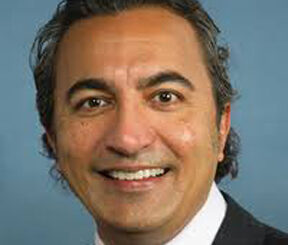
    WASHINGTON, D.C. (TIP): Indian-American Congressman Dr Ami Bera has welcomed the launch of the ‘Gandhi-King Scholarly Exchange Initiative’ by the State Department. The program, championed by the late Representative John Lewis, brings together young leaders from India and the United States to advance social justice and civil rights by exploring the life and legacies of Mahatma Gandhi and Dr. Martin Luther King Jr.

    “As the longest serving Indian-American member of the United States Congress, I am very excited that the US State Department has officially launched the Gandhi-King Scholarly Exchange Initiative, which was championed by the late great Congressman John Lewis,” Bera said on Friday. Bera is the longest serving Indian-American Congressman in the US House of Representatives. “Like Lewis, Gandhi and Dr. King were towering figures who committed their lives to the advancement of civil rights and social justice. By exploring the legacies of Gandhi and Dr. King, this exchange program will empower young leaders in India and the United States to advance these values forward to future generations. The Gandhi-King Scholarly Exchange Initiative will also further strengthen the bonds between the people of India and the United States,” he said. Bera, who serves as Chairman of the US House Foreign Affairs Subcommittee on Asia, the Pacific, Central Asia, and Nonproliferation, has long advocated for the exchange program, including co-sponsoring and voting for the Gandhi-King Scholarly Exchange Initiative Act introduced by the late Congressman John Lewis.

    (Source: PTI)

  • Green Triangle’ named after Mahatma Gandhi inaugurated in Madagascar’s capital Antananarivo

    Green Triangle’ named after Mahatma Gandhi inaugurated in Madagascar’s capital Antananarivo

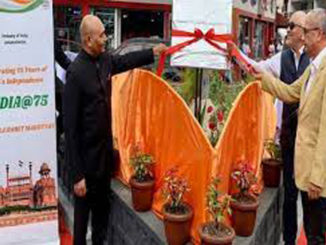
    ANTANANARIVO,MADAGASCAR (TIP): As part of the ‘Azadi ka Amrit Mahotsav’ to commemorate India’s 75th year of independence, a “Green Triangle” named after Mahatma Gandhi was inaugurated in Madagascar’s capital Antananarivo by Mayor of Antananarivo Naina Andriantsitohaina and India’s Ambassador to Madagascar Abhay Kumar on Wednesday, March16 at a special ceremony here. The ceremony was attended by members of local government, diplomatic corps, heads of international organizations and members of the Indian diaspora, to mark ‘Azadi ka Amrit Mahotsav’ celebrations. Speaking on the occasion, Andriantsitohaina voiced appreciation for efforts by the Embassy in greening the area, saying it meets the objective of the Urban Municipality of Antananarivo to create the maximum green space in the capital city of Madagascar, according to a press release by the Embassy. Kumar said Gandhi was the “greatest Pravasi” who returned to India from South Africa, led India’s freedom struggle and changed the lives of Indians forever. He added that Madagascar has a large diaspora from the Indian state of Gujarat, and it is fitting that a green triangle named after Gandhi, who hailed from Porbandar in the state, is being unveiled in the capital of Madagascar. 

  • India in history this Week-March 4, 2022, to March 10, 2022

    04 MARCH

    1879          Bethune College of Calcutta was established in 1879.

    1906          Hakim Abdul Majeed started the Hamdard dispensary in Delhi in 1906.

    1924          In 1924, Shyam Lal Gupta composed the song Raising the Flag.

    1951          Eleven countries participated in the first Asian Games in Delhi in 1951.

    1961          In 1961 I.N.S. Vikrant was brought to Belfast.

    05 MARCH

    1931          Mahatma Gandhi ended the Civil Disobedience Movement.

    1905          Sushila Didi, a freedom fighter who was instrumental in the revolutionary activities of Bhagat Singh, was born in Punjab.

    2010          GP, one of the famous entrepreneurs of India. Birla died.

    1783          Establishment of Geological Survey of India.

    2009          Indian industrialist Vijay Mallya bought Bapu’s legacy for Rs 18 lakhs

    1949          The Jharkhand Party was founded in India in 1949.

    1990          The government announced an interim relief of Rs 360 crore for the five lakh victims of the 1984 Bhopal gas tragedy.

    2002          The Commonwealth Summit was held in 2002.

    2008          India successfully test-fired the BrahMos missile from the sea into the ground.

    2009          IFFCO (‘Indian Farmers Fertilizer Co-operative Limited) became the first company in the world to make annual sales of 10 million tonnes of fertilizer in 2009.

    06 MARCH

    1886          The first nurses’ nightingale is published.

    1915          Mahatma Gandhi and Tagore had their first meeting in Shantiniketan in 1915.

    1947          The Economic Times started editing from Bombay.

    1962          The great revolutionary Ambika Chokrovarti died in 1962.

    1971          Sunil Gavaskar started his Test career in 1971.

    1990          India won the Indira Gandhi Gold Cup hockey tournament.

    1991          Chandrasekhar resigned as Prime Minister in 1991.

    2000          India and China first spoke in Beijing on the security issue.

    07 MARCH

    1956          A huge steel tube plant was opened in Jamshedpur on this day in 1956.

    1987          Sunil Gavaskar made history. Please tell that on this day, he scored 10,000 runs in a Test match.

    1994          India and Iraq signed three Memorandum of Understanding in Tehran.

    1998          Former Prime Minister Atal Bihari Vajpayee was given the leadership of BJP’s MP Party.

    1835          Proposal was made to promote the propagation of European literature and science in India.

    1985          The first antibody test for AIDS, the ELISA-type test, was started.

    2007          Pakistan and India prepared in 2007 to help investigate terrorism.

    1961          Renowned freedom fighter and senior leader Govind Ballabh Pant died in 1961.

    08 MARCH

    1909          International Women’s Day is started to celebrate.

    1948          Air India International was established.

    1535          Bahadur Shah found Fateh at Chittor Fort.

    1673          Chhatrapati Shivaji burst upon the fort of Panhala.

    1930          Mahatma Gandhi started the Civil Disobedience Movement.

    1986          BJP leader Advani was elected party president.

    1998          Indian Airlines flew with all women crew members.

    1833          The great journalist Vishwanath Narayan was born.

    09 MARCH

    1951          Famous tabla player Zakir Hussain is born.

    2007          Indian doctors in Britain get legal success on discriminatory migrant rules.

    1999          Indian-based, British-based industrialist Swaraj Paul was awarded an honorary doctorate by the University of Central Birmingham in 1999.

    10 MARCH

    1922          Mahatma Gandhi was arrested in 1922 on charges of treason.

    1969          The CISF Act was passed in Parliament.

    1985          India won the Bension and Hedges Cricket World Cup in 1985.

    2010          The Women’s Reservation Bill was passed in the Rajya Sabha, the upper house of the Indian Parliament.

    1932          Born in 1932 of Udupi Ramchandra Rao, a space scientist and former president of ISRO (Indian Space Research Organization).

    1945          Famous Congress leader Madhavrao Scindia was born on this day in 1945.

  • Martyrs Day: Remembering Mahatma Gandhi on his 74th death anniversary

    Martyrs Day: Remembering Mahatma Gandhi on his 74th death anniversary

    In India, five days are declared as Martyrs Day in honour of those who laid down their lives for the nation. Of these, the first falls on January 30, the day when Mahatma Gandhi was assassinated by Nathuram Godse in 1948.

    Mahatma Gandhi led the struggle for Independence that culminated in India getting freedom from British rule on August 15, 1947. Bapu, as he was lovingly called, played one of the most prominent roles in India’s freedom struggle through non-violence and peaceful methods.

    Mahatma Gandhi was shot in Birla House compound in New Delhi at the age of 78. He was killed by Nathuram Godse, who had opposed Gandhi’s views on the Partition of India.

    Mahatma Gandhi was born on 2 October, 1869 at Porbandar, Gujarat. Every year on 2 October, Gandhi Jayanti is observed. This year the day marks the 152nd birth anniversary.

    Mohandas Karamchand Gandhi or Mahatma Gandhi was a renowned freedom activist and an authoritative or powerful political leader who had played an important role in India’s struggle for Independence against the British rule of India. He was also considered as the father of the country. No doubt, he had also improved the lives of India’s poor people. His birthday is celebrated every year as Gandhi Jayanti. His ideology of truth and non-violence influenced many and was also adopted by Martin Luther and Nelson Mandela for their struggle movement.

    In South Africa for about 20 years, Mahatma Gandhi protested against injustices and racial discrimination using the non-violent method of protests. His simplistic lifestyle won him, admirers, both in India and the outside world. He was popularly known as Bapu (Father).

    Early Life and Family Background

    He was born on 2 October, 1869 in Porbandar, Gujarat. His father’s name was Karamchand Gandhi and his mother’s name was Putlibai. At the age of 13, Mahatma Gandhi was married to Kasturba which is an arranged marriage. They had four sons namely Harilal, Manilal, Ramdas and Devdas. She supported all the endeavors of her husband until her death in 1944.

    His father was Dewan or Chief Minister of Porbandar, the capital of a small principality in Western British India (Now Gujarat State). Mahatma Gandhi was the son of his father’s fourth wife Putlibai, who belonged to an affluent Vaishnava family. Let us tell you that in his earlier days, he was deeply influenced by the stories of Shravana and Harishchandra as they reflected the importance of truth.

    Mahatma Gandhi: Education

    When Gandhi was 9 years old he went to a local school at Rajkot and studied the basics of arithmetic, history, geography, and languages. At the age of 11, he went to a high school in Rajkot. Because of his wedding, at least about one year, his studies were disturbed and later he joined and completed his schooling. He joined Samaldas college in Bhavnagar in 1888 at Gujarat. Later, one of his family friend Mavji Dave Joshi to pursue further studies i.e. law in London. Gandhiji was not satisfied with the studies at Samaldas College and so he became excited by the London proposal and managed to convince his mother and wife that he will not touch non-veg, wine, or women.

    Off to London

    In the year 1888, Mahatma Gandhi left for London to study law. Thereafter 10 days of arrival, he joined the Inner Temple, one of the four London Law colleges, and studied and practiced law. In London, he also joined a Vegetarian Society and introduced to Bhagavad Gita by some of his vegetarian friends. Later, Bhagavad Gita set an impression and influenced his life.

    In South Africa

    In May, 1893 he went to South Africa to work as a lawyer. There he had the first-hand experience of racial discrimination when he was thrown out of the first-class apartment of the train despite holding the first-class ticket because it was reserved for white people only and no Indian or black was allowed to travel in the first class. This incident had a serious effect on him and he decided to protest against racial discrimination. He further observed that this type of incident was quite common against his fellow Indians who were derogatorily referred to as coolies.

    On 22 May, 1894 Gandhi established the Natal Indian Congress (NIC) and worked hard to improve the rights of Indians in South Africa. In a short period, Gandhi became a leader of the Indian community in South Africa. Tirukkural ancient Indian literature, originally written in Tamil and later translated into various languages. Gandhiji was also influenced by this ancient book. He was influenced by the idea of Satyagraha that is a devotion of truth and in 1906 implemented non-violent protest. He returned to India in 1915, after spending 21 years of his life in South Africa, and no doubt, there he fought for civil rights and at this time he was transformed into a new person.

    Role in Indian Independence Movement

    In 1915, Gandhiji returned to India permanently and joined the Indian National Congress with Gopal Krishna Gokhale as his mentor. Gandhi’s first major achievement was in 1918 when he led the Champaran and Kheda agitations of Bihar and Gujarat. He also led Non-Cooperation Movement, Civil Disobedience Movement, Swaraj, and Quit-India movement against the British government.

    Satyagraha

    Gandhi identified his overall method of non-violent action as Satyagraha. Gandhiji’s Satyagraha influenced eminent personalities such as Nelson Mandela and Martin Luther in their struggle for freedom, equality, and social justice. Mahatma Gandhi’s Satyagraha was based on true principles and non-violence.

  • Republic Day, January 26, 1950: An Epic Journey of India’s  greatest generation

    Republic Day, January 26, 1950: An Epic Journey of India’s greatest generation

    By George Abraham

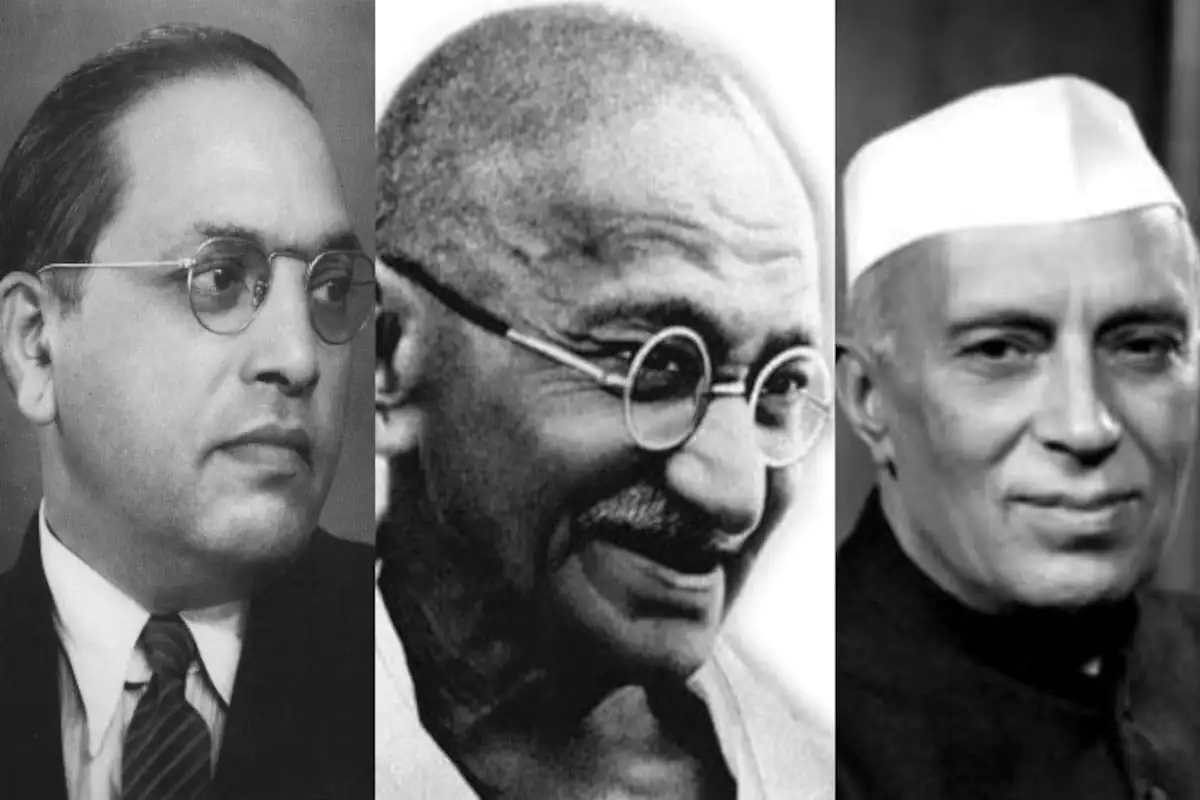
    “The India we witness today is what Ambedkar dreamed,  Nehru built, and Gandhiji paid the ultimate sacrifice for. It is an epic journey of brave men and women who went on to create an incredible constitution of such breathless ambition with great determination. The people who lived in those villages divided by caste, subcaste, and religion ruled by 600 or so primarily autocratic rulers were suddenly given a lease to build their own lives. As we celebrate this Republic Day, let us be mindful as well that the same noxious forces who were in control seventy-two years ago are back in the sheep’s clothing, readying for an opportunity to pounce again! Nevertheless, it will always remain a phenomenal day in history for rejuvenation and renewal.”

    As India celebrates its 73rd Republic Day with pomp, pride, and parades, it is also time to rethink whether the country is living up to its constitution. India became a constitutional republic on January 26, 1950, replacing the colonial government act of India of 1935. It was a memorable day for all Indians who transformed their lives from subjects to citizens and from oppression to liberty. Indeed, this changeover  instilled a sense of national pride in the heart of every Indian regardless of where he/she resides.

    India’s constitution lays down a broad framework structure, powers and procedures, and duties safeguarding its citizens’ fundamental rights and duties. On January 26, 1929, the Indian National Congress made the famous declaration of “Poorna Swaraj,” and the late Prime Minister Jawaharlal Nehru hoisted the tri-color flag on the banks of the Ravi river. Thus, when the constituent assembly approved the constitution draft by the committee chaired by B.R. Ambedkar, many felt it necessary to celebrate the document on that day associated with national honor, which was January 26. The constitution is very clear in its declaration “We the people of India, having solemnly resolved to constitute India into a Sovereign, Socialist, Secular, Democratic Republic and to secure to all its citizens: Justice, social, economic and political; Liberty of thought, expression, belief, faith and worship; Equality of status and opportunity; and to promote among them all Fraternity assuring the dignity of the individual and the unity and integrity of the nation”.

    What leaders like Mahatma Gandhi and Jawaharlal Nehru, with significant input from B. R. Ambedkar, have done to the populace of India was to introduce a new experience in freedom and democracy. The people of India were reeling from the oppressive rule under the British Raj and experiencing horrible discriminations from the feudalist/caste-driven policies of the powerful elites, who more often collaborated with the colonialists to control their own destiny.

    Today, Kerala is considered to be a progressive state, thanks largely to the Nehruvian vision and the reform-minded local leadership in the past sixty years. However, before that period, as narrated in ‘Kerala: an overview” by Titus George, laws were extremely cruel towards the lower castes in those provinces. Like the medieval Catholic Church clergy in Europe, the upper castes enjoyed all the benefits, including tax exemption. A system of slavery was practiced with impunity, at least in the form of bonded labor and there were designated places of the auction of slaves. The landowners had the power to put their slaves to death.

    The Brahmins enjoyed immunity from death penalty, and after all, they have made the laws and applied them differently to different castes. Lower castes were subjected to death penalty for theft and cow slaughter offenses. Capital punishment took the forms of being trampled to death by an elephant, being blown from the mouth of a cannon,  by hanging which lasted three days (Chitavadam), and by mutilation. Most tenants could not keep cows, wear fine clothes, live in a gilded house, use metal utensils, wear gold ornaments, or travel in trains or automobiles. Violators were often severely punished with fines.

    There was a marriage tax for the lower castes, probably preventing them from increasing and multiplying. The use of public roadways was forbidden to the outcastes, and anyone daring to pass within the polluting distance of a Brahmin, or a Nair would be cut down at once. Ezhavas had to keep 32 feet from Brahmins. Low castes could not wear shoes and carry umbrellas in public, even in heavy rains. The proper salutation from a woman to persons of rank was to uncover the bosom. The practice of untouchability was so widespread, even to the point that lower castes did not have the right to walk along the approach roads leading to temples. A hundred years ago, Swami Vivekananda was so appalled by Kerala’s rigid and cruel caste system that he called it a ‘lunatic asylum’. The British did not want to disturb the hierarchical caste system too fast and too radically, and the principle of ‘divide and rule’ always helped their cause. However, they gradually abolished blatant forms of slavery.

    Western education provided in missionary-run schools created a new sense of equality and awareness about injustices and caste discrimination among the lower castes and among the members of the higher castes. In addition, great reformers such as Chattampi Swamikal, the saintly Sri Narayana Guru and Ayyankali, and the freedom struggle led by Mahatma Gandhi provided additional impetus to fight and end caste discrimination and carve a path forward for societal reformation and progress.

    The story of Dr. Padmanabhan Palpu, which is available in the public domain, indicates the struggle even for a person who had the means for better education and a career. He was born in the Ezhava community and learned English from a Eurasian tutor at 12. Like his older brother, he seems to have used his family’s association with Christian missionaries to avoid the usual rule in the Kingdom that Ezhavas were forbidden from school attendance. He was subsequently refused admission to Travancore Medical College due to caste. However, he was able to attend a similar college in Tamil Nadu. Then he went on to further his medical training at London and Cambridge. However, back in India after obtaining a Licentiate in Medicine and surgery, he found that his caste status prevented him from securing employment in Travancore Health Service, which forced him to relocate to Mysore, where he became the Chief Medical officer.

    I am sure that some may be wondering about my reason in retracing some of these historical facts. Short memories often have a way of obscuring recent paths and not revealing how humanity has traveled and survived rough terrains of life. What I have elicited above is a microcosm of what India had been before 1950. Although Kerala has come a long way, the remnants of these age-old despicable practices are still alive and well in many States. Lately, there has been a  torrent of stories on the British legacy of exploitation and oppression, justifiably so, while obscuring or minimizing our own sins and shortcomings. Some authors may even succeed in convincing that if only the British hadn’t come, we would have been in a different orbit!

    The India we witness today is what Ambedkar dreamed,  Nehru built, and Gandhiji paid the ultimate sacrifice for. It is an epic journey of brave men and women who went on to create an incredible constitution of such breathless ambition with great determination. The people who lived in those villages divided by caste, subcaste, and religion ruled by 600 or so primarily autocratic rulers were suddenly given a lease to build their own lives. As we celebrate this Republic Day, let us be mindful as well that the same noxious forces who were in control seventy-two years ago are back in the sheep’s clothing, readying for an opportunity to pounce again! Nevertheless, it will always remain a phenomenal day in history for rejuvenation and renewal.

    (Author is a former Chief Technology Officer and the Vice-Chairman of the Indian Overseas Congress, USA. He can be reached at gta777@gmail.com)

    Preamble to the Constitution of India
  • India in history this Week- November 12 to November 18, 2021

    India in history this Week- November 12 to November 18, 2021

    12 NOVEMBER

    1936       The temples of Kerala are open to all Hindus.

    1946       Pandit Madan Mohan Malviya, founder of Banaras Hindu University and honored with Bharat Ratna, died in Uttar Pradesh.

    1927       Mahatma Gandhi made his first and last visit to Ceylon.

    2009       To promote tourism in India, the ‘Incredible India’ campaign of the Central Government was awarded the World Travel Award.

    13 NOVEMBER

    1780       Maharaja Ranjit Singh of Punjab was born in Gujranwala, Pakistan.

    2009       In Jharkhand, Naxalites have killed seven people including outgoing MLA Ramchandra Singh.

    1892       Storyteller, prose writer Rai Krishnadas was born.

    14 NOVEMBER

    1681       East India Company announced to become a separate princely state of Bengal.

    1889       India’s first Prime Minister Jawaharlal Nehru was born. Children’s Day is celebrated on the occasion of his birthday.

    2006       The Foreign Secretaries of India and Pakistan agreed to create an anti-terrorism mechanism in New Delhi.

    1955 Employees’ State Insurance Corporation (ESIC) was inaugurated.

    1958       Children’s Day was officially announced on the occasion of the birthday of the first Prime Minister Jawaharlal Nehru.

    2009       15 coaches of the Mandore Superfast Express derailed near the Banskho gate in Jaipur, killing 6 passengers.

    15 NOVEMBER

    1949       Mahatma Gandhi’s assassins Nathuram Godse and Narayan Apte were hanged on this day.

    1982       Acharya Vinayak Narhari Bhave alias Vinoba Bhave died on this day.

    1986       The country’s female tennis player Sania Mirza was born.

    1777       Confederation article adopted by Continental Congress.

    1830       Social reformer Raja Ram Mohan Roy left for England.

    1989       Former veteran Indian player Sachin Tendulkar made his Test debut against Pakistan. He played the last Test on 14 November 2013 against the West Indies.

    2000       Jharkhand became the 28th state of India.

    1875       India-born freedom fighter fighter Birsa Munda, a tribal leader, was born.

    16 NOVEMBER

    1846       Akbar Ilahbadi, the famous poet of Urdu, was born.

    1973       Batminton player Pullela Gopichand was born.

    1996       Mother Teresa received honorary US citizenship

    1995       Vasudev Pandey Trinidad and Tobago of Indian origin became the Prime Minister.

    1931       Indian cricket umpire R. Ramchandra Rao was born.

    2007       The severe cyclonic storm ‘Cedar’ from the Bay of Bengal caused severe devastation in the country of Bangladesh.

    1930       Mihir Sen, the famous long distance swimmer of India, was born.

    17 NOVEMBER

    1931       Among the freedom fighters and Punjabi writer Lala Lajpat Rai were martyred.

    2012       From the sketch of the cartoon, the founder of Shiv Sena Bal Thackeray, who made his strong identity in the field of politics, died.

    1525       For the purpose of conquering India, Babur entered here for the fifth time through Sindh.

    1966       Rita Faria of India won the title of Miss World. She was the first Asian woman to become Miss World.

    2009       T. S. Thakur was appointed as a judge of the Supreme Court.

    2006       The US Senate approved the Indo-US nuclear treaty.

    18 NOVEMBER

    1727       Maharaja Jai Singh II founded the city of Jaipur. The architect of the city was Vidyadhar Chakraborty of Bengal.

    1772       Peshwa Madhavrao I died and his younger brother Narayan Rao succeeded him.

    1901       The famous Indian film director V. Shantaram was born.

    1948       500 people drowned after the steamer ‘Narayani’ crashed near Patna, the capital of Bihar.

    1972       The tiger was chosen as the national animal.

    1993       The first meeting of the Asia-Pacific Economic Cooperation Summit took place in Seattle.

    2017       Manushi Chillar of India won the title of Miss World.

    1910       One of the famous revolutionaries of India, Batukeshwar Dutt was born

  • Mahatma Gandhi’s 152nd birth anniversary celebrated across the US

    Mahatma Gandhi’s 152nd birth anniversary celebrated across the US

    I.S. Saluja

    WASHINGTON, DC (TIP): The Indian Embassy in Washington organized an event on Saturday, October 2 at the Gandhi Memorial opposite the Embassy where India’s Ambassador to the US Taranjit Singh Sandhu paid his respects to the Father of the Indian Nation. The event was restricted to the embassy staff and a few guests in view of the Covid / Delta surge. No speeches were made. Mahatma Gandhi taught Indians the values of truth and non-violence during the freedom movement. His ideals also made it possible for other countries in Asia and Africa, where Mahatma Gandhi spent a big part of his life, to free themselves from colonial rule without bloodshed.

    His gospel of truth and non-violence came to be accepted all over the world. The American hero Martin Luther King Jr. and the South African icon Nelson Mandela were deeply influenced by his nonviolent struggle for freedom, and not only said so but practiced when it came to struggling for their rights.

    Called Gandhi Jayanti, Mahatma Gandhi’s birthday was celebrated across the world.

  • Mahatma Gandhi: The leader of India’s non-violent independence movement

    Mahatma Gandhi: The leader of India’s non-violent independence movement

    Mahatma Gandhi was the primary leader of India’s independence movement and also the architect of a form of non-violent civil disobedience that would influence the world. Until Gandhi was assassinated in 1948, his life and teachings inspired activists including Martin Luther King Jr. and Nelson Mandela.

    Mahatma Gandhi was the leader of India’s non-violent independence movement against British rule and in South Africa who advocated for the civil rights of Indians. Born in Porbandar, India, Gandhi studied law and organized boycotts against British institutions in peaceful forms of civil disobedience. He was killed by a fanatic in 1948.
    Early Life and Education
    Indian nationalist leader Gandhi (born Mohandas Karamchand Gandhi) was born on October 2, 1869, in Porbandar, Kathiawar, India, which was then part of the British Empire.
    Gandhi’s father, Karamchand Gandhi, served as a chief minister in Porbandar and other states in western India. His mother, Putlibai, was a deeply religious woman who fasted regularly.
    Young Gandhi was a shy, unremarkable student who was so timid that he slept with the lights on even as a teenager. In the ensuing years, the teenager rebelled by smoking, eating meat and stealing change from household servants.
    Although Gandhi was interested in becoming a doctor, his father hoped he would also become a government minister and steered him to enter the legal profession. In 1888, 18-year-old Gandhi sailed for London, England, to study law. The young Indian struggled with the transition to Western culture.
    Upon returning to India in 1891, Gandhi learned that his mother had died just weeks earlier. He struggled to gain his footing as a lawyer. In his first courtroom case, a nervous Gandhi blanked when the time came to cross-examine a witness. He immediately fled the courtroom after reimbursing his client for his legal fees.
    Gandhi’s Religion and Beliefs
    Gandhi grew up worshiping the Hindu god Vishnu and following Jainism, a morally rigorous ancient Indian religion that espoused non-violence, fasting, meditation and vegetarianism.
    During Gandhi’s first stay in London, from 1888 to 1891, he became more committed to a meatless diet, joining the executive committee of the London Vegetarian Society, and started to read a variety of sacred texts to learn more about world religions.
    Living in South Africa, Gandhi continued to study world religions. “The religious spirit within me became a living force,” he wrote of his time there. He immersed himself in sacred Hindu spiritual texts and adopted a life of simplicity, austerity, fasting and celibacy that was free of material goods.
    Gandhi in South Africa
    After struggling to find work as a lawyer in India, Gandhi obtained a one-year contract to perform legal services in South Africa. In April 1893, he sailed for Durban in the South African state of Natal.
    When Gandhi arrived in South Africa, he was quickly appalled by the discrimination and racial segregation faced by Indian immigrants at the hands of white British and Boer authorities. Upon his first appearance in a Durban courtroom, Gandhi was asked to remove his turban. He refused and left the court instead. The Natal Advertiser mocked him in print as “an unwelcome visitor.”
    Nonviolent Civil Disobedience
    A seminal moment occurred on June 7, 1893, during a train trip to Pretoria, South Africa, when a white man objected to Gandhi’s presence in the first-class railway compartment, although he had a ticket. Refusing to move to the back of the train, Gandhi was forcibly removed and thrown off the train at a station in Pietermaritzburg.
    Gandhi’s act of civil disobedience awoke in him a determination to devote himself to fighting the “deep disease of color prejudice.” He vowed that night to “try, if possible, to root out the disease and suffer hardships in the process.”
    From that night forward, the small, unassuming man would grow into a giant force for civil rights. Gandhi formed the Natal Indian Congress in 1894 to fight discrimination.
    Gandhi prepared to return to India at the end of his year-long contract until he learned, at his farewell party, of a bill before the Natal Legislative Assembly that would deprive Indians of the right to vote. Fellow immigrants convinced Gandhi to stay and lead the fight against the legislation. Although Gandhi could not prevent the law’s passage, he drew international attention to the injustice.
    After a brief trip to India in late 1896 and early 1897, Gandhi returned to South Africa with his wife and children. Gandhi ran a thriving legal practice, and at the outbreak of the Boer War, he raised an all-Indian ambulance corps of 1,100 volunteers to support the British cause, arguing that if Indians expected to have full rights of citizenship in the British Empire, they also needed to shoulder their responsibilities.
    Satyagraha
    In 1906, Gandhi organized his first mass civil-disobedience campaign, which he called “Satyagraha” (“truth and firmness”), in reaction to the South African Transvaal government’s new restrictions on the rights of Indians, including the refusal to recognize Hindu marriages.
    After years of protests, the government imprisoned hundreds of Indians in 1913, including Gandhi. Under pressure, the South African government accepted a compromise negotiated by Gandhi and General Jan Christian Smuts that included recognition of Hindu marriages and the abolition of a poll tax for Indians.
    Return to India
    When Gandhi sailed from South Africa in 1914 to return home, Smuts wrote, “The saint has left our shores, I sincerely hope forever.” At the outbreak of World War I, Gandhi spent several months in London.
    In 1915 Gandhi founded an ashram in Ahmedabad, India, that was open to all castes. Wearing a simple loincloth and shawl, Gandhi lived an austere life devoted to prayer, fasting and meditation. He became known as “Mahatma,” which means “great soul.”
    Opposition to British Rule in India
    In 1919, with India still under the firm control of the British, Gandhi had a political reawakening when the newly enacted Rowlatt Act authorized British authorities to imprison people suspected of sedition without trial. In response, Gandhi called for a Satyagraha campaign of peaceful protests and strikes.
    Violence broke out instead, which culminated on April 13, 1919, in the Massacre of Amritsar. Troops led by British Brigadier General Reginald Dyer fired machine guns into a crowd of unarmed demonstrators and killed nearly 400 people.
    No longer able to pledge allegiance to the British government, Gandhi returned the medals he earned for his military service in South Africa and opposed Britain’s mandatory military draft of Indians to serve in World War I.
    Gandhi became a leading figure in the Indian home-rule movement. Calling for mass boycotts, he urged government officials to stop working for the Crown, students to stop attending government schools, soldiers to leave their posts and citizens to stop paying taxes and purchasing British goods.
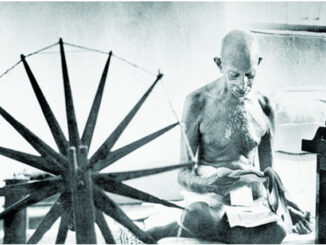
    Rather than buy British-manufactured clothes, he began to use a portable spinning wheel to produce his own cloth. The spinning wheel soon became a symbol of Indian independence and self-reliance.
    Gandhi assumed the leadership of the Indian National Congress and advocated a policy of non-violence and non-cooperation to achieve home rule.
    After British authorities arrested Gandhi in 1922, he pleaded guilty to three counts of sedition. Although sentenced to a six-year imprisonment, Gandhi was released in February 1924 after appendicitis surgery.
    He discovered upon his release that relations between India’s Hindus and Muslims devolved during his time in jail. When violence between the two religious groups flared again, Gandhi began a three-week fast in the autumn of 1924 to urge unity. He remained away from active politics during much of the latter 1920s.
    Gandhi and the Salt March
    Gandhi returned to active politics in 1930 to protest Britain’s Salt Acts, which not only prohibited Indians from collecting or selling salt—a dietary staple—but imposed a heavy tax that hit the country’s poorest particularly hard. Gandhi planned a new Satyagraha campaign, The Salt March, that entailed a 390-kilometer/240-mile march to the Arabian Sea, where he would collect salt in symbolic defiance of the government monopoly.
    “My ambition is no less than to convert the British people through non-violence and thus make them see the wrong they have done to India,” he wrote days before the march to the British viceroy, Lord Irwin.
    Wearing a homespun white shawl and sandals and carrying a walking stick, Gandhi set out from his religious retreat in Sabarmati on March 12, 1930, with a few dozen followers. By the time he arrived 24 days later in the coastal town of Dandi, the ranks of the marchers swelled, and Gandhi broke the law by making salt from evaporated seawater.
    The Salt March sparked similar protests, and mass civil disobedience swept across India. Approximately 60,000 Indians were jailed for breaking the Salt Acts, including Gandhi, who was imprisoned in May 1930.
    Still, the protests against the Salt Acts elevated Gandhi into a transcendent figure around the world. He was named Time magazine’s “Man of the Year” for 1930.
    Gandhi was released from prison in January 1931, and two months later he made an agreement with Lord Irwin to end the Salt Satyagraha in exchange for concessions that included the release of thousands of political prisoners. The agreement, however, largely kept the Salt Acts intact. But it did give those who lived on the coasts the right to harvest salt from the sea.
    Hoping that the agreement would be a stepping-stone to home rule, Gandhi attended the London Round Table Conference on Indian constitutional reform in August 1931 as the sole representative of the Indian National Congress. The conference, however, proved fruitless.
    Protesting “Untouchables” Segregation
    Gandhi returned to India to find himself imprisoned once again in January 1932 during a crackdown by India’s new viceroy, Lord Willingdon. He embarked on a six-day fast to protest the British decision to segregate the “untouchables,” those on the lowest rung of India’s caste system, by allotting them separate electorates. The public outcry forced the British to amend the proposal.
    After his eventual release, Gandhi left the Indian National Congress in 1934, and leadership passed to his protégé Jawaharlal Nehru. He again stepped away from politics to focus on education, poverty and the problems afflicting India’s rural areas.
    India’s Independence from Great Britain
    As Great Britain found itself engulfed in World War II in 1942, Gandhi launched the “Quit India” movement that called for the immediate British withdrawal from the country. In August 1942, the British arrested Gandhi, his wife and other leaders of the Indian National Congress and detained them in the Aga Khan Palace in present-day Pune.
    “I have not become the King’s First Minister in order to preside at the liquidation of the British Empire,” Prime Minister Winston Churchill told Parliament in support of the crackdown.
    With his health failing, Gandhi was released after a 19-month detainment in 1944.
    After the Labour Party defeated Churchill’s Conservatives in the British general election of 1945, it began negotiations for Indian independence with the Indian National Congress and Mohammad Ali Jinnah’s Muslim League. Gandhi played an active role in the negotiations, but he could not prevail in his hope for a unified India. Instead, the final plan called for the partition of the subcontinent along religious lines into two independent states—predominantly Hindu India and predominantly Muslim Pakistan.
    Violence between Hindus and Muslims flared even before independence took effect on August 15, 1947. Afterwards, the killings multiplied. Gandhi toured riot-torn areas in an appeal for peace and fasted in an attempt to end the bloodshed. Some Hindus, however, increasingly viewed Gandhi as a traitor for expressing sympathy toward Muslims.
    Gandhi’s Wife and Kids
    At the age of 13, Gandhi wed Kasturba Makanji, a merchant’s daughter, in an arranged marriage. She died in Gandhi’s arms in February 1944 at the age of 74.
    In 1885, Gandhi endured the passing of his father and shortly after that the death of his young baby.
    In 1888, Gandhi’s wife gave birth to the first of four surviving sons. A second son was born in India 1893. Kasturba gave birth to two more sons while living in South Africa, one in 1897 and one in 1900.
    Assassination of Mahatma Gandhi
    On January 30, 1948, 78-year-old Gandhi was shot and killed by Hindu extremist Nathuram Godse, who was upset at Gandhi’s tolerance of Muslims.
    Weakened from repeated hunger strikes, Gandhi clung to his two grandnieces as they led him from his living quarters in New Delhi’s Birla House to a late-afternoon prayer meeting. Godse knelt before the Mahatma before pulling out a semiautomatic pistol and shooting him three times at point-blank range. The violent act took the life of a pacifist who spent his life preaching nonviolence.
    Godse and a co-conspirator were executed by hanging in November 1949. Additional conspirators were sentenced to life in prison.
    Legacy
    Even after Gandhi’s assassination, his commitment to nonviolence and his belief in simple living — making his own clothes, eating a vegetarian diet and using fasts for self-purification as well as a means of protest — have been a beacon of hope for oppressed and marginalized people throughout the world.
    Satyagraha remains one of the most potent philosophies in freedom struggles throughout the world today. Gandhi’s actions inspired future human rights movements around the globe, including those of civil rights leader Martin Luther King Jr. in the United States and Nelson Mandela in South Africa.

  • History This Week

    October 1

    Ford Model T


    October 1, 1908 – Henry Ford’s Model T, a “universal car” designed for the masses, went on sale for the first time.

    October 1, 1938 – Hitler’s troops occupied the Sudetenland portion of Czechoslovakia. In an effort to avoid war, the leaders of Britain and France had agreed to cede the German-speaking area to Hitler, who later broke the agreement and occupied all of Czechoslovakia.

    October 1, 1946 – Twelve Nazi leaders were sentenced to death at the International War Crimes Tribunal in Nuremberg, Germany.

    October 1, 1949 – The People’s Republic of China was founded with Mao Zedong as Chairman.

    October 1, 1979 – After 70 years of American control, the Panama Canal Zone was formally handed over to Panama.

    Birthday – Virtuoso pianist Vladimir Horowitz (1904-1989) was born in Berdichev, Russia. He made his American debut in 1928 with the New York Philharmonic and became a U.S. citizen in 1944. In 1986, after a self-imposed absence of 60 years, he performed a concert in his native Russia.

    October 2

    October 2, 1935 – Mussolini’s Italian troops invaded Abyssinia, beginning an occupation lasting until 1941.

    October 2, 1967 – Thurgood Marshall (1908-1993) was sworn in as the first African American associate justice of the U.S. Supreme Court. He served until 1991 and was known for opposing discrimination and the death penalty, and for championing free speech and civil liberties.

    Redwood National Park

     October 2, 1968 – California’s Redwood National Park was established. Redwoods are the tallest of all trees, growing up to 400 feet (120 meters) during a lifetime that can span 2,000 years.

    October 2, 1975 – Japanese Emperor Hirohito made his first-ever visit to the White House.

    Mahatma Gandhi.

    Birthday – Indian political and spiritual leader Mohandas (Mahatma) Gandhi (1869-1948) was born in Porbandar, India. He achieved worldwide fame for his devout lifestyle and nonviolent resistance which ended British rule over India. He was assassinated by a religious fanatic in the garden of his home in New Delhi on January 30, 1948.

    Birthday – American statesman Cordell Hull (1871-1955) was born in Pickett County, Tennessee. He served in both houses of Congress, as Secretary of State, and was instrumental in the establishment of the United Nations.

    October 3

    October 3, 1863 – President Abraham Lincoln issued a proclamation designating the last Thursday in November as Thanksgiving Day.

    October 3, 1929 – Yugoslavia became the official name of the Kingdom of Serbs, Croats and Slovenes.

    October 3, 1932 – Iraq gained independence from Britain and joined the League of Nations.

    October 3, 1974 – Frank Robinson was hired by the Cleveland Indians as baseball’s first African American major league manager.

    October 3, 1990 – After 45 years of Cold War division, East and West Germany were reunited as the Federal Republic of Germany.

    October 4

    October 4, 1582 – The Gregorian Calendar took effect in Catholic countries as Pope Gregory XIII issued a decree stating the day following Thursday, October 4, 1582, would be Friday, October 15, 1582, correcting a 10-day error accumulated by the Julian Calendar. Britain and the American colonies adopted the Gregorian Calendar in 1752.

    October 4, 1830 – Belgium gained its independence, after having been a part of the Netherlands since 1815.

    October 4, 1943 – The Island of Corsica became the first French territory in Europe freed from Nazi control as Free French troops liberated the city of Bastia.

    Sputnik 1 Launch.

    October 4, 1957 – The Space Age began as the Russians launched the first satellite into orbit. Sputnik I weighed just 184 lbs. and transmitted a beeping radio signal for 21 days. The remarkable accomplishment by Soviet Russia sent a shockwave through the American political leadership resulting in U.S. efforts to be the first on the moon.

    October 4, 1965 – Pope Paul VI became the first Pope to visit the U.S. and the first to address the United Nations.

    October 4, 1993 – Russian tank-soldiers loyal to President Boris Yeltsin shelled the Russian White House, crushing a hardline Communist rebellion. Yeltsin then fired Vice-president Alexander Rutskoi and jailed other opposition leaders.

    Birthday – St. Francis of Assisi (1181-1226) was born in Assisi, Umbria, Italy (as Giovanni Francesco Bernardone). He renounced his family’s wealth and founded the Friars Minor (Franciscan Order).

    Birthday – Rutherford B. Hayes (1822-1893) the 19th U.S. President was born in Delaware, Ohio. He served from March 4, 1877 to March 3, 1881. He was a Republican best known for his much-quoted statement, “He serves his party best who serves his country best.”

    Birthday – Artist Frederic Remington (1861-1909) was born in Canton, New York. He studied at Yale Art School then traveled extensively throughout the American West in the late 1800s sketching cowboys, Native Americans, frontiersmen, and soldiers. He also created lively sculptures featuring bucking broncos.

    October 5

    October 5, 1813 – Shawnee Indian Chief Tecumseh was defeated and killed during the War of 1812. Regarded as one of the greatest American Indians, he was a powerful orator who defended his people against white settlement. When the War of 1812 broke out, he joined the British as a brigadier general and was killed at the Battle of the Thames in Ontario.

    October 5, 1877 – Following a 1,700-mile retreat, Chief Joseph of the Nez Perce Indians surrendered to U.S. Cavalry troops at Bear’s Paw near Chinook, Montana. “From where the sun now stands, I will fight no more forever,” he declared.

    October 5, 1908 – Bulgaria proclaimed its independence from the Ottoman Empire.

    October 5, 1910 – Portugal became a republic following a successful revolt against King Manuel II.

    October 5, 1938 – Czech President Dr. Eduard Benes resigned and fled abroad amid threats from Adolf Hitler.

    October 5, 1964 – The largest mass escape since the construction of the Berlin Wall occurred as 57 East German refugees escaped to West Berlin after tunneling beneath the wall.

    October 5, 1986 – Former U.S. Marine Eugene Hasenfus was captured by Nicaraguan Sandinistas after a plane carrying arms for the Nicaraguan rebels (Contras) was shot down over Nicaragua. This marked the beginning of the “Iran-Contra” controversy resulting in Congressional hearings and a major scandal for the Reagan White House after it was revealed that money from the sale of arms to Iran was used to fund covert operations in Nicaragua.

    Birthday – Theologian Jonathan Edwards (1703-1758) was born in East Windsor, Connecticut. He led the “Great Awakening” religious revival in the American colonies and later became president of Princeton.

    Birthday – Chester A. Arthur (1830-1886) the 21st President of the U.S. was born in Fairfield, Vermont. He succeeded to the presidency following the assassination of James A. Garfield. He served from September 20, 1881 to March 3, 1885, but was not nominated by the Republican Party for a second term.

    Robert H Goddard, Father of the Space

    Birthday – “Father of the Space Age” Robert Goddard (1882-1945) was born in Worcester, Massachusetts. During his lifetime he was ridiculed by the public and the press over his idea of constructing a space flight machine. In 1926, he launched the world’s first liquid-fueled rocket on a farm near Auburn, Mass. In 1935, his liquid-fueled rocket surpassed the speed of sound. Other developments included a steering apparatus for rocket machines, staged rockets to reach high altitudes, rocket fuel pumps, and a self-cooling rocket motor.

    Birthday – Czech playwright and political leader Vaclav Havel was born in Prague, October 5, 1936. He spent over 5 years in prison for speaking out against government abuses. He went on to lead the peaceful “velvet revolution” which ended Soviet-style Communism in Czechoslovakia in 1989.

    October 6

    October 6, 1927 – The first “talkie” opened in New York. The Jazz Singer starring Al Jolson was the first full-length feature film using spoken dialogue.

    October 6, 1928 – Generalissimo Chiang Kai-shek became president of the Republic of China upon the introduction of a new constitution.

    October 6, 1949 – “Tokyo Rose” (Iva Toguri d’Aquino) was sentenced in San Francisco to 10 years imprisonment and fined $10,000 for treason. She had broadcast music and Japanese propaganda to American troops in the Pacific during World War II. She was pardoned by President Gerald Ford in 1977.

    October 6, 1973 – The Yom Kippur War started as Egypt and Syria launched attacks on Israeli positions on the East Bank of the Suez and the Golan Heights.

    October 6, 1978 – Iranian religious leader Ayatollah Khomeini was granted asylum in France after being expelled from Iran for his opposition to the Shah.

    October 6, 1981 – Egyptian President Anwar Sadat (1918-1981) was assassinated in Cairo by Muslim fundamentalists while watching a military parade. He had shared the 1978 Nobel Peace Prize with Menachem Begin of Israel. He had signed an American-sponsored peace accord with Israel but had been denounced by other Arab leaders.

    Birthday – Engineer and inventor George Westinghouse (1846-1914) was born in Central Bridge, New York. He developed air brakes for trains and was later responsible for the adoption of alternating current (AC) systems for electric power transmission in the U.S. He was also the first employer to give his employees paid vacations.

    Birthday – Norwegian explorer Thor Heyerdahl was born in Larvik, Norway, October 6, 1914. He used Kon-Tiki and other primitive ocean-going vessels to prove the possibility of transoceanic contact between ancient, widely separated civilizations.

    October 7

    October 7, 1765 – The Stamp Act Congress convened in New York City with representatives from nine colonies meeting in protest to the British Stamp Act which imposed the first direct tax by the British Crown upon the American colonies.

    October 7, 1940 – During World War II in Europe, German troops invaded Romania to take seize strategic oil fields.

    October 7, 1949 – The German Democratic Republic came into existence in East Germany. Dominated by Soviet Russia, it lasted until German reunification in 1990.

    Achille Lauro.

    October 7, 1985 – Palestinian terrorists seized the Italian passenger ship Achille Lauro carrying about 440 persons, threatening to blow it up if Israel did not free 50 Palestinian prisoners. Leon Klinghoffer, an elderly wheelchair-bound American, was murdered.

  • Mahatma Gandhi and the Indian Freedom Movement

    Mahatma Gandhi and the Indian Freedom Movement

    Remembering the Father of the Indian Nation on his 152nd birthday anniversary

    “It has been my experience, living and working with Gandhiji that what he achieved by his Satyagraha appeared at the time to be small but the rest was subsequently accomplished through the combination of various circumstances. It is also true that if the first small step had not been taken by Gandhiji the other forces that brought about the final result might have remained dormant for a long time”. – Acharya Kriplani

    Billions of Indians identified themselves with the scantily covered Mahatma Gandhi

    The British Empire’s most talented and Powerful pro-consul in India, Lord Curzon has said, “India is the pivot of our British empire. If the Empire loses any other part of its, we can survive, but if we lose India, the sun of our Empire will set.” Even Churchill said, “the loss of India would mark and consummate the downfall of the British empire from such a catastrophe there should be no recovery.” One can understand how difficult it was to secure Independence from dominion of Britishers.

     Gandhi’s advent and Rise:

    1919 was a twilight year in the history of Indo-British relations. The harsh Rowlett act met with Universal opposition in the Imperial legislative council and outside. Gandhi was challenged with such a situation. There was the Jallianwala Bag massacre. An armed rebellion was out of question in a country forcibly disarmed and deliberately emasculated for about a century. Gandhi changed this situation into an opportunity.

    The unique weapon

    1. The strategy of Satyagraha i.e., non-violent direct action was preferred by Gandhi.
    2. This strategy of Satygraha is no oriental mystic doctrine baffling the oriental mind but a hardheaded mass pressure technique to ensure social, political and economic change. Satyagraha demands public spirit, self-sacrifice, organization, endurance and discipline for its successful operation.

    Three pillars of Satyagraha

    1. Sat implies openness, honesty and fairness.
    2. Ahimsa- non –injury is refusal to inflict injury to others. Ahimsa is an expression of our concern that our own and other’s humanity be manifested and respected; and we must learn to genuinely love our opponents in order to practice Ahimsa.
    3. Tapasya – willingness for self-sacrifice:

    A Satyagrahi (one who practices Satyagraha) must be willing to shoulder any sacrifice which is occasioned by the struggle which they have initiated, rather than pushing such sacrifice or suffering onto their opponent. The goal is to discover a wider vista of truth and justice, not to achieve victory over the opponent.

    NON-COOPERATION- 1920-22

     The weapon of Non-cooperation was designed and developed in order to further the inter-related aims of inculcating Satyagraha among as many Indian social groups as possible.  The reaction of the British to this unusual non-violent struggle was best summed up by the then Governor of Bombay, George Llyod: “Gandhi gave us a scare. Gandhi’s was the most colossal experiment in world history, and it came within an inch of succeeding. “The first experiment with non-violent direct action on a national scale suffered an abortive end. Although it failed to obtain its immediate objective, it was immensely successful in awakening India to the consciousness of her own potential power. Moreover, the experience gathered during the non-cooperation movement paved the way for India’s next great movement of 1930.

    CIVIL DISOBEDIENCE MOVEMENT – 1930-1934

    The radical youth groups and the labor organizations were not convinced of the compelling power of non-violent direct action. However, the ideology of Satyagraha aroused widespread academic interest and discussion. The conspicuous success of the Bardoli Satyagraha of 1928 had already infused new hope in the people and revived a general confidence in Gandhi’s method. The absence of any Indian representative on the Simon commission drew the Liberal and the Moderate elements to the Congress fold. It clearly appeared that the nation was again full of all energy and enthusiasm.

    Gandhi decided to initiate Civil Disobedience movement by a dramatic breach of the salt law. This was a law which affected all and for many years, Gandhi had considered taxation on one of the vital needs like salt to be an immoral law. The incidence of tax was a symbol of human oppression and through this little gesture Gandhi transcended the limitation of human condition.

    After a full year of struggle, the Government gave in and began negotiations with the Congress high command. Gandhi and the members of the working committee of the Congress were released and Gandhi was invited to Delhi.

    For the first time in history on March 5, 1931, the representative of His Majesty signed a treaty with Gandhi. The main demands of the people were granted in the treaty, thereafter, known as the “Gandhi-Irwin Pact act” and the stage was set for further negotiations with a view to evolving of Free India.

    But then he found his pact with Irwin violated by the Government. He also discovered that the bureaucracy was in a belligerent mood and did not mean to carry out the terms of the Pact. Thereupon Gandhi was forced to revive Satyagraha.

    THE QUIT INDIA MOVEMENT

    The Second World War was real life and death struggle for the British people. In the year 1940-41 they made their last heroic stand as a world power. Gandhi’s revulsion from the great slaughter and desire for the universal peace and his hostility to the raj further soured his relations with the British rulers.

    Then Gandhi initiated the Individual Civil Disobedience movement, which was undertaken for the vindication of Freedom of Speech. Individuals carefully chosen by Gandhi himself were instructed to move from place to place on foot, explain to the people the implications of the formula. Sir Stafford Cripps with an offer of political settlement met the political leaders. The terms were however found unacceptable by all parties with the result that Cripps returned to England, disappointed. Soon after this event, Gandhi received a cable from England, in reply to which he gave expression, for the first time, to the demand for British withdrawal as an immediate necessity.

    Gandhi was a charismatic leader who was loved and respected. A sea of humanity poured in to catch a glimpse of him and listen to his words.

    The city of Bombay, after experiencing an unusual wave of jubilation and fighting fervor, lay in the quiet of the exhausted in the early hours of August 9, 1942. On the previous day, Gandhi had electrified the masses attending the momentous August 8th meeting of the AICC by unequivocally demanding that the British should Quit India. His slogan was “Do or Die”. Gandhi however, cautioned his followers that it would be weeks before a civil disobedience could be launched.

    Although more than 60,000 people were arrested, 18,000 kept in prison while 940 were shot dead and about 1630 injured by firing, the people’s violence was limited to objects which were considered to belong to Government, and it did not extend any further. There might have been defeat, but the people’s forces had succeeded in recovering and preserving their morale and this was no small gain. “The British Empire is a Satanic System and I have dedicated my life to destroy it” Gandhiji declared.

    CONCLUSION

    To conclude in the memorable words of Acharya Kriplani, the lifelong colleague of Gandhi, as a fitting tribute to the efficacy of Gandhi’s unique weapon of Satyagraha: “It has been my experience, living and working with Gandhiji that what he achieved by his Satyagraha appeared at the time to be small but the rest was subsequently accomplished through the combination of various circumstances. It is also true that if the first small step had not been taken by Gandhiji the other forces that brought about the final result might have remained dormant for a long time.”

     (Compiled by Rajendar Dichpally and his colleagues. Mr. Dichpally is a General Secretary of Indian Overseas Congress USA. He can be reached at dichpally@aol.com)

  • Quad, AUKUS, SAARC… and a divided Asia

    Quad, AUKUS, SAARC… and a divided Asia

    AUKUS: Yet another anti-China grouping created by the US

    By Sudheendra Kulkarni

    “We Indians, instead of sorting out our disputes with China on our own on the basis of equality and fairness, have chosen to join the US-led quadrilateral. Essentially an anti-China alliance, the Quad could end up making Asia the theatre of a new cold war and an expensive arms race. Should we allow outsiders to put their guns on our shoulder to fire at China?”

    “Exactly a hundred years ago, Mahatma Gandhi had warned about a future when powerful nations, using their navies, would “threaten world’s peace and exploit its resources” (Young India; December 8, 1921). His warning is now coming frighteningly true. Tagore too had warned Asians against imitating the monstrous features of the European rivalry, which triggered two horrific world wars. India, which aspires to become a ‘Vishwa Guru’, is blissfully ignoring Gurudev’s warning, too.”

    Gurudev Rabindranath Tagore would have been an unhappy man were he alive today. A poet-philosopher who relentlessly advocated Asian unity, he would have been utterly distressed by the disunity and conflicts in Asia, and the current efforts by Western powers to mire the continent in bloc rivalry.

    No other Indian leader of his times visited as many Asian countries as he did — Japan (1916, 1924, 1929), Burma (1916, 1924, 1927), Sri Lanka (1922, 1928, 1934), China (1924, 1928), Singapore (1916, 1924, 1927), Indonesia (1927), Malaysia (1924 and 1927), Thailand (1927), Vietnam (1929), and Iran and Iraq (1932).

    His mission was to ‘create an Asian mind’. When he established Visva-Bharati in 1921, his principal goal was to revive the age-old civilizational, cultural and spiritual bonds that linked India and other Asian countries. He was not the only Indian who had this vision. Mahatma Gandhi, Jawaharlal Nehru and Subhas Chandra Bose also espoused Asian solidarity.

    ‘The Asian Mind’ of Gurudev’s dreams is fragmented today. Countries that were once victims of colonialism have drifted apart. Asia — home to 60 per cent of the world population — is becoming increasingly non-peaceful, with Western powers trying to create competing groupings and ignite fires of conflict. Sadly, the internal quarrels in Asia are harming peace and closing the opportunities for mutually beneficial cooperation aimed at enhancing the wellbeing of its peoples. West Asia has seen many wars in the recent past — Iran-Iraq war, the US invasion of Iraq, and the ongoing wars in Syria and Yemen. In South Asia, Afghanistan has suffered four decades of external wars and internal conflicts. Even after the recent withdrawal of American troops, there are no cooperative efforts by India and regional neighbors to help Afghanistan achieve stability and national reconstruction.

    This is mainly due to Taliban’s religious fanaticism on the one hand and India-Pakistan hostility on the other. India and Pakistan are in no mood to establish good unneighborly relations even 75 years after our two countries gained independence from British rule. Because of our ceaseless enmity, SAARC (South Asian Association for Regional Cooperation), of which Afghanistan is also a member, has become completely dysfunctional and remains in coma. Its leaders have not had a summit meeting since 2014.

    In contrast, China has achieved some success in making the Shanghai Cooperation Organisation (SCO) a viable non-Western platform in the region. The SCO managed to induct both India and Pakistan as full members in 2017. At its recent 20th anniversary summit in Dushanbe (Tajikistan), Iran joined it as a full member. Afghanistan has an observer status in the SCO.

    Sadly, India has chosen to isolate itself from a regional cooperation endeavor involving China, Russia, Iran and Pakistan to promote peace and inclusive government in Kabul even though there is no basic difference among the five nations over the issue that the Taliban regime must not give sanctuaries to terrorist organizations.

    Instead, India is aligning its Afghan policy with that of America. More worrisome is America’s reported attempt to seek a military base at some place in ‘north-west India’ for carrying out ‘over-the-horizon counter-terrorism operations’ in Afghanistan. Agreeing to this would be catastrophic for India and the region. It would also expose us to the criticism of following double standards. India has been rightly insisting that the Taliban should not allow Afghan soil to be used against India. How, then, can we allow the USA’s anti-Afghan operations from Indian soil?

    Let’s look at another major intra-Asian antagonism. India and China, the two great Asian civilizations, are locked in a power struggle, which, if unchecked, can be disastrous for both as well as the continent and the world. India-China rivalry, coupled with China’s failure to peacefully resolve maritime disputes with its neighbors in South China Sea, has given an opportunity for the distant US to fish in troubled waters.

    America has no business getting involved in Asian disputes. Yet, invoking the artificial concept of the ‘Indo-Pacific’, which gives India’s westernized ruling elite a feel-good sense of gaining global leadership, Washington has persuaded the Modi government to offer it a foothold in the India-China row.

    Since the end of World War II, US rulers have been acting on the belief that their country is the global hegemon and, as such, have the right to flaunt its power anywhere in the world.

    However, with the rise of China in recent decades, the days of US global domination are clearly numbered. Alarmed by this certainty, it is busy sowing the seeds of disunity in Asia. For this purpose, it is building military groupings to contain China. Unfortunately, we Indians, instead of sorting out our disputes with China on our own on the basis of equality and fairness, have chosen to join the US-led quadrilateral. Essentially an anti-China alliance, the Quad could end up making Asia the theatre of a new cold war and an expensive arms race. Should India allow outsiders to put their guns on its shoulder to fire at China? What will be the consequences of India becoming a pawn in America’s games?

    America has now created yet another anti-China grouping — AUKUS, a security pact among Australia, the UK, and the US, all three being Anglosphere nations. America and Britain will help Australia develop and deploy nuclear-powered submarines to deter China.

    France is extremely angry with its two NATO allies because the pact has scuttled the lucrative $80-billion French-Australian submarine deal. This shows how several western nations have now become predominantly war economies. They prosper only by selling costly weapon systems to non-western countries, including India.

    Be it Quad or AUKUS, what should worry Indians and all other Asians is how our seas and oceans will increasingly become a playfield for menacing warships and submarines.

    Exactly a hundred years ago, Mahatma Gandhi had warned about a future when powerful nations, using their navies, would “threaten world’s peace and exploit its resources” (Young India; December 8, 1921). His warning is now coming frighteningly true. Tagore too had warned Asians against imitating the monstrous features of the European rivalry, which triggered two horrific world wars.

    India, which aspires to become a ‘Vishwa Guru’, is blissfully ignoring Gurudev’s warning, too.

    (The author is a former close aide to ex-PM Vajpayee and Founder, Forum for a New South Asia)

  • The Quit India Movement

    The Quit India Movement

    The Quit India Movement (Bharat Chhodo Andolan) or the August Movement was a civil disobedience movement in India launched in August 1942 in response to Gandhi’s call for immediate independence of India. The aim was to bring the British Government to the negotiating table by holding the Allied War Effort hostage. The call for determined but passive resistance that signified the certitude that Gandhi foresaw for the movement is best described by his call to Do or Die, issued on 8 August at the Gowalia Tank Maidan in Bombay, since re-named August Kranti Maidan (August Revolution Ground). However, almost the entire Congress leadership, and not merely at the national level, was put into confinement less than twenty-four hours after Gandhi’s speech, and the greater number of the Congress leaders were to spend the rest of the war in jail.

    At the outbreak of war, the Congress Party had during the Wardha meeting of the working-committee in September 1939, passed a resolution conditionally supporting the fight against fascism, but were rebuffed when they asked for independence in return. The draft proposed that if the British did not accede to the demands, a massive Civil Disobedience would be launched. However, it was an extremely controversial decision. The Congress had lesser success in rallying other political forces under a single flag and mast.

    On August 8, 1942 the Quit India resolution was passed at the Bombay session of the All India Congress Committee (AICC). At Gowalia Tank, Mumbai Gandhi urged Indians to follow a non-violent civil disobedience. Gandhi told the masses to act as an independent nation and not to follow the orders of the British. The British, already alarmed by the advance of the Japanese army to the India–Burma border, responded the next day by imprisoning Gandhi at the Aga Khan Palace in Pune. The Congress Party’s Working Committee, or national leadership was arrested all together and imprisoned at the Ahmednagar Fort. They also banned the party altogether. Large-scale protests and demonstrations were held all over the country. Workers remained absent en masse and strikes were called. The movement also saw widespread acts of sabotage, Indian under-ground organisation carried out bomb attcks on allied supply convoys, government buildings were set on fire, electricity lines were disconnected and transport and communication lines were severed.

    The British swiftly responded by mass detentions. A total over 100,000 arrests were made nationwide, mass fines were levied, bombs were airdropped and demonstrators were subjected to public flogging.

    The movement soon became a leaderless act of defiance, with a number of acts that deviated from Gandhi’s principle of non-violence. In large parts of the country, the local underground organisations took over the movement. However, by 1943, Quit India had petered out.

    Independence, 1947 to 1950

    On 3 June 1947, Viscount Lord Louis Mountbatten, the last British Governor-General of India, announced the partitioning of the British Indian Empire into a secular India and a Muslim Pakistan. At midnight, on 15 August 1947, India became an independent nation. Violent clashes between Hindus, Muslims, and Sikhs followed. Prime Minister Nehru and Deputy Prime Minister Sardar Vallabhbhai Patel invited Lord Mountbatten to continue as Governor General of India. He was replaced in June 1948 by Chakravarti Rajagopalachari. Patel took on the responsibility of unifying 565 princely states, steering efforts by his “iron fist in a velvet glove” policies, exemplified by the use of military force to integrate Junagadh, Jammu and Kashmir, and Hyderabad state into India.

    The Constituent Assembly completed the work of drafting the constitution on 26 November 1949; on 26 January 1950 the Republic of India was officially proclaimed. The Constituent Assembly elected Dr. Rajendra Prasad as the first President of India, taking over from Governor General Rajgopalachari. Subsequently, a free and sovereign India absorbed two other territories: Goa (liberated from Portuguese control in 1961) and Pondicherry (which the French ceded in 1953–1954). In 1952, India held its first general elections, with a voter turnout exceeding 62%; this made it the world’s largest democracy.

    —————————-

    Indian Freedom Fighters

    74 years ago, on the historic date of 15th August 1947,  India became free from British domination. It was the culmination of numerous movements and struggles that were rife throughout the time of British rule, including the historic revolt of 1857. This independence was achieved through the efforts of many revolutionary freedom fighters, who took the lead in organising the struggle which led to India’s independence. Although they were of varied ideologies ranging from moderates to extremists, their contribution to India’s freedom struggle has been immortalized in the minds of every Indian.

     We have made best efforts to present some of the most prominent freedom activists and revolutionaries who made immense contribution towards India’s struggle for freedom.

    Tantia Tope (1814–1859)

    Tantia Tope was one of the Indian rebellions of 1857. He served as a general and led a group of Indian soldiers against the British. He was an ardent follower of Nana Sahib of Bithur and continued to fight on his behalf when Nana was forced to retreat by the British army. Tantia even forced General Windham to retreat from Kanpur and helped Rani Lakshmi of Jhansi to retain Gwalior.

    Nana Sahib (1824 – 1857)

    After leading a group of rebellions during the 1857 uprising, Nana Sahib defeated the British forces in Kanpur. He even killed the survivors, sending a hard-hitting message to the British camp. Nana Sahib was also known as an able administrator and is said to have led around 15,000 Indian soldiers.

    Kunwar Singh (1777-1858)

    At the age of 80, Kunwar Singh led a group of soldiers against the British in Bihar. Using guerrilla warfare tactics, Kunwar bedazzled the British troops and managed to defeat the forces of Captain le Grand near Jagdispur. Kunwar Singh is known for his bravery and was fondly called as Veer Kunwar Singh.

    Rani Lakshmi Bai (1828–1858)

    One of the key members of India’s first war of independence, Rani Lakshmi Bai went on to inspire thousands of women to join the fight for freedom. On 23 March, 1858 Lakshmi Bai defended her palace and the entire city of Jhansi when it was threatened to be captured by British troops led by Sir Hugh Rose.

    Bal Gangadhar Tilak (1856-1920)

    Bal Gangadhar Tilak was one of the most prominent freedom fighters of India who inspired thousands with the slogan – “Swaraj is my birthright and I shall have it”. As a form of protest against the British, Tilak established schools and published rebellious newspapers. He was famous as one of the trios – Bal, Pal and Lal. People loved him and accepted him as one of their leaders and so, he was called Lokmanya Tilak.

    Mangal Pandey (1827-1857)

    Mangal Pandey is said to have played a key role in inspiring Indian soldiers to start the great rebellion of 1857. Working as a soldier for the British East India Company, Pandey started firing at English officials and caught them unawares. His attack is regarded as the first step of the Indian rebellion that started in 1857.

    Begum Hazrat Mahal (1820–1879)

    Working along with leaders like Nana Saheb and Maulavi of Faizabad, Begum Hazrat Mahal rebelled against the British during the revolt of 1857. She was successful in taking control of Lucknow after leading the troops in her husband’s absence. She rebelled against the demolition of temples and mosques before retreating to Nepal.

    Ashfaqulla Khan (1900–1927)

    Ashfaqulla Khan was a firebrand among the young revolutionaries, who sacrificed his life for the sake of his motherland. He was an important member of the Hindustan Republican Association. Khan, along with his associates, executed the train robbery at Kakori for which he was arrested and executed by the British.

    Rani Gaidinliu (1915–1993)

    Rani Gaidinliu was a political leader who revolted against the British rule. She joined a political movement at the age of 13 and fought for the evacuation of British rulers from Manipur and the neighbouring areas. Unable to withstand her protests, the British arrested her when she was just 16 years old and sentenced her to life imprisonment.

    Bipin Chandra Pal  (7 November 1858 – 20 May 1932)

    Bipin Chandra Pal was one of the key members of the Indian National Congress and a prominent freedom fighter. He advocated the abandonment of foreign goods. He, along with Lala Lajpat Rai and Bal Gangadhar Tilak, spearheaded many revolutionary activities. For this reason, he is called as the ‘Father of Revolutionary Thoughts.’

    Chandra Shekhar Azad (23 July 1906 – 27 February 1931)

    One of the close associates of Bhagat Singh, Chandra Shekhar Azad is credited for reorganizing Hindustan Republican Association. Azad, as he was popularly called, is known as one of the bravest freedom fighters of India. At the time of being surrounded by British soldiers, he killed many of them and shot himself to death with the last bullet of his Colt pistol. He did so, as he never wanted to be captured alive.

    Hakim Ajmal Khan (11 Feb 1868 – 29 December 1927)

    A physician by profession, Hakim Ajmal Khan founded the Jamia Millia Islamia University before participating in the fight for freedom. He joined the Khilafat movement along with other famous Muslim leaders like Shaukat Ali and Maulana Azad. In 1906, Hakim Ajmal Khan led a group of Muslim men and women who gave a memorandum to the Viceroy of India.

    Chittaranjan Das (5 November 1869 – 16 June 1925)

    Chittaranjan Das founded the Swaraj Party and was an active participant in the Indian National Movement. A lawyer by profession, Chittaranjan is credited for successfully defending Aurobindo Ghosh when the latter was charged under a criminal case by the British. Popularly known as Deshbandhu, Chittaranjan Das is best known for mentoring Subhas Chandra Bose.

    Sidhu Murmu and Kanhu Murmu

    In 1855, Sidhu Murmu and Kanhu Murmu led a group of 10,000 Santal people in order to revolt against British colonists in eastern India. The movement, which came to be known as the Santhal rebellion, took the British by surprise. The movement was so successful that the British government had no choice but to announce a bounty of Rs. 10,000 to those who were willing to capture Sidhu and his brother Kanhu.

    Birsa Munda (15 November 1875 – June 9 1900)

    Principally a religious leader, Birsa Munda used the religious beliefs of his tribe in order to revolt against the government of British. He implemented guerrilla warfare techniques to upset the rhythm of the British troops. In 1900, Birsa, along with his army, was arrested by the British soldiers. He was later convicted and was lodged in a jail in Ranchi.

    Tilka Manjhi (11 February 1750 – 1784)

    Approximately 100 years before Mangal Pandey took up arms to fight against the British, Tilka Manjhi gave up his life trying to do exactly the same. Manjhi was the first rebellion to fight for the Indian independence. He led a group of Adivasis to fight against the exploitation of the British.

    Surya Sen (22 March 1894 – 12 January 1934)

    Surya Sen is credited for planning and executing a raid that aimed at seizing the weapons of police forces from the Chittagong armoury of British India. He led a battalion of armed Indians to carry out the task. He is known for turning youngsters into firebrand revolutionaries. Surya Sen is among thousands of young Indians who lost their lives, battling for an independent India.

    Subramania Bharati (11 December 1882 – 11 Sept 1921)

    A poet by profession, Subramania Bharati used his literary skills to inspire thousands of Indians during the independence movement. His works were often impassioned and patriotic in nature. In 1908, Bharati had to flee to Puducherry when the British government issued an arrest warrant against him. A prominent member of the Indian National Congress, Bharati continued his revolutionary activities from Puducherry.

    Dadabhai Naoroji (4 September 1825 – 30 June 1917)

    Credited with establishing the Indian National Congress, Dadabhai Naoroji is remembered as one of the most prominent members to have participated in the independence movement. In one of the books published by him, he wrote about the colonial rule of the British which was precisely aimed at looting wealth from India.

    Khudiram Bose (3 December 1889 – 11 August 1908)

    Khudiram Bose was one of those young revolutionaries and freedom fighters whose deeds of bravery went on to become the subject of folklore. He was one of those brave men who challenged the British rule and gave them a taste of their own medicine. At the age of 19, he was martyred, with ‘Vande Mataram’ being his last words.

    Lakshmi Sahgal (24 October 1914 – 23 July 2012)

    A doctor by profession, Lakshmi Sahgal, popularly known as Captain Lakshmi, encouraged women to join the troop led by Subhas Chandra Bose. She took the initiative of forming a women’s regiment and named it ‘Rani of Jhansi regiment’. Lakshmi fought vigorously for the Indian independence before she was arrested by the British government in 1945.

    Lala Har Dayal (14 October 1884 – 4 March 1939)

    A revolutionary among Indian nationalists, Lala Har Dayal turned down a lucrative job offer and went on to inspire hundreds of non-resident Indians to fight against the atrocities of the British Empire. In 1909, he served as the editor of Bande Mataram, a nationalist publication founded by the Paris Indian Society.

    Lala Lajpat Rai (28 January 1865 – 17 November 1928)

    One of the most important members of the Indian National Congress, Lala Lajpat Rai is often revered for leading a protest against the Simon Commission. During the protest, he was assaulted by James A. Scott, the superintendent of police, which ultimately played a role in his death. He was a part of the famous triumvirate called ‘Lal Bal Pal.’

    Mahadev Govind Ranade (18 January 1842 – 16 Jan 1901)

    Mahadev Govind Ranade    was one of the key founding members of Indian National Congress. Apart from serving as Bombay High Court’s judge, Mahadev Govind worked as a social reformer, encouraging women empowerment and widow remarriage. He understood that India’s fight for freedom can never be successful without a social reform which was the need of the hour.

    Mahatma Gandhi (2 October 1869 – 30 January 1948)

    Mahatma Gandhi led the Indian independence movement and was successful in freeing India from the clutches of the British. He employed non-violence and engaged in various movements as part of his inspiring protest against the British rule. He went on to become the most significant freedom fighter and hence is called as the ‘Father of the Nation.’

    Maulana Abul Kalam Azad (11 November 1888 – 22 Feb 1958)

    Maulana Abul Kalam Azad was an active member of the Indian National Congress and a great freedom fighter. Maulana Azad took part in most of the important movements. He presided over the special session of Congress in September 1923 and at the age of 35 he became the youngest man to be elected as the President of the Congress.

    Ram Manohar Lohia (23 March 1910 – 12 October 1967)

    One of the founding members of the Congress Socialist Party, Ram Manohar Lohia was an active member of the Indian independence movement. Lohia was a key member in organizing the Quit India Movement, for which he was arrested and tortured in 1944. He even worked for the Congress Radio which operated secretly, propagandizing anti-British messages.

    Ram Prasad Bismil (11 June 1897 – 19 December 1927)

    Ram Prasad Bismil was one of those young revolutionaries who sacrificed his life for the sake of his motherland. Bismil was one of the most important members of the Hindustan Republican Association and also a prominent member of the group that was involved in the Kakori train robbery. He was sentenced to death by the British government for his involvement in the famous train robbery.

    Ram Singh Kuka (3 February 1816 – 18 January 1872)

    Ram Singh Kuka was a social reformer, who is hailed as the first Indian to have initiated the non-cooperation movement by refusing to use British merchandise and services. Like Mahadev Govind Ranade, he too, understood the importance of social reforms in order to stand strong against the British rule. Hence Ram Singh Kuka gave much importance to social reforms.

    Rash Behari Bose (25 May 1886 – 21 January 1945)

    Rash Behari Bose was one of the most important revolutionaries who tried to assassinate Lord Hardinge, the then Viceroy of India. Along with other revolutionaries, Bose is credited for organizing Ghadar Mutiny and the Indian National Army. He was also involved in persuading the Japanese to help the Indians in their struggle for freedom.

    Sardar Vallabhbhai Patel (31 October 1875 – 15 December 1950)

    His brave deeds earned Vallabhbhai Patel the title, ‘the iron man of India.’ For his role in the Bardoli Satyagraha, Patel came to be known as Sardar. Though he was a famous lawyer, Sardar Patel gave up his profession in order to fight for the freedom of the country. After the independence, he became the deputy Prime Minister of India and played an important role in the integration of India by merging numerous princely states with the Indian Union.

    Bhagat Singh (1907 – 23

    March 1931)

    The name Bhagat Singh is synonymous with sacrifice, courage, bravery and vision. By sacrificing his life at the age of 30, Bhagat Singh became an inspiration and a symbol of heroism. Along with other revolutionaries, Bhagat Singh founded the Hindustan Socialist Republican Association. To remind the British government of its misdeeds, Bhagat Singh hurled a bomb in the Central Legislative Assembly. By embracing death at a young age, Singh became a symbol of sacrifice and courage, thereby residing forever in the hearts of every Indian.

    Shivaram Rajguru (26 August 1908 – 23 March 1931)

    A member of the Hindustan Socialist Republican Association, Shivaram Rajguru was a close associate of Bhagat Singh and Sukhdev. Shivaram is mainly remembered for his involvement in the assassination of John Saunders, a young British police officer. With an intention of killing James Scott, the police superintendent who had assaulted Lala Lajpat Rai just two weeks before his death, Shivaram mistook John for James and shot him to death.

    Subhas Chandra Bose (23 January 1897 – 18 August 1945)

    Popularly known as Netaji, Subhas Chandra Bose was a fierce freedom fighter and popular leader on the political horizon of pre-independent India. Bose was elected as the President of the Indian National Congress in 1937 and 1939. He founded the Indian National Army and raised the famous slogans, ‘Delhi Chalo’ and ‘Tum Mujhe Khoon Do main Tumhe Ajadi Doonga.’ For his anti-British remarks and activities, Bose was jailed 11 times between 1920 and 1941. He was the leader of the youth wing of Congress Party.

    Sukhdev (15 May 1907 – 23 March 1931)

    One of the key members of Hindustan Socialist Republican Association, Sukhdev was a revolutionary and a close associate of Bhagat Singh and Shivaram Rajguru. He too, was involved in the killing of John Saunders, a British police officer. Sukhdev was captured, along with Bhagat Singh and Shivaram Rajguru, and was martyred at the age of 24.

    Vinayak Damodar Savarkar (28 May 1883 – 26 February 1966)

    The founder of Abhinav Bharat Society and Free India Society, Vinayak Damodar Savarkar was an activist and was popularly known as Swatantryaveer Savarkar. Also an eminent writer, Savarkar published a book titled ‘The Indian War of Independence’ that spoke about the struggles of the Indian mutiny of 1857.

    Aruna Asaf Ali (16 July 1909 – 29 July 1996)

    An active independence activist and member of the Congress Party, Aruna Asaf Ali is remembered for her participation in various movements including Salt Satyagraha and Quit India Movement. During the Quit India Movement, she risked being arrested by hoisting the INC flag in Bombay. She was arrested on many occasions for her revolutionary activities and was lodged in jail until 1931 when political prisoners were released under the Gandhi-Irwin Pact.

    Madan Mohan Malaviya (25 December 1861 – 12 Nov 1946)

    An important participant of the Non-Cooperation Movement, Madan Mohan Malaviya served as the President of Indian National Congress on two different occasions. On 25 April, 1932, he was arrested for his participation in the Civil Disobedience Movement. Malaviya was also a central figure during the protests against the Simon Commission in 1928.

    Sucheta Kriplani (25 June 1908 – 1 December 1974)

    The founder of ‘All India Mahila Congress’, Sucheta Kriplani became an important associate of Gandhi during the Partition riots. Along with other freedom fighters like Aruna Asaf Ali and Usha Mehta, Sucheta became an important member of the Quit India Movement. She was also active in politics post-independence and became the country’s first woman Chief Minister.

    Rajkumari Amrit Kaur (2 February 1889 – 6 Feb 1964)

    A co-founder of the All India Women’s Conference, Rajkumari Amrit Kaur was one of the most important members of Dandi March in 1930. After being imprisoned for her participation in the Dandi March, Amrit Kaur went on to actively participate in the Quit India Movement for which she was once again jailed by the British authorities.

    Udham Singh (26 December 1899 – 31 July 1940)

    Udham Singh was one of the most important and famous revolutionaries who took part in the Indian independence movement. He is remembered for avenging the Jallianwala Bagh massacre by brutally murdering Sir Michael O’Dwyer on March 13, 1940. For his act, Udham Singh was convicted and was eventually sentenced to death.

    Madan Lal Dhingra (8 February 1883 – 17 August 1909)

    One of the earliest revolutionaries who sacrificed his life for the sake of his motherland, Madan Lal Dhingra served as an inspiration to other important revolutionaries, such as Bhagat Singh and Chandrasekhar Azad. When he was studying Mechanical Engineering in England, Dhingra murdered Sir William Hutt Curzon Wyllie for which he was sentenced to death.

    Kartar Singh Sarabha (24 May 1896 – 16 November 1915)

    Kartar Singh Sarabha was one of the most famous revolutionaries who sacrificed his life at the age of 19. Sarabha joined the Ghadar Party, an organization formed to protest against the British rule, at the age of 17. He, along with his men, was arrested when a member of the Ghadar Party betrayed them by informing the police about their hiding place.

    Khan Abdul Ghaffar Khan (6 February 1890 – 20 Jan 1988)

    Khan Abdul Ghaffar Khan was one of those independence activists who opposed the partition of India at the time of its independence. Popularly known as Bacha Khan, he advocated non-violence and wanted a secular country. In 1929, he initiated the ‘Khudai Khidmatgar’ movement, which gave the British a run for their money. Since his principles were similar to that of Mahatma Gandhi’s, he worked closely with Gandhi in all his endeavors.

  • Ancient India celebrates her 75th Independent Tryst with Destiny

    Ancient India celebrates her 75th Independent Tryst with Destiny

    Father of the Indian Nation- Mahatma Gandhi
    “So, thank you Pandit Nehru – whose lap I sat in as a 5-year-old kid thanks to my late great Dad, Hon. S.N. Batra,” says Ravi Batra
    PM Narendra Modi, who in his joint address to Congress on June 9, 2016, declared that the destiny of India and the US was “Indivisible”.

    Indivisible with USA, and PM Modi as UNSC President

    By Ravi Batra

    “At the Stroke of the Midnight Hour…”

    Pandit Nehru spoke of ancient India being born again on August 15, 1947 and promised a “tryst with destiny.” The unanswered question for Nehru and India, as for any individual or nation, is always: what’s my destiny. For decades India asserted its non-aligned stance and became its leader, while becoming “inseparable” from the USSR during the Cold War. Not until PM Modi took charge of the Indian Republic did the age-old Greek wisdom of “order is beauty, and beauty is order” get real traction in India (even as the Emergency declared by Indira Gandhi never did).

    Indira Gandhi and Rajiv Gandhi flirted with America’s Charmer, Ronald Reagan.

    While Indira Gandhi and Rajiv Gandhi flirted with the United States during POTUS Reagan’s tenure, no small feat since it was after Indira and India had been subjected to Richard Nixon’s one of two structural flaws, love and hate, in his dealings with China and India, respectively, and as to India, he was profane, naturally ignoble, while engaging in wholesale denigration of the largest democracy – and there I was, as member of Speaker Tip O’Neill’s Speaker’s Club and a then-member of National Advisory Council on South Asian Affairs, along with our ambassador to Delhi, Harry Barnes, at the South Portico of Congress to receive then-Foreign Minister Narasimha Rao while PM Rajiv Gandhi came to address a Joint Session of Congress – it is not until PM Narendra Modi, who in his joint address to Congress on June 9, 2016, which Ranju and I joyously attended, did India declare that her destiny was “Indivisible” for both, her and us.

    July 4, 1776 is August 15, 1947, Anew; the American Dream, is the Indian Dream.

    No sweeter declaration has been uttered – save the one penned by the late great Thomas Jefferson on July 4, 1776, memorializing that Government is answerable to the Citizenry – as indivisibility means the “oldest” and “largest” democracies are going to rock & roll together!

    Vedic & Western Values Honor Transparency vs Sun Tzu’s Recipe of “Deception” to Win.

    So, thank you Pandit Nehru – whose lap I sat in as a 5-year-old kid thanks to my late great Dad, Hon. S.N. Batra – for India’s “tryst with destiny”; and, thanks to PM Modi, it has resulted in an awesome combination of ancient Vedic wisdom and core Western Values of a Government “of, by and for” the people. Both the Vedic and Western Values honor and cherish “transparency” to deliver Freedoms to the individual. Contrasted with the un-matched wisdom of general Sun Tzu, the foundational military genius of great Chinese empires and dynasties through the millennia: “deception,” as in basis for winning.

    The Quad in the South China Sea to Maintain UNCLOS’ Goal of Maritime Security.

    Hence, it is in the natural turn of events that India is a critical part of The Quad, and since Freedom of Navigation on the high seas is a high priority in perpetuity – especially in the South China Seas where China’s wistful 9-Dashes, imposed by psychedelic domination in violation of UNCLOS and EEZ, irritate (and sometimes kill) – PM Modi on August 9th served as President of the UNSC to enhance global peace and security, by seeking to enhance maritime security. While Pakistan is an eternal and honest ally of the People’s Republic of China since her birth in 1947, thanks to Chairman Mao’s century long-vision, and party to the secret bilateral 1949 Karachi Agreement to start creating China’s Golan Heights, it was impressive to me as an un-conflicted American that the only UNSC “P5”  head of state to attend Modi’s Security Council historic participation was Russia’s President Vladimir Putin.

    India Aids US, Europe and Democracy by Bringing Russia to Our Side vs Wolf Warriors.

    In time, we in the United States will see this durable Russia-India relationship to be our operative asset, to solve many an insolvable dispute of territorial integrity of sovereign states in Europe and Middle East, let alone the primary issue now facing us all: how to keep the world free from becoming a collection of vassal states of an un-elected dominating nation, that likes sinking fishing boats of neighboring states, and has repudiated her own core wisdom, from her statecraft-master Confucius, “may you live in boring times” by weaponizing not just SARS-Cov2 viruses, with un-natural gain-of-function that threaten the ecosystem more than Climate Crisis does our survival, but even abandoning diplomatic protocols in favor of Wolf Warrior-commando’s: diplomat-Wolf Warriors in mortal combat. One recent appreciable change has taken place – that reflects President Xi’s appreciation that general Sun TZU violates the wisdom of Confucius – China’s new ambassador Qin Gang since his arrival on American soil has reverted to warm diplomacy, and rejected the prior Wolf Warrior mandate, visible in Anchorage and Wendy Sherman’s recent visit to Beijing, as it stunningly violates the wisdom of both general Sun Tzu and Confucius. I hope this change is real, and not merely deceptively warm and fuzzy in honor of the greatest Chinese General.

    Even Benjamin Franklin wishes India Happy 75th Independence Day.

    Ben Franklin in 1787 famously answered a lady after having achieved our hallowed Constitution, “It’s a republic madam, if you can keep it.” Thanks to India’s PM Modi’s Washington Declaration of “Indivisibility,” the largest democracy will help the oldest democracy to stay one, and hence, Ben Franklin wishes India “Happy 75th!” Indeed, all of us – Democrats and Republicans, President Biden and former President Trump – wish India well, with peace and security for all her citizens. The land of Mahatma Gandhi deserves no less.

    (The author is an eminent attorney. He can be reached at ravi@ravibatralaw.com)

    Twitter @RaviBatra

  • Boris,beware the Ides of March!

    Boris,beware the Ides of March!

    • India’s External Affairs Ministers S Jaishankar made a strong statement in the Parliament that set the tone for the ensuing period of Indo-UK relations
    • Jaishankar’s statement came after a question about racism in the UK by an MP Ashwini Vaishnaw
    • Vaishnaw alleged that an Indian student and former president-elect of the Oxford University Student Union was “cyberbullied”
    By Prabhu Dayal

    It is indeed a cause of some concern that some mischievous, anti-India elements in the UK have an unambiguous agenda of pushing their country’s relationship with India on a downward spiral. These include Khalistan supporters and Kashmiri activists who have the backing of Pakistan’s ISI.  A series of unfortunate developments engineered by such elements have been threatening to derail the bilateral relationship.

    On the Ides of March (15th March), India’s External Affairs Minister S Jaishankar made a strong statement in the Indian Parliament which set the tone for the ensuing period of Indo-UK relations. Jaishankar’s statement came after a question about racism in the UK by an MP Ashwini Vaishnaw who alleged that Rashmi Samant, a student from Karnataka and the former president-elect of the Oxford University Student Union, was “cyberbullied to the point that she had to resign (from the post).” Jaishankar said in his reply: “As the land of Mahatma Gandhi, we can never ever turn our eyes away from racism wherever it is. Particularly so when it is in a country where we have such a large diaspora.”

    Through this statement, the Indian government sent out a message that if the British parliament can debate India’s internal affairs, so can the Indian parliament debate the internal affairs of Britain. Thus, the clear message sent by New Delhi to London is that the trend being witnessed in Britain to interfere in India’s internal affairs must be brought to an end or else it will adversely affect the growth of bilateral ties.

    It is indeed a cause of some concern that some mischievous, anti-India elements in the UK have an unambiguous agenda of pushing their country’s relationship with India on a downward spiral. These include Khalistan supporters and Kashmiri activists who have the backing of Pakistan’s ISI.  A series of unfortunate developments engineered by such elements have been threatening to derail the bilateral relationship.

    A quick review of recent events is needed to put matters in the correct perspective. Tension has slowly built up between some British political groups and the Indian Government in regard to the farmers protests in India. When British PM Boris Johnson was slated to come to India in January this year as the Chief Guest for the Republic Day celebrations, more than a hundred members of the British Parliament had signed a letter asking him to raise the concerns of India’s protesting farmers in his discussions with Prime Minister Narendra Modi, as also the “brute force” employed against them. However, Johnson had to cancel his visit due to the surge in the Coronavirus cases in the UK.  Later, as a follow up of a petition which was started by a UK Sikh activist Gurch Singh and signed by more than 1 lakh persons, the House of Commons had assigned 90 minutes for a debate on March 8, 2021 on matters relating to the farmers’ protests in India.  During this debate, several MPs from the Liberal Democrats, Labour Party and the Scottish National Party expressed concern about the safety of the farmers protesting against the agricultural laws on Delhi’s borders and the targeting of journalists covering the agitation. They made adverse comments against India over press freedom, freedom of speech and domestic values.

    The Indian High Commission in London issued a strong statement against these British Parliamentarians over their comments. The High Commission said that it would “normally refrain from commenting on an internal discussion involving a small group of Parliamentarians in a limited quorum. However, when aspersions are cast against India by anyone, there’s a need to set the record straight.”

    To further underline India’s displeasure, Foreign Secretary Harsh Shringla summoned the British High Commissioner and conveyed strong opposition to the unwarranted and tendentious discussion on India’s agricultural reforms in the British Parliament. The Foreign Secretary made it clear that this represented a gross interference in the politics of another democratic country. He advised that the British MPs should refrain from practicing vote bank politics by misrepresenting events, especially in relation to another fellow democracy.

    Thus Jaishankar’s ‘Ides of March’ statement in Parliament was a firm signal that the demarche made recently by the Foreign Secretary with the UK high commissioner last week was more than just a passing phenomenon. However, Jaishankar went on to say during the very same statement that “as a friend of the UK, we also have concerns about its reputational impact,” adding “What I do want to say is that we have strong ties with the UK (and) we will take up such matters with great candor when required.” The use of the expressions ‘a friend of the UK’ and ‘strong ties with the UK’ indicates that having made known his displeasure, he perhaps signaled the Indian Government’s willingness to put the relationship back on track.

     Notably, within a few hours of making his statement in Parliament yesterday, Minister Jaishankar and Foreign Secretary Harsh Shringla held talks covering bilateral ties and global cooperation with Lord Tariq Ahmad, the visiting UK Minister of State for South Asia. The talks assume a great deal of significance in view of the fact that British Prime Minister Boris Johnson will visit India at the end of next month in what will be his first major international trip after Britain’s exit from the European Union and will be part of his efforts to boost the UK’s opportunities in the Indo-Pacific region.

    It is a truism that in diplomacy, overcoming the main threats to national interests must always override other concerns. India’s national interests are threatened by serious challenges such as the ongoing stand-off with China, the unending tension with Pakistan and the Covid-19 pandemic with its resultant slowing-down of the economy. No doubt, at this critical juncture, India can ill-afford a deterioration in its relationship with the UK, but the latter must also realize that the reverse is equally true. Hopefully, the combination of tough posturing and deft diplomacy by India will perhaps be able to put things back on track.

    (The author is a retired Indian diplomat)

    (Courtesy OPOYI)

  • ‘Vocal for Local’  tribute to Mahatma, freedom fighters: PM Modi

    Announcing the beginning of the ‘Amrit Mahotsav’, Prime Minister Narendra Modi on Friday said that ‘Vocal For Local’ is a wonderful tribute to Mahatma Gandhi and other great freedom fighters. “Today’s #AmritMahotsav programme begins from Sabarmati Ashram, from where the Dandi March began. The March had a key role in furthering a spirit of pride and Aatmanirbharta among India’s people. Going #VocalForLocal is a wonderful tribute to Bapu and our great freedom fighters,” Prime Minister Modi said in a tweet. He added, “Buy any local product and post a picture on social media using #VocalForLocal. A Charkha will be installed near Magan Niwas at Sabarmati Ashram. It will rotate full circle with each Tweet related to Aatmanirbharta. This shall also become a catalyst for a people’s movement.” Prime Minister Narendra Modi will inaugurate ”Azadi ka Amrit Mahotsav’ and flag off Padyatra from Sabarmati Ashram, Ahmedabad in Gujarat to mark 75 years of India’s Independence. The Mahotsav is a series of events to be organised by the Government to commemorate the 75th Anniversary of India’s Independence. It will be celebrated as a Jan-Utsav in the spirit of Jan-Bhagidari.                Source: ANI