WASHINGTON (TIP): Indian American Congressman Ro Khanna on Monday, Feb 1, strongly condemned the vandalization of a statue of Mahatma Gandhi in the US state of California, calling it as a shameful act.
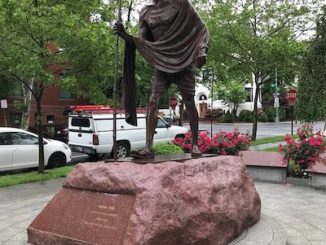
The 6-ft tall, 650-pound (294 kg) bronze statue of Gandhi in the Central Park of the City of Davis in Northern California was vandalized, broken and ripped from the base by unknown criminals early this week.
“Nonviolent, respectful protest was the essence of Gandhi’s life mission. To see the desecration of this magnificent statue only underscores the need for more people to study Gandhi’s teachings, not unilaterally erase him from the public discourse,” Khanna said.
“This was a shameful act. At a moment in our history when disagreement needs to be managed with tolerance and patience, I urge everyone involved to take the time to listen and talk instead of resorting to acts of public vandalism,” he said.
As the Democratic Vice Chair of the India Caucus, Khanna said he will continue to work with his colleagues to build bridges across these divisions.
“I encourage everyone to join me in working through disagreement with dialogue and discussion, rather than resorting to violence that tears at the fabric of our society,” he said.
Meanwhile, two groups gathered at the park in Davis on Sunday where the statue was vandalized, local media reported. While one group demanded that the statue be restored, the other opposed such a move.
The City of Davis has launched an investigation into the incident.
“The City of Davis condemns the vandalism that destroyed the statue of Mahatma Mohandas Gandhi in Central Park. We do not support any actions that include the destruction of property,” the city said in a statement on Sunday.
“We understand that our community reflects a diversity of views and values, but we expect that everyone will extend respect to each other and to shared spaces,” it said.
But we reiterate our belief that the solution to solving such differences is never in violent acts but through compromise and dialogue. It is our sincere desire that our community move forward with peaceful and positive discourse and reconciliation,” the city said in its statement.
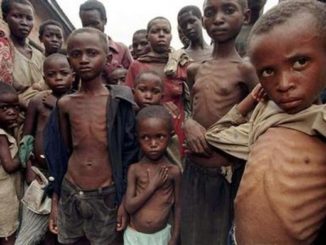
The World Food Programme may have got the Nobel Peace Prize, but the world is not winning against hunger
As the humanitarian organization Mercy Corps puts it, “Hunger and malnutrition are the biggest risks to health worldwide – greater than AIDS, malaria and tuberculosis combined. Globally, food deprivation still claims a child’s life every three seconds and nearly half of all deaths in children under five are attributable to undernutrition”. Eveyone.org, another charity organization says “Every hour of every day, 300 children die because of malnutrition. It’s an underlying cause of more than a third of children’s deaths – 2.6 million every year”. There is an urgent need to take action on war footing against such a situation.
Since its establishment, the WFP has responded to natural disasters and conflicts around the world. Currently, it is working in a number of countries, and it faces its severest challenges in three conflict-torn countries, namely Yemen, Afghanistan and South Sudan.
As Mahatma Gandhi had said, there are people in the world so hungry, that God cannot appear to them except in the form of bread. Hunger is one of mankind’s worst enemies and has driven millions of people to desperation; it has also provided the subject-matter for some powerful literature, an outstanding example being the French writer Victor Hugo’s classic ‘Les Misérables’.
In her article Let Them Eat Bread: The Theft That Helped Inspire ‘Les Misérables’ which appeared in the ‘npr’ (National Public Radio) in March 2017,Nina Martyris wrote:
“On a bitterly cold day in February 1846, the French writer Victor Hugo was on his way to work when he saw something that affected him profoundly. A thin young man with a loaf of bread under his arm was being led away by police. Bystanders said he was being arrested for stealing the loaf. He was dressed in mud-spattered clothes, his bare feet thrust into clogs, his ankles wrapped in bloodied rags in lieu of stockings.”
“It made me think,” wrote Hugo. “The man was no longer a man in my eyes but the specter of la misère, of poverty.” In his novel, Hugo portrays the family’s circumstances in these few, short lines: “A very hard winter came. Jean had no work. The family had no bread. No bread literally. Seven children!”
Jean Valjean is sentenced to five years’ hard labor for stealing a loaf of bread! He attempted to escape four times, and each time his sentence was lengthened by three years; he also received an extra two years for once resisting recapture during his second escape. After nineteen years in prison, he was released, but by law had to carry a yellow passport that announced that he is an ex-convict, an outcast. Hugo uses that loaf to attack society’s criminal indifference to poverty and hunger and to highlight the injustice of the penal system.
‘Les Misérables’ should have awakened mankind’s conscience, but one must ask oneself if it has succeeded in doing that. As former US President Dwight Eisenhower said, “Every gun that is made, every warship launched, every rocket fired, signifies in the final sense a theft from those who hunger and are not fed, those who are cold and not clothed”.
As the humanitarian organization Mercy Corps puts it, “Hunger and malnutrition are the biggest risks to health worldwide – greater than AIDS, malaria and tuberculosis combined. Globally, food deprivation still claims a child’s life every three seconds and nearly half of all deaths in children under five are attributable to undernutrition”. Eveyone.org, another charity organization says “Every hour of every day, 300 children die because of malnutrition. It’s an underlying cause of more than a third of children’s deaths – 2.6 million every year”. There is an urgent need to take action on war footing against such a situation.
“India is home to a quarter of all undernourished people worldwide, making the country a key focus for tackling hunger on a global scale.” India ranks 94 among 107 countries in 2020 Global Hunger Index, even below neighbors like Bangladesh, Nepal and Pakistan Picture / Courtesy Akshaya Patra
We, as individuals, also have a great responsibility. In such trying times, the words of Mother Teresa should guide us: ” If you cannot feed a hundred people, then feed just one.”
Thus, the announcement by the Norwegian Nobel Committee on October 9 that the World Food Programme( WFP) has been awarded the Nobel Peace Prize in 2020 is indeed most welcome. The award has been given for its efforts to combat hunger, for its contribution to bettering conditions for peace in conflict-affected areas and for acting as a driving force in efforts to prevent the use of hunger as a weapon of war and conflict.
The World Food Programme(WPF) has indeed been doing God’s work by providing food aid through the UN system since 1961. Its website mentions: “Every day too many men and women across the globe struggle to feed their children a nutritious meal. In a world where we produce enough food to feed everyone, 690 million people still go to bed on an empty stomach each night. Acute food insecurity affected 135 million people in 55 countries in 2019. Even more – one in three – suffer from some form of malnutrition”.
Since its establishment, the WFP has responded to natural disasters and conflicts around the world. Currently, it is working in a number of countries, and it faces its severest challenges in three conflict-torn countries, namely Yemen, Afghanistan and South Sudan.
Announcing the Nobel Peace Prize, the Chairperson of the Committee, Berit Reiss-Andersen said at a news conference: “The World Food Programme plays a key role in multilateral co-operation in making food security an instrument of peace”. She also said that with this year’s award, the committee wanted to “turn the eyes of the world to the millions of people who suffer from or face the threat of hunger”.
In 2015 the global community adopted the 17 Global Goals for Sustainable Development to improve people’s lives by 2030. Goal Two is ‘Zero Hunger’ which pledges to end hunger, achieve food security, improve nutrition and promote sustainable agriculture. Achieving this goal is the priority of the WFP; if present trends continue, the number of people affected by hunger will surpass 840 million by 2030, or 9.8 percent of the global population.
It may be mentioned that India has enjoyed steady economic growth and has achieved self-sufficiency in grain production in recent years. Despite this, high levels of poverty, food insecurity and malnutrition persist. The WFP’s website mentions that it has been working in India since 1963, with work transitioning from food distribution to technical assistance since the country achieved self-sufficiency in cereal production. It also says something that should prick our conscience: “India is home to a quarter of all undernourished people worldwide, making the country a key focus for tackling hunger on a global scale. In the last two decades, per capita income more than tripled, yet the minimum dietary intake fell. The gap between rich and poor increased during this period of high economic growth”.
Coronavirus has further multiplied the challenges which India faces. In the second week of April 2020 itself, the International Labour Organization (ILO) had said that about 400 million workers from India’s informal sector are likely to be pushed deeper into poverty due to Covid-19. There is no doubt that during the past six months, poverty in the country has worsened; so too, has hunger. The Government as well as many NGO’s are grappling with the colossal problem of feeding millions of impoverished people who have lost even their means of earning a livelihood.
We, as individuals, also have a great responsibility. In such trying times, the words of Mother Teresa should guide us: ” If you cannot feed a hundred people, then feed just one.”
WASHINGTON(TIP): Six US lawmakers, including four Indian American members of the House have introduced a bipartisan resolution honoring the life of Mahatma Gandhi and his enduring legacy in the present world.
The resolution was introduced by Indian Americans Raja Krishnamoorthi, Ami Bera, Pramila Jayapal, and Ro Khanna (all Democrats) together with India Caucus Chairmen Brad Sherman (Democrat) and George Holding (Republican).
Celebrating the life of Mahatma Gandhi, the resolution “encourages the people of the United States to observe the International Day of Non-Violence and supports freedom of religion around the world.”
It also “encourages individual and community self-improvement and civic education and recognizes that elections, democracy, and freedom are essential rights for all people.”
“As we celebrate the anniversary of his birth on October 2nd, I am proud to honor Mahatma Gandhi’s incredible life and enduring legacy through this bipartisan resolution,” said Krishnamoorthi.
“Despite facing tremendous hardship and injustice throughout his life, Gandhi never wavered in his fight for freedom, dignity and equality for all,” he said. “The example he set continues to inspire thousands of people young and old across the world today.”
“His principle of non-violent protest spawned civil rights movements around the world and continues to inspire similarly non-violent movements to this day.”
“I am proud to play my part in honoring his legacy through this resolution and to encourage the people of the United States to observe the International Day of Nonviolence in his memory,” said Krishnamoorthi.
“Today, as we celebrate the anniversary of the birth of Mahatma Gandhi, we must also honor his extraordinary life and enduring legacy of non-violence and equality” said Sherman.
“As Co-Chair of the Caucus on India and Indian Americans, I was proud to help introduce this bipartisan resolution that commemorates Gandhi’s contributions towards freedom struggles across the world.”
The resolution, Sherman said, “will help enshrine Gandhi’s eternal message: All our activities should be centered in truth. Where there is no truth, there can be no true knowledge.”
“As co-chair of the Congressional Caucus on India and Indian Americans, I believe it’s important, now more than ever, that we remember and celebrate Mahatma Gandhi’s non-violent legacy – something that continues to inspire people around the world,” said Holding.
NEW YORK (TIP): Mahatma Gandhi’s statue outside the Indian Embassy in Washington DC was desecrated by some miscreants. The statue was allegedly spray painted with expletives. Soon after the incident took place, the statue was covered with protective cloth and an investigation was launched by United States Park Police.
The Indian embassy spokesperson, in response to queries from The Indian Panorama, June 4,stated that “Mahatma Gandhi statue at the Mahatma Gandhi Memorial Plaza in front of the Embassy was vandalized with graffiti/spray paint by unknown persons during the late hours of Tuesday, 2 June 2020.
The Embassy has taken up the matter with the US Department of State for early investigation into the matter, as also with the Metropolitan Police and National Park Service. The Embassy is working with the US Department of State, Metropolitan Police and National Park Service for expeditious restoration of the statue at the park”.
Ken Juster, US Ambassador to India, has apologized for the incident. “So sorry to see the desecration of the Gandhi statue in Wash, DC. Please accept our sincere apologies. Appalled as well by the horrific death of George Floyd & the awful violence & vandalism. We stand against prejudice & discrimination of any type. We will recover & be better,” Juster said on Twitter.
Soon after the incident took place, the statue was covered with protective cloth
Indian Americans are outraged for the ‘profane desecration.’ “A Molotov cocktail of profanity and hatred, cooked by the tear-filled pages of sad history across humanity existence in every culture and eco-system, was splashed across Mahatma Gandhi’s statue during the Tsunami of George Floyd’s protest” said New York based eminent attorney Ravi Batra.
“That the root of non-violent civil protest was desecrated speaks not of any disrespect, as Mahatma Gandhi is free of such temporal stain as the sun is free of clouds, but of the intertwined pain of age-old racism that humanity sadly enjoys, horrible economic destruction from the Wuhan Virus, and criminals who remain society’s recurring illness. Add to that the pain from the fact that the American Dream is beyond the reach of many. So, the George Floyd protests, necessary for proper societal recalibration, have included criminality and elements of the 1789 French Revolution and storming the Bastille to overthrow a feudalist society. It is this last fact, not the restoration of the Gandhi statue – a given – that is concerning. Having been involved with Yogesh Gandhi to get the Gandhi statue erected in Union Square decades ago, I’m certain Mahatma Gandhi remains unruffled by the profane desecration, and only wishes to comfort hearts that are burning with such hatred so as to save them from being in jail”, he added.
One of the few statues of a foreign leader in Washington DC, the statue of Mahatma Gandhi was dedicated by the then Prime Minister Atal Behari Vajpayee, in the presence of the then US president Bill Clinton on September 16, 2000, during his state visit to the US.
Upon reaching India in 1959, the Rev. Dr. Martin Luther King Jr. remarked, “To other countries I may go as a tourist, but to India I come as a pilgrim.” He added, “Perhaps, above all, India is the land where the techniques of nonviolent social change were developed that my people have used in Montgomery, Alabama, and elsewhere throughout the American South. We have found them to be effective and sustaining — they work!”
The guiding light whose inspiration got Dr. King to India was Mohandas Karamchand Gandhi, the Mahatma, the Great Soul. On Wednesday, we observe his 150th birth anniversary. Gandhi Ji, or Bapu, continues to give courage to millions globally.
Gandhian methods of resistance ignited a spirit of hope among several African nations. Dr. King remarked: “When I was visiting in Ghana, West Africa, Prime Minister Nkrumah told me that he had read the works of Gandhi and felt that nonviolent resistance could be extended there. We recall that South Africa has had bus boycotts also.”
Nelson Mandela referred to Gandhi as “the Sacred Warrior” and wrote, “His strategy of noncooperation, his assertion that we can be dominated only if we cooperate with our dominators, and his nonviolent resistance inspired anticolonial and antiracist movements internationally in our century.”
For Mr. Mandela, Gandhi was Indian and South African. Gandhi would have approved. He had the unique ability to become a bridge between some of the greatest contradictions in human society.
In 1925, Gandhi wrote in “Young India”: “It is impossible for one to be internationalist without being a nationalist. Internationalism is possible only when nationalism becomes a fact, i.e., when peoples belonging to different countries have organized themselves and are able to act as one man.” He envisioned Indian nationalism as one that was never narrow or exclusive but one that worked for the service of humanity.
Mahatma Gandhi also epitomized trust among all sections of society. In 1917, Ahmedabad in Gujarat witnessed a huge textile strike. When the conflict between the mill workers and owners escalated to a point of no return, it was Gandhi who mediated an equitable settlement.
Gandhi formed the Majoor Mahajan Sangh, an association for workers’ rights. At first sight, it may seem just another name of an organization but it reveals how small steps created a large impact. During those days, “Mahajan” was used as a title of respect for elites. Gandhi inverted the social structure by attaching the name “Mahajan” to “Majoor,” or laborers. With that linguistic choice, Gandhi enhanced the pride of workers.
And Gandhi combined ordinary objects with mass politics. Who else could have used a charkha, a spinning wheel, and khadi, Indian homespun cloth, as symbols of economic self-reliance and empowerment for a nation?
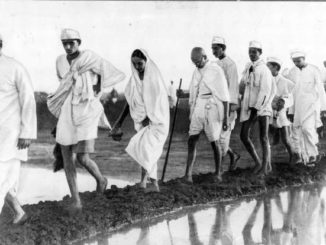
Who else could have created a mass agitation through a pinch of salt! During colonial rule, Salt Laws, which placed a new tax on Indian salt, had become a burden. Through the Dandi March in 1930, Gandhi challenged the Salt Laws. His picking up a small lump of natural salt from the Arabian Sea shore led to the historic civil disobedience movement.
There have been many mass movements in the world, many strands of the freedom struggle even in India, but what sets apart the Gandhian struggle and those inspired by him is the wide-scale public participation. He never held administrative or elected office. He was never tempted by power.
For him, independence was not absence of external rule. He saw a deep link between political independence and personal empowerment. He envisioned a world where every citizen has dignity and prosperity. When the world spoke about rights, Gandhi emphasized duties. He wrote in “Young India”: “The true source of rights is duty. If we all discharge our duties, rights will not be far to seek.” He wrote in the journal Harijan, “Rights accrue automatically to him who duly performs his duties.”
Gandhi gave us the doctrine of trusteeship, which emphasized the socio-economic welfare of the poor. Inspired by that, we should think about a spirit of ownership. We, as inheritors of the earth, are responsible for its well-being, including that of the flora and fauna with whom we share our planet.
In Gandhi, we have the best teacher to guide us. From uniting those who believe in humanity to furthering sustainable development and ensuring economic self-reliance, Gandhi offers solutions to every problem.
We in India are doing our bit. India is among the fastest when it comes to eliminating poverty. Our sanitation efforts have drawn global attention. India is also taking the lead in harnessing renewable resources through efforts like the International Solar Alliance, which has brought together several nations to leverage solar energy for a sustainable future. We want to do even more, with the world and for the world.
As a tribute to Gandhi, I propose what I call the Einstein Challenge. We know Albert Einstein’s famous words on Gandhi: “Generations to come will scarce believe that such a one as this ever in flesh and blood walked upon this earth.”
How do we ensure the ideals of Gandhi are remembered by future generations? I invite thinkers, entrepreneurs and tech leaders to be at the forefront of spreading Gandhi’s ideas through innovation.
Let us work shoulder to shoulder to make our world prosperous and free from hate, violence and suffering. That is when we will fulfill Mahatma Gandhi’s dream, summed up in his favorite hymn, “Vaishnava Jana To,” which says that a true human is one who feels the pain of others, removes misery and is never arrogant.
Nancy Pelosi attends commemorative event at the Library of Congress
WASHINGTON(TIP): As part of the celebrations to mark the 150th birth anniversary of Mahatma Gandhi, the Indian Embassy here organized a commemorative event at the Library of Congress, October 2. A one-day exhibition on the life and teachings of Mahatma Gandhi was held at the Library of Congress.
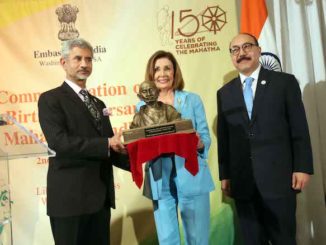
The exhibition was followed by an event where the Speaker of the House, Nancy Pelosi was the Guest of Honor. External Affairs Minister Dr. S Jaishankar and Speaker Pelosi addressed the gathering. Mr. Jaishankar spoke about the influence of the Mahatma on India’s independence struggle and how his ideas had been the key factor in bringing about social change in India.
External Affairs Minister Jaishankar (left) presents a half-bust statue of Mahatma Gandhi to Nancy Patricia Pelosi, Speaker of the United States Congress, as Ambassador Harshvardhan Shringla (right) looks on, during the celebration of Mahatma Gandhi’s 150th Birth Anniversary at the US Capitol in Washington DC , October 2 Photo / Jay Mandal-on assignment
Mr. Jaishankar also spoke about the various flagship programs of the government of India and how they were based on the ideals of the Mahatma. The event was attended by senior officials from administration, media and business community.
Earlier in the day, External Affairs Minister Dr. S Jaishankar and Ambassador Harsh Vardhan Shringla offered floral tributes at the Statue of Mahatma Gandhi in front of the Embassy. Mr. Jaishankar briefly interacted with members of the Indian community at the event.
CHICAGO(TIP): Mayor Lori Lightfoot issued, Spt. 30, a Proclamation declaring October 2, 2019 Mahatma Gandhi Day in the City of Chicago, at an event hosted by the Delhi Committee of the Chicago Sister Cities in partnership with World Business Chicago. The luncheon was held in honor of Mahatma Gandhi’s 150th Birth Anniversary. Smita N. Shah, Chairman of the Delhi Committee, introduced honored guests, United States Senator Richard J. Durbin and Chicago Mayor Lori E. Lightfoot. Also present were four Consul Generals from India, Sudhakar Dalela, Consul General of South Africa Phumzile Mazibuko, Consul General of the United Kingdom John Saville, and Honorary Consul General of Nepal, Marvin Brustin. Other notable guests were Niranjan S. Shah, Vijay Dave, Maarten de Jeu, Babu Patel, Keerthi Kumar Ravoori, and Nick Patel.
“Chicago has a unique history with India, from the Parliament of World Religions in 1893, when Swami Vivekananda came and spoke of the universal unity of religion,” said Smita Shah, chairman of the Delhi Committee. “It is fitting that Chicago is among the first to recognize Mahatma Gandhi’s 150th birth Anniversary.”
“Chicago and the Delhi Committee is one of the first to have an annual Mahatma Gandhi celebration,” commented Andrea Zopp, former Deputy Mayor and CEO of World Business Chicago. “This is unique, and we are honored to do it.”
“The Delhi Committee of Chicago Sister Cities promotes cultural, social and economic exchange between the citizens of Chicago and the citizens of India,” said Smita N. Shah. “We honor Gandhi today, because it is such a significant example of the value of global exchanges.”
Senator Durbin explained how Mahatma Gandhi “was inspired by American philosopher Henry David Thoreau, in the concept of civil disobedience. In return, he inspired many world leaders, including Nelson Mandela and Martin Luther King,” said Senator Durbin. “We can all have an impact on improving lives by working together.”
Senator Durbin also spoke of the importance of immigrants in this country. “Immigrants in this country have made a tremendous contribution,” Senator Durbin noted. “This Senator believes in immigration. This Senator stands by the communities of the City of Chicago.”
Delhi Chairman Smita Shah, in introducing Mayor Lightfoot, noted that “Gandhi’s fight for independence included a desire to fight poverty, create social economic opportunity for citizens and to ensure the preservation of human dignity,”
Mayor Lightfoot gave a moving and impassioned speech about Mahatma Gandhi and his contributions, and how we all can learn from him. “Poverty is the worst form of violence,” she quoted Gandhiji. “We must do better for all of our communities. We must do better for our immigrant communities.”
Smita N. Shah noted, “I see Mayor Lightfoot in that same fight for human dignity for all. Mayor Lightfoot reminds our community and the citizens of this City that strength and conviction belongs to everyone, and that we need to do well for each member of our city. That we cannot be successful unless each neighborhood and community has an opportunity for education and economic opportunity.”
“This is about human dignity,” said Mayor Lightfoot. “We are going to give all people, in every community, especially the neediest and including the immigrant community, their dignity.”
Excerpts from Proclamation, full image follows below:
“Whereas October 2, 2019 marks the occasion of the 150th anniversary of the birth of Mahatma Gandhi; and “Whereas, Gandhi is revered the world over for his nonviolent philosophy of passive resistance and as an advocate for all people, including the poor and disenfranchised, championing the causes of education, economic opportunity, and equality amongst all; and “Whereas Gandhi is often named among the 20th century’s most important figures…
“Whereas, founded in 2014 by the Delhi Committee of Chicago Sister Cities International, under the leadership of Smita Shah, the Annual Legacy of Mahatma Gandhi Luncheon honors Gandhi’s lasting contributions and inspires us all to follow the example left by him:
“Now, Therefore, I, Lori e. Lightfoot, mayor of the city of Chicago, do hereby proclaim October 2, 2019 to be Mahatma Gandhi Day in Chicago, in recognition of the important legacy of Mahatma Gandhi.”
WASHINGTON(TIP): US lawmakers on Wednesday, Oct 2, introduced a bipartisan resolution in the Congress to commemorate the memory and legacy of the apostle of peace.
Coinciding with the 150th birth anniversary of Mahatma Gandhi, US lawmakers on Wednesday introduced bipartisan resolutions in the Congress to commemorate the memory and legacy of the apostle of peace.
In the Senate, it was introduced by Senators Ted Cruz and Robert Menendez, while in the House of Representatives it was introduced by Congresswoman Grace Meng.
The Senate resolution recognizes Gandhi’s decades-long struggle for Indian independence from Great Britain, and his pioneering of non-violent protest as a means of political change which helped to liberate millions of Indians, and inspiring peaceful activists around the world, including Dr Martin Luther King, Jr.
The resolution supports the ideals and goals of the International Day of Non-Violence and calls on all Americans to observe it.
“Gandhi’s unwavering commitment to peaceful dissent inspired countless others not just in India but around the world,” Cruz said.
“His life, sacrifices, and legacy continue to be a light around the world, calling attention to the tyranny and injustice that dictators seek to conduct in darkness. Let us honor him by continuing to encourage and support all of those seeking to be free,” he said.
“I am proud to lead this resolution which honors Gandhi, a man whose memory is held with such reverence around the world. Gandhi was the great spirit that led India’s people to freedom,” Menendez said.
“As we honor his towering legacy as a champion of human rights and democracy, we also draw inspiration to face our own challenges today all around the world,” Menendez added.
“Equal rights for women. Equal rights for minorities. Equal rights for the LGBT community. Protection of the environment. As we mark this momentous 150th anniversary of Gandhi’s birth, let ourselves recommit to the values that he preached and embodied,” he said further.
Meng said Gandhi was a monumental civil rights and spiritual leader who demonstrated that peaceful protests can bring change.
“We honor his legacy with a resolution that calls on all to recognize his important contributions to the world,” she said.
“Our own civil rights heroes, like Dr Martin Luther King, were influenced by Gandhi’s work and it is critical that we strive each day to change the world in a peaceful manner. I urge all Americans to join me in marking International Day of Non-Violence,” Meng said.
“On the 150th anniversary of Gandhi’s birth, I celebrate the profound legacy of his teachings of non-violence and civil disobedience—in the land of my birth and the land I now call home,” Indian American Congresswoman Pramila Jayapal said in a tweet.
Congressman Andy Levin said Gandhi’s philosophy and practice of nonviolent resistance inspired some of the most powerful social justice movements in modern history.
“May we honor him on his 150th birthday by living out his commitment to peace, integrity and equality,” he said.
“Gandhi is a hero, not just to India, but to the world. You may never know what results come of your actions, but if you do nothing, there will be no results,” tweeted Congressman Eliot Engel, Chairman of the House Foreign Affairs Committee.
US Commission on International Religious Freedom Commissioner Tony Perkins joined people across the world in celebrating the life of Mahatma Gandhi, a dedicated champion of nonviolence and religious tolerance, including religious freedom for all. In a statement , he said, “Through his example of embracing the fundamental human right of religious freedom, he fostered an environment of religious freedom and diversity. Gandhi’s 150th birthday is an opportunity to reflect upon these timeless and universal principles”.
“Mahatma Gandhi changed the course of world history,” said USCIRF Commissioner Anurima Bhargava.
“As we commemorate Gandhi’s 150th birthday, we must recommit to Gandhian principles in India and in many societies where religious minorities are currently being expelled rather than embraced,” she said.
(Source: PTI)
Signup to our Newsletter!
Don’t miss out on all the happenings around the world