Tag: Mahavir Jayanti

  • Mahavir Jayanti celebrated at the Indian Consulate

    Mahavir Jayanti celebrated at the Indian Consulate

    Dr. Varun Jeph giving his remarks
    Guest speakers Samniji Nirdeshika Kamal Pragya and Samniji Karuna Pragya giving a talk

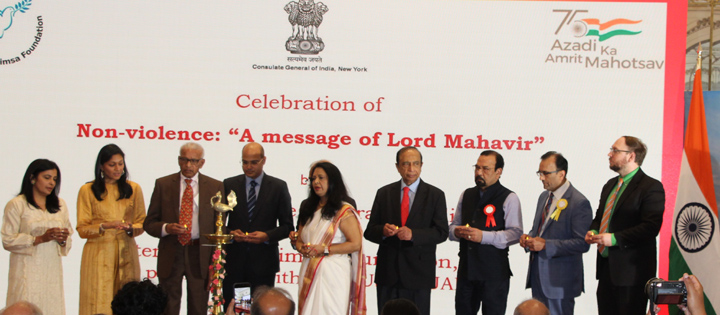
    NEW YORK (TIP): The Consulate General of India, NY and International Ahimsa Foundation Inc. in partnership with JITO USA (Jain International Trade Org – USA), and JAINA (Federation of Jain Associations in NA), hosted Mahavir Jayanti, Lord Mahavir’s 2621st birth anniversary Celebration on Saturday, May 20th, 2023, at the Ballroom of the Consulate General of India in NY. The event also celebrated India’s yearlong initiative: Azadi ka Amrit Mahotsav (75 years of India’s independence).The program was attended by about 200 guests.
    The event was graced by many dignitaries and community leaders. Deputy Consul General of India Dr. Varun Jeph In his keynote address said : “ Lets bring more of Lord Mahavir’s message of Ahimsa & Satya ( truthfulness) in our lives. ” Congressman Gregory W. Meeks sent his best wishes via a video message. He said that this year’s occasion will bring together the community to honor Lord Mahavir’s principles of non-violence and peace.” Former Congresswoman Carolyn B. Maloney also emphasized the importance of “Live and Let Live” in today’s time, a teaching of Lord Mahavir. NYS Assemblyman David Weprin was represented by his Chief of Staff David Sprea and was also joined by Ms. Miosotis Munoz, Deputy Commissioner of External affairs, NYC Mayor’s Office of Immigration Affairs. She also mentioned that Mayor Adams truly believes in non-violence. Democratic District Leader Gurdip Singh Narula also attended the event.
    We extend our sincere appreciation to our esteemed guest speakers, Samniji Nirdeshika Kamal Pragya and Samniji Karuna Pragya, for their blessings and enlightening talks. Their profound insights and teachings on non-violence were truly educative.
    Dr. Neeta Jain, Founder and President of International Ahimsa Foundation Inc. dwelt on Lord Mahavir’s life She stressed on teaching children the 5 Jain principles to make the world a better place to live in. She further mentioned that Lord Mahavir is the one that told the world that “Non-Violence is the Supreme Religion and it’s more relevant in today’s world than ever before. We should pass on Mahavir’s teachings to our next generation so they can learn how to adopt the virtues of non -violence in their lives and make this world a better place to live in peace and harmony.”
    On this occasion, the organization honored 4 distinguished individuals with the “Ahimsa Award” for their extraordinary contributions to society. They included Dr. Ashok Shaha MD (Chair Head and Neck Surgery/Oncology, Memorial Sloan Kettering Cancer Center), Mr. Arvind Vora (Chair, JAINA Interfaith Committee & Shanti Fund of Long Island), Ms. Sweta Jain (Founder & President, Goshwara, Luxury Designer Jewelry), Ms. Kavita Bafana (Cofounder, Little Ustaads Music & Namaste Book Series), for their remarkable contributions and achievements. Their presence inspired many youngsters who attended the event.
    “Ahimsa Awards” and a NYS Assembly Proclamation were presented to honorees by Deputy Consul General, Dr. Varun Jeph, Board of Director IAF, Dr. Ravi Goyal, President and Founder, Dr. Neeta Jain, Vice President, Mr. Amarjyoti Jain and Chair Advisory Board, Mr. Rajeev Pandya.
    “All four honorees are purveyors of peace and align with our mission to spread Lord Mahavir’s message of ‘Live and Let Live,’” Dr. Jain said. Dr. Ashok Shaha said in his acceptance speech that “Forgiveness is the most Important virtue in Life”
    Mr. Arvind Vora another honoree expressed his views after the event as “ one can’t expect better way to celebrate Mahavir Jayanti than the confluence of dignified location of Indian Consulate, partner organizations like JITO & JAINA, stage decorations including Gandhi on a spinning wheel, participation by youths in dance and skit conveying messages of Mahavir and diverse audiences. Everything was wrapped up very efficiently.”
    Ms. Sweta Jain also emphasized in her speech, the importance of “Practicing Ahimsa in today’s time.
    Ms Kavita Bafana expressed her views on how important it is to keep our culture alive.

    The International Ahimsa Foundation Inc. was founded in 2012 with the goal of spreading the message of non-violence and peace based on Jain teachings throughout the world.

    The event was emceed by Aditi Lamba and began with the American National Anthem sung by Michelle Della Fave. Dr. Smita Guha sang the Indian National Anthem. A skit was presented by young Jains on “Color of Thoughts and their impact” directed by Surbhi Pandya. Two mesmerizing performances were presented on “Mahavir Sa Mujko Ban jana Hai” and “Garaj Garaj Aaj Megha”.by Little Ustad Arts: Directed by Kavita Bafana and Vanita Kothari. Mr. Rajeev Pandya Chair, Advisory Board of IAF thanked all the sponsors, media partners and volunteers. At the end, Jain lunch was served.
    You can watch the video at Indian Consulate fb @indiainnewyork or IAF fb page. You can also follow International Ahimsa Foundation on our website: International Ahimsa Foundation New York!
    (Press release)

    A dance performance by Little Ustad Arts
    Honorees with Deputy Consul General Dr. Varun Jeph and organizers
  • US President Biden, VP Harris greet Jain community on Mahavir Jayanti

    US President Biden, VP Harris greet Jain community on Mahavir Jayanti

    WASHINGTON, D.C. (TIP): US President Joe Biden and Vice President Kamala Harris have extended their greetings of Mahavir Jayanti to the Jain community across the world and encouraged people to strive for peace and harmony. “(First Lady) Jill (Biden) and I wish a happy and prosperous Mahavir Jayanti to all those observing. Today, we recognize the values of Mahavir Swami and strive to live with peace, truth, and harmony,” Biden tweeted on Tuesday. Vice President Harris also sent her greetings on the occasion.

    “On Mahavir Jayanti, Doug and I join Jains around the world in celebrating the birth of Mahavir Swami, who taught that all living beings are equal. Today, let us recommit to upholding these universal values of respect and non-violence,” Harris tweeted. The greetings from the US president and the vice president were welcomed by an Indian American community leader.

    “We members of the Jain community thank President Biden and Vice President Harris for sending greetings on the occasion of Mahavir Jayanti, which no other president has done in the last,” said community leader Ajay Jain Bhutoria. “On this day, let us also take a pledge to work towards creating a more peaceful and harmonious world by following the path of Ahimsa, which was the core principle of Lord Mahavir’s teachings,” he said.

    Let us strive to create a society where there is no violence, discrimination, or hatred, and where everyone is treated with equal dignity and respect, Bhutoria said in a statement.

    “As we celebrate the birth of Lord Mahavir, let us also take a moment to reflect on his life and teachings, and to seek inspiration from his journey towards enlightenment. May this day bring us closer to our true selves and help us lead a life of purpose, compassion, and righteousness,” Bhutoria said.

  • Mahavir Jayanti

    Mahavir Jayanti

    Mahavir Jayanti is one of the most significant festivals among the Jain community and is celebrated with splendour in India and across the world. The festival commemorates the birth of Lord Mahavira. As per Jain mythology, Lord Mahavira is the 24th Tirthankara of Jainism. In 2021, Mahavir Jayanti will be celebrated on the 25th of April.

    History

    As per Jain texts and religious scripts, Lord Mahavira took birth on the 13th day of waxing moon on the Chaitra month (Hindu calendar) in Kundalagrama (now Kundalpur) in Bihar, a few kilometres from Patna. That time, Vaishali was considered to be the capital of the state. However, the year of Mahavira’s birth is disputed. As per Swetambar Jains, Mahavira was born in 599 BC while the Digambar Jains consider 615 BC as his birth year. He was named as Vardhaman by his parents – King Siddhartha and Queen Trisala.

    As per Swetambar community’s beliefs, Mahavira’s mother had 14 dreams, which were later interpreted by astrologers all of whom said that Mahavira would either go on to become an emperor or a sage (Tirthankara). When Mahavira reached 30, he left his throne and family in search of truth. He lived in exile for 12 years as an ascetic. During this time, he preached non-violence treated all everyone with reverence. He got his name “Mahavira” after showing exceptional skills in controlling the senses. It is widely belied that when Mahavira was 72, he attained enlightenment (Nirvana).

    Festivities

    The Jain community takes part in several festivities, which permit them to pledge with families and friends. Lord Mahavir is respected and worshipped by this community. The demonstration of an idol of Lord Mahavir is the most important festivity of the festival. The effigy of Mahavir is washed by the people with fragranced oil and this will denote the purity of the Lord.

    Devotees across India and the globe will visit Jain temples in the country. Antique ancient spots, which are connected to the community of Jainism, are visited by people. One of the renowned destinations to visit during the festival is Gomateshwara. It is quite interesting to notice that many Jains bestow money or food to temples. The festivities will remain the same.

    Public Life

    In India, Mahavir Jayanti is a gazetted holiday. State, local and national level government workplaces will remain closed. The shops and commercial outlets owned by the community of Jains will also remain closed. If not, they may have shortened functioning hours.

    The festival is celebrated to champion the cause of peace and harmony, and also spread the teachings of Lord Mahavira. A procession is carried out in the form of “rath yatra” with Lord Mahavira’s idol neatly placed on the top. Jain temples are decorated with flags while the Jains offer food and clothes to the needy. Jainism vehemently opposes animal slaughter and hence donations are made to stop animal killings.

    Other than charitable acts, prayers are offered in temples dedicated to Lord Mahavira. Some other devotes often engage in meditation—a practice championed by Mahavira. Old and famous Jain temples witness a huge surge in devotees on this day. Teachings of Mahavira and Jainism are recited by monks and nuns.

    Mahavir Jayanti is predominantly a Jain festival and to get the true essence of it, you can visit any of the Jain temples.

    Spiritual destinations

    Consider the following Indian destinations to visit during this festival:

    –              Madhuban: Madhuban, sited in Jharkhand, is the divinest destination for Jains.

    –              Girnarji: Girnarji is a place located in the Indian state of Gujarat.

    –              Gomateshwara: Gomateshwara is the most attractive destination in Karnataka to visit during this festival every year.

    –              Mangi Tungi: Mungi Tungi is another renowned Indian place of adoration for Jains in Maharashtra.

    –              Gajpantha: This is also the best place in Maharashtra. It has a beautiful temple. Devotees have to climb not less than 460 steps to reach.

    Teachings

    Belief in Soul and Karma

    According to Mahavira every element was a combination of material and spiritual factors. While the material factor is perishable, the spiritual factor is external and consistently evolving itself. He held that the soul was held in a state of bondage due to karma.

    The soul can be released from the bondage by getting rid of passions. He believed that the soul could be finally liberated only by the disintegration of Karmik force. According to him with the decay of the karmas the intrinsic value of the soul can be highlighted and the soul shines in full luminosity. When the soul attains infinite greatness it becomes Paramatma, the pure soul, with infinite knowledge, power and bliss.

    Nirvana

    The chief object of life according to Maha­vira is to attain salvation. He therefore insisted on avoiding evil Karmas, prevent all kinds of fresh Karmas and destroy the existing ones. According to him this could be attained through five vows viz., non-injury (Ahimsa), speaking truth (Satya), non-stealing (Asteya), non-adultery (Brahmacharya) and non-possession (aparigraha).

    In addition to taking these five vows he also insisted on principles of right conduct, right faith and right knowledge. Right conduct implied a dispassionate attitude towards senses. He said that we must treat the sufferings and happiness on equal planks.

    Right faith meant belief in the Jinas and right knowledge meant the knowledge of the eventual liberation. The above vows and princi­ples were meant for the householders. The Monks etc. had to follow a more severe code.

    Non-belief in God

    Mahavira did not believe in God nor did he believe that he created the world or exercised any personal control over it. According to him the world never comes to an end. No matter ends, it simply changes its form. Since the universe is also composed of certain matters it simply changes its form. We clearly find the influence of the Sankhya philosophy as far as this principle is concerned.

    Mahavira further believed that the emanci­pation of man does not depend on the mercy of any outside autho­rity. The man was the maker of his own destiny. While leading a life of austerity and self-mortification man can get rid of his miseries and sorrows. According to Mahavira the best way to attain salva­tion is through renunciation.

    Rejection of Vedas

    Jainism also rejected the theory of the Vedas and attached no importance to the sacrificial rituals of the Brahmans.

    Ahimsa

    Mahavira laid too much importance on Ahimsa. According to him all creatures, animals, plants, stones, rocks etc. possess life and one should not do any harm to the other in speech, deed or action. Though this principle was not entirely a new one, credit goes to the Jains that they popularized it and thereby put an end to the practice of various types of sacrifices.

    Freedom to women

    Mahavira favoured the freedom of women and believed that they also had the right to attain Nirvana. In this respect Mahavira followed the example of his predecessor, Parsva Nath. Women were allowed in the Jain Sangha and many women became Sarmini and Sravikas.

    It will be evident from the above teachings of Mahavira that he was more of a reformer of the existing religion rather than the founder of a new faith.