Tag: Mahmoud Khalil

  • The Trump Administration’s Attacks on Freedom of Speech and the Threat to American Democracy

    By Prof. Indrajit S Saluja
    By Prof. Indrajit S Saluja

    The First Amendment of the U.S. Constitution explicitly protects the freedom of speech, ensuring that individuals, journalists, and critics can express their views without fear of government retaliation. However, during the Trump administration, there were numerous instances where these rights came under attack, raising concerns about the erosion of democracy in America. If such actions continue unchecked, the country may find itself slipping further towards oligarchy or even, as some fear, authoritarian rule.

    One of the most glaring examples of the Trump administration’s assault on free speech was its relentless attack on the press. Trump labeled the media as the “enemy of the people,” a term historically associated with authoritarian regimes that seek to delegitimize critical reporting. By constantly branding news outlets like CNN, The New York Times, and The Washington Post as “fake news,” Trump attempted to discredit investigative journalism that exposed corruption and wrongdoing within his administration. His administration even barred certain journalists from press briefings, an unprecedented move that restricted their ability to report on government actions.

    The White House also made direct efforts to stifle critical voices. In 2018, the administration revoked the press pass of CNN’s Jim Acosta after a heated exchange during a press conference. This action was widely condemned as an abuse of power, and a federal judge later ordered the White House to restore Acosta’s credentials. Similarly, Trump’s administration sought to silence whistleblowers who exposed misconduct, including intelligence officials who raised concerns about the Ukraine scandal, which ultimately led to Trump’s first impeachment.

    Trump’s approach to social media was another battleground for free speech. While he frequently used Twitter as a tool to spread misinformation and attack critics, he also attempted to suppress dissenting voices. A federal court ruled that Trump violated the First Amendment when he blocked critics on Twitter, as his account was deemed a public forum. Despite this ruling, his administration continued to promote online censorship in ways that served its political interests.

    Another major concern was the use of federal power to suppress protests. The Black Lives Matter (BLM) protests of 2020 saw some of the most aggressive crackdowns on free speech and peaceful assembly in modern U.S. history. In Washington, D.C., Trump ordered federal officers to forcibly clear Lafayette Square of peaceful demonstrators so he could stage a photo-op in front of a church. The use of tear gas, rubber bullets, and military force against protesters was condemned globally as an authoritarian tactic.

    The Trump administration also targeted government employees and agencies that spoke out against its policies. For instance, the Centers for Disease Control and Prevention (CDC) and other health agencies faced political pressure to downplay the COVID-19 pandemic, leading to censorship of scientific information. Dr. Anthony Fauci, a key expert on infectious diseases, was attacked and undermined for contradicting Trump’s false claims about the virus.

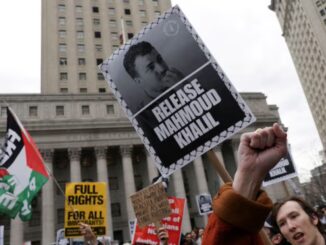
    The Trump administration’s threatened deportation of Mahmoud Khalil, a recent graduate of Columbia University’s School of International and Public Affairs, seems to reflect a dangerous disregard for freedom of expression – a blatant example of official censorship to curb criticism of Israel.

    Khalil holds a green card, giving him permanent residence status, and is married to a US citizen. They are expecting their first child soon. Immigration agents arrested him last week in his university housing and sent him for detention from New York City to Louisiana. He had been a leader of protests against Israeli war crimes in Gaza.

    These actions represent a dangerous trend: a government that seeks to suppress dissent, delegitimize the press, and use state power to silence critics is not a government committed to democracy. Such an approach aligns more with oligarchic rule, where a few powerful individuals control the state and restrict the rights of ordinary citizens. If left unchecked, this pattern of repression could pave the way for a leader who disregards democratic norms entirely and seeks to consolidate power indefinitely.

    A democracy cannot function without an informed public, a free press, and open discourse. The U.S. must take proactive steps to safeguard these principles. Stronger protections for journalists, legal measures to prevent government overreach, and public vigilance against authoritarian tendencies are necessary to ensure that America does not drift further toward oligarchy or, worse, dictatorship. The warning signs have already appeared, and history has shown that once democratic freedoms are lost, they are difficult to restore. The time to act is now.

  • There can be no ‘Israel exception’ for free speech

    There can be no ‘Israel exception’ for free speech

    Trump should reverse his misguided effort to deport Mahmoud Khalil

    “If we tolerate an Israel exception to our rights of free speech, we can be sure that other exceptions will follow. Trump likes to half-jokingly refer to himself as a “king”. Are we heading toward a Thailand-style lèse majesté under which criticism of the king is criminalized?

    But censoring criticism of Israel is a poor strategy even for protecting Israel. Trump’s plan to “solve” Israel’s Palestinian problem by forcibly deporting millions of Palestinians would be a huge war crime; it has been rightly rejected by the Arab states that Trump envisioned receiving the refugees or later paying to rebuild Gaza.”

    By Kenneth Roth

    The Trump administration’s threatened deportation of Mahmoud Khalil seems to reflect a dangerous disregard for freedom of expression – a blatant example of official censorship to curb criticism of Israel.

    Khalil was a recent graduate of Columbia University’s School of International and Public Affairs. He holds a green card, giving him permanent residence status, and is married to a US citizen. They are expecting their first child soon. Immigration agents arrested him last week in his university housing and sent him for detention from New York City to Louisiana. He had been a leader of protests against Israeli war crimes in Gaza.

    Beyond that, the facts are contested. His friends called him “kind, expressive and gentle”. A Columbia professor described him as “someone who seeks mediated resolutions through speech and dialogue. This is not someone who engages in violence, or gets people riled up to do dangerous things.”

    Deporting speakers over supposed ‘propaganda’ is a stock authoritarian move.

    But Donald Trump, hailing his arrest, suggested Khalil was among students “who have engaged in pro-terrorist, anti-Semitic, anti-American activity”. The administration has presented no facts to back up these assertions, but even were it to do so, the suggestion that permissible speech can be a basis for deportation is deeply troubling. Trump vowed more such deportation efforts.

    Ordinarily, the first amendment protects even offensive speech. Although the government retains greater latitude to deport non-citizens, Trump’s rhetoric suggests an intention to step way over the line of propriety. What does it mean to be “anti-American”? As we saw during the McCarthy era, people can face that accusation for a wide range of legitimate political views. Such campaigns are the antithesis of the free debate that is essential for US democracy.

    As for the charge of “antisemitism”, Trump seems to be fueling a disturbing tendency to use claims of antisemitism to silence criticism of the Israeli government. Antisemitism is a serious problem that threatens Jews around the world. But if people see accusations of antisemitism as mere efforts to censor critics of Israel, it would cheapen the concept at a time when the defense against real antisemitism is urgently needed.

    Even Trump’s unsupported suggestion that Khalil is “pro-terrorist” needs unpacking. To begin with, opposing Israel’s indiscriminate and disproportionate attacks on Palestinian civilians, as well as its starvation of them, does not make anyone pro-terrorist. Israel is required to carry out its military response to Hamas’s appalling murders and abductions of 7 October 2023 in accordance with international humanitarian law. War crimes by one side never support war crimes by the other. Pointing that out, if that’s what Khalil did, does not make him “pro-terrorist”; it makes him pro-civilian.

    Trump’s efforts to censor criticism of Israeli misconduct is a recipe for endless war and atrocities
    The Trump administration’s retaliation against Khalil is part of its larger attack on campus protests against Israeli war crimes in Gaza. Just days earlier, the administration announced the withdrawal of $400m in federal funding from Columbia for supposedly failing to protect Jewish students and faculty during anti-Israel protests, the vast majority of which were entirely peaceful. Other universities have now been threatened with a similar suspension of their funding.

    Coincidentally, I spoke on the Columbia campus days before Khalil’s detention. As a Jew, I did not feel the least bit threatened. Indeed, many of the protesters against Israeli atrocities have been Jewish. Again, Trump’s pretext for censoring critics of Israel is transparently thin.

    If we tolerate an Israel exception to our rights of free speech, we can be sure that other exceptions will follow. Trump likes to half-jokingly refer to himself as a “king”. Are we heading toward a Thailand-style lèse majesté under which criticism of the king is criminalized?

    But censoring criticism of Israel is a poor strategy even for protecting Israel. Trump’s plan to “solve” Israel’s Palestinian problem by forcibly deporting millions of Palestinians would be a huge war crime; it has been rightly rejected by the Arab states that Trump envisioned receiving the refugees or later paying to rebuild Gaza.

    Failing that plan, the Israeli government would prefer the status quo – endless occupation – but the world increasingly rejects that option as apartheid, as did the international court of justice in July. Another option would be to recognize the “one-state reality” created by Israel’s illegal settlements in the occupied West Bank and East Jerusalem, but the Israeli government refuses to provide equal rights to all residents. Roughly the same number of Jews and Arabs like between the Mediterranean Sea and the Jordan River, so Israel would lose its Jewish majority.

    The most realistic, legal and enduring option remains a two-state solution, an Israeli and Palestinian state living side by side in peace. The Israeli prime minister, Benjamin Netanyahu, has devoted his political career to avoiding a Palestinian state, but it is the best prospect for lasting peace.

    In pressing Netanyahu to agree to the current temporary ceasefire in Gaza, Trump showed his capacity to exert pressure on the Israeli government to take steps toward peace that it resists. He could do the same for a two-state solution.

    But to build a political support for this important step, we need free debate in the United States. Trump’s efforts to censor criticism of Israeli misconduct is a recipe for endless war and atrocities. Free speech is required if we hope to do better. Trump should reverse his misguided effort to deport Khalil.

    (Kenneth Roth, the former executive director of Human Rights Watch (1993-2022), is a visiting professor at Princeton’s School of Public and International Affairs. His book Righting Wrongs was just published by Knopf)