Tag: Malaysia

  • Miss India Worldwide 2013

    Miss India Worldwide 2013

    Nehal Bhogaita of the United Kingdom won the title of Miss India Worldwide on April 27, 2013 in Kuala Lumpur, Malaysia. The pageant was organized by Dharmatma Saran of IFC. Nehal made history by being the first deaf contestant and now first deaf Miss India Worldwide. Nehal aspires to be a role model for the speech and hearing impaired.

    For her talent, Nehal performed a Bollywood dance routine that highlights her own conviction of never giving up. While she is unable to hear the music, she dances using the vibrations of the beats. Nehal is also the current title holder for Miss India UK where she won among nineteen other contestants in the pageant held at Oxford, England.

    The First Runner-Up was Jasveer Kaur Sandhu of Malaysia and Second Runner- Up was Surbhi Sachdev of Oman. The other two finalists in the top 5 were Geetanjali Kelath of UAE and Ayushi Chhabra of Nigeria.

  • Five Of Indian Origin Family Die In Malaysia Car Crash

    Five Of Indian Origin Family Die In Malaysia Car Crash

    SINGAPORE (TIP): Five members of an Indian origin family were killed and one was seriously injured when the car they were travelling in rammed into the iron pillar of a signpost on the North-South Expressway in the Malaysian state of Johor. Those killed have been identified as P. Pavai, 65, her daughters, R Selvarani, 46, and R Greetha, 42, and two grandsons, G Vikneswaran, 19, and A Akash, 7, media reported on May 2. They were on their way from Skudai to Kulaijaya in Johor state Wednesday when the accident happened. Fire and rescue department personnel took more than 30 minutes to extricate the bodies from the accident site at Km 17.9 of the highway. The injured, G Vinitha, 16, has been admitted to the intensive care unit of the Johor Specialist Hospital. Vikneswaran was reportedly driving the car when he lost control. The car first hit the left hand side of the divider and then rammed into the pillar. Seven-year-old Akash was flung out of the car.

  • More Than 6,500 Indians Languish In Foreign Jails

    More Than 6,500 Indians Languish In Foreign Jails

    CHENNAI (TIP): More than 6,500 Indians are living an uncertain life in prisons in 80 foreign countries, half of them in three Gulf countries. The Gulf countries have the largest number of Indian prisoners, with 1,691 in Kuwait, 1,161 in Saudi Arabia and 1,012 in the UAE. Among the neighbours, Pakistan holds 253 Indians in its prisons, China has 157 of them and Sri Lanka 63. Languishing in the Nepal prisons are 377 Indians. Italy, a country that recently raised a huge uproar demanding special guest house and home-made food for its two citizens arrested on charges of killing two Indian fishermen off the Kerala coast, has 121 Indian citizens in its prisons. The United Kingdom has 426 Indian inmates in their jails, thanks to a fast growing migration of skilled and unskilled labourers.

    There are 155 Indians in the US prisons. The statistics, obtained through RTI by Kochi-based NGO Human Rights Defense Forum, shows 6,569 Indians are in foreign prisons. On Indian prisoners in 30 countries, the ministry of external affairs said it had ‘nil report.’ The RTI reply also says “this figure keeps changing,” and gives no details about the prisoners or the charges against them. In 2007, it was reported that the number of Indian prisoners abroad had come down from 6,730 in 2005 to around 6,000. The RTI reply given by the ministry last month shows the number has gone up again. T P Sreenivasan, former ambassador of India to the United Nations, said ordinary crimes, drug trafficking and domestic violence land Indians in jails in European countries.

    “But a large number of prisoners in the Gulf countries are arrested for badly formulated contracts, illegal stay and migration,” he said. In Malaysia (187 Indian prisoners) and Singapore (156), most of the Indians have been arrested for immigration violations and a few for criminal cases like drug trafficking. In Pakistan, Bangladesh and Sri Lanka, most of the arrests are made on charges of violation of immigration laws. Sreenivasan said different factors, including delay in ensuring justice, communication between the local government and the Indian offices abroad play a major role in the number and duration of detentions.

  • Diplomats celebrate the festival of Spring, Holi

    Diplomats celebrate the festival of Spring, Holi

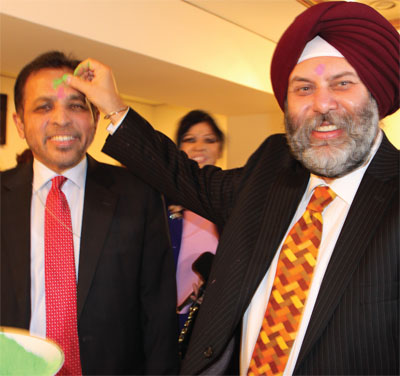
    NEW YORK (TIP): The Permanent Mission of India to the United Nations celebrated Holi at the permanent mission here on Wednesday, March 27, in style and with great enthusiasm. Colors and flower petals expressed the feeling of joy and delight that pervaded the atmosphere.

    Holi is one of the most popular festive occasions in India. The holiday celebrated mainly by the Hindus in India and Nepal marks the beginning of spring and the triumph of good over evil. Bonfires are set on the eve of Holi, and the next day the Hindus throw colored dry powder and water in celebration. It is also observed by the minority Hindus in Bangladesh and Pakistan as well in countries with large Indian Diaspora populations following Hinduism, such as Suriname, Malaysia, Guyana, South Africa, Trinidad and Tobago, the United Kingdom, the United States, Mauritius, and Fiji. Holi is of particular significance in the Braj region of North India, which includes locations traditionally connected to the Lord Krishna: Mathura, Vrindavan, Nandagaon, and Barsana, which become tourist destinations during the season of Holi. There is a legend associated with celebration of Holi. The word Holi originated from “Holika”, sister of Hiranyakashipu.

    The festival of Holi is celebrated because of a story in the old Hindu religion. In Vaishnavism, Hiranyakashipu is the great king of demons, and he had been granted a boon by Brahma, which made it almost impossible for him to be killed. The boon was due to his long penance, after which he had demanded that he not be killed “during day or night; inside the home or outside, not on earth or in the sky; neither by a man nor an animal; neither by astra nor by shastra”. Consequently, he grew arrogant and attacked the Heavens and the Earth. He demanded that people stop worshipping gods and start praising respectfully to him.

    According to this belief, Hiranyakashipu’s own son, Prahlada, was a devotee of Vishnu. In spite of several threats from Hiranyakashipu, Prahlada continued offering prayers to Vishnu. He was poisoned by Hiranyakashipu, but the poison turned to nectar in his mouth. He was ordered to be trampled by elephants yet remained unharmed. He was put in a room with hungry, poisonous snakes and survived. All of Hiranyakashipu’s attempts to kill his son failed. Finally, he ordered young Prahlada to sit on a pyre in the lap of Holika, Hiranyakashipu’s demoness sister, who also could not die because she had a boon preventing her from being burned by fire. Prahlada readily accepted his father’s orders, and prayed to Lord Vishnu to keep him safe. When the fire started, everyone watched in amazement as Holika burnt to death, while Prahlada survived unharmed.

    The salvation of Prahlada and burning of Holika is celebrated as Holi. In Mathura, where Krishna grew up, the festival is celebrated for 16 days (until Rangpanchmi) in commemoration of the divine love of Radha for Krishna. The festivities officially usher in spring, the celebrated season of love. The party at the Permanent Mission of India was hosted by Acting Permanent Representative Ambassador Manjeev S. Puri and his staff, who were in the best of spirits of Holi throughout the evening. Mrs. Puri who was dressed in a beautiful multicolored Saree for the multicolored occasion was enthusiastically going round, supervising arrangements and taking care of guests.

    The event was attended by Permanent Representative of Sri Lanka, Ambassador Palitha Kohona, and Permanent Representative of Republic of Singapore, Ambassador Albert Chua besides diplomats from many countries, and officials at the UN. Ambassador Puri was seen applying colors on his guests and welcoming them to the heavily attended celebratory party. He joyously threw flower petals and colors at the guests, as is the custom during Holi. The authentic Indian menu included Thandai, a special drink made during Holi and much other Holi specialty food that included chats and sweets, among many other delicacies.

  • An Indian American’s Plea For Economic Partnership Between India And US

    An Indian American’s Plea For Economic Partnership Between India And US

    An Overview of the Economy in India
    I. Overview

    India is Asia’s third largest economy in nominal GDP. It hasa GDP of over $1.6 trillion, growing even during this globalrecession at approximately 6% per annum.

    II. India Economic Reforms
    How did India reach this point?In 1991, faced with a balance of payment crisis, India beganthe process of liberalizing its economy. While India has hadmany successive governments since 1991, with different rulingparties, the overall direction of liberalization has remainedthe same. Some may call it slow, plodding, reform, whichstudiously ignores contentious issues such as labor lawreforms. However, the fact is that India is today transformedfrom a socialist economy, with growth rates of 3 to 3.5%, to amarket economy, with an average growth rate of over 6%.

    Let’s put this into perspective:

  • Since 1991, India’s GDP has more than quadrupled;
  • Today, India is the third largest economy in the world inpurchasing power parity and tenth largest in nominal GDP;
  • Its foreign exchange reserves have grown from anegligible level to about $300 billion;
  • It has great strengths ininformation technology, auto components,telecommunications, chemicals, apparels andpharmaceuticals;
  • India has become one of the consumption and growthengines of the world;· IMF forecasts that India is expected to continue its growthmomentum for the next 20 years becoming five times itspresent size.
  • Poverty Reduction
    The best testimony to India’s economic reforms is the factthat, depending on how you define poverty, they helped 100 to300 million people to escape poverty. The history of economicreforms in India has proved that there is a direct correlationbetween the progress of economic reforms and elimination ofpoverty… more economic reforms in India have alwaystranslated into less poverty.

    III. What are the Key Drives of India’s Economy
    There are four key drivers of India’s economy:
    (i) Savings Rate

  • The first key driver is India’s high savings rate;
  • India has a savings rate of approximately 30%;
  • Which mean approximately $0.5 trillion dollars isavailable each year from domestic savings as investiblecapital;
  • India’s savings rate went up from 20% in 1991 to 30%today;
  • So as India’s GDP grows, India’s savings grow, both inactual numbers and percentage terms, and provide the criticalcapital require to finance its further growth;
  • At the same time, unlike China, India’s savings rate is notso high as to choke-off domestic demand.
  • (ii) Service Sector
    The second driver of India’s growth is its service sector which has:

  • Increased its share of the GDP from 41% in 1991 to over57%;
  • Creating an additional wealth of over $6.5 trillion;
  • This sector has grown at a rate of approximately 10%annually in the last decade;
  • It provides employment to 23% of the work force and isgrowing quickly; and
  • Accounts for approximately 33% of India’s total exports.
  • The biggest growth engines of this sector continue to be:

  • information technology and information technologyenabled services;
  • which have grown at a compound annual growth rate ofapproximately 20% over the last few years; and
  • generate a cumulative annual revenue of about $75 billion.
  • Cheap labor, low rents, tax incentives made India a hub for ITservices and outsourcing.While some of these advantages arebeing eroded, India’s service sector, nevertheless, continues togrow, with a low-end services moving to cheaper destinationslike Malaysia, Bangladesh, and Philippines and high-end valueadded services moving to India.

    (iii) Demographic Dividend
    The third key driver of the India’s economy is itsdemographic dividend.

  • India is an old country getting younger every day;
  • Half of India’s population is under 30 years old;
  • This will lead to an addition of 120 million people to theworking population in the next decade;
  • which already constitutes over 60% of the presentpopulation;
  • According to PricewaterhouseCoopers’ forecast, theworking age population growth rate in India will be thehighest among major economies in the world;
  • According to the United Nations, the median age of Indianpopulation is the lowest among the major economies and willcontinue to remain the lowest until 2020;
  • For instance, according to the United Nations, the medianage of population in India in 2020 will be 27.5 years, which willcompare very favorably to 37.5 years in China and the U.S., 42.5years in Europe and 47.5 years in Japan;
  • This will provide India with a requisite workforce, whichwhen properly educated and trained, would be a key driver forthis growth; and
  • It would also lead to a huge increase in the demand forgoods and services typically associated with the youngpopulation because a young wage earner starting life needseverything a house (and everything that goes withit), car, entertainment etc. and in his/her optimism isgenerally a liberal spender.
  • (iv) Urbanization
    The fourth key driver of India’s economy is increasingurbanization.

  • McKinzie forecasts that by 2030 the urbanized populationof India would increase by 70% to 590 million people;
  • The increasing urbanization is projected to requireinvestments in housing, education, healthcare, urbantransportation, telecommunications and sports facilities;
  • For example, increasing urbanization would require Indiato add 700 to 800 million square feet of residential andcommercial space every year. That is like building a brandnew Chicago every year.
  • IV. What are the Key Challenges to India’s Growth
    There are four key challenges to India’s growth:
    (i) Infrastructure

    One of the biggest challenges that India faces is the lack ofinfrastructure. Almost every statistic on India’s infrastructurespeaks of its inadequacy.The Indian government plans to counter the problem withan investment of $1 trillion during 2012-2017, half of whichwill be in the private sector, with significant public/privatepartnerships. A significant portion of this investment isplanned to be made in the construction of a high-speed roadnetwork, dedicated rail-freight corridor, intra-city connectivitythrough metros, power projects and telecommunicationnetworks. The road and metro rail capacities in India areexpected to increase by 20 times during the next two decades.All major airports are being modernized to internationalstandards. Therefore, once India gets its act together oninfrastructure, India’s infrastructure sector, with its massivecapital outlays and multiplier effect on growth, could be thebiggest driver of India’s growth and the biggest opportunityfor foreign investors.

    (ii) Massive Inefficient Public Sector
    The second key challenge for India is the massive inefficientpublic sector, a vestige of its socialist past. The Indiangovernment has made some progress towards privatization ofthe public sector. Generally, it has preferred to dribble downequity in the public sector companies, rather than sellstrategic stakes in government companies. However, the paceof privatization in India continues to be disappointing.

    (iii) Agriculture
    The third key challenge for India is its agricultural sector.Agriculture which supports over 50% of India’s populationsaw a decline from 32% of the GDP to approximately 16% ofthe GDP during the last two decades, which has resulted inincreasing disparity between the rural population and theurban population. This is a challenge that the Indiangovernment needs to tackle head on with a quantum leap insupply chain management and agricultural technology. TheIndian government has increased its budgetary support foragriculture from $800 million in 2001 to $2.7 billion in 2011.For all its shortcomings, agriculture sector is India’s mostpromising sector. Today, 40% of the total agricultural producein India which leaves the farm gates does not reach theconsumers because of lack of roads, refrigeration facilities,storage facilities, cold storage facilities and other supply chainissues. Therefore, as India builds its infrastructure andstrengthens its supply chain, the agricultural sector wouldreceive a boost and could become a key driver of the Indianeconomy.(iv) Manufacturing Sector The fourth key challenge ofIndia’s economy is its manufacturing sector. India’smanufacturing sector also has not done as well as its servicesector and India’s share in the world manufacturing is stillrelatively modest. However, rising middle class and consumerdemand is boosting India’s manufacturing sector. The grosscapital formation in industry has grown at a compoundannual growth rate of 11.76% between 2005 and 2010.

    However, India’s manufacturing sector also has greatpromise:

  • First, the development of the Delhi-Mumbai IndustrialCorridor will give a great boost to India’s manufacturingsector.
  • Second, the key challenge to India’s manufacturing sectoris that more than half of manufacturing is done in theinefficient, public sector. Therefore, as India privatizes itspublic sector, it would add efficiency to the manufacturingsector which could give the manufacturing sector a quantumleap.
  • Third, Indian manufacturing sector has struggled againstan artificially low RNB. As China, under the U.S. pressure,allows RNB to appreciate, India’s manufacturing sector willbecome more competitive.
  • V. How can the U.S. and India Help Each Other?
    U.S. is a rich developed economy that needs stable newmarkets to fuel its growth. India is an emerging economy thatneeds large capital investments, know-how in critical areassuch as supply chain management and a market for its servicesector.

    VI. Conclusion
    The idea of the world’s two largest democracies, U.S. andIndia, working together in an economic partnership, so thateach becomes the growth engine of the other is “an idea whosetime has come” and as Victor Hugo said, “an invasion ofarmies can be resisted, but not an idea whose time has come.”

  • Chinese New Year 2013

    Chinese New Year 2013

    Chinese Spring Festival, also called Lunar New Year,has more than 4,000 years of history. Being one ofthe traditional Chinese festivals, it is the grandestand the most important festival for Chinese people. It isalso the time for the whole families to get together, which issimilar with Christmas Day to the westerners. Originatingduring the Shang Dynasty (about 17th – 11th century BC),Spring Festival, which celebrates family reunion, is full ofrich and colorful activities, and new hopes with the adventof spring and flowers blossoming. People from differentregions and different ethnic groups celebrate it in theirunique ways.

    Festival Time
    The Spring Festival comes on the first day of Chineselunar calendar and lasts for almost half of a month. But infolk custom, this traditional holiday lasts from the 23rd dayof the twelfth month to the 15th day of the first month(Lantern Festival) in the lunar calendar. Among these days,the New Year’s Eve and the first day of the New Year is thepeak time of the festival. The exact days are different inevery year according to the lunar calendar. Schedule ofSpring Festival in recent years is offered in the followingtable.Chinese New Year begins according to the Chinesecalendar which consists of both Gregorian and lunar-solarcalendar systems. Because the track of the new moonchanges from year to year, Chinese New Year can beginanytime between late January and mid-February.

    Below isa chart that shows the beginning day of Chinese New Yearand the animal sign for that year.Chinese New Year is the longest and most importantfestivity in the Chinese calendar. The origin of ChineseNew Year is itself centuries old and gains significancebecause of several myths and traditions. Chinese New Yearis celebrated in China and in countries and territories withsignificant Chinese populations, including Hong Kong,Macau, Singapore, Thailand, Indonesia, Malaysia, Taiwan,Mauritius, Philippines, and also in Chinatowns elsewhere.Chinese New Year is considered a major holiday for theChinese and has had influence on the lunar new yearcelebrations of its geographic neighbors.Within China, regional customs and traditionsconcerning the celebration of the Chinese new year varywidely.

    People will pour out their money to buy presents,decoration, material, food, and clothing. It is alsotraditional for every family to thoroughly cleanse thehouse, in order to sweep away any ill-fortune and to makeway for good incoming luck. Windows and doors will bedecorated with red color paper-cuts and couplets withpopular themes of “good fortune” or “happiness”, “wealth”,and “longevity.” On the Eve of Chinese New Year, supper isa feast with families. Food will include such items as pigs,ducks, chicken and sweet delicacies. The family will endthe night with firecrackers. Early the next morning,children will greet their parents by wishing them a healthyand happy new year, and receive money in red paperenvelopes.

    The Chinese New Year tradition is to reconcile,forget all grudges and sincerely wish peace and happinessfor everyone.Although the Chinese calendar traditionally does not usecontinuously numbered years, outside China its years areoften numbered from the reign of the Yellow Emperor. Butat least three different years numbered 1 are now used byvarious scholars, making the year beginning in 2012 AD the”Chinese Year” 4710, 4709, or 4649.Every family does a thorough house cleaning andpurchases enough food, including fish, meat, roasted nutsand seeds, all kinds of candies and fruits, etc, for thefestival period. Also, new clothes must be bought,especially for children. Red scrolls with complementarypoetic couplets, one line on each side of the gate, are pastedat every gate. The Chinese character ‘Fu’ is pasted on thecenter of the door and paper-cut pictures adorn windows.

    Taboos
    The Spring Festival is a new start for a new year, so it isregarded as the omen of a new year. People have manytaboos during this period. Many bad words related to”death”, “broken”, “killing”, “ghost” and “illness” or”sickness” are forbidden during conversations. In someplaces, there are more specific details. They consider itunlucky if the barrel of rice is empty, because they thinkthey will have nothing to eat in the next year. Takingmedicine is forbidden on this day, otherwise, people willhave sick for the whole year and take medicine constantly.

    Festival Food
    Food during this festival has its characteristics, which isthe representative of Chinese festival food culture.Dumplings and the reunion dinner are indispensable atthis time. Cold and hot dishes are all served. Fish is alwaysan important dish then, which expresses people’s hope ofhaving a wealthy new year.

    History
    It is said that the custom of Spring Festival started inwhen people offered sacrifice to ancestors in the last monthof Chinese lunar calendar. At that time, people preparedthe sacrifice by doing thorough cleaning, having bathesand so on. Later, people began to worship different deitiesas well on that day. It is the time that almost all the farmworks were done and people have free time. The sacrificingtime changed according to the farming schedule and wasnot fixed until the Han Dynasty (202BC-220AD). Thecustoms of worshipping deities and ancestors remainseven though the ceremonies are not as grand as before. It isalso the time that spring is coming, so people held all kindsof ceremonies to welcome the spring.

    Legends
    There are many legends about the festival in Chineseculture. In folk culture, the Spring Festival is also called”guonian” (meaning “passing a year”). It is said that the “nian”(year) was a strong monster which was fierce and cruel andate one kind of animal including human being a day. Humanbeings were scared about it and had to hide on the eveningwhen the “nian” came out. Later, people found that “nian” wasvery scared about the red color and fireworks. So after that,people use red color and fireworks or firecrackers to driveaway “nian” every year. As a result, the custom of using redcolor and setting off fireworks remains.

    Festivities Schedule
    Preparing the New Year starts 7 days before the NewYear’s Eve. According to Chinese lunar calendar, peoplestart to clean the house on Dec. 24, butcher on Dec. 26th andso on. People have certain things to do on each day. Thesefestival activities will end Jan. 15th of the lunar calendar.

  • President Urges Overseas Indians To Invest In India

    President Urges Overseas Indians To Invest In India

    KOCHI (TIP): President of India, Mr. Pranab Mukherjee expressed confidence that the Indian economy would bounce back to an 8-9% GDP growth due to its strong economic fundamentals and the reforms driven policy initiatives of government of India.

    Addressing the valedictory session of the 11th Pravasi Bharatiya Divas here on January 9, Mr. Mukherjee said, “To achieve this order of growth over a sustained period of time, would need large doses of investment. The overseas Indians could help by investing in Indian companies and in the capital market and earn higher dividends as the yield of the equity markets in India was much higher than elsewhere.”

    India, he said, was a “land of immense opportunity; the second fastest growing economy after China. But for a brief period of economic deceleration, six of the nine years that have gone by witnessed a GDP growth of around 8%.”

    The President said that he wished to see the Indian Diaspora as a strong partner in India’s development, not just in economic growth but in the knowledge economy. “Knowledge and experience you have gained can ply decisive role in the growth story of India”, he said. “Together, we will keep our tryst with destiny,” he said, amid huge applause an added “we are proud of your services to India”. Earlier, the President gave away the Pravasi Bharatiya Samman Awards to 15 eminent persons of Indian origin for their outstanding contribution for enhancing India’s prestige in a tangible way.

    The award winners for 2013 included Mr. Rajkeswur Purryag President of Mauritius, who was “recognized for his outstanding contributions in public service and fostering friendly relations between India and Mauritius; Australia-India Society of Victoria (award received by Mr. Gurdip Singh Arora) “recognized for its role in protecting the rights of Indian migrants and establishing a network of welfare activities”;

    Mr. Ashok Shambhomal Vaswani, Guinea “recognized for his efforts in building strong bridges between India and the people of the Republic of Guinea”; Indian Doctors Forum, Kuwait (award received by Dr. Narayan Namboori) “recognized for its contribution to the field of healthcare facilities for Indians and Kuwaitis”; Tan Sri Ravindran Menon, Malaysia “honored for his contribution in fostering better understanding of Indian community in Malaysia, and for his philanthropic works”; Dr. Rasik Vihari Joshi, Mexico “honored for eminence in his field of work, for enhancing India’s image and for promoting better understanding of India abroad”;

    Dr. Satendra Kumar Singh, Fiji “honored for his immense contribution to promotion of Indian culture and heritage in New Zealand, Fiji and South Pacific”; Mr. Gilbert Canabady Moutien, Reunion Islands “recognized for his immense contribution to strengthening and fostering business ties between India and Reunion Island and his efforts in promoting Indian culture and heritage”;

    Mr.Mohammed Rabeeh Karuvanthodi, Saudi Arabia “honored for his efforts and contribution in promoting healthcare facilities in GCC countries and his philanthropic activities”; Mr. Ismail Ebrahim Ebrahim, South Africa “recognized for his commitment to the principles of liberty, equality and fraternity, his outstanding contribution to public service and fostering closer ties between India and South Africa”; Mr. Bava Pandalingal, Abu Dhabi, UAE “honored for his efforts and dedication in the service of Indian communities in UAE”; Ms. Patricia Maria Rozario, UK “recognized for her outstanding contribution to the Western Classical Music and her eminence in skills which have enhanced India’s prestige abroad”; Dr. Narendra Ramkrishna Kumar, USA “honored for his contribution in the healthcare sector and promoting India and Indians abroad”; Mr. Subash Razdan, Chairman and Co- Founder of Gandhi Peace Foundation, USA “recognized for enhancing the prestige of India through his contribution to public and the Indian community”; and Prof. Dr. Gurcharan Singh Chatwal, Germany, “honored for fostering closer scientific relations between India and Germany, and for enhancing India’s prestige abroad”. Dr. Chatwal, however, could not arrive to receive the award due to “unavoidable reasons”.

  • Foreign Tourist Arrivals To Kerala Plummet

    Foreign Tourist Arrivals To Kerala Plummet

    KOTTAYAM,INDIA (TIP): Asharp decline inarrival of foreigntourists to Keralais causing concernin the tourismindustry. Thedeclining trendthat started a fewyears agocontinuesunabated.T. Damu,director of Taj group of hotels and resortsin Kerala, said that foreign tourist arrivalshave declined considerably because ofrecession, escalating air fare andcontinuous rains during tourist seasons.

    Peak season
    Major hotels that accommodateforeigners in Kumarakom said that thepeak season begins in October-November.They hoped that something positive wouldhappen to bring in more tourists this year.Tourism agencies and houseboat ownersare unanimous that there is already a lullin tourist activities mainly because of thedelay in issuing visa for internationaltourists and consequent cancellation oftours. Many foreign tourists coming toIndia have rescheduled their visits toneighboring countries such as Sri Lanka,Singapore, Malaysia, Thailand etc.The exorbitant rent for suites in starhotels, unethical and unaffordable taxi andauto rickshaw charges and above all themisconduct of touts and miserable hygieneproblems are theother reasons fortheir absence inGod’s own country.If a foreigner isspotted on theroad, autorickshaw driverscompete with oneanother to fleecethem.

    Domestic arrivals
    Domestic tourist arrivals are alsosagging. Usually at the beginning of theseason, the domestic visitors arrive fromother States. This year, though the seasonhas already started, the arrivals ofdomestic visitors are yet to pick upmomentum. The poor inflow is affectingthe houseboat sector.Of about 1,000 houseboats atPunnamada, only around 150 are earningthe minimum to meet the daily expenses,said Mr Anil Kumar, owner of a newhouseboat based at Kumarakom.Houseboat owners have already incurredheavy losses because of stagnation intourism sector.Another impact is reported to be the ‘goslow’ in the sale of properties at primelocations in tourist spots where large areashave been bought by leading realtors, filmstars and others, hoping for big profits laterat the time of resale. In Kumarakom, manycelebrities have bought plots for setting upholiday homes.

  • World Kabaddi Cup a Step in the Right Direction

    World Kabaddi Cup a Step in the Right Direction

    The ancient game of Kabaddi is enshrined permanently in the mind of every son of the soil Punjabi. In olden times, it used to be played on the dusty grounds of village common land. There used to be no hard and fast rules of the game. Sometimes the raiders indulged in tactical cheating during chanting of words “Kabaddi Kabaddi” or “Kaudi Kaudi”. In Punjabi style one raider was the attacker and one defender used to stop him. A deliberate touch by a raider targeting two attackers resulted in the point going to the defenders. In a reverse situation, if two stoppers tried to stop the raider one after the other or simultaneously, the point went to the raider.

    Throwing the opponent, raider or defender, out of the ground resulted in a point. This has always been the game of strength, stamina, lung power and agility on the part of the raiders and the defenders. Prior to the independence of India, this game was quite popular in all the five administrative divisions of the Province of Punjab. It was more popular in Lahore and Jalandhar divisions and least popular in Ambala division.

    But now it is popular all over the Indian Punjab and is played equally passionately across the Radcliffe Line in Pakistan’s Punjab. Needing just a pair of shorts and not even requiring formal shoes, this used to be and still is a very inexpensive game. But in order to stay physically fit, the player has to be given strength and stamina building diet and exercise. In olden times a lot of stress was laid on eating butter.

    This culture still prevails, but now some of the athletes are eating a lot more diverse diet. During the nineteen fifties, a lot of Sikh youths settled in the United Kingdom. At about the same time and a decade and two later, Sikh Diaspora spread to Canada also. These expatriate Sikhs passionately love Kabaddi. When they visit their ancestral homes in India, they want to see Kabaddi being played in their respective villages. In order to see that they spend quite a considerable amount of money to arrange Kabaddi tournaments in their mostly non-descript villages. These impromptu tournaments have become very popular in the rural areas of the Punjab.

    In the last two decades there were hundreds of such tournaments held in villages all across Punjab during the six month window from October to April. As the game is flourishing, rules are also getting defined and enforced meticulously. Now the raider has to return to the dividing line in half a minute. Crossing to one’s own side after touching a defender at any spot, other than the designated return line, results in a point being awarded to the defender.

    Slapping the opponent, raider or the defender, results in point being awarded to the opponent. Sensing the enormous popularity of Kabaddi, the Punjab Government in India decided to embrace it. Deputy Chief Minister Sukhbir Singh Badal started the first edition of World Kabaddi Cup in 2010 in a grand style. The matches were held over several venues all over the Punjab. Kabaddi is now played regularly in Pakistan, the United Kingdom, Canada and the United States. India won the inaugural cup and a handsome amount of money.

    The tournament was telecast by PTC TV channel all over India and in several countries, where PTC’s footprint exists. Last year (2011) saw more teams participating. Nice arrangements were made for board and lodging of the teams. Italy was a surprise entry into the semifinal. Several players from the United States and the Canadian teams were disqualified after being found positive in dope tests. In addition to men, several women’s teams were also invited to participate. This created gender equality in this hitherto rural sport. India had a decisive edge in women’s group. In the year 2012, the “Third World Cup Kabaddi Tournament” was held from the first to the 15th of December. The matches were spread in several locations all over the state.

    A glittering several hours long opening ceremony was held in Bathinda on December 1st. The other venues included the holy and premier tourist city of Amritsar, Gurdaspur, Chohla Sahib (Tarntaran), Jalandhar, Hoshiarpur, Fazilka, Faridkot, Mansa, Sangrur, Ropar, Bathinda and Ludhiana. In the men’s category in addition to the host nation India, Argentina, the USA, Canada, England, Scotland, Norwey, Italy, Sierra Leone, Kenya, Iran, Afghanistan, Pakistan, New Zealand and Srilanka accepted the invitation to participate.

    In the women’s section, USA, Canada, England, Denmark, Malaysia, Turkmenistan and India participated. Nepal eventually failed to show up for the matches. The winning team in men’s section in 2012 was offered two crore of rupees and the runners-up team was offered a prize of one crore of rupees. The team finishing at number three was offered half a crore of rupees. These are indeed huge prizes unseen in the history of the game. There have been some problems in the organizational structure of the tournament.

    The buildings of the stadiums are quite good, but the playing fields left much to be desired. Barring a couple of stadiums in Amritsar and Ludhiana, rest of the playing fields were devoid of a decent grass cover and the soil was very hard. Kabaddi players in the European and American countries are used to play on lush green grass turfs. When they are made to play on hard dry soil, their performance level suffers. That is one reason as to why the Canadian and the American teams could not perform to their capacity.

    The teams that entered the semifinal included three teams from Asia. These are Iran, Pakistan and India. The fourth qualifier was the Canadian team. The team from the USA was narrowly beaten by Iran. Both India and Pakistan toyed with their semifinalist rivals. Indian crushed Iran and Pakistan mauled team Canada. In the women’s group also the competition in 2012 was of a much higher level. The Canadian and the Malaysian teams consisted of mostly players of Indian descent. The out of practice Canadian girls played poorly, but the hard working Malaysians covered themselves with glory and entered the final. Two European teams, the English and the Denmark teams also were impressive. Turkmenistan team was very good too. But the Indian players were outstanding.

    This successfully conducted tournament is likely to boost the economy of Punjab. A lot of tourists have been visiting the state to watch this tournament. Some of the participating teams are staying behind in Punjab to play in several village level tournaments to be held in the months of December and January. The two African teams Kenya and Sierra Leone are also staying behind to get more match practice and to master the finer points of the game.

    Both finals and the grand closing ceremony were held in the multipurpose Guru Nanak Stadium in Ludhiana on the night of Saturday December 15th. In the men’s final India crushed arch rivals Pakistan by 59 points to 22. Canada crushed Iran on December 13th in Jalandhar to win the third place and a prize of one hundred thousand dollars. In the final of women’s category on December 15th, in a one sided encounter India toyed with Malaysia.

    The third place in women’s group was won by Denmark by defeating England on December 13th. This was a very closely contested match. The young school and college going girls from Denmark impressed everyone. The dazzling closing ceremony was dominated by the film industry of Bollywood. Katrina Kaif was the star of the night. Film and pop singers Diljit Singh and Sukhvinder Singh kept the jam-packed stadium entertained. Punjab’s most popular TV anchor Satinder Satti was the master of ceremony. In the end there was an impressive show of fireworks. At the end the flame was extinguished, with a promise to hold another edition in 2013. Katrina Kaif and troupe entertain at one of the venues

  • US military to boost Philippines presence; China tells army to be prepared

    US military to boost Philippines presence; China tells army to be prepared

    MANILA (TIP): US and Philippine officials are expected to agree on an increase in the number of US military ships, aircraft and troops rotating through the Philippines, Filipino officials said, as tensions simmer with China over its maritime claims.
    Though he made no direct reference to the territorial disputes, new Chinese Communist Party chief Xi Jinping urged his military to prepare for a struggle. He made the comments during his visit to a South China Sea fleet ship in southern Guangdong province, but did not name any potential aggressor.

    Senior US and Philippine officials met on Wednesday in Manila to discuss strengthening security and economic ties at a time of growing tension over China’s aggressive sovereignty claims over vast stretches of the disputed South China Sea. Philippine defense and diplomatic officials said they expected to see more US ships, aircraft and troops for training exercises and disaster and relief operations. “What we are discussing right now is increasing the rotational presence of US forces,” Carlos Sorreta, the foreign ministry’s assistant secretary for American Affairs, told reporters.

    A fiveyear joint US-Philippine military exercise plan would be approved this week, he added. The size of the increase in the US military assets in the Philippines, a former US colony, was unclear. Pio Lorenzo Batino, Philippine deputy defence minister, said there were “substantial discussions” on a possible new framework allowing Washington to put equipment in the Southeast Asian state. “There has been no discussion yet on specifics … (these are) policy consultations and the specifics would be determined by the technical working groups,” he told a news conference, saying the new framework was discussed in the context of increasing rotational presence. US assistant sevretary of state Kurt Campbell said the two allies’ relationship was “in a renaissance”.

    The discussions come as the Philippines, Australia and other parts of the region have seen a resurgence of US warships, planes and personnel under Washington’s so-called “pivot” in foreign, economic and security policy towards Asia announced last year.

    Wary of Washington’s intentions, China is building up its own military. Its claims over most of the South China Sea have set it directly against US allies Vietnam and the Philippines, while Brunei, Taiwan and Malaysia also claim parts of the mineral-rich waters. Xi, who assumed the role of military chief about a month ago, called on the 2.3-million-strong People’s Liberation Army to “push forward preparations for a military struggle”, state news agency Xinhua said. Xi, speaking during a three-day inspection of the PLA’s Guangzhou base starting last Saturday, did not say against whom the struggle might be fought.

    His remarks echo those he made a week ago and are a common refrain by Chinese leaders. Xi replaced President Hu Jintao as chairman of the Central Military Commission on November 15. Xi also said the army should “modernize” for combat readiness, but gave no specific details.

    Military bases
    US and Philippine officials say there is no plan to revive permanent US military bases in the Philippines – the last ones were closed in 1992 – and that the increased presence would help provide relief during disasters such as a typhoon last week that killed more than 700 people.

    “The increase rotation presence is in areas where we have been traditionally exercising,” said Sorreta. “There are other areas for example where we have been experiencing more disasters. So we might be expanding exercises there.” One US official said Washington was not ready to wade directly into the territorial dispute in the South China Sea and instead would focus on strengthening security ties with longstanding allies such as the Philippines. “I don’t think you’ll see any real movement on the South China Sea,” the US official said. “I’m sure it will come up, but we aren’t trying to step in and ‘solve’ that issue. We really want the solution to be done by the claimants themselves and are hoping the Code of Conduct discussions move forward,” said the official, referring to a Code of Conduct aimed at easing the risk of naval flashpoints. Sorreta told Reuters the Philippines also favored an increased deployment of US aircraft and ships “so we can make use of them when the need arises”, citing last week’s typhoon. He said they would also welcome more US humanitarian supplies.

  • Ghaziabad to Host Interpol Program

    Ghaziabad to Host Interpol Program

    NEW DELHI (TIP): India has requested Interpol to come up with a special notice for terror cases, which is not a part of the existing red corner notice. The request was made at the recently concluded general assembly of Interpol in Rome, which was attended by home minister Sushil Kumar Shinde and CBI director A P Singh. “It will simplify the process for all the investigating agencies to know about terror suspects if the notice’s colour or style is changed,” said an officer. Interpol is reported to be examining the request.

    In the general assembly, it was also decided that Interpol will hold training programmes at the CBI academy in Ghaziabad, for the Asia-Pacific nations. Training will be imparted to law enforcement officers of various countries on bio-terrorism, investigation of maritime piracy and anti-corruption cases, and there will be focused attention on fugitives involved in terror cases. “This was agreed upon at the Interpol’s 81st general assembly which was held in Rome last week. In a series of meetings, Interpol secretary general, Ronald Noble, sought India’s contribution for officers to the Interpol Global Complex for Innovation (IGCI) in Singapore. He also emphasized on the development of a mechanism for informal cooperation with national central bureau (NCB) – India, relating to investigation of cyber crimes,” said CBI spokesperson Dharini Mishra.

    CBI officials also held separate meetings with Saudi Arabia, the US, South Africa, the Netherlands, France, Malaysia, Nepal, Pakistan, Jordan, Bhutan, Portugal, South Korea and others to discuss pending bilateral policing issues like letters rogatory, extradition requests etc. Issues discussed at the Interpol general assembly included cooperation in combating terrorism, crime against children and environmental crime, international notices system, disaster victim identification, intellectual property crime, human trafficking, Interpol travel documents, stolen travel document database, Interpol confidentiality regime and Interpol databases . The Interpol general secretariat resolved to support NCB’s to combat transnational organized crime, corruption and money laundering and recover criminal proceeds.

    The general assembly also decided to set up a communication system to respond in real time to requests for help from countries on cyber crime.

  • Manipal University  inks pacts with 2  Chinese varsities

    Manipal University inks pacts with 2 Chinese varsities

    Mangalore (TIP): Manipal University has signed agreements with Shanghai’s Tongji and Tianjin universities for mutual, comprehensive partnerships.

    Quoting the Vice-Chancellor of Manipal University, K. Ramnarayan, a press release said here on Monday that the MoUs are for mutual, comprehensive partnerships in the areas of student exchange, faculty exchange, joint degrees, twinning programmes, and the exchange of research scholars and post-doctoral fellows.

    It will also facilitate exchange of academic publications, materials and information.

    Ramnarayan signed the documents on behalf of Manipal University, and Xia Liping, Dean of Politics and International Relations of Tongji University, and Li Jiajun of Tianjin University, signed the documents on the behalf of their respective universities.

    “It is a step towards Manipal University’s long-term plan of opening the first-ever campus of an Indian university in China. Eventually we would like to see free creative flow both ways, as we have between India and the United States. For some reason, we have ignored the potential of China, and that is something we want to tap,” Ramnarayan said.

    The release said that Manipal University is in talks with Chinese officials to open a campus there. Now Manipal University has campuses in Dubai, Nepal, Antigua and Malaysia.

    Ramnarayan said he is keen to bring Chinese students to India, as an increasing number of their students are pursuing higher education overseas. China is beginning to recognise the qualities of Indian universities, he added.
    A delegation from Manipal University had visited these universities in June and last week, the release added.

  • Kerala Center to honor six at Awards Banquet on November 3rd

    Kerala Center to honor six at Awards Banquet on November 3rd

    NEW YORK (TIP):The Indian American Kerala Cultural and Civic Center (http://keralacenterny.com) will honor five Indian American Malayalees for their outstanding achievements in their field of specialization or for their service to the society and one diplomat for his service to the UN. The awardees will be honored at Kerala Center’s annual banquet on Saturday, November 3rd starting at 7.00 p.m. at Leonards of Great Neck in Long Island, 555 Northern Boulevard, Great Neck, NY 11021.

    The Chief Guest for the evening is Vijay K. Nambiar, Under Secretary-General and Special Adviser of the UN Secretary-General on Myanmar. Ambassador Nambiar will be honored for his service to the U,N. The keynote speaker is Dr. Geeta Menon, Dean, Undergraduate College and Abraham Krasnoff Professor of Global Business, Stern School of Business, New York University. Dr. Menon will also be honored for her achievement in the field of Education. Other award recipients who will be honored at the Awards Banquet are: Joy Kuttiyani, President of Kerala Samajam of South Florida, whose initiative to erect Mahatma Gandhi came to fruition recently for Community Service; Viju Menon, Vice President of Supply Chain Management at Verizon, the largest wireless carrier in the United States for Applied Sciences; Dr. Narayanan Neithalath is an Associate Professor in the School of Sustainable Engineering and the Built Environment at Arizona State University, Tempe, AZ, for Engineering; Roy Thomas, Deputy Director at New York State Mental Health Department for Social Work.

    An entertainment will follow after the award ceremony with a special performance by Wanted Ashiq, NY’s Premier Bollywood & Fusion Dance Troupe. Tickets for banquet can be reserved by contacting Kerala Center at 516-358-2000 or e-mail at kc@keralacenterny.com.

    This year’s awardees are as follows:

    Chief Guest and Being Recognized for Service to the UN

    Vijay Nambiar

    Ambassador Vijay Nambiar is Under Secretary-General and Special Adviser of the UN Secretary-General on Myanmar. He has been with the United Nations for the last six years before which, as an Indian Foreign Service Officer, he spent thirty eight years with the Government of India and served between 1985 and 2004 as Ambassador of India in Algeria, Afghanistan, Malaysia, China, Pakistan and the United Nations. He is fluent in Chinese and holds a post-graduate degree from Bombay University where he was awarded the Chancellor’s Gold Medal in 1965. He is married to Malini Nambiar and has two daughters.

    Keynote Speaker – Recognition for Outstanding Achievement in Education

    Dr. Geeta Menon

    Dr. Geeta Menon is the 11th Dean of the Undergraduate College at NYU’s Leonard N. Stern School of Business and the Abraham Krasnoff Professor of Global Business and Professor of Marketing. A respected educator at the graduate and undergraduate levels, she has mentored many doctoral students who have gone on to become faculty members at top schools. Dean Menon is also a prominent scholar whose study of the role of consumer memory and emotion in survey methodology has been published in leading academic journals, at which she has held editorial roles. She is the past President of the Association for Consumer Research (ACR). Dean Menon received her undergraduate degree from Stella Maris College and graduate degree from Madras Christian College in Chennai and Ph.D. in Business Administration at the University of Illinois at Urbana-Champaign.

    Recognition for Outstanding Community Service

    Joy Kuttiyani

    Joy Kuttiyani is the current president of Kerala Samajam of South Florida. He conceived the idea to create a memorial to Mahatma Gandhi on a half acre site in a public park in the city of Davie, where he lives. This was done with the involvement of a number of Indian Organizations and the City of Davie. The dedication of the Gandhi Square and the unveiling was done by Dr. Abdul Kalam along with American and Indian dignitaries. He is highly active in the both Indian and American political and community development. Advisory board member of Park & Recreation Town of Davie.

    Recognition for Outstanding Achievement in Applied Sciences

    Viju Menon

    Viju Menon is Vice President of Supply Chain Management at Verizon, the largest wireless carrier in the United States. He is a Fellow of the Massachusetts Institute of Technology’s Leaders for Global Operations Program with graduate degrees in Engineering and Management from MIT. Prior to Verizon, Viju led Intel Corporation’s World-wide Supply Planning Operations. A recognized thought-leader in Lean Manufacturing and Supply Chain Transformations, Viju has published in various journals and is an invited speaker at Industry Conferences. In 2012, Viju was selected to Diversity MBA Magazine’s “Top 100 Under 50” National list of “Diverse Executive and Emerging Leaders”.

    Recognition for Outstanding Achievement in Engineering

    Dr. Narayanan Neithalath

    Dr. Narayanan Neithalath is an Associate Professor in the School of Sustainable Engineering and the Built Environment at Arizona State University, Tempe. AZ. Prior to that he was in the faculty at Clarkson University in Potsdam, NY. His expertise is in the science of sustainable materials for buildings and infrastructure. He is credited with developing, characterizing, and modeling novel cementitious materials that have lower carbon footprints, lower resource and energy implications, and lasts much longer, for use in infrastructural systems. He has authored more than 100 international journal and conference articles, and has delivered keynote lectures in several conferences within and outside the United States. His research on novel materials has been acknowledged by several awards including a CAREER award by the National Science Foundation.

    Recognition for Outstanding Accomplishments in Social Service

    Roy Thomas

    Roy Thomas has been appointed as the Deputy Director at New York State Mental Health Department by the Governor, Andrew M. Cuomo’s office. He is probably the only person of South Asian descent who is entrusted with this title in the history of the New York State Civil Service. During his last tenure of 5 years as the Chief of Service, his bold leadership and management was instrumental in transforming the Bronx Psychiatric Center into one of the leading hospitals in New York State. This landmark achievement has helped him to be chosen by the political leadership in Albany.

  • Malaysia transsexuals lose challenge against law

    Malaysia transsexuals lose challenge against law

    KUALA LUMPUR (TIP): A Malaysian court on Thursday dismissed an attempt by a group of transsexuals to challenge a law that bars Muslim men from wearing women’s clothes. Lawyers say it is the first known effort to overturn an Islamic Shariah law that prescribes jail terms of varying lengths or fines for convicted cross-dressers. The secular High Court in Malaysia’s southern Seremban town rejected a bid by four Muslim transsexuals who were born male to declare the Shariah law unconstitutional.

    The law is enforced in Shariah religious courts against Muslims, who comprise nearly two-thirds of Malaysia’s 29 million people. The transsexuals had argued that Malaysia’s constitution is supposed to uphold freedom of expression and forbid discrimination based on gender. However, the high court ruled that Muslim transsexuals cannot be exempted from Shariah legal provisions. The four, who are in their 20s and work as bridal makeup assistants, were “disappointed and distraught” following the verdict, said their lawyer, Aston Paiva.

    They were considering whether to appeal the ruling, Paiva said. All four have previously been arrested by Islamic authorities, and in some cases fined, for wearing women’s clothes. They have undergone hormone therapy to help them present themselves publicly as women, but their official documents refer to them as male, their lawyer said. Malaysian transsexuals say they’re often harassed by religious police and have trouble securing employment.

  • Auto parts industry attracts heavy online traffic: Study

    Auto parts industry attracts heavy online traffic: Study

    Is among the top three sectors on B2B site in terms of the number of buyers it attracted
    from developed and developing countries

    NEW DELHI (TIP): A report by IndiaMART.com, one of India’s largest online B2B marketplaces, has found that the SME-dominated automotive sector is among the top three sectors on the site in terms of the number of buyers it attracted from other countries, both developed and developing. The report, The Automotive Components Sector, reveals that the US emerged as one of the leading countries in terms of the number of its buyers visiting IndiaMART.com’s automotive category for their sourcing requirements — 12.8 per cent of its total buyers did so.

    Over one million SMEs from sectors such as auto components, apparel and fashion accessories, engineering and industrial, home decor, and others are registered with IndiaMART.com, which acts as a B2B matchmaking platform for these suppliers and helps them generate leads from over five million buyers from across the globe.

    Asian countries are also key buyers for auto products from India. The portal’s automotive category had visits from buyers based in Pakistan (8.2 per cent), China (7.6 per cent), Malaysia (7.3 per cent) and Bangladesh (7.2 per cent). Buyers from India alone accounted for 28.3 per cent of online visitors for auto parts.

    The sector also attracted 6.8 per cent of the total buyers from the UK, followed by 6.5 per cent of Canadian buyers, 6.4 per cent of buyers from Germany, and 6.3 per cent of Australian buyers. Other countries from where buyers showed interest in online sourcing of auto components were the UAE, Saudi Arabia, Egypt and Iran.

    The importance of the automotive sector was also indicated by the number of suppliers from this sector as a proportion of the total number of suppliers from each key country.

    At the top was Canada, 13.8 per cent of whose registered vendors were from the auto parts sector, followed by Denmark (12.3 per cent), China (12.1 per cent), Australia (7.4 per cent), France and Germany. The report reveals that the most popular product searches were for air pollution control devices, fuel injection parts, digital tachometers, security gadgets, gear parts, and car cables. Information on “buy leads” – buyers’ sourcing inquiries that are aggregated by IndiaMART.com and purchased by interested suppliers, who then contact potential buyers to generate business – reveals that the most number come from Maharashtra, which contributes 25.6 per cent of the total buy leads generated in India.

  • India Malaysia to Achieve Trade Target of USD 15 Billion by 2013

    India Malaysia to Achieve Trade Target of USD 15 Billion by 2013

    NEW DELHI (TIP): The Union Minister of Commerce, Industry and Textiles, Shri Anand Sharma informed here today that India’s bilateral trade with Malaysia stood at nearly USD 13 billion last year registering a growth of 34% over the previous year.

    Addressing the members of India-Malaysia CEO Forum, Shri Sharma said, “while we had set a trade target of US$ 15 billion by 2015, I am confident that we will be able to achieve this target definitely by 2013 if not this year. I will be proposing to my counterpart Minister Mustapa Mohamed that we revise this target upwards.”

    Recalling his visits to Malaysia in July 2010 and February 2011, Shri Sharma said that he had sought investment from Khazanah Nasional Berhad (Government of Malaysia’s strategic investment fund) into Indian infrastructure sector through a collaborative venture with IDFC.

    Shri Sharma informed that a SPV has been created between Khazanah and a subsidiary of IDFC with an equity base of Rs. 830 crores for financing the national highway construction projects.

    The Minister said that during his visits, he identified priority sectors of engagement including Roads & highways, Railways, Airports, IT &ITES, Biotechnology, Tourism, Health Services and JV projects in third countries. Subsequently, the two countries have entered into a Comprehensive Economic Cooperation Agreement which was signed in February 2011.

    The signing of this Agreement has provided considerable momentum to trade and investment on both sides.

    Members and the Minister also expressed happiness on the robust investment front. Malaysian investment in India stands at US$ 7.8 billion while Indian investments in Malaysia are in the range of USD 3 billion. Indian investments in Malaysia are growing steadily.

    At present, there are more than 100 Indian companies including 61 Indian joint ventures operating in Malaysia. In the past three years alone, about USD 2 billion have been invested by our companies making it the 7th largest investor in Malaysia.

    The India Malaysia CEO forum is co-chaired by Shri Malvinder Mohan Singh from India and Mr Tan Sri Krishnan Tan Boon Seng from Malaysia.