Tag: Manipur

  • Manipur needs ‘truth & reconciliation’, not political apologies

    Manipur needs ‘truth & reconciliation’, not political apologies

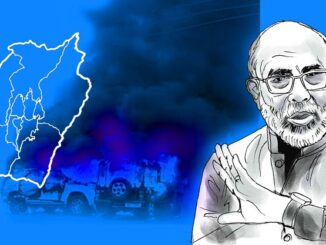
    Manipur needs moral leadership and genuine outreach by the highest offices, and not political and insincere apologies

    “With no major restructuring or reimagining of the governance structure in Manipur envisaged, what it needs desperately to heal the societal divide (beyond more security personnel and fencing of borders, which must be done, in any case) is some honest soul-cleansing, a la ‘Truth and Reconciliation’, as was done in the aftermath of the ended Apartheid (White Rule) in South Africa, when portents of bloody revenge were inevitable.”

    By Lt Gen Bhopinder Singh Retd

    Official apologies can be powerful instruments to heal societal wounds, rectify policies and reignite hope for future unity. They can conclusively redress and reassure the disaffected to invest in another chance to normalize. However, for an apology to work, it needs to be sincere and not political.

    One of the most restorative apologies in modern history is Kniefall von Warschau or the ‘Warsaw Kneel’, with West German Chancellor Willy Brandt’s sudden and spontaneous gesture of genuflection before a war memorial in Poland to symbolically atone for Germany’s past with Poland. Brandt reflected on the poignant moment: “At the abyss of German history and under the weight of millions of murdered people, I did what people do when language fails.”

    The impact of the sincere apology without any unnecessary context or defensiveness was immediate. The clear courage and dignity in Brandt’s apology overcame the murky past and ushered in a new era of trust.

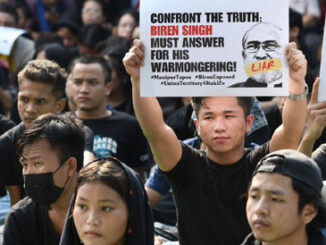
    Recently, the deeply fractured, polarized and largely unacknowledged realm of Manipur re-entered the national imagination with a supposed ‘apology’ by its Chief Minister, who has presided over its slide since violence erupted in May 2023. Questions about the sincerity of the apology abound. Did it tantamount to taking ownership and accountability? Was it unequivocal? Did it resort to rote whataboutery and blame-shifting? Did it include acknowledging missteps and, therefore, rectification of outlook? Or, was it just a mealy-mouthed political statement, essentially implying more of the same, going forward?

    The CM’s statement clearly lacked both personal ownership (as it pandered to generalities) and empathy, as he said perfunctorily, “Whatever happened has happened. We have to forgive and forget the past mistakes and make a new beginning.” As if on cue, and seemingly oblivious to reality, he added incredulously: “The Centre provided enough security personnel and funds”!

    This begs the question that if there was no shortage of support from the Centre, why has the situation deteriorated dangerously? Was it, then, a shortage of governance intent or capabilities? Either way, an unforgivable shortcoming, if any sincerity was implicit. The final straw came with the CM blaming the previous governments (from opposition parties) for the prevailing situation, thereby effectively absolving himself and his governance from the need for any remorse.

    Weeks earlier, the Union Home Ministry had issued its annual report on Manipur which highlighted a laundry list of measures taken, including personnel, financial, material, and detailed an earlier visit by the Home Minister to end the strife and disaffection. The language was almost self-patting, “The central government took a series of immediate and sustained actions to handle the situation.”

    But what was not mentioned in the report or in the CM’s purported ‘apology’ was the fact that the societal divide has only worsened and the resultant violence increased.

    As the face and perception of Meitei majoritarianism (against minority Kukis), the CM could have been more specific in defining who he sought to ‘forgive’ and what he wanted others to ‘forget’ in his ostensible ‘apology’. After all, it was only a political ‘apology’.

    With no major restructuring or reimagining of the governance structure in Manipur envisaged, what it needs desperately to heal the societal divide (beyond more security personnel and fencing of borders, which must be done, in any case) is some honest soul-cleansing, a la ‘Truth and Reconciliation’, as was done in the aftermath of the ended Apartheid (White Rule) in South Africa, when portents of bloody revenge were inevitable.

    With a complex, polarized and contested past (much like Manipur), South Africa, too, could have regressed to an explosive us-versus-them rhetoric, but for the sagacity and wisdom of the leadership under ‘Africa’s Gandhi’, i.e., Nelson Mandela.

    Like the inclusive spirit of unity-in-diversity, as enshrined in the constitutional “Idea of India”, the South African leadership had chosen to valourise and posit their own civilizational concept of ‘Ubuntu,’ which is predicated on the interconnectedness of humankind. This approach is especially important as it offers a fresh and real chance to come clean by seeking forgiveness over prosecution, unlike the spirit prevailing in a solely militaristic approach, as is visible in Manipur.

    If one comes from a more unbiased and progressive outlook that in any conflict, excesses or wrongs are committed by all sides (as opposed to binary ‘othering’, as is the wont in India these days), then a sense of restorative justice prevails.

    Importantly, in the South African experiment under Truth and Reconciliation, the corrective action was not implied for ‘Whites’ only, but also onto ANC (African National Congress) cadres, who, too, had committed excesses. Individuals seeking amnesty came clean on human rights violations that they had perpetuated with the aim of restoring the victim’s dignity and seeking forgiveness.

    A natural outcome of ‘bringing out the truth’ has a reconciliatory and forward-moving effect that cannot be achieved with retributive justice, as there are layers after layers to ‘truths’ in such places. A majoritarian spirit of ‘victor’s justice’ is avoided. In Manipur, one side definitely imagines the State to be favoring the other. Importantly, this process does not preclude justice from running its course if the magnitude and brutality (and also non-acceptance) prevails amongst parties on specific instances.

    What Manipur needs is a total reconstruction of its society (and narratives). That can only emerge if the recent past is opened to inform the distraught populace on both sides about what really happened in order to accept, forgive and heal the same for a collective future. As only a wise statesman and not just a politician, Nelson Mandela could say: “All of us, as a nation that has newly found itself, share in the shame at the capacity of human beings of any race or language group to be inhumane to other human beings. We should all share in the commitment to a South Africa in which that will never happen again.”

    Manipur needs such moral leadership and genuine outreach by the highest offices, and not political and insincere apologies.

    (The author is a retired Lt. General of the Indian Army)

  • Manipur conflict not just a local crisis

    Manipur conflict not just a local crisis

    It is a microcosm of the broader challenges of managing diversity in a pluralistic society

    “Manipur’s conflict is not just a local crisis but a microcosm of the broader challenges of managing diversity in a pluralistic society. India’s ethnic mosaic is both its strength and a vulnerability. Handling ethnic diversity is not about sharpening differences but embracing them within the framework of mutual respect and shared aspirations. The Northeast experience shows that peace is possible when governance is inclusive, leadership responsible and ethnic harmony treated as the foundation of a resilient democracy.”

    By Lt Gen DS Hooda retd.

    The conflict in Manipur, now in its 19th month, shows few signs of an early resolution. In his address on Vijay Diwas on December 16, Chief Minister Biren Singh blamed the unrest on ‘certain agencies’ that are attempting to destabilize the state. He further cited the role of politically motivated and one-sided information as a major contributor to Manipur’s instability. He also claimed that misinformation had been conveyed to Central leaders, creating confusion regarding the appropriate course of action.

    In evaluating the situation in Manipur, it is helpful to reflect on how the Indian State has effectively managed insurgencies across the Northeast and why Manipur has now diverged as an exception. The Northeast has long been a battleground of ethnic assertions, with armed movements emerging soon after Independence. These movements, primarily fueled by tribal groups asserting their identities, have raised demands ranging from secession to calls for greater autonomy. The Indian State has adopted a two-pronged approach to address them: overwhelming military force to establish control and sagacious accommodation of ethnic aspirations.

    The Army initially adopted harsh measures, like the forcible relocation of villages, large-scale cordon-and-search operations and retributive punishments. The military’s role in suppressing insurgencies has often drawn criticism for human rights violations, yet it succeeded in establishing the writ of the State.

    Alongside, the government displayed great foresight in addressing the concerns of different ethnic identities. The states of Nagaland, Mizoram and Meghalaya were carved out of Assam, while Manipur and Tripura went from UTs to statehood. Articles 371A, 371C and 371G were incorporated in the Constitution, providing special provisions for the tribal communities. Autonomous councils under the Sixth Schedule further empowered ethnic groups like Bodos, Dimasas, Karbis, Khasi, Garos and Chakmas, giving them legislative and administrative control over land and local customs.

    A concerted effort was made to get the armed cadre to eschew violence through generous surrender programs. One criticism of this was that the cadre remained in designated camps and were never absorbed into civil society through rehabilitation and, thus, retained their militant group identity. While not perfect, the dual strategy of control and accommodation was successful in significantly reducing violence in the Northeast, with terror-related deaths dropping from over 1,000 in 2008 to just 13 in 2022.

    Manipur represents a volatile blend of three major communities — Meiteis, Nagas and Kukis — each with distinct cultural traditions. All groups maintain armed militant factions, often regarded as crucial for safeguarding their identity in a multi-ethnic landscape. The Meiteis, as the majority community residing in the central valley, have traditionally held significant political power in Manipur. However, they lack the constitutional safeguards available to the tribal Nagas and Kukis, such as quotas in education, jobs and land rights. This imbalance has long been a source of tension. Frequent blockades by tribal groups to press their political demands also affected the Meiteis by disrupting daily life, deepening economic woes and worsening inter-community ties.

    On the other hand, the tribal communities view the special provisions as essential protections against cultural erosion — protections that they argue are necessary due to their minority status. State and Central governments have sought to balance a complex interplay of differing types of accommodation — political power for the Meiteis and special safeguards for the tribals. While this meant that some grievances of the Meiteis remained unaddressed, a fragile status quo was maintained.

    In a sensitive ethnic environment, self-aggrandizing politicians can exacerbate conflict by using ethnic identities as a tool to mobilize support, portraying themselves as the protectors of one group while demonizing another.

    This is what happened in Manipur when the CM’s rhetoric against the Kukis became strident. While he justified his actions as acting against illegal immigrants, drug traffickers and encroachers on forest land, they sparked alienation among the Kukis. In March 2023, the state government withdrew from the Suspension of Operations agreements with the Kuki National Army and Zomi Revolutionary Army, signaling an end to negotiated peace efforts.

    David Lake and Donald Rothchild, in their seminal work Containing Fear: The Origins and Management of Ethnic Conflict, argue that “stable ethnic relations can be understood as based upon a ‘contract’ between groups. Such contracts specify, among other things, the rights and responsibilities, political privileges and access to resources of each group… ethnic contracts channel politics in peaceful directions.”

    Any perceived imbalance in this contract can ignite conflict. In Manipur, this imbalance was exacerbated by exploitative politics and ethnic activism that created a deep polarization between the Meiteis and Kukis. Violence appeared inevitable, and the spark came in May 2023 when the Manipur High Court directed the state government to recommend granting ST status to the Meiteis.

    Today, the geographical and psychological divide between the Meiteis and Kukis is nearly complete. The state forces appear to be helpless actors as armed civilian gangs from both sides roam the countryside in search of defenseless victims. Amid the civil war in Myanmar and instability in Bangladesh, the situation in Manipur is acquiring a larger national security dimension.

    We must learn some lessons. Manipur’s conflict is not just a local crisis but a microcosm of the broader challenges of managing diversity in a pluralistic society. India’s ethnic mosaic is both its strength and a vulnerability. Handling ethnic diversity is not about sharpening differences but embracing them within the framework of mutual respect and shared aspirations. The Northeast experience shows that peace is possible when governance is inclusive, leadership responsible and ethnic harmony treated as the foundation of a resilient democracy.

    (Lt Gen DS Hooda is a retired Indian Army Officer)

  • 2 killed, Major among 50 hurt in Manipur violence

    2 killed, Major among 50 hurt in Manipur violence

    Imphal (TIP)- Two persons were killed and 50 others, including an Army Major, were injured in fresh violence in Manipur on Friday, Sedptember 8, when hundreds of people from the majority community attempted to storm tribal villages, officials said.
    In the morning, a gunfight erupted at Molnoi village near Pallel in Tengnoupal district between the security forces and armed persons who attempted to resort to arson and violence in the village.
    As the news of the gunfight spread, large groups of Meitei community members, including Meira Paibis and Arambai Tenggol militiamen dressed in commando uniforms, attempted to break through security check-posts and move towards Pallel. Security personnel attempted to stop the mob to ensure peace and stability in Pallel, where the situation has been tense for a few days. Being blocked by the forces, some armed persons who were dressed in police uniforms and part of the mob opened fire, resulting in gunshot injuries to an Army Major. The officer was evacuated to a military hospital in Leimakhong by a helicopter. Three other police personnel were also injured in the incident. In a calibrated response, the forces used minimum force to disperse the mob, officials said. More than 45 women were injured after security men lobbed teargas shells to defuse the situation. The morning gunfight led to one death, the officials said. Also, a 48-year-old man was killed in the crossfire.
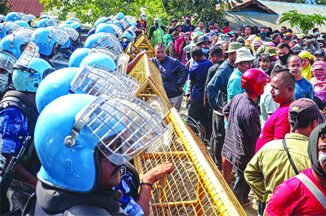
    Earier on September 6, local groups defied prohibitory restrictions and tried to remove army barricades in Manipur’s Bishnupur district on Wednesday, sparking clashes that left over 40 injured according to news agency PTI, hours after the administration clamped curfew in five Valley districts to stave off violence.
    The clashes were reported from Phougakchao Ikhai bazaar, 52 km south of Imphal, along the Imphal-Churachandpur route, after the crowd gathered in response to a call by the Coordinating Committee on Manipur Integrity (COCOMI), a Meitei civil society organisation, to remove security barricades at Phougakchao Ikhai village.
    COCOMI has sought the removal of the barricades from Meitei-inhabited areas in Phougakchao Ikhai village up to Torbung, another Meitei-inhabited village, along the border of Bishnupur and Churachandpur districts. The groups says this is needed for the resettlement of community members who have been displaced in the ongoing ethnic violence that has lasted four months.

  • Playing out a farce: On government and legislature functioning in Manipur

    The Manipur Assembly disregards duty by adjourning sine die at a time of crisis

    Given what transpired on Tuesday, it is difficult not to term the functioning of the government and the legislature in conflict-ridden Manipur a farce being played out in the State. The Assembly met just before the stipulated six months after the last session on March 3. Article 174(1) of the Constitution mandates that sittings have to take place within six months of the end of the previous session. Incomprehensibly, the session was adjourned sine die just 48 minutes after it began; there was barely 11 minutes of business with 10 MLAs of the Kuki-Zo community also absent. Chief Minister N. Biren Singh had reportedly invited the absentee Kuki MLAs to the House, by guaranteeing their security, but they denied having spoken to him and refused to buy the guarantee by pointing to the law and order situation in the Imphal valley. This reiterates the breakdown of trust between legislators of one community and the government’s leadership despite a sharing of party affiliations. The session was originally set to convene on August 21, but the Governor, Anusuiya Uikey, had, inexplicably, not issued the notification summoning the House, despite the Cabinet’s advice to her on August 4. That legislative functions have been so poorly conducted when there are pressing issues related to the rehabilitation of displaced residents, the recovery of looted weapons, the persisting ethnic divide leading up to “economic blockades” and the sporadic violence, indicate the failure of a government that commands an electoral majority in the House.

    The Manipur Assembly is no stranger to controversy. In its previous iteration, little heed was paid to parliamentary conventions, as it was marked by rampant defections, exemplified by the case of Congress MLA T. Shyamkumar, who became a Minister in the Bharatiya Janata Party-led government and later stripped of his office by the Supreme Court which had lost patience with the Speaker’s inaction after his blatant violation of the anti-defection law. This time around, the BJP regime suffers a severe legitimacy deficit — in its inability to bring about a turnaround in the deterioration of ethnic relations following the May 3 violence and to conduct proper legislative sessions to at least discuss a way out. Ethnic conflicts present complex problems, but the use of constitutional means is a must to enable workable solutions. As things stand, the two sparring communities in the State are veering towards positions that are becoming even more intractable as the government continues to flounder. The BJP is mistaken if it continues to believe that its ham-handed approach to retain the status quo in leadership will yield a breakthrough in the State.
    (The Hindu)

  • Manipur incidents make Indians hang their heads in shame

    The horrifying & gruesome incident of Manipur has  put the whole nation to shame. The irresponsible  religious propaganda spread by media everyday will doom the whole nation one day. Society now has been brutally divided  in the name of religion to fulfill the vested interest of the ruling party. The insanity has reached its peak because of the hate messages being officially circulated on social media, which are turning us into intolerant human beings . If this continues,  after some time the whole country will be  sitting on the Time Bomb and anarchy will rule the Day. If we don’t stop here the results will be devastating. Tomorrow it can be one of us. It is high time we  recognize this game of dirty politics and refrain ourselves  from spreading hatred in the country. No one can manipulate us against our wish. So,  only the citizens of this country can stop the occurring of these incidents in future.  Let us stop ourselves from being fooled by dangerous politicians who are not even affected by the incident. Let the people suffer;  they are interested in their vote banks only. What goes out comes back, this is the law of nature. So, please spread love, affection and care and make India a place worth living in.

    Tript Kaur (Ludhiana)

  • Manipur & beyond

    Crisis imperils peace in entire North-East

    The Manipur crisis, which has reached a crescendo due to the nationwide outrage over a video clip showing two women being paraded naked, is spilling over to other states in the North-East. Dozens of Meitei people, who were residing in Mizoram, have fled to Assam following an ‘advisory’ issued by the Peace Accord MNF Returnees’ Association (PAMRA), an ex-militants’ group. The Meiteis — the majority community in Manipur — find themselves under threat because a Meitei mob was allegedly responsible for the horrifying assault on Kuki-Zomi women in early May. Meiteis are leaving Mizoram despite the state government’s assurances about their safety and security, even as PAMRA ‘clarified’ that it had only asked them to exercise caution in the light of ‘public sentiments’ regarding the ethnic conflict in Manipur. Some Mizoram-based Meiteis have even taken refuge in Manipur. What has caused anxiety and insecurity among Meiteis is a call given by Mizoram’s civil society groups to hold statewide demonstrations today (July 25) in protest against the violence unleashed on members of the Kuki, Hmar, Mizo and Zomi communities in Manipur. Notably, the immediate trigger for ethnic clashes in Manipur was a ‘Tribal Solidarity March’ taken out on May 3 in protest against the Meitei community’s demand for Scheduled Tribe status.

    (Tribune, India)

  • Mob torches Manipur minister’s godown, tries to burn down residence

    A group of people set on fire a private godown of Manipur minister L Susindro at Chingarel in Imphal East district, reducing it to ashes, police said on Saturday, June 23.
    An attempt was also made to torch another property of the consumer and food affairs minister and his residence at Khurai in the same district on Friday night but timely intervention prevented it. Security forces fired several rounds of teargas shells till midnight to prevent the mob from gheraoing his Khurai residence, police said. No casualty was reported in the incident.

  • Law ministry approves increase of poll expenditure by candidates

    New Delhi (TIP)-The Union ministry of law and justice on Thursday, Jan 6,  approved raising the election expenditure ceiling by a candidate to a maximum of Rs 95 lakh in Parliamentary elections and Rs 40 lakhs in assembly elections, increasing them from the earlier limits of Rs 77 lakh and Rs 30.8 lakh.

    The increase comes at a time when five states are headed for assembly polls — Uttar Pradesh, Punjab, Uttarakhand, Manipur and Goa — even as a sharply rising third wave of Covid-19 cases has raised the clamour for political rallies to be conducted virtually to avoid the spread of the infection.

    The increased budget is meant to facilitate this shift, officials familiar with the matter said on condition of anonymity.

    “In exercise of the powers conferred by subsection (3) of Section 77 read with Section 169 of the Representation of the People Act, 1951 (43 of 1951), the central government, after consulting the Election Commission of India, hereby makes the following rules further to amend the Conduct of Elections Rules, 1961, namely, the government said in a gazette notification. These rules may be called the Conduct of Elections (Amendment) Rules, 2022. (2) They shall come into force on the date of their publication in the Official Gazette,” the gazette notification said.

    In 2020, the government approved a 10% raise in the poll expenditure cap ahead of the Bihar elections to allow candidates to spend on virtual campaigning amid the pandemic. The ceiling for parliamentary constituencies was at the time raised to Rs 77 lakh, from the 2014 limit of Rs 70 lakh, and assembly polls to Rs 30.8 lakhs from Rs 28 lakh in larger states. With the revision, candidates in Uttar Pradesh, Uttarakhand and Punjab — classified among large states — will therefore be able to spend Rs 40 lakh in the upcoming polls, while those in Goa and Manipur — classified as small states — will have to adhere to a limit of Rs 28 lakh.

    The increase was cleared on the recommendation by the Election Commission, the official cited above said.

    According to EC officials, there were three considerations which officials had while recommending raising limit. “Number of electors has gone up significantly, inflation index has also gone up,” a second official said.

    The Commission anticipates virtual campaigning to also increase costs. ‘They will need to out up big screens in various places so a budget for that had to be factored in,’’ the official added, saying that this was part of the reforms that the poll panel has been pushing for. The Commission had come under the scanner in April this year as polls continued amid the peak of the second wave of the pandemic. The Madras High Court went as far as to say that EC officials were culpable for murder for conducting polls.

    Candidate expenditure includes the money spent by them on polling events, rallies, posters and other paraphernalia. The same, however, can also be borne by the political party the candidate is affiliated to.      Source HT