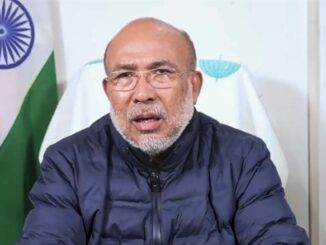
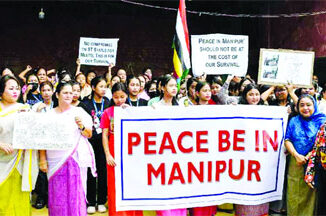
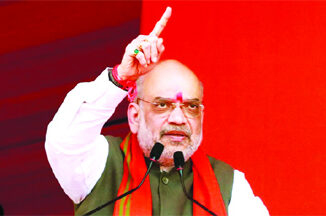
New Delhi (TIP)- The Centre has deployed 90 additional companies, or nearly 9,000 personnel, of the Central Armed Police Force in Manipur since August, state Security Adviser Kuldiep Singh said on Friday, November 22, reported The Hindu. Presently, 288 Central Armed Police Force companies, which comes to around 29,000 personnel, were deployed in the conflict-ridden state, Singh said at a press conference in Imphal. Apart from this, personnel from the state police, the Army and the Assam Rifles were also present in Manipur.
Singh also said that the number of persons, including suspected militants, killed in the state since the clashes broke out between the Meiteis and Kuki-Zo-Hmars in May 2023 had risen to 258. Singh’s statements came amid an uptick in ethnic violence in Manipur over the past two weeks.
On November 11, the state police said that 10 suspected Kuki militants were killed in a gunfight with security forces in Jiribam district.
However, Kuki-Zo-Hmar organisations claimed that the persons killed in the gunfight were village volunteers. The term “village volunteers” has been used for armed civilians guarding villages since the ethnic clashes broke out between the two communities in 2023.
After the gunfight, three women and three children, including an infant, from the Meitei community were abducted allegedly by Kuki militants. Their bodies were found floating on the Barak and Jiri rivers over the past week.
The abduction led to protests on November 16, with mobs storming and vandalising the homes of MLAs, including of chief minister’s son-in-law Rajkumar Imo Singh. Mobs also ransacked the offices of the BJP and the Congress.
At the press conference on Friday, Singh said that the police will look into the claims that the Meitei family was abducted in the presence of security forces, according to The Hindu.
“Whether they were SoO [Suspension of Operations] militants or not, will be verified by police,” he added.
The Suspension of Operations agreement was signed between the Centre, the Manipur government and two conglomerates of Kuki militant outfits – the Kuki National Organisations and United Peoples Front – in 2008.
Under the agreement, the security forces as well as the militant groups are prohibited from launching operations. The militant groups must abide by the laws of the land and are also confined to designated camps identified by the Central government. Earlier this year, the state government withdrew from the pact when it came up for annual extension.
Singh said that 32 persons had been arrested for incidents of arson and vandalism at the homes and properties of legislators, The Hindu reported. A meeting to review security measures was also held in Imphal and combing operations were being conducted in the state, he added.
On Friday, Nov 22, the last rites were performed in Jiribam for nine persons who had died since November 11, which included the six persons abducted and killed, two others who were burned to death and one person who was shot by the police, according to The Hindu.
India cancels more consular camps in Canada, says ‘minimum security’ not being provided
The Consulate General of India in Toronto announced on Thursday, Nov 21, that it had cancelled more consular camps due to the “continued inability” of Canadian authorities to provide “minimum security against heightened threats”.
Consular camps are routinely organised by the Indian diplomatic missions in Canada, including the High Commission in Ottawa and the consulates in Vancouver and Toronto, to assist citizens of Indian origin with documentation services.
On November 3, protests by pro-Khalistan groups erupted during a consular camp organised by the Indian High Commission in partnership with the Hindu Sabha Temple in Brampton.
Since then, several such camps have been cancelled due to security concerns.
On Thursday, Nov 21, the Consulate General of India said it has had to cancel more camps, including one that was supposed to be held at a police facility.
“Consulate is fully sensitive to the difficulties faced by close to 4,000 elderly members of the diaspora in the Greater Toronto Area – both Indian and Canadian nationals – who have been deprived of an essential consular service,” it said.
Videos of the November 3 incident in Brampton circulating on social media showed men and women attacking temple visitors with sticks.
Tag: Manipur violence
-

Manipur violence: 90 additional companies of Central Armed Forces deployed
-

Violence, militia & leadership crisis in Manipur
Manipur’s unending crisis continues to torment the state, with the recent violence shattering the uneasy calm between the people of the Imphal valley and a section of the hill communities in the uplands.

By Sanjoy Hazarika Manipur’s unending crisis continues to torment the state, with the recent violence shattering the uneasy calm between the people of the Imphal valley and a section of the hill communities in the uplands. For a brief period, public attention shifted to Shillong, capital of Meghalaya, where Chief Minister Conrad Sangma announced the withdrawal of his National Peoples Party’s (NPP) support to the state government.
The NPP, with seven MLAs, is the second largest group in the 60-member Assembly. The Assembly is dominated by the BJP, which holds a comfortable majority on its own with 37 MLAs and a coalition with smaller parties, including the JD(U) with six and the Naga Peoples Front with five. In a sharp denunciation of Chief Minister Biren Singh — the NPP remains in the NDA led by the BJP at the Centre — Sangma, who also heads the NPP, declared that “there was no confidence in our party in the current leadership of Biren Singh.” Though he pledged to work for peace, the party clarified that it would rejoin the government only if Singh was removed.
However, removing Singh is easier said than done. While it has been a demand of the Kuki groups, which have felt deeply aggrieved, the latest massacre of a Meitei family of six — three women and three children — triggered angry attacks on the homes of MLAs and ministers in the Imphal valley. The majority Meitei population lives in the valley. Among the main driving forces of the Meitei campaign is the COCOMI (Coordinating Committee on Manipur Integrity), an NGO representing the valley.
While the Centre has been silent on the demand for Singh’s removal, interviews with people on both sides of the divide indicate that the main challenge before the BJP and the Centre is to find a replacement who is strong enough to handle Manipur’s complex politics. This would include not just holding the balance with allies but also controlling civil society, dealing with insurgent groups, managing the media and keeping dissident MLAs in check. Until May 2023, when the ethnic eruption began, this cash-strapped state was seen as a place of promise and growth.
If anything, Singh has been a survivor. Over the years, he has honed his skills, besting rivals and rebels several times. In 2022, he led the BJP to a majority in the Assembly elections, crushing the Congress. A few weeks ago, much noise was made about a purported letter signed by 19 party MLAs critical of the CM, but it fizzled out.
In June last year, barely two months into the internecine conflict, Singh set out for Raj Bhavan with a resignation letter in hand for the Governor. A large crowd stopped the convoy, snatched the letter and tore it up in a theatrical, well-publicized display of support.
But Singh continues to face huge internal challenges. On November 21, 10 MLAs from the Kuki tribe, including seven from the BJP, attacked the state government, accusing it of favoring the majority Meiteis.
“The CM has mismanaged the situation from the start,” said Yumnam Joykumar Singh, national vice-president of the NPP and a former deputy chief minister in Biren Singh’s first term. “He says he is protecting the territorial integrity of Manipur, but where is this integrity? We cannot even travel to Jiribam or Moreh.”
Even as talk swirls around the imposition of President’s rule without the dissolution of the state legislature, the CM is unfazed. There is also growing criticism that he has no role in the security architecture, known as the Unified Command, which coordinates the security operations in the state.
The Centre’s point person for Manipur has been Home Minister Amit Shah and New Delhi’s response to the latest spasm of violence has been to restore the draconian Armed Forces Special Powers Act (AFSPA) in areas from where it had been lifted and to fly 5,000 additional paramilitary troopers to Manipur to bolster the already substantial presence of security forces. This muscular approach to security issues has evoked mixed reactions.
When the Home Minster announced an ambitious plan earlier this year to fence the 1,643-km Indo-Myanmar border, Nagaland and Mizoram stiffly opposed it, while Tripura, Manipur and Arunachal Pradesh, all BJP-governed states, welcomed it. Singh’s government and BJP MLAs have opposed AFSPA’s reimposition. Some say that this concern stems from the fact that the sweeping law can be used against militias and vigilante groups, some of which are said to be close to the state’s leadership.
Editor Pradip Phanjoubam said in an interview that the primary challenge was the proliferation of weapons accompanied by acute lawlessness, with a growth of pro-government militias as well as armed rebels of virtually all ethnic groups. “Anybody who has a gun in his hand becomes the law,” he remarked. He described the bouts of fragile calm as an “absence of violence” in a “frozen conflict”. An undercurrent of grievances and unmet aspirations runs across the state, threatening to erupt at the slightest provocation.
The identity of the protagonist or antagonist often depends upon the perception of the viewer. In one incident, 10 Kuki men who were killed when fired upon by a CRPF unit, have been described variously as insurgents or village guards, depending on who is speaking. The precise circumstances which provoked the shooting remain unclear, as do many situations in Manipur.
A person with knowledge of the situation said that the Kukis had automatic weapons and had been trained by rebel cadres who sometimes led them there and elsewhere.
Revenge is also a factor. In the latest burst of violence in Jiribam, the ill-fated family, members of a relief camp, were walking to a market when an armed group took them captive. The group was reportedly seeking to avenge the death of a young Hmar woman allegedly killed by a Meitei vigilante group. The Hmars, while listed as a Scheduled Tribe, are part of the larger Kuki-Chin-Mizo group of tribes.
There are economic issues, too. Jiribam is a major entry point from Assam. It has a mixed population of Bengali-speaking Muslims, Meiteis and Hmars while a railhead, the earliest in Manipur, and a major highway have made it a commercial center. Different political groups as well as competing non-state armed groups have long vied for control here. It is in such complex frameworks that the ongoing conflict needs to be understood.
The impact of Manipur’s tragedy appears limited to the Northeast. It has not become a live election or political issue across India. While warranting a few sentences in political campaigns across the country and rousing talks by opposition lawmakers in Parliament when issues conflagrate, it draws the occasional scathing editorial, commentary and news report in the media. Top officials and political leaders in Delhi remain occasionally engaged and deeply concerned, but the lack of a long-term strategy is visible.
(Sanjoy Hazarika combines roles as researcher, columnist, mentor and practitioner. Author, journalist, filmmaker, policy analyst and human rights advocate, he is a former reporter for the New York Times) -

Manipur Violence: Govt, Opposition talk of middle path after 11-day Parliament impasse
New Delhi (TIP)- After 11 days of impasse in Parliament over the structure of the Manipur violence debate, signs of a thaw, though still weak, appeared on Thursday, Aug 3, with the Opposition and the government discussing a middle path to break the stalemate.
The formula proposed by INDIA alliance veterans at a meeting with Leader of Rajya Sabha Piyush Goyal and Union Parliamentary Affairs Minister Pralhad Joshi relates to their climbdown from the current insistence to discuss Manipur under Rule 267, which entails the suspension of entire business to debate a matter. Sources said the Opposition has offered to discuss Manipur under Rule 167, which covers issues of public interest and which has in the past been invoked to debate crucial yet controversial subjects. A key condition of the new formulation, however, is the agreement of both sides on the draft of the motion under Rule 167.
“The ball is now in the government’s court,” an Opposition source said, still insistent that PM Narendra Modi should reply to the Manipur debate. Sources cited past instances when Rule 167 was invoked to find a middle path. On May 6, 2002, the Rajya Sabha had discussed a motion moved by Congress MP Arjun Singh on violence in Gujarat. After Singh moved the mutually drafted motion, Leader of Opposition in RS Manmohan Singh spoke and was followed by then PM Atal Behari Vajpayee and then Home Minister LK Advani. “In the end Arjun Singh replied to the motion, which was unanimously adopted without the need for any voting,” an Opposition leader said.
On August 4, 2010, then Leader of Opposition in RS Arun Jaitley moved a motion under Rule 167, expressing concerns over inflation. Then Finance Minister P Chidambaram replied to it and it was adopted.
“INDIA parties have offered a middle path to the leader of the House to break the logjam and get a discussion on Manipur going in an uninterrupted manner in the Rajya Sabha. Hope the government agrees,” Congress chief whip in RS Jairam Ramesh said.
TMC’s Derek O’Brien said: “The Opposition does not stand on ego and Manipur needs healing.”
The Union ministers noted that for 11 days, RS Chairman Jagdeep Dhankhar kept offering to start the debate under Rule 176, but the Opposition posed roadblocks.
On MHA request, Kuki mass burial put off
Hours before a planned mass burial of deceased Kuki-Zomi people who fell victim to the ethnic violence, the Manipur High Court today ordered that status quo be maintained at the proposed burial site in Churachandpur district. The ITLF, the apex tribal body, which organised the funeral services, said it was postponing it by seven days following requests from the Union Ministry of Home Affairs (MHA).
The developments came amid fresh violence that left 17 persons injured in Bishnupur. Police sources said Army and RAF personnel fired tear gas shells in Kangvai and Phougakchao areas of Bishnupur to stop massive crowds from proceeding to the proposed mass burial site. The security forces cited violation of restrictions imposed on the gathering of more than five persons. The district magistrates of Imphal East and Imphal West withdrew curfew relaxations announced earlier and imposed day curfew as a precautionary measure throughout the Imphal valley, officials said. Source: TNS -

After fresh Manipur violence, Amit Shah to visit state, hold talks with stakeholders
Guwahati (TIP)- Union home minister Amit Shah on Thursday, May 25, called for peace in violence-torn Manipur and said he will visit the northeastern state next week to hold talks with all stakeholders — the first major public intervention by the Centre since ethnic clashes broke out three weeks ago, killing 74 people and displacing another 30,000. Speaking at an event in neighbouring Assam, Shah said only talks between various groups can bring calm. His comments came a day after fresh bouts of violence roiled a district in Manipur that had previously been relatively unscathed by the clashes that convulsed the state from May 3. “I will go to Manipur soon and stay there for three days but before that, both groups should remove mistrust and suspicion among themselves and ensure that peace is restored in the state,” he said.
Union minister of state (home) Nityanand Rai, who arrived in Imphal on Thursday, told reporters that Shah will reach Manipur on May 29 to take stock of the situation and stay till June 1.
“The Centre will ensure that justice is delivered to all those who suffered in the clashes in the state, but people must hold dialogue to ensure peace….in the last six years, prior to the recent clashes, there was no blockade or bandhs in Manipur and people must ensure the return of such a situation again,” Shah said.
“Charcha ke saath hi shanti ho sakti hain (Peace can only be restored through dialogue),” he added.
This is the first announcement of a high-level intervention by the Centre in Manipur since May 3, when clashes broke out in Churachandpur town after tribal Kuki groups called for protests against a proposed tweak to the state’s reservation matrix, granting scheduled tribe (ST) status to the majority Meitei community. Violence quickly engulfed the state, displacing tens of thousands of people who fled burning homes and neighbourhoods into jungles, often across state borders. To be sure, the Indian Army has been deployed in the region since May 4. Source: HT