Tag: Manoj Joshi

  • G2 won’t be music to India’s ears

    G2 won’t be music to India’s ears

    The new deal between the US and China is all about give and take

    “One thing is clear: the threatened decoupling of the Western and Chinese economies is not around the corner. The race now is for global leadership amidst some shaky guardrails between the G2. Here, while the US has been seeking ephemeral gains through tariffs, the Chinese are preparing for another future. Their latest five-year plan focuses on quantum technology, bio-manufacturing, hydrogen energy and nuclear fusion. China already leads in some of these fields, but the US remains ahead overall and has placed its current bets on AI.

    By Manoj Joshi

    The economic and geopolitical consequences of competitive US-China relations in these areas are hard to forecast. But they cannot be particularly comforting for countries like India that had counted on the US to maintain geopolitical heft against China. The new deal between the US and China is all about give and take.

    The recent meeting between US President Donald Trump and his Chinese counterpart Xi Jinping in South Korea has been judged as a draw/ceasefire/truce in the long-term competition between the two world powers. From a situation suggesting decoupling, the relationship seems to have taken a 180-degree pivot. This seems to be a consequence of China besting the US in its trade negotiations.

    Trump termed the outcome of the meeting as scoring a hyperbolic 12 out of 10. US Secretary of War Pete Hegseth, who was in Kuala Lumpur for the ASEAN Defense Ministers’ Meeting Plus, tweeted after he met his Chinese counterpart Admiral Dong Jun, “I just spoke to President Trump and we agree — the relationship between the US and China has never been better”.

    Having spoken to Admiral Dong twice in a day to restore ties between the US and Chinese militaries, he declared that the tone had been set by Trump’s “historic G2 meeting” and ended by noting “God bless both China and the USA!”

    He was echoing Trump’s tweet posted hours earlier: “My G2 meeting with President Xi of China was a great one for both our countries. The meeting will lead to everlasting peace and success. God bless both China and the USA!”

    Both sides have pulled back from some of their more dire threats and actions. Effectively, they have kicked the can down the road by making their decisions valid for just the coming year. At another level, they seem to be trying to work out the framework in which G2, or a global US-China condominium, can operate.

    In his official tweet on the Dong Jun meeting, Hegseth noted the importance of maintaining a balance of power in the Indo-Pacific and US concerns about Chinese activities in the South China Sea and Taiwan.

    In the Phase I trade deal that China signed with the US during Trump’s first term in 2020, Beijing was forced to make unilateral commitments to buy American products. But the current deal is all about give and take.

    The US backed off from its new Entity List export restrictions in exchange for China doing so with its rare earths rules. The Entity List rule was unveiled on September 29, barring Chinese firms at least 50 per cent owned by previously sanctioned Chinese companies from receiving restricted US tech exports using subsidiaries. What it did was to effectively increase the number of Chinese firms on the Entity List from 1,400 to a massive 20,000.

    This had led China to use its Brahmastra of rare earths on the eve of the Xi-Trump meeting. Under this rule, export controls would kick in even if 0.1 per cent of the product used Chinese rare earth processing technologies anywhere in the world. This virtually covered almost all smartphones, hard drives, TVs, motors and medical devices in the world.

    The Chinese also agreed to resume soyabean purchase, much to the relief of Trump, whose farmer support base was becoming increasingly restless over the Chinese decision not to buy American soyabean. The US suspended the implementation of measures under its Section 301 investigation targeting China’s maritime logistic and shipbuilding industries for a year.

    The US will now drop its overall tariff rate for China to 47 per cent. This is, in effect, where it was before Liberation Day, April 2. If we take the 20.7 per cent tariff that existed before Trump assumed office and add 10 per cent of the reduced fentanyl tariff, we are left with just 10 per cent additional tariff which was the baseline figure applicable to all.

    Both sides have agreed to cooperate on the fentanyl issue, but there are other matters that need to be resolved, such as Chinese access to Nvidia chips and the ownership of TikTok. The Taiwan issue seems to have been sidestepped for the present.

    A major reason for China’s success has been tactics. While Beijing systematically prepared for a possible clash in the last few years, Trump led Washington to hit out recklessly on the tariff issue. Instead of targeting China alone, as it had done in 2020, the US sharply escalated the fight with China and hit the whole world with its Liberation Day tariffs, alienating friends and allies.

    To an extent, this was also an underestimation of Chinese developments in recent years. There was a belief that the American economy, with the help of artificial intelligence (AI), had gained a decisive edge, while Covid-19 travails, economic slowdown, unemployment and military purges had weakened China.

    The détente, which now seems to be verging on an entente, has brought a sense of relief around the world. A US-China implosion would have had consequences for the entire global economy. But the developments should not generate a false sense of security. Despite Trump’s and Hegseth’s effusive take on the China relationship, the reality is that there have been too many recent ups and downs to predict a stable future.

    One thing is clear: the threatened decoupling of the Western and Chinese economies is not around the corner. The race now is for global leadership amidst some shaky guardrails between the G2. Here, while the US has been seeking ephemeral gains through tariffs, the Chinese are preparing for another future. Their latest five-year plan focuses on quantum technology, bio-manufacturing, hydrogen energy and nuclear fusion. China already leads in some of these fields, but the US remains ahead overall and has placed its current bets on AI.

    The economic and geopolitical consequences of competitive US-China relations in these areas are hard to forecast. But they cannot be particularly comforting for countries like India that had counted on the US to maintain geopolitical heft against China. The new deal between the US and China is all about give and take.

    (Manoj Joshi is an Indian journalist and author specializing in security and international relations)

  • Trump putting US soft power in jeopardy

    Trump putting US soft power in jeopardy

    The MAGA policy is bound to hit America’s global image and diminish its long-term influence

    “American soft power exerted itself not only through the dollars and cents of its foreign aid funding commitments, but through four main pillars. First, the cultural influence of its entertainment and media industries and its education system that led the world in innovation and technology. The second was the political example of its commitment to democracy, equality and human rights, as well as its vibrant civil society. The third was the power and perceptions it derived from the policies of the institutions it helped create — the UN, World Bank and so on. The fourth, its dynamic consumer-oriented economy ensured that the US has retained its status as the largest economy in the world since WWII.”

    By Manoj Joshi

    In the 1990s, the New York Times carried a report about a Chinese delegation touring Broadway in New York. The visitors’ goal was to learn how that fabled theatre district worked and how it could be reproduced in Shanghai or Beijing. The Chinese understood well that US power was not just in its military, but also in its vibrant culture.

    The hallmark of power is the ability of a country to shape the policies of others. This can be through hard power — military and financial — but it is often more easily done through soft power, the attraction and persuasion you are able to exert because of your culture, values and ideology.

    For four years after World War II, the US had a monopoly of nuclear weapons. These were the years in which it launched the Marshall Plan to revive Europe and created the NATO military alliance to cement its global authority. But it also helped create the United Nations, the World Bank, the International Monetary Fund, the World Health Organisation, the General Agreement on Trade and Tariffs to provide global governance to deliver public goods in the areas of development finance, health and trade.

    These became instruments of US soft power along with the steadily rising American prosperity that supercharged its cultural appeal around the world. The shutdown of USAID, America’s principal aid-giving agency, has brought out just how dramatically the Trump administration plans to gut the ways in which US has exercised power around the world so far.

    USAID was the largest donor of official development assistance in the world. The $70 billion it provided annually was spread out among countries where it had strategic interests, such as Ukraine, Jordan and Palestine, and where it provided humanitarian assistance — Sudan, Yemen, South Sudan, Afghanistan and so on.

    Tempering hard power with soft has been an established strategy of the US that other countries, including India, have sought to follow. In the 1950s and 1960s, USAID played a significant role in helping India’s development goals in the fields of health, agriculture, food and education. But this was a clever means of deflecting Indian unhappiness arising out of its policy of arming Pakistan.

    American soft power exerted itself not only through the dollars and cents of its foreign aid funding commitments, but through four main pillars. First, the cultural influence of its entertainment and media industries and its education system that led the world in innovation and technology. The second was the political example of its commitment to democracy, equality and human rights, as well as its vibrant civil society. The third was the power and perceptions it derived from the policies of the institutions it helped create — the UN, World Bank and so on. The fourth, its dynamic consumer-oriented economy ensured that the US has retained its status as the largest economy in the world since WWII.

    These exerted a pull among students and researchers, businessmen looking for opportunity, artistes and performers as well as workers who flocked to the US in ever larger numbers, through legal or illegal means. Around the world, the US was admired for its democratic system, its prosperity and technological leadership. Its culture and fashions were widely imitated and there was a perception that its policies contained a dash of altruism absent from those of other big powers.

    Today, all this is being turned inside out. The ‘America First’ policy of the Trump administration seeks to put US interests ahead of everything else. The US President’s attempt to overturn the verdict of the 2020 elections or attack the vaunted judicial system has hit important institutions of democracy.

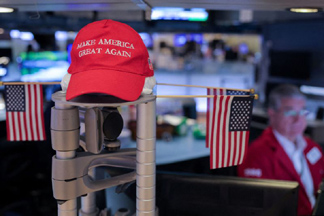
    Under attack within the US are universities, research institutions, charities, the media and even the Church — all of whom are being asked to conform to the demands of the MAGA (Make America Great Again) movement. Trump’s threat to defund universities for alleged transgressions undermines the intellectual freedom that has characterized American culture. Besides undocumented aliens, the Trump administration is making life difficult for foreigners in general, visa holders, tourists, permanent resident or Green Card holders. These actions strike at the very heart of American soft power.

    Around the world, American soft power has been envied. Today, Shanghai and Beijing have Broadway-like theatre districts. Besides culture, China has reached out to foreign countries to promote Chinese language through Confucius institutes and scholarships to attract students, another hallmark of soft power. India is another country that uses a mix of soft and hard power to navigate complex foreign policy challenges. This country is a major destination for foreign students.

    It is easy to claim that soft power can be given short shrift in our hyper-realist era. But the reality is that hard power by itself cannot achieve what a combination of hard and soft power, or “smart power” can do. Else, China or Russia would be seen as the more desirable countries in the world. Instead, whether it is the rich countries, or middle-income ones, the US is the more preferred option, as it has been for millions of migrants seeking to improve their lives.

    Despite Trump, the US is likely to retain its primacy around the world — through its films, music and technology. But by undermining trust among allies and altering the global perception of US values and goals, the MAGA policy is bound to damage America’s global image and diminish its long-term influence.

    (Manoj Joshi is a Senior Journalist & Distinguished Fellow, Observer Research Foundation)

  • Trump’s threats portend turbulence

    Trump’s threats portend turbulence

    • US President-elect’s stand on tariffs has caused consternation among friends and foes

    “The assumption that the Trump administration will not be a problem for India needs to be taken with a pinch of salt, especially when it comes to trade, tariffs and immigration. During Trump’s first term, tough immigration policies affected Indian tech professionals adversely and India lost its GSP status. Having some of the highest tariffs in the world and a trade surplus with the US, India could be a target for US action. Differences over Iran and Russia could still cloud the India-US picture.”

    By Manoj Joshi

    The year 2025 is going to be eventful. On January 20, Donald Trump will be sworn in as the President of the richest and militarily most powerful country in the world. In itself, it would not mean much; after all, more than a dozen men have held that office since the US achieved premier status in the wake of World War II. But Trump’s policies aim to end the liberal international order that the US established, based on the solidarity of democracies, a US-led global military alliance system, concern for human rights, free trade and the setting up of the UN system.

    Taken together with separate but parallel revisionist efforts by Russia and China, the world could witness a wild rollercoaster ride in the coming year. As it is, with US backing, Israel has made a huge hole in the rules-based international order by its use of massive and disproportionate military force in Gaza.

    Till now, Russia and China were countries that the US defined as revisionists, wanting radical changes in the global order. These countries have seen the liberal international order with its solidarity of democratic states as a major threat and have had no hesitation in challenging its fundamental tenet – territorial sovereignty – in Ukraine, Taiwan, India and the South China Sea.

    Now, Trump is also keen on territorial revision and wants the Panama Canal back. He also wants to buy Greenland and pull the US out of the World Health Organisation and several other UN organizations and blow up the global trading system and climate change agreements.

    Trump’s threats on tariffs have caused consternation among friends and foes. America’s neighbors like Mexico and Canada are reeling from the prospect of facing 25 per cent tariffs. Others are bracing for a tariff war. Trump wants to withdraw the US from its NATO commitments if the allies do not “pay their bills”, but this time he seems fine with regard to South Korea and Japan, no doubt because of Russia, North Korea and China.

    A world where three of its principal powers are revisionist is bound to be a turbulent one because there is nothing common in the issues on which they want a change. Russia, much reduced as a military and economic power, is really in a defensive mode. But as the case of Ukraine shows, it is willing to inflict great damage and destruction in an effort to recreate its erstwhile dominance of eastern Europe till the 1990s. The Europeans understand this and are rightly apprehensive. It was not for nothing that long-standing neutrals like Sweden and Finland hastily joined NATO in the wake of Russia’s invasion of Ukraine.

    As for China, after its ‘Century of Humiliation’, it sees itself as a global power again and wants the world to acknowledge it. So, it wants to revise the law of the sea as per its needs, demands an international system that is not based on ideology (i.e. democracy), sees economic development as more important than political freedom and wants changes in the governance structures of international bodies such as the International Monetary Fund and the World Bank.

    The Chinese military posture, too, is defensive in relation to the US. But in the process of countering America, China has built a formidable military machine. The recent displays of two advanced fighters and the launch of what is the world’s largest and most modern amphibious assault ships are manifestations of this approach.

    China may be undergoing a serious economic slowdown, but that is unlikely to affect its military buildup that involves significant investments in boosting technological self-sufficiency and advanced manufacturing. Alarmingly, the Chinese People’s Liberation Army has continued with its rapid nuclear buildup. The US estimates that China now has more than 600 operational warheads and is heading for a total of 1,000 by 2030.

    For India, this situation offers both an opportunity and a threat. The broad contours of the Indian response to Russia and China have been visible for a while. India continues to deal with Russia and seek opportunities, whether in buying oil at a discount or promoting trade that the Russians are trying to shift in a southerly direction through economic realignment and infrastructure development.

    As for China, India is seeking a mini-détente based on resolving border tensions that arose in 2020 and restoring normal trade and investment links.

    The assumption that the Trump administration will not be a problem for India needs to be taken with a pinch of salt, especially when it comes to trade, tariffs and immigration. During Trump’s first term, tough immigration policies affected Indian tech professionals adversely and India lost its GSP status. Having some of the highest tariffs in the world and a trade surplus with the US, India could be a target for US action. Differences over Iran and Russia could still cloud the India-US picture.

    Even so, there can be gains from a potential easing of tensions between Russia and the US. Aggressive US policies against China could accelerate the China+1 strategy of Western companies and lead to increased FDI in India, assuming Delhi makes itself more attractive to foreign investment.

    But when it comes to Trump, nothing is simple. The assumption that the US would look favorably towards India on account of China could be undermined by Trump’s instinct to avoid external conflict. Further, his advisers such as Musk are keen for even ties with China because of business reasons. Don’t forget that in January 2020, Trump signed a major trade deal with China. Never mind that it didn’t work then, but it could be the template for a new arrangement that might undermine the rationale of the India-US connection.

    (Manoj Joshi is Senior Journalist & Distinguished Fellow, Observer Research Foundation)

  • Violence has become a part of US polity

    Violence has become a part of US polity

    Political consequences of assassination attempt on ex-President Trump will be huge

    “The reality is that violence has become a part of American political life. The courts have not helped by loosening controls on the availability and ownership of guns. An attempt to ban assault weapons like the Colt AR-15 that was used to target Trump lasted just 10 years and faced repeated challenges in court. Currently, certain states ban such weapons through their own legislation; Pennsylvania, where the incident occurred, is not among them. It is largely with such weapons that mass shootings are carried out; in July, there has already been one other shooting, leading to five deaths. In 2023, there were 604 shootings, leaving 754 people dead and nearly 2,500 injured. To say that the US Supreme Court has been unhelpful here would be an understatement.”

    By Manoj Joshi

    The political consequences of the assassination attempt on former US President Donald Trump will be huge and they will benefit him immensely. Of great import is Trump’s instinctive and combative response to the attack. As he was encircled by Secret Service agents, with blood streaking down his face, he raised his right fist, shouting “Fight. Fight. Fight”.

    Images of a bloodied and angry Trump with a fist clenched, and an American flag fluttering behind him, have gone viral and will become iconic in the campaign. The presidential contest had already been plunged into turmoil just two weeks ago when Joe Biden’s performance in the presidential debate raised questions about his ability to run an effective campaign.

    It has been Trump’s signature approach to put himself across as a martyr and victim of persecution on account of the legal cases against him. Now, his close shave with death will add to the notion of martyrdom.

    By seizing the news cycle, the Trump assassination attempt could have the inadvertent effect of stilling the campaign for the removal of Biden as the Democratic nominee following the debate debacle. The Trump campaign would like nothing better than that.

    The shooting will complicate the Biden campaign. In the past week, the President said he would now focus directly on Trump and his view was that he remained the best candidate to beat him. Indeed, his rhetoric that “it’s time to put Trump in a bullseye” is now being retailed by some Republicans as a call to violence against their candidate. JD Vance, a potential vice-presidential candidate for the Republicans, posted that this was not an isolated incident but the inevitable consequence of the Democratic rhetoric that Trump was “an authoritarian fascist who must be stopped at all costs”.

    The reality is that violence has become a part of American political life. The courts have not helped by loosening controls on the availability and ownership of guns. An attempt to ban assault weapons like the Colt AR-15 that was used to target Trump lasted just 10 years and faced repeated challenges in court. Currently, certain states ban such weapons through their own legislation; Pennsylvania, where the incident occurred, is not among them. It is largely with such weapons that mass shootings are carried out; in July, there has already been one other shooting, leading to five deaths. In 2023, there were 604 shootings, leaving 754 people dead and nearly 2,500 injured. To say that the US Supreme Court has been unhelpful here would be an understatement.

    In recent years, violence has dogged the US election process since the January 6, 2021, Capitol riot, when Trump’s supporters sought to overturn the result of the election that was won by Biden. Nine people died in the mayhem before the insurrection was suppressed and for which Trump faces charges.

    The current American polity is deeply divided. A Pew Research Centre poll has found that nearly two-thirds in each party believe that those in the other are immoral, dishonest and close-minded.

    That Trump’s rhetoric is incendiary is no secret. In an interview in March, he declared that there would be a ‘bloodbath’ if he lost in November; later at a rally, he repeated: “Now if I don’t get elected… it’s going to be a bloodbath for the country.” In March 2023, he had warned of “potential death and destruction” if he was charged by the Manhattan district attorney for the case in which he was later convicted. There are numerous instances of his threats that “there will be riots in the streets”, “bedlam in the country” if he was wronged. His followers have spoken of violence against migrants, foreigners and people of non-White races. Indeed, after his May conviction on 34 felony counts, pro-Trump websites were flooded with calls for riots, revolution and violent retribution.

    There has been a political pattern in the violence of recent years. In 2017, Steve Scalise, Republican House Majority Whip, was shot at during a baseball game by an anti-Republican gunman, who was shot dead. In 2018, a Florida man mailed pipe bombs to critics of then President Trump. Among those targeted were Barack Obama, Hillary Clinton and Kamala Harris. Two years later, six persons were convicted of a plot to kidnap Michigan Governor Gretchen Whitmer and make her stand ‘trial’ for treason before the 2020 elections. In 2022, former Speaker Nancy Pelosi was targeted; her husband was seriously injured in an attack. The far-right assailant had planned to take Pelosi hostage.

    In these circumstances, the average American is bound to be disheartened and dispirited. The way they see it is that the extreme wings of both parties are holding sway, leaving little room for the bipartisanship that characterized American polity in the past.

    In the coming days and weeks, we will see the unfolding of the consequences of recent events — the Biden debate fiasco and, layered upon it, the assassination attempt on Trump. While most right-thinking people will be hoping that the shock impact of the attack will bring a certain calmness in its wake, there is no guarantee of it. A Pandora’s box has been priced open by social media and already the evils of disinformation, hyperbole, extremism, racism, polarization and distrust are swirling about cyberworld, with the Russians and Chinese adding their bit.

    A great deal depends on how Trump handles the situation. He could choose to use the assassination attempt to attack the Democrats and deepen divisions or take the high road and seek to heal the partisan rifts. But grievance and retribution have long been Trump themes, and though his immediate response has been cool and sober, all bets are off on which direction he could take in the coming days.
    ( The author is a Distinguished Fellow, Observer Research Foundation, New Delhi)


  • Biden’s debate fiasco deals a blow to his campaign

    Biden’s debate fiasco deals a blow to his campaign

    Joe Biden’s aides had hoped that the debate would help steady their campaign. But it may have undermined it completely

    “One major advantage is that the debate happened in June, when four more months are left for the elections. In terms of the US presidential election cycle, it is early, and it offers an opportunity for Biden to turn things around. Other events can and will take place in the US and around the world until November, dulling the impact of Biden’s debate performance last week. Large numbers of Americans simply do not focus on elections until a week or two before polling. You can be sure, though, that Republicans will use videos of Biden’s performance to keep memories of the debate alive through attack ads.”

    Biden versus Trump is all about the election. And despite poor polling numbers, Biden still has a fighting chance to beat Trump. But the debate performance has thrown a bright light on the issue of Biden’s age and raised doubts about whether he is capable of managing the presidency till 2029, when he will be 86.

    By Manoj Joshi

    There are wars raging in Gaza and Ukraine, and tensions are running high around Taiwan and the Philippines. You may not believe it, but perhaps the gravest crisis that the world may face could be in the US, which is looking like it could elect a narcissist, liar and convicted felon as its President this November.

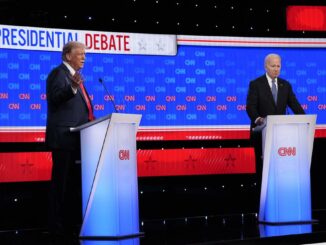
    Millions of Americans saw President Joe Biden on debate night on Thursday, delivering his answers in a hoarse, faltering voice, slack-jawed and struggling to string his thoughts together. The performance has set off alarm bells ringing across the world. Instead of focusing on his substantial achievements as the President, we have been forced to look at the issue of his age.

    Biden’s aides had hoped that the debate would help steady their somewhat slow-moving campaign. Instead, it may have undermined it completely. Since then, there have been calls by prominent voices for Biden to step aside to enable a younger candidate to take his place.

    Debate disasters are not new. But what makes this a first-class crisis is the fact that it could propel Donald Trump back into the White House. Almost all the commentary noted that Trump’s attacks on Biden were often false and mostly misleading. But all he had to do was be Donald Trump. The damage was done to Biden by himself.

    Given his felony convictions, other looming cases and his history, Trump is unfit to be the President of the US. But he is what we will get, given the current circumstances. Biden supporters believe that the President has the opportunity to make up for the fiasco by improving his performance in the next debate in September. But given that things are going his way, why would Trump want any further debates?

    Just 14 hours after the debate, Biden addressed a campaign rally in Raleigh, North Carolina, where he was forceful, confident and landing hard political punches on Trump and the Republicans. Unlike in the debate, he gave categorical and clear outlines of his positions on abortion, immigration, taxes and race. But does this suggest that Biden could still turn things around? It’s too early to say.

    Over the years, the Biden team has carefully managed his sleeping hours, his walk to the Marine One helicopter and his climb aboard aircraft to mute concerns over his age. But the debate performance last week has shattered the efforts to show Biden at his best. Insiders say that Biden performs best between 10 am and 4 pm. But the debate began at 9 pm and went on till 10.30 pm.

    Biden accepted at the Raleigh rally that his debate performance was poor. “I know I am not a young man. I don’t walk as easy as I used to. I don’t speak as smoothly as I used to. I don’t debate as well as I used to,” he told the crowd. But that is precisely the point: age is a factor.

    As of now, his allies are publicly supporting him. This includes his former boss, ex-President Barack Obama, and a clutch of potential candidates who could replace Biden were he to step aside —Transportation Secretary Pete Buttigieg, Governors JB Pritzker of Illinois, Gavin Newsom of California, Wes Moore of Maryland and Gretchen Whitmer of Michigan.

    One major advantage is that the debate happened in June, when four more months are left for the elections. In terms of the US presidential election cycle, it is early, and it offers an opportunity for Biden to turn things around. Other events can and will take place in the US and around the world until November, dulling the impact of Biden’s debate performance last week. Large numbers of Americans simply do not focus on elections until a week or two before polling. You can be sure, though, that Republicans will use videos of Biden’s performance to keep memories of the debate alive through attack ads.

    Biden versus Trump is all about the election. And despite poor polling numbers, Biden still has a fighting chance to beat Trump. But the debate performance has thrown a bright light on the issue of Biden’s age and raised doubts about whether he is capable of managing the presidency till 2029, when he will be 86.

    This central question, which is linked to the important decision on whether he should step aside for another candidate, demands answers, and soon. The Democratic National Convention will be held in August, and Biden could well show the electorate in the coming month that he is indeed fit to continue. But if he is unable to do so, the delay would make it difficult for the party to find another candidate to take over the campaign and win.

    The Democratic Party rules make it almost impossible to replace Biden at the top of the ticket unless he voluntarily steps aside since most of the 4,000 estimated delegates are pledged to him already.

    Biden could step aside, even while endorsing an alternative. But the issue would inevitably divide the Democrats at a crucial time when they need to be united not just for the presidential campaign but for the elections to the entire House of Representatives, one-third of the Senate, several governorships and state legislatures.

    The Democrats are hoping they can retain their Senate majority and win the House of Representatives as well. Both Houses have slim majorities, and the races there are almost as important as winning the presidential poll. The problem they now face is that the presidential worries could also adversely affect these other important elections.

    (The author is a Distinguished Fellow, Observer Research Foundation, New Delhi)

  • Why G7 needs allies like India

    Why G7 needs allies like India

    New Delhi occupies a unique place as an oasis of political and economic stability

    The G7 meeting has brought out just how fragile the world order is these days. India occupies a unique position here as an oasis of political and economic stability, but it cannot but take into account the turbulent waters that are washing its shores.

    By Manoj Joshi

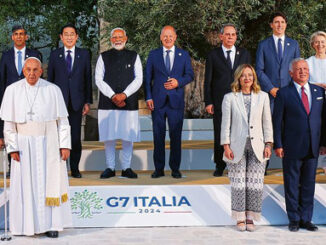
    Prime Minister Narendra Modi’s presence as an outreach guest at the G7 summit in Italy is a useful backdrop for the launch of the new government’s foreign and security policy.

    India is not yet the world power it wants to be. What we need to guard against are hubris and overreach. The G7 meeting has brought out just how fragile the world order is these days. India occupies a unique position here as an oasis of political and economic stability, but it cannot but take into account the turbulent waters that are washing its shores.

    The political situation in four of the G7 nations appears brittle — the US and the UK are going to the polls amid uncertainty, while Germany and France are witnessing the rise of right-wing forces. Two of the big world powers are, of course, entirely out of the G7 process, which purports to promote democracy. But those two, China and Russia, are making major efforts separately and collectively to challenge the G7’s purported global hegemony.

    The presence of India, Turkey, Brazil and some other countries is an acknowledgement that the G7 needs allies to manage issues relating to migration, climate change, economic competition with China and the wars in Ukraine and Gaza. In turn, these countries are seeking to persuade the G7 nations, which are increasingly economically and demographically challenged, on the need for more equity and balance in global decision-making.

    In all this, Modi’s central challenge and opportunities are in India’s neighborhoods and beyond. While continuity has been the central message that the BJP-led NDA government has sent out, there will be inevitable changes arising from the very fact that the General Election has shifted the national political paradigm.

    The presence of leaders from Bangladesh, Bhutan, Nepal, Sri Lanka, Maldives, Mauritius and Seychelles at the swearing-in of the new government speaks for itself, as does the fact that the leaders of Myanmar, Pakistan and Afghanistan were not invited. India’s relations with those invited are fairly even, even though we face challenges in Nepal, Sri Lanka and the Maldives. The participation of Maldives President Mohamed Muizzu was significant because of our strained relations with the island republic.

    The Indian strategy of riding out the Chinese challenge in the neighborhood was most visible last year when Sri Lanka faced a financial crisis. China played hard to get, but New Delhi immediately provided humanitarian and financial assistance of $4 billion, surpassing even the International Monetary Fund’s (IMF’s) 48-month bailout package of $3 billion. By providing financial assurances, New Delhi also shored up Sri Lanka’s IMF process.

    The absence of Pakistan, whose then Prime Minister Nawaz Sharif had attended PM Modi’s 2014 swearing-in, has its own story of just how sharply India-Pakistan relations have deteriorated, even though the government in power is that of the Pakistan Muslim League (Nawaz), albeit in a coalition.

    India says it emphasizes its Neighborhood First policy as well as SAGAR (Security and Growth for all in the Region) for the Indian Ocean Region (IOR). It has China very much on its mind. Whatever may be the military challenge India confronts along the disputed border, the one it faces from China in South Asia and the IOR is equally significant and has implications for the geopolitical future of the region.

    China, too, is a neighbor and, it too, was not present. In an interview to Newsweek on the eve of the General Election, Prime Minister Modi had noted that there was a need to “urgently address the prolonged situation on our borders so that the abnormality in our bilateral interactions can be put behind us.” Last week, speaking in Mumbai after taking charge of the Ministry of External Affairs for a second term, S Jaishankar said India would focus on finding solutions to the border issues that had bedeviled their relationship.

    American ties with New Delhi are on a high after Modi’s Washington visit last June. While US elections could disrupt some of the bonhomie, they are unlikely to lead to any major change. But managing ties in a potential Trump presidency will definitely be a strain, though the Gurpatwant Singh Pannun issue is unlikely to create major problems. The American focus, regardless of who wins, is likely to be China, though there is a danger that another US-China tariff war could affect us in the form of collateral damage.

    India’s ties with Russia are definitely being tested by the Ukraine war. India may be gaining from its oil purchases, but it is alienating its Western allies. As the situation in Ukraine remains serious, pressure on the West to step up its support to Ukraine brings pressure on India indirectly. Having told Putin that this was not the era of war in 2022, Modi is now hard put to come up with some initiative which will lend credibility to India’s proposition that the issue could be settled through dialogue and diplomacy. In the meantime, New Delhi continues to walk a tightrope — it attended the Swiss peace conference, but not at the Prime Ministerial level.

    Another area which may require attention is West Asia, where Modi deserves credit for building solid ties with the UAE, Israel, Saudi Arabia, Qatar and Egypt. These were not just about the nine million-strong diaspora or energy security but also aimed at tapping the region for investment and buying into their plans for a post-oil future. At present, however, new initiatives like the Israel-India-US-UAE grouping and the India-Middle East-Europe Economic Corridor (IMEC) have sought to link Indian ports to Europe via the Israeli port of Haifa. Significantly, the G-7 communique pledged support to the IMEC.

    India is not yet the world power it wants to be. As a leading power, however, there are opportunities for taking initiatives and shaping policies both in the neighborhood and beyond. What we need to guard against are hubris and overreach.

    (The author is a Distinguished Fellow, Observer Research Foundation, New Delhi)

  • The ossified American electoral system

    The ossified American electoral system

    The seven ‘swing states’ are all-important for Republicans and Democrats

    “This archaic system is not based on the popular vote but on an electoral college. When an American citizen votes on the Tuesday following the first Monday of November (this year, November 5), he/she is not voting for the candidate but a slate of electors. Though there is no constitutional compulsion, these electors pledge to vote for one of the candidates when the 538-strong electoral college meets on the first Tuesday after the second Wednesday in December, (this year, December 17). A simple majority of 270 or more electoral votes is needed to win the election. In 2020, Biden won 306 electors against Trump’s 232, and he also got 7 million more votes than Trump.”

    By Manoj Joshi

    Amid the election season in the US, it is important to understand that the American electoral system is ossified — the results in certain states are a foregone conclusion and thus they are clearly identified as red (Republican) and blue (Democratic) states. The 2024 presidential election will really depend on the outcome in just seven of the 50 states and about 100,000-200,000 voters.

    An analysis of Super Tuesday primaries, along with US census data, tells us that Trump has wide Republican support, but it varies demographically. This archaic system is not based on the popular vote but on an electoral college. When an American citizen votes on the Tuesday following the first Monday of November (this year, November 5), he/she is not voting for the candidate but a slate of electors. Though there is no constitutional compulsion, these electors pledge to vote for one of the candidates when the 538-strong electoral college meets on the first Tuesday after the second Wednesday in December, (this year, December 17). A simple majority of 270 or more electoral votes is needed to win the election. In 2020, Biden won 306 electors against Trump’s 232, and he also got 7 million more votes than Trump.

    Sparsely populated Wyoming, North and South Dakota have three electoral votes each; California has 54 and Texas 40. As per predictions, California will go blue and Texas red. States can and do flip between blue and red, but no one is expecting that this time around.

    The seven ‘swing states’, where the election will be decided, are Arizona (11 electoral votes), Georgia (16), Michigan (15), Nevada (6), Pennsylvania (19), Wisconsin (10) and North Carolina (16). In 2020, Joe Biden won all of them except North Carolina. Currently, Donald Trump is leading in five of these states and Biden desperately needs to retain Michigan, a state with a significant number of Arab-Americans who are angry with his West Asia policy.

    An analysis of the Super Tuesday primaries, along with US census data, tells us that Trump has wide Republican support, but it varies demographically. He has done better in counties with lower levels of college education and lower incomes. His support is strong in rural counties, but not in large metro areas. Also, support is in places with population older than 50; he is less popular with younger voters, who had favored Biden overwhelmingly in 2020. There is also a gap between those who voted for Haley in the primaries — who tended to be college-educated and against a federal abortion ban and not too happy with Trump’s personality.

    If the Democratic Party is able to convert some of the energy Biden displayed in his State of Union (SOTU) address last Thursday into its campaign hereafter, it will go some way in blunting doubts about his age (81). What is clear, though, is that Biden retains that “fire in the belly” that has made him a successful politician.

    However as of now, the opinion polls have been saying something else. A New York Times-Siena poll at the beginning of this month said if the elections were held today, 48 per cent would vote for Trump and 43 per cent for Biden. The President’s problems have been accumulating — doubts about his fitness, the backlash over US support to Israel, fears over immigration on the southern border and the continuing worries over the impact of inflation. Even as Trump has consolidated his hold over the Republican Party, Biden’s Democrats are splintering. He is having trouble in retaining the support of younger voters as well as non-college-educated Blacks and Hispanics.

    And then there are third-party candidates. In the US system, it is not easy for such candidates to get onto the ballot, but this time there are three — the well-funded Robert F Kennedy Jr, Jill Stein of the Green Party and Cornel West, the leftist political activist. There is also a threat from No Labels, a political organization, to come up with a candidate who will target Republican and Democratic votes. They have no chance of winning, but by depriving a candidate of 5-10 per cent of the vote, they can alter the verdict in particular states, skewing the larger result. As of now, their impact is falling heavier on Biden than Trump.

    Eight months are a long time in the presidential elections, and the opinion polls are not always accurate. Issues will be rejigged and new ones can surface. The rate of inflation is declining and people’s skeptical assessment of the economy could change. A ceasefire in West Asia and even Ukraine could shift views, and a Trump conviction in any of his cases could change perceptions of some swing voters.

    A Biden victory would have largely predictable consequences, but what will a Trump win bring? There has been an old-fashioned consistency and achievement in Biden’s policies. He has restored the American alliance system and revitalized the US economy, even while maintaining a tough line on China and Russia. He has indicated that the US remains part of the global system by supporting policies to fight climate change and re-engaging with the WHO.

    With Trump, it’s different. He is now in complete control of the Republican Party and is, in a sense, ‘unchained’. At the best of times, he is unpredictable and inconsistent. This time, he is going in with a plan to pack the entire government and the judiciary with his supporters and negate all checks and balances on presidential powers. He could walk out of NATO, abandon Ukraine and give up on free trade. The only comfort is that while his approach to India will be transactional, it will not be hostile and could even be friendly.
    (The author is a Distinguished Fellow, Observer Research Foundation, New Delhi)

  • The road to 2024 is uphill for Trump

    The road to 2024 is uphill for Trump

    Republicans could well end up with a nominee who might have been convicted more than once
    The current Republican approach to the Trump issue seems to be to ignore his crimes and misdemeanors and argue that the responsibility for this outcome rests with the Democrats.

    “There is a kind of an auto-immune disease that has turned America against itself. Consider the likely candidate and possible future President Donald Trump. He will go on trial in May next year in the case pertaining to mishandling of classified documents. But this is only one of the several cases he will confront in 2024. The date for the criminal trial relating to the payment of hush money to cover up a sex scandal during the 2016 presidential campaign has been set for March. There is also an ongoing investigation into Trump’s efforts to reverse the election loss in Georgia. Finally, investigations into the charge that he attempted to overturn the 2020 election verdict through a conspiracy involving fake electors — which culminated in the January 6, 2021, attack on the Capitol.”

    By Manoj Joshi

    America’s brutal summer of 2023 is unrelenting. In many ways, it is symptomatic of the fevers, political and cultural, that are gripping the country, a little more than a year away from what is being called the most consequential presidential election in recent history.

    Clearly, the USA is undergoing change, but the process is not without its dangers, as exemplified by the politics of the Republican Party. There is a kind of an auto-immune disease that has turned America against itself. Consider the likely candidate and possible future President Donald Trump. He will go on trial in May next year in the case pertaining to mishandling of classified documents. But this is only one of the several cases he will confront in 2024. The date for the criminal trial relating to the payment of hush money to cover up a sex scandal during the 2016 presidential campaign has been set for March. There is also an ongoing investigation into Trump’s efforts to reverse the election loss in Georgia. Finally, investigations into the charge that he attempted to overturn the 2020 election verdict through a conspiracy involving fake electors — which culminated in the January 6, 2021, attack on the Capitol.

    The Republican process to choose its candidate will begin in January 2024 and could conclude even before various trials are over. The Republican Party could well end up with a nominee who might have been convicted more than once. The current Republican approach to the Trump issue seems to be to ignore his crimes and misdemeanors and argue that the responsibility for this outcome rests with the Democrats.

    Just how the Republican Party has gotten here is not clear. But from the party of ‘law and order’, it has become one which sees nothing unusual in the January 2021 riot. It now also wants to abolish the FBI. The party of high morality which cannot tolerate abortion is also the party that doesn’t care that its nominee has consorted with porn stars. Where their erstwhile leader Reagan led the campaign against the Soviet ‘Evil Empire’, their current leader is Putin’s best hope.

    The Democrats have their problems, not in the least being an unpopular Joe Biden seeking a second term. On paper, things are going well: the economy is flourishing, jobs are plentiful and expectations are that things will get better in the coming six months. The Republicans are trying to undermine Biden by threatening impeachment. They claim that the activities of Biden and his son Hunter involved corrupt practices, though as of now there is little evidence of wrongdoing by the President himself.

    Equally dramatic are the culture wars gripping the country. The biggest divide is, of course, abortion. After the US Supreme Court stripped away the constitutional protection for abortion rights, several Republican states have passed stringent laws prohibiting it and criminalizing abortion providers. This is despite the polls showing now, as they have in the past, that a majority of the Americans favor the right to abortion, with some restrictions.

    Last week, President Biden inaugurated the Emmet Till monument to memorialize a 14-year-old black boy who was abducted, tortured and killed in Mississippi in 1955 for allegedly whistling at a white woman. The murder and the acquittal of his killers triggered the civil rights surge of the 1960s. And in the last decade, we have seen the rise of the Black Lives Matter movement, an outcome of the persistence of racism in the US.

    Just how contemporary racism works is evident from the steps being taken by Florida Governor and Republican presidential hopeful Ron DeSantis to play down slavery to the point of inanity. Revised textbooks in the state claim that slaves actually benefited from their status since they picked up certain skills doing slave labor.

    And then there are wars over sex education, sexual orientation and gender identity. Building upon the successful efforts to establish gay rights, bisexual and transgender people are seeking to stake out their rights. According to opinion polls, almost 21 per cent of Gen Z — those born between the mid-1990s and around 2010 — identifies itself as lesbian, gay, bisexual or transgender (LGBT), as against 10 per cent of the millennials (born between early 1980s and mid-1990s).

    The arrival of Gen Z is affecting the country in other ways too. A Gallup poll has revealed that the share of young people (18-34 years) who say they are “extremely proud” to be American has plummeted from around 40 per cent in 2013 to just 18 per cent now. The political divide is deep. This year, some 75 Bills aimed at restricting LGBT rights were passed in legislatures across the US. Hate crimes based on sexual orientation have increased and demonstrations and counter-demonstrations have become a regular feature. The battleground includes school and university curricula as well. These so-called ‘culture wars’ are really an attempt by the conservatives to fight change. They project themselves as victims of liberalism run amok, with immigrants, gays, women, poor, black and other groups being given unfair privileges at their cost.

    Notwithstanding the noise, the road is uphill for Trump. According to one pollster, between 2016 and 2024, there will be an addition of 52 million more voters, younger and leaning towards the Democratic Party.

    Clearly, the USA is undergoing change, which by itself is not unusual. But the process is not without its dangers, as exemplified by the politics of the Republican Party under Trump. With the help of institutions such as the right-wing-dominated Supreme Court, they are attempting to maintain ‘white male dominance’ of the country. But that is simply not possible. Change is coming, like it or not.
    (The author is Distinguished Fellow, Observer Research Foundation)

  • Shilpa Shetty, Paresh Rawal-starrer Hungama 2 to release on an OTT

    Shilpa Shetty, Paresh Rawal-starrer Hungama 2 to release on an OTT

    The sequel to the hit 2003 comedy movie Hungama, Hungama 2 will release on a major streaming platform, the makers shared on Monday. Hungama 2 features Shilpa Shetty, Paresh Rawal, Meezaan and Pranitha Subhash in the lead roles.

    Although the film was made for theatres, the makers have decided to go the digital way because cinema halls are shut due to the ongoing second wave of Covid-19. With no guarantee when theatres would finally reopen, producer Ratan Jain shared in a statement that he wanted the audience to enjoy the comedy caper from the comfort of their home.

    “Hungama 2 is a lighthearted film meant to be enjoyed across all age groups, and we feel it will entertain the audiences and bring some cheer in these trying times. We will release the film on a digital platform this year and movie lovers can enjoy the laugh riot at the comfort of their homes. We have made Hungama 2 with utmost love and we are confident that our film will bring a smile to people’s faces,” said Jain.

    The team had finished shooting the movie earlier this year.

    Directed by Priyadarshan, Hungama 2 also features Rajpal Yadav, Johnny Lever, Manoj Joshi and Ashutosh Rana in significant parts. The film has been co-produced by Ratan Jain, Ganesh Jain, Chetan Jain, and Armaan Ventures. The release date of the Priyadarshan directorial is yet to be announced.